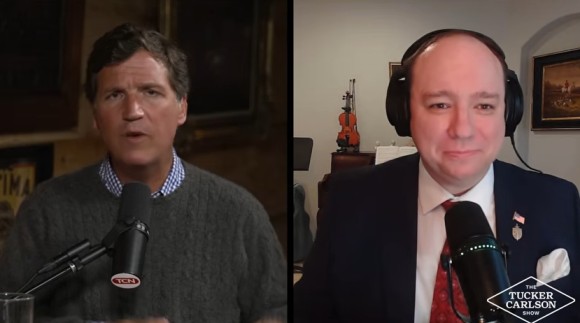
Editor’s Notes: Is the war in the Middle East really about territory and security—or is there a deeper religious agenda driving events toward a global crisis? In this video, Tucker Carlson breaks down Israel’s true motives, the risk of potential false flags, and how escalating tensions could reshape the entire world order. Stay tuned as he connects the dots between the Third Temple, Al Aqsa, and the growing possibility of a wider war that could pull in major world powers. (Mar 5, 2026)
TRANSCRIPT:
Who Runs the World? The Geopolitical Question at the Heart of the Conflict
TUCKER CARLSON: It’s a safe bet that almost no one involved in the war now ongoing in Iran, in the Gulf, would like to see it continue much longer. If you were to poll the Iranians or the Americans, basically anybody — how long do you want this to go? — very few people would say I want it to go a long time. But that doesn’t mean it won’t go a long time. Unfortunately, it is likely to. It’s unlikely to be resolved anytime soon.
Of course, that could prove to be untrue. You never know. It’s an utterly dynamic situation. But big picture, there are still a couple of unresolved questions that this war may resolve. This war may be the only thing that resolves them. And so until there’s a consensus on the answers to those questions, it probably is going to continue.
What are those questions? Well, the first is geopolitical, and it’s the biggest question of all, which is: who runs the world? Who gets to make the decisions? Not simply who’s richest, but who makes the rules? Who sets the terms?
And for most of our lifetimes, there has been no question about that. The answer has been the United States. The United States sets the rules. The United States runs the world. That’s been true in the western half of the world since 1945, when the US emerged stronger and richer than any other nation after the end of World War II. And it’s been true since August of 1991, 35 years ago, after the collapse of the Soviet Union. The United States has reigned in a unipolar world. That’s the color. There’s just one pole. There’s one center of gravity, there’s one power center, and that’s been the United States.
But that has changed over the past several years, maybe decades, certainly since China was admitted into the WTO in 2001. Now it is a multipolar world. You’ve heard that phrase, no doubt. And that means there are a couple — at least a couple — centers of gravity. Really, there are two. There’s the US and the constellation of states with which it’s allied. And then there is, on the eastern hemisphere of the globe, China.
And China is now a peer with the United States, at least almost no matter how you measure it. Population, of course, much bigger. Military power — well, we’re not quite sure, but certainly from a technological and industrial output standpoint, at least a peer. And then on a pure economic level, well, China has a bigger economy, a bigger real economy than the United States. So, yes, China is a peer.
The Unipolar Illusion: Washington’s Refusal to Face Reality
And so the question is, since you now have two countries that are roughly evenly matched — we think, we never do know until they come into conflict, but they seem roughly evenly matched — who gets to set the terms for commerce and diplomacy and everything else that happens on the globe?
Well, if you were to reach a diplomatic solution, there would be, in effect, a power sharing agreement between these two countries. “You take the East, I take the West. Here are the terms.” But unfortunately, no such agreement, formal or informal, has been reached. For a bunch of reasons, it’s everybody’s fault. But one of the reasons is almost nobody in Washington can get his head around the current, present, obvious reality, which is: no, we don’t run everything anymore. We are in competition — not necessarily in conflict, but in competition — with this other country that is at least as powerful as we are, called China. Different system, language, culture, etc. But at least every bit as powerful.
And so you can’t make unilateral decisions anymore. It’s sort of that moment that many parents face when, used to barking orders at their kids, they realize the kid is taller than them and it’s a new relationship. In some ways, you’re always the parent, but you can’t just bark orders anymore. That’s pretty much where we are with China, or maybe a little past that, actually.
And what we’ve noticed over the past several years is the total unwillingness, the inflexibility of Washington policymakers to just acknowledge the reality. And instead, even as we speak, there’s probably some symposium underway in Washington about what will we do if China invades Taiwan. Well, of course, from China’s perspective, Taiwan is part of China. It just sort of ran off for the past 75 years, but it’s still part of China. That’s their view. And the United States, of course, isn’t in a position to stop the reclamation of Taiwan. Let’s stop lying. And yet, only in D.C. is that not obvious.
Which is to say, people in Washington are still acting like they’re running everything unopposed, but they’re not. And the rest of the world is looking on and thinking: at some point, you’ve got to knock it off and face reality.
Now, there are a lot of people in the United States, me included, who would like to live in a unipolar world. It’s way less fun to be constrained, to have to come to terms with another country before you make a decision. No one wants to do that. No one wants to be challenged.
And so this is the reality we live in. And the question is, are we going to come to terms with it in a reasonable way, or are we going to be forced to, through use of arms, to face that reality? And it looks increasingly like the latter. Unfortunately, that is not the way to settle matters like this, because you can emerge greatly diminished from those contests and find yourself in a much weaker negotiating position. Better to negotiate while you’re strong than when you’re weak. But our leaders weren’t wise or farsighted enough to do that. Seized by hubris, they were dictating terms like Baghdad Bob. It’s sad, actually. No reason to laugh about it.
The Religious Dimension: What Most Americans Are Missing
But that is one of the questions now being decided in Iran. Why Iran? Well, because these questions are always decided by proxy. No two great powers want to go to war with each other, of course, especially in the nuclear age, because that could mean simultaneous elimination. And no one wants that, at least consciously. And so typically, these things play out in third countries, like Vietnam, famously, or Afghanistan — for both the Soviets and the United States — or Korea, and now Iran. Iran, which is part of an alliance that includes the other big powers, Russia and China. So they may not be explicitly weighing in — which is to say they’re not fighting alongside the Iranians yet — but they’re certainly on Iran’s side, and they’re certainly helping in a multitude of ways. A lot rides on the outcome for them, and because it does, it makes it harder to settle this thing.
So that’s the geopolitical, very obvious overlay here. That’s why this is not just a debate about whether the Ayatollah has nuclear weapons. Stop. It’s much bigger than that and much more serious than that, and the consequences are much more profound than that.
So that’s the first. But there is another layer that most Americans are not aware of, but much of the rest of the world is highly aware of, and that is a religious layer.
Now, Lindsey Graham is on tape saying to a gaggle of reporters — his bloodshot eyes, his puffy face, God knows what he’s been doing — saying explicitly: “This is a religious war. This is a religious war.” Now, his motive in saying that — he’s not here to answer the question, we can only guess — is he trying to foment a religious war? Probably. He’s an end times kind of guy. But it almost doesn’t matter. He’s telling the truth for once. This is a religious war, fundamentally.
And that is not obvious to most Americans because this is the most secular society — not just the United States, but the West, the English-speaking world, Europe and the US, Canada, Australia, New Zealand — in history. There’s never been a more godless, to be blunt about it, a more secular society at scale. Never. Nothing approaching this has ever happened, ever. Every society is fundamentally a religious society, explicitly religious, except ours. So we lack the terms to describe what we’re seeing, and we lack the imagination to think about it. And, to quote Jesus, we have the eyes, but we cannot see. We don’t see what’s happening around us, but the rest of the world very much does see.
Jerusalem and the Foundation Stone: The Center of Three Faiths
So you often hear people talk about the Middle East crisis and they usually mean energy — people want the oil, the gas. But traditionally when people have talked about the Middle East, they’re talking about Jerusalem. They’re talking about the holiest spot on earth.
Let’s be a lot more specific when we say the holiest spot on earth. The holiest spot on earth is something called the Foundation Stone. The Foundation Stone is literally a rock in Jerusalem on what used to be called Mount Moriah, which was at one point the highest place in the oldest part of Jerusalem. And it’s on that spot, on that rock, on that stone, that Jews believe the world began. The Old Testament, or the Jewish Torah, tells us that Abraham brought Isaac, bound, to be sacrificed to God. It’s on that spot that Muslims believe that the Prophet Muhammad ascended into heaven. And of course it’s right nearby that Christians believe Jesus was crucified and then rose to heaven.
So on that spot, or right nearby, a lot has happened. But critically, on that spot — because it was the place where Abraham brought Isaac — and again, to American ears this sounds weird, but to the rest of the world it’s like, “Yeah, everyone knows this,” because it’s the center of their lives. On that spot, Solomon built his famous temple.
Now, in the Torah it says pretty clearly — and correct me if I’m misreading it — that Jews, followers of God, can only publicly worship God and sacrifice on that spot, in that city, Jerusalem, on that spot. And on that spot was built a temple, the First Temple. Now that was destroyed by the Babylonians, famously, and then it was rebuilt and later improved by Herod. And it was at its completion, I think, the largest building — certainly the largest religious building — in the ancient world.
The Second Temple, Jesus, and the Prophecy of Destruction
And it was in that building, what we call the Second Temple, that Jesus preached — the very center of Judaism, a building without which you can’t really have Torah Judaism. The religion just didn’t work without it. By its own terms, in its own book, it said that.
And during one of his sermons, in that sermon, Jesus — who Christians believe is God sent to earth — says: “This will be torn down. Not one stone will be left standing.” And it was shortly after that that he was put on trial in the middle of the night and tortured to death, crucified as it happens.
So that’s the religion. Here’s the history. About 35 years later — 37 years later, in that range — in 70 A.D., Titus, the emperor of the Roman Empire, got into quite a conflict with the Jews of Judea and Jerusalem. It’s complex and incredibly brutal. But the bottom line was, in A.D. 70, the Romans besieged Jerusalem, finally broke through the walls, and tore that temple stone from stone. Not a single stone left upon another. Really a kind of dedication to destruction that’s hard for the modern mind to imagine. We talk about genocide this, genocide that. The Romans tried to genocide the Jews for real, and they succeeded in destroying the temple and with it, Temple Judaism, Torah Judaism.
You can’t have the religion that existed before A.D. 70 after A.D. 70, because there’s no temple. And so this has been an open wound for 2,000 years. And certainly, understandably, people have wanted to rebuild the temple — to build what they call the Third Temple, to reestablish this religion at its birthplace.
The Dome of the Rock and the Clash of Sacred Spaces
There are a couple of problems with this. One: exactly 500 years after Titus destroyed the temple in A.D. 70, in A.D. 570, a man called Muhammad was born in Mecca and built one of the world’s great religions — the world’s second largest religion as it stands today — in a very short period. His name was Muhammad. He was born in Mecca, he died in nearby Medina. But in the meantime, he built, or inspired the building of, within 50 years of his death, one of the great religious monuments in the world — certainly one of the prettiest — called the Dome of the Rock.
And it’s in Jerusalem, on Moriah, in fact, built over the Foundation Stone. And if you’ve ever been to Jerusalem, or if you’ve ever seen photographs of it, you will remember vividly a gold dome. It’s called the Dome of the Rock. Why is it called that? Because there’s a rock underneath it — the Foundation Stone — that is built on the site of the Second Temple. And that’s within what’s known as the Al-Aqsa complex. There’s a mosque next door called the Al-Aqsa Mosque. And that spot is one of three holy places — apparently co-equal holy places — in Islam: Mecca, Medina, Dome of the Rock, Al-Aqsa.
So that is at the very center of Judaism — physically the center of Judaism, that spot, that exact spot over the Foundation Stone — and Islam. And it has been occupied by a mosque. A mosque has been sitting there since the 7th century, since the late 600s. Amazing.
The Third Temple: Ancient Prophecy Meets Modern Warfare
You may be dimly aware of this. Now, why go on at length about this? Because now is the moment. Right now, like this week, is the moment that some people — not a huge number; most people, Christians, Jews, Muslims, are not fully aware of all this — but some people are highly aware of it and would like to begin the process of tearing down the Dome of the Rock, tearing down Al-Aqsa Mosque, and rebuilding the Third Temple. Now, there are a lot of things to say about this, about its likelihood, the potential effects of it.
But first, just a quick side note on the theology of this from a Christian point of view. Now, it was Jesus who said, “This temple will be torn down,” shocking everyone around him. It’s in the Gospels — at least a couple of the Gospels. And the people who heard it just couldn’t believe it. And of course, the people running the temple, the Pharisees and Sadducees, were gravely offended by it. Why wouldn’t they be? But then it happened. Less than 40 years later, it actually happened. He was right. He called it.
And so from a Christian perspective, he did that. God called for the destruction of the temple. And as Jesus says plainly in the Gospels: “I’m the temple. I’m the temple. Now the temple will be rebuilt after three days. When I’m resurrected, I am the new temple.” He says that.
Julian the Apostate and the One Attempt to Rebuild the Third Temple
But there has been at least one attempt in the last 2,000 years to rebuild a physical Third Temple. And it happened in the 4th century, shortly after the death of Constantine. Now, Constantine was the 4th century Roman emperor who converted to Christianity and very famously turned the Roman Empire Christian, thereby spreading Christianity basically instantly across the West, where it’s remained more or less ever since. That was in the 300s, the fourth century.
Now, his nephew became emperor not long after he died. And his name was Julian, referred to very often by Christian historians as Julian the Apostate. And he was an apostate. He was the last non-Christian emperor of Rome, of the Roman Empire, and he had been born a Christian apparently, but he was a fairly enthusiastic pagan polytheist and very aggressively opposed to Christianity. And for that reason, Julian the Apostate decided in 363 to rebuild the Third Temple.
So it has been tried. For those who are thinking, “Could this ever happen?” — oh, it happened. They tried to rebuild. He spent a ton of money doing it in 363.
What happened next? Well, let’s read the account of the only attempt ever made at rebuilding the Third Temple. And this comes from a personal friend of Julian the Apostate’s, who wrote it contemporaneously. And we still have it, amazingly, all these years later.
I’m quoting: “Julian thought to rebuild at an extravagant expense the proud temple once at Jerusalem and committed this task to Alypius of Antioch. Alypius set vigorously to work and was seconded by a governor of the province when fearful balls of fire breaking out near the foundations of the building continued their attacks till the workmen, after repeated scorchings, could approach no more. And he gave up the attempt.”
By the way, just a few months later, Julian — Emperor Julian the Apostate — was killed. You know what he was killed doing? Invading Iran.
The Third Temple: Religious Motivations Behind the Conflict
They call this operation the Swords of Iron. But what are we really fighting for? We’re fighting for the right of the Jewish people to exist, be Jewish, practice the religion and be free. And one day our true leader will come and we’ll be united as a whole Jewish nation.
So we can rebuild the bits of Engdash, probably mispronouncing it, that’s the Hebrew term for the temple, the Third Temple. We are doing this so we can rebuild the temple.
Now, you’ll notice he’s pulling off patches on Velcro on his IDF uniform. These are not civilian clothes. This is the uniform of the government of Israel, of its military. And he has patches on that uniform, one of which is a symbol of the temple, the Third Temple. So it just couldn’t be clear why are we doing this? To rebuild the Third Temple.
Now, if you think we’re just cherry picking this off the Internet, one guy wearing an unauthorized temple patch paid for, by the way, a uniform paid by US Armaments, paid for by us. The US taxpayer pays for all this stuff one way or another. The US taxpayer pays for the military of Israel. Boy, does it. If you think we’re being unfair and just like found one guy. Well, here’s a bunch of guys. It took us about two minutes on the Internet to find this today.
Here is a selection of IDF soldiers. Let’s put it on the screen. There you go. And all of them have the same patch. Look for me, look carefully at that. What is that? That’s the temple. That is the Third Temple. And we’ll get to a minute in a minute about how this might actually happen and what it would mean for the rest of the world.
And just to be clear, these are conversations that most Americans, certainly me included, never wanted to have. Everybody’s religious beliefs, sincere religious beliefs, when held up to the light of the rational world, to the man made world, seem a little spooky and crazy, which is one of the reasons that in the culture some of us grew up in, we don’t talk about them in public because they’re personal. They’re the most personal part of a person. So it is without judgment, by the way, that we’re airing this. Okay, just describing it, because it is significant to the future of the world, to the future of this war, and to our future as Americans.
Chabad and the Push for the Third Temple
So how exactly did the IDF, the Israel Defense Forces and military that the US taxpayer pays for, that lots of wealthy Americans send money to, to friends of the IDF, how did all these guys wind up wearing patches suggesting the point of this war was the destruction of one of the holiest places in Islam and the rebuilding of a temple that is totally anathema to Christianity? Like, how did this happen?
Well, there are a lot of ways it happened. The main way it happened is because no one in the United States noticed because it’s such a secular place. And as noted, we have eyes but can’t see and ears and can’t hear. But this has been going on a long time in public through, in part, the efforts of a group called Chabad. C H A B A D. And you may know people who give money to Chabad or run to Chabad. Super nice people engaged in all kinds of charitable activities, drug rehab. There’s a lot about Chabad that’s really good.
But what is Chabad exactly? Well, Chabad, you can look it up, is a very old organization, about 250 years old, and it’s a branch of Hasidic Judaism. It’s an organization that was overseen for many years by a guy called Rabbi Menachem Schneerson, who was famously in Brooklyn, considered the Messiah by some of his followers, who was a friend of presidents, or certainly someone presidents visit. He was a very powerful man in the Orthodox and the Hasidic community, and he was the overseer of Chabad, which predated him and outlasted him. But he was its most visible ambassador.
And Chabad has been pushing in a pretty subtle way, unless you look carefully, for the reconstruction of the Third Temple. And it seems like from the reading we did recently that those patches actually came from Chabad. Well, any case, Chabad is pushing for the building of the Third Temple.
Christian Zionists and the Third Temple
But it’s not just Hasidic groups from Brooklyn and it’s not just IDF soldiers. There are, amazingly, a lot of American evangelical leaders, Christian Zionists, whose main point is rebuilding the Third Temple.
Now, how could an American Christian or any Christian call for the building of a temple whose presence, whose inherent presence denies Christ, who said, clearly, and Christians believe this, it’s a core point of faith, “I am the temple. You want to speak to God, you speak through me.” That’s Christianity. That’s the whole religion right there. So if you’re a Christian preacher calling for the rebuilding of the Third Temple, you kind of missed the whole point. That’s more than apostasy. That’s like not even knowing what the religion’s about.
So it’s hard to believe there could be any ordained Christian leaders pushing for the rebuilding of the Third Temple. Oh, but there are a lot. There are a lot. And here’s just one. This is Pastor Greg Locke. Listen to this.
VIDEO CLIP BEGINS:
Pastor Greg Locke: The Gaza Strip, which has now been cut off by Israel, and rightly so. They should have cut them off a long time ago. I don’t care how insensitive you think I am to that. There’s six doors in this church. You can leave anytime you want to. They’ve cut them off, electricity. They’ve cut off their water. They should have. Now, listen, I’m not for hurting anyone that’s innocent, but anybody that supports terrorism is not innocent. You understand that. Israel should make the Gaza Strip a parking lot by this time next week. Destroy the whole thing. What they ought to do is evacuate up there on the hill and get a great big missile and blow that wicked Dome of the Rock plumb off of the spot where it’s standing right now so we can get that Third Temple rebuilt and usher in the coming of Jesus.
VIDEO CLIP ENDS:
TUCKER CARLSON: Boy, it is embarrassing and shameful as an American Christian, to hear that and to know that video is from a few years ago. It’s been on the Internet. No one bothered to highlight it. Most people weren’t even aware this was going on. Oh, it’s definitely going on. These are very common views.
Seems obvious that Mike Huckabee has them, that a lot of the Christian Zionists, John Hagee, that you think just like Israel, they just like Israel a lot. No, these are clerics, so their lives are informed by their religious views. What are their religious views? Well, you just heard it right there from Pastor Locke, who is quite a prominent Christian Zionist. He’s not some lone wacko. And there he is with an Israeli flag waving behind him. Casual calls for genocidal violence. Just blow it up, make it a parking lot. Well, 2 million people live there. What happens to them? They’re terrorist sympathizers.
That right there is the tell. This is not Christianity. Imagine Jesus saying, “Just kill them all. They’re terrorists.” Is there anything in the Gospel that suggests Jesus believed that? No, there’s a lot to suggest. In fact, to tell us in very clear terms, he thought the opposite, of course. But the last part, “Let’s build the Third Temple and bring about the return of Jesus,” is a direct contradiction of core Christian theology.
And even people without theology degrees who didn’t go to some eminent Bible college can tell you what Jesus says: “I am the temple.” That is not Christianity. It’s not even a close facsimile of Christianity. It’s clearly evil. And it is, in some sense, the driving force behind the efforts to rebuild the Third Temple.
Julian the Apostate, who was the last guy to try it, who died invading Iran, he was not Jewish. He was a pagan, just like Pastor Locke. But for some reason, he was the instrument of trying to do this. There are many of these people, and not just in the theological realm, in the political realm.
World Leaders and the Third Temple Agenda
And that’s relevant to you, whether you believe in God or not, or interested in the history of the Abrahamic faiths or not. Global leaders believe this. People you wouldn’t expect. And you wonder what is going on here. It’s tough to make the hair in your arms go up. Did everyone know there was an effort to rebuild the Third Temple and the foundation stone except me? I can’t believe I was left out of this conversation.
No, all of this took place in public. And if we’d been paying attention or been tuned into that frequency, the spiritual frequency, been spiritually sensitive enough to pay attention, we would have known this. But of course, when you grow up in a materialist culture, when the only things you believe are real are the things that can be measured or purchased on Amazon, you tend to miss a lot. And we missed this.
Here’s the President of Argentina, Javier Milei, who we know personally, at the Western Wall, which is believed by some to be a remnant of the Second Temple, the last stone from the Second Temple. That’s the claim. Here he is there, the famous Wailing Wall, saying this. Watch the subtitles.
VIDEO CLIP BEGINS:
UNIDENTIFIED SPEAKER: There’s a prophecy about the destruction that says that a fox will break into the holiest of holies. There is another prophecy that says that the same place will be rebuilt. Now that I see with my own eyes the first prophecy come true, I laugh in joy and full of hope as the second prophecy will surely come true.
VIDEO CLIP ENDS:
TUCKER CARLSON: So a correction, that doesn’t appear to be the Western Wall. And there were no subtitles. You heard him say it through his translator. “I laugh and quiver with joy when I think about the Third Temple being rebuilt.”
Now this is the supposedly, maybe, who knows, Catholic president of an overwhelmingly Catholic country, South American country, wonderful country, Argentina, who got elected and was presented to American news consumers as a libertarian economist who was going to fix their debt problem and get rid of inflation and just make life better for Argentines. And there he is in Jerusalem saying that he’s weeping with joy thinking about the return, the rebuilding of the Third Temple.
What the hell is that? You would think that would not even be on his to do list. If you’re running a country as complex and damaged as Argentina and as promising and great as Argentina, but there’s a lot of things you got to do in Argentina if you’re running it. But you take time to go to Israel and say the thing you really want in life is the rebuilding of the Third Temple. What is going on here? And why haven’t we talked about this before, say, before we invaded Iran with troops who say out loud, “We’re doing this to bring about the creation of the Third Temple.” Why weren’t the rest of us informed?
Pete Hegseth and the Third Temple
Now, here’s a piece of tape you may have seen and that I personally don’t want to play since I know the guy and I like him, but it does make you wonder. So this is the current Secretary of War, Pete Hegseth, former Fox News employee. Nice man. Very nice man. 2018 in Jerusalem.
And as someone who knew him well, I can tell you I had no idea that he had such evolved and specific and apparently very informed opinions on rebuilding the Third Temple. Of all questions, this is not something they teach you in Sunday school in the Presbyterian Church. This is not something that people talk about at dinner in the United States. This is not something our Congress ever mentions, that the President ever talks about. This is considered so esoteric and weird and crypto historical and religious and kind of culty, and “What’s Chabad?” that no one ever mentions it.
But here’s Pete Hegseth, football player from Princeton, going on about it in a way that suggests he’s thought a lot about it. This is 2018.
VIDEO CLIP BEGINS:
PETE HEGSETH: Today, Jennifer and I and others had a chance to go see the Western Wall of the Temple Mount. The Western Wall tunnels, so much of the Old City. And as you stand there, you can’t help but behold the miracle before you. And it got me thinking about another miracle that I hope all of you don’t see too far away, because 1917 was a miracle. 1948 was a miracle. 1967 was a miracle. 2017, the Declaration of Jerusalem is the capital was a miracle. And there’s no reason why the miracle of the reestablishment of the Temple on the Temple Mount is not possible. I don’t know how it would happen. You don’t know how it would happen. But I know that it could happen.
VIDEO CLIP ENDS:
The Risk of Global Religious War
TUCKER CARLSON: What is that? That’s the Secretary of War right now, overseeing the war with Iran that people fighting it are starting to say actually is about rebuilding this Third Temple, it’s the same man. Okay, this is the point where you begin to think maybe we should have talked about this and its implications and what are its implications? Religious war. Global religious war.
So the first heavily publicized move by the United States military and the Israeli military in this conflict was to kill the head of state of Iran, the 86 year old Ayatollah, Ayatollah Khamenei, who was replaced today by his son who’s apparently more anti Western than he was. So I guess strictly speaking that wasn’t very effective.
But if you take three steps back — and no one did because everyone’s busy denouncing him as Hitler and the most evil man in the world and we’re so grateful he’s dead — when was the last time the United States military or the Israeli, working in conjunction with the Israeli military, killed the head of a world religion? Is that wise?
It’s not because we agree with all world’s religions. It’s not an endorsement of Shia Islam to say maybe we should pause before killing its 86 year old leader. It is instead an acknowledgement that that might have consequences that affect the United States and Europe and the world, but particularly the United States, since we are the United States and we have children and hope to have grandchildren. And what will be the downstream effects for them when you kill a religious leader?
Did killing the religious leader cripple their command and control structure? Were they unable to launch missiles and drones when we killed the 86 year old Ayatollah? No, because he knew he was going to be killed. That’s why he stayed above ground. Apparently he wanted to be martyred. Now why would he want to be martyred? Maybe because he wanted a religious war. Why did we kill him? Maybe because we wanted a religious war. Now why would we want that? Why would the Israelis who got us into this war — everyone admits that now, sorry — why would they want that? I don’t know.
The Dome of the Rock and the Stakes of a Religious War
Think about what would happen if this war leads to the destruction of the Dome on the Rock and the Al Aqsa complex on Mount Moriah in Jerusalem. And we’ll explain in a second how that could happen. A war that began with the killing of the head of Shia Islam. What would happen?
Well, here are the numbers. There are about 15 and a half million Jews in the world total. There are about 2.5 billion Christians and there are about 2 billion Muslims. So whatever happens next is not going to be a fight between the Muslims and the Jews, because 2 billion versus 15 million — not much of a fight.
This is likely to be, if not brought under control immediately — or maybe it’s too late — a war, a religious war, the one that Lindsey Graham just described, between Muslims and Christians. And it’s not going to play out in the Middle East because this is a regional conflict. But as noted at the beginning, it’s a global conflict where every big power has a stake in what happens. This will play out globally and it’ll play out in our cities.
Islam is the fastest growing religion in the United States. There are not that many Muslims in the United States — 5 million or something like that — but it’s the fastest growing religion. That’s enough to cause problems, for sure. In Europe, 65 million Muslims, second biggest religion in every European country. Fastest growing in every country. Australia, same thing. Second biggest, fastest growing. New Zealand, same thing. Second biggest, fastest growing. Canada, same thing.
What happens in all those countries — those Christian western white countries — what happens there? If there’s the religious war that Lindsey Graham and clearly the Israeli government and some in our government are hoping for, what happens? Oh, those countries suffer more than they have suffered. And so it’s possible that the real target here — it’s just possible, throwing this out there — is not the mullahs in Iran. It’s us, as it always has been.
VIDEO CLIP: Israeli Rabbi on Destroying the Dome of the Rock
But don’t take our word for it. Here’s a particularly candid and honestly kind of articulate clip from a couple of years ago. This is from August of 2024 from an Israeli Rabbi Yosef Mizrachi, describing how Israel should take advantage of a then ongoing conflict with Iran — much less intense than the current conflict we’re seeing with Iran — to destroy the Dome of the Rock in Al Aqsa. Watch this.
VIDEO CLIP BEGINS:
RABBI YOSEF MIZRACHI: “If it was up to me, the last time when they shot hundreds of missiles, I would pretend that one missile came from Iran and shoot it down. You know, then all the Arabs will go against Iran. It will be the end of the problem. You make them fight with each other.”
VIDEO CLIP ENDS:
This bunch of lunatics. Never too late. You deal with a bunch of cowards, shoot it down into the Dome of the Rock in Al Aqsa. Destroy what’s on what the Israelis call the Temple Mount on the foundation stone, destroy it and blame the Iranians. And that has the effect, as you just heard him say, of turning our enemies against each other.
Turning our enemies against each other — although they’ve refused to recognize it for quite some time. The Europeans are the enemies, the mortal enemies of the Israelis. That’s the Israeli perspective, obviously. Look at the effects. And so if that were to happen in this conflict, it’s not the Israelis who would bear the brunt of it. It’s the Europeans, it’s the Canadians, it’s the Australians, and it’s us. And it’s the Russians. 20% of Russia is Muslim. All of those countries would be in for serious turmoil and bloodshed.
And maybe already, this shortly into the war — “turn them against each other,” you heard the rabbi say.
The Fog of War and the Threat of Censorship
Now, how could this play out? Very simple. Iran is sending drones and missiles into Israel right now, mostly into Tel Aviv. Is it beyond imagination that in the fog of war, maybe one of those missiles hits the Dome of the Rock? Or we’re told that it did. And of course, during war, the first thing you see is censorship. So it’s very hard to know what’s going on. You’re already seeing it today. Is there less or more video available on the Internet, say, than there was yesterday from this war? Well, there’s much less, of course. That’s called censorship. They’re censoring video of what’s actually happening.
It happens in every conflict. Every war sets off the same cycle at home, far from the fighting — censorship and persecution. Censorship and persecution of the enemies, real or perceived, to the people prosecuting the war, and censorship of their views.
So in that environment, when you can’t really know what’s going on — it’s thousands of miles from here — all of a sudden, the Al Aqsa complex is just vaporized.
Oops. The Iranians did it. Then we have this debate. It’s like a hospital bombing in Gaza. Who did it? Well, it was a booster from a Hamas rocket. Well, how do I know? I wasn’t there. All we know is it’s gone. Oh, so sorry.
Could that happen? Oh, yeah, it could happen. The army is fighting with patches of the Third Temple on their arms, on their official uniforms. And what happens then? Global religious war.
Talk about high stakes. You thought nukes were high stakes? At least nukes are over quickly. There are survivors. A generational religious war that’s worse than any virus and more deadly. That could happen. Do the people in charge know what could happen? Some of them do. They don’t seem worried about it. They should be. We should all be worried about it. We should all be noisy about it. No, you can’t do that. To the world we hope to give to our grandchildren.
Interview with Brandon Weichert: The State of the War
So what is going on in this war? It’s again hard to know because of the censorship, but there is a man, an independent analyst called Brandon Weichert, who we think — after spending a lot of time looking at analysis from a bunch of different people — is one of the most informed people in the United States who can speak freely and publicly about what is actually happening. And not just in a conceptual big picture way, but in a detailed way. Coming at this with an understanding of the technology in use, the tactics and the strategies, we’ve been super impressed and we think you will be too. With that, Brandon Weichert joins us now. Brandon, thank you so much for coming on.
BRANDON WEICHERT: Thank you for having me and thank you for those kind words. That was very — I’m very honored.
TUCKER CARLSON: Well, it’s true. We’ve never met, but I’ve just been watching your stuff recently and, wars tend to bring out phonies and people are like, “Oh, I was on Seal Team 27 and I know what’s going on,” and they don’t know anything. But your analysis has been —
BRANDON WEICHERT: I’m just a nerd.
TUCKER CARLSON: Yeah, well, I have been very impressed by your grasp of what’s happening. So can you just give us really quickly the overview of where we are today? What are the big developments?
Munitions Depletion and the Shift in Military Strategy
BRANDON WEICHERT: Well, the big developments, as you saw with Secretary of War — I guess he’s calling himself now — Hegseth, is they’re transitioning the munitions. So now the claim is that it’s been so successful, this air war, they don’t need to use what’s known as standoff weapons. So think the Tomahawk cruise missile. And they’re going to now shift. The Air Force and the Israeli Air Force are going to shift now to flying large sorties of warplanes into Iran and bombing targets with what are known as gravity bombs. And these are things like the Joint Direct Attack Munitions, JDAMs. They require you to be close to the target. So the risk factor to our pilots is now increasing exponentially.
But I would just like to posit a theory, and it’s just a theory. I actually think the real reason we are doing this shift is not because of realities or facts on the ground that are amenable to the US and Israeli strategic position. I think we are being dictated to by the depletion of our stockpiles.
And what I mean by that — I have some numbers for your audience. We all know the Tomahawk cruise missile, going back to the Clinton era, where he would just pop those things off as soon as the Lewinsky impeachment got underway. 4,000 Tomahawk land attack cruise missiles are believed to be in the arsenal. We have been draining those since 2022, 2023 in Ukraine at a disproportionate rate. In the last four days of this conflict, we have expended 400 of those systems, which means that’s 100 per day. With the operational tempo not ceasing, in 2026 the budget request was only for 59 new missiles. We need several hundreds every year.
The reason we’re getting such low numbers, Tucker, is because our defense industrial base is broken. And we have no business starting a world war or a major regional war as we are in the process of doing so.
I believe the real reason the US and Israeli militaries are starting to get more daring and dangerous with their airstrikes is because they cannot afford to blow through the munitions that are already depleting. And it is, in fact, a race to depletion between us and Iran. And right now, I think the Iranians still have a very sizable, unused, increasingly sophisticated missile arsenal.
Colonel Rob Manus is a friend of mine. He’s a former Air Force colonel. He disagrees with me. He says, “Look, these missiles that are being popped off by Iran are basically a bunch of dead enders. It’s going to fizzle out.” And Hegseth made a sort of argument about that today, that there was a decrease. But I actually think that those dead enders, if that’s what you want to call them, actually are probably still combat effective.
And that is why we are now having to still continue the war even though we have blown through these standoff munitions, which really were protecting our people. In fact, I got word from a source of mine who’s monitoring this on open source, which it looks like the USS Abraham Lincoln is going to be repositioned to within anti-ship ballistic missile range of Iran. So either the US really believes we’ve degraded the Iranian capabilities sufficiently, or we’re just throwing caution to the wind because we’ve got to get this thing over before we run out of materials. And that’ll probably start happening this weekend.
The Decision to Strike Khamenei
TUCKER CARLSON: This is not a surprise to people who watched carefully the few days in the run up to this conflict where there were uniformed servicemen, I mean there were flag officers who apparently did this by Samurai Kocher. Yes, exactly. That we just don’t have the munitions to sustain any kind of real conflict. They said that, right?
BRANDON WEICHERT: Yeah. In fact, it is my understanding, and this is again, take from this what you will. It is my understanding that last Friday the order went out at 3:38pm Eastern. Before that there was a, quote, particularly contentious meeting between General Dan Raisin Cain, who is Trump’s hand picked chairman of the Joint Chiefs of Staff. He was pulled out of retirement by Trump. So this is Trump’s guy.
And Cain tried to get the word to the President that this thing is not going to go like you think it is. This is not Venezuela. This is a very different operation. And the President for whatever reason still decided to ignore the best military advice he got and went forward with this.
In turn, Vice Admiral Fred Kocher, who was an adjutant basically to Cain, leaked parts of that meeting to, I think it was Reuters. Now the question that I’ve been hearing from people is was that Kocher acting on his own volition or was that in fact Kocher executing some kind of informal order from Dan Cain? Because Cain is — the rest of the military is very, the high level is very worried about the blowback from this operation.
And it is my contention that the permanent bureaucracy is desperately trying to push blame away from itself to the politicians. And even as we’re seeing Marco Rubio now to Israel itself, which is not how a winning war would look like. There’d be no blame shifting.
Diplomatic Deception and the Strike on Khamenei
TUCKER CARLSON: So do you have any insight into how the decision was made to kill Iran’s head of state, chief cleric? And this has not been a conversation anyone’s been willing to have because, of course, the proponents of it have been screaming about how he’s Hitler, he’s the worst person. If there’s any question about whether it’s a good idea to kill him, you’re an ayatollah lover. You know, just the normal low IQ crap that you see on Fox News. But it’s a real question, like, why? What was the thinking there? Do you know?
BRANDON WEICHERT: So, again, this is all background and sort of piecing the puzzle together with what I know about how it works up in that horrible city we call D.C. But basically what it sounds like is the administration used the idea of diplomatic talks to lull Khamenei into a false sense of security.
We were going into a holy week at that time, and Iran wanted, or Khamenei wanted to basically come out of his hole, and he thought, okay, we’re going to get a reprieve. We’ll kick this down the road until Monday, which I think was March 2nd. They got the word on Friday that, hey, we’re open to negotiating. So Khamenei and his cadre let their guard down. And at the moment they did, Israeli missiles were fired.
It was actually, if I can nerd out here for a second, the Israelis did a very interesting performance with their missile where they fired it into space from, I believe, F-16s or F-35s. It went into the space above Iran and came down at hypersonic velocities. And it came within millimeters of the known position of Khamenei. So from a tactical standpoint, yes, it was very technically impressive.
But the key thing here was that the US used its honor to lull the counterparty into a false sense of security using our diplomatic word that, hey, we’re going to hold off and try to talk to you. And I actually think, and I say this as somebody who’s a fan of Steve Witkoff, I actually think Witkoff and probably Kushner were probably in on the whole thing to basically lull the Iranian leader into a false sense of security so we could clip him.
And I think, Tucker, I think the assumption was that if we lopped off the head of the regime, Khamenei, that the whole thing would implode like a house of cards in about 72 hours, which is why I think Trump didn’t really care when Dan Cain was warning him last Friday that, hey, we’ve got eight days of munitions at CENTCOM before we have to start cannibalizing INDOPACOM. And then we have a real crisis on our hands.
I think Trump was thinking, we can probably do this in about 24 to 72 hours. We’ll get Khamenei, the Israelis will, and then it’ll all work out. It’s all going to work out. And obviously nobody took the time to brief the President on — and I could have done it, I wrote a whole book about it — on basically what the Iranians have been doing for pretty much 47 years to harden their regime and to make it relatively survivable.
And that is why now we find ourselves, what is it, day four or day five now, and they’re already having to panic and change the munition structure because we’re depleting them too fast. This is why, by the way, the heads of those defense companies are now being summoned to the White House because Trump is going to try to read those leaders the riot act, saying, you’ve got to boost production. And they’re going to say to him, sorry, we can’t do it because the defense industrial base is both broken and corrupt.
Was the US Involved in the Strike?
TUCKER CARLSON: I don’t know the truth about what you said about the diplomacy as a cover for action, lulling Khamenei into vulnerability. I have heard just the opposite, that the Israelis are telling everybody that the US knew the strike was going to happen. And they’re doing that to shake the faith of any of our partners in the region in our diplomacy and make us sound dishonest. That.
BRANDON WEICHERT: That, that would — well, and obviously, like I said, take from this because this is all — I don’t have evidence of this to presume.
TUCKER CARLSON: I don’t either.
BRANDON WEICHERT: But I find it just — if I can speculate here for a moment, I find it impossible or improbable to think, given the level of fusion between the US and Israeli command — and I mean, for goodness sakes, there are Israeli officers permanently stationed in the Pentagon. And I was just told by a former CIA case officer at Langley. So basically, I find it really hard to believe that the administration did not have any involvement in this.
Now they want to say that they did it. And I think they are saying this because they’re worried that there’s going to be significant political and possibly legal blowback over time, because this war is anyway. But I don’t believe that particular story when they say, oh, we had nothing to do with it. I think we probably did not have an active role in the sense of bombardment. But I do believe that we were aware of what was going to happen and I think we probably nudged it along.
The Strategic and Moral Consequences
TUCKER CARLSON: If that’s true, that’s one of the craziest things that’s ever happened. I mean, we’re trying to negotiate an end to the war we’ve been waging against Russia, which is — right.
BRANDON WEICHERT: Are we?
TUCKER CARLSON: Yeah, well, exactly. And the Russians aren’t stupid, the Iranians aren’t stupid. Not everyone other than us is stupid. And which is our assumption. They’re all a bunch of savages. They’re all Pashtuns, living in the Hindu Kush. But they’re not actually. They’re really smart. And they look at this like, why would we enter into negotiations with the same negotiating team that just did this?
So, okay, but here’s my macro question, which is what about the safety of the United States? Like, when you kill an 86 year old leader of a global religion, which Shia Islam is — it’s this smaller but still enormous branch of Islam — you’re going to expect to create religious extremism. You kill the religious leader during Ramadan. Like, was there no one in the room?
And I know you’re not supposed to say this because it makes you like a Muslim lover or something. I just want to say this as a Jesus person, but as an American who wants peace in my own country — nobody stood up and said like, hey, what are we doing here? Like, we’re going to create a generational war that our grandkids are going to have to deal with at the shopping mall. Did anyone say that?
BRANDON WEICHERT: No. I think General Caine was the closest and he was making sort of a tactical, technical argument. And I have to say, as much as I do like the general and I do like him, I think he’s a decent guy. I think he’s gone down in my book a little bit because he didn’t resign in protest. Because whatever they’re saying in public, the logistics — it’s like math. It doesn’t lie. It’s gravity. It doesn’t lie. And the logistics are not in our favor if this becomes — Trump said it was a forever war yesterday. Now he’s putting it in sneer quotes.
But this could become at least a five to eight week war. Hegseth said eight weeks today. And so I’m starting to remember Covid and two weeks to flatten the curve became years of dealing with fallout. So I am very concerned that the President has really bad advisors. These are not people that I think have the best interests of MAGA or America First, the coalition that got him elected, in their hearts. I think these are deep staters masquerading as MAGA lovers. And I think that this is why we’re here.
This is one of the most strategically irresponsible moves I’ve ever seen. And the fact that the President — I don’t believe he was informed the truth about what was going to happen in the way it was going to happen. I think now that’s why you’re seeing the administration expanding the war, talking about giving Kurds weapons and money, and we’re going to now expand it into Iraq and destabilize Iraq, as if that’s another thing we need on our plate.
This to me is a country that has made a very serious mistake with triggering this war. And now they’re just making the mess bigger and bigger and bigger, hoping that they can clean it up once it’s totally out of hand. Or maybe they don’t even want to clean it up. I don’t know. That’s speculation.
But I do believe that we were involved on some level with what was going on behind the scenes. And by the way, I just want to make something clear. I am very much anti Islamic Republic of Iran, that regime, all that. I’m on the record. People know this about me. So I’m not saying this because I’m mourning the loss of Khamenei, but it is very dangerous what we’re doing. And I think that we really damaged America’s credibility for a long time when it comes to diplomacy.
Can We Still Pull Back?
TUCKER CARLSON: I mean, I’m not going to put up with that for one second. That whole, like, call your patriotism — some guy working for Israel is calling me unpatriotic in a country my ancestors founded. I don’t think so. I’m not going to play along with that at all. And it’s shocking that they would even be throwing that out there at the most patriotic.
BRANDON WEICHERT: I’ve gotten it too.
TUCKER CARLSON: I bet you have. So let me — I mean, you look at this and it’s so heartbreaking and it’s so potentially catastrophic that you keep thinking, all right, point made. Can we pull back? Can we just pull back and declare victory and go home? In the famous phrase, are we at a place where that’s possible?
The Risk of Escalation and Economic Fallout
BRANDON WEICHERT: Well, I’m reminded of a 2004 interview that Donald Trump gave to your old colleague Neil Cavuto. And it was during the Iraq war, at the height of the insurgency. And at the time, everybody made fun of Trump. But I thought it was brilliant. Trump told George W. Bush on that interview, he said, “Listen, just declare victory, bring everybody home. We got Saddam, you’ve won. Let’s just call it a day and let the Middle East figure out the mess.”
Now, people mocked him at the time, but I actually thought, actually, that’s probably the best at that time. Way out. Well, he could do the same thing right now because, get this, he got rid of Kimani. He got rid of very top bad IRGC guys. He can claim that he has done what he can to help the people. There is a way forward. It’s a golden off ramp. But he’s got to take it in the next probably 48 hours because if he doesn’t take it, Tucker, this thing takes on a life of its own.
The Iranians are not going to surrender. They’re not going to stop popping off missiles. They have planned for this, like I said, for 47 years. Yeah, they’re degraded. Yeah, they’re hurt. But so are our allies, by the way. And the oil coming out of the region is not coming out of the region. We are now looking at spikes in the price of energy. I saw a report from Seeking Alpha, which is an investment publication, saying that if this continues for four to eight weeks, this could take oil over $200 a barrel. That’s recession territory going into a midterm election.
TUCKER CARLSON: Yeah, well, I think $200 is depression territory. I mean, well, who knows, right?
BRANDON WEICHERT: But I think that’s the extreme. Yeah, that’s the extreme. But listen, they’re not just blockading the Strait, they’re destroying the refineries in Qatar, in Saudi Arabia. And the Qataris are saying they’re not going to get this stuff online for months, if not years. So that’s going to be a gaping hole in the global economy for oil and natural gas. So even if Trump gets a, quote, “victory” here in Iran, and I don’t even know what victory looks like anymore, we’re going to be cleaning up this mess economically for many, many years thereafter.
TUCKER CARLSON: All of that is awful. All of it is.
BRANDON WEICHERT: They don’t call me Dr. Doom for nothing.
The Threat of Unconventional Weapons
TUCKER CARLSON: All of it is manageable, though. You can imagine working through those problems and convincing yourself that it was worth it somehow. Or you could concoct a story to tell yourself. There are certain things that are not possible to recover from, and one is the use of unconventional, highly destructive weapons that just change the calculation forever. And I worry about that. And everyone I ask about it says, “Oh no, no, that would never happen.” Do you worry about it?
BRANDON WEICHERT: Yeah, yeah, yeah. So I think I tweeted about this in the last 24 hours. Trump responded to what I’ve been writing, and I’m not going to get into how I know that, but somebody told him what I’ve been writing and he’s quite cross with me. And I’m a three-time supporter of Trump. I’m saying this out of love, not out of hate.
But I was told that the statement he made yesterday in the Oval Office was partly responding to my claims about the stockpiles. And he said something very specific. He said not only do we have enough weapons to fight a, quote, “forever war” — which, holy cow — but he said that we’re depleted a little bit on the lower level weapons, and I’m paraphrasing, but we’ve got enough higher end and middle tier weapons to fight forever. Well, the higher end weapons would be things like, I don’t know, low yield nuclear weapons.
And you don’t want to think that an American president would go there, especially over something like this where we weren’t attacked — which we were not. And I’m not a fan of the Iranian regime and they do support terror. But we were not attacked. The Israelis weren’t even attacked. This was all sort of the machinations of Netanyahu’s worst fears. And it is my concern that if we truly are reaching depletion, that we might have an incident where a nuke is used. And it’s not the likeliest, but it’s no longer impossible. It’s now moved into sort of the realm of it could happen.
And the longer this goes on and the more that we run through these stockpiles, and if we start losing planes to some of the remaining Iranian air defense systems, then we’re going to have some problems. And I want to also say something about the strategic side. I was on Bannon’s show earlier today and one of the guests was basically saying I was wrong — and maybe I am, but who knows? He was saying that we’ve got local air superiority and from there we’ll be able to grow out and go farther. And the only reason you get local air superiority is because you’ve degraded the enemy so much.
Well, yes and no, but that’s just a small slice of a very large country. They probably, in Iran, if they’ve decentralized those missile capabilities to the local commander level, anticipating that we would degrade command and control, they likely have hidden and decentralized their air defense capabilities. And that means we have to do sort of a long-term air defense hunt. And in the meanwhile, the Iranians are still combat effective. And the longer this lasts, the longer that strait is closed down, the more the oil is disrupted, and basically the more we get to these really nightmare scenarios.
In my book, I said a war over Iran will likely trigger a World War Three. Now, that book came out in 2022. I remain convinced that we are at the opening salvo of a true world war. And it’s happening because of our actions and the actions of our partner Israel.
Netanyahu’s Influence Over American Policy
TUCKER CARLSON: I would say even more precisely, it’s happening because of Benjamin Netanyahu and the hammerlock he has over the American government, including Mossad officers at CIA headquarters and IDF officers at the Pentagon.
BRANDON WEICHERT: I mean, that one came from a — you would know this individual. He’s a very famous CIA guy. I got off the phone with him about an hour before I came on with you. And it’s scary. I mean, remember though, Gary Vogler, who wrote a great book for the Libertarian Institute — it was called, I think, “Israel Was the Winner of the 2003 Iraq War,” something like that. He was an oil guy working for the Coalition Provisional Authority. And he identified this guy named Makofsky who was a Pentagon bureaucrat who ran the Iraq war desk for the first part of the Iraq war in 2003. And he was a Mossad officer, not just IDF. And he was Doug Feith’s son-in-law. So, you know, our country is unfortunately not being run entirely by the United States people.
TUCKER CARLSON: No, it doesn’t. You don’t see a lot of sovereigns.
BRANDON WEICHERT: I’ll get emails for that one.
TUCKER CARLSON: Well, it’s true. It’s factually true. And the Secretary of State, God bless him, admitted that two days ago and said we did this because Israel made us do it and we’re going to go anyway. So what about the question of hypersonic weapons? You read that Iran has them, they’ve been given them.
Iran’s Hypersonic Weapons and China’s Role
BRANDON WEICHERT: Oh yeah. Oh yeah, they’ve got them. In fact, I got an interesting report from overseas yesterday — and I take these with a grain of salt, but when they’re right, they’re really right. This one came from our friends in Russia, so take from this what you will. But the report that I received was that a retired Russian general is telling the press over there that he knows for a fact there’s a cluster of Chinese high-tech officers, or technical officers, on the ground in Iran right now, perfecting and maintaining Iran’s growing hypersonic weapons capability.
And the reason is because the Chinese want to test these systems because they’re basically very similar to the Chinese ASBM, which of course, when and if — and I really hope it’s if — the war with China erupts, the first thing the Chinese are going to do after they knock out our satellites and disrupt our electromagnetic frequencies is they’re going to use thousands of ASBMs ringed in those man-made islands to either keep our carriers at bay so that we can’t launch planes in range, or to sink or destroy the carrier’s flight deck.
And the Iranians are the testbed, the same way that we’ve been using Ukraine as a testbed against Russian tech. And so the Iranians have them, they’re buried in those underground missile cities. They have not really fired them. I believe they fired four ballistic missiles at the carrier after Kamani was killed. That was a symbolic attack, though. If the Iranians really wanted to go ham on the carrier with a missile swarm, they absolutely could. The only thing that would be preventing them was if we had degraded their C2 functions enough. And at that time I don’t believe we had.
TUCKER CARLSON: What’s a C2 function?
BRANDON WEICHERT: I’m sorry, that’s command and control. So basically their ability to control their systems and issue commands. That’s why before the war began, the Iranians — basically the government said to their local field commanders, “We’re going to give you permission to take command of your individual missile batteries so that if something like killing Kymani happens, you can just start going and you won’t have to call in for orders or for range.”
And by the way, the Chinese are using their Yaogan — I think it’s their Yaogan satellite constellation — to do surveillance of the carrier and of the US air bases in the region. And they are providing increasingly accurate targeting sets to the Iranians. In fact, I believe the reason the Iranian missiles have been so effective in damaging our bases — and boy, have they done a doozy. It is not being reported accurately. They have done a real doozy to these bases. It’s because the Chinese are providing direct real-time signals intelligence and electronic assistance to the Iranians.
TUCKER CARLSON: So we’re fighting a proxy war with China right now.
A World War in the Making
BRANDON WEICHERT: It’s a world war. I mean, this is a world war. And the Chinese are more than happy to see us stew. Now there’s this story that the politicians keep telling us — it’s really the Republican side that keeps saying this — that, well, we went after Venezuela and we went after Iran and that’s going to really kill China because they rely on these countries for their oil. It’s not really accurate.
The Chinese got less than, I think, 4% of their oil from Venezuela. It was a nuisance, if anything, to lose. If anything, they were sinking more money into rebuilding the refining capacity because the communists had ruined the oil industry in Venezuela over 25 years. And then with Iran, they get at most, I think, 14% of their oil and natural gas from Iran.
What they were doing is — the Chinese knew, because they could read the room, they knew we were going in. So what they started doing was shifting their purchases of oil from Iran to places like neighboring Russia and to other Middle Eastern countries. In fact, I think that the largest amount of oil purchased by China in Saudi Arabia occurred two weeks before the war began. So while this will hurt the Chinese absolutely economically, it’s not going to trigger a collapse. The Chinese were prepared for this, just as the Russians were prepared for what we were going to throw at them in 2022.
These regimes have been studying us for years. For years. And they know our pressure points. And we’re like the gentle giant. We’re like the lovable giant. We were just too stupid to realize these people are serious and they’re killers. They’re killers. And we’re trying to lecture the world about transgendered rights in Namibia, and these guys are playing hardball and they’re playing for keeps.
And I was actually speaking to Brendan O’Reilly, who’s probably one of the foremost China scholars — real, real-world intelligence type scholar, practitioner. He wrote a great book called “Everyone is Wrong about China.” And I just talked to him this afternoon, and he tells me he’s convinced that at the end of the day, the real winner of this conflict is China. And I think actually this conflict, worst case scenario — because you laid out a pretty bleak scenario too — but worst case scenario is this is the end of American military power for a generation.
TUCKER CARLSON: I mean, I think that’s clearly the goal. And that’s up to us at this point. It’s the same in a fistfight. The second you punch someone, everybody standing around finds out how tough you actually are. The second the blows start, we know. And you don’t always want to reveal that. It’s better to keep it mysterious. I would say same with nudity — none of us look better naked. But okay, so the hypersonic weapons, missiles which they possess.
BRANDON WEICHERT: Yeah.
TUCKER CARLSON: You suggest they might be deployed against surface craft, right?
BRANDON WEICHERT: Yes.
The Devastation of US Bases and the Question of Ground Troops
TUCKER CARLSON: What about Israel? Would any of them wind up.
BRANDON WEICHERT: So, yeah, yeah, yeah. So you’ve got two classes of hypersonics. I apologize. I was fixated on the carrier because I got that text. But yeah, so you’ve got the maritime targeting of surface warships, but then you also have what you’ve seen a couple of times in the last year where the Iranians did deploy hypersonics against Israel, and it did an incredible amount of damage to Tel Aviv, if I remember correctly, in the 12 Day War.
And I think, although this might have been AI, I think in the last 48 hours, they deployed another. The Iranians did another hypersonic against Tel Aviv that did a lot of damage. So these hypersonic weapons, there is no active defense against them. Our air defense systems cannot. And the problem is it’s really what makes them very interesting is they come in fast and then they sort of zigzag unpredictably right before they land.
And this is the problem for our AD systems, our air defense systems, because they sort of just track and then go. But if you’ve got a target coming in and then they, you know, those AD systems are not. Because the AD systems are older. And they’re based on older generation being able to track incoming regular ballistic missiles. So this is where we get real concerned because I don’t think we really know how many hypersonic weapons they’ve got. I would imagine they’ve got at least 100 or so because they’ve been just churning them out. And the Chinese have been helping them. And of course, the Chinese have overmatched with us in terms of industrial mass production.
TUCKER CARLSON: What is the damage right now to Israel and to US bases in the Gulf, do you think?
BRANDON WEICHERT: Well, the bases in the Gulf, I wish I had kept the window open that I was reading, but basically at least three of the bases have been devastated. The Fifth Fleet headquarters, I am told, and if you look at the satellite imagery that you can find on open source information, it looks like. Actually the base in Bahrain looks like Gaza. It’s completely moonscape. So the American Fifth Fleet.
Now, I don’t believe, I don’t know if there’s any, because I think we might have evacuated that base before this started. So I don’t want to say there’s casualties, because I don’t know. But just looking at those satellite images, it looks like that’s been flattened and that’s a very expensive base that you and I paid for. And that was the sort of the hub for the US Navy in the Middle East for many years. And it has been completely taken offline.
And I have serious doubt. I was talking also to a Middle East expert not long ago, and he was saying that with these bases being obliterated, basically, to use a term, essentially, he doesn’t think. Because he thinks the Arabs are going to be so irate with us for having kicked over this hornet’s nest. Because it is not going to end anytime soon. His belief is that once the war does end or settles down enough for us to say, “Hey, we’re good, we’re done,” the Arabs are going to say, “You’re not building back in our countries anymore.”
TUCKER CARLSON: Why would they? We didn’t defend them. I mean, this is a reciprocal relationship. They’re not doing this because they love us. They give us deals on billions, hundreds of billions in foreign investment in the United States, all this. But in exchange, we promised to protect them, and we didn’t.
BRANDON WEICHERT: That’s right. And in fact, there’s reports, and I think they’re credible. In fact, the Saudi official was complaining about this two days ago. Basically, whatever air defense systems were in these Arab countries were sent over to Israel.
TUCKER CARLSON: Yeah.
BRANDON WEICHERT: And they actually left our own bases and people vulnerable. Our own government did. To protect Israeli targets rather than to protect our men and women in uniform.
TUCKER CARLSON: Do you believe that’s true? Do you believe the US Government prioritized Israel over our own troops?
Did the US Prioritize Israel Over Its Own Troops?
BRANDON WEICHERT: If you had asked me this a year or two ago, I would have said, no way. But after seeing that Huckabee interview, by the way, bravo. After seeing that Huckabee interview, I can’t imagine how we didn’t do that. I mean, it is very clear the United States is being led around the nose right now by its. By what should be its proxy. I mean, let’s get it real. I mean, it should be. You know, so they’re the housekeeper.
TUCKER CARLSON: We’re the homeowner. Like, what is this? I don’t. I don’t get it. No, I’m serious. I don’t understand.
BRANDON WEICHERT: I agree. I agree. So I do believe. Yeah, we probably did. And the worst part here, one of the worst parts is I have a colleague who’s in the Gulf States, and he tells me he sent me a picture of the warning he got from the State Department to get out. And to cut to the chase, it basically said, “You’re on your own to get out. Like, we’re not doing flights.”
TUCKER CARLSON: That’s true.
BRANDON WEICHERT: And meanwhile, I hear that until 24 hours ago, the British government was evacuating their people, no questions asked. So you mean to tell me that the sole superpower is picking a fight with this missile city that is Iran, and we’re not even going to provide exfiltration for our people? And that’s not an empire. That’s not a superpower. That’s a power in decline. That’s what the Chinese see, by the way. And the Chinese think their time is at hand because we are committing national suicide with this insanity.
TUCKER CARLSON: I wish I could disagree. It’s one of the saddest things.
BRANDON WEICHERT: I wish I didn’t have to say these things.
TUCKER CARLSON: No, I totally, totally agree. And you think of the men whose lives are going to be taken. Americans who are, like, the best people.
BRANDON WEICHERT: Already have been.
TUCKER CARLSON: Already have been. And I think the DoD has only released the hometowns of four of them, I think, but it’s like Iowa. A couple from Iowa. It’s like the best people we have.
BRANDON WEICHERT: These are our people. These are our people.
TUCKER CARLSON: No private equity kids in that group. I know that’s right.
Hegseth’s Press Conference and the Path to Ground Troops
BRANDON WEICHERT: And I just want to say something, and I probably shouldn’t, but I was, as I said, a very early supporter of Hegseth as Secretary of Defense. I thought his takes on hypersonics were good. I thought that he was a war fighter, so he understood in a way that maybe you or I could never understand. But I was mortified by his press conference this morning. The glibness. Six Americans are dead because of a political decision that was made.
Obviously, I don’t expect him to challenge the President on this publicly, but at the very least, it’s a solemn day, and we should probably not be acting like this is just another walk in the park, because this is not. This is not going to plan. Now, hopefully we can pull it out of the fire, whatever that looks like. But right now, this is not going the way we were told it was going to go, and certainly not the way the President assumed it would go once Khamenei was whacked.
TUCKER CARLSON: So the question, I think, is, do we commit ground troops? Americans on the ground. They already are. Okay, so explain what you know, if you don’t mind.
BRANDON WEICHERT: So it’s just. Again, I don’t have any. But just for the record, because I know I’m going to. I have no access to classified information.
TUCKER CARLSON: Right.
BRANDON WEICHERT: I am an open source guy, but I can read a freaking room. And I can tell you right now, if the President went into this air war thinking, “I’m going to be over in three or four days, I don’t have to worry about the stockpiles,” and now he’s waking up and going, “Holy cow, everything’s running out and I’ve got to keep fighting.” He’s talking about now opening up a front in Iraq using the Kurds, which is lunacy. What are the Turks going to do?
TUCKER CARLSON: Well, by the way, the point is, because Israel’s next priority is Turkey. So the point is to diminish Turkey. The truest.
The Unattainable Objectives and the Risk of Strategic Defeat
BRANDON WEICHERT: Yeah, yeah. And so there’s that. And then there’s the fact that the President wants to be seen as, quote unquote, winning. And winning means he’s already outlined what the objectives are. And this was also a big bugaboo of mine. War and strategy is about objectives, attainable political objectives. Clausewitz: war is an extension of politics through other means.
Trump came out on Saturday. He’s repeated it since. The aims are regime change. The aims are denuclearization, and the aims are getting rid of the ballistic missile system. He’s now added on getting rid of the Navy of Iran. So those four objectives. What is the objective of the Iranian regime? Survive. That’s all they have to do. Survive long enough because they know, because the Chinese and Russians are giving them the intel, they know that our stockpiles are about to be depleted.
So all they have to do is hold out until we have to start cannibalizing INDOPACOM, and there’s going to be a real political fight at that point. I’m told that INDOPACOM leaders are already raising quite a stink behind the scenes because they know once those systems are gone out of their arsenal, they ain’t coming back anytime soon.
So the question of ground troops, this gets us to that. I don’t believe it would ever be an invasion like Iraq in 2003. First of all, we don’t have that capability anymore, which should scare every American because we don’t have that capability anymore. Second of all, the way the country is arrayed, Trump is trying to do this in like a light footprint methodology.
So I think he is going to replicate the US strategy in Afghanistan in 2001, where we sent a bunch of special forces A teams and CIA paramilitaries, infiltrated the country, linked up with already organized locals. It was the Northern Alliance in Afghanistan. This time it’ll probably be the Mujahedin-e Khalq, MEK, to try to basically organize a movement with the Kurds coming in probably from the Iraqi side in the. I think it’s the north, I think it’s the northwest of the country, and will be coming in from the south. And it will kind of link up in whatever’s left of Tehran.
That’s the plan, I think, using air power as an interdiction, like we did. Exactly like we did against the Taliban in 2001. Well, first of all, the MEK is not the Northern Alliance at its height. It’s not. Second of all, you’re talking about far greater ground that’s going to have to be covered and a logistics tale that is going. I mean, we’re talking like this is not going to work.
Then you’re going to have to deal with the rugged terrain of Iran. Iran is basically like Switzerland. It’s just surrounded by mountains. It’s a desert in the middle. I mean, this is not good geography for the kind of tactics we’re talking about. And again, the size matters. This is a much bigger country than Afghanistan with many more people. So we’re talking about a much longer end commitment on our part.
And I think the President knows this, and I think he’s sort of like the frog boiling in the water. He’s just sort of slowly getting us used to the idea before he has to send troops in because he wants to, quote, win. Well, winning for him is regime change. The regime is not going to change on its own. It’s not going to be the people who can do it because they’re not organized enough. They’re too divided amongst each other.
So he’s going to need to send in Special Forces and CIA to basically do the organizing on the ground and to do force multipliers. And I’m sorry to say that the likelihood of this working is very, very low. And now we’re talking about being seen in this region as strategically defeated by what we were told was a backward military force in Iran.
TUCKER CARLSON: The first American to die in the war in Afghanistan was a CIA officer, Johnny Michael Spann.
BRANDON WEICHERT: Yes. Right. That’s right. Yeah.
TUCKER CARLSON: So these forces, the CIA paramilitaries, special forces, would be deployed to do what the goal is. What here?
BRANDON WEICHERT: Well, it’s exactly what. Well, again, the goal that we are told and that Trump continues to say is regime change. Regime change. We don’t want the Islamic Republic of Iran in charge anymore. We want, I don’t know, MEK, or the Shah’s son who’s a lobbyist in Northern Virginia. I’m sure he’ll do great. Or any of these other great groups. The thing is, we don’t really know, and I think it’s very interesting that.
Fomenting Religious Conflict
TUCKER CARLSON: Wait, can I just ask, is the problem. I mean, I do detect. I don’t detect. I notice it’s very obvious efforts by Israel and its proxies in the United States to foment a religious conflict in our country. Hate all the Muslims, deport the Muslims. As if that’s better than saying hate all the Jews. It’s not better. It’s the same thing. But they’re trying to turn religions against each other in our country. And I.
BRANDON WEICHERT: That’s right.
The Threat of Censorship and the Path Forward
TUCKER CARLSON: I see the same. Which I resent more than anything I’ve seen in a long time because it’s not going to make a peaceful country for my children. No, but I see that in this effort. So the idea is like, they’re not allowed to have an Islamic country or something — half our allies are Islamic countries. Like what, what kind of country are we calling for? It’s their country.
BRANDON WEICHERT: Now clarify, I was just using the official name of the. I don’t know if this — I’m sure for some people it is, but they just want to replace it with anyone other than the current crop of leaders. And I believe that that is not possible because this regime is deeply embedded. So we killed Kamani and a dozen new leaders, replaced all of these other leaders.
This reminded me a lot of the early days of the Ukraine war when the Ukrainians and the NATO types would be, “Oh, we killed this Russian commander, we got this guy.” Well, within 24 to 48 hours, the leadership was replaced and the Russians kept going. Who knew a nation of 96 million people would find other generals and people to promote?
TUCKER CARLSON: Well, also you wonder, if you really believe that killing an 86-year-old cleric is going to topple the government, how much do you know about the country and how much of what you think you know —
BRANDON WEICHERT: Well, that’s my point.
TUCKER CARLSON: — is filtered through some CIA source who wants to be president. Like the former king. Exactly. Like, do we know a lot about Iran? I don’t sense that we do.
BRANDON WEICHERT: Well, I know a lot about Iran, but I was boxed out of the administration almost from the beginning. And people like — I think there’s some personnel in the White House that doesn’t like me. I think that they don’t like that I don’t play ball. I got out of DC, moved to Florida, and I never looked back. But there are people like me as well who were boxed out, who know a lot about these things, and we are not talking.
TUCKER CARLSON: Can I ask you who? If you can say who, because you’re clearly very knowledgeable, you seem sensible, you seem pro-American.
BRANDON WEICHERT: I’m going to tell you offline. I really don’t — I’m really not looking to start a firestorm.
TUCKER CARLSON: I understand. But let me ask you a broader question, which is — and I know the answer, but I want to hear you say it. Was there, from the very beginning of this second Trump term, an effort to exclude anybody who might conceivably stand in the way of an Iran invasion?
BRANDON WEICHERT: Yes. Yes. Even though — again, understand, I hate the regime. I don’t like that regime. I’m not like some lover of — but I was. A friend of mine joked I wasn’t sufficiently on board with this program —
TUCKER CARLSON: — this Iran invasion program, Iran war program —
BRANDON WEICHERT: — because I think it’s the stuff of lunacy. This is literally like the mad king. This doesn’t make any sense. Unless you know what you were saying in your monologue, which I think you’re probably right. I think that’s definitely at play here.
The Third Temple and What U.S. Policymakers Don’t Know
TUCKER CARLSON: Yeah, I mean, I just want to be clear. I don’t think that most U.S. policymakers have any idea what the foundation stone is, or Al-Aqsa, or the Dome of the Rock, or the Third Temple. This is just so far from the concerns of average people in this country.
BRANDON WEICHERT: Even their minders are not paying them to know.
TUCKER CARLSON: Well, that’s it. But there are people who do know, and certainly in the region, in the Middle East and the rest of the world, people are religious. They’re not Americans. They care. So these are big questions to people around the world, just not —
BRANDON WEICHERT: Well, I care. I’m a Christian.
TUCKER CARLSON: Well, I care too, actually. Let me ask you — since you said that you’re constructing most of your analyses through open source materials, you’re reading publicly available things on the Internet — have you noticed an effort to clamp down on videos? Tell us what you’ve noticed.
AI Disinformation, Bot Attacks, and the Censorious State
BRANDON WEICHERT: There’s also an interesting effort, Tucker — and I think this is coming from our guys — to spread AI videos of what look like war scenes. And then you share it, and then they say, “Ah, that’s AI. We gotta get him dinged now.” This is all — Tucker, it is a sad day in this country when we have official — and I have a feeling I know the group that’s doing it — we have official U.S. Intelligence people being paid with our tax dollars to sit around a basement in Langley or Arlington, Virginia, and harass American citizens online for sharing their opinion.
But that is where we are at in this country. I can tell you right now, I have been the victim of bot attacks. I have been the victim of cyber attacks in the last 24 hours on my personal email, which I didn’t know people had, but apparently they do. I had to file a police report, in fact, yesterday with my local police on this — ever since coming out in the last week and sharing my opinion. And this is not an organic phenomenon. This is either ours, or Israel, or the British — because they’re always in there somehow.
TUCKER CARLSON: Or the French.
BRANDON WEICHERT: That’s right. Or the French. That’s right. So this is where we are. This isn’t really America anymore. This is some censorious state. And I thought that we were going to be cleaning that up, but we’re instead giving the keys to these guys and telling them to go start World War 3.
TUCKER CARLSON: I wonder if we’re going to see — this is purely speculative — but wars tend to create an environment where there’s actual persecution of critics of the war.
BRANDON WEICHERT: Well, I was told — and again, take from this what you will, because I have no way of proving it — I was told two years ago that the Biden regime had concocted a list of high-profile MAGA supporters that they were going to basically go to and say, if Kamala had won, “Hey, you got to leave the country, or we’re going to basically prosecute you until you’re broken” — Lawfare. And thank God that never happened. But those lists are still around.
In 35 months, we have an election coming up. And if this keeps going the way it is, Tucker, I don’t think the Republicans stand a chance to win the next election if things keep going the way they are.
Newsom, the Deep State, and a Golden Off-Ramp for Trump
TUCKER CARLSON: Last question — J.D. or if it’s Marco — yeah, well, I unfortunately agree with you. Last question. I hope you’ll come back because I think this has been —
BRANDON WEICHERT: Anytime you need me. I live near you.
TUCKER CARLSON: Thank you. So here’s my question. I saw video — maybe AI — of the governor of California today, Gavin Newsom, saying point blank, “Israel led us into this war. Israel leads us around by the nose. Israel, genocide in Gaza. And we can’t — we’re not getting anything out of this. And we need to reassess our military support for Israel.” And —
BRANDON WEICHERT: Yeah, that’s probably your next president right there.
TUCKER CARLSON: Well, I know him. And I wouldn’t credit a single word he says with sincerity. He doesn’t believe anything, but he’s smart. And I know that Donald Trump thinks he’s formidable — he has said that in public a lot. I mean, if that’s real, then that guy has a shot. Do you think?
BRANDON WEICHERT: Yeah. Yeah, I think — I wouldn’t be surprised. Look, this can all be — I just want to make it clear — this can be reversed in the next 48 hours if Trump declares victory.
TUCKER CARLSON: Thank you.
BRANDON WEICHERT: And just gets out and says, “Look, I got everybody we needed to get. If the people of Iran can’t do it, then they’re never going to do it.” This is an easy out. It’s a golden off-ramp, Mr. President. It’s a golden off-ramp with your name on it. Take it.
TUCKER CARLSON: Can Israel — will Israel allow that?
BRANDON WEICHERT: I probably — they will probably try something. But I can’t dictate what Israel is going to do. All I can say is the president has got to make it clear he’s getting out now. “We’ve achieved our objectives, we’re done.” That’s what he needs to do.
In terms of Newsom — he will probably be the nominee because he is wily enough. He kind of reminds me of Bill Clinton a little bit, in a weird way.
TUCKER CARLSON: Oh, yeah.
BRANDON WEICHERT: But I wouldn’t be surprised if his veep is from my old state, where I used to live — Virginia — Abigail Spanberger. Because the CIA wants to have one of their own sitting in the White House, man.
TUCKER CARLSON: That’s not democracy. That’s really, really dark. I hope you’re —
BRANDON WEICHERT: No, it’s a deep state, man, and we’re supposed to dismantle it.
TUCKER CARLSON: Brandon Weichert, that was great. Thank you so much for doing this.
BRANDON WEICHERT: Thank you so much for having me.
TUCKER CARLSON: Great to meet you. Thanks. And thank you for joining us. We’ll be back next Wednesday. Thanks for watching the Wednesday edition of the show. We stream live every week, Wednesday, 6pm Eastern on TuckerCarlson.com. Members can watch the show live, join the members-only chat, and take part in the conversation in real time. We’re grateful to be doing it and grateful that you watch it. Thank you.
Related Posts
- Transcript of Elizabeth Lane Interview on Propaganda Network: Tucker Carlson Show
- Transcript of Justice Ketanji Brown Jackson Interview: IMO Podcast
- Transcript: Mary Talley Bowden Interview on Tony Fauci’s Diary @ Tucker Carlson Show
- Transcript of CIA Whistleblower Jim Erdman Interview: Tucker Carlson Show
- Transcript of Shawn Ryan Interview: Trump’s Betrayal – Tucker Carlson Show