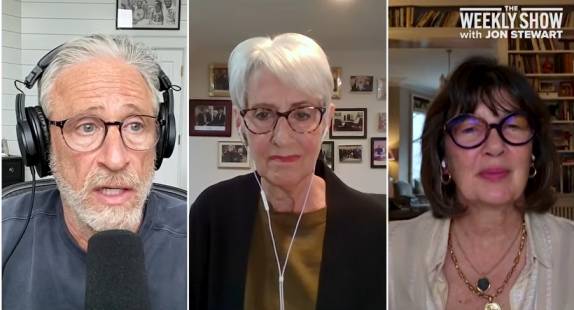
Editor’s Notes: In this episode of The Weekly Show, Jon Stewart sits down with CNN’s Christiane Amanpour and Ambassador Wendy Sherman to tackle the complex and rapidly escalating conflict with Iran. The panel dives into the lack of a clear diplomatic strategy, the chaotic evacuation of Americans from the Middle East, and the shifting justifications behind recent military strikes. Together, they offer a sobering analysis of “might makes right” foreign policy and its profound impact on both regional stability and the rights of the Iranian people. (Mar 5, 2026)
TRANSCRIPT:
Introduction
JON STEWART: Hello, everybody. Welcome to the weekly show podcast. My name is Jon Stewart and I will be your host and pilot for this evening’s flight. It is Tuesday. It is March 3rd, and we had a banger planned for you. We had election experts, we had experts in dark money, we had experts in social media.
The point of the conversation was going to be that, you know, there’s all this focus on undocumented people that are completely throwing our elections and all that, and yet everybody ignores the billionaires who are putting $350 million and changing algorithms to reflect their own political ideologies. And what’s really out of those two things, the one that is more damaging to a free and fair election and our democracy. And it would have been decisive. It would have been informative, decisive, entertaining. I think it would have been exactly what you were all looking for.
And then this motherf*er bombed another country. And so we once again, the best laid plans of mice and men, man plans. And Trump laughs, or I don’t know if he can laugh. All he can really do is look at the drapes.
So we are going to talk about Iran and everything that is going on there, and with two people that I think have both wonderful areas of expertise about Iran and I think can help us get through a little bit of some of the confusion and lack of justifications and all those different things that are flying around in the moment right now. So let’s get right to them.
So as we try and navigate through these somewhat chaotic times and these somewhat malleable justifications for a war that we have just launched, or maybe not a war, perhaps it is not a war. In fact, it is just merely a long distance explosion.
Hello. We are joined by Christiane Amanpour, CNN chief international anchor, and Ambassador Wendy Sherman, former Deputy Secretary of State and lead negotiator of the 2015 nuclear deal with Iran. Thank you both for being here.
Christiane, can you give us just very briefly, any kind of sort of real time update about where this all stands right now as we’re entering days four and five? What are you hearing?
The Chaos of War: No Planning, No Strategy
CHRISTIANE AMANPOUR: Well, for me, the most important signifier of where we are right now is the order given by the United States for all Americans to leave the Middle East. But do it on your own dime, do it on commercial. We can’t get you out.
For me, that speaks volumes. It speaks to me to a lack of planning, to a lack of having talked about this war in any public forum. Certainly they didn’t go to Congress, but there was no speech to the American people. There was no advice to American civilians, businessmen and women, tourists and all the people who live out in the Middle East and in all those areas that are vulnerable, which host U.S. bases, to leave panicking.
So I don’t know, I can’t say that they’re panicking inside the White House or the Pentagon, but that was a panic message to me. And the whole thing is very different than people expected. There are civilians dead in many places, not to mention in Iran, more than 500 plus. Some of those were children, about 160 according to the Iranians, at a school. There are allies targeted. There are shifting reasons for this about why they’re doing it.
Not only that, what they want to achieve in one 24-hour period, maybe even less, 12 hours — Hegseth, Trump, Vance, Rubio all gave different, and I don’t know what kind of, justifications. And Rubio ended last night by saying — he didn’t say it like this, but he implied — that Trump was essentially rumbled by Netanyahu into this.
JON STEWART: He was bullied. But the thing that strikes me about it, and Wendy, maybe you can speak to this, is in the chaos of all that, in the idea that maybe we didn’t understand the justifications. Also buried in the briefings is this has been planned for months. They and the Israelis have planned the attack meticulously. And so they may not have been prepared in any way for the aftermath or the collateral effects of all this, but they’ve clearly put more effort into this than they did to any kind of negotiation for a nuclear deal. Is that fair or unfair?
WENDY SHERMAN: I think that’s absolutely fair, Jon. Our military is extraordinary and they plan for plans for plans. There is nothing they do not plan for and do it meticulously. And that’s what we’re seeing, a meticulous military plan. But the objective, as Christiane pointed out, keeps changing on a minute by minute basis. And as a result, there was no real political strategy. There was no overall strategy. There certainly was no regard for people, whether those were our diplomats who now have to leave embassies or American citizens who are told, as Christiane pointed out, “Leave, but we’re not going to help you.”
JON STEWART: Is that unusual? I don’t know. I’ve not been in a war zone.
WENDY SHERMAN: Extremely unusual. If you recall, Jon, the first day of the Afghanistan withdrawal was tough and it was brutal and it was not done well, and we got excoriated for it.
What this administration has done is called a neo, which means everybody has to get out. But they did no planning, no preparation. They have axed the State Department budget, and in those 14 countries where Americans are to leave, eight do not have confirmed US ambassadors. And that matters because it makes it harder to talk to governments.
JON STEWART: Who do you go to?
WENDY SHERMAN: Exactly. This is truly outrageous. The first responsibility of the Department of State is to protect American citizens.
Americans Stranded: No Help, No Plan
JON STEWART: I have friends that happen to have been in Dubai who fled on foot, who literally walked because the bombs started dropping.
CHRISTIANE AMANPOUR: Where are they walking to? Because all the airspace is being closed around the region.
JON STEWART: Yeah, they had to get, I guess, to the border and get out of there on land routes and that kind of thing. I mean, that’s how chaotic it’s got.
CHRISTIANE AMANPOUR: Well, there you go. I mean, usually we would see military planes deployed or the government renting big transport carriers or big airlines.
JON STEWART: And this is all for American personnel, not necessarily just American corporate?
CHRISTIANE AMANPOUR: It’s for everybody.
WENDY SHERMAN: It’s for everybody.
JON STEWART: Everybody.
WENDY SHERMAN: The Europeans have chartered airplanes to take their people out. The United States has not chartered airplanes. And we have done this in every other circumstance. We pay to get airplanes to difficult places to help get people out. Not just our diplomatic personnel, but Americans.
JON STEWART: And right now, the American government has basically given the order, “Get out of there and Godspeed. Good luck.”
WENDY SHERMAN: Yeah, pretty much.
CHRISTIANE AMANPOUR: And airports are all closed, as you just mentioned.
Iran’s Retaliation and the Spreading Conflict
JON STEWART: That’s incredible. Now, Christiane, is that an indication, though, that the United States believes that the escalation — that this is going to spread to a variety of — like, that it’s not just going to be the Iranians targeting American bases in these areas, that this actually may spread?
CHRISTIANE AMANPOUR: Well, look, I think it is an indication because of what happened in the first 24, 48 hours. There was response immediately, and then there was more response after they had buried Khamenei, or the remains of Khamenei, and done some kind of official prayer ceremony, because like Jewish people, Muslims get buried immediately. So that’s basically what happened. And some of my contacts said that wait for an even bigger response once they’ve got that out of the way.
But the thing is, again, to Wendy’s point, when you plan for war, you plan for the day after and you have an exit strategy as well. Of course, reality hits against reality and things change. But you’re meant to have a plan going in.
And the problem, exemplified by the surprise and shock that Iran has retaliated — number one, I’m sorry, they said they were going to do exactly this.
JON STEWART: Oh, that can’t be a surprise.
CHRISTIANE AMANPOUR: Well, it is. Obviously they are saying, “How could this be?” These are countries that didn’t want this war to happen. Iran could have, maybe had them on side. But they’re not just targeting the Iranians now with their missiles and drones, the American bases. They’re also targeting some of the economic hubs and, at one point, very sadly, a civilian hotel in Dubai. Now some of these hotels are housing military and other personnel. So I don’t know what Iran’s justification is, but it’s not allowed to hit civilians.
JON STEWART: Forget about justification, just strategy wise. If you’re already being overwhelmed by a two-on-one fight — you’ve got the United States and Israel, who both have vaunted militaries, seemingly, who got married and blended into each other and now they all fight together — why in God’s name would they then provoke the Saudis and any other country that has our military equipment to get into this? Wouldn’t they want to limit the participation? Or is the idea that if they cause economic damage in these other countries, that that will put pressure on the United States to back off?
Economic Fallout and Trump’s Pressure Points
WENDY SHERMAN: So it has put pressure on the United States. The stock market is way down today. Energy prices are way up. This is only going to get worse. LNG as well. That market is off because it comes out of Qatar. And so I think the idea is to sow chaos, to sow economic damage.
We know Donald Trump, we know the President of the United States now, and we know that if he sees the stock market go way down, if energy prices go up — after all, he has bombed, I think now, Christiane, no better than seven or eight countries.
JON STEWART: Well, but he stopped eight wars. So right now he’s even.
WENDY SHERMAN: Right now we’re even.
JON STEWART: Stopped eight, started eight. We seem to be even.
WENDY SHERMAN: Yes, but in that bombing of all of these countries, what he’s always focused on is how the stock market’s been doing. And it helps him to avoid dealing with the real affordability issues in the United States. To deal with the Epstein issue.
JON STEWART: Well, we saw the same thing with the tariffs. As soon as he levied the tariffs, when he saw that the bond market was about to crash, he suddenly backed off of that. Does that give him a justification? Because they’re being so all over the place for what the aims of the war are, does that then make it easier for him to declare, “Oh my God, we won, we did everything we intended to do. Now I can leave”? Is that where he’s going with this, Christiane?
Iran’s Strategic Calculus: No More Restraint
CHRISTIANE AMANPOUR: I don’t know. To add to Wendy’s analysis of why all these lashing outs by Iran — many Iranian experts have said that when Trump killed Qasem Soleimani, the head of the Quds Force, back in 2020, Iran practically telegraphed a very limited response.
JON STEWART: They gave us a heads up before.
CHRISTIANE AMANPOUR: Yes. And then in the so-called 12-Day War, and even before that, the actual encounters with Israel — Iran really didn’t land a punch. Israel was doing really well, and its allies were doing well, helping it with a defensive shield and all the rest of it. So this much-vaunted “Iran will wipe us off the face of the earth” didn’t even come close to happening. And Iran was, in my opinion, revealed as either not having the wherewithal or the ability or the desire to go further.
So then that became an issue within the Iranian regime. “We were limited and restrained,” they say, “last times. Now, if we’re attacked like this” — with their weakened state, we’re weakened because of all the Israeli and US strikes in this past year, we’re weakened because of the legitimate uprisings of people in Iran — they’re weakened from the outside, they’re weakened from the inside.
A war was going to be existential for them, and I think they decided, “No more proportional. Now we have to give it all that we’ve got because it didn’t work the last time and now they’re after us.” And they know that because both Netanyahu and Trump and everybody else was saying this is about regime change. You remember, we can quote left and right, Trump and Netanyahu — they were even saying it in the opening hours of the war.
JON STEWART: Oh, Netanyahu very explicitly said in an address, “I’ve been working this for 40 years.”
CHRISTIANE AMANPOUR: 40 years.
The Iranian Power Structure and the Limits of American Strategy
JON STEWART: What I’m curious about, Wendy, maybe you can speak to this. I feel like the hubris and arrogance of the Trump administration is reflected in the idea that they think they cracked the code on regime changes. We all remember four weeks, five weeks they went into Venezuela, they took Maduro, and what they did is they just basically decapitated the leadership. And rather than trying to foment a democratic revolution or bring more liberty to the people who’ve been suffering, they just cut a deal with the next in command, basically by saying, “You see what happened to that guy? If you don’t want to get two to the back of the head, you’ll cooperate with us.”
Is that the strategy now that they think they can deploy on any other nation? Like now with Iran, “Hey, we took out Khamenei. The next guy up, you’ll just make a deal with us.” We’re not necessarily going to free the people. We’re just going to get a slightly less reactionary dictator to work in American interests.
WENDY SHERMAN: Right. One of the things of the many objectives laid out that worried me the most was Trump saying that Venezuela was a template. And if Venezuela is a template, then he somehow believes of the various scenarios the CIA offered, he’s choosing the one that somehow he can find a pragmatic person in Iran who will cut a deal with him, maybe give him access to Iranian oil or economic possibilities, end all of their enrichment, end their missiles, and somehow control the economy of Iran, but help out Donald Trump.
This is so naive. Christiane has looked at Iran and been in Iran for many, many years, and she knows as well as I do there are many layers of Iranian leadership, many plans for succession. It is a culture of resistance. Ostensibly, this morning there was a hit and run against the council that was meeting to elect the next supreme leader, another effort to decapitate the leadership of Iran. That will not stop Iran. That will just double down to try to keep going. And maybe this time they won’t have a public meeting. They’ll do it in a bunker somewhere to make sure that they get a supreme leader.
If, in fact, everyone was killed in this attack, I don’t know yet. But the bottom line here is a total misunderstanding of what Iran is, who Iran is. And if a deal is made, freedom for the Iranian people is not going to happen. And remember, that’s how this all started. President Trump said to the protesters who were being killed, “We have your back.”
JON STEWART: Sure, rise up. We’re not going to give you weapons, but we have your back. Christiane, can you explain a little bit about, so what is the power structure? And when we talk about the Iranian power structure, this is obviously post-1979 revolution. It was very different when the Shah was there. Still autocratic, but not dogmatic in the theocracy sense. What is the power structure there beyond sort of the Supreme Leader? Then there’s a council, right, of mullahs. Can you walk us through that a little bit?
CHRISTIANE AMANPOUR: I can walk you through it. But it’s really complex. So I’m going to give you a general picture, please, based on what’s called the velayat faqih. Essentially, the supreme leader, so called, is the representative of God on earth. That’s what it — like a pope, right, in the Catholic faith. And therefore what he says — because it’s always a he, it’s a mullah — is their state policy, both religious and military and economic and foreign and domestic and everything under that.
There are various councils. There’s the Council of Experts, there’s the assembly councils, there’s a Guardian Council, there’s a number of different councils which are so medieval to try to pick through, but they have a certain internal logic and a bureaucracy and an administration that works to put the next leaders or to map out the policy or to do all the things. And I know Wendy’s familiar with this because she would have had to go through all their machinations when they did the JCPOA, the Iran nuclear deal.
But suffice to say, immediately Khamenei was killed, the state television and Ali Larijani — who I know very well, he is currently the national security honcho, he comes from a very hardline family of Larijani’s, and he used to be speaker of the Parliament — he can be described as pragmatic, but nonetheless, he’s a true believer. And he’s in charge. That’s all I’m telling you. That’s what I’ve been told. He’s in charge along with the current speaker of the Parliament, who is named Bagheri Kani, who is a Larijani.
JON STEWART: He’s not eligible to be the Speaker.
CHRISTIANE AMANPOUR: No, no, no. Now he’s running the country because of what has happened. The leadership has been decapitated. They’re trying to get a new supreme leader. And so all of this stuff is going on and it’s very unique to that place.
But the real issue for me, no matter how much we talk about whether America will succeed, whether Israel pulled America into it, what the retaliation is, the real issue for me, as an Iranian and as a journalist, is the promises made to the Iranian people. And as Wendy says, I have covered this place for nigh on 35 years, ever since the first Gulf War. Obviously, I grew up there, but then fled with the revolution, et cetera, but went back and continued to cover it.
These are the most extraordinary people I’ve ever met in my life. And you just had a conversation with Iranian director Jafar Panahi, who showed you how extraordinary the Iranian people are. And all they want is freedom, democracy, a standard of living that they can actually afford to live and survive and have three meals a day, pay their rent and send their kids to school, not to mention try to travel and be normal human beings. That’s what they want.
And in every opportunity they’ve had, whether it’s these so called elections, they’ve always, in the last 30 odd years, chosen the lesser of the two evils. The more pragmatic, the more reform. Except for Ahmadinejad and Raisi, but that’s where they are.
JON STEWART: But even then they chose really Mousavi and not Ahmadinejad.
CHRISTIANE AMANPOUR: That’s exactly right. You’re right. Because you know it. The 2009 — and I got, that’s the last time I got banned from there — for explaining and showing with CNN’s new technology how all the people were in the streets saying, “This time we’re going to rise up, madam, we’re going to take our country back.” And they were crushed.
So the people, Jon, have risen over and over again and they’ve been crushed by their heavily armed IRGC, Republican Guard, Revolutionary Guard, the foot soldiers, the Basij. They have the guns. Then Trump said, “Help is on the way.” And Reza Pahlavi said, “Help is on the way.” And then they got crushed again when help didn’t come.
JON STEWART: So now they were massacred. I mean it was — they’re saying now 30,000, 40,000 people.
CHRISTIANE AMANPOUR: Now there are a faction of people there who are desperate and hoping that this will liberate them. But there’s another faction which are also on the streets that are pro-regime. Now it’s smaller, but it’s very, very fervent. And it’s backed by the thugs with the weapons. So this to me is what we’re going to wait and see — who is going to win the battle of the streets if there’s a military resolution to all of this.
Negotiating with Iran: The Gap Between Bureaucrats and Theocrats
JON STEWART: Wendy, you’ve dealt with them in a slightly different capacity. When you’re negotiating with these — when Christiane is talking about the power structure and there’s the mullahs and it’s dogmatic and it’s theocratic — what layers are you having to walk through to get agreements that can hold? Are you walking with the pragmatists first to create these frameworks and then they are sort of pushed up the ladder to the mullahs to make sure that they abide by a different standard?
WENDY SHERMAN: Exactly. The current foreign minister, Abbas Araghchi, was my counterpart during the Iran negotiations and his deputy, Majid Takht-Ravanchi, also was my counterpart. And particularly Araghchi speaks perfect English, writes perfect English. Most of these folks spent time in the United States. Foreign Minister Zarif at the time, who built a relationship with Secretary John Kerry, had lived in the United States for 30 years. He understood us very, very well.
But even though these folks understood us very well — Araghchi and I both became grandparents and we shared photos of our grandchildren — at the end of the day, they answer to the Supreme Leader and to this layered bureaucracy and theocracy that Christiane laid out. And so for months we could not put anything on paper, because if we put it on paper, they had to send it up the chain and they would be told no. So we had to do everything in all kinds of machinations to get to a deal.
And when we finally thought we had parameters that we’d all agreed to, and we really thought we were on the glide path to a deal, the Supreme Leader gave a speech and changed every threshold. Every single one.
JON STEWART: So the red lines in a deal for the bureaucratic state are different than the ones for the theocratic leaders.
WENDY SHERMAN: Without a doubt. Without a doubt. And so then we had to twist ourselves into pretzels to figure out how to meet the Supreme Leader’s parameters while staying true to what had been agreed in this multi-party negotiation.
JON STEWART: What are the types of parameters that came from on high that complicated — in other words, what would we have to do to satisfy their vision?
WENDY SHERMAN: So their vision was much stricter. A lot of it was on technicalities in the deal. And one of the things I think people need to understand is Witkoff and Kushner did a drive-by negotiation.
JON STEWART: Well, they’re also real estate guys. I mean, they’re viewing this as a development scheme. Exactly. It’s just a different animal.
WENDY SHERMAN: Right. And if you can’t build one building, you just go on to the next building. This is national security. This is the geopolitics of the world. And so their drive-by — they said, “Well, Iran wouldn’t agree to anything.” They didn’t understand Iran’s need to hold on to its dignity, though we all find that sort of strange. They didn’t understand Iran’s need to have a deterrence. What sovereign country doesn’t want a deterrence, even if we hate and find an anathema what this country does?
And so they wanted a quick fix, because Trump always wants a quick fix. They couldn’t get a quick fix. Negotiations are tough work, really hard work.
The JCPOA and the Limits of Negotiation
CHRISTIANE AMANPOUR: But worse, I’m really interested to ask Wendy, because you mentioned the last drive-by negotiations. In your words. I was stunned and I’m sure you were, Jon and Wendy, I’m sure you were. Last week, just before the war started, Witkoff said to Fox, you know, the president and we’re — quote, “I don’t want to use the word frustrated, but we’re frustrated. I don’t want to use the word capitulate, but because they haven’t capitulated” — which in one word to me said they just don’t get it. Wendy, you never got a capitulation. And it seems that for Trump and the Trumpies, negotiation means zero-sum game. I win, you lose. And that’s not what this law in Iran are all about.
But again, I also want to ask Wendy and Jon to respond to something that I can’t answer to. But Vance and Trump and all the others have been — now they’re basically saying that this negotiation process was rubbish for the longest time. You all talk, talk, talk, talk. Iran was never going to do X, Y or Z. We had to get to this point today. That’s their latest justification. And maybe they really believe it that, you know, 2015 JCPOA wasn’t good enough.
WENDY SHERMAN: Well, they didn’t believe it was good enough, Christiane. They were critics at the time. And what we said to them is we have a choice. We can stop their program, we can verify it and monitor it to the nth degree, or we face the prospect of an Arab-Persian war, which is what we’re getting.
JON STEWART: Oh, wow. Well, that’s the question, Wendy. So when you talk about, in that nuclear deal, the big trigger was that international inspectors were going to be going in. This is the JCPOA.
CHRISTIANE AMANPOUR: Yeah, JCPOA.
JON STEWART: That international inspectors would go in there and that they would be able to monitor the Iranian nuclear program. And Iran was saying for our national sovereignty we have to be able to enrich uranium, not for weapons, but for energy and other types of things that seem to be very crucial to them. Now we’ve expanded the aperture to the development of missiles. I don’t know if that was in the JCPOA. I don’t. And also their support for proxies and other things within the region. I don’t know if that was also — so they’ve included — it’s a much broader negotiation.
WENDY SHERMAN: And get rid of their navy. So it’s a long list of things that we’re doing now.
JON STEWART: So it’s basically, in some respects, a castration.
WENDY SHERMAN: Absolutely. Without a doubt. But here’s the thing.
Obliterated? The Confusion Over Iran’s Nuclear Program
CHRISTIANE AMANPOUR: And this, again, I don’t understand, because it’s different words being said in public. So after the 12-day war, Israel and the United States brought all the intelligence images and all the pictures and said, “We have obliterated their nuclear program.” And by and large, I think most people agreed that it at least put it out of commission — that they were — they have not been able to enrich since the 12-Day War. And a lot of the main production centers and enrichment centers have been obliterated or at least extremely badly put out of action.
And we also read in the lead-up to this war that these aerial satellite photos and things had shown that the Iranians were not, in fact, going to enrich and doing that. They weren’t doing that. They were plugging some of the holes. But what they were doing was trying to rebuild their missiles and all the rest, through which, as Wendy said, is their sort of defense thing and deterrent. But even now, Rafael Grossi, who’s the head of the IAEA, the U.N. agency to monitor the nuclear issues, said that in this round of bombings, the nuclear stuff has not been touched. So it’s just really confusing.
WENDY SHERMAN: Well, it appears, Christiane, that they may have gone after Natanz today. But the tell is exactly what you said. President Trump said that we obliterated all of their facilities. Clearly, we said it way back, but we did not obliterate it. And did I think that Iran would try to start enriching again? Yeah, probably they would. But as you pointed out, the real way to ensure that, you know, what’s going on is to have the inspectors inside.
And we had the most unbelievable monitoring and verification mechanisms that didn’t exist anywhere else in the world that Iran agreed to. We had eyes on everything. We had for 25 years what’s called uranium accountancy. Whatever you take out of the ground, you follow it through the process. And you know that what comes out the other end is exactly what you put in. It hasn’t been taken off to some covert supply chain to create a nuclear weapon. So there was just tremendous work because we had an amazing cadre of experts. And obviously, as you know, Secretary of Energy Ernie Moniz, who was just completely brilliant. None of that existed in these negotiations. None of that hard work existed. So we’re in a really tough place.
Regime Change by Air: A Strategy Without a Plan
JON STEWART: Are we searching for answers that maybe aren’t even there, that this is a much simpler — they’ve sort of decided, and this happens sometimes — they did it with Saddam Hussein — they are bad actors. Gaddafi, Saddam Hussein, Khamenei. And the Americans decide, in a somewhat cavalier manner in my opinion, these are bad actors and we’re going to take them out. And whatever comes next will probably be better than these bad actors.
Somehow we didn’t do it to Assad, but we’re going to do it now in Iran. And we set terms that we know a country cannot meet, similarly to what Netanyahu is doing with Hamas, basically saying, “I’ll just bomb you till you disarm,” knowing that — well, and now they won’t. So it just turns into this weird siege. But is it simpler? Are we looking for justifications and strategies that don’t actually exist?
CHRISTIANE AMANPOUR: Look, you have the broader, more governmental view. I have the more on-the-ground, reportorial view of this. So, look, a number of things have struck me in the aftermath of the launch of this war. The United States says — the US officials say there is no international law. There is only American law. And we do whatever we want for our own national interests. And that’s what they’re going by right now.
In Britain and in most of the other parts of the democratic world, there is international law. So why did Britain decide not to go with Trump in the initial opening salvos? Because there was no legal justification for it. There was no imminent threat. They call it, you know, the US and Israel preventative, preemptive and all the rest of it. But that implies an imminent threat, of which there was none, despite the false claims of many of the Trump administration and their foot soldiers. So Britain then — now it’s expanded, there are reasons — and Britain is now letting the US use some of its bases. So that’s one thing.
The other thing is that what’s really — I think you’re right. The President has decided that might makes right. And this is what has been playing out since last January, since his inauguration. I was at the Munich Security Conference when, of last year, when J.D. Vance read the riot act to his allies — not his adversaries, his allies — and basically said, “You know, we’re going to do what we want. You’re a bunch of pussies. You don’t even enable your far right and all the rest of it.” I mean, it was mad. And then sort of cozied up a little bit, as you saw play out in the White House, to Putin and dissed Zelensky and all the rest of it.
So, yes, I think they think that they can decapitate whoever. But here’s where it’s a problem. In Iran, there is no known modern or ancient example of regime change from the air. Doesn’t happen. Maybe this is an exception, but right now it hasn’t happened yet and it hasn’t happened before.
JON STEWART: Would Libya be that?
CHRISTIANE AMANPOUR: No, it wasn’t regime change. No, no, no. They just — I think, and correct me if I’m wrong — they bombed Benghazi, but Gaddafi stayed until his own people massacred him, basically. And it’s total chaos and you don’t want that kind of regime change. To this day, Libya is chaotic.
And my fear about Iran is that already, even before the war, experts in Washington — people like Karim Sadjadpour — I said to Karim, “What are they saying to you in the State Department, the Iran experts?” First, he said to me, “There aren’t any. I haven’t found any.” And second, he said to me that they seem to be talking about doing a deal with a pragmatic Revolutionary Guard or somebody. Whoa, that’s not what the opposition wants. The US-based opposition of Reza Pahlavi has basically said anybody who does anything with anybody in the current power structure is appeasing or collaborating, and we won’t have it. So there’s no clarity on the day after — who, what, where, when. And in the middle of this, there is no clarity for the Iranian people. And I’m very fearful because it’s already being said by the Trumpies, “We’re just providing the environment for you, Iranian people. Go seize this moment.”
Might Makes Right: The Arrogance of Military Power
WENDY SHERMAN: Yeah, I think, Jon, you’re totally onto something here, that this is just about might makes right. We’re tired of this. We’re just going to use our military. When we heard Hegseth the other day do his very macho announcement of why we were doing this, he said, “We’re not going to have any stupid rules of engagement.” It was a very telling statement about how to go about these things. We will do what we want to do, when we want to do it, because we’re the United States of America. And we know that that arrogance has gotten us into big trouble in the past. We all loved the shock and awe of the first few days of the Iraq War, the fact that we were going to help the South Vietnamese create a democracy, and then it turns into a quagmire.
So whether this is a forever war or not, I don’t know. But it’s certainly a war of choice and a war of chaos and a war of confusion. There’s no doubt about it. And it has second and third and fourth order effects with our allies in Europe in terms of Ukraine. The president’s going to China at the end of March. I think he wants this to be over before he goes to China, unless he’s succeeding, and then scares the devil out of Xi Jinping, which I don’t think is going to happen. I think what it says to Xi Jinping is he can take Taiwan because might makes right and the US will let him do what he wants to do because the President wants to be his partner, not his competitor. We are in a really different world.
The Rules-Based Order We Built — and Are Now Burning Down
JON STEWART: Certainly Putin has said — I mean, he has — Putin has said explicitly, “Gloves are off now. Now we get to do whatever we want. There is no moral order.”
But Wendy, I want to ask you because I think you’re more familiar with these negotiations. I’m struck by the Trump team’s air of grievance and victimization. The United States created this rules-based order. It was our design after World War II. We’re the ones that rebuilt Japan and Germany, and the rules were that they were going to be militarily neutered. And we created the trade rules. And we created this world order. And now we’re saying everybody is taking advantage of us in this world order that we created and that the United States has benefited from more than any other country.
We have had the most successful 80-year run of a country in the modern times, but we’ve been getting ripped off. And so we’re going to burn the whole thing down and go with the old world — more sort of monarchical, colonialist version of “I need something, I’m going to go take it.” Is that the frustration you’re seeing from negotiators, that treaties are for losers? Is that where we’re at?
The Roots of Grievance: Iran, the Middle East, and the World Order
WENDY SHERMAN: Well, Donald Trump famously said that John McCain, a patriot and a war hero, was a loser because he had been captured. So a lot of this is out of Donald Trump’s mentality. He has always been a fan of McKinley, the president who believed in spheres of influence, who believed in tariffs, who got us into a lot of trouble. Yes, may have acquired a couple of territories, but we shouldn’t be a colonial power. We should not be an oppressor ourselves. This is like nuts.
And I think we’re beginning to see politically in the US, MAGA beginning to have some concerns about all of this, because it was supposed to be America first and no wars abroad. And the President instead is projecting power.
JON STEWART: But do they really believe that the world order has existed, the democratic world order, I’m talking about Europe, Canada, that they’ve existed to exploit the United States and that we have been victimized by the world we designed?
WENDY SHERMAN: I think the President has always worked on the concept of grievance. And globalization, which was part of that world order after World War II, helped people get better food, better pharmaceuticals, have possibilities. But it also meant that some people no longer had their manufacturing jobs in the United States. It was collateral damage. And we never had an employment assistance program worth anything. And so those folks feel like they were left out and left behind, that that world order didn’t help them.
They saw huge cultural change in this country where gay people could be married, women would go to work, a woman might even become president of the United States. Their wife had to go to work, even though that wasn’t their deal. People moving into their community spoke a different language or went to the mosque, not to their church. And people felt untethered and filled with grievance.
And Trump has worked really hard to milk that grievance and say, everybody’s against us. Yes, we are the most powerful. We’re going to show it with use of our military. I’m going to get you what you deserve through tariffs. Instead, what he’s gotten is a tax hike for every single American and a war that may not have an end anytime soon.
Echoes of Grievance: From the Middle East to the West
JON STEWART: Christiane, I’m struck by what Wendy is saying, in that the seeds of that grievance can be found in the seeds of the religious movements in the Middle East. The sort of a response to modernity. If you were to look at the University of Cairo graduating class in 1966, you’d probably see women in miniskirts and you’d see a whole thing, back when there was sort of Nasserism and we were going to have rapprochement with the West and everything got liberalized and Beirut was the Paris of the Middle East. And the seeds that Wendy is talking about, it feels like those were the sort of cataclysms that occurred in the Middle East that turned it into this much more conservative area. Do you see the echoes of that?
CHRISTIANE AMANPOUR: Yeah, I do, and I actually think it’s really interesting that you bring it up. Of course, those kind of grievance-based politics are very dominant in Europe, but also in the Islamic world, particularly since the Islamic revolution of Iran. Some of it is based on the grievance of the Iranians when the Americans and the Brits had that coup, as you know, in 1953, brought the Shah back when their democratic prime minister had been kicked out in a coup, et cetera, et cetera.
But if you read the history of Shi’ism, the Shiites, of which Iran is the most powerful country and the most populous Shiite nation, it’s 99% Shiite. And the history of Shi’ism is the same kind of grievance, victimhood, and martyrdom that you’re seeing, in a much more different religious way, all these centuries later, by post-industrial Western nations who have used all their politics and fear of the other to gin this stuff up.
But that’s why both these countries are talking past each other. There’s actually no understanding. And if you go back and read a little bit of the history, which I’ve been doing this last week to refresh my memory — I mean, I was in Iran during the revolution, but to refresh my memory of everything — the Americans are still haunted by the Hostage Crisis of 1979. The Iranians are still haunted by the coup of 1953. And it goes on and on and on. And so there’s a wall of mistrust.
Khomeini and the Iranian Revolution
JON STEWART: In 1979, though, it seems like that revolution against the Shah wasn’t necessarily a religious one. I don’t think Khomeini —
CHRISTIANE AMANPOUR: Yes, it was.
JON STEWART: But no, I’m saying, don’t you think Khomeini appeared to be a more moderate figure before he got there? When he was living in exile?
CHRISTIANE AMANPOUR: No, I don’t think he was more moderate. He was a true believer. But what he did do — because you did get quite a lot of the upper middle class deciding to go into the streets against the Shah and vote for him — he managed to lie. He managed to tell everybody that he was going to bring democracy, he was going to bring this, he was going to bring that, and, “Oh no, a mullah will never be in charge.” So all of this stuff was a lie. And actually, very gullible Western politicians believed —
WENDY SHERMAN: — him at the time.
CHRISTIANE AMANPOUR: The British government, maybe some in the US government, thought, “Wow, we’re going to get democracy in Iran. Let’s throw the Shah over,” our decades-long ally who, yes, was authoritarian.
But I think the difference there was that in 1979, after a full year of revolution — and I just have to tell you, on New Year’s going from 1977 into 1978, Jimmy Carter and Rosalynn came to Tehran and they had a state visit which culminated in a state dinner. And President Carter told the Shah that you are our greatest friend and an island of stability in the Middle East. That meant they knew nothing about the rumblings. Their ambassador there knew nothing. Eight days later, the revolution started. It took a year. And one year later, Khomeini came back.
Eight days after Carter’s famous, “You are my best friend and you are the stability of the Middle East” — which means that nobody knew anything, or if they did, the message wasn’t going up the chain. I mean, that’s a simplistic version, but that’s basically what has been happening to this day. To this day.
I’m going to just say, I think 47 years of Western policy toward Iran has been rubbish. Literally rubbish. In the sense of the —
JON STEWART: — sanctions and the way that they isolated everything.
CHRISTIANE AMANPOUR: You know why? Because they focused only on the hard power — nukes, missiles, foreign mercenaries — never on the rights of the Iranian people. And the Iranian people are some of the most sophisticated people in that whole region. The best educated, the most female empowerment, the most technologically savvy, the best scientists, doctors, artists, for thousands of years. And we just lump them all as quasi-terrorists. All the people of Iran — never, never put their human rights or their democratic rights not just at the top of an agenda, but anywhere on the agenda.
Iran and the United States: A Missed Connection
JON STEWART: That’s what I meant, Christiane. Even with Khomeini, it felt like a bait and switch. Not to the world, but to the Iranian people — that he —
WENDY SHERMAN: And to the world.
JON STEWART: — was going to give them democracy. And then he gets there and they start massacring everybody and imposing these religious customs. Because I agree — and Wendy, maybe your experience there as well — if there is a country over there that seems most inclined to be kind of brethren with the United States, it’s Iran. Their culture, their people, seem much more aligned with Western sensibilities. No?
WENDY SHERMAN: Well, without a doubt. As Christiane pointed out, it’s a highly literate country, very sophisticated people — technologically, culturally, intellectually. I think there’s no doubt that there could have been another story written here.
But I think that the searing of the Hostage Crisis in 1979 lives with us forever. And certainly for my generation, it lives forever, in the same way that Vietnam lives with me forever. Madeleine Albright, with whom I worked both at the State Department and in business, was really a daughter of Munich, not of Vietnam, and had a very different view of the world and the United States because of that experience. And we are all creatures of our history.
And this generation, as we’re seeing where Israel is concerned — I know my own daughter — young people around the world, yes, they think Israel has a right to exist and therefore the Israeli people, but they do not consider themselves Zionists in the same way that my generation perhaps did. And we see a huge split in any of the polling that is done. For the first time, the American public has greater support for the Palestinians than for Israel. And that’s really astonishing. And it has to do with our own experience and Bibi Netanyahu’s decades now of deciding how the world would go.
I’m very much, certainly, feeling horrified by what happened to Israel on October 7, no doubt about it. But I’m also horrified about everything that is happening now, and the rights of the Iranian people — not the mullahs, but the people.
CHRISTIANE AMANPOUR: Yeah, I’m always talking about the people. I mean the people, not the structure.
JON STEWART: Sure, yeah.
WENDY SHERMAN: The people are going to get left behind, I’m afraid, in all of this sound and fury.
Could There Be a Berlin Wall Moment for Iran?
CHRISTIANE AMANPOUR: Okay, one question. Could it be a Berlin Wall thing? Because I’m very nervous. We’ve explained all the possible downsides and the possible cynical deals that might be made around the back of the Iranian people to end this. But could it be, Wendy, John — I didn’t cover the fall of the Berlin Wall, I wasn’t a foreign correspondent yet — but it was like, no, no, no, no, no, until one day it happened. Now, it did have Gorbachev sign off, and the soldiers didn’t shoot, and that was crucial, which will be crucial in Iran. But I wonder if you think there might be the space, Wendy, created by this war, to allow that there.
JON STEWART: Christiane, you should be a journalist. Because let me tell you something, that is an incisive question and one that we had not considered previously. Send me your resume.
CHRISTIANE AMANPOUR: Can I work for your show?
JON STEWART: Oh, please. Absolutely. Anytime. I hope you like basic cable money, because that’s where it’s going. Wendy, what about that question? I mean, I think there’s always that possibility. Anybody who lived through the Berlin Wall falling, and the fall of the USSR and all those things — what is your feeling on that? These guys could collapse and there could be a sort of different renaissance.
WENDY SHERMAN: Look, I think we would all find that a wonderful outcome. I think that we don’t have an organized opposition in Iran. There were organized groups in Europe, ready to take the seeds of the fall of the Berlin Wall. And we had West Germany, of course —
JON STEWART: Right. Who could help usher it —
WENDY SHERMAN: — who could help usher in that change. Perhaps that can happen here. We didn’t have a Shia-Sunni split in the same way that we do here. Nonetheless, that was a hard integration between East and West Germany. We’ll see how that plays out in Merz’s visit with the President today, the Chancellor of Germany.
But look, nothing would make me happier — not in terms of our politics in the United States, because I am not a fan of President Trump’s — but for the Iranian people, I’d be delighted if there were such a situation.
The Arab Spring Legacy and Democratic Infrastructure
JON STEWART: Christiane, you covered Arab Spring and it does bring up. I remember being in Egypt right before. It wasn’t before Mubarak fell, but before Morsi fell. And the Arab Spring had that feeling of young people and a democratic movement. But what we saw was exactly what Wendy is saying. Without having the infrastructure or organization, the only groups, because civil society has not been fostered necessarily in those countries in the same way. The only groups organized enough were either the ultra religious groups like Muslim Brotherhood or the military. And so what you don’t get, and maybe this is the legacy of Arab Spring, you don’t get that fostering of that democratic society that is from bottom up, you get top down autocracy either through religious actors or military actors. Is that the problem with the general structure there?
CHRISTIANE AMANPOUR: Yeah, I think it was absolutely the problem there. And what happened is that because the Muslim Brotherhood had civil society in its pocket, having been the sort of humanitarian lifeline for so many Egyptians through the mosques and through their foundations and this, that they were the only, the only clear organized group first. And when there were elections, they won. And then the military said, “No, no, no, no, no.” And they had the weapons. So it’s the weapons versus, you know. And nobody wanted to see what they thought may be radical Islamic groups taking over any of these countries.
It was different than Iran in that there was no outside intervention. Here you’ve got Israel and the United States bombing. And I fear very much for the backlash coming in generations to come, because I think it’s very controversial to be liberated in a Muslim country by Israel and the United States. But I know a lot of people are saying whoever it takes, whatever it takes. But I worry about that for the future.
Iran’s Democratic Potential
JON STEWART: Are there tentposts within Iranian society that would make them better ground for that type of democratic infrastructure to rise up?
CHRISTIANE AMANPOUR: I think that you have a very young population. It’s very, very young across the board, but most especially it’s essentially called like a Gen Z uprising right now. These are people who are incredibly plugged in, but I worry a little bit that they’re also incredibly plugged into TikTok. So there’s potentially a little bit of an unrealistic notion of how you have to do the grassroots and the groundwork, and most particularly unifying. What you don’t want is to have an opposition wherever it comes from, who’s going to just replace one hegemony with another, for want of a better word.
JON STEWART: Which is what happened in so many of those other countries.
CHRISTIANE AMANPOUR: Superiority. Yeah, to another. So I think just like in Syria, where the new president, Al-Shara, who’s been in now just over a year, his biggest challenge, and he’s known that it’s his biggest challenge, but he must get over it, is to unify a very fragmented country so that any leader has to do that. And do not forget that there is a genuine 10, 15% fundamentalist population in Iran who are very religious, who could be brought along in a new Iran, but they’re not nothing, they’re not nobody. And they need to be brought in and unified.
I think Israel has to decide what it’s going to do. I mean, there’s another whole front open now again in Beirut. There may be a land invasion of Lebanon again by the Israelis, but they are under cover of our inattention, regularly bombing a new free Syria who the US happens to be friends with.
Trump’s Approach and Netanyahu’s Ambitions
JON STEWART: That’s a leader Trump likes. I mean, that almost seems like his model, which is I like a strong man, but I want a strong man who’s my friend, because he has no compunction with strong men throughout. He loves Putin, he loves—
CHRISTIANE AMANPOUR: But my fear, Wendy, and you can take this away, obviously, because you know much more than me on the diplomatic side, is that Israel does not want a strong Iran, no matter who is under who. I think that they want to fragment it and have a chaotic Iran, and that would be a disaster, in my humble opinion.
WENDY SHERMAN: I certainly don’t think that Bibi Netanyahu wants an Iran that has any strength whatsoever.
JON STEWART: Even—
CHRISTIANE AMANPOUR: Yes.
JON STEWART: So even if they’re not a theocracy, he would object to a powerful Iran?
WENDY SHERMAN: If they are still financing proxies in the region, if they still have missiles that can reach Israel, if they still have an enrichment program. None of that is anything that Bibi Netanyahu wants.
And let me just say on this political point, it’s really important. I actually, with Anne Patterson, who was then the ambassador in Egypt, went to meet with El-Sisi. He was not the president of Egypt yet. We also met with all the different political factions and political groups. They were just beginning. They were babes in the organizational development of what you did.
JON STEWART: Is this in between Mubarak and Morsi in that space that year?
WENDY SHERMAN: Yes, in that space. Right, right, right. And we met with all these political groups, and they were terrific and wonderful, but had so far to go to have the power and the capability to rule a country like Egypt. And we met with El-Sisi, and Anne and I came out of that meeting, turned to each other and said, “He’s going to take over. He’s going to throw Morsi in jail and he’s going to take over.”
JON STEWART: And was very popular when he did it.
WENDY SHERMAN: Was very popular when he did it.
JON STEWART: That year of chaos had created, such as Christiane said, I think the people just wanted to feel safe.
WENDY SHERMAN: Yes.
Prospects for Negotiation with Iran
JON STEWART: And as though they were in. Wendy, when they talk about Trump says, “Now I bomb. But hey, look, I’ll negotiate.” What does that even look like? And who would he even talk to at this point? And what could they cede other than just utter supplication, which, as Christiane said earlier, no country will allow itself to be in that position?
WENDY SHERMAN: So if I were Iran, and in June I was negotiating, and three days into that negotiation got bombed, and then I was negotiating again in February and got bombed. The hell, as we’ve seen in these last few days, the chances I would sit down and negotiate with the United States — boy, I’d have to know a lot was going to be on the table that I would get as a result of doing that. And I don’t think from Iranian culture and a culture of resistance, again, Christiane knows better than I do, I would give in and say, “Well, if you’ll just stop bombing me, I’ll give you everything you want.” That’s not going to happen.
CHRISTIANE AMANPOUR: And I don’t know, Wendy, whether you know any more from talking to maybe insiders and particularly close to the administration, but I was told that Trump is trying to negotiate with Iran’s new leaders. God only knows who those are. But we’ve heard that Larry Janney has said there will be no negotiations under bombs.
But I do find it interesting, the couple of polls that I read right as the war started. A poll was taken that basically had 41% of Americans for and 41% against. So that’s pretty equal. The latest one from yesterday from Washington Post found 52% against and 39% in favor. And you’ve seen all the officials, the major cabinet officials, including the president of the United States, sort of struggling with their messaging, and MAGA very upset. Can you imagine? It’s Tucker Carlson who’s the only one who’s actually tried to tell Trump the negative fallout of a possible war with Iran. The rest of them just off they went into it.
JON STEWART: That’s what’s launched him into frontrunner status for 2028.
CHRISTIANE AMANPOUR: Yeah. But I wonder what’s going to play out internally in the politics of the—
American Public Opinion and the Gulf States
JON STEWART: US, and also in the context of Americans. Look, we love us a good new war. And a lot of times, if you remember, H.W. Bush, when he started bombing the Middle East, his numbers would go up to 90%. Generally, Americans rally around the president and the flag during these times. So to start out with even 50/50 about going into a place like that is shocking for these types of operations.
But as we wrap up, and I’m cognizant that you guys have a lot to do, the one area we haven’t really discussed is the other Gulf states. What kind of a game is Saudi Arabia playing here? Because let’s be honest, the Sunni-Shia rift in that part of the world and that power structure is real. And as Iran had tried to create that sort of corridor through Lebanon and Syria to extend their power, the Saudis were very concerned about that, and that’s why Iraq was so important to them. What are they doing with regards to Palestine and with regards to Iran? Because they talk a game of resistance, but it seems like behind the scenes they facilitate and agree with a lot of these actions. So what is your feeling about their role in all this?
Saudi Arabia’s Strategic Calculations
WENDY SHERMAN: I think Saudi Arabia more than anything wants stability and wants to have the economic future that Mohammed bin Salman, really the person who’s running Saudi Arabia, hopes out of his 2030 plan for the economic future of Saudi Arabia, which also has a very young population and an understanding that oil will not exist forever and that in fact, the royal family will be at risk if they cannot create a future for the young people in that country.
He has tried to create a relationship with Iran, even starting diplomatic relations, that was really to protect his back. But now Saudi Arabia has been attacked. And of course Saudi Arabia didn’t want to be attacked by Iran again after they went after the Saudi Aramco plant some time ago. So this was sort of like his, “I’m going to make sure that I’ve got a back channel and a way to make sure we don’t get targeted again so that I hold on to the future I want for Saudi Arabia.”
JON STEWART: How does his public relationship with the United States and Netanyahu differ from what you believe is going on? Because that portrays him in a much more conciliatory role with Iran than I would have.
WENDY SHERMAN: I don’t think he’s conciliatory. I think he’s trying to have it always, all of the time, and stay in control. And as we’ve seen, he’s a very controlling person. We all know about the murder of Jamal Khashoggi, which many of us will never, ever be able to forget. It was so horrifying and so outrageous.
So I think a lot of these countries are very pragmatic, very transactional, and Saudi Arabia has bought an enormous number of weapons from the United States, truly important to us as part of our economy. They don’t know how to use these weapons sometimes very well. We saw that in Yemen, which hasn’t gone very well for Saudi Arabia, and now that Saudi Arabia has been attacked. But some of those targets have been US targets, not just Saudi targets. So we will see where Saudi Arabia goes and whether they will now be all in.
The Munitions Crisis
One other point I’d make about all these Gulf states, and reports this morning, which is they all have munitions often bought from us and they are running out of those munitions. And one of the big debates to come in the United States now is whether we’re going to spend more money to help all of these Gulf countries increase their munitions as well as get more for ourselves. And our military industrial complex is very slow going. Getting those munitions in storage and in stock is not something that happens in five days.
JON STEWART: And we don’t have the manufacturing base for it.
CHRISTIANE AMANPOUR: Exactly.
WENDY SHERMAN: We do not have the manufacturing base for it. And you can’t start up those manufacturing on a dime. So we are about to see how this is all going to play out. UAE, ostensibly United Arab Emirates, only has maybe a week at most left of—
JON STEWART: These munitions to keep those missiles from — talking about all those shields that they’ve created. Christiane, what’s your thought on where the Gulf states play in this and Saudis in particular?
The Ramifications of U.S. Policy in the Middle East
CHRISTIANE AMANPOUR: Well, I would just add that I think it’ll potentially cause Saudi Arabia and UAE and Qatar and their people to potentially maybe question the wisdom of having American bases on their soil, particularly when they’re not being defended by the United States, their allies. And I don’t even know whether they were alerted that this was happening on Saturday morning. I don’t know.
But I also think that for the UAE and Qatar especially, and now Saudi, more and more, they have branded themselves as this place that is modern, that is stable, that is a financial hub, a business hub, a negotiating peace hub, you know, World Cup here, this and that there. They have completely branded themselves on being a safe bolt hole for very rich people and those who want to have some tourism and sports and all the rest of it. Whoa, now they are in the line of fire. So they’re going to have to make some decisions and it’s going to be very weird and interesting to see how this all plays out for everybody. It really is so huge, the ramifications of what’s just happened.
And I will go back to the whole business of Israel because I was pretty shocked two weeks before October 7th to learn that the then National Security Advisor, Jake Sullivan, had said publicly, you know, things in the Middle East are quieter and more organized — and I’m paraphrasing — than in a long, long time. So all I’m saying is there still seems to be a knowledge gap. There just seems to be a gap between what’s going on and what is actually happening and what your best friends think halfway around the world. And that affects everything, even Netanyahu. It’s been written recently that he asked the Qataris to increase the funding for Hamas practically on the eve of October 7th.
JON STEWART: Right.
CHRISTIANE AMANPOUR: So, guys, something’s got to change. This same policy that’s been sort of had for the last half a century is not producing the optimum result.
The Hubris of Control: Lessons Never Learned
JON STEWART: Well, certainly not a learning curve. I mean, you had talked earlier about the lessons of Vietnam and the lessons of Iraq, but it doesn’t seem that we’ve tried every version of this game, whether it’s bombing for a little bit, whether it’s bombing and then invading and then occupying and holding it until — and we’ve seen in Afghanistan and we’ve seen in Iraq and we’ve seen in Vietnam and we’ve seen in Libya — that the collateral damage and the downstream effects we just don’t know are going to be.
But the one thing we never seem to stop doing is meddling and trying to control. The hubris of a nation, even as strong as we are, thinking that it’s not just about influence, it’s about control. And when you put it into control, our constitution very clearly states people want to breathe free, they want self-determination. And when we have policies that use these other countries as puppets, how can that not be disastrous?
CHRISTIANE AMANPOUR: I still think the Americans have one big superpower and they have to use it, either this president or the next one, to force peace and a just solution to the Israeli-Palestinian conflict. I genuinely believe that that is the source.
JON STEWART: You think that’s a nuclear reactor?
CHRISTIANE AMANPOUR: It is huge. Everything else is a tentacle that hangs off that. Everything else I believe is a tentacle. I’m convinced that a proper lasting peace will do so much to quieten most of the tension in that region. I really do. And I think focusing on the human rights and democratic rights of a people like in Iran is very important too. Along with the national security, not just the transactions. You have to have something for the people, you know.
Dignity, Identity, and the Limits of American Patronage
WENDY SHERMAN: Yes, I agree with you, Christiane. I think that’s absolutely critical. I don’t think it’s about building a resort on the beautiful waterfront of Gaza, but I do think that giving people the dignity they deserve to live a decent life and the dignity of their own
JON STEWART: — identity. And maybe understanding it’s not ours to give.
WENDY SHERMAN: Yeah.
JON STEWART: We cannot be patronizing when it comes to the dignity of other people. It’s their unalienable rights. We don’t grant them the ability to get those. But I really appreciate the conversation and the insights here today. I think you’ve both got bright futures.
CHRISTIANE AMANPOUR: I just hope the people of Iran have bright futures and the people of Israel and the people
JON STEWART: Absolutely.
CHRISTIANE AMANPOUR: — of Palestine and the people in the world, because they are treated as, unfortunately, second fiddle to everything — or fourth or fifth fiddle.
JON STEWART: Right. And when you talk about it, it just all seems so much simpler than what it is, which is: let people live in dignity and peace.
CHRISTIANE AMANPOUR: Hey, women rule. We should go and do it, right.
WENDY SHERMAN: Indeed.
Closing Remarks
JON STEWART: Christiane Amanpour, CNN Chief International Anchor. Ambassador Wendy Sherman, former Deputy Secretary of State and lead negotiator of the 2015 nuclear deal with Iran. Both of you, thank you so much for your insights.
WENDY SHERMAN: Thank you, Jon.
CHRISTIANE AMANPOUR: Which Trump pulled out of, don’t forget.
JON STEWART: Yes. Because it was a disaster of Barack Hussein Obama’s doing. And he’s the only one who prevented nuclear war.
WENDY SHERMAN: Right. A man of great dignity.
JON STEWART: Always. Thank you, guys.
WENDY SHERMAN: Thank you.
CHRISTIANE AMANPOUR: Thank you.
Post-Interview Discussion: No Goals, No Strategy
JON STEWART: I am always somewhat taken aback when two experts — one in the field of diplomacy, one in the field of journalism — both come to the same conclusion, that this will not end well.
WENDY SHERMAN: I mean, it really can’t. There’s no goals, like real concrete goals, no strategy. I mean, how can it end well?
JON STEWART: Yeah, it’s shocking in that they’re describing sort of the dynamics of it. And then they say, now there is a way for this to go right. But it’s not going to.
WENDY SHERMAN: Not going to happen.
JON STEWART: Like, even when they say, like, could this be a Berlin Wall moment? Then they took a moment to think, like, yeah, no, probably not.
WENDY SHERMAN: It’s also crazy. There’s a Board of Peace in the region. I wonder what their take is. Has anybody thought about calling them?
JON STEWART: So the problem is they’re still in the hiring phase. They’re still taking resumes. They’re not fully — now you can call there and obviously you can still get through. There’s still not a lot of followers.
WENDY SHERMAN: They’re fully funded, though. Just ramping up the hiring.
JON STEWART: Well, because it costs a billion. Was it a billion dollars? He runs everything like a f*ing country club. Like, it’s a Board of Peace. You pay a billion dollars and there’s a dining budget that you have to fulfill.
WENDY SHERMAN: But the food is not that good. There’s a three-year waiting period.
JON STEWART: How quickly after the war started did the Board of Peace puns — the Board of Peace is bored of — like, the Internet is undefeated.
WENDY SHERMAN: Well, I think when he fell asleep at the meeting, “Board of Peace” just became very easy to make jokes on.
Trump’s Attention Span and the $400 Million Ballroom
JON STEWART: That did become the meme. But don’t you think, like, his ADD — I really do wonder. He just doesn’t have the long — he likes demo day. He’s a big demo day guy, but he doesn’t like to be in there the day where they’re like, “Yeah, we’re just framing out the siding, we’re painting the trim.” Like, that’s not the stuff that interests him.
WENDY SHERMAN: I mean, he’s falling asleep in meetings. And I imagine that once these “big beautiful attacks” or whatever aren’t as big or as beautiful, he’s probably going to move on.
JON STEWART: Right.
WENDY SHERMAN: I saw this great thing that was like, “Trump is not a day two president. He’s just day one.” And anything that happens day two is like, “I have no time for that.”
JON STEWART: No.
WENDY SHERMAN: But the ballroom does continue to captivate him.
JON STEWART: That — Jillian, that’s so — I was exactly going — but the one thing that he brings up in any situation
CHRISTIANE AMANPOUR: Yeah.
JON STEWART: — is that the ballroom.
WENDY SHERMAN: He loves ballroom. I think it’s because it’s right outside the window. Like, you can’t forget about it when it’s right outside your window. We need to start putting some wildlife right outside. Have, like, two zebras divert to —
JON STEWART: Right. That’d be so great if they did it like one of those Disney hotels where the giraffes just walk up to the window, and that’s what he could open up on.
WENDY SHERMAN: We’ve got to get those fly-by planes. Like the Jersey Shore.
JON STEWART: Yes.
WENDY SHERMAN: Yeah, we could. Really?
JON STEWART: With lawyers that you can call to sue people. I like what’s going on here. Distract him with benign things that can’t get the world in trouble. Just like baubles and trinkets and such.
But somebody said to me the other day, which I hadn’t even really considered, and they go, “And by the way, I’m not like a construction guy, but how can a ballroom cost $400 million?” And I was just like, that’s a great — I don’t know what kind of sound system you’re putting in there, but $400 million does seem like a lot for a one-story —
WENDY SHERMAN: Like, especially DC real estate.
JON STEWART: Right.
WENDY SHERMAN: This is not New York City.
JON STEWART: We’re talking about $400 million. What?
WENDY SHERMAN: I can’t wait to go to my first party there.
JON STEWART: Yeah.
WENDY SHERMAN: Maybe the speakers are like — I don’t know. Camouflage does other things. Like, you can’t see the sound. It’s all built into the curtains. I don’t know. I’m trying to imagine.
JON STEWART: I don’t think he’s getting his money back is what I’m saying. I think even when he sells this, he’s going to take a hit. They’ll write off the depreciation because, by the way, he’s never moving out of that. He’s living — Brittany, what do they got for us on this fine week?
WENDY SHERMAN: Okay, Jon, you said you thought your guy David Ellison should have it all. Looks like he’s about to.
JON STEWART: That’s right, baby.
WENDY SHERMAN: I called him good with that.
Media, Prediction Markets, and the Speculative Economy
JON STEWART: I am the king of Polymarket. I made. Now, don’t. Don’t look into the transactions too much, but there may have been a whale that came in towards the end of the betting and threw down, you know, a quick half billion on whether or not Netflix would bow out. I didn’t have the inside information. No, it’s. I mean, they are accumulating toys. They are. It’s. Santa’s bag is full. Were you guys surprised that it ended with such a weird kind of whimper?
WENDY SHERMAN: No. Yes, completely. I was.
JON STEWART: No. Lauren says no. What were you thinking?
WENDY SHERMAN: I don’t know. I just remember Lauren had the inside scoop.
CHRISTIANE AMANPOUR: Oh, yeah.
WENDY SHERMAN: I wish I would have cowsheed all over it. No.
JON STEWART: Yeah, baby.
WENDY SHERMAN: I just think I’ve seen these types of issues in the past, like during the first Trump administration, and how much things have ramped up. I mean, the meetings we’re seeing, these executives taking with the President, the subservience in the public to him. I just had a feeling it might be inevitable that what Trump wants will happen.
JON STEWART: Right. Well, how astonishing is it for the President of the United States in a business merger to go, “I haven’t decided yet who I’m going to give it to.” Where it really is like, we are all just things on his desk that he can hand out, party favors to be distributed to the loyalists.
WENDY SHERMAN: It’s a. John, were you surprised?
JON STEWART: No, I was not surprised at all. I never thought Netflix had a chance, to be honest.
WENDY SHERMAN: Oh, really?
JON STEWART: No, because of how clearly the President wanted a loyalist. Look, that’s how they ended up with TikTok. CNN is too big a prize for them to risk handing it over to news people, or people that are going to let it just operate. So I never thought that. I always thought that they were going to use the lever of FCC approval as a manner by which to tilt the scale.
And I thought the one thing Zadlov did smartly was use Netflix to drive Paramount insane and make them pay $110 billion for something that clearly, you know, and if you look at once Paramount got awarded the deal, their stock looks like a f*ing luge course.
CNN, CBS, and Trump’s Media Ambitions
WENDY SHERMAN: I was just curious what you thought was going to happen to CNN. Does it just become CBS too?
JON STEWART: I kind of think so, yeah. Like, I’d be astonished if they don’t walk in there and go like, “Yeah, nice show you got here. It’d be a shame if something happened to it.” I mean, I think the kinds of changes that you’re seeing at CBS are in the offing. And he’s also got a much more personal grudge against CNN than he does against CBS.
WENDY SHERMAN: Right. That’s such a good point.
JON STEWART: So I have a feeling he’s going to go in there and like their studio. I would be surprised to see that looking more like the Oval. Like, are those gold cherubs behind Wolf Blitzer? I think he’s going to be more involved in that. And I wouldn’t be surprised if one of these media properties was handed over to Trump Inc., that Donald Jr. had his hands in.
Look, those guys run a drone company. And as far as I know, they’re not either one of them real aeronautics guys. But I would not be surprised to see, you know, at one point, Trump going like, “Why are the Ellisons getting all that? Why isn’t my family getting a taste of this empire?”
WENDY SHERMAN: What about Jared Kushner?
JON STEWART: I mean, Kushner will go in there and develop a mall around it. The Saudis. I mean, look at the financing. There’s a lot of money from, I think, the Middle East that’s also going through there. This is so explicitly corrupt that it’s almost breathtaking. And to think that they consider it on par with Hunter being on the board of Burisma. You’re like, you have no f*ing idea.
WENDY SHERMAN: It’s so quaint.
JON STEWART: No, this is like, you know, real f*ing monarch shit for sure.
Prediction Markets and the Gamification of Everything
WENDY SHERMAN: You know what I thought was interesting was that over the weekend, I guess there was all this drama blowing up with the prediction markets, and Kalshi wound up shutting down the Kamini One and saying that it’s not appropriate for people to benefit from death or to make money off of death.
WENDY SHERMAN: And it’s like, that’s their whole business model, you know.
JON STEWART: That’s where they draw the line. These are moral operators. Meanwhile, they’re offering prop bets on like how long his beard would be when he got out of the rubble.
We’ve gamified our entire existence, and the sub economy, the sort of speculative economy, I think is probably so much larger than the actual economy. That’s the thing that’s going to blow us up. It’s sort of like the derivatives market. You know, we have a derivatives market now on our lives. Everything is gamified. Everything’s a prop bet. “I think he’ll get divorced in the third quarter of…” You know, it’s f*ed up.
I can’t tell if it exposes that we all have a taste for gambling, or if it exposes that our real economy is also just kind of a speculative game. I’m not sure what ends up looking worse throughout all of it — our amorality, or the fact that maybe our entire f*ing economy is a bit of a shell game.
CHRISTIANE AMANPOUR: Yeah.
JON STEWART: With all that. What else? What else? They got Brittany.
Last Meal: Taco Bell vs. Arby’s
WENDY SHERMAN: Last question, John. God forbid.
JON STEWART: What?
WENDY SHERMAN: Your last meal. Taco Bell or Arby’s?
JON STEWART: Oh, that’s not even really —
WENDY SHERMAN: Yes.
JON STEWART: Did you just say so — last moment on earth, a hug or a punch in the face? Like, that’s not even a question. That’s like the worst “would you rather” I’ve ever — you know, would you rather fall asleep eating ice cream or be burned alive? Like, Arby’s and Taco Bell?
WENDY SHERMAN: All right, there’s a follow-up question.
JON STEWART: Really, to the Arby’s and Taco Bell question?
WENDY SHERMAN: Yes.
JON STEWART: All right.
WENDY SHERMAN: What’s your Taco Bell order?
JON STEWART: Crunchwrap Supreme. No meat, with refried beans. To give it a nice — I like the refried over the black bean because the black bean, I don’t like to see my beans as individuals. I feel like then I get attached to them. It’s not right that you see them as individual nuggets of bean. The refried bean then feels more like a substrate, something in which the other ingredients — we all exist together in this. But the black bean always felt like, “Who are you? You arrogant, you.” Not even mixing with my other ingredients.
So I like the refried. And then if I’m feeling particularly celebratory — and I apologize for having thought about this too much — I’ll go the Nachos BelGrande. No meat.
WENDY SHERMAN: Yes.
JON STEWART: And what I like about that is you have the individual — each chip is its own experience. You can get the couple of chips that are in the corner that nobody has decided to touch, so they’re empty and devoid, and you can create whatever bite you want. A little bit of refried, little bit of cheese, little bit of sour, little bit of tomato. Boom.
WENDY SHERMAN: Choose your own adventure.
JON STEWART: But then there are others that are in a “come as you are — you will eat me as is. I am loaded for bear.” And so you have all these different — what would you guys do?
WENDY SHERMAN: I cannot stress how hungry I am right now. It’s lunchtime.
JON STEWART: Are you guys Taco Bell people? Are you?
WENDY SHERMAN: Yes. Well, now I am.
JON STEWART: Jillian, were you not a Taco Bell? Do they even have them in Brooklyn? Oh, they must.
WENDY SHERMAN: There are a few. I honestly didn’t think it was very vegetarian friendly. And you’re very blowing my mind.
CHRISTIANE AMANPOUR: This is thrilling.
JON STEWART: It’s the best one. How many times have I had to roll through McDonald’s and be like, “I’ll have a Big Mac without the meat.” And they’re like, “Sir, I’m going to have to ask you to leave.”
WENDY SHERMAN: That is a crime.
JON STEWART: They’ll make it, but they’ll be like — you’ll walk up there and be like, “You know I’m charging you extra, right? Even though you’re not getting the thing.” But Taco Bell is made for that.
WENDY SHERMAN: I have to say, your Taco Bell spiel sounded a lot like a fake ad just for nachos.
JON STEWART: That is the beauty of nachos, by the way, is it’s one of the few foods that you’re served where you decide the proportionality. Somebody makes you a sandwich, you don’t get to go in there and go like, “Oh, on this bite, I’d like all turkey with just a little bit of —” You know, people do that. But the nacho, it really is — I’m sorry. I didn’t want to get choked up.
WENDY SHERMAN: This is beautiful.
JON STEWART: It is. It is America. It is. I understand that it doesn’t seem to be native to us, but it is an emblem of freedom where each chip allows you to accept, express your individuality.
WENDY SHERMAN: Every chip a possibility. I think FDR said that.
JON STEWART: What? Wait, what? Lauren just dropped a bar. You just dropped a bar. Hit that again.
WENDY SHERMAN: Oh, God. I don’t know if I should. No, just a new possibility.
CHRISTIANE AMANPOUR: With each chip.
JON STEWART: Every chip a possibility.
WENDY SHERMAN: We’re opening up.
JON STEWART: We’re opening up our own Taco Bell.
WENDY SHERMAN: I would love. I hope we get sponsored at some point.
JON STEWART: Oh, I don’t. They want nothing to do with — they want nothing. It’s gotten to the point of my Taco Bell because I go there regularly and generally, like, oh, it’s always right before band practice because, you know, if I’m going to go act like a 14-year-old at band practice —
WENDY SHERMAN: You sound like a teenager.
JON STEWART: I should eat like one. So now I come up and whenever I roll up, you know, they come on the thing and they go, “Are you using the app?” And I’m like, “I don’t know what that is.” And then, “What do you want?” “Crunchwrap Supreme. No meat. Refried beans.” And they’re like, “You again. All right, sir.” So it’s all good.
It’s all good, guys. Thank you so much, Brittany. How do they get in touch with us?
WENDY SHERMAN: Twitter, we are @weeklyshowpod. Instagram, Threads, TikTok, Blue Sky, we are Weekly Show Podcast. And you can like, subscribe and comment on our YouTube channel, The Weekly Show with Jon Stewart.
JON STEWART: Preach. As always, fantastic. Great job. Very, very interesting conversation. Lead producer Lauren Walker. Producer Brittany Medevic. Producer Jillian Spear. Video editor and engineer Robert Tola. Audio editor and engineer Nicole Boyce. And our executive producers, Chris McShane and Katie Gray. All right, see you guys next week. The Weekly Show with Jon Stewart is a Comedy Central podcast, produced by Paramount Audio and Busboy Productions.
Related Posts
- Transcript: World’s First AI Actress Interview on Piers Morgan Show: ft. Tom Conti, Tom Bilyeu & Prof Jiang
- In Vivo Podcast: w/ Cathy Tie and Prof. Jiang on Editing Embryos (Transcript)
- Transcript of Evy Poumpouras Interview: Read People, Spot Lies & More – FO563 Raj Shamani
- DOAC AI Emergency Debate: ft. Ed Zitron, Andrew McAfee, Nate Soares & Roman Yampolskiy (Transcript)
- Transcript of Norman Finkelstein Interview: Tucker Carlson Show