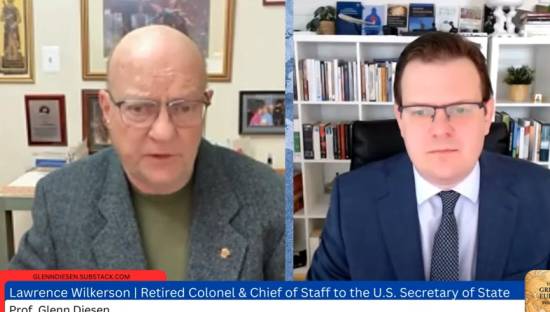
Editor’s Notes: In this urgent episode, Glenn Diesen is joined by former Colonel Lawrence Wilkerson to provide a sobering analysis of the rapidly escalating conflict involving Iran. Wilkerson critiques current U.S. and Israeli strategies, specifically highlighting the dangerous implications of arming Kurdish fighters to trigger a domestic civil war within Iranian borders. He warns that a fundamental misunderstanding of the region by American leadership could lead to a global catastrophe, potentially drawing in powers like Russia and China while crippling the world economy. This deep dive offers a critical look at the high-stakes “great game” being played in the Middle East and the potentially disastrous consequences of current military policies. (Mar 5, 2026)
TRANSCRIPT:
Introduction and Overview of the Conflict
GLENN DIESEN: Welcome back. We are joined today by Colonel Lawrence Wilkerson, former Chief of Staff to the US Secretary of State. Thank you for coming back on. I’ve been dying to get your take on what’s happening in Iran, but first of all, you sent in a text to a newspaper on the first day of the war where you said that how this war developed depends on many things.
It depends on the actions of Russia and China, the shortage of vital munitions, the resilience of the Iranians, the actions of other actors on the grounds, the energy facilities, how they are impacted. Also, what will happen to these critical straits, i.e. Bab al-Mandab, which can block off the Red Sea, and the Strait of Hormuz. And also you ask, well, it also depends on how the American public reacts to this war.
So now that we’re in day five, how do you assess this war? I have to say, in terms of identifying variables which are important to see, you pretty much — what’s a good way to say it — you nailed it.
LAWRENCE WILKERSON: Well, first of all, I’d have to say I’ve developed some new variables, too, in addition to those. But you introduced me as Chief of Staff to the Secretary of State.
GLENN DIESEN: Oh, no, sorry, I meant yes.
Wilkerson’s Military Background and Experience with Iran
LAWRENCE WILKERSON: Yeah, that’s right. You’re absolutely right. That was my last position. But I just want your listeners to know that 31 years in the United States military, a lot of which were spent as a military planner planning for war, particularly in the largest unified command then in the repertoire, the US Pacific Command, which fed forces to Central Command. Central Command was just a tiny little blot on the map. We gave them all their forces, or didn’t give them to them most often, because we didn’t want to give them to them. Different business. Today, it’s grown to be the most powerful command arguably in the Unified Command Plan.
And I say all that so everyone listening knows that I’ve been here and I’ve done that with regard to Iran. I was there when the war started, like World War I in the Levant, between Iraq and Iran, and we backed Iraq. I was there when we made decisions to back Iraq to defeat Iran because we didn’t like Iran after the revolution. I was there when they stood up to Iraq and were going to march on Baghdad. And then we entered the war ourselves with naval combatants in the Strait of Hormuz, one of which was hit with a mine and we almost lost it. Another one limped back after Saddam Hussein fired two Exocet missiles at it and hit it. Bridgeton, an oil tanker, was hit. The captain was very angry with us, and on and on.
All to say, I know this region well in terms of military action, in terms of geography, and in terms of the difficulty of the terrain and the, shall I say, the nature of the Persian people, who are resilient to a fault and who fought that bloody eight years of war against our chemical weapons supplied to Saddam Hussein, and were going to march to Baghdad.
The U.S. Aegis Cruiser Incident and Its Aftermath
The culminating act, as most people will not remember or never knew, is the US Aegis cruiser in the sea fired a missile or two at an Iranian Airbus with 290-some odd people on board, and we killed them all. And that’s when the then-Ayatollah said, “I’m throwing in the towel. I’m accepting a UN resolution on how to end this conflict because I can’t fight the empire too.”
And since that time, all to say, they’ve been trying to figure out how to fight the empire. And that’s the first thing I would say about the nature of this conflict, which, if you read your Clausewitz, you know, the one thing you need to do anytime you’re contemplating using the military instrument to turn policy into violence is you need to understand the nature of what you’re entering upon — the nature of the conflict.
The Administration’s Failure to Understand the Conflict
We do not. Every statement from Marco Rubio, every statement from Pete Hegseth, every statement from Donald Trump, indeed every statement out of the administration, has indicated to me they do not understand the nature of this conflict.
The leading factor of which is we’re taking on a people who are 3,000 years old, 90 million strong, 53% Persian, and who have lots of problems, but who will seal themselves into their very doom in order to give us a truly vicious headache. And that’s what they’re embarked on. And they’re not going to stop, they’re not going to cease until the last one of them is dead.
And we can route out all the Kurds we want to try and hire them to fight for us, and others like that in the region. And therein lies another disconnect in our understanding of this conflict, the nature of it.
Netanyahu’s True Objective: Chaos in the Region
The objective of Bibi Netanyahu, for whom we’re fighting this war, is chaos — not putting in Tehran a regime that would run a reasonably functioning state, or at least a state that got along with the United States and sold us the oil and everything else.
Turkey right now needs to worry about, for example, intelligence assets of Mossad and other assets, too, that are operating in Cyprus and in southern Greece, preparing the battlefield, if you will, for when they march on Turkey.
The Risk of Global Escalation
So the nature of this conflict that I did not necessarily touch upon in my response that you sort of quoted from there is that it has every potential, not just to go regional, but to go global — to marry itself with Ukraine, for example, with our efforts in Georgia, with our efforts in Armenia and in Azerbaijan, with our efforts all on the southern rim of the old Soviet Union, to destabilize Russia and ultimately to aim an arrow at the heart of China. All of this is a part of that.
Every bit of what I just said and more is part of the warp and woof of the nature of this conflict. And we’re crazy if we think that it’s going to be confined to a few days and a few bullets and bombs, and then we’re going to march triumphant up on the hill and say we have a new regime in Tehran or whatever. First of all, Netanyahu is not going to permit that. And second, we’re not going to be able to achieve it.
So that’s what I meant by those general comments — most importantly of all, Clausewitzian to a tee, we do not understand the nature of the conflict upon which we have embarked.
How Would You Have Planned It?
GLENN DIESEN: Well, how would you have planned it? Not that you would endorse it, but again, from your previous roles there in the US Government, how would you carry out such an attack, if indeed this was an objective? And what would be the main risks? Where would your concerns be?
LAWRENCE WILKERSON: Well, the only answer to that question, if I were Chairman of the Joint Chiefs of Staff or advising him as I was with Colin Powell, I would say: don’t start this conflict. You do not want to use the military instrument in this way, in this region, period.
It was 40 years of US policy not to use the military instrument from ground bases in the region. We’re seeing one proof of that right now.
The Failure to Evacuate American Citizens
And I can’t believe that Marco Rubio was so delinquent in his duties. But I probably have to blame every Secretary of State all the way back through Tony Blinken and Rex Tillerson and a host of others. The forms, the F77s, the NEO — Non-Combatant Evacuation Operation — forms that tell you where everyone is in your ambassadorship: every American citizen. You have to have their name, telephone number, passport, all these things. And you have that all so you can evacuate them. We didn’t.
And I’ll tell you why we probably didn’t, if it just wasn’t crass stupidity on the part of Marco Rubio — because we didn’t want to give warning. We didn’t want the Iranians to see the Non-Combatant Evacuation Operations taking place and to understand: “Whoa, diplomacy notwithstanding, we’re going to war because the Americans are going to attack.”
So now we have a lot of American citizens stranded and very difficult to get out because the airports have been closed. You can’t fly in, you can’t get them out. So we might have some civilian casualties there before this is over. And I lay that directly at the feet of the Secretary of State for an incompetent job, concentrating on too much other than his real responsibilities.
Advice to the Chairman of the Joint Chiefs
So all that to say — I wouldn’t start. The military instrument is not the instrument to use in the Levant, period. That’s my advice to you, Mr. Chairman. Please, under the new law, the Goldwater-Nichols Act, the DoD Reorganization Act of 1985, I have the same power you do to advise the President. So you coming with me to the White House? That’s what I’d say to the second Pete. “You coming with me to the White House? I’m exercising my right under Goldwater-Nichols. I’m going to advise the President. You coming with me? If you’re not, I don’t care, because I’m going to tell him: don’t do this.”
Which apparently Cain did try — the Chairman of the Joint Chiefs of Staff did try to register some objections. I’m told they were based on munitions we don’t have, particularly air defense missiles, on the danger for surface combatants in the region given the incredible array of missiles Iran has, and some other things like that. But he was not a happy camper, I don’t think, about using the military in this matter.
The Rapid Spread of the Conflict
GLENN DIESEN: I wanted to circle back a bit to what you said about Turkey, because this is an interesting element. And this whole war, it’s spreading so fast. I mean, we’re in day five and we’ve already lost track of how many countries have been pulled into this and been attacked.
LAWRENCE WILKERSON: Look at India, for example. They don’t have 25 days of oil on hand. It’s about $15 billion they’ve got to raise immediately just to reach the oil prices that they are now. And they’re going to go higher. So you’re right.
Turkey’s Position and Israel’s Regional Ambitions
GLENN DIESEN: But pulling in Turkey — I think that would be a disaster. I don’t think they could be pulled in because they say they’re not a participant. They deny that Israel and the US were allowed to use their airspace. They don’t like Iran attacking the Gulf states, but they’re also not happy about America attacking Iran. So they kind of just want to distance themselves from the whole thing.
But you were mentioning these wider ambitions of Israel in the region. And when you had the US Ambassador to Israel, Huckabee, he was interviewed by Tucker Carlson, and Tucker Carlson asked, you know, does Israel have the right to do this? And well, more or less half the Middle East, if they can take it, they should have it — more or less, that was the message, because God gave it to them or something along those lines. This must surely shock the region.
And as you said with Turkey, it’s also trying to reposition itself in the world again. America’s not the only game in town. It’s a multipolar world. They want to diversify. They don’t want to join any anti-American groupings, but on the other hand, they have to look after their own national interests as well. So how do you see it — do you see any pathways to Turkey being pulled into this mess somehow?
Turkey, the Kurds, and the Risk of Regional Escalation
LAWRENCE WILKERSON: I think they’re already in it, really. I know what you’re saying and I know what their public voice has indicated, but I think they’re already in it. I think they are very concerned about Israel stirring up the Kurds and arming the Kurds, which is happening, I think, in order to fight Iran and having that battle turned around the other way because Erdogan is not like any Turk, any Kurdish group being armed to the teeth, as Israel is apparently doing with these people.
So I think they’re already watching it very closely. They’ve got people on the ground, they got people in the area, they got people reporting back to Ankara. I don’t know where they’ll go though. That’s the question here, because Erdogan apparently had a meeting that I’m told was really, really pure Netanyahu convincing Erdogan that his future lay with the capitalist ingenuity, the energy, the bombast, the talent and so forth of the Jews in Israel.
I mean, Netanyahu is very explicit about this, especially when he’s talking to other leaders. “You join with me and we’ll own the Mediterranean. And much more than that. You join with me and you will have access to the highest degree of technological talent, the highest degree of AI skills. And don’t you believe for a moment that the empire is — that we are, we are. So ally yourself with me and you’ll be on the cutting edge of the new Mediterranean world led by Israel and you.”
He always would add that. I’m telling you how that works. And it’s stunning that people keep falling for it. Not Trump, but Erdogan is supposed to be a little smarter than that.
And I’m not so sure about Modi either. Modi is almost as bad as Netanyahu in his desire to kill Muslims. So that’s why he’s been so supportive of what Netanyahu is doing in Gaza and on the West Bank and elsewhere. But Modi’s got a shock coming to him too.
India’s Energy Vulnerability
As I was indicating in my preliminary comments, India doesn’t know what it’s going to do now. 60% of its oil comes through the Strait of Hormuz. 60%. China only has about 21%, and already they’ve only got 25 days on hand right now. Already the price of West Texas Intermediate and Brent crude, the benchmarks, is going up.
And when I did the exercises in Beijing — in a much more cooperative world with the Chinese, the Japanese, the Europeans, everybody was there. Lloyd’s of London, MARAD, most of the shippers were there looking and observing — it went to $200 a barrel. In this case, in the Strait of Malacca and off Ras Tanura in Saudi Arabia, which at that time was about eight and a half million barrels per day productive capacity, that was a serious blow. That’s what really sends prices up. And shippers wouldn’t ship and insurers wouldn’t insure. So you had a real problem.
Because of the cooperative spirit in the world at that time, and very visible at this simulation, the Chinese actually went back to their MOFA, their Ministry of Foreign Affairs, to get permission to make a decision in this game. It was so serious to them. Chas Freeman was there, and you know, he speaks Mandarin fluently. They didn’t know that. And so Chas is sitting there listening to everything they’re saying and understanding it. At a later breakfast, when he revealed the fact that he did, they were quite stunned. And they were going over their notes to see what they had said.
All to say that we came to agreements on shifting oil all across the world. We shifted oil away from China, toward Korea, away from Alaska and toward Russia. We moved oil because it was so serious. This is the only commodity on the face of the earth that every state extant needs, and we found that out in that game. As I said, the price went over $200 before we got through.
Oil Prices and the Strategic Petroleum Reserve
I think we’re looking at another potential for that. And without the cooperative spirit in the world — I mean, tell me what kind of spirit we’ve got in the world right now. Much of it laid at the feet of the empire we’re creating. But I don’t know what it’s going to mean in the long term, except I think a lot of people like Putin are going to make a windfall profit, and a lot of people like Modi are going to be sorry they ever said a word about anything, because they’re going to be in tough shape.
I was told this morning by an Indian who knows India pretty well, knows business in India pretty well, and he said, “This will be a tragedy of the first order for us if we really have to pay what is being forecast that we might have to pay.”
On top of all of that, let’s look back at the empire. Trump made a promise. I think the promise actually started in his first administration, but it certainly recurred in his campaign for the second. And in the opening days of the second, he made a promise to the American people that he would restore and fill up the strategic reserve. 500 billion — I think it’s billion gallons. Yeah, it has to be billions — is the figure that the security state says is essential. We’re at 415 right now. He didn’t put a penny in there. He didn’t put a gallon in there.
So we’re sitting in a situation, too, where we might have to ramp up production, we might have to do all manner of things in order to get what we need. And it’s going to cost. It’s going to cost majorly. And it’s all because he didn’t bother to do anything in fulfilling his promise to put the reserve back where it should be.
The Gravity of the Conflict and Nuclear Dimensions
So all of these things are playing in the nature of this conflict to make it, what I say, a much more serious exchange of arms — if you will — than anybody right now is thinking, even probably including Tehran. This is serious business.
And the fact that I know positively that nuclear weapons in Israel will be moved, that some have probably already been uploaded or at least put in the stages of uploading — I know that Netanyahu would not hesitate to use a nuclear weapon. That’s another dimension to it.
We have a really strange phenomenon here. We have two nuclear-armed states — one avowed, the United States, and one criminal, Israel — attacking a non-nuclear state. You can’t make this stuff up. This is extraordinary what we’ve done. Showing Iran that they made a huge mistake, that they should have built a nuclear weapon, and then they’d be in North Korea’s state. They might be a pariah, but they would be safe and they wouldn’t be being pummeled with bombs and missiles.
Munitions Shortages and Military Realities
But there’s the other question that I have of my military colleagues. How is it that you’re going to win this exchange of modern-day armaments — that you were schooled in majorly, or should have been, since the special military operation started in Ukraine — how are you going to do this when you don’t have the munitions? And from everything I’m hearing, Iran does. And you are not attriting what Iran has fast enough to keep up with the missile shortage you have.
And Iran is doing this very carefully. They’re not expending things rapidly. They’re pounding Israel as they can. The very first time they shot something in there that Israel wasn’t aware of, it was just a simple little drone, and they killed something like 22 people, wounded 66 — or killed 22, wounded 66, with some missing, whatever. And they’re all civilians, which is not normally what Iran does.
But when you’ve got a barrage coming in now, and Israel hides a lot of its military facilities underneath or alongside civilian installations on purpose, because it knows Iran doesn’t like to hit civilian targets — so you just have so many imponderables here.
And when I hear people like Hegseth and others saying, or Trump bragging, that we have more missiles than you can shake a stick at — well, I know how many missiles you have, Mr. President. I can give you the total. You probably don’t even know what the total is.
I can also tell you that when they hit Bahrain — and Bahrain was cheered, for example, cheered that Bahrain had been hit — Fifth Fleet headquarters, they also took out, apparently — I got pretty good word of this — took out the vertical missile launcher loading apparatus, the crane and everything you need to load the vertical. It’s a very complicated process, loading these vertically fired missiles in these combatants. So they’ve got to go all the way to Diego Garcia now, which is a fairly long trip — turn, go there and go back.
So all kinds of things are happening right now that lead me to believe that not only do we not understand the nature of the conflict, we simply don’t understand our capacity to wage it.
The Folly of Ground Troops in Iran
And the president talking — however offhand — about ground troops, and Hegseth talking about ground troops, is pure nonsense. You could put a million American soldiers in Iran and they disappear in five years. They’d either all be dead or prisoners or lost somewhere.
We put 12 million men into a 70 million country called Germany, and Japan with another 70 million. And that was a colossal effort that we only managed because we needed so many people back in industry, and we counted on the Soviets, of course, to really take the Wehrmacht on and do the damage to it. And they did.
But look at the comparison. Here we’re looking at a 90 million-person country, a huge country, much larger than Iraq, with terrain much more difficult than Iraq, and pretty good cohesion among the 53% that are Persian, if not most of the rest of them — especially since we’ve done what we did, like bombing the school and killing the children. No better way to fuse a population against you.
And for that matter, killing the religious leader who wasn’t hiding, who wasn’t stuck down in a bunker. He was in his office, in his home, because he was ready to be martyred — and he was martyred. And he will be remembered as a martyr. And he’s probably done more to bring the two sects of Islam, the two major sects of Islam, together than anything in a long time.
So the nature of this conflict is going to eat us up. And Rubio and Trump have no concept of it.
GLENN DIESEN: Well, what you’re saying — there are so many strange things that have happened. For example, the US spent all this time trying to convince India not to buy Russian oil, and now they wish they were buying more. But also this idea about the shortage of munitions — Trump went out on Truth Social and wrote that we have unlimited of these weapons. And then on the same day, they started pulling back — at least discussing sending the THAAD missiles and Patriots from South Korea to the war theater against Iran.
So everything he says is just nonsense. This is — they still haven’t valued it.
Losing Allies: The South Korea Warning
LAWRENCE WILKERSON: If you give me just one moment, because that’s a very poignant subject. Nothing gives an ally less faith in you than when you get into duress — I’ve been there, I’ve done this — and you take your equipment designed expressly to defend them away and put it in another conflict. That says to that ally, “I can’t trust these people.”
And right now, in this case, South Korea is debating every day. They debate in their clustered rooms whether or not they want to stay in the alliance. And it’s obvious why. Because they understand the only reason we’re on the peninsula is to fight China, not to protect Korea. And they don’t want to fight China, thank you very much. They’ve got a good relationship with China. It’s a hell of an economic relationship. They don’t want to fight China, and they know we’re there to fight China from their peninsula. What does that mean for them?
So we’re going to lose Korea. I predict we’re going to lose them within 24 months. And this just sped that up a bit.
Arming the Kurds: Consequences for Turkey and Iran
GLENN DIESEN: But on arming Kurdish groups — this is something the US is now seriously discussing again. The ramifications are beyond — it’s a huge topic. Because first of all, what would this mean for the US-Turkish relationship? Because it is something that will alienate the Turks even more if you start building up the Kurdish groups.
But this has also been done before. In 1991, President Bush encouraged the Iraqis to rise up against Saddam Hussein, and they were left to their own and slaughtered. Also in Syria, the Kurds were also seen as being used against Assad, and then again seemed to be abandoned.
So I’m not sure how well the Kurdish groups in Iran, to what extent they’re able to get them on board as frontline soldiers. But if you have these four countries with a lot of Kurds — that is, in Iraq, Syria, Iran, and Turkey — and the US now arms the Kurds in three out of four of those regions, this can’t be good for the relationship with Turkey. This is a massive military power, by the way.
And also, what would this mean for Iran? That’s also tied to it. Because a few days ago, we were still pretending that the purpose of the war was to help protesters and stop ballistic missiles. Now this is about stoking civil war. This is burning a country down — 90 million people, with hundreds of thousands, if not millions, dead if they’re successful in triggering a civil war.
So I guess the humanitarian way of selling the war was always a facade. We do it every time, and it works every time. I get it. But surely that must be out the window now.
The Unconscionable Nature of U.S. Actions
LAWRENCE WILKERSON: I think it’s unconscionable what we’ve done. So what’s new? People tell me, people ask me in emails, “What’s new? Larry, you were there. You saw how unconscionable we are under a whole series of presidents since, especially since George W. Bush and 9/11.”
But I think there’s a new tone and intent to this. And it’s that way, I think, because we have, as I said, so little understanding of the region and so little understanding of the people. At the same time, we’re killing them at a rate that’s probably fantastic once we find out how many are dead already. I’m hearing 150 or a thousand or whatever.
In Iran, with all the ordnance that Pete Hegseth says has been dropped, if that’s all they’ve killed, then they are sorry shots. That’s all I got to say. Because there are people all over the place in that country, especially where they’re attacking. And we’ve already seen they killed children in the school. I think they hit a hospital now. They had nurses running out in the street. Not very good targeting, dudes.
All to say that I don’t think we care anymore. I really don’t think we care. We’ve been carefully taught by Netanyahu, who doesn’t care a hang about all the civilians — men, women, children, babies, dogs, cats, and everything else he’s killing in Gaza, in the West Bank.
John Hagee and the Holy War Narrative
Now listen to John Hagee, just a few minutes ago, right before I came on with you — head of Christians United for Israel. Here’s John Hagee up there, just like Huckabee, saying, “This is a holy war. This is a holy war. And you go, you boys and girls out there, we’re praying for you. We’re praying for you. But you are on the right side. You are bringing about Armageddon. You’re bringing about the return of Jesus Christ.”
This is a guy who influences a lot of Americans with his preaching about being on Israel’s side, like Huckabee demonstrated in that traitorous interview he gave. But nonetheless, he told the truth — told the truth on Netanyahu in particular.
Hegseth’s Purge of the Military
So we’ve got all these different currents working right now. We’ve got Hegseth working on the U.S. Armed Forces at the rank level with preachers and Christianity and taking their oath to God and Jesus instead of the Constitution. And we’ve got him working on the upper ranks by letting people go. This director of the Joint Staff, a three-star Navy admiral that he just let go — he’s carefully vetting the military so that when January 6th comes again, the military will not stand on the sidelines.
He’s building the military to support whatever coup has to happen, whatever Trump has to do, whether it’s a full-fledged coup or canceling the midterm elections or something in between. He’s building a military to do that. And it’s really alarming watching him do that.
The Impossibility of a Ground Invasion of Iran
And this is a perfect reason, once we find out how badly enmeshed we are and have to either withdraw or double down — and can’t double down because we don’t have any men and women to double down with in terms of ground forces. And Hegseth has already talked about ground forces. We can’t do that.
The most we could put on the ground in Iran is 400,000 to 500,000. And I don’t think we could do that. Just as Netanyahu is finding out with this 90,000 reservists call-up — lots of them aren’t showing up. Tell me where 18 and 19 year olds in this country, were we to fully mobilize, would go if they suddenly found out they were subject to the draft. Mexico and Canada.
We can’t do this, Glenn. And yet we are posturing as if we can, even to the extent of going all the way and mounting an invasion of Iran. Someone asked me, “Well, how would you ever do that?” I said, “You’ve got amphibious bottoms. We don’t have many. The Marine Corps has been complaining for 20 years and it’s gotten worse every year. But there’s enough if we throw them all together, even the broken ones, and we sail them over there and we put the Marines, even the broken ones, on these bottoms.”
We could probably somewhere around Bandar Abbas, or somewhere on the southern coast there, put a force ashore. It would be swallowed. Within six months, it would disappear. So that’s where we are.
The Kurdish Question: Iraq, Syria, and Iran
And it’s absurd — your question about the Kurds, from which I deviated majorly. I dealt with the Kurds most closely in northern Iraq, Operation Provide Comfort, and then the absolute backing away from our promises to them and their saying “never again.”
And starting fairly — in fact, in terms of Iraq today, modern Iraq today, they’re probably the most successful portion of Iraq. Sulaymaniyah and other places, Erbil and other places up there. They’ve gotten a good agreement now with Baghdad about the oil, and the majors are back in because the majors did not want to go in there and mess with that Kirkuk and Mosul oil. Because if there was a dispute between Baghdad and the Kurds, the majors didn’t want the lawsuits that might fall out of that. So they’re apparently going back in now because they’ve settled that. This will perturbate — that may. So that’s your Iraqi Kurds, who had come to a modus vivendi with Turkey.
They were getting along pretty well because they said they would not rile up the Kurds in southeastern Turkey. They would not send agents into Turkey, and they pretty much lived by that. And Turkey promised not to invade them. They periodically invaded them and pounded them a little bit.
In Syria, it’s a different ballgame altogether. I think what best describes Syria is chaos for everybody — all the groups except Israel. Israel has been busy going around and making sure every little foot it consolidates is consolidated in a way that’s defensible. So they’re taking little pieces of Syria as they go along. And they don’t give a damn about Damascus. They’d like to have it and probably covet it very much, but they don’t give a damn right now about it.
The Most Dangerous Kurdish Group: Iran and Syria
And then as far as the Kurds, as they overlap in Iran and Syria, I think that’s the most dangerous group right now because they haven’t gone through this process of learning, such as it was, that the Kurds in northern Iraq have. So they’re apt to try something just because it’s arms and they’re free or whatever. But I don’t think they’ll be very successful because I think the Iranians have that sort of thing in mind.
One of the reasons they got the helicopters from Russia — the latest shipment of major end item equipment from Russia was helicopters, tactical helicopters — I think the reason they got those was just that they’re the best weapon to use against these border infiltrators, if you will, these armed people that are trying to overthrow the Iranian republic. And coming from places in the northern part of the Persian Gulf and on up into Azerbaijan and Armenia, they’re best dealt with using helicopters.
So I think that’s what they got the helicopters for. They anticipated this and they said, “Okay, come on.” That plus SAS — they wanted to take on the British SAS with these helicopters too, because warfare has proven over the last decade or so that’s the best way to use against irregular forces like that, that are regular guerrillas actually working for a state.
So I think the Iranians have thought this out. I really do. I think they’ve thought it out. No doubt there will be some surprises for them. But of all the contestants in this conflict, they’ve thought it out the longest and the best.
The Contradictions in U.S. Policy
GLENN DIESEN: As you spoke, some contradictions came to mind. That is, the Iranian government is unacceptable because it’s a theocracy — that you have the religious leadership having political power — but at the same time you have the U.S. ambassador Huckabee saying Israel should control half the Middle East because God gave it to them. And also we have to prepare for a holy war, you know, and pledging allegiance to Jesus, all of this.
But it’s a little bit the same with the nuclear weapons, as you also suggested. That is, we have to fight the Iranians so they can’t develop nuclear weapons. However, they said that they won’t develop nuclear weapons. Our intelligence said they’re not developing nuclear weapons. They signed the Non-Proliferation Treaty. They agreed to the JCPOA with additional inspections for transparency, allowing in the IAEA, and they were doing all of this. While an illegal nuclear power — Israel — which didn’t sign the Non-Proliferation Treaty and acquired nuclear weapons, demands that Iran must be disarmed on nuclear weapons it doesn’t have, or stop a nuclear weapons program it doesn’t have. It’s all very bizarre to see these contradictions.
LAWRENCE WILKERSON: But throw one more bizarre aspect of it in there. Trump destroyed that program, remember, with the B-2s.
Contradictory Narratives and the Absence of a Coherent Story
GLENN DIESEN: Oh yeah, it’s obliterated. And also on the White House press releases, anyone claiming it’s not obliterated are spreading fake news. Now here, on the other side of that, it is very bizarre. I don’t think they thought out the narratives yet either.
I saw Rubio talk to the journalists. He was making the point that, “Listen, it was a justified war. We had the right to attack because the threat was imminent.” So why would Iran attack you? Well, Israel would attack Iran, and when that happened, Iran would attack us probably. So that made it imminent. Now it’s legitimate. And then they said, “Okay, so Israel started it. They pulled us in.” “No, no, no, that’s not what I said.” It’s like, yeah, it’s pretty much what you said.
So they don’t have the story straight. It’s very — at least in Iraq, as horrible as it was, they were hammering on about weapons of mass destruction. All the media were repeating the same talking points. There was a narrative in place when it wasn’t. They had the fallback option of, “Okay, we were just spreading democracy.” But here they’re actually contradictory narratives.
And it doesn’t — we have to help Iranians, you know, they deserve freedom and peace, and oh, a brutal government. At the same time, we’re bombing the airport, hospitals, schools, civilian residences. I mean, it’s just — and to top it all off, even the Speaker, Mike Johnson, he came out and gave a speech and he was making the point that Iran started this war. “They declared war on us. We never went to war. We had an operation.” He didn’t call it a special military operation, but an operation. And then now the Iranians started the war. It wasn’t us. We were just bombing a little bit.
And he was also making the point that what they did is unforgivable. “They attacked American embassies in Saudi Arabia. And all this is sovereign territory.” But you bomb their schools, their hospitals — this is also sovereign territory. You should watch this. It’s a crazy speech, but it’s the same kind of contradictions and the failure to construct a cohesive narrative for everyone to kind of rally around. But there’s nothing there.
At Least Hagee Is Consistent
LAWRENCE WILKERSON: At least I’ll say this for John Hagee — I find it really makes me ill to listen to him, but he says the truth. “We are out there. You are out there. You are crusaders for Jesus Christ. We are going to win.” And of course, what he’s going to win is the Rapture. Jesus is going to come down and kill all the unbelievers and establish a thousand-year kingdom, and all these people will be wafted up to heaven in this kingdom. But at least he’s consistent and he doesn’t make any bones about it.
These people lie all the time, and the lies are becoming so piled, one on another. Rubio — if you saw that, you saw the same one I did, I guess — because he’s actually picking the questions because he knows this reporter is smart. Or he knows this one. So he’s saying, “I’m not talking to you. You, you, you.” He got so flabbergasted, I thought he was going to flip a lid right there on the spot. I wish he had.
We can’t keep our narrative straight. Not only amongst people — Hegseth, Rubio, Trump, anybody speaking, that bimbo who speaks for the administration — not only is that inconsistent, but the individuals are inconsistent themselves from hour to hour and day to day. Who the hell in America could make heads or tails out of anything in terms of what Trump is really trying to achieve? And I think that’s why you’re seeing polls that show less than 29, 28% of Americans support this.
The World After This War
GLENN DIESEN: Well, he ran on no wars, and now he’s doing exactly the opposite. But early on, you were discussing how essentially the world won’t be the same again after this. Perhaps that is — how will this affect the relationship, you think, between the Gulf states and the United States, or Israel and the United States for that matter? Those are big questions, but —
China, Russia, and the Strategic Endgame
LAWRENCE WILKERSON: Those are huge questions. I think you probably need to start with how much of this — I’ve been taken to task by a number of listeners in the last 48 hours for not enumerating my thoughts on this. I’m not sure what they are.
There are some people out there who believe, and some of them are in a position to know more than I, that this is all about China and secondarily Russia, and that what we saw was an avenue of opportunity, if you will, that we could mask in things like Iran’s nuclear program and ballistic missiles and everything else about which we don’t give a hang. What we’re trying to do is damage China and along the way, Russia.
And they cite as prima facie evidence of that the fact that — what did Russia and China do? They signed a trilateral, not a bilateral each with Iran, but a trilateral defense pact with Iran that showed everyone that they were in for whatever might come. Well, we’re using this to go after China and, as I said, secondarily Russia.
We’re still agitating in Georgia. We’re still agitating in other states along the southern rim of the old Soviet Union. Russia today, we’re still trying to do damage to Russia in that way. Tbilisi is the most obvious one right now, where the government’s hanging on by the skin of its teeth.
And that’s a sound argument. If the great game is afoot again and afoot in a way that shows some astute players. I just don’t see the astute players. I see chaos. I don’t see the great game being orchestrated by a czar in Moscow and a potentate in London and someone else in the Ottoman Empire or whatever. What I see is chaos, and I see China and Russia ultimately benefiting from that chaos.
Maybe not prima facie, in your face, ultimately, or in this particular theater, but I think ultimately they’re going to benefit from it because they’re winning. I’m sure Xi Jinping doesn’t want anything to do with the hot war, but I’m sure he would not refuse it if it came to an opportunity to do mortal damage to the empire that would not accrue to his disadvantage.
One of the reasons he hasn’t moved any faster with economic sovereignty, if you will, over the world is because he understands how important the Western economies, particularly the US, are to the global economy. And he doesn’t want to do it precipitously and dangerously.
China’s Move to Replace the Dollar
I was really surprised he just came out now with the new mandate that the Renminbi is going to replace the dollar. He essentially said in that statement — I passed it by Chas Freeman, so I know that the Mandarin was translated properly — he says in that statement: “We are the number two economy in the world.” I think he’s not boasting — industrially, Chinese capitalism, technologically, militarily, and so forth, I think they’re the number one. The one area we aren’t paramount in is finance.
And then he goes on with the operative statement: “The only way we can do that — I didn’t want to do this. Deng Xiaoping is rolling over in his grave as I say these words. Didn’t want to do this because I know how debilitating it is. I am going to put the Renminbi forward as the world’s new transactional reserve currency, a replacement for the dollar.”
He said that in writing. So that means he’s ready for the fight now and ready to finish it. But I don’t think he wants to finish it in terms of blood, in terms of bombs and missiles and maybe even nuclear. I think he wants to finish it indirectly, if you will. Good old Sun Tzu action out there.
But I wouldn’t try him. I wouldn’t try him. And if he figures out that this is an effort not just to block his southwestern Belt and Road Initiative and the effort to build a new trade route up along the Gulf and into the heart of Russia — if he figures out that this is really aimed at him, he will throw his weight into this conflict and terminate it very early.
The Submarine Threat in the Arabian Sea
Just submarines, Glenn. Russia and China together could take care of every combatant in the Arabian Sea just with submarines. It is the most hospitable seawater on Earth to submarine operations — convection zones, salinity levels, convergence zones. You can actually be in a top-of-the-art attack submarine beside a top-of-the-art enemy attack submarine a hundred meters apart and not know where you are, not know your enemy’s over there, or he know you’re over there. Passive and active sonar is not operative to the extent it should be in that kind of water.
So you’ve got a hundred, maybe 100 submarines that could be active in there — with the Chinese diesel electrics that are very slow and quiet. You’ve got torpedoes that can be fired that don’t show wakes, that sink ships without identifying what sunk them. You’re talking about a real naval war here that we would lose. No question in my mind.
Yes, we’ve got some very sophisticated submarines too. But the old adage about the best weapon to use against a submarine being another submarine is hogwash. The submarines are the most deadly weapon on the face of the earth. They still are. They were in World War II and they are now.
We took a lot of casualties in the Pacific because Chester Nimitz and Doug MacArthur and even Franklin Roosevelt didn’t understand that, nor Admiral Stark or Admiral King. Submarines had the Japanese eating rats in August of 1945. We had just devastated them with our submarines.
People say, well, you couldn’t get a diesel — are you kidding me? Tang and Wahoo, the two top killers in the Pacific, made 10,000-mile patrols. They went all the way to the Formosa Straits and attacked Japanese shipping and then went back to Pearl. They’ve got long legs. Long legs and speed in those long legs, too.
So this is just ripe for exploitation by people who know what they’re doing. And Putin’s Navy’s not tied down.
The Risk of Wider Escalation
GLENN DIESEN: Well, that’s what I meant. There are so many ways this can go terribly wrong. And if you’re sitting in Moscow or Beijing and you see the possibility of the US knocking out the Iranian piece on this massive Eurasian chessboard, it will be a disaster. So it’s also an opportunity to rebalance essentially the hegemonic ambitions.
And much like the way the Chinese saw the war in Ukraine — they know that if NATO was able to knock out Russia, they’re next. So I think it can go wrong. Are there any other wider implications here in terms of China challenging the dollar? They can’t live with this. But Ukraine — surely they’re running out of weapons as well. Zelensky’s not looking happy these days. He’s trying to trade in some, get some more Patriots by offering drones, but that’s not happening. Do you see other parts of the world being impacted by the attack on Iran?
Russia’s Battle-Hardened Army
LAWRENCE WILKERSON: I do, and I see an indirect impact on Ukraine. And it’s this — in 1865, right after most of the observers on our battlefields in that Civil War went home to Europe — they’d been at Cold Harbor, they’d been at Antietam, they’d been at Gettysburg, and then Cold Harbor and then a few other battles — at the end of the war, their messages back to Europe said: “Beware.” To their foreign ministries and to their leaders: “Beware. This is a million-man army, battle-hardened. We’ve seen them on the battlefield. They’ll be after you next.”
Of course, by 1866, we pretty much demobilized and put a few soldiers out on the prairies to fight the Native Americans. That was all. But they were scared. They were very scared.
Russia has that kind of army today — the most battle-hardened, well-trained, well-fought army in the world. And I would not be messing around with Georgia and Armenia, Azerbaijan, whatever down there. I just wouldn’t be doing it right now, because again, they are extremely competent. And we’ve had observers on that battlefield. So I know we have people — Marines, soldiers, and others — who are reporting back that this is not the army that started the special military operation. It’s learned throughout the experience of new drone warfare techniques and such. It’s learned.
So it is probably the deadliest army on the face of the earth right now. You slip off the line right now and you head on down to Odessa. You finish off consolidating Kherson. You present that as a fait accompli. You own the Black Sea and the Sea of Azov, and now you say you want to mess with Georgia. I mean, this is the game. It’s afoot. And some of the people playing are neophytes, if even that.
NATO Expansion and Future Flashpoints
GLENN DIESEN: I think that what they might be banking on as well is that any minor peace deal — not only does it risk giving a temporary pause for NATO to rearm Ukraine and start again later — but also, if it’s limited in victory, the same problem could manifest itself in other places. That is, if you have NATO expanding eastwards, what happens to all these divided societies? Be it Moldova, Georgia — all of them can be new flashpoints. So I think a big victory in Ukraine would then send a clear message to Moldova and Georgia to, well, don’t go down this path.
LAWRENCE WILKERSON: Lavrov — actually, I think it was Ray McGovern or Larry Johnson or somebody told me this — they met with Lavrov when they were there. He actually said: “The concern is NATO. The concern is NATO moving eastward. And anywhere it moves, we will check it. And this is the most obvious example right here, the special military operation. But you need to understand what our concern is.” No further.
GLENN DIESEN: Well, if common sense would return, perhaps we would find solutions to these things. But — well, thank you for taking the time and giving us some proper insights.
LAWRENCE WILKERSON: I’ve been watching your shows, by the way, and I congratulate you on having several of them that were really informative.
GLENN DIESEN: Well, thank you. I appreciate it.
LAWRENCE WILKERSON: Sure.
Related Posts
- Transcript of Elizabeth Lane Interview on Propaganda Network: Tucker Carlson Show
- Transcript of Justice Ketanji Brown Jackson Interview: IMO Podcast
- Transcript: Mary Talley Bowden Interview on Tony Fauci’s Diary @ Tucker Carlson Show
- Transcript of CIA Whistleblower Jim Erdman Interview: Tucker Carlson Show
- Transcript of Shawn Ryan Interview: Trump’s Betrayal – Tucker Carlson Show