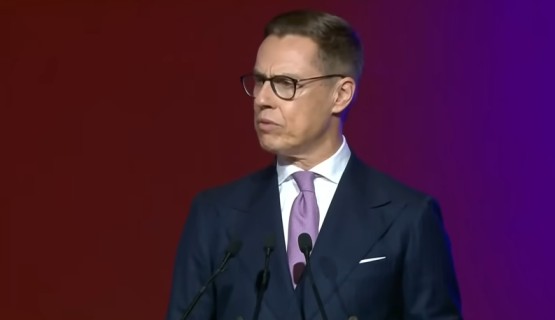
Editor’s Notes: In this compelling address at the Raisina Dialogue, Finnish President Alexander Stubb explores the shifting geopolitical landscape and declares the end of the Western-led world order. He highlights the critical role of India and the Global South in shaping a more representative multilateral system through “values-based realism” and institutional reform. By proposing a “New Delhi moment,” the President calls for a collaborative effort to rebuild global governance to better reflect the realities of the 21st century. This speech provides a profound vision for a fairer, more stable world order built on mutual respect and shared interests. (Mar 5, 2026)
TRANSCRIPT:
Opening Remarks
ALEXANDER STUBB: Mister Prime Minister, ministers, excellencies, ladies and gentlemen, it’s a great honor to be here today inaugurating the Raisina Dialogue. It’s also a great honor for me as the President of Finland to have spent the better part of three hours in the presence of the Prime Minister of India, Narendra Modi, today. We got to be such good friends that I feel I can say this. For me, it was an empowering moment because today, we stood there together representing almost 1.5 billion people. And I’m sorry the speech is going to go only downhill from here.
During the past decade, it’s been remarkable to see how Raisina has developed into one of the foremost platforms for strategic thinking and global engagement. And I think for that, we should all be thankful to both Minister Jaishankar and Samir Saran. The fact that you’ve been able to do this in eleven years and gather such a distinguished group, with some flight problems getting here, I think, is remarkable. So congratulations for that.
Three Mistakes We Make
Let me take some twenty minutes of your time and begin by the following. I think we human beings make three mistakes. The first mistake is that we over-rationalize the past. We think that the world worked in a certain way and juxtapose examples thereof. The second mistake we make is that we overdramatize the present. And when we do these two mistakes, the problem is that we end up underestimating the future.
And I’ll try to avoid that today, but the problem is that us nerds of international relations, we quite often draw parallels between the past and the present, sometimes to make convincing-sounding predictions and sometimes just to make the case that the world was more orderly and much better in the good old days. At the same time, we get quite hit up about things that we see around us, as if the world has never experienced crisis of the scale that we are presently facing.
I was reminded of this lately when, over the holidays, I read the biography of U Thant, former Secretary General of the UN, the first Asian one. The book was called The Peacemaker, and I just drew the conclusion that, at least having read that, the number of global crises is actually fairly constant. Now, by this I do not in any which way want to diminish the significance of the increase of the number of local and regional conflicts that we are now witnessing around the world.
The State of the World Today
I’m deeply concerned about what we see today in the Middle East, in Sudan, and in Ukraine, just to name a few. My worry though is that these conflicts are incrementally becoming global. And my aim today is to try to find a pathway back to an international order in which institutions, norms, and rules are respected. Without a functioning world order, power vacuums will be filled by raw power, rogue behavior, and predatory hegemons.
So today, we hear assessments that the rules-based world order is dead, that a wrecking ball is destroying all of the international institutions and rules that have been built since World War II, and that the rupture of the old system is inevitable.
Sure, we’re living through a major challenge in world politics. Sure, the old order is being challenged, questioned, and attacked. But I would argue against a binary “everything is lost” kind of a view. I think the reality is actually much more complex.
I really liked Mark Carney’s speech in Davos, and Mark was here on a visit as well a few weeks back. I sort of want to build on his speech here today, but instead of only describing what is presently wrong with the global order, or disorder as the case might be, or longing back to the good old days, I think we should set our sights on the future.
We should strive to provide concrete normative proposals on how to fix the global order and make it work better for all. That is not idealism, but it is motivated by interests and realism.
The Finnish Approach: Cool, Calm, and Collected
Now, you’ll know that we Finns are often described as being cool, calm, and collected. And I see at least two former Swedish Prime Ministers and a former Danish Prime Minister in the audience, and you can ask them. I’m sure they will agree.
Now, when the going gets tough, a Finn goes in the sauna and takes an ice bath. We consider it a good way to clear the mind, take a breather, and try to understand what is going on in the world. And that’s what I’ll try to do today, not in the sauna or the ice bath, but here from the podium.
I think this goes quite well with the theme of this year’s Raisina Dialogue, Sanskara — assertion, accommodation, and advancement, just as the chairman just noted. I think we have to sit down during these three days, take the world as it is, and make the best out of it in a dignified manner.
Two-Part Framework: The Problem and the Solutions
So today, I will kick off the Raisina Dialogue by focusing on two things. First, I will attempt to identify the problem.
So, what’s wrong with the world order today? And second, I will try to outline a number of possible concrete solutions for the future, which you can then tear apart in your dialogue. In both of these parts, I will reflect on India and what India teaches the world.
It’s an attempt by someone who’s been born and bred into the Western-dominated liberal world order to understand how the world is really changing and be open about it.
My thesis is very simple. I believe that the Global South will decide what the next world order will look like. And India, as a major power, will be a major — if not the — force in deciding whether the world will tilt towards conflictual multipolarity characterized by deals, transactions, and spheres of interests, or whether the world will tilt towards a new cooperative, fair, and representative multilateral world order based on international institutions, rules, and norms. The policy choices that India and other key powers make truly matter in this time of transition. They will set the direction of the future.
Part One: What’s Wrong with the World Order?
Let me begin by stating the obvious. The world is changing much like it did after World War I, World War II, and the Cold War. It’ll take a few days to settle, but only two things are sure. One, there are more players who have agency than there were after World War I or World War II, or indeed the Cold War. And number two, the starting point for a new settlement is different from 1918, 1945, and 1989.
The global power balance has shifted. The Global South has both demography and economy on its side. I mean, here we are in a country which is portraying growth rates of seven percent, probably projecting all the way to 2047, and at the same time, it’s the biggest democracy in the world. But my argument is that the era of a Western-dominated world is over. That’s the disruption.
This is obvious, but it will take some time to sink in across the West. Nostalgia can give us lessons, but it rarely provides us with solutions. So I think that a good starting point to any analysis is to deal with the world as it is, not with a world that we would wish it to be.
So, we live in a time of power politics, a time where might seems to make right. Violence has once again become a go-to foreign policy tool used around the world with very little restraint.
In Ukraine, Russia is trying to subjugate a sovereign country through a war that is a blatant violation of international law. The way this war will end will have major consequences not only in Europe, but globally. It is in all of our interests that the outcome does not reward the aggressor.
In the Middle East, the events have taken rapid turns. We’re now witnessing a regional escalation with countries who were pushing for diplomatic solutions. I had the chance to speak to the President of the United Arab Emirates yesterday and the Emir of Qatar today, while getting insights from the Prime Minister of India on how he sees the situation.
In Sudan, the vicious circle of domestic power battles and regional rivalry have led to one of the deadliest conflicts of our time, forcing millions of people to leave their home.
Gone are the days when international politics were predictable, even to some degree. Now each new day may bring new surprises and challenges to tackle. This is, of course, interesting for us who deal with international relations, but in terms of global stability, it is an ongoing challenge.
Learning from India’s Worldview
One of my favorite foreign ministers, Dr. Jaishankar, has remarked, and let me quote once again: “Europe has to grow out of the mindset that Europe’s problems are the world’s problems, but the world’s problems are not Europe’s problems.” This is what you get. You give speeches and you quote someone else, and immediately everyone applauds.
I wholeheartedly agree with you, Dr. Jaishankar. What we need to recognize is that all the three examples that I mentioned — Ukraine, Middle East, Sudan — and many other wars and conflicts, are all of our problems. We need to work together to solve them. We can see the effects of Russia’s war of aggression in Ukraine on fertilizers, on oil prices. The same thing we are now seeing, of course, with the ongoing conflict in the Middle East.
Now, does all of this mean that the liberal world order, the one we created after World War II, is dead? No, it doesn’t. The fact that the rules are broken does not make the whole system null and void, any more than someone getting caught for speeding makes speed limits irrelevant. If we give up on international rules, the current world order would collapse, but we are far from that.
Now, none of the previous world orders have been perfect. We should drop the illusion of a utopian order in which all two hundred nation states of this world live in harmony, peace, and eternal love. Instead, we should try to figure out how best to contain power in an imperfect world.
When I say we should drop the illusion of a perfect order, I should probably specify. I mean we in the West. To us, the change we’re living through has come as somewhat of a shock. History didn’t end as many expected in 1989. For decades, we got to enjoy relative peace and stability, functional global supply chains, and stable alliances. At times, we offered advice and criticism from our ivory towers to those faced with a different reality. Now our holiday from history is over. Instead of preaching and teaching, it’s time for us to learn from others, and India would be a good starting point.
India has been under no illusions. For your entire independence, you have based your foreign policy on a pragmatic and realistic worldview. You’ve showed the rest of the world what strategic caution and safeguarding autonomy means, all the while championing multilateralism and global cooperation. It is time that we all became a little bit more Indian.
Whether you call it non-alignment or multi-alignment, you’ve been careful not to rely solely on the goodwill of one partner or bloc. You have invested in your own security and actively developed partnerships in many directions. Your approach makes sense. You represent one fifth of the global population, together with Finland. And you cannot be a mere follower. You have to be an active and independent actor.
The Europeans have now also been taught a lesson from India. Passivity is not a strategy. We have to develop our capabilities, avoid harmful dependencies, and strengthen our global partnerships. And we have to continue investing in our alliances. Indeed, for a country like Finland, the collective security that NATO provides is a necessity. The economic clout that the EU projects is a must.
Despite not being part of a formal alliance, India does not isolate itself. Quite the contrary. Your power is based on active engagement. A timely example of this is, of course, the EU-India strategic partnership that took major steps forward earlier this year with the conclusion of a comprehensive free trade agreement and the launch of a security and defense partnership.
I think this was huge. This agreement and the other major trade agreements signed by both India and the EU in the past year underline the fact that we still believe in multilateral cooperation and the benefit that it brings. Our deal is not just the mother of all deals, but a strategic choice and a gesture that opens up a new era in our relationship.
Together, we’re building a partnership that can set an example to the rest of the world, a partnership that is built on mutual respect and common interest and serves to strengthen the multilateral system, not to undermine it. We refuse to believe that the future will only belong to, say, two great powers, while the rest of us are left to choose our sides. This does not hold true now, and it will not hold true in a decade or two. We should not allow it.
Part Two: Shaping the New World Order
So, let me then move on to my second part — a few concrete suggestions on how we can begin shaping the New World Order. Some of the proposals are of substance and others are of process.
India and Finland, we might be geographically different, but we understand what it means when power goes unchecked. We have both gone through difficult periods in history and fought for our democracy, equality, and sovereignty. We don’t want to see these values forgotten.
Finland’s foreign policy is based on what Samir Saran noted earlier — values-based realism. We stand by our values that we consider important and central to us: democracy, equality, justice, human rights, and freedom, just to name a few. At the same time, we are ready to engage in dialogue and cooperation with countries that do not necessarily share our values.
The aim is to find a balance between values and interests in a way that prioritizes principles but recognizes the limits of power and respects the reality of the world’s diverse cultures and histories. You cannot solve the world’s big problems — such as conflicts, technology, energy, or climate change — just alone.
In many ways, India has been applying values-based realism for far longer than we have. Thousands of years ago, Kautilya’s Arthashastra recognized that the international system is competitive and interest-driven.
Values-Based Realism and Multilateral Reform
It called for a pragmatic and realistic approach to statecraft. At the same time, the ruler’s ultimate duty was to values and ethics guided by the concept of dharma. This marriage of interests, values, and principles is evident in how India works as a constructive founding member of the UN, and one of the biggest contributors to global peacekeeping operations. Defending multilateralism is in your DNA. How then do we apply values based realism in the multilateral system?
Three Substantive Proposals
I have three substantive proposals.
Proposal number one: we need to improve representation. International institutions must not be one more tool of power for the powerful. Currently, their power structures reflect a world as it was, not as it is. The voices of the global South must be heard much louder than today.
The obvious place to start is the UN Security Council. I have proposed two permanent seats for Asia, two for Africa, and one for Latin America. And let me be clear, India should have a permanent seat in the UN Security Council. Equally, we should reform the Bretton Woods institutions. The countries where the future of the world economy is made should have a bigger say. We also urgently need to reform the WTO to work better for all of us.
Currently, the rules based trade system is not delivering as it should, and trade is being wielded as a geopolitical tool, an instrument of power. In this area, India’s leadership is needed.
Second, we must create rules and norms that bring stability but allow for diversity. Technology, especially AI regulation, is a test case. AI is a life changing technology.
It is the first technology that can be seen to have agency on its own. We are creating something new and we have to make sure that what we create works for all. For that, we need common basic rules and guardrails. But we also need to acknowledge that the different realities around the world, different systems create very different threats and opportunities. So new technologies should not deepen the digital divide between the developed and the developing world.
They should bridge it. And in my mind, India is both a driver and a bridge of AI and technology. This is a field where you showed leadership recently in the AI Impact Summit. I could not agree more with you, Mister Prime Minister, when you said in your address at the summit that AI will only benefit the world when it is shared.
Third, we need to accept local and regional solutions while developing our joint international institutions.
These two layers, local and global, can live side by side. My point is that for international institutions to survive, we need to strengthen regional integration globally. Mercosur, ASEAN, the African Union, the GCC, and the EU, and many others are examples of organizations which are good at dealing with regional challenges. Regional organizations are at their best when they support the multilateral system and amplify the voices of their members in the international arena. I add that victims of war cannot wait for perfect institutions.
We have to push for solutions in an imperfect world. Global phenomena such as climate change, migration, have local impacts. They require solutions. Overall, we need to approach that foreign policy in what I call dignified foreign policy. We have to create an atmosphere of dialogue and engage with each other on an equal footing with respect.
A New San Francisco Moment
By reforming the multilateral system to better reflect the realities of today, we have a chance to save it. At the same time, we have to hold on to the core principles of the system as it was built. Those principles are enshrined in the UN Charter, provision of the use of force, and respect for sovereignty and international law. And this applies to each and every one of the 193 members of the United Nations.
So to finish, let me make a procedural proposal on how to try to get things back on track. The foundations of the United Nations were built in San Francisco, much like the framework for our global financial system was built in Bretton Woods. I think what the world needs now is a new San Francisco moment. A moment where world leaders come together in the spirit of cooperation to think long and hard how to reform the international institutions that have served us since World War II. We need to rebalance the world order. We need to agree on the principles on which we can find common solutions to common problems.
And if I may, my procedural proposal is that we should have a new Delhi moment. In other words, that India gathers world leaders here in Delhi and begins the process of looking what happens after wars.
Conclusion: Finnish Happiness and Indian Optimism
So in conclusion, it is in our interest to make the international system more inclusive and fairer while maintaining its core values and principles. The division of power is a political reality. Some have more, others less.
How one uses power is a political choice. We can choose multipolar opportunistic competition, or we can choose mutually beneficial multilateral cooperation.
Now us Finns, we are known for eight years running as the happiest people in the world. Although I have to say that one would not necessarily draw that conclusion from a Monday morning tram ride in Helsinki in November, but statistics tells us that we are happy. Now Indians, on the contrary, are smiling people.
And you’re constantly topping one very important statistic, the one that measures optimism. Most Indians believe that tomorrow will be better than today. So let’s combine Finnish happiness and Indian optimism in constructing a fairer and a more stable new world order. Together, we are stronger. Thank you very much.
Thank you, Mister President. Now may I invite His Excellency Doctor S. J. Shankar to propose the word of thanks. Namaskar, and a very good evening to all.
Related Posts