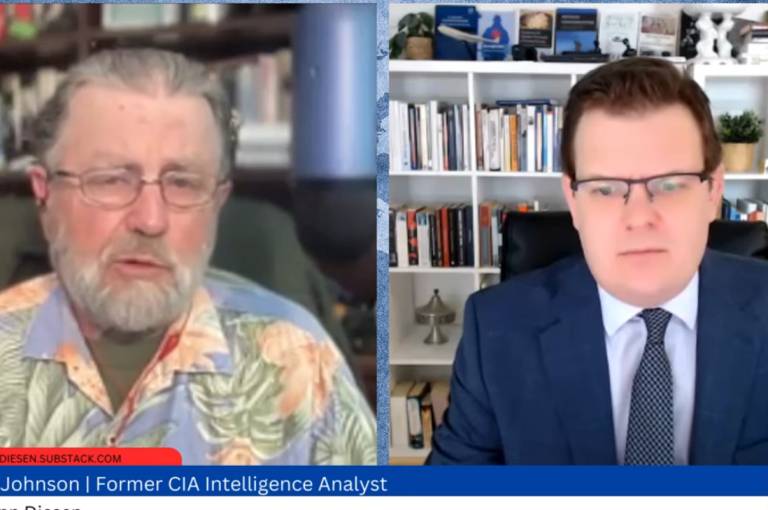
Editor’s Notes: In this insightful discussion, host Glenn Diesen is joined by former CIA analyst Larry Johnson to analyze the rapidly evolving conflict involving Iran, Israel, and the United States. They delve into the reality of infrastructure damage, the tactical use of alleged false flag operations, and the growing crisis of weapon shortages for Western forces. The conversation also examines the potential for a “Syrian solution” in Iran and how current U.S. strategies could lead to a significant decline in Western influence across the Persian Gulf. This episode provides a comprehensive look at the military and economic risks threatening to reshape global geopolitics. (Mar 5, 2026)
TRANSCRIPT:
Israel’s Hidden Damage and Iran’s Strategic Targeting
GLENN DIESEN: Welcome back. We are joined by Larry Johnson, a former CIA analyst to discuss the developments now in Iran and beyond. So we’re getting a lot of pictures coming out of Iran of some very terrible bombing. But we know in Israel they keep, they have much more stricter rules there now in terms of what they’re allowed to report on. I was wondering, what do we know about the hits that Israel is taking? Because we see Iran, we see the Gulf states, but we’re not seeing any, or not any, but we’re not seeing much footage coming out of Israel these days.
LARRY JOHNSON: Yeah, I think the situation in Israel is probably worse than it is in Tehran as a consequence. Now you’ve not had as many people killed because Iran again is not trying to kill Israelis, but it is trying to destroy their infrastructure. So both economic and military intelligence.
But one of the reasons, one of the ways you’re doing this is we have these ardent Zionists, Larry Ellison and his son who bought TikTok, so they control TikTok. And so several of the social media platforms that in the past were used to, where people took videos and posted it. That’s very difficult for people in Israel to do today. And so they’ve tried to cultivate this image that, oh, Israel’s not suffering any damage whatsoever.
And in fact, I posted last night at sonar21.com a brief video showing the complete ineffectiveness of the Israeli and U.S. air defense systems that are deployed in Israel and then four missiles, ballistic missiles impacting in Tel Aviv, across the horizon. So there are reports coming out. I’ve heard, our mutual friends Danny Davis and Doug McGregor, the three of us are sort of in conversations behind the scenes, but they’re saying that there is significant pushback in Israel. There’s growing divisions between the police and the military and protests, or shortages of food. The shelters are not adequate and people are supposed to be within a minute of a shelter in the event of an attack.
So this propaganda that’s being pushed out by the west that says that Tehran is suffering and everything’s great in Israel, it’s just the opposite. So I think what we’re seeing is increased desperation on the part of the Israelis. They’re trying to expand the war against Iran and they’re doing that through some false flag attacks.
There was a report of an attack on an oil field in Aramco in Saudi Arabia. Well, Iran got in touch with the Saudis and said, “Hey, that’s not us. We didn’t do that.” Similar things happened in both Azerbaijan and Turkey and Cyprus. So clearly the Israelis are trying to do a number of false flags, implicate Iran, particularly do it against a NATO member so that Article 5 would kick in and hopefully would bring all of NATO to fight Iran. That’s what Israel is trying to pull off. And thank God they’re failing at it so far.
False Flags and NATO’s Article 5
GLENN DIESEN: Yeah. So Mark Rutte just gave a speech saying that they weren’t going to trigger NATO’s Article 5 because a missile was heading towards Turkey. And I heard about the Saudi one as well. One would think it’s credible if the Iranians are taking credit for everything they’re doing, but saying no, not this one, that’s not us. It is interesting. It also seems, I guess, reckless almost if Iran would be behind the attack on Azerbaijan. And why one missile, or one drone, I don’t know. I’m skeptical. At least let’s say it like this.
But another key issue though is, as we’re a few days into this war now, how about the weapon shortages? Because there’s been a lot of talk whether or not the US actually packed up properly for such a long war or if it pretty much bet on it being very short. I saw both Hegseth and Trump referring to them having unlimited weapons, but I saw at the same time their discussion now about pulling weapons, that is Thaad missiles and Patriots, out of South Korea and sending them down to the Middle East. And it makes you question, well, I know they didn’t have unlimited, but it begs the question how long the Americans can keep this fight going. Of course, every reason in the world to pretend as if they can fight forever. But what do we know, because it’s not publicly available information, how much weapons the Americans have?
America’s Weapons Shortage: Patriots, Thaad, and Tomahawks
LARRY JOHNSON: Well, there are two, let’s call them defensive weapon systems that we absolutely know what the status is. The PAC-3 missile that is fired from the Patriot missile battery started production in 2015. Between 2015 and 2020, they were producing between 100 and 300 a year. So let’s go with a higher total. So 2015, 2016, 2017, 2018, 2019, 2020, that’s six years. So that gives you 1,800 possible maximum in that period. Then from 2021, 2022, 2023 and 2024, the production went up to about 550. So again, let’s just take the 550 times four, that’s 2,200. So 2,200 and 1,800.
Well, Patriot missiles have been fired in Ukraine. And normally when they’re being attacked, you fire a minimum of two Patriots against the target. So Ukraine was given 974 of these missiles. I suspect they’ve used them all up now. And then the other element is all of the Patriots are not in Central Command. They’re not under the control of the commander that is responsible for the whole Middle East. You’ve got some Patriots in INDOPACOM, they’ve got to be prepared to fight China, and European Command should have some as well. Well, so you get down to it, there’s a very, very, very small number of Patriots left.
And unlike what Russia did at the start of the special military operation, where they basically had factories that they could open, they had material, they just doubled production, tripled production, they put their personnel at work 24 hours a day, seven days a week, the United States doesn’t have that. So the Patriot missiles — in fact, in this current campaign against Iran, I anticipate the United States will no longer have any Patriot missiles to fire by the end of next week. They could be out that quick.
The Thaad missile, what do they call it? The Terminal High Altitude Area Defense weapon. That’s like the Patriot, except instead of costing between 3 and 6 million dollars a missile, each of those missiles costs like 12 to 13 million dollars, and they only produce 79 of them a year.
So the United States is not sitting on ample supplies of weapons. And then you get to the issue of things like the Tomahawk. Producing Tomahawks requires some rare earth minerals that China’s holding onto. So it’s not even like, even if the United States had the industrial capability, you can’t just go flip the switch and start cranking them out. So there are supply chain problems. There are structural problems with the lack of factories, lack of trained workers, lack of material.
So yes, this burst of activity we’ve seen since last Saturday, the United States is not going to be able to sustain it over another three weeks. In my judgment, they’ll have to curtail, cut back.
Boots on the Ground: The Kurdish Gambit
GLENN DIESEN: But how do you see it? Given that the war isn’t going well, the United States could begin to run out of ammunition. The Iranians obviously struck some bases, which makes it difficult to refuel and replenish weapons. So if they have to sail very far away, the logistics becomes a problem too. So it looks as if the strategy changed a bit. Instead of liberating Iranians, they now seem to be just mass bombing Tehran. But there’s also now not just talk, there’s movements already about boots on the ground. Probably not Americans, I think, at least. But at least proxies like the Kurds. What do you make of this?
LARRY JOHNSON: Well, if the Kurds are stupid enough to believe the promises of the CIA, they’re going to join a long, long line of people around the world, through history, that have trusted the CIA and wound up being betrayed, killed and impoverished. Look at what happened in Vietnam, or actually Laos, to the Hmong. They were recruited to fight against the North Vietnamese. And then when the North Vietnamese prevailed and won the war, the Hmong found themselves on the outs. And instead of the United States rushing to save them and take care of them, it was just, “Too bad, you’re on your own now.”
This is a bizarre strategy to try to put boots on the ground in Iran. The Iranian territory, especially along its western border with Saudi Arabia and Iraq, is rugged terrain equivalent to what we’ve seen in Afghanistan. Mountainous, difficult to operate in. So yeah, you could put an insurgent group in there, but they’re going to be so isolated, they’re not going to be affecting the country’s politics at all.
And then you get to the issue of logistics. How do you keep them supplied? If they’re shooting any kind of ammunition and they get into a firefight, where do they get more ammunition to fight with? Because, I don’t know if you’ve ever carried an ammo can, they weigh about 22 kilos, well over 40, 45 pounds. One man can maybe carry one of those, but you’re not going to be carrying two. You’ve got to have other things on your back. So this notion that they’re going to put a ground force in to put pressure on Iran, it’s going to end in a disaster for that ground force.
In fact, there are early reports already overnight that the Kurds did try to infiltrate and they were immediately ambushed by Iranian forces. And frankly, this was expected. Why do you think that Russia sold, or gave, those 28 attack helicopters to Iran three weeks ago? Because I think their intelligence is such that they knew this was part of the plan.
Downed F-15s, False Flags, and America’s Endgame in Iran
LARRY JOHNSON: We’ve seen the west trying to paint a story of Iran as it’s being shredded, its defenses are shrinking, that it can’t withstand the might of the United States onslaught. Yet in the last three days, there have been four F-15 Eagles shot down. And the last one yesterday was shot down over Iran. There was what they call a combat search and rescue mission. US helicopters flew in and rescued the two pilots, but the plane was taken down.
We’re seeing a remarkable number of false flag reports, the attempt to attack the Saudi oil facilities, trying to blame that on Iran. Iran got a hold of the Saudis and said, “Hey, that’s not us.” The attack in Cyprus, the attack that allegedly took place in Turkey, and then one in Azerbaijan. And each of those, what the Israeli strategy is right now is they want to pull in NATO and make this an expanded war, so it’s NATO against Iran, not just the US and Israel. But I think Iran’s being pretty effective in knocking down these false flags.
So the United States anticipated that by killing Ayatollah Khamenei and the key leadership, the Minister of Defense, the head of the IRGC, that this would have caused a collapse of the Iranian regime. Now what comes after that? Even as Marco Rubio said the other day, “I don’t know.” So this thing has not really been planned at all. There has been some planning, but in terms of trying to figure out what kind of outcome does the United States want? All they want is that there are no more mullahs running Iran and that whoever is running Iran will be obedient to us and do what we tell them to do and give us complete, unfettered access to their oil and gas. I think that’s what this is all about.
The Syrian Solution and Regional Fallout
GLENN DIESEN: So the Venezuelan solution. But once that doesn’t play through, it looks as if they’re going for the Syrian solution here, which is sparking civil war. This could be horribly destabilizing in Iran, and one has to ask to what extent one wants a civil war to break out in a country of 90 million. But I guess Rubio doesn’t have a plan for that either. But this of course creates shockwaves outside Iran as well. I mean, the Turks can’t be happy. How’s the rest of the region looking at the potential of Kurdish troops being used to attack Iran?
The Unification of Iran and the Expanding Conflict
LARRY JOHNSON: Yeah. No, the Turks have been in touch with the Iranians, and so actually that’s sort of the good news out of this. Turkey and Iran are coordinating now. The Western analysts, the people advising Trump and the Israelis, they genuinely believed that by launching these attacks they would rip the social fabric in Iran and create more opposition to the government. The exact opposite has happened.
You know, I know you’ve had discussions with Professor Marandi, and Marandi represents sort of a break point in the generations in Iran. Professor Marandi went into the Iranian army when he was about 17 years old in 1980-81. So the Iran-Iraq War started in September of 1980, and Professor Marandi entered service and was wounded twice. But that event, that war, for the people who were 17 years of age and older, became an important part of their psyche. It influenced how they viewed the United States, how they viewed the West.
And the people that came after, let’s say the folks who were 10 years old in 1989 when the war ends — well, that’s 37 years ago. So those people are now 47 years of age. They haven’t had any other event in their life that was galvanizing them as patriots for their nation. Until last June, the surprise attack hit them.
But now, even worse, what happened on February 28 — as a result of this, you’ve got this new generation who are in their late teens, in their 20s, in their 30s. They are now, if you will, enraged at the duplicity and the perfidy of the West, to have attacked Iran in such a cowardly fashion, especially when there were negotiations underway. And then to top it off, to kill — not just killed, but to murder — at least 165 little girls who were aged 6 to 12. This has united Iran in a way that it wasn’t united, say, a year ago.
We saw that same phenomenon happen in the United States in the immediate aftermath of the 9/11 attacks in 2001. And that’s what these so-called geniuses in Israel and the United States who planned this operation didn’t take into account. So right now they’ve made it more difficult to overthrow the Iranian regime. It’s got more support, not less.
The Sinking of the Iranian Warship
GLENN DIESEN: Well, besides other countries being pulled in, we also see the war expanded in terms of geography. That is, the United States — a US submarine sank an Iranian warship, I think not that far off the coast of Iran. Not India.
LARRY JOHNSON: Yeah, it was nearer to Sri Lanka, but they had been invited to participate in a naval exercise. So Iran had gone as part of that. The ship was not armed for combat. It was basically on a diplomatic training mission, and the United States ambushed it. Yeah.
GLENN DIESEN: So Hegseth very triumphantly even posted videos of it on Twitter. And Hegseth argued that this was the first time a ship had been sunk by a submarine since World War II. Again, very triumphantly — not correct, though. The British sank an Argentinian cruiser warship during the Falklands War. But, put that aside.
What I thought was interesting, though, is the reference to World War II, because then one often thinks of the German Nazis. But actually the Nazis, when they sank ships with their submarines, they rescued the survivors thereafter when the ship went down — being the decent, honorable thing to do. Again, Nazis. The US did not. They left it to the Sri Lankans to save them.
It’s quite shocking. It reminds me a bit about the attacks and even double taps on that boat off the coast of Venezuela. There’s something that’s died here — the civility — and there’s a certain pride behind it. Because what is it? He keeps making these comments all the time: “Well, we’re not going to be politically correct when we fight.” Just very basic rules of law, rules of war, which are just being ignored because it’s somehow seen as politically correct or woke. The effort of civilizing the process of killing each other — it’s not easy, but it’s all being thrown away. It’s quite shocking.
LARRY JOHNSON: Well, this is why he’s setting himself up for a Nuremberg trial. If somehow the United States has a complete collapse and Iran would take over, they’d be on trial as war criminals — which is what Trump and Hegseth are. They are war criminals, and that’s what they’re engaged in.
The Vovan and Lexis Prank on Pahlavi
But I was smiling as we talked about this. You know who Vovan and Lexis are, correct?
GLENN DIESEN: Yeah, I saw their video as well. That’s all this horror. I enjoyed the comedy where the sub — Vovan.
LARRY JOHNSON: I know both of them. I got to spend some time with them when I was in Russia last. They’re great guys. They’re both lawyers in their 30s. And Vovan dresses up — he claims to be an advisor to Friedrich Merz. And he says, “Yes, my name is Adolf H.” And he was talking to the Shah of Iran — the aspiring Shah of Iran, the son of the former Shah. And God, what an incredibly stupid man Pahlavi is, because he was getting pranked and had no clue. As soon as I saw the photo with the black hair and the black postage stamp mustache, I knew right away what it was. But no, he didn’t.
GLENN DIESEN: So this is actually one of them dressed up like Hitler.
LARRY JOHNSON: Yeah.
GLENN DIESEN: Called himself Adolf. But beyond the humor of it, I thought it was fascinating because of what they were promising. “Oh yes, the Germans have decided we’re going to join the war. Our Taurus missiles will now be launched on Tehran.” And you would wonder — this new aspiring leader of Iran — how does he feel about Germany sending missiles attacking Iran? He was like, “Oh, this is wonderful news. We were hoping more people will join this crusade.” I mean —
Iran’s Rapid Retaliation and the Destruction of US Radar Systems
LARRY JOHNSON: Well, what is fascinating is how quickly Iran retaliated this time compared to last June. They got hit on June 13. It took them about 10 to 12 hours before they could actually launch a missile back at Israel. And what was the other major difference between what happened eight months ago and what’s happening now? It wasn’t until the very last day of that missile exchange on June 24 that Iran finally launched a missile at a US military installation — and that was at Al Udeid Air Force Base in Qatar. Apparently that was sort of a quid pro quo that had been negotiated. I’m not sure who the intermediary was, but the United States and Iran agreed: “Okay, you hit us, we’ll hit you this one last time, and then you, Iran, get to continue selling oil to China.”
This time they didn’t wait 10 hours. Within the hour of that ambush and the killing of Khamenei, Iran was already firing back. And they started going after the US bases in particular — and not just firing randomly. They destroyed at least two, and I’ve seen reports that it’s as many as five of these billion-dollar radar systems. One we know for certain — one that was at Al Udeid was destroyed, and another that was in Bahrain at the 5th Fleet Naval Station, destroyed.
They have what’s called a multi-layered air defense system. Think of it like a pyramid. At the bottom, the foundation, are those radars. What those radars do is, when there’s a missile launch, they identify where it was launched from, they identify the direction it’s headed, and then that information is communicated to the other elements — whether it’s a Patriot missile battery or whatever. Those were taken out early on. So now both the United States and Israel are effectively blinded. They’re not going to necessarily know when a missile is being launched and where it’s headed. They can’t anticipate it like they did back during the 12-Day War.
But note this — even with that information, during the 12-Day War, Iran was still very effective in hitting targets all over Israel. And we’ve learned that the Iron Dome is probably effective against subsonic rockets, maybe a drone. But beyond that, they have zero capability to interfere with or intercept a ballistic missile traveling at Mach 6 or higher. And the same for the Patriot. Ted Postol has been on a couple of different podcasts showing how these Patriot missiles fire, they miss, and the missiles continue to rain down on Israel.
The Strategic and Economic Consequences
So I anticipate that as this attrition continues, Israel is going to get more and more desperate because they can’t stand the pain. They’re too small. Most people don’t realize that Iran is almost three times the size of Ukraine. And you look at how much firepower Russia has brought to bear on Ukraine over the last four years — and with that, it has not forced the collapse of the Zelensky regime. The park is supported from the outside, but it’s just a reminder that defeating a military force of that size, with Russia next door and not having long logistics lines — and here’s the United States trying to take out a country three times the size of Ukraine, with stronger beliefs about their nationality and their patriotism, much stronger than anything in Ukraine. It’s just an incredible miscalculation, because the United States is going to lose this.
And I think the biggest way it will manifest will not be so much through a military defeat, though that’s going to play a role. But it’s economic defeat, because Iranian control of the Strait of Hormuz is going to choke the world’s economy.
Now, some are thinking, “Oh boy, this is going to really hurt China.” They forget that, at least from Saudi Arabia — Saudi Arabia is not going to lose much in terms of oil exports. The price will go up, but it has a pipeline that runs from its east shore all the way across Saudi Arabia to the Red Sea, so they can pump it across there, load it up, and it’s on its way. It’s just going to add shipping costs, so it’ll make the oil a little more expensive.
The three Gulf states that are in real trouble are, first, Bahrain, where the naval base is located — it’s the only one in the Gulf that has an 80% Shia Muslim population, so the possibility of an insurrection there is quite high. Second, Qatar, which is the largest liquid natural gas producer in the world — it has completely shut down its facility. The reports I’ve read say that even if they restarted it tomorrow, it’d be a month before they’d be back in service. So that income has fallen off the table. And the countries that were formerly buying that liquid natural gas — where do they get alternative supplies? Because the way the natural gas industry works, you pay today for what you’re going to receive six months down the road. So literally what they were producing today was for somebody that had placed the order six months ago. Anybody that shows up new is going to have a six-month to a year wait.
And then the same with the United Arab Emirates. They’ve become sort of a false-front tourist destination. You’ve got a lot of expats, a lot of Americans living there. The ships supplying them with beef and all the luxury items are sitting outside the Strait of Hormuz — they’re not traveling. So this is going to be very, very tough on Qatar and the United Arab Emirates, less so on the Saudis.
GLENN DIESEN: Well, I also saw the Qataris had to shut down their aluminium smeltery as well.
LARRY JOHNSON: Right. Yeah.
The Gulf States’ Dilemma and the Limits of Air Power
GLENN DIESEN: And this one, according to the media, takes a year to restart. So it’s quite a, it will have a profound impact. But I was wondering how you see the wider transformation of the region because of this. Because a lot of these Gulf states, they do have, well, they rest on a lot of expats, many of them, well, people from abroad, they’re not nationals living there. A lot of them easily leave once things become unstable. Less problems, prosperous. They’re also very dependent on energy, which is being shut down. They very much linked all their security to the United States. And some of that trust is also diminishing, especially as the frontline state positions are now making them vulnerable instead of more secure.
And I think overall many of them are also growing weary of war. Many people make it seem almost like common sense that, well, of course we should reduce Iran’s ballistic missiles. You know, they shouldn’t have this capability. But what is the alternative? You know, if you have a large power like Iran, it doesn’t have a proper conventional deterrent, then it should get a nuclear deterrent. I mean, this is the logic. You want a country not to be completely vulnerable, have no weapons to defend itself. It just seems, and also being attacked to get rid of these weapons. Now you have a vulnerable Iran, a big power like you said, almost three times the size of Ukraine and 90 million people. It has reason to fear for its existence, and it’s being denied conventional deterrence. I mean, it almost seems foolish at this time not to develop nuclear weapons. And that’s something I don’t think anybody wants.
So what happens in the neighborhood now that America’s allies are taking all this punishment? The Turks can’t be happy with what’s happening. All of this is happening at the backdrop when the American ambassador to Israel, Huckabee, says, well, if Israel wants to take half the Middle East, then, you know, God gave it to them. None of this. It just seems like almost scripting their own defeat. This is a horrible, horrible strategy, if there is one.
LARRY JOHNSON: Yeah, well, it would be generous in calling it a strategy because strategy assumes you’ve thought something through and they haven’t. This has not been thought through.
I think the most immediate consequence of this attack is it’s driving the United States out of the Gulf. So, you know, we’ve had at least 10 military bases, you know, airfields or some ground troops deployed. All of those have been hit, and I don’t want to say destroyed, but rendered inoperative. In other words, the US soldiers can’t just, you know, show up there for work every day. It’s a combat environment. They’re a high threat, and they’ve actually had to close down and transfer personnel.
When this is over, I don’t necessarily see, you know, Qatar throwing open the doors. “Okay, guys, come on back in. Let’s get out there to Al Udeid and make things happen.” That’s not going to take place. The attacks on US embassies and specifically CIA stations — Iran is sending a message. They’re going to force the United States out of the Gulf. So when this is over, the United States is going to have, at best, a diminished presence, and at worst could be completely shut out. I don’t think they’ll wind up completely shut out. But it’s not going to be like it was in the golden age where the United States basically had these countries as its prostitute. And they trusted in the protection of the United States.
Now they’re finding, particularly the Saudis, they’re a little miffed. They feel that the United States is taking greater efforts to protect Israel than to protect the Saudis. So I think that’s going to be a major change. But also investment dollars. Who’s going to want to invest in Qatar or the United Arab Emirates now, or Kuwait for that matter, or Bahrain?
So what looked like a great place to invest and seemed secure, because the assumption was, well, the United States will protect us — well, the United States can’t protect. Not only has it been proven that the Iron Dome doesn’t work, the Patriot really doesn’t work. It’s not effective, particularly against ballistic missiles. And THAAD, the Terminal High Altitude Area Defense missile, not only is it terribly expensive, but it’s not effective.
So all of a sudden there’s going to be a change in the perception of the United States, on top of its duplicity. Who can trust the United States in anything, whatever they say? They promised that they were going to negotiate in good faith with Iran and they didn’t — they used it as a pretext to attack Iran. So next time somebody says the United States wants a ceasefire, that’s why Iran said no. There’s nothing to talk about with you. Iran’s going to talk with its missiles.
The Gulf States’ Security Bet and the Decline of American Hegemony
GLENN DIESEN: Yeah, I can kind of empathize or understand where the Gulf states are coming from. Because when the United States was the only great power, the only hegemon, unrivaled, the only game in town, then of course it makes complete sense to bet your security on the United States. We saw the same dynamic in Europe — countries who would join NATO would be safe. Those who would stand on the outside could possibly become a target. So you want to be on the inside, not on the outside. And I can see why the Gulf states bet everything on the only horse in the race.
But that was the comfortable, unrivaled hegemon of America. The problem in the international system is when the hegemon is in decline, when other rival powers come up, because then the instinct of the hegemon will be to weaken those other centers of power, and suddenly those frontline states can be used. You see this in the economics here, by the way. There’s a willingness to essentially cannibalize the industries, be it of Taiwan, South Korea, all of Europe, and suddenly all the nostalgia about the past, using this as a reason to still continue the cooperation, it doesn’t make much sense.
And I think the problem for the Gulf states is, where do they go from here on? Are they going to make peace with Iran? And the Americans are not going to allow this either. So what exactly do they do? Do you know much about the internal divisions there in these Gulf states? Because surely many of them must be worried about this new plan or the rhetoric coming out of Israel as well.
LARRY JOHNSON: Well, yeah, none of these are popularly elected governments. These are autocracies, essentially autocrats, tribal autocrats. And they operate with, you know, they’re dependent upon what I call a sort of modern slave labor. They import people from the Philippines and from Asia who do all the menial tasks, and they live in horrific, horrific conditions. That’s across the region.
That’s why there’s some real alarm right now. The reaction by the average man and woman on the street in Bahrain — they were cheering when those Iranian missiles were pouring down and hitting the US Naval base there in Bahrain. So the prospect that you could get the rise of a political movement in any of these Gulf states — Qatar, United Arab Emirates — that would challenge the current rich rulers, because they don’t have a base of support. It’s not like there’s some beloved father figure. And in Saudi Arabia, it gets even more complicated — you’ve got the different princes all competing. They’re not all loyal to Muhammad bin Salman.
So yeah, the instability in the Persian Gulf, I think, will be a continued high probability when this war is ended.
Iran’s Leverage and the Historical Failure of Air Power
LARRY JOHNSON: I believe the key to ending the war will be Iran opening up the Strait of Hormuz again to traffic, but it will only do so with an agreement in hand — something like the economic sanctions being lifted and the United States agreeing to no longer put a military base anywhere in Saudi Arabia or Qatar or wherever. I think Iran is actually going to be in a position to dictate some terms right now.
You say that in the United States, they laugh at you. “Oh, no, no, Iran’s in trouble.” But I wrote a piece last night looking at the history of the use of air power for regime change. We don’t have a single example since World War II of air power bringing about regime change. And that includes Vietnam — you had Operation Rolling Thunder. We had the attack on Serbia. And then the big ones — look at Israel in Gaza over the last two and a half years. It’s been largely an air war there, and even with troops on the ground, they can’t beat Hamas.
The failure of the United States in Operation Rough Rider last March. The failure of the United States to oust Saddam with just air power back in 2003. Never, ever have we accomplished it. And now we’re expecting to accomplish it against Iran.
If we run down the list of countries — Iraq attacked twice, Gaza, Vietnam or North Vietnam at the time, Serbia — the only country on that list that’s comparable to Iran militarily and economically would be Vietnam. And so the reality is we’re sitting there saying that Israel, who cannot defeat Hamas after two and a half years of complete military dominance on every aspect, is now going to defeat Iran. And similarly, the United States, who spent seven weeks trying to stop mobile missile launchers by the Houthis and failed, that these two combined are going to take down Iran. It is ludicrous. But that’s the level of delusion that infests Washington and Tel Aviv right now.
Escalation with Iran: Is There an Off-Ramp for Trump?
GLENN DIESEN: Yeah, well, the memory of Iraq should be fresh in the United States — we don’t have to go to Vietnam. Iran has almost four times the territory of Iraq, and about twice the population of Iraq. So it’s a massive country. And they are properly developed. Given that they had to pull away from Yemen, it’s kind of fascinating that they decided, well, let’s go for Iran then. It’s a very different adversary.
But I have to say, though, in Yemen at least, there was some wisdom on Trump’s side — he went in, you know, he was going to do it much better than Obama because he’s so much smarter. It didn’t work. And then what do you do when you fail? Do you escalate or de-escalate? He didn’t double down. He said, well, mission accomplished.
LARRY JOHNSON: Yeah.
GLENN DIESEN: But even Greenland, you know, it was going to go. Then the Europeans put up a bit of resistance and at least temporarily walked this back a bit. But in Iran, it appears this is not an option, that there will only be escalation from here on. Do you see any off-ramp for Trump here? Or if not — where do you think this war is going? Because we’re at the end of day six now. How would you see this going in a week or two from now?
The Wizard of Oz Moment: America’s Reputational Collapse
LARRY JOHNSON: Well, I think by the end of next week, the US supply of Patriot missiles and THAAD missiles will be exhausted, and then there will be a fight underway within the Department of War between the commander of INDOPACOM and the commander of CENTCOM. CENTCOM will be demanding that they get all the remaining air defense supplies from INDOPACOM.
INDOPACOM has three batteries, or three battalions — three Patriot missile battalions. Each battalion contains four to six batteries, and each of those batteries per battalion can carry a stockpile of between 72 and 96 missiles. So you’re going to have an internal fight within the US Defense establishment over who gets what. Are we going to prioritize China as a threat, or are we going to bleed ourselves out with Iran?
I do not see the United States militarily being able to bring Iran to its knees. If anything, these attacks, particularly the murder of Ayatollah Khamenei, have had the exact opposite effect. It’s galvanized the people in a way that they’ve never been inspired — not since the Iran-Iraq War in the 1980s. So they are more committed, more determined than ever. And you’re seeing it on social media. It’s not just in Tehran, but it’s across Iran.
I bet you Iran has at least 100 cities that are bigger than Tel Aviv, or let’s say 50. In fact, I’m going to look this up. But it has a lot more cities with a population greater than Haifa and Tel Aviv. And what that gives Iran is the ability — they don’t have to hit a lot of targets. They’re targeting Haifa, targeting Tel Aviv, and targeting the military bases. Basically five or six distinct kinds of targets. And they don’t have to cover a massive landmass to find these, whereas Israel and the United States do.
Tehran is a city of 12 million people. All of Israel is just 7 million. So roughly, Tehran is almost twice the size, population-wise, of Israel. Israel presents a much easier target to hit and to devastate. It’s far easier to destroy Israel because it’s a small, confined area compared to trying to break Iran.
And let’s again use the example of the kind of firepower that Russia has poured on Ukraine over the last four years. Russia has inflicted massive damage, but that still hasn’t caused the government in Ukraine to collapse — at least not yet. Maybe someday it will, or it will collapse once the ground operations expand.
So yeah, I think this war — Trump is now in a war of attrition. His only way out is to declare victory and leave. And I don’t think he’s going to do that. Look, this is going to end his presidency. I predict that by November, the anger at Trump over getting us into another needless foreign war, despite his promises to the contrary, will put the control of not just the House of Representatives but the Senate in the hands of the Democrats, who will then be in a position to impeach Trump.
And frankly, I think you’ll find a lot of Republicans willing to jump on board that train, because what Trump has done now — he didn’t even try to build support and make any kind of coherent case of why we “need to attack Iran.” He just did it. And the resentment and anger among his supporters is real.
Elizabeth Warren’s Warning and the Wizard of Oz Moment
GLENN DIESEN: But I also don’t know where Israel is going to go from here, because if they can’t defeat Iran, what can you do? One can escalate the brutality, bomb populated areas, try to compel Iran to accept a ceasefire, or they can pull in other states — be it Azerbaijan, form proxies like the Kurds. Hopefully no one’s thinking about nuclear weapons, but I wish I could see an off-ramp somewhere. Otherwise this could get very ugly very quickly — uglier, one should say. Anyways, any final thoughts before we wrap up?
LARRY JOHNSON: Did you see the comments of Elizabeth Warren, the senator from Massachusetts? She came out of a CIA briefing on the war in Iran yesterday and she said, “It’s worse than you can imagine. It’s much worse.” What’s going on — the incompetence and the capabilities of Iran — this really has the potential for blowback on Trump. The politics of it are going to haunt him. And the reputational damage to America is profound.
Because previously, those who thought, “Oh, well, America is so powerful — who can stand against her?” — now, when Iran is standing at the end of this and the United States is begging Iran for a deal to get out and stop this, they’re going to step back and say, “Wait a second.”
It’s like that moment — if you saw the original Wizard of Oz — when Dorothy gets to the palace of the wizard, the great and powerful Oz, and then the dog goes and pulls back the curtain and there’s this little old guy behind there working this machine. That’s going to be that moment — the Wizard of Oz moment for the United States — where it turns out to not be the great powerful wizard, but instead it’s a little old man behind a curtain.
GLENN DIESEN: Well, I think that’s also been part of the Israel strategy. People are always taken aback by their brutality when they go to war. But this also makes some strategic sense — that is, if you want people to think Israel is all-powerful, if you go toe to toe, it will destroy any adversary, no limits. Countries see it as essentially a no-go. But I think a lot of the ideas, images, and reputations will shatter. And they also have quite a significance beyond not only the materials. But yes, as I said, thank you for taking the time.
LARRY JOHNSON: That went fast.
GLENN DIESEN: Oh yeah, time flies. So thank you.
LARRY JOHNSON: Yeah, yeah. Of the world.
GLENN DIESEN: So thank you.
LARRY JOHNSON: We’re having a good time. But anyway, thanks for all you do, Glenn. You do great work. Keep it up.
GLENN DIESEN: Thanks, Larry.
LARRY JOHNSON: Okay.
Related Posts
- Transcript: World’s First AI Actress Interview on Piers Morgan Show: ft. Tom Conti, Tom Bilyeu & Prof Jiang
- In Vivo Podcast: w/ Cathy Tie and Prof. Jiang on Editing Embryos (Transcript)
- Transcript of Evy Poumpouras Interview: Read People, Spot Lies & More – FO563 Raj Shamani
- DOAC AI Emergency Debate: ft. Ed Zitron, Andrew McAfee, Nate Soares & Roman Yampolskiy (Transcript)
- Transcript of Norman Finkelstein Interview: Tucker Carlson Show