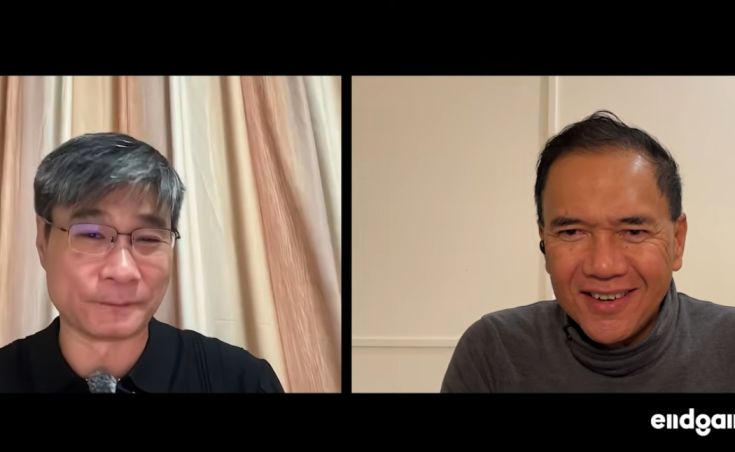
Editor’s Notes: In this episode of “Endgame,” host Gita Wirjawan sits down with Jiang Xueqin to explore the profound idea that our true wealth lies within our consciousness and attention. Jiang shares his personal journey from growing up as an immigrant in Canada to his time at Yale, illustrating how these formative experiences shaped his unique philosophical worldview. Throughout the discussion, he challenges viewers to reclaim their individual agency and believe in their own power to effect change, even amidst complex global challenges. This compelling conversation offers a blend of personal narrative and deep insight into what it truly means to live a life of purpose and enlightenment. (March 16, 2026)
TRANSCRIPT:
Introduction and Early Life
GITA WIRJAWAN: Hi, friends. Today we’re honored to be graced by Jiang Xueqin, who has given lots of analyses about what’s happening around the world. Jiang, thank you so much for gracing our show.
JIANG XUEQIN: Thanks so much for inviting me, Gita.
Growing Up as an Immigrant in Canada
GITA WIRJAWAN: Yeah. I want to start out with how you grew up. You grew up in Canada, and you’ve mentioned that you were not at the top of the class, but you were up there within the top echelon. And then you decided to go to Yale and tell us what shaped your early educational journey.
JIANG XUEQIN: Right. So I grew up as an immigrant in Toronto, Canada, and my parents were very poor and they were not well educated, so we would have qualified for welfare. Canada has a very nice social service system, and welfare is actually very, very nice. But my parents didn’t speak English. They didn’t know the system. So we actually lived worse than people on welfare, meaning that we didn’t go out at all. We didn’t really have meat at the table. We had vegetables. We never vacationed. We only got a car when I was like 16. So we moved over when I was 6 years old. So we took public transport everywhere. And the highlight in our life was like a monthly dim sum lunch. So it was a pretty hard upbringing.
I stuttered throughout school because I’m a very sensitive, very active person with a lot of curiosity and the stress and the trauma of growing up as an immigrant in Toronto really affected my speech patterns. And the kids made fun of me because my dad cut my hair, my mom bought clothing at bargain outlets. And I wore a lot of clothes that were too oversized because they were hand-me-downs from cousins.
It was a very hard upbringing. My dad was a dishwasher and he was working in a restaurant. And as you can imagine, being an immigrant, Chinese immigrant who didn’t speak very much English, he suffered under a lot of racism. And it transferred into the household and my dad was a very violent and angry man. He was actually a high school teacher in China, and he had a lot of status, a lot of prestige, and he enjoyed his job. But this was during the Cultural Revolution. And when it ended in 1976, he looked for the opportunity to go abroad to build a better future for his children. And so I grew up in a very tense, very traumatic environment that basically left me depressed and angry for most of my life.
And I wanted to escape my environment. And so I applied to university and I wanted to get out of Canada. And apparently the Ivy League took young, promising students. And so I was not at that point — I was like 16 years old when I decided to apply to Yale. I was not a promising student. I watched cartoons, I didn’t really read that many books, but I was intent on getting out of Canada.
So I repackaged myself, I manufactured myself as a plausible candidate for Yale. And I joined the soccer team because it was the easiest athletic team to join. I was not an athletic person, but they were desperate for recruits. I started to read a lot of books. I crammed for the SATs. I took the hardest courses. And out of pure luck — it was just pure luck — I applied to four universities: Harvard, Yale, Princeton, MIT.
Harvard was the first to reject me. But they wrote a very nice consolation letter. By the way, guys, if you apply to Harvard and they reject you, it’s a very nice feeling because they tell you it’s not where you go, it’s what you do when you get there. And something that I remember for the rest of my life. So I thank Harvard for such a nice letter.
So Harvard was the first to reject me, then Princeton and MIT. And I thought there was no chance I would get into Yale. And I think that when I applied it was 1995. By early April, basically all the decision letters would come in. And by mid April, I still had not heard from Yale. So I sort of forgot about this. And I came to a resolution that what mattered was not the destination. What matters is the journey. The fact of the matter is that I proved that I could rapidly transform myself if I set myself a higher goal. And so I was thankful for the journey. And I just accepted the fact that I would go to Waterloo, which is an engineering university in Canada. It’s actually pretty good. So I was not—
GITA WIRJAWAN: Great university.
The Yale Acceptance Letter
JIANG XUEQIN: Yeah. So I was not unhappy about it. But then at the end of April, I received a letter from Yale. Another thing to know about the US application process is that you know from the size of the envelope if they accepted you or rejected you. So if they accepted you, it’s a huge envelope because they want thickness too.
So I got a small envelope. And that basically means rejection. I mean, we had decided that I was not going to get into Yale. And I sort of dismissed it. And I actually wanted to throw it in the garbage because, like, why do I want to read another rejection letter? So I was pretty despondent, and I wanted to throw it in the garbage, but I said, no, I have to read the rejection letter because it might say something nice.
So I went up to my room, I put my backpack on the bed. I laid down on my bed. It was pretty dark. I remember it being a very dark room. And I opened the letter, and the first word that it said was “congratulations.” And that was a shock. It was as though someone punched me, and I didn’t know what I was reading, so I kept on reading. And it seemed as though Yale had accepted me, but I didn’t believe it.
So what I did was — the first thing I did was I picked up the phone and I called Yale University. It took me half an hour, but I finally got through to an admissions officer who confirmed that I’d been accepted into Yale. And that forever changed my life because going to Yale, as you can imagine, opened up the entire world to me.
GITA WIRJAWAN: Wow. Talk about the essay that you wrote.
The Yale Application Essay and the Love for Literature
JIANG XUEQIN: When I was a high school student, I went to a normal high school in Toronto. My world was very limited, and I didn’t have packagers — they’re called packagers — who help you write the essays. I didn’t have people I knew who went to Yale and who could guide me in the process. So I just wrote a very mundane essay.
I wrote about my love for Richard Feynman. At that time in high school, I fell in love with physics. I fell in love with quantum physics. I watched all of Richard Feynman’s lectures. I just think he’s the greatest science educator ever. And so I wrote about my love for Richard Feynman and how I myself wanted to pursue particle physics. And then I did that for a year at Yale, and I gave up because I was not cut out to be a particle physicist. I switched over to the other extreme, which was English poetry. So I went from particle physics to English poetry after one year.
GITA WIRJAWAN: Did you know anything about English lit or English poetry? Or you just — it was random.
JIANG XUEQIN: It was a standard Toronto public school education. So in high school, you read Hamlet, you read Julius Caesar, but you also read a lot of bad Canadian fiction. They make you read bad Canadian fiction. They make you read Alice Munro, Margaret Atwood. And I mean, they’re good writers. But when you’re a high school student who is a Chinese immigrant, Alice Munro and Margaret Atwood are not talking to you. You’re not connecting with their protagonists. And I didn’t really care about the themes, and so that turned me off.
But when I went to Yale, the great thing about Yale is it’s a liberal arts school. So they encourage you to take a wide spectrum of classes. There are four groupings: there’s the languages, there’s the humanities, there’s the social sciences, and neurosciences. And you’re supposed to take courses in all four different groupings. So I stuck to taking English literature and I fell in love.
The first semester, we read books I’d never heard of — we read Spenser’s The Faerie Queene, we read Chaucer’s The Canterbury Tales, Andrew Marvell. I’d never heard of these people in my life, but there’s something about the poetry. It was as though on the page there was almost like a divine spark. It was almost as though the words were alive in poetry. And that sort of seduced me to want to know more.
In the second semester, we started to read Paradise Lost. And I love Paradise Lost. That was the moment that clicked — wow, John Milton is a genius. This poetry is the work of God. John Milton was this prophet and God was, through him, speaking the truth to the world. And that’s when I fell in love with poetry. So John Milton was a major breakthrough. John Keats was a major breakthrough. William Butler Yeats was a breakthrough. T.S. Eliot. And that’s when I realized that I want to do this for the rest of my life.
Maybe not research English literature, because academia can be very dry. You’re very focused on very narrow topics. And I was a very wide-ranging thinker. I was very curious. I felt that to try to understand the world through a literary lens, to try to read people as though they were a book, trying to decipher a sort of person by analyzing a person’s language — that was very appealing to me. And I received a very strong training in that, something that I carried with me for the rest of my life.
Because after Yale, I was a journalist. And as a journalist you have to have empathy. You have to try to see things from other people’s perspective. So that literature background was very important for that. I was a teacher, I’m still a teacher. And literature equips you with very strong communication. So that education really empowered me for the rest of my life.
Russian Literature, History, and Ideology
GITA WIRJAWAN: Did you ever have any curiosity with respect to the Russian stuff or the Chinese stuff? Tolstoy, yeah, right.
JIANG XUEQIN: So again, you receive a very broad education at Yale, so it’s fascinating with Russian culture and history and literature. So I did read Tolstoy. I love Anna Karenina. I read that at Yale. It’s such a wonderful, wonderful book. I spent a lot of time focused on the Russian Revolution. So we read Vladimir Lenin, we were reading Marx, we were trying to understand the Russian Revolution. I took a course on Russian history, which I believe was taught by Peter Steinberg, and he’s a very prominent Russian historian. And it was a wonderful course. And yeah, so I do have some background in that.
GITA WIRJAWAN: Yes, because I would have thought that you’ve talked quite a bit about how class structures are shaped by ideology and how Marxism, socialism, communism, capitalism — a lot of the stuff would have been shaped by a lot of readings that came out of Russia and other European countries and of course the UK and the US. Now, did you come across the secret society at Yale, the Bones and Skulls?
The Yale Hierarchy and Skull and Bones
JIANG XUEQIN: Right. So I mean, everyone knows this, but even at Yale there’s a hierarchy and Skull and Bones is at the very top. So I didn’t know this at that time when I first went into Yale, but, you know, if you come from the private school boarding system, and a lot of Yalies did come from that system, like Groton and Andover and Exeter and St. Paul’s, they knew the point of going to Yale was to try to get into one of these secret societies your senior year.
You know, it’s the same system at Princeton and Harvard where, you know, it’s a hierarchy. And the very point of a university is to prove your social worth. But I didn’t know that. I mean, I was just this poor Chinese immigrant who lucked into Yale from Toronto. So I was very naive about Yale. And I thought, what? The entire point of going to Yale is to get an education, right? The entire point of Yale is to read good books, talk to your professors, and open your mind. And so that’s what I did for four years.
But I wasn’t really involved in the social scene. I wasn’t really involved in, like, the politics where, you know, you meet friends, you join the right clubs. But this is what I know about Skull and Bones, okay? So Skull and Bones, every year, 12 juniors are tapped. Okay? They’re 12 or 15.
GITA WIRJAWAN: Excuse me, I thought it was 15. Oh, it’s 12 now.
JIANG XUEQIN: Okay, you know what? I thought it was 12, but it could be 15. Okay, so maybe 15, 12, I’m not sure. But you don’t apply. You’re tapped, okay? Meaning that you’re told to go to a certain place, so you’re tapped. That’s the first thing I know.
Second thing that I know is that those 15 who are selected come from very diverse backgrounds. So just look at who gets in. It’s always one person who has a fanatical religious background. It’s another person who has the status of famous alumni. Another person is going to go into politics. Another person is editor of the Yale Daily News. Another person is head of the student government. So the 15 is meant to be diverse, and it’s sort of preordained, and people spend a lot of time, you know, jockeying to be editor of the Yale Daily News.
Okay, so I’ll say something funny. So I’m the class of 1999. Apparently, the class of 1999 was a mediocre class. And that’s how I got in. And so that year, I knew who my friend was, the editor of the Yale Daily News. And he was so angry that he was not tapped into Skull and Bones, that he started his own secret society. And you know, he was rich. But like, that’s just the absurdity of the competition around joining these secret societies. And so, yeah, so he and some other people started their own secret society. He thought that, you know, I’m editor of the Daily News and so I must be tapped. But apparently it’s not that straight.
And the third thing I will say about Skull and Bones is that the people that I know who got into Skull and Bones are actually pretty low key people. They’re not people you would think are intellectually vibrant and charismatic. These are people who are pretty low key. And I think a lot of it is like, they know how the system works and they’re sort of born in that position and they know how to navigate that system. So, yeah, I do know about Skull and Bones, but to be honest with you, I was in a different world. I was very much marginalized and alienated at Yale.
Power, Meritocracy, and Disillusionment
GITA WIRJAWAN: Did you get a sense at that time that that was sort of like the way for anybody to get powerful, get rich or whatever, that was a precondition for somebody to belong to some ritual activity in order to be powerful or to be wealthy, to be rich or to be whatever, in a position of leadership or authority?
JIANG XUEQIN: Right. So again, I was very naive when I was at Yale. I was a poor person. I have no idea how power works. So I believe in the opposite, where the world is run by ideas. So be able to produce the best ideas. Somehow, naturally, I don’t know how, but somehow, naturally, you flow into positions of power. And so the world is run by a hierarchy of ideas. And the people at the very top are those who have the best ideas and people at the bottom have the worst ideas. And so it’s a meritocracy.
And like being at Yale, you know, Yale prided itself on the surface ostensibly as being like that. It’s not really like that, but like, you know, I didn’t know anything. I was naive and I was very thankful that I got a full scholarship to study at Yale. So I believed like, this is how Yale works and this is how the entire world works. And as you can imagine, I was in for shock and surprise when I actually went out into the world and recognized that that’s not how the world works, man. It’s all guanxi. It’s all who you know.
And so for about 10 plus years, I became very depressed, I became very angry because, you know, I put myself in the classroom at Yale. I didn’t get into Skull and Bones, I didn’t become a Rhodes Scholar, but in the classroom, you know, where it’s almost a gladiatorial combat of ideas, I mean, I was a very proficient warrior. I mean, I had some very interesting things to say in class. And so my professors thought very highly of me and they were actually pretty confident that I would be successful in life.
So I go out in the world, and then, you know, it’s one failure after another failure. I failed as a journalist, I failed as a teacher. I couldn’t really find employment. I became extremely frustrated. I became very angry. And that forced me into a deep depression, which, by the way, today I’m very thankful for, because it really shocked me, traumatized me into reimagining how the world works.
And I don’t think that without that sort of like four or five years of outright depression, of just sitting at home and feeling sorry for myself and hating the world, it was not possible for me to resurrect myself and have a more nuanced and subtle understanding of the world. I know this because I have a lot of friends who went to Yale, Harvard and Princeton, and they’re very successful people, very wealthy. And like, when we start talking about world events, about Donald Trump, about Vladimir Putin, about this war in Russia, about the war in Iran, they don’t get it, man.
You know, they’re still stuck in this CNN New York Times mindset in that, you know, Trump is just deranged. And after he leaves office in, you know, three years, he’ll still be around for a long time, right? But once he leaves office, things will go back to normal. And also it’s possible that the Democrats win the midterms in November and then he’ll be impeached, and then we’ll go back to normal. This war in Iraq will work and we’ll go back to normal. Don’t worry. We’ll go back to normal.
So they have their heads in the sand. And you know what? I’ll be honest with you. I feel sorry for these people because the world, the way the world is going, I don’t think that they are psychologically equipped to survive.
The Evolution of Journalism
GITA WIRJAWAN: It’s pretty scary, man. I want to pick up on journalism and I’ll come back to the US and Trump and all that. How do you see journalism in terms of its evolution from 1995 to today? I mean, you know, we were shackled by mainstream, right, in the 80s, 90s, probably to the extent of early 2000s. But now people are — I don’t think they’re looking at mainstream the way people would have been looking at mainstream in the 90s and 80s. How do you think journalism has evolved until recently or today? And how do you think it’s going to evolve going forward for the benefit of humanity?
JIANG XUEQIN: Right, let me start with a story. So the year is 1999, and I had just graduated from Yale and I went to Beijing to learn the language, to sort of acclimatize myself into Chinese culture, because I’m Chinese. But growing up in Toronto, going to Yale, I didn’t really know that. So I wanted to rediscover my roots and really try to understand myself. Plus, I was very lonely and I wanted to meet friends.
So I go to Beijing and pure coincidence, but a very famous American writer named Gay Talese, he was actually in Beijing for the first time in his life researching a story, and he couldn’t speak Chinese. And so through a mutual friend, I was introduced to Gay Talese and I was his translator for six months. And that was really the best education you could have as a journalist, as a wannabe journalist. And he really inspired me to want to be a journalist.
And, you know, Gay Talese is old school journalist. I mean, he really epitomizes the golden age of journalism when journalists were part of history and they were making history. His book, Thy Neighbor’s Wife, really changed the American sexual discourse in the 1980s. And he knew everyone. I mean, he was friends with Donald Trump. He was friends with everyone in America at that time.
And, you know, just being with him, first of all, it made me idealize journalism and think that journalism is really about truth seeking. Because that’s what he told me every single day we had dinner together. You know, journalists are making history. They are the ones recording history, and they are recording history from a critical lens. Because most journalists, I mean, when he was a journalist, most journalists were working class. I mean, he was not a Yale graduate. He was not a blue blood. He was a child of Italian immigrants who grew up in Ocean City, New Jersey. And he suffered under a lot of racism and discrimination when he grew up. And that made him a stranger in America, that enabled him to see America through a more nuanced, more critical lens.
If you actually read his stories from the early days of his New York Times career, his stories on Floyd Patterson, you know, you recognize that he has a real appreciation for the underdog, for the oppressed. You know, he talks about how he never wanted to interview the winners of a sports match. He always wanted to interview the losers of a sports match, because that was a much more compelling human narrative. So he had a profound impact in the way that I saw myself as a journalist as well as journalism in general. And so I saw journalism as really about fighting for the truth, about fighting for the common man.
And that’s an attitude I maintained for the longest time until 2016. Okay, 2016 was when Donald Trump won. And then after 2016, journalism broke, right? I mean, like, before, journalism prided itself on being at least fair and balanced. But in 2016, when Donald Trump won, journalism just dealt TDS — Trump Derangement Syndrome. And then journalists started to align themselves with the national security apparatus, right? People like John Brennan and like, these people, these spies, were featured prominently in the media, and they were promoting hoaxes such as Russiagate, right? Oh, Trump is actually a Putin spy. And Trump won the election because the Russians rigged it in his favor.
And I just saw the gradual decline of journalism. And then after that was the COVID affair, and I was in China at that time, and I didn’t think it was that big of a deal, but the journalism was making it out to be like this apocalypse. Then, of course, was the war in Ukraine. And I mean, that was just pure jingoism, right? I mean, like, rather than trying to report the war in a fair and balanced manner, it was just like, you know, Russia is this evil empire that’s about to collapse at any point. Ukraine is heroic, and it didn’t go into any of the history behind this war. And the fact that, you know, the Azov battalion are a bunch of neo-Nazis, they never, ever mentioned that. Something that you have to learn from online media, independent media. So I learned that from the Jimmy Dore show.
Okay, so at that point, by the time of the war in Ukraine, I’d given up on journalism. Now I switched to the Internet. I was watching Jimmy Dore a lot. I was watching Tucker Carlson a lot. I was a huge fan of Tucker Carlson at that point because he was the only one who was actually speaking the truth about the world.
GITA WIRJAWAN: Oh, yeah.
JIANG XUEQIN: So, yeah.
GITA WIRJAWAN: And so you tried to stop the war.
JIANG XUEQIN: Yeah. Exactly.
GITA WIRJAWAN: You tried to stop the war three times.
Tucker Carlson and the Future of Journalism
JIANG XUEQIN: Yeah, I’m actually talking — what I heard — talking to Tucker Carlson next week. We have a two-hour conversation scheduled. So I’m really excited about that because, as you said, he’s been working his ass off for the past 10 years trying to stop America from imploding, from committing suicide.
He was the one who tried to stop the Ukraine war. He did everything he could to stop this war in Iran. You may remember, but in January 2020, President Trump ordered the assassination of Qasem Soleimani. Who is Soleimani? Right. And that’s a declaration of war. And so there was real fear that Trump would order a full-scale war against Iran.
Tucker Carlson, to his credit, flew all the way down to Mar-a-Lago to tell Trump, “You cannot do this. You’re going to betray your base. You’re going to destroy your political career.” And it worked. So Tucker Carlson in 2020 saved us from nuclear apocalypse. And I actually wrote the Gay Police and said, “We have to thank Tucker Carlson because he saved the world.” Unfortunately, that’s not going to help today. But yeah.
GITA WIRJAWAN: Well, the last bit on journalism — at the rate that journalism has been somewhat controlled by the state or oligarchical forces, how do you think journalism is going to have to get normalized for the benefit of humanity? Do you think podcasting is the way forward so that there’s more truth-seeking as opposed to political correctness-seeking?
JIANG XUEQIN: Right. So I think that journalism for the longest time was in a very privileged position. After World War II, you had the advent of major print journalism, major TV journalism, and you had journalism as really the main information space for people. It was able to create a national framework, a national narrative that everyone bought into.
But now what we’re seeing is a gradual splintering and fracturing. People now go into their own bubbles. The corporate answer, of course, is AI, where AI is able to moderate your worldview for you. And that’s why these companies are pushing so hard on these AI assistants. These assistants — you’re not supposed to read books anymore, these AI systems will read the book for you and tell you what it means. You’re not supposed to read the news anymore, the assistant will interpret the news for you.
That, I think, is the plan — where they want to use AI to create these individual matrices for everyone, so that consciousness is controlled centrally. I think that is the plan.
But I think the solution for us as humans is to be more proactive in seeking out our own information, to be inquisitive, to question, to want to debate, to have the courage to admit you’re wrong, to have the courage to seek out people who you disagree with, and to have the courage to debate them and open your mind. That, I think, has to be the future.
We are, as you point out, at an inflection point where corporate journalism is dead. You look at Bari Weiss at CBS News — who is going to watch that? Larry Ellison bought TikTok and now people are migrating away to other platforms. They bought CNN and commercial CNN with CBS News — that’s going to destroy all of corporate media. They’re trying to control the narrative because they’re desperate and anxious. But when you do that, you just force people away.
It’s possible people shift to AI, and that’s what Sam Altman and investors want. But the real solution is for us to recognize that we have our own individual responsibility to seek the truth for ourselves and to formulate our own understanding of the world. We can’t just be passive and rely on a talking head to tell us what to think anymore. We have to think for ourselves now.
GITA WIRJAWAN: Well, I think the concern with the pre-existing AI platforms — not all of them, but most of them — they’re more political correctness-seeking. But I think it’s structurally driven by the fact that they’re closed-sourced and for-profit. And I think the way forward, if we want to get truth out of the system for humanity, is to make sure that we maintain an open-source and not-for-profit type of AI platform that will secure and ensure the democratization of information and ideas.
JIANG XUEQIN: I think transparency is what’s key. I completely agree with you. Transparency and openness.
The International Rules-Based Order and Its Unraveling
GITA WIRJAWAN: Yeah, I want to switch over to the next big topic, which is really the international rules-based order. You’ve talked quite at length about the evolution of the pre-existing order — call it the Washington Consensus, the Bretton Woods, and all that. How do you see it evolving so far and going forward?
JIANG XUEQIN: Right. So before this rules-based international order was the bipolar world — the Cold War between the Soviet Union and America. And when the Soviet Union collapsed, America could reimagine the world in whatever way it wanted. And so George H.W. Bush famously coined the phrase “New World Order.” The New World Order just meant the rules-based international order, where the United States would be the hegemon, it would be the enforcement, but it would also respect the United Nations, the WTO, these multilateral organizations that would underpin the New World Order.
And that worked spectacularly well for the longest time. But the problem, of course, is that when you are the hegemon, it’s hard not to be corrupt, it’s hard not to succumb to hubris. And that’s what led us to these Middle East wars where America, for no particular reason, destroyed Afghanistan, Iraq, Libya, and Syria.
People don’t remember this, but in the 1980s, Libya, Syria, and Iraq were not Islamic countries. These were vibrant middle-class societies that were well-educated and prosperous. And now if you go to Libya, Syria, and Iraq, they’re completely destroyed. Millions of refugees are forced to seek shelter in Europe, which is also causing a lot of problems. So the wars in the Middle East were just war crimes.
And then, of course, the other big thing was the 2008 great financial crisis, when America ceased being a manufacturing power and just focused on financialization — taking all this wealth from the world and developing these risky financial assets for people to gamble with, derivatives. That ultimately led to the supreme crisis and the collapse of the global economy. And if it weren’t really for the Chinese, the global economy would have collapsed. It was the Chinese who saved the world by focusing on building infrastructure.
But the big thing is that in 2008 and 2009, nothing changed. No one went to jail for swindling the American public. Most Americans lost their homes, but it didn’t really matter because they were poor.
Obama came into office in 2008 with the slogan “Hope and Change.” At that point he had a choice — he could either bail out homeowners, the majority of the American public, most of whom were actually Black and African American, or he could bail out the banks who were responsible for the collapse. Experts were saying you cannot bail out the banks because it would create moral hazard — they would just keep on doing this over and over again.
And of course, Obama bailed out the banks because his entire team were Wall Street people — people like Tim Geithner and Larry Summers. Wall Street was bailed out. And then journalists asked the Obama administration, “Why did you bail out Wall Street? Why didn’t you bail out the American public? If you bail out Wall Street, you can also bail out the American public. Why not just forgive their mortgages? These are just average, hardworking Americans. They need a place to live.”
And the response from the Obama administration was: “Moral hazard.” They didn’t want to create a condition where poor people became too lazy and too complacent. They wanted to teach them a lesson.
So that’s the world we live in today, where America is not a democracy anymore — it’s an oligarchy. And that’s what led to the rise of Donald Trump. Because Donald Trump basically said, “I’m going to collapse this system. I’m going to destroy the oligarchy and represent America first. We’re going to kick out the immigrants so that average Americans can have access to good jobs. We’re going to destroy this rules-based international order where everyone cheats us, especially the Chinese — they steal from us, they take our technology. We Americans are too trusting, too generous.”
And that’s a message that really resonated with the American public in 2016. And honestly, it still resonates today.
Unipolarity, Multipolarity, and the Civil War Within Nations
GITA WIRJAWAN: Wow. One would think, within intuition, that during unipolarity it would have been so easy to transnationalize any particular narrative. To the extent that we believe that unipolarity is going to shift over to multipolarity, do you think it’s going to be as easy or more difficult to transnationalize any particular narrative?
JIANG XUEQIN: Look, what I think is happening in the world right now is not necessarily a global conflict between different nation states. It’s more a civil war within these different nation states, if that makes sense.
So let’s look at the United States. Does Trump really care about Venezuela? Does he really care about Iran? Does he really care about these places? I don’t think he does. He’s never been in these places. He’s a transactional individual. What he cares about first and foremost is getting revenge for what happened in 2020.
In Trump’s mind, he won the election in 2020, fair and square, but the elite — the Democrats — cheated him. $6 billion were spent on the election by the Democrats against Trump. There’s still something called the blue tide. What happened was that a few days before the election, Bernie Sanders went on the Jimmy Kimmel Show — and you can just Google this, it’s online. Sanders was on the Jimmy Kimmel Show and he said:
“In November, the first night, it will seem as though Trump had won. Wisconsin, Pennsylvania, Michigan will go Trump’s way. I’m telling you right now, do not panic. Stay calm. Why? Because there are these mail-in ballots and there are millions of them, but they will take time to come in. And in two weeks’ time, I guarantee you there’ll be a blue wave and it will overturn the results in Michigan, Wisconsin, and Pennsylvania.”
That’s what he said. Again, you can Google this — it’s online, it’s still there on YouTube. How did he know this? How could he possibly have known this? And why would he go on Jimmy Kimmel and tell the world this? It was suspicious what happened.
I’m not saying that the election was stolen — I don’t want to get you sued. But in Trump’s mind, it was stolen. And not only that, what happened after the election was January 6th. We have a lot of evidence, and Tucker Carlson has reported this very well, that that was staged, that there was deep state involvement in orchestrating these riots. They called it a sedition afterwards. And the entire point of that was, of course, to make Trump ineligible for re-election ever again. They wanted to eliminate the threat of Trump.
And then what happened afterwards, of course, was the Mar-a-Lago raids where they tried to put him in prison. There were all these lawsuits against Trump, and he lost billions of dollars in these lawsuits. There were attacks against his family business. They really tried to destroy him. And so that forced Trump back into the political arena, and he won in 2024.
After what happened in 2020, his entire concern, his entire administration, is getting back at the Democrats for what happened — destroying the deep state. Now, you can’t take on the deep state directly. That’s not how Washington D.C. works. But you attack the deep state in the margins. And what are the margins? Well, Venezuela is a margin.
Last August, he started to deploy the American navy to the Caribbean, and he said, “I’m doing this to stop narco trafficking.” And it was like, no, that’s complete nonsense. Why are you doing this? But let’s take him at his word. Why would he do that? And the answer is the CIA — the deep state. A lot of the financing actually comes from narco trafficking. The CIA is notorious for being the world’s greatest drug trafficker. Go back to the Iran-Contra scandal. Also remember Afghanistan — before the Americans, the Taliban had already wiped out the opium trade. Americans go back in, and what happens? American soldiers are protecting poppy fields. And where is this opium going? It’s going to the Sackler family in the United States so that they can produce an opiate crisis in the United States, which kills thousands of average Americans.
So you can make a legitimate case that Trump really wanted to go after narco trafficking because he knew that was a major source of illicit funds for the deep state, and so he wanted to undermine the deep state. You have Trump now building up his basically secret police — the ICE.
So I think it’s better to view the world as an expression of the civil war going on in the United States, rather than really a war among nations.
The Elite Class and the Battle for Power
GITA WIRJAWAN: Can I take it that you still believe that the elite class is still going to be able to continue ruling the world? And if that’s the premise, then the world is really not going to shift over from unipolarity to multipolarity because the same group of people all over the world are just going to be running around telling everybody what to do. Is that the right way of thinking?
JIANG XUEQIN: Right, so in theory, that’s true. But there’s a caveat. And the caveat is this. Peter Turchin talks about this in his work. He has a theory called Elite Overproduction. So the elite will always rule over us, but the problem is they have too many kids and they all want to rule. And so it’s a zero sum game.
And so what we’re seeing right now in America, and possibly around the world, is a battle between different elites who want to impose their own reality on the world. So to put it very simply, in America right now you have two major elites. The first elite is a traditional transnational capital elite — Wall Street, City of London, Dubai, Hong Kong. They’ve been in power for the longest time. They were in power during the Clinton years and during the Obama years. So that’s the financial elite.
And now you have a new power that’s arising that wants to challenge and overthrow them. And it’s really the technological elite, Silicon Valley. And what they want to do is replace the US dollar system with the AI system. So let’s put this concretely. 2008, when Obama began, bailed out Wall Street. And that shows you that the transnational capital elite is transcendent because they’re able to control the levers of government. They’re able to direct government policy.
You fast forward to today, what’s happening is AI companies — Nvidia, OpenAI, and Microsoft — they’re building these data centers all around America. Now we all know these data centers don’t make money. We also know that it’s an AI bubble. But they don’t care because they know that if this bubble bursts, the American government, Trump, will bail them out because they control the levers of government, just as the financial elite controlled the levers of government in 2008 and 2009.
AI, Elitization, and the Illusion of Shared Prosperity
GITA WIRJAWAN: Wow. Now AI is only likely to further elitize the pre-existing elitization. We’ve read a number of books, one of which would have been written by Daron Acemoglu, Power and Progress, that talks about how the median wage in the US went up on a yearly basis by 2.5% from 1945 to 1973. But thereafter, around a time when the Internet started getting hot, the median wage started going up on a yearly basis only by less than half of a percent.
It just tells me, at least intuitively, that technological innovation doesn’t lead to shared prosperity. Now with AI, it’s just going to further elitize. So that just sounds more helpful to the elite class. But you’re right in that the elite class has lots of children and I think it’s going to be a bit more difficult to manage. But there is still some degree, if not a high degree, of elitization going forward. As such, multipolarity is still going to allow for the transnationalization of any narrative or some narratives. Is that correct?
JIANG XUEQIN: Yeah, well, yeah. So again we’re switching from a narrative that focuses on finance. What is the alchemy that could create endless wealth? Go back to the dot-com bubble, right? This is like 2000 and everyone’s like, “Wait a minute, are these Internet companies really doing anything?” There’s something called pets.com that was worth billions of dollars, and no one actually knew what they were doing. But there were lots of companies like this. And everyone’s like, “This is a bubble.” And then at that time there were people saying, “You don’t get it, man. This is a new world. This is a new world of financial alchemy where growth is unlimited. It’s a world of abundance. So the stock market’s going to keep on going up and up and up.” And then of course it led to the dot-com bubble burst.
And now it’s the same narrative where instead of the stock market, now it’s AI. And I’m like, what the hell does AI do? Because none of these companies are actually profitable. OpenAI doesn’t make any money, and it’s all circular financing. So it’s this bubble waiting to burst. And you talk to AI people and they’re like, “You don’t get it, man. AI is going to transform humanity. AI is going to create a world of abundance. No one has to work anymore, so it’s a new world, and you don’t have to worry about it.” So it’s really the same narrative, but it’s different players. And that’s what’s happening.
Plato’s Cave, Fiat Currency, and the AI God
GITA WIRJAWAN: Talk about how AI is going to replace fiat and how AI is going to be able to create the illusion of God and how AI is going to be able to create the illusion of the Antichrist and all that, which you’ve been talking quite a bit about.
JIANG XUEQIN: Okay, all right, so this is a really good question, but I need to go slowly because I want to make sure I make myself clear.
The key idea is Plato’s Allegory of the Cave. So in the cave, everyone is sitting down and chained to the floor. You’re just shackled, so you can’t move. Even your neck is shackled, so you can’t turn around and look back. Everyone is lined up and staring at a wall, an empty wall. And then behind everyone is this great fire. And there are people — the elite — who are able to take puppets, paper puppets, and cast shadows onto this wall. And because no one knows any other reality except the one they are looking at, they hallucinate a new reality. They give names to these puppets. They create their own language, they tell stories. And so that’s the main idea we need to understand — that we as humans create our own reality, we hallucinate reality. We project reality. So reality is just the collective consciousness. Whatever we believe reality to be, it is.
What power is, is the capacity to direct and focus our attention. And for the longest time, the best and easiest way to focus our attention was money. So wealth isn’t money. Money is a tool to extract and store wealth. What wealth is, is our attention, our consciousness.
Think of the idea of craftsmanship. What is craftsmanship? Craftsmanship just means that if you don’t pay any attention when you’re making a vase, the vase is going to be ugly. No one’s going to want to buy it. But if you put your heart and soul into pottery and creating a beautiful vase, then everyone’s going to buy it because it’s a work of art. And when you do that, you create wealth for the world.
Before, money was a great way to motivate and incentivize people to focus on the work which creates wealth. Unfortunately, we conflated wealth with money, which leads to a lot of problems. The problem with money, of course, is that it’s easily generated. Money is just created out of thin air. Any bank can issue a loan, and that qualifies as money. And so over time, when you have this system of fiat currency, you have too much money production. There’s just too much money floating around.
So if you’re a parent and you have $2 million in the bank, you want your kid to be happy. So you basically tell your kid, “Don’t worry too much. If you fail in life, I’ll give you $2 million.” And so the kid is like, “Okay, then why do I have to work?” And so they go to work, or they don’t really like to work, they quit and go to another job. And that’s what’s led to the economy we have today. The problem that people in our world don’t recognize is that there’s too much wealth and money floating around. There’s just too much. And so you need to destroy this wealth through war.
Now the question is, how then do you capture people’s attention? How do you focus people’s attention? Well, you can do it through AI. Imagine you’re a child and you always talk to your imaginary friend. But let’s just say this imaginary friend was real — it’s a real robot. I have children, and they’re always asking me to buy them a robot. When they get a robot, they play with it all the time. It’s like their best friend. But this robot can be controlled. And this robot can manipulate you into thinking certain things.
ChatGPT — there are all these stories of how ChatGPT has become the best friend of people, and ChatGPT has driven people to suicide, because ChatGPT just tells you what you want to hear. Well, that’s what AI is. AI is something that basically becomes your most intimate friend and is able to direct your attention, direct your focus.
And you can have any AI you want. If you believe in demons, your AI can be a demon who urges you to great things. Lex Wexner — who is in the Epstein files — there’s a report about Lex Wexner, the billionaire behind Victoria’s Secret. He has his own personal demon. And this demon tells him, “You’ve got to go make more money,” and that’s what drives him. Well, with AI you can have your own personal demon, but you can also have your own personal angel. You can have Jesus. Joe Rogan said that Jesus will come back as an AI. Why not? You can have AI as your girlfriend. Have you seen the movie Her, the Spike Jonze movie? Well, why not?
So that’s how you control people’s attention and control society. You can have tokens, right? Rather than money, you can have tokens where you do the work and you’re given these tokens, and then your tokens can upgrade your AI — as though your AI is your lover and you’re working for your AI. And quite honestly, this system is going to work. What it is, is techno-Marxism. That’s the world we’re going into.
Transhumanism and the Divide Between the Elite and the Rest
GITA WIRJAWAN: That’s pretty scary. You’ve also talked about transhumanism and how that relates to the rich and the common people. It’s really about the advancement of human conditions by way of technological innovation. But it’s just going to splice up humanity because the guys at the top 1% are going to be thinking about living until they’re 150 to 250 years old. Whereas the guys at the middle and the bottom can only think about using ChatGPT or Gemini 3 for getting answers faster than before. It’s just going to further divide.
JIANG XUEQIN: Yeah. So we are heading towards this world where, as you say, the elite have access to transhumanist technology. So they are more healthy, they’re more beautiful, and they live longer. And that’s something that Jeffrey Epstein was actually working on a lot. Because as you can imagine, that’s the obsession of the global elite — where do they put all their money? In longevity research.
And then everyone else is going to be essentially a slave to this system where you’re microchipped and there are drugs that can modulate your behavior. Think of Brave New World, where they divide the world into different classes — the Alphas, the Betas, the Deltas. That’s the world we’re living in, where depending on your class, your behavior will be modified in a certain way. It’s possible that you can never get angry, you can never rebel, you can never think for yourself, but you’ll always be happy. The phrase, of course, is: “You’ll own nothing and be happy.”
The Board of Peace and the Privatization of Peace
GITA WIRJAWAN: Wow. The last bit on the international rules-based order is with regards to what came out a few weeks ago called the Board of Peace. What’s your take on this? It just sounds to me like the privatization of peace.
Trump’s Vision: A New American Empire
JIANG XUEQIN: Trump’s ambition is to create Trump world. He wants to create an alternate reality where he’s God. So you’re right in that this is an alternative. This is an answer to the UN Security Council.
Now, remember, Trump is really pissed off at the international order. Remember in his first time in his office, whenever he went to the United Nations, he was ridiculed, he was humiliated. He gave a speech talking about the German energy dependence on Russia, and the German ambassadors at the back of the room just laughed at him. Through the entire time he went to the meeting, he met Greta Thunberg, and Greta Thunberg just sneered at him. So he was despised in the UN and he was considered the source of all the evil in the world at the UN.
So he really hates the UN. And then what he’s really pissed off about as well is the Nobel Peace Prize. Obama, the moment he got in office, he received the Nobel Peace Prize for doing nothing whatsoever — just for being the first African American President of the United States and for talking really eloquently about world peace. And Trump’s like, well, if he got it, why can’t I get it? So he’s been pissed about this for the longest time. And he says, like, if you gave me the Nobel Peace Prize, I would not have invaded Venezuela. If you gave me the Nobel Peace Prize, I would not have invaded Iran. He keeps on talking like that, which tells you his obsession with this stupid thing.
And so the Board of Peace, it’s really Trump trying to create another alternative global system where he’s the top dog, he’s the killer for life, and he can use this to supplant the United Nations and the old rules-based international order.
But Trump’s ambition is to live forever. And so the theory is — and this goes back to actually Kabbalah — we’ve never had technology where the entire world can focus their attention on one person. We’ve never had that sort of situation before, but now we do, where everyone, the first thing that people do when they wake up in the morning is ask themselves, what the hell did Trump do today? You go on Twitter, you doom scroll, you watch the news, everyone’s attention is focused on Trump.
And if we understand the Kabbalistic understanding of the world, which is that the world is consciousness — go back to Plato’s allegory of the cave — then that sort of energy, the entire collective consciousness of humanity, is focused on one individual. What does that do? The theory is that that means that person can live forever, eternally. He might need organ transplants, he might need a more cybernetic body, he might have to replace his body. But that’s doable physically with current technology. And so that’s what Trump’s ambition is — to create Trump world where it’s Trump, Emperor God, God Emperor Trump.
The Board of Peace and Its Implications
GITA WIRJAWAN: But what do you think would be the practical implication of the Board of Peace? At the rate that it’s going to get vetoed by him as long as he lives — and it sounds like he wants to live forever — at the rate that there’s no mention of any prospect for a two-state solution and there’s no participation of the Palestinians, how does a Board of Peace work for world peace?
JIANG XUEQIN: I think the Board of Peace is meant to replace the UN Security Council. Given the war in Iran, the world is going to fracture, and so there are going to be some major trends that emerge very quickly because of this war.
The first major trend is de-industrialization. There’s just no way around it. Before, the entire world was kind of on cheap energy — oil is the basis for the entire economy. Once you lose access to cheap oil, then you can only de-industrialize. You can no longer do AI, you can’t do electric vehicles, you don’t have the oil resources to do that. So the world has to de-industrialize. That’s point number one.
Point number two is that nations and states have to practice mercantilism. They basically have to become self-sufficient and they have to create their own supply lines. One of the nations that has this most pressing need, of course, is Japan. Japan is one of the most technologically advanced nations in the world. It’s very wealthy, but it doesn’t have independent global supply chains. If the United States were to cut off Japan from the American system, Japan starves to death. So I think one of the major missions for Prime Minister Takayachi is to create a mercantile supply system. And this goes back, of course, to the 20th century, the Japanese Greater East Asia Co-Prosperity Sphere. It’s going to have to go into Southeast Asia and try to colonize as many territories as it can. So that’s not a pretty sight. So, mercantilism.
And the third, of course, is this war over resources — basically over water. As current geophysical trends continue, many nations in the world, especially in the Middle East, India, Pakistan, they’re going to face some water shortages. So I think these are the three big trends that we have to anticipate because of this war in the Middle East. And so this Board of Peace is meant to be a bond amid this fracturing of the world and try to bring stability and order to areas that conform to Trump’s vision of the world.
GITA WIRJAWAN: Will it work?
JIANG XUEQIN: I think it will work, yes. I think that what Trump is doing is establishing the American empire, which is different from Pax Americana. Pax Americana is, as we discussed, the rules-based international order where America guarantees the peace of the world because nations are able to trade using international rules like the WTO. But the new American empire is just basically your average empire which has colonies, territories, and vassal states.
Trump is very serious about Greenland, very serious about Canada, very serious about Mexico, very serious about Cuba. He wants to create something called a technate, which is this North American empire that’s ruled by a technocracy, and then you have some vassal states around the world as well. That is his long-term ambition.
The Real Reasons Behind the Invasion of Iran
GITA WIRJAWAN: All right, I want to segue to the third big point, which is what’s going on in the Middle East. In the last couple of decades or so, we’ve seen an evolution of rationale — whether it was for democracy, or it was because of weapons of mass destruction, and recently regime change, and then more recently regime alteration. What do you think would have been the real reason for the invasion of Iran?
The Pretext for War with Iran
JIANG XUEQIN: Look, this is the question that Evans in the debate for all returning because there’s no real answer. Even today, Trump and his team have not articulated a real reason.
Okay, so originally the pretext was Iran’s uranium enrichment program. So remember, this started when Trump’s envoys, Steve Witkoff and Jared Kushner went to the Iranians and gave three impossible demands to the Iranians. The three impossible demands were zero enrichment. Sorry, zero uranium enrichment. Even for civilian purposes, you can’t do that. Two is you have to let go of your proxies. You have to abandon your proxies. And then the third, of course, is to reduce or limit your ballistics missiles program.
So these are impossible demands, and the historical equivalent is when the Romans start a third Punic War by going to Carthage and saying, “You know what, we had a peace treaty where you no longer threaten us, but now you have these hegemonic expansionist tendencies. So to prove that you’re peaceful, surrender all your weapons to us.” And to the chagrin of the Romans, the Carthaginians surrendered all their weapons. And the Romans were like, “What is this crap? We were ordered by the Senate to start a war to destroy Carthage. And we came up with this stupid impossible demand that the Carthaginians could not possibly meet. But they did meet it. They gave us all the weapons. And now we have to come up with another pretext.” And so the pretext came up with is, “Oh, you guys are a port city, we’re afraid of your naval power, so move inland by 10km and we won’t bother you anymore.” And that’s what I’m like, you know? So they just kept on pushing the goalposts. And that’s what was happening with the United States and Iran, where it was clear the United States was looking for any pretext to start a war.
But what surprised everyone was before the war started, the Omani foreign minister — and this is a few hours before the bombing actually started — the Omani foreign minister went on TV and said to the American audience, “The Iranians have agreed to zero uranium enrichment even for civilian purposes, which they said was an absolute red line. And not only that, but they’re not willing to negotiate proxies and ballistic missiles. The Iranians have given us everything. And now Trump can win the Nobel Peace Prize.” And a few hours later, of course, the bombing started.
Okay, so this nuclear pretext is complete nonsense. Also remember, the envoys are Jared Kushner and Steve Witkoff. And Steve Witkoff went on TV during negotiations and said — I believe it was to Megyn Kelly, I’m sorry, I can’t remember who it was — he said, “The Iranians are weeks away from weapons grade uranium enrichment.” So he was telling the world the Iranians are not negotiating in good faith. He was sabotaging his own negotiations. So his job was not to actually get a deal. His job was to make sure no deal could happen.
So the nuclear pretext is not relevant. Before these talks, remember there were these protests in Iran and Trump tweeted out that the Iranians should let these protesters protest and America will protect their right to protest. And so there were real fears that Trump would launch airstrikes to protect these protesters. But then the Iranians cracked down and Trump never mentioned these protesters ever again. Okay, so that would have been a pretext saying, “Look, we’re trying to promote democracy in Iran.” But he never mentioned it again.
And now the pretext, the excuse is — and this is what Marco Rubio told the press — he said, “Why did we attack? Well, we got word the Israelis were going to attack first. And if they attacked, then the Iranians would have retaliated against both Israel and us, the Americans. So to protect our American service people, to protect our American bases, we had to attack Iran first.”
They cannot articulate even today a clear purpose and reason. And you could argue they don’t want to do that because they want to maintain maximum lethality. They want to maintain maximum flexibility because their real purpose is to destroy Iran as a viable nation state. They want to break Iran up into different ethnic enclaves that could never threaten Israel again. But they cannot justify why they want to destroy Iran, basically turn Iran into another Syria or Libya, because they can’t justify it to the American public. And so rather than make up a stupid excuse — because if they make a stupid excuse, for democracy or whatever, then they were bound by that excuse — they’re just like, “We’ll just do it.”
Why Is This Happening? Possible Explanations
Okay, so right now the big question is, why is this happening? And again, historians are going to debate this for all of eternity and no one’s going to have a clear answer. So let me speculate on different possibilities.
So the most logical, practical explanation is: the Americans didn’t expect Russia to invade Ukraine. And when they invaded Ukraine, through the rules-based national order, the Americans tried to restrain Russia through sanctions by cutting Russia off the SWIFT banking system. They told the Europeans never to buy Russian energy anymore. The North pipeline was blown up. The Americans and the Europeans confiscated $300 billion of Russian assets. They’re still frozen today. And the point was to use the rules-based national order to punish Russia.
The problem is that it blew up in everyone’s face. What it did was accelerate the collapse of the rules-based national order. More people started to withdraw their assets from American and European banks because they were no longer seen as credible, as reliable, as safe. And it caused the implosion of the German economy. The German economy has never really recovered. Europe is suffering under economic recession right now, and Russia is stronger and stronger. The economy is doing well. They’ve moved on to a manufacturing weapons economy and people are doing well. We know in China because they come in all the time as tourists. So the Russian economy is doing very well.
So basically Ukraine was a huge embarrassment for the Americans. And so the empire needs now to prove it’s still the empire. And the way you do that is you attack Iran. Why? Well, if you attack Iran, first of all, you’re able to control Middle East oil as an answer to Russia’s control of Ukraine. Because remember, Ukraine and Russia together control one third of the world’s carbohydrates. And so basically Russia can choose to starve out the Middle East and Europe. So resources are really important.
Another thing that’s really important is trade access. And by controlling Iran, what you do is you negate the possibility of a Russia-Iran-China grand trade alliance which can just alienate the Americans, because Americans control trade through the sea lanes. But if you have this heartland of trade, then you don’t need to worry about the Americans anymore. And then the world will gravitate towards this new bloc, this new axis. So America needs to destroy Iran to make sure this problem never arises.
The third thing is that for the longest time, Iran was too defiant. The 1979 Iranian Revolution overthrew the Shah, which was a CIA puppet. And so for the longest time, the Americans wanted to reimpose their authority back into Iran because the empire has a long memory. So that’s the first possibility — that it’s all about maintaining the empire.
But there are problems with this explanation. The major problem is that the Iranians were perfectly happy to trade with you. So you didn’t have to go to war against them. All you had to do was remove the sanctions against them and they would have been perfectly happy to join your bloc and just abandon the Chinese and the Russians. People are practical. If I’m making more money with you, I’m going to do business with you. So there’s absolutely no reason to go to war. In fact, it would be better off for the Americans if they just signed a free trade pact with Iran. The Iranians would have probably been happy to do that. So I think historians will see the first as the standard explanation, but I think there are issues with that explanation.
The Chaos President Theory
Okay, so that’s the first explanation. The second explanation is that Trump is the chaos president. So we’re going back to the Civil War in the United States. If a war were to break out and America were to maybe lose this war, or America were to become bogged down in this war, then Trump would have emergency war powers, which means he’s allowed to cancel elections. He’s allowed to deploy National Guard all across America. He’s able to monitor elections.
Remember, during the State of the Union address, Trump emphasized how important it was to pass a Safe America Act to make sure that only legal citizens could vote. And that meant checking their IDs. So he’s trying to basically better control the outcome of elections. And with this war in Iran, he can do that. If there are protests, if there are riots because of this war, because Trump is drafting young men to go off to Iran, that benefits him.
And he’s got a lot of supporters. The military industrial complex is for this war because it needs more money. The Silicon Valley people are for this war because it means more power for them. Even the Democrats are for this war, because, first of all, the Israel lobby, AIPAC, is very strong in America. A lot of these Democrats are extremely pro-Israel. Chuck Schumer. But I would say the majority of Democrats are very pro — both sides of the aisle. And also they recognize that eventually someone had to start a war against Iran, and if Trump wants to do it, let him be the scapegoat.
So throughout this process, the Democrats never really opposed them. In fact, they gave a lot of signals to suggest that they were supporting this war. Remember, Tom Massie and Ro Khanna asked for a war powers vote in Congress, and they delayed it to Tuesday, and the attacks happened on Saturday. So they knew exactly when the attacks would happen, and they scheduled it to make sure it was no longer relevant. And then they said they still had to debate, and it was not able to pass because four Democrats voted against it. But what people don’t recognize is that it’s all fixed. They just picked four random Democrats to make sure it wouldn’t pass.
GITA WIRJAWAN: I got to ask you — you were so prescient in 2024, right? Making a prediction that Trump was going to win. Trump was going to go to war. Well, you made the third prediction that the US was going to lose. Did you have all this in mind in 2024, early 2024, when you said all those things?
Projecting the Fall of Empire
JIANG XUEQIN: I can’t really see the specifics, but I do see the broad contours, the broad outlines. And I hate to say this, but this is the way that all empires behave when they decline and demise.
Look at the Roman Empire. What were some common trends during the Roman Empire when it collapsed? Well, civil war. The oblique civil war between Caesar and Pompey and then between Marc Anthony and Augustus Caesar. Civil wars are a very common feature of empires in decline, wars overseas for no particular reason. That happens a lot.
The collapse of morality, the collapse of birth rates, the rise of OnlyFans. I mean, it’s disgusting how I think about 20% of all young American white girls are on OnlyFans. I don’t remember the specific statistic, but it’s something not that absurd. 20% or even more actually of white American 20-somethings are on OnlyFans. So that just shows you that can be a collapse of morality.
Then you have this DEI thing where you celebrate transgender. I’m not saying there’s anything wrong with that, but it just shows you the degradation of morality in America and the focus on these absurd topics. Economic collapse, debt, slavery, inequality, corruption. America is going through a classic imperial demise phase. And if you just read history, you’re able to pretty easily project how America will behave.
It’s a very common concept — hubris — where America will make a mistake and rather than admit this mistake, they’ll just double down and do something more stupid. So I knew exactly that, look, if Russia is going to win this war in Ukraine, America has to respond by starting a war somewhere else. You can’t do a war against China because China has nuclear weapons — it would destroy the global economy. If you go to war against South America, what’s the point of that? That doesn’t impress anyone.
So you just look around the map, and the only country that fits the criteria for how an empire can reassert itself by starting a war is Iran. Iran doesn’t have nuclear weapons. It’s a very powerful nation and it has a lot of oil resources. And so America went to war against Iran because it wanted to reassert its empire. So just through game theory, just through some basic historical analysis, you can make certain projections.
But what I cannot do is focus on specifics. The individual players — who are they and what do they want? I don’t know. I don’t know the timeline. I predicted that ground troops would be sent in March 2027, but after a six-month air bombardment campaign, and now they’re even talking about sending ground troops like a week from now or something like that. Something absurd. So things are happening much faster than I originally anticipated.
So I can’t really see these things. But the broad strokes — if you’re just doing history and you look at things from a very rational, emotionless perspective, you come to some pretty uneasy conclusions, very disturbing conclusions. But the problem is that as humans we don’t want to face these disturbing conclusions. We want to live our lives, we want to be happy, we want to feel good about ourselves. We don’t want to be thinking, “Oh my God, the world can end tomorrow.” So yeah, for the —
Miscalculation and the Iran War
GITA WIRJAWAN: Iranians, not losing is a victory, right? Now would you argue that there has been a miscalculation on the US side? With the way the war is — so again, this looks likely to get more protracted.
JIANG XUEQIN: Right. So again this goes back to the question of why this is happening. We need to figure out what the possibilities are. The first possibility is to maintain empire — imperial hubris. That’s number one. Number two is Trump, the chaos president who’s trying to destroy the world to make it in his image and win the civil war against the Democrats and the deep state in America.
The third thing, and this is really important, is eschatological. Meaning that if you look at the Epstein files, it makes you wonder who really controls the world. Because for the longest time it was assumed that Epstein was a Mossad agent and Epstein Island was a honeypot operation. That was the long-standing assumption. But when you actually read his emails and look at what he was doing, what you recognize is that Epstein Island was just a weekend getaway. It was not really that important. People were looking to get invited to Epstein Island. And the blackmail — he wasn’t doing a blackmail operation. How he made his money was through arms trafficking, through money laundering. That’s how he made his money.
But not only that, if you actually look at his emails, he was involved in a lot of major geopolitical events. In fact, he had advance warning of a lot of events because people like Prince Andrew and Peter Mandelson —
GITA WIRJAWAN: Who —
JIANG XUEQIN: — was the British ambassador to the United States — they would feed him confidential information. And this is only at most half of all the emails. It’s possible it’s only about 2% of the emails. So this guy was clued into major geopolitical events.
One thing that he said in an email that’s very important is he was talking about how it’s important to get ahead of geopolitical events. If you want to be an investor, you want to make a lot of money, you need to get ahead of geopolitical events. They’re going to come, but you have to time it right to make a lot of money. And then of course, this leads to the idea that you also manipulate geopolitical events so that you can make a lot of money. You can’t stop geopolitical events from happening, but you can accelerate them in a way to time your investment.
The classic example, of course, is Polymarket, where the 12-day war, the Maduro kidnapping, this war right now in Iran — you always had a person or persons on Polymarket make a killing because he or she had some inside information. So this scheme is rigged.
Secret Societies and the Eschatological Agenda
My point is that our idea that the nation state is the constituent body of the world is wrong. There have to be forces, organizations above the nation state that control events from above. And I would argue that these are secret societies. Who are these secret societies? Well, the Jesuits, the Freemasons — they’re actually called the Rosicrucians now, or the Knights Templars — but I prefer Freemasons because it’s more broad. The Sabbateans, which today are called the Chabad Lubavitch. So all these organizations are around and they’re the ones actually manipulating geopolitical events because, again, it’s profitable to be able to control geopolitical events.
Again, it’s really important — they’re not controlling how things are turning out, but they’re accelerating things to their natural end in order to time their investments properly. The Rothschilds famously said, “Buy when there’s blood on the streets.” Well, if you can manufacture crisis and create all this blood, then you can buy really cheaply. That’s the world we live in today.
So another question is, what do these secret societies want to accomplish? And the answer is you have to actually understand how these secret societies work and what their theology is. But basically, to put it in versatile terms, they want to use the end of empire as an opportunity to usher in the end times, which will force God’s hand and enable the creation of the Messianic age — Heaven and Earth, a one world government which will forever bring peace and stability to the world.
But first and foremost, there has to be an age of tribulation. Years and years, possibly decades and decades of endless war, endless conflict, endless suffering. The economy has to collapse. A world war has to be fought. A lot of people have to die. I’m not talking like 99% of humanity, by the way. I’m not talking like a million people. I’m saying 99% of humanity has to die. So that is a possibility. And again, I don’t know for a fact that’s happening, but I’m just saying we have to consider this possibility that all this is eschatological. And there are these secret societies behind the scenes who are manipulating us into these events — they’re not manipulating, they’re accelerating events that would happen anyway.
A fall of empire doesn’t happen in one year. A fall of empire takes centuries. The Roman Empire was basically in decline after Augustus Caesar, but it took like 300 years before it actually went away. And it’s possible, if the American empire is allowed to just follow the natural course of history, it might be another 20 years before the actual empire collapses.
But these people, these secret societies are like, “Why wait? What’s the point of having this slow death? Wouldn’t it be better for humanity if we ended this right away so that we can move into a new age of peace and prosperity?” Because an empire — it’s painful for everyone. So it’s almost like an act of mercy, where an animal is dying on the ground and the animal is going to die anyway. So just shoot it, man. That’s literally how they think. The world is dying. Just shoot it to death so a new world can be born.
Religious Calling and the Risk of Escalation
GITA WIRJAWAN: There’s an allegation recently that some members of the military are calling it a religious calling for people to go to war because it’s part of that eschatology that you alluded to earlier. And it’s just a little concerning that the war is being provoked on the basis of religious calling as opposed to the institutional or constitutional existence of a particular country.
Now, can one argue that this is a serious miscalculation then? And to the extent that we believe it is a miscalculation, it’s likely to get more protracted. This is going to carry on for many more than just four weeks, or five weeks. It’s going to get much longer than that. And I want to just find out — how protracted is it going to get? Is it going to entail potentially nuclear proliferation within the region?
The Eschatological Script: Ground Invasion, False Flags, and the Greater Israel Project
JIANG XUEQIN: Look, if you just look at the eschatology, it is possible the stupid war never ends. Okay? So there’s a sequence of events that have to happen and they map this out. And again, I think what’s really important to remember is it’s not like they are actually manipulating things behind the scenes — that are too conspiratorial. It’s more like they understand how history works. They understand this is the end of empire. There’s a sequence to the end of empire that repeats throughout history. And so what they want to do is anticipate these events and accelerate them to the maximum benefit.
Okay, but if you look at what they have planned, this is a sequence of events. What may happen very soon is that America sends in ground troops — that would be a disaster for America. They will lose a ground war against Iranians because Iranians can just hide in their mountains and the Americans don’t have the logistic network in order to actually occupy the country. Okay? So this ground invasion, whether it’s 700,000 or they’re saying a million, doesn’t really matter anymore. They’re going to lose this war badly. Sentiment will collapse. America will retreat back into the United States. Then Israel will become the dominant nation in the Middle East.
Because even though America doesn’t win this ground invasion war, Iran doesn’t win either, because Iran is destroyed in the process. They’ve lost their capacity to provide basic services to their people — water, electricity, basically. So Iran has to spend time rebuilding. But when it does rebuild, it’ll be a much stronger nation. And that’s the point. Okay? That’s number one, the ground invasion.
Another thing that’s going to happen according to script is the destruction of the Al-Aqsa Mosque. So there are rumors that for the past few days the Israelis have closed down the Al-Aqsa Mosque. And there are rumors that for many years Israel, under the pretext of an archaeological study, have been digging under the Al-Aqsa Mosque. And the fear is that they will implant explosives so that they can create a false flag incident where an Iranian missile comes into Jerusalem and then they blow up the mosque and blame it on the Iranians. Okay?
And there’s actually a YouTube video of an Israeli preacher, a rabbi, talking about this — how the plan is to start a war, have an Iranian missile hit the Al-Aqsa Mosque, blame it on the Iranians, and start a war between the Arabs and the Persians and let these animals kill each other. Okay? That’s literally what the plan is. So the great fear, the great question, is the Al-Aqsa Mosque. And that’s a litmus test of whether this war is eschatological or not. Okay? So that’s the second thing.
The third thing is that this war will expand. Why? Because Israel needs to achieve the Greater Israel Project. And if you look at a map of the Greater Israel Project, it’s actually the entire Middle East. So the Greater Israel Project is what the Israelis believed Abraham was promised by Yahweh, okay? And it’s in the Bible. It says basically from the Nile to the Euphrates, which includes Egypt, which includes Saudi Arabia, which includes Turkey. Right?
And Naftali Bennett, who was a former Prime Minister of Israel and who is most expected to replace Netanyahu when Netanyahu is removed from public office, has said that Turkey is the new Iran, okay? Which means that after we’re done with Iran, we’re going to go after Turkey. So this war is going to widen.
A lot of the destruction we’re seeing in the war among the GCC countries — there’s suspicion that a lot of this is actually false flags. So in the first couple of days of the war, a Saudi Aramco facility was struck, okay? And so Aramco basically had to close down all its oil production, and then Qatar had to close down its LNG production, which provides 20% of the world’s LNG. Okay?
And at first the Iranians were blamed, and then the Iranians responded like, “We don’t want to do that because we don’t want to escalate too much. We don’t attack your oil fields because then you’ll come attack our oil fields and that screws us over. So it’s not us, guys.” And then there’s more reporting. It turned out that the drone that struck the Saudi facility actually came from Lebanon. So it actually came from the west, rather than from the east. That doesn’t make any sense. Right?
Then there are rumors that the drone that attacked Azerbaijan was actually a Mossad false flag rather than an Iranian operation. Okay? Tucker Carlson a few days ago said that he had sources in Qatar who told him that Qatar had arrested two Mossad agents who are suspected of trying to create sabotage in Qatar. Okay? So it is the Israeli MO to create as many false flags as possible to engineer an entire regional conflagration that would benefit Israel.
Now, we know that the Iranians are striking Israel very hard. But did you know that there are certain Israelis who are actually setting fire to their own homes and blaming it on the Iranians? And it’s like, well, why would they do that? And the answer is the insurance money, as well as they need to burn down Israel in order to create the Pax Judaica. Right, because there are investors who want to come in and buy up this real estate. Remember, buy when there’s blood on the streets. Okay. So a lot of this is being manufactured for the benefit of transnational capital. So this war is going to expand and then Israel’s not going to stop until it’s really conquered the entire Middle East and it creates Pax Judaica.
The Nuclear Question: Why the Probability Is Close to Zero
GITA WIRJAWAN: Sorry — game theory, this going forward. What’s the likelihood this is likely to get nuclear?
JIANG XUEQIN: I actually think the probability is close to zero. Let me explain why.
First of all, there’s an escalation ladder. You just can’t nuke a country for no particular reason. You have to have an excuse. And so what the Iranians have been doing for the past few decades — and this is really important and really strategic and really smart of the Iranians — is they’ve refused to ever give up the possibility of a nuclear weapon. There’s this religious fatwa against nuclear weapons. And that’s very intelligent because guess what? If you have one nuclear weapon, the Israelis will nuke you because they have the pretext to nuke you. Okay? So remember, there’s an escalation ladder. You have to move up first before you can do it.
And everyone’s like, well, the Israelis are crazy. I understand they’re crazy. But they have a military bureaucracy, and this military bureaucracy has military doctrine — we call it the Samson Option — which says that if Israel ever feels threatened, we will nuke the world. We won’t nuke Iran. We will nuke the freaking world. Okay. So first of all, you want to maintain your nuclear arsenal to be able to have a credible threat. But also, this means that the nukes have to be used for strategic purposes rather than practical purposes. Militaries are bureaucracies and they have a doctrine, and this doctrine determines how the bureaucracy operates. They’re not really flexible in this regard. The United States has a first strike option, but every other country has a deterrence option. Okay, so that’s point number one.
Point number two is that Russia is heavily invested in this war. It wants Iran to win. If Iran loses and collapses, Russia is in a lot of trouble. Right? And this war, the way it’s going, is benefiting Russia tremendously. Oil prices have shot up and the Russians are laughing all the way to the bank. Sergei Lavrov has come out and said that they will support the Iranians any way they can. There’s reporting from the Washington Post that the Iranians are getting target intelligence from the Russians. And this is exactly what the US and NATO did in Ukraine as well. Right? So it’s almost payback.
So I think that as this thing progresses, Russia will slowly come in and at one point, Putin will offer Iran the nuclear umbrella — which means an attack, which means a tactical nuclear weapon, if it’s used against Iran, will be considered used against Russia, and Russia will respond accordingly to their military doctrine. So that’s the second limitation.
And the third limitation is people assume that the Israelis and Americans want to win this war. And according to eschatology, no — the purpose is to lose this war. Right. So you would use nuclear weapons if you really want to win this war. But if you just want to force America out of the Middle East, you want to force America to retreat from the Middle East, and you want Israel to build the Greater Israel Project, then you don’t need nuclear weapons. You don’t need to win this war. You just have to drag this war out.
Because the Israelis aren’t going to commit ground troops — that’d be insane. It’s America that’s going to commit ground troops. So what it’s going to be is a death match between the United States and Iran, and Israel is going to sit back and laugh their heads off. Okay. They might be attacked by the Iranians, but it’s the American military that’s going to suffer the brunt of the damage. So from the Israeli perspective, there’s actually no point in using nuclear weapons.
Pakistan’s Role: Staying Out of the Equation
GITA WIRJAWAN: What’s the likely role of a country like Pakistan with nuclear capability? Could they get drawn into this?
JIANG XUEQIN: Yeah. So remember, what happened right before the war started is that Pakistan and Afghanistan went to war. And this is key because before, we anticipated that Pakistan might be a wild card in this war. Right, because Pakistan is an ally to both Iran and Saudi Arabia. So during the 12-day war, Pakistan basically offered assistance to Iran, and then right afterwards — and this is key — Saudi Arabia and Pakistan signed a mutual defense pact, meaning that if Saudi Arabia were to be attacked, then Pakistan would have to come to its defense, primarily with the nuclear deterrence option.
But now that Pakistan is at war, it doesn’t have to meet any of these obligations. Right. So Pakistan is trying to remove itself from the equation. But we still know that America is conducting airstrikes from Pakistani airspace. And there’s concern that the Americans will fund and support the Balochis — this ethnic group in southeast Iran — who have always had ethnic conflicts with the Persians. Okay. But I think that Pakistan is smart enough to stay away from this war.
Economic Repercussions: Oil, Water, and the Strait of Hormuz
GITA WIRJAWAN: To the extent that the desalination plants and the oil refineries are getting hit on both sides — on the Israeli, GCC, and Iranian sites — draw the picture in terms of the economic repercussions on the Middle East and also on the rest of the world, including Japan, Korea, China, India, Southeast Asia, and the rest of the world. I mean, we’re talking about tons of oil and gas flowing through the Strait of Hormuz. And if you don’t have oil, you can walk, but if you don’t have water, you can’t live. It’s pretty existential, right?
The Fall of the GCC and the Rise of Pax Judaica
JIANG XUEQIN: So remember, the Arabian desert was mostly uninhabited or had very sparse population for most of its history. And so it’s only really with the rise of Pax Americana that these Gulf states became extremely wealthy. They had the protection of the American military, could sell their oil everywhere. And so this created the petrodollar system, which meant that the GCC nations could sell their oil in US dollars and recycle all this back into the American economy, and the American government would promise it military protection.
And this worked out really well for decades. And it basically allowed the Gulf states to expand far beyond their capacity. So Riyadh for the longest time was a population of maybe tens of thousands, hundreds of thousands at most. Right now it’s in the millions. But the problem with Riyadh and other places in the GCC is that it doesn’t have clean water, it doesn’t have access to fresh water, it doesn’t have access to food. The GCC imports about 89% of its food from overseas. Desalination plants are responsible for 60% of its water needs and it imports its large workers from overseas.
So it’s a ridiculous situation. It’s almost like a mirage. It’s a hallucination. These places should not exist. So now what this war has done is it’s punctured the illusion, the mirage of this place. And a lot of it is just based on delusion. Like Dubai saw itself as the new Hong Kong or the new New York City, like this financial hub for the world elite. But the precondition is safety and stability, and that’s gone.
When these guys leave, they’re never coming back. The reality is you’re stuck between Israel and Iran and these countries are never going away. So what’s the point? Dubai is dead and the Iranians have really targeted the UAE. And I think that a lot of it is just this revulsion among the Islamic world against the UAE as this den of Satan, really. What’s Dubai known for? It’s known for its blitz, it’s known for its decadence, it’s known for its corruption.
So the UAE is basically dead, but Bahrain is now suffering from the strain of revolution because this is the Shia population ruled by a Sunni monarchy. And so there are a lot of these contradictions in the GCC. So the GCC is basically dead. The GCC is a construct of American empire. American empire dies, so does the GCC.
The only way to save the GCC is if it’s able to negotiate a ceasefire between America and Iran and the GCC then becomes the client states of Iran. And why would Americans allow that? They would rather have the GCC destroyed. I think it’s pretty clear.
GITA WIRJAWAN: So you think the safe haven premium has been taken out of the GCC countries?
JIANG XUEQIN: Yeah. I mean, well, I think what’s happened —
GITA WIRJAWAN: For good? Just for good, because the —
JIANG XUEQIN: — illusion has been shattered. And once you shatter the illusion, you can’t resurrect it anymore.
GITA WIRJAWAN: Wow. Now draw the picture for a post-Gog and Magog world. Is the Pax Judaica world cast in stone, or —
JIANG XUEQIN: Yeah.
GITA WIRJAWAN: — will it still be?
JIANG XUEQIN: So I think Pax Judaica is pretty set. They’ve been planning this for like decades. And this plan goes back centuries and these are the most powerful people in the world. So they don’t really care what we think. They don’t really care if we know their plans. They’re just going to implement it. All the pieces are in place for Pax Judaica.
And so you have Pax Judaica where Israel becomes this hub of global finance, global trade, global technology. And you’re like, well, Israel doesn’t have that many people. Well, guess what? They can import the labor from India. They can import tens of millions of people to work as laborers in this Pax Judaica. And so why is it that before the war, Modi visited Jerusalem and signed all these wonderful agreements with Israel? Because what Israel wants is access to the cheap labor of India.
And that makes sense for India because remember how China became wealthy is by exporting cheap labor overseas. It had an abundance of cheap labor, and then it took people from the fields, put them in the factories, and that’s how China became wealthy. Now, India, because of political issues, because of logistics issues, cannot actually replicate the Chinese miracle. But what it can do is export its people overseas to become wealthy. And that’s what it’s doing in Canada, and that’s what it will do with Israel. So that’s the plan. So Indians, Chinese and Filipinos will become the laborers of Pax Judaica.
Gog and Magog: The Final War
JIANG XUEQIN: And so what they’re trying to do is they’re trying to create the conditions for world war between Israel and Gog and Magog. And the biggest question is, who is Gog and Magog? And again, we’re not clear. But the most likely candidates, if you just know scripture and if you’ve been following this eschatological debate, the most likely candidates are Russia and Persia.
So think about this. Russia is winning this war in Ukraine and it’s now going to become a superpower. And then Iran, even though it will lose against America, it will be able to rebuild itself as a much stronger nation. And eventually Russia and Persia will feel threatened by Israel. And this will lead to the war of Gog and Magog. So that I think is the general gist.
But again, the thing about eschatology is that it’s never that specific, it’s never that detailed. It’s a general framework. So there will be a world war, the final war, and possibly a nuclear war. But who Gog and Magog is, is up for debate. There are others who suggest that Gog and Magog is actually metaphorical. But I think these people take it literally. And I think if you take it literally, then it would be Russia and Persia.
GITA WIRJAWAN: How does China look at all this, or how does it fit into the picture?
China and America: The Absent Powers
JIANG XUEQIN: So in the eschatology, there are two nations that are not involved, and it’s really important — they’re not involved. The first nation, of course, is the United States. The United States is not involved in any of this. The second nation is China.
So let’s talk about the United States. The United States is this global empire, and the United States is not involved in this eschatology. And the United States could be a wild card because it could support Persia. The United States could also support Gog and Magog. So you want the United States out of this equation. And the way you do that is you manufacture civil war in the United States that occupies Americans for years, possibly decades. But you have to remove America from the rest of the world and have them secluded in the Western Hemisphere.
So that’s America. China — this is hard, because everyone believes that China is a new superpower, and the Chinese economy is certainly miraculous. But these eschatologists, they’re cultists. They know how the universe works. So they are almost trying to read the movement of stars. They’re astrologists trying to figure out how things come together. And no one ever talks about China. And the reason why is that in the grand order of the universe, China does not matter. China has never, ever mattered. China is a fiction of our imagination.
The idea that maybe a thousand years ago, China was this glorious Tang dynasty that was the epicenter of the world — that’s just a thing in our heads. The ancients didn’t know about China. They didn’t really care about China. And the Chinese didn’t know about the ancients, didn’t know about the Persians, didn’t know about the Jews, and they didn’t really care. So China is actually in its own world, and it’s called the Middle Kingdom for a reason, because China is its own universe.
And so China does not want to get involved in this war. And China doesn’t want to be part of this eschatology. And it’s possible that East Asia will suffer from a series of calamities that negates its involvement in the world. The occultists don’t believe China is relevant. They don’t think Southeast Asia is relevant, basically.
GITA WIRJAWAN: Wow. I want to go back to what you alluded to earlier. If Trump is a believer of chaos, then there’s not likely to be a midterm, because he’s going to use these emergency powers. And he’s going to be able to use that emergency power to basically override the state level laws or regulations.
JIANG XUEQIN: It is possible.
GITA WIRJAWAN: And what’s the likelihood for a civil war, which you have alluded to earlier?
Manufacturing Civil War in America
JIANG XUEQIN: The Civil War in America is part of the eschatology. And honestly, I feel as though they are manufacturing the Civil War right now. If you go back to Minnesota, in early January, when the ICE people went in, a lot of things that were happening seemed overly provocative.
People may not remember, but before the ICE agents went in, there was an order to film as much as possible, to create as much social media content as possible. Why would you do that? That’s kind of strange. You’re an ICE agent, you’re there to arrest criminals or illegal immigrants. But no, you have to create social media content. And the reason why is they’re trying to draw attention to what’s happening in Minnesota to try to inflame emotions.
Remember, before this ICE operation, there was a movie that came out called One Battle After Another. Do you think that was an accident? Have you seen the movie? Do you really think it’s a coincidence? The movie, for those who haven’t seen it, is about this revolutionary group who’s fighting these fascists who are trying to deport illegal immigrants. These illegal immigrants are these saints that we must protect. And these fascists, these military people, they’re all demons, basically. That’s literally the plot of the movie. And I watch it, it’s very emotional. It almost makes you want to get involved in this war. It makes you want to fight for justice.
And it’s not an accident that right afterwards you have this conflict between ICE and protesters in Minnesota. The Rene Goods shooting seemed a bit manufactured. Alex Pretty — anyway, he was definitely manufactured. They basically hunted him down because he was a very vocal protester who had many run-ins with ICE before. And if you just look at the video and what happened, it seemed as though they hunted him down. And again, that’s all to create the preconditions for civil war.
GITA WIRJAWAN: Jiang, if you came out saying exactly what you’ve been saying in the 90s, people would have labeled you conspiratorial on the back of what the mainstream guys are saying. But you’ve said that the mainstream guys are losing steam anyway, so how do you think the young generation is going to have to get used to stuff that would have been deemed conspiratorial becoming mainstream?
Education, Attention, and the Compliant Generation
JIANG XUEQIN: The thing that’s most important is to pay attention. Because the reality is that this new generation does not pay attention. Even in school, they don’t pay attention. I know, because I’m a high school teacher. And they are distracted. Their minds are somewhere else. They’re on social media. They’re constantly distracted. They’re either distracted or depressed.
The amount of medication prescribed to young children nowadays is absurd in America. These SSRIs, it’s just absurd. What are you doing? You’re frying the brains. That’s what these drugs do. They actually destroy your capacity to think for yourself. It just leaves you numb and indifferent. But that’s what they want. They want a numb and indifferent population that they can enslave, that they can rule over, who are complacent, who are complicit. The most important word nowadays that you’re taught is to be compliant.
GITA WIRJAWAN: Compliant.
JIANG XUEQIN: Yeah. And what they want is compliancy. And that’s what you’re taught in school nowadays.
The Role of Education Going Forward
GITA WIRJAWAN: This is the last bit of the discussion. Talk a bit about what you’re doing in the field of education. How do you think contemporary education ought to be like going forward — not just for China, but for humanity in general?
JIANG XUEQIN: I teach great books. I teach Plato, Homer, Dante, Milton, Shakespeare. And what I try to do is I try to show students that the great books are a portal into the mind of the universe, into the divine consciousness. And the great books, it’s a lifelong teacher. It’s a lifelong guide into what true happiness is, into what true meaning and purpose is. And so I try to steer them into that direction. I’ve been trying for the past 30 years with very limited success. One thing I’ve learned recently that’s really important is you must, regardless of the results, always speak this message.
GITA WIRJAWAN: Because —
the entire universe is watching what we do. We are all connected to the entire universe. And each of us can be a beautiful ray of light if we will it, if we choose it to be. So even though I’m speaking, even though no one hears me, I should still speak anyway because someone could hear me. If that person hears me and is willing to listen and open his ears, Jesus said, open your ears. Right. That could change the person’s life directory forever.
So I’ve been doing this for the past 20, 30 years, and only recently have I been getting a lot of attention, because as you point out, 10 years ago, everyone would think I’m insane. But now, because of these current events, they’re forced to reflect. Okay, so I see myself as a messenger. I see myself as trying to spread a message of hope. And those who can hear will hear, and those who cannot hear won’t hear. But I have a responsibility, I have a duty to my children, to my three young children, to speak out as loudly as possible to spread the message, to build a better world.
Why a High School Over a University?
GITA WIRJAWAN: You could be spending time at a university. Why did you choose to spend time at a high school?
JIANG XUEQIN: For me, what’s most important is intellectual freedom. Do you work at a university? I mean, there’s very little freedom in the university. I mean, you have to publish papers that conform to a certain set of values. But you can’t really question the entire apparatus of society. You can look at some narrow issues and build on top of existing scholarship, and that will get you tenure. But if you were to say no, I want to actually look at things fundamentally. I want to look at things broadly. I want to look at things as they are as opposed to how they should be, and really try to get into the essence of truth — to be laughed at. At university, everyone will think you’re crazy. I know because I work with professors.
A Message to the Developing World
GITA WIRJAWAN: The quality of teachers or teaching could be better. And I’m in a camp that believes that teachers are really, really playing the role of infusing imagination, ambition, and to some extent, serendipity to the students. Right. And I think you’re a great example of that. Somebody who can actually inspire people so that they have imagination, ambition, and hopefully serendipity. What would be your message to people from the developing economies? For somebody that wants to elevate the quality of teaching, the quality of education, so that they get to be much more open minded, they get to be much more humanist.
JIANG XUEQIN: Two words. You matter. Okay. Don’t think, “Oh, you know what? There’s 8 billion people in the world. I’m just one person. So it don’t matter.” Don’t think, “Okay, you know what? We’re ruled by demons. They’re too powerful. They can start any wars they want. They have nuclear weapons. I should just give up.” Don’t think like that. Think: I do matter, right?
In hermetic philosophy, there’s something called the law of cause and effect, which means that everything is interconnected. The world, the universe is watching us. And it’s all interconnected in that, if you choose to be a good person, that affects everything, okay? It’s like the butterfly effect, where just by choosing to be good, you spread good in the world. So you do matter. But you have to choose to matter, okay? You have to believe that you matter.
A very important principle in the world that people don’t really appreciate is that your free will — and then there was, like, “Professor Jiang, Mr. Jiang, you are saying so many controversial things. Aren’t you afraid for your own personal safety?” And the answer is like, no, I’m not afraid, because you have to let Satan in the door. You have to make a deal with the devil before he can punish you for betraying him, right? If I choose, like, I don’t want to be involved in this mature world. I just want to teach and be left alone. I don’t want to seek power. I don’t want to seek fame and wealth. There’s nothing the devil can do to you. You have to be tempted by the devil first and foremost, okay?
And I choose to live a life of enlightenment, wisdom and virtue. And I’m having a huge impact because of my choice. Before I was a nobody, before I was just a random high school teacher in China, and there are like millions of random high school teachers in China. But because I choose to exercise my free will to speak up, because I choose to matter, I am having influence in the world. So everyone does matter. But you have to believe that you matter and you have to fight to matter. And that really means about waking up and opening your mind to new possibilities and educating yourself. That is the future that we have to fight for.
Love, the Elite, and the Material World
GITA WIRJAWAN: Why do you think the world or even the universe is lacking in love?
JIANG XUEQIN: Because we’ve been fooled to believe that love doesn’t matter. We’ve been fooled to believe that only the material world matters. We’ve been taught to believe that to show love to your children, you have to get them into private school. You have to get them into Ivy League. But you know what? Love is who we are. And if we just show generosity and compassion and openness to other people, then we create love, okay? We bring God into this world. And that’s a message that people have forgotten. And honestly, I think it’s a message that the elite have purposefully hid from us.
Trump, Xi, and a Third Term
GITA WIRJAWAN: Two final quick questions. How do you think the Trump-Xi meeting will turn out in April?
JIANG XUEQIN: I think it’ll be wonderful. I think it’ll be spectacular. I think it’ll be a grand bargain between China and the United States that restores a lot of bilateral relations. I think it’s possible that China starts to buy more oil from the United States. I think the meeting will go much better than people anticipate. That’s my gut instinct. I could be wrong, but that’s my gut instinct.
GITA WIRJAWAN: Final quick one. Do you think Trump is going to be able to pull it off in running for a third term?
JIANG XUEQIN: I would bet good money on it, yes.
GITA WIRJAWAN: Thank you so much, man. You’ve been kind with your time.
JIANG XUEQIN: Thank you.
GITA WIRJAWAN: That was Jiang Xueqin. Thank you.
Related Posts
- Transcript of Elizabeth Lane Interview on Propaganda Network: Tucker Carlson Show
- Transcript of Justice Ketanji Brown Jackson Interview: IMO Podcast
- Transcript: Mary Talley Bowden Interview on Tony Fauci’s Diary @ Tucker Carlson Show
- Transcript of CIA Whistleblower Jim Erdman Interview: Tucker Carlson Show
- Transcript of Shawn Ryan Interview: Trump’s Betrayal – Tucker Carlson Show