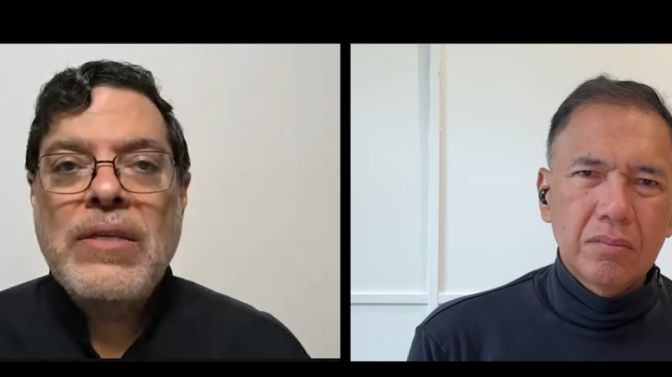
Editor’s Notes: In this episode of Endgame, Gita Wirjawan sits down with Professor Seyed Mohammad Marandi from the University of Tehran to explore the deep-seated information asymmetries surrounding Iran. Professor Marandi shares his unique perspective as someone who grew up in the United States before returning to Iran, providing a critical look at how Western “Orientalism” and media narratives often distort the reality of the region’s geopolitical struggles. The conversation delves into his personal experiences during the Iran-Iraq War, the resilience of the Iranian people under modern pressures, and his critique of the “Empire” and the global double standards regarding human rights and sovereignty. It is a compelling discussion that challenges mainstream viewpoints and examines the historical and cultural forces driving the Axis of Resistance. (April 6, 2026)
TRANSCRIPT:
Introduction
GITA WIRJAWAN: Hi friends, today we’re honored to be graced by Professor Mohammad Marandi, who teaches at the University of Tehran. Mohammad, thank you so much for gracing our show.
SEYED MOHAMMAD MARANDI: Thank you very much for inviting me. It’s a great honor being here.
Growing Up Between Two Worlds
GITA WIRJAWAN: You grew up in the first 13 years of your life in the US, and then you moved back to Iran. Tell me a little bit about how you grew up and how you have evolved all this time.
SEYED MOHAMMAD MARANDI: Well, I was born in the United States. My father fled the country, but also he went to study. He studied medicine at the University of Tehran, and then he wanted to become a pediatrician, and later on he became a neonatologist.
So I was there as a child. The first 5, 6 years I was in Virginia, Richmond, Virginia, and then we moved to Ohio. And shortly before my 13th birthday, after the revolution in Iran, as soon as the school year finished, we immediately traveled to Iran. Me, my siblings, and my mother, and we remained in Iran and my father stayed back to sell the house and the cars and his shares in the clinic. And so he joined us a few months later.
And since then, I’ve lived in Iran except for a period when I, among I and a number of other colleagues, we won scholarships for an exam, at an exam to do our PhDs. Because back then in my field we didn’t have PhDs. So I went to the UK for 3 years, 3 years and a few months, and I was on sabbatical for a year and I spent it in Beirut. Besides that, I’ve spent my entire adult life in Iran.
Of course, as maybe some of your viewers know, and I’m probably you know as well, I, at the beginning of the revolution, near the beginning, when Saddam Hussein invaded Iran, and when I was 16, I volunteered. That was the youngest age in which you could volunteer. Of course, you’d have to go through an interview process. And so I went through that and I joined the war effort, and I would go back and forth until the end of the war.
After that, I went back to studying, and I also worked. And then, of course, when I got the scholarship, I passed an exam and did my PhD. I came and began teaching at the University of Tehran, which is where I also did my BA and MA. Since then, I’ve been teaching.
Teaching English Literature and Orientalism
GITA WIRJAWAN: If you’re teaching English literature and Orientalism, why did you choose those two topics? And I’m just curious as to how your experience in enlisting yourself into the Army and how the history of Iran as it relates to the trials and tribulations shaped by the Ottoman Empire, the Soviet Union, the Brits, the Americans and then the Iraqi invasion. How do you think those things would’ve shaped your decision and how your teaching is at the university?
SEYED MOHAMMAD MARANDI: It’s hard to say now that I’m 59. You sort of maybe don’t remember exactly many things of your youth, or you may think that you thought about a certain thing in a certain way, and it may not necessarily have been the case.
But I was politically aware to a degree because my parents were very political. My father had been in jail under the Shah for a few months. Both of my parents were religious and politically active. When I was 11 or 12, my parents gave me a number of books of Dr. Shariati to read. They were among the few books that were translated into English, and they were pretty good, the translation. Of course, these were the more simple books, but they were encouraging me to be more aware of the world around me.
And when the revolution started, it was clear to me that there was an enormous gap between the narrative of American media and what my parents were telling me. And so as the revolution in Iran was taking place, it was probably the only real popular revolution in the 20th and 21st century because across the country people were on the streets in huge numbers, sort of like right now. Every day people are on the streets supporting the war effort. People have probably seen the footage under missiles. Yet the American media was defending the Shah and blaming Ayatollah Imam Khomeini for the bloodshed, even though it was the Shah’s army that was gunning people down.
And I do recall a cartoon, I think it was, where they depicted Imam Khomeini in a bath playing with blood. And that I could never find, but it was, for me, very surprising that the Shah was killing people yet he was being blamed for all the bloodshed.
So I guess, and here again I’m sort of not quite sure if this is a correct interpretation, or if it’s partially correct, but I think I was always fascinated with how language works and how — obviously I didn’t know narratives and I wasn’t that aware — but I did feel that language was very effectively used to say things that weren’t necessarily right, and those who were saying what is right weren’t able to express themselves, or not allowed to express themselves in a way which their righteousness would be comprehended or broadly understood.
The War Front and Chemical Weapons
When the war began, I was, I think, roughly 14. So it was the third year of the war when I wanted to join the armed forces as a volunteer, the Basij. And I joined. It was in my second time I went to the war front that I survived a chemical attack. And it was a nerve agent that was used. So I was 17. And those chemicals, of course, were provided to Saddam Hussein by the West.
And since I did know English, even though I was detached — back then there was no internet or anything like that — so in the war front and in Tehran, I would regularly listen to radio BBC or VOA. And the depiction of the war, which I was a part of, was very different from reality. And one aspect of it was chemical weapons.
And then let me fast forward a bit. During the last couple of, near the end of the war, Saddam Hussein used chemical weapons to slaughter a city, 6,500 people, or 6,000 to 6,500 people, in a city in Iraq, in northern Iraq, Kurdish, the Kurdish area, a city called Halabja. And I went to that town, city, soon afterwards, not when the — after the bodies had been buried and all that, because that was an area that was liberated. And I went in there and the doors were still open. It was, you know, people just died. They just fell and were strangled. And you could see the doors to the houses open, the yards. And it was obvious that people just, everyone had suddenly died and they suffocated. And it’s a terrible death because I’ve experienced that nerve agent myself.
And that was, I think, a very defining moment for me because the West gave him those chemical weapons, the Germans in particular. And when foreign journalists were taken there to see what Saddam had done, there was no real reaction. And only when Saddam Hussein invaded Kuwait did suddenly this become an issue, and all the Western media and Western governments were talking about how evil he is and how he uses chemical weapons. Well, they didn’t say anything when he was using them, and they had no problem giving it to him. That was, I think, a very important moment.
Of course, I’ve also survived mustard gas. And one of my dark experiences was visiting fellow comrades in hospital. And the hospital was full of combatants who were injured with mustard gas. And mustard gas is really bad because if you survive it, it can gradually kill you. And people, for years, suffer. They can’t breathe. It gets worse and worse. It corrupts your lungs and it does other things as well.
But I have an acquaintance — I had an acquaintance, the brother of a colleague of mine, a friend of mine — who, after suffering for almost 30 years, he finally died of his chemical wounds. So chemical weapons, I think, was an important experience for me in understanding the West and the political order and how it really works.
The Influence of Chomsky and Edward Said
Probably in addition to that, the very fact that they tried to sort of blame Iran for the war, even though it was clear that they and Saddam Hussein were behind it. And since I was influenced by these, I think that probably led me to the critique of the West, and I began reading authors, writers such as Chomsky — now somewhat discredited because of the Epstein files — but in any case, back then, I read Chomsky, Said, Edward Said.
And they sort of, in many ways — and I think you and your audience would probably understand what I’m saying — they said what I sort of already knew, but they put it in words which made it much clearer for me, or they put it in words which I could not do to make what I felt understood. So I think a lot of people feel that way. Often you read things and you say, “Yes, that’s exactly correct,” but you could never put it into words like the author could.
So it has influenced the way I think, my worldview, obviously. It has also made me more interested in Orientalism and the critique of Western Orientalism.
The Resolve of the Iranian People
GITA WIRJAWAN: The other day, the university campus in Iran was attacked or bombed. How do you think that would have reshaped or further shaped the resolve of the students and the Iranian people? And add to that, how the late Soleimani made the public exhortation that Iran is a nation of martyrdom. Add to that the fact that the late Khomeini, Ali Khomeini, was murdered. How do you think all these have affected the resolve of the Iranian people?
Iran’s Unity and Resilience Under Attack
SEYED MOHAMMAD MARANDI: I think it has united the Iranian nation more than I’ve ever seen in my lifetime. The 1980s was extraordinary and how the people came together to defend this Islamic Republic against the empire. And what I’ve been seeing over the last month goes beyond that. Every day now, every night, people are on the streets at night. Sometimes I go out to a studio for an interview, like now, and on my way, I see huge gatherings in different parts of the city, small gatherings, big gatherings, huge gatherings all over the city. And this goes on to like 2 AM and 3 AM. And there are caravans of cars with flags every single night and under the threat of airstrikes and missile strikes.
And we know that the Americans, and I’m sure everyone knows that the Americans and the Israelis, the regime, these two regimes are bombing everything. They bomb hospitals, they bomb universities, they bomb schools, they bomb apartment blocks. They carry out carpet bombing. Some of the most outrageous strikes have been carried out just yesterday, I think. Right now you can hear, I don’t know if you can hear the bombs falling, but anyway, can you hear? They’re bombing Tehran right now.
So just yesterday, they bombed an organization that deals with orphans. And two people were killed. Excuse me. Two people were murdered, martyred as a result. And on numerous occasions, they bomb these gatherings. And you won’t hear this in the Western media. You won’t hear this in the Western media. You can still hear them. They carpet bomb. The objective is to slaughter people because they failed on the battlefield. So in frustration, they take it out on the people, Americans and Israelis.
Of course, they were doing it from day one. The first thing that the Americans bombed was a school murdering 168 little girls and a couple of dozen teachers and school staff. And it was no mistake because it was the first wave. Those first targets were well vetted. They had weeks to do so. And that school was well known. You could find it on any app. It was to teach the Iranians a lesson. And on the same day, they also targeted a gymnasium full of girls, killing 20, 21 of them. They were playing volleyball. Those were intentional.
In any case, sort of going back — on some occasions, all these gatherings are under the threat of bombardment, and it’s not just Tehran, it’s cities across the country and even towns and villages. But I witnessed twice the attack on gatherings in Tehran, a huge gathering. One was on the last Friday of Ramadan, where Iran, since the revolution, they’ve had Quds Day, International Quds Day, where on the last Friday of the month of Ramadan, people would come on the streets of Tehran in support of the Palestinian people, or Jerusalem Day, Al-Quds. And I was there. They fired missiles at the rally and one woman was martyred. And I put footage of it, people can see it. It’s not my footage, but others filmed it from multiple angles. People did not run away, they did not stampede, they did not move, and they continued chanting slogans and saying, “Allahu Akbar.” And it was extraordinary, stunning. And like 16-year-old teenage girls who could be at home doing what teenagers do, they were there, they wouldn’t budge.
So the front lines are the cities now. In the 1980s, the front lines were on the border or near the border, or the cities that were targeted were near the border. Now they target everywhere and people are steadfast across the country. There are other examples of them firing missiles at Anzali City at gatherings, at rallies, which I put up in my Twitter account because I’ve been removed from Facebook and Instagram, but people can see it in Anzali City as well as in Hamadan and so on.
So the point is that you see a mobilization of the people, and the steadfastness of the Iranians during the last month has been beyond belief. I’ve never heard of such a — under these circumstances, under rain, under cold. We’ve had a lot of rain and even snow during the last month in Tehran. Freezing at night, and people would still be out till 2 AM, 3 AM. So it’s been an extraordinary experience.
Khamenei’s Doctrine and the Question of Succession
GITA WIRJAWAN: Amazing. You wrote a paper on the late Ali Khamenei’s doctrine. Tell us how you think the doctrine has evolved by way of the younger Mojtaba Khamenei ruling or governing Iran as of today?
SEYED MOHAMMAD MARANDI: Well, we didn’t have a leader for a week. And that is one of the amazing things — they bombed the leader, murdered senior military commanders, and they were expecting the country to move towards chaos. And for a full week, effectively, the people held the country together. People came to the streets and they stood day and night during the first few days, not just during the nights, day and night.
Meanwhile, the army, the Revolutionary Guards, they immediately began responding. Less than an hour after the initial strike where Ayatollah Khamenei, Ayatollah Sayyid Ali Khamenei was martyred and all the school children and others were martyred, less than an hour later, Iran began to strike, counterstrike. And we saw — and this is no exaggeration at all — no queues, no lines for bread, no rush to gas stations. Not at all. Not even for a few hours. No rush to take food from supermarkets. It was just ordinary. The only thing that changed was that after they murdered all those children, the government shut schools and universities and in Tehran, they asked people to leave if they didn’t have serious work to do or serious reason to stay in Tehran.
But after a week, the council that chooses the leader chose his son. But the point I want to make is that the strength of the Islamic Republic is due to the population and the people. In the absence of senior leadership, even though the constitution has solutions — when in the absence of the leader, the president and the head of the judiciary and a representative from the Guardian Council, they are the provisional leaders — but there was a state of war and not just some ordinary war, a superpower. And it’s the Israelis, which have everything that they could ever imagine having, with the full cooperation of all these regional regimes which hosted bases, they launched this attack. And so during that week, it was the people, the population that held the Islamic Republic intact.
But in any case, I think that most probably Ayatollah Sayyed Mojtaba Khamenei is a sign of continuity. And I don’t think that there will be any drastic change in Iranian foreign policy at all or in internal policy. Ayatollah Khamenei, when he was alive, supported the private sector, but he was a strong believer in social justice and he believed that the state had a responsibility to protect the oppressed and the marginalized. And he always stressed to the different presidents who had, during the last 3 decades, had differing views from each other, often very differing — but he always stressed for them to deal with the oppressed, to not allow anyone to remain without government support, state support. And I think that is part of his Islamic worldview.
And of course, Iranian culture is deeply influenced by the Quran, the Holy Prophet, all the prophets of course, the Holy Prophet, his son-in-law, his household. And in this case, his son-in-law — social justice was a very strong element of his 5-year rule. But also the issue of supporting the oppressed meant supporting the oppressed beyond Iran’s borders. And that is why Iran always supported Cuba, Venezuela, the resistance in Southern Africa against apartheid. In fact, Ayatollah Khamenei, when he was the president, he visited the frontline states in Southern Africa to help support them and to strengthen ties with Iran.
Iran’s Pre-Revolutionary Foreign Policy Principles
And of course, the issue of Palestine, which was always before the revolution. There were 3 foreign policy issues that the revolutionaries focused on. One was Iran’s lack of independence. The second was apartheid — Iran’s support for apartheid South Africa under the Shah. And just like the regimes in the region today with regards to Palestine, you see Turkey transporting oil from Baku, you see Egypt importing gas, you see Jordan doing extensive trade and so on. So the Shah exported oil to both apartheid South Africa and Israel, the Israeli regime. And so the three issues were the lack of independence, Iran’s support for apartheid in South Africa, and also Iran’s support for apartheid in Palestine. This was something that was key. These were key issues before the revolution.
So that sense of supporting the oppressed, which is also deeply manifested in the struggle of Imam Hussein against Yazid, the grandson of the Prophet, his martyrdom in Karbala, the role his sister played, his martyrdom and his companions, and how he would not submit to the despot of his era — that is a big deal in our culture. If you come to Tehran or any other city in Iran on any day of the year, just walking down the streets on Ashura and the day before Ashura is different. The streets, the people, the gatherings — it’s a different place altogether.
And of course, this is a common theme across the Axis of Resistance. So there’s a certain steadfastness and resilience and a certain element of resistance that’s unique in Hezbollah, in Lebanon, and in Iran. Today, you see how Hezbollah is fighting against the Israeli regime against all odds. The US has its proxies in charge in Syria. It has a pro-Western government installed in Lebanon, even though the majority of the country supports Hezbollah, but they constantly stab them in the back. They betray the resistance, but they continue to fight. And they fought from the beginning in order to ease the pressure on Gaza.
During the height when the genocide began, they started fighting alongside the border with occupied Palestine to draw troops away from Gaza. In other words, Hezbollah and its people and their families, they were sacrificing themselves for Gaza. And that, I think, is unique in contemporary history, that one nation, one people.
Mojtaba Khamenei’s Foreign Policy Posture
GITA WIRJAWAN: One would assume that the slaying of Ali Khamenei was a Karbala moment. My curiosity is with respect to the extent to which Mojtaba Khamenei is likely to posture more proactively or more aggressively than his late father. Is that something that we could expect as it relates to the foreign policy? I think you’ve talked about the domestic policy, but as it relates more to the foreign policy of Iran — the martyr was always a very popular figure.
Iran’s Resilience and the Nature of the Conflict
SEYED MOHAMMAD MARANDI: And contrary to what Western media always said, how the regime, as they like to call it, was unpopular, it was imploding, it was corrupt, people despise it, that was all nonsense. People can be critical of the government and critical. If you go into any taxi under ordinary circumstances, like a month ago, 2 months ago, 6 months ago, in ordinary Tehran, you go into the metro, if you get on a bus, people will nag, they’ll complain, they’ll say, they can say really nasty things. They’ll say, they can say things against God. I mean, they can say anything.
It’s very different from US allies in the region or its proxies in the region and the Persian Gulf where people cannot talk. They cannot even say things on TV. Up with me. But actually, in Iran, society is quite open. There are all sorts of differing views. But he was a popular figure, whether they liked it or not, in the West. And I think that’s reflective of how Iran succeeded all these years under maximum pressure sanctions. And all those sanctions were because of Palestine and Iran’s independence.
Iran is the only country that has really made sacrifices for Palestine. For all these decades. Now Yemen too, but Iran has been under pressure for decades. And of course, terrorism that we saw just a few months ago where they brought in terrorists to slaughter and they killed hundreds of police officers, Western intelligence agencies working against Iran, maximum pressure sanctions, and multiple wars. In 1980, Saddam Hussein, less than a year ago, Israeli regime in the United States.
And again, this time around, Ayatollah Khomeini, though, when he was martyred, that was a very significant moment because even those who disliked him or some of those who are ambivalent about him or even some of those who liked him, they were shocked because there was a lot of propaganda. There’s this huge Persian media empire that is owned and controlled by Western intelligence agencies that broadcast into Iran. They’re bigger than any media that exists in Iran. And billions of dollars are spent a year on it. There are hundreds of media channels, TV channels, very high quality, very well funded, some of them. And they broadcast day and night with disinformation and they’re hostile.
And so Iranians see anti-Islamic Republic propaganda more than they see anything that comes in from inside Iran because they have so much money. And they literally employ— I don’t know if you can hear the explosions. Actually, it’s quite close. They usually bomb at this time of day. Sorry about that. So no, no, I— you do what you have to do.
So when he was martyred, people were under the influence, and there’s tens of thousands of people who work abroad. And that’s why sometimes you see so many expats in Iran so openly against Iran. They’re on the payroll. Most expats are not like that. They just, they’re quiet because in the West, if you’re pro-Iran, it’s not going to do you any good. Those who are actively pro-Iran, they can’t get jobs. It’s very difficult. The FBI visits them or intelligence services regularly visit them. And marginalized them.
But when he was martyred, because they were constantly being told by this media empire that he was like in hiding in some bunker, and then when they saw that he actually refused to leave his home and office because so many Iranians had nowhere to go, so he said, well, others cannot go, I’m not going to go. People are struggling and they don’t have the money to go somewhere, then I’m going to stay put, even though he knew that he’s a top target. And that, I think, changed the mood of a segment of society, that segment of society that was influenced by the West.
And then a lot of young people who were influenced by these anti-Iranian narratives, this Persian media empire coming from the West, working from the West. They saw how hospitals were being bombed. Western media and even opponents of Trump were not interested in any of this. They were talking about how regime change is good, how evil Iran is, even though all of this is illegal, all of these are crimes against humanity, war crimes. They began to recognize the reality of the world, sort of like me.
As I told you before, early on, when during the revolution, I saw Western narratives on Iran and it contradicted what my parents were saying and also the reality that I was also seeing people on the streets being killed. The news was coming out from Iran and it didn’t fit with the Western narrative. And then of course the war, and how the West was deploying chemical weapons against Iranians.
And so I think that this generation, younger people in Iran, this was an extraordinary learning experience. And so I think that Iran is stronger today than before. And that gives Ayatollah Sayyed Mujtaba Khamenei added strength because the people are more steadfast and the people are more knowledgeable about what they’re confronting and more realistic about the nature of empire, and that really empire is not going to tolerate you and it really does not compromise with anyone.
Decentralization and Asymmetric Warfare
GITA WIRJAWAN: I want to talk a little bit more deeply about the ongoing war. Many have, I think, come to the conclusion that Iran’s threshold for pain is much higher than they would have thought. And this, I think, relates to so many factors, many of which you’ve alluded to. One is really the decentralization of decision-making in Iran, which I think many did not expect. Another would be the asymmetry with which you have undertaken in dealing with this attack or invasion. Talk a little bit about the decentralization of decision-making and the asymmetry that have, I think, elevated your threshold for pain.
SEYED MOHAMMAD MARANDI: Well, first of all, there are very few books that are any good in the English language on Iran. That I’ve read. There’s one that’s actually quite good, and I would advise your viewers to read. I don’t agree with everything in it, but I think it’s a very good book. And ironically, the authors worked in the White House. One of them was the head of the Middle East and the US National Security Council. And the other was the head of the Persian Gulf region. And the head of the Persian Gulf, she’s Jewish, Hillary Mann. And the person who was in charge of the Middle East was Flint Leverett. And they met in the White House and they married. So it’s Flint Leverett and Hillary Mann Leverett. He’s Catholic, she’s Jewish. Their views on Iran evolved over time, and they wrote a very good book. And it’s called, as I said, Going to Tehran. I think even though it’s a bit old, it’s like what was written a decade ago, but I still think that it’s very much—
GITA WIRJAWAN: You tweeted about it, I think.
SEYED MOHAMMAD MARANDI: Yes, I did. I think it’s very much worth reading. Contrary— and again, this goes back to Orientalism. In the West, there’s a very strong element of Orientalism, and it influences us too. Because we’re influenced by Western narratives and Western thought. Our textbooks in Iran and elsewhere in the world are influenced by their writings and history books are influenced. So the world is very Eurocentric, has been very Eurocentric, even though I think we are beginning to see the decolonization of the mind in different parts of the world in ways that we haven’t before. In my opinion.
But this Orientalist narrative produced in the West is something that has influenced, I think, people across the world. And of course, Iran is backward, and corrupt and abnormal and all that within the framework of Orientalism. But it also makes them assume that if they just cut off the head, that things will fall apart because everything is bound to a single person, the despot, or that they’re not sophisticated like we are. And so in wars, their superior weapon systems can overcome anything with ease.
And I think that ignorance, along with the narrative of Iran being unpopular, corrupt, backward, and collapsing and all that, all of this helped them devise policies that when confronted with reality, they fail. These people hit brick walls. It happened during the 12-Day War. They failed, but it didn’t teach them a lesson because those narratives are so powerful.
But Iran has a very sophisticated society and has very sophisticated state institutions and private institutions. And the Constitution shows that sophistication, and we’ve achieved results during the 47 years under maximum— I mean, the pressure that Iran has faced over the last 47 years is unique. I think it’s difficult to imagine any country surviving wars and maximum pressure of sanctions and attempts to create coups, or at least armed rebellion or armed uprisings and that sort of thing.
So they thought that by murdering senior officials that it would fall. But for me, it was clear as day that nothing would happen because Iranian society is a mature society and we have a sophisticated state and laws which can deal with these crises. But they don’t see it, the West doesn’t see it that way.
The second, of course, was the military. They underestimated Iran. They thought that, okay, after a couple of days, the Islamic Republic would collapse. And then when it didn’t, they said, well, their weapons will be dealt with and destroyed in 3 or 4 days. I don’t know if you remember the graphs during, after 4 or 5 days, they said the number of missiles being fired are going down rapidly, the number of drones being fired. And then now it’s over, it’s a month now. And Iran is still striking hard and harder than before. And they are unable to block Iran’s missiles or drones. And they’re unable to destroy the factories that produce them or the underground bases that hold them, where they keep them.
And this, the sophisticated way in which the Iranians are fighting a much more powerful entity, which of course has the support of Saudi Arabia, the Emirates, Qatar, Bahrain, Kuwait, Jordan, Turkey, all of them are in their camp, every single one of them. The Republic of Azerbaijan, despite all that, and of course the collective West, the collective West, even though they don’t dare come and join the battlefield, the Americans on the battlefield, but they support the United States, they’re hostile towards Iran. They condemn Iran even though their allies launched the war, just like during the 12-Day War.
So I think that sophisticated nature of Iranian society, and of course, which is reflected in Iran’s ability to devise a military doctrine that can push back against the empire and defeat the empire. I think all of that led to major miscalculations, these capabilities in Iran. And of course, the resilience of the Iranian people, which is the very top. If Western policymakers, in addition to reading that book that I advise people to read, Going to Tehran, if they’d read about Imam Hussein and Ashura and Karbala and how it influences the culture of resistance, they wouldn’t have chosen to carry out this war. They understood what they’re up against.
And it’s very interesting. I have a Marxist friend who’s a journalist. He’s Brazilian, but he’s in Moscow. He has one of the key Marxists in Brazil was telling him just a few days ago, he was stunned. Well, a couple of weeks ago, actually. He was stunned at how Iran resists. And he was saying that if these Iranians win, I’m going to convert to Shiism. And regardless of whether he does or not, the point is that this idea of resistance, this— of course, there’s no such thing as Shiism, Shia Islam, but this idea of resistance exists in our culture in a way in which it does not in Marxism. And Marxism, of course, is a European ideology. It comes from Europe itself. And sometimes Orientalists, when they would want to insult non-Westerners, they would say your ideology through which you resist, meaning Marxism, is ours. You don’t even have your own modes of thought.
But in any case, the point is that they underestimate. The West underestimates, and that underestimation comes from this sense of arrogance, this sense of superiority, this sense of exceptionalism, very much like what you see with the Zionists. Zionism is the belief in a master race, a master people, and therefore everyone else is subhuman. It’s not just the Palestinians that are Amalek, it’s everyone. It’s Hindus, it’s Iranians, it’s Arabs, it’s Europeans, it’s anyone who does not—
GITA WIRJAWAN: Gentiles too.
SEYED MOHAMMAD MARANDI: Yeah, anyone who’s not a member of their thought, of their— Of course, many Jews are utterly opposed to Zionism. And many Jews heroically stand against Zionism, both religious and non-religious. So we should never conflate Judaism with Zionism, just like we should not conflate ISIS and Al-Qaeda, which are Western-backed creations created by the West with their regional, with the support of their regional proxies like Saudi Arabia and more recently Qatar. We should not conflate ISIS and Al-Qaeda with Islam, just as we shouldn’t conflate fascism with Christianity. So yes, I think that arrogance that you see among Zionists makes them underestimate the so-called Amalek or others, however we want to describe them.
Duration of the Conflict
GITA WIRJAWAN: Mohammed, we’ve seen recent galvanization in Iraq, Yemen, and Lebanon. Add to that your ability to basically manage or control the Strait of Hormuz. Add to that the decision to put boots on the ground. Draw the picture in terms of the duration of this conflict. How long do you think this thing will sustain or last?
Iran’s Conditions for Peace
SEYED MOHAMMAD MARANDI: Well, Iran would rather it last longer because, and it will extend it until it gets what it wants. And the reason is obvious. Ceasefires are of no use to Iran. What will happen in a ceasefire? Trump and Netanyahu will regroup. They’ll rearm, and they’ll launch another war. Remember, we already had a war less than a year ago, and they were negotiating, the US was negotiating with us, but it was secretly conspiring to attack us. And this time around, they did the exact same thing. They were negotiating with us. The Omani foreign minister, who was the mediator, said that progress was made, but in reality, they were conspiring to attack us. So we’re not going to let that happen again.
And so the facts on the ground are going to have to change. No signature of Trump is of any worth to Iran. He’ll write something and tear it up tomorrow. Not even tomorrow, he may tear it up later that day. So the facts on the ground have to change. US proxies in the region can no longer be platforms for aggression against Iran. And reparations have to be made. So they have to, for all the people who are killed. Now, whether the Americans give it or these proxies give it, it doesn’t matter to Iran. And Iran’s allies in the region will also have to be a part of this, whatever agreement that, any agreement in future.
They can’t — they have a ceasefire, a so-called ceasefire in Gaza, which is fake. Every day they’re slaughtering Palestinians in Gaza. It’s not much in the news anymore because everyone is focused on Iran and Lebanon. They’ve been slaughtering the Lebanese ever since the ceasefire every day. That’s unacceptable. So Iran will continue this war. Until the facts on the ground change, until sovereignty is respected, until its allies are respected, and until reparations are given for the murder and death and destruction carried out.
Trump made a catastrophic mistake. We don’t care what — how it impacts his future. Iran is not going to — the Islamic Republic is not going to be lenient. He can pretend that Iran is negotiating with him. It’s not. He can pretend that Iran gave him, I don’t know, 20, 30, 40, 50 ships as tributes. He can say all the nonsense he wants. Iran will continue to resist, and soon we’ll probably have, in the coming days, a major assault on Iran. You’ll have a few days of propaganda where Western media, from The Guardian to Breitbart, from Fox News to BBC, will try to tell you that they are winning and making fantastic strides. But after a few days, you’ll see that just like in this war, they failed. They’ll fail.
And the resilience of the Axis of Resistance and the heroism of the Axis of Resistance will ensure that they’re defeated. And remember, all of this is because of the Palestinian people. All of this is because the Axis of Resistance says no to genocide. That is why Iran has been targeted during the last 47 years. Iran is the only country that has been supporting the Palestinian people. No other country does. Other countries, some countries pretend they do. And they, like for example, Qatar, they have a TV channel which, I mean, they have many TV channels and many media outlets, but the main one being Al Jazeera, for example. So show sympathy, but they won’t do anything. And they won’t say anything that the Americans don’t accept. And they give scholarships to Palestinians so that Palestinians like them, but they won’t do anything for Palestine.
And yet that is why no one is sanctioned but Iran. That’s why no one is punished but Iran. They’re all in the Western camp. They may hate each other. Qatar may hate the Emirates, and the Emirates and Turkey may dislike each other or Saudi Arabia, but they’re still in the American camp. So Iran sacrifices, Yemen sacrifices, Hezbollah sacrifices, the resistance in Iraq sacrifices for Palestine.
And as I said, this is a part of a broader tradition. Iran supports Cuba, which is being strangled today. Now it can’t do much because it’s fighting a war. It supports Venezuela. I’ve been to these countries. It assisted Venezuela when things were very bad a few years ago when the economic warfare was engaged, was being imposed. I don’t know if you recall, Iran sent tankers and warned the United States not to touch its tankers. Those tankers were being sent to rescue the Venezuelan economy. Or Bosnia. Bosnia was being wiped out, and it was the Iranians that went to Bosnia and saved the country. No one else did it.
Pakistan’s Mediation Efforts
GITA WIRJAWAN: There was a report about the prospect of the foreign minister of Pakistan flying out to China to help mediate. Do you see this as a potential remedy, or Iran is sort of like pricing in, you know, a continuation of diplomatic ruse?
SEYED MOHAMMAD MARANDI: Iran doesn’t need mediation. Iran will allow certain ships to come out to help Pakistan or Bangladesh or other countries in the global majority that are under a lot of stress and have very few resources. But — and messages go back and forth between Iran and the United States for decades. It’s not new. They sometimes go through Oman, sometimes through Moscow, sometimes through other regional countries. So sending a message is not negotiations.
As I said, until the facts on the ground change, nothing changes for Iran. So if Pakistan wants to, let’s say, or any third party, wants to mediate, ceasefire — ceasefire means nothing to us because one year from now, we’ll be having this conversation again as bombs are being dropped on our city. So the only thing that can bring about change is the United States coming to this recognition that they can never bomb Iran again. And Iran wants to make sure that happens, and it will come at a heavy price.
Many people die. They’re murdering families. They’re slaughtering lots of people. They’re destroying infrastructure. They bomb parks. They bomb, you know, stadiums. They bomb cultural centers. They bomb everything. They bomb local police stations. They bomb everything. So the price is high for us. People are being murdered. But we have to ensure that in future this doesn’t happen again. And so mediation in the way in which you describe is not something that is going to lead to any breakthrough. And the Americans know what we want, and we know what we want. And therefore, ultimately, sometime down the road, the war will come to an end. But it will come to an end when Trump has paid a heavy price for it. So no, I don’t take this mediation effort or other mediation efforts to be very important at this moment.
The Nuclear Question
GITA WIRJAWAN: In the context of the escalation letter, if one were to hypothetically consider using the nuclear weapon, how would you draw the picture?
SEYED MOHAMMAD MARANDI: Well, in general, I would say that I would remind everyone that we didn’t start this war. Because if you watch Western media, you think that we started the war. And that again shows how Western media, this myth of democracy and freedom of expression, and that’s all just nonsense. That’s just a dark joke.
But we didn’t start this war and we do not escalate. We only escalate, we only go up the escalation ladder when they escalate, but we hit harder to prevent further escalation. So for example, when the Israeli regime struck Iran’s South Pars gas field, Iran had already said beforehand, you do that, you hit our vital infrastructure, we will hit you much harder. So what did Iran do? It bombed the Qatari gas field, its LNG facilities, and Saudis and the Emiratis, because they’re all a part of this war, and the Israeli infrastructure. So Iran went in, they hit one, Iran hit multiple. Why? Because Iran is saying, don’t do it again. And that’s why, if you recall, Trump backed down. He said, “I didn’t know about this.” He wrote a social media tweet, “I didn’t know about this. Israel will not do it again.” Of course, no one believes anything Trump or Israeli regime says, but the point is that they took it seriously.
So Iran doesn’t escalate, but Iran and the Axis of Resistance can escalate. They’re far more powerful than what you’re seeing right now. And when the US invades, they’ll see escalation and they’ll see that Iran can hit them hard, but also in Iraq and Yemen and Lebanon, the capabilities of the Axis are enormous and the resilience and the resistance is extraordinary.
The question that you raise, I think, is interesting in the sense that it implies how evil the United States and the Israeli regime are. Because no sane person would ever, no decent person would ever contemplate using a nuclear weapon, let alone actually try to use one. But this just shows the evil nature of Zionism and the evil nature of Zionists and the evil nature of the empire. So I think that’s an interesting point always to keep in mind.
The second is that I don’t think that the world will tolerate this. Nuclear powers will see that this is basically going to lead to a situation where in future nuclear weapons will be easily used. And I think there will be a rush across the world. Because countries will recognize that from now on they can be nuked. And with the rise of AI and the new technologies, I am sure that there are tens of countries that if they had the will, they would be able to develop nuclear weapons in a roughly short period of time. And of course, our region would be full of countries that would, for their own survival, be pursuing nuclear weapons, all countries in this region. So I don’t think that would lead to the survival of the Israeli regime. It would destroy it ultimately in multiple ways and at multiple layers.
Iran and Vietnam: A Parallel?
GITA WIRJAWAN: I come from Southeast Asia where there’s one country called Vietnam which experienced trials and tribulations. There was a time when actually the late Ho Chi Minh, he actually pretty much copycatted the Declaration of Independence from the United States for its own independence crafting, but he was labeled as a tyrant. How do you compare Iran with what Vietnam might have gone through? Is there a parallel here?
Iran’s Role in the Resistance and Regional Geopolitics
SEYED MOHAMMAD MARANDI: I think there are obviously similarities wherever there is resistance to empire, but I think that in the case of Vietnam, they had support from major powers. In the case of Iran, obviously, countries like Russia and China have good relations with Iran. In the case of Russia, I would say very good relations with Iran now.
But the nature of the cooperation between, for example, Russia and Iran or China and Iran is very different from the nature of the relationship that Vietnam had with rivals to the United States during the Vietnam War. Iran is truly, truly an independent country, and it’s standing on its own feet, and it helps others too, simultaneously.
For Iran, it’s not important that Cuba is a communist country. They are the victims of empire. So Iran has always tried to support Cuba and Nicaragua. Venezuela, of course, Venezuela is very different from Cuba. If you’ve been to Cuba and Venezuela, you’d know that religion in Venezuela is not something that the state or President Maduro or President Chavez before him oppose. In fact, it was the opposite. So Iran had a very comfortable relationship with Venezuela, more than Cuba, but Iran assisted both. And I should point out that Hugo Chávez also helped Iran when he could. Or supporting South Africa or Palestine.
For 47 years, Iran has been demonized by Arabic media, by the Qatari media empire, by the Saudi media empire, by the Emirati media empire, by Erdoğan’s media empire, which is partially funded by Qatar, or has been at least until last time I knew. And they’ve always told the Palestinian people that Iran is your enemy. “They’re Shia, they’re Rafidi, they are not Muslim, they’re doing secret deals behind your back, they’re using you for their—” And basically, they were lying to them day and night, and many Palestinians believed it.
And then you would have that Persian media empire controlled by the West, which is like these Arabic media empires. They would broadcast or show what some Palestinians would be saying about Iran, saying, “Look, your government is supporting Palestinians, but Palestinians hate you.” But Iran would not allow these things to change its resolve. They say these are victims regardless.
Now, of course, not all Palestinians were fooled by these narratives. Many were. But Iran was not deterred because they were victims. It didn’t matter to them if they were deemed as good people or bad people. These were victims and it was our responsibility to help them. And we did so for decades.
Over Syria, these regimes tried desperately to make it a sectarian issue, Qatar and Saudi Arabia alongside the West. And they did succeed to a degree to fool people. But now it’s all come out. The reason why Iran was in Syria was not because of Assad being an Alawite. Iran couldn’t care less if he was an Alawite or Sunni or a Shia or a Jew or a Hindu. The project in Syria was to break the resistance. And these proxies in our region, they’re proxies. They are part of the Western Empire. And they helped do that. And they succeeded. And now you see that Syria’s basically working with Americans. And if it wasn’t for the fall of Syria, today the situation for the Israeli regime would be very different. The regime would be in far greater hardship. But these regimes fooled a lot of people towards sectarianism.
Why? Because of their own inaction. Turkey under Erdoğan never did anything for Palestine. But if they see Iranians are working for Palestine, Yemen sacrificing for Palestine, Hezbollah, then there are people who will say, “Well, you should join.” So what’s the best way to quiet the people? To say that they’re bad guys. “They’re not Muslims. They’re not sincere. They’re doing deals with Israel behind the scenes you don’t know.”
But for 47 years, we’ve been suffering as a result. And what deal? I mean, if Iran wanted to cut a deal or Hezbollah wants to cut a deal, they could have received a lot. Imagine what the Americans would be willing to do for Iran if Iran just left Palestine alone or Hezbollah. So Iran continued despite all that anti-Iranian propaganda, anti-Shia propaganda, to support the Palestinian cause because it’s a principle, because they’re human beings. It’s not just because they’re Muslims.
The same was true with apartheid in South Africa. The same was true in Bosnia. Bosnia, they’re not Shia. They were Sunni Muslims. And Iran felt a responsibility to save them. So there are values in the Islamic Republic of Iran that are the driving force behind all this.
And I think that it is these values ultimately that will lead us, the resistance, to bring about a strategic defeat for Trump. A catastrophic defeat for Trump. I think it’ll lead to the end of his presidency. I’m not saying that the Israeli regime will collapse tomorrow, next week, or next month, or next year, but I think we are definitely witnessing the dying era or period of time of the Israeli regime. It is now globally despised. It is definitely not invincible, and in the West, they despise it.
And now ordinary Americans and people across the world are going to see their own economic suffering is because of the Israeli regime, because Trump is doing the bidding of the Israeli regime. Americans are going to have to sacrifice their economy because of the Israeli regime. So I think all of this is just foolishness. They’re not being smart. If they were smart, they wouldn’t have started this war in the first place.
A Lasting Peace in the Middle East
GITA WIRJAWAN: A couple of follow-up questions, I guess.
SEYED MOHAMMAD MARANDI: I think I didn’t answer your question though. I got distracted.
GITA WIRJAWAN: No, no, that’s totally fine. But a couple of follow-up questions to your remarks just now. The first would’ve been how, from an Iranian perspective, would a lasting peace in the Middle East look like? And number two, do you see hope in — we’re seeing or witnessing this increasing divergence between public opinion and policy in the West. Do you see hope for that to reconverge on the back of what you have illustrated earlier?
SEYED MOHAMMAD MARANDI: I’m in general optimistic about the future, although I don’t think it will be easy. I think that the only way for peace in our region is for the end of ethnic supremacism and that Palestinians and Jews and Christians and everyone who lives in that land have to be treated as equal human beings, as human beings that are the same.
South Africa under Nelson Mandela, you can say many things about it. There are many faults with the ANC government. Nelson Mandela probably made some big mistakes when it came to social justice, but at least we don’t have ethnosupremacism or racial supremacism in South Africa. That is an enormous step forward, an enormous step forward. Now, is there racism? Is there injustice? Of course. But you don’t have an official ideology which says whites are superior to non-whites. That has to come to an end.
A one-state solution. That’s always been Iran’s policy, a one-state solution. In Iran we have Jews, we have synagogues, we have kosher restaurants. Recently, Max Blumenthal visited Iran. He’s Jewish himself, a very good friend of mine. He and his wife traveled the country for a couple of weeks, and they did actually a documentary on synagogues. Maybe worth watching some of the stuff he produced from his trip to Tehran. He’s in charge of the Gray Zone.
So actually, Iran is not anti-Semitic at all. And Iran has always made the distinction. Imam Khomeini, at the beginning of the revolution, said Jews are completely separate from Zionism. Of course, anti-Semites are the Palestinians, but that aside. So a one-state solution is the only way to have peace in this region. And the two-state solution is impossible anyway. From the very beginning, there was never an intention by the West to have a two-state solution. It was just a facade from the very beginning. We’ve always been saying that, and it turned out to be true.
The second, what was the second question? The second part?
GITA WIRJAWAN: The divergence between policy and public opinion.
SEYED MOHAMMAD MARANDI: I’m, again, I’m optimistic. It just shows how when people receive information in general, people are good. If they’re given the right — the problem in the West is that there’s no democracy because there’s no democracy of information. The mainstream media and even significant parts of the alternative media are controlled by the oligarchs. By the Epstein class, as I would call it, and others would call it, by the Zionist overlords of the land.
So people are not always well-informed, but people are waking up because what happened in Gaza and continues to happen in Gaza. And we should never forget Gaza, even for a day. Should always be reminding people what’s happening in Gaza, even as the missiles between Iran and the US and Iran and Israel go back and forth and Hezbollah heroically fights in the north and Lebanese women and children are being massacred because of Hezbollah’s resistance and medics are being bombed and journalists are being murdered. But still we have to remember that this is all about Gaza. It’s all about Palestine. It’s all about ethnosupremacism.
But we have to keep pushing because as human beings, we are forgetful. And in Arabic, it means we’re forgetful. And in the Quran, it says that people, most people do not contemplate. So we have to always push. We have to keep pushing. But I think there’s a lot of momentum.
30, 40 years ago, those who were behind the resistance were much smaller in number and their global audience was very small and limited, but they kept struggling. And if it wasn’t for them, we wouldn’t have what we have today. So we have to keep pushing like the older generation who pushed before, and we have to do that until we achieve results.
Iran, BRICS, and the Multipolar World
GITA WIRJAWAN: Iran is a member of BRICS. How do you see the BRICS and Iran intertwining, and how do you see whatever is happening as we speak likely to reshape BRICS going forward, or whether BRICS has been helpful to Iran’s cause, or how do you see BRICS being more helpful to Iran’s cause?
SEYED MOHAMMAD MARANDI: It’s complicated because BRICS and the Shanghai Cooperation Organization, and Iran is a member of both, they have problems in the Shanghai Cooperation Organization, less so, but still. For example, India pursues a very different policy than some of the other leading countries. And in BRICS, it’s even more complicated because the United States is able to put a lot of pressure on Brazil alongside India. And Indian policy under the current prime minister is not what it was during Gandhi or even the Congress Party.
And because of the structure of BRICS, it’s difficult to achieve a great deal when there isn’t real consensus. But it is a place where heads of state gather. And they meet and they enhance cooperation. And BRICS can be more important in the future, and perhaps the changes that we’re witnessing today will act as a catalyst. The crisis that we’re seeing today will act as a catalyst for BRICS, but that remains to be seen.
GITA WIRJAWAN: Many have argued that we’re sort of living in a much more multipolar world. How do you see nuclear proliferation in a much more multipolar world?
SEYED MOHAMMAD MARANDI: Well, with the behavior of the West, they are encouraging it, but Iran has always been responsible. In fact, there’s also a good book called Manufactured Crisis, and a friend of mine wrote it. I can’t remember his name now. He’s very old now. He wrote it 10, 15 years ago. If someone looks it up, they could perhaps tell us right now. About how the whole nuclear issue in Iran was a manufactured crisis from the beginning. And there’s another book actually that was also quite good, but this is perhaps more detailed. The smaller book was written by Peter O’Born. But this I think is more detailed.
Iran has always been responding. Iran was never pursuing nuclear weapons. And for moral reasons, during the war where Saddam Hussein was giving chemical weapons, leading figures in Iran went to Ayatollah Khomeini and said we need to produce chemical weapons too, like Saddam has. And he said no, and he didn’t allow the Iranians to produce chemical weapons. And thus Ayatollah Khamenei’s fatwa is for similar reasons.
Also, there are other considerations too, and that is that if you produce a nuclear weapon, then countries around you want to produce nuclear weapons too. Like the Republic of Azerbaijan, a family dictatorship, or in the Persian Gulf, all these family dictatorships — none of them are inherently stable. So it’s not a good thing. So Iran has actually been responsible.
But the West’s hostility towards Iran is not because of nuclear weapons. Because there’s no evidence of it. They’ll use nuclear weapons. They’ll use human rights. They’ll use terrorism. They’ll use whatever they need to use. The issue is Iran’s independence. And today, more than anything else, by far, Iran’s support for the Palestinian people and its opposition to ethnosupremacism and genocide.
Decolonization and the Rule of Law
GITA WIRJAWAN: Mohammed, I know you’ve got to go, but I’ve got two final questions for you. The first one is something that you alluded to earlier as it relates to decolonization. Do you see in the near foreseeable future any hope for less selective rule of law? I mean, we’re seeing some countries that are basically undertaking an optional or selective rule of law type of behavior, right? Do you see that declining?
The Path Forward and Personal Reflections
SEYED MOHAMMAD MARANDI: I think we never had the rule of law, but there were some things, some laws that were still, to a degree implemented, and it prevented complete chaos. Now it is sort of the law of the jungle, but I think it’s partially because the West is on the decline and the empire is collapsing, and they’re going to break all the rules to preserve their empire.
Hopefully after this stage, I think we will see a period where there will be an eagerness for stability. How that will ultimately be achieved, that’s not for me to say, but I think people will want an end to this chaos. But that chaos is increasing because the West is struggling to preserve its evil empire.
GITA WIRJAWAN: Last question, Muhammad. It’s a bit personal, but you know, with the traumatic situation that Iran is going through, what gives you the strength, the calm and composure in answering so many questions from around the world?
SEYED MOHAMMAD MARANDI: God, Quran, the Prophet. His household, and the fact that across the world, among all races and religions and ethnicities and sects, you always see human dignity, you see humanity, and you should always be hopeful that ultimately, if you struggle and you do not give up your struggle, good will come out of it. I’m not a good person. I’m not what I want to be at all. But those are my ideals.
GITA WIRJAWAN: Thank you so much. You’ve been kind with your time.
SEYED MOHAMMAD MARANDI: Thank you. Bye for now.
GITA WIRJAWAN: That was Professor Mohammad Marandi from the University of Tehran.
Related Posts
- Transcript: World’s First AI Actress Interview on Piers Morgan Show: ft. Tom Conti, Tom Bilyeu & Prof Jiang
- In Vivo Podcast: w/ Cathy Tie and Prof. Jiang on Editing Embryos (Transcript)
- Transcript of Evy Poumpouras Interview: Read People, Spot Lies & More – FO563 Raj Shamani
- DOAC AI Emergency Debate: ft. Ed Zitron, Andrew McAfee, Nate Soares & Roman Yampolskiy (Transcript)
- Transcript of Norman Finkelstein Interview: Tucker Carlson Show