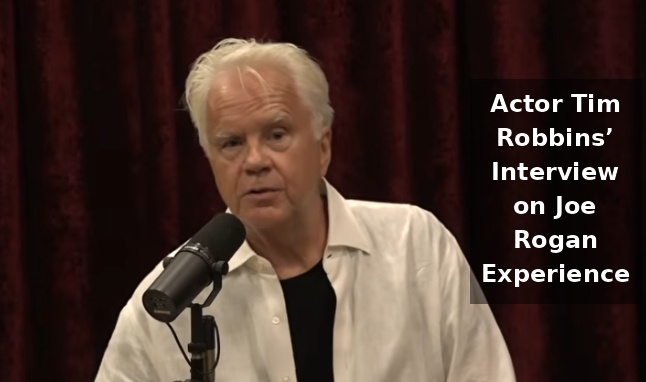
Read the full transcript of Academy Award-winning actor Tim Robbins’ interview on Joe Rogan Experience #2532, July 29, 2026.
Editor’s Notes: In this episode of the Joe Rogan Experience, Academy Award-winning actor, director, and producer Tim Robbins joins Joe for a wide-ranging conversation. Robbins reflects on his iconic roles in films like The Shawshank Redemption and Mystic River, as well as his current work starring in the Apple TV+ series Silo. The discussion explores themes ranging from Stephen King’s creative process and ancient underground cities to personal experiences opposing the Iraq War, navigating COVID-era policies, free speech, and cancel culture. Robbins also shares insights from his prison theater rehabilitation programs and offers thoughtful takes on comedy, Hollywood, and the nature of truth in public life.
Shawshank, Stephen King, and the Power of Saying No
JOE ROGAN: All right, Jamie’s very geeked out, I want to let you know. He didn’t want to say it. Shawshank is his all-time favorite movie, so he was kind of freaking out when he met you.
TIM ROBBINS: Thanks, Jamie.
JOE ROGAN: I mean, thank you. It’s all time. I mean, you’re a part of one of, easily one of the greatest movies in the history of people.
TIM ROBBINS: I know, it’s such a gift. I mean, when people come up and say something about it, it usually is coming from a pretty deep place.
JOE ROGAN: Yeah. If you didn’t like that movie, there’s something— you should go to a doctor. You need medication. There’s something wrong with you. That’s an amazing movie. And weird that it’s a Stephen King movie too, you know? He’s— that guy is arguably one of the most prolific guys in the history of fiction.
TIM ROBBINS: Yeah. And in the same novella, there was Stand By Me too.
JOE ROGAN: Oh, wow. That’s amazing. So weird. He writes— his stuff varies so much. He had to do, like, a pseudonym at one point in time. Remember? He did Richard Bachman because he was churning out so many books. They’re like, “Hey, we can’t keep selling these f*ing Stephen King books.” And he’s like, “Well, how about I come up with another name? Give me a fake name.” And he just started killing it under a fake name. Yeah, wild, wild guy, man. Just a very unusual human. You know, they exist.
TIM ROBBINS: Yeah, I’ve only met him once.
JOE ROGAN: Really?
TIM ROBBINS: Yeah.
JOE ROGAN: Did you meet him like when you were filming the movie?
TIM ROBBINS: Around the premiere time. Yeah.
JOE ROGAN: Yeah, so he’s out there, man. You know, during his early days, I’m fascinated by his early days because his early days he was off the rails with cocaine and alcohol. And some of the best stuff that he made, he doesn’t even remember writing it.
TIM ROBBINS: Wow.
JOE ROGAN: I think Cujo— I think it’s one of the books his wife took out of the garbage because he threw it away. He’s like, “F* this book, it sucks.” It was Cujo or one of the classics.
TIM ROBBINS: Yeah.
JOE ROGAN: And she was like, “Are you out of your f*ing mind? Like, this is incredible.” And he was literally going to throw it out because he was just out of his mind.
TIM ROBBINS: He wrote The Shining, right?
JOE ROGAN: Yeah. So what was it, Carrie?
TIM ROBBINS: Yeah.
JOE ROGAN: He threw Carrie away?
TIM ROBBINS: Crazy. No way.
JOE ROGAN: Crazy.
TIM ROBBINS: That’s crazy. Yeah, The Shining was a big book for me. I was working in a 9-to-5 job, in between colleges, and it really woke me up to all kinds of great possibilities in writing.
JOE ROGAN: Well, he hated the movie, which is so crazy because he felt like Jack Nicholson got insane too quickly.
TIM ROBBINS: Really?
JOE ROGAN: Yeah, because in the book— I read the book too. It’s very different. Similar, but it’s more of a drawn-out process of him becoming possessed by the property.
TIM ROBBINS: A slower rollout.
JOE ROGAN: Yeah, Jack Nicholson was kind of kooky already, like, right away, which, you know, it’s Jack Nicholson. It’s also Stanley Kubrick. It’s like he’s got to do his interpretation of it. You just got to accept that.
TIM ROBBINS: Of course. Yeah, that’s some scary stuff in that.
JOE ROGAN: Man, his books are insane. It’s like, what is going on inside that guy’s mind, or was going on inside that guy’s mind when he was writing that?
TIM ROBBINS: God knows.
JOE ROGAN: I think once he got clean, he kind of changed and straightened out, and he’s a different human now. But boy, I’m fascinated by the off-the-rails days because the books were so nuts.
TIM ROBBINS: Was Shawshank during that time?
JOE ROGAN: I don’t know. It must have been, because I don’t think he got sober until— it was decades after his career began.
TIM ROBBINS: Wow.
JOE ROGAN: And some of the great stuff, like The Stand— I think all that stuff, he was out of his mind when he was writing all those.
TIM ROBBINS: But in the midst of all that madness, there’s a tenderness, you know?
JOE ROGAN: Oh, a great humanity to it all.
TIM ROBBINS: Yeah.
JOE ROGAN: Yeah. But also just a true understanding of the darkest nature of humans and how they’re influenced. And then of course, demonic possession and Salem’s Lot and all that other crazy stuff. It was just so good.
TIM ROBBINS: But then the idea that a library can be— in Shawshank, that the library can be the liberation.
Silo, Underground Cities, and Surviving Cataclysms
JOE ROGAN: Yeah. No, it was an amazing movie. We were talking about your show Silo, which— it’s been around for 3 seasons. I just started watching it, so it’s new to me. I watched the first 2 episodes last night.
TIM ROBBINS: Wow.
JOE ROGAN: Something nutty like that.
TIM ROBBINS: I’ve seen pictures of it.
JOE ROGAN: Found completely by accident.
TIM ROBBINS: Yeah.
JOE ROGAN: So some guy lost one of his chickens, went through a hole in the wall, and never came back. And he was trying to figure out where this f*ing chicken went, so he broke down the wall to see what was going on. And then they realized that there’s this insane underground city.
TIM ROBBINS: Oh my God.
JOE ROGAN: Yeah, underneath this town in Turkey, and it’s massive. Just absolutely massive. They have no idea who made it. There’s no historical record of it.
TIM ROBBINS: Any idea of when?
JOE ROGAN: Well, they make guesses based on stuff they find there. But when you carbon date an object— you could go visit the pyramids today, right? And you could leave behind some stuff. And then everybody dies, humanity dies out in a cataclysm, and then 100,000 years from now, people start looking through the piles of some of these sites and the pyramids will probably still be there.
If there was any organic material left, like a book that you left or a leather-bound book or some piece of wood, they could carbon date that, and then that would say the time that you were there, but it wouldn’t say the time that the actual structure was made. So who knows how long— when was it found? I feel like it was found in the 20th century.
TIM ROBBINS: There must have been some kind of hostile force that they built it to—
JOE ROGAN: Exactly, or something going on outside. And not just hostile, but environmental. 1963, rediscovered in 1963. Wow. That’s crazy. It was in his f*ing house. Even today, only 10% of it is accessible to tourists. The rest is still being explored. That’s how nuts it is. So how many people do they think it held when it was operational? I think it’s something like 20,000 people. I mean, that’s how big this place is.
TIM ROBBINS: That’s amazing.
JOE ROGAN: So they don’t know when or why, and around 20,000 people plus livestock and food stores.
TIM ROBBINS: Really? How’d they farm down there?
JOE ROGAN: Who f*ing knows? I don’t know, but they had grain storage. They had all kinds of stuff down there.
TIM ROBBINS: Oil presses.
JOE ROGAN: 18 levels reaching 85 meters— so 280 feet deep into the ground— with ventilation shafts, wells, stables, wine and oil presses, storage rooms, chapels, and schoolrooms, plus half-ton circular stone doors that could be rolled shut from the inside only. So they were obviously either fighting off some sort of an army or the outside air was hostile. There was something going on.
TIM ROBBINS: Got too hot or something.
JOE ROGAN: Could have been.
TIM ROBBINS: Yeah, yeah.
JOE ROGAN: Well, there’s been many moments in the time that human beings were alive where there have been cataclysms. You know, there’s this thing called the Younger Dryas Impact Theory that’s around 11,800 years ago. There’s all this evidence that there was massive asteroid impacts all over the Earth, comet impacts. And they think that it was probably a reset of civilization. And so this could have been post that. It could have been how some people survived in these areas.
TIM ROBBINS: Human beings have this amazing ability to survive.
JOE ROGAN: Yeah.
TIM ROBBINS: I mean, which is Silo.
JOE ROGAN: I mean, it’s really— Silo is a modern version of Derinkuyu.
TIM ROBBINS: Yeah. And here I was, in the middle of lockdown when I received those scripts. And I was like, “Oh, this is actually talking about right now.”
JOE ROGAN: Yeah.
TIM ROBBINS: This is about a controlled society where information is censored and where compliance is necessary, and if you don’t comply, you get sent out into the hostile environment. It was all too familiar metaphorically for me.
JOE ROGAN: Perfect timing.
TIM ROBBINS: Yeah, perfect timing.
JOE ROGAN: Because you got to think that he must have written that before, right?
TIM ROBBINS: Yeah, many years ago.
JOE ROGAN: So it just got lucky.
TIM ROBBINS: Yeah.
JOE ROGAN: Yeah, perfect.
TIM ROBBINS: Here we go.
JOE ROGAN: Synchronicity.
TIM ROBBINS: Yeah. I’ve been blessed that way in my career.
The Art of Saying No: Career Choices and Instincts
JOE ROGAN: What do you think that’s about? Do you ever wonder why you’re so lucky? Obviously you’re very talented, but it’s also— there’s a lot of talented people that don’t— nothing ever happens for them.
TIM ROBBINS: I think it comes down to the ability to say no at crucial times when I was facing down— I remember when I first had my first child and I was broke and I got offered this comedy that was dumb, and it was a million bucks, and I needed the money. And I also had an opportunity if I waited. Robert Altman was trying to put together The Player. So I threw caution to the wind and said, “No, I can’t do that stupid comedy.”
JOE ROGAN: What was the stupid comedy?
TIM ROBBINS: It was called Folks. I remember flying out to LA to meet on it, and I’m with Alan Arkin. And he was the guy that was going to play my father in this thing. And he said, “What the f* are you doing this script for?” I said, “I need the money.” He says, “I don’t know. I’m not sure I want to do this thing.” I was like, “Thank you, Alan Arkin, for confirming what I was thinking.”
JOE ROGAN: Wow. Yeah.
TIM ROBBINS: And so I said no. And then The Player came through and shifted my whole career.
JOE ROGAN: So yeah, it’s a matter of following that voice in your head, the instinct, the one that’s telling you this is the right way to go.
TIM ROBBINS: Yeah.
JOE ROGAN: Even though there’s all sorts of influence that want to lead you into the other direction.
TIM ROBBINS: There was a period of time, about 10, 15 years ago, when I got offered— in the course of 7 months, I got offered to play the head of the CIA 3 times.
JOE ROGAN: Did you ever wonder what that’s all about?
TIM ROBBINS: I couldn’t even imagine. I mean, for some reason that was— I don’t know, I have no idea. And then a couple years after that— and again, you’re looking down at your bills and your mortgages and stuff, and you need the money and just have to— I don’t want to do that, right? Then a couple years after that, I got offered in the course of a couple months, one, to play the head of FIFA, which is a corrupt organization, but in the movie it was, you know, they were the best people in the world, right?
JOE ROGAN: Propaganda.
TIM ROBBINS: Not to mention that the head of FIFA was a Brazilian, and they were offering a ton of money, and basically it was FIFA producing a movie about itself.
JOE ROGAN: Oh, wow.
TIM ROBBINS: And after that, I got an offer to play the head of the Chilean mine that had just had this huge disaster, and it turns out the mining company — they were really nice people, according to the script. And it wasn’t bad management or anything that made the disaster happen. So I realized that the oligarchs are starting to make movies about themselves. It’s oligarchical cinema. It’s like they produce movies that make themselves look really good.
JOE ROGAN: And you can get away with it.
TIM ROBBINS: Oh, hell yeah. Nobody knows. Nobody cares. And they think they can buy anybody. And they almost bought me, but I just — I have to — at times I just have to look, face it down and say, listen, it’s not right in my heart. I can’t do it.
JOE ROGAN: Yeah. Well, that’s great. You’ve got that North Star.
TIM ROBBINS: It’s great that I had the luxury.
JOE ROGAN: Yeah.
TIM ROBBINS: Oftentimes people don’t have that luxury, right?
JOE ROGAN: And one bad decision can pigeonhole you, right, in a bad direction, and then you’ll never get the ones that you really want.
TIM ROBBINS: Yeah.
JOE ROGAN: These movies about you playing CIA head, did they ever get made?
TIM ROBBINS: Oh yeah, yeah. There were TV shows and movies, yeah.
JOE ROGAN: Was any of it any good?
CIA Portrayals in Hollywood
TIM ROBBINS: No. I remember when we were doing movies like Three Days of the Condor, which was critical of the CIA. And I think now we have the rogue CIA agents that are actually good guys. And listen, CIA — whatever it does, nobody really knows the extent of what they do, but they do have a lot of good portrayals in the media.
JOE ROGAN: Yeah, well, I think there’s good people that are in the CIA as well, and I think that it’s necessary. I just think that they obviously have unchecked power and they’ve done some really f*ing shady shit, in the name of “this is the right thing to do right now.” Including selling drugs.
TIM ROBBINS: Yeah, I remember that. Iran-Contra. I remember that.
JOE ROGAN: That’s one of the — I mean, I remember that because I was — gosh, I guess I was either right out of high school, it was like in that area where the whole Oliver North thing was on television all the time.
TIM ROBBINS: And it was Oliver North.
JOE ROGAN: Oliver North. Excuse me. Yeah, Oliver North and Ronald Reagan. And there was this guy, Jimmy Tingle, hilarious Boston stand-up comedian, who had a great joke about it. Where they’re interviewing Ronald Reagan and they say, “Mr. President, did you ever sell arms to people who hate us?” And he’s like, “I don’t remember.” He goes, “Well, in the future, if you sell arms to people who hate us, jot it down. Make a note of it.” He goes, “Put a Post-it on your refrigerator. ‘Today, I sold arms to Iran.'”
TIM ROBBINS: I remember that was in the ’80s. I did a play about it. I wrote a play about it.
JOE ROGAN: Really?
TIM ROBBINS: And we performed it with the Actors Gang. Yeah.
JOE ROGAN: There was a meme that was on social media recently that showed Oliver North during the whole Iran-Contra trials when, they got caught selling drugs in Los Angeles to fund the Contras versus the Sandinistas in Nicaragua. And then he goes to jail. And then the same guy you see later on Fox News as like a war analyst. And it’s like this hilarious meme.
TIM ROBBINS: Like, if you told me —
JOE ROGAN: If you told me in 1980-whatever the f* it was where he got in trouble, that he would eventually be the guy that they call upon for expert advice on what’s going on overseas.
TIM ROBBINS: Yeah, it’s a deep connection that goes back years. All the people that get it wrong — particularly the Iraq War — anyone that got it wrong got promotions.
JOE ROGAN: And no one got in trouble.
TIM ROBBINS: No one got fired. People in the media as well — they promoted it and got better jobs.
The Rise of Independent Media
JOE ROGAN: Well, this is kind of the only time in our lifetimes where there’s actual real independent media, where there’s independent journalists that are not connected to any major corporations that are operating either on Substack or online or on YouTube or on X. It’s fascinating because they’re the ones that are exposing all these connections that the media and the Central Intelligence Agency and all these other government organizations have had, where they’ve all been working together forever, spinning narratives on TV.
And so any time something like the Iraq War happens where they go, “Oh, we’ve got weapons of mass destruction, we’ve got to go in there” — no weapons of mass destruction — no one goes away. No one gets in trouble. And the same people are on TV telling you about some new thing that you have to pay attention to. It’s like, this is nuts.
TIM ROBBINS: Well, some people get in trouble — people that come out against it, right? And there’s never any apologies. I risked a lot to do it and wound up being right, but no one ever said, “Hey, you were right.”
JOE ROGAN: And this was during the Iraq War?
TIM ROBBINS: Yeah.
JOE ROGAN: What did you say?
Speaking Out Against the Iraq War
TIM ROBBINS: I was one of maybe 5 people that were famous that came out against that war. Went on various television shows and made a couple of speeches. I got my appearance at the Baseball Hall of Fame for Bull Durham‘s 15th anniversary canceled by the head of the Baseball Hall of Fame.
It was funny because I was doing a show at the time and I heard about it and I had started writing a response, but it was already printed by the time I had my response. So the next day I got a bunch of people contacting me. I hired a crisis PR person for the first time in my life and wound up getting my letter to Dale Petroski, the head of the Hall of Fame, out there with the press release. They were basically ambushed, trying to call me a traitor and all this stuff. So I pushed back, and the publicist that I had hired was very smart. He said, “We’re going to send this to all the sportswriters.” And it was the sportswriters that wrote the articles defending freedom of speech at the time. So it was —
JOE ROGAN: What year was this? Is this right after 9/11?
TIM ROBBINS: This was right when we were cooking up the war, 2003. And I also wrote a piece about that called Embedded that we performed for the first time 3 weeks after Bush landed on that aircraft carrier with the “Mission Accomplished” thing. That wound up playing across the country. We toured it and played the New York Public Theater and played in London.
But it was attacked when we went to New York — they sent someone that wasn’t a theater critic, while we were still in previews, and published this thing in, I think it was the New Republic, basically calling me a conspiracy theorist, anti-Semite, all this stuff to try to discredit this play that was playing at the Public.
JOE ROGAN: How did they connect anti-Semite?
TIM ROBBINS: That doesn’t matter. That’s what they throw out. There was nothing anti-Semitic about the play.
JOE ROGAN: Of course.
TIM ROBBINS: It’s just one of the things they use to discredit people.
JOE ROGAN: What made you compelled to come out against the war?
TIM ROBBINS: I was reading foreign press. I was reading stuff from Europe and what they were writing about the weapons of mass destruction — that there wasn’t any evidence — and it wasn’t being covered like it was here. It was more open, more transparent, the reporting. So I was trusting that and trusting sources that I had trusted in the past, and realized that when I did question, the attacks were vociferous. That usually is a tell, like in poker. It usually means you’re onto something.
JOE ROGAN: You’re over the mark.
TIM ROBBINS: When I came out against that first war in Iraq in ’91, I remember the elder Bush said, “Well, this is a democracy, people have the right to oppose it,” and that was their response. But this one was like, “You’re a traitor, you’re a Saddam supporter, terrorist sympathizer,” all that stuff. They really attacked. And that told me that I was probably over the target.
The Reality on the Ground
JOE ROGAN: That had to be a very disturbing moment because, look, it turns out you were right. And not only were you right, but now today in 2025, it’s universally accepted that there were no weapons of mass destruction. That was a terrible war and it was not something that should have ever happened. Universally. If you said it today, it’s not even remotely controversial.
TIM ROBBINS: Yeah, well, that’s the way it works. They finally admit the truth later. I think they’re doing that now with COVID — Fauci’s going to do his thing tomorrow. Very curious to see what happens with that.
JOE ROGAN: Well, they don’t give you a universal pardon for 10 years if you didn’t do something. You don’t campaign for that if there’s not some smoke.
TIM ROBBINS: Yeah, that was a very scary time. To come out when the media is attacking you — it’s a very scary thing. But the great good fortune I had in 2003 — I was living in New York at the time, so I would have to walk my kids to school. And I remember thinking, “Oh my God, what’s going to happen? Are there going to be people yelling at me?” And that wasn’t the truth. The truth was that people, if anything, said, “Way to go. Thanks for speaking for us.” And if they disagreed, they said, “You have the right to do it.” That’s the way generally people are in this country.
JOE ROGAN: And should be.
TIM ROBBINS: Every year I would take my kids to the Final Four. And that year it was in San Antonio. And I remember thinking, “Oh my God, I’m going down to Texas and they’re going to yell at me down there.” And no one said a damn thing.
So the reality on the ground was a lot different than the reality they were creating. The reality they were creating was to intimidate other people into silence. It wasn’t based on any kind of real reality of people being angry at me. It was more them trying to intimidate others.
COVID, Ivermectin, and Censorship
TIM ROBBINS: And that same thing kind of happened — I recognized that same smell when COVID was happening, when people came out and started asking questions and were deplatformed or marginalized or canceled. And I followed what you were going through with the ivermectin, which was a drug that I had taken. I had lost my sense of smell and a day later it was back. So I knew there was something going on with that. And in an emergency, why not find whatever you can treat until your magic potion arrives?
The Ivermectin Narrative and Media Disinformation
JOE ROGAN: You know, it wasn’t just that. It was like the completely disingenuous characterization of it as a veterinary drug. And calling it horse paste or horse dewormer, which is crazy. It’s crazy to— because maybe that would have worked in 1980 when people would have to go to the encyclopedia to find out what ivermectin really was. But when you’re trying to do that in 2020, it’s just too easy to look up, “Oh, look, it got a Nobel Prize for use in human beings. Oh, it’s great for yellow fever and dengue fever and river blindness. And oh, this has been used billions of times? Oh, it’s one of the safest— oh, wait a minute, it’s in the World Health Organization’s essential medicines list?”
Yeah, this is crazy. But yet on television it’s horse dewormer, right? And even Rolling Stone had an article where they showed people waiting in line. They said that people in Oklahoma were waiting in line at the emergency room with gunshot wounds because they couldn’t get in there because so many people were overdosing from ivermectin, right? Which is just fake.
And it’s in the Rolling Stone, and you’re like, what is going on? This is insane. Even the photograph was fake. The photograph showed people wearing winter coats because really the line was people waiting for a flu shot. That was the actual line, right? And they were trying to say that these are people waiting in line to go to the emergency room for a gunshot wound. It’s like, first of all, how many f*ing people are getting shot in Oklahoma? Like, what’s going on over there?
TIM ROBBINS: Are you—
JOE ROGAN: There was some gunfights in the streets, wild stuff going on at the time.
TIM ROBBINS: You know, the disinformation and the—
JOE ROGAN: Yeah, and just orchestrated propaganda. Orchestrated, organized, with big money behind it. Wild. Wild to watch.
Division as a Strategy
TIM ROBBINS: I suspect that that whole period of time was another way to divide us, you know, in the larger picture. Orchestrated chaos masquerading as a revolution. There’s been so many of those things over the past 5 years, you know, alliances that you’re building and then all of a sudden there’s a new crisis and now you don’t like those people that you were building alliances with. And it’s just one after the other, and ultimately at the end of the day, I think it’s all about division. It’s all about dividing us and making us argue with each other and not finding common ground. And that’s ultimately the strategy that’s been used from time immemorial, for the power to stay in power. How do you get people fighting with each other?
JOE ROGAN: Yeah, people don’t like to hear that, but that’s a strategy that’s been used all throughout history. And it’s a good one.
TIM ROBBINS: And it works.
JOE ROGAN: Yeah, it works. And especially in today’s day and age when you have social media, and then you have not just our government, but many governments that have fake accounts, and these people just get outraged about things or attack things or have a narrative that they push. And you don’t know if it’s real people. You don’t know what it is. It’s just a bunch of accounts. You go to the accounts, a guy’s face, it’s a woman wearing a dress, holding a book. She seems normal. Meanwhile, it’s a man somewhere with a bank of computers that are all connected to the internet that’s typing in these different responses with a bunch of different— or now it’s AI automated. You tell this bot to be a right-wing nationalist that’s like attacking anything. It’s crazy.
TIM ROBBINS: And it’s on both sides. And it’s nuts. I was over in London doing a project, and I noticed this was during their lockdown. I noticed by my hotel, there was this protest. And I went down to check it out, put my mask on. I was very compliant at the start of all this. And I noticed what they were portraying as National Front right-wingers was actually hippies and homeopaths and free speech activists. And I talked to them. And I tweeted, “Hey, I don’t think it’s a right-left thing here.” And hundreds of attacks, whether they’re bots or an organized army of righteousness, I have no idea. But at that point, I was like, “F* it, I’m not going to put my foot in this water. These people are nuts.” This is a crazy, crazy time.
Mass Formation Psychosis
JOE ROGAN: Yeah, it was crazy not just from the propaganda perspective, but from actually people that I knew that were really terrified, that got caught up in it all. Mass formation psychosis is what some people called it. I think that’s a good description. Robert Malone, I think, termed that, or got that from somebody else. But that’s really what it was. Like, everybody just kind of went nutty. And there were people that were doing the government’s job for the government, or the pharmaceutical drug companies’ job for them. They were the ones that were forcing all these things.
TIM ROBBINS: Yeah.
JOE ROGAN: And they were doing it because they wanted a solution, they wanted to be correct. And unfortunately, there’s a lot of people in this world that don’t experience much real adversity. And when real adversity comes at them, they fall apart. They don’t know what to do. And they get scared. And they lump up together in teams, and then they reinforce each other and repeat the same things. And they all want to be a part of the right side of history, or the right side of whatever it is.
TIM ROBBINS: And also, they’re being led to believe that that’s the virtuous thing to do. So it’s not like their intentions are bad. And because of that, I’ve had a similar experience where friends of mine and people I love fell into that, as I did. I fell into it for a while, that kind of fear-based behavior. And I’ve come to understand in my later years that one of the things that’s truly liberating is the ability to say, “I don’t know.”
JOE ROGAN: Yeah.
TIM ROBBINS: And “I may have been wrong.” These are two things that have led to such great discovery for me. I really don’t trust virtuous experts anymore. I don’t believe in experts. I think if you consider yourself an expert, you’re done learning. You’re done speaking with others. You’re done challenging yourself. And when we put our faith and trust in people that are deemed experts, ultimately, throughout my experience, it’s led to bad things. The experts that talked about weapons of mass destruction, the experts that talk about various things that have led us to violent altercations throughout the world. I don’t trust them anymore. I trust the idea that there are many sides to a story and that there’s a lot to be gained from having dialogue with people you disagree with.
The Problem with Settled Science
JOE ROGAN: Absolutely. I mean, there are experts in some fields and we do need them. It is important. Like if you want information about the Large Hadron Collider, you don’t understand what are you guys doing over there. You need to talk to someone who actually understands it, who’s an expert on particle colliders. It takes a long time to develop that sort of knowledge base and have an understanding of what they’re actually trying to accomplish. What is the Higgs boson? What was this particle? It’s a part of the earliest stages of the universe? Okay. You’re going to measure it?
TIM ROBBINS: I’ll be in the bar.
JOE ROGAN: It exists for a quarter of a second or something like that? What? What are you guys doing? But the problem is, to bring it back to COVID, one of the things that Fauci said that was so wild— he said, “When you are criticizing Anthony Fauci, you’re criticizing science.”
TIM ROBBINS: Yeah.
JOE ROGAN: Just the fact that he felt so confident that he could say that— that is such a crazy thing to say. And then science became like an object.
TIM ROBBINS: Became a religion.
JOE ROGAN: Well, science is supposed to be data. It’s supposed to be measuring data, and it’s supposed to never be settled. And it’s always supposed to have a bunch of people from various positions viewing down on this thing, analyzing it with new studies, new data, new tests, new hypotheses, working out and communicating with each other. It’s not supposed to be a brick. Like, this is a brick. If you question the brick— no, no, this is a f*ing fluid thing that exists only if you allow people to ask questions. The moment you stop questioning data— and even real experts, like guys from MIT and Harvard were getting deplatformed off of Twitter because they didn’t believe it. They were saying, “Look, I don’t think this lockdown idea is a good idea. I think it’s bad for children. I think children aren’t even really susceptible to this disease. Why are we doing this? What’s going on?”
TIM ROBBINS: It became a faith. It became dogma.
JOE ROGAN: Yeah.
The Impact on Children
TIM ROBBINS: And if you question the dogma, you were a heretic. You were kicked out of the religion. It was a scary time and still is scary. The Actors Gang, my nonprofit in Los Angeles, we have education programs. And we’ve been dealing with the ramifications of that lockdown for the last 5 years. These kids had 2 years robbed of them from socialization and education.
JOE ROGAN: And that was your senior year of high school.
TIM ROBBINS: Oh my God. F*. And we’re dealing with the aftereffects of that. Gratefully, the kind of work we do brings them out again and gets them expressing emotions, making eye contact, having experiences with other children that are productive. The good news is you can get out of that funk. But it was really scary to see those kids walk into classes after that lockdown because they wouldn’t make eye contact, looking at the floor, kind of desocialized and traumatized. It was really scary.
JOE ROGAN: Critical development time for them.
TIM ROBBINS: Absolutely. Absolutely.
JOE ROGAN: Yeah, and all of a sudden— imagine being a toddler and all of a sudden everyone has a mask on.
TIM ROBBINS: Yeah, it’s weird.
JOE ROGAN: You don’t want to wear the mask. They keep trying to take it off and people yell at them, “Put it back on.” So it’s terror and anxiety and confusion. Also, you’re not reading people’s faces, which is an important part of the developmental process. You get to know people, you read faces, you see how people talk. All of a sudden everyone’s wearing a mask, everyone’s robbing a bank. Like, this is crazy.
Compassion and Moving Forward
TIM ROBBINS: Yeah. I’ve tried to approach it all with just openness and compassion for people that went through that. I don’t attach blame. Everyone— there was a pretty sophisticated propaganda machine that was happening, and I have great compassion for people that fell into that. I just want us to not do it again. I want us to have the knowledge and the consciousness to not fall for that again.
JOE ROGAN: Yeah, hopefully. It was very eye-opening that it was so easy to pull off. That it was so easy to get people to just gang up like that.
TIM ROBBINS: It said a lot about us, unfortunately. And I hold faith in humanity, but that was a tough one.
JOE ROGAN: I do as well, and I think it was a learning moment for a lot of people, whether they admit to it or not, whether they’re public about it or not. Because I know a lot of people that just weren’t public about their dissent, but they really didn’t like any of it. They just didn’t really have a position to talk about it. They wanted to keep their job and wanted to keep their place in the community, or whatever it was that they were trying to protect, and they kept their mouth shut. But you’d get a couple of drinks in them when they were alone, they would tell you.
Free Speech and a Free Society
TIM ROBBINS: Well, that begs the larger question— is it freedom of speech if, when you freely speak, your job is threatened and your future is threatened? Are we living in a free society? And that’s not just COVID. That’s a lot of things. That’s—
JOE ROGAN: It’s a lot of things. It’s almost everything. And it’s one of the most important things that we do— we disagree, we talk, you have conversations and—
TIM ROBBINS: Only way to learn.
JOE ROGAN: And you get exposed to information that maybe you didn’t know before you establish this opinion that you’re arguing.
The Water Cooler Conversation and the Loss of Community
TIM ROBBINS: Do you know what was the big tragedy, in my opinion, during that time period is that we totally lost the water cooler conversation. That accidental conversation that happens at work with a coworker who you don’t necessarily agree with, but it’s a human being expressing something to you in person, and you have to deal with that person and their opposing viewpoint. We got into our own silos of thought and algorithms of thought, and everything we experienced during that period of time was an affirmation of what we believed rather than a challenge to it.
And so the water cooler was completely eliminated, the idea that the accidental conversation at a bar where you’re watching a game on the television and someone sits next to you that is not necessarily of your belief system, but you buy them a beer and you watch the game together. All these moments of meeting up that were eliminated. And that’s what I love about sports. I love that you can go watch a game and not think about politics or not think about your differences and think about the team that you like and support them together. Same thing with theater or any kind of gathering of people. Individuals, music.
What I love about the theater that we do is that we’re able to take people to a common emotion, and we never want to have a completely— we don’t want audiences that think the same, right? You want a disparate amount of people, different beliefs, that you can get them to share a common emotion, get them to laugh together, get them to feel something and cry together. That is— that’s the community you’re able to build when you’re doing a show, as you know.
What really pissed me off was that when we had a— we have a theater in Los Angeles, and it was 2 years we had to be closed. And a year and a half in, we were told we could open. But we’d have to check vaccine passports at the door, and I talked to some people at the theater, and we agreed it was— no, we can’t do that, because what that is doing is it’s basically saying the only people allowed in our theater are people that agree with what the government wanted, and that for me is not a theater. That betrays the whole purpose and function of what a theater should be. It is a gathering place for the community that might think differently to bring them together. And this was saying basically, if you agree, you can come in. So we waited another 6 months before we opened the theater until everyone could come in.
JOE ROGAN: Yeah, there was a time where you had to have a vaccine passport in order to perform. And there was an exemption in New York, and you had to have a vaccine passport if you wanted to go to a show, but you didn’t have to have one if you were performing. And I did Madison Square Garden, so the whole audience had to have vaccine passports, but I didn’t. And so there was a senator, I forget who it was, that was proposing a new law based on me sneaking through the loophole that performers should have to be vaccinated as well. And he was upset that I wasn’t vaccinated and that I was performing.
TIM ROBBINS: You could have infected the entire Madison Square Garden.
JOE ROGAN: I could have been a super spreader. Yeah. But—
Vaccine Passports and the Theater World
TIM ROBBINS: Well, in London, because I spent a lot of time over there the last 5 years, their West End rebounded immediately, unlike Broadway. And the reason it did is because during that time period, you could show a vaccine passport, but you could also show a negative test. So they didn’t demand that you have a vaccine. So they didn’t lose their audience. Their audience came right back. And in Broadway, they basically told a third of their audience, you’re not welcome. And so I can see why it might’ve been a struggle to get those people back into the theater.
JOE ROGAN: Well, it was crazy. It didn’t make any sense. If the people are negative, they’re negative. What do you give a shit if they’re vaccinated? Also, what about people that got COVID and then recovered from it who have far superior immunity, 7x superior immunity to people who were vaccinated? What are we doing here? You’re doing the pharmaceutical drug companies’ work for them. And you’re making people follow along in lockstep. And it’s just nuts. It just didn’t even make sense that people were going along with this.
TIM ROBBINS: Well, glad that’s in the rearview mirror.
JOE ROGAN: Yeah, for now. But I feel like it’s a case study in a lot of— I mean, if there are people that are manipulating society, and I think there are, there’s a lot of lessons that they learn from how we behave. And, relatively speaking, without making light of the pandemic, relatively speaking, a fairly mild pandemic in terms of the bubonic plague and all sorts of other things that have happened throughout history, the Spanish flu. Have killed way more people. Like, it could have been way worse, right? So just one that was just twice as bad as the flu got people to behave like that.
Cancel Culture and the Soviet Union
TIM ROBBINS: Yeah. Well, the good news is, though, the uptake wasn’t— a lot of people took it because they had to. It wasn’t like enthusiastically taking it. We did a play called Topsy-Turvy, which was about lockdown, and we performed that in Eastern Europe. And it was really interesting to see their response there. Because I would— one of them said afterwards, I asked, what was the uptake on the vaccines in Romania? And they said something like 40%. I said, well, how do you explain that? And they said, well, we lived under the Soviet Union for many years, so we know how to look like we comply when we’re not complying.
And I said, what else reminds you of the Soviet Union? They said, without a doubt, cancel culture. I said, why? They said, well, the Soviet Union used to keep files on all of us, right? So as long as you’re a good party member, there wouldn’t be a thing said.
JOE ROGAN: Yeah.
TIM ROBBINS: But once you stepped out of line, they brought out that old file. Now that affair with your secretary from 30 years ago is going to ruin your life. They’re going to ruin your family, they’re going to kill your career, and they’re going to make a big public display of it to show other people to stay in line. And they felt like cancel culture was basically operating in the same way as the Soviet Union did. And it was really interesting to see that perspective in Eastern Europe, people that have lived under that kind of oppressive situation and their perspective on modern day.
JOE ROGAN: That must have really made you think about what happened to you during the Iraq War.
TIM ROBBINS: Yeah. Right. Yeah.
JOE ROGAN: Because that in particular, because back then there’s no real social media.
TIM ROBBINS: Yeah.
JOE ROGAN: There’s no real way to get your message out.
TIM ROBBINS: Oh man, they lied. They made up things. They made up this— I was doing this play Embedded at the time at the Public Theater, and we’d go out afterwards, and the New York Post wrote that I was making out with a woman under a palm tree at this club. They just made it up, and it didn’t really help my marriage at the time. And they just lie. They basically lie, they’ll attack you.
JOE ROGAN: They just decided you were an enemy and they were going to pull out whatever stops they could.
TIM ROBBINS: Discredit you in whatever way they can. Wild. Yeah, that’s a powerful thing when it hits you and you realize, oh my God, the truth doesn’t matter here.
Freedom of Speech and the American Way
JOE ROGAN: Yeah, well, that’s what’s so scary about it is that in this country where freedom of speech is supposed to be one of the cornerstones of our society, it’s one of the most important things we all recognize that separates us from everywhere else in history. Like, this is the first country where really it’s written into the doctrine of the country you’re supposed to have the freedom, the ability to express yourself. And that this is being attacked and suppressed in all sorts of different ways, not just stopping your ability to express yourself, but attacking you in a concerted effort and lying about you, just lying about you in order to scare other people. It’s very Orwellian, and it’s very un-American. And the fact that the New York Post would do that to you, or whoever it was from the New York Post would do that, like, what the f*, man?
TIM ROBBINS: Well, the good news is there’s no gulags yet. They don’t arrest you in the middle of the night and force you into some kind of prison thousands of miles away.
JOE ROGAN: Sure, it could be worse. Yeah, but it’s not along the line of the American way of life. And if you are a person who really does appreciate what this experience and this experiment in self-government, which is the United States, it’s supposed to have free discourse. That’s a big part of it. The founding fathers recognized that. You’ve got to have the ability to talk about things. And if you don’t, we’re f*ed, because if someone can tell you what you can and can’t say, that’s step one. And then everything else falls in line after that. And next thing you know, you’ve got a dictatorship, right?
Susan Sarandon and the Cost of Speaking Out
TIM ROBBINS: And there’s people that have lost opportunities, in show business recently— including my ex Susan Sarandon, who was against what was happening in Israel and lost her agent and, having a hard time finding work.
JOE ROGAN: This is crazy.
TIM ROBBINS: This is nuts. Yeah.
JOE ROGAN: And especially someone like Susan Sarandon, like one of the most respected and established actors of many generations. Like she’s been around forever. The fact that a take on something that if you’re just looking at it, like what are you— how could you defend that? Like how could anybody defend that?
TIM ROBBINS: Right.
JOE ROGAN: I don’t even know how many people are dead. You have a complete wipeout of a city, like 90% of Gaza is gone. Or whatever the percentage is. You look at the buildings, you look at what it used to look like, you look at what it looks like now. Like, this is defensible?
TIM ROBBINS: Yeah. And I think the point of it is to make a show of it and to say, see, we could do that to her, so we could do it to you, so shut the f* up.
JOE ROGAN: Yeah.
TIM ROBBINS: You know?
JOE ROGAN: Yeah. Especially the timing of when you do it, right? If you’re against Gaza now, it’s safer than being against what happened a year and a half ago, say. Especially close to October 7th. If you’re like one of the early— like Roger Waters, one of the early people talking about this is—
TIM ROBBINS: This is—
JOE ROGAN: You’re watching genocide in real time. And they came for that guy.
TIM ROBBINS: Yeah.
JOE ROGAN: And more people see it the way he sees it now. And just like what happened to you with the Iraq War, 20 years from now, it’s going to be a universally accepted opinion, I bet.
TIM ROBBINS: Yeah, yeah.
JOE ROGAN: Well, that’s just— it’s crazy to go through something like that, and for you to have gone through it really early on, for you to have gone through that in 2003. I guess it really does inform your opinions though, like when you see things that are happening today, you go, okay, I’ve seen this before.
The Prison Theater Program
TIM ROBBINS: What I started looking for after that was a way to be someone that was more involved with something that could affect change. In other words, I used my nonprofit. We started a prison program 20 years ago, and we see the change that happens. We have people that go in and basically offer rehabilitation in the form of theater — and not doing plays or anything, but getting people to play emotions through characters we introduced to them. And in doing so, unlocking emotions that have been suppressed for many, many years.
So in prison, there’s one go-to emotion. It’s anger. That’s your survival face. That’s your mask on the yard. You have to be a badass or you’re going to die. But sadness is compromising. Fear is compromising. And happiness is genuinely not encouraged either.
So we get these guys in a room, we get to introduce them to these stock characters from the commedia dell’arte, and then they have to express their emotions and make choices with their emotions in improv. And what they find is that if someone approaches them in anger in an improv, the facilitator will encourage a different emotion in response to anger than anger, right? And what they come to understand is that they don’t have to respond to anger with anger. There are other choices. And in fact, in real life, they can do that too if they can do it in an improv.
And so what happens is these people tap into long-dormant emotions and start to understand that they are more than the worst act that got them there. They tend to create bonds across gang ties, racial lines. When we’re putting together a group, we ask that rival gangs are in the same room with each other.
JOE ROGAN: Oh, wow.
TIM ROBBINS: And what happens is these bonds are made through the sharing of emotion. We get these guys into an improv where they’re all putting a flower on a grave of someone and saying something under their breath about the person that’s deceased. And then at some point, the facilitator will say, “Now look at each other,” and they’re looking at each other with these eyes of sadness, and they realize they have a lot in common in that shared emotion.
I had 2 guys come up to me, one black guy, one white guy. They said, “We’ve got to tell you what happened 2 weeks ago.” We were — our shot caller said, “We’re going to have a fight on the yard.” And you never question the shot caller. So that’s going to happen. And so what they did was they found each other, these 2 guys, and they rolled around on the floor acting like they were killing each other.
JOE ROGAN: Wow, how convenient.
TIM ROBBINS: Yeah, so it looked like they were participating, but they weren’t hurting each other.
JOE ROGAN: Oh wow, that’s a good solution.
Art as a Transformer
TIM ROBBINS: It’s amazing what happens when you experience something like that in person, when you see the transformation happen. And we see this in our schoolchildren as well. That’s something that is deeply inspiring. You know that you’ve had something to do with some real change, right?
Whereas for years, I was asked to attend fundraisers and various causes. And it’s great that they’re doing that, and it’s great that they’re raising money for these organizations that need it. But at the end of the day, you don’t really feel like it did anything other than go to a dinner. And this was a way to get my hands dirty and really get in the struggle of it. And I found it to be so, so much more satisfying. Whatever inclination I had towards activism was really fed by this as opposed to hopping from fundraiser to fundraiser. It just felt more real.
It felt like something that I could take that experience and then say to my group, “Let’s expand. Let’s get into more and more prisons.” And now we’re in 18 prisons in the state of California doing these programs.
JOE ROGAN: Did you have to develop a curriculum? Like how you begin to reach out to these guys and how you set it up?
TIM ROBBINS: It took a couple years — a kind of pilot program in one prison, in Chino and Norco in Southern California. Trial and error, you know, what’s the way to do it, what’s the way not to do it. Of course, you go through a training with the prison system of certain things to watch out for, and you develop these lines where you say, “We’re here to do this, not to talk about your case.” There are all kinds of things you learn — how to avoid the distractions that will derail the program.
But essentially, it’s a very physical way of working, and there is a lot of fun in it. So those 2 things together allow the entry for these guys that are in the room because they want to be there, but it’s weird stuff we’re asking them to do. And if they can have a laugh about it and then something about it shifts some kind of consciousness inside them, that means something to people.
You’ve got to remember, when we started, there was only one other program in the state of California that was offering rehabilitation through any theater. There were a couple of music programs and 2 theater programs, and now we’re able to lobby the state to get more funding for arts in corrections because art is a transformer. Art is something that can shift consciousness. I truly believe that. I’ve seen it with the work that I’ve done — I’ve seen how people can think in a different way after they see something in the theater or movies. A good stand-up can do the same thing.
You know how George Carlin used to shift my consciousness with every new special because he would always be challenging me. It wouldn’t be like, “Hey, we’re all in the same club.” It would be, “Yeah, you thought we were in the same club, but here’s a little thought.” And you realize he’s talking right at one of your hypocrisies. And that was his genius — his ability to really tap into the idea that we can be better. We can all be better.
JOE ROGAN: There’s been a few guys like that throughout history that really have figured out a way to embed humor into social commentary. George Carlin’s probably the most known for it, but do you know about Bill Hicks?
TIM ROBBINS: Yeah, for sure.
JOE ROGAN: In my generation, he was the one that twisted people the most. A lot of comics would watch him and go, “What am I doing? Why am I doing what I’m doing? This guy’s doing something that’s so much more meaningful.”
Philosophers and Stand-Up Comedians
TIM ROBBINS: Yeah. Who was it in Apatow’s documentary about Carlin? There was a comedian that said George Carlin was basically — in the earliest part of the century, in the 1900s, philosophers debating used to be a huge deal, right? Like hundreds of people, thousands of people would come watch people debate 2 different points of view.
JOE ROGAN: Sure.
TIM ROBBINS: He said that’s what the current philosophers of our generation are — the better stand-up comedians, the ones that test your belief system by saying something that might be controversial or challenges your worldview. That’s the whole great purpose and function of a philosopher or a stand-up comedian: to take your worldview, shatter it a little bit, and make you rethink.
JOE ROGAN: Yeah. And Hicks was sort of — for our generation, he was like the first guy that really did that in a way that — some of the things that he said weren’t even designed to be funny at all. It was just designed to make you think about things differently. And then he would hit you with some funny things after that to keep you occupied.
TIM ROBBINS: Yeah. Provocative statements that the first reaction is, “F that. No, that’s not true. F that.” And then you realize, “Oh s*, he’s bringing me there.” And it’s like a great play can do that too. A great movie can do that too. Provoke you and challenge you and then make you refocus, rethink.
JOE ROGAN: Yeah, it’s just amazing how little of that we have today and how much content we have today. Did you ever see the documentary — God, what is it? The documentary with William F. Buckley and the other — yeah, you know what I’m talking about.
TIM ROBBINS: Gore Vidal.
JOE ROGAN: Gore Vidal. Yeah, yeah. Where they had these — it was NBC, I think, and NBC was failing in the ratings. I was going to say Relentless Enemies, but that’s — yeah, the line. Enemies.
TIM ROBBINS: Best of Enemies.
JOE ROGAN: Yeah, great documentary. So they had a series of these debates on television. Gore Vidal being a progressive and William F. Buckley being a conservative. Very interesting because this kind of hadn’t happened before on television — where you have these long-form discussions with these 2 guys just intellectually jabbing at each other.
TIM ROBBINS: Yeah.
JOE ROGAN: And it was great. The documentary is really amazing.
Gore Vidal, Bob Roberts, and a Documentary in the Vault
TIM ROBBINS: I was friends with Gore. Oh, really? Yeah. He agreed to do my first film, Bob Roberts, which is about a right-wing folk singing candidate for Senate in Pennsylvania. And Gore agreed to play Brickley Paiste, my Democratic opponent. So he played a politician, which is something he always kind of flirted with in his real life. And so I got to be quite friendly with him.
And I actually did a documentary that I’m editing right now about 4 soldiers from World War II that became great writers. Gore, Kurt Vonnegut, Norman Mailer, and Howard Zinn are all in this documentary. I filmed it many years ago, shelved it, and now I’m in the final stages of putting it together.
I’m opening a new website on September 1st, and this is one of the many things that I have in my vault and my storage units that I’ve just been getting out over the past year — finding all this crazy stuff that I have that I’ve never finished because I’ve been going from project to project to project. So I slowed down a little bit and just opened up some sealed boxes, and it’s been really fun.
One of the things is also — I used to fool around on film sets with a video camera when I had enough money to buy one for the first time. And so I started making these little short films on movie sets. There are 2 films from when I was doing Howard the Duck — one of those endless productions that just went on and on and on. So I just started amusing myself by making my own little short films, including — I’m sure illegally — using the duck itself, which I made a character in one of the films.
Howard the Duck
JOE ROGAN: I forgot about Howard the Duck. It was crazy.
TIM ROBBINS: We walked on the set —
JOE ROGAN: What a f*ing weird movie that was.
TIM ROBBINS: I know, right? I walked on the set the first day and knew we were in trouble.
JOE ROGAN: Why’d you know you were in trouble?
TIM ROBBINS: The puppet wasn’t ready. And it was a little too cute. If you look at the comic book, Howard the Duck was not that cute.
JOE ROGAN: No, he was cigar smoking, kind of shitty, mean duck.
TIM ROBBINS: Yeah, kind of Fritz the Cat-ish — really kind of borderline obscene.
JOE ROGAN: And it was a Marvel comic, right?
TIM ROBBINS: Yeah.
JOE ROGAN: Yeah.
TIM ROBBINS: So, do you have an image of the old Howard the Duck from the comic? Yeah, that guy.
JOE ROGAN: Yeah.
TIM ROBBINS: So I walked on the set and I saw that cute duck. I was like, uh-oh.
JOE ROGAN: Yeah, he was always with chicks.
TIM ROBBINS: Look at him there. He was always with chicks. Yeah.
JOE ROGAN: Which was very weird. Like, hey lady, what are you doing? You’re f*ing a duck? What’s going on here? Bestiality? Like, what is this? What is— his charm got you? Like, what is— what’s the message there?
TIM ROBBINS: Yeah, yeah.
JOE ROGAN: So a strange character.
TIM ROBBINS: Very strange. And I don’t think they had the technology to pull it off.
JOE ROGAN: I remember they need to try again now. Yeah, it’d be good.
TIM ROBBINS: They could take the old film and animate it. I spent 6 weeks on that film doing an ultralight chase that lasted maybe 2 minutes in the film.
JOE ROGAN: What’s an ultralight plane?
TIM ROBBINS: You know what ultralight planes— well, you’re basically— it’s you and the wings and a motor. And so there’s a chase sequence at the end that’s about 2 and a half minutes, 3 minutes long.
JOE ROGAN: Did you actually have to get in one of those things?
TIM ROBBINS: No, I mean, I got in like a fake one.
JOE ROGAN: Good.
TIM ROBBINS: Yeah, good. No, you have to fly it. The guy— yeah, you have to. That’s fake, of course, right?
JOE ROGAN: The duck’s real. Looks so legit. Yeah, but was that one of those ones where your little voice, you didn’t listen?
TIM ROBBINS: No, not at all, because that was early in my career, right? So it was George Lucas—
JOE ROGAN: Oh, wow. George Lucas?
TIM ROBBINS: Yeah, and he’d just done Star Wars. Whoa! So it had to be good, right?
JOE ROGAN: He went from Star Wars to Howard the Duck?
TIM ROBBINS: Well, he produced Howard the Duck.
JOE ROGAN: Okay.
TIM ROBBINS: But he had just produced Star Wars. So it was like, hell yeah. It doesn’t make sense on the page, but he’ll figure it out. They’ll figure it out.
I was so lucky too. Again, blessed. Because I got a movie called Five Corners that was with Jodie Foster and John Turturro right around the same time. So I’d already done that movie when Howard came out. So it kind of saved my ass.
JOE ROGAN: Nice. You already had one in the chamber.
TIM ROBBINS: Yeah.
JOE ROGAN: You had a good one on the pipe.
TIM ROBBINS: Yeah. Thank God.
Howard the Duck and the Limits of Technology
JOE ROGAN: It’s just, I wonder why George did it. Like, it seems so odd to try to do a movie with a talking duck.
TIM ROBBINS: Yeah, well, maybe it made sense when they imagined it.
JOE ROGAN: Maybe they were on acid or something. It seems—
TIM ROBBINS: I just remember those poor puppeteers, man. They were trying to make this thing work, and it— I don’t think the technology really existed, or the—
JOE ROGAN: Well, it was like 1986 or something.
TIM ROBBINS: Yeah, and they were trying so hard. And it just was— I felt for everybody, including the director. I felt he tried his damn best, and it was just betrayal by puppeteering. And it wasn’t the puppeteers, it was the actual machinery.
JOE ROGAN: Well, it’s kind of— if you think about Star Wars in particular, it’s kind of amazing they were able to pull that off with the technology that was available at the time. Yeah, to have this crazy movie where you like the cantina scene and you go in, there’s all these different f*ing creatures from different planets, and they did not have very good technology back then. Like if you watch that cantina scene now, like, whoa, looks terrible, right?
TIM ROBBINS: Right.
JOE ROGAN: So clunky. Like the masks don’t move. Like, ah, yeah, stuck.
The Charm of Analog: Film, Music, and Imperfection
TIM ROBBINS: It’s almost like looking at claymation around that time. Amazing what they can do. But I do like the old school. I do like the kind of analog version of— because with the CGI and everything, it’s all so sophisticated and they can do anything now, and you almost want them not to be able to do everything.
JOE ROGAN: Right. Oh, 100%. Yeah.
TIM ROBBINS: Just want a little roughness around the edges. It really helps.
JOE ROGAN: Well, there’s also a thing about CGI where the part of your brain that is looking at it recognizes that this is not a real thing happening. Like, as good as it looks, there’s something about it.
TIM ROBBINS: Yeah.
JOE ROGAN: Which is why a lot of the movie special effects guys, like the monster guys like Rick Baker and along those lines, who did Star Wars— yeah, yeah, American Werewolf in London, that thing outside, the wolf that you see in the hallway— yeah, yeah, they wanted to make sure that it looked like a real thing.
TIM ROBBINS: Right.
JOE ROGAN: It was a physical object. So in order to make it a physical object— and obviously CGI wasn’t even available back then— but you see it and you know it’s a real thing. Whereas like later on they did The Wolfman, and Rick Baker did that as well, and there’s a lot of CGI in there and the transformation scenes. And this part of it is just like your brain’s like, this isn’t really happening. Yeah, I don’t like it.
TIM ROBBINS: Yeah, yeah. It’s kind of the same way in music too. Like when they correct everything and make the Auto-Tune— yeah, great music has a little bit of mistake in it. Yeah, it has a little bit of human error. When you’re hitting a chord on a guitar, there’s a way to play it perfectly, but there’s also a way to play it a little messed up, right?
JOE ROGAN: And I kind of prefer the little bit messed up, like when Hendrix did the Star-Spangled Banner at Woodstock. Yeah, there was something about it. It was like, yeah, immediate.
TIM ROBBINS: It was being done at that moment with full danger, which is a great thing to listen to.
JOE ROGAN: Yeah, it’s really happening. Yeah, it’s not polished and edited and sent through a machine.
TIM ROBBINS: Then you get the feeling that maybe that was the second or third time he’d played it, ever. Or maybe the first, right? Which would have been even more insane. But yeah, well, that’s why people like records.
JOE ROGAN: They love listening to the scratches and the pops, and then you hear the voice— it’s just pure recorded voice. There’s no Auto-Tune, there’s no nothing messing with it. Yeah, especially like an old record.
TIM ROBBINS: I have one of those 78s where you have to crank them up— oh wow— and they have the little cone that amplifies, right?
JOE ROGAN: Oh wow.
TIM ROBBINS: 1920 or 1910 or something like that. And I just imagine living on the prairie and ordering this from Sears Roebuck, right? And getting your first record and putting it on and hearing a voice coming from this acetate— it must have been magical. It must have been transformative to hear this amplified song that you can dance to or fall in love to right in your living room.
The History of Recorded Music
JOE ROGAN: When did they first figure that out?
TIM ROBBINS: I think it was early part of the 20th century. Thomas Edison.
JOE ROGAN: Thomas Edison? Yeah, they had like this little cylinder.
TIM ROBBINS: But when they started mass-producing them in— oh, like just records?
JOE ROGAN: Yeah, when was the first record?
TIM ROBBINS: I think in the ’20s.
JOE ROGAN: They might have mass-produced those because people had them. Just a way different player. Let’s ask Perplexity, what was the first record? What was the first actual, like, record disc that you could play with a needle? Like a real record. I want to say like 1919. I’m just taking a wild guess. There’s a famous viral video of a guy dropping— that time I said it. 1931. 12-inch, 33 and a third RPM disc was pressed in Victor’s vinyl-based Victrolac.
TIM ROBBINS: But that’s 33 and a third.
JOE ROGAN: Mm-hmm.
TIM ROBBINS: What about the 78s? Or is it called— say, a 78?
JOE ROGAN: So yeah, 23 minutes per side versus roughly the shellac. 48 Vinyl LP arrived on June 21st, 1948. Columbia Records unveiled, oh, 33 1/3 microgroove long-playing record. So was that it?
TIM ROBBINS: But in the ’20s and ’30s, there was a microgroove.
JOE ROGAN: ’47, you got the 45. Oh, okay.
TIM ROBBINS: So the little— ’31, first vinyl disc.
JOE ROGAN: Wow. So ’31 for the first vinyl disc, ’48 for the first real album. Which is really nuts because if you think about like all the amazing albums of the ’60s, you’re talking about a technology that didn’t exist 20 years prior.
TIM ROBBINS: That’s weird.
JOE ROGAN: Nuts. Yeah, nuts. Yeah, right. So like when you listen to Voodoo Child, like that technology 20 years ago didn’t exist.
TIM ROBBINS: Do you remember the magic of watching it for the first time? Like when you put that thing down when you’re a kid and you put it on the thing, this music starts coming out.
JOE ROGAN: Oh yeah, well, I remember the ones where they— look at that, look at the vinyl grooves around 1,000x magnification. You see the waveforms of the music itself. That’s crazy. Incredible that those little weird— imagine if you were like from another civilization and you saw these things, you’d be like, what the f* is this? Like, what do they have here?
TIM ROBBINS: How did they figure that out?
JOE ROGAN: Yeah, what is this? They figured out how to make music out of that? And you could hear a heartbeat, you could hear banjo, you could hear drums, orchestra. Yeah, you can hear Janis Joplin all in that.
TIM ROBBINS: Yeah.
JOE ROGAN: How’d you do that? Like, what? And if it scratches, it skips.
The Vinyl Revival and Robbins Radio
TIM ROBBINS: I’m really encouraged that vinyl is making a comeback. I’m very excited about that.
JOE ROGAN: People love it.
TIM ROBBINS: Yeah. Yeah, it’s all the difference.
JOE ROGAN: Like, people love like wood tables. As the world gets more digital, people want things that are organic, something that a person made, something that seems like it makes more sense.
TIM ROBBINS: I’ve been finding, in my search for my archive and everything, cassette tapes, and then I put them on— they sound amazing.
JOE ROGAN: Really?
TIM ROBBINS: Yeah, they sound really good because there’s more information in a little cassette tape than on a, whether it’s MP3 that’s been compressed and compressed and compressed. But reel-to-reels obviously sound still great, but the cassette tapes really survived.
I’ve been digitizing everything, of course, just to make sure that they don’t decay. But it’s been really interesting that a lot of my dad’s music he recorded on cassette tapes. He was a folk singer. They did 5 albums as the Highwaymen. And he was a classical musician and did choral music. And so he had a group, then he would record on these cassette tapes. And so we’ve been digitizing those because I’m going to put them all on my new website.
This thing called Robbins Radio, which will be my dad, my granddad, my brother, and myself, the music that we’ve done over the years, kind of playing on a constant loop when you come onto the website.
JOE ROGAN: Oh, wow. Yeah.
TIM ROBBINS: Yeah, so I want to honor my dad. I’ve been digitizing also his scores, and he wrote music by hand, so I’ve got boxes and boxes of that that I’m trying to transcribe and make available. Probably in about 6 months we’ll have that archive up.
JOE ROGAN: Oh, that’s awesome.
TIM ROBBINS: Yeah.
JOE ROGAN: Yeah, when did they figure out how to put things on cassette tapes? That happened— that was around when I was in high school. I remember I had a cassette deck in my car.
TIM ROBBINS: Yeah, and there was pretty good technology. You could buy really good microphones and plug them into a pretty good cassette player.
JOE ROGAN: Well, 8-track was the first, right?
TIM ROBBINS: I think so, but those were so impractical.
JOE ROGAN: Well, they were huge.
TIM ROBBINS: Yeah, plus they’d stop in the middle of a song and then go to the next track and continue.
JOE ROGAN: Oh, really?
Music, Movies, and the Evolution of Entertainment
TIM ROBBINS: Yeah. I remember driving with my friend Frank, who lives in Austin right now. And we were driving back up to school, my first school, college, Plattsburgh, and there was an 8-track of Bread playing. You remember that band Bread? And he— this was around 1977. And he rips it out of the 8-track, rolls down the window, throws it out, and he says, “We’re never listening to that again. This is— it’s punk rock from this point forward.” And it was like a defining moment in my musical life was like Frank saying, “No more bread, no more bread, he’s going to put his Sex Pistols now.”
JOE ROGAN: That’s hilarious. Yeah, I remember my first introduction to 8-track. My friend Javier, when I lived in Florida, his mom had an 8-track player and she had— what is that song? Who sings it? “When my baby, when my baby smiles at me, I go to Rio de Janeiro.” Remember that song?
TIM ROBBINS: Yeah, yeah, yeah.
JOE ROGAN: I don’t remember who sings it. Pablo Cruz.
TIM ROBBINS: Oh yeah, okay.
JOE ROGAN: Yeah, and she had a Pablo Cruz 8-track in her car. I’m like, this lady’s a wizard, she’s got her own music. Because before then, I think I had only seen people play stuff that was on the radio, right?
TIM ROBBINS: Right.
JOE ROGAN: And she put it in there and she pressed the button, and I was like, this is crazy, she gets to pick what songs are on the radio in a car. I thought it was the wildest thing I’d ever seen in my life.
TIM ROBBINS: Yeah, that was right. It was 8-track first, then the cassette, and then the cassette was so much better.
JOE ROGAN: CDs, you had to flip it over though, pop it out.
TIM ROBBINS: Yeah, but those things are cooked in the sun though. I mean, oh yeah.
JOE ROGAN: Oh, I lost a bunch. I used to have one of them big books with cassettes in it and these little vinyl things. You leave it in your car and they get f*ed, and then it gets stuck in the tape machine that you had to do with your finger. We had to try to wind it back with your finger.
TIM ROBBINS: Which I did like a month ago with one of the old cassettes.
JOE ROGAN: You had to stick your pinky in there.
TIM ROBBINS: I just did that last month trying to respool it.
JOE ROGAN: Yeah, nobody knows what the f* we’re talking about today. Well, then, you know, VHS tapes was the next one because that was the first time where you could choose to watch a film at home.
TIM ROBBINS: Yes.
JOE ROGAN: You know?
TIM ROBBINS: Yes. And a huge deal too, you know. I mourn the loss of video stores.
JOE ROGAN: Oh, yeah. It was a great experience.
TIM ROBBINS: Well, yeah, because you could go and you say, you know, “I just saw this film,” and there was someone that really loved film there.
JOE ROGAN: Right.
TIM ROBBINS: And he could say, “Well, if you like that one, check this one out.”
JOE ROGAN: Yeah.
TIM ROBBINS: That’s now been replaced by an algorithm. And I’m not trusting that algorithm is going to find— it’s going to show me the way to Battle of Algiers or any kind of— oh, these are great movies. Just— the personal was lost. Same thing with record stores. You could go in and like, “What’s new?” And hear what’s playing and, you know, talk to the guy and get what his opinion was. And bookstores too, you know, it’s like, if you told me 30 years ago that it would be— you know, it’s very hard to find a bookstore, a record store, or a video store, I would say you’re crazy. But now it’s all very convenient. You have access to everything, but you don’t have the arbiter that is a person. You have the arbiter that’s almost a machine, right?
JOE ROGAN: You get a little bit of that with people online recommending stuff. Just kind of cool, you know. Someone says, “Hey, I just saw the show, it’s f*ing incredible.”
TIM ROBBINS: That’s true.
JOE ROGAN: You get a little bit of that, and then you get IMDb and Rotten Tomatoes scores, which I think that does something, you know. They’re a little manipulated occasionally, but there’s something to it. Where you get to see what people think about it. That helps.
TIM ROBBINS: Yeah, that’s nice. I think Silo’s like 100% Rotten Tomatoes.
JOE ROGAN: Is it really?
TIM ROBBINS: Yeah, right now it is. That’s nice.
JOE ROGAN: That’s once you said that though, you put it out there.
TIM ROBBINS: I know, now it’s dead. I just killed it. They’re going to bomb it.
JOE ROGAN: They’re going to bomb it into oblivion.
TIM ROBBINS: Oh yeah, 100%. We’ll see about that.
The Golden Age of Streaming
JOE ROGAN: But there’s almost too many shows. You know, there’s just too much. I just got into The Agency. I just finished season 2 of The Agency. Michael Fassbender. Yeah, it’s a CIA series that’s on Paramount. It’s fing incredible. It’s so well-written. It’s so well-acted that it makes so many other shows seem really clunky because it’s just— it’s so good. It’s got so many layers to it, and it’s subtle, and it’s brilliant. And Fassbender is one of my favourite actors. He’s fing incredible.
TIM ROBBINS: He’s great.
JOE ROGAN: He’s so good. He’s so good in this. He plays this CIA spook.
TIM ROBBINS: So many things to choose from.
JOE ROGAN: Too many.
TIM ROBBINS: Yeah.
JOE ROGAN: Almost.
TIM ROBBINS: Yeah.
JOE ROGAN: I mean, essentially, you could waste your whole life just being entertained. Like, it used to be difficult to be entertained, which I think there’s something to that. You had to go to a place, you had to pay, buy your popcorn, sit down.
TIM ROBBINS: You had to make an active choice in your life.
JOE ROGAN: Now it’s just like, yeah, steps along the way they’ve made it more convenient to be entertained. But then again, it’s like there’s something lost in that, you know? Like, “Oh, the movie starts at 7:00. Come on, we got to get out of here. We got to go park. We got to get there.” Yeah, got to get there in time. There was a lot to it.
TIM ROBBINS: Or the idea that, you know, if there’s only 3 choices, you’re going to stumble— you might stumble into something you wouldn’t have watched, right? And be surprised.
JOE ROGAN: Oh, all the time. You’d go, “What do they get? What do they have at the movie theater? Like, what’s this?” “All right, well, there’s no more Star Wars tickets left, so we could go see this. You want to see this? What is it?”
TIM ROBBINS: I don’t know.
JOE ROGAN: “Yeah, this guy’s in it though. I like him.” “Okay. Yeah, let’s just take it.” Take a guess. That’s the crazy thing about Shawshank is that it wasn’t a big hit in the movie theater initially. No, which is really hard to believe now.
The Shawshank Redemption Story
TIM ROBBINS: Yeah. No, it was nominated for 7 Academy Awards. But nobody went to see it.
JOE ROGAN: That’s nuts.
TIM ROBBINS: Yeah. Maybe it was the title they didn’t understand, or I don’t know what it was. I was in 2 films that year, one, Hudsucker Proxy, and Shawshank Redemption, 2 really challenging titles. But, like, “What’s it about? A hudsucker? I don’t know. What’s it about? Shawshank? Who knows?” I had people coming up to me saying, “I really liked you in that scrimshaw reduction.” I’m like, yeah, thank you.
JOE ROGAN: Especially if they don’t plan on meeting you and they run into you at a restaurant like, “Tim Robbins, that movie, there’s just shrimp straw.”
TIM ROBBINS: Shimshank. Shimshank Shawshank.
JOE ROGAN: What did it come out against? What other films were out at the same time as Shawshank? Was there other big movies?
TIM ROBBINS: Forrest Gump.
JOE ROGAN: Oh wow. Oh wow. Jurassic Park.
TIM ROBBINS: Whatever. Pulp Fiction. Oh Jesus.
JOE ROGAN: Ace Ventura. Oh my God, Ace Ventura too? That’s one of the best years for movies in history. Oh my God. Yeah, Pulp Fiction. Oh my God.
TIM ROBBINS: But, you know, it made its way, interestingly enough, because— so Ted Turner was running Warner Brothers at the time, right? And Warner Brothers produced Shawshank Redemption. And when he sold the rights to it for television, he sold it to himself at the lowest cost possible. So basically, you had a film nominated for 7 Academy Awards that was getting sold like it was beach blanket bullshit, right?
And so it didn’t cost him anything to put it on his channel. So he put it on again and again and again, was getting all those advertising dollars that come with playing something on his TV channel. And I think that’s why it caught on, because it was ubiquitous. It was always there. It was always something you could see. And so eventually people understood what kind of movie it was.
JOE ROGAN: Wow.
TIM ROBBINS: And so that’s a good example of where someone’s business acumen or greed or whatever you want to call it, winds up producing something quite lovely, you know, something that actually I’m really grateful for because so many people know that film and it’s been like number 1 on IMDb for the last 15 years.
JOE ROGAN: Isn’t that crazy?
TIM ROBBINS: Yeah, it’s crazy.
JOE ROGAN: And that was one of those movies that also took off like wildfire once it got into video because once people could watch it at home. Yeah, that was— even though it didn’t do as well in the theaters as it should have, on video it did fantastic.
TIM ROBBINS: Yeah, which is why I really— I always remember that when, you know, I’m in a movie and it doesn’t, quote unquote, perform. You know, I’m the turtle. I know the turtle can win the race.
JOE ROGAN: Yeah. Yeah, that was something that was lost also during the pandemic. And I was really worried about that, that it wasn’t going to come back. It seemed like it was so easy to stream films at home that people just— for a while, it was hard to get people to go out to movie theaters.
TIM ROBBINS: Yeah.
JOE ROGAN: And the experience is very different. Yeah. It’s very different.
TIM ROBBINS: Yeah, it’s been a struggle, you know. And, you know, I think also a lot of producers in Hollywood or studios lost faith in their adult audience even before the pandemic. I mean, they were producing movies for teenagers. And, you know, there’s nothing wrong with that, but— because they can be— that can drive an economic engine. But at the same time, you know, films like Shawshank Redemption would not get made today because they’re about something that isn’t about the whole huge multiplatform experience of an action movie.
And that’s unfortunate. I mean, that’s kind of migrated into streamers. You know, the people, the adults that like to watch stuff tend to watch these longer-form things. And that’s a nice thing in a way because it’s allowing filmmakers to make 10-hour films. You know, when you think about it, a season of a show is 10 hours. And so you can think in this kind of long form of telling a story. Which is a nice thing, which would have been impossible in old Hollywood, you know, right? “Got to keep it under 2 hours.” So now you have the opportunity— creators have the opportunity to create long-form entertainment.
JOE ROGAN: Well, that I think is one of the beautiful things about some of these Netflix series, is that you— you like things like Stranger Things, you essentially have a 30-hour movie. Yeah, or however many episodes it is. And like Ozark is a great example of that. It’s like f*ing amazing show, and it’s essentially like a movie every week, and the story continues to progress, and you get a chance to really stretch something out. And you get the quality of like a great film, but you get it extended, you know, with these huge budgets.
The fact that they’re able to do this— so because of streaming, it has opened up this long-form aspect of storytelling that I think is really difficult to do in a movie. Like, Kill Bill kind of did it a little bit.
TIM ROBBINS: For sure.
JOE ROGAN: You have 2 episodes of it.
TIM ROBBINS: It was nice also as an actor, like with Silo, I’ve got— I’ve had 3 seasons. The first 2 seasons, my character represented something which completely shifts in season 3.
JOE ROGAN: Oh, spoiler alert. Don’t tell me.
TIM ROBBINS: No, I’m not telling you what it is.
JOE ROGAN: I can’t believe you did that.
TIM ROBBINS: I’m just telling you that—
AI, Hollywood, and the Future of Storytelling
JOE ROGAN: F*ed it up for me. Now I’m going to be looking for that.
TIM ROBBINS: You won’t even be able to guess.
JOE ROGAN: Okay. Good.
TIM ROBBINS: Good. It’s such a profound— And it was fun to play. It was like this kind of like— And I was told about this at the beginning. The creator said, listen, wait till season 3.
JOE ROGAN: That’s interesting, because I always wonder how far they map these things out. Did they even know that they were going to be picked up for season 3 when he started?
TIM ROBBINS: No, but they knew at the end of season 1 what the trajectory of 2 and 3 was.
JOE ROGAN: So if it got picked up, they had a plan.
TIM ROBBINS: Well, if they were going to get picked up, they would have to tell the studio what 2 and 3 are. So the other thing that you have to consider is that if you’re an asshole, they’ll f*ing kill you.
JOE ROGAN: It’s true.
TIM ROBBINS: Writers don’t— if an actor is trouble, they’ll kill him. They will. I’ve heard it. I’ve been told about one of the guys I worked with— I won’t say his name, but when I was directing for television, I did a couple of episodes on this show, and he told me about a show that he was doing where there were 3 actors that were giving him a real hard time.
One was getting in trouble because of sexual inappropriateness. One was getting in trouble because they were too much in their head. And the other was something else— basically, they shot them all in the anatomy that was associated with what their problem was. So all 3 of them were shot in the finale.
JOE ROGAN: Oh, no.
TIM ROBBINS: They said, well, we allowed a couple of them to survive, but one we really killed off. So, you don’t mess with the writers. In television, they wield a lot of power.
JOE ROGAN: And not only that, they’re also looking for angles, different places to take the character. And if you’re a douchebag, they’re like, let’s f*ing—
TIM ROBBINS: Yes, yeah, that’ll be a good show.
JOE ROGAN: Let’s turn him into a pedophile and then we kill him. Basically, you can do whatever you want. Here’s the twist. Yeah, you didn’t see this coming.
TIM ROBBINS: Yeah. Watch out. Yeah, be nice.
The Threat of AI to Writers and Actors
JOE ROGAN: Well, there’s a lot of fear in Hollywood when it comes to AI and replacing writers and replacing actors and just replacing this whole human-created thing of storytelling. And I think writers in particular are really terrified.
Because with AI engines today, you could take a few films, like Bullet and Heat, and say, “Make me a John Wick meets Bullet meets Heat. This is the protagonist. This is what he’s facing. These are the issues.” And AI can churn it out in a few minutes. And then you could say, “Make it more like Quentin Tarantino would do it,” and it’ll do that. It’ll fix it in that way.
TIM ROBBINS: That’s crazy.
JOE ROGAN: You say, “Okay, I want it more like Kubrick. I want some weirdness to it, some real thought, some Easter eggs, some hidden aspects to it that people connect later,” and it’ll do that. It can do stuff instantaneously, and it’s kind of stealing, right? But it’s not, right? It’s making an original thing, but it’s not, because it’s inspired by everything else that’s already been made. But that’s kind of what people do, but not in the same way. And we don’t do it that quick either. And so for writers, it’s f*ing terrifying.
TIM ROBBINS: Yeah. And who do you sue? I mean, you can’t sue AI.
JOE ROGAN: Well, artists are having a real problem with that.
TIM ROBBINS: I have a real problem with it. I don’t like it at all. But I also have faith in the individuality of the human experience.
I’m writing a companion piece to The Player right now. What would happen if that character was alive today? And I have my perspective that only I’m going to bring to that. I don’t think you could plug that into an AI. I think talented people will figure out a way to be individual and apart from AI.
But I also really don’t like the lack of protection that the guilds and the unions are offering their membership. There should have been a hard line for the Actors Union. The hard line should have been, “You cannot use this to replace actors or writers.” But there was compromise. I don’t think that protection was held up at the last negotiations. And I think we’re going to see the ramifications of that, unfortunately.
JOE ROGAN: Well, that’s what’s scary— ultimately economics has a major impact on the decisions that they make. And it’s way cheaper to use AI to write things than screenwriters, especially really talented screenwriters. Even though it’s kind of drawing on the past creative work of really talented screenwriters, they don’t get compensated for it.
I think ultimately people are going to want and appreciate something that’s made by a human being. That’s what we really like— not just to be entertained. We really love the fact that someone made something.
TIM ROBBINS: Well, my girlfriend Reed Morano has been advocating for a seal to be put on projects that are made without AI.
JOE ROGAN: That’s a great idea. That is a very good idea.
TIM ROBBINS: I think that’s a great idea.
JOE ROGAN: I like that a lot. Instead of like the parental warning— AI-free. Yeah, AI-free, right? No GMO foods, bitch. There’s something to that. I think that’s a great idea, actually. That might be the solution— a seal. Yeah, I like that a lot. Makes sense.
When you see something great that someone made, one of the things that you really like about it is that it came from a human being’s creativity. Did you see Obsession?
TIM ROBBINS: No.
JOE ROGAN: It’s f*ing great. It’s so good. It’s so crazy and so creepy and so weird and so brilliant. No one in it is famous, and it’s phenomenal, and it’s really original and creepy. And one of the things I loved is— what is he, like 25 or something like that? Yeah, he’s 25 years old, who had done a bunch of YouTube stuff.
TIM ROBBINS: I love it. It’s a complete accident.
JOE ROGAN: Just has this amazing idea, and you got these people who are relatively unknown but really talented.
TIM ROBBINS: We’re craving that.
JOE ROGAN: Yes. Yes.
Risk-Taking and the Hollywood Formula
TIM ROBBINS: We don’t want the formula, right? Never have wanted the formula. It’s so maddening to try to set a movie up right now in Hollywood because what they want is an actor that’s worth $20 million, and they’ll give you $10 million to do the film. You get the guy that they normally would have to pay $20 million and you get him to do your film for $300,000, you got a film.
JOE ROGAN: Good luck.
TIM ROBBINS: There’s no gamblers anymore. There’s no risk-takers. When I was coming up, you had these guys— actually, Joe Roth gave me the money to do Cradle Will Rock. He said, basically, “Here you go, kid, do it.” I’m like, “Really? I get to do this?” I wound up with Final Cut and everything.
They used to do that. They used to invest in the risk, because only the risk will produce something genuine and new and fresh. If you don’t gamble and you’re measured and you’re on a formula and you got your stars, the audience is going to know it.
JOE ROGAN: Yep.
TIM ROBBINS: They know it’s prepackaged and pre-programmed for their demographic. And they kind of resent it.
JOE ROGAN: Yeah.
TIM ROBBINS: Whereas something like Obsession is coming out of left field. No one is predicting it, programming it. It’s just an accident and people love it. That’s what is exciting— it’s like when you’re trying new material in a club and you’re like, “I don’t know if it’s going to work, but I’m going to f*ing do it.” And it gets the laugh. That thrill is what it’s all about, right? That’s the moment where you go, “I gambled and it paid off.”
JOE ROGAN: Right.
TIM ROBBINS: Yeah. I don’t know how much we have that experience anymore in Hollywood.
JOE ROGAN: Do you think it’s just because of the extreme cost that’s involved? I mean, just to promote a film— I think it’s probably why so many superhero movies get greenlit, right? Because it’s one of the only gambles where, if you’re gambling on an Avengers movie, you can’t miss. Get the Hulk to smash a bunch of shit, Captain America comes in, you’re good. You’re going to make your money back.
And so if you’re a money person, if you’re not a creative person, you’re just a money person who happens to be in the movie business— which I’m sure a lot of them are— you’re just looking at it as a return on investment.
TIM ROBBINS: Yeah, but that’s always been that way to some degree. But I don’t know why it became such a risk to try new stuff. Because they’re not putting that much money into it. Those Marvel movies are costing them $250 million, $200 million to produce.
JOE ROGAN: Right.
TIM ROBBINS: There are independent filmmakers— proven independent filmmakers— that are asking for $5 million, $4 million to do a film. So if they put some advertisement in it, maybe it’s going to cost them $14 million all told. Can they make that back? Is the marketplace going to support that? Who knows?
I wouldn’t want to be an investor, but I also have a nostalgia for a time when Robert Altman could make a film, you know?
JOE ROGAN: Yeah.
TIM ROBBINS: And it could just blow people’s minds. And then the next film he made, as he would gleefully tell you, “They’re going to hate this one.” And I love that. People would either love it or hate it, but he was making his own films. He was making distinctive films that were him.
JOE ROGAN: Is it more difficult or easier to get a film released today if you make it yourself?
TIM ROBBINS: Because you don’t have distribution, really. I suppose in the future there’s going to be some form of distribution that will be more egalitarian, but right now it’s a huge risk.
JOE ROGAN: How does distribution work? Say if you decided you’re going to get a bunch of investors together and put together a film. Do you have to get distribution before you even start producing?
TIM ROBBINS: Yes, you have to have foreign sales in place.
JOE ROGAN: Whoa, foreign sales?
TIM ROBBINS: Yeah. The economic model right now is that the investors want to be paid and not be losing money by the time they start shooting. In other words, they’re not going to lose money— they’ve already sold it for more than they’ve paid. So there’s really no risk, no gamble. Then if the movie catches fire at a film festival, they’ll put the money into advertising it. If it doesn’t catch fire at a film festival or with critics, they’ll just say, “Okay, I already made my money,” and sell it to DVDs, whatever.
JOE ROGAN: Yeah, what a f*ing shitty environment to create something.
The Lonely Path of Independent Filmmaking
TIM ROBBINS: It’s hard. Yeah, my gal’s struggling with that right now. I checked out of that hotel a while back, you know. I was like, I don’t want my heart broken like that. So I’ve just been doing things on my own. I’ve been producing things on my own, shooting them, editing them. That’s one of the reasons I wanted to do this website was because I’ve got all this stuff that is unreleased and just going to start releasing it slowly.
JOE ROGAN: Is that more satisfying to do it that way?
TIM ROBBINS: No, it’s more satisfying to go to Cannes and win Best Actor. Much more satisfying. When you have a machine behind you that’s supporting it, it’s great. Mystic River, that kind of like— you have Warner Brothers like, “We love this film, we’re going to make sure that people see it.” That’s what you need. You need your sponsors that get it, that want people to see it, that see the value of it, and they’ll put money into advertising. And that’s a great experience to be in.
The other thing is just pretty lonely. You’re trying your best. I was in 3 movies after I won the Oscar for Mystic River that I’ve considered 3 of the best movies of my career, but nobody’s seen them. These are The Secret Life of Words, Code 46, and Catch a Fire. And they’re all excellent movies. But they came at a time where the producers or the people that were distributing them didn’t really want to risk the money that would take.
The Need for a Modern Siskel and Ebert
JOE ROGAN: See, that’s where there’s a room for a Siskel and Ebert type character today that can find those films and say, “Hey, this one slipped under the radar,” but this is really an actual person that’s a giant movie buff that can go back and watch these and comment on them. And we don’t really— back then, Siskel and Ebert were the guys. If they gave you 2 thumbs down, you were fed. Yeah, you were fed.
TIM ROBBINS: Yeah.
JOE ROGAN: And they were very catty with each other. It was a fun thing. It’s fun to watch the outtakes, how much those guys actually didn’t get along.
TIM ROBBINS: Yeah. But I was lucky with them. They gave me great reviews.
JOE ROGAN: They had good taste.
TIM ROBBINS: Yeah, they did. And they loved film.
JOE ROGAN: Yes, they clearly loved film, and they loved all aspects of it. And they would talk about, with great understanding and great passion, the subtleties of the performances and what really— and how it was put together. They’d even talk about the score.
TIM ROBBINS: Yes. And they’d spend like 15 minutes on each film. Which was— yeah, never happens these days.
JOE ROGAN: And it was a hugely successful show, which is really confusing why there’s not something like that today. Because there’s so much content today. It’s not like what’s out in the movies right now. Today, there’s a million shows that are streaming. There’s so much content that if you had a trusted source— a person who’s a real good critic of stuff— I’m not even a critic, an appreciator is a better word. Like someone who’s a real passionate enthusiast of film and of different creative works. They could just talk about something and recommend stuff.
TIM ROBBINS: Yeah. But then there’s the burnout of that too. I would talk to some of these guys and they’d be like, “For every one of those good films, we have to see like 10 dreck,” and the time spent watching these things is kind of mind-numbingly painful for some of these people. Imagine having to weed through the muck to get to the gems.
JOE ROGAN: I guess, but can’t you just walk out of the film? Like, just like you walk out of a movie theater and you’re like, “This movie sucks.” I’ve done that a few times.
TIM ROBBINS: Me too.
JOE ROGAN: It’s a terrible place to be.
TIM ROBBINS: Me too.
JOE ROGAN: You’re like, “I can’t believe I’m leaving.”
TIM ROBBINS: Hard to do in the live theater though, because when they know you’re there, right?
JOE ROGAN: That’s different.
TIM ROBBINS: Yeah.
JOE ROGAN: But if you’re watching it at home, I mean, it’s really what you’re trying to do. If you want to be one of the persons that says, “This is the worst f*ing movie I’ve ever seen in my life,” that’s what you’re doing. But if you want to be a person who’s just an enthusiast of great stuff and just keep it on the positive side, there’s so much great stuff to review and so many great things from the past that people haven’t seen before that you could sort of turn people on to.
TIM ROBBINS: Yeah. Oh, that’d be great.
JOE ROGAN: It’s kind of weird that there’s not someone like that right now.
TIM ROBBINS: It is weird. It is weird. I think maybe you should do that. Produce that.
JOE ROGAN: No, I’m busy.
TIM ROBBINS: You should produce that.
JOE ROGAN: But it just doesn’t even make sense that there’s so much content, but yet there’s not that one thing that was a really big part of the movie experience when we were younger.
TIM ROBBINS: Yeah. And that idea that there’s some exciting movie coming out on Friday and we’re going to go to it.
JOE ROGAN: Yeah, it was huge.
TIM ROBBINS: Yeah, that was huge.
The Odyssey and the Culture War Debate
JOE ROGAN: Yeah, a movie was coming out. I guess you have it right now with The Odyssey. A lot of people are— that’s like one of those movies that’s so big people are scrambling to go see it in the movie theaters, and it’s getting people excited about it, along with a lot of the culture war controversies. But everybody that I know that’s seen it— I haven’t seen it yet— says, “F* all that, the movie’s amazing.”
TIM ROBBINS: That’s what I hear.
JOE ROGAN: Yeah. It’s almost like a good way to bait people into getting really confrontational about it. Aren’t you getting tired of that though? Oh yeah, real tired of it.
TIM ROBBINS: Yeah, like, “Oh, it’s not correct.” I’m tired of it from both sides. I don’t want to hear judgment. I don’t want to be in the middle of this fight constantly. It’s the only— I feel like this is, again, what we were talking about before. As long as we’re fighting with each other. And now we’re fighting about films that are coming out. I was like, “Come on, guys, calm down.”
JOE ROGAN: Like, I don’t care. Is it entertaining? Is it good? It doesn’t have to be correct. Doesn’t mean anything to me. There’s never been a time in history where correct was important to me.
TIM ROBBINS: Yeah, or indicative of great art, right?
JOE ROGAN: Just make it good. And by all accounts, everyone that I know that’s seen the movie says it’s f*ing incredible. Yeah, I’m going to try to see it soon, but the culture war part of it is like, at the very least, it got people excited to see it.
TIM ROBBINS: Hmm.
JOE ROGAN: And either to hate it or— but I know a lot of people that wanted to go hate it, because they were upset that Elliot Page played this person.
TIM ROBBINS: I understand that. I just—
JOE ROGAN: Helen of Troy is a black lady. Like, who f*ing cares?
TIM ROBBINS: Doesn’t matter.
JOE ROGAN: Not only that, it’s a made-up story.
TIM ROBBINS: Exactly. It’s a myth to begin with.
The Discovery of Troy and the Origins of Ancient Stories
JOE ROGAN: Yeah. It apparently might actually be based on a real place though. They used to think that Troy was not a real place and then they discovered it. I think that was— was it in the ’70s? When did they discover Troy? Because they used to think that it was completely mythical, that it was just fiction, a work of fiction, and then they found the actual real city. And they’re like, “Oh.” That’s the weird thing about really old stories— it’s so ambiguous as to what was the root, what was the origin of this story. Was this a real event in a real place?
TIM ROBBINS: Have you ever stood on the stage of an old Roman amphitheater?
JOE ROGAN: Yes.
TIM ROBBINS: That’s something else.
JOE ROGAN: Yeah, it’s wild.
TIM ROBBINS: Yeah. There’s history in those stones. We were doing a show over in Lyon, France, in one of those theaters, and I found something out because we were doing rehearsal. When you’re talking to the other actor like this, you can’t hear it out there at all.
JOE ROGAN: And it’s—
TIM ROBBINS: So it told us that what they were doing back in the old days— they had to perform out, because you wouldn’t be able to hear if you were doing it realistically, talking to someone, making eye contact.
From Stage to Screen: The Evolution of Acting
JOE ROGAN: That’s what’s weird about early film. Early film you have stage actors who are used to doing it with no microphones, projecting, now doing it on film. So it looks odd. There was this transitionary period, and then Brando came along, and Brando just did it real. It was like, “What the f* is he doing?” Like he’s acting like a real person. This is crazy.
TIM ROBBINS: Yeah, Montgomery Clift too. Yeah, that was a huge step forward for all of us.
JOE ROGAN: Yeah.
TIM ROBBINS: To take the onus off the theatrical and get more into the real.
JOE ROGAN: And again, if you really think about it, not a whole lot of time between the invention of film and then movie stars and all these things happening. Like, this is a completely new cultural thing. What was the first film with sound? What year was that?
TIM ROBBINS: That was first sound.
JOE ROGAN: 1920s?
TIM ROBBINS: Yeah.
JOE ROGAN: ’27, ’29, something like that. Wow. So think of that. From ’27, and then just a few decades later, you have On the Waterfront, you have The Hustler, you have these incredible movies— did they just have to figure out on the fly?
TIM ROBBINS: Yeah.
JOE ROGAN: Citizen Kane. They had to figure out on the fly how to do this.
The Magic of Silent Films
TIM ROBBINS: But also, if you ever watched the first films, the silent films, and the ability to tell a story without words— that was a whole other talent. I mean, you watch those Chaplin films, that man was insanely talented.
JOE ROGAN: Well, Nosferatu, the original Nosferatu.
TIM ROBBINS: I love that film.
JOE ROGAN: I saw that at a public library in San Francisco when I was a kid. They had a night where they played it, and I went to see it. I was like, “This is nuts.”
TIM ROBBINS: Incredible.
JOE ROGAN: And you gotta think, what year was that film? 1922.
TIM ROBBINS: And then Metropolis was—
JOE ROGAN: Oh yeah, that’s a crazy movie.
TIM ROBBINS: Yeah, yeah, yeah. I love that old stuff.
JOE ROGAN: Those movies are great. And at the time, you got to imagine the experience of going to see that where no one had seen movies before. This is like a new thing. Seeing things moving around on a giant screen, like this is mad.
TIM ROBBINS: Alchemy. Yeah, crazy magic, Satan.
JOE ROGAN: And you had to read what they were saying to each other on the screen. Yeah, and then music would play. They had a guy with an organ that was playing music along with it.
TIM ROBBINS: Yeah, super cool.
JOE ROGAN: It is super cool.
TIM ROBBINS: I would love to, if you could try time travel and go to one of those movie theaters back then. There is—
JOE ROGAN: I mean, one of the best vampire movies of all time.
TIM ROBBINS: And the lighting is so good. German Expressionist. Did you ever see M? Peter Lorre.
JOE ROGAN: It’s just M?
The Simplicity of Silent Films and the Joy of Gardening
TIM ROBBINS: It’s called M, yeah.
JOE ROGAN: The letter M?
TIM ROBBINS: Isn’t it M?
JOE ROGAN: 1931.
TIM ROBBINS: Yeah, 1931.
JOE ROGAN: No, I never saw it.
TIM ROBBINS: It’s really good.
JOE ROGAN: What is it? What’s it about?
TIM ROBBINS: About a murderer that’s stalking a bunch of people. Yeah, I was a huge fan of that whole genre of filmmaking.
JOE ROGAN: Well, something so exciting about it because it— like, when you limit the sensory input, like you have to read the words and you want— it’s all black and white and there’s music playing. It’s like it’s a totally different thing you’re taking in. It’s like it’s almost like half reading, half watching. Like you’re reading— like you don’t hear their voices. You have to create their voices in your head.
TIM ROBBINS: Yeah. And you’re feeling in a different way. Because of the— it’s black and white, so it’s not real, but it is real. And so, yeah, it’s a great, great form. We should have more of those.
JOE ROGAN: Well, it’s just hard to imagine that this is only 100 years old. That from there to now, this is 100 years. That’s a blink of an eye. And when you think about human history, like when we think about the 1500s versus the 1600s, they’re kind of— I think it’s basically the same if you’re born in 1520 or 1620. It’s fing exactly the same, right? But you’re born in 1920 or 2020, a fing completely different world you’re living in.
TIM ROBBINS: Huge.
JOE ROGAN: 1920, you have Nosferatu. 2026, you have The Odyssey, you know, right? You have Dune. You have these insane films, right?
TIM ROBBINS: Not to mention the technology you personally possess. In your pocket.
JOE ROGAN: Yes, right. Or any moment in time you could stream a movie.
TIM ROBBINS: I could see Nosferatu right now, right?
JOE ROGAN: Yeah, or the Robert Eggers one, the new one. Yeah, which is f*ing fantastic. But it’s just instantaneous. Everything’s instantaneous and everything’s right there for you. So it’s great in that sense that you will be entertained. There’s something to watch no matter what. But you’re— there’s— you’re missing something on the, like, the specialness of, like, having to go out and go to a place, even go to a video store and go get it, you know? There’s something missing.
Active Participation in Life
TIM ROBBINS: I think that that’s really at the core of it, though, is the— I’ve decided this is what I’m going to do today, the whole thing, you know? Like, pre-this. Like, I am going to be an active participant in my life.
It’s when I first moved to LA that I first understood this. This in the late ’70s. LA, as opposed to New York where I grew up— LA, you have to make a choice to find your fun. New York, it’ll drop in your lap, right? If you walk down the street, something will present itself. But in LA, when I first moved out there, I realized you got to drive there. You got to drive and find your fun, and you have to be an active participant in your cultural life.
And once I understood that about LA, I could understand how to live there. It was at first very frustrating because it was very boring, right? It wasn’t happening, you know, when I walked out on the street. There was no street to walk out on. It was just too big. But it’s that kind of, “I have chosen this weekend to drive 30 minutes in that direction to see this punk rock band,” right? And I will be an active participant in that. And once you do that, you’re liberated. Then you know anything’s possible. But now it’s like, I want it in my backyard.
JOE ROGAN: Not only that, now that thing interrupts you while you’re taking something else in, right? It constantly wants your attention. It’s like a puppy. It’s like, “Hey, hey, hey, watch the movie.”
TIM ROBBINS: I want to be fed.
JOE ROGAN: Yeah, it’s constantly demanding your attention, or at least enticing you to take a look at it, vibrating in your pocket, you know.
TIM ROBBINS: Yeah. Have you ever thought about trashing it?
JOE ROGAN: I’ve gotten off social media for weeks at a time. I’ve done that, but I need it for work too much. I need it for emails. I need to— I can’t always just be in front of a laptop.
TIM ROBBINS: Do you have, like, a flip phone?
JOE ROGAN: No, no.
TIM ROBBINS: I’m thinking about getting one.
JOE ROGAN: I have a computer that I write on that’s not connected to anything. My writing computer is just a Lenovo ThinkPad. I never use it for anything other than writing. If I go online, it’s just to research something, like ask a question, like, “What is this? How does this work?” It’s never— I never surf the web. I don’t look at any websites. I don’t do anything with it, and that helps a lot for that.
But for phones, I have too many friends that are sending me funny things. There’s always like some funny thing, and I’m like, “All right, I guess I’m back on Instagram. Check it out.” Like, “Oh Jesus, this is crazy.” There’s too much coming at you, and the problem is if I put it down, which I do often for like the whole day, when I pick it up, I’ll get 70 text messages to go through. And then I don’t respond to some, and some people get mad, and then I’m like, “I’m sorry.” It’s like, it’s too much. Yeah, it’s too much coming in. And then there’s so much, “Hey, look at this. Hey, check this out. Have you seen this? What do you think about that? You think this is real?”
TIM ROBBINS: And then the people that you don’t respond to can oftentimes take the lack of response as basically you saying f* you. And that’s not the case at all. You just don’t have the time to do it. And you read it and you liked it and you smiled, but you didn’t put a smiley on it.
JOE ROGAN: Right. You have to put a little heart, you gotta double-click it.
TIM ROBBINS: It’s a very strange social dynamic. I’m not sure I’m very good at it.
JOE ROGAN: No, no, it’s probably a good sign.
TIM ROBBINS: Yeah.
JOE ROGAN: Yeah, it demands too much. That’s the problem. As much as it is interesting, if you have a wide social circle, it demands too much of your time. If you have, you know, 100 units of attention that you have for use throughout the day, it demands too many units, right? There’s just too much coming at you. Yeah, and it’ll take away from other things that you do, and that’s a real problem.
Gardening, Pickling, and Getting Back to Basics
TIM ROBBINS: Yeah. Yeah, I like sitting in my garden.
JOE ROGAN: Is that your thing?
TIM ROBBINS: Yeah. Yeah. Yeah, I have a really good— I’ve been gardening. Yeah, that’s the real thing. That’s my peaceful place.
JOE ROGAN: That’s a real thing. It’s real.
TIM ROBBINS: It’s dirt.
JOE ROGAN: Yeah, real plant grows out. Life comes from it.
TIM ROBBINS: Yep. You can eat stuff from it.
JOE ROGAN: Yeah, you need stuff to do, right? You need a thing that can take you away from the other things.
TIM ROBBINS: Something to make more beautiful every day. Something to care for. Whether it’s the garden— I have a garden in Los Angeles that, you know, I grow herbs. And to walk down and put those fresh herbs in the omelet you’re making, you know, it’s a small thing, but it’s huge.
And then, back east, I planted a garden with my son this year, like a vegetable garden. And he’s— I haven’t been there, but he’s been saying the tomatoes are coming like crazy and the cucumbers. And that’s such a beautiful— yeah, there you go. I really love this. I love the idea that we can— the earth has so much to offer us. All it needs is water and sunlight and it’ll produce all these beautiful things.
JOE ROGAN: Well, there’s built-in human rewards for growing things too. There’s a human reward system that we have had in our DNA for thousands and thousands and thousands of years. When you grow things and they produce fruit and they produce vegetables, like, it’s exciting. Yeah, because you’re going to eat. Yeah, you’re going to survive.
TIM ROBBINS: Yeah, and then when you’re doing your harvest in the fall, you have an abundance, right? And then I learned how to pickle, and that’s a joy because now you’re set for the winter, right? Now you got a refrigerator full of pickled stuff, and to be able to bite into a crisp pickle that you grew as a cucumber in the summer in December is— it’s just like, you know, this is how they survived. This is the storage of crops and how you make them survive through the winter. It’s a skill that— well, that’s why we’re still here.
JOE ROGAN: And then you find out that pickling and fermented foods and all these things are fantastic for your body. In a way that other foods just aren’t. And helps your microbiome. And helps your gut.
TIM ROBBINS: Yeah. And then you can use the extra pickle juice for a martini, right? It’s fantastic.
JOE ROGAN: Or you can just drink it.
TIM ROBBINS: Yeah, I do that too.
JOE ROGAN: Pickle juice. I have a company that sells you these little packets of pickle juice and you drink it. Yeah, it’s a probiotic beverage.
The Master Cleanse and Mental Clarity
TIM ROBBINS: Yeah, I have many jars of pickles that are— there’s no more pickles in, but I keep the juice for drinking. And fermented foods. I’ve learned so much about the gut biome and how to make that healthier and all these challenges we’re up against with all the poisons in our food and how to get around them and how to clean yourself out.
And I just did a cleanse, one of those master cleanses. I just did 14 days on where you don’t eat anything for 14 days, and it’s amazing how great you feel at the end of it.
JOE ROGAN: 14 whole days, no food at all?
TIM ROBBINS: No food at all.
JOE ROGAN: Wow. What did you drink? Water?
TIM ROBBINS: Lemon juice, cayenne pepper, and maple syrup. And that’ll get you through the day. And then every morning you’re doing a purge, right? So you’re cleaning out, you’re cleaning all the poisons out. I do that a couple times a year.
JOE ROGAN: 14 days is a long time with no food. What’s the first thing you eat when it was over?
TIM ROBBINS: You got to ease your way back in, like clear broth first, soups, then vegetables, then get to—
JOE ROGAN: Over how long?
TIM ROBBINS: About a week reentry. Yeah. I mean, you’re eating, but you’re not going for the steak first, right?
JOE ROGAN: Right, right.
TIM ROBBINS: Yeah. And so you have to kind of ease your system back into it.
JOE ROGAN: Do you experience mental clarity when you do that?
TIM ROBBINS: Total mental clarity.
JOE ROGAN: Interesting. Yeah, I’ve never done it. First I’ve done is a day.
TIM ROBBINS: First 3 days are tough, but then once you get past the 3rd day, it’s pretty— your energy level is like constant throughout the day, and you can work. I play sports with it, you know. It’s around 10 days you should stop doing the physical stuff, too much exertion. I could still take a bike ride and stuff.
JOE ROGAN: But you were working out 3 days of no food?
Fasting, Sugar, and the Body as a Temple
TIM ROBBINS: Yeah. Wow. You have to, everyone’s going to have their own reaction, so I’m not advocating even to do it, right? I don’t want to be responsible for that. But for me personally, it’s really helped because it also restarts your system. It basically, you get rid of toxins. You’re certainly not drinking. Not doing any kind of abusive shit to yourself. And basically your body is thanking you by the clarity it gives you. Like, you’re really like— and the other thing that happens is I’ll just start cleaning shit, right? So when I’m on a cleanse, I’m going to clean a closet because you’re not only cleaning yourself, you’re cleaning your environment around you. And I just did it 2 weeks ago.
JOE ROGAN: So yeah, how do you decide when to do it?
TIM ROBBINS: Usually when you’ve been a little indulgent and you’re not feeling too good and you put on a little weight and just like, I don’t feel good. I want to clean out.
JOE ROGAN: You must lose a ton of weight doing that.
TIM ROBBINS: Yeah.
JOE ROGAN: How much have you lost doing 14 days? 25 pounds?
TIM ROBBINS: Whoa, about 2 a day. Wow. Yeah.
JOE ROGAN: And then your body’s running completely on ketones, right? Because your body’s running on fat.
TIM ROBBINS: Yeah.
JOE ROGAN: And so your body’s burning fat and ketones. When you run on— I’ve been on ketogenic diets in the past, and then I’ve been on the carnivore diet, which does the exact same thing, where your mental clarity is just so much better. Like everything just runs smooth. It’s just like you were saying, you have this level flat energy throughout the day.
TIM ROBBINS: There’s no highs and lows, like crashing after a big meal or caffeine bumps or all that stuff.
JOE ROGAN: Yeah.
TIM ROBBINS: Yeah. But staying up till midnight and fine. The energy is fine. And you sleep less too. You need less sleep for some reason. I don’t know why.
JOE ROGAN: Also, I think it’s probably good to give your digestive system a little break too. Yeah, let it relax. I mean, it’s constantly working, especially if you eat all throughout the day. If you’re a snacker, and then you have late at night, you have a little bite to eat, wake up in the morning, you have breakfast. Like, your digestive system is just constantly grinding out this food and digesting everything.
TIM ROBBINS: Yeah, yeah. The real poison for me is sugar. It manifested in alcohol for a while, but I don’t drink that much anymore. But sugar is the big one— for everybody. Yeah, it’s a tough one. It’s very addictive. And you think, oh, it feels great when you first have it, but then it makes you pay.
JOE ROGAN: Well, it’s also with modern diets, like the kind of sugar that we have available today really never existed in the past before.
TIM ROBBINS: That’s true.
JOE ROGAN: For most of human history, if you wanted something sweet, you had to eat fruit, right? And now all of a sudden you’ve got candy bars. You have stuff that comes to you in this insane form where you have 100 grams of sugar in something that you can eat. That’s nuts. Yeah, or a drink— what is it, Baskin-Robbins Blizzard? Is that the one?
TIM ROBBINS: Oh my god, that thing. Those things will mess you up.
JOE ROGAN: Oh, you get a headache after you’re done.
TIM ROBBINS: I know, it’s like alcohol.
JOE ROGAN: Yeah.
TIM ROBBINS: What’s that expression? “Candy’s dandy, but liquor’s quicker.” Yeah. It’s just, liquor’s just concentrated sugar. But I try not to be too much of a zealot about any of this stuff. My mom was introducing us to natural food in the late ’60s. She had read a book called Poisons in Our Food and started taking processed food out of our diet.
JOE ROGAN: Oh wow.
TIM ROBBINS: White bread. This is early on, like 1967. She was a real— she really was a homeopath before it was called a homeopath. And she wound up getting cancer and was told she had to have chemo and said, no, I’m not doing it, and kicked it herself with changing what she was putting in her body.
So I’ve always had her as a kind of guidepost for my health. She used to always say the body is a temple and that the body can heal anything. And a lot of it has to do with how you approach it in your mind. And if you believe that you can heal yourself, you can heal yourself.
JOE ROGAN: Is she getting this from books?
TIM ROBBINS: I think she got it from a combination of books and her faith in Catholicism. I think every religion has a fasting day for some reason. That seems to be something that is common to all religion, that it’s important that you not eat one day a week. She wouldn’t do that with us as kids. She wouldn’t starve us for a day. But she did have a whole holistic approach to the way that she viewed illness.
And I remember her drumming it into our heads that if you ever get told by a doctor anything, you have to challenge it. You go to a different doctor and see if they say the same thing. Always, always, always. She lost her father and her brother within the course of a year to medical malpractice in the ’50s. And so she had a serious distrust of the medical profession. Back then, no one even thought about suing for malpractice. It was like, that’s the doctor. He’s an authority figure. You can’t mess with him, right? So she always approached it with a healthy level of questioning whenever she was given advice by doctors.
And it’s interesting. I’ve always kind of wondered how she would have reacted to this recent thing and all that. But— have you ever done ayahuasca?
Ayahuasca, His Mother, and the Afterlife
JOE ROGAN: No. Yeah, I’ve done DMT, which is the— that’s the actual compound that’s active in ayahuasca. Ayahuasca is an orally active version of DMT.
TIM ROBBINS: Yeah, yeah. When I did it, they tell you to go in with an intention. And my intention was— I was frustrated with feeling anger about what was going on in the world. And I said, I want to release that. I don’t want to be consumed by that anger. And so I wound up in this heavy-duty journey that ayahuasca is. And my mom showed up. Wow. Yeah.
It’s not like you actually hear a voice, but you hear a voice, right? If she’s there, you know it’s her. She’s saying something to you. And what she said was, “You’re injured. You’re a warrior and you’re injured and you need to rest. But the fight’s not over.” That was what she told me in response to my intention.
JOE ROGAN: Whoa. What were you battling?
TIM ROBBINS: I was battling my frustration with the dissolution of society, people being angry at each other over ridiculous things, long friendships being affected, people being canceled for expressing their opinion, all this stuff. And I wanted out. I wanted to be absolved of that. I didn’t want to be engaged in it.
And what she told me in the course of this thing— believe it or not, I understand people will say, well, that’s woo-woo and you’re just tripping and whatever. But I definitely felt her presence there. It was no doubt it was her. I went through a whole journey with her. I saw things from our lives together.
And there was one moment— I’ve always been curious about something that happened in kindergarten or something. I don’t remember. And at one point, I felt her presence. And she said, “You were right about that. I’m sorry we didn’t listen to you.” And this kind of really profoundly deep experience. But at the end of it, I felt completely lighter and completely relieved to have been through the experience, and a great connection with my mom. Just like a beautiful, like, ah, she gets it. She’s still around.
I’ve had quite a few experiences in this realm. My mom— my father died when he was 80, and my mom was 78, and she wasn’t sick. But my dad had been dying for a while, and we all got down to say goodbye to him. They were living in Mexico at the time. And we went to the funeral and my mom was very stoic and sang very strongly my father’s favorite song at the funeral. And she didn’t cry. And we were all concerned about her. And we hired a couple people for when we left to take care of her.
She was really agitated the last night. And she said, “I don’t trust these people. I don’t know if they’re going to talk about you, and you’re famous and all that stuff.” I said, “Mom, don’t worry about it. They’re just here to get your stuff if you need it. Don’t worry about it.”
I go off. She wakes up the next morning. She says to my sisters who are still in the house with her, “Everything I said last night, don’t worry about it.” And they said, “What happened, Mom?” She said, “I had a dream.” She said, “I was in my childhood home in Westwood, California, and there was something in my living room and I couldn’t look at it. It was this stone figure. It was disturbing me. I didn’t want to look at it. But then I look out the bay window, and coming down the street, I see, led by my first friend in life, a group of people coming towards the house. And it didn’t make any sense. There were people from my childhood, people from my choral society, people from my work, but they were all there, and they all came to the door. And when they showed up, I realized everything was going to be fine.”
And I realized, oh my God, that was the departed that had come to say it’s going to be okay. Wow. And my sisters left. 3 days, 4 days later, we got a phone call. My mom has died. She wasn’t sick.
And then my sister talks to the woman that was taking care of her, and she said, “It was really strange. The night before she died, she said, ‘He’s here.'” And they said, “Who’s here?” And she said, “Gil, my husband. He’s here. He’s come to get me.” And they said, “No, Mary, he’s not. He’s not there.” And she said, “Oh, no, he most certainly is. And he looks very strong,” because he died feeble. Goes to bed that night and passes.
So even the most cynical person in the world that doesn’t believe in afterlife or anything, how do you explain that? How do you explain whatever chemicals were going on in her brain to bring her to that passing where she was going to join the person that she loved for her entire life? That’s a beautiful thing regardless of how you look at it.
JOE ROGAN: I don’t think there’s any value in being cynical about these experiences. And even the ayahuasca experience, like this idea that you’re hallucinating and that that’s what this is, doesn’t matter. It’s the same experience if you really did make contact with your mother in the afterlife and you really did have this communication versus whatever the f* hallucination means. I don’t know what you mean by that. It’s the same experience. Yeah, so there’s no value in being cynical about it. You get— there’s something that you experience from it that’s tangible. It’s real. You feel it. It changes your perspective. It changes the way you feel about the world. Yeah, like that’s a real thing.
TIM ROBBINS: That’s a real—
JOE ROGAN: Just because you can’t put a measuring tape to it or you can’t put it on a scale, don’t say it’s not real.
TIM ROBBINS: There’s so many ways of being that we haven’t even studied or have no idea about, right? How people can communicate over 2,000 miles— like a mother wakes up in the middle of the night knowing something’s wrong with their child, and 5 minutes later the f*ing phone rings. What the hell is that?
JOE ROGAN: Or twins. Twins who have some sort of very strange connection with each other. Yeah.
The Magic of Life, Angels, and Human Connection
TIM ROBBINS: When I was— my grandfather, who I was very close to, he had been dead for 2 months, and I had a dream about him. And I woke up startled, and I heard his voice, and he said basically, “Don’t worry, I’ll take care of it.” And I didn’t know what the hell it meant, but it was very clear. It was like, “I’ll take care of it.”
15 minutes later, I get a phone call from Susan, and my son Miles, who was 6 years old at the time, had run out into the middle of 7th Avenue. And she said it was the weirdest thing. It was like something stopped him, like that, and a car goes behind him and a car goes in front of him. And I was like, I know exactly what just happened. He was— whatever that is, whatever energy he could muster in whatever phase of being he was, he f*ing saved my son’s life heroically. No doubt about that. Why would he show up and say that to me? He said, “Don’t worry, I’ll take care of it.”
JOE ROGAN: Wow.
TIM ROBBINS: So I totally believe this stuff. I believe that we— that life, death, there’s other planes of existence that we can get to through various means. It doesn’t have to be ayahuasca. It doesn’t. There are— if you’re open to listening, in different ways, there are great things available for you. It’s like the idea of an accident. Is it an accident that you run into that person that you’ve been wanting to talk to and all of a sudden now they’re right in front of you? That’s not an accident. It’s divine, whatever the divine is for you.
There’s another level of energy that is going around. We haven’t even studied how the heart communicates. There’s that Spanish or Portuguese cardiologist that talks about the realm of communication in the electromagnetic field of the heart and what that means and how the heart can communicate, and parts of the heart have more neurons than parts of the brain. And what is that all about? We don’t think that way. We don’t want to experience— we have a— it’s a heart, it’s a meat pump, and it just runs your entire life. But this guy’s suggesting, no, it’s electromagnetic energy. It’s what makes us live longer if we’re with someone else or with a pet.
Some people that are isolated and alone are hurting, and they’re not having that electromagnetic connection with other people. That’s why we crave crowds. It’s why we want to be in groups of people. It’s a natural thing. It keeps us alive. It keeps us activated in a community. But we don’t study that. We don’t study what that is. And I think it’s kind of magical.
JOE ROGAN: And that’s why solitary confinement is such a cruel punishment. There’s a lot of people that think it’s actual torture.
TIM ROBBINS: Of course it is. Of course it is. You’ve got nothing to interact with. And it’s why that lockdown was cruel, that just the scope of that loneliness was just immense, that some people had to deal with, especially people that were already struggling.
JOE ROGAN: When some people are already filled with anxiety and they already had suffered from depression, they were already weird socially, and all of a sudden they’re just completely isolated from everyone else for a year or a year and a half, depending on where you lived.
So it’s weird, this desire that people have to define things as real or not real, and also to let everyone know, “Oh, I’m not falling for that nonsense.” But at one point in time, do you have to say, well, all these stories, all these experiences that people have, maybe there’s something to it, and maybe this closed-mindedness is not benefiting me in any way.
Epicureanism, Magic, and the Miracle of Existence
TIM ROBBINS: There’s magic in the world. There’s this old way of thinking. Do you know what the— there’s a book called The Nature of Things by a guy named Lucretius, written in 350 BC. And it’s Epicureanism. And Epicureanism now is about, you know, you like food, you like wine, whatever. Back then it was like the whole purpose of this philosophy or religion, whatever you want to call it, was that all of life is a miracle.
Everything that you’re seeing in front of you is the first time it’s happening and will never happen again. It’s a collision of atoms in a particular way. They don’t call them atoms, but they call them the smallest part that create unique experiences every moment of your life. And the whole purpose of life is to seek the pleasure of that and avoid pain. And the pain can be either living isolated or without the idea of magic, or indulging in something where it creates pain. Too much pleasure creates pain.
But this philosophy in this beautiful long-form poem written by Lucretius in 350 BC is all about magic. It’s all about this idea that, look how lucky we are to wake up in the morning and see that frickin’ cactus blooming. When we get so inured from that, so anesthetized from the magic, and it’s all just the doldrums, every day is the same — that’s robbing yourself of so much. The idea that what if you just woke up and said, “Hey, it’s fing magic. This is amazing. First of all, I’m breathing. Second of all, look at that sun coming in the window. And this is going to be an amazing day.” Instead of like, “Ah, s, I got to get up and do my f*ing thing.”
JOE ROGAN: It’s also relative because if you were dying in a hospital and you had this opportunity, say, okay, all you have to do is say these magic words and you’ll be transported back to health in your home with a completely new perspective and a completely new appreciation for just being healthy and alive. It’s just hard for people to shift that perspective and think like that all the time.
But if you could force yourself just as an exercise to say, “I am so lucky to be above ground. I am so lucky to be healthy and mobile if I am, and I could just go do what I want to do and live my life and go say hi to people I love.” Appreciate it.
TIM ROBBINS: And the idea that you can also, even if things are bad, if you approach life that way, then there is a possibility of making everything better. And it has to do with humility. It has to do with being able to say, “I can forgive somebody for something. I can also ask forgiveness for something I’ve done.” It’s all about humility. It’s all about humility in the face of not only your own personal experience, but in how you view the universe. Like, either I’m lucky to be here, or, what a blessing to be able to have this life I’ve had.
The Tibetan Woman and Learning to Receive Love
I want to give, and I had this beautiful experience when I was going through one of my darkest periods. This woman showed up, and I’d met her once in my life, this Tibetan woman. She’s a great singer. And I said, “Why are you here?” She said, “You’re in trouble. I’m going to take care of you.” And I didn’t even know her. And I said, “All right, okay.”
So she did this Reiki healing on me. She sang. She burned incense. And I didn’t understand it. I didn’t understand why she was there. She makes me a meal that evening, the first evening she’s done all this healing on me. And she makes the meal, I’m eating, I finish eating, I start taking the dishes.
JOE ROGAN: She says, “What are you doing?”
TIM ROBBINS: I said, “Well, you cooked, I’ll clean.” She says, “Sit down. That’s the problem with you people in the West. It’s all a business deal. I’m doing this for you. Can you just accept that? I’m taking care of you. Can you accept that?” And she said, “You will never know how to give love until you know how to receive love.”
And it blew my mind because at the time I realized I was engaged in that kind of transactional way of looking at relationships, that the idea that giving completely is so much better — you actually get more out of it than you do receiving it. And once I understood that, it kind of transformed everything for me because— and that was a person that was a total stranger, and she showed up just out of nowhere.
And I said, finally, at the end of it, “Why are you here?” And she said, “You have done good things for the world. We need you.” And she left.
I didn’t plan that. There was— I had no idea that was going to happen. But it made me realize there are angels in this world. They are manifested as human beings. But there are certain kinds of people that are there for you if you are open for it. If you are closed off and cynical, you will not see your angels. But if you are maybe sometimes just completely wiped and you have no— you’re just ready to receive it. And maybe the fact that I was able to receive that really helped me and helped me shift everything.
It’s always a struggle, of course. That lesson doesn’t mean that I’m that way forever. But it’s a reminder. There is another energy in the world that is actually an energy of good. We are consumed by the bad all the time.
JOE ROGAN: Right.
TIM ROBBINS: There’s all these negative forces that are trying to bring us down. And I think that sometimes we get so defeated by those things that we are not open to the energy of the angels, the good. And when I say angels, I don’t mean—
JOE ROGAN: I know what you mean.
TIM ROBBINS: Super positive people, like something, some pure expression of love and compassion and generosity.
JOE ROGAN: Yeah. And this is the real problem with social media and algorithms in particular, is that it really highlights the things that make you upset.
Social Media, Negativity, and Protecting Your Energy
TIM ROBBINS: It does.
JOE ROGAN: And that kind of energy — is that affecting your everyday life? Well, it is if you dive into the negativity all day long and you’re engrossed in social media and getting upset about things rather than experiencing the life that’s actually in front of you, and doing it from a positive perspective and not concentrating on all these external things that could be making you angry or making you frustrated or filling you with anxiety. You’re actually poisoning yourself with that.
TIM ROBBINS: Yeah, you are. And it’s a constant battle because that damn thing’s buzzing all the time. But I have gotten better with it. I will not look at it first thing in the morning anymore.
JOE ROGAN: Well, it’s much like we were talking about, like film and records being a new thing. This is a really new thing, and it’s very invasive, and it’s going to take a while for people to figure out the right way and the wrong way to use it. And what are the ramifications and the consequences of using it incorrectly? No one’s teaching that. They’re not teaching children that in school. There should be a course on this — these are the negative aspects of social media, these are the negative aspects of interaction, this is what it’s doing to your consciousness, this is what it’s doing to your focus. It’s stealing your joy. It’s stealing your appreciation of the moment.
TIM ROBBINS: And it’s leading you into conflict constantly, constantly. And that’s a negative thing. That’s a force of evil. Strong word, but it’s the right word though.
JOE ROGAN: There’s these words: good, evil, angel, God — they f* with people because they’re like, “Oh, what is that?” I think you’ve got to kind of abandon that way of thinking and just go, well, there’s certainly positive and negative, and there’s certainly love and evil. Those are real things. And there’s good in the world.
Also, the more you concentrate on other things, the more your life is defined by those other things, whether it’s good or bad. So if you’re constantly thinking about bad things, you can’t have a very loving and amazing life if you’re constantly inundated with thoughts about negative things. And on the other side of it, if you’re thinking in a positive way and enjoying love and friendship and community and just doing stuff that you actually find value in, well, that’s got to give you better energy in life. And also the way you interact with other people will be different, so you’ll affect the way they feel, and that’ll have that butterfly effect out into the rest of the people they come in contact with.
TIM ROBBINS: Not to mention it’s really good for your health.
JOE ROGAN: Yes. Like you were saying before, one of the worst things for your health is loneliness.
TIM ROBBINS: Yeah. It’ll kill you.
JOE ROGAN: Tim Robbins, you’re a cool motherf\\\*er.
TIM ROBBINS: Thank you, man.
JOE ROGAN: I enjoyed talking to you.
TIM ROBBINS: I appreciate it. Great.
JOE ROGAN: Thanks very much.
TIM ROBBINS: Thanks for having me. My pleasure.
Related Posts
- Transcript of Paul Wesley Interview: Call Her Daddy Podcast
- Transcript of Madonna Interview: Howard Stern Show
- Transcript: Rick Beato Interviews Billy Joel
- Call Her Daddy: w/ Kenzie – Love Island Tell All (Transcript)
- Call Her Daddy: w/ Emmy Rossum – Shameless, Motherhood & Knowing Your Worth (Transcript)