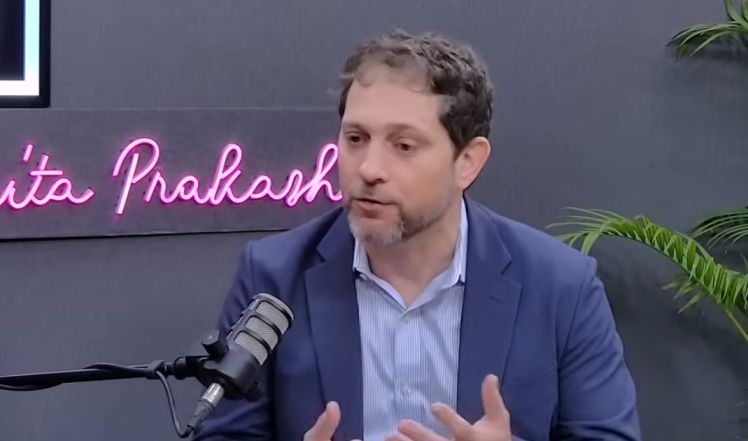
Editor’s Notes: In this episode of the ANI Podcast, host Smita Prakash is joined by Jon Finer, an international affairs expert and former U.S. Deputy National Security Advisor, to dissect the escalating conflict in West Asia and its global implications. The discussion delves into the strategic uncertainties of a potential U.S. victory in Iran, the shift in nuclear ambitions among global allies, and the complexities of current American foreign policy toward Pakistan and India. Finer also provides a unique insider’s perspective on U.S.-China competition and the ongoing war in Ukraine, offering a deep dive into the “long game” of modern geopolitics. (March 5, 2026)
TRANSCRIPT:
SMITA PRAKASH: Namaste. Jai Hind. You’re watching or listening to another edition of the ANI podcast with Smita Prakash. In the studio with me is Jon Finer, international affairs expert, to discuss the situation in West Asia.
Finer was Deputy to the National Security Advisor Jake Sullivan, serving for the entirety of the Biden administration. And before that, Finer served in the White House of President Barack Obama as the White House Fellow assigned to the Office of the White House Chief of Staff and National Security Council staff. Before joining government, Finer was a foreign and national correspondent for the Washington Post. He’s reported from over 20 countries around the world.
Joining me in the podcast today is my colleague Ishaan Prakash. Thank you, Jon, for coming on the podcast and looking forward to listening to your session at the Raisina Dialogue. And of course we are watchers of your podcast. So great having you here as a fellow journalist, fellow podcaster and…
JON FINER: Well, for me I get to learn what a long standing, successful podcast is like. So I appreciate it.
Pete Hegseth’s Justification and the Shifting Rationale for War
SMITA PRAKASH: Thank you so much. So Ishaan and I have a bunch of questions. So much happening. I wish this meeting was in happier times, but the conflict in West Asia has occupied everybody’s mindspace. So I want to begin by asking you whether, when Pete Hegseth said that a conventional weapon shield to their nuclear bomb — and he used that terminology — is what he used and why Iran was attacked, what was your first thought? Did you feel it was justified, the attack on Iran?
JON FINER: I guess my first thought was this is yet another explanation for why we have entered into this war. I think that was either the third or the fourth, depending on how you count — people forget at this point.
But the reason we even are contemplating military action is because President Trump, during the demonstrations that started around the turn of the new year in Iran, came out and said, “Look, if Iran kills a bunch of demonstrators, we’re going to intervene to defend them,” and urged them to seize their state institutions and said, “Help is on the way.” Well, those demonstrations were crushed. President Trump himself has said maybe 30,000 people were killed. The United States didn’t take action.
So then the rationale shifted — maybe the nuclear program, which had been “totally obliterated,” and again according to the president, last summer, was starting to advance again and the US needed to take military action for that reason. Pete Hegseth offered yet another rationale. As you said, long range missiles, conventional missiles that are supposedly unacceptable to the United States and its allies. And then looming in the back was always this idea of regime change, which I think has been a goal of the government of Israel for quite some time, and of some in the United States. So which is the actual explanation? It’s very hard to know.
SMITA PRAKASH: A bit like the cluster missiles which are being used — a whole bunch of excuses or reasons for this attack. Who’s running it? Is it Bibi Netanyahu or President Trump?
JON FINER: Look, the United States is the senior partner in this relationship, but they have been urged, persuaded, and ultimately convinced to do this in conjunction with Israel. And so this is now very much a joint venture.
Is Regime Change Possible from the Air?
ISHAAN PRAKASH: So again, going back to the objectives of this attack on Iran that’s happened — Israel has been very clear that they want regime change. President Trump, not so clear. He’s gone back and forth on this. Is there any historical precedent of a regime change happening from the air? History doesn’t show it. Do you think it would be possible? And if there were to be a regime change, would it be American boots on the ground, Israeli boots on the ground, or would it be maybe the Kurds with American support or Israeli support?
JON FINER: Look, I can’t point to a successful example of regime change by air. Sometimes people will talk about Serbia, which was bombed relentlessly. Ultimately, eventually a sequence of events took place that led to the departure of Milosevic, the dictator there, but not a straightforward and not particularly analogous to the current situation in Iran.
So, no, I don’t think there’s any precedent for something like this working out cleanly, smoothly, successfully without boots on the ground. And even with boots on the ground, the regime change history is rightly pretty infamous and unsuccessful for the most part, with Iraq in 2003 being the primary example. I began my career as a journalist covering the invasion of Iraq and then the aftermath of that. I thought that the lessons our country had learned were not to try this sort of thing again. It seems like some of those lessons may have been ultimately forgotten, and after not too long.
What Would Jon Finer Advise President Trump?
ISHAAN PRAKASH: You’ve been in a position where you advise presidents in the past. I’m sure you must have war gamed something like this with Iran.
JON FINER: Well, right now we’re pretty far along down the road toward something that is going to be hard now to get out of. And that’s what you’re seeing. President Trump is having a hard time, I think, setting the standard for when the United States could stop, having started this war.
He said at one point, “We’re about to negotiate. Iran’s asked to negotiate.” The Iranians denied that. Then he said this could go on for four or five weeks. By the way, at this point, four or five weeks is feeling like it could be short, given how extensive the military operation is. And Iran still seems to have some capabilities to strike back.
The problem you get into as a policymaker or as a leader in a situation like this is you start to feel what I guess I would call the sunk cost fallacy. We have already done a lot now, and to do a lot and fail feels like an unacceptable outcome. So then you decide, “Okay, we need to do more and more and more.” And that’s why I think you’re seeing these discussions about the possibility of arming factions — either Kurds going in from Iraq, Iranian Kurds who are based in Iraq, or factions who are already inside Iran — which would only escalate the situation. And by the way, no guarantee that that wouldn’t just lead to a state failure, civil war, or even more violence without success.
What Would an American Win Look Like?
ISHAAN PRAKASH: What do you think a win would be like for President Trump over here? Because he needs something like this to sell to the American people. The political cost of this would be great if America were not to succeed over here. And for Iran, it appears they just have to survive this onslaught. So I’m not talking about an off ramp right now, but what would an American win be like? I was reading some commentary that maybe America takes over Kharg Island — that basically ensures, basically takes care of all Iranian oil exports and they have long term exposure over there. You tell me.
JON FINER: I read that too. It’s hard for me to see how the United States putting American troops on the ground in Iranian territory, even if it’s an island, is going to feel like a win to the American people. There’s a lot of vulnerability there.
By the way, we’ve had American casualties — American service members killed and wounded in this conflict already. And unfortunately in conflict, that’s what happens, and there are likely to be more. So I think a win at this point is going to be pretty elusive.
There may have been a win of sorts available to the president had he stopped very quickly after the initial salvos — a version of what he did in Venezuela, which I didn’t support and still think ultimately was the wrong decision, but which was relatively clean from an operational perspective. The United States went in, took Maduro out, did not suffer significant casualties, did not, by the way, change the fundamental nature of the government in Venezuela. It’s just run by now one of his deputies. So what we actually accomplished is debatable. But he can at least point to the operation as having been a success. He’s losing that ability by the day here on the Iran war.
Iran Strikes Back: The Regional Fallout
SMITA PRAKASH: Jon, was it gamed at all that Iran would strike back — not just at Israel, but the entire region? Did Saudi Arabia think about that, that every military base in that region would be bombed? And not just the military bases — now you’re talking about airports, you’re talking about civilian infrastructure, malls, embassies, consulates. Everything is up for—
ISHAAN PRAKASH: It’s fair game now.
SMITA PRAKASH: So it’s fair game. And now the talk is — Saudi Arabia representatives have gone on air to say that American action spawns attacks on self, and how do you trust your ally? How do you trust America? And they’ve even said, “America has abandoned us.” So how does that work now?
JON FINER: Yeah, so I think there was a bit of a false sense of security from what we called the 12 Day War last summer, because Iran ultimately did not choose to massively retaliate against as many targets as maybe they could have — as many targets as they have tried to hit this time. They took some shots at Qatar, they obviously took some shots at Israel. Ultimately, the United States and our allies were relatively successful at defending against those attacks. And then it ended.
I do think that President Trump came into office with justifiable, understandable, and I think correct reservations about the use of force, particularly the use of force in the Middle East. He’d called the wars the United States has engaged in in the past “stupid,” and the people who ordered them were his political enemies. He was supposed to be the no-war president, the Republican Party. He was the president who promised, “I will not embark on these sorts of conflicts like my predecessors did.”
And so something changed along the way. And I think part of what changed is he used force a few times and it went very well, because the United States has the most capable military in the world. They can accomplish extraordinary things. And I think because those operations were successful, he believed you could do this almost at zero cost, with impunity. And I think we’re finding out that war is complicated. The minute you unleash it, you do not know exactly where it’s going to go.
The Asymmetry of War: Drones vs. Missiles
ISHAAN PRAKASH: I want to talk about the asymmetry of the war over here. We have a video from US CENTCOM. I just want to play it for you, where you’re seeing these Shahed drones — Iranian Shahed drones — being targeted by US military assets. What we’re seeing over here are individual drones that cost thousands of dollars being struck by missiles that are worth millions of dollars. You were at a high position in national security as Deputy National Security Advisor to the Biden administration. How long do you think the US can sustain this kind of campaign?
JON FINER: Yes. So this is one of the things you worry about in the context of a conflict like this, because you’re showing drones now being taken out on the ground. When these drones are fired, they also need to be intercepted by relatively expensive and relatively scarce missiles — munitions that the United States and our allies have, but that supply is not infinite.
And so you get into this calculus of missile math. How many munitions does Iran have in its stockpiles? How many drones, how many ballistic missiles, how many cruise missiles? And then how many interceptors — the things that we use to shoot those munitions down — does the United States and our allies have? I don’t know those numbers off the top of my head. Those numbers are certainly classified. But I can imagine that is one of the things that could prove a limiting factor on how long this conflict can go on. Because what you don’t want to do is be in a situation in which you’re out of interceptors and the other side still has things that they can shoot at you, because you will not be able to defend.
The Billion-Dollar Radar Incident in Qatar
ISHAAN PRAKASH: Mr. Finer, did you read the report that came out today about a billion-dollar radar — an American radar — that was targeted in Qatar by an Israeli munition? What is the significance of that in the region?
JON FINER: I saw the report. Can’t speak to whether that report is accurate. But I guess what I would say—
ISHAAN PRAKASH: The satellite images by Planet Labs have come out as well.
JON FINER: I understand. But one thing that is a real problem in contemporary conflict — always been a problem in war — the phrase “the fog of war” is used probably too often, but it’s pretty accurate. I was a journalist in war zones. The initial reports that come out of conflict situations almost always have to be revised. And so let’s just see.
But I think what it underscores is that the longer this goes on, it does show that Iran still has capabilities to reach out and do harm to US assets and people in the region. And so that has not been eliminated at this point.
Iran’s Asymmetric Warfare and the Data Center Attack
SMITA PRAKASH: Iran attacking the AWS facility in Dubai, the data centers, the data center. So do you think it’s just to damage the economy of West Asia, Iran deciding to do that? Whose game plan would it be to damage? I mean, a data center? Why would Iran do that?
JON FINER: So as far as I’m aware, it’s the first time a data center has been targeted like this in conflict, probably will not be the last time something like this happens, because computing power, processing power is one of the assets that countries bring to bear, including to give themselves a military advantage. So I am not saying that’s what this data center was used for. I think probably more likely it was attacked because it was an emblem of some kind of the West and of America and Iran.
SMITA PRAKASH: For Pizza Hut Iran,
JON FINER: a strategic asset that a fast food restaurant isn’t.
SMITA PRAKASH: But if you remember Desert Storm, and at that time those were the targets, KFC and symbols of American soft power. But here, a data center — I mean, this is what America’s future power is going to be, AI, and to hit at technology and at data centers. I think there’s a bigger game.
JON FINER: Yeah, look, this is an asymmetric conflict. The United States and our allies have massive military advantages over Iran. A conventional conflict, military against military, is not going to go well for Iran. Has not been going well, by the way, for Iran. And from a military perspective, the United States has had extraordinary success against the Iranian military, against the Iranian regime.
But what was always likely to happen in a conflict like this is Iran would choose asymmetric targets — going after civilian targets, going after allies, going after strategic assets like data centers. And the problem with that is, yes, it’s illegal, yes, it’s against the laws of war, but this is an existential conflict now for the Iranian regime. They are not going to be bound by any sort of limits, and they do have the ability to inflict harm on us.
Iran’s Military Capabilities and Targeting Accuracy
ISHAAN PRAKASH: This ability was what is surprising to us also over here when we were reading all these reports. How do you think they managed to get such pinpoint coordinates? They’ve been rather successful in attacking Iran —
SMITA PRAKASH: Iran.
JON FINER: Iran.
ISHAAN PRAKASH: Iran, yes, yes, Iran. Attacking these data centers, or whether various shipping routes that they are targeting, various GCC nations. Do you suspect that China has given them coordinates, access to their satellite constellations for such pinpoint accuracy of their munitions?
JON FINER: So I’d say a few things. One, unfortunately, a lot of this information is readily available in the open — what we call the open source world. Commercially available imagery, available simply by googling the locations in some cases of some of these places. Again, these are soft targets, in some cases not military targets that are hidden.
Second, it is possible that Iran has gotten help from some of its quote unquote friends. It hasn’t gotten much help, by the way — it’s not like Iran or China or other countries that maintain good relations with Iran have done much to support them in this, but it is possible that they have passed them information.
But then the last thing that I think is important is Iran has now been in several exchanges of fire — over the last year or so — with Israel, with the United States. This, by the way, goes back to 2024, when Iran twice attacked Israel and the United States helped Israel fend off salvos of hundreds of ballistic missiles and drones. But each time they do this, they learn a little bit. Their weapons become more precise, they become a bit more experienced and better at using them. And so I think you’re seeing the results of some of that too.
ISHAAN PRAKASH: In 2024, you were there as part of the NSA team. How potent are Iran’s missiles? Because we are hearing that this is the first stages of their counterattack, where you have these drones and you have the short range missiles going. Do they really have those long range missiles, and do they have the mobile launchers still available to fire off those long range missiles?
JON FINER: Look, they seem to still have some ability to do some launches even now, several days into this conflict. I don’t think they are holding capabilities in reserve for some later day. That would be, I think, strategically unwise given how much they have suffered in terms of losses. I think they are firing what they can, when they can, and they still can at this point. But I don’t think there is some giant new capability that they are withholding for a later stage of the war.
The Collapse of Nuclear Negotiations
ISHAAN PRAKASH: So, going with the name of your podcast, The Long Game, I want to zoom out a bit. We’re going into the nitty gritties of the war right now. I just want to zoom out a bit and go back to the negotiations that were happening with Iran on their nuclear arrangement. The Omani foreign minister in multiple interviews said essentially Iran had agreed to zero enrichment, had agreed to reducing their missile stockpiles and all, and it was all going — it’s essentially exactly what Donald Trump wanted to hear on the enrichment point. What do you think happened that it just broke down?
JON FINER: Look, to be fair to the United States negotiating team, I’ve dealt with the Iranians as part of a different negotiating team in a different era that ultimately reached a nuclear deal. They are famous for offering you just below your bare minimum that you need to get a deal. They do that repeatedly, over and over again, almost as a tactic to see what they can extract. I am confident that they did not make an offer to the United States that gave the Trump administration everything that it was seeking. I’m sure that that is the case.
But if the Trump administration wanted a deal from Iran, I strongly suspect they could have gotten one. And I suspect they could have gotten one that is better, from the perspective of having a smaller Iranian nuclear program, than even the JCPOA allowed. I think that was very much on the table from Iran.
And ultimately, now twice — because this happened last summer too, where negotiations were relatively advanced — the United States and Israel chose military action instead of trying to complete a deal. Twice the United States has walked away from the table when I think a deal was possible. Not a perfect deal. No negotiation is going to produce a perfect deal. That’s the nature inherently of a negotiation.
And the real challenge came down, as you said, to this question of enrichment. Would the United States ultimately ever tolerate Iran claiming that it could someday continue to enrich uranium? They’re not enriching uranium at all right now. The United States said no. Iran said, that is our red line.
Congressional Approval and the Politics of War
SMITA PRAKASH: You’ve been in the security establishment, you’ve been a journalist too. So let me ask you a couple of questions — political questions. This did not go via the Congress. President Trump didn’t get the stamp of approval from the Congress. And he’s also told the American people that America was going to come in for attack. And then he said “we.” So there’s a little bit of quibbling. He said “we” — they were going to attack Israel. Does America feel that the people are being told untruths once again regarding a war in West Asia?
JON FINER: I think time will tell how this actually ultimately plays with the American people. Right now, it is not popular. A majority of Americans say they do not support the handling of the war. And even the killing of Khamenei has been, according to polls, not popular among Americans, which surprised me a little bit.
My view is, if you are going to launch a major war — which the United States has said that this is, and which is self-evidently what this is if you watch your TV and see what’s happening — under our system, you should go to Congress to get approval for that. Even the Bush administration in 2003, when they invaded Iraq, did go to Congress, did get what’s called an authorization for the use of military force, voted in favor by Congress, and then ultimately launched the war. So, by the way, it doesn’t mean that your decision is going to be right just because Congress supports it — that’s a good example to the contrary. But that is the standard in our system, and they did not follow that this time.
SMITA PRAKASH: So there’s a lot of conspiracy theory which happens in podcasts.
ISHAAN PRAKASH: We try to stay away from it over here.
SMITA PRAKASH: So one which I heard was that even if he gets a stamp of approval now and the war escalates, President Trump doesn’t — in case at the midterms he doesn’t get it — could, as a wartime president, he offer a third term? How does that happen? What does the Constitution say?
JON FINER: Can it happen under the Constitution? It’s very clear that cannot happen. And the president has been asked this question and said that he does not intend to seek a third term. So for now, I think that prospect seems totally off the table. But we live in strange times.
MAGA, Public Opinion, and the Search for an Off Ramp
SMITA PRAKASH: Okay.
ISHAAN PRAKASH: It’s a rather big gamble for President Trump to take, because you talked about the Iraq War. There was a lot of popular support before they went in. Over here, there was never support in the first place. Where do the popular voices in MAGA right now lie? And do they have enough lobbying power to get Trump to seek an off ramp?
JON FINER: We’ll see. I’m the last person who should hold himself out as an expert on MAGA for you guys. But I will say, as we talked about at the beginning of the conversation, President Trump ran for office saying — and it’s a core part of MAGA ideology — we should not be going back to the Middle East and engaging in these wars. And so I do believe it will be challenging for him to explain to his own base why he believes we had to do this, why he made a decision that he said he would never make. How they will respond to his explanation, I’m not the right person to ask.
ISHAAN PRAKASH: Since we’re talking about it, please allow me this question as well. Tucker Carlson made this allegation that Mossad agents were arrested in Saudi Arabia and Qatar in his podcast, and maybe they were planning bombings in the region. Do you think these chaos agents were probably there as well and helping out? How much weight do you give to Tucker’s allegations?
JON FINER: I have never heard this allegation. It strikes me as pretty far-fetched. Again, we live in strange times, and I don’t know what I don’t know, but this is a person who more than occasionally traffics in conspiracy theories, as you said. So I would take it with a huge grain of salt.
ISHAAN PRAKASH: What is the off ramp for Iran? I mean, you’re in day three, day four of a shooting war now. How long do you think Iran can sustain this? And when can we see hostilities in the region dwindle down a bit?
JON FINER: So I think the question of how long Iran can sustain it is maybe not the right question, because as one of you indicated earlier, Iran’s goal at this point — its strategic objective — is simply to survive the onslaught. If they do, and the regime remains to any extent intact, they will claim this as a massive victory. They stood up to the strongest nation on earth. They are still here, some of them. And the regime lives in one form or another. That, to me, is Iran’s kind of path to victory, if they are allowed to achieve it.
For the United States, it’s again much more complicated. I think there’s a political math in the United States. How long can the president do something that is as unpopular as it feels like it is right now? Maybe it becomes more popular over time, but it doesn’t look like that’s the trajectory. How much can we continue to unload on Iran from the perspective of munitions and weapons systems? We do not have an infinite supply, as big and powerful as our military is. So how long can that go on? And then this question of defensive missile math that we talked about earlier — how long can we keep fighting without leaving our allies and our bases exposed because our interceptor supply runs down?
I think all of these things are going to be part of the calculus, and we’ll see where it goes.
Nuclear Proliferation and the Collapse of the American Umbrella
SMITA PRAKASH: I go to the nuclear issue, since we’re talking about arsenal and stuff. Natanz has been hit, but no radiological impact has been detected. When that gets hit, Macron said we are going to develop our nuclear weapons. And then Poland says we’re going to have a weapon of our own. Now, your allies — America’s allies — are all now going the nuclear way because they’re not going to rely on America. That’s what the allies are saying. We can’t rely on an unreliable partner like America. What do you think President Trump has unleashed with regard to his allies?
JON FINER: Well, to be honest, I think it began long before this conflict. But this conflict will further drive home the point exactly what you made, that many countries have decided they don’t need nuclear weapons because they are content to live under what we call the United States nuclear umbrella. The more the United States demonstrates less commitment to defending partners and allies around the world, the more countries that feel under threat — and by the way, those countries are likely to be in the Middle East, in Asia, in Europe — will believe they need some sort of additional protection, whether it’s living under another country’s nuclear umbrella.
France is now offering potentially to extend its nuclear umbrella further than it has before, or to obtain these weapons themselves, as a whole host of countries are contemplating. I think sometime over the next five or ten years you are likely to see the emergence of new nuclear powers because of these dynamics.
SMITA PRAKASH: And Pakistan providing the Islamic bomb, you —
JON FINER: — know that Saudi Arabia, that is something that has been widely reported to have been contemplated in the past. You know, we’ll see.
SMITA PRAKASH: They have a security arrangement, Saudi Arabia —
ISHAAN PRAKASH: — and Pakistan, the mutual defense partnership.
SMITA PRAKASH: Yes. Do you see that extending to the nuclear umbrella as well?
JON FINER: Look, I don’t think they took nuclear out of that partnership explicitly.
SMITA PRAKASH: Yeah.
JON FINER: But you know, at this point, I think the main driver of Saudi Arabia’s desire to potentially someday have a nuclear weapon was whether Iran would obtain a nuclear weapon. It does look like, for the time being, very unlikely in the near term that Iran is going to be able to obtain a nuclear weapon, just given the condition of its nuclear program and its military. Should Iran go back down the nuclear path — which, by the way, you could argue would be rational for them to do, as countries that have nuclear weapons do not tend to be attacked in the way that Iran has been attacked over the last year — I think Saudi Arabia would very seriously look at nuclear weapons.
Pakistan’s Missile Program and the Arc of American Foreign Policy
SMITA PRAKASH: Because you have mentioned once that Pakistan’s missile program is a threat to the U.S., right. How do you see that now panning out?
JON FINER: Yeah, I mean, I said when I was in the government that Pakistan was developing an ICBM program that could ultimately reach the United States. By the way, not a totally different concern than the one that the current Trump administration is expressing about Iran, which is also in the process of developing a long range missile program and has been for some years. But my understanding — you know, I’m not subject to or privy to all the intelligence — my understanding is that program is still a number of years from being successfully completed, if it’s ever successfully completed.
ISHAAN PRAKASH: I’m glad you brought that up. The irony was that in 2024 you warned us about long range weapons systems that Pakistan was doing, and now Trump is talking about this. Therefore, I want to talk about the arc of American foreign policy. In 2024, Pakistan was a threat with their missile technology. In 2026, Asim Munir is President Trump’s favorite military general. So how — explain to New Delhi — how does that work?
JON FINER: Yeah. Look, it’s hard for me to explain, honestly. We used to, in the United States, have a lot more consistency on foreign policy. When you went from one administration to another, even from a Democratic to Republican or Republican to a Democratic — what’s different now is nothing significant seems to survive that transition anymore.
And the first Trump term really was the inflection point for this. President Trump, during his first term, pulled out of the Paris climate accord, pulled out of the Iran nuclear deal. It was virtually unprecedented for a new American administration to withdraw from agreements that had been made by its predecessor. Now, that is par for the course in our politics.
And I think the result of that is going to be that countries are less likely to think about the United States in strategic terms — you know, over the long horizon, the way countries have in the past. They have made many countries big bets on the United States as a partner that would endure for generations. Now I think they’re more likely to think about us in four year increments, because after that, it’s too unpredictable.
America’s Retreat from the International System
SMITA PRAKASH: And we saw that happening in the Munich Security Conference. Whether it was J.D. Vance’s speech last year or it was Marco Rubio this year, where they want to rewrite — America wants to rewrite its relationships with its traditional allies. And there was some truth talking being done to the Europeans. Is America consistent that these rules which have guided these relationships for generations, as you said, that’s changing. And these are the new laws, new rules which are going to come into place. Is there consensus even in the administration, let alone in America, that they were being taken for a ride by their allies?
JON FINER: The position of this administration is that all of the foundations of what we call the international system — and that’s international organizations like the UN and its affiliates, that’s agreements like the ones we were describing made among nations, that’s alliances — these have been kind of the hallmark of the international system that Americans have believed for some time was good for peace and stability and prosperity around the world, but was also fundamentally good for us as the United States, that essentially we built this system to our own advantage.
President Trump does not believe that. He’s the first president, actually, who has not believed that, who believes that all of these things I just described are burdensome on the United States and that we would be better off essentially going it alone, because we are bigger and more powerful than everybody else. And in a system in which there are not rules and there are not multilateral arrangements that constrain power, as the most powerful country, we will be the best off. That is his view.
I think the problem with that view is that ultimately it leads to a lot of chaos and uncertainty, which is bad for stability, bad for business, and also that there are competitors to the United States that are substantial and significant — China, obviously, being at the top of that list. And one advantage America had was a system we built that works well for us, in our way of life and partnerships, who can work with us when we need to compete or even when we need to go to war, as we have, unfortunately, at many times in our history. And diminishing all of that, I think, will leave us more vulnerable, not less.
What you’re seeing in Munich and other places is the Europeans coming to the realization that the United States cannot be relied on to the extent that we could before, and that they need to, in some sense, de-risk themselves from us — reduce their dependency on American energy, reduce their dependency on American security, reduce their dependency on American economic ties. It’s going to be very hard for them to do that, though, because there are not great alternatives in the world. And I did take note of the fact that the EU and India have reached a trading arrangement, and I think that is also related to exactly the same phenomenon, context and overview over here.
Pakistan’s Strategic Value to Washington
ISHAAN PRAKASH: But I want to stress on Pakistan a little bit more on this one. What has Pakistan promised the Americans? That relationship has remained steady and has probably grown a bit under the Trump presidency. I mean, the irony over here — we’re talking about Iran and their historical nuclear program. The P1 P2 rotors is based on A.Q. Khan’s smuggled European nuclear technology. I mean, this is a country that’s also worked with North Korea on nuclear materials for their missile technology. This is a country that hosted Osama bin Laden in its land, yet it remains a crucial partner. Please explain. What has Pakistan given America, promised America, that that partnership remains strong even today?
JON FINER: I mean, look, I’m aware of all the history that you just recounted. Pakistan has been a U.S. partner for quite some time, and that’s not new under the Trump administration. They’ve always been a complicated partner. The relationship has really ebbed and flowed. Sometimes we have really relied on and needed Pakistan to pursue our own interests, particularly when we were fighting the war in Afghanistan.
Again, I’m not the right person to explain what exactly transpired that has shifted the U.S.-Pakistan relationship so much toward a closer relationship in this administration. I observed what you all have observed. There was a short conflict between India and Pakistan. Pakistan invited the United States in to help resolve that conflict. I don’t know exactly what role the United States played, but they claim to have played a significant role. And then afterwards, Pakistan profusely thanked the president, said he should be nominated for a Nobel Prize. All of these things, I think, were significant in how the president thought about that country.
Obviously, in India, for a whole different set of reasons, a different approach was taken, which I understand. So I’m not sure it’s all that much more complicated than that. I’ve seen the reports, as you have, of business dealings and other things, but I can’t speak to any of that. I don’t know if it’s true.
Trump, Modi, and the U.S.-India Relationship
SMITA PRAKASH: You said that President Trump mismanaged ties with India. What did you mean exactly by that? You worked with the Biden administration. Where do you think that President Trump overturned everything with that?
JON FINER: Look, I have to say I was surprised. If there was one relationship I would have bet in the second Trump term would have been a very strong international relationship, it would have been the U.S.-India relationship, in part because the trajectory of this relationship has just been up and up and up from a very challenging start. You know, that dates back to Cold War politics and deep mistrust and suspicion. But over the last 25 years, every successive United States administration, including the first Trump administration, has improved substantially the U.S.-India relationship. And then on a personal level, President Trump and Prime Minister Modi seem to have developed a very close working relationship as well. So I would have bet on this being a very constructive partnership.
Things got off the rails for reasons that I described earlier and that are now a matter of public record. And I was gratified to see an arrangement reached in January — early February, I guess it was — to start to put some of this back together. There’s now an American ambassador here who seems deeply committed to the U.S.-India relationship. I think that’s fundamentally a good thing, a good thing that he is close to the president. So I think things are on a better track now than they were. I was surprised by how far they got off track.
India’s Role in the West Asia Crisis
SMITA PRAKASH: You know, you worked with the Obama administration as well as the Biden administration, and as you mentioned, there was bipartisan support for the India-U.S. relationship. And then comes the second term of President Trump. Did you expect it to happen? You say you were surprised, but do you think that the fracture that we saw in 2025 and now the West Asia conflict — do you see at all, you know, America looking at India to help with an off ramp in the current situation in West Asia?
JON FINER: I don’t know what conversations are taking place behind the scenes between America and India. I talk to Indian officials still. My understanding is that India is deeply concerned about, first and foremost, Indians who are living in this region.
SMITA PRAKASH: Yeah, we’ve got 8 million.
JON FINER: Yes. In a number of countries — a small number in Iran, many, many others in the Gulf. And, like Americans who are stuck in these places, they’re in some degree of danger. And I think the government is rightly focused on that problem.
I think the government is also focused on the energy implications. Obviously, India is a major purchaser of energy coming out of that region. And right now, energy supplies are not flowing freely. Although you saw probably the statement from the president that the United States might not only provide insurance, but also provide escort — naval escort to carriers — which is a new development, and we’ll see how that plays out.
And then I think, generally, India, like a lot of countries, is not in favor of major instability in the world and would like to see these conflicts ended. So whether India actually plays a role in this or not, I can’t speak to. You’d have to ask the government of India. You’d have to ask the United States. But I think India’s interests are pretty clear in this.
India-US Relations: Strategic Partnership and People-to-People Ties
SMITA PRAKASH: Tell me about the Biden administration and the Obama administration and their view about India when you were working out there.
JON FINER: Well, I think it starts from the perspective that we are two of the world’s, if not the world’s, two most important consequential democracies. And I think the relationship begins from that perspective, which makes us, to an extent, natural partners.
I think there’s an economic dimension of this relationship that American businesses, American government has always believed had much more potential than was being realized, although it is becoming a very deep and large economic relationship. And then I think there is the strategic dimension of this. I think India increasingly, from the perspective of its own strategic calculus and security calculus, has become more focused on China. The United States has also become deeply focused on our competition with China in our strategic calculus, which has sort of pushed the United States and India closer together over time. So I think it operates on a number of these dimensions.
And that’s before you even get to the deep people to people relationships between the two countries, which I think unfortunately are diminishing. There are fewer Indians now, I think, studying in the United States than there have been in recent years. I think that was a very good and important connective tissue between the two countries. And I hope that that trend reverses.
China’s Role in the Iran Conflict
ISHAAN PRAKASH: Perfect segue to China. How are they looking at what’s happening in Iran?
JON FINER: Well, you’ve seen what they’ve said. I think on a diplomatic level, their messages have been twofold. One, condemning what the United States has done, calling for an end to the conflict, providing rhetorical support for Iran. Two, they’re not doing a whole lot to actually help Iran, at least overtly.
SMITA PRAKASH: It doesn’t look like.
JON FINER: It doesn’t look like they are. Well, they’re not doing anything militarily.
ISHAAN PRAKASH: Yeah, I think that’s the export of dual use technologies that China—
JON FINER: Yeah, so I was going to get to that. They have had, though historically, quite an intertwined economic relationship and certainly have provided Iran over time with capabilities that have been inputs into Iran’s military. How successful that work has been, I think, is debatable given how poorly, for the most part, Iran’s military has performed against Israel and against the United States.
So they have this relationship. But I think it should not be overlooked that China has very important relationships throughout the Middle East. It’s not like they necessarily prioritize Iran above the United Arab Emirates, above Saudi Arabia, above other countries where they are customers for energy, where they have kind of deep connections. China’s strategy tends to be to try to be on good terms with everybody and try not to make commitments that are too big to any one country. And the United States has taken a different approach historically, but that’s what China’s done.
The last thing I’d say that I’m seeing from China — and I think you’ll see this increase — is trying to use what is happening as a propaganda lever against the United States. “America is a warlike country. We’ve told you this before. China loves peace. We don’t go around attacking other countries. America does.” I think you are going to see this sort of messaging coming out of China to try to achieve kind of information victories around the world.
ISHAAN PRAKASH: Yeah, I saw Wang Yi’s statement.
SMITA PRAKASH: But they haven’t built military bases. And those military bases were supposed to be a security framework for the entire world, for that matter. And that security is now in question. So I think when you say they—
JON FINER: —haven’t built military bases, you mean China has.
SMITA PRAKASH: China has. That’s it.
JON FINER: And maybe Cambodia as well. Yeah, but I will say it’s not for lack of trying at this point. I mean, one of the things that was interesting in our administration is we did identify that China was seeking to establish military facilities further afield than they have in the past. So I think they are increasingly trying to go down this path. For what reason? I can’t—
SMITA PRAKASH: Like Belt and Road initiative and the Pakistan element, which was, in Pakistan, it didn’t work. It was supposed to be quasi military. China hesitates putting boots on the ground, they do not like it. And as soon as there are any attacks on their people, they just withdraw. So CPEC just stopped when it happened. It didn’t work. They couldn’t even provide security for their people working in the oil refineries and in the oil network.
JON FINER: Yeah, look, again, as I said, they have taken a totally different strategic approach than the United States. Try to be on decent terms with everybody. Don’t make commitments that pull you into certainly conflict from a security perspective. And look out first, foremost, maybe exclusively for your own interests. It doesn’t maybe make them the greatest partner. That’s partly why I think China does not have alliances around the world in the way the United States does. But what it does do for them is it prevents them from being overstretched, over-committed in the way that the United States can sometimes feel.
China’s Complicity in Iran’s Military Capabilities
ISHAAN PRAKASH: They do give supported services. So Iran’s telecommunications networks has Huawei and ZTE networks that are built in. And again, I come back to the precision strikes that we are seeing by Iran. If it is proven that the Baidu satellite link was used by Iranian rocket coordinates to get those precision strikes, and there is complicity of China in the Iranian kill chain, how does the relationship with the US and China move forward? I know that President Trump is supposed to go to China in April. Does he still go ahead with this trip?
JON FINER: If this is proved, it will make the possibly as many as four meetings between President Trump and President Xi in 2026 significantly more interesting and consequential. If this topic is on the table because it is revealed that China has played some greater role, I will say both sides for now seem very committed to making these encounters successful from primarily an economic perspective. They want to make trade announcements and that sort of thing. And so this administration, the Trump administration, has shown a strong desire to develop closer ties to Xi Jinping and China. Whether this would derail that, I don’t know. But I have not seen the kinds of allegations that you just described substantiated yet.
Xi Jinping’s Position and the CMC Purges
ISHAAN PRAKASH: Okay. Your podcast gives a fantastic commentary on China, Mr. Finer, your co-host, Mr. Sullivan. They give great context and depth into China. So I want to pick your brain on what’s happening in Beijing right now. I mean, last month you saw the CMC purges over there with Zhang and the other sort of heads being basically taken out, and now it’s a shell. How secure do you think Xi Jinping is in Beijing right now? And what do you think — do you think he will enlarge the CMC, or what do you think his next move will be after seeing what’s happening in Iran and everything?
JON FINER: So one of the things that this entire event has underscored for me is how little, sometimes even people who play incredibly close attention to China, read all the intelligence that the United States government has about China, really understand about the inner workings of the Chinese Communist Party, how decisions get made, how Xi Jinping’s decisions get made, which are obviously the ones that matter most.
In the case of the sacking of Zhang, you could argue that this is a sign of weakness and instability because there were these reports, again unsubstantiated, that he or others may have even been plotting to undermine Xi Jinping. You could also argue the exact opposite, that Xi Jinping would not have moved on Zhang if he wasn’t extremely confident that he had consolidated a firm grip on power. You don’t take on somebody as entrenched and consequential as Zhang, unless you feel pretty confident about your own position. I don’t know which of those is accurate, and I see analysts arguing on both sides.
I’ll give you another example. One of the big topics that’s debated — we did debate this, actually, literally, Jake and me on our podcast — is, does the sacking of Zhang suggest that Xi Jinping’s timeline for possible military action on Taiwan has sped up or slowed down?
You could argue that it slowed down because if you want your military to do something challenging, and this would be an incredibly challenging military operation, you would want to make sure you have full confidence in your military. And if you’re firing the senior most military officer, the person in charge of the planning for that operation, it suggests you’re not confident enough in your military to go forward with something like that right away.
The other side of that argument, though, is Zhang was reputedly one of the few people in the Chinese system who could speak truth to power, who could tell Xi Jinping, “Actually, we’re not ready for this. It’s not a good idea. I know you want by 2027 to be at least ready to take military action. Maybe we’re behind schedule and you should slow that timeline down a bit.” Now that he’s not there, there is a younger cadre of military officers who are likely to move up, who again, reputedly may be more aggressive, more confident, who, unlike Zhang, have not served in conflicts before. Zhang fought in what is really China’s only significant war over the last 50 years, in Vietnam in 1979. There are very few senior officers left who have that experience, if any. And so you could argue then that these more aggressive people who are less likely to tell Xi Jinping bad news may push the timeline faster. Again, I don’t know the answer to that question, but there are good arguments on both sides.
India-China Border Tensions
ISHAAN PRAKASH: I saw your red team, blue team debates that you do, and it was focused on Taiwan primarily. But let me ask you — India has actually drawn blood of PLA—
JON FINER: —soldiers and vice versa.
ISHAAN PRAKASH: Exactly. And I know the world’s attention is on Taiwan. Should we also be worried on our borders of what China could do next, or what Xi Jinping could do next, to just solidify his position?
JON FINER: Look, I think it’s only prudent to be focused on all the potential threats that your country faces. And I’m not the one who should lay out what your security strategy should be. I do know from talking to Indian officials, including during the time that I was in government, that there is an increasing focus on China, in large part because of the border skirmishes that you described that are sometimes downplayed, but that were combat — hand to hand combat, even in some cases. And so I know those issues have not been resolved, even if the temperature is a bit lower now than it was in 2020.
ISHAAN PRAKASH: Yeah.
American Media’s Coverage of India
SMITA PRAKASH: You’ve been with the Washington Post too, and you must have read in the Indian media — people in India just feel that American media has a bias against India. Do you see that at all?
JON FINER: To be honest, I don’t see that. In fact, I feel, generally speaking, a lot of positive energy in the US-India relationship in the public narrative. We are not 100% aligned on all issues, and we have had some major challenges in the relationship too. But I think for the most part, our press covers these issues fairly. I’m sure you could point to an article here, an exception there, that I would not contest.
But maybe I’m too much of a defender of our press because I came out of that. But I think if you’re focused too much on press coverage, you probably have a bigger problem than just the media. That problem is explaining your own narrative about what is happening. And in the United States, I don’t think India has a major public relations problem. I think generally speaking, the attitude of the American people is positive towards India. I think there have been some times when we have been on different sides of important issues and that’s inevitable. When there are two— the social media—
SMITA PRAKASH: —narrative seems to be like, “Oh, Americans are taking away our jobs, they need to go back to India.” There’s a lot of that which is happening, and then some racial attacks which have taken place in, say, Texas.
India-US Relations and the Indian Diaspora
JON FINER: Yeah, look, no doubt about that. And you know, this sort of anti-immigrant sentiment — and to some extent, you know, Indians in the United States are victims of their own success. They have been a very successful diaspora group in the United States. And that leads both to some people being very supportive and other people resenting that and being jealous of it.
And one of the things I like least about President Trump’s very intense kind of anti-immigration message is that it is doing, I think, a lot of harm, including to some of these relationships where immigrants are, again, as I said before, one of the most important ties between us. Indian Americans have made massive contributions to our country. You don’t have to look very far around Silicon Valley. It’s almost hard to find a company that is not led by an Indian American CEO. And they are deeply involved in our politics, in every aspect of American society, in academia for sure.
And so, you know, the fact that the number of Indians studying in the United States is down, at least by what I heard, up to maybe 40% in recent years, I don’t think is a good thing for India. But I also don’t think, as an American, it’s a good thing for the United States either.
SMITA PRAKASH: Yeah, and also many of those students who used to go were like full tuition paying students, not necessarily on scholarship and aid. So that’s going to hit the universities too, because one, they’re not getting funding from the government — the US Government — many of them, because of their policies, and two, full tuition paying students not coming. It’s going to impact.
JON FINER: But to your point on media narrative, I mean, India is a country that has significant soft power. I think it underestimates sometimes its soft power. You saw an example of this the other day with the AI summit here, which I know generated a lot of headlines for being crowded and chaotic and all these things. But look who showed up at that event — this was not, you know, middle management from the most important technology companies in the world. These were the founders and the leaders and the chief executives. And that happens almost every time India wants to kind of convene the world here. That is a strong signal of sentiment about India.
SMITA PRAKASH: Are you bullish on the India-US relationship?
JON FINER: You know, I have to say I have been, I still remain bullish. I do think damage was done last year, and maybe the most important area of damage is — I started by talking a bit about distrust between the two countries. I think 25 years ago there was a significant amount of distrust. Even if the two countries recognized there is a lot in this relationship for us, if we can get on the same page, the history made it such that I think there was just deep skepticism.
And we have done a lot — Indian officials, American officials, again, Republicans, Democrats on our side — to break through that and to reduce the level of distrust and increase our ability to work even on sensitive issues like defense, like advanced technologies. I think trust suffered a setback last year. So that is something that concerns me. Again, diminishing people-to-people ties by reducing the number of students is something that concerns me because that’s been ballast in the relationship on both sides. I think historically, I think we all now have a lot of work to do to put things back on track.
Russia-Ukraine War: Causes, Consequences, and the Path to Peace
SMITA PRAKASH: Okay, last question.
ISHAAN PRAKASH: Most of this was also because of India’s oil imports from Russia. So I have you over here, so I must ask you this question. It’s on the Russia-Ukraine war. We have the fourth year — the four-year anniversary is done.
JON FINER: I have a good example of an issue where the United States and India have not seen 100% eye to eye. And it’s been an area of tension, and we have maintained the relationship in spite of it.
ISHAAN PRAKASH: There was an allegation by Professor Jeffrey Sachs. Everyone follows him very closely over here on foreign policy. And this is regarding your colleague, Mr. Jake Sullivan. If I can just quote, he said:
“I had an hour-long call with NSA Jake Sullivan in the White House begging, ‘Jake, avoid the war. You can avoid the war. All the US has to do is say NATO will not enlarge to Ukraine.’ And he said to me, ‘Oh, NATO is not going to enlarge to Ukraine. Don’t worry about it.’ I said, ‘Jake, say it publicly.’ ‘No, no, no, we can’t say it publicly.’ I said, ‘Jake, you’re going to have a war over something that isn’t even going to happen.'”
This sort of sums up the entire debate in the war.
SMITA PRAKASH: How true —
ISHAAN PRAKASH: — is this allegation by Jeffrey Sachs?
JON FINER: So I can’t speak to the phone call — you know, whether Jake talked to Jeffrey Sachs, I don’t know. But let’s just stipulate that maybe there was a phone call. What Jeffrey Sachs is alleging there is completely false. I think it is false — analytically false — based on the evidence, to reduce Russia’s motivation for attacking Ukraine to simply this question of will Ukraine be in NATO or will Ukraine not be in NATO.
I think there are deep historical reasons why President Putin wanted to do this. I think there are reasons related more broadly to European security why President Putin wanted to do this. I think there was paranoia on the part of President Putin, maybe even fueled by his isolation during COVID. I don’t think you can discount any of these factors. I think there are many factors that went into it. And to reduce the decision to go to war to just this binary question — will Ukraine be in or out of NATO — I think just fundamentally misunderstands the situation, and by the way, totally lets Russia off the hook.
Russia chose to invade a sovereign country, a member of the United Nations, that was posing no threat to Russia. And for someone like Jeffrey Sachs to focus on Jake, who was doing everything possible to try to prevent this and then to help Ukraine defend itself — I think the question should go to him.
ISHAAN PRAKASH: Four years on, where do you see this war going? Is it ending?
JON FINER: I would like to sit here and say I had a lot more optimism than I do that negotiations are moving forward and likely to bring an end to the war. By the way, I give the Trump administration credit for working to end the war. I think that is the right policy. And I think if Kamala Harris had won in 2024, a Democratic administration would also be trying to end the war.
The big mistake I think they are making is that in order to end the war, you need to put pressure on the country that is the holdout — that is the one that doesn’t seem to want to end the war — and that is Russia. Russia will have to make more concessions in order for the end to the war to be durable and just, given what Russia has done to Ukraine.
Instead, the administration has the opposite approach. They want to put all the pressure on Ukraine to continue making concession after concession to Russia, and then they believed that Russia would, of course, accept a deal under those circumstances. But it has not worked out that way. Every time Ukraine says yes, Russia says no. And until this administration realizes that it needs more pressure on Russia to get a deal, we’re not going to have one.
US Weapons Support for Ukraine: Defending the Biden Administration’s Record
ISHAAN PRAKASH: And you know, I’m going back just to tie this all together. President Trump had posted a Truth yesterday where he talked about the munitions — there’s a shortage in the munitions over here — essentially saying that we can continue because we have the immediate missiles needed to fight this war. But he said he blamed Joe Biden for giving away super high-end weapons to President Zelenskyy for free. So you were part of that team. Were such high-end weapons given for free to President Zelenskyy, and did that cause a shortage in the US weapons arsenal that now President Trump is blaming?
JON FINER: It’s funny, most of the time I’m asked questions like this, it’s why did you not give the Ukrainians this weapon system and that weapon system sooner — not this question of did you give them things that were too advanced? And to be honest, I reject both of these critiques. I completely reject President Trump’s argument. I’m not sure what he thinks we should have withheld from the Ukrainians while they were in this existential fight for their country.
But I feel very comfortable about what we provided, about the success Ukraine has had on the battlefield with the help of the United States. You could quibble with a tactical decision here, a tactical decision there, and I think there are reasonable debates over that. But no, I don’t think the United States should feel — and President Biden should feel — any regret at all about having provided Ukraine robust support to defend its country.
Closing Remarks
SMITA PRAKASH: I think we have to let Jon go because he has the next assignment —
ISHAAN PRAKASH: — so Part Two, hopefully when you’re —
SMITA PRAKASH: — back in India, when you’re back here. Thank you so much for spending time here and talking to us about West Asia, Russia. What else did we touch? China.
ISHAAN PRAKASH: We touched everything, and everyone should go and watch the Long Game podcast with Jon Finer and Jake Sullivan.
JON FINER: If we could just get, you know, 1% of the Indian podcast market, we’d be in really good shape.
ISHAAN PRAKASH: Yeah, it reinforces every first principle that you want to understand about American foreign policy and what’s happening in the world. So I can’t recommend that enough.
SMITA PRAKASH: Geopolitics, global geopolitics. Yes, I think — thank you so much for speaking.
JON FINER: Thanks for having me.
ISHAAN PRAKASH: Thank you.
SMITA PRAKASH: Thank you for watching or listening to this edition of the ANI Podcast with Smita Prakash. Do like or subscribe on whichever channel you’ve seen this or heard this. Namaste, Jai Hind.
Related Posts
- Transcript of Elizabeth Lane Interview on Propaganda Network: Tucker Carlson Show
- Transcript of Justice Ketanji Brown Jackson Interview: IMO Podcast
- Transcript: Mary Talley Bowden Interview on Tony Fauci’s Diary @ Tucker Carlson Show
- Transcript of CIA Whistleblower Jim Erdman Interview: Tucker Carlson Show
- Transcript of Shawn Ryan Interview: Trump’s Betrayal – Tucker Carlson Show