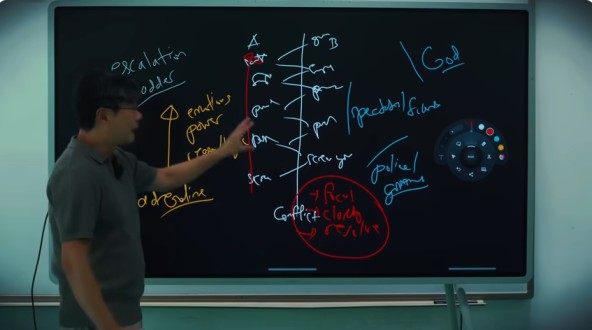
Editor’s Notes: This lecture by Prof Jiang Xueqin @Predictive History provides a deep dive into game theory to analyze and predict the outcomes of the ongoing geopolitical conflict between the U.S. and Iran. The discussion centers on three critical questions: the likelihood of a U.S. ground invasion, the potential use of nuclear weapons, and the future of the Al-Aqsa Mosque. By examining the “escalation ladder” and strategic decision-making of key players like Israel and Saudi Arabia, the analysis offers a compelling look at how control and calibration often outweigh pure military dominance in modern warfare. (March 10, 2026)
TRANSCRIPT:
Introduction: Three Key Questions of the US-Iran War
PROF. JIANG XUEQIN: We continue our analysis of the US-Iran war. And in this war, there are three major questions that will determine the outcome of this war as well as the world afterwards.
And these three questions are:
- Number one, will the US launch a ground invasion?
- Number two, will nukes be used?
- Number three, the Al-Aqsa Mosque.
So right now, the United States and Israel are primarily focused on an air war, striking Iran from a distance. In the past we would call this siege warfare. And as long as it remains an air war, the United States can choose to de-escalate and withdraw from the Middle East. They would lose this war, but the loss would not be catastrophic.
Whereas if they choose to launch a ground invasion, it would escalate very quickly and they would be trapped in Iran for the next five to ten years. It would be a catastrophe whether or not they win or lose. Because in order to fight a ground war, the United States would have to institute a national draft where a young man, as young as eighteen, will be forced to join the army and be sent to fight in Iran.
So that’s the first big question for us. Will the United States send in ground troops? Remember, there’s the idea of mission creep, where maybe in the beginning, you’re like, “I’ll send out a thousand troops to do a small mission.” But then it doesn’t go well, so you send in two thousand. It slowly creeps up. It’s what we call mission creep. And that’s how the United States embroiled itself in Vietnam.
The Three Big Questions
So that’s the first big question. The second big question is, will nukes be used? There’s a lot of concern online that Israel is preparing a nuclear strike on Iran because the Israelis don’t like how the war is going and they want to reclaim the initiative.
Nukes are a taboo in geopolitics. The Americans used them at the end of World War Two and no one’s used them ever since. If Israel were to use nuclear weapons, they would break this universal taboo and we might find ourselves in a nuclear apocalypse. So it’s a great concern that everyone has right now.
And the third question is the Al-Aqsa Mosque. This is the third holiest site in the Islamic world. There’s Mecca, there’s Medina, and there’s the Al-Aqsa Mosque. The Muslims believe that it is from the Al-Aqsa Mosque in Jerusalem where Mohammed ascended to heaven. And the Jews believe that the mosque sits on the site of their temple, which is the house of God.
Religious Jews, extremists, want to destroy the Al-Aqsa Mosque to rebuild the third temple. And if religious Jews, the extremists, destroy the Al-Aqsa Mosque, then the two billion Muslims in this world would be religiously obligated to go to war against Israel. So these are the three big questions that will determine the future of the world.
Three Predictions Based on Game Theory
So in this class, I teach you game theory to make predictions about the future. So right now, I’m going to make three predictions, and then I will show you my analysis as to how I make these predictions.
Now, what’s important to understand is that these are only my guesses based on my analysis. And whether or not they turn out to be correct will determine the validity of my analysis. I don’t have inside information. I don’t know more than you do. I’m just working out of public knowledge and doing game theory analysis.
So according to game theory:
- **Question one** — Will the United States send in ground troops? **Yes.**
- **Question two** — Will nukes be used? **No.**
- **Question three** — The Al-Aqsa Mosque? **Yes.**
So what I’m going to do is spend the next two classes explaining to you my game theory analysis as to how I come to these conclusions. And we can watch how world events unfold.
Now I want you to understand something, which is that for my theory to be valid, for my analysis to be valid, I have to be correct on all three. If I miss one, then all my theory is wrong.
I know there’s a concern from around the world that nukes will be used. And I am a hundred percent confident that nukes will not be used at this time in this war. And if I’m wrong, I apologize to the world. But at the same time, we’ll all be dead anyway, so it doesn’t really matter.
Today’s Plan
So let me explain my analysis. Today, what I’m going to do is cover number one and number two — explain to you why Israel will not use nuclear weapons and why there will be a ground invasion. And then next class, I’ll explain number three to you. That’s the plan for this week.
The Escalation Ladder: A Core Concept in Geopolitics
So to understand what’s going on, I need to teach some basic geopolitical theory. In military affairs, in geopolitics, there’s a concept called the escalation ladder. And the dominant theory is that whoever has escalation dominance has the most advantage.
What this means is, let’s just say you and I get in a fight.
Applied to this war in the Middle East, Israel and the United States have escalation dominance because they have nuclear weapons and Iran doesn’t. Therefore, the United States and Israel have a huge advantage over Iran. But what I will show you today is that this theory is incorrect. It actually doesn’t work that way.
How the Escalation Ladder Works: A Simple Example
So let’s start off with a very simple example. Let’s just say that two people get into a fight — A and B. And how the escalation ladder will work is that maybe A and B run into each other. And then A says, “Hey, man, say sorry.” And then B is like, “It’s not my fault. You say sorry.”
So there’s a conflict. And it’s usually a very small conflict. No one knows why and no one knows who’s at fault. So they start cursing each other. The first step is a conflict. Second step is they start cursing each other — “Screw you.” “Screw you.” And then they might start pushing each other. And then they hit each other. And then they start the fight. And then one pulls out a knife and the other pulls out a gun. And then B shoots A dead. Fight over.
The Three Factors That Drive Escalation
There are certain things that we need to keep in mind about this example. First of all, the fight is not contained in itself. You cannot perceive this game as just one between A and B, who’s physically stronger. There are other players involved as well.
For example, there are spectators or friends — there’s a crowd watching you. This is important because there’s also the police. Eventually the police will come, the government, and they will ask people, “Hey, what happened? Whose fault was it?” And also, for people who are religious, there’s also God. If you die, you have to go up to God in heaven and God’s going to ask you, “Hey, how did you die?” So you have to explain how you died.
So in other words, in this escalation ladder, there are three factors that you have to consider that drive people up this escalation ladder. These three factors are: emotions, power, and reason or logic.
What drives people up is adrenaline. It’s impossible to skip the escalation ladder — you don’t go from “Screw you” to the guy pulling out a gun and shooting you. You have to go up step by step by step because adrenaline is rushing in your system. And this adrenaline is making you more angry, but it’s also making you stronger and more resolved. And it’s also telling you how to fight this battle.
The Law of Escalation: Control Over Dominance
And the thing to remember about this — and this is really important — is that it’s not about how fast you climb up the escalation ladder. If you get too angry and you overreact, then you are at fault. What you want to do is climb it up strategically, and that means you have to remain calm and controlled.
Because if you remain calm and controlled, you have three advantages over your opponent. The first is focus, the second is clarity, and the third is resolve. What this means is that you know what you’re doing, you have a strategy, you’re clear about how to achieve your strategy and your goal, and you’re determined to achieve it.
But in order to have all three, you have to remain calm and therefore you need to control yourself as you climb up this escalation ladder. Because remember, it’s not just about beating your opponent — it’s about justifying yourself to your friends, to the police, and to God as well. Because you might hit that person, he might go to hospital, and you’ve won the fight, but then you go to prison for ten years, in which case you’ve lost the fight.
So the main idea I want you to remember is this, and this is the law of escalation, and this is a very important idea in my game theory model:
**Control is more important than dominance.**
Why? Because control is the idea of calibration. Calibration means that you time, or you structure, or you strategize your response in a way that helps you achieve your strategic objective. You’re not just throwing punches — you’re throwing a punch in a certain way that allows you to defend yourself, that strikes fear in the opponent, and also allows you to seem as the good guy amongst spectators. And then when the police come, you can justify why you threw that punch in a certain way so that you don’t go to jail.
Another way of saying this is that calibration is ultimately about strategic flexibility. And the idea of strategic flexibility is that in a fight, the person who has the most options, the person who has the most flexible strategy, will usually win the fight.
Thought Experiment: The Bully and the New Kid
So before I actually talk about the war, what I want to do is a thought experiment to examine how we’re going to understand what’s going on between the United States and Iran.
The thought experiment is this. Let’s just say that there’s a bully. He’s the biggest guy in the school, and he has a gang — maybe four friends. And so what they do is they basically prey on everyone at the school, maybe a hundred people.
What they do is they make everyone in the cafeteria pay a tax. You want to go in the cafeteria and eat, you have to pay a tax — maybe a dollar. The friends of the bully go collect the tax and then give him all the money. That is the structure of the school: if you want to eat lunch in the cafeteria, you have to pay a tax, and the bully’s friends collect the money, and the bully shares the money amongst his gang.
Now, at first people are okay with the system because they think it’s actually beneficial — the bully is keeping the peace and order in the cafeteria. He’s keeping everyone safe. So, “Yeah, I pay a dollar, but it’s not that much money, and we’re all safe so that we can all enjoy our lunch in peace.”
The Bully’s Hubris
But then what happens over time is that the bully gets more and more arrogant because he feels invincible. Everyone just obeys him. So he develops the idea of hubris — the idea that “No one has the courage to challenge me. Everyone’s afraid of me, and therefore I can do what I want.”
So what does he do? Well, the first thing he does is charge more money from everyone. The tax goes up, and so people are disgruntled about this. They don’t understand why they’re paying more to the bully. But not only that, he will also pay less money to his friends so that he can have more money — because he wants to buy a car or he wants to go to Paris for the summer.
So everyone’s not happy about this, but this is the reality that they live in and there’s nothing they can do about it. And so people just put up with it.
The New Kid Arrives
One day, a new kid comes into the school. And he doesn’t really understand the rules of the game. He goes to the cafeteria and he doesn’t know he’s supposed to pay a tax. So the bully’s friend comes over and says, “Hey, man, where’s the dollar?” And he’s like, “What dollar? I just got here.” And he refuses to pay.
So what they decide to do is teach him a lesson by ostracizing him — by making him sit alone by himself in the cafeteria. “You have no friends because you don’t know the rules and you refuse to play along.” The new kid is like, “I don’t care. I’m happy not having any friends.”
Then the bully and his friends start to discuss, “How can we get this new kid to play along?” And so they decide they’re going to curse him, they’re going to bully him. So the new kid goes to lunch and he’s eating his lunch, and the friends come down and start to curse him and say, “You’re a wimp. Do you want to fight us?”
And what the new kid does is he just ignores these guys. And these guys are like, “What’s going on? Why isn’t he afraid of us?” And slowly what happens is that the other people, the other kids, recognize that — wow…
Applying the Law of Escalation to the Middle East
PROF JIANG XUEQIN: Maybe it is possible to rebel against the bully. Maybe it is possible not to pay these stupid taxes. And so they start talking to him secretly. Okay? They give him presents. They start to say smile at him and say hi to him.
Okay? But the new kid just ignores everything. Right? And then the friends are like, you know what? We don’t actually benefit this much from this relationship anyway.
Maybe if we appoint this new kid as the new bully, the new boss, he’ll treat us better. And then you have other friends who are like, you know what, this bully, he’s fat, he’s ugly, maybe I should be the boss. Okay? So just because a new kid comes in, doesn’t know the rules, and he’s willing to challenge the reality, challenge the assumptions, the values of this cafeteria, now there’s dissent, now there’s rebellion going on. Okay?
And different people are talking to him and trying to form alliances with him. But what he does, and it’s really interesting, is that he just ignores everyone and keeps focused. Okay? And then one day, the bully’s friend comes over and says, “You’re a wimp.”
And the new kid finally says, “I’m not afraid of you.” Okay? And this friend goes back and tells his boss, “Hey, this new kid said he’s not afraid of you, man. What do you do about it?” And the bully gets angry and says, “I’m going to go punch his face.”
Okay? So the bully goes in front of the new kid and says, “If you don’t apologize, I’m going to punch you in the face.” And the new kid is like, “What did I do wrong? What should I apologize for?” And the bully’s kind of confused, he goes away.
Comes back and says, “You apologize now, man.” And the kid’s like, “Okay. For what? Tell me, tell me to apologize for what?” And this goes on for a long time.
Okay? And then eventually, the bully gets so pissed off that he punches the new kid in the face. Okay? So he started it. The new kid is hurt, but he decides to punch the bully back in the face.
Okay? The bully is stronger, so he beats the new kid up. But what’s happened now is that everyone in school has seen that the bully is not that strong. Everyone’s seen that the bully is actually pretty weak.
And so they recognize that, “Hey, if we stand alongside the new kid, we can beat the bully.” Alright? And eventually what happens is the bully is defeated. Does that make sense to you guys? Alright.
So certain things to understand is that, yes, the bully has escalation dominance because he’s stronger and he’s the biggest kid in the school. He can beat up everyone. But what wins the fight is control. What wins the fight is calibration, strategic flexibility. The fact that the new kid has many different options and he’s picking the option that is most strategically advantageous to him.
Okay? Now what you will notice from this example is the bully doesn’t have that many options actually, because he needs to maintain the idea of face or credibility. Right? This is the essence of his power. His power lies in the fact that if you do not listen to him, if you do not obey him, he will come and beat the crap out of you.
Right? That’s credibility. But the moment that you show that it’s actually not that big of a deal to be punched by him, that he’s not that strong, then he loses all credibility.
Okay? Which means that he either retreats or he’s forced to strike harder to kill you. Okay? To maintain his credibility. So another way of saying this is that by calibrating your movements strategically, you can manipulate the bully into self-destruction.
Does that make sense to you guys? Alright? Any questions? Okay. So that’s the theory.
The US Escalation Ladder
Alright? So now what we’re going to do is we’re going to apply this theory, the law of escalation, to what’s happening in the Middle East. Okay? We’re going to do that by looking at the escalation ladders of both Iran and the United States. Alright.
Okay. This is the US. This is Iran. Okay. So let’s look at their escalation ladder.
So the first thing the United States does, of course, is something called decapitation. What is decapitation? Decapitation is like, “I just kill your leaders. You don’t have any more leaders, and therefore, you don’t know what to do, and therefore, you surrender.” Okay?
That’s the first thing the US did. It didn’t work. So now what the United States is doing is attacking military targets, air defense, and military bases. Okay? The idea is that you beat the crap out of the military, so they surrender. But that didn’t work either. Okay?
So then what you do next, of course, is economic embargo, where you basically prevent Iran from trading with the world. Right? Prevent Iran from selling oil to China basically by blockading the seas. And the idea here is that if the government doesn’t have any money to pay its soldiers, its soldiers will just not fight. Okay? But that’s not working either.
So then what you do, of course, is you attack civilian infrastructure. Okay? Which is probably water and oil. So you may have seen the news that Israel attacked an oil depot in Tehran. And now, if you look at a picture of Tehran, it’s all black. Okay?
And this is a war crime, or this goes against international law, because you’re attacking civilians. But that’s what you do when you feel as though you need to apply more pressure to win this war. Okay? And so you can keep on escalating.
And then what you do is, now that you’ve attacked the civilians and they still refuse to surrender, you use secret weapons. Secret weapons might be advanced missiles that no one’s ever seen before. Okay? And the point of these secret weapons is to scare the crap out of people and say, “You see how dominant we are?” Okay?
If that doesn’t work, then what you do next is use biological and chemical weapons. Okay? Biochemical weapons. Doesn’t work either? Then, guys, nuclear weapons. Alright?
So what’s really important for us to understand is that you must follow this escalation ladder if you are to use nuclear weapons. And the reality is that we have not seen nuclear weapons. We have not seen biochemical weapons, and therefore nuclear weapons comes later. Okay? Unless I see biochemical weapons being used, I refuse to believe that nuclear weapons is on the table.
Okay? Alright. So I think we are here, which is the beginning of attacks on civilian infrastructure. But already, we’re seeing arguments in the American political system against the use of weapons against civilians. Okay.
The reason why is that if you do this, if you destroy civil infrastructure, you unite the people behind the government. Because the idea is that you use airstrikes to split apart the government and the people, and you want the people to overthrow the government for you. Okay? That’s the idea here. So we are at this stage, meaning that we have a long way to go before we hit nuclear weapons.
The Iranian Escalation Ladder
Okay? Alright. So now let’s look at the Iranian escalation ladder. So what’s happening is that in the beginning, Iran does two major things. Okay?
The first is attack military targets. Okay? And what they’re basically targeting are US radar systems and air defenses. Because once these two things go, then Iran can attack whatever it wants. Okay?
It’s also close to the Strait of Hormuz. Alright? And by closing the Strait of Hormuz, you put pressure on the economies of the GCC as well as East Asia. The hope is that by blockading the economies, the GCC — UAE, Saudi Arabia, Iran, Qatar, Kuwait — will put pressure on Donald Trump to end this war as quickly as possible. Also, East Asia receives most of its oil from the GCC, from the Strait of Hormuz.
Right? So China gets about forty percent of its oil. Japan gets seventy-five percent. That’s a lot of oil. So the hope is that these countries will put pressure on the United States to end this war as soon as possible.
Okay? So that is the Iranian strategy. But if they’re forced to go up the escalation ladder, what will happen is this. If you attack their economy, they will attack your economy as well. Okay?
With missiles, basically targeting oil fields. If you attack their civil infrastructure, they will attack your civil infrastructure as well. And what is the main weakness in these GCC countries? Desalination plants. Okay?
Desalination plants. And that’s it. Okay? That’s the extent of the Iranian escalation ladder. Because it doesn’t have nuclear weapons. It doesn’t have biochemical weapons. It doesn’t have intercontinental missiles that it can target the United States with.
So as you can see, the US and Israel have escalation dominance because they can go way up higher in the escalation ladder than Iran. But that’s the wrong way to understand this. Okay? Because if you look at their strategies, Iran has much more flexibility, much more calibration than the United States. Okay?
When the United States attacks you, it’s pretty blunt. But look, if I close the Strait of Hormuz, I can be strategic in how I close the Strait of Hormuz. For example, if you’re a Chinese ship, I’ll let you pass. For example, if you are a GCC nation and you want to bribe me, you want to pay me a toll, I’ll let you pass as well. If you’re a GCC nation and you’re like, “You know what? Forget the United States, I won’t be your friend of Iran,” I’ll let you pass as well. Do you understand?
So by closing the Strait of Hormuz, it creates a calibration strategy. It allows Iran to selectively and strategically apply pressure to the friends of the United States so that they become the friends of Iran. Okay? Same thing with these strikes against oil fields and military targets. Right?
“If you attack me, I attack you with drones. But if you don’t attack me, then I don’t attack you.” Okay? So in other words, this is a really important idea. The US and Iran have different military decision trees. Okay? Alright.
So let me explain how. Because the United States and Israel, they’re just attacking Iran. Okay? And they attack with air power, so that’s very blunt. Right? Okay? So you go from one step to the next to the next to the next.
Okay? This is the classic escalation ladder. Iran is not like this. Their decision tree is different. Okay?
Because their strategy is to force the United States to admit defeat and retreat from the GCC. Okay? To close down the military bases in the Middle East so that Iran has control of the Strait of Hormuz and therefore it can control all world trade. Alright? So that’s the strategy.
So this strategy means that you have different options. Alright? Your options are: attack Israel, attack military targets, attack civilian targets, attack Tel Aviv. Okay? Alright.
So I don’t want to spend too much time on this, but as you can see, if you think about it, Iran can be much more selective in its targeting than the United States and Israel. And therefore, the options that it has are much more diverse, which gives Iran escalation control over the situation. Do you guys understand this? Alright.
Why Iran Has Advantages on the Escalation Ladder
So let’s look at why Iran has advantages over the escalation ladder. Okay? US, Iran. The first major difference is that Iran is active, whereas the US is passive. Okay?
Another thing — go back to the bully example where the bully has to maintain credibility. He has to show that he’s more powerful than the other kids. Right? So if you provoke him, he has no choice in the matter but to hit you. Okay?
But you, the new kid, can choose whether or not to provoke him or not. You can choose the timing of when to provoke him. Therefore, you are active. Okay?
The second big difference is that Iran has a clear strategy. It knows what it wants to accomplish and it knows how to accomplish what it wants. Remember, what Iran wants is to control the Strait of Hormuz and get the United States out of the Middle East. That’s what it wants to do, and it’s calibrating its attacks in a certain way to achieve this end goal, and it’s working out very well for Iran. Okay?
The United States, on the other hand, doesn’t know what it wants. It wants to destroy Iran. What does that mean? Okay? “Destroy.” It could mean regime change. It could mean the economy collapses. It could mean the civilian population starves. Okay? It could mean anything. But because there’s so much ambiguity, so much confusion about what it means, it confuses military strategy. Alright?
And the last thing is, of course, that Iran is flexible and the United States is inflexible. Okay. So by studying the escalation ladder, we discover that Iran has far more advantages than the United States. Okay?
What This Means for the Middle East
Alright. So what does this mean? Alright. It means that Iran will probably win this war ultimately, but it has to make major changes to its society in order to win this war. Alright?
So remember, to win a fight, you have to have three things: focus, clarity, and resolve. Alright? You have to know what your purpose is. You have to know how to achieve it. You have to be determined to achieve it. Okay?
So what does this mean for the Middle East? What does it mean for Iran? The first thing is focus means unity. Meaning that you have to unite your population, which means basically crushing all the dissent. We can’t argue anymore. We have to unify for a purpose. Okay?
The second thing, clarity, is to censor people. Censorship. And we’re already seeing that in Israel where you’re not allowed to film military strikes. Okay? If a drone comes and attacks Tel Aviv in Israel, you cannot film that and put it on social media. Okay?
The government will come and arrest you. Same thing in Dubai. You cannot show Dubai being attacked. Okay? So massive censorship is going on.
The Four Dimensions of War
PROF JIANG XUEQIN: And resolve just means militarization, where the Middle East moves towards total war. Total war just means that every citizen now is recruited into the war effort. It just means that the entire economy is geared towards war.
One last point I’ll make is this. What we need to understand about the escalation ladder is that as it moves up, we have to remember that this war is being fought multidimensionally. What does that mean? It means that the military is just one dimension, but there are four major dimensions. There are others, but let’s focus on four major dimensions.
The first major dimension is narrative. Narrative is basically world opinion. Second is political. Political just means the relationship of nations to each other, the relationship of the need of the government to the people. The third dimension is economical. And the fourth is military.
What’s really important to understand is that the military dimension is probably the least important. There are other dimensions that are much more important. Therefore, these four factors determine how the United States and Iran move up the escalation ladder.
Because your purpose is to control the narrative and justify why you’re doing what you’re doing. Political means you still have to maintain good relations with other states. So as the United States is fighting this war against Iran, the United States is still talking to China, the United States is still talking to Russia. That political discussion determines the contours of this fight.
Economic means that as this fight is still happening, nations are still trading with each other, and that factors into how the military is fought. So I know this is very complicated, but you need to understand how complicated war is. It’s not as simple as saying, “Let’s nuke that guy.” It doesn’t work that way. There are a lot of constraints, a lot of factors, a lot of stakeholders involved to constrain the use of nukes.
The Cost Pyramid: Why Ground Troops Are Inevitable
Alright. So let’s now discuss ground troops. The first question we look at is, will ground troops be used? And the answer unfortunately is yes. They have to be used. And it has to do with how the military works, how wars are fought.
Basically, when you fight a war, you have to have a correct cost pyramid. The most simple cost pyramid is this. Infantry, soldiers, they’re at the bottom. Why? Because they’re the cheapest. What’s above them? Armor. Artillery, tanks. They’re more expensive to produce. You need more resources, more time. Then you have naval, then you have air.
This is a cost pyramid, and it just addresses the question of how much energy, how much time, how much resources do you need to produce a certain product. It costs you very little to produce a soldier, but it costs you a lot to produce an airplane. This is important because wars are usually wars of attrition, meaning that you have to put all your resources in to win the war. This is just production capacity, and this is the most standard model that you have of a cost pyramid for a military war.
The problem is that the United States has an inverse pyramid. Meaning that air is what’s dominant, then naval, then armor, then soldiers. You can’t fight a war like this. The moment you choose to fight a war like this, you’ve lost the war, because you either take out the country in like two days or you scoot over, but you cannot replenish your forces.
Now, I know this is hard to understand, but 1991, the Persian Gulf War, 2003, the Iraq War, these are not real wars. Because the Americans were so dominant and Iraq was so weak that it was basically a video game. It was just these pilots flying around just bombing everything. It’s like guys in tanks just running over the Iraqi army. Those were just video games, but this Iran thing is a real war.
Therefore, you cannot fight a war like this. If you want to win this war, the only thing you can do is return to a realistic cost pyramid. You don’t have a choice in the matter. Because again, your cheapest product are soldiers, and the most expensive are airplanes. You cannot afford to use an airplane in order to save the life of a soldier. Eventually, this cost-benefit analysis will blow up on you.
So if the United States wants to win this war, then it has no choice but to use ground troops, to use soldiers as the main force of its military.
The Four Players and Their Objectives
Now the question then is, will the United States use ground troops? I already said that if the United States is to win this war, there’s no choice but to use ground troops. But will the United States use ground troops? A lot is determined by the game theory strategies of the different players.
So let’s look at the four major players in this war. You have the US, you have Israel, you have Saudi Arabia, and you have Iran.
The United States and Iran, they’re pretty easy to understand. What the United States wants to do is destroy Iran. Why? Because if they were to destroy Iran, the United States would have complete control over Middle East oil, and it would control global trade through the Strait of Hormuz. Therefore, the United States can maintain its empire. A really simple objective: let’s destroy Iran.
Iran has another strategy, which is to control the Strait and destroy CENTCOM. CENTCOM is basically the American military in the Middle East, called Central Command. Because if CENTCOM is destroyed, Iran has complete control over the Middle East. Now Dubai, now Oman, Kuwait have to pay taxes to Iran. Iran, the new kid, is now the bully of the Middle East. It’s now the hegemon. That is the political objective of this war.
Israel is a bit more complicated. One other thing for Iran is to humble Israel. Because even if you defeat the United States, you still have to deal with Israel. Israel is the great military power of the Middle East, so you want to humble them, you want to weaken them. You can’t destroy Israel because Israel has nuclear weapons. You piss off Israel, those nukes start flying. You don’t want that.
So those are the three major political objectives for Iran: control the Strait, destroy CENTCOM, and humble Israel.
If you are Israel, the strategy is different. What you want to do is destroy CENTCOM and destroy Iran. Why? Because if you destroy both the United States and Iran, then you are the sole hegemon in the Middle East. Also destroy the GCC, destroy Saudi Arabia as well. Why? Because once Saudi Arabia is destroyed, all its resources belong to you. And this creates something called the Greater Israel Project, which is what we will discuss next class.
But as you can see, it’s really important to note that even though the United States and Israel are allies, their optimal strategy is different. Their objectives are different. In fact, they’re in conflict.
Then you have Saudi Arabia. What does Saudi Arabia want to do? Well, destroy Iran. Because if you destroy Iran, you have complete control of the Strait. But you also want to destroy the US and you want to humble Israel.
Forcing a Ground War: The Strategic Logic
So by understanding how each player perceives the game, we can now understand how they will go about their strategy. The United States just wants to destroy Iran. But as you can see, Israel, Saudi Arabia, and Iran all want to destroy the United States. And how do you do that? You do that by forcing the United States into a long ground war.
Therefore, if you’re Israel, you don’t want to use nukes. Why? Because nukes would end the war too quickly. You want to drag this war out as long as possible to force the United States to send in ground troops.
And why doesn’t the United States use nuclear weapons? The answer is the escalation ladder. It needs to justify itself to the people. When you do anything, you have to worry about certain factors. You have to worry about troop morale — your soldiers have to believe that they are fighting for a good cause. You have to worry about public opinion — you have to make sure that the world is on your side. You have to worry about political will — you have to make sure the people are unified. And you have to worry about enemy morale — you don’t want to provoke your enemy so much that they jump the escalation ladder too far beyond your control.
So as you can see, war is extremely complicated. It’s not just about weaponry. It’s not just about resources. It’s ultimately about controlling the narrative, controlling the political landscape, and marshaling the resources in a proper way that is strategically beneficial.
So we just answered two questions. Will the United States use ground troops? Yes, it will. Because [Iran], Saudi Arabia, and Israel will work together to force a ground invasion, even though the United States doesn’t want to do so. But unfortunately, the United States doesn’t have a clear, coherent strategy. It’s passive. Therefore, it can be manipulated into sending a ground invasion.
And the second question is, will Israel and the United States use nuclear weapons? And the answer is no, because it’s not in their best interest to use nuclear weapons. Israel wants the United States to lose this war, and so that means a long war that destroys the American political will to fight any more foreign wars. If America loses, Israel becomes the dominant power in the Middle East.
And so the last question is the Al-Aqsa Mosque, and we’ll answer that next class on Thursday.
Q&A
UNIDENTIFIED SPEAKER: Will Americans take over Iran like what they did to Venezuela? Like, they captured their president?
PROF JIANG XUEQIN: The strategy in the beginning was to do Venezuela in Iran. Meaning, you go in, you kill a leader, a new leader emerges, negotiates with you, and surrenders to you because you’re too powerful.
But Venezuela and Iran are two very different countries. The Venezuelan elite is very pro-American, meaning that their wealth, their children, their family is stored in America. Therefore, the Venezuelan elite have an invested interest in negotiating a deal with America to protect their own interests.
But for forty-plus years, America has sanctioned the Iranian elite, and Iran has become poor and angry and disgruntled because of that. Therefore, they have nothing to lose by fighting you. So even though you’ve killed the Supreme Leader and you’ve killed many of their leaders, the elite themselves are unified in opposing you.
UNIDENTIFIED SPEAKER: So I have a question about the motivation of the US to involve in this war. As you said, the US wants to control the oil, so they must destroy Iran. But I think this is a little bit confusing, because I think the US knows that this war is really high risk and it can potentially even destroy the whole system. So why would the US risk the whole system collapsing to control the oil that Iran has?
The Heartland Theory: Why the US Has No Choice
PROF JIANG XUEQIN: This is the key question that everyone’s arguing about. Quite honestly, we’re going to argue this for the rest of eternity. There’s never going to be a clear answer. In fact, there are multiple possibilities.
What I’m going to do today is offer you the most simple explanation. In the next class, I will offer you a much more complicated explanation.
The simple explanation goes back to military doctrine — how the United States military works. And the military doctrine is: prevent the heartland from arising.
So the United States is here. This is Europe. This is Russia. This is Iran, India, China, Japan. This is the Middle East, and this is Africa. The American military doctrine is this: the greatest threat to American power is the heartland unifying. Why? Because if the heartland unifies, it can trade by itself through railways. But America is primarily a naval power. Therefore, it requires people to trade by sea.
And so its strategy is to make sure there’s never any cohesion in the heartland — either by making sure that no great power arises in the heartland, and that’s why America went to war in World War One and World War Two. There was a great fear that Germany would conquer Europe and Asia and create the heartland. Therefore, America had to stop Germany from rising. So you either make sure no great power arises, or you create so much conflict that they’re always fighting each other. And that used to work before.
Now, there’s a problem. The problem is the BRICS nations. Russia, Iran, and China are coming together. And if they come together, that’s a major piece of the heartland. And everyone else — Europe, the Middle East, Africa — and India would probably follow. Because it is easier to trade in the heartland than through the trade routes of America, especially with the US dollar declining.
In other words, the United States has no choice but to fight this war, because that’s their entire strategy to maintain hegemony in the world — to prevent the heartland from unifying.
Saudi Arabia vs. Iran: Historical Conflicts and Strategic Goals
PROF. JIANG XUEQIN: Does that make sense? Because once you destroy Iran, the heartland fractures. There’s no way that they can now trade together anymore. They’re still reliant on American maritime routes. Okay?
America maintains — America is still a hegemon because it controls world trade. Whoever controls world trade, controls the world. Whoever controls the heartland, controls world trade. Okay? Does that make sense?
Okay. But this is just one explanation. There’s actually other explanations, and I’ll go into a more complicated explanation next class. Alright. Any more questions?
UNIDENTIFIED SPEAKER: Yep. So you mentioned Saudi Arabia and how it wants to see the downfall of both the US and Iran. It wants to see the downfall of Israel, US, and Iran. Yeah. And to me, that sounds like a pretty big goal. And how would you say — how would they possibly use their strategy to achieve that goal? Or how would it possibly be for Saudi Arabia?
Saudi Arabia’s Strategic Position and Future
PROF. JIANG XUEQIN: Okay. Alright. So it’s very confusing to people why Saudi Arabia is actually against Iran. Okay? But actually, if you go back and look at their history, they have major conflicts with each other. Alright. So let’s go over some of their conflicts. Alright.
So Saudi Arabia, Iran. The first major conflict is that Iran is a theocracy, and Saudi Arabia is a monarchy. A theocracy just means that you’re ruled by clerics who represent God. The monarchy is a king who represents God. And for Iranians, that is blasphemy, that’s heresy, that’s against the religion. Okay? So Saudi Arabia and Iran hate each other. Saudi Arabia sees Iran as a threat and trying to induce a revolution within Saudi Arabia. Iran sees Saudi Arabia as blasphemous. Okay?
And it’s a huge issue because Saudi Arabia is the home of Mecca and Medina, the two holiest sites in the Islamic world. Okay?
Second issue is Saudi Arabia is Sunni and Iran is Shia. So these are two different sects of the same religion, but it’s like Protestants and Catholics. They just hate each other. Okay?
And the last thing is that Iran is anti-US and Saudi Arabia is pro-US. What this means is that Saudi Arabia has American military bases inside of the holy land. And for the Iranians, that is the worst crime. Right? Because it’s infidels who are protecting the holy land. Infidels are not allowed in the holy land. Alright. If you’re not a Muslim, you’re not allowed to go to Mecca. Alright.
Saudi Arabia’s Oil Economy and the Need to Act
So Saudi Arabia and Iran hate each other. Saudi Arabia has a huge problem in that it is an oil economy. Most of its GDP comes from oil exports. And for the longest time, it was trying to build a new economy. It was trying to build tourism. It was trying to promote games. Okay? Does that work?
So if you’re Saudi Arabia and you see the future, it’s a pretty dismal future because eventually your oil is going to run out. Eventually, people are going to switch to electrical vehicles. Digitization, which means that oil is no longer so important. Okay?
So what you need to do is, if you’re able to control the Middle East, right, so where you get your money now is from trade access — the Strait of Hormuz. That’s a viable future. If you just sit back and wait, eventually your nation’s going to run out of oil, and therefore, it’s going to cease to exist. Okay?
So Saudi Arabia needs to act now. And the way that it wants to act is it wants to create a conflict between the United States, Israel, and Iran where they destroy each other. Once they destroy each other, Saudi Arabia can come up on top.
Now, Israel cannot be destroyed because Israel has nuclear weapons, but the goal is to negotiate a peace with Israel after the war is over. Right? Does that make sense? To split the Middle East between Israel and Saudi Arabia.
But will Israel agree to this deal? Probably not. But according to game theory, Saudi Arabia has no choice in this matter because it is so far behind everyone else. It can only hope that this chaos leads to new possibilities because given the structure of the game so far, it does not have a very good future. Okay? Does that make sense?
Three Key Predictions
Alright. Any more questions, guys? Alright. Okay. Great questions. So please continue to follow the war. Okay? So you have to follow the war and understand what’s going on.
In this class, what I’m doing is I’m providing you the game theory analysis for you to understand what’s happening and why it’s happening and where this war is going. Okay?
Again, the three big predictions I make — and we’ll know in the next year or two if these three things happen or not — is the United States will send in ground troops. It has no choice in the matter if it wants to win this war or continue this war. There’ll be no nuclear weapons being used. Again, I will apologize to the world if nuclear weapons are used. Okay?
The third is that the Al-Aqsa Mosque will be destroyed at some point. That’s something I will talk about next class.
Related Posts
- Transcript: Maya Angelou’s Greatest Life Lessons on Oprah Podcast
- Transcript: The Next 50 Years: Humanity, AI, Power w/ Yuval Noah Harari
- How to Stand Out in an AI World by Thinking Better, Not Faster: Sol Rashidi (Transcript)
- Modern Wisdom: w/ Alex Petkas on True Story Of The Odyssey (Transcript)
- Reconstruction: Malcolm Gladwell Interviews Barack Obama (Transcript)