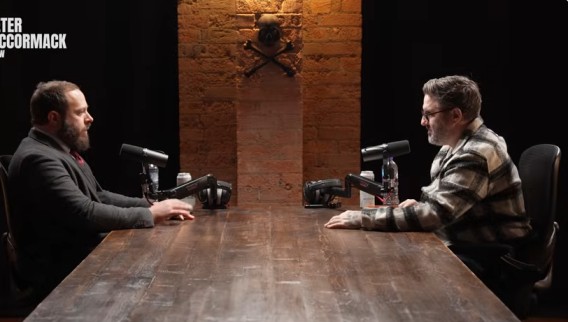
Editor’s Notes: In this hard-hitting episode of Peter McCormack Show, Peter sits down with Middle East expert Firas Modad to deconstruct the “war machine” and the forces driving current geopolitical conflicts. The conversation explores the deep-seated influence of powerful donor networks and corporate interests on Western foreign policy, questioning whether elected officials or an unelected “oligarchy” are truly in control. From the breakdown of Iranian negotiations to the role of entities like BlackRock and Vanguard, this interview provides a critical analysis of why the West remains entangled in endless Middle Eastern wars. (March 7, 2026)
TRANSCRIPT:
Introduction
PETER MCCORMACK: Morning, Firas.
FIRAS MODAD: Good morning. How are you?
PETER MCCORMACK: I am good. Right. You’re my expert on the Middle East. Why is America at war with Iran? And what do we not know? What are we not seeing in the press?
The Iran Nuclear Negotiations
FIRAS MODAD: We are seeing some of it, but it is fundamentally about Israel. The Iranians are a bit of a nuisance for the United States, but they’re actually a threat to Israel. And the negotiations were going relatively well, according to the Omani mediators. The Omani foreign minister, after the war began, comes out and says, “This is unnecessary. We had an agreement, or we had almost an agreement.”
The Iranians had conceded on every major point when it comes to the nuclear issue, including getting rid of their highly enriched uranium stockpile — 60%, so well below what’s needed for an actual modern nuclear weapon, which is 90% — limited enrichment at a very low level. They keep the capability to enrich, but they give up on everything else, meaning they really don’t have a pathway to a nuclear weapon, because they would be under constant surveillance by the International Atomic Energy Agency.
But it seems that the American negotiators were part of the problem. The negotiators are Steve Witkoff, who is a Jewish real estate New York tycoon, and Jared Kushner. Jared Kushner is associated with Chabad, which is a Jewish supremacist sect, essentially, and his family is also best friends with Benjamin Netanyahu, meaning that essentially the negotiations were being run by a Netanyahu family friend. They were never meant to work.
And for the Israelis, the problem wasn’t the nuclear, because that is solved through the negotiations. The problem is Iranian ballistic missiles, because the ballistic missiles, if they hit a small number of targets in Israel, they can wreck the country. A couple of desalination plants. Israel has maybe four functioning ports, one major chemicals complex, a couple of refineries, three civilian airports, etc. So a limited number of very vulnerable facilities. And if these are hit, they can collapse the state.
So the negotiations were focused on the nuclear issue. The Americans bought into the Israeli demands when they solved the nuclear issue, as the Omanis said they had done. Instead of continuing down the line, or instead of figuring out a solution to the other stuff, they went to war. And this is the second time they do this. In June 2025, the Israeli attack happened two days before — or one day before — the Americans were supposed to meet with the Iranians to negotiate, and it was going well. And now, as the negotiations were going well, the attack began.
So you’ve ended up in a position where diplomacy is used as cover to conduct attacks, in the same way that the Israelis tried to destroy the Hamas negotiating team in Qatar when the negotiations seemed to be going well. So now if you negotiate with the Americans or with the Israelis, you’re an idiot, because they’ve done this three times.
Israel’s Strategic Goals in the Region
PETER MCCORMACK: And is this because Israel considers the Iranian regime an existential threat to Israel?
FIRAS MODAD: It is an enemy of Israel, but —
PETER MCCORMACK: An existential threat if they —
FIRAS MODAD: And they consider it an existential threat if they become powerful enough. But they’d already kicked them out of Syria. And now the Israelis are saying something that I’ve said a bunch of times, which is that Turkey is going to become the next Iran for them. Because the view, according to Israel, is that all of their enemies need to be weak and in chaos, because any one of them becoming sufficiently powerful is, in fact, automatically a threat.
PETER MCCORMACK: So Israel wants to be surrounded by —
FIRAS MODAD: Failed states, essentially, or poor, dysfunctional states like Jordan and Egypt that are kept on a tight leash by the fact that they are in insane amounts of debt. So what they want, really, is no functioning strong states anywhere near them.
Except that this circle keeps expanding. So initially they made peace with Egypt, and then Egypt got into all kinds of debt traps. They made peace with Jordan, and Jordan gets into all kinds of debt traps. The US backed the Sunni jihadis to overthrow the Syrian government and cut off the supply line from Iran to Iraq through Syria into Lebanon. Now the Syrian jihadis have been moved to Iraq and they’re probably going to be used against Iran and its allies again, in the same way that they were used in Syria, in the same way that they were used in Bosnia, in the same way they were used in Chechnya, in the same way that they were used in Afghanistan.
So you have a radical Sunni threat, and then you use it against your enemies. And then domestically you say the answer to this threat is to clamp down on people and to police their speech and to police their opinions and control their bank accounts and so on and so forth. So the blowback from this is also domestic, especially at a time when you’re endlessly importing immigrants from countries that you’re wrecking.
Why Is America in Another Middle East War?
PETER MCCORMACK: I imagine the people listening to this show would be a broad group of people, but the American listeners we have — which is a good percentage — will be split between those who are the “America, f*, yeah, let’s go to war” people.
And I think people, even in the UK — I know some right-wing parties, one called Reform specifically says this is a special relationship with America and should be supported. But I think I kind of side probably with the leftists here in that why are we getting sucked into another conflict in the Middle East which could destabilize the region again and bring immigrants and terrorism back to our shores?
FIRAS MODAD: The traditional conservative position is to want stability.
PETER MCCORMACK: Yes.
FIRAS MODAD: And to say these nations have a different culture, a different history, a different way of doing things, so long as they are not a direct threat, leave them be. That’s the traditional conservative thing. So it’s kind of worrying that a party like Reform will take a neoconservative who believes in precisely the opposite, like Alan Mendoza, and make him their chief foreign policy advisor.
PETER MCCORMACK: But you know what? I do wonder, Firas, if Keir Starmer had come out immediately and said, “America, we’ve got your back. You can use our bases, we’ll support you in this war against Iran,” I’m pretty sure the Reform leadership would have come out and said, “This is reckless, this is crazy what you’re doing. It’s reactionary bollocks.”
FIRAS MODAD: In the same way as Trump won the presidency by railing against unnecessary wars and saying that this is a stupid idea and that the United States should not be involved in the Middle East — guess what? That’s how Obama won his presidency. And then he gave us Syria and Libya. So there is this tradition. Even George Bush was critical of Bill Clinton for having supported the war against Serbia unnecessarily when it wasn’t a threat. And he promised a more restrained foreign policy. So everybody promises the same exact thing and then everybody implements the same exact playbook. Why?
Who Actually Runs the War Machine?
PETER MCCORMACK: Is it the deep state? Is it the bankers? Is it AIPAC?
FIRAS MODAD: When you look at the Epstein network, it kind of reveals it, because you figure out that this group of donors is actually in control of elected officials. We have evidence essentially that Marco Rubio, who’s the head of the National Security Council and the Secretary of State, was vetted by the Israelis to see whether or not he supports them properly. And then Larry Ellison of Oracle decides to finance him. That’s a bit weird.
The Obama administration is deeply connected to the Epstein network and they’re doing deals with the Rothschilds and helping them get out of fines and things of that nature. So is the Trump administration. So is Labour through Peter Mandelson. And who’s Peter Mandelson’s friend? George Osborne of the right-wing Tory Party —
PETER MCCORMACK: — who Jenrick is a personal friend of.
FIRAS MODAD: Who Jenrick is a personal friend of. And Jenrick is sending his economic policy for approval and support by George Osborne. Like, if George Osborne agrees with your economics, that’s a bad thing.
So you get this impression that there is this massive club of people who are essentially facilitating war profiteering and implementing an Israel-first policy in every single foreign policy decision. And the average taxpayer has the privilege of funding it and paying for it with a degraded living standard brought about by endless flows of migrants and refugees coming from these conflicts.
PETER MCCORMACK: And inflation —
FIRAS MODAD: And inflation. This is going to be expensive.
The Economic Consequences of the War
FIRAS MODAD: If the Iranians go all out against energy, which they haven’t done yet, the repercussions of this war will break the system as we know it. Because so far the Iranians have done a couple of small hits against Qatar on the Ras Laffan and Mesaieed gas infrastructure, and the Qataris had to decide to shut down gas production completely, and to shut down aluminum production. They’ve also hit a couple of ports in the UAE — Fujairah and Jebel Ali. Fujairah is where a lot of the oil bunkering happens before it’s exported, and it’s intended to bypass the Strait of Hormuz. So the Iranians said, “No, no, no, don’t you dare.”
They hit refineries in Ras Tanura in Saudi Arabia, which is where the bulk of Saudi oil exports happen. And the message is, “No, you’re not exporting anything.” And now it seems they’ve hit a ship off the coast of Kuwait, and they’re probably going to make an example of Kuwait and wreck the energy industry there, to say to the region, “If you don’t stop the Americans, we’re going to just destroy everything and bring this all down on everybody’s heads.” So a kind of economic Samson option that parallels the Israeli nuclear Samson option.
PETER MCCORMACK: So more chaos.
FIRAS MODAD: Not just more chaos. The extent of chaos, when you think it through, is genuinely scary. The energy shutdown that is currently underway can last for quite a long time, because if you look at the map, when the Houthis shut down the Red Sea, they did that from north of Daz — which you see on the map — all the way to the border with Saudi Arabia. And so the ships have to pass next to their territory.
When you look at the Strait of Hormuz, it’s different. The ships have to pass through this bend that hugs, or is hugged by, Iranian territory, meaning that as a ship passes, it can be attacked from three different directions.
PETER MCCORMACK: What’s that small piece of land at the north of the UAE? Not that one, the one below it.
FIRAS MODAD: That’s Oman.
PETER MCCORMACK: That’s still —
FIRAS MODAD: So they fought a small battle over there to figure out who gets the tip of the Strait of Hormuz. And the Omanis came out on top, right, in the same way that there’s a bunch of contested islands in the strait between the UAE and Iran, and they are under Iranian control.
PETER MCCORMACK: So how does the politics of this work? Because this is obviously terrible for Kuwait. It’s a problem for Saudi Arabia, it’s a problem for Qatar and UAE and Oman. How does this work?
FIRAS MODAD: Well, by shutting down shipping, they’re saying to them, “You can’t export anything and you can’t import anything.” And the Gulf exports a huge amount of chemicals, including stuff like aluminum, including chemicals that are necessary for every industry you can think of — from automotives to medicine to fuel to what have you. And that stuff is also necessary for fertilizers, meaning that there is going to be a knock-on effect on agricultural commodity prices, and obviously on energy prices and on the price of any industrial product that you buy.
PETER MCCORMACK: So we’re going to pay for this war through inflation.
FIRAS MODAD: You’re going to pay for this war through inflation. Exactly. If it lasts for a long time — and we can talk about the scenarios and what might happen and how this might actually play out.
PETER MCCORMACK: Am I right in saying there’s about 20 to 30% of the world’s oil that goes through that passage?
FIRAS MODAD: 20% of all oil exports go through that passage, and most of it goes to Asia. So it really hurts Asian markets most of all, which the Americans might think suits them. And the rest goes to Europe. That also works for the United States. So it weakens their two big industrial rivals. But everybody’s going to pay for the inflation.
Can America — or Israel — Win This War?
PETER MCCORMACK: Sometimes you have to remember governments are just made of people, just people who make stupid decisions. Is this a war that America can win? And what would a win for them be? Or should I reframe that — is this a war Israel can win? What is a win here?
The Iran War: Scenarios and Consequences
FIRAS MODAD: Well, if you start from first principles, the Americans can’t lose this war because nobody can bomb the United States. The Iranians can’t hit New York, they can’t hit Miami, they can’t hit D.C., they can’t cause direct damage to the United States. They can wreck military bases in the Middle East, which it seems they’ve done a decent enough job on a bunch of them. Udeid in Qatar has been very badly hit. The bases in Kuwait have been hit. The naval support base in Bahrain has been smashed to bits. A bunch of very expensive radars have been hit. So they’ve degraded to some extent some American capabilities in the region.
PETER MCCORMACK: But isn’t it more complicated than that? It’s not about whether America wins it, it’s about what the impact is on the administration. Because a war that drags on, that sees bodies coming back in boxes, that sees a cost to the American people, could cost Trump in the midterms and could cost the Republicans in the next election.
FIRAS MODAD: Yes.
PETER MCCORMACK: So that can be a problem.
FIRAS MODAD: So in that sense, you’ve achieved Israel’s objectives, or at least some of them. But you’ve wrecked the United States and you’ve discredited the MAGA movement and you’ve discredited every single right-wing party that isn’t sufficiently radical on Israel. And every party that is sufficiently radical on Israel and says it is none of the West’s business what the Israelis do — “we don’t care” — ends up being labeled anti-Semitic.
So it’s a lose-lose situation, essentially. And if you get the anti-Israel left, well, they will destroy your lives and destroy your economies and pretty much everything else. So it is lose-lose. And what it does essentially is that it tells voters that there is no bloody point in voting. It doesn’t matter who you vote for — you get Israel, you get Israel first. And if it’s not Israel first, then they’re anti-Semitic. And so it traps politics in a dynamic that is deeply radicalizing.
We’ve already spoken about the risk of civil war in the West, and this is really becoming a problem because you’re convincing people that no matter what you do, it doesn’t matter.
Scenarios: What Happens Next?
And this is before we think about your original question, which is how does this play out? Let’s go through the scenarios here.
One scenario is the Iranians give up. Now, if you understand Shia theology, it’s based on the idea that the Shia abandoned the grandson of the Prophet of Islam, Hussein Bin Ali, in a battle at Karbala, and he was martyred fighting an army of thousands with a group of maybe 40 or 200 — whatever the figure is — a deeply uneven battle.
PETER MCCORMACK: Zero, sort of.
FIRAS MODAD: And the thinking is that if you’re a genuinely devout Shia, you never give up, because doing that means that you’ve abandoned Hussein again. And so their slogan is often repeated: “Death rather than humiliation,” or “Death over humiliation.”
PETER MCCORMACK: Sorry, what percentage of the Iranians is this? Because we know there are many Iranians.
FIRAS MODAD: It’s everybody with a gun.
PETER MCCORMACK: Everyone with a gun. So it’s the administration.
FIRAS MODAD: Exactly. And they have a base of support — a social base of support. So the way the Iranian regime works is that, like any regime, it co-opts all kinds of other interests. So there is a merchant class that backs them, which is obviously not happy with the war. There is a class of poor people that they provide welfare to in exchange for their devoutness. There is a class of workers that they employ. There are legions and legions of state employees. There are legions of security forces and their families. And you could estimate that at, I don’t know, 20 to 30% of the population. But it’s a big enough and committed enough group to make the others who are not committed less relevant.
PETER MCCORMACK: So regime change is naive.
The Risk of a Failed State
FIRAS MODAD: It took 10 years, 14 years to get rid of Assad. And this is Syria — with full-on airstrikes against Gaddafi, you got rid of the regime. And that brings the second scenario: if the Iranians don’t capitulate, which they probably wouldn’t do, this becomes a failed state.
Now the Americans are talking about backing Kurdish insurgents, and that’s going to suck Turkey into a war. Because the last thing Turkey wants is an autonomous Iranian Kurdish region on their border, especially with the Israelis saying that Turkey is the next Iran — because that will then be used as a base against Turkey.
The Iranians are hitting Azerbaijan as of this morning. And in Iran, something between 15 to 25% of the population is also Azeri. So you could see the Azeris moving in towards Tabriz, and then this becomes a civil war. But to add insult to injury, they’re also arming groups on the border with Pakistan — the Baloch. These guys have been used to blow up the China-Pakistan Economic Corridor, and they’ve been backed by the United States. So you end up with a situation where all of the countries in the region are sucked in.
But collapsing the Iranian regime in full isn’t that easy. Because if you look at the Caspian Sea, the Belt and Road Initiative has many ports and land ports in Russia, but also in Kazakhstan, which can then be used to transfer things by rail and ship from China all the way to northern Iran. And then it connects through the same route to Volgograd in Russia and from that onto the Black Sea through the canal system that the Russians have — meaning that Russia and China can back Iran as much as they want to.
PETER MCCORMACK: Are they? At the moment?
Russia and China’s Role
FIRAS MODAD: So far, the problem has historically been the Iranians — they’ve insisted on being fully autonomous. Now China has a spy ship next to Iran and is providing Iran with updated satellite data on their targeting. So they’re helping the Iranians with their strikes. And there is at least one report that the Russians are helping them with the drones.
These drones — I saw someone saying that they date back to Nazi technology that was then refurbished and updated a bunch of times, with the Iranians mastering them and sending them to Russia, and then the Russians upgrading them further, using them in Ukraine, and then sending them back to the Iranians.
And if this becomes a drone war against energy in a failed state, what you kind of get is the Assassins — but with drones. The Assassins, somewhere between 1000-something and 1200-something, dominated the Middle East basically by having a bunch of forts surrounded by radical Shia, and they would just go around assassinating random people. They kept up a state through that threat of violence: “We won’t attack you with an army because we haven’t got one, but we can murder you in your sleep.”
And if you give the same kind of radicals drones and put them on top of the energy lifeline of the world and make them into a failed state, that does sound like a stupid thing to do — because it is. So that would be considered success: they would have brought Iran into a civil war, dragged in a bunch of regional countries into that civil war, and created absolute chaos for the Iranians. But then you have infinity drones sitting on top of the Persian Gulf, lobbing them at every bit of energy infrastructure and at every bit of shipping that goes their way, with the ability to extort anyone and everyone.
Iran’s Strategic Calculus
PETER MCCORMACK: So strategically for Iran, the best option for them is to drag this out as long as possible?
FIRAS MODAD: To raise the cost as much as possible to the United States. Because as a state, they can’t live with the idea that every year or every few months, the United States sends over a bunch of aircraft carriers and starts bombing their stuff. And so they have to make this as expensive as possible for the United States, regardless of the cost to them, so that they reestablish deterrence.
So we have a very unusual situation where a nation state — which Iran is — is behaving like an insurgency and breaking all of the rules of state behavior. But the people who broke those rules first were the Americans and the Israelis, by using negotiations as cover to prepare for military strikes and by attacking the top leadership. I mean, it isn’t the done thing that you just murder all of their political leadership and plunge them into chaos, because you need people to talk to if you’re going to end the war.
PETER MCCORMACK: Well, no one’s going to trust you.
FIRAS MODAD: No one’s going to trust you. So it has to be said the Iranians are breaking the rule book — absolutely. But it wasn’t them that started. It was the Israelis that bombed negotiation teams and used negotiations as cover to conduct military strikes.
PETER MCCORMACK: But Firas, are you just siding with Zac Polanski in protecting the mullahs?
FIRAS MODAD: I mean, I hate the mullahs.
PETER MCCORMACK: I know.
FIRAS MODAD: I don’t think anybody’s as critical of Islam as I am, but I can still see what a stupid idea is when I see it. And this is a stupid idea.
The Pro-War Consensus Online
PETER MCCORMACK: I take a lot of my direction from who is influential on X — Twitter, whatever you want to call it. But I’ve been surprised how pro this war so many people are, and how those who’ve questioned it have been radically attacked as being defenders of mullahs.
FIRAS MODAD: But that’s what happens every single time.
PETER MCCORMACK: It just feels more this time like — have we not learned our lessons?
FIRAS MODAD: If you say that trying to ethnically cleanse Gaza by bombing every civilian structure in Gaza is actually a bad thing, then you’re a Hamas apologist.
PETER MCCORMACK: Yep.
FIRAS MODAD: If you say that having a stable Syria is better than running a bunch of jihadis — who are now going to invade Lebanon, by the way, which is something we should talk about — if you say that having Assad run Syria instead of a bunch of jihadis is a better outcome, then you’re an Assad apologist. If you say that destabilizing Saddam’s regime is going to unleash the Iranians, then you support Ba’athism and the sort of fascist socialist ideas of Saddam. If you say letting the Libyan civil war be and letting it play out is better, then you’re a fan of Gaddafi.
But every single time, the argument is focused on your person and on your integrity. It isn’t focused on the policy and the consequences. And if you can’t think of the second and third order consequences of a war that can suck in the Turks and the Azeris and the Pakistanis and the Arabs and the Russians and the Chinese — sitting on top of the world’s energy lifeline — then you have no business speaking about politics or questioning my integrity. Shut up. Thank you very much. I don’t want to hear from you.
But this is what it is. The second and third order consequences of this are insane.
The Energy Weapon
And again, the Iranians haven’t gone full tilt when it comes to attacking energy. They still have another option, which is to bomb the Gulf’s desalination plants and power plants, which they can do. And they’ve done it twice already with relatively small hits, intended to signal: “We can blow this whole thing up and make the entirety of the Gulf uninhabitable.”
But then you think about — what if they cause enough damage and you’re the ruler of a small Gulf principality?
PETER MCCORMACK: Well, everyone could turn on them.
FIRAS MODAD: It’s not just that everybody can turn on them — they’ve decided that that’s a risk they’re willing to take. Fair enough. But there’s the economic dimension, which is that Gulf money is propping up all kinds of equities and all kinds of real estate and all kinds of things like — no offense — but football clubs.
PETER MCCORMACK: Yeah, no, you’re right.
FIRAS MODAD: And if they have to draw that capital down and repatriate it to the West at a time when you have very high inflation due to energy — and you’re going to have to adjust your interest rates, but you can’t in fact raise interest rates because of the size of the debt and what that does to your interest bill — you end up with a genuinely explosive economic situation where there’s a chain reaction that kicks off on the back of this. And we’re still in the first week of the war, if the Iranians just go full tilt against all of the energy.
The Information War: Propaganda, AI, and Media Control
PETER MCCORMACK: How accurate is the information we’re getting coming out from the war? Because obviously my limited memory of wars is what happened in the Balkans, what happened in Iraq. But really the information you got was from your main primary TV sources, the BBC News, Sky News or whatever. And yeah, they’re not always accurate. And yeah, there’s the right kind of criticism that you can label at those channels.
But now it is even more complicated because we obviously have endless propaganda bots on social media channels. We now have AI slop — the number of videos I’ve seen which seem to be claiming incidents in the region which are clearly — well, not always clearly, actually, sometimes not clearly. But it turns out they’re AI created videos and people having to then delete the tweets and apologize. It’s a big mess. Do we have any idea what is really going on?
FIRAS MODAD: We have a sense of some things. We have a sense that the air defense over Tehran has collapsed. We have a sense that this isn’t a full collapse of all Iranian air defense. We have a sense that the rate of missile fire has slowed down, probably because some of these missile launchers have been destroyed, but probably because the Iranians wanted to deliver a very quick big hit initially and then wanted to maintain the ability to keep on striking for a long time to make the war more costly.
We have basically a sense that the Gulf states are overusing their interceptors. If you look back at how the Syrians behaved, I think in the ’73 and ’82 wars against Israel, they pretty much just fired everything as quickly as they could. And it didn’t work and it was very expensive.
But now you see that there is a lack of training because a lot of the regional armies that go get trained in the west are kind of given passes without passing. And we just saw a Kuwaiti aircraft shoot down three American jets, which shows you that you have a problem with how these guys are trained, because the pilots are supposed to be the best that your military has to offer, given how technical and difficult this is. And still some guy in the first couple of days of the war ends up shooting down three American jets.
Plus you have things like CENTCOM saying that they need to hire a lot more intelligence workers, which shows that — okay, now what do you mean? You did all of this military buildup and now you need to hire people to work intelligence. It means that you haven’t properly prepared for this.
And then you have to factor in things like how many hours of maintenance each of these jets need. Obviously Western armies are the best at turning around these jets and maintaining them and keeping them up to scratch. But it’s time consuming and expensive. And the more you use them, the more you need to do it. You have the fact that it seems that they’re running out of interceptors already, which is a problem.
Running Out of Interceptors
PETER MCCORMACK: Who’s running out of interceptors?
FIRAS MODAD: The Arab states and Israel. I mean, we know that in the 12-day war in June 2025, 25% of the Terminal High Altitude Area Defense interceptors were just consumed. 25% of the entire stockpile. And these are built at a rate of, I’ve heard, between 10 and 20 every year. So it takes a long time to stockpile them again. And Trump just summoned a bunch of the CEOs of defense contractors and said, “Listen, you need to do something about production because there isn’t enough production.”
PETER MCCORMACK: This is great for the shareholders of Lockheed Martin and Raytheon, but who are these shareholders?
FIRAS MODAD: A bunch of them are going to be BlackRock and Vanguard and so on and so forth, which all have their own Epstein networks. So the system is fundamentally rigged. And then to make sure that this passes and that there isn’t enough damage to the Israelis — what did Larry Ellison do? He bought CBS and he bought TikTok. And who’s the rival? Well, it’s Fox News. Who runs that one? Rupert Murdoch.
So you end up in this situation where you see that the whole system is rigged. And if you say that there is this influence over finance and media and policy making, well, that’s anti-Semitic. But this is what the facts say. I don’t want to hate anyone, and I don’t want to hate anyone.
Casualties and Media Censorship
PETER MCCORMACK: Is Iran landing missiles in Israel and innocent people dying? Yes, they are.
FIRAS MODAD: Absolutely. Not at the rate that the Iranians are dying, but absolutely they are.
PETER MCCORMACK: Have we got any idea of the scale of deaths in the region at the moment?
FIRAS MODAD: So the Iranians are reporting, as of yesterday, I think a thousand plus people killed.
PETER MCCORMACK: Okay.
FIRAS MODAD: And in Israel, it’s less clear what the number is, but there’s a bunch of people who were killed while sheltering. Probably a couple of dozen.
PETER MCCORMACK: Yeah.
FIRAS MODAD: Obviously, you don’t want civilians dying on either side, if you have a heart, if you have a conscience. But the Israelis — there was a Chinese team that tried to film one of the impact sites in Tel Aviv, and within five minutes security forces arrived and cleared them out. And it was only through CENTCOM that we learned that the Haifa refinery in Israel had been hit, which wasn’t mentioned in any other media.
So you get the impression that in fact there are hits landing in Israel, but they are really controlling the narrative and making sure that this isn’t revealed to the public, even within Israel. To the extent that Israeli media is being very critical of Israeli military censorship — everything that is published in Israel, and I mean everything, is under the authority of military censors. And so they have full control over the media ecosystem in their country.
PETER MCCORMACK: And in Gaza?
FIRAS MODAD: And in Gaza, obviously. If you’re a mainstream Western journalist and you send a team to Israel, you have to obey the military censors. Now, every once in a while, people find workarounds, but the media institutions are generally supportive of Israel. The mainstream media is generally quite supportive of Israel. And if they aren’t, there is an anti-Semitism scandal. And in some cases it’s real antisemitism. But in a lot of cases it’s just saying, “Guys, this is a bit extreme. You shouldn’t try to depopulate Gaza. You shouldn’t try to depopulate South Lebanon.”
Lebanon and the Hezbollah Front
PETER MCCORMACK: Tell me what’s happening in Lebanon. Obviously, they’re after Hezbollah.
FIRAS MODAD: So Hezbollah very stupidly decided to join the war. From their ideological position, this is perfectly coherent. The problem is that I don’t agree with their ideology. I think it’s just fake and wrong.
What they first did was try to target some of the radar stations in Israel, in Mehrun Air Base, and near Haifa, with the idea being that they would disable some of the radars to enable the Iranians to score more hits. That’s the logic behind it. And as a result, the Israelis ordered everybody south of the Litani River in Lebanon — which is around 10% of Lebanese territory — to clear out. Maybe 10% of the population: just go, you’re not allowed to be here anymore.
Now, this is a consistent policy on the part of the Israelis. In the 1993 war, they tried to depopulate tens of villages. In 1996, they tried to depopulate, I believe, 78 villages. In 2006, they did the same exact thing. And now they’re doing it again.
And after the Israelis and the Lebanese agreed to a ceasefire, the Israelis didn’t stop. First, they kept on attacking Hezbollah because they said Hezbollah wasn’t adhering to the ceasefire, which entailed their full surrender — which is kind of true. And they then went around southern Lebanon, flattening the villages that they had been unable to take in combat. They just sent tractors and diggers and turned houses flat, turned entire villages flat, to make sure that nobody could return.
So Hezbollah said, “You didn’t adhere to the ceasefire. We want — you’ve been bombing us for a year now. We’re going to retaliate.” And they placed it in part as retaliation for the killing of the Supreme Leader of Iran, Khamenei.
And now, even before the war started, Syrian forces — that is, the jihadi head choppers that currently govern Syria, that are being received in the White House and in the UN and the World Economic Forum — these guys are massing their forces along the border with Lebanon, and they are quite possibly going to invade Lebanon to try to subdue Hezbollah. Because if the Israelis were to send their own forces on the ground, they would take too many casualties. But just as the Kurds are being used against Iran — the Kurds and the Baluch and perhaps the Azeris — these guys in Syria are expendable.
And mind you, I don’t mind seeing jihadis dying. I just don’t want that to be part of a civil war in my country. But there is a level of cynicism here when it comes to policymaking that is insane.
Unprincipled Alliances and the Chaos Agenda
PETER MCCORMACK: Well, there are insane alliances that get formed.
FIRAS MODAD: Yes, yes. But it is fully and completely unprincipled. And the main objective is to sow chaos. Because if the Kurds are used successfully against Iran — which is a big if — they are then going to be turned and used against Turkey. And the migrants in Europe are going to follow a Turkish call for jihad. And it will be presented as a defense of the west, but in reality it is the destruction of the west, because these people should have never been in the west in the first place.
And then you can’t not notice that the Board of Deputies keeps on insisting that asylum routes should be kept open. And pretty much every other parallel organization in the west says the same thing — in Australia, in France, in Germany. They insist on the same stuff in the United States, obviously. And if you’re anti-immigration, you are far right. And you get to win awards from Hope Not Hate.
PETER MCCORMACK: Yeah, I was disappointed not to make the list.
FIRAS MODAD: Yeah.
PETER MCCORMACK: I’m not relevant enough yet.
FIRAS MODAD: Well, the Lotus Eaters made it, so I’d like to think that I contributed.
PETER MCCORMACK: Yeah.
FIRAS MODAD: But there is this reality that structurally this system isn’t working.
PETER MCCORMACK: Yeah, you could say that.
Life on the Streets of Iran
PETER MCCORMACK: Do we know what it’s like on the streets, in the towns, the cities in Iran? Because we already know their currency has been decimated. That was part of the recent uprising. But people still got to eat. People still got a business. Do we know what’s actually happening?
FIRAS MODAD: By the look of it, it’s really bad.
PETER MCCORMACK: Okay.
FIRAS MODAD: We’ve seen protests against the government. We’ve seen media say that there were Mossad and CIA agents on the ground — Western media say that and taking credit for it. We’ve seen reports of tens of thousands killed. I don’t think — I think that this is heavily exaggerated. Not that I doubt that the regime would shoot thousands of people. They’ve done it a bunch of times. I just doubt the total figure, that’s all. I think it’s in the low thousands. Some of the reporting is that it’s 30,000 and then 80,000 and then a hundred thousand. You’re kind of going, “Guys, come on, stop.”
PETER MCCORMACK: Yeah, I think the Grayzone came out against those numbers.
FIRAS MODAD: Say again?
PETER MCCORMACK: I think the Grayzone came out against those numbers. Yeah, because it’s one of those arguments — it’s like, “Why are you defending the mullahs? They’ve slaughtered 40,000 people on the streets.” And I’m with you. I have no doubt. I mean, we’ve seen the footage of them shooting people on the street. We’ve seen the body bags.
FIRAS MODAD: They do that. Yeah, they do that. But don’t lie to me about it. It’s like when Saddam invaded Kuwait, we had this story come out about how the Iraqis were killing Kuwaiti babies in incubators in hospitals. And it turned out to be completely fabricated. But then if you say this is a stupid policy, you’re defending people who kill babies in incubators. “How dare you.”
PETER MCCORMACK: But are you trying to demand no propaganda in warfare?
FIRAS MODAD: Just trying to demand: don’t insult my intelligence.
PETER MCCORMACK: Yeah.
FIRAS MODAD: And if you’re going to talk about policy, talk about it without emotion, analytically, calmly. And think of the second and third order consequences of what you’re doing. Not in terms of stupid moralistic slogans. And don’t tell me you oppose the shooting of protesters in Iran if you also support the flattening of Gaza. Be consistent. Show me principle. If you show me principle, and if you talk to me about policy and if you talk to me about consequences, I will talk to you endlessly. And I hope we can reach a good faith agreement.
PETER MCCORMACK: Yeah, good luck with that. You’re asking for people not to have special interests.
FIRAS MODAD: Yeah, I’m just asking them to be Christian, Peter, as I’ve always asked.
The War Machine’s Beneficiaries
PETER MCCORMACK: Which is fair. Okay, so look, at what point do the war hawks realize? At what point do they have buyer’s remorse? At what point do they realize, okay, we f*ed up again? Because when you talk about interceptors running out and air defenses not being able to defend the air above them, that changes the entire dynamic of this war. It emboldens the Iranians to…
FIRAS MODAD: But only up to a point. Because whatever production there is of air defense interceptors is going to be prioritized for Israel, and the United States directly is not going to be hit. And there was zero buyer’s remorse when it came to Iraq and Libya.
PETER MCCORMACK: I disagree.
FIRAS MODAD: Bosnia and Chechnya. Not for the people who advocated for these wars and made money. There was buyer’s remorse for the public.
PETER MCCORMACK: The public, the politics, some of the politicians.
FIRAS MODAD: Sure, sure. But the politicians are not the decision makers. That’s the key point here. You can take Clinton and replace him with Bush, promising you restraint. He then goes into Iraq and Afghanistan. You can then take Bush and replace him with Obama and he promises you restraint, and he gives you Libya and Syria. And then you can take him and replace him with Trump and he will give you Iran. And it never really, actually matters. It never really makes a difference. So the politicians are not the decision makers and they’re not the beneficiaries.
PETER MCCORMACK: Are you saying they’re making peanuts?
FIRAS MODAD: Yes. I don’t want to be conspiratorial because everybody in the Middle East is a conspiracy theorist.
PETER MCCORMACK: But they all come true. These psychopaths — they all come true.
The Pattern of Power: Oligarchy and the War Profiteers
FIRAS MODAD: It gets to a point where it is impossible not to see the pattern. Just look at the Epstein files. You had the Soros network obviously instigating the unrest in Ukraine through their NGOs, and they played a huge part of it. You had Igor Kolomoisky, a Jewish billionaire who was given a governorship in Ukraine and used his billions to fund literal neo-Nazi groups.
Then it turns out that Zelenskyy is in touch with Larry Summers and Epstein, which is fundamentally weird. It turns out that after the 2014 escalation, Epstein and Rothschild are talking about how to profit from the Ukraine war. Then Trump enters the scene. Jared Kushner goes to negotiate over Ukraine, and who does he bring with him? Larry Fink of BlackRock.
PETER MCCORMACK: I know.
FIRAS MODAD: And it isn’t anti-Semitic to say that this is wrong.
PETER MCCORMACK: They’re rubbing it in our faces.
FIRAS MODAD: This is an oligarchy. And this oligarchy is behaving in a way that fundamentally disregards not just the citizens of the Middle East, but also, obviously, the citizens of the West.
PETER MCCORMACK: I did see Larry Fink discussing how to rebuild Ukraine.
FIRAS MODAD: And it’s going to get 8 million migrants — 20% of their pre-war population. How is that to the benefit of the Ukrainians?
PETER MCCORMACK: How do you think this plays out?
Failed States and the Chaos They Create
FIRAS MODAD: I think either the Iranians hold the regime together somehow, or we end up with a failed state. But the problem with failed states is that they require constant intervention.
PETER MCCORMACK: And they bring chaos to our own shores.
FIRAS MODAD: They bring chaos to the West, and they bring chaos to all of their neighborhoods. It is a bad outcome to have a failed state. Nobody says, “Yay, we became a failed state. We won.” Nobody’s ever said that.
PETER MCCORMACK: It’s the argument that Iraq was more stable and better under the sadistic regime of Saddam Hussein and his psychopathic sons than what we got after the war.
FIRAS MODAD: What you replace Saddam with is a million different little Saddams. So if Iran becomes a failed state, each of the leaders of the Shia militias in Iraq is an aspiring Saddam. So are the leaders of the Kurdish militias — and supposedly Kurdistan is the good part of Iraq — but so are the leaders of the Sunnis, and they can all make Saddam look good.
After the invasion of Iraq, you had people who were torturing other Iraqis with drills. Can you imagine drilling people’s bones and then drilling their skulls? But instead of having one torturer in chief who could at least put a leash on them and actually have an economic policy and actually say, “Well, this is what I want for my society” — good or bad, but a functioning government — you had dozens of these running around, each one with his own militia.
So if the Iranians can no longer constrain these Shia militias — who all, by the way, hate each other because of the nature of the competition between them — and nobody’s constraining the Kurds and the Sunnis, it’s chaos. And who is this chaos going to invite in? The closest people are Turkey. But then the expansion of Turkey is going to be used to spin a narrative that Turkey has now become Iran. “Let’s go and fight them.” And that narrative is already being spun by Israeli government officials.
The Three Fronts of War: Kinetic, Economic, and Energy
PETER MCCORMACK: This war seems to be fought on three fronts. There is the obvious kinetic war we’re seeing now, but there is an economic war and an energy war. Which do you think is the most important part of the war? What do you think decides it?
FIRAS MODAD: The part that affects the West most is obviously going to be the energy and the economic war, because of the chain reaction that gets triggered if the Iranians decide to go all out against the energy infrastructure. That chain reaction sort of annihilates the GCC as we know it, especially if they also hit the desalination and power infrastructure.
It creates chaos in the entire Middle East. You have countries like India, Pakistan, Jordan, Egypt, and Lebanon that are massively dependent on remittances from that part of the world. So it’s not just the energy inflation, the industrial costs inflation, and the agricultural commodities inflation — it’s also their remittances that cascade to a huge range of countries all over the world.
If the Iranians go all out against energy again — and that’s a big if — that is obviously going to break the Western system. Because politically, I can’t think of a Western leader who isn’t fully discredited. With the exception of Nayib Bukele, all of the rest are fundamentally discredited. Merz, Macron, Sanchez, Starmer, and now Trump.
PETER MCCORMACK: Did you see the Bukele tweet that came out just as the war started?
FIRAS MODAD: No, I didn’t.
PETER MCCORMACK: You might have to look it up, Conor. I’m pretty sure he just tweeted “game theory.”
FIRAS MODAD: That’s interesting.
PETER MCCORMACK: Yeah, yeah, yeah.
FIRAS MODAD: If you put it in terms of how the Iranian response is going to be, their only way of surviving this is to create chaos in the West.
PETER MCCORMACK: I thought he was thinking wider than that.
FIRAS MODAD: Okay.
PETER MCCORMACK: Yeah, there you go. It’s game theory, right? Scroll down, see what comes into “Game Theory 101.” Yeah, explained.
FIRAS MODAD: I’m not 100% sure what he means by this. What do you think he means?
PETER MCCORMACK: I think he’s just telling the world that this is the way the world works. This is how geopolitics works.
FIRAS MODAD: It doesn’t have to work this way.
PETER MCCORMACK: I know, but we’re run by f*ing psychopaths.
FIRAS MODAD: Yes.
PETER MCCORMACK: And pedophiles.
FIRAS MODAD: Yes. And that has to be said as the core part of the problem.
PETER MCCORMACK: But you’re a conspiracy theorist.
FIRAS MODAD: You have Howard Lutnick sitting as Secretary of Commerce. Tom Barrack, the envoy to Turkey and Syria — he’s in the files. I want to know, Barrack in the files.
PETER MCCORMACK: What’s in the files we haven’t seen? Where’s the leverage right now? Is this war being fought on leverage from the Epstein files?
Kushner, Netanyahu, and the Question of Loyalty
FIRAS MODAD: No, I think a big part of it might be just the personal connections. Trump ends up relying on Jared Kushner. Jared Kushner’s family is best friends with Netanyahu, and so Netanyahu becomes part of the extended family as far as Trump is concerned, and that’s how it’s being run. But Jared Kushner’s loyalty isn’t to the Trump family. That’s the issue.
PETER MCCORMACK: So why do you think Iran hasn’t gone out and attacked the energy infrastructure yet again?
FIRAS MODAD: Theirs can be destroyed just as badly.
PETER MCCORMACK: So do you think they’re trying to get the Israelis and Americans back to the negotiating table?
FIRAS MODAD: I think they want this war to end. Because the strategy of lasting indefinitely as your leadership gets decapitated and your capital assets get destroyed isn’t much of a strategy. It is a stupid play by the Iranians, except that all of their other plays are worse because they involve capitulation, and capitulation is seen as a fundamental religious betrayal.
PETER MCCORMACK: So their strategic advantage is time.
The Madman Theory and the Roots of Radicalism
FIRAS MODAD: Their strategic advantage is time and being crazier than anyone ever thought they could be. The problem with the Madman Theory — which Trump tries to play against China, against Russia, and against Iran — is that at some point, the best counter strategy to the Madman Theory is to be even madder still. At some point, people call your bluffs and actually end up being crazier than you.
And if you know anything about Shia theology, you kind of see why they did it. The issue is that the Iranians acted with restraint for so long over so many things, even as everybody accuses them of being too radical — which they are radical. But you also have to see the times where they acted with restraint.
They didn’t start the war with Iraq in Lebanon. They backed Hezbollah just because Israel had invaded and refused to withdraw. They’d invaded all the way to Beirut. They got the Palestinians out, but they didn’t leave the country. And so the Shia were like, “Okay, if you’re not leaving, we’re going to make you leave.” So it didn’t happen in abstraction. It happened in a context.
And the same with the Palestinians. They massacred them in 1948 and forced them to flee. And then the Palestinians started using terrorism, which is a bad thing. But they didn’t have an army, and the armies that they did have were absolutely crap. So you could understand it without agreeing with it — while saying, “This is bad” — while tracing the origin of it to the fact that these people were massacred and expelled. People are vindictive, and in a Christian context, they shouldn’t be. But they’re not Christian, and it’s stupid to expect them to behave as Christians if they aren’t.
PETER MCCORMACK: Are the Americans behaving as Christians?
FIRAS MODAD: No, no, they’re behaving —
PETER MCCORMACK: The Republican Party is a Christian party. Look, they say a prayer before they start bombing people.
The Republican Party and Christian Values
FIRAS MODAD: Think about the wider context. You’re not getting mass deportations. Trump backed out of Minneapolis. For a long time, the Republicans refused to make abortion an issue — which should be an issue from a Christian perspective — because they insisted that it would be bad for the coalition and bad for the base.
Managing the debt — they just keep spending like drunken sailors. It doesn’t matter when somebody says, “Stop spending.” They do all kinds of things and attack them in all kinds of ways, as they do with Ron Paul and with Massie and with some others.
When it comes to immigration, there was no real shutdown of immigration. There was maybe some marginal movement. They closed illegal immigration; they didn’t shut down legal immigration. And the demographic change is mainly happening because of legal immigration, except under the Biden years. So on all of these other issues, they gave up.
PETER MCCORMACK: What is the correct Christian position on immigration?
Christianity, Governance, and the State of the World
FIRAS MODAD: It’s to recognize that nations are nations and that they have the right to be nations, because this is how God ordained it to be. So there’s a famous story about the King of Spain and Two Sicilies, the Two Sicilies being like, kind of the boot area of Italy and the island of Sicily. And one priest actually told him that what you should do is impose the Spanish language on all of these people and integrate them into one kingdom. And it was the king who corrects the priest and says, “No, no, no, these are separate nations. I am the king of all of them, but I am the king of all of them separately.”
Which is why the Austro-Hungarian Empire didn’t have a problem with the fact that they had to issue orders with 14 languages. Obviously they had a logistics problem and all kinds of consequences for that, but they thought it fit and right to allow the diversity of nations within their population.
And so if you recognize that these are diverse nations and they have a right to exist as nations, you can say that you, the British, have the right to restrict immigration in accordance with your own needs and interests. It doesn’t mean that anybody who comes in you can just take away their assets and enslave them or exploit them. You have to be Christian towards the stranger, but towards the stranger as an individual, towards the sojourner, usually as in somebody who is there temporarily.
You have no Christian duty to say, “Well, actually I’m going to turn Tower Hamlets into Bangladesh.” Like, no, there is no Christian theological defense of having people run for the BNP, the Bangladeshi National Party, also be on the council of Tower Hamlets. Nothing in Christianity says that’s a good idea.
Fake Christians and Political Prayer
PETER MCCORMACK: As a Christian, when you see the White House — Trump’s about to come out and give one of his speeches to the press, but before that happens, we have somebody giving a prayer. When you see politicians talking about praying for the soldiers, how do you feel about these fake Christians?
FIRAS MODAD: I can’t say that other people are fake Christians because I myself am a bad Christian and could be called a fake Christian.
PETER MCCORMACK: Okay, fair.
FIRAS MODAD: I can say that it’s good that they do it, and it is good to have prayer be a part of life in general, including political life, because I believe in the separation of church and state in terms of the authority of the church versus the authority of the state. You don’t want a full-on theocracy and you don’t want the state deciding what religion says. These are both bad outcomes. But I do believe in the moral influence of Christianity over politics. I do believe in that firmly, and I think that politics should be informed by Christian values.
The worst insult that Christ consistently used was “hypocrites.” And this was repeatedly said about the Pharisees. And it is true of all of us on some level. We are all hypocrites because we all fall short. But if you’re going to pray and endorse the ethnic cleansing of Gaza and of South Lebanon and the plunging of Iran into civil war and a policy of endless chaos that sees chaos as an end in itself, I would submit to you that you’re being hypocritical.
PETER MCCORMACK: You’re probably going to have a longer conversation at the Pearly Gates. You’ve got a lot to discuss.
FIRAS MODAD: You’re going to have to explain your choices, Peter. Yes, as we all are, my guy. As we all are. We’re all going to have to be held to account.
PETER MCCORMACK: Yeah, but you —
FIRAS MODAD: I wouldn’t call them fake Christians, but I would say that it is not obvious to me that Christian faith is truly playing a part in their policy choices. Because you can’t defend chaos as policy if you’re a Christian. If you’re a Christian, you respect order, even unjust order. One of my favorite proverbs is: “Injustice is of lesser consequence than no government or weak government.” In Arabic it sounds nicer, but this is fundamentally true. If you have a bad actor keeping order, it is a better outcome for everybody involved, especially the poor, the weak, the downtrodden and the needy, to have stability than to have chaos.
PETER MCCORMACK: We should see significant queues at the confession box. Some people are going to need a bit of time to repent for their sins.
FIRAS MODAD: We all do. But this is quite jarring. Yeah, this is becoming quite jarring.
A Christian Assessment of the Current Moment
PETER MCCORMACK: I do always enjoy discussing Christianity with you. So as you observe the world at a more macro level — about what is happening, the astronomical debt that Western nations have that keeps increasing, that’s impoverishing people, everything around the Epstein files, which I still don’t think we have nearly enough information —
FIRAS MODAD: We don’t have a full understanding of it.
PETER MCCORMACK: No. Regional conflicts breaking out — we obviously have Russia-Ukraine, we have now the Middle East, the threat of China and Taiwan, which, by the way, we should also discuss. How do you as a Christian assess this moment in time?
FIRAS MODAD: You have to take it on yourself to be a better Christian. You can’t have people that evil governing you, except because the society isn’t Christian, and it isn’t Christian because you aren’t — you. I am not showing a good enough example. I am not being Christian enough towards my family and friends.
In a society that is truly Christian — I mean, we see it in the Psalms all the time where you have the psalmist saying, “How long, God, will I have to suffer this?” You see it in Jeremiah, you see it in Isaiah, you see it all over the Old Testament, when essentially the corruption of society ends up leading to cataclysmic political outcomes. And it is always because we’ve all been corrupted and we aren’t enough of servants of Christ to actually inspire those around us to also be servants of Christ.
And it is our responsibility to see the beam in our own eye first and to correct ourselves. And we do all fail at this responsibility. We all fail always. Because faith is a covenant and a conscious choice. You choose faith and you genuinely commit yourself to God. And maybe down the line you’ll be saved. And all along the way there are all kinds of pitfalls. And if I fall, I encourage others to fall. And we end up in this chain reaction until it gets to a point where you can’t walk anywhere without seeing people bragging about their homosexuality and their degeneracy. Until you end up with a society where a third of all babies are killed, in a society where divorce is seen as the norm, and in a society where nobody takes responsibility for anything.
Nobody ever resigns anymore, nobody ever says, “I failed,” and nobody says “I’m sorry” and gives you the impression that they genuinely mean it. That no longer happens, and it comes bottom up and it cascades down. And if you want to be governed well, you have to fulfill — if I want to be governed well, I have to fulfill my part of the covenant and I have to do my duty. And I am failing at this. And I think that a lot of others are also failing with me. And I take my responsibility for my sins, but clearly not enough to be better. And I have to take some of this burden myself.
Biblical Parallels to the Modern World
PETER MCCORMACK: Is there a part of the Bible that you can refer to which is relevant to this period in time that we’re living through?
FIRAS MODAD: Yeah, you can obviously look at Sodom and Gomorrah, in the sense that the story of Sodom and Gomorrah is about everything being immoral, sensual, sexual, and lacking commitment. And the end result is destruction. You can refer to the story of Noah, where the entirety of society is so corrupted that God decides to flood the earth. And what is a good man to do? A good man is to build an ark to save as many people as he can and as much of life as he can.
And you can see it in the Tower of Babel, where you have these lunatics trying to control every penny that you spend, trying to control your every movement, trying to make sure that you have no ability to dissent. And if you say, “I disagree,” they will call you names and debank you and remove you from social media and assure that you cannot speak. But the end result of that is chaos.
But it’s even worse because even as these people are trying to build their own Tower of Babel — in centralized digital currency, in policing of all speech, in control of all media and so on and so forth — they are also using chaos as policy against all of their enemies. And they see everybody as an enemy.
Dante’s Inferno and the Sin of Treachery
PETER MCCORMACK: I read Dante’s Inferno recently.
FIRAS MODAD: Right. I’ve been meaning to read that actually.
PETER MCCORMACK: Yeah. The bit that got me — do you know the story? It’s about the journey through the rings of Hell.
FIRAS MODAD: Yes.
PETER MCCORMACK: And the bit that got me, which I was surprised about, because if you’d have asked me, like, the rings of Hell — what is the worst place? You would have thought the rapists and the murderers. But the final ring is for the treacherous.
FIRAS MODAD: Yes, yes. Because firstly we have that through Judas, who sees the miracles of Christ and decides to sell him for 30 pieces of silver.
PETER MCCORMACK: I think he’s there in the frozen lake with Satan gnawing on his body.
FIRAS MODAD: I mean, I could be —
PETER MCCORMACK: You might want to fact check that for me, Con. But I think that’s true.
FIRAS MODAD: I would imagine it would be, yeah. I can’t imagine him not being featured there. But it’s also — when you betray, you also betray yourself, right? If I betray you, I’ve also betrayed myself. I’ve betrayed the relationship that we have between us. I’ve betrayed my own integrity. I’ve betrayed the reason that we have bonds with each other. We are loved and therefore we love. That’s the nature of — we are loved by God and therefore we are ordered to love each other. And so I’ve betrayed God and I’ve therefore betrayed my relationship with God. So betrayal and treachery is a sort of —
PETER MCCORMACK: It’s a failure.
FIRAS MODAD: Yes, it’s you rejecting the teachings. You will fail, I will fail. We will all fail.
PETER MCCORMACK: The bottom of Hell, the ninth circle, is called Cocytus. It’s a frozen lake. Is Judas there?
FIRAS MODAD: I would imagine.
PETER MCCORMACK: I’m sure Judas is there being endlessly eaten by Satan. Punish those who betray their loved ones, their country. Yes. And in Dante’s Inferno, Judas is in the frozen — yeah. Is he being eaten by Satan? I’m pretty sure that’s what it is.
FIRAS MODAD: That makes perfect sense for eternity. Yeah, that makes perfect sense.
PETER MCCORMACK: But it’s not a fiery pit — frozen lake. It’s a pool of Lucifer’s tears frozen by his wings flapping within the center.
FIRAS MODAD: Wow.
PETER MCCORMACK: Yeah, yeah, it was an interesting read. Judas is indeed eaten by Satan. Yeah, it was an interesting read. I was driving to an interview and I was listening to an interview between Tucker Carlson and Mike Cernovich, and it came up in that. And so I ended up listening to it. And the treachery thing stuck with me for a long time because at first I was thinking treachery to another man, but actually — I am christened and I am confirmed, but I am not a practicing Christian. But as you know, I feel this draw towards Christianity as a guiding —
FIRAS MODAD: You can fix that.
PETER MCCORMACK: Yeah, I know. And I have something I will tell you off camera, an interesting story. But actually, if you are treacherous to Christianity, that’s when you sin, right? And each time you sin, you are adding to the compound interest of the evil things that happen in the world.
Christian Zionism, Just War Theory, and the Moral Framework
FIRAS MODAD: And you can’t tell me that Christian Zionism is not a betrayal of Christianity. You can’t tell me that. Because it is. Because it is. Because the only way — I mean, when somebody like Mike Huckabee says that they can have all of it, not only is this insane diplomatically, but you also have to look at what does that actually mean? It means ripping people out of their homes, scattering them to the winds as refugees.
And to be able to do that, you need to do it with an enormous threat of force and a bunch of massacres that are intended to convince these people that they have to leave, as opposed to simply try and stay and suffer underneath your rule. And those who do manage to stay will be constantly punished and besieged and targeted as the Palestinians are in the West Bank.
And mind you, sometimes they bring it on themselves by doing terrorist attacks and suicide bombings. There’s no denying that. But there’s also no denying the other part of it, including the reality that not all of it is necessary and a lot of it is genuinely intended to humiliate them and break them and convince them to leave.
So when Mike Huckabee says, “I’m a Christian Zionist, I think they should take all of the territory between the Nile and the Euphrates.” I hope he doesn’t know that this is what he’s actually endorsing, but I think he does. And you can’t tell me that this is not a betrayal of Christianity. You can’t tell me that Jesus Christ would approve of this behavior, because that is obviously not true.
There is a just war theory in Christianity, and most of Israel’s wars don’t really fit that definition. You could argue that the War of Independence did. You could maybe argue that the 1973 war did. But the rest of them, and especially the wars on Lebanon, they really didn’t fit that definition.
PETER MCCORMACK: The last resort to defend against injustice, protect the innocent, or restore peace.
PETER MCCORMACK: The Christian inside of me has this deep empathy for Jewish people going about their business, who want to protect their family, put food on the table, and honor their religion. And it also has deep empathy for Palestinians living in Gaza under constant bombardment in a prison state. And it has empathy for Iranians now after a failed currency being subjected to bombing campaigns.
And this is why I’ve become so anti-war, and every justification — I just, especially with this — I’m like, are you f*ing mad?
FIRAS MODAD: This is completely a war of choice. Yeah, this is completely a war of choice, which by definition fails the just war theory test. There is no just war of choice. You just decide that we’re going to go and kill a bunch of people. There is defensive war that is imposed on you, and even then you must distinguish between combatant and civilian. It must be done under appropriate leadership, for good reason, having exhausted other options, etc.
So this, as a complete war of choice, it doesn’t fit any Christian definition. And if you say that you’re Christian and you want to defend this because of strategic interests, what have you — well, if you cared about strategic interests, you would fix your economy, fix your debt, fix your immigration system, et cetera, et cetera.
PETER MCCORMACK: When I see one of these psychopaths within the US Government say, “I’m only interested in things that advance America’s interests” — I’m like, well, hold on a second. Under that slogan, you could justify, “Let’s attack this country and steal their oil, because that advances America’s interest,” but it doesn’t advance Christian interests. So, what the f*?
FIRAS MODAD: This is why you have to be a Christian first and a patriot second. This is why the commandment is you have to love God with all of your mind and all of your heart and all of your soul. You have to put God first. You have to put Christianity first. You have to put Christian morality first, and then seek your interests within a moral framework.
But if you simply say, “I will do what is in my interest” — well, I’m going to go downstairs now and mug somebody because it’s in my interests. That’s stupid. So, yes, you need a firm focus on the national interest, but you need a moral framework that defines what is in your interest. Otherwise anything and everything is permissible.
Faith, Debt, and the Rigged System
PETER MCCORMACK: So at a time like now, do you ever question your religion, or do you feel even more drawn to your religion?
FIRAS MODAD: More. More.
PETER MCCORMACK: Is it the answer?
FIRAS MODAD: It really is the only answer. It really is the only answer. None of this is going to be fixed by tinkering at the margins of the economy — because why are you tinkering at the margins of the economy? Because the debt numbers are high. Well, that makes you a slave to the financial markets. Nobody has benefited by being a slave to the financial markets.
PETER MCCORMACK: Does the Bible talk about money and debt?
FIRAS MODAD: It talks about usury being impermissible. And in the Old Testament it says that usury is not permissible between Jews, but is permissible otherwise. And I think that develops in a way that generally condemns usury and people earning money from usury. And this condemnation of usury — it goes back to the Greeks, it goes to Islam, it goes to Christianity. Obviously everybody understands that usury is bad. Everybody with any moral sense.
You can’t have stuff like Klarna where you can just order, deliver, and put that on debt. That’s insane. And then when you fail to pay, the penalty fees come in. And it’s interest free — yeah, but if you can’t pay, it stops being interest free very quickly. And you shouldn’t be behaving in this irresponsible way.
PETER MCCORMACK: This is literally how the world runs now, on debt.
FIRAS MODAD: It completely runs on debt. If you don’t have a credit score, you can’t get a mortgage. The only way to get a credit score is to get a credit card and a car loan. And then you’re stuck in this cycle where you must be borrowing all the time, constantly. And then maybe when you retire, you’ve
PETER MCCORMACK: — paid off your mortgage, and then you sell that to pay for your retirement home because you can’t look after yourself.
FIRAS MODAD: Exactly.
PETER MCCORMACK: We are — you’re so funny. You grow up and you see these kind of, what are considered, crazy conspiracy theorists: “The system is rigged against you. It’s a rat race. You’re going to spend your life in debt.” And then you look, observing — no, that’s exactly what’s happening.
You see it with the student loans now. You get all these people — you get half the population of kids to go to university, those who can’t pay for it. They’ve got £70,000 of debt, they spend a year paying it off, and they’ve now got £75,000 of debt.
FIRAS MODAD: Think about it this way. You’ve taken the smarter half of your population, perhaps, arguably. But the policy is intended to take the smarter half of your population.
PETER MCCORMACK: So you’ve taken the intelligent — not smarter, okay?
FIRAS MODAD: And you’ve placed them in debt slavery from before they’ve actually properly developed, because they are debt slaves. They can’t afford to buy a house, meaning that they can’t afford to start a family, meaning that they will reproduce less, meaning that you’re going to get a dumber population with every generation that repeats this. Meaning that you’re going to get an easier-to-control population with every generation that repeats this.
So it’s a fundamentally evil policy. And you have people trading in securities on the back of these loans. And Jeffrey Epstein tells us that he never touches the real economy because, by his identity, he will only ever touch financial markets to make money — which is condemned in the Bible as usury. You shouldn’t be making money just off of money.
PETER MCCORMACK: I don’t think Jeffrey Epstein was a Christian, obviously.
FIRAS MODAD: Obviously.
PETER MCCORMACK: He’s going to be next to Judas being gnawed on in that way.
FIRAS MODAD: He ended up buying a copy of the Massacre of the Innocents — when King Herod kills all of the babies to try to get to Jesus Christ. He ended up buying a copy of that and putting it up in his New Mexico ranch, I believe. Which kind of makes you wonder, why does this guy want to see a painting of dead babies?
PETER MCCORMACK: Satanic pedophile elite.
Patterns, Oligarchy, and the Call to Christian Duty
FIRAS MODAD: I mean, maybe he has a strange taste in art. But if you look at some of his other art — from Clinton in the dress, to Bush playing with the two crash Jenga towers and a paper airplane — you kind of go, well, he’s signaling something to us.
And in a way, if you dare say, “This is what it looks like,” you are accused of being a conspiracy theorist because you can’t provide definitive proof. And you’re accused of being anti-Semitic, even though this is how Jeffrey Epstein talks about himself.
And then you reach a conclusion — I don’t want to be radicalized in this way. I don’t want to be thinking about other religions. Honestly, I don’t want to be thinking about that. I want to be thinking about my own religion and how I behave, and what are my own duties, and how I’m failing in those duties. That’s what I want to think about.
But you’re making me think things that I’m genuinely doing my best to avoid, and you’re making me reach conclusions that I’m not happy about. And I’m not saying that this is true of everybody. And I’m not saying that you should go and attack people on the street, or say mean things to them, or that you shouldn’t give them jobs, or that you shouldn’t treat them fairly or kindly, or that you shouldn’t be Christian to them.
I am saying that I’m noticing a pattern where a particular oligarchy is constantly acting in a way that it believes is right and absolutely justified from its perspective — which is deeply at odds with everything that I think is right and good.
PETER MCCORMACK: So evil is winning. Satan is winning.
FIRAS MODAD: But we know this is a fallen world. We know that this is a fallen world. We know that we are born into sin, and we know that we carry the burden of our sins. And that if enough of us — like me — aren’t acting in a Christian enough way, all of society will end up becoming the cesspit that you see around you. So this isn’t a surrender to evil. This is a call to fulfill our part of the covenant.
Closing
PETER MCCORMACK: Okay. I appreciate you, man.
FIRAS MODAD: Thank you. Thank you.
PETER MCCORMACK: I think I love you, man. I do. You’re the first person to come on the show four times, and each time I leave deep in thought.
FIRAS MODAD: Well, that’s very kind of you. Thank you.
PETER MCCORMACK: I wish you the best. Don’t carry too much of a burden. It’s not yours to carry on your back alone.
FIRAS MODAD: Thank you.
Related Posts
- Transcript: World’s First AI Actress Interview on Piers Morgan Show: ft. Tom Conti, Tom Bilyeu & Prof Jiang
- In Vivo Podcast: w/ Cathy Tie and Prof. Jiang on Editing Embryos (Transcript)
- Transcript of Evy Poumpouras Interview: Read People, Spot Lies & More – FO563 Raj Shamani
- DOAC AI Emergency Debate: ft. Ed Zitron, Andrew McAfee, Nate Soares & Roman Yampolskiy (Transcript)
- Transcript of Norman Finkelstein Interview: Tucker Carlson Show