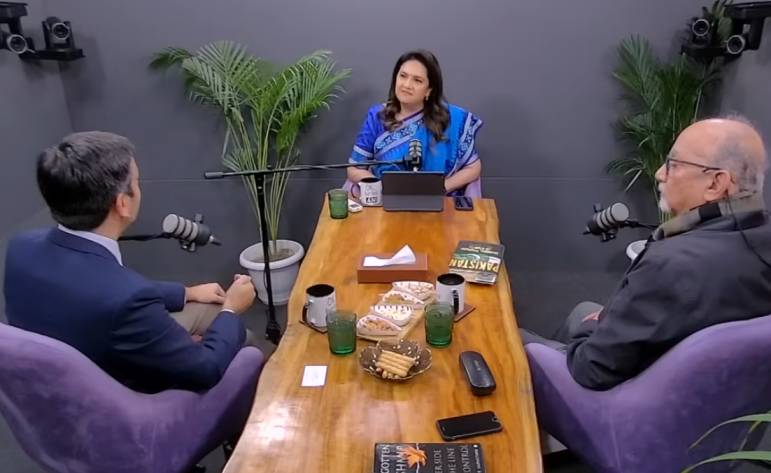
Here is the full transcript of ANI Podcast with Smita Prakash #EP-377 titled “Bangladesh to Pakistan: Rising Islamisation & Terror Threats Explained”, Premiered January 4. 2026.
Brief Notes: In this insightful episode of the ANI Podcast with Smita Prakash, former ambassador Dinkar Srivastava and senior fellow Constantino Xavier provide a comprehensive analysis of the shifting geopolitical sands in South Asia as we enter 2026. The discussion delves into the “constitutional coup” and economic instability currently paralyzing Pakistan under General Asim Munir, contrasted with the rising Islamization and political uncertainty in post-revolution Bangladesh.
Xavier highlights the deep-seated anti-India sentiment in Dhaka and the strategic necessity for New Delhi to build bridges with emerging conservative forces like the Jamaat-e-Islami, while Srivastava recounts harrowing personal stories of his time in Karachi to illustrate the “Kalaishnikov culture” of the Pakistani state. From the challenges of “Operation Absolute Resolve” ripple effects to the potential for a new era of regional connectivity through energy and infrastructure, this conversation offers a masterclass in the diplomacy required to navigate India’s increasingly complex neighborhood.
Introduction
SMITA PRAKASH:
Namaste. Jai Hind. You’re watching or listening to another edition of the ANI podcast with Smita Prakash. In this episode we take a look at the Indian subcontinent as we enter 2026.
Pakistan is grappling with a constitutional coup amidst an economic collapse. Mistrust between polity and militancy grows and animosity with India continues to define its ethos.
Bangladesh, once a success story of growth, now faces political polarization, rising radicalism and a delicate balance between New Delhi and Beijing. In Nepal and Sri Lanka, shifting alliances and economic vulnerability opens the door to external influence, particularly China’s expanding footprint in the subcontinent.
For India, the challenge is not merely securing borders. It’s about diplomacy, energy, connectivity, water, trade, migration and the battle for influence. Is India shaping the neighbourhood or reacting to it? Can New Delhi sustain regional leadership in South Asia where every country has multiple suitors?
Today in the studio I have Ambassador Dinkar Prakash Srivastava, former Ambassador to Iran. He’s also served in Indian missions in Washington, Brussels, Karachi, Jeddah, Riyadh, Tripoli and Prague. Also with me is Constantino Xavier, author and senior Fellow at the center for Social and Economic Progress.
Thank you for coming on the podcast, Ambassador Srivastava and Dr. Xavier, thank you so much. Dr. Xavier will be talking to us about Bangladesh and Ambassador Srivastava about Pakistan.
We’ve seen in 2025 there’s the coup which has happened and constitutional coup and you have a field marshal now literally all power resting in his hands. How do you see, you know, post operation Sindoor, it’s not yet we still supposedly in that state of an operation but how do you see the next couple of months panning out between India and Pakistan and Pakistan’s internal politics?
Pakistan’s Constitutional Coup and General Asim Munir’s Power Grab
DINKAR SRIVASTAVA:
General Asim Munir, he is now directly in charge of the nukes and he’s got himself extension and immunity. Now this is seen as an index of the power he holds. But let’s remember army chief in Pakistan has always been the most powerful figure and General Asim Munir probably did not need these additional titles.
So what is behind it? It is a sense of insecurity because he is presiding over a divided house where the army, there’s a dissension within the army and this was evident in the events of May 23rd when the army GHQ was attacked and the Lahore Corps commander’s residence was ransacked.
Now that raises a question, why wasn’t there resistance? Pakistan army does not believe in Gandhian values of non-violence. So obviously the entire chain of command melted down. And this probably is the suspicion which led to purge of six senior generals way back in 2023. This is much before the former ISI chief Hamid Faz’s sentencing recently.
So this division rift within the army explains his sense of insecurity and his attempt to guarantee himself immunity. Now this is also driven by the fact that within Pakistan there is a complete polarization. PMLN versus Imran Khan. And Imran Khan also poses a threat, direct threat to army chief.
SMITA PRAKASH:
Despite being in jail.
DINKAR SRIVASTAVA:
Despite being in jail. Because you know, he was in jail when the events of May 23rd took place. So he has followers and as I was explaining earlier, this included people within the army. So it’s a hold of the ideology. Imran Khan is known in Pakistan as Taliban Khan. He has always been very close to TTP and Taliban.
So given this situation, internal division within Pakistan between the government and the opposition, rift within the army and their relations with India have always been tense. They have now a live border with Afghanistan and they have had missile exchanges with Iran.
So I don’t think there’s going to be any scope for us to look for stable relations with that country. We’ll have to wait it out till these internal situation settles down. And at the moment it doesn’t look like as if it’s settling down. It’s going to get worse because once the army chief has granted himself an extension, it blocks the promotional avenues of the generals below him. And that creates more dissension.
SMITA PRAKASH:
But no mutiny.
DINKAR SRIVASTAVA:
It won’t be a mutiny, but it certainly means that there will be less willingness to carry out his orders.
Historical Precedents of Military Dissent in Pakistan
SMITA PRAKASH:
Has there ever been in history this kind of a resentment resulting in some kind of a mutiny in Pakistan where they depose a sitting army chief or a field marshal for that matter and the first CDF?
DINKAR SRIVASTAVA:
Let me take you back to early 1950s. Akbar Khan who led the tribal raiders in Kashmir. He had got promoted to Major General’s rank. He was number two in Pakistan army.
Fast forward 1995. Major General Abbasi was arrested on suspicion of coup. He was sacked along with hundred other officers.
In the new millennium after Musharraf got himself appointed chief martial law administrator as the chief martial law administrator and CEO, Kayani slowly distanced himself. And this you can see from the fact that the moment Musharraf was forced to give up his army chief’s position, army and General Kayani did not back him.
So there was a simmering resentment. And I think we’ll have to wait and watch. But it’s a very tense situation within Pakistan and within the Pakistan Army.
India-Pakistan Relations and Cross-Border Militancy
SMITA PRAKASH:
So if Pakistan continues to have a hot border in 2026 with Iran, with Afghanistan, will they continue with their policy of cross border militancy with India? Will that continue to happen? Or will he get and internal dissension which he could probably face? General Munir, would he continue to focus on India and cross border militancy?
DINKAR SRIVASTAVA:
You know, we remain their eternal enemy, Hindu India. So that is the first target for Pakistan. And it is an unstable equilibrium where the army chief or the civilian prime minister has to eventually fall back on hatred against India to shore up support for himself, prime minister within the civilian constituency and army chief within the military.
So we can’t rule out another terror attack. And you know, Palgam took place this summer only when Pakistan was and still having Balochistan up in arms. And despite that there was this terror attack and it was almost on a cue. Asim Munir’s speech of 16 April a week before Pehalgam. This was almost a hint that you go ahead and do something.
SMITA PRAKASH:
But you know, many of the talk shows which one gets to see which are coming from Pakistan, all the talking heads say that because of Operation Sindur General Asim Munir got this fillip. Should I say, I don’t know what word to use, to go ahead and appoint himself as the chief of Defence Force and then gives himself Field Marshal rank and then gets the importance in D.C. with the Pentagon. You know, every country in that region now looks upon him as somebody who’s taken on India.
The Reality Behind Pakistan’s Claims of Victory
DINKAR SRIVASTAVA:
Let me break down your question in two parts. First is Pakistan’s internal dynamics and whether they won the war. And the second is the importance Pakistan received or Asim Munir received in terms of a lunch at the White House.
After 1965 war which Pakistan lost, and this is now confirmed by Pakistani sources, including Ayub Khan’s press advisor Altaf Gohar, who’s given a very detailed account. For decades Pakistan maintained this fiction that they won the war, that they won the war because a lost war has consequences for the leadership. Ayub Khan had to go after 1965 war. It took four years. Things move faster. So they had to invent the charade that Pakistan has won.
Now let me take you back to the sequence of events. It was Pakistani DGMO who called Indian DGMO and sued for Peace on 10 May. And given the Pakistani mentality, if there was even a remotest chance of defeating what they call Hindu India, they would never have accepted peace or any mediation effort as they claim. So this was because they were tottering on the verge of collapse.
Indian Air Force had taken out all their air defenses, including Noor Khan base in Islamabad, Lahore, Karachi. So this charade had to be built up that they have won the war and to supplement it, it was necessary to give the man a promotion.
Now let me answer the second part. Why was he invited to White House? And I think the answer is not in Indian subcontinent or Kashmir. It’s wrong to link President Trump’s actions to ourselves. You have to see it in the Middle east context. And Middle east has always remained much more important in American calculus than South Asia.
This invitation came in the middle of Israel Iran war. And if you take the sequence on 10 May, General Kurilla, the Centcom chief, gave a testimony to US Congress that this was the right time to hit Iran. On 13th, sorry, 10 June. On 13 June, Israel struck. On 15 June, Asim Munir got a lunch at the White House and barely a week later, America entered the war.
So if you see this in the context, this was linked to Pakistan’s possible role or help to America in its actions against Iran. Now, this is a very sensitive issue within Pakistan. And incidentally, on the 15th of June, the same day he met President Trump, Pakistan announced closure of five land crossings with Iran.
Now, these land crossings in normal time do not play much of a role. Most of the trade goes by sea to Bandar Abbas, but the Baloch get affected. But for Iranians, this is the back door which would be crucial for their survival in case American or Israeli action shuts off their ports which are in the Hormuz Strait.
So Pakistan essentially backstabbed Iran. And this is a piece of history. In 1965 war, it was Shah of Iran who gave sanctuary to Pakistan Air Force. June this year, when Iran was being attacked by Israel in America, Pakistan backstabbed it.
This thing has been played down in Pakistani media because you can understand the explosive potential of Pakistan, Pakistani army, the army chief collaborating with the Jewish entity. The main beneficiary of this was Israel.
SMITA PRAKASH:
Okay, interesting. Pakistan using its geographical location again and again.
Bangladesh: The Reality Check on Yunus’s Interim Government
Dr. Xavier, I’m going to come to Bangladesh and return back to Pakistan later. In Bangladesh, tell me, what is the current situation? Will elections take place in February or not? Why would Yunus hold it? He’s enjoying power without any accountability. But does he want to hold elections? And what are the constituents now? What are left of the political parties out there? Do you see the BNP playing a major role in the next election if it is held?
CONSTANTINO XAVIER:
Good to be here, Smita, on your podcast and great to chat with you.
SMITA PRAKASH:
Can I call you Tino after this, please? Just for viewers and listeners, I’m not being disrespectful to my guest. I know Dr. Xavier for a long time and I call him Tino. So henceforth in the show, if I call you Tino, I hope you don’t mind.
CONSTANTINO XAVIER:
Please do, Smita. I think first a moment of silence for all those good souls that believed that Yunus was actually going to reform Bangladesh, bringing an era of democracy, of prosperity. I think those souls maybe were optimistic, they were hopeful. We heard their voices between August and November, December last year, 2024 up to early 2025. And I think there’s been a reality check now and that’s a good thing.
I’m a realist. I think we have to look at things how they are. There was a lot of enamorment with Yunus, particularly from the West. Let’s not forget that he came into power with Biden still in the White House, with the west supportive of his agenda, including of what he at some point promised to be four years of reforms, new constitution, new electoral system that shifted very quickly.
And I’d say that now we’re in a place to, your question is, does he still, is he committed to the elections? I think he’s realized that the only way out for him politically and actually also literally in some ways is to hold elections and to leave with this medal saying, “I have held the country together for a year and a half, two years. I’ve held elections, I got a charter through that will be validated through a referendum that is going to be held in parallel to the February election.”
Whether that referendum is going to lead to something significant or not, we don’t know. But it’s a smooth exit plan for this cast of characters that has shown up from nowhere really and disillusioned itself, I think quite quickly, fortunately, with the reality on the streets that is very different from what Yunus and his advisors think.
SMITA PRAKASH:
So is the street now accepting of the fact that Yunus will leave and they will have an election?
The Street’s View of Yunus and Political Actors
CONSTANTINO XAVIER: I think the street never recognized in that sense Yunus as a long-term solution. But it was the BNP who certainly saw him as a transient individual that was going to hold elections sooner rather than later. The BNP always pushed for elections.
The Jamaat, for example, I don’t think recognized in him the leader of the Bangladesh that the Jamaat Islami wanted and still wants. The army was never, I think, particularly supportive of Yunus. They gave him time, gave his interim government some time.
But in March this year, when the army chief Waker came out and pretty much signaled very clearly, “you better hold these elections sooner rather than later,” that was the tipping point, I think, for me, where we realized that Yunus was there for as long as he could be and he wanted to be, but eventually he wasn’t going to last.
SMITA PRAKASH: To be a Karzai in the sense that imposed by America and, you know, kind of stayed on for a long time, made himself a part of the polity?
CONSTANTINO XAVIER: See, the point is, does he have, did he have the power to do what he was saying? Right. A new constitution, for example, without elections. That’s initially what his agenda was, a new electoral system. He never had that power.
And if you’re in the business of politics, you know that every relevant Bangladeshi political actor knew that he was at best a very short-term figure. And that’s exactly what has unraveled, I think, over the years. And now we’re finally having the elections which are the condition for a normalization where you’ll see the emergence of a new legitimately elected government that will have the power of voters on its side to then do what it wishes to do.
Awami League’s Participation and Credibility
SMITA PRAKASH: So will Awami League participate in the election? BNP would want it to be because that will lend credibility to the election. Without Awami League participating, with just the BNP and maybe the Jamaat and some student leaders forming some kind of setup, does it have credibility if Awami League is not part of the election?
CONSTANTINO XAVIER: Difficult one, Smita, because this depends first, who is the Awami League today and who is the BNP? And I think no one is really sure.
SMITA PRAKASH: What’s wrong with the BNP?
CONSTANTINO XAVIER: The BNP has different factions within it. When I was in Dhaka recently, there are different people saying very different things about what Bangladesh they want, what the relationship with India should be.
Sheikh Hasina, to the point now about who is the Awami League, we have someone sitting here in Delhi still assuming that she is in effect the Prime Minister of Bangladesh and that what has happened since August last year, 2024, is not legitimate. Now, that makes it very difficult for the Awami League to move on.
Forget now what it’s allowed to do or not. I spoke to several MPs from the Awami League who are in exile now. They’re telling that within the party there is confusion and there are people certainly saying this is an era where we need to move on as a party. She’s part of the past. Whether she’s done crimes or not is a larger discussion, but she’s certainly not going to be part of the solution of a new Awami League going forward.
These are the debates we don’t hear so much about. They’re of course, internal, tough, painful debates. And you know, it’s your leader, after all, that was in power for 15 years and a leader that made the party herself. We know towards the last few years of rule, Sheikh Hasina was very isolated, right? Her party became weak from a sense of strong figures, like you’re asking for second rank figures that could take over now.
So it’s very difficult to do all this within a year when you’re being persecuted with MPs literally being attacked, as you know, in Bangladesh and abroad, and being slapped with cases. They’re reconstituting their families, their well-being and the party’s in disarray. But we have her, of course, still operating as the leader, which complicates it.
So I think obviously for a free and fair election, the Awami League should, technically, every party should be allowed to run. But look at it also from the Bangladeshi perspective. The Awami League has to pay some type of price for what it did. And it may have not done as much as it’s being accused of. But you know, there’s a nice expression: you sit this one out. Maybe the Awami League needs to rethink a little bit, you know, itself, how it wants to position itself. And I think there will be that space.
Now, there’s two problems with that. One is, as you see over the last few weeks, the Awami League is trying to push the conditions to be reassimilated into Bangladesh. So it is making a lot of noise, right? It is criticizing, it is operating again in Bangladesh. We see still some movements there. So the Awami League is trying now to carve out its space again and saying, “fine, we may not realistically run the election or even recognize it, but we want to be part after February of as soon as possible.” Right? Because otherwise you may remain banned forever.
DINKAR SRIVASTAVA: Yeah, right.
CONSTANTINO XAVIER: To your point about, I’m not sure if the BNP is very interested to bring the Awami League in, right? Because the question is, what will happen to, let’s say, different estimates, 20 to 30% of the electorate that the Awami League holds in Bangladesh? Will that transfer to the BNP? Will it transfer to the Jamaat, different versions? Will people stay at home and not vote? Right.
But certainly if the Awami League would run, that vote would be a significant vote. Maybe not as large as we think, but 10 to 20% is significant if you want to form the majority, which is why the BNP wants to hold elections as soon as possible.
Desecration of 1971 Memories and Rising Conservatism
SMITA PRAKASH: Tino, you’re back from Dhaka. Did you go to those places where Mujibur Rahman’s statue had been broken down? And the desecration of anything, I mean, that’s what the Awami League says. The desecration of all the memories of 1971 and Bangabandhu and everything. Did you see that? And do you feel that the people of Bangladesh with some kind of a tacit approval for all this that happened?
CONSTANTINO XAVIER: I think it’s a churning in the country. That’s what I saw. I spoke to students, which is always a good sense of what’s going to come. I met many students of Dhaka University, women, many women, progressive women, I mean, studying engineering, medicine, have traveled abroad and they said they voted for the Jamaat student wing, which swept the elections of the Dhaka University Students Union and won because they kept saying, you know, “they’re clean, they’re not corrupt, they’re different.”
SMITA PRAKASH: They haven’t had the chance as yet.
CONSTANTINO XAVIER: They have changed. Not just saying what they are saying, they have changed. They’re not so radical as they’re being portrayed. “We want to give them a chance and we’re tired of what was and we want something different.”
So I think there’s a churning in the country, which is difficult for many of us, historians, scholars, people here in India, to accept that 1971 doesn’t weigh, doesn’t loom as large on the psyche of this new generation for many reasons. They’re young, 50 years have passed. And also there is an Islamization of the country. There’s a wave of conservatism in the country.
You see this in the universities, right. You see this in the demands for, you know, more Islamic informed law, if you want. Sharia is a big word. But yes, there’s a movement towards a conservatism that you feel across the country. And that’s not necessarily a threat. We can come to that. But I think it’s not necessarily a threat.
You know, frankly, when I see often many Western commentators say there’s a conservatism in India, religious and culture, and that’s a threat and it’s dangerous, I’m not sure. I think these countries go through different moods and, you know, we have to respect. There’s a certain trend in Bangladesh that makes it apparent that 1971 and the heroes that were, are not as important anymore, are not as important as they used to be.
Pakistan-Bangladesh Relations and General Munir
SMITA PRAKASH: Ambassador, do you see General Asim Munir visiting Bangladesh before elections happen out there? We are seeing, you know, opening up of ties between Bangladesh and Pakistan to such a large degree, much more than ever before. I mean if I see Sheikh Hasina’s period, of course when General Zia was there it was different. When Khaleda Zia was there, of course there were ties.
But you know in the past 15, 20 years that we’ve seen, we’ve not seen this kind of back and forth movement which are happening, visits. Do you see General Munir going there before elections?
DINKAR SRIVASTAVA: I don’t think General Munir would be interested in influencing the electoral process. What he will be interested in is to strengthen ties with Bangladesh army and Jamaat-e-Islami which already has strong ties with its Pakistani counterpart and ISI.
But you know, let me mention when Sheikh Hasina was overthrown there was a delightful comment by General Asim Munir that there were those who said that the two-nation theory has been drowned in the Bay of Bengal and how wrong they were. So Pakistani army sees Hasina’s overthrow as validation, as return to two-nation theory.
This may not be so, you know, Sheikh Hasina has been removed from power. And as Constantino was saying that 1971 maybe is a memory to the new generation. But I don’t think there is any yearning to go back to Pakistan because the Bengali nationalism, you may call it Muslim nationalism but a sense of distinctiveness is there now.
The second part, Pakistan army and especially General Asim Munir is also very cautious about the Bangladesh experiment being repeated in Pakistan. And you know, immediately after Hasina’s overthrow he addressed a group of clergy, Ulema and he gave a very stern message that nobody would be allowed to create anarchy.
Now why did he choose this particular audience? Because Ulema or the clergy had played a role in overthrow of Sheikh Hasina. And Asim Munir did not want that history to repeat itself in Pakistan. There’s the other side of the coin that Imran Khan when he was out and now in jail, he keeps reminding people of Pakistan the role of Pakistan army in breakup of the country. So you know, it cannot be ignored.
Divisions Within Pakistan: Sindh and the Muhajirs
SMITA PRAKASH: And then you had the Indian Defence Minister saying that Sindh may not want to be part of Pakistan. So it wasn’t Balochistan that most people when they heard that comment they thought he’s talking about Balochistan, you know. But within a week the Indian Defence Minister said Sindh might not. So it wasn’t just KPK or Balochistan, Sindh too. So there are divisions in Pakistan. Let me come back to Bangladesh.
DINKAR SRIVASTAVA: Let me just intervene. It’s not simply Sindh, it’s the Muhajirs. And I have been witness to this drama firsthand. I was posted to Indian Consulate General in Karachi from 1991 to 1992. A very short but eventful stint.
SMITA PRAKASH: During that Muttahida Qaumi Movement era when there was…
DINKAR SRIVASTAVA: The first military operation was launched against Muhajirs who created Pakistan. It was called Operation Cleanup. Now this was such an irony that Muhajirs who created Pakistan became a victim of Pakistan Army 40 years later. So and this continued for next two years. And it has been again, you know that move, the MQM is split with Pakistan with army’s intervention. But the sentiment remains.
In 2016, Altaf Hussain, the MQM leader who’s in London now, permanently exiled in London, he made a statement that “Pakistan is a cancer on the face of the world.” So there was, you know, he was…
SMITA PRAKASH: Dubbed a RAW agent immediately.
DINKAR SRIVASTAVA: He was. There was total consternation. There is nothing to do with RAW. This is the result of the suppression of national and ethnic identities by imposing an artificial ideology based on religion.
So the Pashtun, the Baloch, the Sindhi, they were the first to realize it. The Muhajirs were in the vanguard of Pakistan movement. But even they have now realized that there’s no place for them in the country they created. And you look at the title, the name of the party, it’s called Muhajir Qaumi Movement. Qaum means nation. So they have realized that being Pakistani is not enough. They have to be a separate qaum.
So the divisions within Pakistan are very deep. And this is not something which has been helped by Pakistan Army’s actions. And this is an army which is almost entirely dominated by Punjabis.
Bangladesh’s Complex Identity Politics
SMITA PRAKASH: You know, when we talk about identities in—I don’t want to say South Asia—in the Indian subcontinent, we’re talking about multiple identities. Like ambassador mentioned, you know, when Pakistan was created, they tried to wipe out every other identity and just keep the Islamic identity.
But in Bangladesh, which was East Pakistan, these multiple identities are part of their being. They are Bengalis also, they are secular also, they are Islamic also. So you know, and they were East Pakistanis then became Bangladeshis. So that complex structure of identities. And now comes this, the other era.
And democracy is very important for them. You know, they have held on to that democracy and, you know, saying that they are a functional secular democracy. That is important to them too, at this stage. What are they looking at when they see a part of their population destroying temples, talking about their Islamic identity being the most strongest of all identities of the Bangladeshi. What is going on right now?
The Structural Shift Toward Religious Conservatism
CONSTANTINO XAVIER: There are so—I mean, absolutely, there’s many, many overlapping identities in Bangladesh. I’m thinking of the tribal communities, right, in the Chittagong Hill Tracts, for example, and how that was solved peacefully in the late 90s with Indian support to stabilize that. So I think Bangladesh has always coexisted with that.
But I think there is a structural change now. Yeah, there is a structural change in the form of religion. Right. And that is something we have to acknowledge. It is not something that may be dramatic necessarily. I think often we portray it as, you know, the radicalization of Bangladesh that will hurt Indian interests, destabilize the country, etc. Not necessarily.
That is exactly my point. I think there’s a conservative turn in Bangladesh based on a religious element, but not only. And that will inform the future of Bangladeshi politics. Right. And that will therefore need responses from many inside and outside.
For example, it will need a response from the Awami League. And if you look at Sheikh Hasina, she was already experimenting with that, right? She was already experimenting with Islamic conservatism, pandering into the Jamaat on many demands prior to her fall. So I think that shows again, her acumen also realizing that this is not just a purely secular country, that there was a particular primacy, if you want, of Islam in that country.
Now, what Islam is the question. I think, therefore, looking at what the Jamaat is saying and how it will position itself is very interesting. I think the election of February is not of interest, Smita. No, because it will be an election, in a sense, the BNP will win, most likely. Right. We’ll have a weak BNP. I’m saying there’ll be something that will govern that country in the form of a BNP. Which faction now will—we’ll see.
The BNP people already telling me in Dhaka, “We want to work with India.” One year ago, they were all silent on this. They were all singing SAARC songs and saying—and almost—I mean, it was bizarre. When it was there, November 2024, India did not exist. I mean, there was not a single word about India. Right. Including from the interim government.
I mean, no one in the interim government was able to say simple thing, which is, you know, “We don’t like the politics in India,” for example, or “We don’t appreciate the way India supported Sheikh Hasina,” or “We have a political problem with India, but we need to continue working on economic and developmental issues.”
SMITA PRAKASH: Sure.
CONSTANTINO XAVIER: No single high level leader was able to articulate a speech and address that tells you of how deep the anti-India sentiment was or how also weak this political leadership was of Yunus and his advisors was unable to articulate this. Right.
So going forward now, the BNP might win. The Jamaat question will be how close and strong of a second—Alame will probably be outside left, outside the BNP, you know, the student party. Will it? To what extent will it? But my real question is 2030 or 2031, assuming that this government will last four or five years. Right. Which is that’s the moment where the Jamaat will make a run for power.
SMITA PRAKASH: Okay.
The Jamaat Question and India’s Strategic Response
CONSTANTINO XAVIER: And I think we have five, six years till then to think about a Jamaat-ruled Bangladesh. Which begs the question, what Jamaat will it be? A Jamaat, it will be extremist, ideological, you know, sanguinely against India, radical in its, you know, most vicious form on economics, on culture, on minority issues, on foreign policy issues, or will be a more moderate Jamaat.
And we have seen many radical groups moderate themselves as they come closer and eventually join power. I’m thinking of many groups across the region that have moderated themselves. I think today we can make a safe assessment that the Taliban in Kabul are different, more moderate, maybe far from what we would like from a normal—
SMITA PRAKASH: So India should keep a more open kind of attitude towards the Jamaat, build bridges with them and not just say that, oh, they’re Islamist radicals. Keep away. We only deal with Awami League or else some factions of the BNP. Is that—
CONSTANTINO XAVIER: I think India will have to do what it always has done so well in the history of the last 75 years, which is set red lines and say “This we will not accept” and extend a hand like you say, build bridges and say, “Here’s where we can work with you.”
Now there’s an economic agenda that we have to work with each other. We have the fifth largest land boundary in the world between India and Bangladesh. 4,000 kilometers. Yes, 4,000 kilometers. Two, we have trade that is at what, $12, $13 billion. Before the Ukraine invasion, India was exporting more to Bangladesh than to Russia. Okay. Before the whole oil crisis. An economic important partner for India. Right.
This is the 8th largest country in the world. Smita, this is a very large country, so you can’t wish it. You have to deal with whatever those cards the Bangladeshi political cards are going to give you. My assessment is that the Bangladeshi political cards are going to give you increasingly conservative political dispensation and that should not necessarily be seen as a totally hostile towards India position.
SMITA PRAKASH: What is the situation with the Rohingyas out there?
CONSTANTINO XAVIER: In fact, just one thing. If you see the leader of the Jamaat, what he’s saying, already saying on ’71, for example, which they’ve been very radical, right, and very strong, he said already that “We apologize for mistakes that we might have done in ’71.” Right. So there’s also a sense of safety, signaling that, you know, not all was right in the past, but political parties and movements are very complex. There’s various factions within the Jamaat.
SMITA PRAKASH: Right.
Red Lines and Pakistani Interference
CONSTANTINO XAVIER: So Jamaat, what Jamaat comes up is also something that others can shape, I think. And if you’re going to say Jamaat is evil, hostile, they will become evil and hostile. Right, let’s say. But also red lines. Red lines means that you cannot do things that will hurt India.
Hanging out with Pakistani security establishment. We see today the Pakistanis developing a presence in Bangladesh that is mostly 90% driven to irritate and hurt Indian interests. Right. It’s not a productive agenda to reshape Bangladesh or to support the development of Bangladesh. That’s what they will say. But we know today on security, on intelligence, on defense equipment, on training of the next generation, on ideological basis, what Bangladesh do you want? It is one that is premised on making things more difficult for India. That is the Pakistani approach.
SMITA PRAKASH: Yes.
CONSTANTINO XAVIER: And—
SMITA PRAKASH: And if Bangladesh, whatever the new leadership is, if they follow what Yunus is doing, then it’s going to be difficult for India, right?
CONSTANTINO XAVIER: Yes. And that’s why it’s a tough situation for India to say also, “Listen, we’re going to work with you, but on certain conditions.” And again, the people I’ve met in Dhaka were already—that’s a good sign, I’m saying, and I think the Bangladeshi National Security Advisor was here, as you know, recently. That was the first important visit, I think, from India.
The signals, despite what we are told and reported, particularly in international press, has been extremely reasonable. I mean, people forget the Home Minister of India in October 2024, three months after that revolution, as people were singing down India in the streets and an interim government that had come into power did not say a single positive thing about India. He went to Petrapole, West Bengal, the largest land crossing that exists. 70% of India’s land-based trade with Bangladesh goes through that checkpost and inaugurated the most modern land post that India has, you know, an integrated check post. That is huge investment. That was a signal to say “We can work with you on connectivity, on flows of trade and people, you do—”
SMITA PRAKASH: Your part if they want to do it.
CONSTANTINO XAVIER: That is correct. And that what interim government I don’t think has reciprocated, frankly. That is—and I think—but the BNP post-February I think will reciprocate because today, one year later I go to Dhaka and I already hear people telling me “No, we need to work with India, we understand, on trade, on growth, on water, on investment, on technology, on health, on a variety of issues that are very important.”
The Rohingya Crisis and Western Withdrawal
SMITA PRAKASH: I was asking about Rohingya issue. What is the current situation there in Bangladesh with regard to Rohingyas and then Myanmar also and then India also. We are all dealing with the Rohingya problem. So explain to me this.
CONSTANTINO XAVIER: So let me start with why do we see Bangladesh pivoting a little bit more towards Pakistan and China over the last six to 10 months? I think it’s a function of the US withdrawal and the Western lack of interest in what’s happening in Bangladesh since early this year. Right.
SMITA PRAKASH: I mean they brought in Yunus brought—
CONSTANTINO XAVIER: In is a larger question. We can talk. And they supported a change. They wanted that change and they supported it. I don’t think they could have done it. I think you do things, but you can support them. And I think the European countries, the US clearly wanted Sheikh Hasina gone. Right. And put in not only words but also money to make that support. Right.
But there wasn’t—they couldn’t have artificially created this thing. It’s a very important distinction. There was an exhaustion with Sheikh Hasina from across the spectrum, whether it was Jamaat, the progressive students, a variety of groups that wanted her to go.
That is within August and November. November Mr. Trump gets elected. And that’s a big tipping point. Why? Because the Europeans get busy with Mr. Trump as we all have been, because he is, you know, launching chaos in our relationships. So there’s very little attention span now for Asia, particularly for small Bangladesh.
The Americans also largely, you know, I mean what is left of the State Department these days? You know, it’s a very difficult situation for the bureaucracy in the US and for a variety of organizations. You know, they’ve lost attention span for agendas of democracy promotion that they had been pushing for many years and they were actually often aligned with India, in fact for more democracy in some countries.
Third, I think as a function of that, if you are Yunus and you want to stay in power, you have to look for support elsewhere. And that’s where he went, I think to China earlier this year, accelerated that Pakistan and a variety of other partners that he’s fulfilled. Not India. Right. There’s very little left. So I think that’s the first assessment we have to understand now that I don’t think will last.
I think that post-February we have the conditions right for re-engagement with India. And that’s why again, when I went last month to Dhaka, I’m hearing those voices across the spectrum that is saying something very simple which is “We know that broadly we cannot rely on the US and the west for any significant support and investments, funding developmental ambitions that Bangladesh has.” Right.
The Chinese have not stepped up the way we wanted. In fact, Yunus visit to Beijing did not materialize into anything significant. Yes, defense, we can talk about defense equipment, et cetera. But from a real development perspective, which is always good to look at, water, boats. They’re not investing. Yeah. They’re worried about what they have there. They’re building that influence but they’re not putting in more money into—and textiles, their major thing.
SMITA PRAKASH: They want markets for their textiles.
CONSTANTINO XAVIER: So therefore you have to normalize with India.
SMITA PRAKASH: Yeah.
CONSTANTINO XAVIER: Right. And I think that augurs a good chapter. But again, the 2030, 2031 horizon is the one I think politically the most interesting. What Bangladesh will we have then? And that’s what we need to start thinking about, I guess India preparing for. And that will require a lot of work because you’re dealing with a wave of very strong anti-India sentiment in Bangladesh.
SMITA PRAKASH: Okay. I asked you about Rohingyas.
CONSTANTINO XAVIER: Rohingyas.
SMITA PRAKASH: Listen, I think—
DINKAR SRIVASTAVA: Good.
CONSTANTINO XAVIER: You remind me of that because I mean how do you feed 1 million people with 3 meals a day? Who was feeding them? It was the USAID program. It was not India.
SMITA PRAKASH: And that’s shut by Trump and that’s—
CONSTANTINO XAVIER: Shutting down very quickly.
SMITA PRAKASH: Yes.
CONSTANTINO XAVIER:
So that’s a massive security concern. Bangladesh is also worried about that. So someone is going to step in, which leads me to a larger point. Some people may be singing hurrahs—the USAID was up to some weird things, we don’t like them, we don’t like the Americans in our periphery. Fine. But someone is going to have to put up the bill to feed these 1 million people, especially if you don’t want them to go elsewhere. And we know where.
Well, I can think of one country next door where Rohingya would want to probably go and have been, in fact.
SMITA PRAKASH:
Yes.
CONSTANTINO XAVIER:
Have been trickling through the border, despite all the security concerns and the strong measures since 2024. But they can, of course, go elsewhere. And they’ve showed up on boats near Sri Lanka. So it’s a very difficult situation for India to deal with that Rohingya. And I think we need to find ways to stabilize that. And as the U.S. naturally, under Trump, withdraws from all this stuff, sometimes that’s maybe making the job for India easier. Sometimes it begs the question, saying, it’s not our theater.
SMITA PRAKASH:
But then if China steps in, then it’ll become America’s theater. Or do they not want that anymore?
CONSTANTINO XAVIER:
See, I was mentioning before the country next door, Smita, because geography still matters. The Chinese can afford to play from across the Himalayas, very far away. They’re not going to deal with the Rohingyas coming into their land, or they’re not going to deal with a collapse of the Bangladeshi state, which could have happened, might still happen.
So I think geography puts a special responsibility on countries that are close. And I know that Indian policymakers are worried about this, what’s happening in the Bay of Bengal. And that’s why we saw the Americans and Europeans singing hurrahs in August 2024. But six months later, I just heard the same people telling me, “Listen, oh, India, please come in. You deal with this now.” Because what is going to say no, you have to. Because Europeans can afford to opt out.
DINKAR SRIVASTAVA:
Yeah, right.
SMITA PRAKASH:
We can’t. You can’t.
CONSTANTINO XAVIER:
It’s the eighth largest country. I don’t think people realize how quickly these things can go down south. We saw in Sri Lanka collapse, financial collapse. We saw Nepal—within two days, buildings burning, insecurity, no one in control. This can also happen in Bangladesh. And unless you develop a developmental agenda that gives jobs and continues the growth path, you will face a lot of political issues.
Student Movements and Political Upheaval
SMITA PRAKASH:
Ambassador, why is it that you see these student movements happening in Bangladesh? You see it in Nepal, it happened in Sri Lanka. Why is it that it doesn’t happen in Pakistan?
DINKAR SRIVASTAVA:
Imran Khan is supposed to have symbolized that. He got a lot of support from the younger generation, not the students themselves, per se, because each political party has its own stone wing. But the younger generation did support Imran Khan and the underlying factors were the same—unemployment and disenchantment with the existing political order which was dominated by two major political parties but ruled by family dynasty.
SMITA PRAKASH:
But finally they go to polls. Whatever the movement was, Tehreek-e-Insaf movement. Ultimately the decision is taken by the ballot, right? It’s not as if they caused an overthrow of the elected government. They went, they fought an election, won and he became Prime Minister. It’s a different matter that he got thrown into jail.
DINKAR SRIVASTAVA:
He did not become Prime Minister. He finished first. You are right. His party was not allowed to contest. His party members contested as independents and clocked up the largest number of seats. But the Prime Minister was chosen from the second largest party, the runner up which was PMLN.
SMITA PRAKASH:
That’s this election.
DINKAR SRIVASTAVA:
Yes.
SMITA PRAKASH:
But before that he has become Prime Minister.
DINKAR SRIVASTAVA:
You know, there again there was a lot—
SMITA PRAKASH:
He was installed.
DINKAR SRIVASTAVA:
Stolen election, not stolen election. These figures are available in public domain. He did not have majority at the end of 2018 elections. So that majority was manipulated by breaking up PML ranks and engineering defection to Imran Khan, both at the federal level as well as in Punjab. So army played a role.
So what is keeping the stone’s power from asserting itself is the role of the army. And the other part is the religious parties and religious parties or groups. Their hold cannot be just only in terms of electoral outcome. You know there’s this oft-repeated argument that they have never won election but their percentage has kept on increasing. It went up from 3% to 5%. Last elections it was 9%. But more than that, the religious group’s agenda has been adopted by the mainstream political parties in order to outflank them. So this is a much larger issue that their agenda is now being pursued by both.
SMITA PRAKASH:
Both the political parties.
The Legacy of Islamization
DINKAR SRIVASTAVA:
Both political parties. And let me just give you one example everyone. A lot of people must have heard of Article 58B of Pakistani constitution. This was brought in by Zia to consolidate his hold on the state and the government. It gave him the power to dismiss the Prime Minister, dissolve the parliament, dissolve the state assemblies and so on.
It took about 15 years after Zia’s death, another eight years or so before the civilian parties clawed back this power for the Prime Minister’s office. This is sometime in 1997, 15th amendment. Both PMLN of Nawaz Sharif and PPP of Benazir cooperated to scrap Article 58B so that the Prime Minister became the most powerful political figure.
But they did not touch, they did not touch Hudud Ordinance. They did not touch the entire gamut of religious changes, Shariat law, which Zia had brought in. So Zia serves a convenient purpose for these parties to point out that he is responsible for Islamization. But they share that agenda. So that part was left untouched.
So the Hudud ordinance remains there, still there. And Shariat law remains there. And in fact now there are institutions, there’s a Shariat court, federal Shariat court. So they have carved out a separate judiciary.
A Harrowing Experience in Karachi
SMITA PRAKASH:
Okay, interesting. But I want to take a break from all this serious conversation. I want to ask you about that incident in your life when you were shot at when you were posted in Karachi. Can you tell me a little bit about that?
DINKAR SRIVASTAVA:
They did not shoot, but let me tell you, this was the 9th of June, 1992. I was coming back from a colleague’s place at night around 9 o’clock or so and I had my wife in front seat and two children, ages 6 and 9 at the back.
And we were stopped, blocked by Suzuki. First they tried to take over from side. I let them pass. It happened twice, Suzuki car. And suddenly they went a little ahead and blocked me, my car and three people jumped out with guns.
My son was too small, his head was below the headrest. Toyota I was driving, so he didn’t see. But my daughter, she was nine and she shouted, “Papa, guns!” And the driver kept sitting. These three people, one came to driver’s side and tried to open the door. Fortunately it was locked. But he put the gun—there was just the glass, the window glass between my temples and the gun. And two took position in front of the bonnet pointing guns at me.
So I had to, I instinctively ducked, reversed the car and went over the pavement. Now this, they had not foreseen the pavement. There was a small—this was next to my house. And like in India and Pakistan also people encroach on public space. So there was a small extension of boundary wall running across the pavement. So they had not probably foreseen this, that I will drive over it. And I was a desperate man. It was about 6 inches high and I drove over it, I didn’t stop.
I had a guard at my residence, he was part time, worked for the embassy, but ex-military chap. But he used to have a couple of pegs in the evening and it was a heavy iron gate. So I realized by the time he comes, I’ll be done. So I raced straight to a police station, nearest police station, which was about 5 kilometers away.
And these fellows in Suzuki followed me. We reached—for some distance, 5 kilometers. They followed me about half the distance. Then they dropped off and they in turn were being followed by two ISI chaps. You know, every Indian diplomat had two ISI chaps round the clock in Karachi. Karachi was the worst.
So we reached the police station and initially the SHO was very polite. The moment he heard that I was from Indian consulate he said, “Sir, I’ll come” and disappeared. He surfaced six hours later. After waiting for about couple of hours, then I asked them—your children were—
SMITA PRAKASH:
In the police station.
DINKAR SRIVASTAVA:
My wife and children were in the police station. After about couple of hours I told them that neither my wife nor my children had eaten. So let me go and drop them back. They gave me some escort. I went and dropped them home, came back and again waited.
That SHO surfaced around 4 in the morning and started questioning me about the number of the car, number plate. So I said that look, my attempt was to save my family and myself. And it was dark night, so how could I see? But why don’t you ask those ISI chaps who were always trailing me and they were behind that? They had two opportunities to see the number plate when that car went ahead and blocked. If they were not involved they should have been very suspicious—who’s jostling with Indian diplomat’s car. And second when they turned back and left.
So those ISI chaps were called in and you could see the military men—strong, well built and crew cut and with the pockets bulging out, carrying revolvers, hand weapons.
SMITA PRAKASH:
Yeah.
DINKAR SRIVASTAVA:
And I asked them and the fellow’s response was, “Ki sahib meh dar gaya.” I got scared. So I said that attack was on me and you are a military man and you got scared. So at which point he just turned and left.
So this was the 9th of June. Finally they registered some fake FIR which was registered. And later I went back home around 4:30 or so. A week later, exactly the same drama followed.
SMITA PRAKASH:
No, let me come back before you go to the second incident. When this happened, didn’t you contact the mission?
DINKAR SRIVASTAVA:
I did contact the mission. Consul General got the message through the security guards. He didn’t turn up. My other colleagues, Mr. Francis, K.J. Francis from Foreign Service and Mr. Anand Rani, they came to the police station and J.J. Singh—these three officers. Military Attaché, he was—no, no, they were all civilians.
So they came to the police station and when I reached finally home around 4:30, Mr. Tripathi, the consul general came with his wife who was deputy consul general and asked for a glass of beer. So this was the first incident.
SMITA PRAKASH:
And the second incident.
# The Karachi Incidents: A Diplomat’s Harrowing Experience
DINKAR SRIVASTAVA: A week later, on 16 June, the second incident took place. This time I was alone. I was coming back from the consulate. And by that time, you know, I had developed this habit of looking in the rear view mirror and I saw a Suzuki, identical Suzuki car. But you know, every time you see a Suzuki you don’t start running.
I had nearly reached my house. I kept on debating whether I should get out and open the gate. Now during the daytime the guard who was actually part time, he worked in the consulate, he was not there. His wife used to help my wife. The ladies were alone. So I realized I had to get out and open the gate. I didn’t want to do it because I saw this car which was parked about 20 yards away.
And in that split second when I could not decide, certainly the car zoomed up and they again blocked my way. And this time they completely blocked my way. And the same drama followed. Three men jumped out with guns. So I had no option but to reverse.
Now to reverse on a narrow street with three men following you with guns is an extremely scary experience. I was trying to reach the crossing at the back so that which would have given me three ways to run. I’m very fond of Faiz Ahmed Faiz’s poetry. So I was playing Faiz’s poetry on the audio in the car.
Now car engine tends to stall when there’s extra load, especially at slow speed. So by the time I reached the crossing, suddenly the engine stopped and these fellows caught up with me. And the same drama, you know, trying to open the door. I was desperate. I just turned the car on the side lane and I sped and that fellow had to jump out of the way and reached the police station.
Now within a week there was a new SHO. Obviously the previous SHO’s performance was not found good enough by powers that be. And the same drama followed. But let me add a footnote. We had to, we changed. We residents, we moved to consulate had a kind of compound because my wife said that, you know, these people will kill you.
After some time we again came back. Now this time when we came back, a guard from a neighboring residence came. All the guards in this area, this was Defense Housing Area. They were posh villas and they all had private guards. And all of them carried Kalashnikov. This is early 90s, private guards carrying Kalashnikov. This is the Kalashnikov culture of Pakistan.
And this fellow came and, you know, in that running around, I had not noticed that one hub plate of the rear wheel had dropped out. And he was carrying that and he said that. So I was, you know, very touched by his courage. And he knew that, you know, I was being monitored around the clock. In fact, by that time the guard trailing me had increased.
So I was very touched by his courage and his honesty. And then he said, “Now this is, you know, the humanity. People are the same. You know, they are good people in Pakistan also.” I laughed. I said…
The Motive Behind the Attacks
SMITA PRAKASH: But why were they doing this? I mean, what was the reason? They could have killed you in both the instances. Did they want to kidnap you for ransom or what?
DINKAR SRIVASTAVA: No, they were just trying to intimidate me. And the background was Operation Cleanup against Muhajirs. This was the first military operation against Muhajirs launched by Pakistan Army. I’m from Lucknow, I speak Arabic. I’m fluent in Urdu. My family was very well known in Pakistan. My grandfather’s name is mentioned in Khalid Kuzama’s memoirs “Pathways to Pakistan.” There are political rivals in Lucknow.
So whatever suspicion they had about me and I am a foreign service officer, had nothing to do with RAW. It was very clear to them, there were no two ways about it. But ISI, they are not mad. So they had their reasons for, you know, selecting me. But whatever those reasons, I’m sorry, you know, this is, we have secrecy laws. So I would not like to…
SMITA PRAKASH: But why were you not sent back to India? Usually when an officer gets targeted like this, he’s sent back and replaced.
DINKAR SRIVASTAVA: You asked me, I have not spoken about it in public. Let me, now that you have asked me, let me mention Mr. Lamba, the then High Commissioner. After the second gun attack, he came because he felt there was something terribly wrong.
SMITA PRAKASH: From Islamabad to Karachi?
DINKAR SRIVASTAVA: He came from Islamabad to Karachi. He said two gun attacks against… And he went on around asking people in the consulate that two gun attacks against the same officer and nobody else is touched. Very relevant question. I’ll not comment further.
He also called my wife and me for a, you can say counseling session. But, you know, it was a bit surprising. He invited us to his hotel room, not in the consulate and kept motioning throughout this. And he’s passed away, so I have highest regards for him now.
Mr. Lamba’s words to me was, “Dinkar, I have, Foreign Secretary has asked me to convey a request to you.” Foreign Secretary was Jain Dixit. “And the request is please do not ask for a transfer. Because if you ask for a transfer we will have to give you. But this will give Pakistan the wrong message, Pakistanis a wrong message.”
My reply to him, I remember these words are etched in my memory. My reply to him was, “Sir, I’m not asking for transfer. This is part of my occupational hazard. But even my wife is not asking for transfer. It’s no part of her occupational hazard.” And we stayed on.
We had some very minor requests. You know, we wanted a, I wanted an official transport in Karachi. Even the LDC or UDC or assistants were given official transport to come to office and go back. I was number three in the Consulate General. I wanted the transport for the same reason because I was specially targeted. He agreed.
SMITA PRAKASH: Mani Dixit had also done an Islamabad posting. So he understood, I guess, Pakistan.
The Foreign Secretary’s Support
DINKAR SRIVASTAVA: I’m talking about Mr. Lamba. So, you know what I mean to say is as Foreign Secretary, yes, I’m very grateful. I’m extremely grateful to Mr. Dixit. I’m also grateful to Mr. Lamba. But let me complete. You know, we also wanted a change of house. He approved everything. Nothing was done. We stayed on.
I’m very grateful to Mr. Dixit because the first, you know, Lambasab told us why did he come. He said that, you know, it was very strange that both Foreign Secretary and the High Commissioner learned of attack on the Indian diplomat from BBC and that is why he had come to find out what was wrong. Because the Consul General had, Deputy Consul General had neither registered a protest with the Pakistani Foreign Office. They had a branch office in Karachi nor with the Islamabad, nor informed the High Commissioner Islamabad, nor the MEA.
So I stayed on. And six months later by that time CG and DCG had gone. I had become Deputy Consul General and Consul General was Mr. Dogra. And six months later, on 8 December, two days after Babri Masjid there was an attack and they ransacked Consul General’s residence. I was by that time Deputy Consul General.
SMITA PRAKASH: So on file, there’s no record of this incident. These two incidents that happened to you, on file?
DINKAR SRIVASTAVA: There’s every record not only in MEA but also in other departments of Government of India. But they’ll probably be disclosed after my death.
SMITA PRAKASH: Things that happen which nobody gets to know, only decades later tells you also.
CONSTANTINO XAVIER: About the hard work I think that Indian officials do in the neighborhood. I mean Karachi but I’m thinking also of smaller consulates. Sitwe, there are a lot of places.
Memorable Encounters in Pakistan
DINKAR SRIVASTAVA: I had the privilege of knowing some very interesting people and have very high regards for them. One of them was Dorab Patel. He was a justice in Pakistan Supreme Court and one of the very few dissenting judges who gave a dissenting judgment in Bhutto trial at the height of Zia’s powers. And in gratitude to Dorab Patel, the mother and daughter, that is Nusrat and Benazir made him chairman emeritus of Human Rights Commission of Pakistan. I have quoted him in my book “Pakistan: Ideologies, Strategies and Interests.”
There was a Nawab Mazari, a Baloch chieftain who Bhutto called “my Tumandar.” In debate in Pakistan Constituent Assembly, Tumandar is feudal lord. He was Bhutto’s feudal lord. Okay, Sherbaz Mazari. I met Bhukti Nawab Akbar Bhukti. And this was a chance meeting. I had gone to Quetta for, you know, familiarization.
SMITA PRAKASH: No wonder the ISI was after you. You’re meeting with the dissidents, you’re meeting with Bhukti. What do you expect?
DINKAR SRIVASTAVA: And somebody accosted me and he said that. So I was very surprised. But I accepted the invitation and I went. It was again a very memorable meeting. Bhukti, as you know, was assassinated many years later by Pakistan Army.
SMITA PRAKASH: His sons live abroad, right, in Europe somewhere?
DINKAR SRIVASTAVA: I met a man for whom I again have very high regards. And that is Maulana Edhi of Edhi Foundation. And when High Commissioner came, Lamba Sahib had come for his first visit. I had insisted on taking him to Edhi Sahib’s place. Edhi Sahib had invited him and his wife. And in fact they had invited me earlier. And my wife has also been there. His wife was Bilquis and she herself had cooked. Maulana Edhi is, you can say, the Karachi Gandhi of Pakistan’s Gandhi. Mohammad Yunus…
SMITA PRAKASH: Tried to, you know, model himself on and his organization on the Edhi Foundation.
DINKAR SRIVASTAVA: And I had a meeting with Mir Sahib. Mir Sahib was the founder of Jung. So he, you know, you can imagine his stature. And he came to meet me on a Friday. I had just landed in Karachi from Washington. And somehow it escaped my mind that Friday, you know, I asked for appointment and Friday, yeah. He said, I didn’t realize that Friday is a holiday in Pakistan.
I went and the old man, you know, I saw a deserted office. And then they said, “Mir Sahib Khan Zahar Karra.” And you can imagine their status. Mir Sahib and Maulana Edhi. Maulana Edhi’s funeral and Mir Sahib’s funeral was attended not only by the prime minister and the president, but the services chiefs.
So, you know, there are all kinds of memories. There are people who were very good and they were, you know, the establishment of course, obviously didn’t like me.
India’s Regional Leadership and Bangladesh Relations
SMITA PRAKASH: You know, the Bangladesh, the Indian ambassador in Bangladesh, he keeps getting summoned by the current dispensation. And the Indian ambassador has, you know, tried to play this soft approach that we need to take the relationship forward. And as you mentioned, India will have to take longer perspective, see the next election which is going to happen.
How do they see this now? You know that the primacy of India as a regional leader for some time in this area, do they want to continue accepting that or is there resistance towards that? How do they see it?
CONSTANTINO XAVIER: I think all these countries are playing a game of hedging their bets, of diversifying relations and finding a way to live, you know, and benefit from India, but at the same time also have alternatives like defense purchases.
SMITA PRAKASH: They’re buying from Europe.
CONSTANTINO XAVIER: They want China in Bangladesh again. We saw Professor Yunus tell us about Bangladesh interest to join ASEAN in some form or as dialogue partner, RCEP, the regional conferences.
SMITA PRAKASH: They’re not dialogue partner in ASEAN. No, they’re not.
The Politics of Anti-India Sentiment
CONSTANTINO XAVIER: No. They want to upgrade that. They want to become, negotiate an entry into Regional Comprehensive Economic Partnership trade arrangement that India opted out of. So there’s all those signals of diversifying relations, but that’s not a Bangladesh centric story. That’s what the Maldives has been, is still doing. That’s what Sri Lanka is doing.
But you know, it’s very difficult for many of these leaders to resist the temptation to play politics. What does it mean? It means that during elections or after elections in particular, you have to position yourself often in a way to win votes based on an anti-India agenda. That’s what Muizzu did, President Muizzu in the Maldives, for example, and it cost him because he came to power.
And you can’t just then switch off the plug and say now I’m friends with India, I’ve reached power. So for many months he actually took actions that hurt Indian interests, right? Including on the position of the presence of Indian security forces in the Maldives, which then of course India had to push back.
But within six months after his election, you saw a recalibration of the relation. He came here and there was a succession of visits and a normalization of relationship. What I’m saying is there are going to be cycles of political animosity and some leaders play into this, Smita, to a point that really hurts relations in the long term.
I’ll give you one example. Prime Minister Oli in Nepal. Yes. He has systematically played since 2020 an anti-India card which benefits him in some ways at home but has destroyed any trust.
SMITA PRAKASH: Sure.
India’s Diplomatic Approach to Neighboring Countries
CONSTANTINO XAVIER: And by the way, a Delhi that is fine. A government to deal with many formerly anti-Indian or people who came from groups that were maybe hostile towards India. Think of the current presidents of Sri Lanka which comes from a lineage, a political lineage that was certainly not favorable towards India over the last few decades.
SMITA PRAKASH: But things have changed.
CONSTANTINO XAVIER: I’m talking about the Taliban for example. We had the Foreign Minister, the Industries Minister here. It took some time but the relationship is developing. So I think the open hand is here always.
That’s why I gave you the example of the Home Minister going and opening up the integrated check post passenger terminal on the India-Bangladesh border last October. That’s why India for the first time operationalized Nepal exports of electricity to Bangladesh via India transmission lines after August 2024 to support Bangladesh’s energy transition.
DINKAR SRIVASTAVA: Right.
CONSTANTINO XAVIER: It could have also switched off that plug and say no, we don’t have a good political relationship with Bangladesh so we’re going to slow on this. These are signals I think that explain what I think in the neighborhood is a dual track point.
SMITA PRAKASH: So for Nepal and for Bangladesh, is it the first time that they’ve had these multiple suitors? China, the US, India?
The China Factor in South Asia
CONSTANTINO XAVIER: Yes, it’s the first time. Which is why you can’t—I mean it’s very tempting to play the China card these days if you’re in Nepal. And also because they do a lot. China has been delivering a lot of developmental defense solutions to these countries. It’s showering them with political attention instruments.
The recent studies we’ve done at CSEP, for example my institute on how China is developing deep inroads in these countries. It’s because they’re preparing the long term game of building influence to sometimes very simple things. Scholarships, exchanges, fellowships for politicians that are elect members of Parliament. Not so much on defense equipment. You’ve been reporting only with the leadership, not with the people, with everyone spreading their eggs into different baskets, different political institutions.
In Sri Lanka, for example, you see now a growing outreach with the Chinese government where the Tamil constituencies, which traditionally was not engaging with China, it was mostly the south, the JVP and a variety of other groups, particularly the Rajapaksas for example.
But I’m saying is that what’s very interesting is that the leaders there are leaders who play this to a point that it hurts their relationship. And there are leaders I think like the Sri Lankan president for example, who abstained from this and he got elected without caving into this shrill anti-Indianism. He came to power, he worked out a relationship where he’s frank and calls up Delhi, it says, “Listen, on these things I cannot deliver. I have trade unions or I have pressure from my conservative base and I can’t.” Right. Often it is about, it’s actually the—
SMITA PRAKASH: India playbook, but it’s a maturity of leadership. No, what I mean to say is India does the same when it comes to dealing with Russia, dealing with America. It’s the same playbook.
Non-Alignment in the Neighborhood
CONSTANTINO XAVIER: It’s a mini lab. Exactly, you’re absolutely right. Right. These countries are doing a non-alignment on you. Right. And therefore it shouldn’t be too difficult for us to understand and navigate it.
In fact, the Indian government has been quite clear. I mean these shrill assessments that India’s losing the neighborhood. I mean look at the waterways, the roads, the railways that India’s built with Bhutan, with Bangladesh, with Nepal. I mean building till five years ago, India was exporting electricity to Nepal, sitting on the largest hydropower potential in the world. Look how ironic this was after decades, right, of neglecting the hydropower potential.
Today you have Bhutan and Nepal generating record levels of hydropower and exporting to India and beyond to Bangladesh in the case of Nepal. So things that we thought of for decades that were not activated because you could just sit on these neighboring countries and deal with political security instruments have become now, I think shaped by an economic logic.
That’s why, for example, the new prime minister went to Sri Lanka and spoke about a land bridge, right? An idea that is not just a bridge but power sector, for example, transmission lines, oil and energy pipelines, data cables that connect the mainland of India to Sri Lanka.
So I think that logic is also very difficult to sell sometimes in those countries. But you see the maturity of some leaders who are able to tell the people, “Listen, we may have political problems with India and there are many identity angst or whatever, but we need to find a solution because we will not grow, we will not become middle income countries unless first and foremost we engage with India.”
Of course you have to engage with many with China on trade with the Southeast Asians. But I mean you cannot be under the illusion, and many have caved in that somehow the gold lies beyond. Right? And that’s been the problem with the current dispensation in Bangladesh, which has not been able to articulate this. And this is felt.
You know, you feel if you’re sitting here and you’re not—and the neighboring country is not telling you, “Yes, I hear you and we’re going to find a way.” That’s immaturity from a political leadership and we have political leaders that are in that category.
We have others that have played this well frankly the Nepal crisis, I mean why has India reacted differently towards Nepal? Same complete coup, complete change, students in the streets burning down things. Two transitional figures emerging. Why is India supportive and has not been—why has India been so supportive of Nepal? Because she’s come in the provisional prime minister and said we’re going to have elections.
SMITA PRAKASH: Yeah, that’s the only thing I can do. We wait and watch for elections to happen in Bangladesh and in Nepal. But it take a hands off approach.
Infrastructure and Connectivity as Long-Term Strategy
CONSTANTINO XAVIER: I think it’s two things. Hands off. What does hands off means you’ll not get involved in politics, you’re not engineering. And in fact the Chinese have burned their own hands by trying to engineer for example. I think that’s also a good learning here that you can’t do things you used to do maybe in the past. Because also what’s the utility? They’re all going to be the same more or less the leaders. That’s the long term point.
What you can do is I think and you know I’ve been a big proponent and I think it’s something we don’t see. Smita which is India’s finally connecting through infrastructure, energy, transportation for the first time since the 1960s properly, I mean for example India, East Pakistan, Bangladesh 1964 before, just before the war. Twelve railway links connecting India to East Pakistan adversary country technically 1964. Right.
Today we’re still below ten. So we’re still behind what we used to be in terms of flow of growth, capital movement, mobility, transportation. Right. And that is a long term agenda which will be politicized. But we have to depoliticize and say listen, there are political problems, sometimes they connect to economic issues. But we also have to understand that we cannot afford and we will not grow on either side. Assam will not grow unless it connects with Bhutan with Bangladesh.
SMITA PRAKASH: The Act East policy.
CONSTANTINO XAVIER: Correct. The Northeast will have to grow through more connectivity with its neighboring countries. And that I think India is doing more than ever. But it’s of course not good enough.
But just point about message Srivastava with the important Smita of deep knowledge about these societies. We need to know these countries. If you see what the Maharaja Srivastava is telling us, look at the density of connections he had in Pakistan built on expertise, on the time he had to read to engage, to cultivate relations with people probably that were not exactly sometimes biggest friends of India, if you think of it in the newspapers. But you engage them and you build rapports.
And for that we need knowledge about these countries. Which means I think by now in India we should have at least a dozen Bangladesh centers at universities and at think tanks. And I don’t see this. For the last year and a half, we had political problems with Bangladesh. That doesn’t mean that we shouldn’t invite Bangladeshi academics, scholars on economics, on the jute industry in Bangladesh, on the political economy, on health, on digital, on technology in Bangladesh to come here and tell us about the country. I don’t see that enough.
The Need for Regional Knowledge and Expertise
SMITA PRAKASH: Yes. In fact, all these conclaves that take place, you don’t see Bangladeshi participation. I mean, forget now, even during Sheikh Hasina’s time, you didn’t see much of participation happening. You’re so right.
CONSTANTINO XAVIER: Not enough. Very little from the—
SMITA PRAKASH: Even from Sri Lanka. Not.
CONSTANTINO XAVIER: It reminds me of what supposedly Vice President Sarah Palin said. I mean, I think she was taken out of context, but it became a joke, which is. She said, “I’m from Alaska. I understand Russia because I can see—”
SMITA PRAKASH: Yes, we can see that. Yes.
CONSTANTINO XAVIER: You know, I think often we have this illusion that we’re sitting in the region and we know our neighbors very well. We don’t. We don’t. I mean, this is the eighth largest country. I keep saying this. This requires a lot of experts and knowledge.
And I think this is also felt in those neighboring countries, you know, that—are you studying? Are you engaging? Are you bringing us in? You know how many universities are sending their PhD students to Nepal, to Bhutan, to Sri Lanka, to Bangladesh? In India, right? From India, not many fieldwork, which means building these reports, connecting, spending, learning the language, understanding their perspective on things.
And I’m worried about that. I think we need to invest much more in our neighborhood knowledge. Right. From a policy perspective, of course, from a national interest perspective in India. But we need to invest and we can’t wish these countries away or just deal with them when things blow up suddenly.
India’s Role in Pakistan’s Political Landscape
SMITA PRAKASH: Ambassador, you know, when Tina was talking about this, engineering elections and things like that, which there were attempts by India in the past to do this in our neighborhood. India always plays a role during elections in Pakistan, willy nilly. It happens. There’s always that “Hindustan ka joyar hai, gaddar hai, gaddar hai.” You know, these naras come up.
And especially with Nawaz Sharif, it used to be said all that much, what is the current status. This—there’s so much of interest with the film Durandhar. And it seems Pakistan is very interested in the way it was portrayed. And people are watching it as banned, but people are watching it nevertheless and they want to know what part two is going to be like.
Is there this continuous abiding interest about India as much now as it used to be when you were posted there?
DINKAR SRIVASTAVA: Let me begin by saying that I’m not aware if played any role in Pakistan’s elections, but it is true what you said, that India and I always maintained it when I was in Pakistan and later India continues to be the standard in every way in Pakistan.
And we saw this firsthand in Pakistan in Karachi. Indian textile industry, Lakshmi Industries, their textile machinery used to come to Pakistan through Dubai. Change of papers came directly. And textile is the main revenue earner, 55% of exports. Indian film industry. And it was very popular Indian films.
And there were people, you know, who used to come to Indian consulate to collect Indian film magazines. In fact, we used to send a set of Filmfare and other Indian film magazines to Benazir. I’m not saying we did anything. You know, this was just public magazines through Nahid Khan. Nahid was a social secretary. So this was—
SMITA PRAKASH: She was in the—in the car when Benazir was shot, in that armored car, in that Toyota.
DINKAR SRIVASTAVA: So India continues to be the standard in Pakistan in every walk of life.
SMITA PRAKASH: But in politics, as in like engineering elections and things like that, are they always suspicious about Indian interference in their elections?
DINKAR SRIVASTAVA: I mean, it’s always very useful to beat the other fellow by, you know, declaring him as Indian agent.
SMITA PRAKASH: Because the reason I’m asking is just a couple of weeks ago, when Imran Khan’s sister, she spoke with Indian television channels and she said that this is why, you know, they’re not letting us meet Imran Khan and all that. And then the reaction in Indian social media was that every time a politician in Pakistan gets into trouble, they speak to the Indian media. They ask Indian media to help out, whether it was Nawaz Sharif, whether it is Shabaz Sharif, and subsequently now with Imran Khan.
DINKAR SRIVASTAVA: There’s the other side of the coin. The same politician, once they come to power, then they have the most hardline rhetoric against India. So I don’t think we should get involved in their internal politics. Let them sort it out for themselves.
India’s Role in Regional Politics
CONSTANTINO XAVIER: But your part, always about the internal politics. And that’s a larger point also. The position can be that one which is, I think, a moderate and important position. But today, if you look at the entire neighborhood, India is a feature in the politics of these countries, right? And that is irresistible, whether positive or negative.
You go to Bhutan, you go to the Maldives, you go to Sri Lanka, or like you mentioned, this case of Pakistan. It is a feature and it will always be accused of bad things and rarely the positive things come out. But increasingly, you know, you see in these countries politicians positioning themselves in face of India. Are you pro-Indian? Are you anti-Indian? And then you have the China card. Are you pro-India? Are you anti-China? That puts a bigger stress, I think, on diplomacy.
SMITA PRAKASH: And it puts the biggest stress on those countries also that they have to find, you know, with you, without you kind of a thing. Do they have to choose? Like India doesn’t like to be made to choose between China and the US. We didn’t like it when it was choose between the US and Russia or the former Soviet Union. We don’t like that being positioned in that manner.
Now these countries now are saying that why are you imposing this on us, China or India? But I think post-Trump that has changed, isn’t it?
Developing Non-Alignment in South Asia
CONSTANTINO XAVIER: Well, these countries are developing their own systems, their own non-alignment now, right? That’s what you see in Sri Lanka, the debates, internal debates on. Even in Bangladesh. I’m happy to see over the last few weeks finally in Bangladeshi media a serious discussion. What connectivity do we want with India? What role do we want India to play in Bangladesh? And how it doesn’t mean all in, right?
Supposedly we have to de-Indianize foreign policy. Something very popular these days in Dhaka. As if you were complete, as if Sheikh Hasina had been completely beholden to India. As if she hadn’t gone to China, as if she hadn’t gone to the US, as if she hadn’t worked with the Europeans, with the Japanese. You know, there was a balancing policy. Maybe it was of course tilted or particular respectful or deferring on some issues due to India.
But on the other hand, also you can’t go to the other extreme, right, which is all out on India. And it shows to you that the maturity in these countries is developing on how to develop their own balanced foreign policy. And that requires a lot of people thinking about these things in these countries which traditionally did not think about foreign policy.
SMITA PRAKASH: Do you know when Mr. Modi came to power in 2014, if you recall, you were here then by then, right?
CONSTANTINO XAVIER: No, 2014. I was actually, I was here but for six months.
SMITA PRAKASH: Okay. So when he became prime minister, there was this whole talk that India would have a muscular foreign policy. Eleven years have passed. Do you see India still interested in its neighborhood as it was in 2014 when he came to power? Or has it lost focus about the neighborhood because of this great power games that are going on between China and the US?
India’s Sustained Neighborhood Focus
CONSTANTINO XAVIER: More than ever. More than ever interested, right? I see today across different ministries in the government of India, across industry also, right, these two important indicators of what is important or not, an interest in your neighboring countries. Sometimes the concern about how do we deal with Bangladesh or political interest. Sometimes it is how do we develop opportunities for business in Sri Lanka, for example, right? Number one.
Number two, this muscular foreign policy, I don’t understand what that means. I mean India, if muscularity is coercive diplomacy and pushing things on your neighboring countries, India’s history pre-2014 is full of muscularity. I’m thinking of the IPKF Sri Lanka. I’m thinking of Maldives engineering politics. I mean I’m thinking of Prime Minister Nehru deciding what the cabinet composition will be in Nepal in 1955-56, writing to his ambassador and saying we need to include a few people from this party and that party, a few Madhesis in there, so it’s an inclusive cabinet. There was a logic to it. Not just bullying Nepal. There was a logic, but it was intervention at the highest way.
SMITA PRAKASH: Sikkim also.
CONSTANTINO XAVIER: Absolutely. There’s muscularity, I think throughout Indian foreign policy. And it’s a good thing that, because sometimes you have to protect your interests or there’s different moments that warrant different things from India, right? To be more interventionist or less, right? That history is there.
But today the region is more competitive. So you have the Chinese around, you have the Americans more present than ever. You have Australia opening up its embassy in the Maldives. So there’s many more actors present which makes it more competitive and makes you rethink how to achieve your interests, right?
And that’s why the logic of delivery, we have to connect with these countries for economic interests so they stabilize also, right, is one that has gained a lot of speed I think in policymaking now. No one sees this, no one cares. No one cares about a railway line being developed with Bangladesh. It doesn’t make news. It’s all about okay, the Jamatis comes had something enter India or there’s a coup or Oli’s become now gone to China.
You know, this political mindset I think is something also I’ve been trying to correct here within us, right, that we look at this only through political instruments of who’s anti-India, pro-India, who’s going to win power. This is about fleshing out interdependence with these countries for India’s own growth. You know, I think earlier this year I was in Lucknow for an entire day doing something with the UP government on UP-Nepal connectivity, right? This is a UP government and a variety of stakeholders across the border.
SMITA PRAKASH: What border do they share with Nepal?
State-Level Cross-Border Engagement
CONSTANTINO XAVIER: A long border. I mean if it was a country, the UP, it would be one of the largest countries in the world. And you’re sitting next to a next door in Nepal where you have hydropower, railways, growth markets. And it was fascinating to see how people in the border areas and what are many aspirational districts in northern UP talking about opportunities in Nepal or attracting Nepali students to higher education colleges here on this side in Bihar, et cetera.
So I’m saying there’s an entire logic now that is being activated, often driven even by states. Assam, West Bengal, unfortunately not. That’s also a mystery why West Bengal hasn’t embraced this connectivity agenda. It’s mostly been the center, but you have across the border states also now a logic of if we want to grow, there’s markets across the border and to access those markets, whether it’s students, whether it’s Nepali tourists who want to take a flight from the new Darbhanga airport, right, then we have to develop the roads, the railways, the transmission lines.
For the first time ever in the region, we have a petroleum product pipeline that was inaugurated between India and Nepal. So instead of hundreds of trucks that are polluting, slow and full of bribes and a whole political economy that is corrupt, you now have a petroleum products pipeline that was opened before the deadline when India in the past would sit for years on delivering all these projects. Delays of decades on projects because there was no incentive. Who cared?
Today these are accelerating. So to your point, yes, I see more than ever an interest in the neighborhood. Challenges are there. But frankly the paradox is while you are more interested in doing more than ever, it’s still too little and too slow, right?
Because the last point, Smita, I think people keep saying yes, there’s an anti-India movement, but when I speak to people behind closed doors, politicians, leaders in these countries, say in Sri Lanka or Bangladesh, they will say what they know is true, which is we know that to achieve growth in our country, to generate jobs, to generate the energy transition, to trade more and find new markets as the US is closing down on its markets and the Europeans, do we need to look at India?
They don’t say this always in public, but they say it in private and they know it. So I’m confident in that sense that we’ll find ways to work with each other, including with a BNP or a Jamaat or whoever comes to power, Taliban Kabul. Because the logic of delivering growth to restless, young, nervous people that want jobs and want solutions right now is huge. And if you don’t do that, you will see what happens in Bangladesh or Nepal or Sri Lanka, which they will ransack capitals.
To your point also before, why have we not seen change in Pakistan and I guess also not in India? It’s because in India you have generated growth, maybe not enough. We’re trying to find ways to accelerate it more, but that’s the only solution. And political stability. And I guess in Pakistan, I risk saying that there has not been what you said, a massive rupture because the military is in charge and the army is controlling that. But it might not any longer in reality.
India’s Shaping Influence in the Region
SMITA PRAKASH: Because otherwise they’d still have an elected government, supposedly. Ambassador, last question is, do you agree with Tino that India is shaping the neighborhood? I mean, I risk saying that, but shaping the neighborhood and not really reacting to it. All that minus Pakistan. With Pakistan, it’s only reaction.
DINKAR SRIVASTAVA: No, I agree that India has played a part, a major part in shaping the neighborhood. The series of development projects he mentioned, Nepal, Bangladesh, Sri Lanka, we gave them assistance at a very critical time. Maldives. With Pakistan, we would like to do the same. It’s Pakistan, Pakistani establishment which has shut the door.
And this is despite the fact that, you know, they would gain more from this. Today’s negotiations, trade negotiations, are about market access. Pakistan is a small economy for Indian business, but India offers a very large market to Pakistani business. So the logic is they should open up. And this is a logic which is denied by Pakistani military establishment for past 75 years.
SMITA PRAKASH: Because it’s an existential question for them.
DINKAR SRIVASTAVA: It is an ideological question for them that, you know, they still regard India, Hindu India, as an eternal enemy.
SMITA PRAKASH: Okay, interesting. So thank you very much, gentlemen, for coming and explaining the neighborhood situation to us. Thank you.
DINKAR SRIVASTAVA: Thank you.
SMITA PRAKASH: Thank you for watching or listening to this edition of the ANI Podcast with Smita Prakash. Do like or subscribe on whichever channel you’ve seen this or heard this. Namaste, Jai Hind.
Related Posts
- Transcript of Arnab Ray Interview: ANI Podcast with Smita Prakash #EP-433
- Transcript of Pink Floyd’s Roger Waters Interview: Tucker Carlson Show
- Tony Robbins Interview: Secretary Kennedy Podcast (Transcript)
- Transcript: Tucker Carlson Interviews Benn Jordan on the Coming Slave State
- Transcript of JD Vance Interview: Joe Rogan Experience #2526