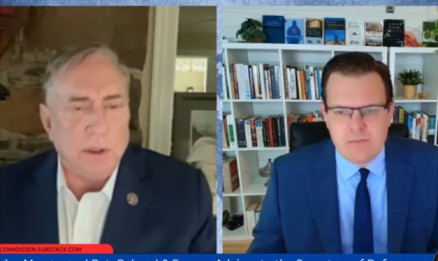
Read the full transcript of Colonel Douglas Macgregor’s interview on Greater Eurasia Podcast, June 9, 2026.
Editor’s Note: In this episode, Colonel Douglas Macgregor joins host Glenn Diesen to discuss the profound geopolitical shifts currently challenging the era of American global primacy. Together, they analyze the precarious state of U.S. and European policies regarding conflicts in Iran, Russia, and Ukraine, while exploring the potential for a necessary, yet painful, strategic realignment in an increasingly fragile world.
Introduction
GLENN DIESEN: Welcome back. Today is June 9th, 2026, and we have the pleasure of being joined by Colonel Douglas Macgregor, the former advisor to the U.S. Secretary of Defense, as well as being a decorated combat veteran and prolific author. So thank you very much for coming back on the program.
DOUGLAS MACGREGOR: Thank you for inviting me, Glenn.
The End of American Global Primacy
GLENN DIESEN: If we take a step back, it appears that the world is undergoing a massive shift. That is, the era of global primacy is over, essentially ending something that defined the world order over the past decades. Yet in both the United States and Europe, it seems to be this conviction that we can do anything, that it’s still the 1990s. And the cost, I guess, of this delusion is high. Trump has trapped himself in Iran. The Europeans have, well, I would argue, de facto declared war on Russia, which is seemingly getting ready to retaliate.
So all is not well. And I was wondering, what do you see as being the main challenges for the United States to adjust to this new time? And, well, what is it that America should do?
DOUGLAS MACGREGOR: Well, normally we regard the ocean as the metaphor for the international relations environment. The ocean is always changing. The problem that we’re having right now is that we’re trying to cross the ocean in a leaky boat, and we are staring at an onrushing tsunami, and that tsunami is profound change in the way the entire world is organized and aligns itself. We’re trying to hold back the future, to be blunt, and that’s never a good idea. You can’t hold it back.
Sometimes I think we’re like Austria was in the 1830s and ’40s. It became the reactionary state that was dedicated to forcing back all the powerful impulses for significant change that the French Revolution had unleashed. And in fact, I think you can argue that Austria was more successful than people think because these forces really came unglued, if you will, at the end of the First World War. To some extent, the unsettled business from the Napoleonic Wars returned with a vengeance by 1914-15 and then burst into the open in 1918.
So I think that your assessment is accurate. It’s profound change. It’s not necessarily in the direction that we in the West would like, particularly the United States, but it’s going to happen anyway. And the smart thing would be for the United States to accommodate it. You know, in this sense, Britain was very stupid in the first part of the 20th century. It could have accommodated the rise of German influence and power without any difficulty at all. Instead, Britain’s refusal to accommodate Germany led to an inevitable war that destroyed almost everybody in Europe. So there’s not much evidence out there for common sense and, let’s put it this way, tolerance for anything. That’s depressing.
Financial Fragility and the Black Swan
Now, is there any good news? Yes. The difference is that we are really financially extraordinarily leveraged and as a result, very fragile. This almost never seems to come up for discussion, Glenn. You know, when someone like you says, well, it looks like we’re going to go to war with Russia. Well, that’s absurd. There’s not going to be any war with Russia. The Europeans can’t fight. They don’t have anything. They’re leveraged up to the hilt. They’re in very fragile condition.
They’re dealing with an electricity bill that is beyond anybody’s imagination. The French are the only ones that are not suffering dearly under price hikes in electricity because they’re so heavily dependent on nuclear power. But Germany and Italy and other countries are really suffering. German industry without reasonably priced energy, which is certainly not what we’re charging the Germans when it comes to liquefied natural gas, has really hurt Germany tremendously. Germany is no longer competitive as a result of the loss of cheap energy. So you look at an enormous firm like VW, which is an institution in Germany, they’re shutting down plants left and right. And surprise, surprise, there’s tremendous unrest in Germany.
Now you add to all of those problems the presence of millions and millions of unwanted non-Europeans. Most of them are Muslims, but not all of them. And the populations in Europe are very, very restless. They want a return to a better way of life. They want peace at home. They want a reduction in criminality, and they don’t support war with Russia.
So how do you get there from here? Well, the last word in this sort of thing is revolution. And you’re going to have to have something akin to a revolution, whether it’s a revolution at the ballot box, which is what everybody would like, or it comes out of the barrel of a gun, is a question I can’t answer at this point. Because whenever I talk to my friends in Germany, they tell me everything is rigged against change. There’s no possibility of the Alternative für Deutschland to join the government and come into power. And frankly speaking, AfD is too moderate for what needs to happen in Germany. I think the situation is not very different in France, Italy, and so forth in that sense politically.
So an awful lot of what you’re discussing right now I think really hinges more on our internal conditions than it does on any external interests.
But if one were to happen quickly, within the next, say, 2 weeks or 3 weeks, we would pull out of the Indian Ocean and the Mediterranean. We would pack up our things and come home. We would stop. There is nothing happening overseas right now that is more important to Americans than what is happening here at home. People don’t understand that.
Iran, the Persian Gulf, and the Trump Trap
You know, right now nobody’s paying a lot of attention to the rise in gas prices. I shouldn’t say nobody, but not very many people. If it hits $10 a gallon, everyone will pay attention. And that’s why you keep hearing from President Trump over and over and over again, “Oh, we’re within a couple of days of the deal. Oh, peace is at hand. Gas prices are going to fall.” And the markets, for reasons I don’t understand, actually believe what the man says. And we saw this morning a sell-off in oil. So the price of oil actually dropped. Not dramatically, but it dropped. That can’t go on much longer.
And you now have these perceived problems between us and Israel. And that’s worth discussing. And then you have the Europeans who had this little meeting with Zelensky and his phony letter. It’s absurd. It’s the theater of the absurd. Nothing is real. That’s the sad part.
The truth is Iran is in charge in the Persian Gulf. That is not going to change. So that’s number one. They’re in charge. They have effectively won the war. Even President Trump’s inner circle recognizes that there is nothing we can do militarily to reverse this outcome. And if you look at the demands that we’ve made since this business got started last year, our demands have been moved back quite a bit. Remember, we must have unconditional surrender. Then suddenly, well, if we can open the Strait of Hormuz, that would help a lot. Well, everybody forgets that the Strait of Hormuz was open before we attacked. So who’s the problem? And I think the whole world sees us as the problem.
So we have an insoluble problem in the Persian Gulf. There’s no easy way for Donald Trump and his administration in Washington to escape from the trap of self-destruction. We started this. We can’t win it. So we’re leaving. Well, that means you lost. Yes, we lost, but it’s better to lose now than drag this tragedy out for many more months. But that’s exactly what we are positioned to do.
And you have the same group of people that want to maintain this blockade and keep the war with Iran at a low boil in Washington and in Israel, and they are the same people that want to keep things going in Ukraine, even if it means no real change, no real reversal of any kind, because they all know the war, as far as Ukraine is concerned, is lost militarily. They’re just banking that Putin will sit there and simmer, so they’ll sit and simmer.
So we’re simmering quietly in Ukraine, simmering quietly — not so quietly, but we’re simmering — in the Indian Ocean and the Gulf of Oman. And things just get worse. You know, the Houthis just said that the Red Sea is now blocked to Israel and all friends of Israel. That helps the global economy enormously, doesn’t it? So there’s no end in sight. There’s no imminent agreement because President Trump and his friends cannot back down.
The U.S.-Israel Relationship Under Strain
GLENN DIESEN: Well, you mentioned Israel and — what does this mean for the relationship between the US and Israel? We’ve seen in the media that there is some quarreling. Well, we can assume it’s true, I guess. But overall, as you said, when the US strategic interests, or core interests, begin to be challenged, one can assume that the relationship with Israel will be tested. And you see the growing, I guess, unpopularity of Israel within the US. So there’s reports that the Israelis have been spying on the Trump administration. There’s talk now about this Section 244 about integrating Israel into the US military-industrial complex. I mean, what is it? How do you see the future then of the Greater Israel project and Israel itself for that matter?
DOUGLAS MACGREGOR: Well, let’s step back a minute and go through some of the points you just made. If we were living in the normal world, Glenn, it would not be a question of what relationship the United States has with Israel, but what sort of relationship Israel has with us. In other words, the way you presented that suggests there’s something radically wrong. Israel is the tail wagging the dog. What difference does it make what Israel does unless it impinges on our interests?
What are America’s core strategic interests in the Middle East? Number one, stability. Why stability? Because we’re interested in commerce and productivity and ensuring things like fertilizer, liquefied natural gas, crude oil, helium, aluminum — we just go down the list — move routinely through the Strait of Hormuz to their destinations. In other words, we’re a commercial power. We’re interested in doing business, are we not? Of course.
But those things don’t count. Instead, we have the situation you just described. We have a Congress supposedly representing the interests of the American people and the United States planning to integrate or assimilate Israeli interests into American national security interests, to blend, integrate, assimilate the Israeli security state with the U.S. national security state. And all of this at a point in time where resistance to Israeli Jewish power and influence in the United States is at an all-time high.
The Question of Foreign Influence in American Politics
When that is brought up, the answer is, “Well, anyone who suggests that is an antisemite.” Well, if we’re going to make that the definition of antisemitism — resistance to foreign power and influence inside the United States that happens to emanate from Israel — I would suggest we have millions and millions and millions of antisemites. But do they have any real influence, these evil antisemites, these American citizens who dare question the goals and objectives of Israel and its partner in Washington? The answer is no.
And what have we heard from President Trump? When someone brings up the economy and the impact on the American — “I don’t care about that.” He was very, very straightforward. He didn’t hesitate. He came back later and said, “Well, that’s not really what I meant.” He said exactly what he meant.
And the same thing is true on the Hill. Why? Because of money. It’s called Jewish financial power. And that power is pervasive and it’s influential and it causes representatives of the American people to act in ways that are antithetical to the interests of the United States. And this is not simply in national security ways. It affects economics and commerce and immigration and border security, all sorts of things.
This can’t last, Glenn. I mean, it’s going to go on for a while, but it won’t last. And it won’t last because the economy is fragile. Our financial system is in trouble. We are leveraged to the hilt. This can’t last forever. And Mr. Bessent is working overtime 24 hours a day, 7 days a week to figure out ways to periodically print enough cash to keep the good ship United States afloat, and at the same time steer it away from the onrushing tsunami. It’s not going to work.
So people are asking, when does this stop? And I always try to tell them the same thing. It stops when we can’t afford it, when it becomes so painful financially and economically at home that we simply can’t continue. That’s when it will stop, and not before.
Iran’s Extended Deterrence and the Trap for Trump
GLENN DIESEN: Well, we appear to be approaching that moment. That is, not just in the US but around the world, economic problems are setting in. But looking at how Trump, though, is stuck in Iran now, we see recently now that Iran announced it extended its deterrence to Lebanon and essentially then, yes, struck Israel. And then we heard from a Hamas spokesperson that Iran would also demand that Gaza is part of the ceasefire.
This kind of punched a hole, it seems, in the US illusion of escalation control. That is, that it’s able to, as you said, take the Iran War off the high-intensity war and just put it on the slow burner and essentially try to control, escalate when suitable, de-escalate when it’s required. But how can Trump get out of this now? Because the situation just keeps getting worse. As you said, the Red Sea as well, the access is being shut down. So what can be done at this point in time?
DOUGLAS MACGREGOR: President Trump is not in control of anything. That has to be understood. If anyone wondered who was in charge in this partnership between Israel and the United States, it’s very obviously not Mr. Trump. And Mr. Netanyahu has made it abundantly clear, and I can explain why, he has no intention of subordinating himself to Donald Trump’s demands.
What the Israelis unleashed when they invaded South Lebanon was a war to the death for both Israel and Hezbollah. Right now they are locked in a death grip. Each one has each other’s throat. They can’t relax their grip for fear that someone will produce a knife and cut the other’s throat.
Now, why is this? Well, this goes back over many, many years, reaching back into 1982. Hezbollah grew into a very serious existential threat to Israel. The people in northern Israel cannot return to their homes or live in that country as long as Hezbollah continues to be robust in military terms and able to threaten northern Israel. So Israel has to fight this war to its bitter end or reach some sort of agreement or compromise. No one today in Israel wants to compromise on that matter. I know, I was there. I understand exactly how they feel and why they feel the way they do. Problem is, they may not be able to defeat and utterly destroy Hezbollah.
Now, Iran in the meantime has done something that no Muslim state in the region has done. It has stepped forward and said, “We will support and fight for Hamas in Gaza. In other words, Gaza. We will stand in support of and fight for Hezbollah, southern Lebanon. So there will be no agreements between us and anyone, Israel or the United States, that does not include those areas.”
In so doing, Iran has emerged as the leader of the Islamic world. Iran, the heretic Shiite state, is now the de facto leader of the House of Islam. If I were a Turk, I would be ashamed of myself. If I were an Arab, I’d be ashamed of myself. Of all the states and all the peoples who has stood up and said, “I will not submit” — Persia. It’s an amazing development. People in the United States have no idea how important this is. It is extremely important. And eventually it’s going to shame the rest of the region to join the war. That’s coming. And that war is against Israel.
So the real question for us, instead of what we’re worried about right now, which is how do we open the Persian Gulf — that’s easy. You renounce, as Washington renounces, any claim to the Persian Gulf, abandons the blockade, and agrees to disengage its forces. And it does so on the grounds that are humanitarian, that the global economy desperately needs this. “We disrupted it unintentionally. We’re going to fix that.” That’s number one.
Then number two, we need to step forward and find a way to end this war that at the moment is on a trajectory to the destruction of Israel. People don’t get that here in the United States. They don’t understand that Israel as a state, as a people, is actually at risk of going out of existence. We should be interested in stopping that, but you’re not going to stop it by killing more Muslims. That won’t work. Israel cannot kill its way out of this to success, and neither can we.
Israel’s Military Overreach and the Path Forward
GLENN DIESEN: Well, how do you see the Israelis doing so far on the battlefield? Because I know the drones have created some problems. We hear from the IDF that they are very much overstretched. And when the Israelis say they consider Hezbollah or Iran to be an existential threat, that’s not really unreasonable. I don’t buy it for the United States. I don’t see Iran being an existential threat to the US, but Israel — this is seemingly reasonable. But again, what is it that they can actually achieve here? Because they appear to have chewed over much more than they can consume. So where do you think this is heading? Do they have to back off at some point, or do you think they will double down and try to knock out Iran, however that might be, if that’s possible at all?
DOUGLAS MACGREGOR: Israel will not cease and desist as long as it is supported unconditionally by Washington. And Washington will continue to support Israel unconditionally as long as we can afford to do so, as long as we are not constrained by economic and financial crisis at home. It’s as simple as that.
Now, President Trump can end that. If he wanted to end the war in Ukraine, if he wanted to end the war in the Middle East right now involving Israel and Iran and its neighbors, it’s a very simple process. You halt all aid, military subsidy, whatever it turns out to be, to Israel. You halt all aid and sustenance to the government in Ukraine. That would bring things to the end. The Europeans simply can’t manage that on their own. But he hasn’t shown no interest in doing that.
And he is obligated by his promises to the various billionaires that back Mr. Netanyahu in the United States to fight this war to the finish. And indeed, if you listen to all the rhetoric at the beginning about ending the civilization overnight by unconditional surrender, total destruction — go down the list of all these hyperbolic statements from Donald Trump — it’s very clear what he set out to do. He’s failed. It hasn’t worked.
He can pull out. It’s not the end of the world for him, although it may be the end for him here at home. Why do I say that? Well, these billionaires that have been supporting him may turn around and say, “Fine, if you’re not going to hold to your word, the word that you gave us, then we’ll arrange for you to be impeached as soon as you pull out.” And can they do that? Absolutely, because they control both parties on the Hill. The same money from the same sources goes into both parties to guarantee support for whatever Israel wants.
So if he pulls out unilaterally and says this is the only way to end this tragedy, is for me to take responsibility and on humanitarian grounds pull out — if he does that, he’s probably going to be impeached and thrown out of office, at which point in time he’ll probably face all sorts of court battles and potentially jail time. So he’s not in a position that’s all that different from Mr. Netanyahu, is he?
So under those circumstances, is it realistic to expect Trump to step forward and do what is right? You know, Andrew Jackson used to say, when people would question what he wanted to do and question what he could do with the US Army during wartime, he would say over and over and over again, “One man with courage makes a majority.” He was right. He proved it. Lincoln proved it. That’s been the hallmark of American national identity for 250 years. Does he have the courage? I’ve outlined to you why I don’t think he does. And for that matter, neither does Mr. Netanyahu.
Europe’s Dangerous Escalation Against Russia
GLENN DIESEN: Well, as the whole world is looking at Iran and the debacle playing out there, people forget how dangerous the war against Russia is becoming now. That is, I think you’ve accurately pointed out that the Europeans don’t have the capabilities to fight a battle with Russia. But that doesn’t seem to influence their intentions. I mean, they have very openly said that their goal now is to destroy the economy. They argue that they need mass-produced long-range weapons to penetrate deep into Russia. They have even set timelines for when they think a battle with Russia would begin.
And as you and I have discussed, there are now increasing strikes on Russia from NATO territory, primarily the Baltic states. Only, I think it was 2 days ago, the EU announced it would now start to go after Russian ships in the Mediterranean. And essentially, self-preservation doesn’t appear to be a very strong instinct in Europe these days. So where do you see this headed? I mean, how much more do you think the Russians, or Putin to be honest, can absorb before they have to change course? Because my impression is that his entire National Security Council is now against him, arguing that any restraint, or at least restraint, will be interpreted as weakness in the West. So how long do you think they can hold out before they take dramatic action?
Putin’s Next Move: Offensive Operations in Western Ukraine
DOUGLAS MACGREGOR: Well, there were two things that happened within the last sort of 24 to 36 hours. One is a presentation by President Putin at the St. Petersburg conference, and the other was a presentation by Sergey Lavrov, and I’m not sure where he made it, but I listened to it in its translation.
President Putin ended his discussion on the problems with Ukraine with the phrase, “Comrades, work,” which I’m told really translates into “Comrades, keep working.” And this was preceded by praise for the Russian Armed Forces, praise for the soldiers, sailors, airmen, Marines, and so forth. So I think what he is saying right now is keep working, keep fighting, keep moving forward.
I think what he did not say, but which is under very serious discussion right now, is what he will do offensively from eastern Ukraine into western Ukraine. He’s not unaware of the problems in Ukraine. I’m sure you’ve seen the film footage from Bohemia in the very far west of Ukraine of people with shovels coming out to hit recruiters over the head and get rid of them, who were trying to take their sons and fathers and put them in the front lines to die in eastern Ukraine.
Now, western Ukraine is very interesting because of the various parts of Ukraine, that is without a doubt the most westernized. They were under Austrian rule for almost 200 years and quite happy, by the way, under Austrian rule. That part of Ukraine is renowned for its resistance to things it doesn’t like. In 1968, when the Warsaw Pact was mobilizing to go into Czechoslovakia, the Western Ukrainian Military District — that was really called the Carpathian Military District, the areas we’re talking about — practically no one showed up to mobilize. This is 1968. What did the Soviet government do about it? Not much. They didn’t want to have a fight in Western Ukraine.
These people are serious. They’ve had it. They’re sick to death of Zelensky. And I think there’s more of that in Western Ukraine than people in the West really understand and grasp. That’s good news. The bad news is we’re doing nothing to support these people. And we need to. And we can do that by stopping the support for this dictatorship in Kyiv.
Now, in the meantime, I think there are serious discussions about offensive operations into Western Ukraine. If you look at the positioning of Russian forces right now, there are 3 major concentrations. There is one in the south near Zaporizhzhia. There’s another further north that is aimed, generally speaking, beyond Chernigov, from Sumy and so forth, towards Kyiv. There is a third in Belarus. The third one in Belarus, I’m told, includes somewhere between 20,000 and 30,000 North Korean troops.
So there are three concentrations that could near simultaneously or sequentially attack. And I think it would be a game changer if they did that. Now, people who think the Europeans are going to act in response to this — my advice to the Europeans is don’t even think about it, because it won’t work out well for you. I do not think President Trump will be involved. In fact, if anything, I think that would persuade him to withdraw whoever is on the ground in Western Ukraine right now that is working for the United States government or the intelligence departments.
So this would be a time that I think the Russian government could exploit to end this war. It’s just the act of crossing that river and moving south and moving north quickly is enough to bring it down and end it. And will it involve casualties? I’m sure it will. And I must always pay tribute to President Putin because I think of all the Russian leaders over the last 100 years, no one has been more concerned about Russian life — and I would even add Ukrainian life — than President Putin. He never gets credit for it, but I think we need to mention it.
But this sort of thing could happen, and I think it’s under consideration. We’ll see what they decide to do. But you only have until about mid-September right now if you’re going to act, for reasons of weather and terrain, as you know.
And as far as the Persian Gulf is concerned, I think what you said earlier is accurate. I think President Trump wants to maintain the blockade. He’ll keep it simmering. And when the Israelis ignore him and bomb somewhere, he’ll come back and say, “Well, under the circumstances, I could understand why this happened. I hope it doesn’t happen again. I would prefer that it didn’t.” But nothing will change. That’s where I think we’re headed.
The Manpower Crisis and Ukraine’s Fate
Glenn Diesen: Well, regarding this manpower problem, it’s causing, as you said, a lot of social tensions within Ukraine. Well, that might be an understatement. Ukrainians are very much fed up with Zelensky and his government, but the Europeans appear to be responding to this by preparing to expel Ukrainians, Ukrainian refugees in the millions with the hope of refilling the trenches so they can all go die for NATO essentially.
And given that Ukraine has been able to capture some grounds in Zaporizhzhia, that is mostly along the Dnieper River, the European media is now, well, all up in arms. They are arguing the tide has turned, we’re winning, we’re winning. So we really gone back to this sadly. But did you think it’s too late to turn things around even if they pump in all the weapons? Well, they don’t really have the money. Expel all the refugees. You know, they’re successful in pressuring Zelensky to lower the conscription age to get the 18-year-olds into the trenches. Do you think there’s any way that things can be turned around at this point?
Douglas Macgregor: No, I don’t. I think the Ukrainian goose is cooked. So it’s a question of when, not if, it’s going to simply collapse. And it will be interesting to see what they do with all these young men. A friend of mine back in 2015, 2016 was telling me about various trains that were coming in that were full of young Muslim men. No families, just young Muslim men.
And when they were actually questioned, I was there at the time in Germany watching the television. And they questioned these men, young Muslim men at the border coming up from Austria. They said, “Well, we’re here for the women. We hear there’s lots of women we can rape.” And that was taken off German television. I’m sure that film was destroyed. So this is not the first time they’ve been overwhelmed by lots of young men.
When it comes to the Ukrainians, yeah, I had friends in the train stations. They lived in Hanover and in Cologne, and they were shocked at the numbers of young men getting off the trains from Ukraine. No families, no wives, no children, young men. So I think the Europeans have a lot of young men they need to round up and expel. There’s no question about that. We’ll see whether or not that happens, but if they try to do that, they will have their hands full doing that. They won’t be able to do anything else.
So again, I think the ball is firmly in Russian hands. It’s time for them to carry the football over the line and win the war if they’re going to win it. And I don’t think the whole National Security Council has turned against President Putin, but I think the National Security Council and many of his advisors have simply said something along the lines that I have. Let’s end this. Let’s get it done. And I know the Russian people are fed up with it, and I know lots of people in Western Ukraine are fed up with it. So it’s time to do this.
And I wouldn’t worry too much about the blowhards in Berlin, Paris, and London, because that’s what they are, they’re blowhards. And I don’t know if you’ve watched any recent German television, but the numbers of people on the streets opposed to the draft are — those numbers are really quite impressive. People have figured it out. No, we don’t want to go fight in Russia. That’s ridiculous. So I don’t give that much credence. Let’s put it that way.
The Collapse of the U.S. Alliance System
Glenn Diesen: But just to, well, round off, get back to where we started. How do you see though the — well, you mentioned that the United States might be forced to make changes if an economic crisis compels it to make this. But one of the problems of, and this is a problem the Europeans have as well, is not accepting the current international distribution of power is, well, essentially the system punishes you.
And I think a key problem for the US was by still trying to have global primacy, be everywhere at the same time. So prioritize everything, which means prioritizing nothing. It seems that this is causing a lot of problems. I use the example that, you know, for example, the United States pumped in a lot of its weapons to Ukraine. Then it became time to fight Iran. It didn’t have enough weapons, so it began to direct them out of East Asia from places like South Korea, took them from Europe, from Ukraine. And then even when it reached the Middle East, it couldn’t really protect the Gulf states, also partly because Israel was prioritised.
Anyways, my point is, by not prioritising one region over another, we now see that, well, essentially key allies from Europe to the Gulf States to East Asia are now discussing to what extent they should develop their own capabilities and, you know, whether or not they can rely on the partnership with the US. I think this could have been avoided if the US had just said, you know, our resources are limited, let’s focus on this, or in that region, but it hasn’t.
So I guess my question is, how do you see the alliance system which the US has built up? How long can this be sustained unless the US begins to, well, not necessarily scale back, but prioritise some regions over the other, or at least act according to limited resources? Again, I would add, at least the Americans have resources. The Europeans do not, and they still act as if they have plentiful, so.
Douglas Macgregor: Well, you’re talking correctly and accurately about this ends-means calculus. That hasn’t been done in the United States for decades. There was always this assumption of limitless resources, limitless money. Remember, all of this begins with the end of the gold standard. Once you were no longer tied to the gold standard, you could print as much money as you wanted. And that’s exactly what we’ve done. And so instead of trying to maintain a solvent household, we’ve simply printed more money, brought it up from the basement and say, “Here you go. We’ll pay for it with this.” And with each passing year, obviously the currency has been worth less. Now we have an inflation problem. Some people think we’re going to have a deflation problem as well.
Whatever happens, we know two things. Number one, we’re headed into a very serious recession. There are very few people who deny that. Secondly, it could easily become a depression. The longer this business in the Gulf continues, the more likely we are to see a global depression. We’ll see famine. We’ll see shortages of all types and kinds and minerals and products and technologies, all because of this crazy, unnecessary war in the Persian Gulf.
What will happen? I think what you’re going to see is it doesn’t make any difference what happens over the next 6 months. The future is pretty clear. We are going to have to withdraw most of our forces from beyond our borders. We are going to have to cut defense spending. Defense spending is the largest portion of what we call discretionary spending. We’re talking about a budget this coming year of $1.5 trillion. It’s absurd. It’s fantasy world. We can’t afford the trillion that we’re wasting now. We’re going to have to make some hard decisions.
Iran’s Military Revolution and the Future of Defense
The good news is the whole foundation, the rationale for the NATO alliance and our other alliances around the world are no longer valid. There was a wonderful op-ed that was penned in a Korean newspaper. I read it this morning. I’ll send it to you. It was translated into English. And this Korean journalist very astutely and very, very calmly pointed out that warfare has changed. He looked at the Persian Gulf. He looked at what’s going on in Ukraine. And he says, if you have US forces stationed on your soil and the United States decides to go to war with China, with Russia, with Iran, with anybody, those forces on your soil are now magnets for enemy action. In other words, they’re now part of the problem. They’re not a source of security. They are a source of insecurity.
Here’s Korea, a nation of almost 50 million. It’s a brilliant society with a brilliant economy, and it’s quite prepared to defend itself and navigate the waters of the international ocean as a sovereign state. And we keep insisting that they retain our military establishment on their soil. They don’t want it. They haven’t wanted it for a long time. They don’t need it. And now they see it as a liability, not an asset. The Japanese will reach similar conclusions. The Europeans will reach similar conclusions.
And the thing that people really need to understand, and they haven’t grasped this yet, everybody talks about Finland’s magnificent and courageous stand against the Soviets in 1939. Well, they need to look at what has happened in Iran. Iran has conquered the revolution in military affairs for the present, and that revolution, which began back in the mid-20th century, is to link overhead surveillance of all kinds, whether it’s a Reaper or it’s a satellite, any number of different things, a manned or unmanned aircraft, link that intelligence surveillance reconnaissance platform and the data for targeting that it produces directly to ground stations that control thousands of platforms with hundreds of different strike systems. And in the space of a few minutes can identify a target anywhere from 500 to 1,000 miles beyond Iran’s border, track it, and eventually target it and destroy it.
That has proved impregnable for us. It’s impregnable because they’re also benefiting from natural geography, mountain ranges that operate as walls that you cannot easily penetrate or scale, endless deserts in the south of the country that are burning hot that you don’t want to have to live in for any extended period of time. You put all of those things together and Iran has proven you don’t need a navy, you don’t need an air force. What you need is what I just described and some ground forces. And with that, you could defend yourself very effectively.
That’s true for Europe as well. The Swedes could do that. The Norwegians can do that. The Danes can do that. The Dutch can do it. The Germans can certainly do it. You don’t have to spend a trillion dollars a year to achieve that capability. So the real question is, what do you want to do in the future militarily to protect yourself? That’s number one. That may or may not include alliance with anybody else. On the other hand, it may include alliance with your neighbor. It certainly would make sense for the people in Scandinavia to be aligned with each other. Certainly the Swedes and the Finns, probably the Danes, the Germans, maybe Lithuania, Latvia, Estonia. But these don’t have to be offensive alliances designed to attack anybody. They’re designed to make it impossible to penetrate their states without paying a terrible price. And that’s the essence of deterrence, is it not?
So we live in a different world today where those things can be accomplished. Korea is a wonderful example. It’s a peninsula surrounded on three sides by water. You set those weapon systems up and the surveillance structure and you completely cover your entire peninsula and protect yourself not only from something from the north, but all the way around from the seas.
Rethinking NATO and the Path Forward
The world is changing. The world is moving in that kind of a direction. I think that’s a better solution than the one that we’ve had for the last 80 years. Because the last 80 years has been predicated on the assumption that if somebody attacks Nation X that’s allied with the United States, that we will suddenly launch nuclear weapons and put our cities, our population at immediate risk of annihilation in order to protect a small state on the periphery of Eurasia. I don’t think that was ever realistic.
By the way, neither did Dwight Eisenhower. Which is why he said when he agreed to sign us on for NATO that if NATO lasts for more than 10 years, we have failed, because he felt strongly that we should adopt a different approach. And incidentally, his recommendation in the ’50s was that Poland, Lithuania, Latvia, Estonia, the Czech and Slovak Republics, and Hungary, and Romania and Bulgaria be neutral. Gosh, what an idea!
Glenn Diesen: That would have been a much better path than where we’re now in terms of, instead, criminalizing neutrality. But, as you said, I think the, you know, we’re ruled by people and people need time to adjust. And, you know, under the unipolar moment, hosting US troops gave you absolute security. Now with a declining hegemon, I think it invites problems and makes a target of them. Anyways, we run out of time. I had hoped to ask you about the Zelensky letter and whether or not NATO is dead, but we’ll have to do that next time.
Douglas Macgregor: I think it’s pretty moribund. Yeah. The Zelensky letter is not going to breathe new life into NATO.
Glenn Diesen: Oh, that’s one of the more ridiculous things I read. So, well, thank you very much for your time.
Douglas Macgregor: Sure, thank you. Bye-bye.
Related Posts
- Transcript: Laura Loomer Interviews Volodymyr Zelenskyy
- Transcript of Lawrence Wilkerson Interview: Iran War Escalates Toward Global Crisis
- Transcript of Robert Pape Interview: Diary Of A CEO – Mass Casualty Attack
- Michael Hudson: The U.S. Plan to Revive Geoeconomic Dominance (Transcript)
- Prof. Jeffrey Sachs: How the Military-Industrial Complex Produces Perpetual War (Transcript)