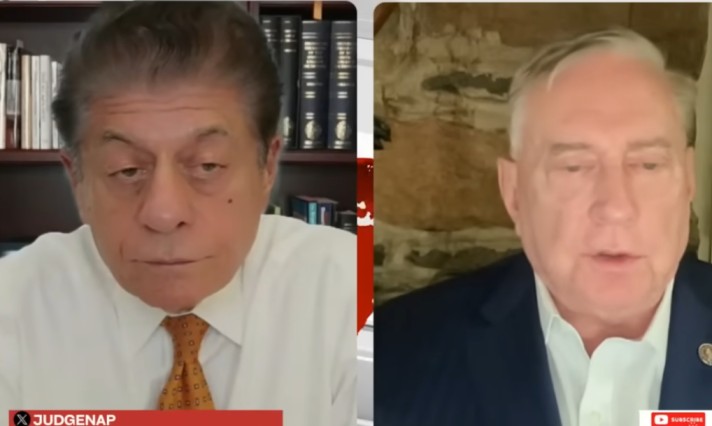
Editor’s Note: In this episode of Judging Freedom, host Judge Andrew Napolitano welcomes back retired Colonel Douglas Macgregor to dissect escalating global conflicts and critical shifts in geopolitical power. The discussion dives deep into Russia’s hardening stance in Ukraine following recent drone strikes, as well as the collapsing diplomatic options and massive economic threats surrounding the conflict with Iran. Together, they analyze the domestic political pressures influencing President Trump’s foreign policy and the growing risk of a wider regional war in the Middle East. (May 28, 2026)
TRANSCRIPT:
Introduction
JUDGE ANDREW NAPOLITANO: Hi everyone, Judge Andrew Napolitano here for Judging Freedom. Today is Thursday, May 28th, 2026. Colonel Douglas Macgregor will be with us in just a moment. Is Iran stronger now than it was in February when the war started? And is Vladimir Putin ready to take the gloves off?
Colonel Macgregor, welcome here, my dear friend. Thank you for, as always, accommodating our schedule. Let’s start with Ukraine. How morally wrong and militarily disastrous was the Ukrainian drone attack on the female dormitory in a Russian college that killed 25 schoolgirls?
The Ukrainian Drone Attack on Russian Civilians
DOUGLAS MACGREGOR: It was despicable and unforgivable and unnecessary, but it’s certainly not the first time. And what we’ve learned over the last several years is that whatever Kiev accuses Moscow of doing that is immoral is usually evidence that they’ve done something and not the other way around. We can go all the way back to Bucha, as I’m sure you’ll remember, when the atrocity there was blamed on the Russians. Russians had nothing to do with it. It was a Ukrainian atrocity. So I think this is nothing new, but it’s depressing, and its impact on Russia has been quite profound.
JUDGE ANDREW NAPOLITANO: And what do you suspect that Foreign Minister Lavrov said to Secretary of State Rubio when he insisted on speaking with him, even though Secretary Rubio at the time was in India. This was 3 days after this attack.
DOUGLAS MACGREGOR: I think that both President Putin and Secretary Lavrov individually talking to President Trump about Iran and then subsequently with Lavrov to Rubio about what happened in Ukraine are trying to make the same point. “You have not taken us seriously. You listen to us, but you don’t hear what we say. And what we’re telling you now is that we are not going to take this lying down. We’re going to respond decisively, and we reserve the right to respond as we see fit against what we think are the sources of the real problem.”
And the sources for these long-range drone strikes are components that are produced in the West and then shipped into Ukraine, assembled in Ukraine. So I think that’s the essence of it. And I think the Russians are trying to emphasize that they’re ready to act to end this war in Ukraine on their terms.
Western Co-Belligerence and Russian Restraint
JUDGE ANDREW NAPOLITANO: Colonel, are those facilities in the West, Great Britain and Germany, fair, moral, lawful targets for the Russian military?
DOUGLAS MACGREGOR: Well, under international law, not that anybody in the United States pays much attention to it, it would certainly suggest that if you are providing critical components to a belligerent in a war, then you are a co-belligerent. So I suppose on that basis, they definitely could inflict pain on Western states.
Now, the Russians obviously are not interested in widening the war. They have exercised a lot of restraint over the years. Remember, everything that happens involving these long-range drone strikes actually involves us. We’ve actually sent Rivet Joint and other surveillance aircraft to systematically map out every potential air and missile defense battery, every potential radar site, every potential ammunition storage site, refineries, all the targets of interest to the Ukrainians. And we’ve provided that information to the Ukrainians. This in spite of the fact that President Trump has insisted he wants an end to the war and is trying to largely disengage from it.
It hasn’t happened, which once again reinforces something that President Putin has said repeatedly. He’s met many, many American presidents over the years, and he’s discovered that while many of them have good intentions, nothing they ever say or do finds a way to be translated into action. That the so-called deep state or the federal bureaucracy or the Congress continue to operate as they will. So I think that’s also what’s going on right now in Russia. They’ve said, “We’ve listened to this before, we’re not going to put up with it anymore.”
JUDGE ANDREW NAPOLITANO: Can the Russians justify attacking MI6 and CIA facilities in Ukraine?
DOUGLAS MACGREGOR: Oh, absolutely. In Ukraine, without a doubt, and they have. Let there be no mistake about it. They have actually attacked those places in Ukraine. So that’s already happened. They’re concerned more right now at this stage about the components Ukrainians cannot build themselves that are critical to these long-range unmanned system strikes.
The Oreshnik Missile and Russia’s Next Move
JUDGE ANDREW NAPOLITANO: So I think it was last weekend the Russians fired off an Oreshnik, maybe for the second or third time. My count may be wrong, and it was aimed at factories on the outskirts of Kyiv. What happens if they unleash Oreshniks on the government buildings in Kyiv?
DOUGLAS MACGREGOR: Well, I’m sure they’ll level them. And I think that’s coming. I think they’ve put everyone on fair notice. They’ve announced that any foreign diplomats that are operating in the area should plan to leave as soon as possible. I think that’s a pretty clear indication, but I think that’s the beginning of something much larger. I think we’re finally going to see Russian forces on the ground move more decisively than we’ve seen in the last couple of years.
Germany: Merz, the AfD, and the Future of NATO
JUDGE ANDREW NAPOLITANO: I remember about a month or so ago you saying to me in one of our many communications, you were critical of Chancellor Merz.
What are the Germans doing?
DOUGLAS MACGREGOR: Well, that’s a great question. What are the Germans doing? I think the Germans are finally getting ready to change the government in Berlin. I think Merz and his friends have gone far enough. Merz’s approval ratings make Trump’s position in the polls look pretty good right now. He’s seen as effectively a shill for BlackRock, a front for international finance that has damaged Germany. He’s seen as effectively having betrayed Germany, and more and more Germans are coming around to understanding that this betrayal really began with Merkel.
Sie war diejenige, die die Grenzen geöffnet hat und Millionen von Menschen, die jetzt in Deutschland leben, die nie Deutsche sein werden, nicht wollen sein, und die aus Deutschland vertrieben werden müssen, wenn Deutschland als ein Nationalstaat überleben soll.
And finally, the leader of the AfD, Alisa Weidel, who has recently spoken brilliantly in Parliament and publicly, has made it very clear that if they are installed in power, either through coalition or as a minority government, they’re going to do 3 things.
Number one, they’re going to stop supplying Ukraine. Ukraine will receive no more money that Ukrainian leaders can essentially steal and move into their private bank accounts. They’re not going to send any more equipment that can be resold on the black market.
Number two, they’re going to go to Moscow and they’re going to make arrangements to buy Russian energy instead of buying our very expensive energy that comes all the way from the United States.
And then finally, they’re going to ask us to leave Germany. In other words, they want to expel us from the place, get us out of the country, and that’s the end of NATO for all intents and purposes. And that’s also something else that the AfD really would like to see go away.
Now, everybody thinks that’s very radical, but actually all those things are inevitable. They make a lot of sense for the Germans right now, and frankly, they should have happened a long time ago.
JUDGE ANDREW NAPOLITANO: Is Merz rearming the German military at an alarming rate?
DOUGLAS MACGREGOR: No, no, no. You’re not going to turn Germany into some sort of massive military machine overnight. I mean, this is the problem that Americans have. They’re easily beguiled. They say, “Oh no, we’re going to start spending all this money,” and after you spend money, you get instant military power. That takes a decade to build an army, and it would take a decade to build a new force that makes sense in this world right now, for the Germans or anybody else to do it. So that’s not going to happen.
But at the same time, this has put an enormous burden on German industry. You have foolish people running around saying, “We’re going to convert the VW factories to tank factories.” Now, why you would want more tanks at this point, why you would not want other kinds of platforms other than the sort of traditional World War II tank, is another question. But I think that’s not going to happen.
The other thing is they’ve got to get industry back on its feet. They’ve got to get people back to work. They’ve got to get the foreigners that they don’t want in their country out of the country. Those things are much more important. So no, I don’t subscribe to the view that Germany is going to be converted into some sort of armed camp overnight. Absolutely not.
Netanyahu, Iran, and the War in the Gulf
JUDGE ANDREW NAPOLITANO: Switching to the other hotspot, Colonel, who or what can stop Netanyahu?
DOUGLAS MACGREGOR: Ah, well, that’s a good question. Obviously we cannot. I think that’s pretty clearly demonstrated on a daily basis. Mr. Netanyahu continues to exercise veto power over anything we do and anything that President Trump wants to do.
I found it very interesting listening to some of Mr. Netanyahu’s supporters on mainstream news try to argue that this war was all Donald Trump’s idea and that he’s made all the decisions and that Mr. Netanyahu really doesn’t have any influence, and that’s perfectly obviously not true. You can go back and look at all the trips that he made last year when he came to the United States. You can look carefully at his arrival and shortly thereafter the war breaking out. I think people know we are not in charge of our own foreign and defense policy at all right now.
JUDGE ANDREW NAPOLITANO: Whose fault is it that we’re losing the war?
DOUGLAS MACGREGOR: Well, you got to look at the people that drummed up this dumb idea. I mean, first of all, what are we doing? What are we going to war for? What are the goals of our military operation? I mean, those have never really been explained to the government or explained to the American people.
What we’re doing is we’re taking Israeli demands, and those demands are well known: no enrichment of uranium, no plutonium, no bomb-grade anything, and frankly, no more centrifuges. Everything’s got to go. That whole program’s got to go, and everything that we have today inside Iran has to be removed and sent somewhere else, presumably or preferably to the United States.
Secondly, we have to restrict the ballistic missile arsenal. And finally, stop cooperating in any way with all of Iran’s traditional friends.
But we’ve now added something else, which is interesting because it’s the last thing that we can make happen. And that is, we’ve said that Iran cannot under any circumstances control the Strait of Hormuz. And you know, as an attorney, as a man of the legal profession, that possession is 9/10 of the law. And here’s a blinding flash of the obvious: the Iranians have got it, we don’t. And it’s becoming pretty damned obvious that we don’t have the military wherewithal to gain control of it, even though we never did have control of it.
So the whole thing right now is, everybody’s talking about where we’re on the verge of an agreement. We’ve heard that how many times? 7, 8, 9 times. We’re hearing it again, and then we’re being told that this will help end the fighting, extend the ceasefire, and then all of these hard discussions will be kicked down the road, as they say. I don’t know. I don’t see how we get out of any of this unless we admit that we have lost, and I don’t see any evidence that anybody’s willing to do that right now.
Can Anyone Stop President Trump?
JUDGE ANDREW NAPOLITANO: Who can stop President Trump?
DOUGLAS MACGREGOR: Oh, I think the American people could. That’s very obvious. The American people stopped Lyndon Johnson in 1968. Go back and look at all of the public demonstrations and then the polling that was done, and they contacted their representatives on the Hill and made it abundantly clear what they did and did not want. They wanted an end to the draft and they wanted an end to the Vietnam War. Lyndon Johnson heard it. He said, “I’m not running for reelection.” Nixon ends up being elected.
Unfortunately, he listened to some of the wrong voices in his administration, Kissinger in particular, telling him that he had to do something before he left. And so we ended up in Cambodia unnecessarily, but he did eventually get us out. Now, the bad news is it took longer than it should have.
But when you ask who can do what, well, the American people can do this sort of thing. But the problem is, Judge, and we’ve talked about this before, the American people have been largely insulated from what’s happening in the Gulf. That’s not going to last much longer. We’re going to pay a terrible price down the line, but right now they don’t feel nearly the pain that they’re going to feel in the future.
The Collapsed Deal and Political Pressure on Trump
JUDGE ANDREW NAPOLITANO: Last week, Trump said we’re very close to a deal. It will be ceasefire for 60 days. The Strait of Hormuz will be opened up, and we’re gradually going to lift the sanctions. And the holy hell rained down on him from Lindsey Graham and Ted Cruz, and presumably in private from his Zionist supporters, and suddenly this so-called deal was gone.
The Strategic Petroleum Reserve and Global Economic Consequences
DOUGLAS MACGREGOR: Yeah, well, I think that’s going to happen again no matter what he does. Mr. Netanyahu and his agents in the United States are not interested in peace with Iran. They want us to destroy Iran. We need to understand that. Americans need to understand that.
When you ask someone, what is the goal of our military operation? Well, now we have people saying, well, one of our objectives is to reopen the Strait of Hormuz. Well, we forget that the Strait of Hormuz was working just fine when we attacked Iran. So how do we stop that? Well, we can stop the war with Iran, and then the Strait of Hormuz will likely open. But nobody wants to go there. So we’re in an impossible situation.
But there are other things happening, Judge, and this is what people don’t seem to understand in Washington. Inflation is rising. Yes, it went from what, 3.28% up to 3.8%. Projections are now over the next several months that we’re going to see inflation rise to 6%. Now, if you go to that high based on the Paul Volcker model of dealing with inflation, that means you raise interest rates to 7% if it’s 6%, or you raise it to 6% if inflation is at 5%. But we can’t do that, Judge. If we do that, what happens? Our entire economy will crash. The financial system will implode. So we cannot do those things.
In the meantime, we’re doing things that are going to make it almost inevitable that we end up crashing. We know that President Trump within the last week or so sold 17.8 million barrels of oil from the Strategic Petroleum Reserve at a price well below market rates. Now, this was helpful in keeping the oil prices below $110 per barrel, but we are also hearing that that Strategic Petroleum Reserve is probably going to bottom out in early August or late July. What happens at that point? That’s why I say the long-term consequences of this stupidity in the Gulf are going to strike probably at the end of the summer and in the fall. We’ll start to feel a little of it now, but that’s really when it’s going to hurt.
The Looming Global Economic Depression
JUDGE ANDREW NAPOLITANO: And the government will be spending 5, 5.5% to borrow money.
DOUGLAS MACGREGOR: At least, and I don’t think they’re going to be able to do it for very long. We’re not much of a credit risk anymore.
The other thing is I was reading people looking at the global economy, and we managed to remove 13 million barrels of oil a day from the market. There’s evidence now that thanks to some of these attacks on refineries in Russia, that another 10 or 11 million barrels per day have been taken off the market. At this rate, assuming no change over the next 60 days, no significant change in the Persian Gulf and the access to the Strait, you’re looking at maybe a 36% shrinkage in the size of the global economy.
Now, why is that significant? It’s significant because during the Great Depression, the world economy shrank by 20%. Now we’re talking about going to a shrinkage level of 30 to 36%. That’s Great Depression. That’s where the world is headed, and we’re not going to escape it.
And worse, I think even worse than that, we’re going to be stuck with the blame for it. Right now, you travel around the world. Everybody I talk to that’s traveling across Asia and India, Africa, Latin America, everyone blames us for the closure of the strait and the catastrophic consequences for the global economy. No one is upset with Iran. Iran is seen as the victim. And obviously Israel is not exactly popular, but I think it’s tragic and unfortunate that we Americans are blamed for this.
Gas Prices in Tehran and the Reality of Negotiations
JUDGE ANDREW NAPOLITANO: When I asked Professor Mehrandi, coming from Tehran, what the price of gas is in downtown Tehran, you’re not going to believe what he told me. Of course, he translated from Iranian numbers and liters to American numbers and gallons. 5 cents a gallon.
DOUGLAS MACGREGOR: Yeah, well, obviously we haven’t destroyed their— all of their refineries yet.
JUDGE ANDREW NAPOLITANO: No, apparently we haven’t. So there’s a dilemma here. I mean, are the Iranian-US negotiations based on reality? Because the Iranians will never agree to a deal that fails to restrain Israel, and Trump can’t restrain Israel. So where are they going?
DOUGLAS MACGREGOR: Well, it appears that the Israelis have decided that this is a good time to press ahead in southern Lebanon, as well as in Gaza and elsewhere.
JUDGE ANDREW NAPOLITANO: And maybe in Turkey and Egypt, as you pointed out to me earlier today.
DOUGLAS MACGREGOR: Yeah, we need to go to that next. But right now, they’re clearly in the belief that while we’re distracted by the Persian Gulf, they’re going to try and finish up everything they want to do elsewhere.
If you’re an Iranian and you look at all of this, what incentive do you have to sign up for anything that we put in front of them? Where is the evidence that we will stick to any agreement? Where is the evidence that another president, even if Trump is removed, that the next one who comes along will be trustworthy? What can you expect from the current Congress?
So I think the Iranians are in a position where they’re going to sit there, they’re going to entertain whatever we send to them, but they’re not going to budge on the basic points that they’ve made because they see no reason why they should, because they just don’t see any evidence that we’ll be truthful and we’ll carry through on any promises that we make. So I think that’s just an insurmountable problem.
Jonathan Pollard’s Threat: Israel’s Sights on Egypt and Turkey
JUDGE ANDREW NAPOLITANO: Jonathan Pollard, the American-born Israeli spy, spy for Israel against the United States. He was a civilian employee of the Navy. Sentence commuted by President Trump, flown in a private jet by Sheldon Adelson out of the country, greeted in Tel Aviv personally by Prime Minister Netanyahu, now running for the Knesset in Prime Minister Netanyahu’s party, recently said that once the Israelis finish with Lebanon they will set their military sights on Egypt and Turkey.
Now, A, does that surprise you? B, is it insane? Turkey has a sophisticated military, many times the Israelis, does it not?
DOUGLAS MACGREGOR: Oh yes, very much so. In fact, Turkey is the leading power, military power, in the region. I think the Iranians would certainly agree to that assessment as well.
I mean, if you look at Iran, Iran is almost entirely defensive in its orientation. The Turks have tremendous offensive striking power. They also have a martial culture, much more martial in its content than anything we’ve seen in Iran.
You know, Judge, it’s tempting to say, oh, well, this Pollard, he’s insane, he can’t be serious. No, he’s quite serious. And I think we have to understand that this is the view held by Mr. Netanyahu, by Gvir, by Smotrich, and large numbers of others, and also by their agents in the United States, the billionaires who put Trump into the White House. These people absolutely are committed to what he outlined.
Now, this is not of interest to us in the United States. This is not a vital strategic goal for us. We’re not interested in seeing a war break out in the Eastern Mediterranean with the Turks that could easily bring in the Greeks and ultimately other European powers. I don’t think the Russians are interested in seeing this happen. We certainly don’t want to see Egypt dragged into this war. Egypt has got an enormous problem right now just trying to feed its own population and power its own power grid.
So what should we make of it? I think we should take it on face value. I think we have to understand that, yes, from our standpoint, this is Looney Tunes, but this is what the people who are running the show in Israel believe. And the people running the show in Israel are currently running us. They’re in charge. Our armed forces are committed to their goals and strategic objectives.
Erdoğan Responds to Pollard’s Threat
JUDGE ANDREW NAPOLITANO: Here’s someone else who takes this very seriously, what Jonathan Pollard said, and that’s the president of Turkey. Chris, cut number 11.
VIDEO CLIP BEGINS:
RECEP TAYYIP ERDOĞAN: “With the help of God and by his divine will, I firmly believe that this oppressive tyrant known as Netanyahu will very soon be forced to learn the profound and necessary lesson that he so rightfully deserves from the collective strength and unity of the Muslims across the entire world. We are all looking forward with great anticipation to the moment, which we hope will arrive very soon, when we will finally be able to witness this new stance being put into practice for everyone to see.”
VIDEO CLIP ENDS:
JUDGE ANDREW NAPOLITANO: I know sometimes his bark is worse than his bite, but it sounds pretty serious to me, especially in light of what Pollard said, and your understanding that Pollard is serious, and this is a view embraced by the Netanyahu government.
DOUGLAS MACGREGOR: Yes, and I think Mr. Erdoğan is certainly speaking for large numbers of Turks, easily the majority, but the problem is he has a credibility issue. He, on one hand, has continued to sell oil and food and other things to the Israelis, while the Israelis have simultaneously annihilated people in Gaza and southern Lebanon and attacked people in Iran.
So if you’re a Turk right now, you look at that, you listen to it, and you say, yes, that’s correct, we all agree with that, but Mr. Erdoğan, what have you done? And the answer is Mr. Erdoğan hasn’t done much of anything.
Closing Remarks
JUDGE ANDREW NAPOLITANO: Colonel, thank you very much, my dear friend. Dangerous and dark times across the world and domestically, but your analysis always sheds a little light on the truth and on our understanding.
DOUGLAS MACGREGOR: All right, Judge, thanks very much.
JUDGE ANDREW NAPOLITANO: Thank you. All the best. We’ll see you again soon. Coming up tomorrow morning, Professor Jeffrey Sachs. At 4 in the afternoon, the Intelligence Community Roundtable with special guest Scott Ritter. So Larry Johnson, Ray McGovern, and Scott Ritter, just in for Paul Townend for Judging Freedom.
Related Posts