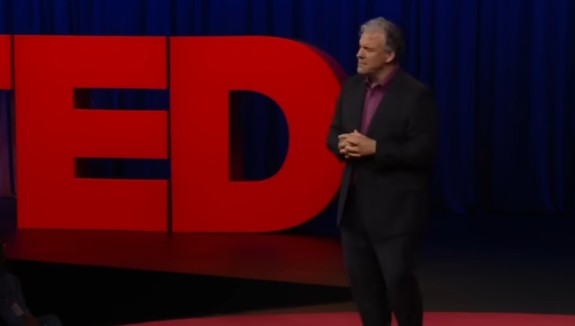
Editor’s Note: In this insightful TED Talk, behavioral scientist Nicholas Epley explores the fundamental paradox of human connection: why do we choose isolation even though interacting with others makes us happier and healthier? Drawing from over a decade of research and 30,000 data points, he reveals how our misplaced social pessimism holds us back from meaningful connections. Ultimately, Epley shares his own transformative experiences to show how a simple, data-driven habit of reaching out can profoundly enrich our daily lives and relationships. (April 16, 2026)
TRANSCRIPT:
The Paradox at the Heart of Human Connection
NICHOLAS EPLEY: There’s a fundamental paradox right at the core of human life. On the one hand, decades of research has shown that we are highly social creatures who are made happier and healthier by reaching out and connecting with other people in the moments, the days, the weeks, the months, and the years of our lives. And yet, on the other hand, just look around a little bit. It’s not clear that all of us have gotten this memo. Every day there are opportunities big and small to reach out and connect with other people that we choose not to take.
We avoid talking to strangers. We lean back and type to each other rather than leaning in and talking to each other. Once talking, we stick to shallow talk, to small talk, rather than going deeper. We feel grateful but don’t express it, want to reach out to offer support to someone in need but hold back. We’d like to be open and honest in our relationships but all too often keep our true selves to ourselves.
If being socially connected is so darn good for us, then why do we so often seem to be so darn unsocial?
A Train Ride That Changed Everything
This paradox hit me like a freight train one morning while I was on an actual train, commuting into my office at the University of Chicago where I work as a professor of behavioral science. That morning on the train began like every other I’d been on for years beforehand, all filing onto the train, everybody in a desperate search for their own little acreage of solitude right along the window. I think we’d have sat outside the train if that was possible. Heaven forbid you’d sit next to somebody and start a chit-chat.
Of course, you creep. Or worse yet, somebody would come and sit down next to you, surely some kind of weirdo. But then there we all were, highly social creatures, made happier and healthier by connecting with other people, now sitting hip to hip with another perfectly reasonable human being, and what did we do for the next 30 to 45 minutes with each other? We chose to ignore each other. You could have heard a pin drop that morning.
That morning, a woman who was about 15 to 20 years older than I was at the time sat down next to me, dressed professionally for work, and wearing just this fabulous, killer, stylish red hat. I’m never going to forget this red hat. I put other people in experiments for a living, but this morning I decided to put myself in an experiment and pay close attention to what happened. Instead of keeping to myself and doom-scrolling on my phone or checking my email, I try to have a conversation with her, try to help us get to know each other a little bit, turn this 30-minute dull ride into something a little more interesting, turn a stranger into a momentary acquaintance.
The second though I had that thought about that experiment, my brain started screaming at me all the reasons why this was a really, really bad idea. Clearly she doesn’t want to talk to you, otherwise she’d already be talking to you. She’s going to think you’re some kind of creep. You probably don’t even have anything in common with her, and you’ve got nothing to even start with, smarty pants.
Nevertheless, I decided the experiment must continue, so I ignored that part of my brain. I turned to her, and I said, “Hi, my name’s Nick. I love your hat. I have one just like it.” Yeah, huh? Now look, I know that’s not going to make its way into the conversation starter hall of fame, but it didn’t seem to matter.
She turned to me, a big smile, her face all lit up, almost like she looked like a different person. And from there, the conversation just flowed really easily. Found things that we had in common. We talked about our families, our work, our hope for the future. A 30-minute train ride just went like that.
I was done. I got up to leave, and she stopped me, and she said, “Thank you so much for taking the time to talk with me this morning.” I forgot a lot of details about how that conversation actually went, but I’ve never forgotten how that conversation made me feel. Not just good, but surprisingly good. The contrast between my beliefs about how that would go and how it actually went was pretty sizable.
Social Connection Is a Choice
And there then also in that gap was a potential resolution to this paradox. Social connection, after all, isn’t something that just happens to us. It’s a choice we make. It’s a choice we make at times to reach out and approach other people to engage with them or to hold back and avoid them. It might, in fact, arguably be the choice we make, the most important choice we make, because how we make that choice over and over and over again in our lives so routinely determines so much about our happiness, our health, and our success in life.
But highly social creatures like us might avoid reaching out and engaging with other people mistakenly if we underestimate just how positively our attempts to connect might turn out.
That morning changed both my career and my character.
What the Research Reveals
In my career, my collaborators, my wonderful collaborators, and I have now conducted well over 100 experiments with over 30,000 people of all ages and nationalities and found that my tendency to be overly pessimistic is not unique to me. It’s something we see over and over again in varying shades and magnitudes across different contexts that vary a little bit across people, but that consistent signal is there.
In one of our very first experiments, we went back to a train station on the line that I ride into work every day, and we recruited a group of commuters. And we asked them to predict how they would feel on the train that morning if they kept to themselves in solitude or if they turned to the person who sat next to them that morning and tried to have a conversation, tried to connect.
The results here were crystal clear. People thought talking to a stranger was a really bad idea. They thought they would have a more pleasant experience that left them feeling happier if they kept to themselves in solitude than if they turned to the stranger to connect with them on the train. But when we recruited another sample of people and actually randomly assigned them in an experiment to either keep to themselves in solitude or to try to connect with a person sitting next to them, rather than just imagine it, to actually do it, we found exactly the opposite results. The people we had instructed randomly to keep to themselves that morning reported having a less pleasant and happy commute than those we asked to connect to the person sitting next to them.
People’s beliefs about social interaction here weren’t just wrong, they were precisely backwards. But notice that if you believed that talking with a stranger would suck, you wouldn’t try it. And then you’d never find out that you might be wrong about that. Pessimistic beliefs in that way are self-fulfilling. This little experiment was just the tip of a very large iceberg that came into view for us in many ensuing years.
The Power of Deep Conversations
We’ve now seen this tendency to be overly pessimistic over and over and over again. We’ve now had, for instance, more than 4,500 people, not just to have conversations with a stranger, but to have deep conversations with a stranger, talking about things like, “Can you tell me what you’re most grateful for in your life?” Or “Can you tell me about one of the last times you cried in front of another person?”
So when I show people these questions in these experiments, I can feel just a sense of dread spreading over the room when I put these questions out on the board. Like people said, eye on the exits, wishing they hadn’t come to this session today. But then when I actually put them into the experiments, the trouble that I have in the conversation, the trouble I have is getting them to come back. These conversations go much better than people expect that they will.
This is also true when we have people who disagree about the most divisive political issues that divide us today, talk about those political grievances, even those political disagreements. Those conversations about political disagreement go better than people expect them to.
We find in our research that we have tremendous power to create meaningful social connection every day of our lives, but if we underestimate how positively our efforts to reach out and connect with someone will go, we won’t use that power that we have.
Misplaced Pessimism Beyond Conversation
We see this tendency for misplaced pessimism also showing up beyond conversation. When we ask people to think of a compliment they could give to their friend and then actually deliver that compliment to their friend, they leave their friend feeling more uplifted than the complimenters imagine they will. When we ask people to express their gratitude to someone they love, they leave their recipients feeling even better than the expressers predict that they will.
Performing random acts of kindness, reaching out and asking for help, expressing support to someone in need, being open and honest in our relationships, all tend to be received, on average, more favorably, more positively, by the people we’re reaching out to than the people who are reaching out expected to. How much more time would you spend reaching out to lift somebody up if you knew just how much good in that moment you could actually do?
How This Research Changed My Life
No research I’ve ever been involved with has changed the way I live my life more than this. My train rides are almost never silent anymore. I met amazing people on planes and in cabs. Even just walking around town is more pleasant for me, whether I’m on campus or work or in a grocery store, because I made a habit of walking around with my head up smiling and saying hello to other people, and I get in return a lot more smiles and hellos when I’m walking around.
When I feel grateful, I write a note and send it off. When I need help, I’m less reluctant to ask for it. When I know someone needs some support, I’m not as embarrassed to reach out and offer it, even if there’s nothing I can do in that moment. It’s made me a more open, friendlier person, and as a result changed pretty much all of my relationships. I’ve turned countless strangers into friends, or into acquaintances at least, even if just for a moment. My friendships are better, I think my marriage is stronger, I think I’m a better father.
These changes didn’t happen to me overnight. They happened, of course, slowly over time, just like you move a mountain, not by pushing it all at once, but one shovel full at a time. The way you change how you approach other people happens slowly over time, one choice after another, one small choice. As you learn where your mistaken beliefs about other people might be holding you back needlessly, and then you develop habits that then just become part of your character and part of who you are.
When Pain Struck My Family
Overcoming my misplaced pessimism, though, has also affected how I’ve made some big choices that I have been a part of in my life, including when pain struck my family. So 10 years ago my wife Jen was three months into a pregnancy when we learned that our daughter, who we had already named Sophie, had Down syndrome. And three months after that, we learned that our daughter had died before she could be born. Losing our daughter was horrible. It was absolutely horrible. And we mourned that loss for many months.
Until one morning, Jen and I were talking, and she asked whether we could, whether we should, whether we might consider adopting a child with Down syndrome. And there it was, the choice. Do you reach out and connect with someone? Do you engage with them? Do you approach? Or do you hold back and avoid it?
Jen and I had already adopted two children into our family, and so we had some sense of how this might go. But nevertheless, this choice caught me off guard. I wasn’t there at that moment. My mind wasn’t there yet. And so I had all the pessimistic fears that you might have when you think about connecting with a stranger or having a deep conversation with someone, except multiplied by a hundred or a thousand.
How well would this go? Would we be able to handle this? Would we be able to connect, to love, to parent the stranger we were bringing into our lives with all of these challenges that seemed to me at the time very hard and difficult. How would this child respond to us? My first thought was, I don’t think we can do this. I’m not sure I can do this.
Data-Driven Courage
But my second thought then started turning to my data, as researchers will tell you, can happen. And I started thinking about thousands and thousands of data points, of people underestimating the joys they would experience when they reach out to engage with, to connect with, to pull someone else close to them. And it gave me data-driven courage. That, yeah, we can do this together. I happened to marry a superhero, too. We can do this together. And it won’t just be good. I bet it’ll be surprisingly good.
And so about a year after that, Jen and I boarded a flight to China with our four other children, where we were going to meet Lindsay, two years old, born to a woman we will never meet, with big, dark eyes and just a relentless smile to start a really, really hard start in her life. We reached out to Lindsay, and Lindsay reached back to us. She’s been bringing love and smiles like that into our lives for years since.
Now, I want to be clear. Raising a child with an intellectual disability is hard. It’s really hard.
The Power of Reaching Out
Lindsay is not just one handful. She has both arms completely full. But she’s also enriched and blessed our lives so far beyond what my pessimistic expectations beforehand ever possibly could have imagined.
Connecting with other people is one of the most consistently enjoyable, enlightening, and enriching experiences we’ll ever have, and yet all too often our choice to reach out and connect with somebody is thwarted by overly pessimistic fears about how other people might respond. Being overly pessimistic doesn’t mean we should reach out all the time or that it always turns out well, of course.
What it means is that we tend to underestimate the likelihood that it will turn out well, and as a result, we tend to hold ourselves back a little too often. I’ve found in my life and in my research that testing some of those beliefs that hold us back can reveal places where we’re making mistakes about other people, and show us how to reach out, empower us to reach out a little bit more often than we might otherwise to make both our own lives and those we reach out to a little bit better.
You want to change your life for the better? I suggest keeping some data-driven courage in mind. And when in doubt, reach out.
Thank you.
Related Posts