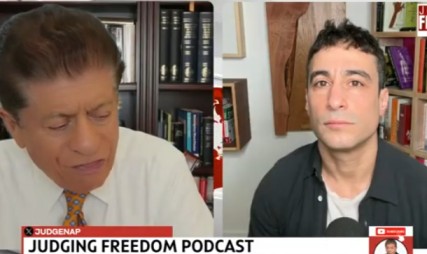
Read the full transcript of journalist Aaron Maté’s interview on Judging Freedom Podcast, June 17, 2026.
Editor’s Note: In this episode of Judging Freedom, host Judge Andrew Napolitano is joined by journalist Aaron Maté to analyze the evolving geopolitical dynamics between the United States and Iran. The discussion dives into the complexities of recent diplomatic shifts, specifically examining how Iran has navigated its position effectively in its dealings with the Trump administration. Tune in for a critical look at these high-stakes foreign policy developments and what they reveal about shifting power structures in the Middle East.
Introduction
JUDGE ANDREW NAPOLITANO: Hi everyone, Judge Andrew Napolitano here for Judging Freedom. Today is Wednesday, June 17th, 2026. Aaron Maté will be with us in just a moment on how Iran got the best of Trump.
Aaron Maté, welcome here, my dear friend. This is a most peculiar ceasefire agreement that supposedly has 14 points, none of which has been published. People are claiming that they have seen little snippets of it, but if it involves a cessation of Israeli hostilities in Lebanon, or if it involves the withdrawal of Israeli forces from Lebanon, A, what will the Israelis, who are no part of this, do? And B, how can that possibly be enforced?
The Ceasefire Agreement and Its Terms
AARON MATÉ: I’ve been told that the language refers to a cessation of hostilities on all fronts, including Lebanon, not explicitly for an Israeli withdrawal from Lebanon. If it does call for an Israeli withdrawal from Lebanon, that would be a huge achievement from Iran, but I doubt Trump would give them that victory. But we’ll have to wait and see, because as you said, the final text has not been released.
How it could be achieved, whether it’s a withdrawal or a cessation, is the fact that the U.S. has the leverage over Israel, and Israel can’t continue to operate without the U.S. green light. All these claims of a rift between Trump and Netanyahu — I think Trump’s public frustration about Netanyahu the other day did reflect some reality, because it is true that at the very last second, just as a deal was about to be announced between Iran and the US, Netanyahu attacked Beirut trying to elicit an Iranian response, knowing that that would help his chances of blowing up the deal.
How simply that can be achieved is if Trump tells Netanyahu to knock it off. But the problem is, at this point, Israel, in recent weeks, probably understanding that a deal is at hand, has advanced as far into Lebanon as it can. And it might claim that, okay, fine, we’ll cease hostilities, we’ll stop firing, but we’re not going anywhere. We are staying here to establish our so-called security or buffer zone. And that will be a way for Israel to steal, as it’s always wanted to do, more land inside of Lebanon.
Netanyahu’s Attack on Beirut and Trump’s Reaction
JUDGE ANDREW NAPOLITANO: You mentioned Netanyahu ordering an attack on Beirut itself. I think it was on Sunday night, but it was when the electronic signing of this thing was getting very close. Did Netanyahu really miscalculate? Did he in some perverse way so aggravate Trump that Trump agreed to whatever last-minute demands the Iranians made at that point, as a result of Netanyahu’s midnight attack?
AARON MATÉ: There’s some speculation about that — that because Netanyahu almost destroyed this deal at the last second, that forced Trump, because he really wanted a deal, especially around his 80th birthday, to announce that it was done, and that got him to agree to some last-minute Iranian demands, including clear language on freezing or ending the war, Israel’s war on Lebanon.
I think that’s fair speculation because he’s so brazen. Now, the only question is how much did he coordinate with the White House behind the scenes? I do actually believe that this last-minute Israeli attack did surprise Trump. He did publicly seem agitated in a way that was, I think, hard to fake. He was very harsh about Netanyahu. He’s even started talking about how Israel’s been blowing up all these buildings in Lebanon when they don’t have to. And he suggested that the former al-Qaeda offshoot that now rules Syria, that they should instead be fighting Hezbollah in Lebanon rather than Israel.
Trump’s Public Criticism of Israel
JUDGE ANDREW NAPOLITANO: Here he is saying just that.
VIDEO CLIP BEGINS:
DONALD TRUMP: I’ll tell you what, Israel’s fighting Hezbollah too long and too many people are being killed. And you don’t have to knock down an apartment house every time you’re looking for somebody because there are a lot of people in those apartment houses and they’re not all Hezbollah. That I can tell you. And I suggested to Israel to let Syria take care of Hezbollah, because, to be honest with you, I think they’d do a better job of doing it.
I didn’t like where, 2 hours before we’re signing the agreement, that there was an attack in Lebanon — in Beirut. It was right in — it wasn’t like in the southern side, and you know, it was in Beirut. I did not like that. I let them know that I didn’t like it, not at all.
VIDEO CLIP ENDS:
JUDGE ANDREW NAPOLITANO: How do you think Netanyahu, his supporters, and even his adversaries react to something like that, which we’ve never really heard in public from an American president?
AARON MATÉ: I think they see it as a slap on the wrist, because again, the same question with Joe Biden — yes, you can criticize Israel publicly, but what are you willing to do about it policy-wise? Are you going to stop any weapon shipments, demand that Israel cease attacks, demand that Israel stop using U.S. military assets to carry out these attacks? Trump is not doing that. And so therefore, these public recriminations don’t really amount to much, but I don’t want to totally dismiss them.
It’s interesting — he’s basically saying that al-Qaeda, a former al-Qaeda offshoot, would act more humanely than Israel in fighting a war, which I think is accurate.
Trump is right about that. But second of all, he’s also saying that he prefers a former al-Qaeda offshoot to the people of Lebanon who are resisting Israeli aggression, and he just wants a different way of fighting them. He doesn’t want to stop the fighting, and he still shares the Israeli goal of wiping out Hezbollah and its supporters. He just wants someone to do it more humanely, I guess, and kill fewer people.
So it’s worth parsing what he’s really saying there, because ultimately, although it sounds like criticism of Israel, he’s still endorsing Israel’s goals of wiping out Hezbollah and in the process ethnically cleansing the people of Lebanon who support Hezbollah. That’s what Israel has been trying to do over these last 3 months, where it’s killed over 3,000 people and displaced more than 1.5 million people inside of Lebanon. He’s saying that Syria should go in and do the job, which I don’t think is very feasible. I don’t think Syria will be doing that, but it does offer a reminder of why the U.S. was in Syria in the first place, to install a government that it could ask to do things like this, rather than be part of the coalition that was in Israel.
Mike Huckabee and the Question of Loyalty
JUDGE ANDREW NAPOLITANO: Here’s a full screen from the United States Ambassador to Israel. He might as well be the Israeli Ambassador to the United States, Mike Huckabee. “Fortunately, Secretary Rubio made clear that Iran and Hezbollah aren’t linked in a deal.” And now he highlighted this: “Israel doesn’t need Iran’s permission to defend itself. The tether of terror must end.” This guy is really blind to what’s happening right underneath his nose.
AARON MATÉ: You know, one of the funny things about this talking point is that what has been the main US demand of Iran? That Iran stop supporting its so-called proxies. So it’s the US and Israel that have been linking all these different regions, all these different countries, including Lebanon, to Iran’s behavior, saying, “Iran, if you want a peace deal, if you want us to stop bombing you, you have to stop supporting your allies in Lebanon.”
So then when Iran says, “Okay, fine, if we’re going to stop the war of aggression that you started against us, you have to stop attacking our allies in other places” — in other words, we’re going to link peace to other areas exactly as you do when you make your demands of us and launch a war of aggression against us — and all of a sudden, Mike Huckabee and others complain that Iran is daring to draw a linkage between the war that Israel and the US started against Iran with the wars they’re carrying on inside of Lebanon. So the hypocrisy there is just off the charts.
The US and Israel can demand a linkage to other areas, but Iran can’t? It makes absolutely no sense. And of course, there’s never any talk of the US cutting off support to its main proxy, which is Israel. That is not even under discussion. Iran is not even allowed to ask for that. So it’s very hypocritical. And the fact that Mike Huckabee, who is the U.S. Ambassador to Israel, goes out of his way to basically make pleas to his own government on Israel’s behalf, it speaks to who he’s really working for.
JUDGE ANDREW NAPOLITANO: Right, right. He should be fired. By the way, it turns out we did the highlighting, not Ambassador Huckabee. That does not diminish the effectiveness and — perversity, I’m using that word intentionally, Aaron — perversity of what he said. This guy works for Secretary Rubio and President Trump, and he’s thumbing his nose at them in deference to the host country in which he now lives as the U.S. ambassador. Do I have this right?
AARON MATÉ: You do. I’ve never seen anything like it where — and he’s not the only one — people who serve in government are openly more loyal and openly doing the bidding of the government that they’re posted to as a diplomat, as an ambassador, than they are to their own government, the government that sent them to that foreign country. It’s extraordinary. And if Mike Huckabee wants to go lobby for Israel, he should go do that. There are plenty of jobs for him, I think, at AIPAC or some other Israel lobby group, but don’t do it as a U.S. diplomat representing your country.
Naftali Bennett and the “Worst Nightmare” Threat
JUDGE ANDREW NAPOLITANO: And then there’s this.
VIDEO CLIP BEGINS:
NAFTALI BENNETT: President Trump said in March 2026, “There will be no deal with Iran except unconditional surrender.” We’re a long way from that, aren’t we, Naftali Bennett?
Well, what you’ve just described is that Iran is a big violent bully, and it proves all the more so that we have to ensure that it doesn’t acquire a nuclear weapon, ensure that it can’t terrorize the world, because we’ve seen a demonstration of what this bully looks like when it uses conventional weapons. So now imagine what it would look like if it acquires nuclear weapons. So if anything, we’ve all seen the true Iran.
I also want to tell you that I believe that soon in Israel, there’ll be a new government. Hopefully I’ll lead that new government. I want to tell the Iranian regime from here, I’m going to be your worst nightmare ever. I won’t relent until we free your people, ensure you don’t have a nuclear weapon. So you’ve got no hope. We won’t let up on this effort because it’s fighting for our freedom, for our security, and for the benefit of the entire Middle East.
VIDEO CLIP ENDS:
JUDGE ANDREW NAPOLITANO: Now, is this part of his political campaign? And by the way, how does an Israeli get a last name like Bennett? Is he not Jewish?
AARON MATÉ: I don’t know his background, but is he born in the U.S.? I don’t think he was born in the U.S., no. But you’re speaking to the fact that a lot of people call themselves Israeli, don’t come from the region. They’re of European ancestry. I mean, that’s what the country is. It’s a European settler state on Palestinian land. And Naftali Bennett follows in that tradition.
But he did say one thing there that was correct. He said, “We have seen the true Iran.” He’s right about that. We have. We’ve seen an Iran that was resilient, where despite claims of people like Naftali Bennett, the people of Iran were going to rise up against their government after the US and Israel started bombing it, the opposite happened. People rallied around the flag in defense of their sovereignty.
And contrary to what the US and Israel do, which is bomb civilian areas like the girls’ school that was hit in the opening hours of this regime change war, Iran strikes military assets. And did that in the region and did it very effectively while also using its leverage over the Strait of Hormuz.
So we saw an Iran that was resilient, and because that is the true Iran, the lies that sustained this war about Iran being close to a nuclear weapon and Iran was going to collapse and the people of Iran were going to rise up — all the lies that people like Naftali Bennett told us — they all collapsed. And Iran forced the opposite of what Trump demanded, which is a surrender on the U.S. and Israeli side. They had no choice but to stop this war. So Iran suffered a major victory.
Naftali Bennett is frustrated at that, and that’s considered to be Netanyahu’s opposition. Someone even to his left is someone who’s calling for an even more extreme version of the war that Netanyahu helped get started. And that’s what we can look forward to no matter who wins the Israeli election.
Netanyahu’s Political Standing and Trump’s Declining Popularity in Israel
JUDGE ANDREW NAPOLITANO: What kind of political jeopardy is Netanyahu in, whether it’s over October 7th or now this agreement between the United States and Iran?
AARON MATÉ: I don’t think politically he’s in that much trouble. Polls show he’s got support. People like what he did in waging a genocide against Gaza. They like the fact that he waged a war of aggression against Iran. If anyone’s taking a hit recently in Israel, it’s Donald Trump, because Donald Trump announced a peace deal.
If you look at polls recently in Israel, Donald Trump’s standing — after being the most popular politician in Israel, more popular than Netanyahu — his ratings have declined. And why is that? Because he’s now talking about a peace deal rather than continuing a regime change war. So in the eyes of a public that’s completely off the charts in its radicalization, that’s seen as a bad thing.
Ambassador Huckabee’s Controversial Remarks
JUDGE ANDREW NAPOLITANO: I think that Ambassador Huckabee heard your, my, and many other folks’ criticism of him. Because he just defended himself. Watch this.
VIDEO CLIP BEGINS:
MIKE HUCKABEE: It’s also my job to represent the importance of Israel to the United States. This is just another reminder that it is your heritage, without a doubt, but Minister, it is also the heritage of the United States. Without Israel, without the Jewish foundation, there would not be an America. We owe our very existence to what happened in this land. Without Israel, there would not be an America.
VIDEO CLIP ENDS:
JUDGE ANDREW NAPOLITANO: What the hell is he talking about?
AARON MATÉ: America is celebrating its 250th birthday. Israel is not even 80 years old, so the timeline doesn’t even match up. I don’t know what he’s talking about. His fanaticism is off the charts. I’ve never seen a U.S. diplomat or U.S. official speak this way as Mike Huckabee does, and it speaks to why we’re in the situation we’re in.
If you have a U.S. ambassador in Israel who openly credits this tiny apartheid state with the existence of America, who openly says that Israel is biblically entitled to steal as much Arab land as it wants to, as he did in the interview with Tucker Carlson — no wonder Trump’s Iran-West Asia policy has been such an absolute mess. I can’t believe he’s still in his job, actually, given all the many times he’s humiliated this administration.
John Bolton on the Iran Deal
JUDGE ANDREW NAPOLITANO: Here’s the neocon-in-chief. No, it’s not Lindsey Graham, it’s John Bolton. Basically arguing that he honestly believes this. I think it’s absurd, and you’ll agree, that Trump has jeopardized American national security interests for the price of gasoline.
VIDEO CLIP BEGINS:
JOHN BOLTON: Bad deal for the United States. Trump isn’t thinking about the geostrategic implications of the deal. He’s thinking of one thing: he wants the strait open. He wants Gulf oil on international markets. He wants the price of gasoline at the pump down. That’s all he cares about.
UNIDENTIFIED SPEAKER: So at this point, we understand you’re saying that he’s put the U.S. national security at risk in exchange for cheap oil.
JOHN BOLTON: Well, I think that’s basically what it comes down to. Trump says he’s digitally signed the agreement. The prime minister of Pakistan says they’re going to sign it on Friday after four more days of technical talks. We don’t know what’s in this deal. If it were a great deal, it would be out in public. And I think that tells you pretty much what you need to know.
VIDEO CLIP ENDS:
JUDGE ANDREW NAPOLITANO: Make a point, I think, Aaron. The last thing that he said — “if it were a great deal, it would be out in public.”
AARON MATÉ: Yeah, it is curious that the text hasn’t been released yet by the U.S. side, and I think that’s because they’re worried about a backlash from people like John Bolton and all the people who feel the same way as he does in Congress, including Lindsey Graham. And the Israel lobby, of course. So yeah, I do agree with that.
But I also don’t think that this memorandum of understanding that has been signed offers that many concessions to Iran. What I was told, and I wrote about this the other day — and there’s been some reporting on this too, I believe — is that in the short term, Iran will be given some sanctions waivers for the export of oil and petrochemicals. But in terms of the broader sanctions relief that underpins the agenda of people like John Bolton, which is designed to prevent Iran from having a functioning economy, from being able to meet its people’s needs, those aren’t going away. And that will only go away pending a broader agreement.
And that’s where it gets complicated, because if there’s just an agreement about nuclear issues, then agreement is possible. Iran already made one under the JCPOA with Barack Obama, which Trump tore up. And Iran’s already agreed to terms that were even harsher than under the JCPOA. So that could be done.
But JD Vance, who’s been taking the lead on this, has offered conflicting statements. When he did a round of interviews on Monday morning on the cable news shows, he said conflicting things. In one interview, he said that the deal will just be nuclear, and if that goes through, then Iran will get sanctions relief. But then he also started talking about the deal covering nuclear issues and also Iran behaving like a normal country — and stopping support for terrorist groups, which means Iran stopping support for groups that resist U.S.-Israeli aggression in the region, namely Hezbollah.
And that’s a non-starter for Iran. This war of aggression against Iran has underscored in Iran’s eyes the need for allies in the region that could be part of its forward defense network, so that if the U.S. and Israel attack it again, it has allies that will help it resist U.S.-Israeli aggression. And the main one is Hezbollah. Giving up support for them is just a non-starter strategically and ideologically, because they’re committed to resisting Israeli-US dominance of the region.
So if the US comes back and starts insisting that Iran drop its support for its allies, and that’s the only condition under which it will receive sanctions relief, then there won’t be a broader agreement and people like John Bolton will be very satisfied.
But what he’s really saying there too is that he’s mad that Trump has given up on the war of aggression part of this — that this was a regime change war, as Trump said at the beginning. And Bolton is mad that Trump didn’t have the fortitude to stick it out, that he’s caving to higher energy prices and the upcoming midterms. And that’s because John Bolton is an ideological neocon who’s committed to regime change at all costs. Trump has other considerations going on with him.
Trump’s Zionist Negotiators and Last-Minute Conditions
JUDGE ANDREW NAPOLITANO: I wonder if Trump’s two Zionist negotiators encouraged him to reject the plan that they had negotiated. We know how close the two of them are to Netanyahu.
AARON MATÉ: Well, we do know that Trump in recent weeks has repeatedly reneged on terms he agreed to, and whether that was a decision he made on his own or under prodding from people like Jared Kushner and Steve Witkoff, that’s a very fair question. But that’s one of the reasons why this deal has been delayed for so long and why Trump kept doing this song and dance of saying we’re about to sign a deal.
Because what he’s really doing behind the scenes — I was told this by an Iranian official, and I believe there’s been some public accounting of this too — is that he would add last-minute conditions after agreeing to a different version of a deal, that would then require Iran to go back and deliberate all over again after agreeing on something. So it was Trump who dragged his feet on this.
I suspect what he was doing was simply hoping that his strategy of imposing a blockade on Iran, coupled with the crippling sanctions, would be enough to force Iran’s economy to totally collapse, especially after all the economic damage that he caused in the kinetic phase of his war by bombing Iranian factories. That didn’t work, and I think he ran out of time on that.
Just as when the Obama administration negotiated the JCPOA, the reason they came to the table is because they tried to collapse Iran’s economy through crippling sanctions. Their calculation was that maybe they could collapse Iran’s economy before Iran could get their centrifuges running sufficiently to enrich in a way that threatened them and Israel. That was the calculation — that they could basically collapse Iran’s economy before Iran’s nuclear program could sufficiently enrich at a level that was threatening. And that didn’t work. And that’s why they went ultimately to the JCPOA. And I think Trump faced a similar situation.
Israel’s Options to Derail the Agreement
JUDGE ANDREW NAPOLITANO: What will the Israelis do to try and wreck this agreement?
AARON MATÉ: Well, they can continue to try bombing Lebanon. That’s what they can try to do, because Iran has drawn that as a red line. Iran hasn’t drawn Gaza as a red line because Gaza is under a separate process. There’s a so-called Board of Peace that was subject to a UN Security Council resolution. Russia and China didn’t veto that resolution. The Gulf States supported that resolution.
So if Iran were now to try to insist on making Gaza part of this deal — and recall, Israel has killed thousands of people in Gaza since the so-called ceasefire took effect last October. Thousands of people. Hamas has not fired at Israel, but Israel daily keeps killing people inside of Gaza.
Iran is in a tough position because if it insists on making Gaza part of the deal, then it’s not just going against the U.S. and Israel, it’s also defying essentially a UN Security Council resolution and the Gulf states, who I think foolishly assented to Trump’s so-called and fake Board of Peace.
So Iran, though, is insisting on Lebanon as part of any peace deal, and that’s where Netanyahu has leverage to blow it up by continuing to carry out his acts of aggression there.
JUDGE ANDREW NAPOLITANO: Aaron Maté, thank you very much, my dear friend. Great analysis as always. All the best to you. We’ll see you next week.
AARON MATÉ: Thanks, Judge. Sure.
JUDGE ANDREW NAPOLITANO: Coming up later today at 3 this afternoon — Netanyahu go home. Who else? The great Phil Giraldi. Judge Napolitano for Judging Freedom.
Related Posts