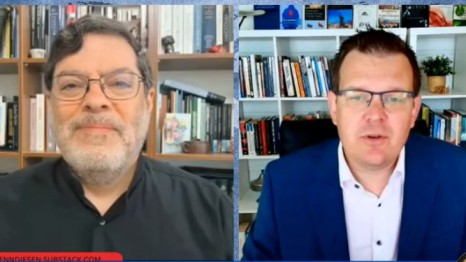
Read the full transcript of Seyed Mohammad Marandi’s interview on Greater Eurasia Podcast, August 9, 2026.
EDITOR’S NOTES: In this interview, Professor Glenn Diesen speaks with Seyed Mohammad Marandi, a professor at the University of Tehran and former advisor to Iran’s nuclear negotiation team. They examine the near-finalization of an Iran-Oman agreement related to the Strait of Hormuz, alongside the emerging Saudi-Turkey-Pakistan defence pact and its regional implications. The discussion covers escalating tensions over energy routes, shifting alliances in West Asia, and Iran’s strategic outlook amid broader geopolitical pressures.
Introduction
GLENN DIESEN: Welcome back. Seyed Mohammad Marandi joins us today, a professor from Tehran University and a former advisor to Iran’s nuclear negotiation team. Thank you for taking the time on a Sunday morning to speak with me.
SEYED M. MARANDI: It’s always a pleasure, Glenn. Thank you very much for inviting me.
Attacks in the Strait of Hormuz and Iran’s Strategy
GLENN DIESEN: So we see a lot of things having happened over the past 24-plus hours. First, Iran attacked a ship in the Strait of Hormuz, which caused a lot of outrage, especially from the UAE. We also see reports of the Iranians being more vocal on their demands against the United States — that is, they should pay compensation for what they have destroyed and remove the blockade on Iran.
Beyond this, of course, we have all these other diplomatic developments as well: the Saudi-Turkey-Pakistan defense pact, the Oman-Iran deal, and the US-Saudi nuclear deal — well, not yet finalized. What do you make of all these developments? Because things appear to be moving fast. We can start with the new attacks in the Strait of Hormuz. How can we understand what is happening now?
SEYED M. MARANDI: It’s just another normal day in West Asia. The situation is unlike what the Americans want to believe — it’s not good for the United States at all. The Iranians are now showing that they’re not going to allow oil, or any other goods, to be exported from the Persian Gulf region without Iran’s consent.
They’ve had a specific project, it seems to me, of targeting UAE ships. They’ve struck a number of UAE tankers over the past few days. And remember, a while back, Trump made that Truth Social threat where every time Iran strikes a ship, they’ll destroy some Iranian critical infrastructure — a bridge or a power plant. But Iran has been striking these tankers since then and blocking any sort of exports from even the Emirates, including from Fujairah, which is outside the Strait of Hormuz.
We can see the same situation in the Red Sea. The Yemeni armed forces are blocking Saudi ships. This morning there was another strike on the Jizan refinery. The pressure is on, the pressure is continuing, and as time goes by, the global energy crisis is getting worse.
Iran’s Awareness of US Internal Politics
SEYED M. MARANDI: The Iranians know exactly what’s going on, and it’s not just the leaders. I rarely go on Iranian TV, but last night I went. I began explaining my views on the region, and I thought I’d speak a bit about Japan. As soon as I said a couple of words, the host interacted with me — it was clear he knew exactly what was going on and the threat to the bond market in the United States. This is how closely events in the United States and the West are being followed.
People know exactly what’s going on in general terms. A lot of people know as much as I do, if not more. They know about the midterm elections. They know what’s going on in the Democratic Party. They know what’s going on in the Republican Party. They know what Tucker Carlson and his political allies are doing. This shows how carefully monitored the situation is, politically speaking.
I think that Iran’s military and political actions are carried out with an eye on what’s going on in the United States — internally but also internationally.
Economic Pressure on Gulf States
SEYED M. MARANDI: Yes, the Emirates are very upset, but there’s nothing they can do about it, and there’s nothing that the United States can do about it. The Saudis are very upset because now they are in the same boat as Qatar, the Emirates, and Kuwait. They can’t export much from the Red Sea. They can’t export from the Persian Gulf.
These are countries that consume a lot. They are not like Iran, which has lived under maximum pressure sanctions and sanctions for decades. The consumer in Saudi Arabia is used to spending like there’s no tomorrow, and that is true across the Persian Gulf region. That is going to have an added impact — not only are the hopes of Trump to bring in trillions of dollars from the family regimes in the Persian Gulf for the US economy going to be dashed, but now it’s going to be the opposite. These countries are going to have to withdraw money from the United States. They’re going to have to sell bonds in the US market in order to sustain their economies, in order to sustain the country, and in order to repair the damage that has been done and the ongoing damage that is being caused.
The costs are enormous, especially for these societies which are extremely wasteful and need huge quantities of money just to sustain themselves.
Iran’s Waiting Game
SEYED M. MARANDI: From the way I see it, the Iranians are playing a waiting game. They’re going to put as much pressure on the other side as possible and try to tolerate the pain inflicted on Iran as much as possible, and outweigh the United States. Based on past experiences since the war began, they have every right to be optimistic.
The 40-day — or 39-day — war, I never figured out exactly how long it was, was a massive failure for the United States.
US bases, Israeli assets, and assets of the regimes in the region that were assisting the United States — all of them were out in the open — while all key Iranian assets were deep underground. Whether it’s the factories, the missile bases, the drone bases, the bases that hold Iranian naval speedboats, the bases that protect Iran’s air force, the bases that protect Iran’s air defense systems, or other command and control bases alongside the Persian Gulf that were created in case the United States carries out a land invasion — all of these are protected, while Iran goes one by one and destroys US assets on the ground.
The MOU and Iran’s Demands
SEYED M. MARANDI: In the siege warfare, the United States tried to strangle Iran. Ultimately, it was the United States that had to agree to the MOU. And now we saw the statement by the chair of the Iranian Supreme National Security Council reinforcing the MOU — but it’s sort of an MOU plus. These are not new demands. Some people seem to think that these are new demands or excessive demands. No, they are maximizing the MOU.
As I said before on a number of occasions, for example, in Article 1, when it speaks of Lebanon, it also speaks of the other fronts. It doesn’t name them, but in this statement they are named: Palestine, Yemen, Iraq. These wars must come to an end — and of course, it means both Gaza and the West Bank.
So the demands of the Iranians are not new demands, but they are saying: we are not going to compromise on anything. When it comes to compensation, the Iranians demand full compensation — that is in the MOU. But the stress that is being put on these issues now is basically to send a message to the United States that not only are we not going to compromise on the MOU, we are going to maximize our demands within the framework of the MOU.
US Deterrence Eroded
GLENN DIESEN: I always think that the US lost something quite important in the war against Iran. During the post-Cold War era of US hegemony, the main perception — rooted in facts, I would say — was that the United States was all-powerful. The perception that you can’t challenge the United States kept all countries at bay, and this was a huge resource for the US.
But now with every attack on Iran, you see the weapons stockpile driven down, which means whoever is the opponent of the US would have better cards to play. And the deterrence that Trump always screams about on Twitter — that if anyone dares to attack the US, “we’re going to blow up your country and destroy your civilization” — well, again, this pushback from Iran shows there’s not much the US can do, really, short of nuking Iran.
Economic Ripple Effects
GLENN DIESEN: It is interesting what they gambled on in this war. It’s not just the Strait of Hormuz — it’s regional partnerships. But it does seem that the economy is a key concern. In July we see that the crude oil exported by Saudi Arabia to the US dropped to zero. It’s hard to calculate the kind of economic and political repercussions this will have.
First of all, Saudi Arabia will be destabilized — it’s money inflow, but also where it invests money into the US. The US needs this as well. The tech industry, which the US is in the AI race with the Chinese, needs its funding. The petrodollar system — everything comes under a massive squeeze. I think in the future this will be a key theme for academics: to see exactly what the US gambled and lost on in this war.
The Saudi-Turkey-Pakistan Defence Pact
GLENN DIESEN: I did want to ask about this new defense pact, because we see Saudi Arabia, Turkey, and Pakistan all forming this defense pact. All of them, of course, are more or less surrounding Iran. That being said, they have very different interests and very different motivations. I was wondering to what extent is Iran a target or the reasoning behind this? And to what extent should the Iranians worry, or how might they react?
The U.S. Empire’s Arrogance and the Seeds of Its Decline
SEYED M. MARANDI: Just before answering that — a couple of years ago, maybe in one of our first discussions, I said that I always believe that the collapse of the Soviet Union and the victory of the United States over Saddam Hussein in Kuwait was the worst thing that could happen to the United States. And that is because it created an arrogance that basically led to the swift collapse of the U.S. empire. The ghosts of Vietnam were swept away after Iraq, and it was the unipolar moment.
And then came 9/11 and the invasion of Iraq, which, when you look at the evidence being put forth by the likes of Tucker Carlson, it’s obviously not just Al-Qaeda and those 19 people who were involved. It doesn’t look like that at all. It looks like it was much broader, and that agencies linked to the West, or Western agencies, were also involved.
But in any case, since then, the United States has been rapidly declining. And this war is the exact opposite of what we saw in Kuwait. In Kuwait, there was a stunning victory, and now, just 3 decades later, you see the exact opposite — that the United States fought a war and it failed. In fact, the 39 to 40 days of fighting is similar to the time it took to defeat Saddam Hussein in Kuwait. I think that was 43 days or so. Maybe I’m mistaken.
But I think that actually turned out to be horrible for the United States, because the United States changed. It became aggressive, extremely aggressive, and that destroyed it.
Iran’s Role in Pushing Back the U.S. Empire
And a lot of that destruction again has to do with Iran. Because when the United States invaded Afghanistan and Iraq, Iran began to work with the resistance. In Afghanistan, Iran began to work with the Taliban. The first generation of the Taliban was horrible — they were carrying out mass murder and slaughter. But after they collapsed in Afghanistan, the second generation became more moderate. We still have big differences with education, women’s education, and women’s rights. That’s a big divide. But the relationship has evolved tremendously.
Iran supported the Taliban to weaken the U.S. occupation. And ironically, it has angered many of the minorities — many people among the Shia, the Tajik, the Persian language speakers, the Uzbeks — who are all opposed to the Taliban. But for Iran, the priority was to expel the empire from the region. The Iranians believe that if the empire is expelled, then the situation in Afghanistan will calm down, because there’s no foreign manipulator to turn community against one another, one nation against another.
And the same was true in Syria. The Iranians supported the Syrian government to oppose the U.S. project and the Israeli project, which sadly regional regimes participated in. The same model took place in Iraq. In Iraq and in Afghanistan, Iran pushed back. It was General Soleimani behind both. And that led the United States to leave, having spent trillions of dollars.
So to a large degree, U.S. failure against Iran in this war is linked to the U.S. failure in Iraq and in Afghanistan. They had to move away from Iranian borders. They spent trillions of dollars and became much weaker. The American people became much more skeptical about these forever wars, and the economy became weaker.
So if it wasn’t for Iran supporting the resistance against the empire in Afghanistan, in Syria, in Iraq, in Lebanon, and in Yemen, then today it would have been a very different situation. The Americans would have been able to come forward with much greater strength.
Iran’s Support for Russia and the Broader Strategic Picture
And I would add — and I’m not saying that Iran foresaw all of this — but Iran’s support for Russia during the war was because Iran saw the expansion of NATO as a threat to itself as well. Not just Ukraine, but also Georgia. And then, of course, Armenia and Azerbaijan would be next. We already had Türkiye as a NATO member, and these additions would have made the threat even greater for Iran.
So Iran’s support for the Russians during the war also helped destroy a lot of the assets that NATO gave to Ukraine and weakened NATO economically and militarily. Many of those air defense systems that were used in Ukraine — that benefited Iran. And of course, right now, the war in West Asia helps Russia when the United States is forced to spend money and waste its assets on multiple fronts. It benefits Iran and Russia.
The Saudi-Turkey-Pakistan Defence Pact and the Yemen Factor
But with regards to the three leaders gathering in Saudi Arabia — the Turkish leader, the Pakistani leader, and Muhammad bin Salman — I think it’s pretty clear that this is about Yemen. It’s about the weakening position of Saudi Arabia.
These countries did not gather over Gaza. They didn’t gather over Lebanon. They didn’t gather over the Israeli advancements in Syria, and they didn’t gather over the horrific situation taking place in the West Bank. It is about Saudi Arabia being severely weakened because of its own policies.
The Saudis helped the United States attack Iran. They co-conspired with Americans against the Iranian people. They acted as the U.S. airbase — the country. Not only did they provide airspace, they provided airbases. Not only did they provide airbases, they provided jet fuel. They provided everything that the Americans needed. They paid for the U.S. war as well. All of the expenditures of the United States — Saudi Arabia, Qatar, and the Emirates paid for the U.S. presence. That’s true about Kuwait too. The expenditures on these bases were paid for by these governments. It was so much that some of them were facing financial difficulty as a result.
So Saudi Arabia helped the United States against Iran. They were part of the war, and then they went and provoked Yemen. They bombed Yemen at a time when they had imposed a siege that had been going on for years. And then they bombed Iraq, falsely blaming Iraq for drone strikes which were carried out by Yemen.
Yemen Strikes Again — The Jizan Refinery
And Yemen again today has carried out further drone strikes. Just today we saw a Yemen strike on the Jizan refinery again. They will continue to do so. And I don’t see these countries getting involved against Yemen. It doesn’t look good for them at all.
People will remember that for years, the Saudis — with the support of Turkey and other countries in the region — carried out a genocidal war against Yemen, but they failed. It was like Gaza. They imposed starvation. The Saudis and Qatar were supporting it until the siege on Qatar. Then Qatar and Turkey tilted away from Saudi Arabia. But they failed. And Yemen today is much stronger than it was back then, while Saudi Arabia is much weaker.
So I don’t really see them having the capabilities to stop Yemen from striking ships, refineries, or oil installations. They don’t have anything that the United States didn’t have. And so many of those munitions — those anti-missile, anti-drone munitions that the United States has been bragging about — are depleted now. We are all hearing the news about the current shortages.
Yemen’s History of Defeating Foreign Ambitions
Yemen has a history of wrecking the ambitions of other countries. Egypt in the 1960s under Gamal Abdel Nasser invaded Yemen, and it was their Vietnam. That’s part of the reason why they failed so badly against the Israeli regime — because they had expended so much of their capabilities in Yemen.
So I don’t see this agreement as signifying much. Pakistan had this arrangement with Saudi Arabia more or less before. There are financial issues that lie behind this for Pakistan, and military sales for Turkey. They may try to do some things with Saudi Arabia — I’m not saying it will be completely meaningless. It’s just a piece of paper that’s been signed. But I don’t think it’s going to have any major impact on Yemen’s capabilities or the capabilities of the resistance in Iraq.
And of course, Iran defeated the combined forces of the United States and the Israeli regime. So I don’t think that Iran is worried about any piece of paper signed in Saudi Arabia.
The Unipolar Trap: How Hegemony Breeds Its Own Decline
GLENN DIESEN: Yeah, your comments on hegemony — the collapse of the Soviet Union being also problematic for the U.S. — people like Stephen Walt wrote a lot about this. That is, if you’re a hegemon and there’s no balancer, he was always making the point that the greatest challenge for the U.S. is that states don’t constrain themselves — essentially, that the U.S. would no longer be balanced. It would go out in every direction, exhaust itself, and make a lot of enemies. This was the argument in the 1990s.
And you can see why. If you’re a hegemon unconstrained, you can do anything, and you can absorb the cost of this military adventurism. So essentially, this is a perfect condition for the rise of the hawks when they say, “Well, why shouldn’t we have military solutions for everything? Who can stop us?” And that’s what you saw already from 1990, 1991.
And so you’re going to see predictable developments: decline of diplomacy, decline of fiscal discipline, the moral compass will be thrown out, there will be a collapse in the trust of the political class. That’s when it exhausts itself economically. You’ll also have political instability, and eventually the rising rivals at the periphery will begin to get closer together — the Chinese, Russians, Iranians — because they realize this is not a functioning international system.
And once the hegemon begins to decline, it will be desperate to hold on to power. That’s when you will see extremely foolish policies — the war on Iran, war on Russia, economic war on China. A lot of this would be predictable.
Of course, if you argue that the best thing in U.S. interest now is to accommodate a multipolar system where it can retrench, you’re often met by arguments: “Oh, that’s anti-American. You want to give more space for the Chinese and the Russians.” In my opinion, this is the medicine the U.S. needs to restore itself and go back to normalcy. But it’s a very difficult argument to make in this day and age when everything is emotional sloganeering.
The Iran-Oman Hormuz Deal: How Close Is It?
Anyways, I take your point on the Turkey-Saudi-Pakistani defence pact — that we shouldn’t expect to see collective defence right away. But we also hear now that the deal between Oman and Iran might be in its final stages. Again, I’m not sure if we should take these media reports with a grain of salt, but I do hear that from other places as well. How significant would this be? And also, what would such a deal actually include? I guess you don’t have it in front of you, but what can we expect being the main points there?
The Myth of American Exceptionalism and the Erosion of U.S. Power
SEYED M. MARANDI: Well, just a couple of points. First one is with regards to the United States. I agree with what you said completely. And even now, as all the indicators show that things are not going well at all, you still see that this myth of American exceptionalism still exists. You don’t see any change in U.S. policy, which of course is linked to corruption — the money that’s going to the military-industrial complex, and their lack of any ability to reform because they’re making huge amounts of money, and so on.
I mean, the leadership is increasingly corrupt, manipulating the markets, and then benefiting from it directly — their families, their allies. All of that is true, but the myth still exists. They still behave as if nothing will actually run out. This “can-do” attitude — “we can win somehow, we’ll come out on top” — that continues to push the United States towards the cliff, whether it’s economic or political or military. It’s just moving forward. And I think by the time they’ll really figure it out, even though they’re seeing it, they have the evidence in front of them, it’ll be too late. And I think we’re pretty close to that moment.
But others know this. Others are looking objectively. The Iranians are calculating very carefully. The Russians are calculating carefully. The Chinese, everyone is calculating very carefully. And U.S. allies, I think they are beginning to recognize that they’re in a very dangerous situation — these proxies — because none of them have any popular support. They don’t have any mandate by their people to be U.S. proxies. And so that undermines their own authority. Because when that aura of power is gone, it is also gone for the proxies too.
The Axis of Resistance and the Legitimacy Crisis of U.S. Proxies
And so even this alliance, whatever it is, it is not going to look good when it does nothing for Gaza, it does nothing for the West Bank, it does nothing for Lebanon, it does nothing for Syria. But let’s say they collaborate against Yemen. People will say, well, Yemen was the country that supported Gaza, that the United States went to war against because it blocked the Red Sea to the Israeli regime over Gaza. So these countries — Turkey, which does trade, transports oil to Netanyahu’s regime, and the others — they will be seen as fighting against the supporters of the Palestinian people.
The image will not be good. You will see people online from these countries defending these policies, but these are basically elites that are close to the Saudis or close to the governments. And they will, of course, support this and they will attack Yemen, they’ll attack Iran. But people who are looking at the reality on the ground about who’s defending Palestine — it’s the Axis of Resistance, no one else. They see through that.
So it’s going to be very difficult for the Americans in the months ahead because of all those indicators that you alluded to. It’s going to be difficult for U.S. proxies to pursue the same policies, especially since that American power that they relied on is melting away. And the public, which has not been satisfied with many things over the past few years, will be raising more questions and will probably become more feared by these governments. The governments will become more fearful of an angry population that wants to see the genocide in Gaza come to an end.
Iran’s Position on Palestine and the MOU
Meanwhile, the Iranians are simply reiterating their position on Gaza. The Iranian chair for the Supreme National Security Council in his statement yesterday was very explicit about something which I’ve said repeatedly — that Palestine has to be a part of the MOU. It must be a part of the MOU. It is a part of the MOU for Iran, not just Gaza, but also the West Bank, because Iran didn’t name Gaza, it said Palestine. So none of this bodes well for the United States or its allies.
The Iran-Oman Hormuz Deal: Almost Complete
And then, getting to your question on Iran and Oman — the negotiations between Iran and Oman, from my understanding, are almost complete. And probably one could say they’ve been completed. But I think since the issue of the Strait of Hormuz is linked to the broader issue of the MOU, that is why the Iranians are holding back.
Now, the Iranians never believed that the United States had any intention of implementing the MOU. Iran is not naive. But there are a number of reasons why Iran went for the MOU in the first place. One was that the Iranians wanted to export oil. Iran was under siege, so it accumulated a lot of oil in tankers — tens of millions of barrels. As soon as the MOU was signed, Iran exported that oil to the Asian markets to strengthen its position for the months ahead.
But also Iran wanted its allies and friends across the world to know that Iran is seeking an agreement. It’s not as if Iran wants forever war, unlike the United States. Iran wants to bring it to an end. And so this is a message to its friends, both regional friends and global friends, that there is an end in sight if the Americans have the will to move in that direction.
Iran’s Military Performance and the Resumption of War
And the Iranians, knowing that the United States would undermine the deal, had prepared themselves. And we saw that in the war that resumed after the United States violated the deal and set up that corridor in the Strait of Hormuz against Article 5. When the United States resumed the war, Iran performed even better than the 40-day war. And we saw that the Iranian missiles and drones were hitting very hard. And then we saw Yemen enter the war as well because of the stupidity of the Saudis by attacking Sana’a International Airport. So it made things much worse for the United States.
Iran Withholding the Hormuz Agreement
So now the Iranians are holding this back. They’re holding this agreement — where there will be fees, by the way, contrary to what Vice President Vance claimed — there will be fees. But Iran is withholding this until the issue of the MOU is resolved, because Iran is saying that the United States has to go back to the MOU and it has to fulfill it in the way which we interpret it. And thus the Iranians were more explicit in the statement yesterday.
So the deal is ready for signing, from my understanding. There’s no disagreement or anything like that holding it back. But the Iranians are waiting to see which direction the United States is going to go. Is it going to resume fighting? Because that’s not an impossibility, Glenn. You and I both know that Trump is under enormous pressure from the Israeli regime, the Zionist lobby, his own ego, the Israeli-firsters in the United States. He’s under pressure to continue the war. This is the sort of narrative that we continue to see on Fox News, for example. And we know that’s where he gets his intelligence briefings — by watching Fox News.
So it’s not impossible. No one should count this out. The Iranians are preparing for war, and Iran’s allies in the region are preparing for war. In Iraq, they’re preparing. In Yemen, they’re preparing.
Two Scenarios: War or a Deal
But that’s one scenario. The other scenario is for the Americans to decide, “Well, we have to end this.” The situation with Japan is getting dangerous. The shortage of oil is intensifying at a very rapid pace — more rapid than before — because of the Red Sea and because Iran is not allowing the Emirates to export either. So the pressure is on. But at the end of the day, the decision is made in the White House — which direction things move in.
GLENN DIESEN: Well, it is quite significant though, as you say, the Oman-Iran deal is close to signing. This will more or less find a solution to the issue of the Strait of Hormuz, and I’m assuming that Oman is in close coordination with the U.S. and others, trying to also accommodate their interests. So it could be interpreted as a wider agreement which solves this issue.
But as you said, it’s not the only problem. It’s not as if the war comes to an end with the signing, because with the MOU, the United States has other obligations, as you said, they haven’t fulfilled. That is — ending the blockade. I guess this could be done without too many problems. Ending the fighting in Lebanon — more problematic, I guess. The reparations — I don’t see that happening either, but maybe in the way the language is framed, it can take on some format. I’m not sure if there’s a compromise in terms of how this is made over time, or—
Financing Reparations: Models That Break the Sanctions Regime
SEYED M. MARANDI: There are ways to do this. I mean, these countries in the Persian Gulf region, they have lots of money in the U.S. markets and in the West. And they were, of course, with the United States in this war. But the MOU was devised in a way in which, for example, the money that would come into Iran would effectively be a violation of U.S. law, or at least a violation of presidential decrees or decisions made by the U.S. government with regards to investment in Iran.
So — and of course I’m not familiar with the details — but the models that the Iranians have been devising are models that are doable, but also they break the sanctions regime as well. So it doesn’t have to come from the United States. Of course there are things that the United States will have to do — and there are many things that the United States will have to do. First and foremost, for the Iranians, is handing over Lebanese territory back to the people of Lebanon, forcing the Israeli regime to back off in Gaza and the West Bank. I mean, these are key demands by Iran. This is not going to be over until there is peace in West Asia.
And of course, Iran’s assets that were stolen have to be returned, and the other issues which were discussed. But there are models in which these things can be carried out without, you know, the United States sending money from bank accounts in Washington to bank accounts in Tehran. There are other ways of doing this.
GLENN DIESEN: Yeah, well, I’m just thinking — in the U.S., even if they do recognize that all the paths to a potential victory have been exhausted, that they have to put an end to this thing — domestic politics is still an issue. I mean, Trump has spent like a decade, more than a decade now, saying how weak Obama was for unfreezing some Iranian assets. Also, the JCPOA was such a horrible deal. So the fact that he will now have to release Iranian funds and accept a deal which, at best, wouldn’t be any different than the JCPOA — it’s going to be a very hard sell in Washington.
The Decisive Battle for the Strait of Hormuz
SEYED M. MARANDI: It’s not clear if we will ever get there, but Iran is not going to compromise. The decision is theirs. It can be resolved within weeks. It can be resolved within months. And it can remain unresolved. But the Iranian position today, I think, is very different from what it was before, and it would be a further loss to the United States.
It’s not as if the Iranians are expecting Trump to capitulate tomorrow and to carry out its obligations within the framework of the MOU based on the Iranian interpretation. But it does show the Iranian determination to make sure that the United States is defeated and that its allies in the region — in Gaza and Palestine, the people of Palestine, the West Bank, and elsewhere — that they feel the benefits of this US-Israeli defeat. Because at the end of the day, the defeat of the United States regime is a defeat for the Israeli regime.
And the battle over the Strait of Hormuz was more important than any other battle that took place in West Asia during this period. Some would ask me, why didn’t Iran strike the Israeli regime during these 13 days? Well, the Iranians were focused on winning the Strait of Hormuz, and a defeat for the United States is a defeat for the Israeli regime.
Of course, during this period, Iran was destroying all those radar and defense installations that were built in the Persian Gulf and in Saudi Arabia and Jordan and in northern Iraq to protect the Israeli regime. They destroyed that so that if there’s war, the Iranians can use their drones especially more easily and their missiles.
Also, the Iranians want the crisis — the internal crisis in Israel that we’re seeing. If the Israelis attack, Iran will hit back hard to hurt Netanyahu if Netanyahu starts a war. But right now, before the elections, the Iranians want to see what happens in Palestine. Not that Netanyahu’s opponents are any less genocidal, but this deep divide in Palestine is a good thing for the region.
But ultimately, the battle for the Strait of Hormuz was the decisive battle. That was what basically changed the direction of the region and changed the future of the world. And what Yemen did was it strengthened what happened in the Strait of Hormuz. It made the Strait of Hormuz even more important because if Yemen had carried out these operations under normal circumstances, it would have bothered the Saudis. It would have caused them significant damage, but it wouldn’t have critically punished the Saudis or the Americans or the West.
But now when you look at what’s happening in the Bab-el-Mandeb Strait alongside what has happened in the Strait of Hormuz, it becomes all the more effective. So no one in Iran is naive about the days and weeks and months ahead, but they are sending a very strong message to Washington that “we won this war, and don’t be under any illusion that you are going to be able to chip away at Iran’s gains and the gains of the Axis of Resistance at the negotiating table, or undermine them by cheating in implementing the MOU.”
The Myth of American Power and the Moral Bankruptcy of Western Elites
GLENN DIESEN: I think this is another problem for Trump though, because he’s been selling victories — or essentially the indicator of victory as being, look how many people we killed, or how much military or civilian infrastructure we’re able to destroy. But these are not indicators of victory. As you said, this is a very complex conflict and there are definitely better indicators of success here than killing opponents.
SEYED M. MARANDI: And probably the worst is not just the fact that the United States is continuing to support a genocide, but the fact that the United States is constantly threatening the Iranians with a holocaust. Not only has the United States failed militarily, but the United States and the West have been exposed — Western elites have been exposed morally. And that’s why people in the West are turning against the political establishment, especially in the United States.
We’re seeing that play itself out in the civil war on the right and the civil war in — well, the Democratic Party. I don’t know if you can call it the left, but in any case, that civil war is because of not just economic issues, but it’s because of the moral bankruptcy of Western political elites, and people across the world see it.
And of course, the myth of US power is broken. People see that every day the United States is saying that “we destroyed this, we destroyed that.” But every day the Iranians are firing missiles. So obviously they’re not destroying all those things that they claim to have destroyed.
And it seems that even if the United States did not have the shortages that we’re hearing about today, it would still lose. Because during the 40-day war — or 39 days of war — there was no talk of those shortages. Those shortages existed, and the Iranians were depleting US capabilities even beforehand. Operation True Promise 1 — we recall when Iran sent those missiles and drones, they spent huge quantities — and then Operation True Promise 2. All of these contributed to what we’re seeing today.
But even when those shortages weren’t showing themselves on the battlefield during the 39 or 40 days of war, they still failed. They lost the war. They were using those missiles back then like there’s no tomorrow. And ultimately Trump, who demanded unconditional surrender, was forced to accept the Iranian 10-point peace plan for the war to end after 39 or 40 days.
So the myth of American power has collapsed. And of course the myth of the US economy being the powerhouse of the world — that has failed too. And what’s going on in Japan is just one indicator.
The Nuclear Deal and the Saudi Question
GLENN DIESEN: Yeah, it’s a big mess. And of course, the one thing Trump could do to sell this as a victory is if he could get a nuclear deal — another JCPOA. Because then he can claim, “Well, we inflicted so much pain on them that they had to sign this deal and now they won’t get nuclear weapons.” But even on this issue, from what I understand, the Iranians don’t want the US to cherry-pick what they want out of an MOU. So the nuclear deal has to come at the end, which means that first the Americans will have to deal with the issues of ending sanctions, unfreezing Iranian assets, paying reparations, ending the blockade and the war on Lebanon — and Gaza. So we’re not close to the end of the war just yet, I guess.
And of course, the Saudi deal Trump might be making now — the nuclear deal — I guess that could also throw another wrench into the system. It’s hard to imagine this not impacting Iran’s position on a nuclear deal if there’s one set of rules for the Saudis and one for the Iranians. And as the White House explains, “Well, that’s because the Saudis are an ally,” and this is now apparently how the international system should work.
SEYED M. MARANDI: But even there, Trump humiliated Mohammed bin Salman. Not only did he a while back say he can kiss him in his backside, but then after all the negotiations and the deal was agreed upon, Trump comes out and says, “But first they have to accept Israel.” The humiliation rituals are just extraordinary — the way in which the United States treats its friends and supposed friends, its proxies. It is just unbelievable. And this contributes to their weakness.
So Saudi Arabia — in order to get a nuclear program — Iran offered Saudi Arabia the technology for nuclear enrichment. People can check online. Iran has been saying this for many, many years: “If they want the technology, we’ll give it to them.” But the Saudis refrain from doing so. They refrain from getting it from China or from Russia. They simply sit there and wait to see if the Americans will give it to them. And when the Americans finally agree to give it to them with many restrictions, then they say, “Oh, but you have to first bend the knee to Netanyahu.” And this does not strengthen the foundations of the ruling family.
Closing Remarks
GLENN DIESEN: Well, as a European, I’m all too familiar with how the US humiliates its satellite states. So anyways, thank you again for taking time on a Sunday morning to speak with us. Thanks again. It’s a great pleasure, Glenn.
SEYED M. MARANDI: Thank you very much for inviting me.
Related Posts
- Transcript: Nepal PM Balen Shah’s Speech At UN General Assembly 81st Session
- Transcript: President Trump and the President Xi Remarks at a State Dinner
- Transcript: Israeli PM Netanyahu Addresses UN General Debate, 81st Session
- Transcript: President Trump and President Xi Deliver Remarks at Arrival Ceremony
- Transcript: Secretary Marco Rubio Remarks at Press Conference in New York City – Sep 23, 2026