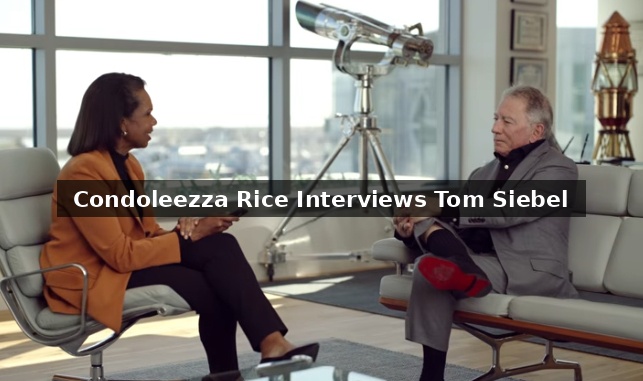
Read the full transcript of C3 AI CEO Tom Siebel’s interview on Only In America Series with Condoleezza Rice, premiered July 31, 2026.
EDITOR’S NOTES: In this episode of the Hoover Institution’s Only In America series, Condoleezza Rice sits down with Tom Siebel, founder, chairman, and CEO of C3 AI, to explore how a history major became one of Silicon Valley’s most influential entrepreneurs. They discuss the foundations of American exceptionalism, the promise of the AI revolution, and Siebel’s extraordinary personal reinventions after surviving an elephant attack and later losing his vision. Throughout the conversation, Siebel shares why he believes America’s greatest days still lie ahead.
Introduction
CONDOLEEZZA RICE: We always say that America is a land of opportunity and also a land of reinvention. Our history is full of stories of ambitious entrepreneurs meeting opportunities to transform technologies, industries, and society. Often more than once in their lifetime. Reinvention takes resilience, getting back up after being knocked down. Tom Siebel, serial entrepreneur, veteran of Silicon Valley technology, and living testament to the power of resilience.
Tom embodies the idea of reinvention in America, from surviving a near-fatal elephant attack to dominating in some of the most competitive industries on Earth, Tom Siebel has remained grounded in history across a long career driving innovations in business and technology. At the headquarters of C3 AI, his latest venture, Tom shared his vision of America’s future and how the country can draw on history to chart a course to unprecedented prosperity. Now, for Only in America, my conversation with Tom Siebel.
Thomas Siebel. Good morning.
TOM SIEBEL: Nice to see you.
CONDOLEEZZA RICE: Nice to see you too. How are you doing today?
TOM SIEBEL: Better than ever.
CONDOLEEZZA RICE: Good, good, good. My goodness, what a day.
TOM SIEBEL: It is.
CONDOLEEZZA RICE: Yeah, and I know from your office you can see everything, so—
Neuroplasticity and Learning the Organ
TOM SIEBEL: So I’m on a new adventure, a number of new adventures, some actually really interesting ones that I’m doing with Stanford. All kind of related to neuroplasticity. We’re starting a really interesting initiative that will be world-changing, exploring every means of increasing neuroplasticity with the idea of getting the brain to heal itself. The question is, can we get the brain to wire around faults? And I have a fault in the optic nerve. Now, we are absolutely 100% demonstrating that you can do it.
Now, one of the things associated with that that I’m doing that you’ll chuckle at is I’m learning to play the organ. So I have one song.
CONDOLEEZZA RICE: Really?
TOM SIEBEL: One song that I’m working on. I do one at a time. And it’s “Jesu, Joy of Man’s Desiring,” which is simple, right? I mean, even Tom can figure out that.
CONDOLEEZZA RICE: Well, it’s actually not so simple, actually.
TOM SIEBEL: But I won’t tell you that. Yeah, well, I’m playing the baby— I’m not playing the complex one. I’m playing the simple one. No, but I have one song and then I’m going to learn another song and then I’m going to— but just one. And so that’s my—
CONDOLEEZZA RICE: So I didn’t know, actually, did you play the organ at some point?
TOM SIEBEL: No, no, I’ve never— I mean, like every kid, I played the piano, but not really.
CONDOLEEZZA RICE: They talk about how music improves your neuroplasticity.
TOM SIEBEL: There’s just no question.
CONDOLEEZZA RICE: So reading and learning.
TOM SIEBEL: Have you played the Stanford organ?
CONDOLEEZZA RICE: So the organ is really hard. I took organ lessons. Now, I’ve played piano since 3. My mother was an organist. It is hard to play the organ.
TOM SIEBEL: I can’t believe you haven’t done that. Before this is over, I’m going to have to do that. I’m going to go do it.
CONDOLEEZZA RICE: Yeah, I guess I have to go do that.
TOM SIEBEL: And before this is over.
A History Major Turned Tech Titan
CONDOLEEZZA RICE: Tom, you and I have been friends for many, many years. I want to thank you also. You’ve been a great supporter of the Hoover Institution, which is making our little conversation possible. I didn’t know in all those years that you were a history major. So can you tell me how a history major ended up becoming one of the titans of American technology here in the Valley and beyond? How did that happen?
TOM SIEBEL: Well, I am fascinated by history. I read history all the time. I think the background I have in history as an undergrad was very helpful. I mean, it was really focused on history of technology, history of science, Thomas Kuhn, Aristotle, Galen. And I think that foundation really inspired my interest in history. And I’ve been reading about history nonstop through my whole life. History of technology, diplomacy, civilization. I find history fascinating.
I think, to the extent that I suspect it doesn’t repeat itself, I’m certain it rhymes. I think that to the extent that I’ve been fortunate professionally, and no one has been luckier than I— no one has had more lucky bounces than I have. I guess a lot of people have had more lucky bounces than I have, but I’ve had a lot of lucky bounces. And I think to the extent that I’ve made good guesses about what was going to happen next, it was well-informed by what happened prior.
Unfortunately, one of the consequences of the concentration that we’ve seen on STEM, particularly in the last 15 years, is I think the arts and sciences are suffering. And things like history, classics, languages, literature are being discouraged. And I think that’s a big mistake.
CONDOLEEZZA RICE: It is. I was just going to say, the number of history majors in universities has been dropping for a long time. Although I will say, I’m beginning to run into students who are computer science and history, or computer science and— I had one student, computer science and religious studies.
But I want to take you back to entrepreneurship for a minute because when one thinks about the history of this country, you can’t write the history of this country without writing the history of its great entrepreneurs going back a long, long time. How do you think about that? How do you think about the role of entrepreneurship in American history? As we were walking in, you told me you have a different view of what we call American exceptionalism. Talk a little bit about that.
American Exceptionalism and the Power of Education
TOM SIEBEL: The role of entrepreneurship and philanthropy in this country is really impossible to overestimate, to overstate. And we get to, be it Vanderbilt, Carnegie, Edison— I mean, these people are all giants. And Franklin. And this whole story, this whole experiment about American exceptionalism, I mean, it is just so real.
And I think much of that has to do with the focus going back to Cotton Mather with the Puritans, has been on the education system in the United States, which has been simply exceptional and remains exceptional. When we get to 17th and 18th century America, these Puritans that came out of Boston into Ohio and Illinois— I mean, the stuff that they taught in one-room log schoolrooms to people like Lincoln and people like George Washington, and people like Ulysses Grant. I mean, these guys went on to quote Plutarch, Aristotle, Homer. Who quotes Plutarch? Like, nobody. And in first draft, they write these incredibly eloquent documents.
And you get into 19th century America, the education system that’s in place is unbelievable. And then we move on to the era of Lincoln when we have this issue where this form of Republican government and these geniuses come up with, I think it was called the Morrill Act in 1862. And they decided to form the land-grant institutions. I think, as I recall, 78 land-grant institutions like Berkeley, like Michigan State, like Illinois, like Ohio, like Oregon State. And holy moly, I mean, I think that changed everything.
This idea that education historically had been something available to the rich landed class who could send their sons to Harvard, Yale, Princeton— males. And all of a sudden we have this idea where we’re sending men and women, and Germans and Irish and African Americans. And I think that really is the heart of this miracle. Look what’s happened to Berkeley, Illinois, Cornell, Purdue. I mean, these are amongst the greatest institutions on earth.
And I think that is the foundation where we took this Jeffersonian dream of building this educated republic. And we educate them in agriculture and engineering and science and medicine. And the miracle is exceptionalism. And what we have enabled is entrepreneurship. We’ve enabled greatness. I think that is the heart of American exceptionalism, is the educational system that was here in the 18th century, the 19th century, and now continues in the 20th century.
And I think we have this system. And now, Stanford being aside— Stanford being a coed institution from day one, I mean, the Ivy Leagues caught on late.
CONDOLEEZZA RICE: Later.
TOM SIEBEL: Like Brown, Harvard, Yale. When did they admit women? Like yesterday? In the 1970s, right? Now they came along. And so anybody could become anybody you wanted. You could become anybody you want in America.
American exceptionalism is real. I think it started with the Puritans and then the revolutionaries, where this idea where they wanted limited government, they wanted individual liberty, they wanted freedom, they wanted religious freedom, and they wanted a republican form of government. Big experiment, republican form of government. I think it had been tried twice before on pretty small scale, once in Athens and for a short period of time in Rome. I mean, here, 250 years later, this thing is rocking.
And this idea that we have limited representational government, we keep governments in place, let people do what they want, and give them the tools to be whatever you can become. And I think we have to thank for that the land-grant institutions in America. I think that is the core fabric of American exceptionalism and American greatness.
Federalism, State and Local Government, and C3 AI
CONDOLEEZZA RICE: You know, it’s very interesting because you mentioned the kind of late 19th century. Of course, one of the other great institutions, historically Black colleges, come out of the notion in Reconstruction that you’re going to have people that have to be educated. And so this is a part of our DNA, this idea of the educated populace, that that’s one of the pillars of Republican government, one of the pillars of democracy. It’s also one of the pillars of making sure that anybody who is smart enough and has a good idea can thrive, that you don’t have to be of a certain class to be an entrepreneur. Look at some of the people who’ve come up from basically nothing and have contributed in this way.
But there’s another element of it. And C3 AI, which you founded, not your first company that you’ve founded, has a state and local practice. So we also have this federalism embodied in our DNA, in our exceptionalism. The idea that not everything happens in Washington too. And we’re now a big country, but can you talk a little bit about the federalism piece of it? Because you decided to actually make a product for state and local.
TOM SIEBEL: We make AI products for all forms of entities that can use AI to be more efficient. So yes, state and local government. I think that certainly things like manufacturing, process optimization, demand forecasting, what have you in the manufacturing sector, in the finance sector, it’s obvious. I think the obvious forms where we will be using AI beyond the prosecution of war, in state, local, and federal government services, has to do with delivering higher quality services at lower cost into the hands of more satisfied constituents.
So we can use AI— if we think about, once we get— I’m not sure what the federal budget is today because they raise it by a few trillion dollars every day, but I think it might be roughly $7 or $8 trillion. And everybody wants to focus on the War Department, which would account for about $1 trillion of that. And the rest is all kind of various benefit programs, Social Security, Medicare, Medicaid, what have you. And that would be the other 85% of the federal budget.
So these programs, Medicaid, Medicare, health benefits, food benefits— I mean, we can provide those benefits, higher quality benefits at a fraction of the cost using these new generation of generative AI technologies, so the government will be more efficient. There will be dramatically less fraud. And it’s just a natural application of this new generation of technology.
The Promise and Origins of Artificial Intelligence
CONDOLEEZZA RICE: So what is your AI? What are your greatest hopes about it? And then do you have any— are there any warning signs about it?
TOM SIEBEL: Well, AI, I think, is a fascinating area. And a lot of people in Silicon Valley like to think that they invented it. And a lot of friends of yours and mine like to think they invented it. They didn’t invent it. I mean, AI was kind of— and pretty much everything that we know about, but for generative AI, was invented by John McCarthy at Princeton in 1950. Hard stop. Supervised learning, unsupervised learning, reinforcement learning, TD learning, all Princeton, 1950.
CONDOLEEZZA RICE: Right. And some of the work in neural networks a little bit later.
The AI Revolution and American Exceptionalism
TOM SIEBEL: John McCarthy. Absolutely. I mean, he did it. He described that. Now, he did. Okay. Now, it took us maybe 70 years to get the computing capacity and the storage capacity to be able to run those systems. And that’s when AI winter turned into AI spring and summer as we get into the 21st century, when we have this essentially cloud computing phenomenon where we have virtually infinite computing capacity, infinite storage capacity at no cost. So as we power into the 21st century with this, you know, infinite cloud storage and computing capacity for free is a lot, and free is pretty cheap. And so now we can solve these problems that were previously unsolvable.
Now, as we power into the 21st century, say 2022, we have something genuinely new in this area that’s called agentic AI. And this is about these generative pre-trained transformers, what most people know about as LLMs. And the rate of innovation there, it is new and it is staggering and it is unbelievably important and it does change everything. And the rate of innovation, Kandi, is absolutely breathtaking.
Now, this sounds a little bit unhinged, but I am not certain — we might have seen as much innovation in the last year as we saw in the last 60 years in computer science. It is unbelievable. And it changes everything about the way we work, the way we govern, the way we conduct war, the way we engage in social exercises. It changes everything.
I mean, let’s just think about something that everybody knows and nobody’s really thought about. With these large language models we have, I think there’s roughly 8 billion people in the world. You’ll correct me if I’m wrong. And there were about 6 billion plus smartphones out there. And pretty soon everybody has one in the Gobi Desert, the Serengeti. I mean, you name it. And on these devices, we will have, like tomorrow, a large language model that will be available in that person’s language. The union of the information collected in the history of mankind will be immediately available to that person in microseconds.
Okay, then this makes — we talk about polymaths, like Jefferson and Franklin. This just makes them look like nothing. It’s a polymath, like how to drill a well, how to grow corn, how to irrigate a field, how to deal with breech childbirth, how to raise a cow. I mean, you’re going to have this information available to 7 billion people every day. I mean, think about this. What’s the correlation between that and productivity? Directly positive, and it’s high. What’s the impact on that on global GDP? It’s staggering. I mean, it’s breathtaking what’s about to happen.
And everybody knows that happens. That’s before you get to any of this magic stuff that people are talking about, with all the demons associated with that. This happens. Where everybody in the world in 200 local languages can ask any question about any subject and get the answer in a language they can understand. Their child survives, their family — their child is born. Their family eats. They have fresh water. Think about it. The implications of that on the global economy are — we’re going to enter a new world of productivity and prosperity that is going to be unimaginable and magical.
Why Technological Revolutions Keep Happening in America
CONDOLEEZZA RICE: Now, Tom, hearing this from you, because you’ve been through several of the technological revolutions in this era — you’ve been through the internet revolution and you’ve been through the software revolution, having created Siebel Systems and so forth. So to hear you say this is new is really quite stunning. Why do we keep, in the United States of America then, coming back to kind of the American story, the 250-year American story — why does it keep happening here? Because you think of all these technological revolutions and they all seem, at least not just in recent times, to be happening here.
TOM SIEBEL: I think there are 3 great experiments that happened here beginning in the 18th century through today. We have freedom of religion. How big was that? It was big. Republican government — big. The idea of limited government — this is huge. And individual — well, I guess now 4 — individual liberty. And that is the Republican form of government. And this is what people like Lincoln drove home and Grant drove home. And before that, of course, we had Washington and Adams and Jefferson. And this experiment is a miracle. It’s about keeping government in its place. It’s about letting people do this thing. And it’s about making sure that everybody is educated, because that is the ultimate form of welfare — to make sure that people are educated. So we don’t really need to deliver fish to people. We need to teach them how to fish.
And with this land grant educational system that we have in place, I mean, come on — Oregon, Alabama, Mississippi, Illinois, New Jersey, Rutgers, Cornell. I mean, this is a miracle. And it is the apogee of global education and it is the foundation of American exceptionalism. And you can be anything you want to be.
I mean, my family came from Europe in the middle 19th century. They were not indentured servants and we’ll agree that they were not slaves. But so they did have some rights, but they were serfs and they were poor and they had nothing. And not religious liberty — I mean, they were Protestants. They wanted a direct relationship with their God. And so they bailed and they came through New York and Chicago and became farmers. And then one becomes a lawyer and one becomes something else. And Tom gets to go to the land grant institution in Illinois, because that’s where he could afford to go.
I’m a public school kid. And I got to study history and then later business and engineering and computer science at a land-grant institution that turns out to be a pretty respectable engineering school. And I learned some languages. I think I learned how to read. I wish I learned how to write better, but I try. And learned the languages of information technology. And I got to play the game. I mean, I got to play the game with the giants of the industry for 50 years. I mean, I played the game with Bill Gates and Larry Ellison and Gordon Moore and Andy Grove. There’s nobody I didn’t play the game with. I had a seat at the table. What a privilege. I wanted to have a seat at the table, and I was able to get a seat at the table. And play the game with the greatest people, I think maybe in the history of commerce. And I know it and I’m lucky and I benefited from everything that everybody did to get individual liberty for everybody in America. And I am a highly, highly privileged and fortunate person and I know it.
On Taking Risks
CONDOLEEZZA RICE: Do you think that you had to take risks that — at the time, did you think they were risks? Did you think it was risky to leave Oracle and form Siebel Systems? Did you think in terms of a risk or did you just do the next best thing? It’s always interesting because when we think back on our ancestors or immigrant populations, they were taking big risks. They were leaving everything behind and going into a world that they really didn’t know what to expect. I grew up in Denver after leaving Alabama. And I’ve always said, I know how Denver got there because people looked up at those mountains and they said, “We’re good. We’re staying right here. We don’t need to cross those mountains.” But some people did. Did you think throughout this about risk?
TOM SIEBEL: Well, yes. I remember my first job out of undergraduate school. I had just graduated in history from the University of Illinois, and I got in a pickup truck and started driving west. My father was in tears at the end of the driveway, and I started driving west, and I stopped in Bellevue, Idaho, and became a cowboy. That was my first job, driving cattle and cutting hay. Baling hay on the Devine Ranch in Bellevue, Idaho. And later I was a manager of a shovel on a construction job in Hailey, Idaho, S&V Construction, laying Johns Manville, believe it or not, asbestos sewer pipe and water pipe. That was my second job at $7.50 an hour, union job. I couldn’t believe it.
And so where do we go? Was there risk in that? I don’t know. That was adventure. As we get professionally, did I take calculated risks? Every day. Was it a risk to go to work for Oracle? Yes, it was a calculated risk. Oracle was a small startup company with about 20 or 30 people when I got there, and that was a calculated risk. And relational database technology didn’t even exist commercially. That was my field of research in grad school — relational database theory. And back then it was just theory, it hadn’t been productized yet. So we were involved. Could this concept of relational database technology — an important concept in the history of information technology, we can talk about some other time — could it be commercialized? I thought it could. But that was a definite risk. That was a gamble, but it was a well-informed gamble.
When we later founded Siebel Systems and we created the idea of applying information technology, communication technology to the business process of sales, marketing, customer service — a market that we named and later became known as CRM — was there risk in that? Absolutely, there was risk. Every expert in the world knew that there was never a market for that and it was never going to materialize. I believed that the fundamental economics and history of information technology suggested that it had to happen.
When we started C3 AI in 2009 — I mean, 2009, understand, this is before Google Cloud, before Azure. I believed that the fundamental economics of information technology had to converge on the explosion of elastic cloud computing, the Internet of Things, predictive analytics, and therefore enterprise AI. And so we started years before there was any market there. And nobody believed in 2009, ’10, ’11, ’12, ’13, ’14, ’15, ’16, ’17, ’18, ’19 that there was going to be a market for enterprise AI. Nobody.
C3 AI and the Future of Enterprise AI
CONDOLEEZZA RICE: So you’re using artificial intelligence, AI, to see growth. Tell us about the company.
TOM SIEBEL: We live at the intersection of artificial intelligence and this new phenomenon called Internet of Things. There’s this phenomenon called digital transformation, and there are companies who are driving that, like Amazon. And then there are companies — maybe 30% of the Fortune 500 companies likely will not exist in 10 years if they don’t make this transformation.
Now, I believed, due to my background and what I had studied, that this had to happen. And so now, by the time we get to 2022, maybe everybody now believes — to 2022 and beyond — I would say that the world is pretty well resolved that yes, there is a market for enterprise AI, and however big we thought it was when we started, it’s bigger, 10,000 times bigger than that. So was that a risk? Absolutely it was. There was a risk, but I knew it to be true. So it was a calculated risk, but I think there was really no risk. It was just a matter of time.
VIDEO CLIP BEGINS:
JIM CRAMER: So let’s check in with Tom Siebel, the founder, chairman, and CEO of C3 AI, to get a better read on the company. Mr. Siebel, welcome to Mad Money. Jim Cramer, nice to see you. So we got to take head-on the people who say that you’re not on the right path and explain to them why they could be very wrong about C3 AI.
TOM SIEBEL: I’ve been kicked in the teeth a few times.
JIM CRAMER: You’ve been kicked in the teeth a few times. Yeah, and what happens when you get kicked in the teeth? What do you do?
TOM SIEBEL: Okay, you pick yourself up off the ground, you get up on one elbow, you get up on the other elbow, you get up on a knee, you stand up, and you put one foot in front of the other.
JIM CRAMER: That’s what you did. I know you did. Okay.
TOM SIEBEL: And that’s what I did too. And I’ve had a couple more opportunities than I would like.
VIDEO CLIP ENDS:
The Portrait and the Elephant Attack
CONDOLEEZZA RICE: As a matter of fact, Tom, I’m going to ask you — I want to ask you about a portrait that’s out there. So do you mind if we go out and take a look?
TOM SIEBEL: Let’s go take a look. All right. Now, if you look at this guy.
CONDOLEEZZA RICE: Oh my goodness.
TOM SIEBEL: Now look at their eyes and walk back and forth.
CONDOLEEZZA RICE: Yeah.
TOM SIEBEL: And the eyes are going to follow you.
CONDOLEEZZA RICE: Oh my.
TOM SIEBEL: Oh, whoa. Now go look in the right eye. And you’re going to see me standing.
CONDOLEEZZA RICE: Oh my goodness, I do. I have to say, I’m not sure I would keep it there given all that you experienced, but maybe it’s just a reminder of the resilience. Can you talk about that incident? You came back a long, long way from that bad day — or terrible day — when you were attacked by the elephant.
The Elephant Attack: A Fight for Survival
TOM SIEBEL: It was a bad day. I think you either own it or you run from your life, and I decided to own it. And I had taken Stacy and the girls. They wanted to go on a safari in Africa. So we took them on a safari in Africa to Tanzania. And one of the things that they feature there is walking safaris. And the girls got sick of riding around in a Range Rover a few days. They wanted to take a day off. And so I went to the head guide and said, can we go on a walking safari tomorrow? He said, no problem, Mr. Siebel. Meet me for breakfast at 6:30 in the morning.
So we’re out at one of these tented camps with one of these mud holes that are a big deal in the Serengeti. And he’s out there and this guy’s 6’3″. He’s got the whole getup and the accent and the funny hat and all that. And he says, okay, Mr. Siebel, I’m carrying a Nikon camera. And he was going to be carrying a double barrel .45-70 rifle. Well, a .45-70 rifle, as you know, is about a side-by-side. It’s a size — it’s a charge about the size of a roll of dimes. It’ll stop an elephant in its tracks at 100 yards. And he said, well, I’m only carrying a rifle, and it’s very important if we get charged, you don’t run, because if you run, we’re going to get hurt. Okay, got it.
And so we go out for a walk at daybreak, and we skitter around a herd of Cape buffalo. And you know how scary they are. I mean, they’re pretty bad, and that’s a little scary. And then we go out another 15 minutes, and we come upon a herd of elephants, about 15 adult and juvenile elephants, maybe 200 meters away. And there’s not a breath of air in the Serengeti. And the Serengeti is just a big desert. There’s really not much in trees or relief or hills.
And after watching this scene of the elephants kind of ripping branches off the trees the way they do for about 7 minutes, all of a sudden, one matriarch elephant goes back on her haunches, ears go back, trunk goes up. And there’s this bellow that is just deafening. And you can see her kind of acquire the target, and then she comes at us. And so this is 5 tons moving at 30 miles an hour, and it covers 200 meters pretty quickly.
So it’s me, Lee Fuller, and the elephant. Elephant comes 200 meters. 150 meters, 100 meters, guide doesn’t shoot. 70 meters, 60 meters, 50 meters, guide doesn’t shoot. Well, Condi, I’m starting to get a little concerned at this point. 40 meters, 30 meters, 20 meters. Guide doesn’t shoot. Guide shoots at 10 meters, misses.
Elephant comes up, wraps her trunk around the guide, hurls him off about 15 yards, comes to a screeching halt and just stops. Right. I mean, Condi, closer than you and I. Now that I will — this is August 1st, 2009, and I’ll never forget the next 7 seconds as long as I live. Time stops because you don’t know what — there’s no place to put an elephant. There’s no register for it. So time stops and it’s very surreal. But I can see it, I can smell it, I can see every hair follicle, the eyeball, the tusk.
And meanwhile, Tom has to run and it’s like, okay, what are you going to do now? So then the elephant knocks me to the ground, rolls me, punches me. I took a tusk through the left leg. Elephant stepped on my right leg. My foot came off. And I was taking hits — I mean, God, it was just unbelievable. I mean, I was getting rolled and punched and gored. And I just couldn’t do it anymore. And I remember a distinct thought. I said, “Please God, make this stop.” And I really didn’t care how it stopped, but it had to stop.
And I look up, elephant’s gone. I’m critically injured. Guide’s now 15 yards over there playing dead, laying dead on a double-barrel .470 rifle. This guy could have gotten 6 rounds off. He knew I was dead. He didn’t want to be dead too. So this guy’s a coward. And I remember saying, “Hey, Lee, this might be a real good time to get on the radio and see if we can get some help.”
And so they call trucks, surround me with trucks. Literally, my foot is off, my other leg is splayed open, and I lay there for 3 and a half hours bleeding in the Serengeti. Then they took me from there to the back of a pickup truck, back of a pickup truck to a tail-dragger aircraft, tail-dragger to Nairobi. Had surgery in Nairobi. You want to be scared? Have surgery in Nairobi. Then airlifted to San Jose, California. 20-hour flight. I had 10 hours of morphine, which might have been all the morphine in Kenya. Might have been, actually. And arrived 6 units short of blood.
I spent the next 5 years and 19 reconstructive surgeries. You lived with me through some of that. Walked 5 years later. 2 of our good friends at a medical institution with which you and I are both affiliated decided that they were going to amputate my leg. And I remember that meeting very well, saying, “Well, I guess this interview is over, isn’t it? I have to leave now.”
And anyhow, 5 years later, I walked and this is my leg and I own it. And so the elephant is on my wall and it’s there, and I don’t have elephant nightmares. Those were a tough 5 years. And I didn’t have to walk. I didn’t have to live. And I’m here. And since then, I’ve performed pretty well athletically. And it’s a miracle that I walk, miracle that I run, miracle that I sail, miracle that I surf, miracle I’ve done aerobatic flight. And so again, we are very fortunate, but that was tough.
Resilience in Business and in Life
CONDOLEEZZA RICE: I’ll say that I can’t even imagine just going through the incident, but then having the resilience to say, “No, you’re not going to amputate,” and “I am going to walk again.” And then to spend 5 years doing it must make some business decisions seem pretty simple. Does it not?
TOM SIEBEL: I think in business, there’s nobody who doesn’t get knocked on their teeth. I mean, come on, did Bill Gates ever get knocked on his teeth? Did Steve Jobs? How many times did Steve Jobs get knocked on his butt? Larry Ellison? I mean, the guys at Intel — I mean, they almost got wiped out. And professionally, you get knocked on your teeth, you do the same thing you do physically. You get on your feet, you put one foot in front of the other, and then you keep walking.
Losing His Sight — and Finding a New Purpose
CONDOLEEZZA RICE: And all of those ancestors, their DNA was somehow in you to do that. But it wasn’t the last time that you had to pick yourself up. As a matter of fact, almost peculiarly, you suffer another blow, which is to lose something that all of us maybe don’t value as much as we should until you lose it, which is your sight. And you’ve kept going. You’re continuing to be active in the company, ran the company for a while, and kept going.
This time though, I see something else in you that speaks to the American innovation side. You are out there looking for ways to regain your sight and exploring every possible technological innovation. Can you talk about that piece of it? First of all, what was it like the day that you realized you had lost your sight? But what did you decide to do about that? The physical recovery from the elephant is an amazing story. This recovery is equally, if not more, amazing.
TOM SIEBEL: And I would say this is, emotionally, a little bit wracking. But as we get into early 2025, I’m in pretty good physical condition. I’m surfing, I’m sailing, I’m doing aerobatic flight. I’m in the gym 5 days a week. I’m in the office 5 or 6 or 7 days a week. And operating at a reasonably good level. And so it came as a little bit of a shock, almost a year ago today.
I had something that seemed like influenza for a couple of months, and that was misdiagnosed as a sinus infection. And then I was admitted to the hospital and woke up about the 17th of February blind. There was some sort of autoimmune attack that’s not yet been explained, where the optic nerves got fried. And so I was bilaterally blind, and the diagnosis was “you’re blind,” and the prognosis was “going to be blind. Get used to it.”
And so that was just jarring. I generally am a person, I think, whose world consists of glasses that are half full. I don’t know a world with glasses that are half empty. But it was tough to realize that you’re never going to see a sunset, you’re never going to see a bird. You’re never going to see your wife’s face. You’re not going to see your grandchildren’s face. You’re not going to see a mountain. You’re not going to see a river. You’re never going to see a moon, a constellation, a flower. And then you kind of go from there. And that is — I mean, it’s hard to get your mind around that.
And then all of a sudden — and I wasn’t partially blind, I was blind, blind, blind. And then it’s like, how do you get through the day without getting hurt? Really, how do you get to the bathroom? How do you get dressed? How do you get down the stairs? And you get so sick of bumping your head. And granted, you might only walk at 2 or 3 miles an hour, but you crack your eye at 2 or 3 miles an hour and you know it. So how do you not get hurt and how do you deal with it? Emotionally it is tough.
And then you find that the more you learn about this, as time goes on, it’s not that you don’t see — it’s that you see different things than people who see. So I actually see lots of things. And they’re real. They’re just different than what you see.
Now, we’ve been embarking on an adventure for the last year with a number of experts around the world from Hopkins, MIT, Stanford, UCSF, working on a new area related to neuroplasticity to see if we can find ways to restore vision through increasing neuroplasticity. And the early data are that we can do that. So we’re now getting ready to embark on a large-scale initiative centered around Stanford where we’re bringing in neurology, optoneurology, chemistry, pharmacology — things like transcranial magnetic stimulation, other forms of electronic stimulation of the brain, music, meditation, and other things to increase neurostimulation, to see if we can get the brain to wire around faults.
And this has been discussed since the mid-’40s, ’50s, ’60s, ’70s, ’80s. But nobody’s ever launched it in a big way. Now at Stanford, we’re getting to launch this project in a massive scale way, kind of multidisciplinary across the university. And this will be a global effort centered at Stanford. The probability of something good not coming out of this is zero. Now, will it work for restoring vision? We don’t know. We’re seeing a lot of progress. My vision is getting better and better and better. I can see you, which I couldn’t before, and I navigate this office and my home and lots of space without a dog, without a cane. I didn’t used to be able to do that. So we are making progress.
This has progress, though, more importantly, for almost any brain-related disease — like aphasia, like a stroke associated with paralysis. And so it’s very interesting what we’re about to embark on. And so this infliction — when this happened, I have to say it was a little jarring. Like, I don’t really need another test right now. I feel like I’ve been tested enough. Like, come on, lighten up here.
But first of all, it seemed arbitrary, to no purpose. And now I think maybe it was arbitrary, but it’s to purpose. It’s got a purpose. And as a result of this, we’re going to form this initiative. And by the time we’re done dealing with the right people around the world, I can assure you it will have no shortage of funding to do what they want to do. And maybe that’s why they poked my eyes out — to do this. And so now what just seemed senseless has a purpose. And maybe some good will come out of this, and maybe we’ll make the world a better place. And maybe when we’re done, people will see who would have not seen. Imagine that. I mean, imagine that, Condi — I mean, this might happen.
The American Spirit of Hope and Innovation
CONDOLEEZZA RICE: Tom, where does that come from though? As you said, where does it come from to now begin to think about bigger things — like what it might mean for curing problems in the brain, what it might mean for human society? Where does that come from in you? It’s not a uniquely American characteristic to be — I won’t call it optimistic, but that hopeful about the future. But it is one of the characteristics of this country. Can you talk about that?
TOM SIEBEL: Condi, I don’t know.
The American Dream and the Spirit of Reinvention
TOM SIEBEL: I’m just the luckiest person in the world. And I was able to, some people taught me how to read and how to write a little bit. And I take advantage of that. Now I read through audiobooks voraciously. And just like you, Condi, I get up in the morning and I have one purpose, and my purpose is, is there something I can do? And this sounds a little crazy, I know, but is there something I can do to make the world a better place? And that’s what I will try to do today. And maybe in some edge case, I might be able to do that.
I know that you’re going to try to do that too. And so I don’t know how to describe that force that wants to get up and make your neighborhood, your community, your government, whatever it is, better. Your education system, make it better. And just like you try to do that every day, I try to do that too. And this might be really something special.
CONDOLEEZZA RICE: Tom, it’s been so great to be here at the C3 AI offices and to have a chance to talk about a wide variety of things about what’s special about America and your story in it. You have reinvented yourself several times in business and, as we’ve been learning, reinvented yourself also when you’ve had some personal challenges. We keep reinventing ourselves as Americans, too. It’s kind of a part of our DNA that we don’t stay in one place. We keep meeting the next challenge and meeting the next challenge and meeting the next challenge.
TOM SIEBEL: I just think invention and reinvention and invention and invention and invention. This is what’s fun. And you experiment, you fail, you experiment, you fail, and sometimes you pull it off.
CONDOLEEZZA RICE: And is that part of your excitement and hopefulness for our country?
TOM SIEBEL: Absolutely. I think that the greatest days of this country are before us. This experiment, now 250 years old, I think is just getting started. And the world is a better place for what we’ve done. People are healthier, they’re happier, the world is safer. And we take some credit for that. And we should be proud of it.
CONDOLEEZZA RICE: Tom, it’s been a joy to be here with you to talk about your personal story, your American story, this great country.
TOM SIEBEL: I am the American dream. I mean, I know that. And I was born in the right time, in the right place, and have been repeatedly lucky and managed not to totally goof up the opportunity. And I keep trying not to goof it up every day. And so I’m the luckiest person in the world. And thank you.
CONDOLEEZZA RICE: Thanks, Tom Siebel, for a great time.
Related Posts
- Transcript of Jamie Dimon Interview: Firing Line with Margaret Hoover
- Transcript of Michael Saylor Interview on Bitcoin: Diary Of A CEO
- Transcript of Ray Dalio Interview on AI Bubble: Diary Of A CEO
- Transcript of Sophie Rain Interview: Iced Coffee Hour Podcast
- Transcript of Mohandas Pai Interview: Raj Shamani FO539 – Truth About India’s Tax System