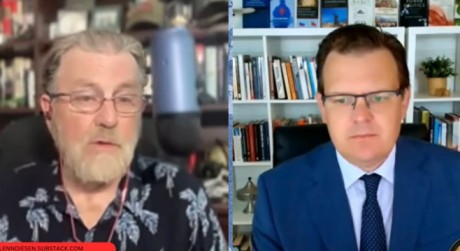
Read the full transcript of former CIA intelligence analyst Larry Johnson’s interview on Greater Eurasia Podcast, August 5, 2026.
EDITOR’S NOTES: In this interview, Professor Glenn Diesen speaks with former CIA intelligence analyst and State Department counterterrorism official Larry Johnson about the mounting desperation in Washington as U.S. weapons stockpiles rapidly deplete amid the conflict involving Iran. Johnson offers a candid assessment of America’s military limitations, the strategic fallout, and the broader geopolitical consequences.
Opening and the Strait of Hormuz Deal
Glenn Diesen: Welcome back, everyone. Larry Johnson joins us today, a former CIA analyst and former employee at the U.S. State Department’s Office of Counterterrorism, who now also writes on Sonar 21, and I’ve left a link in the description. So thank you, Larry. It’s great to see you again.
Larry Johnson: Professore, always a pleasure to be with you. You’re on the cutting edge.
Glenn Diesen: I try to be. Well, I guess the big news of the day seems to be that Iran and Oman are reportedly getting closer to an agreement on how to reopen shipping in the Strait of Hormuz. That is, well, allegedly the deal would entail that ships heading into the Persian Gulf would transit through the channel controlled or administered by Iran, while those who leave the Gulf will travel at the southern end near Oman.
Again, there’s a lot of secrecy around this thing, so I’m not sure if this is correct, but either way, it appears that these two sides are talking. In the past, the US threatened Oman not to make a deal with the Iranians. Now it seems that the US wouldn’t mind it, that there comes some kind of a deal that opens up the strait.
But of course, this will be a huge shift. Now Trump is talking about opening the Strait of Hormuz, but of course it was open. But if it reopens, it will be under partial Iranian administration, which is, I guess, a geopolitical defeat for the US. How do you see this? Because I remember once a few weeks ago Trump threatened to blow up Oman if they made such a deal, but of course, the situation in the international energy markets have changed a lot and the US position itself has changed.
The Economic Reality of the Strait of Hormuz Closure
Larry Johnson: Yeah, look, there’s so much lying going on right now and denial about the economic realities, the economic damage that’s been done. And with Trump insisting, “Oh yeah, no, we control the Strait of Hormuz. It’s under our control.” No, it’s not. You can say that. You can say also you own a unicorn with magic flying abilities. You can say that, but that does not make it true.
I would be surprised if Iran agrees to anything which limits its control over who goes in and out of the Persian Gulf right now. I think it has significant leverage over Oman with respect to coming up with a system where, whatever, if ships are allowed to go out only through the Omani Channel, they will have to pay a toll. And Oman will collect that toll and Iran will be a recipient for a certain percentage of those fees. Likewise, if Iran is collecting fees off of ships coming into the Persian Gulf, then Oman will be entitled to that. I think that’ll be something about the nature of the deal.
The problem, what undergirds all of this, it’s twofold. First, it is the disruption of key commodities for the global market. And it’s not just the disruption of the oil, which is predominantly sour crude, which means high sulfur content. The disruption of LNG, principally out of Qatar, connected to that, the disruption of 40% of the world’s supply of helium, because helium is a byproduct of the production of the liquid natural gas that was being pulled out of the ground in Qatar. And then the limited supplies, the decline of about 35% of the world’s supply of sulfur and urea, which play critical roles in a number of industrial processes, but especially with fertilizer.
So you’ve had this global disruption, and particularly for the oil that was coming out previously out of the Persian Gulf, there are four geographic centers of refinement for sour crude. And the sour crude is used to produce diesel and aviation fuel. Those four areas were the Gulf Coast of the United States, now called Gulf of America, previously Gulf of Mexico, India, then China, and last, I’ll put them together, Japan and South Korea.
Now, India’s refining production is way down simply because the United States got about 8 to 10% of its oil out of the Persian Gulf. And it’s important that people understand that how refineries are set up, they’re built to handle specific types of oil. The simplest way to say is they’re built up either to handle high sulfur content or low sulfur content. The low sulfur content is called sweet. United States produces tons of that. We got abundance. We produce so much we’re able to export that to other countries.
Our problem is only 30% of our refineries are set up to handle that sweet crude. 70% of our refineries are set up to handle the sour crude. That’s why the United States has to import it from Canada, Mexico, Venezuela, and formerly from Russia and the Persian Gulf. Well, now roughly 8 to 10% of what it used to import is no longer available. Meanwhile, the availability in places like India, China, and Japan, South Korea is reduced significantly.
So you’ve got it right off the bat. You’ve got a global shortage of diesel, aviation fuel, which is why the prices of those keep going up. And yet today in the futures oil market, they’re saying, “Oh, Brent, it’s dropped almost $20 in four or five days.” Everybody’s deluding themselves. “Oh, happy days are here again.
Glenn Diesen: It’s not.
Larry Johnson: It’s that they’re lying to themselves. They’re lying to the world. And you can tell those lies all you want, but then when you go to fill up your truck with diesel, reality hits you right in the face about the increased price.
Global Maritime Choke Points and the Coming Financial Crisis
And then related to that, step back and look at the global choke points for oil, for movement of all maritime traffic, not just oil, not just LNG, bulk goods, container ships. You got the Malacca Straits, okay, they’re open. You got the Strait of Hormuz, closed. You got Bab-el-Mandeb, restricted. You got the Suez Canal, so far still open. You got the Bosphorus, coming out of the Black Sea into the Mediterranean. You got Gibraltar and you got the Suez Canal, and the Suez Canal is screwed up. The lack of rainfall is preventing them from handling the number of ships that they normally did.
And China, despite all the US threats and attempts at exerting control over Panama, Panama has now made a secret deal with the Chinese. Chinese companies are back in control of the Panama Canal. So we’ve got a disruption, a global disruption on maritime supply routes, supply chains. You’ve got the economic, the recessionary, if not depression rate on global supplies. And yet everybody’s pretending, “Oh, everything’s cool, all’s normal, all good.”
Look, this is a financial crisis that when it explodes, it is going to be global and it is going to be devastating for countries around the world. And sitting there and pretending that it’s not real, “Oh, everything’s okay, we’ve got it under control.” They do not have it under control. It’s one damn lie after another.
Tolls, Fees, and Trump’s Path to Claiming Victory
Glenn Diesen: Yeah, well, we’re getting used to that with all of our wars. It’s all about narratives these days. I did notice though that you used the terms toll and fee, both of them. And I think the distinction between them will soon become quite important, because toll suggests one has to pay simply to transit through, while a fee can be something essentially one gets in return. That is, if it’s admin costs, environmental protection, search and rescue.
The reason I bring it up is because at some point, Trump will have to accept Iranian control over this, and his claim to victory then will be that Iran will not have any tolls. That means no money paid for simply transiting through, but they will have a fee. And so it will essentially, you know, it’s a bit of semantics. It’s still, they would all get paid for transit, but they will argue, “Well, we’re cleaning up the straits, you know, in case of accidents we have to help navigate the ships, we may have to do some rescue.” So they will come with the reasoning. But my prediction is that’s how Trump will call this a victory, by claiming no toll and then brushing off the fee thing as something not important.
America’s Depleting Weapons Stockpiles and the Gallium Crisis
Larry Johnson: Yeah. Well, look, Trump doesn’t have a viable military option to open the Strait of Hormuz. In fact, no country or group of countries in the world have the viable military capability to force open the Strait of Hormuz without suffering significant maritime losses. Iran simply is too well entrenched, too well armed to be able to carry that off in a way that it would force Iran to back off.
And what took place over the weekend where Trump had vowed a massive, massive campaign — now, I’m not sure it would have compared with what was done in the early days of this war, what was done between the first three or four weeks starting from February 28th — it was a significant, massive campaign, but turned out it did not weaken Iran. If anything, it strengthened Iran.
And I know that the US military people I was in touch with, they were geared up. They thought this thing was going to jump off on Saturday night at about 6:00 PM Eastern time. Didn’t happen. Trump pulled the plug. So the question is, why did he pull the plug? And I think it may be a combination of factors. One was reportedly he got a plea, an insistent plea from Saudi Arabia saying, “Don’t do it.” Because Iran said, “If you hit their power plants, if you hit their nuclear sites, they’re going to destroy ours.” And the Saudis said, “No, we don’t want any of that.”
The other element though is the United States is running out of weapons. And they keep claiming, “No, that’s not the case.” Nonsense. I just put a piece up at sonar21.com last night on gallium, “The Galling Reality of the Gallium Chokehold.” Because gallium is a critical mineral — you can’t build a functioning, fully functioning F-35 fifth generation fighter without it. And guess what? The United States’ supply of gallium is zero. It doesn’t have any. Where does it come from? China.
Gallium is a byproduct of aluminum production. The United States, when it moved away about 40 years ago from producing aluminum, let that production process go overseas to other countries, and lost its ability to take that aluminum and extract the gallium from it. So now the United States is totally dependent upon China, and China’s telling us, “We’re not giving you a damn ounce.”
And it’s not just for F-35s, it’s for precision strike missiles and other systems. We’re out of PAC-3s, we’re out of THAADs. They need gallium in those too. So the United States is now confronted with a situation where we want to use military force that we do not have, or if we use it in any sort of sustained, intense fashion, we’re going to deplete ourselves to a level that we cannot replace it within the foreseeable future, two to three years. Not replaceable. And this is not me being alarmist. This is an absolute fact. And they refuse, they keep denying, they keep lying about it. “Oh no, we got plenty.” No, you don’t.
The Counterproductive Effect of Escalation Against Iran
Glenn Diesen: And the horrible thing is that the gallium is also used in those radars, which the Iranians have been blowing up across the Middle East. And I might get the numbers wrong, but I think about 98 to 99% of the gallium comes out of China. So yeah, you’d better be real nice with China if you want to fight a war with China in the future, it seems.
But Trump, as I said, he issued now all this final warning. He said — well, he issues those every now and then — the final warning to Iran: “Now make a deal or we’ll annihilate you.” And I guess all these rounds of attacks on Iran, the objective is to wear them down, and either get them to capitulate or at least get a favorable deal out of them. But one gets the impression the opposite is achieved, because while of course Iran can be worn down a bit, you see these continued attacks on Iran, it suddenly makes them not believe in diplomacy anymore, for good reasons.
As you said, the energy markets and global economy also go from bad to worse. So the Iranians are getting the advantage, and as you suggested, every round of attacks, the US depletes its weapon stockpile. And the Iranians know this. So if the US is going to play hardball with the Iranians, they know there’s a limit to what the US can do now. So it seems as if all of this escalation could have the opposite effect.
But what do we actually know specifically about how bad the weapons shortage is? I mean, I guess it’s hard to have accurate information given that I assume there would be some secrecy around this. What weapons are missing?
America’s Depleting Weapons Stockpiles
LARRY JOHNSON: So you can go to open source. So I wrote about this. People can go back and look at March 3rd of this year at sonar21.com. And I went through the open source because the open source regarding the PAC-3 missile, the Patriot missile. And we know from open source that from 2015 to 2020, so that’s 6 years, the United States was producing, it said, between 100 and 300 a year. So just for the sake of estimate, I said, let’s go with 300 every year. Let’s give it the full benefit of the doubt, man. We were maxing it out.
Then for ’21, ’22, ’23, ’24, those 4 years they produced 500 a year. Okay, so that’s 2,000 plus 1,800, so that’s 3,800. And then in 2025, I think the number was they produced like 620. So that takes you up to like 4,200 and 4,260. That’s the maximum. So that was as the end of 2025.
Okay. Then you start doing subtraction. How many missiles were given to Ukraine that they fired? Remember, every time they fire a PAC-3, they’re firing 2 against 1 incoming target. Estimated they gave Ukraine roughly 1,000. Okay. So we go from 3,600 down to, or 4,600 down to 3,600. How many were given to Israel and used by Israel during the 12-Day War? Well, in June of 2025, take off another 800. How many have been used in the course of the first 42 days of this war this year and then over the last few weeks? Guarantee at least 1,500.
And then out of that, look at that, of that total 4,620 number, at least 1,500 of those had gone to foreign countries. So they’re out. For all practical purposes, they’re out. They can pretend, “Oh yeah, we got plenty.” Nonsense. They don’t. And it’s not a matter of just turning to Lockheed Martin and flipping the switch. “Okay, y’all build us some more.” Because they need the rare earth minerals.
I want to beat this into people’s heads. This is so critical to understand. It’s just not a matter of do we have the willpower to make it. Yeah, you might have the willpower, but you don’t have the material you need. And then on top of it, apparently, the PAC-3 missile has got like 20 or more subcontractors that each make like one little part, then each part has to be tested, so getting them assembled becomes a multi-year process. I mean, it’s insane.
So the United States could pretend, and the same, look, same with Tomahawks. Right now they’re saying the United States has about 2,000 left. All I can say is what we know for certain is during the first 5 weeks of the war that started on February 28th, the United States fired 850 according to US sources. So that got that down to 2,000. And remember, that’s 2,000 for the entire Department of Defense, all the regional commands, for Pacific Command, for European Command, for Central Command. I don’t think they give any to AFRICOM, Africa Command, or SOUTHCOM, the South America or South Central America Command.
But if you take 2,000 and divide it 3 ways, that means PACOM’s got 750, roughly, that Central Command has 750 and EUCOM has 750. PACOM says, “Hey, we need it in case we have to go to war with the Chinese.” And European Command says, “Hey, we got to have it in case we have to go to war with Russia.” And so if CENTCOM burned through 850 in 5 weeks, they’re left with 750 now. Tell me about how long you can sustain an intensive campaign.
So I mean, it’s like the United States has created a system that is so counterproductive that it cannot meet its own defense needs anymore. The supply chains are dependent upon China principally. And notice Iran doesn’t face those obstacles. Iran’s supply chains are secure with China, and with Russia. And it can build whatever it needs underground and has been building underground. And it’s not having to worry about going out and competing, having different publicly traded companies compete to build it. And you never get it built properly.
Narrative Control and Self-Delusion
GLENN DIESEN: Yeah, I see the benefit though in terms of seeming all-powerful. That is when Trump says, “Actually, we have more missiles now than we did before the war.” But still, when you look at the not just the numbers but the actions being taken, for example, when the US pulled its missiles out of East Asia to send it to the Middle East, or diverted from Europe down to the Middle East, obviously this wouldn’t be done if there wasn’t a shortage.
And as we see now, even in the media which has been cheering on this war, they’re now also recognizing increasingly that yes, this is a huge problem. And that is narrative control. You know, it can be quite powerful if one deters or fools the adversary, but self-delusion is something different. This is very dangerous.
AI Disinformation and the Reality on the Ground
LARRY JOHNSON: Well, and it’s not, Glenn, it’s not confined just to what’s going on with Iran. My God, it is. I challenge anybody to go on to Grok or Claude or ChatGPT or DeepSeek or KIMI, use any of them. And ask the question, “How much territory has Russia taken in Ukraine this year?” Oh my God, “Russia’s lost territory.” And you’re going, “What?”
I mean, what they’re basing it on, what these search engines are based on, is they take information from people like the Institute for the Study of War, and it’s algorithmically rated higher, more reliable than anything out of the Russian Ministry of Defense, and of what they call open-source intelligence, which is essentially CIA disinformation put out on the web. And these intelligence absolutely insist that Ukraine has taken more territory from Russia than Russia’s taken territory from Ukraine, despite the fact that right now in Sumy, you can see the armies have swept forward and are enclosing Sumy.
The same thing, the Russian army enclosing and encircling Kharkiv. They have advanced significantly, Konstantinovka in Ukraine, except Ukrainians keep saying, “Oh no, no, we still got control of that.” And so these AI search engines go, “Well, if Ukraine said it, it’s got to be true.” I mean, it’s just such total horseshit. But it’s put out there as a fact shaping public perceptions when the reality on the ground is 180 degrees opposite.
And we’re seeing the same thing with respect to Iran. They keep talking about Iran’s weakness. Iran has driven the United States military effectively out of the Persian Gulf. It’s knocked out at least 19 radars and/or satellite communication systems. It’s forced the United States to withdraw personnel from bases, army bases in Kuwait, from the naval base in Bahrain, from the Air Force base in Al Udeid in Qatar, and locate where are they going primarily? To Israel. They’ve even forced them out of air bases in Jordan because they’ve come under sustained attack.
Iran’s Escalation Strategy
GLENN DIESEN: But do you see Iran changing its posture a bit or its tactics? That is, I got the impression from the beginning of this war that Iran has been largely reacting to US moves. That is, if the US attacks, the Iranians respond in a somewhat symmetrical way. That is, it demonstrates its ability to go up the escalation ladder with the United States. And I think it’s been quite successful at this. And it’s also quite a powerful move because the US now knows that Iran predictably can escalate if it does. So the consequences of escalation are quite clear. It’s not as if they can bomb Iran’s, for example, critical infrastructure without seeing this exact same thing being hit across the Gulf states. So it knows it can’t pressure Iran further, which is why the US is cautious to go further up that escalation ladder. And indeed, it must de-escalate.
However, that being said, it also, by Iran simply responding to the US, it also handed a lot of power over to the US because it essentially gave the US escalation control. That is, it can decide when the war begins, it can bomb one week and then decide, “Oh, let’s negotiate the next.” And sometimes this seems to be coordinated, that the bombing begins when the stock market closes and then it ends when it opens. And we have, of course, these talks about, “Oh, now we’re going to talk again.”
But the problem is it also suggests why would the US have any restraint if it can decide when the war begins, when it ends? And I was wondering if you see any changes now with Iran, if they’re going essentially on the offensive, because Iran appears to have changed its approach a bit, as you saw with the attack on Jordan, as you mentioned. The US, I think the White House referred to it as a surprise attack on Jordan, but my God, there’s a war. The US attacked Iran. Yeah, it’s a bit strange to talk about a surprise attack, but what they meant was that the US had halted its bombing and assumed that then Iran has to do the same because Iran should always mirror what the US does. But do you see the Iranians essentially changing its game now, or may I read too much into this perhaps?
Iran Goes on the Offensive
LARRY JOHNSON: No, no, I don’t think you’re reading too much into it. I mean, let’s look at what’s happened over the course of the last 2 weeks, even after Iran has continued to attack US bases in Erbil, Iraq, that are primarily CIA special operations forces bases that are there to provide training and assistance to the Kurds in anticipation of the Kurds launching attacks inside Iran. So Iran has been ruthlessly and relentlessly attacking those. And blowing up both installations and personnel.
We saw yesterday again that Iran launched attacks in Kuwait at US military installations. So not waiting, not waiting for them to fire back. They’re going after them. I think today we’re going to see. So our Arbaeen is over. If I recall correctly, and Iraq is going to retaliate against the Saudis and the United States for that last attack that killed both IRGC and Iraqi members of their, let’s call it the paramilitary group that’s part of the government. They vowed they’d retaliate, but they were going to wait till after Arbaeen and the pilgrims are no longer at risk.
So no, yeah, Iran’s not going to sit back and be a punching bag anymore. And that was like the other night when they hit targets in Jordan. That was the surprise attack. They were quite clear, “Hey, we’re going after—” they saw something, they took a preemptive step against it.
Iran’s Long-Term Security Strategy
GLENN DIESEN: Yeah, that makes sense. But for the Iranians, the long-term ticket for security would be— I mean, if I was Iranian, I would want to essentially destroy the entire US military ecosystem of the region. That is, well, they have bases across the Gulf states. There will always be this incentive to build up an alliance. And indeed, well, this is not advocacy. I’m just saying, if I was Iranian, I see the security situation being in their shoes, this is how I would see it. That this should be the long-term path for security.
Now, you can achieve this through some means. You can, of course, control the Strait of Hormuz and put some geoeconomic pressure on the Gulf states to scale back their security partnership with the United States. Or you could just destroy all the bases and essentially make it clear to the US that its bases in the region are vulnerable. They’re not this asset, they’re a vulnerability, and also signal to the Gulf states that their countries will not be more secure, but they will be more exposed.
If that message comes across, the US would have an incentive to pull back a bit. I’m not sure if they can move everything to Israel, but essentially get rid of the bases in the near proximity of Iran. Because this will also shift the politics of the region by having US bases, as we also see in Europe. But do you see any— how do you see the likely success of that objective? Because it is quite a grand objective, one has to say. I mean, the US military is the most formidable in the world.
The Limits of US Military Power in the Gulf
Larry Johnson: Well, I disagree. It’s the most expensive in the world. Expensive and formidable are 2 different things. We’ve already demonstrated the limits of the power of the US Navy. On paper, yeah, man, you’ve got this powerful, these aircraft carriers, carrier strike groups, man, who can stand against them?
The Houthis, they demonstrated that over the course of 18 months, starting in December of 2023, once they declared a shutdown basically of normal ship traffic through the Red Sea. And then the first Operation Prosperity Guardian tried to stop them. And then Trump said, “Oh no, we’re not a bunch of wimps and weaklings like Biden. We’re going to show you Trump’s in charge now.”
And so Trump launched the new initiative, Operation Rough Rider, back in March of 2025. And 7 weeks later, after losing 1 MQ-9 Reaper per week, then each one goes for a tune of about $65 million apiece. So they came close to losing almost half a million dollars worth of Reapers. And then 3 F-18s that, under different, one fell off the ship, one got damaged by friendly fire, who knows what happened to the other one. And then those aircraft come up to probably another $300 million combined. So all of a sudden you’re out almost a billion dollars and Trump’s declared, “Oh, the Houthis have capitulated, we’re going home.”
The rest of the world saw it for what it was. The United States didn’t compel them militarily to surrender, not at all.
So what has transpired despite the promises of the United States to the Gulf Arabs? “We got your back. We’re here to defend you. Come on, trust us. Who can withstand us?” Now here those guys are 5 months later into this war going, “Looks like Iran can withstand you. Not only can Iran withstand you, Iran has forced you out, and you have been unable to protect us. You’ve been unable to defend us. You promised us these air defense systems that don’t work. You had to spend billions of dollars on your military equipment that doesn’t work. We’re less secure, not more secure now.”
And the United States, how has it replied? It’s abandoned those bases. In Al Udeid, it used to be the de facto forward headquarters of AFCENT, Air Force Central Command. The nominal base was in South Carolina, Shaw Air Force Base, but the actual commanding general, the staff, all the activity, it was there forward at Al Udeid because they had this massive billion-dollar-plus radar, couple of other radars. They were able to see everything in the area. They were on top of it.
And just before the start of the war, the Pentagon, Central Command, above us went, “You know what, it’s going to be too exposed there. We better get these guys out.” They relocated it all to Shaw Air Force Base. But they thought, “Hey, we still got the coverage of radar.” And within the first 2 weeks, Iran had destroyed the radar. So now they’re blind. Now they’re dependent upon AWACS and Poseidon P-8s to give them ISR information because the ground radars are gone. They’re history. And they’re not coming back soon because they too need gallium and other rare earth minerals. And the Chinese are saying, “No, we’re not selling you that.”
So the United States has been effectively run out of the Gulf. And I think much to the surprise and shock of the Saudis, Qataris, Bahrainis, et cetera. They keep trying to figure out how to rope the United States back in, but the United States does not have the abilities to sustain military operations at those forward locations.
The Diplomatic Impasse Between the US and Iran
Glenn Diesen: Yeah, that’s what I was thinking. Then given that the technologies now are quite different, that is the ballistic missiles and drones of Iran, can now target the bases. I mean, these US bases were not built for these technologies because they can’t protect them. All these fancy, expensive radars, I mean, they just became very attractive targets for the Iranians.
So you see this being a problem. Setting that region on fire has some profound implications for the world economy. You see the US weapons stockpiles being depleted. And as you said, there’s no convincing pathway to a military victory in which the Iranians will then capitulate and agree to have their state destroyed. So there’s no way of even opening the Strait of Hormuz.
And given all of this, at some point Trump will have to circle back from “I’m going to destroy Iran” to “Oh, negotiations are going great.” So at some point they will have to go back and talk to the Iranians. How do you see the pathway to diplomacy go now? Because they just got the MOU and Trump began to dispute the key points in the MOU hours after it was signed. But again, the Iranians don’t trust Americans, but at some point they do have to talk to them as well. And Iran has some interest, I guess, in terms of getting sanctions relief or whatever the US might be willing to offer or reparations. So how do you see diplomacy playing out again? Because if I was Iranian, I would want to talk to the Americans, but I wouldn’t trust them for a second. So how would those negotiations look like?
Larry Johnson: Well, you’ve got the Trump public negotiation, which starts with these threats and attempt to coerce the Iranians. And then his famous taco move, as they’re calling it. Trump always chickens out.
There is a diplomatic impasse right now. The impasse is this. The Trump team’s position is Iran must negotiate on the nuclear issue first and foremost before anything else. The Trump team needs a victory to show that, okay, we’ve basically going back to the JCPOA. That’s all it is.
Iran’s saying, “No, we’re not going to negotiate anything about any nuclear issue, whether it’s enrichment or the possibility of building a nuclear weapon, until you fulfill the MOU, which means Israel withdraws from southern Lebanon, you lift the blockade, you lift the sanctions, you unfreeze the assets, and you acknowledge that we’ve got control of the Strait of Hormuz.”
And right now, the United States is not willing to do that. But the problem Trump is going to face is going to be on the economic front. They’ve been able to mitigate, cover up so far the actual effect on diesel, aviation fuel. They’ve been able to pretend that everything’s okay, but it’s not okay. And the international financial market is not okay. The dollar on the international market is not okay. People aren’t lining up to buy the dollar, just the opposite.
Whereas the Chinese are in a much stronger position. They’ve been buying gold like mad and stockpiling gold. Why? Because they’re going to have a gold-backed currency. And when people around the world are looking to invest, do you want to invest in the United States where you just got Donald Trump’s promise, “Oh yeah, we’ll gladly pay you Tuesday for a hamburger today”? Or do you go with the Chinese and say, “Hey, ours is gold-backed. You buy it, you get guaranteed for each dollar will have X amount of value on gold depending on what the gold market is.”
So China is rapidly moving along with Russia. They’re building up the whole BRICS economic infrastructure. And the United States is going to have to contend with that because the impact of the shutdown of the Persian Gulf right now, it’s a global economic impact.
Now, China, for its effort, on one hand, is trying to mitigate that because they depend upon exporting to the Global South. But at the same time, they’ve shown no indication that they’re going to abandon Iran and force Iran to surrender to the United States. Just the opposite. Because the Chinese recognize as well, they’re next on the menu. If Iran goes down, if Russia goes down, China’s next on the menu. And China, they understand this. So they’re planning for it and are prepared to deal with that.
That’s where the United States hasn’t even planned for this. We thought, “Oh well, the supply of rare earth minerals, that’ll take care of itself somehow.” And any solutions are a good 3 to 5 years away for the West.
So I think the economic realities are ultimately going to be what’s going to compel Trump. He’s going to have to make concessions to Iran that will basically establish Iran as a winner in this confrontation. It’ll drive the neocons and the Zionists crazy. But it’s not like the United States lacks the will to use military power. It doesn’t have the military power to use in a way that it’s willing to incur the losses that would accompany its use.
The Saudi-Yemen Conflict and Iran’s Mediating Role
Glenn Diesen: I always make the point that in Europe they seem always convinced that whatever limits the US is never its capabilities but always the intention. So if the US just gets committed to something, then it will prevail because its resources are seemingly unlimited. But yeah, that’s what we’re seeing is obviously not the case.
But given that Iran is now, as the US military all starts to break down in the Middle East, they will have to coordinate or adjust their demands accordingly. And of course, one of the things they want an immediate end to is the US naval blockade on the Strait of Hormuz. As we see, the US even denied some states — like Qatar was transferring LNG out of the Strait of Hormuz to Pakistan, but because they used the Iranian route and made a deal with Iran, the Americans blocked it, which I thought was fascinating.
So the Iranians want an end to the blockade on the Strait of Hormuz, but they also want the Saudi blockade to end. But again, the Saudis aren’t just an American proxy, they also have their own skin in the game here. So how do you see the possibility of Iran resolving this issue between Yemen and Saudi Arabia? Because as this war widens and expands, it becomes very complicated to resolve.
Larry Johnson: Yeah, actually, I think they’re going to stay out of it because you’re going to see Iraq, the elements in Iraq now, they’re going to retaliate.
Glenn Diesen: I don’t know if it would be today or tomorrow.
Larry Johnson: But they’re going to hit Saudi targets. And Yemen continues to hit targets in Saudi Arabia. So the combination of Iraq and Yemen, that will compel the Saudis back to a negotiated settlement because particularly with Ansar Allah, they can inflict a lot more damage on the Saudis than the Saudis can on Ansar Allah or the Houthis. Just a fact of the nature of the differences in infrastructure and sophistication of the oil industry in the respective countries.
So the Saudis, if they want to stay viable without losing their oil terminals at Yanbu, they’re going to have to negotiate with the Houthis. And I think to that extent, Iran would play a mediating role, would be happy to help the Saudis and be offering conciliation in that regard.
But the Houthis are not some puppet of Iran despite the way that the West likes to portray it. The Houthis are their own critters. They are actually the original Arab inhabitants of the Saudi Arabian Peninsula. The Saudis were just a bunch of nomadic Bedouins that got lucky with oil and then became the dominant power. But the reality is in terms of native population and history, the folks in Yemen and the Houthis in particular, they’re the ancient Arabs in the region. So they’re pursuing their own objectives and they’re not — I suspect they’re coordinating with Iran, but it’s not critical for them. But I think they’ll be amenable to listening to Iran provided that the Saudis stop attacking them and lift the blockade.
Iran’s Growing Missile Capabilities
Glenn Diesen: Yeah, I agree. I think the way they’re portrayed as simply being proxies of Iran, again, it’s the same dangerous self-delusion pretending they’re just an arm of the Iranian government. It’s appealing, I guess, to portray them as such, but they have their own autonomy, they have their own interests. And I think the Yemen-Saudi conflict, as I said, it has a life of its own independently of what’s happening between the US and Iran.
My last question, though, was just about, as the US military capabilities are diminishing in the region, we see also a different development, which is quite interesting. That is also reported in the Western media, who have no love for Iran, which points out that Iranian missile capabilities appear to be increasing. You would think at the end of the war they would be at their head; they would be getting worse. But you see, even the larger papers in the US recognizing that the missiles are getting faster; they are able to evade missile defense to a greater extent, and they’re getting much more deadly.
How do you explain this? I mean, I’ve seen some leading hypotheses that the Chinese and the Russians are assisting in picking targets, etc. And again, if I was Chinese or Russian, I would be definitely helping, otherwise those weapons would be coming for me. So I would see a common cause with the Iranians. But are there any other explanations? How do you explain this, the enhanced capabilities of the Iranians?
Iran’s Missile Capabilities and the China Factor
Larry Johnson: Well, there are a couple of several factors. Number one, during the 12-day war in 2025, Iran relied upon GPS for targeting its missiles and discovered only to its chagrin that the United States and Mossad could backdoor the GPS and actually divert missiles from their intended targets. So that reduced the effectiveness of Iranian missile launches in that 12-day war in 2025.
By the start of the war this year, on the 28th of February, Iran had moved to the Beidou system, the Chinese system for targeting, and it has proved much more effective. It is immune from US-Israeli hacking. And so they’ve been very effective in the targeting. That’s number one.
Number two, the Iranian missile factories, they’re underground. They built them underground expressly to resist the possibility of a nuclear attack, and they have uninterrupted supply chains from Russia and China, plus what they produce on their own. So they’re able to continue whatever they’re using and launching, they’re actually able to replace some of it in fairly close, short order.
Third, they are getting targeting data and assistance from both Russia and Chinese intelligence, as well as China has introduced some of its own missile systems into the Iranian arsenal to test them in a wartime environment, see how they work. You know, China has got all these missiles, and on paper they are supposed to work out on the range, but they have not actually been tried in a combat environment. So this is where they get to test.
The Iranians are happy to fire them. They have got Chinese technicians which come in and help get them configured properly, and then they fire them against US targets. And that way they come away and say, “Hey, that works, that doesn’t work, this is the problem.” So it’s both sort of R&D for future conflict, let’s call it that.
Parallels with NATO’s Strategy in Ukraine
Glenn Diesen: It almost sounds like you’re describing what NATO’s been doing in Ukraine, because there as well you see different NATO countries, arms manufacturers get to test out their new weapons against the Russians. So they get to develop weapons and test them, but also at the same time they get to weaken a strategic rival.
I guess it would be expected if China does the exact same thing, right? Because the NATO countries can’t keep setting dates for a war with Russia and planning for a future war with China and expect them to just sit idly by and allow the NATO countries to decide when the war will be waged upon them. So I guess, yeah, they would do the exact same. Anyways, any final thoughts before we finish off?
Final Thoughts: Escalation and the Strait of Hormuz
Larry Johnson: I think we’re going to see some more back and forth. I think potentially today or later we’ll see the US retaliating for the attacks in Kuwait, and then Iran will retaliate in turn for that. So this back and forth — the claims that the Trump administration is making is that, “Oh, we got advanced talks and we’re going to get the Strait of Hormuz open.” I wouldn’t go to the bank and bet on that.
Glenn Diesen: No. No, but the desperation is definitely setting in and that’s usually not a good thing. Then people deal with things. Anyways, Larry, always a pleasure. Thank you so much.
Larry Johnson: Hey, Professor, good to be with you. Thanks, Glenn.
Related Posts
- Transcript: Nepal PM Balen Shah’s Speech At UN General Assembly 81st Session
- Transcript: President Trump and the President Xi Remarks at a State Dinner
- Transcript: Israeli PM Netanyahu Addresses UN General Debate, 81st Session
- Transcript: President Trump and President Xi Deliver Remarks at Arrival Ceremony
- Transcript: Secretary Marco Rubio Remarks at Press Conference in New York City – Sep 23, 2026