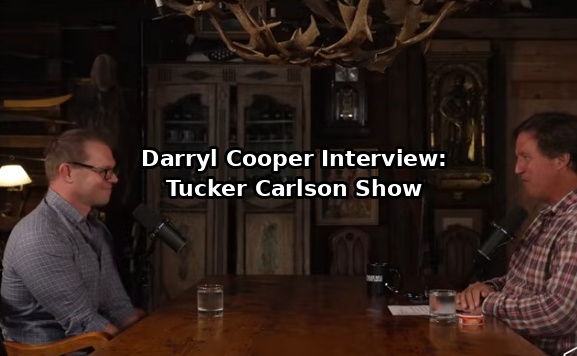
The following is the full transcript of historian Darryl Cooper’s interview on Tucker Carlson Show, August 4, 2026.
EDITOR’S NOTES: In this in-depth interview, Tucker Carlson speaks with historian and podcaster Darryl Cooper—creator of the popular long-form history series Martyr Made—about why the conflict with Iran represents a pivotal moment in world history. Their discussion ranges across Zionism, the clash of Christian and Islamic civilizations, and the scale of demographic change underway in Spain. Cooper brings a sweeping historical lens to these urgent geopolitical questions.
Tucker Carlson Interviews Darryl Cooper on the Great Replacement
Tucker Carlson: Darryl, thank you for doing this. We must think of you every two weeks. We should call it Darryl Cooper. But we try to keep it to once a year because you live so far away. And I’m just grateful that you made this effort. And I just have to say, not simply because it vindicates me, but just because it’s such an amazing and wonderful fact that you actually are literally, measurably America’s most popular and important historian. That’s just a fact. It’s incredible. It gives me hope. Because you do like 5-hour podcasts on things that happened 100 years ago in granular detail. And there are a million and a half people listening to that. It’s like, this country is not lost. So anyway, thank you so much.
Darryl Cooper: Always a pleasure.
The Decline of Honorable Warfare
Tucker Carlson: We were speaking at breakfast about how the Iran War started, and you were putting it within the context of how Western nations, European nations fight wars historically, and why this was different. Can you recap what you were just saying?
Darryl Cooper: Sure. I mean, I think that when you look back at the period of limited warfare in the 18th and first half of the 19th century, that was really one of the pinnacles of not just our civilization but human civilization in general. War is something that is sometimes necessary. Sometimes interests conflict and you have to fight over it. But to be able to arrive at a place where you can treat your enemy with respect, even in defeat, is really an amazing accomplishment.
And you start to see the breakdown of that over the course of the 20th century, of course, the First World War. But even still, there was a sense of, what’s the saying, that hypocrisy is the tribute that virtue pays the vice, right? We still had to pretend, we still had to come up with stories to tell ourselves so that we could go to sleep at night. We hadn’t given up on those values completely.
Tucker Carlson: And what are the values?
Darryl Cooper: Fair play.
Tucker Carlson: Yes.
Darryl Cooper: The idea that even somebody who you have to put bullets downrange at is a human being, and deserves to be treated as a creature of God. These are things that became very deeply embedded in our social consciousness and as individuals as well. So that again, even as those values started to fade in practice, we still held on to them in our hearts.
And I think a lot of people today, or well, I should say maybe a few years back, just a few years ago, if you talk to your average American soldier in Iraq, for example. Well, actually, that’s a perfect example. If you look at Iraq, I have a lot of anti-war libertarian type friends, and they’re very strident in their views sometimes of American militarism. And I always tell them, look, when you compare — there were incidents in the Iraq War, no doubt about it, in the Afghanistan War where soldiers got out of hand. But when you compare their behavior, the level of discipline and honor that they displayed in those wars relative to any previous conflict in American history or world history, probably, let alone in a really vicious insurgency like they were fighting.
This was not a conventional war. It was, especially in Iraq, the enemy was vicious on a level that is hard for most people, I think, in our society to really even believe. And yet our guys continued to treat the people who were under occupation with dignity and respect by and large. And they really did have the idea that they were there to try to help these people and to free them from this. Again, whether we agree with that or not, they believed that. And if they hadn’t believed that, they would not have been as willing to risk themselves and their friends the way that they did.
I mean, we took a lot of casualties in Iraq and Afghanistan because we refused to do certain things that we could have done much easier. We could have done it in ways that would have killed a lot more of their civilians, but preserved a few of our soldiers’ lives.
Tucker Carlson: Yes.
Compromising Our Values for Political Convenience
Darryl Cooper: And we chose not to do that. And that, it’s unfortunate because over the course of the war on terror, and I think largely in more recent years due to our just compulsive need in our political discourse to find ways to rationalize everything that we see the state of Israel do, it’s forced us to really compromise on a lot of those values. Because if you don’t compromise on them, then you have to condemn what’s going on in Gaza, right?
Tucker Carlson: Exactly.
Darryl Cooper: And so we’ve lost a lot of that over the course of the last few decades.
Tucker Carlson: We’ve been poisoned and polluted by it.
Darryl Cooper: I had this dark thought. I think I mentioned this to our friend Scott Horton a while back. Back in 2004 when Abu Ghraib happened, or when the photos came out, again, I don’t want to downplay it, it was a very dark chapter, obviously.
Tucker Carlson: Yes.
Darryl Cooper: And yet people saw those photos and they were horrified by them. And they weren’t just horrified by, “look what we’re doing to those people.” They asked themselves, “what are we doing to our own people here? What are we making our kids do in this place? What is happening here?”
And nowadays, I don’t know if people would blink if they saw something like that. I mean, they do see something like that on a weekly basis come out of Gaza, often posted by Israeli soldiers themselves. And people have to find a way, it seems, to rationalize and justify that stuff. And so to do that, they’ve compromised their own most deeply held beliefs about what it means to be a civilized person.
The Iran War and the Sneak Attack
And so when we go into Iran, I’ll never forget when Donald Trump was entertaining the Prime Minister of Japan and he mentioned the secrecy and the sneak attack that we started the Iran War off with. And he kind of made that sly joke about, “you guys understand sneak attacks, right?” And for the President of the United States to compare — correctly, in my view — the way we began this war to the day that shall live in infamy, and to think back to Pearl Harbor and how they felt about that at the time, how we still feel about it now.
And then if you imagine that the attackers at Pearl Harbor had just happened to blow up a school full of little girls, I mean, it would be on page one of every history book that talked about that incident to this day, right? Because it’s something that offends our basic sense of decency and honor. You don’t launch a sneak attack in the middle of negotiations. That’s just not the way European civilization has conditioned itself to behave over the years.
But we’ve compromised that stuff in very recent years, to the point where the cognitive dissonance became so great that we either had to change our ways or we had to just give up on certain values. And I unfortunately think that, at least our political class has gone the wrong direction on that.
Our guys out there, our soldiers and Marines — it’s always tough for me because I don’t like a lot of the actions that they’re forced to take overseas in service of things that I think are beneath them. And yet I know from personal experience that the guys themselves, those are our best people. And they’re often criticized by people who are not fit to tie their bootlaces.
Those guys, if you give them a good reason, they will go fight. They will risk their own life unnecessarily to avoid the possibility of harming an enemy civilian. That’s who these guys are. But when you remove that sense of honor — that’s been on every recruiting ad and recruiting poster going back as far as you can imagine — when you tell them that we’re going to launch a sneak attack in the middle of negotiations on a much weaker country, we’re going to threaten to end their civilization and destroy their civilian infrastructure over a war we started for reasons that nobody’s really bothered to even articulate to the American public, it becomes much more difficult to get those guys to do their job.
And I think that within the service, these guys are still duty-bound enough that they will do whatever we ask them to do. But that’s all the more reason not to abuse that trust. And we really have. We’ve just burned that credibility with our own people and I think with much of the rest of the world.
The Origins of Honorable Warfare in European Civilization
Tucker Carlson: What does it do to us? Like, why would a civilization decide at its peak evolution, as you just said, the high point of its existence, that it was going to treat enemy combatants as human beings? That is a kind of new innovation in world history, right? Is there any evidence that’s ever happened before at any time ever?
Darryl Cooper: Outside of European civilization, it would be really hard to think of any examples.
Tucker Carlson: Because traditionally, when I’m at war with you, I get to torture you to death, enslave your children, rape your wife, burn your fields, slay your livestock, literally whatever I want. I own you. You’re not human.
Darryl Cooper: Right. And that’s something that only emerges under conditions of strong organization, leadership, internal discipline, and really just the organizational aspect of it, right?
When you look at World War I, for example, absolutely savage war where we were spraying cans of raid at enemy lines just to choke people to death with gases. Horrible, horrible exterminationist war. But one that was almost entirely restricted to enemy soldiers. And when soldiers were taken captive, they were treated with dignity and respect by all sides, by the way.
And when you see in Eastern and Central Europe immediately after the war, the same people who just fought this relatively organized, relatively disciplined war from 1914 to 1918 — when all the empires broke down and the states fell apart and organization went away — you saw a descent into chaos and madness that’s straight out of ancient history books, where wars became exterminationist to entire societies, where the goal was to wipe people out and push them out. And these are the same people who were fighting the war in a relatively peaceful way.
Tucker Carlson: We’re celebrating Christmas across the trenches famously, right?
The Collapse of Civilization and the Degradation of the Human Spirit
Darryl Cooper: I mean, that was Western Front guys, but on the Eastern, because it was in the States specifically where everything fell apart, where the gov— I mean, just, this is something that I’ve really been trying to convey in my World War II series right now because I think it’s very difficult for most Westerners to really picture the trauma that this would cause.
I mean, when I was talking to friend Jocko a while back, and he was describing how they’d be fighting in Ramadi. And it’s just an insane gun battle, mortars going off, explosions, gunshots going everywhere. And so they would kick down a door, take cover inside of a building, and it’s somebody’s house. And there’s the wife and the kids are hiding under the table. And that’s what’s going on. You have this flash of like, oh, wow, this is happening outside somebody’s front door.
And so back after the First World War, when the German Empire, the Austro-Hungarian Empire, and the Russian Empire— so basically everywhere from the Rhine to Vladivostok— the government just disappeared. All of them, in the course of about 18 months or so, all the governments disappeared. There’s no police to call. There’s no government to expect to come in and enforce order of any kind. You really saw a complete descent into primitive sort of human tendencies as people started to really focus on their immediate survival as opposed to things that we would associate with civilization.
Meaning that the idea that you’re living historically and are part of a chain of being that stretches out long before you were born and will continue long after you’re dead. And there’s certain things that you’re expected to uphold as you steward— you know, through these 70 or 80 years of your existence, when it’s your turn to steward your civilization, there’s certain things that you’re expected to uphold and make sure that the next generation inherits them just as you inherited them.
When all that falls apart and your time horizon collapses to this afternoon because you’re looking at your kids and there’s no food and they’re hungry and their bellies are bulging and their cheeks are sunken in, there’s not going to be anything on your mind except for how do I feed my children? And when people’s horizon shrinks down to that level, they become something very close to animals. And that’s what you saw happen immediately after the First World War in a lot of Eastern Central Europe.
And so this is something that, from a basic level, you can think of a lot of things like this where, if you’re the only person behaving this way, then it really makes no sense and you’re just going to end up nailed to a cross. That’s what’s going to happen to you. But if everybody can come around and embrace these values and basically behave this way, then it’s much, much better for everybody.
And when you’re able to achieve that, when you’re able to get to a place where— because America had a reputation. It’s not perfect, especially in what we used to call the Third World, but had a reputation that we might get carried away in a counterinsurgency setting. We may in a total war like the Second World War drive ourselves to the point that we’re firebombing cities, but there are still certain basic rules of fairness. Like you don’t start a war of aggression with a sneak attack in the middle of negotiations, that people would have said, yeah, but America wouldn’t do that. Even our enemies would have said that. And when you have achieved that, when you’ve gotten to a place where that really is true of your people, that’s something that you really have to hold on to because the minute you let go of it, you let go of that bar, that ledge, you start falling down into that very dark place.
Tucker Carlson: And the way you understand yourself changes, which is— I’m not saying it’s the most important thing. How you treat other people is the most important thing. However, it’s not unimportant how you see yourself. Like, “I’m the sort of man who will do this. I’m the sort of man who will refuse to do that.” And I think that’s the idea from which self-respect and dignity grows, right?
Darryl Cooper: Right. And our civilization is emergent from our collective quality in that sense. How individuals see themselves— the sum of all those self-perceptions adds up to a society and a civilization eventually and the direction that it’s going to take. And when you stop seeing and treating people you’re in conflict with as human beings and see them just purely as a material obstacle to whatever goal you’ve set for yourself, you’re handing the reins over to Satan at that point.
The Moral Cost of Prolonged War
Tucker Carlson: I so strongly agree. The most distressing part of all of this— I had the same thoughts when this war started. It’s hard to believe that— in fact, I couldn’t believe we did that— or when we double-tapped the girls’ school. Even now, it’s hard to believe that could have been intentional. But the unwillingness of the Secretary of War or the president to apologize for it— they’ve never apologized for it— suggests that—
Darryl Cooper: And at first trying to deny that it was us. I mean, it’s just like— if I was the emperor of the United States— and you’d have to be the emperor because if you’re an elected official, our system just doesn’t— it’s not built to incentivize this kind of behavior. You could stay at war with Iran, fine, if there are reasons to be at war. I would offer restitution to the families of those girls. In the middle of the war, I would do it. And I think that kind of thing goes a long way.
Tucker Carlson: But what’s so distressing is not just that Trump did this. Obviously, Trump is totally degraded as a person. That’s widely known. But there was no kind of popular reaction against it. There were no protests. There were zero antiwar protests or zero anti-double tapping girls’ school protests. There were almost no commentary on the fact it was a Pearl Harbor that we committed.
Darryl Cooper: Yeah, I think about this a lot. One time when I was still with the DOD, I was out training a ship’s crew on their missile defense system, or their air defense system. This was maybe— it must have been 2019 or early 2020, just before COVID because everybody’s talking about the election that was coming up. And I remember one of the kids on the ship was 17 years old. His parents had to sign on the dotted line to let him get in under 18 years old. And it hit me— this kid wasn’t alive when 9/11 happened, which means for his entire life— and the people who are going to go out and protest, these are 17 to 25-year-olds traditionally, right? That entire generation, we’ve been doing this stuff since as long as they can remember. Abu Ghraib, they probably—
Tucker Carlson: It was—
Darryl Cooper: That was something they learned about in a history class because they were 3 or 4 years old. And so we’ve been at war. And this is one of the real issues with prolonged, protracted war— the degradation of the spirit of the society and communities that are engaged in it.
If you look at any conflict that’s been really long-running— the Israelis and the Palestinians, or the Israelis in the surrounding region in general, the Balkan Wars, for example— go to the Balkans today, you meet Serbs. My great-grandmother was from Serbia. You go meet them, they’re just Europeans, they’re fine. It was not that long ago that they were fighting an absolutely savage war, at the bottom level of human conflict. And you say, well, how is this even possible? It’s like, well, because when you’re engaged in a conflict for that long— you’re fighting a conflict your parents were fighting and their parents might have been fighting— the hatred that is necessary to keep a conflict like that going over time just comes to define who you are in important ways until you get out of that conflict cycle.
And that comes back to what I said about Abu Ghraib a minute ago. People would have protested if we had opened the Iraq War in 2003 by killing 150 little girls. People would have had a problem with that. They wouldn’t have overthrown the government. They wouldn’t have necessarily forced them to stop the war or anything like that, but people would have had a problem with it. And public officials would have felt the need to explain themselves. But when that’s all you’ve known, and anybody under really 30 years old at this point, this has been their entire lives, it’s not as shocking. It’s just how the world works as far as they know.
Gaza, the Zionist Lobby, and the Corruption of the American Soul
Tucker Carlson: Is that why Israel’s been able to ethnically cleanse the territories, Gaza most of all, without anyone in our political class saying anything about it?
Darryl Cooper: It’s definitely one of the reasons. And I think there’s a tendency among really strong American Zionist elements— and by strong, I mean the people who this is sort of their first and only issue, or at least their bottom line—
Tucker Carlson: There are many of those.
Darryl Cooper: There’s been a push to sort of desensitize people to that kind of thing. And here’s a perfect example. When you were on— I believe it was your interview with Rogan— and you said the outrageous, just insane thing that maybe we shouldn’t have nuked a couple cities full of civilians in Japan. And of all the things that you said in that interview, that was the thing that people were just so angry and so outraged by, right? Because the minute you start asking those kind of questions, that attitude carries over into the modern day and you start judging decisions that we’re making now according to these very human standards. And absolute standards, like it’s always wrong to murder civilians, right?
Tucker Carlson: No matter who does it.
Darryl Cooper: And because look, the bottom line is, for all of the influence and power that the Zionist lobby has in the United States, if Americans saw what was going on with the Palestinians and did not approve of it and demanded an end to it, they would have to stop. That’s the bottom line. And so it’s a strategic imperative for them, for people like—
Tucker Carlson: To corrupt people so completely that they don’t even care that they’re paying for genocide.
Darryl Cooper: Yep.
Tucker Carlson: And just to rot the souls of the host nation so thoroughly that it’s like, no, that’s fine.
Darryl Cooper: It’s a strategic imperative.
Tucker Carlson: Yeah. Okay. Boy, what a cost to us.
Darryl Cooper: To them too. They might not know it, but to them too.
Tucker Carlson: What do you mean?
Darryl Cooper: The corruption— it corrupts the heart of the corruptor just as much. So they suffer from it as well, even if they don’t know it.
Where Does This War Go?
Tucker Carlson: So where does this war go? I should just say, for those who aren’t familiar with your bio, you spent 20 years working for the Defense Department, 10 active, 10 as a contractor. I think that’s right. Working a lot of the time on missiles and missile defense. So I would say you’re literally an expert on that subject. And our munitions stock is like a big factor in how this goes going forward. So where does this war go, do you think?
The Limits of U.S. Military Power: Missile Defense and the War with Iran
Darryl Cooper: You know, it’s hard for me to imagine. We were talking about this beforehand about how I’m always just hopelessly naive and optimistic when it comes to all these things. I was the guy, full admission, before the Russian invasion of Ukraine who was being like, no, I don’t think they’ll do it. That would be crazy.
Tucker Carlson: That’s— I said that on TV, unfortunately.
Darryl Cooper: Same thing as we were building up all of our munitions for this attack on Iran. I was the one saying, it just doesn’t make any sense. You know, just from a technical standpoint, from a logistical standpoint, this doesn’t make any sense because we’re not going to invade Iran. Iran knows we’re not going to invade Iran. I’m doing it again, by the way, right there. But this was my thinking.
And so, knowing those things, there are just certain limitations to what we can do in a standoff war, meaning a war where we’re mostly launching munitions from outside of Iran’s borders, for fear of their own air defense network and flying our own manned aircraft over them. Also, our strategy has changed over the course of the War on Terror. We have this very strong dependence on unmanned drones, the Reapers now, the Predators famously in the Iraq and Afghanistan War, where we’ve come to rely on them to a tremendous degree. But those things are not stealth platforms. You can’t get real close with them. What you can do is launch long-range standoff weapons from far away, but there’s only so much you can do with these things.
People have this idea, I think, like if a missile hits this building that we’re in, that’s going to be really bad news for us. The people across the street, they’ll probably be fine. These things are not nuclear weapons. Like a Tomahawk missile. You remember back when in the first Trump administration when he launched those Tomahawks at that Syrian airfield because they supposedly used chemical weapons? Yeah, launch something like—
Tucker Carlson: —that was a lie, I think we know.
Darryl Cooper: Yeah, yeah. He launched something like 80 Tomahawk missiles at this airfield, and it was back up and running a week and a half later. I mean, these things are not massive payload because they got to fly 600 miles or something to get to the target, right? So a huge portion of it is just the rocket fuel to get it there. And so the payloads are 500 pounds, maybe, you know, a little more or less than that, which is, again, if you’re in the building, that’s bad news. But you’re not going to level a civilization as Donald Trump keeps threatening, using standoff weapons like that.
And so knowing that, and having a rough idea — it’s been a while since I’ve been in the game — but having a rough idea of what our stockpiles are, of what’s involved with fighting a long-distance war like that where our bases that are in theater are under assault and mostly not usable, it makes the logistical element extremely difficult.
The Limits of Naval Firepower: Missiles, Reloading, and Logistics
I was describing to you how if you have a, say, a destroyer, which is our primary air and ballistic missile defense platform, and also the platform from which we launch our Tomahawk missiles — and we have submarines as well, but mostly destroyers and cruisers, and more destroyers than cruisers now — you’ve got 128 missile cells. Some of those are going to be intermediate-range anti-aircraft, anti-cruise missile, SM-2 type missiles. Some of those are going to be Tomahawks, and depending on what the mission is will depend on the total loadout, but some of those are going to be Tomahawks. Some of those are going to be vertically launched torpedoes. Some of those are going to be really short-range ESSMs. And then some of them are going to be long-range ballistic missile defense missiles, right?
So let’s say you’ve got 32 long-range anti-ballistic missile defense missiles. When a missile’s coming in, you don’t fire one missile at it. You fire 2 in each volley, and usually you’re sending multiple volleys before the first volley even reaches its target because you want to be pretty sure. Things are traveling so fast that you don’t want to necessarily find out that you missed the first time and then have to make the decision to fire again. So multiple missiles each time. If you’ve got 32 missiles, you’ll be lucky if — really lucky, I mean, this is if everything goes absolutely perfectly — if you can shoot down 8 incoming with that.
Well, what happens then? You don’t have a supply ship that rolls up and gives you another magazine of missiles to pop in. You got to go back to one of the very few bases around the world where we’ve got large stockpiles of those missiles and the facilities on base to reload them. And it’s hard hats and cranes, and it takes multiple days just to do that, let alone the trip.
Tucker Carlson: Just to reload takes a couple of days.
Darryl Cooper: Just to reload. And that’s not counting the time it takes to transit going all the way to Diego Garcia and back.
Tucker Carlson: And can you, for those who don’t have a map handy, is Diego Garcia right around the corner?
Darryl Cooper: No, it’s way out in the middle of the Indian Ocean. You know, it takes, depending on the platform or the ship that’s going out to it, close to a week to get out there. One way. Yeah. And then a couple of days to reload as well.
And so one of our ships is out there, maybe it gets shots off at 8 missiles, and then it’s got to take 2 and a half weeks to go reload its missiles and come back. It’s just something that was not sustainable. And it’s one of the reasons that I just thought, this is crazy. I don’t think they’re going to do this because it just makes no sense.
Missile Defense Testing vs. Real-World Conditions
And as we saw, it made even less sense than I thought, because one of the things that those of us who were on the technical side of missile defense understood for a long time — that the general public and honestly a lot of government and even military officials, I think high-level military officials, didn’t understand — was that certain aspects of the data might have gotten to them, but the narrative that got to them was very often rose-colored, in terms of what our actual capabilities were.
If we want to do a missile defense test, a ballistic missile defense test, we will wait until all of the conditions environmentally are perfect. We will do it at a specific time where they’ll say countdown 10, 9, 8, so you know exactly when they’re launching, exactly where they’re launching from, exactly where that missile is headed. And we place our assets, our radar and our missile launchers, in specifically the place that will give them the absolute best view and best chance of engaging that target.
Tucker Carlson: What, this is during a test?
Darryl Cooper: This is during a test, right? Because we’re trying to baseline the system. We want our data to be something that, under absolutely controlled conditions, or to the extent that we can make them that way, we know what our data is going to read. And then we can judge deviations from there. And there we’ll often, we’ll usually hit the thing, but not always. Still tough. It’s hard to do. Ballistic missiles are very difficult.
And this is something, by the way, that even through government shutdowns and everything like that, it was basically SOCOM and ballistic missile defense that just had unlimited money. We were the two that never shut down, never had any of our budgets looked at anything like that. We placed a very high priority on it. And so from a technical standpoint, we knew it was very difficult to shoot down a ballistic missile.
The Reality of Iran’s Missile Campaign
About a week or so into the war with Iran, I’m watching all these videos — just crazy, like the footage we get out of these wars now. And you’ll see a ballistic missile coming in, and you’ll see a volley of 2, volley of 4, or 2 volleys of 2, go up and engage the missile. Very often the missile would land and blow up somewhere where it was headed.
But then after about 10 days, 2 weeks, and from there on, I started seeing all these videos of a ballistic missile coming in and we would just flood the sky with interceptors — 8, 10 interceptors for every incoming. And as soon as I saw that, I was like, well, first, this kind of makes more sense. Knowing the effectiveness of ballistic missile defense systems — and we have the best in the world, by the way — but it’s just a technically difficult thing to achieve. Knowing the limitations of it, I was surprised at first that I was seeing volleys of 2 and 4 going up. Once they started to get up to volleys of 8, 10, 12 missiles per incoming, I said, well, this makes more sense.
And they would come out and say, “We’re having a success rate of 97%. We’re shooting down 97% of incoming.” It’s like, well, yeah, but you’re shooting 10 interceptors at every one of them. So you’re shooting it down, but at what cost?
And when that started to happen, then I realized that this thing is way more irrational than I even thought at the beginning. There’s no way that this can be a protracted war because we just don’t have that many. And we don’t have a defense industrial base that allows us to sort of ramp that up real quick.
The Defense Industrial Base Problem
These systems nowadays are so proprietary and so specialized and high-tech. It’s not like World War II where you can tell General Motors and Ford to start making tank parts. This is something that even if you had the budget put aside, even if you had all of the resources you needed to build 5 more factories, we don’t have the personnel to man those factories. We would have to get people that we have now to train up an entirely new workforce to build these things. Just something that would take years under the best of circumstances.
And honestly, I was surprised that it lasted as long as it did, especially since I know, from people that I speak to on a regular basis, good friends of mine who work in the Pentagon, that at the highest levels on the uniform military side, at least, they were perfectly aware of the problems. Even from the earliest days, we were going to have issues with ammunition stockpiles. We were going to have issues defending all of the things that we had committed ourselves to defending.
And you saw very quickly that we essentially abandoned a lot of places that probably — a lot of Arab countries who have spent a lot of money, a lot of credibility with their own people, a lot building up their relationship with the United States for this eventuality — and they found out what that was worth very quickly when we started moving a lot of our resources over to honestly much less strategically critical areas of defense around Israel.
The Risk of Nuclear Escalation
Darryl Cooper: And so I mean, the whole thing has been a disaster, not just for our relationships in the region. It’s been a disaster just in a much broader strategic sense because, if you look at Afghanistan, you look at Iraq, people say we lost those wars. And granted, what we found out in those wars was not that the US military is incapable of achieving military objectives. We found out it’s not the best tool to fight an embedded counterinsurgency. Yes, fine. But I promise you that the Russians, the Chinese, all of our potential adversaries out there, potential peers, they still looked at the United States and they were like, “Yeah, but I don’t know, in a real war, we just don’t know what they can do.”
Now everybody knows. Everybody knows. The sheen is off. They know not just what our political limitations are, but what our technical and actual capabilities are. And that’s going to reverberate as countries start to adapt their own geostrategic posture to what they now see are genuine limitations.
Tucker Carlson: How long can this go on?
Darryl Cooper: I mean, it kind of depends, right? There seems to have been a shift recently where Iran realized — this is how it looks just for me as an observer — that Iran kind of realized that they were getting played a little bit by allowing things to die down in a tit-for-tat while we kind of catch our breath and let oil prices go back down and let bond yields fall a bit. And then we start again and they launch some in return, but then when we stop, they stop, kind of letting us set the pace and set the terms.
It was — I had to laugh. I mean, it’s obviously none of this is funny, but a week or so ago when Iran launched those missiles at Jordan and they were like, “It was a sneak attack, this dastardly sneak attack.” I’m like, is there a ceasefire that I’m not aware of right now? We’re in a war. And so it seems like they’ve adjusted a little bit to not letting us set the terms and set the pace, to the extent that we had been before.
And so if we had been allowed to just continue to do that, a tit-for-tat on our own terms at our own pace, I mean, we could probably, from a pure military standpoint, not talking about global oil reserves and stuff, we probably could have continued it for quite some time. If the Iranians, as it seems now, are wise to that and they say, “No, you’re not going to get a break and rebuild your interceptor stockpile while you do it, you’re going to continue to spend those things,” then things are going to come to a head very quickly.
And I say that with trepidation because our system, unfortunately, the bravest thing that Donald Trump could do is to admit this was a mistake, pay some restitution to those girls’ families, and get out of there, stop doing it. That would be an incredibly brave thing to do. It would honestly go a long way to making up for a lot of the things that he’s done that I don’t like. I would be amazed by it. But our political system is just not structured in a way that that’s really even a possibility.
And so if we are backed into a corner where we’re running out of stockpiles and the Iranians are aware of that, and they’re not going to take their foot off the gas pedal because they’re afraid that if they do, we’re never going to stop, that we have to be forced to stop, we could take this to places that I think even most hawks who are in favor of the war would probably be uncomfortable with.
Tucker Carlson: It has been obvious to me since day one that this was moving toward a nuclear exchange. I just thought that from the very beginning.
Darryl Cooper: The really dark part about that though is it’s not an exchange.
Tucker Carlson: Well, exactly. Sorry, that’s just a phrase.
Darryl Cooper: Yeah, yeah. But that’s — how dark is that to even —
Tucker Carlson: Well, I don’t know. We’re assuming that there would be no response. I mean, there are a lot of other players in this, right, beyond just Iran. There are a lot of countries with nuclear weapons, including Pakistan. And there’s a lot that could happen. But the use of nuclear weapons for the first time in 80 years — I thought that immediately. Do you think that’s a possibility?
Darryl Cooper: Man, I’ll say it’s certainly a possibility for the Israelis. That’s what I’m talking about. Yeah, it’s really hard for me to imagine the American government doing it, but again, I’m always caught off guard by everything, no matter how many times I’ve been beaten over the head with a lesson. It really depends. I’ll put it this way. I think if the Israelis thought they could get away with it, if they thought that they could handle the geopolitical fallout, they would have already done it a long time ago.
Consequences of Losing for Israel
Tucker Carlson: Oh, of course. Well, they’ve threatened it many times. But I just think of the consequences of losing this. So for the United States, it means obviously the end of our empire and all kinds of consequences that are hard to foresee. But it’s a huge deal. It’s like the end of the postwar era. And then we have to deal with whatever comes next. A world run by China. Okay, so that seems like it’s going to —
Darryl Cooper: Or, I mean, the lesson of this might be that nobody’s going to run the world.
Tucker Carlson: Well, that’s exactly right. And the eastern part of the world run by China, which seems natural to me anyway. Because they’ve got a bigger economy than we do. So like, why wouldn’t they control the South China Sea? I don’t really understand why we’re fighting what’s inevitable. And if we didn’t want that, then we probably should have done something to prevent China from becoming a bigger economy, right? But anyway, the consequences are big for the United States. But for Israel, what are the consequences of losing this? I’m just trying to be empathetic.
Darryl Cooper: The consequences of losing this for Israel — and this is, you know, a reason that a lot of the hawks over there sound as crazy as they often do these days — I mean, it could be the thing that sets the ball rolling toward the conclusion of that whole project.
Tucker Carlson: Well, exactly.
Darryl Cooper: You know, Israel has survived certainly since 1967, at least on this aura of military invincibility. And there are a lot of people over in Israel — even now, Israel has trouble holding on to its people. Even before all this started up, Israel has trouble holding on to its people. You’ve been to Israel. We love going to the Old City and things like that, but you go around and it’s — there are nice parts of it for sure. I like going to the Baha’i Gardens in Haifa.
Tucker Carlson: And, but in general, the only nice part of Haifa is the part that was there before 1948.
Darryl Cooper: And so it’s much nicer in Paris or London or New York or something, put it that way.
Tucker Carlson: Or Dubai, Riyadh, or Abu Dhabi.
Darryl Cooper: Right. And so there are a lot of people, I think, who — this was a big concern of the Israeli leadership after the 2006 Hezbollah War, which they also lost. It was not necessarily that our enemies are going to see this and this is going to lead them to become more belligerent toward us. It was that if our people don’t believe that we are completely invincible over here, that job that their cousin has for them in Manhattan starts to look a lot more tempting and people start to leave. And then you start to get this self-reinforcing cycle, right?
Where it’s the people who aren’t quite comfortable with, say, the Likud government, the people who think that maybe Israel is going a little bit too far in Gaza — few as they may be left over there these days — but the people who we would consider somewhat moderate, people who aren’t prepared to die in their apartment from an Iranian missile because Netanyahu decided to start a war, those are the people who are going to leave. Which means that the people who are left behind are going to be more and more concentrated crazy.
Tucker Carlson: That’s right.
Darryl Cooper: And more hardline.
Tucker Carlson: And nonproductive, who don’t work and don’t serve in the military.
Darryl Cooper: And the people who do make Aliyah and travel there — I mean, you see this, I guess, in like, it’s kind of similar to when you talk to a lot of Orthodox and Catholic converts and they’re all just “Deus vult,” you know, just holy war kind of thinking in these big grand historical, cosmic terms. Whereas you talk to somebody who grew up as an Orthodox or Catholic and they’re thinking about their relationship with Jesus Christ and that kind of thing.
And you get this sort of thing like, you go out into the West Bank and a lot of these settlements and it’s a bunch of guys from Brooklyn and they’re crazier than the craziest Israelis. And it’s like, of course they are. They moved from America to go out to live in this hostile territory. Naturally, that’s who you’re going to get. And as the society becomes a more and more concentrated version of that, then the stakes really do get raised.
What happens when you remove the last people who were against the first use of nuclear weapons from Israel because they go live in New York or London? Then you start to get a real problem. I mean, you see this with — it’s so shocking for Americans over there. There’s so much of what goes on over there that I think for Americans and Europeans, it’s so far outside of our understanding of how human beings behave toward each other that people just don’t believe it. They assume it must be exaggerated or propaganda.
Extremism Within Israeli Society
Tucker Carlson: But I mean, they’re not really raping people with dogs in their prisons, right?
Darryl Cooper: And having high cabinet ministers celebrating it and defending the rapists. I mean, Ben-Gvir, essentially the equivalent to Marco Rubio in our system, he’s the leader of the Jewish Power Party, and he has over the years defended this position many times, that one of his heroes is Baruch Goldstein, the mass shooter who killed dozens of innocent Arabs back in the early ’90s.
And so it would literally be as if the Secretary of State was a leader of the White Power Party and had repeatedly said that Dylann Roof was one of his heroes, and people are fine with that. And when you get to a place where your society is perfectly fine with something like that, you have to imagine the consequences that spill out in other areas, maybe beneath the surface that you’re not seeing. Like they blow up the Temple Mount and then launch a nuke against Iran.
Tucker Carlson: But I guess the reason I’ve always thought it was a possibility is because Israel can’t lose, as you just said. They’ve spent so many years hyping the threat against them falsely, telling stories to themselves and the rest of the world about how they’re just one moment away from being eliminated. It’s always been fake, but now it feels like it’s getting closer to true.
The Psychology of Paranoia and Group Identity
Darryl Cooper: Yeah. And not militarily wiped out necessarily and driven out of there, but I think it’s something that could collapse under its own weight. You know, if you were to go back to the earliest days of Zionism and tell most of the people who were embracing the ideology back then that you’re going to get your state, but here’s what it’s going to require and here’s what it’s going to transform you into, it would have lost a ton of support.
I mean, it took a long time and a lot of effort to even get much of the Jewish community around the world to support Zionism in the first place. I mean, it was primarily just an Eastern European movement, the German Jews, the French Jews, most British and American Jews. It took all the way up until the 1930s before they started to come around to it at all. If you would’ve gone back then and told them that this is what it’s going to entail, this is what it’s going to take from you, a lot of people wouldn’t have supported it to begin with.
And so when you have this edifice that is built on the kind of brutality and requires really not just the hard things to be done in war, but really to keep it going over time requires the population to take on a persistent mentality of paranoia and hostility the way we’ve seen taken root over there, something like that becomes— it goes back to what you were saying about the effect that it has even on the corruptor. I mean, that becomes oppressive on people and it becomes something that people are not as interested in defending.
Tucker Carlson: But it turns them into monsters. I mean, the more you think you’re hated, the more you hate other people.
Darryl Cooper: Right. Yeah, it always happens that way. I think, for all of us, George Kennan, when talking about the Soviet Union, he said something like, I won’t be as eloquent as he was, but that it’s the privilege of every paranoid man to eventually prove himself correct. And it’s because when you believe everybody’s out to get you, you interact with everybody as if they’re out to get you, and then eventually they get tired of it and they’re out to get you.
That happens with every cult, every, honestly, every nascent nationalist movement. We saw this after the First World War, to go back to that. You saw a lot of these emergent countries, the Polish, for example, the Czechs. You see it with the Ukrainians now, especially since 2004. When you have this newly birthed sense of nationalism, you feel like you’re under threat. You know, you were just under an empire for centuries. You might be under an empire again if you’re not ready for that threat. And there’s this real sense of paranoia and hostility toward outsiders that kind of holds the national community together.
And most of those other countries stabilized to a point that it wasn’t necessary any longer and the kids were raised differently. But in Israel, they’ve been in a state of conflict for their entire existence so that it’s really just become the identity of the state.
And unfortunately, this is one of the saddest things about the whole project. There were a lot of prominent religious Jews back in the early days of Zionism who feared exactly this, that Zionism was just going to swallow Judaism whole. And it really has done that.
What that means in practice is that for so many Jews, not just in Israel, but in the diaspora— oh, here’s a perfect example of it, actually. There was a Gallup poll or a Pew poll a few years back where they polled American Jews and asked them, “What is the most important aspect of Jewish identity?” And it was, you know, belief in the Torah, affinity for the state of Israel, various moral values and things. Far and away, the number one answer, like 70%, was remembering the Holocaust.
Which is another way of saying, when you consider the Jewish understanding of the Holocaust, it’s not the way the Armenians understand the Armenian Genocide, where this is something that the Ottoman Empire or the Turks did to us. This is the culmination of what mankind has been doing to us for thousands of years since the Pharaoh and all the way on up through, and then it culminated in this thing. So when you say remembering the Holocaust, what it really means is remembering what they have done to us.
And when that becomes the primary fact that is constitutive of their identity for 70-something percent of your entire population, there are going to be consequences to that and how that identity develops and how you relate to the rest of the world.
Tucker Carlson: How do you feel about people who hate and persecute you?
Darryl Cooper: Well, I mean, I know how I’m supposed to feel and how I do feel.
Tucker Carlson: No, but as a human being in general. Right. No, Christianity offers us a way out of this, which is a true blessing. But human instinct, all human, not just Jews or Israelis or Ottoman Turks or Armenians, everybody feels, I think, instinctively, if someone hates me and threatens me, I hate them back. I want to hurt them.
Darryl Cooper: Hatred and anger, they make you—
Tucker Carlson: I want to shoot the home invader.
Darryl Cooper: They make you strong. When you feel weak, they make you feel brave when you feel vulnerable. You know, they’re useful emotions, but when they become, again, constitutive of your identity and the basic building block of your relationship with other peoples, then things become sort of self-reinforcing, and it becomes a self-fulfilling prophecy over time.
And when you look at what happened to the Jews in World War II, it’s easy to understand why there’s a lot of collective trauma that has been passed down. And you wouldn’t expect people to be just over it, right? Just because a couple generations—
Tucker Carlson: I agree with that.
Trauma, Identity, and the Cycle of Fear
Darryl Cooper: But that also doesn’t mean that it’s healthy for them or anybody else. You can say they’re not paranoid if they’re really out to get you. And the thing is, no, you still can be pathologically paranoid even if they are. Even if there is something worth fearing out there, being pathologically paranoid is still bad for you. It still has really negative effects on yourself and your relationship to the rest of the world.
I was talking to a common friend of ours — I won’t say who, but a common friend. He’s Jewish, but not Zionist and not religiously Jewish. He grew up Jewish. And he mentioned that when he was a kid, there was a period of time where he was afraid to take showers. He wouldn’t take showers because his parents had drilled into him the story of the showers at Auschwitz and stuff.
There was an interview a few years back with Winona Ryder when she made the TV series of that Philip Roth book, The Plot Against America, where she said that when she was a little girl — this is a privileged American actress — that when she was a little girl, there was a period of years where she wouldn’t sleep in her bedroom. She would sleep with the lights on in the hallway right outside her parents’ door because she knew beyond a shadow of a doubt that one day her neighbors, the parents of her friends, were going to break down their door and drag their family off to be murdered. This is a little girl.
And I remember actually when I was at your show in Fort Worth, you were with Roseanne Barr. And I remember she told you a story about how she was a little girl and her parents sat her down and were having her watch all this footage of people being bulldozed into pits and all of these emaciated, naked people being liberated from the camp, all these horrible things. Just a little tiny girl. She said it gave her weird twitches and nightmares for years and years afterwards.
And it’s like, I get it on one level, right? I get it too. Those parents, all they think they’re doing is preparing their kids to live in a dangerous world. But when you look at it from the outside, you realize that’s a form of pretty extreme child abuse.
Tucker Carlson: They’re also teaching their kids to hate. Because if I — I’ll just speak for myself. If I felt that — and by the way, I agree with you, I get why trauma persists through generations. I do. Sorry to sound like a liberal. I really do understand that. And I think it’s real. And I think the trauma is real. Awful things were done to the Jews in Europe. There’s no doubt. But if somebody told me that my neighbors could rise up at any minute and kill me, I would hate my neighbors. I would hate any nation where that was true. Why wouldn’t I?
Darryl Cooper: I mean, really the only answer to why wouldn’t I is Christianity. Well, right. So when that starts to happen, it affects the way that you interact with the people outside your in-group. And you see this again on small scales. You see it with individuals, individual people. The person at work who thinks everybody at the office is out to get them — eventually nobody at the office likes that person and they kind of are out to get them because that’s how they interact with everybody. So that’s always a danger.
It’s something that I found very strongly when I was researching different cults for my Jonestown series that I did. That’s almost a universal feature.
Tucker Carlson: Amazing.
Darryl Cooper: Everybody hates us. Everybody wants us destroyed because we have this special truth, or whatever the cult’s thing is. Jim Jones told his people that. They all tell their people that. And it’s because the people are being held together by something that is really inorganic. For that to persist over time, you can organize a group according to two principles, right? One is that there’s something inside the group, inside the people that pulls them together. Or they can be packed in from the outside because external forces are preventing you from escaping.
It’s one of the reasons that you see, for example, so many cults, organized crime elements as well, that one of the first things that they’ll do as part of initiation is get you to do something that you can’t take back.
Tucker Carlson: Yeah.
Darryl Cooper: Because now it’s a lot harder for you to make your way back into mainstream society with the expectation that you’re going to be forgiven for that, right? And from an internal standpoint, it lets you know that I can probably trust the person next to me because we’re both similarly guilty, that kind of thing. So it does lead to in-group cohesion, but it leads to an in-group cohesion that makes conflict with external elements basically inevitable.
Mass Migration as a Weapon: The Case of Spain
Tucker Carlson: So is the world getting more stable or less stable? That’s a rhetorical question. We’re not in charge of the world, unfortunately. All of which leads to what’s happening in Spain. So Spain just had part of a longstanding — the biggest wave of a longstanding invasion of 50,000 people over the course of just hours from Morocco. And in the days following, it became really clear that this was not organic at all, that the Israeli government and the US government obviously knew this was happening and basically both governments were using mass migration as a weapon against a government that they don’t like for various reasons, mostly because it’s anti-Israel. And people are shocked to discover this. Were you shocked to discover that?
The Great Replacement and Western Civilization
Darryl Cooper: Again, kind of. I shouldn’t be at this point, but yeah, kind of. I still am always shocked. I guess it’s a good thing. I always look at it as a good thing, the fact that I’m still capable of being shocked.
Tucker Carlson: It’s just exactly the opposite of what we’ve been told. It’s a pretty clear story that they’ve been telling, propagandists in this country have been telling for the last, I don’t know, 10 years at least, really since 9/11, that we have to support Israel because they are the bulwark against, the defense against what we just saw happen in Spain. Like, we’re going to get overtaken by the Muslims unless we support Israel.
And here you have Israel supporting an invasion of a Western European country by Muslims, which I think has been sort of ongoing for generations now. Like, they’ve been doing this for a long time. But most Americans kind of think we’re on the same side. Like, now they’re— we don’t want to be invaded by the Muslims, and the Europeans don’t, and the Israelis are our ally in that. But they’re not.
Darryl Cooper: Yeah, one of the worst aspects of— I mean, look, Christian civilization and Islamic civilization are different things with their own geographic spheres and are, you know, it’s definitely a situation, I think, where, you know, what do they say, “strong fences make for good neighbors” kind of thing, right? We should have our own spheres. And I think it would be deleterious for any European Christian country to acquire a Muslim population past a certain threshold where it becomes a culturally separate, you know, thing. That’s something that’s not necessarily specific to Christianity and Islam. It’s just 2 different groups. And so I’m not in favor of that kind of stuff. And I do see the problems with the migrations.
But one of the saddest things and most gross things that really has come out of just the last couple of years of the recent things going on since really since Gaza— I mean, it’s when you look back on it, it’s been going back, it’s gone back further than that, but it’s really intensified where, as Israel has lost support, they have really, really, you know, they’ve almost— they’ve lessened the propaganda that comes from the direction of sort of justifying and explaining and building up support for what they’re doing and directed it instead toward just building up more and more hatred of Muslims and Islam in general.
I mean, you see this from people like Laura Loomer and other types who their whole thing is just we need to get Christians to hate Muslims because if they do that, then their enemies are our enemies and we don’t have to think past that. And that’s very unfortunate.
Tucker Carlson: Yeah, I never thought I would be the defender of Muslims. It never occurred to me since I’m not a Muslim and I’m not going to become a Muslim.
Darryl Cooper: Yeah.
Tucker Carlson: But it’s been so gross and obvious and anti-human that at some point you have to be like, I don’t know.
Darryl Cooper: When it comes back to the universal values you were talking about, I mean, there are certain things that apply no matter who is standing across from you.
Tucker Carlson: Exactly.
Darryl Cooper: And if you believe that, then, I mean, a lot of this comes down to just personal experience too. I mean, I spent a lot of time in the Middle East. I’ve known a lot of the Muslim community down in like the South LA, Orange County area. And after a while, once the mystification, you know, the fog sort of starts to part, you realize, yeah, there are differences for sure, cultural differences and things, but they’re just people. And I think most Americans have very little, if any, experience with Muslims.
Tucker Carlson: I feel that way about Jews or Baha’is or any— I don’t know that hate all Muslims, I don’t know why that’s better than hate all Jews. I just don’t. It’s the same to me. Of course.
Love Your Enemy: The Hardest Command
Darryl Cooper: Yeah, of course it is the same. I mean, obviously it is the same. So it’s really hard for— I mean, when you think about Christianity, the hardest command in Christianity, well, the hardest command in any world religion that’s ever been made is “love your enemy.” And so to be able to recognize that somebody is your enemy, that their interests are fundamentally contradictory to yours, and that you have to be prepared to defend your interests, but not allow that to escalate to hatred for this creature of God that’s across from you— I mean, that’s something that, again, is built very deeply into our hearts.
Even people who consider themselves atheists, I think to a degree, very often still have that built into them. But it’s a mistake to think that, you know, to extrapolate that and think that everybody in the world, certainly throughout history, but even today, sees things that way because they don’t. And yeah, again, I think it’s— but that is Western civilization, isn’t it? Yeah, it defines it. Absolutely.
Tucker Carlson: And that’s not just some random line in the New Testament. That’s a repeated command from Jesus. Repeated. It goes on about it. “And if you only love those who love you, how are you different from the pagans?” That’s easy.
Darryl Cooper: Yeah, and we have no excuse, you know, for particular— like, we can’t use particular circumstances as an excuse when he gave us the example and prayed for, you know, the people who were in the process of crucifying him. And so we have no excuse to allow that to build up in our hearts, and we have to fight it. And very often, I mean, that is— it becomes one of the— you know, like you can survive a war physically. You can even win a war and still have it do so much spiritual damage to you over time that the victory is hollow.
Tucker Carlson: I’m from a country that did that. So I’m aware you end the war by nuking a population and then you never apologize for it and pretend it was the right thing when it’s prima facie repulsive. And look what happens to your society when you do that.
The Nuremberg System and the Destruction of Community
Darryl Cooper: Yeah. And you know, the post-World War II, sort of post-Nuremberg society that we live in is very much a— I mean, if you look at the effects of our policies and the cultural tendencies that have been imposed, you know, it was much easier obviously throughout most of the 20th century to impose cultural norms from above because mass media was still in general trusted by most people and it was controlled by very few interests. And so we were all sort of sharing the same couple of dreams, you know, and participating in the same couple of imaginaries.
And the general thrust of that, and this comes back to what’s going on in Spain and Europe in general and in the United States, is that for a people to live historically, meaning to feel themselves as part of a chain of being that stretches back before they were born and will go on after they live, that that is actually something that is very dangerous and that is something to be broken down and destroyed.
I’m writing a foreword for a book. You know, this is— I always tell people that you got to read everything. You got to read stuff even by people who, you know, all your friends or maybe even you think of as on the extreme side. I’m writing the foreword for a book on the Nuremberg system right now by an author, Thomas Cyr. And you know, he’s a— he rocks his leather jacket with Iron Cross patches on it, walking around the streets of Chicago, right? So like most people would think, wow, that’s an extreme dude. And he kind of is in certain ways, but he’s a dude who wakes up with a book in his face, goes to sleep with a book in his face and reads the entire time in between. He’s a good writer and a good researcher and just a very smart guy. He’s worth reading. He’s one of those guys who would not have been available to any of us to read until very recently. You know, that’s one good thing that the internet has done, is broken apart that.
Tucker Carlson: When you say the Nuremberg system, what does that mean?
Darryl Cooper: It means, well, there’s a lot of elements to it having to do with geopolitics and warfare, but from the standpoint that we’re talking about right now, you know, it’s this idea that for people to live historically in the sense that I just described it is something that is dangerous and to be targeted and broken down.
And you saw this really on domestic social levels. I mean, it’s not as if that left-wing government in Spain is not part of the problem. They definitely clearly are. But here in the United States, you saw the effects of it over the course of the second half of the 20th century, where you had our cities back in the day that were sort of these organic communities with separate neighborhoods divided by ethnicity and religion that were not in conflict with one another. They had arrived at compromises over the years and ran their cities in an organic way.
And people were part of, you know, they were plugged into communities that watched them be born and that would watch them die and that their kids would grow up in and know that their kids were going to grow up in. And they sensed themselves as these people. You know, they understood themselves as part of this living community that was going to continue on afterwards. So it was important for them to make sure that the things they inherited were given to the people that came along after their period of stewardship.
And over the course of the second half of the 20th century, I mean, it was official U.S. government policy essentially to use mass migration generally of African Americans from the South as bludgeon weapons to go in and break these communities up and drive these people out to the suburbs, drive them out to other areas where, you know, that old parish church that used to be all, you know, Italian Catholics, you go drive through there now in Newark and it’s maybe some old grandmas who are still there, but everybody else lives 45 minutes away now. So nobody goes there anymore. And all of those communities were broken up by force very often and through violence indirectly. On purpose.
And it was because they were looked at as something that was potentially, you know, that when people are living in a way where they sense themselves as part of a larger project, the idea after World War II was that that can, and in fact will almost inevitably get out of hand. And out of—
Tucker Carlson: Get out of hand in what way?
The World War II Myth and Its Legacy
Darryl Cooper: Well, the way that the Germans got out of hand. I mean, that’s the idea that they start taking themselves too seriously and thinking of their historical mission too seriously and they start to act on it in the world in a way that is dangerous to others. That was the idea, right?
And of course, there’s only one group, at least in the Western world, that we decided that that doesn’t apply to, and it’s because they were the ones who were the victims of the Germans. So the Israelis, the Jewish people in general, very much live historically, and their right to do that and ability to do that is, you could say it’s the central and primary, certainly foreign policy, but even with a lot of domestic policies, mission of the US government and the sort of Western European NATO system in general.
It’s a central focus of that, which is very strange when you think about it until you realize that we’re living in the aftermath of Nuremberg. We’re living in the aftermath of the Second World War, and we’re probably coming up to the end of that cycle right now.
I think that we’re reaching the point where everybody who was around back then is gone. People who remember it directly and who have the real enthusiasm for it that was born out of direct experience is probably fading away. That seems to be the historical cycle. Every 80 to 100 years, things blow up again and the crisis and trauma of that explosion sort of shapes the four generations that are alive during that period. You were either a young man who had to deal with it, you were a kid who watched your father deal with it, you were an old man. And so as people go through the rest of their lives and they mature into other stages of life, they carry that with them. And it really shapes who people are for 80 to 100 years or so.
And the Second World War, at least the myth of the Second World War — and by myth I don’t mean that it’s a lie, that something didn’t happen, but something that has taken shape in the cultural consciousness in a way that explains to people why things are the way they are, why power arrangements that exist now are necessary, all of them legitimate, right? It underlies the legitimacy. Exactly. And I think I said this on the episode that we had that got us in so much trouble. But you said nothing wrong. Controversial.
Tucker Carlson: It’s — I’ve never in 35 years of interviewing people, I’ve never had an interview so mischaracterized with that level of hysteria. It was like crazy. I would tell everyone who barked at me, like, actually, Darryl Cooper is a very moderate kind of liberal-minded man who’s like, means malice toward no one, wouldn’t hurt anyone ever. Like, what are you even talking about? That was crazy.
Darryl Cooper: Yeah, it was an interesting experience for sure. I’ve seen it happen to other people, but when it happens to you, it’s —
Tucker Carlson: But I’ve never seen it happen on the basis of less.
Darryl Cooper: Yeah, and with such a level of —
Tucker Carlson: Say anything —
Darryl Cooper: With such a level of ferocity too. Yeah, it’s crazy.
The Post-War System and Its Consequences
Tucker Carlson: Well, it just tells you a hurt dog barks. Like, the lies that have attached like barnacles to the World War II story define our lives and do lend legitimacy to projects that are inherently illegitimate. And anti-human and harmful. The post-war system is a disaster. I don’t know if it’s a worse disaster than the war itself, but it’s certainly a disaster. Completely destroyed Western civilization. I don’t know if it’s fixable. And so I guess if you’re one of the rare beneficiaries of that monstrous system, you’ve got a lot at stake.
Darryl Cooper: Absolutely. And the World War II narrative is one — well, just look at the response that we had in that episode to something that I said that I thought was fairly anodyne. I could have put it in less punitive terms, I guess, with a nod to all of my English friends out there. But the content of what we were talking about was not anything particularly extreme that you can’t find in A.J.P. Taylor or Pat Buchanan or something like that.
But when you have a topic, a historical topic, that the slightest deviation can provoke that kind of a response, that sends a message out to everybody of how they have to handle this topic. There’s this set about with taboos and forbidden areas that you’re not supposed to —
Tucker Carlson: But you don’t have to live like a slave anymore. Yeah, that’s dangerous. Right, right.
Darryl Cooper: And so, when that happens, you’re naturally — it’s naturally going to be a topic that is just incredibly fertile because you have something that is relatively recent history that we have a ton of documentation on that most people still know very little about what actually happened. And what they do know, a lot of it is not true, or it’s true in a way that doesn’t necessarily prove the point that they’ve been taught to think that it proves.
I figure we probably used to have similar myths around the American Revolution and things like that. But as our demography’s changed over time, nobody really cares if you slander George Washington.
Tucker Carlson: No one ever went to jail for having different views on the American Revolution.
Darryl Cooper: Okay.
Tucker Carlson: Just to be clear.
Darryl Cooper: Indeed. And so, to me, look, every society, we need our myths.
Tucker Carlson: I agree.
The Myth’s Purpose Then and Now
Darryl Cooper: Right? But those myths, you have to — it comes back to what purpose they’re serving. And there was a period of time throughout the 20th century that maybe you could have said the World War II myth — look, there’s something to the idea that, really over the course of a single generation, we had this moral revolution that made it so that virtually everywhere — I mean, you go down to Birmingham, Alabama in 2026 and you drop an N-bomb in a 7-Eleven and it’s going to be a bunch of white people in there are going to look at you like, are you crazy? We don’t say that anymore. Like, what are you talking about?
And so that’s a moral revolution that, in part grew out of the Second World War and the myth of the Second World War and what it was about, that you would look at and say, it was a positive development. It softened the way people look at outgroups and things. Great. But what is that myth? What purposes does it serve now?
Tucker Carlson: Well, and what’s the fruit of it? So Selma, Alabama is much worse than it was in 1965, like, for the people who — for the Black people who live there. Britain is much worse than it was in 1945. So is the United States. So if the system produces human misery and death, failure to thrive, debt, then it’s not legitimate. Like, do you know what I mean? Like, I’m all about politeness in the face of myths. Like, I’m not running around attacking —
Darryl Cooper: Which is why I do feel like anybody else’s religion — when I made those comments about Churchill on that one, as anodyne as I think they were, afterwards I was like, I did wish I hadn’t put it that way because there are people out there — you know what I mean? I wouldn’t — I don’t necessarily love FDR, Abraham Lincoln.
Tucker Carlson: But FDR actually deserved a lot.
Darryl Cooper: But I don’t want to hear, some Frenchman talking smack about him. So I get that.
Tucker Carlson: I get it. No, but the point is, like, you go along with certain things that maybe it’s not fully true or it’s mischaracterized or whatever, but like, it’s working. It inspires empathy between people and we get along better. And like, I don’t think you should call the fat girl fat, actually. I think you should refrain from saying obvious things in the service of human understanding. Like, I’m not for using the N-word, actually. Just, I’m just not. I never have. I’m never going to. Like, I get all that.
But if obeying the lie, pretending to agree with the lie, gets you modern Britain or modern Germany or modern America for that matter, like, why are we going along with this? This is what you get when you go along with a lie — misery. So no. Is that —
The Great Replacement and the Weaponization of Migration
Darryl Cooper: Yeah, I mean, I think one of the things that happened is that it happened so rapidly, really over the course of a single generation. Yes, since the 1960s. That, yes, by the time anybody even realized what was going on, they found themselves in circumstances that the measures, the severity of the measures that would be necessary to correct the error are so great that they violate all of these landmines that have been planted in our heads since earliest education.
Again, to go back to what purpose is the myth serving? If you want to do something about the fact that your people — and I’ll speak about like European countries because we have a little bit different situation here in America — but you know, if you go to Ireland or someplace like that, these are real people. This is a people who have existed for thousands of years as a bloodline, as a nation, and they’re about to lose their homeland permanently. If you oppose that and want to take measures to correct it, well, you’re a Nazi, you’re Adolf Hitler.
And that’s the myth that — that’s the purpose that that myth serves now, along with, of course, legitimizing the American Zionist empire around the world, things like that. There’s geostrategic and other purposes it serves, but on an individual psychological level, and as far as our own domestic policy and societies, it’s so powerful that it has convinced people to do what by any measure is really the craziest thing that any people could do, which is to give up its homeland forever without a fight and to allow their daughters to be raped.
Tucker Carlson: So like, the lie that European peoples and Americans believe is that all this is about love and tolerance, but your daughter’s getting raped. That’s not love. That’s the ultimate act of violence. And yet that’s the result of it. Yeah, literally the result.
Darryl Cooper: Sure. And again, to go back to the internal migrations in the 20th century after the Second World War, like in the United States, and the way that the internal migrations were used to break up these traditional Catholic parish communities in city after city after city around the country. And done so — I mean, we know this from documentation — that this was something that they knew what they were doing. They knew they were breaking up these communities that they saw as pools of insularity, these black boxes that the system itself couldn’t really see into and didn’t exactly know what was going on.
Tucker Carlson: So Robert Moses wasn’t just a highway designer, is that what you’re saying? No, no.
Darryl Cooper: But this was a national push. I mean, this didn’t just happen in New York City, it happened everywhere. And when you realize that, when you start to see that and then you start to see what’s going on in Europe and now in the United States as well, and you recognize that these are weapons that are being wielded against us, they’re not something that — it’s not happenstance, it’s not something that’s being done because the labor markets demand it. The labor markets demand it or because —
Tucker Carlson: My favorite, it’s just the market.
Isolation, Atomization, and the Loss of Community
Darryl Cooper: Yeah. Or because we’ve just sort of, there were certain Cold War strategic imperatives that led to the promulgation of certain propaganda that maybe made some sense at the time that has just outlived its usefulness and is sort of going along on its own power at this point, that this is a weapon that’s being used against these countries on purpose.
Because there’s a great little book by a French author, Jacques Ellul. He wrote a bunch of great books, but he wrote one on propaganda. And how it functions. And he has this great section in there on how it seems like at first blush that a mass society and individualism are somehow like, that it’s oil and water, that those are 2 completely different things, when in fact they’re the same thing.
Because when you break up, say, those parish communities and you drive everybody out to the suburbs, everybody’s living within their own fence line now. They’re not living in a community. They’re living in their own fence line. They maybe don’t even know their neighbors’ names. You have all of these people who are completely isolated and easily homogenized over time. And they lose their distinctiveness and become and melt into a part of a mass that you can now propagandize on a mass level.
If you lived in a parish community back in the 1920s in the United States, if you lived in an Irish parish community in New York City, and the government was, or the culture, whatever outside force it is, is trying to propagandize you in a given way that your grandfather and your priest and the elders in your community that everybody respects are all telling you is not true, you’re not going to believe that. And you also just really have no need for whatever ideology it is that’s being pushed on you because you have your community here. That’s your ideology.
And when you break all these people up, every intelligence agency going back to the Korean War has known that if you want to brainwash people, the first thing you have to do is isolate them.
Tucker Carlson: Of course.
Darryl Cooper: And so when everybody’s isolated and yet you can propagandize all of them at the same time in their little isolation, it becomes very easy to, and in the 20th century, when the media channels were as controlled as they were, it was incredibly powerful.
One of the great hopes that I think, even though it was originally a military technology and everything, is I don’t think that they planned for the internet. And the reason I think that is because, even though they created it, when you look back at so many, at JFK, at all of these different things that happened in the pre-internet era, a lot of times you look back on this and you’re like, “This can’t be true because they would have covered this up,” right? It’s like, no, they didn’t even bother. Because they had control of the 3 channels and the newspapers and they just didn’t have to worry about it.
I just don’t think they planned for the internet. And so that’s why there’s a huge scramble to try to clamp it down and consolidate and get control of it, because it is a leak in their system.
Tucker Carlson: So that’s— but Balkanizing your society and then atomizing it is the key to homogenizing it. I think that’s such a smart insight. And that’s one of the reasons so much energy has gone into feminism, because the marriage is kind of the ultimate stronghold of— that’s the ultimate community. It’s the basis of all communities.
Darryl Cooper: Well, and family also is the basis of any community that is living historically in the sense that I meant.
Tucker Carlson: Exactly. Have you ever met a happily married woman, happily married woman who’s for mass migration into the United States?
Darryl Cooper: I mean, I think that—
Tucker Carlson: Who’s for any of that program?
The Cultural Shift and the Role of Delayed Parenthood
Darryl Cooper: I mean, yeah, look, you’ll find people who are not particularly political and so they parrot whatever they think the— But in terms of people who have given it any thought, no, definitely not.
Because it’s actually really funny, if you look over the decades, right, in the 1950s it would have been impossible to predict the 1960s. The 1960s probably would not have predicted the 1970s. Things go in cycles, there’s a sine wave of sort of cultural movement that exists. But this one has really just gone in one direction for quite some time now.
And I think part of the reason for that is that millennials took until their mid-30s, late 30s to start having kids. And so people didn’t become mothers, they didn’t become fathers for a much longer stretch of time. And so that group of people had a much— those ideas had much more runway, before people got into that period where they start to rethink things like that.
Because I’ve seen this with a lot of my friends, people who I hadn’t seen. I had this experience really powerfully recently, good friends, but I just hadn’t seen them and hadn’t really kept in touch all that much for 10 years or so. These were the 2 least political people you could possibly imagine. I mean, the idea that they would even have an opinion on any political issue would have just been— it just didn’t fit at all. And when we met them again, not because I brought it up or anything, they couldn’t go 5 minutes without just all this stuff about their kids’ schools and the stuff they’re teaching. Yeah, changes your mentality, right?
Tucker Carlson: And so even just the act of getting married, I have seen this up close a number of times, a young unmarried woman living in a city has a certain set of politics. That woman gets married to a man she loves and respects, boy, those attitudes change like in about 10 minutes. It’s crazy how fast that works.
The Loss of “We” and the Erosion of National Identity
Darryl Cooper: Yeah. And when you have people who are isolated and whose time horizon has shrunk down to their next fix of whatever it is that the culture’s managed to addict them to— Netflix or weed or whatever, gambling, benzodiazepines, right? When you do that, you can do anything you want with that population because, and this goes back to what we were talking about earlier, why did nobody protest when we blew up a school? Because at this point, who’s “we”? Like, that’s really what’s been lost is a sense of being a part of a “we” at all is something that has really been broken down and disintegrated.
And so that allows the people who are at the levers of power to get away with almost anything because nobody really identifies, like nobody actually thinks about it. It sounds like, almost like, these days it sounds like a 1950s kind of slogan or something maybe made sense in Beaver Cleaverville when they say, “Not in my name,” that the government is doing these things in my name. I feel that way, but people so much these days really don’t. And what that means is that the people who do have control of the levers of power can do pretty much whatever they want without worrying about backlash because nobody really identifies with it unless it harms them in some way.
Tucker Carlson: I feel so personally affronted by— you bomb a girls’ school and then you don’t apologize? I feel like smacking him in the face. Who do you think you are?
Darryl Cooper: Yeah, I’m a history nerd.
Tucker Carlson: So this is your country? I don’t think it is. You just like rolled in here and like took control, and then you get to do stuff in my— in my country my ancestors built? Like, no.
Living Historically and Stewardship of a Nation
Darryl Cooper: Yeah, yeah. And don’t you feel that? Of course. I’m a history guy and nerd, and so I think about— and maybe this is something that only a nerd would do, but every time I read a history book about ancient Rome or the British Empire or just anything like that, I think about, wow, 500 years from now, people are going to be reading about America. And what are they going to read? We put the first man on the moon.
Well, now we’re shaping it so that they’re going to read a lot of— they’re corrupting the way that my country, my people are going to be remembered by future generations. And that offends me. It really does bother me.
And I think a lot of people would find that sentiment— I know you don’t, but a lot of people today would find that sentiment sort of antiquated and just kind of silly. And that’s unfortunate because what that means is that you have a people who is no longer living historically. You have a people who no longer have the mentality that certain things for centuries my ancestors shepherded so that they could hand them down to me. And it is my job to steward those things to make sure the next generation can carry it on.
Tucker Carlson: Turning the family home into an Airbnb, it’s degradation. Random strangers are like wrecking your house that your ancestors built. That’s how I feel.
Darryl Cooper: That’s what’s happening.
Tucker Carlson: And it’s so much like the Bolshevik Revolution. It’s like none of the people leading the revolution or with power have any connection to the country at all.
The Decline of the Old WASP Power Structure
Darryl Cooper: Yeah, isn’t that something. I often think about how I think Nelson Rockefeller died in ’78, ’79, something like that.
Tucker Carlson: ’75, I think.
Darryl Cooper: ’75. And with Megan Marshack. The only Rockefeller that I know about after that was the one who got eaten by cannibals in the Indian Ocean, right? And I always look at that as sort of a specific— South Pacific.
Tucker Carlson: He got eaten before.
Darryl Cooper: Okay. Yeah. Oh, did he really?
Tucker Carlson: Yeah, he did.
Darryl Cooper: Okay. But well, that kind of goes to my point, right? Is like, I kind of look at that almost as emblematic of the disintegration of the old WASP power structure that—
Tucker Carlson: You can tell I keep track of this subject.
Darryl Cooper: Yeah. That look, over the years made its mistakes, had its faults, all these kinds of things, but had a proprietary sense of “this is our country. This was my father’s country and it’s going to be my son’s country.”
Tucker Carlson: Yeah. Don’t have another passport.
The Decline of WASP Leadership and the Rise of Organized Minorities
Darryl Cooper: Right. And they had their hands on the steering wheel, even as we had an open system that was self-governed to a large degree. There was a ruling class that ruled with a very light hand for the most part, that had their hand on the steering wheel. And when that last generation after the Cultural Revolution and the Vietnam War sort of made it so that those people’s own children just didn’t want to do it anymore. They just lost legitimacy in their own eyes. Their own college professors told them they had no right to rule.
They took their hands off the steering wheel, and ever since then, the American system has really been under the control of whatever organized, highly organized, well-funded minority group can manage to get its hands on the controls. And it’s one of the reasons, by the way, that — I mean, if you go from 1948 when the state of Israel was founded up until the late ’60s, early ’70s, people have this idea that America has always had this tremendous Zionist influence. And it’s been there at certain elite levels and stuff, but it was never this overwhelming force that we started to see in the last several decades.
And it was because you had guys like George Kennan, these old WASP guys who saw the big picture and were still living historically, who were like, if these neocons would have rolled into their administration and started barking orders at them, they would have told them to get lost. But now that just doesn’t exist anymore. Everybody’s time horizon is their own lifetime at most. Most people aren’t even thinking that far ahead. And their sense of continuity is completely cut off from the past and future.
And so people who are still connected to that sense of continuity, who are well organized and thinking in longer terms like that, who have been able to get their hands on the helm of the state, they’re really just able to make it do whatever they want, even though they may not be — what we found is that you don’t have to be this overwhelming dominant force that controls everything. You can get what you want done as long as you’re organized and focused.
And we’ve really just kind of seen that. That’s why the American government, ever since really like the 1980s at least, but certainly since the 1990s, has just been sort of this tool in the hands of whatever organized minority is controlling it at the time, or at least controlling certain aspects of it.
The Partnership for Peace and Eastern European Émigrés
Darryl Cooper: You saw this, for example, after the fall of the Soviet Union during the Clinton administration. Back in the ’94 election, ’94, ’96, whenever, we were pushing really hard for an organization called the Partnership for Peace, which was supposed to be like a non-militarized NATO that was going to include Russia and kind of be an institutional platform for European societies to mediate disputes and just learn to get along with each other and learn to live with each other again and communicate on diplomatic levels, all those kind of things. And it was the big push.
And you had a lot of officials in the Clinton administration who were very much in favor of that, but you had another contingent in the Clinton administration that was just irrationally hostile to Russia. And when you look at who a lot of those people were, these are a lot of recent émigrés or children of émigrés from Eastern and Central Europe who just hate Russians.
Tucker Carlson: Or think they have a right to own Russia or control Russia.
Darryl Cooper: Or own and control it, right. And in the ’96 or ’94 election, one of the two, I can’t remember which, the Partnership for Peace basically just fell apart that year because Clinton was worried about the Polish vote. He got convinced — I don’t know if this actually would’ve been a thing — but got convinced that the Polish vote in Chicago and the Lithuanian vote over here was going to be critical to this swing state. And so he said, well, we have to completely change our entire approach in foreign policy with regard to the former Soviet Union because this tiny, well-organized political minority is — I mean, obviously Cuba is probably the best example of this over a long period of time. But that’s unfortunate. That’s not the way that —
Spain as a Battleground: History and the Great Replacement
Tucker Carlson: Well, we wound up in a war with Russia as a result. So can I just ask you about Spain? The internet is aflame with the realization that Sanchez, who runs Spain, is obviously aligned with this replacement project and is a source of a lot of Spain’s problems, in my opinion. However, this specific example of invasion was really the result of larger forces acting on Spain, including the US and especially Israel and Israeli figures, including the prime minister and his son, are basically saying, “This is what you get. We’re going to punish you with Muslims because you don’t approve of the Gaza genocide.”
So people are just like, what in the world is going on? This is dawning on people who didn’t know this was happening and has been for a long time. But Spain itself — I was thinking this morning — has been this kind of battleground for hundreds and hundreds and hundreds of years. It’s considered a sort of irrelevant place now. Good ham, that’s it. Decent soccer, but like Spain, who cares about Spain? But a lot of people do care about Spain and have for a long time. Hundreds and hundreds of years, Spain has been a place where larger battles are fought. Have you noticed this?
Darryl Cooper: Absolutely. And I would say that even as the Spanish Empire declined over the years and it became something of a backwater as the rest of Europe developed industrially, the Spanish were one of the peoples — and to this day remain — there are several peoples along the northern side of the Mediterranean actually who are still this way, who are living historically in the sense that we were talking about earlier, where they still know themselves as Spaniards. And they still have it, even if they’re atheists and they don’t like the Catholic Church or something like that, they still have a sense of continuity with their history.
And people who have had conflicts with other people who are living historically, who have had conflicts with them over the years, they remember that and they know that the other side remembers it too. And so it has been a battleground because there’s no reason, once a people stops living that way and it just becomes a kind of an atomized Blade Runner society or something, there’s no reason to fight with those people anymore. Who are you fighting? You know, you might have to put down a rebellion of some kind, but you don’t have to actually have conflicts with those people because what people are you really even talking about?
And Spain has not lost that to a great degree. And if you think about it, all of the European countries that are still insisting on holding onto that sense of who they are, whether it’s Spain, whether it’s Russia, whether it’s Hungary — these are all the targets of the Western system. I mean, of the sort of American-led, whatever you want to call it, the global American empire system. Those are the targets.
Tucker Carlson: But why is that? I mean, because there’s a rational explanation which you offered before, which is the lesson of World War was when European peoples have a sense of themselves, they’re a threat to others. Okay, so you have to break that down. You can’t have Europeans with self-respect because they’re a threat. Okay, but there’s also — it feels like there’s a deeper thing going on, like there’s a spiritual factor here that maybe —
Darryl Cooper: It’s hard to get around that feeling, right? When you look at the history and you see the Spanish Civil War, for example.
Tucker Carlson: Yes. What was that?
Darryl Cooper: I’m going to have an entire episode on it.
Tucker Carlson: Thank you.
The Spanish Civil War and Its Anti-Christian Violence
Darryl Cooper: As part of this World War II series, even though it only lightly involves the future Axis powers — they were involved with the conflict, but that’s not really what it’s about. The episode is really going to be about trying to help people understand how absolutely shocking what was happening over there was to —
Tucker Carlson: Can you just give us a quick — without taking an hour — what’s your summary of it for people who aren’t — the Spanish Civil War, so it’s ’35 to ’39, something like that?
Darryl Cooper: ’30s. Yeah. And there was a very — the thing that it is sort of most notorious for is the anti-Christian, just absolute zealotry of the Republican and later Communist side that came into it. And it’s something that — when the Bolsheviks took over in Russia, one of the first things they did — this is 1920, I think, so very, very early on — they built a statue to Judas Iscariot in Moscow.
Tucker Carlson: What?
Darryl Cooper: Yeah. And this is at the same time they’re burning down churches, massacring priests.
Tucker Carlson: They built a statue to Judas?
Darryl Cooper: Yeah, I was surprised. I actually only learned that relatively recently.
Tucker Carlson: How did I not know that?
Darryl Cooper: Well, indeed. And it’s the same reason probably that people don’t know about a lot of what happened in Spain in the 1930s. I mean, you’re talking about something that can only — it had the character of what you normally see in history from slave revolts, like in Haiti, for example, where there is just a conflict driven by abject resentment and hatred for the people so that — they were not just raping nuns, they were not just massacring priests, they were not just using churches as latrines and pornography theaters. All of those things were happening. They were digging up the graves of people who had died years before, centuries before, and desecrating their corpses.
These are the kinds of things that were happening. When you see something like that — look, Israelis don’t like Palestinians. They’re doing a lot of really bad things down there. They’re not doing that. It’s not quite to that level.
Tucker Carlson: Right. No, that’s fair.
Darryl Cooper: And so when you do see something like that happening, I think it’s very hard, especially for people of our persuasion, not to see a spiritual element in there.
Tucker Carlson: Well, I mean, first of all, anyone who’s ever dug a hole in the ground knows it’s difficult work. So to dig up a grave by hand is not something that you do because you’re bored. You do it because you’re driven by some overwhelming impelling force, right?
Darryl Cooper: You’re doing things that humans — when you see things that humans can never justify according to their own personal or collective interests, but can only be justified by some larger ideological or spiritual imperative, then you have to believe them when that’s happening.
Tucker Carlson: Nicely put.
Spain as a Bastion of Historical Identity
Darryl Cooper: And so that’s definitely true in Spain. I would put it this way — I think there are a lot of people out there who see those comments from Israeli government officials and from Netanyahu’s son and so forth and think that their problem is with the Spanish government because the Spanish government has a problem with what’s going on in Gaza. I don’t think that’s really what it is. I think the problem is with Spain and with the Spanish people themselves because they’re seen as — look, as long as there’s one group of people left who are still living historically, there’s hope for the rest of us. And Spain is one of those bastions. It’s one of those places.
And just recently, I think in the last couple of years, they just completed that cathedral in Barcelona, the Sagrada Família. I bought my sister — they came out with a Lego set of that, it’s 12,000 pieces. I bought it for my Catholic sister, so she has to do it with their kids. But the fact that that thing took 120 years or something to build and they just finished it, and at no point over the last 120 years, with everything that’s happened — all the social changes, the Civil War, the World Wars, everything that’s happened — that project was never abandoned and they finished it. That’s a people who are living historically.
The people who started that, the people who worked on it 50 years after they started — they did not see it completed. They never attended a service in there. That’s what living historically means. Planting trees under whose shade you’ll never sit, right? And so that’s a people who’s still doing that, at least in remnant. And as long as that’s there, it’s going to be targeted.
Living Historically: Community, Identity, and the Path Forward
Tucker Carlson: And how interesting, targeted not just by political factions within Spain that don’t like it, though that’s happening, but by the world. So the Spanish Civil War breaks out. They rape nuns, murder priests, dig up the bodies of long-dead Christians and desecrate them, and the entire intelligentsia in the West joins them. The Abraham Lincoln Brigade forms. It’s like all guys from Brooklyn. What, what is that?
Darryl Cooper: Oh, it’s a really deep subject. I mean, because you’re talking about the same class of people who were all very pro-Stalin, very pro-Trotsky, and the Bolshevik Revolution as that was going on. And I think that just like with a lot of issues, there were different people with different motivations. But the ones who are the engine of the whole thing, the motive power behind it, they have a very, very deep belief that’s driving them. And I think that when—
Tucker Carlson: And what’s that belief?
Ancient Enmities and Living Historically
Darryl Cooper: Well, I think it comes back to— I mean, look, there are people in the world for whom Spain is an ancient enemy. It’s not something that has anything to do with Falangism and Franco. It doesn’t have anything to do with whatever the political order of the day is. Same with Russia. There are peoples in the world who just have a deep and abiding intergenerational hatred of Russia. And they see their conflict in broad historical terms. It’s not with Putin. It’s not with this or that leader. It’s with this people over a long period of time.
And part of it’s because, when you get to a place where nobody else in the world is living historically, when the entire world is just a mishmash of atomized people and you have a couple of groups that are still living intergenerationally like that, those groups are going to rule the world. It’s going to be their world. They’re going to be living among a bunch of human beasts. And I mean that almost literally in the sense that when your time horizon has shrunk down to your next meal or even the end of your own lifetime, you’re living like an animal lives. You’re not living like a human being.
And so you’re going to be living in a sea of human beasts as real people still living historically, and you’ll rule the world. And when there are other peoples out there who are also living that way, you’re not going to be able to fool them into thinking that that’s not what you’re trying to do. They’re going to recognize other people who are living historically, and they’re going to recognize you as— it doesn’t even have to be as allies or enemies, but just as people who are doing that. And then once that happens, it becomes much more difficult to pull the wool over their eyes.
And so the Spanish are a people who still have a remnant of their population and something deeply embedded in their culture that allows them to see things that we here in America, for example, where almost nobody is living historically in the sense that we’ve been talking about, we just don’t have the conceptual horizon that encompasses enough to allow us to recognize that in other people.
Probably, if you were to take— maybe the Tucker Carlson audience is obviously an exception, but if you were to just take a lot of this conversation and show it to a random cross-section of people, they would think they wouldn’t understand half of what I was saying. What do you mean living historically? What do you mean intergenerationally? I care about what happens to my kids. But this idea of being part of a great chain of being, that there’s an organic living community of which you are a part that goes through history as a cohesive unit, even as the individuals that comprise it pass in and out of the world — this is something that used to be taken for granted by all humans everywhere in the world, at least once we proceeded out of paganism.
And that’s what’s been lost. And the people who are still out there living that way, at least in remnant, have a different relationship to each other than they have to the rest of the world that’s no longer living that way. If that makes sense.
Tucker Carlson: Not only does it make sense, it’s one of the most profound things I’ve heard in a long time. I assume you’ve said this before. What kind of reaction do you get from that?
Darryl Cooper: Well, my audience is fairly curated, partly thanks to you. So they’re used to hearing me talk like that. So the reaction is usually fine. But I have had the experience from time to time where you speak out of class on these issues, and usually it’s not even hostility you run into. A lot of times it’s just people are befuddled. They don’t exactly even know what I’m getting at, which is unfortunate because again, this is something that it was taken for granted by—
The Replacement of Meaning
Tucker Carlson: And then taken from people without even their knowledge. And it’s one of the essential things to know. George W. Bush, who didn’t put many things well, put it this well, and he said, “Everybody wants to believe they’re living for something bigger than themselves.” And the missions that have taken the place of living historically, of being attached to this larger whole, are so small. Liberating Ukraine. Okay. Or whatever, the war on poverty, war on cancer. I mean, I’m against invasions, I’m against war, I’m against poverty. I get it. But fundamentally, they’re offering up a vision that is just so silly.
Darryl Cooper: And it’s one of the reasons I feel so terrible for the people in Ukraine. Your average nationalist in Ukraine who thinks that this is what he’s doing — he’s serving the forces that are actually attacking it, and it’s just very sad.
Tucker Carlson: Well, and of course, the very first thing the Zelensky government did was ban the largest Christian denomination and put priests in jail. So it’s impossible not to see the Zelensky project, which is not Ukrainian in any sense.
Darryl Cooper: I think he only learned the Ukrainian language something like 8 or 9 years ago.
Tucker Carlson: Yeah, the whole thing’s absurd. But he’s the Trotsky of Ukraine. Okay, fine. But it’s the same as the French Revolution and the Spanish Civil War and the Bolshevik Revolution. It’s exactly the same program. It’s the anti-Jesus program. And it always winds up in the same place, which is total destruction and misery. And the Ukrainians are an unusually great people, I think, just based on knowing a lot of them. Great people, excellent people, great culture, just good-hearted, decent Christian people. And the fact that they’re being subjected to this is really sad.
Darryl Cooper: It is. It’s going to go down as a mark of great shame on our country that we had anything to do with that whole situation. That’s an understatement of our involvement, obviously, but it’s a terrible shame. And I guess I’m really grateful that Dostoevsky has been my favorite author since I was in high school because it made it so that when I started getting bombarded on all sides with anti-Russian propaganda, I had an immune system built up to it because I already loved these people.
Tucker Carlson: Anyone who wrote The Brothers Karamazov — that’s not a shallow culture. You can say whatever you want about Russia.
Darryl Cooper: And it’s not my enemy. I don’t care.
How Individuals Should Respond
Tucker Carlson: I so strongly agree. Last question. As the United States, for many reasons, including its own sins, gets pulled into all of this — what’s happening in Europe is happening here, maybe even more aggressively. We just don’t know that, but it is. How do individuals respond to that?
Darryl Cooper: This is usually not a popular answer, but I think that— I’m not saying don’t go vote in the next presidential election or anything like that, but I think that the idea of imposing a solution politically from the highest levels is probably a lost game. I think we have to start to look very close to us and build out from there. You need to focus on your family. You need to know who your neighbors are.
Tucker Carlson: You need to—
Darryl Cooper: I mean, think about it. A society works best, or works at all, when each of the concentric circles of concern — your family, your community, somewhere out here is your country, maybe further out is your civilization — when each one of those concentric circles that are further out have legitimacy because they nourish the ones that are closer in. And it’s those that protect and nourish the ones that are closer. So your community matters because that’s the world in which your family is able to thrive together. Your larger political community matters because it allows your community. And so that’s how a society maintains legitimacy over time and becomes something that people are willing to march off by the millions to defend if that’s what it comes down to.
And unfortunately, over an incredibly short period of time, that has— I mean, think about how crazy this is. We went from all of human history — and I’m not talking about back to the Sumerians, I’m talking about back to, you know, Homo erectus, basically — people lived in a cohesive, coherent community among people who knew them and who they knew, who some of them watched them be born, and they would watch those people die. They lived within a community that they were absolutely plugged into as a significant part of. People lived all of human history that way up until like the 1950s or ’60s. And then, in a generation, that has completely evaporated so that people literally don’t know the name of their neighbor that they’ve lived next to for years.
And even worse than that — their kids leave for college and for the rest of your life, you see them once every 2 years on Christmas because one year they come see you and the next year they have to go see the in-laws, and that’s it. And maybe you hear from them on the phone once or twice a year. You took something that was absolutely so fundamental to being human — the social environment that we literally evolved to be adapted to — and you stripped that away from people and threw them out on their own resources. And they’re expected to go out there now and find meaning for their lives and orient themselves in the world without recourse to a broader community or even a family. And that’s what needs to be rebuilt.
And you’re not going to rebuild that from the Oval Office or from the halls of Congress. It’s got to be something that starts— so, it’s very seductive. People on the right like to make fun of or criticize people on the left for having so much love and concern for people who are far, far away from them, while the people who are right here close to them they really don’t like that much. And that is a thing for sure. But we do that on the right as well, where you have a lot of people who interpersonally don’t really feel a need to love their neighbor, treat their neighbor as themselves, or even their own children, who are so concerned about whether the federal government is being used to impose some moral law that is important — but the far more important thing is the things that are within reach. Start there and build out.
And once you start to do that, here’s the magical thing about it: once you start to do it, you won’t even have to explain it to yourself. It’ll be so obvious that this is the proper way to do it, because what you’re doing is you’re building something that you will know in the deepest core of your being is worth defending. And once you’ve done that, you’ve got solid ground to stand on to move out from there and hopefully fix the bigger picture.
Tucker Carlson: Darryl Cooper, just every time I see you, it’s really a soul bath. So thank you very much.
Darryl Cooper: Anytime.
Related Posts
- Transcript: FBI Director Kash Patel Interview on American Thought Leaders
- All-In Interview: w/ Saronic Co-Founders Dino Mavrookas & Vibhav Altekar (Transcript)
- Transcript of Andrew Wilson Interview: Joe Rogan Experience #2535
- Transcript of Cassie Coppersmith Interview: Joe Rogan Experience #2528
- Transcript of Elizabeth Lane Interview on Propaganda Network: Tucker Carlson Show