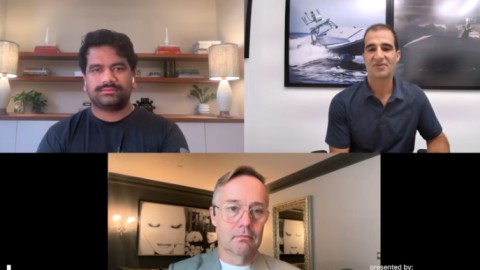
Read the full transcript of All-In interview with Saronic Co-Founders Dino Mavrookas & Vibhav Altekar, August 6, 2026.
EDITOR’S NOTES: In this episode of the All-In Podcast, the besties sit down with Saronic co-founders Dino Mavrookas—a former Navy SEAL and CEO—and Vibhav Altekar, the company’s CTO, to explore how autonomous vessels can close America’s massive shipbuilding gap with China. As Beijing outbuilds the U.S. by a staggering 230-to-1 ratio, the founders break down real-world Navy successes with their low-cost drone ships, the economics of swarming fleets versus $3 billion destroyers, and an exclusive reveal of Port Alpha, their ambitious new 4,000-acre shipyard in Brownsville set to create 10,000 jobs.
Introduction
JASON CALACANIS: All right, everybody, welcome back to the All In interview series. I am thrilled, really thrilled, because Saronic is a defense company that has been doing amazing work, and we are so lucky to have the co-founders here on the program. Welcome to the program, Dino Mavrookas. How are you, sir?
DINO MAVROOKAS: Doing well. Thanks for having us.
JASON CALACANIS: And your co-founder here, Vibhav Altekar. Let’s talk a little bit about Saronic, and we’re going to get into everything, but you were in the news. You were in the news because you’re making autonomous ships. And one of these was used recently in the Strait of Hormuz, I understand.
The Strait of Hormuz Rescue Mission
JASON CALACANIS: I got to start there, Dino. Tell us about the mission. Tell us what happened. This is the first time an autonomous ship has ever rescued folks in the field. And then we’ll get back into your history and everything. But I think we got to start off with this story because it’s incredible.
DINO MAVROOKAS: It’s just a huge story. And look, I can’t get into too many specifics of the operation and the mission for obvious reasons. But before we get into what it means for the country, what it means for our company, I mean, without saying, the most important thing is that those 2 pilots came home safely, regardless of how they got there.
Right now, what we were able to demonstrate through this partnership with the Navy, for us, the Navy actually trusted us in this moment. Lives are on the line. We’re going to send this autonomous platform to go and rescue these folks. This is not a patrol. This is not maritime domain awareness. This is the highest stakes of the highest stakes. There’s downed American pilots in the Straits of Hormuz. And they said, “Corsair,” which you actually see right over my right shoulder, which is our 24-foot fully autonomous speedboat for those that don’t know, “we’re going to use that to rescue the pilots.” And that’s actually like a milestone moment for the country.
I’ll tell you a personal story firsthand on kind of what this means. Leaving people behind in the US military, just, it’s not a thing. The US military does not do it. I was in the Navy SEAL Teams for 11 years from 2004 to 2015. My last 5 years were on SEAL Team 6. I personally experienced — in 2005, there were 4 SEALs trapped on a mountainside in Afghanistan, and the helicopter got shot down while going to rescue them.
So what we were able to prove in this moment was that you can go and rescue people without putting additional soldiers in harm’s way. That’s the impact of what this had. That’s what it means for the country and for our company. It was just an extremely proud moment where the Navy trusted us in this high-stakes environment.
JASON CALACANIS: Absolutely incredible. And obviously, thank you for your service. And I know you can’t get into too many details, but I’ve been reading all about it. And I got to wonder, when these 2 pilots — did they know that this was an autonomous ship? And the ship comes rolling up and they’re like, somebody sent them a message, “Hey, you’re going to get picked up by the autonomous ship, grab the side of it, climb on board.” What’s the protocol for the autonomous ship picking up 2 folks? Are they swimming out to it? I just got to get a little color on this before it becomes a movie.
DINO MAVROOKAS: I mean, it’s the first time that it happened. And when a boat pulls up to you and there’s nobody on it, you can very quickly deduce that it’s fully autonomous. And these pilots were in the water for — I don’t even know how long. They’re in a completely contested environment. We’re in a conflict with Iran. They’re in the Straits of Hormuz. And we can go through the dynamic there. But they looked at this platform and said, “That’s my way home. That’s how I get out of here.”
America’s Shipbuilding Crisis
JASON CALACANIS: I love it. All right, let’s step back a bit here. You’re a Navy SEAL, Vib. You’ve worked in this space for a while, and you previously worked at Anduril, I understand. The mission, as I understand it, for the company is to greatly increase our ability in America to produce ships. And for people who don’t know, the amount of tonnage, the number of ships that we’re able to make in America and most Western countries is very low. But there’s an adversary in the Pacific who is able to produce a lot of ships. It’s known as the Chinese Communist Party.
So maybe from first principles, you could just explain what you’re building and why it’s important and just how insane the incompetence of the West in terms of building ships has become. I mean, we are really bad at making ships right now. Am I correct?
DINO MAVROOKAS: We’re beyond bad. Let me take a step back and just kind of highlight where we’re at, and then I’ll let Vib go through what we’re doing about it, how we’re changing that dynamic.
Jason, what you were saying — just to put it in context, the United States can build 100,000 gross tons of ships every year.
And it wasn’t always the case. 30 years ago, the Chinese didn’t have this capability. They had 5% of the world’s shipbuilding capacity. Today they have 57% of the world’s shipbuilding capacity. And actually that problem’s getting worse because the Communist Party is just constantly subsidizing the entire industry. So they’re undercutting the commercial market on price. They’re not just subsidizing the direct cost to build. They’re subsidizing raw material and labor costs. So the ship built in the United States is actually 5 to 6 times the cost of that same ship built in China. And so they keep getting more and more orders. So that number of 57% is just going up.
JASON CALACANIS: How did they get that capability? Is that because as a manufacturer to the world, they needed to ship out products, so they did this in a commercial way first? Or was this always very intentionally, “We need to own the South Pacific”?
DINO MAVROOKAS: Very much revolves around the commercial market. And then I want to talk about the status of our Navy — like where the naval fleet is today, what that means, and then where the Chinese Navy is and where that’s going. Because again, 30 years ago, the Chinese Navy was a littoral backwater navy. Today they have nuclear submarines, aircraft carriers, and hypersonic missiles. So there’s a massive, massive change over the last 30 years.
And what’s happened in the US shipbuilding industry — it’s completely declined. So the US naval fleet has 296 ships today. There’s a congressional mandate, a statutory minimum of 355 ships that was set by Congress in 2018. That was 8 years ago. Last year we built 9 ships, but we retired 19 naval vessels. So we’re going in the completely wrong direction. The Chinese delivered somewhere in the ballpark of 30 ships. Their fleet size is around 370. They’ll be at 450 before you know it.
But the commercial market is where that discrepancy lies even larger. They delivered over 1,000 commercial ships last year. The United States built 5.
JASON CALACANIS: 5. 1, 2, 3, 4, 5.
DINO MAVROOKAS: 1, 2, 3, 4, 5. One hand. Wow.
So if a conflict actually kicks off — and we saw this in the US in World War II, we had the production capacity where we’re building thousands of vessels every year — if a conflict kicks off, that commercial capacity isn’t going to go to building cargo containers anymore. It’s all going to flip to defense capacity, and it’s going to be building for what the Chinese Communist Party needs to win a conflict. And that’s what we have to be building towards. That’s what we’re doing at Saronic. That’s why we’re thinking about, “Okay, how do we build mass? How do we build scale in whatever it is that we do?”
The Advantage of Autonomous Ships
JASON CALACANIS: And so how do you do it, Vib? I would think — and listen, I’m a neophyte here — but if these are autonomous ships, well, you can remove things. Like, you don’t need beds, you don’t need a commissary, and you don’t need latrines. And I don’t know what percentage of a Corsair or battleship are there to support humans on the ship, but I gotta think it’s half the mass of it is to keep humans on it. Am I directionally correct?
VIBHAV ALTEKAR: I think half is a little excessive, but there is a significant percentage of the components, the cost, the labor that actually goes into catering to human beings on board. I would say at a high level, you’re really reducing the complexity of the entire product. You don’t need to worry about a separate electrical system for humans. You don’t need to worry about, as we mentioned, doors, bathrooms, stairs, et cetera.
And then at the end of the day, you can actually start to end-to-end optimize a lot of different things. So even if you look at Corsair, for example, if you were to buy a commercial 24-foot boat, it’s unlikely to go 1,000 nautical miles. It’s also unlikely to drive and have the control authority of the boat that we’ve built here, because you don’t have to worry about a person feeling, you know, taking G-forces in the middle of the ocean.
And so you can actually optimize across a bunch of different areas — naval architecture, the speed, range, and payload of the craft itself. And then again, reduce a lot of the complexity where you’re removing subsystems that are meant for humans.
The Saronic Name and Product Line
JASON CALACANIS: Yeah, and the Corsair — which is my favorite ship just based on the name — I believe from my research this was originally meant like a pirate ship or a privateering ship. But is it now standard lingo that that’s a 24-foot boat and has a certain profile? Do you know, is that how these designations come about, the names of these ships?
DINO MAVROOKAS: I mean, I wouldn’t say that Corsair is now universal for a 24-foot autonomous surface vessel. It’s the name of our product line, and we chose it very purposefully. We chose all our names purposefully, even the name of the company.
We were talking about our Greek heritage before the show and where that came from. The Saronic Gulf is a gulf off the coast of Athens where the Battle of Salamis happened. It’s one of the most famous naval battles in history. It came after the Battle of Thermopylae, or the famous stand of the 300 Spartans. And it was the naval battle between the Greeks and the Persians, where the Greeks were wildly outmatched. The Persians had much, much larger ships. They had a much larger fleet, and the Greeks were able to lure them into this narrow strait and use smaller, more maneuverable products to ultimately defeat the Persians.
The Case for Smaller, Autonomous Fleets
JASON CALACANIS: Now, cost is part of this in terms of these ships in the field and the number of ships. My understanding of contemporary China is that they don’t build a lot of big ships — they build a lot of ships. So they’ve got a lot of smaller and very varied number of ships. If I’m correct there, then the cost becomes the issue, because building a bunch of aircraft carriers — I keep hearing that supersonics are going to take out all these aircraft carriers in the first 15 minutes. Vib, is that true what we hear, that we need smaller ships, faster ships? And what is the cost of something like the Corsair that you used on this incredible mission?
VIBHAV ALTEKAR: Yeah, I would say at a high level, the goal is mass — large-scale attritable mass. And yeah, if an aircraft carrier takes 10 years to build and $13 billion, you’re not really achieving that. I think there’s always going to be a role and responsibility for a craft like that. But ultimately you’re right. If you’re big and very obvious to find — and you can find it from space, et cetera — it’s a real risk.
When you reduce the overall cost of just doing things in the ocean, that’s ultimately where the autonomous piece comes in. You can deploy at scale, you can monitor a larger body of water with less people. And ultimately what you’re really getting to is removing people from harm’s way.
So when we think about designing and thinking through the price points of these things, the comparison to manned crafts isn’t really necessarily even comparable as you get into larger ships. For us, it’s really a question of, “What is the cost that you would typically have to use humans for, and how much is that actually being reduced by having a large autonomous fleet?”
JASON CALACANIS: Corsair’s a million bucks or something, do you know? The Corsair costs about a million.
Unit Economics and the Case for Autonomous Ships
DINO MAVROOKAS: Yeah, I want to go back to— we’ll get that. I want to go back to one thing you said earlier, and it’s like China’s building both very large ships and a lot of ships. They’re right, they’re doing it all right. And when we think about, okay, how do you actually change the paradigm for the US Navy? It’s let’s actually boil it down to unit economics. Let’s think about this like a commercial company.
Viv mentioned payloads. What are you actually moving on the ocean? One of the most important metrics is VLS tubes, so vertical launch systems. Basically, how many big Tomahawk missiles can you carry on a ship? It’s how much firepower are you fielding? So let’s use an example of that, right? A destroyer, naval destroyer, costs about $3 billion.
JASON CALACANIS: $3 billion?
DINO MAVROOKAS: $3 billion. And I’m not even getting into the sustainment and maintenance costs over the life cycle of the destroyer. I’m just talking about what it costs to buy. If we do that, it’s $10 billion over 30, 40 years. $3 billion, 6 to 8 years to make, you carry— you can field about 96 VLS tubes. So I’m going to round up and make that 100 for easy math. So on average, you’re fielding somewhere between 10 to 15 VLS tubes per year at a cost of $30 million per tube.
Marauder— I won’t give you the exact price or cost, but can reduce that cost by a significant amount. But we’re going to be building 20 Marauders per year at our shipyard in Louisiana. So now you can field— we can carry the equivalent of 16 VLS tubes on the back of that 180-foot fully autonomous ship. So now you can field 320 VLS tubes per year as opposed to 15, and you could do it at a fraction of the cost. This is how you actually save the taxpayers hundreds of billions of dollars, and you get more capability into the field faster.
Manned vs. Unmanned: What Do You Lose?
JASON CALACANIS: I mean, that’s just extraordinary thinking about it. What do you lose by not having humans on it? Are we going to be faced with a moment in time where these are kind of like drones, where there’s no pilots, they’re just pilots in a shipping container dropped somewhere either in the middle of America and doing it remote like we’ve done? Is that the future of warfare with these ships? And what do you lose when you don’t have a team there on the boat? And what is the criticism, valid or invalid, that people have of unmanned ships?
DINO MAVROOKAS: I’m going to let Viv talk about the way that we’re using software, because I think the criticism to your question is, “Well, what happens if we’re in the middle of the ocean and the ship breaks down? Who’s going to fix it?” It’s not that we don’t need this technology. It’s folks that aren’t used to technology saying, “Oh, how’s the technology actually going to work?” And that’s what we’re proving out every single day.
To your point of what do you lose by not having people on them? Look, it all boils down to the mission, right? And this is why we partner so closely with the Navy. This is why we work with actual operators. It’s like, what are you using? What are you delivering? If the mission is long-range fires, we’re packing a bunch of VLS tubes on the back of Marauder. You actually don’t lose anything, right? You’re just delivering those capabilities into the field while keeping people out of harm’s way. And that’s a very, very important part of the equation.
But if our ships— let’s be clear— if our boats and ships aren’t accomplishing the mission, then they’re not relevant. They’re not going to be used in the first place. And there is going to be some mix. I don’t know what that mix is. I don’t think anybody really knows what that mix is of manned and unmanned ships. So what you’re going to see in the Navy is a hybrid Navy. The things that you’re missing from having people on the ships— forward-deployed decision makers in the environment— you can actually have out there on manned ships, but you’re using unmanned ships to put into combat areas and conflict areas to keep those people very safe.
Building at Speed: Vertical Integration and the Supply Chain
JASON CALACANIS: Vib, take us through the production of these. How do you achieve speed at it? Friend of the pod Elon Musk with the Teslas over time— he eventually built the full stack. In the beginning, if you had a Tesla, you would look at the shifter and you’d be like, “Hey, that looks like my Mercedes.” And that’s because they had their steering column from Mercedes, one of their early investors. The HVAC was from somebody else. But eventually he had materials coming in one side of the factory, cars coming out the other, and he made every single thing in that car. He was now no longer dependent on any third-party manufacturers or a supply chain. And famously the HVAC, I think in the Model 3 and Y when it came out, reduced massively the drain on the battery, right? So it’s purpose-built for that mission. So I’m assuming you’re doing that from first principles, but what’s the secret to this rapid production and lower-cost production?
VIBHAV ALTEKAR: Yeah, listen, I think within the shipbuilding industry at large, there’s a bunch of different challenges of why the production isn’t as high as it should be. And one of those core reasons— and the Navy’s talked about this extensively— is investing in the supply chain, right? When you only build 5 commercial ships a year, your genset manufacturers, the marine engine manufacturers also don’t have to produce at a very high rate.
So one of the things that we get the luxury of doing by being vertically integrated is we get to work with these manufacturers directly, do non-recurring engineering work, invest in really digitizing a lot of the components that historically have been very analog, right? You asked earlier, what do the people do on the ships? What are they going to do if the ships are autonomous? Well, when you think about— Dino mentioned the lifecycle of these ships are 30 years. You think about a ship that was built 30 years ago, you have people that are doing extremely manual things in the engine room that today should be extremely trivial to automate through software.
A lot of that work actually gets completely absorbed by the software stack, and so you don’t have to worry about it. And as we choose components, we invest in the supply chain, we invest in the industrial base, we actually help bring all of these analog components that for a long time were meant to be operated by humans. We give them software APIs, we make sure that they can be controlled by the software stack somewhere else and can be remotely accessed.
JASON CALACANIS: So the complexity is going to go down massively when you’re building one of these.
VIBHAV ALTEKAR: Yeah, absolutely. Frankly, I don’t think the person who’s sitting in the engine room is super thrilled about it anyway. You’re actually changing the— you’re democratizing the decision-making, right? Now there’s going to be more mass out in the ocean, more sailors are going to be making decisions about what that mass is going to be doing and where assets are going to be, instead of worrying about coolant pressure in an engine, right?
And so when we think about the actual design, there’s a lot of different variables there. There’s some components that are commercial off the shelf, right? Elon, in the early days, from a compute perspective, they had to invest in ASICs, right? The compute stack wasn’t there to run large models and run inference at the speeds and power budgets that they wanted to. In 2026, it’s a totally different game, right?
And so there’s a lot of different parts of the supply chain that sometimes we’re looking at investing in the industrial base and making sure that our engine manufacturers and genset manufacturers are keeping up. On the other side, there are particular components that we’re like, “Hey, the marine industry actually hasn’t had this level of investment in a long time. So we’re going to have to build this in-house.” A couple of examples around that are related to a lot of the electronics related to the sensors and compute. But a bunch of different things there help us build and assemble quickly.
From Cost-Plus to Firm Fixed-Price: The Defense Acquisition Shift
JASON CALACANIS: Let’s talk a little bit about, Dino, on the business side, how you work with the Department of Defense. Emil Michaels and a bunch of the folks over there are really focused on getting startups like you more contracts. But you also are moving out, I assume, of this cost-plus world. And you’re just figuring out, “Hey, what’s the right price for this?” Take us inside that paradigm shift. You have these primes and then you have these upstarts, and it seems like based on history, the incumbents sometimes don’t take this lying down. So take us inside the paradigm shift from cost-plus to what these— I guess they call the new primes like yourself and Andruil are doing.
DINO MAVROOKAS: Yep. And I’ll just define cost-plus. Everybody that’s listening— basically it means, “Hey, we’re going to go build you something, Mr. Government, and however long that takes, however much it costs, you’re just going to pay us 10 to 15% on top of that.” So I’m actually incentivized— and I’m not saying there’s malicious intent— but I’m incentivized to make it take longer and cost more, because if it costs $100 million, well, then I only make $15 million. But if it costs $1 billion, then as a company, I make $150 million. So there’s this perverse incentive to drive up costs.
Now, that’s not the only reason the industry is where it is today, but we’re very encouraged by the push from the administration to adopt things at speed and scale and to do that quickly and to do that differently and to move away from cost-plus.
You hit it. We invest our own capital. To date, we’re just about 4 years old. We’ve raised $2.5 billion in private capital. We’re pouring that into R&D. I remember when we decided to build Marauder— again, 180-foot ship— Viv and I were talking and it was like, “Who’s crazy enough to go and build a ship on IRAD?” And it’s like, “Well, we are. Because that’s what the country needs, that’s what it demands, that’s what we’re going to go do.” And our investors are giving us the capital to go do it. They’re actually entrusting us with that capital.
That’s the reverse of what’s happening in the large primes where their investors are kind of demanding share buybacks. They’re saying, “Give us our capital back.” So the country very much needs companies like us to build for the future.
And when you look at what the administration is doing, even just in shipbuilding— just recognizing that shipbuilding is a critical strategic industry, right? The president, one of the first things he did was put out the Maritime Executive Order that was followed with the Maritime Action Plan, right? There’s the SHIPS Act sitting in Congress. You had the Secretary of Defense give a whole speech on defense acquisition reform, talking about how we’re going to push the department to be better, to move faster, to work with companies like us that are building on firm fixed-price contracts that are focused on delivering at speed and scale and driving down cost for the taxpayer. So all of that is extremely encouraging.
But I also want to be clear here on the flip side— we’re in the early days, Jason. Very early days. When you look at the overall Defense Department’s budget, 1% goes to autonomous systems. That’s not nearly enough. Make that 5%. I don’t know the right mix, but it needs to go up and it needs to go up quickly.
VIBHAV ALTEKAR: I’ll just add one more thing. Historically, shipbuilding— the design is bifurcated from the builder, right? Someone gets paid to do the design, and the ground-up general assembly and all of that gets handed off to a totally different person to go build a ship. And I think there’s a statistic out there that’s like 70% of sequence-critical components on some Navy ships are sole-source suppliers— single source suppliers.
And so to Dino’s point, it’s not just that you’re incentivized to take longer, it’s that you’re not incentivized to change that necessarily, because you know that you’re still going to get paid. Whereas from our perspective, when you own the design, you own the shipyard— software engineers, shipbuilders, naval architects, welders can all sit down and eat lunch together in the yard. There are end-to-end optimizations that you get that the system, from a historical perspective, just wasn’t set up to gain.
Securing the Strait of Hormuz
JASON CALACANIS: Yeah, let’s do a little look at what happened in the Strait of Hormuz. We weren’t able to control it completely. Doesn’t seem like anybody in history has been able to control it. If we were to fast forward and you had your entire fleet — let’s assume, not unlimited but massive capacity — how would you, or would you be able to secure something like the Strait of Hormuz with these autonomous vehicles? And what might that look like? Take us into a scenario 5 years from now. What would it take?
DINO MAVROOKAS: That’s the type of scenario that we’re building for. I think before talking about the scenario, let’s talk about the Strait of Hormuz itself. The environment, the part of the world — what neighborhood is it in? It connects. So you have the Persian Gulf, which is 200 miles wide, which narrows down to a 20-mile-wide strip, which is the Strait of Hormuz. And then it connects to the Indian Ocean and connects these large oil-producing countries to global markets.
On the one side of the Persian Gulf, you have Iraq, Kuwait, Saudi Arabia, UAE, Qatar, and Oman. And on the other side of the Persian Gulf, the north side, is all controlled by Iran. So now Iran is saying, “How are we going to disrupt traffic in the Strait of Hormuz?” Well, it’s only a 20-mile-wide stretch. I can use missiles, I can use fast attack vessels, I can use naval mines, I can use cheap drones because I don’t have a large distance to cover. I can launch these things anywhere from shore. So it becomes this completely chaotic environment that sending in naval destroyers into, or trying to get commercial ships past, becomes extremely dangerous.
So using large numbers of autonomous vessels, you can combat these threats in completely different ways. You can offer scale, persistence, and risk reduction in ways that manned vessels just can’t. And again, won’t get into too many of the specifics on the types of operations that we’re building towards, but autonomy is a way to counter these effects — effects that are overwhelming, or that really aren’t meant to be countered by traditional manned ships alone. We can counter that with scale and technology and keep people out of harm’s way.
The Corsair and Manufacturing at Scale
JASON CALACANIS: Well, you have some small ships. You got the Cutlass and you got the Spyglass in this build-out. Those are 6-foot, 15-foot or whatever.
DINO MAVROOKAS: We actually started with those, and I’ll give you an interesting story. We actually don’t build those — we haven’t productized those. Those were great subscale demonstrators, but our real flagship product is Corsair. And when you talk about the scenario in the Strait of Hormuz and what type of volume can we bring there, it’s not only 5 years in the future. We could build 2,000 Corsairs per year right now at our manufacturing facility in Austin. I know you live in Austin. We’d love to show you around. When you see it, it actually comes to life. You’re like, “Oh wait, you can actually build thousands of these vessels every single year.”
JASON CALACANIS: How many would you need? 1,000? 5,000 in the Strait of Hormuz?
DINO MAVROOKAS: I don’t think it’s a 20-mile-wide strait.
JASON CALACANIS: So you’re just going to — and this is their offensive strategy. They have these speedboats that they use. I don’t know what they’re called, but they call them fast vessels. Fast attack vessels. These guys essentially are kamikaze, right? They just zip in, no regard for safety in their life, et cetera, and they will attack.
DINO MAVROOKAS: They’re using fast attack vessels. They’re using cheap drones. So you have to be able to have counter-UAS capabilities. They’re using mines. They’re just floating mines into the strait without regard for what those mines may set off. So it’s a really complicated environment that you need to bring a lot of capabilities towards.
AI and Autonomous Decision-Making at Sea
JASON CALACANIS: Yeah, but it sounds like, Vib, with artificial intelligence — which is the next card that I think is going to turn over — you put these Corsairs out there, could they with AI be able to use satellite data from Planet or whoever’s providing it, or military satellites, and just zip out there and know, say, somebody’s putting out some mines, somebody’s putting out some of these fast attack vehicles, just intercept them? And now they have an actual cost — human life and a limited amount of resources. And hey, we’re America and we have you guys building ships at scale. They don’t have this ability to build AI-based ships. So talk about what AI on these ships could do eventually.
VIBHAV ALTEKAR: Yeah, so I would say today there’s a bunch of different machine learning applications that run on our boat today. There’s heavy amounts of compute on all of our crafts that allows people to have tons of capability, whether it’s the navigation and the autopilot or self-driving of the craft itself, or compute for payloads — whether that’s counter-UAS, as Dino mentioned, or a bunch of other things, really. There’s a variety of different mission sets.
The end state here is that you have a distributed fleet across the ocean. The ocean is a tumultuous place by default. Without a war zone, the ocean’s still bad. Saltwater hits your antennas, you lose comms. So there’s a bunch of different redundant communications on this. There’s a bunch of different sensors. All of those things are networked together with ML, with a bunch of different software components of the software stack, to make sure that you can basically translate intent from a commander or a sailor and then result in a mission outcome.
Confronting China and Autonomous Weapons Policy
JASON CALACANIS: Talk, Dino, a little bit about the adversary China. They have started to put weapons on robots. I’m assuming that they’re doing the same if they’re willing to put it on one of those dog robots like the Spot robots. They’re putting weapons on them, they’re demonstrating it, and whatever they’re demonstrating, they’ve already got in production. Let’s just call it what it is. And they’re not signing some UN treaty to not put autonomous and AI weapons. This is a different type of adversary. And I’m sure North Korea and other bad guys are doing similar things. We have, I believe, treaties where we’re not allowed to put weapons and use AI-based weapons. Am I correct about that in the West here?
VIBHAV ALTEKAR: There is an autonomous weapon system standard called 3009 that basically outlines exactly how AI can be used on an autonomous system. Yeah.
JASON CALACANIS: Tell us all about that. Are — because this is the RoboCop scenario. This is the robotic soldier or the robotic boat that’s able to engage the enemy without a human, if it loses comms, or to do a kamikaze mission, which seems like something we might have to do. These are things we might have to do, Dino, versus the Chinese, because they’re not signing these treaties. They are not thinking ethically. They are not respecting the Declaration of Human Rights. They’ve got their own playbook.
DINO MAVROOKAS: And I think the important thing to articulate here is, especially when you use the RoboCop example — and just to quell people’s fears a little bit — is even in that example where we’re sending boats off of Taiwan and we’re in the Taiwan Strait and they’re engaging, we’re still using artificial intelligence to bifurcate between an enemy vessel and a friendly vessel, between a non-combatant and a combatant, and people are still making the decisions and setting the mission intent.
It’s just government policy that’s setting, “Okay, when are you authorized to engage versus not?” Artificial intelligence actually just gives the military the opportunity to, one, operate at a greater scale, and then operate more efficiently. These aren’t robots actually just making decisions on when to go to war or not.
JASON CALACANIS: Got it. So it says, “Hey, this is a bad guy. Our recommendation is to neutralize it.” And then a human has to say, “Okay, neutralize it.” But if you’re up against an adversary who says, “No, no, we built this thing — anybody comes into the blockade in Taiwan, which we think is a pretty significant non-zero probability in our lifetime, if you’re up against somebody who says, ‘I’m just going to have these ships kill anything that’s not our ship, period, full stop,'” then we lose, don’t we?
DINO MAVROOKAS: No, because all you’re doing is putting policy thresholds and approval thresholds into the technology. There’s a real-world scenario — a doomsday scenario — where we go to World War III, the Taiwan Strait is a complete conflict. Exactly what you said, our commanders are going to make that same judgment. They’ll be like, “Hey, there’s no fishing boats out here right now. There’s no cruise ships coming through. No collateral damage. If you’re not a friendly vessel, you’re an enemy vessel, and that’s that.”
And our technology actually enables that. What we were talking about earlier is the autonomy, the artificial intelligence, and everything else is there, and you’re building the policies into the software based on government procedures and when those authorizations need to be in place. Those authorizations will change based on the threat environment that we’re in.
Allied Nations and Global Shipbuilding Capacity
JASON CALACANIS: Is the plan for you to sell to our allies, and what are the rules there? Because it sounds like we need as many ships for our Navy as we can get. But if you can get up to capacity, then hey, the French, the Germans, and the English have essentially just stopped making ships, right? They have very deprecated militaries. My understanding is the only people who are really doing a great job at this are the folks in South Korea, which I believe are building but one ship for us. So maybe you could talk about the other top countries in the world — democracies and our allies — and what their capability is, and then your ability to help arm them and sell to them?
DINO MAVROOKAS: Very, very focused on our allies and partners. If you talk to the Department of War, if you talk to the United States Navy, they actually want our allies and partners to have these capabilities as well. This is going to be a combined effort. We mentioned earlier that China has 57% of the world’s shipbuilding capacity. That’s not limited to just that one industry. We could go industry by industry and talk about their manufacturing might and their manufacturing dominance.
So you really do need a combined effort. You need our allies and partners to have this technology. We’re talking to our allies in Asia, obviously, in Europe, and in the Middle East right now about getting not only our products there, but also how do we stand up domestic production in those countries. How do we give them the sovereign capability? How do we have production lines overseas so that they’re already forward deployed if we get into a conflict in the first place?
Announcing Port Alpha: America’s Shipyard of the Future
JASON CALACANIS: Pretty amazing stuff. And you have an announcement today, I understand, that we’re going to share with the All-In audience for the first time.
DINO MAVROOKAS: That’s right. So we’ve been working on Port Alpha for a long time now. Port Alpha, just for the listeners, is our shipyard of the future. This is going to bring American shipbuilding back to a place that we haven’t seen since World War II.
To be clear, we’re already operating a shipyard. We have a shipyard in Franklin, Louisiana. That’s where we’re building Marauder. We’re ramping that up to 20 Marauders. We can bring that up to 50 Marauders per year, every single year. And that is a 100-acre shipyard. What we’re doing at Port Alpha is 10x-ing that. We’re looking at a shipyard that is well over 1,000 acres. We’ve been doing this search for over a year now on what is the ideal location for this shipyard. Where are we going to find the right partner, the right land, the right workforce, the right community to be a part of?
And we’re proud to announce that we found that in Brownsville, Texas. So we’re headquartered in Austin. We’re going to be basing Port Alpha in Brownsville. We’re going to start on an 800-acre plot of land, which in and of itself, 800 acres is now the largest shipyard in the United States.
JASON CALACANIS: Amazing.
DINO MAVROOKAS: Just to give you a sense of scale, we have the opportunity over time to scale that to 4,000 acres. We’re going to invest billions of dollars into this project. We’re going to create 10,000 jobs over the next 10 years, and we’re going to bring shipbuilding in this country back again to a place that we haven’t seen since World War II. And we’re just grateful for the partnership from the state, from Governor Abbott, from Cameron County, and then the city and the port of Brownsville for making this happen.
Building in Texas: A State That Lets You Build
JASON CALACANIS: I mean, this is one of the great things, Vib, about being based in Texas. They let us build things in Texas. As a recent resident here, it’s pretty amazing to live in a state where the state’s like, “What do you want to build? How can we help?” As opposed to, “Hey, F* off,” like they told Elon in California, and he got the message received reply to that. So maybe you could talk a little bit about operating in Texas, Vib, and the crazy support you get from Abbott and everybody.
Austin, Texas: The Ideal Hub for Maritime Innovation
VIBHAV ALTEKAR: One of the questions that we used to get back in the day was, “You guys are a maritime company, but there’s no water in Austin. What are you guys doing there?” And I would say Austin has this magical kind of nexus of both digital and physical labor forces. You can find software talent, you can find AI talent, you find designers, but you can also tap into the industrial base from San Antonio, from the oil and gas industry in Houston.
And when you marry those 2 together, you can actually start to co-design these things across the entire stack. I mentioned earlier, typically ship design and ship build is totally independent. But with Port Alpha, we get the luxury of greenfield designing what the manufacturing plant for ships should look like. So you can optimize the design of the ship for the yard and the design of the yard for the ship.
It’s very similar to how companies today do hardware-software co-design on chips, right? You design a compiler and they stick together to optimize both for the other. And we have the luxury of being able to do that for ships here. And I can’t think of a better place to do it than Texas.
JASON CALACANIS: Well, Starbase is right down the block. SpaceX, obviously. And Elon’s made that work. And I think it’s like a 4, maybe 4 or 5, 6-hour drive down to the coast. Yeah. So you guys can either zip there on a PJ or you can just drive. So it’s pretty straightforward.
Rebuilding America’s Shipbuilding Workforce
DINO MAVROOKAS: Pretty straightforward. It’s easy for logistics. What SpaceX has done in Brownsville is incredible. I think what Brownsville has done for SpaceX and helping them build out, build the community down there — we were very impressed, very, very excited to be basing Port Alpha there.
And look, at the end of the day, it’s the people that are going to make this work. It’s the labor force, it’s the workforce. Vib mentioned it earlier, and we can talk about why the American shipbuilding industry has declined so much, but it’s the supply chain and the workforce that has suffered the most. And so one of the things we focus on is really how do we rebuild that workforce? How do we upskill existing talent to advanced manufacturing? How do we take somebody that’s building a car at Ford and get them building ships very, very efficiently, very quickly?
And that actually all starts with the design. If you design a ship from the ground up, from a first principles approach to be more simplistic, to be designed and manufactured at scale, then you can put in the training, the work instruction, the processes and everything else where, hey, let’s go make this much faster. Let’s train, let’s build the workforce.
And then let’s be honest — you have to make it cool for young people to go work in a shipyard again. You have to pay them good wages. Every one of our employees, every welder, every pipefitter, they have good wages, the same benefits as our Silicon Valley software engineers. They have equity in our company. They’re fired up. Our shipyard in Louisiana — people are fired up down there. And it’s not just the workforce, it’s the community.
Some of the stories I hear when I’m down there are so encouraging. People are like, “I’m wearing my hat in the grocery store and people are coming up to me saying, ‘You guys are kicking butt, keep building ships,'” because nobody else in the country is doing what we’re doing.
JASON CALACANIS: And these are great salaries. People are getting paid significant amounts of money, obviously, to work in manufacturing at your company, down at Starbase. And now you have these 2 incredible companies — I don’t know if there’s any other ones in Brownsville, but this is a small community. It’s only like 200,000 people down there. This is going to be an incredible boomtown.
Cutting the Cost of American Shipbuilding in Half
DINO MAVROOKAS: Oh, it’s going to be with SpaceX, and your Terran components. And I mentioned earlier, the cost of building ships in the United States — the United States just isn’t competitive in the commercial market. And again, we can go through the specifics and what happened over time. It’s 5 to 6 times the cost of building a ship in China.
We think just by investing in product and processes and new shipyards, we can cut the cost of a ship in the United States in half. So if you have a ship that costs $300 million, we can get that under $150 million. And that’s not by simply just paying people less. We’re paying people more, but we’re investing in our product. We’re investing in the process. We’re designing the product to be built that way in the first place. So we’re making the investments that are needed for long-term sustainability and to rebuild the workforce.
Join the Mission: Careers at Saronic
JASON CALACANIS: All right, if people want to come work with you, Vib, how can they apply? There’s a career page, and what are you looking for? What talent do you need to come do this incredibly patriotic duty and go work at Saronic?
VIBHAV ALTEKAR: Yeah, saronic.com, we have a careers page. You can reach out on Twitter, LinkedIn, whatever you want. We’re hiring pretty aggressively right now. I would say that the biggest thing we look for, generally speaking — especially in 2026 when ChatGPT and Claude are getting so much better every year — it’s pretty important right now to be fairly neuroplastic, be ready to adapt for what the future looks like.
Computing is changing. There’s going to be agents that can help you on the manufacturing floor to assemble faster if you have an issue. There’s all of these digital systems that are kind of changing the paradigm here. When we first got to Gulfcraft down in Louisiana, a lot of the processes were pretty much pen and paper, and that’s pretty common across most shipyards. So bringing that into the 21st century really quickly is just going to require people to be thoughtful, adapt to the future, and really be passionate and excited about building the future.
JASON CALACANIS: Yeah, go to the website saronic.com, join the mission. It’s 300 jobs listed on the website. There’s something there for everybody. And listen, just as a fellow Greek, Dino — we were obviously the cradle of innovation, or science, math, technology, art, and everything happened. But we were also the great warriors, and we patrolled the sea. Obviously Greece has a lot of coastline, so you’re doing our Greek brothers and sisters and ancestors proud.
DINO MAVROOKAS: Greece has a lot of coastline, and they’re actually big in the shipping industry. They are big, yeah. So now I hear more often than not, “Oh, it’s good to see a Greek building ships.”
The Importance of Defense Tech in Protecting Democracy
JASON CALACANIS: You know what? I can sleep now at night. I was very worried about the Strait of Hormuz. I was worried about the Pacific theater and the South China Sea. Dino, now that I know that my Greek brother is on top of this, my head’s going to hit the pillow. I’m going to go right — I’m going to sleep like a baby tonight. I know you got us covered.
Thanks so much, guys. And sincerely, on behalf of all Americans, thank you for doing this work. This is something where we really need technologists and entrepreneurs to really help us innovate because we’re falling behind. And we’re the good guys in this. We’re the ones who are spreading democracy and freedom and protecting that.
The only thing in the world that isn’t trending in the right direction — if you look at lifespans, if you look at infant mortality, if you look at people’s standard of living, everything is trending in the world in the right direction except the spread of democracy, which has been on the decline in our lifetime. Let that sink in, folks. More people living under authoritarians than democracies. It’s a modest amount, but you’ve seen the statistics, I’m sure, Vib and Dino.
And we need to have a great military. We need to have this advanced technology if we’re going to maintain the number of people living under a democracy, in freedom, and hopefully increase it. A lot of bad guys out there. And thank you so much for doing this work.
DINO MAVROOKAS: That’s right. Well, thank you for having us. And I will end on a positive note where, yeah, look, we’re seeing that starting to turn around in a really big way. It’s not just Saronic. You mentioned Anduril. There’s SpaceX, Palantir before that. And now there’s just a big wave, a big push into defense tech because people realize the importance and the magnitude of the moment that we are living in right now.
I tell our team, “This is our generation’s version of the space race. Make no mistake about it, and we cannot lose.” So that’s how hard we’re working at Saronic. That’s how we’re working with a sense of urgency. And there’s a lot of other companies coming into the space that are working with that same sense of urgency. So I am very optimistic. I know this country can do it when we put our minds and we get a collective effort behind something. Nobody can beat us. Nobody can.
JASON CALACANIS: Yeah. Nobody can beat us. And listen, if you were thinking of going — there’s no dig to anybody — but if you’re thinking about going and optimizing an ad network at some big tech company, it’s incredibly boring. And it’s incredibly meaningful. You’ll get 20, 30 years into your career and you’ll say, “What did I do?” Go work at Saronic. You’ll get a couple of years into your career and you’ll say, “I’m doing important work.”
DINO MAVROOKAS: That’s right. That’s right. Every person that walks through the door every single day is quite literally changing the world. And we remind them of that and they know it. Yeah.
JASON CALACANIS: All right, Vib, Dino, thank you so much for coming on and we’ll see you next time on the All In Interview.
Related Posts
- Transcript: FBI Director Kash Patel Interview on American Thought Leaders
- Transcript of Andrew Wilson Interview: Joe Rogan Experience #2535
- Transcript of Cassie Coppersmith Interview: Joe Rogan Experience #2528
- Transcript of Darryl Cooper Interview on Iran Deep Dive: Tucker Carlson Show
- Transcript of Elizabeth Lane Interview on Propaganda Network: Tucker Carlson Show