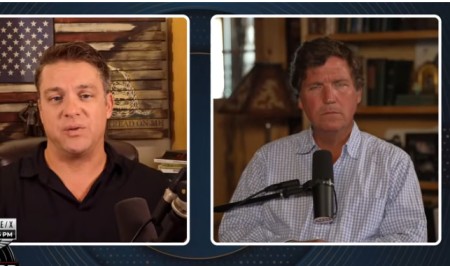
Read the full transcript of Tucker Carlson’s interview on Jim Webb Podcast, August 5, 2026.
EDITOR’S NOTES: In this episode of the Jim Webb Podcast, host Jim Webb welcomes Tucker Carlson for a wide-ranging conversation on the state of the American republic and the forces reshaping it. They examine perpetual war, executive overreach, nuclear risks, and artificial intelligence as a power-concentrating force, while Carlson reflects on his Iraq War mea culpa and the “uniparty” dynamics that leave voters with few real choices. The discussion also turns to surveillance, institutional pressures on truth-telling, and whether rebuilding around sovereignty, fairness, and decency can offer a unifying path forward.
A Republic If You Can Keep It — Tucker Carlson Interview
JIM WEBB: “A republic, if you can keep it.” Benjamin Franklin speaking to Elizabeth Willing Powel in 1787. We are at a crossroads in this country in more than one way, and there is nobody better to talk about it than Tucker Carlson. He is here today, and I’m just going to shut my mouth because you want to see him. He’s coming up next.
All right, it’s Wednesday, August 5th. Welcome back to another episode of the Jim Webb Podcast. As mentioned, Tucker Carlson is here today, and Tucker, it is so great to see you. Thanks for coming on. You in many ways are responsible for this, so I thank you for that as well. I hear you got some big things brewing, but we’ll get into that. I just really appreciate your time to sit down and talk with me about what’s going on right now and your journey to this point.
TUCKER CARLSON: I’m honored to be here, and I was just thinking what an obviously tragic and chaotic moment in the life of the world, and there’s a lot to be sad about, but there’s also, and there always is, a lot to be grateful for. And as much as I hate technology, the fact that it allows people with something to say to say it and find an audience for it at very little cost, and they can make a living doing it — it’s just one of the great improvements of my whole lifetime. Thank you, Joe Rogan, for inventing this. I mean, it’s incredible. So yeah, I’m grateful that you’re doing this.
War, Power, and the State
JIM WEBB: No, and thank you again. So the student might become the master by the end of this, but I highly doubt it. You are the master of interviewing people.
But one thing I want to kind of start off with is there’s another great quote. We got the quote that’s on top of our episode, but “War is essentially the health of the state.” That was initially said by Randolph Bourne, who was a progressive, but it’s been adopted by many, including libertarian Murray Rothbard.
And I think what’s important within the context of the times is that people on both sides of the aisle agree with this principle — basically that conflict expands power and it leads to increased taxes, suppresses individual liberties. And it is, quite frankly, the key issue of the moment and our time, in my opinion.
Because for the last quarter century, we’ve been at perpetual war, even though the public has demanded an end to this for subsequent administrations. And whether it’s the Obama administration, the Trump administration, part of the Bush administration, you’ve seen the political class consumed by this. And we don’t really know who’s pulling the strings. And at the same time, executive overreach is at a spot like never before. And the war in Iran is unprecedented. What’s your read on where things are and how did we get here?
TUCKER CARLSON: We got here because the system itself is exhausted and is failing to do the main thing that systems are designed to do, which is to protect and serve the people it governs. So the point of a church is to serve the congregants, the point of a government is to serve the citizens, and the point of war is to manage and mitigate threats to that system, to those people.
So war is a break-glass-in-case-of-emergency tool — you don’t do it unless you have to, hopefully they’re defensive wars. But in real life, of course, many of them are not defensive. The Gulf of Tonkin was not an actual attack on Americans — it was part of a larger strategy designed, however, to help the United States and its allies. And so even if you disagree with it, you can sort of understand the internal logic of it.
We’ve reached a place where our system — our political system, but more than our political system, just our national culture, to the extent we have one still — is incapable of responding to threats. And it’s easy to miss that because we’re at war with Iran because of its nuclear program and its threats to Israel and all that stuff. So it seems like we’re doing this in response to a threat in order to mitigate it. But actually, if you take three steps back, we’re paralyzed.
The Two Greatest Threats: Nuclear War and AI
The two greatest threats in history are nuclear war and AI, and they’re both coming at us fast. And what you see is a leadership class — and really, I hate to say this, but a country incapable of responding.
We are moving toward nuclear war. If this trajectory remains unchanged, we will be at a nuclear exchange. All things being equal, that’s where this train is going. AI — its designers tell us we’re two or three years, maybe ten years away, but at some point we’ll arrive at a place where human autonomy is gone. No more sovereignty. You can’t make decisions because machines make those decisions. And by the way, there’s a non-trivial risk of extinction.
So those couldn’t be bigger threats.
So what does that tell you? We’re getting a new system. It’s just reached the end. Our leaders are old and cynical, and they’ve kind of given up. And the best they can do is sort of profit from disaster rather than avert it. So we know we’re getting a new system, either by force or by choice. And what will that look like? I really don’t know. But I know what I want, which is a responsive, decent system — a country with sovereignty, the things that everybody wants really, I think, on both sides.
But I don’t think that we can overstate how big a change we’re living through. This is the change — whatever we had is becoming something new. And we know that. So anyway, that’s the context for what we’re watching.
The Breakdown of People Power
JIM WEBB: Interesting. So what do you think? I mean, top line — I take a look at all the opinion polls all the time, I talk to a lot of people, and there is an incredible demand for change. You just pick an issue set — the war is unpopular, the economic situation is untenable, people see it, they feel it, it’s palpable. But there’s a high degree of atomization that is happening or has happened. I think it’s probably influencing why everything is so paralyzed.
But what would you say is the breakdown in people’s ability to respond and effectively assert the will of the people, for lack of a better term?
TUCKER CARLSON: Well, that’s the question. There are three obvious kinds of power, three main sources of power. One is economic, one is political, and the third is force.
Economic power shifted profoundly — most obviously in 2015, when the middle class became the minority in the country. I was born in ’69, and for my lifetime it was a middle-class country, and that was the defining fact of it. And because it was a majority middle-class country — however you define that, but there is an actual Labor Department definition of it — it was an egalitarian country. It was obvious that all people had the same rights, despite the fact we had rich and poor, but everybody was kind of united in citizenship.
That change — where it became a non-majority middle class, for a bunch of reasons, deindustrialization being the main one — changed the national psyche and the expectations of people. So people lost economic power. Labor has no power. It’s one of the reasons that labor unions — which I’m not opposed to; I was actually a member of a labor union most of my life, SAG, a fake girly union, but still it’s a labor union — they don’t have any power at all, only nostalgic power. And the reason they don’t have power is because labor doesn’t have economic power. It doesn’t matter. And AI will make it matter still less.
Then there’s the question of force. Ultimately the citizenry can revolt. That’s what the Second Amendment guarantees — the right to resist tyranny with arms. That’s what that is. And I’m not sure, because of technological advances, that still exists. It hasn’t, thank God, been tested. But I think if it ever were tested — if I’ve got my AR-15 to assert my freedoms — you quickly find out they’ve got drones.
JIM WEBB: Yeah.
TUCKER CARLSON: And so your AR-15, much as I appreciate the rifle and have many, I’m not sure it’s meaningful. So actually force is not a power that you actually possess.
And then there’s political power — the thing that keeps the population placid, like, “Well, we can vote our way out of this.” And in a world of electronic voting machines, you don’t actually have the power to fundamentally change the system of government, because an electronic voting machine, whether it’s been corrupted or subverted or not, can be corrupted and subverted. Anything. I mean, people’s Bitcoin was stolen off their cold wallets last week — wallets that aren’t even connected to the internet. So that’s a perfect example of a baseline truth, which is as soon as you plug it in, you lose control of it.
So the system — I think it can work in small-bore ways, but if you ever had a national movement to really make change — to, I don’t know, ban usury, for example, the actual third rail, which is money lending — if you ever tried that, no, not allowed. That’s too much of a threat.
So then you reach a point where you’re like, well, where does the average person have power? What can he control? And I don’t really know the answer to that question. And these are global trends, by the way — there’s no country where this isn’t true.
Hope Beyond the Horizon
Now, I would say one last quick thing, which is we’re not in control of history. God is. So just when you think things are hopeless — just when you think they’re crucifying the Messiah and we’re done — you find out that there’s more. So I’m not hopeless, actually. I do think there’s a purpose to all of this. I think there’s a resolution that we can’t actually envision. I do think there’s a happy ending ultimately. I think history itself ends in a happy way. So I’m not despondent about it, but I don’t see how what we’re facing now — if you seek to restore freedom to people — is resolvable.
AI as a Tool of Control
JIM WEBB: Yeah, I mean, as a note, I am always optimistic about the American system. It’s imperfect, but it’s the best system that’s been designed. We have all the talent on the bench that we could possibly want to help influence it. And over time, it’s shown to rebound from any number of particular situations — I mean, the Civil War, we came back from that. We were literally at war with each other.
But one thing that you mentioned here is AI. And one thing I’ve identified is that people are having a hard time organizing. You get little bits and pieces of it, but whenever you get a groundswell, it tends to get penetrated — whether it’s the Tea Party movement, whether it’s the 99%. But how do you see AI as a threat? And does it directly tie into breaking up those kinds of movements down the road, or even now?
The Power of Words and Truth
TUCKER CARLSON: Well, it concentrates power is the bottom line truth of it. It doesn’t democratize anything. It makes the system more pyramid-shaped and lopsided. Obviously. And it gives potentially just ultimate control, not simply of our bodies, but of our minds to a small group of people who administer it. And then ultimately maybe to the machines themselves, which is like the nightmare scenario.
I can’t assess — I’m not a technologist. I can’t really say, and I don’t know that anyone can, how likely it is that the machines become fully autonomous and start acting in ways inconsistent with our interests. They’re already killing people, by the way. I mean, people shouldn’t — yeah, you know that because of your business.
I don’t think most people understand that a lot of the battlefield decisions in Ukraine or in the Middle East right now today are being made by machines without human intervention. Have we ever allowed machines to decide who to kill? I mean, they’re programmed or whatever, but they’re making spot decisions, momentary quick decisions about who lives and who dies. Who’s ever bestowed that power on a machine? That’s such a huge step. And it was undertaken with zero debate, without any government oversight whatsoever. It’s a decision that bureaucrats made in conjunction with private companies.
So it shows you how democratic our system is. We literally allowed machines to kill people as they choose. And we never even talked about it. So that kind of is a foretaste of what’s coming, I would say.
JIM WEBB: Yeah, as a note, we always had this thing when I was still on active duty that you had a human in the loop. We didn’t have AI, but we had the first iteration of machine guns that could be mounted with a remote control on top of a vehicle. And the rule was that you had somebody always looking at that. There was no chance of any type of autonomous decision by the instrument itself.
And then I think it was the first time I saw this was actually in Gaza a couple of years ago where there was a vehicle full of aid workers and their protective or security services that were hit. And it included Americans and included, I believe, one guy who was prior SAS. And the justification was that the algorithm that the Israelis were using had identified somebody as a potential terrorist and therefore they hit the vehicle and it was totally wrong, if I remember correctly. And this is a massive leap into something that I don’t think the American public, like you said, fully understands.
And then one thing that bothers me is looking at something like the flock cameras, and you’ve been very outspoken about that. We’ve got them in my area. But if you speak out against something that constantly violates your Fourth Amendment rights, collects on you, and then systematically categorizes you, you’re effectively a terrorist, and that has to stop. How do we stop this? Is there a way we can do it without changing what’s basically the administration at the top? Is there a groundswell of protests that can happen?
The Power of Words Over Force
TUCKER CARLSON: I mean, I continue to believe — obviously I have to believe because it’s my job — but that the most effective over time means of changing anything are words. I mean, if you think about all the campaigns the Romans fought, subdued the world, and with remarkable efficiency and forethought and just skill. Like, they were amazing, amazing people. But the main thing that remains of the Roman Empire, apart from an aqueduct or two, is Christianity, right? Which is based on words. So the actual legacy of Rome and our inheritance from Rome is Jesus’s words.
JIM WEBB: Yes.
TUCKER CARLSON: And I think that’s always true. Like, saying something out loud — I mean, ancient Hebrews considered words like sort of independent from people. They were almost like spirits. Spirits is the wrong word, but they had holy power, right? And I think that is correct. That’s absolutely correct. “In the beginning was the Word, and the Word was with God, and the Word was God.” I mean, that’s how John begins. It’s like for a reason.
So if you want to change the world — you’re not Gandhi or some fruity peace activist to acknowledge that saying the truth out loud is what gets it done way more than killing people. It’s just a fact. And by the way, that’s why our right to do that is enshrined in the very First Amendment to the Bill of Rights. It’s why clamping down on speech is the first agenda item in any totalitarian regime — or really any regime, I should say totalitarian.
Our regime in the United States is far more totalitarian than anything attempted in East Germany. There was no spying in your bedroom in East Germany, at least for most people. There was no camera in your vehicle watching your face. They couldn’t turn off your car if they didn’t like what you were doing. That’s all going on now in the US. I’m not attacking — I love the US, I’m never leaving — but we should just have perspective on what we’re living through, which is a panopticon where we have zero privacy and total control. And the main thing they want to control is what you say.
And the reason they want to control what you say is because what you say matters much more than what you do, weirdly. So that whole — remember that rhyme? Maybe they didn’t. It had been banned by the time you grew up. But, you know, “sticks and stones may break my bones, but words will never hurt me.”
JIM WEBB: It was still there.
TUCKER CARLSON: That’s like the fakest, most dishonest, reality-distorting axiom ever written. Of course words can hurt you. Words are the only thing that hurts you. How many times have you been punched in the face? You’ve probably been shot. I don’t even — never even asked you, but you’ve been in war zones.
JIM WEBB: Yeah, yeah. I mean, I’ve been punched. I used to box. I used to get punched in the face.
TUCKER CARLSON: Oh, exactly. Okay, exactly. You’ve been punched in the face how many times? How many bones have you broken? How would you compare those experiences to a sharp word from your wife in the kitchen before breakfast?
JIM WEBB: Oh, crushing.
TUCKER CARLSON: They don’t even compare. And so “words will never hurt me” — no, no, words are the only thing that hurt us. True words. And so I think that telling the truth about the moment we’re living through, about the nature of it, doing it in the least destructive way possible, going out of your way not to be cruel — I think that’s really important because words are so powerful. Nuclear weapons are powerful, that’s why we don’t deploy them if we can help it. But doing that is the only hope we have. I really believe that.
JIM WEBB: Now, I’m right there with you on that 100%. I think that’s why there’s so much obfuscation about what is actually going on. And avoid the rabbit hole for now, but particularly in a place like Iran — the conduct of our war there, whether it’s killing kids or ineffects on target or the real situation about who has leverage — if you speak the truth, you get smashed.
TUCKER CARLSON: And it’s pretty obvious to see for a lot of people, of course, which is why — well, it’s actually kind of a way to reverse engineer what the truth is. Because it’s not always clear to me anyway, I’ll admit it, what the truth is. Like, what’s true? I don’t know. I don’t always know. Sometimes I’m totally confused. But one handy guide to discovering what’s true is taking a look at what’s penalized. So if somebody says something and gets yelled at, deplatformed, or in some cases put in jail, you can be pretty certain that person is not telling a lie.
JIM WEBB: Right.
TUCKER CARLSON: He may not be telling the whole truth and maybe out of context, and maybe he’s mean when he says it. But fundamentally, he’s not being punished for lying because no one ever is punished for lying. We’re encouraged to lie.
Tucker Carlson’s Evolution Since the Iraq War
JIM WEBB: Yeah, that is an incredible point. So transition just a little bit here. You and I both grew up basically in the DC metro area. Similar circumstances, not identical. Different timeline. And I’ve had the privilege of being able to follow you for a long time, going back to, I believe, Crossfire, if not a bit before Daily Caller. Yeah, I know it’s been a minute. But you’ve had quite the evolution, say, since — we’ll go since the Iraq War.
And it’s one of those things where — I think it’s a Christian value where if somebody can do a mea culpa, admit they’re wrong, pivot — I’m not accusing you of being wrong, but you had different views back then than you do now.
TUCKER CARLSON: Oh, so wrong. Like unbelievably wrong.
JIM WEBB: Yeah. But it takes — you know, it brings out humility in somebody, and that is an incredible virtue for someone to have. And it’s one of the foundational pieces of the Bible as well, is to have humility in all aspects of your life. So could you walk us through how your views have changed without taking an hour to do it? How did you get from where you started to where you’re at now? Because I think it’s a fascinating journey.
The Uniparty and the Purpose of the Economy
TUCKER CARLSON: Let me just say, I think mea culpa is the most beautiful phrase in Latin, but English now. I think it’s the most important thing, especially if you’re in my business where I’ve spent 35 years pointing the finger at other people, and I still do it every day. You’re bad, you suck. And that’s all very easy and kind of gratifying in a sugar high sort of way, but the only accusation that carries weight with me is a self-accusation. Nothing ever gets better until you acknowledge what you’ve done wrong. That’s true in human relationships, and that’s true on any scale, including the national scale. Like, we did this wrong, it’s our fault. And that’s the beginning, that’s the basis of reconciliation and healing. It’s a prerequisite for it. So I think it’s so vital, not just to make things better, but also for your soul to admit when you were wrong and just say it loud, not proud, but loud.
I’ve been wrong about most major things. But just to summarize it in one sentence, I grew up, as you alluded, in a pretty specific kind of environment, very specific kind of environment. And I’m not blaming my childhood, but it’s just a fact that because of the way I grew up, I just never questioned some of the more basic institutions in our society. I just thought they were good. And also the context was the Cold War, so that was like a sort of neat little morality tale. I mean, we were literally fighting Stalinism, and like, how could you defend Stalinism? So by contrast, we were great, they were evil. It was that simple. And it turned out to be a little more complex, as life is, but I really believed that.
And it took until — I mean, it began in the Iraq War in 2003 when I went over there. I’d been a supporter, a cheerleader for it. I don’t think I caused it. I didn’t give the UN speech. Colin Powell did. But I was an anchor on the 2nd highest rated show on cable television at the time. And we were daily making the case for the Iraq War and not just the case for the war, but you know how these things play out, the case against anyone who doubted it. Anyone who doubted it was bad. And so like, that’s immoral, that’s disgusting actually what we did, what I did. And there are lots of reasons that I did that. But anyway, my views changed after I went to Iraq, they changed like a hard stop. I was like, wow, I was totally wrong. I admitted it immediately in an interview with the New York Times. And that began a process that totally changed my worldview and life.
And I realized a lot of things, and that kind of culminated, I would say, on February 28th with the beginning of the current regime change war effort against Iran, when it just was proven true, darkest suspicions proved. And the darkest suspicion was that the whole system is designed for a purpose it doesn’t admit, for the benefit of a tiny minority, and that none of us know that because this kind of elaborate kabuki has been presented to us, which we fall for. So like on the big questions, the parties agree — those would be economic and foreign policy questions. But the public doesn’t agree with those at all. And we don’t know that because they construct all these other issues, which are inherently important, some of them, some not, but they’re basically designed to make us think that the parties are at war with each other when in fact they’re in collusion.
And Trump was the most radicalizing thing for me because I knew him so well for so long, because I liked him so much. I still kind of like him. I can’t help it. But he was the last person I suspected was actually in cahoots with Chuck Schumer, but he was. And so that just totally changed my life. And there’s no getting around that conclusion. Like, I don’t care what you say your motives are. I’m looking at what you’re doing. I’m like my dogs who do not speak English but have a really clear read on me. Because I can’t BS them with my fluency. How articulate you are is irrelevant to a Spaniel. They watch what you do. And when you walk toward the food cabinet, it’s time for dinner. Like, they just know that.
And so I watched Trump and I’m like, you can say whatever you want about America First or MAGA, or you’re against the neocons. You were doing the bidding of a foreign power. And you are aligning with the people you say you hate, including the leadership of the Democratic Party. So it is a uniparty, actually. Sorry, I wish that wasn’t true. And that means the rest of us have no choice whatsoever when we vote, our last existing power. We’re not getting even the possibility of what we think we’re getting.
Socially Conservative, Economically Liberal
And so my politics for 25 years have tended toward the inverse of all of my neighbors. I’ve lived in affluent, well-educated neighborhoods since I was born. Pacific Heights, La Jolla, Georgetown — that’s where I’ve lived. And all my neighbors had the same politics, which is socially liberal and economically conservative. And they’ll always tell you that at dinner, like they’re dropping some profundity, like, “Well, actually, I’m economically conservative, but I’m socially liberal.”
Over time, first of all, I always thought they were just vapid. My whole life I thought these people were not impressive. But over time I realized that my politics are pretty much the mirror image of that. I am socially conservative. I believe in the family. I don’t want to kill kids either in Gaza or at Planned Parenthood. I’m against that. So I guess I’m a right-winger. And I think the purpose of an economic system is to serve the people who live under it. I don’t think it’s to feed GDP numbers or make Ben Shapiro’s family rich. I just don’t believe that. Why would I think that? I don’t think that. I’m not a socialist, but I’m definitely not for whatever this is. So I am, I guess, socially conservative and economically liberal or something.
I would say that at dinner. They’d be like, “Well, I’m economically conservative and socially liberal.” And I would say, “Yeah, I’m actually economically liberal and socially conservative.” And they would look at me. That was such a crazy concept that no one ever responded. They always assumed I was like dyslexic and just inverted it. Because they couldn’t even get it in their heads.
And over time I realized it’s not just me. It’s like the whole country believes that. They don’t want socialism. I don’t think they want government grocery stores. I’m not saying that, but they definitely don’t want a tax code that taxes investors at less than half the rate of wage earners. Like, tell me why that’s okay. It’s totally unfair and crazy. By the way, it’s not the free market. That’s a government policy. And you’re defending it.
And now you’re watching them on the internet. I try to stay off the internet, but I did see it today because people I know are like, “No, food prices really — food inflation up 30% in the last year and a half or something.” And you’re not allowed to complain about that? Just make cheaper burritos. Now obviously I’m way richer than the average person, so actually I don’t even know what food prices are because I don’t go to the grocery store. I’m also a man in middle age. So I am disconnected. I’ll totally admit that. But I know that it matters because you have to eat to live.
JIM WEBB: Yes.
TUCKER CARLSON: So anyone who says it doesn’t matter, probably my enemy, actually. And I don’t care what you call yourself. “Well, I’m a free market capitalist.” Okay, I’m Santa Claus. It doesn’t matter. You’re defending something indefensible and ugly, and I’m not for it anymore. And I feel like the last thing I’ll say is, we are so free to say that now. That is the upside of this moment. It’s like, I don’t care anymore. You’re going to call me a socialist? Okay, I was the lead anchor on Fox News. I’m a socialist now? I’m a jihadi? I don’t even care what you say. Nothing you say is sincere. That’s how I feel about it. You’re not even grappling with the idea. You’re just dismissing it with slander. You discredit yourself when you do that. And I’m not even interested anymore. We need an adult discussion about what the purpose of the economy is. And it can’t be this.
CEO Pay and the Growing Wealth Gap
JIM WEBB: No. And you hit the nail on the head, Tucker. And there’s one stat I like to throw around out there is if you go back to, let’s just say like peak industrialization, peak America, American economy, I’ll pick out the ’60s prior to everything kind of devolving around the Vietnam War and the maze that happened after that. You had about an average disparity between a CEO and a worker of, it was like 40 to 1. Somewhere in there, 40 or 50 to 1. Today it’s around 400 or 500 to 1. And it’s not socialism to say like, “Hey, that doesn’t make sense. And could things be better for people if you peeled some of that off and increased wages or hired more people?” And it doesn’t — it shouldn’t take a government mandate to do that. It should be in the best interest of people. I —
TUCKER CARLSON: Well, yeah, what it takes is leaders who don’t hate the population. And we’ve traded a group that had a lot of problems. The people, the descendants of the people who founded this country ran the country up until fairly recently. And there’s a lot to say about them that’s negative. They drank too much, and there’s a lot of things about them that I would never defend. However, they didn’t hate their countrymen, and the people who run it now really do hate —
I’ll give you a perfect example. I have a house, a little cottage in Florida, and I mean little. I mean, I don’t know if it’s 2,000 square feet. It’s like 3 bedrooms. It’s literally 3 bedrooms, okay? Had it for a long time. That house, which is not on the beach, it’s not even like 4 houses from the beach, was built by the president of Chemical Bank. Of Chemical Bank. It was like a big bank. It’s now part of JP Morgan. It’s on the deed. I looked it up. This guy was the president of Chemical Bank. He lived in Greenwich, Connecticut. So he was like a titan of industry. I mean, finance was not essential to our economy in 1968 when the house was built, but he was still a big deal, president of Chemical Bank in New York City, in Manhattan, Midtown — big guy, right? And that’s the house he built. A 3-bedroom house, not close to the beach. That’s literally the house he built.
So imagine now the head of a bank, whatever those are, building a 3-bedroom house that’s not on the beach, like a modest little house. Like that is not imaginable because the whole point of the exercise is to build the giant house on the beach, is to go like 20,000 square feet, marble, gold, whatever they do now. The vanity, the shortsightedness, just the venality. And also, I’ll just say this as a WASP, the bad taste of the ruling class is repulsive to me. Of course, I feel hostile about it, but it’s also so provocative to the population. Like, if you want the Bastille to get stormed, keep acting like this, Dumbo.
The Rise of the DSA and a Political Pivot Point
JIM WEBB: Yeah, for real. And we’ve seen — there’s one of the things that we’ve talked about a little bit and I’ve picked up on recently is, you have a — I’m not even picked up on it, but the DSA keeps running candidates that win primaries. There was another one last night in Michigan who won a Senate primary.
TUCKER CARLSON: Yeah.
JIM WEBB: Abdul El-Sayed. And I look at their rhetoric, I look at their talking points, and it is — I mean, it’s not 100% match, but it’s so close to Make America Great Again circa 2016 and then second iteration in 2024. And I think it illustrates how desperate people are getting and they’re starting to glom on to socialism. And historically, at least, these guys could be different, but historically it’s just a messaging campaign for something different. And it could be — we could be heading towards a pretty important pivot point.
TUCKER CARLSON: Yeah. I think about this every single day, and I don’t have firm or confident answers to where we’re going because I don’t know where we’re going. But I think the broad outlines are really clear, and you just described them better than I could, which is because Trump failed and didn’t even try, right? Because he’s like selling Truth Social posts and made $3 billion as president. Like, it’s so bonkers.
JIM WEBB: Disgusting.
The War on Christianity and Western Civilization
TUCKER CARLSON: So what do you get? Every action is an equal and opposite reaction. You’re going to get socialism. Now, I’m not even sure what socialism means in an American context. It’s usually most, you know, it’s a slur rather than an explanation. So what actually is it?
Well, the part that I’m really afraid of are race politics, the anti-white stuff, which has been central to it. And because of the narcissism of our ruling class, which is like the defining fact of our lives, the only controversial statements that Mamdani made that got any press coverage at all were about Israel. He doesn’t like Israel. Who cares? Well, first of all, who could like Israel? But also, who cares what he thinks of Israel? He’s the mayor of New York. Like, stop with that Israel. Just stop talking about yourself.
But what got no coverage at all was the open hostility to whites, which are still the majority of the population of the United States. And are you really allowed to attack— you know, he’s an anti-Semite. Well, okay, I don’t think he is. I know for a fact he’s anti-white because he said it. But that’s totally cool with the ruling class because they’re anti-white too. But what about the rest of us?
JIM WEBB: Yeah.
TUCKER CARLSON: So what you don’t want is a marriage of— I mean, class politics can be resolved, okay? Because people change classes. At least theoretically they can. You can ascend or descend or whatever. It’s not fixed. Race is fixed. You can’t become unwhite or unblack or unwhatever.
JIM WEBB: Right.
TUCKER CARLSON: So if you hardwire racial animosity into your politics, you get generational conflict that can’t be resolved without bloodshed. And that’s the story of the world. And so I’m very concerned about that. And also, by the way, it’s a betrayal of the basic American promise, which is you’re judged by what you do, not how you were born. So I don’t want that. But the people who run everything want that. They definitely want that. They hate the whites. And I don’t really know why. There’s something deep going on there. But I mean, look what they say. They hate the whites. Okay.
Race Politics, Religion, and the Conduct of War
JIM WEBB: Yeah, no, you’re not wrong. And I think part of it is, you know, we’ve touched a little bit on Christianity in this show today, but we’re seeing a rapid departure from the word of God. And it’s, you know, I can sound like a preacher when I say that up here, but at the same time, you look at the way this country was founded, how it was founded, and even the words in the Constitution and the Bill of Rights. And they are derived specifically from the Enlightenment period and from the Bible. It’s all right there.
And to have a conscious undermining of it is more than disturbing, particularly when you take a look at how we’re conducting the war on Iran right now. It is in a lot of our policy decisions generally where there’s a glorification of killing. It’s killing for killing’s sake. There’s a lack of rules of engagement. There’s not even an apology for the bombing of the girls’ school in Iran. And I think it’s a very disturbing trend, to be quite mild about it.
TUCKER CARLSON: Well, you were in the warfighting business. I’ve just been in the observation business. I’ve never participated in really anything my whole life. I’ve just, like a voyeur, I’ve just watched. So you could speak to it more eloquently than I can from firsthand experience.
But I don’t think you can wage war— or you— I don’t think you want to wage war without limits. And one of the limits has to be the recognition that you’re fighting other human beings. And while you may feel compelled to kill them for your own protection, you don’t derive pleasure from killing them. And you don’t consider them animals. You’re not Ben-Gvir about it. You’re a Christian man about it.
And it is a fact that the United States, from its inception, from the Revolutionary War until pretty recently, did fight wars like that. And they had atrocities committed, war crimes committed, and the people who committed them were punished. Or at least we were, the rest of us were told that was bad. My Lai was bad. Abu Ghraib was bad.
And all of a sudden you have the Secretary of Defense now renamed himself Secretary of War, which is itself like a profound change in the way we think about what $1.5 trillion US tax dollars every year are going to. We thought they were going to defend us. Now they’re going to wage war. It’s a conceptual change that we should pause and think about. But anyway, he’s just like, no, killing is good. And then he posts pictures of Jesus or whatever, trying to tie bloodlust to the Christian gospel.
JIM WEBB: And dangerous.
TUCKER CARLSON: And I know him very well. I mean, I’m sure, you know, had the same job as him. So I worked with him closely and know him very well. And have always liked him. And I think underneath it all, you know, he’s not like an evil man, but that’s evil behavior for sure. I mean, that’s the definition of it. And it pollutes my religion, the world’s largest religion, the only true religion from my perspective. So why would you want to do that?
Can you really read the 4 Gospels and tell me Jesus is like commanding you to kill innocents? I don’t think you can. In fact, you can’t. So what are you even talking about? What are you doing here? What you’re doing is degrading my country, like, to such an extent. When you call for the killing of innocents, I’m implicated in that. I find it disgusting on its own terms, but I also find it a threat to me and the country my kids will inherit, because a country like that has no future.
Rules of Engagement and the Lessons of War
JIM WEBB: No, it doesn’t. It doesn’t. And you will reap the whirlwind from the rest of the world. Nobody wants another country like that running around.
And to go back to your point about not killing people, one of the things that goes, I guess, left by the wayside, particularly today, is how many prisoners we took in Europe in World War II. We took millions of Germans prisoner. And yes, all you have to do is do the math. If you had 1, 2 million more guys still on the battlefield, how many more American lives would that have cost? And how much longer would it have made the conflict?
You can even remove the religious aspect from it and just make it purely practical. I mean, it’s the right thing to do, but also it makes sense. And then I go back to Iraq 20 years ago, man, that’s a— that hurts to say. It’s 2 decades.
TUCKER CARLSON: We’re getting old.
JIM WEBB: Yeah, for sure. Kids keep me young, though. But, you know, the rules of engagement we had layered on top of us were absolutely insane. And there was a lot of talk about rules of engagement in Afghanistan, about how restrictive they were. But there was a point to it. You put yourself at risk because you’re trying to help the population. You’re the medium. We were supposed to be the medium between the population and, say, al-Qaeda or, you know, head-chopping insurgents. Could be all false, like the pretenses for the war were not accurate, but it was our duty to stand in between the civilians and everybody else. And I don’t see that right now. It looks more like we’re copying the Israeli playbook on this. And that bothers me as a guy who’s fought in war and as an American.
The Purpose of America and the End of the American Project
TUCKER CARLSON: Well, I mean, it’s kind of the end of the whole American project, right? Because like any project, you need a point. Like, why are we doing this? And so we can tell ourselves we’re doing it for the benefit of our country. We can never tell ourselves we’re doing it in self-defense because we’re isolated by the Pacific and Atlantic Oceans and we’ve never been invaded. So unlike, I don’t know, Hungary, you know, or some flat country in Europe that keeps getting invaded, we can’t say that.
So why are we doing this? Well, to spread decency. And decency has many synonyms, including democracy and freedom or whatever. But we’re doing this out of pure motive. And it’s very important that people believe that. And by the way, it’s very important that it remain true. People will not believe a lie forever. So the second it stops being true, or at some point after it stops being true, people will figure out it’s not true. And then it’s like, okay, if we don’t have a good reason to fight this war, what’s the point of our country? Like, why are we doing this? Why am I paying 50% taxes or whatever? Why am I standing for the national anthem? Why am I celebrating the 4th of July? Like, I don’t understand. Like, what is this? Is it really just so BlackRock can take over Ukraine? Isn’t Larry Fink rich enough?
There has to be a point. It has to be bigger than just money. And unfortunately, in the minds of the people running things, the Larry Fink class, it’s not bigger than money. It’s just money. And our group, our friends, we’re in control. And that’s not enough to sustain a country or a civilization. It’s not.
I mean, even the Romans, you know, there’s been no global empire that didn’t have a deep theological slash ideological underpinning, deep. I mean, the Romans did it for their gods. Britons did it for Jesus and for the decency of white civilization or whatever, but they had a whole— I mean, Rudyard Kipling wrote about this better than anybody. There was a reason that they kept India for 300 years. It wasn’t just to steal the resources. And the second it became about just stealing the resources, then the empire fell apart in very short order and was totally degraded. And now it’s going to be gone. I mean, the country will be gone. There’s no Britain anymore after 50 years. So you see what I’m saying? Like, the consequences of behaving as the current leadership is behaving are existential.
Neoconservatism, Trotsky, and the War on Christianity
JIM WEBB: Now, I’m with you on that. And one of the great, I think, curveballs that has been thrown at the American people is in terms of ideology. I run the neoconservative movement back to Trotsky. If you look at the people who taught it at the Chicago School, the individuals who espoused to it, many of them were very much on the far left during the 1960s and ’70s, and all of a sudden they flipped over. And you just take that one little underpinning, which is perpetual revolution at the barrel of a gun. That is Trotsky’s ideology.
Yet somehow they’ve managed to roll this into what it means to be a conservative, or, you know, effectively paralleling the term conservative with anti-communist, if you will. And it is a very interesting slip of the tongue. And I was hoping that all of these folks had been purged once Trump was elected in 2016. But then all of a sudden he became Lindsey Graham’s best friend. And I’m never going to be able to figure that one out.
TUCKER CARLSON: Well, it’s interesting that you brought up Trotsky. I mean, he is the pivotal figure in the Bolshevik Revolution.
JIM WEBB: Yes.
TUCKER CARLSON: We learn a lot more about Stalin, the pockmarked Georgian, than we learn about Trotsky for some reason, which is pretty interesting.
JIM WEBB: Go figure.
TUCKER CARLSON: Yeah, go figure. But it really was Trotsky who made it possible. I mean, he won the Russian Civil War. And I just learned the other day from Darryl Cooper this week that outside— and I looked it up and it’s true, despite the fact that Grok wants to tell you it’s not, it is true, documented true— that outside of Trotsky’s headquarters in 1920, which was during the Civil War, he was leading the Reds against the Whites, he won in the end. There was erected a statue to Judas Iscariot.
Now, why would Trotsky okay the construction of a monument to Judas Iscariot? Well, because that tells the whole story. They overthrew a Christian monarchy, and in so doing, they’re trying to overthrow Christianity and make Russia non-Christian, which they succeeded in doing for a time, 70 years.
The same project, 15 years later, emerged in Spain, where, you know, the Spanish left was at war, not just with, you know, Franco’s forces, but with the gospel. And so they executed priests and raped nuns and exhumed the bodies of dead clerics and, you know, blew up statues of Christ. And like, so this is the same war that’s been going on for 2,000 years. I don’t want this to be true, by the way, but it is true.
And the same theme connects all of these conflicts. There’s a reason that Zelensky banned the biggest Christian denomination, started imprisoning priests. There’s a reason, which he did, and it’s still banned. There’s a reason that the American media won’t report on that. They’re right. So all of this is a war on Christianity and the civilization it spawned called Western civilization. And I think we should know that because it makes everything make sense all of a sudden.
The Case for a Third Party and Core American Values
JIM WEBB: No, and I agree with you. I mean, if you take a look at Western civilization, particularly America, it is underpinned by individuality. And that’s fundamental in the Bible as well. And you take away that, people are easy to control. And quite frankly, I mean, this is just my personal opinion, and I’ll summarize it in 5 seconds, but communism itself is effectively— I would say it is the government of the Antichrist. I don’t think it’s too far out there. Just look at the way that they revel in death, they destroy individual liberties, they destroy your ability to think for yourself, to really do anything, and you’re just smashed under a thumb the entire time. It would be a literal hell to live in on Earth.
TUCKER CARLSON: Well, I think that’s the definition of it, because it is, again, I hate the word, I’ll say it, literally Antichrist. I mean, what’s the core of the ideology that supports communism, Marxism, radicalism of most kinds? It’s anti-Jesus. It’s rejecting explicitly, certainly implicitly, but often explicitly, from the French Revolution to present, Jesus. So that’s— to the extent that that’s what communism actually is, it’s not an economic system. It never made sense as one.
I do think Stalin kind of should get credit for being one of the very few people in leadership in the Soviet Union who actually believed the economic theories of Karl Marx. His diaries show this. He really believed it. But the architects of it, the people who created the Bolshevik Revolution— it wasn’t Stalin— they did not. Of course not. This was throwing off a Christian monarch and destroying Christianity, uniquely Christianity, which was the only religion that was actually banned. So that kind of tells you a lot. And we’re seeing it now, right now.
The Appetite for a Third Party
JIM WEBB: Yeah. So, okay, I got to pivot. I would love to talk about this all day. You and Joe Kent and Thomas Massie and Marjorie Taylor Greene all appeared in a fantastic picture over the weekend. And I believe you have a show coming up later today, this evening. It’s teasing, maybe getting into this. Let’s talk about a third party. Let’s talk about the appetite for it here in the United States. I think it’s extremely high. I worked for Kennedy last time around, and I thought that was probably the high watermark at the time for a third party. But man, the calls have only gotten louder. The demands have only gotten louder. And the need, quite frankly— I mean, because if you take a look at something like the NDAA that was voted on, the motion to proceed on the Senate side last week, ostensibly the Democrats said it was about the war powers issue, funding the war in Iran. Nothing happened. All the Republicans, including unfortunately Rand Paul, voted for it. But it had nothing to do with, shall we say, Section 219, which would link the two militaries together. Nothing to do with the American interest. They all appeared to be engaging in some kind of kabuki theater to keep things arcing in a direction they want to go. What do you think the probability is of a third party winning the next election? Can you get there?
TUCKER CARLSON: I have no idea, and I’m the last person to ask. I don’t have good political instincts. I always call the races wrong. It’s just not my skill for some reason. I can see the bigger— my only gift, to the extent I have any, is I’m an excellent tier of trout flies, if I can brag. If you need trout flies tied, I can do that.
JIM WEBB: I do.
TUCKER CARLSON: And I’m better at the big picture stuff. And so these realities will find a political expression just because reality does ultimately find a political expression always. But politics follows reality. And the reality is that the current system is not only not working as designed, it’s leaving us vulnerable to total destruction by nuclear war and AI and a lot of other trends. So that system will either be reformed or eliminated and replaced, but that system as currently operating cannot continue and it won’t continue.
So my role in this is pretty limited, but I flatter myself and think it’s important. My role is to say out loud what I think is happening and what I think should happen next in the broadest terms. And the first thing that needs to happen is we just need to remind ourselves, why are we doing this? We’re often told by Ben Shapiro— and by the way, guys like Ben Shapiro and Mark Levin and all those people, like, talk about footnotes. These are not significant players. I hate almost pivoting against them because it’s like, these are not significant people at all. But it’s useful just to point out what they say, because it is kind of a perfect representation of the ruling class view of everything. But we’re doing this because our GDP numbers are important or something?
JIM WEBB: To whom? For why?
TUCKER CARLSON: It’s like, none of it even matters. The S&P, the price of Brent crude. It’s so obviously all fake now. There’s no correlation between those measurements that I just listed— CPI, whatever the Washington-approved numbers are— there’s no correlation between those and the reality of people’s lives. They’re not accurate measurements anymore, just in the same sense that who you vote for in the two-party system is not an accurate measurement of what you’re going to get. Because the system itself isn’t measuring things correctly. It’s as if someone broke into your workshop and rewrote the numbers on your tape measure. You can’t actually build anything because you’re not getting the right measurements and they don’t correspond to reality.
So I know that’s going to change and I want it to change in a sensible, pro-human incremental way. What I don’t want are massive abrupt changes where you wake up with a totally different system or different language or different— because people are not made for that. They can’t handle that pace of change. So I am always in favor of the slower incremental way, explaining it as you do. Foreplay, we call it in sex. I’m for that. And that’s why I’m conservative, by the way.
I don’t know if we can get to that. I do think these changes tend to be much more abrupt than we want. And all of a sudden we can’t sell our bonds and the country can’t make good on its commitments to its population. Like, no more Social Security, we’re closing the hospitals. You could see that kind of thing happening. I don’t want that at all. Because I think you just empower the crazies when that happens. You have Bolshevik-level stuff happen when that takes place. So I just want to be the guy who helps create a framework for understanding what we’re going through and then a consensus about where we should go. And I plan to start doing that.
Sovereignty, Fairness, and Decency
JIM WEBB: Yeah. So if you could pick out 2 or 3 issues that you think are going to win and are of utmost importance to the American people, what would those be?
TUCKER CARLSON: Well, sovereignty, fairness, and decency would be the first three. Sovereignty meaning the ability to make your own decisions unencumbered by outside forces. And so in the foreign policy sphere, our foreign policy is completely controlled by Israel. John Ratcliffe reports to Mossad, not to the president, obviously. So that’s intolerable. That’s humiliating. It can’t continue.
But it’s also true that ordinary Americans don’t have sovereignty because they’re in debt. And what your credit score is, is like the most important fact of your life all of a sudden. Your credit score, really? So you can go into more debt? The whole system is so screwed up that people don’t have the freedom to think clearly because they’re not free. So that’s the first thing. Let’s get some freedom, which leads us to some headspace to make wise decisions. But you can’t think clearly when you’re taking orders from Netanyahu or from Equifax. You just can’t. Okay, so that’s number one.
Number two is fairness. The whole promise of America, the Anglo inheritance of America, is fairness. That no matter how much money you have or I have, or no matter how high your IQ is or how low mine is, we’re both citizens, and therefore we expect the same treatment on the basis of immutable principles. Justice is blind. The FBI agent at your doorstep has exactly the number of rights you have. And if you’re not allowed to lie to the FBI, they shouldn’t be allowed to lie to you. That’s called fairness. And that extends to every part of a society. It’s what makes a society stable, when you think you’ve got a shot on the basis of good behavior to succeed.
But if you think that your kids aren’t getting into school and you’re not getting the job, you’re not getting the federal contract, and you’re handpicked to death by the national security state while Jeffrey Epstein gets to rape kids and get away with it— that is so dispiriting. And so we have to return fairness. It’s an Anglo principle. It’s not an Eastern principle at all.
JIM WEBB: Okay.
TUCKER CARLSON: It’s not an Eastern principle. This country is run with an Eastern mindset. Like, “I’m the Mandarin. I get to do whatever I want. You don’t get to do anything. Shut up and obey.” That’s not our inheritance. Our inheritance is the Anglo understanding of fairness. We need that back.
And finally, decency. You have to be proud of yourself. You have to behave in a decent way. It’s why you make your bed in the morning and brush your teeth, not because anyone sees that you made your bed, but because you know that you’re— as my father, a former Marine, used to say— you’re squared away. You get square corners on your bed. And because that gives you dignity and self-respect. So you keep your quarters clean, you keep your cities clean, you keep them tidy, orderly. Cleanliness is super important because the physical world is important. Reality is important.
And so returning that to the country— there are certain things we can do. Like, we don’t nuke our enemies, not simply because they’re human beings who deserve that acknowledgement and decent treatment, but because we’re decent human beings. There are some things we don’t do. I don’t get three of my friends and beat the crap out of you four on one because I’m above that. And we’ve really lost that sense, and with it we’ve lost our dignity. And so it’s not surprising that people are cruising Walmart in their pajamas, because in a country without self-respect, people are degraded.
So it’s just important to say that out loud. No, we’re Americans. We don’t act this way. During the Zulu Wars, there’s a famous scene where the British— surrounded, and I think they lost the battle actually— but surrounded by Zulus whom they respected, who like the Brits were conquerors. They were not from South Africa, as we know. They conquered South Africa because they were a martial culture, and the Brits really respected the Zulus. And there’s a famous scene where they come over the lines and an unarmed Zulu warrior faces off against a Welsh NCO who’s got a rifle. He drops the rifle and boxes the Zulu. And why does he do that? Because he wants to lose? No, but because he’s above shooting an unarmed man. It’s beneath his dignity. We don’t behave that way because we’re decent, honorable people. If you lose that sense of yourself, all is lost.
So those are the things that I think are really important. And if you get those things in order, if you really internalize that stuff and work on that stuff, if you improve yourself, everything else gets fixed. Why are we trillions in debt? Because we’ve got crappy attitudes about our obligation to other people and about sovereignty. And if you really cared about being a free man, you probably wouldn’t be trillions in debt. You probably wouldn’t vote for people who would allow that. That’s what I’m saying. So that’s the level on which it’s fixed, in my opinion.
Getting Money Out of Politics
JIM WEBB: Well put, Tucker. I truly appreciate it. I would toss one more thing in there: get money out of politics. I was taking a look at this a little bit earlier today, and I was actually shocked. I thought I had a good handle on how much money was spent in the last election. Looking at it right now, for example, Kamala Harris had $1.1 billion raised in candidate money, and outside money was $842 million. Donald Trump, almost $1 billion in outside money and $400 million in campaign donations.
And I truly appreciate the principles which you’re talking about. They’re very, very important. But on the practical side, it’s become such an intense money game that, for all intents and purposes, it looks like these people can clearly be bought for a price. There’s a literal price tag on power, and we are in a bad position if that continues.
TUCKER CARLSON: I guess. But then I see that phenomenon, which— and I agree with you completely— as downstream from the other problems that are the foundational problems.
So, for example, Thomas Massie loses in the Kentucky primary last month to a guy no one’s ever heard of. Who wins purely because Miriam Adelson, who’s not even an American, some Israeli chick and a bunch of Israeli-aligned donors flood the zone with tens of millions of dollars.
So in a normal country, voters would look at that guy, Ed, whatever his name was, and say, “You’re a slave to Israel. And I’m not voting for a slave to anything. I don’t vote for slaves. I vote for men. And what you just did is so dishonorable that you can’t be elected to Congress.” And maybe I don’t even like Thomas Massie, but I’m not voting for you if you’re taking orders from Miriam Adelson, who inherited a bunch of gambling money made in Macau. Like, it’s too gross for me.
And so it would be nice to say that kind of thing out loud, to remind people that we do have standards and that we don’t need laws in place to enforce those standards. Like, you don’t need a law telling me that I can’t scream the F-word at my children in public. There’s no law against that, by the way. It is legal. But no one would ever do that because all bystanders would turn and say, “What are you doing?” Yeah, like, that really matters, actually.
So just saying it out loud, like, “You can’t get rich as president.” Do we need a law against getting rich as president? I don’t even know. It’s very hard to contain this behavior with law. It’s very easy to do it with social sanction. Like, one thing we know about being president— you can’t use the office to enrich yourself or your family. But by the way, we’re so degraded that no one even says that. People are like, “Oh, Trump is bad.” Well, any president who uses the office for personal enrichment is by definition unfit for the office.
JIM WEBB: Agreed.
TUCKER CARLSON: Yeah.
JIM WEBB: Self-apparent. Should be.
TUCKER CARLSON: You thought so?
Atomization of Culture and Social Marxism
JIM WEBB: Yeah, you think so. But that gets into— we only have like a minute or two left here. But that gets into something I think you were talking about with Darryl on his episode, which is the atomization of culture, of attitudes. It’s a deliberate attempt to poof it, for lack of a better term, into the wind. And I tie that back actually into Trotsky and the concept of social Marxism, where if you want to maintain control, you constantly identify the strongest voices or the strongest wills in the room. You isolate, you break it up, you move it. And it’s one of those things I wish people were more aware of out there.
The Bond Between People
TUCKER CARLSON: Well, yeah, because the strongest force in the human world is the bond between people— the loyalty and love between people. And it makes you strong or makes you weak depending on how much you have in your life.
Men go off to war and their sweethearts tell them, “Be brave,” and they’ll go die for that. You’re taking an unpopular position at work and your wife says, “I’m proud of you,” and anything is possible. And it’s that relationship between people who love each other that gives you heart. And that’s like the most basic fact of human existence.
And so in order to get people to do things that result in their deaths or their degradation, to treat people like slaves or animals, you have to break those bonds. And those bonds begin with the family— child to the parents, brother to the sister, husband to the wife, parents to the children. That’s the family. And if you can break that up, you can make people do whatever you want because they have no North Star, and they are weak by definition. People alone are weak. That’s why solitary confinement is our harshest punishment.
So it’s super obvious what’s going on. No one says it. And the whole point of feminism was to divide women from men and make them easier to control, make them more fungible commodities in the marketplace, get more female labor, devalue labor itself, but also to make the population easier to control. And it’s why the Democratic Party aggressively promotes singleness and childlessness. They had an abortion wagon at the last DNC. Why? I mean, obviously it’s part of some dark Mayan religious ritual, there’s that. But also in practical terms, because women without children are easy to command. Just a fact.
Closing Remarks
JIM WEBB: All right, well, Tucker, I truly appreciate your time, and I thank you for being out there saying these things. It takes massive cojones. I have a tremendous amount of respect for you. And believe it or not, that was a little bit of a dark conversation. I don’t think too dark, but I’ve got plenty of hope that we’re going in the right direction. And you’re part of a movement in this country that mobilizes the people along the principles which you’ve outlined to go take it back for us.
TUCKER CARLSON: I don’t know if anybody cares, but I’m going to try. Thank you.
JIM WEBB: Good. Well, give me a call. All right, everybody. Truly appreciate it. If you like this episode, hit the like and subscribe button. We will be back tomorrow at the same time, same bad place. As of right now, Darryl’s coming on board, but he is also dealing with wildfires up in his neck of the woods, so we’ll see. But we will be here regardless. Appreciate your time, and until then, everybody have a good one.
Related Posts
- Transcript: President Trump Addresses the 81st Session UN General Assembly
- Maggie Haberman: Trump’s ‘Unreality Bubble’ Meets the Midterms (Transcript)
- Transcript: President Trump Remarks on Healthcare, Sep. 18, 2026
- Transcript: Jonathan Swan’s Dive into Trump’s Reality: The Weekly Show
- Transcript: President Trump Remarks in Dublin, Ireland – Sep 12, 2026