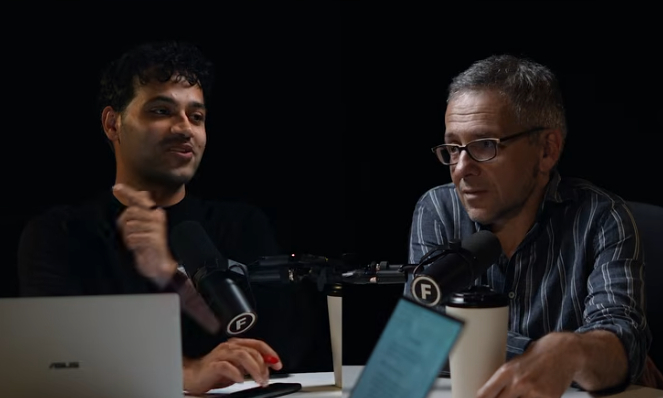
Read the full transcript of geopolitical expert Ian Bremmer’s interview on Figuring Out podcast, August 6, 2026.
EDITOR’S NOTES: In this episode of the Figuring Out podcast, host Raj Shamani sits down with renowned political scientist and geopolitical expert Ian Bremmer to examine the shifting balance of global power. Bremmer discusses why he believes America is no longer the world’s clear leader, the rise of China’s influence under Xi Jinping, the concept of a “geopolitical recession,” and how artificial intelligence, India, and eroding trust in U.S. institutions are reshaping international relations. The conversation offers a clear-eyed look at the forces that will define global leadership and security in the decade ahead.
Introduction: Who Is Ian Bremmer?
RAJ SHAMANI: Let’s start from the point where if someone’s watching you for the first time and they have no clue who you are, how would you explain them what you do, who you are, and why should they watch this?
IAN BREMMER: Look, why they should watch it is because I’m going to be honest with you about what I think about the world, the state of the world, where the world is going. Global politics, international relations, how it all comes together, how it’s coming apart.
I’m a political scientist, and they probably don’t want to watch me for that reason, but that is what I am. That’s what I do. I’m not a journalist. I’m not a businessman. I’m a political scientist. There are a lot of people out there that try to understand global politics. A lot of them are very political. They have a very strong preference, and therefore they’re trying to sell you that preference. I have preferences. I have things that I like, things I don’t like. I’m not trying to sell you on them at all. I’m really trying to best understand where the world is going, and frequently it’s not things that I like.
What Does It Mean to Study Where the World Is Going?
RAJ SHAMANI: So when you say that you talk about and you’re going to teach us about where the world is going, and that’s what you try to understand, what specifically you try to study when you mean by, “I’m trying to understand where the world is going, what’s happening” — what are the specific pointers, what are the specific things that you study which gives you a sense that this is where the world is heading?
IAN BREMMER: Well, for a very long time, the principal actors on the global stage have been governments. And so you look at things first and foremost through a country lens. You want to understand those different kinds of governments. Their political systems, their economic systems, what drives them, what constrains them. Frequently what constrains them is even more important than what drives them. How short-term or long-term are they? How much do their leaders matter or not very much? What are the things that create differences among different international actors, different countries?
But there’s also increasingly the sectoral lens, the issue area lens. You want to understand how, for example, a changing global energy environment from coal and oil and gas to sustainable energy, how that’s changing the world. It’s moving very fast. How AI technology companies that are becoming principal actors in determining how countries work, how security works, how the economy functions, and even who we are as human beings — because at the end of the day, global politics is a study of how human beings interact with each other.
I mean, there are some people that find human biology really interesting and they want to be doctors or scientists. I find most fascinating how human beings interact with each other, what makes for the models that are the consciousness that we have today. And for me, political science and international relations was the best way at that. So that’s what you do.
Is America Still the Superpower?
RAJ SHAMANI: And when you study international relations and geopolitics today, do you see certain signs that the superpower of today is changing?
IAN BREMMER: You’re saying that the Americans are the superpower today?
RAJ SHAMANI: Yeah, Americans are the superpower today.
IAN BREMMER: Do you believe that? Do you believe America is the superpower today?
RAJ SHAMANI: That’s what we’ve been fed, right? That’s what we’ve been fed.
IAN BREMMER: But do you believe it? I’m just asking you. I’m wondering.
RAJ SHAMANI: No, I think American companies are the superpowers, not American, like America as a nation. Does that make sense?
IAN BREMMER: Yeah.
RAJ SHAMANI: I think few companies are dictating where and how we are going to go rather than an American government. That’s what my belief is. But it can be biased, it can be very little. I don’t know.
IAN BREMMER: It’s good to understand always when you’re talking to someone where they’re coming from. There were a lot of Chinese that believe that actually China has a bigger economy than the United States, depending on the measure that you use. There are a lot of people that believe America’s in decline, and that it’s going to fail. Xi Jinping talked about a Thucydides Trap when he met with Donald Trump. That means that China’s rising, America’s in decline. Trump says, “Yeah, he said he’s declining, but declining under Biden, but now it’s doing great under Trump.” All this kind of stuff.
Look, we lived back in the Cold War when I was growing up. We had 2 superpowers. The Americans thought the Soviets were a much stronger superpower than they were. They thought their economy was much more robust than it actually was. But the world had different countries, and some of them aligned with the US and some of them aligned with the Soviets. And that was clearest in Europe, where you actually had the Berlin Wall. And if you were on one side, you had one political system, one economic system.
I started my graduate school in 1989, and the Soviet Union collapses. The Berlin Wall comes down. So suddenly there’s only one superpower. It’s the United States. It’s the new world order, and we’re going to win. So everyone’s going to want to be like us, right? They’re all going to integrate. China joined the WTO, the World Trade Organization, and NATO expands, and the EU expands, and everyone’s going to be allies.
And then now people look at the world and they say, well, even if the US is the most powerful country — because most importantly, it has the reserve currency, the dollar that most people trade in, and that provides a level of gravitational pull to the US — most people wouldn’t say that the US acts like the global superpower, because the US doesn’t want to be the leader of everyone.
Trump says it’s the Monroe Doctrine, it’s the Western Hemisphere, that’s where America really wants to dominate. But Ukraine is really far away. And so the Europeans should take care of that with the Russians. Taiwan is really far away. And so that should be the Chinese and the Japanese — they should figure that out.
So Trump, and not just Trump, but previous American presidents have increasingly acted as if some of the core precepts of superpower leadership — which was, for the Americans, “We’re going to be the sheriff, we’re going to be the architect of global trade, and we’re going to promote universalist values just like we did after World War II, the United Nations” — well, the Americans aren’t doing that anymore.
So today, even if the US still has the global reserve currency, and it does, and the US has the biggest military, the only military that has global reach with bases all over the place, and it does, that’s true — the United States doesn’t want to be the global sheriff.
RAJ SHAMANI: Right.
IAN BREMMER: I’m saying that very clearly. It wants other countries to do much more of their own lifting, take care of their own national security. The US certainly doesn’t want free trade. They’re putting tariffs on that we haven’t seen in almost 100 years on countries all over the world, including India. And they’re not promoting global democracy and rule of law all over the world. The United States isn’t even sure that it has an effective democracy itself. They’re fighting internally over what America stands for.
So even if the United States is the most powerful country, and there are other countries that are increasingly — China is increasingly powerful and very competitive with the US on technology, for example, very competitive in terms of commercial and trade relations with other countries around the world. More countries do more trade with China than with the United States, for example. China has a lot more people. India has even more people than China. So there are lots of ways you can think about the power balance changing.
But the most important thing is: if the United States does not want to take leadership globally, then you can’t say that the United States is a superpower. And that means that what’s happening in the world is much more uncertain. It’s much more volatile.
The GZERO World and the Geopolitical Recession
IAN BREMMER: And I think the reason for that is because you now have a misalignment between the rules and the institutions and the architecture of how the world works and the balance of power. It’s changed a lot, not just because the Soviet Union collapsed, but also because Russia wasn’t brought in.
RAJ SHAMANI: Yeah.
IAN BREMMER: And China was rising and people said, “Okay, we’ll bring China in.” But what if we don’t really trust China? What if China doesn’t integrate with what we want? India is rising. “Okay, we’ll bring India in.” But what if India doesn’t want to really be our ally or our friend? And then the United States says, “Well, we don’t want to do all of this stuff.”
So those are the reasons why we have this huge uncertainty — what I would call a GZERO world. Not G7, not G20, but an absence of global leadership and therefore a geopolitical recession. Just like we have economic recessions, boom and bust cycles, we have geopolitical recessions, but they’re much longer. They don’t happen as frequently. And you don’t necessarily recognize when you’re in it.
But here’s the key point: if you’re in a geopolitical recession where you don’t have global leadership, there are only 3 ways out. Only 3. One is you take the institutions and the rules of the road that you didn’t used to believe in as much and you make them stronger. The second is you build new institutions and architecture that better reflects what people need and the new balance of power today.
RAJ SHAMANI: Yeah.
IAN BREMMER: The third is you go to war. That’s it. There are no other choices. There’s a fourth, actually. The fourth is you ignore it. You pretend that there’s no geopolitical recession and you act as if everything is fine — which, by the way, the Europeans had been doing for a long time until the Russians punched them in the face. You can pretend. Number 4 is a bad strategy.
But the first 3 — we are doing the first 3. The Europeans are investing more in Europe because they know they need to. Why? Because the Russians are invading. The Chinese aren’t trustworthy. The Americans are not predictable. So they have to invest. There are new institutions being created. Looking at global climate, for example. Look at Belt and Road. Look at the Quad, for example. Look at what’s happening with Saudi Arabia and Pakistan — very important for India right now, for example. Those are happening.
But then there’s also war. People are going to war. They’re going to war globally — Russia, Ukraine, Gaza, Iran, US. But they’re also going to war domestically against their own establishment, against their own governments. And that’s true in Bangladesh, as it’s true in the United States.
There aren’t any other options. That’s what you do in a geopolitical recession. And if you don’t take the first 2 steps adequately — you don’t rebuild or create — then there’s going to be a lot more conflict. That’s the reality.
Does America Still Call the Shots?
RAJ SHAMANI: So we’ll come to geopolitical recession, but before that, you said America doesn’t want to be a superpower or a leader anymore.
IAN BREMMER: Yeah, in the same way.
RAJ SHAMANI: Is that true?
IAN BREMMER: In the same way.
RAJ SHAMANI: Because don’t you think they’re still trying to actually just protect their interest all around the world, and they are calling the shots on certain things. And they’re like, “If you don’t follow this particular way of doing business or doing things, we’re going to punish you. We’re going to penalize you.”
They are still interested in Iran. That is a different country — they should have no job there. I don’t know what they’re trying to do there. Then they try to say that, “Okay, Russia, even though Ukraine — we are not going to fully support it” — whatever, whatever. Still, “Let’s put sanctions on them. The whole world should stop trading with them. If you don’t stop trading with them, you are our enemy.” They try to do this everywhere, in almost every country.
When in Venezuela something happened — which I don’t know what, even if it’s even legal or possible, or should that be allowed for any leader to —
IAN BREMMER: But it happened. That’s right. Yeah.
RAJ SHAMANI: Right. Then Taiwan — you said it’s far away, but America has its interests clearly, where they have said openly out there that they’re going to protect Taiwan from the Chinese if they ever try to take over Taiwan. So in bits and pieces, they still want the world to follow them.
The Erosion of American Leadership and Global Trust
IAN BREMMER: So, a couple of ways to answer that. The first is, what is a leader? A real leader is not someone that tells you what to do. A real leader, a leader that has followers, is someone who is able to get you to want to do what they are telling you to do. Leaders do not operate in isolation of followers, of a team, of people around them.
So the first point is that what we see is that so many countries around the world that have viewed the United States as a leader, as a partner, as an ally, are now saying, “We do not believe that we can rely on this country the way we have historically.”
So are the Americans leading on Ukraine? They were when Ukraine was invaded. Not in 2014, right? Not when Russia took Crimea and sent their little green men. Nobody did much then, so there wasn’t much leadership then. But when they invaded in 2022, for reals, as we say, they went into Kyiv, or tried, then the Americans said, “Okay, we got to stand this.” That’s not happening today. Who’s leading? The Ukrainians are leading, the Europeans are leading, and the Americans at best are in third place on that.
And I would say that on Taiwan, the Taiwanese are much more concerned that, well, maybe nobody is really going to come to our defense, and we’re worried about that because the United States can’t be counted on the way they could historically. The United States certainly is changing the rules of the game on trade. So the US has not become isolationist at all. The US has become more unilateralist. It’s become more transactional. It’s become more short-term.
It is still a really powerful country. I think the US is still the most powerful country overall. I think China is Number 2. It’s close in some areas. It’s surpassing the United States in some areas, but overall number 2.
RAJ SHAMANI: True.
IAN BREMMER: And then other countries are middle powers, as is the term of art these days, then occupy another geopolitical space. And then there’s a whole bunch of countries that are forgotten.
I talked to a lot of world leaders. I talk to world leaders in Asia. I talk to world leaders in the Middle East. I talk to world leaders in Europe all the time, Latin America. And if you were to ask those leaders, “Do you believe that the United States is the world leader today?” Most of them would say no. They would say the US is the most powerful country. They would not say the US is the world leader.
And by the way, they would not say, as you did — I want to go back to this point, important point. You said you think that the companies in America are actually the leaders. They would not say that. Most of those leaders who are the global leaders on the global stage would say the American government is still the leader.
But I agree with you that a large part of the American decision-making process has been captured by private sector companies and by special interests, some of which are not companies. I mean, the NRA, the National Rifle Association, is not a company, but it is a special interest. The trial lawyers or the teachers union or AIPAC, those are not companies, but they are special interests.
And the point that I think you’re making, which is important, is that the role of money in the United States, and even some of that money from outside the United States, has an outsized role in capturing the political process. And it is a big part of the reason why many Americans no longer believe in their own political system and their elites the way they did when I was a kid, the way they did in the ’70s and ’80s. I think that is a real change.
And I think it’s the reason why New Yorkers — we’re sitting here in downtown New York — everyone under 35 voted for Mamdani, a socialist Democrat. Inconceivable 30 years ago that New York City, the global capital of capitalism and the free markets and Wall Street and Madison Avenue, would vote for a socialist Democrat. And yet all the young people did that.
RAJ SHAMANI: Why?
IAN BREMMER: Because of what you said. Not because America is truly controlled by the corporates, but because the role of money is making them feel, “These leaders don’t represent me. They represent the big money. They represent the big money.”
When the World Stops Trusting America
RAJ SHAMANI: So you pointed out 2 different things, and let’s talk about both of them, and both of them stem from trust, right? Global leaders are not trusting America, and people inside America are not trusting America as well. What happens in both situations? When the world stops trusting America, what happens then? Because clearly they have, and they’ve shown so many signs in so many places where you can’t trust them, like Afghanistan. So now all their allies are worried that if they can leave Afghanistan overnight, how can we rely on them for security?
IAN BREMMER: And I’m glad you mentioned Afghanistan because that wasn’t Trump. That was Biden. When the US went into Afghanistan, the Americans asked all these countries to join. The decision to leave Afghanistan, they didn’t ask the coalition members. And I think a lot of countries around the world said, “Why should we trust you?”
RAJ SHAMANI: Yeah.
IAN BREMMER: So this is not new. It is being accelerated by Trump, and he’s certainly benefiting politically from it in the United States, but it’s not new. It’s been coming for decades now, I think.
But the reality is that even if these countries don’t trust America, in many ways they still rely on the United States. Japan still relies on the US for defense, and that’s not going to change in the next year. The Mexicans overwhelmingly rely on the United States for trade and investment and tourism and remittances. The Canadians overwhelmingly rely on the United States for a market. That’s not going to change tomorrow.
So I think you’re seeing a few things. The first thing you’re seeing is that countries around the world are starting to diversify more, to have less exposure to the US incrementally and more exposure to other countries, so that the Americans will not be able to hurt them as much with their unpredictability.
You see this with the EU-Mercosur trade agreement. Mercosur is the largest trading group in Latin America. They had been talking for years and years. The deal was basically dead. It was stalled. It wasn’t going anywhere. Trump puts all these tariffs on. They get together. They say, “We got to do this deal.”
You see Mark Carney — the Canadians had a really bad relationship with India. Sort of the killing of this one Canadian citizen. They got into a big fight. Mark reaches out to the Indian prime minister. They fix it. A big piece of that: “Can’t trust the Americans. Need better relations there.”
Europeans spending much more on defense, and coordinating more amongst themselves for ballistic missile defense that is parallel with NATO, so you don’t necessarily rely only on the United States. So the first point is you want to diversify your exposures. This is not a middle power coordination. It’s not like there’s a new middle power bloc that’s developing. That’s not happening. They are too small, too diffuse, not coordinated, don’t share enough interests. But all of the middle powers are engaging in the same hedging strategy to reduce at the margins their exposure.
And the second thing that happens is you invest more in your own resilience. So if you’re a Gulf state and you know you can’t count on the Americans for the Strait of Hormuz, you need to build out your security, your defense. If you’re the Europeans and you can’t count on the Americans for Ukraine, you’ve got to spend a lot more on your own defense. The Japanese are doing the same thing.
But what you can’t do is pretend that reality doesn’t exist. And reality is that the United States is still the most powerful country. The United States still has the most powerful defense capability. The US is, along with China, the most powerful in technology. And these countries that are allied with the US don’t suddenly trust China just because they worry about the United States.
And so you have to maintain your base level of relationship and exposure to the US in many, many ways, even if it feels more uncomfortable, even if it makes you feel more vulnerable.
And this is why it’s so important to have a podcast conversation, because if you’re talking on cable news, you’re talking on social media, it’s like, “America’s a superpower.” “No, America’s in decline.” “I like America.” “No, I hate America.” It’s not about that. World leaders don’t get to make yes/no decisions like that. They have to live with reality. And reality is that even though the United States has become much less trustworthy over time, and that has actually accelerated in the past years, there’s still a very significant amount of dependency that needs to be recognized and maintained.
Is This the Beginning of America’s Decline?
RAJ SHAMANI: But is it the start of the decline then? If the world doesn’t trust you anymore and they’re only dependent on you because they have to — it’s their need, it’s there only on the things that they don’t trust you — like they don’t want to build relationship or they don’t want to invest into newer things with you. They are just dependent on certain things where they don’t have any other alternative or any other choice. So the moment they’ll have another alternative, they’ll probably pull out.
IAN BREMMER: Well, let’s recognize a couple of things. First of all, if I look at the last 30 years geopolitically, if you want to talk about power, there have been a couple of different things that have happened. One is that China and India have been rising. China much faster, India more recently with Modi, but that has been happening. They’re becoming more influential, more powerful.
Secondly, America’s allies have gotten weaker. They are demographically shrinking — many of them, like Japan, South Korea, much of Europe. They have not invested in defense. They haven’t invested adequately in technology. Their productivity and their growth has slipped.
So the former group, India and China, you could definitely see them becoming more independent, diversifying, even decoupling to a much greater degree. The advanced industrial democracies — it’s not as if they are becoming so strong that they can suddenly go off on their own. This middle power strategy that Mark Carney, Alexander Stubb, the Finnish president, and others have been talking about — there isn’t a there there, because for the last 30 years those countries have gotten weaker.
Now that they find that the Americans are less trustworthy and less dependable, they’re starting to finally invest much more in themselves. But it’s late. You needed the Draghi plan for Europe 20 or 30 years ago. You didn’t need it in 2025 or 2026.
So I think what you’re describing — we’re very far from that. And the other point is that I think we don’t know what kind of political system is going to succeed in the future. I think we don’t know whether governments are going to be principal actors or whether technology companies are. We don’t know if power is going to be more centralized or decentralized because AI is moving so fast.
Now you’re asking me about 10 and 20 years’ time — might the United States be declining? The answer to that may well be yes. The role of the US dollar as reserve currency may be considerably less in 20 years than today. But that may not be because other countries are more important. It may be because countries are less important, period. It may be because actually our present geopolitical order doesn’t really work.
A Planet Without Global Governance
Let me give you a big example of this that I think is worth considering. Let’s imagine that you’re an alien and you come down to the planet right now. You’ve traveled light years away, and in 2026 you suddenly encounter Earth — Earth with 8+ billion people on it.
And you go, “Wow, I came here at exactly the right time, because for billions of years almost nothing was happening. And now suddenly human beings are developing the technologies that will allow them to transform the Earth around them, transform themselves, and create tools that can be even smarter than they are — in a cosmological eye blink.” What an exciting time for the aliens to come down and see this planet.
So then the aliens say, “Okay, now I wonder what kind of governance — how do they actually run this society?” And then you look around and you see that there’s no global governance at all. None. You’ve got these technologies that are going to completely transform humanity and the planet, and there is no global governance. You’ve got a Security Council that doesn’t work, with core countries that veto everything. You’ve got a United Nations with almost no money and no influence. And otherwise, you’ve got decisions that are being made by these nominally sovereign countries that have delineated territory amongst themselves. Sometimes they fight over it. Most of them don’t trust each other. Some of them hate each other.
If the aliens look down at that, they’d say, “This is not sustainable.”
RAJ SHAMANI: Yeah.
IAN BREMMER: You know that.
RAJ SHAMANI: Yeah.
The Need for Global Governance
IAN BREMMER: And so when you ask me a question like, is the United States in decline in 20 years’ time, and are people going to move away from it, I see the world is moving so fast, technology is moving so fast, that the right answer to that question is what kind of governance are we going to need? What kind of rules are we going to need as 8 billion people on the planet in 20 years?
I don’t think that question is primarily going to be resolved by saying the United States is or isn’t in decline. I think that was the right question to ask in 1962 during the Cuban Missile Crisis. It was the right question to ask in 1945 when the Nazis were defeated. It is not the right question to ask in 2026, not for the Indians, not for the Americans.
RAJ SHAMANI: What kind of governance or what kind of political system will we require in order to build a global leadership? Will it be government-led? Will it be country-led? Will it be technology company-led? How do you see it? What is likely to be according to you?
IAN BREMMER: If I look at the kinds of things that require global governance, I wouldn’t say that about nuclear weapons. We almost blew ourselves up. And yet it was only 2 countries that had lots of nukes and they were scared of using them. And so as a consequence, even though there was no trust, none, they were able to do a hotline and they created arms control agreements and they limited the building of what they did. They didn’t do defenses. And I think that the Chinese, even though they’re building nukes very fast, largely are just as scared about using those weapons. So I don’t think you need global governance on nukes.
Climate change — a lot of people have argued you need global governance on climate change because we’re ruining the climate, we’re destroying, we’re killing so many of our species. And I am worried about that, but I’m also much more optimistic that we don’t need global governance because we on the planet have been investing an awful lot, seeing what’s happening to the climate, saying we’re going to need post-carbon energy. It can’t all be coal and oil and gas. It’s going to have to be solar and wind and nuclear, electric cars and batteries. And this is developing at such a scale and it’s becoming so much cheaper that we will invent these solutions that will eventually respond to climate change. Too late, with lots of damage and pain that was unnecessary. But we will get there.
And the Chinese are taking the lead, but other countries are going to move very fast. And some of that is in the US. We see it in California, we see it in Texas, we see it in Europe, we see it all over the world. It’s going to happen.
AI and the Case for Global Governance
IAN BREMMER: I think in technology and specifically in AI, we have to have global governance. We have to, because otherwise these technologies will move so fast. They’re so wonderful in terms of what they can do to help human beings unlock energy and efficiency and creativity. But they’re also incredibly dangerous if used as weapons.
And we already saw this very recently with Anthropic and OpenAI and Mythos and Fable and all of these advanced models that when deployed can identify any vulnerability in your software that would allow hacking to destroy what you have. And that’s the whole digital economy. That’s the banking system, it’s critical infrastructure, it’s water, it’s energy. It’s national security, it’s everything. So the government had to suddenly shut this down so they could figure out how do we patch all this stuff.
Now, I think that can get fixed. There may be some damage, there may be some costs, but I think that can get fixed. But what happens when AI can do that with bioweapons? What happens when AI can do that with lethal autonomous drones? What happens when AI can do that with programming people with misinformation?
And that can come from anywhere. That can come from the US, it can come from China, come from India. It can come from a government, can come from a company. Can come from an individual that’s just tinkering with an open source model 6 months, 1 year after the companies are developing the big proprietary models. We will not be able to grow as humanity without a global governance system for that.
Now, you asked me what is likely to happen. Well, right now we know there ain’t no global governance. There was just a G7 summit meeting in Évian, France. The global leaders were there, and so were the other global leaders, all sitting around the circular table. You’ve interviewed some of them, some of the top hyperscalers in the AI space. And if you just looked at that table, you’d say, I couldn’t tell who the real leaders really are right now. It’s changing, right? You get this.
So there’s going to be a crisis, many crises, because there’s no governance model, because you’re just rolling these models out. And the companies, maybe some of them are run by good people, maybe some of them are run by bad people. That’s not the point. The point is they’re spending all of their time, all of their money in just trying to ensure they don’t lose to the people breathing down their neck who are competing with them — the other American companies, the Chinese, you name it.
So we’re going to have crises. And in response to those crises, we will then have some form of, “Oh my God, we need some kind of global governance.” Now, I don’t think that global governance is the end of India or the end of America, but I do think it is something that is very new.
The Financial Markets Analogy
IAN BREMMER: And the analogy that I have for it is the financial marketplace. We all know you and I need the financial markets to survive as humans in the 21st century. We use it all the time. We rely on it. It’s how we get paid. It’s how we consume. It’s how we live. And we understand that if there is a threat to the financial markets, we need all of the governments in the world to identify that threat and kill it.
And that’s why, despite the fact that you have an Indian government, we have an American government, we’ve got a Chinese government, we’ve got European — the EU governments that work together — they all have central bank governors. And those central bank governors act independently, more or less, from their governments. And they have tools that allow them to respond to financial crises because we need it to work and it has to be global. When the financial crisis happened, we needed everyone to come together and avoid the financial markets having a global meltdown because we were all screwed if that happened.
Right now, what I am suggesting is that AI is becoming like the financial markets, but for everything in the digital space. And once we have AI robotics for everything in the physical space too, once we have physical AI models for everything in the physical space too. But for now, in the digital space.
So what we will need will be technocratic global governance like we have for the marketplace. We will need that for AI, and that will include the financial markets, because if AI makes a financial market vulnerable, you need to identify and stop it. But that will also include all the physical economy that includes digital software — anything from airports and airplanes and shipping lanes and anything that can be affected by AI, to biosecurity. All of these things. So it’s a really, really big component.
The Ministry of the Future
IAN BREMMER: I think of this — there was a book that was written by Kim Stanley Robinson. It was called Ministry for the Future.
RAJ SHAMANI: Okay.
IAN BREMMER: Now, that was a book. Have you heard of this book?
RAJ SHAMANI: No.
IAN BREMMER: So it’s a book about the future of climate. And we didn’t deal with climate. We didn’t have the technological improvements. The world got really hot. And at the beginning of the book, there was this incredibly hot wet bulb event in India with millions of people that got killed outside, no air conditioning. They all died. And there was this incredible global reaction, revulsion to the fact that the world hadn’t dealt with climate change. So the world created a Ministry of the Future that basically had full control of anything having to do with climate.
As I said before, I don’t think we need that for climate, but I think we’re going to need a Ministry of the Future for AI. And that Ministry of the Future is going to need to be populated not just by leaders of governments who don’t have the expertise and they don’t move fast enough and they have elections. This needs to be oriented by experts that understand the technology and are responsible for it. So they can identify a threat. They can communicate that threat immediately to everyone that needs to know, including the AI agents that are vetted and working for them. And then collectively, you can respond to the threat and contain it. Because if we don’t do that, we won’t be on the planet for long.
RAJ SHAMANI: Right.
IAN BREMMER: So I think it will happen because it will have to happen. The Ukrainians are now the strongest military in Europe. And the reason for that was because it had to happen, because the Russians invaded them. The Germans could have done it, but the Russians didn’t invade Germany. They invaded Ukraine. Any group of human beings are capable of deploying superpowers when we have to. But when we don’t have to, we don’t bother. It’s not because we’re bad. It’s not because we’re lazy. It’s because we just don’t give our best until we have to.
The point is that AI is going to force humanity to show our best in terms of governance. We’re going to be challenged by AI. It’s coming real soon, and our present structures are inadequate. That’s the reality.
RAJ SHAMANI: Today we don’t have this, right? Today we don’t have these ministries. Today we don’t have this governance.
IAN BREMMER: Nope.
RAJ SHAMANI: And probably if someone is thinking about this idea, then it’s not out there yet, right? So at this point, anything could happen. There are powerful players and individuals or organizations in the world who can challenge and probably misuse this entire thing. Who do you think — who are the top 3 most powerful players today who could probably shape the future?
The World’s Most Powerful Players
IAN BREMMER: The most powerful person today in the world is Xi Jinping. His country is less powerful than the United States, but there are no checks and balances on Xi Jinping. He has no term limits. He is the great leader of the Chinese Communist Party and the military and the state system.
RAJ SHAMANI: He—
IAN BREMMER: Xi Jinping Thought motivates what is and is not acceptable ideologically for the elites, for the party cadres, and for the individuals that matter in the system. And he controls the second largest economy in the world with some of the most important technologies, some of which are leading the United States and everybody else. So certainly, any one person — who’s the most powerful in the world today? It’s Xi Jinping. Most powerful country? United States. Most powerful person? Xi Jinping.
RAJ SHAMANI: Not Donald Trump?
IAN BREMMER: Donald Trump is gone in 2029. The checks and balances on Donald Trump — half of what Donald Trump tries to do, the courts say no. So the answer is no. The United States is an imperfect democracy, a flawed democracy, a non-representative democracy, but it’s still a democracy. And there are real checks and balances. There is a judiciary. There is a military that is independent from the president. It is professional. Congress doesn’t work very well, and he controls the Republican Party. Absolutely. But you cannot say that Donald Trump has anywhere near the kind of control over the US that Xi Jinping does over China.
Now, Putin has even more control of Russia than Xi Jinping does over China, in my view. But Putin’s country is vastly less powerful.
After I get past Xi Jinping and Donald Trump, I start thinking about people that aren’t running countries. I start thinking about Elon Musk and Dario Amodei and Sam Altman. We talked briefly about Russia-Ukraine. The Russians were winning that war. They’re not anymore. Why not? The main reason they’re not winning the war today is because back in February, Elon Musk shut off Starlink for the Russians, which meant that their drones no longer worked. Now, the American government didn’t tell Elon to do that. Elon told Elon to do that. And yes, he’s the wealthiest person in the world. But more important than that money, because Xi Jinping’s control of resources is far greater than the trillion dollars that Elon has control over. Far, far greater.
RAJ SHAMANI: Right.
The World’s Most Powerful People
IAN BREMMER: But the fact that Elon has control of those technologies and he basically has a near monopoly on near-Earth orbit, which is pretty extraordinary when you think about it, right? I mean, not to mention the data that he has accumulated and what he can learn from it, how he can manipulate it. The control of a component of the American and the Western and some of the developing world’s public square through Twitter X. I mean, that’s a lot of power for one guy, right? So you got to put him— you’d certainly put him in your top 10.
Yeah, I put the Pope up there because the Catholic Church at the end of the day is an extremely hierarchical, extremely large population institution that really respects that one guy. And so his ability to write an encyclical on the way artificial intelligence should be run is probably more important than any individual contribution we have seen in collective consciousness on what AI should and should not do going forward. That’s really important. Modi is extremely important.
RAJ SHAMANI: Why?
IAN BREMMER: India is a democracy. Yeah, but he’s been in power now for well over 10 years, and he basically runs the system so that he’s been able to develop a series of economic reforms and foreign policy relationships that have been consistent, that you can count on, like the India-Japan relationship, which is the most important relationship in many ways that India has in the world today.
He’s been able to do that in a way that many leaders of democratically elected governments cannot because they don’t have the consistency. They can’t do the long term. I mean, again, I wouldn’t put him on my top 3. But I put him in my top ten, right? I put him in my top ten.
RAJ SHAMANI: You said you would put Xi Jinping as the top most powerful person in the world.
IAN BREMMER: Yeah.
Trump as the Biggest Global Risk
RAJ SHAMANI: But in your report of risk this year, yeah, you mentioned the number one risk in the world is not China, is not Russia, yeah, is not even nuclear war, right? It is the president of the United States.
IAN BREMMER: The political revolution in the United States. Yes, I did say that.
RAJ SHAMANI: Why? Why didn’t you mention Xi Jinping? You mentioned Donald Trump.
IAN BREMMER: It’s a very good question because Xi Jinping is much more risk-averse. He may be more powerful, but he’s much more reluctant to take sudden steps that would lead to unpredictability, right? I mean, we see that even with Taiwan, and he really wants Taiwan, but very incremental. He invites the head of the Kuomintang into China, and he does inspections and he does operations with the Coast Guard, but not with the military naval vessels because he doesn’t want to fight.
Meanwhile, Trump takes out Maduro in Caracas and puts him in jail in Brooklyn, just a few miles from where you and I are sitting right now. He goes and puts the highest tariffs on every country in the world that we’ve seen in almost 100 years. He goes to war together with Israel and he actually decapitates the leadership of Iran with 90 million people in the middle of the Middle East, right on one of the most important waterways in the world.
I mean, I wrote this back in January with my firm, but now you and I are talking months later. It should be obvious that Trump was the bigger uncertainty, even though Xi Jinping individually is more powerful.
RAJ SHAMANI: And you feel that that’s going to happen going forward as well? Trump’s going to be the bigger risk?
IAN BREMMER: Less so.
RAJ SHAMANI: So less so. Why?
Why Trump’s Disruption Is Being Constrained
IAN BREMMER: Because I will tell you why. It’s a very important question. Less so because we’re now almost 2 years into Trump’s second term and Trump has been very disruptive. But the responses to that disruption have constrained him.
So the biggest disruption he made on the global stage in his first year last year was Liberation Day. That’s what he called it. April 2nd, tariffs on everybody. Biggest decision against China. So I’m going to put big tariffs on you, right? Because you’re weaker than I am economically. I’m going to make you capitulate. I’m going to make you bend the knee. You can do what I want. How do the Chinese respond? They hit back. He hits them back again. They hit back again. He said, “I’m going to export controls on you.” They say, “How? We’re going to shut down your critical minerals. And your factories aren’t going to work.” So Trump was disruptive, but it turned out the Chinese could force him back. And now he has a much more stable relationship with China.
Trump tried to reach out to Putin. He invited him to Anchorage, Alaska. They had a summit, red carpet. He invites him to travel with him in the Beast, in the limousine that he has. “I’m going to do a deal with Russia. Don’t care about the Europeans. Don’t care about Ukraine. I’m going to do a deal with Russia.” Well, it turned out the Russians wouldn’t do it. And the Ukrainians bent the knee a little. But then the Ukrainians start building their own defense. And the Europeans, they say, “You’re going to take away support from Ukraine? We’re going to support them ourselves. We’ll do it without you. We’ll spend all the money.” So it turns out his idea of engaging with the Russians, couldn’t do it, was constrained.
Goes to war against Iran, going to be a win just like Venezuela, right? Except that the Iranians emergency break glass, pull lever, shut down the strait. What does Trump do? He has to back down because he understands that there’s going to be an economic catastrophe. Then he goes in again. But he’s constrained.
So the point is that after 2 years of showing that Trump is maximally unpredictable, the constraints on him, even as the president of the most powerful country in the world, they’re growing. We also know we’ve got midterm elections coming up in November. He’s going to lose those midterm elections, certainly the House. That’s going to constrain him more.
You’ve got elections coming up in 2028. I know if you go to the Oval Office, he’s got a little store there because he’s got to sell the merchandise. And he’s got like “Trump 2028” — it’s the third term. It’s illegal. He doesn’t get a third term, right? He’s done in 2028. January 2029, there’s a new president coming in. The closer we get to that date, the less people are willing to jump when Trump says jump.
We just saw he went to this summit and he was angry at the Spaniards. He said, “I’m going to cut off your—” And the Spanish prime minister is like, “You’re not going to cut off my trade. It’s not about you. It’s about corporations that actually do the trade. It’s about people that buy goods. You’re not cutting off the trade.” He didn’t cut off the trade. He says, “I’m going to put a 20% toll on everything that goes through the Strait of Hormuz.” 24 hours later, he’s like, “Ah, no, I’m not.” Why not? Because he can’t do it.
So I mean, this is a guy that talks a lot and he’s been very disruptive, but that disruption has been constrained. And the more you say it, and the more you cry wolf, the less people actually believe there’s a wolf.
RAJ SHAMANI: But don’t you believe in prospect theory? So if you feel like your power is going to go, you’re more likely to take riskier things. So now that he knows that probably my term’s about to end, I want to do riskier things. I want to be more irrational.
IAN BREMMER: I think that’s right. He will take greater risks, but he will also be constrained more. And so the question is, which of those 2 things is becoming more important?
By the way, I think that the constraints on Trump globally are increasing. I think the constraints on him domestically are still uncertain. So I think that Trump’s willingness to use ICE to cause disruption internally around elections, I think he’s going to lean more heavily into that. That’s more uncertain. But I don’t think he can pull off another China-type trade war because he knows that he’s going to get hit back in the face. And what we’ve learned from Trump is he can throw a punch, but he has a hard time taking a punch. Whether it’s from China, whether it’s from Iran, that is learned behavior. And other countries are learning that.
What Drives Trump
RAJ SHAMANI: What’s your guess on him? Why is he like this? What do you think?
IAN BREMMER: Well, one is he’s deeply transactional. He is a businessman that does real estate. Real estate is not about long-term relations with business partners. Real estate is, “I’m doing a deal, I do the best possible deal, I make as much money as I can out of you, and then I move to the next guy.” It’s very transactional.
Secondly, he has enormous personal charisma, and he’s very convinced in the rightness of his instincts. So he doesn’t need to know a lot of details. He just goes in, which makes him extremely effective as a campaigner, makes him extremely effective at building a brand. It does not make him good at policy. And so he makes a lot of mistakes. He’s shameless and he engineered the biggest political comeback story in American history after January 6th, after felony convictions. He comes back and he wins the popular vote. You’ve never seen that before. But he makes huge policy mistakes because he doesn’t understand policy and he doesn’t listen to the people around him that understand policy. Some of whom— he has some advisors that are actually very capable. Scott Bessent, Secretary of Treasury, Marco Rubio, Secretary of State and National Security Advisor — he doesn’t listen to them the way he should.
Third point, he was almost assassinated. I mean, there have been several attempts on his life, but one time he’s standing on a stage, actually shot him in the ear, this close. Now, if you or I had had that happen to us, that would affect us for the rest of our lives. And if you go into the White House, you go to the Oval Office, there’s a huge painting, 6 feet tall, that shows him standing up going, “Fight, fight, fight,” with the blood coming down from his face. This is front of mind for him. And the people I know that are close friends to Trump, he talks about it all the time — that God saved him and he doesn’t know how long he’s going to be here. He could be killed at any moment. He could go at any moment. Obviously, he’s got lots of health issues. We don’t have full transparency on what that’s all about.
This is a guy that is really focused on the now, what he’s doing now, and fighting his enemies now. He’s not thinking about 10 years down the road, 20 years down the road. He’s not a Republican. He used to be a Democrat. He doesn’t care about ideology. It’s about him. It’s not the Republican Party, it’s the Trump Party. They’ve got to be loyal to him 100%. Those are the things that motivate him.
RAJ SHAMANI: Do you like him?
The American Dream and Political Revolution
IAN BREMMER: No, no, no, I don’t. You got to call balls and strikes. There are things that Trump has done that are successful that no one thought he could do and that all of the political establishment types said he would fail at. I mean, I saw when John Kerry, Secretary of State, and he thought he should be president, very smart guy, very arrogant guy, was like, “You could never do peace in the Middle East unless you have an Israel-Palestine agreement.” And Trump and his son-in-law Jared Kushner proved him wrong and got the Abraham Accords done. With no experience and background in the Middle East, they did something no one else could do. That was a big win.
Venezuela, he took out Maduro and now this regime has completely flipped to support what Trump and Marco Rubio want. And that’s going to be better for the Venezuelan people long-term. He got that done. So never say this guy can’t get things done. He can do a lot, but he is not a good person.
And you asked me before about leadership. Leadership, in my view, is about someone that cares. They have empathy for people around them, and they get those people through that empathy to want to be part of your team. Trump does not do that. Trump is predatory. He fears strength. He smells weakness. If he thinks you’re weak, he will crush you. He will take you for everything that you have. He demands loyalty. He offers no loyalty in return. That’s not a good human being.
And look, I worry that we are living on a planet where some of the most powerful men are old, they think about themselves, they don’t listen to expertise, they certainly don’t listen to young people, and they don’t care about other people. And that’s a horrible position for our world to be in right now. And I worry about that with some of the most powerful leaders in the world, like Trump and Xi Jinping and Putin. And I worry about it with some of our technology leaders too.
I mean, I understand that Elon and Jeff Bezos want to go to Mars, go to space. I want people that care more about the fellow human beings on the planet right now. Those are the leaders we need. That’s why I mentioned the Pope. I am Catholic, I was raised Catholic, but I think the Pope is a fundamentally good guy. I think this guy actually spends a lot of time thinking about and legitimately caring for other people on the planet.
And I think we need more leaders that spend more time thinking about and caring about other people on the planet. We need more young leaders. We need more female leaders. We need more leaders from other parts of the world that represent more actual people and not just small constellations of the rich and powerful. That’s why young people are so pissed off, right? Because they see what these old guys have been doing to the planet. They’re not happy about it.
RAJ SHAMANI: Do you think young people today, they believe that the American dream is dead?
IAN BREMMER: In America? The young Americans?
RAJ SHAMANI: Yeah.
The Two Americas: Anger, Inequality, and the Erosion of Trust
IAN BREMMER: I think they believe less in the American dream. Look, there are still an awful lot of young people that are starting companies in America, small companies, but it is harder. And I do think that a larger number of Americans think that the country today has inextricably become a two-tier system. Where there’s one set of rules for powerful rich people and there’s another set of rules for other people. And I think there are far more people like that today, and I worry about that.
I worry that it is harder to network today. It’s harder to build yourself up from the bootstraps. And I think there are 2 different groups of people that are angry.
I think you’ve got a lot of men that don’t have college degrees. They are working or middle class. Some of them have good money. They feel like no one has paid attention to them while a lot of immigrants came in. They feel like free trade took a lot of jobs to India, a lot of jobs to China, robotics, the workforce doesn’t need them the way they used to. And then they see that they’re the one group of people that you can discriminate against and no one’s going to get mad at you. You say these guys, as Obama said, “clinging to their guns and their religion.” I mean, if you had said that about women, if you’d said that about gay people, if you said that about Black people, you’d be canceled. But you say that about rednecks, these sort of white trash, right? And they’re angry. They’ve got grievances. And they are like, “No one cares about us.” And by the way, women are doing well and they’re getting more educated and they’re getting more rights. And we can’t even have relationships with women anymore. Scott Galloway, my good friend, talks about this a lot. I think this is a real thing. I think it’s a big part of why Trump won. And that is a big group of men that are angry in this country.
I think that there’s also an increasingly large group of college-educated, white-collar, professional women, urban and suburban. And they have watched as there’s this backlash against them. They’ve seen Roe v. Wade get taken down by the Supreme Court after 50 years, right? They see that AI is coming and it’s taking jobs away from the professional class. They see the corruption, they see Epstein, they see a small number of men and tech bros and bankers all enriching themselves. And meanwhile, they don’t think their children are going to have opportunities graduating from college, and they’re really angry, and they are not gettable by Trump. That is the progressives on the left.
But the reason I say this to you is because both of these groups of people, and there’s a lot of them, would say that the American dream doesn’t exist anymore.
Look, I believe in the American dream. I am the American dream. I mean, my family looks at what I did and they go like, “This guy, we gave him opportunities with education and look at what he was able to build.” They don’t even really understand exactly what I do, but they know it’s really cool, right? Whatever. That’s awesome. And I truly think that that could not have happened in any other country. There’s no other country that I could have built what I built at that time and made it into this today. Not possible.
But I think that we’re not just talking about a few deplorables in America that hate everybody and want to bring the system down. There are a lot of people in the U.S. that are falling into those 2 categories. And the longer we have governments and leaders that we don’t trust, that aren’t really leading, the more of those people there are going to be.
RAJ SHAMANI: So don’t you think then this starts the decline much faster than the external trust which America is losing?
IAN BREMMER: Yes.
RAJ SHAMANI: Right. Because of course, if the external world doesn’t trust you, but they’re dependent. But forget the external world — the internal world, people inside, they don’t trust in you anymore. I was reading a report that in the ’50s, more than 75% of people had trust in the government, in the institutions in America. Now less than 20% of people have trust. So it’s significantly declining.
IAN BREMMER: Couldn’t agree more.
RAJ SHAMANI: So now that people don’t trust anymore, isn’t it like a bigger problem? And that’s how other countries get the opportunity to win.
IAN BREMMER: But I think, again, I’m going to go back to — I’m not sure that countries are going to be the principal object of analysis for winning and losing in 10 and 20 years. And the things you’re talking to me about are not happening in one year. It happens over time.
RAJ SHAMANI: Yeah.
Political Revolution and the Need for New Leadership
IAN BREMMER: Also, these people in the United States, they are angry. Trump channeled that anger and he was a destructive force, a disruptive force, but for himself. The biggest problem and the biggest reason I don’t like Trump personally is because so many of the things that motivate him are when he promotes himself above the country. And you see this with the money he’s making personally and the enrichment of himself and his family and his friends over the interests of the country, driving individual policies — whether it’s “I want to make sure that I control TikTok with my friends so I have more influence,” or crypto with Pakistani investors, all of that nonsense, right?
But the fact that America picked a bad guy to drive a political revolution does not mean the political revolution is a bad thing. We’ve had this before, during the Gilded Age, which is the last time that the United States had this level of inequality and this many people that were really mistrusting the system. You elected FDR. And Franklin Delano Roosevelt came in and he engineered a political revolution. Now, some of what he did failed. He tried to pack the Supreme Court with 15 people — failed, couldn’t do it. He tried to purge his own Democratic Party of people that weren’t loyal — failed. But he created an administrative state that was professional and independent from the president, that allowed for the construction of a government that would build infrastructure, that would create and support a working and middle class for generations. And that was a great thing.
So we’re going to need someone like that. You don’t get someone like that unless you have a whole bunch of young people that are dissatisfied with the existing system. So you are correct that there is a big threat that so many Americans feel like the American dream does not work for them. Thank God, because it doesn’t.
If the American dream didn’t work but they didn’t feel that way, I’m much more worried about Chinese young people. Chinese young people are saying, “We don’t think the Chinese system works for us. What are we going to do? Lie flat. We’re just not going to try.” These young Americans aren’t saying we’re going to lie flat. They say, “We’re going to vote for Mamdani. We’re going to vote for AOC.” Now, I’m not saying that those are the answers, but the point is they have agency. They have voice. They will not be quiet. They won’t just sit down and take it. And some of them will probably be violent. And I hope that that number will be very small. They’ll be found, they’ll be contained. But there’s going to be disruption and we need disruption.
When the political system doesn’t work in a country or globally, you need disruption. So just like you’re going to need a Ministry of the Future for AI, you’re going to need a political revolution in the United States. We shouldn’t be scared of that. We should welcome that. That’s the opportunity we need. We can’t continue to have 80-year-old white dudes running the country. I mean, Biden was not capable of running the country for at least the last year, and we didn’t even know. No one was even saying anything about it. That’s a huge scandal, right? And the only reason we don’t talk about it more now is because he’s been replaced by someone that’s doing even worse.
RAJ SHAMANI: Right.
IAN BREMMER: And so, of course we need something else. But when you come to America and you’re going to interview a whole bunch of people to talk about the country, one of the things that makes this country so tremendous is the fact that we will tell you what we really think.
RAJ SHAMANI: Yeah.
IAN BREMMER: If you try to do that in China, good luck with that. They’ll tell you how much they hate America or the problems in America. Those are things they like about America too — they’ll be honest about America.
RAJ SHAMANI: America.
IAN BREMMER: A lot of the Chinese — I have great conversations with the Chinese about what they think about America. As soon as you ask them what they think about China, the conversation becomes much more narrow, right? That’s a problem. That’s a limitation. You can’t limit creativity like that and expect the country to flourish.
RAJ SHAMANI: I have 2 questions on this, what you just said. What happens when the young people of a country stop believing in the system? They start getting more scared. What happens to a country then?
IAN BREMMER: If we’re talking about the United States specifically, now that it’s happening, okay, so what do you see?
RAJ SHAMANI: What will happen now? What’s going to happen next?
The Divided America: Red vs. Blue and the Algorithmic Sorting
IAN BREMMER: Well, you’re already seeing a bigger divide between red and blue. You’re seeing that in certain parts of the country there is a greater sense of support for a certain style of policies and politics, and in another part of the country, it’s opposite, and there’s less tolerance. And that’s being made worse by the algorithms that is sorting the country into 2 groups of people that don’t talk to each other, 2 different political nations or tribes, if you will. And that’s a dangerous thing.
I also should say that one of the great resiliences of the US system is that the federal government doesn’t control everything. So the fact is, you were just in California, you were down in LA. California makes a lot of decisions about California. If you go to Austin, go to Texas, you’re going to see that Texas makes a lot of decisions for Texas. Florida makes decisions for Florida. New York makes decisions for New York.
And that’s a useful thing because it means that even though you have very different ways to experiment with policy, they don’t have to all follow one or the other. I mean, California and Texas right now are leading the country and leading much of the world in the creation of green energy. California is doing it from state-directed subsidies and regulation. Texas is doing it with almost no regulation, entrepreneurship and business. I don’t know which one will be more successful, but I’m glad we’re doing both because that gives you an opportunity to make these things work.
So I don’t think the fact that the country is becoming more divided, given how decentralized the system is, is less dangerous than it would be if everything was determined by Washington.
Capitalism Under Pressure: New York’s Socialist Turn?
RAJ SHAMANI: True. And what happens when the financial capital of the world, the capitalist place where capitalism was in the blood of people, starts choosing leaders which are not in support of capitalism upright? Well, is that a good thing for a country or no?
IAN BREMMER: I think that Zohran Mamdani, he’s a young guy. He’s very charismatic. He likes his job. He’s ambitious. He’s only been in office for months at this point. Absolutely, he wants to help the poor people of the city, the people that can’t afford living in the city. He wants to make it more attractive for them. So definitely rich people are going to see more tax, and some will leave.
But number one, like I just said about Washington, the mayor of New York does not get to determine everything in New York. The governor matters a lot. So it’s not as if Mamdani is suddenly creating a socialist paradise, good or bad, in New York City. Secondly, he’s got a bunch of people around him that actually do the job of running the city. Most of those people so far have been pretty managerial class. So he’s got the same police chief that the former mayor had. She’s doing a pretty good job. He’s not trying to destroy policing. He’s not saying blue lives don’t matter. He’s not defunding the police. He’s not touching any of that. Trash is still being picked up on time. The subways still work.
Okay, we had the World Cup in New York, very exciting time. He made sure that there was a lottery so that a few hundred people could get cheap seats to go there. That’s nice. Does that change the— it doesn’t change the city. So I do not think that America is in danger. I don’t think New York is in danger of suddenly getting rid of capitalism. I think the bankers are staying. I think the tech companies are staying.
But I also recognize, look, just recently there was this guy, Luigi Mangione, who only a few blocks from our offices got a gun, went over to a CEO, shot and killed him, assassinated him. And this was a college-educated kid who decided that healthcare was exploitative, wasn’t taking care of the average American, got all radicalized and violent and went and killed somebody. And there’s going to be more of that in this environment, too. And that’s a horrible thing.
I do worry that in a society that has as much mental health problem, as much gun availability, and as much anger, political anger algorithmically hyped up, that you’re likely to see more violence. And I really worry about what that means when the technology becomes more accessible. To develop a bioweapon or to develop drones that could have a mass death event in a big open-air stadium. I really worry about that because we could easily have another 9/11 or worse in the US, not from Islamic extremism, just from one idiot that decides that he— probably he, it’s not usually a woman— is going to go and kill a bunch of people.
Of course I worry about that. But that is not a structural worry. That’s not a worry about America as a country. That’s a worry about citizens that are going about their day-to-day lives.
Government Intervention in Markets: Industrial Policy and the Spectrum of Capitalism
RAJ SHAMANI: Fair. I was reading one thing recently. I’m shifting gears to the markets now a little bit, which is earlier America used to follow a thing that let’s not intervene in companies. Let’s not intervene in the markets. Let market pick the winners. Governments are here to set the rules and we are here to govern. Now it’s been changing. The government is now interfering or probably picking up stocks of a lot of companies, and especially in technology, semiconductors, critical minerals, all of these. Do you think it’s a good thing?
IAN BREMMER: I think it’s always happened.
RAJ SHAMANI: Again, the exposure is going really high, right?
IAN BREMMER: The amount of money we’re talking about is still comparatively small. But the industrial policy is becoming more strategically important. The tariffs that we’re seeing, the trade deals that require foreign investment in certain sectors or else, for example, the state is definitely taking a heavier hand in the amount of and the kind of winners and losers that they’re picking. I completely agree with that.
I think that the way people think about the markets and the economy and government is a little bit misguided. Frequently people will say that you’ve got either socialism, which is the government, or you’ve got capitalism, which is the companies. I think it’s much more about the relationship between a government and companies, and that there’s a spectrum.
In China, you have a system where the government is really powerful. It’s the most powerful actor in the economy, and they pick winners and losers. State capitalism. Here are the sectors that we’re going to invest in. Here are the individual companies that will be our champions in that area. Here are the companies that we’re going to own as the government, and we’re going to have Communist Party cells inside every company to make sure that what they do is okay. So the state captures the corporations.
In the United States, let’s go back to what you said before about who the powerful companies are. We’ve got special interests that invest a whole bunch of money in lobbying to write their own regulatory policy. So the private sector captures the government. Private sector capturing government is not a free market economy. It is a private sector captured economy that has oligopolistic identity.
Now, small and medium enterprise in the US is very, very free market oriented. It’s super competitive. That’s still true. No one is saying that’s changing. That’s the place where people still believe in the American dream. But the big corporations, not at all.
Then you’ve got Europe, and Europe is in the middle because Europe, you’ve got a government that’s actually quite bureaucratic and makes rules with the long-term interests of the citizens in mind, but doesn’t actually have control of the corporations at all the way the Chinese do.
RAJ SHAMANI: Yeah, right.
IAN BREMMER: Now here’s the issue. The European system in principle supports the social contract to the greatest degree, but the European system has not driven the growth, the productivity, and the technological advances that allow for the pie to be big enough to keep paying for all of these benefits. China and the United States, those systems where the state captures the corporations or the corporations capture the state, drive a lot more growth and productivity, even though they also drive a lot of inequality because the distribution is not being aligned with a broader sense of a social contract.
So when you look at it that way, you recognize that the United States is not going from a well-regulated, free market, competitive economy to one where the state controls everything. You see that it’s going from one where the companies have had, and special interests, inordinate power, to one where the governments are actually starting to do more of that picking and choosing. So it’s a horseshoe. And the US is starting to look a little bit more Chinese, but it’s not becoming more European.
RAJ SHAMANI: True.
IAN BREMMER: And maybe what the US needs to do is learn more, especially if AI is going to start displacing lots of workers in all of these professional services, in all of the digital economy, which is the commanding heights of an advanced economy. It might be that the US needs to continue to harness the growth, but will need more of the European model to ensure that the people don’t get so angry that they start burning it down. Because otherwise the people are going to start electing people like that anyway.
Is a Financial Crisis Coming?
RAJ SHAMANI: True. Do you think all of these things are leading towards a crisis in terms of financial crisis?
IAN BREMMER: I don’t think it’s—
RAJ SHAMANI: AI with companies becoming really big and powerful and now that we need structure.
IAN BREMMER: I think that the crises that are coming in the near term are more about the unfettered technology being used as a weapon than it is the financial meltdown. And I think that takes longer.
I think so far the companies that are using AI at scale, they’re spending a lot of money on tokens. Most of them aren’t yet sure exactly where the productivity and growth is coming from, leaving aside the coding and the tech companies. I think that you have a lot of individuals that are making decisions in these companies that are much more cautious. Organizational politics really matter. I think it will take longer. I talked to Indian CEOs as well in this space. They see this as more of a 10-year horizon, and they are very cost-sensitive around this stuff. And when I talk about bioweapons and lethal autonomous drones and software vulnerabilities, that’s a 12, 24-month risk.
So if there’s a crisis coming, and there are probably many, I think they’re much more about that than they are about this fundamental displacement. Again, so much of what you’re asking me, they’re really smart questions, but the answers have different timeframes. So when you’re asking me a 10 or a 20-year question about decline of a great power, things are moving faster than that. When you ask me a question about the large displacement of major workforces, other things are happening faster than that.
So I think as a political scientist who’s trying to understand the future of the world, comparative speed really matters. Climate change is a really, really big thing, but fortunately it’s a comparatively slow-moving thing.
Fast-Moving Geopolitics: India, Europe, and West Asia
RAJ SHAMANI: So let’s talk about fast-moving things which are happening right now. You tell me your opinion and views on what’s happening there. Just explain me, right? One is India, you call it a pivot state. Then there’s Europe, the region, and then there’s West Asia. You explain me what’s happening in all 3 places right now. Come on, because we were talking about it before.
IAN BREMMER: Yeah.
RAJ SHAMANI: And you said, because you’re friends with a lot of European prime ministers and presidents, what’s happening in Europe?
Europe’s Vulnerabilities and Resilience
IAN BREMMER: Europe is structurally in the most vulnerable geopolitical position because they have a lot of trade with China, but they don’t trust the Chinese. And the Chinese in many ways are hollowing out their own industrial base. You saw Volkswagen just had to fire half of their employees, all of that. They’ve got this big vulnerability from Russia, which invaded Ukraine and is engaging in espionage and all sorts of asymmetrical attacks across Europe, disinformation campaigns and the rest. And then they’ve got an alliance with the United States that they don’t really trust, right?
So they are really vulnerable in a way that Japan is less so, India is less so, Mexico is less so. They’re really vulnerable.
Now, Europe has been the most successful experiment of supranational governance that humans have ever done. Taking all of these countries, putting them together and saying, “We’re going to take a whole bunch of sovereignty and do it at the Brussels level, create a common market and common policies that used to be made by individual governments.”
But Europe, with all of these vulnerabilities, suddenly is thinking, “We better start making our model a lot stronger.” And that’s what I see them doing.
Now, the Draghi plan — Mario Draghi, Super Mario, the former head of the ECB, the European Central Bank — came up with this 800-page competitiveness plan. And everyone out there that knows the marketplace is like, “Yes, this is what Europe needs to do.” And of course, because they’re 27 countries and they’re bureaucratic, they move slowly. But they are moving.
And so you see an effort to increase productivity, to increase infrastructure investment. You see an effort to increase the financial integration in Europe and build stronger institutions. You see the Europeans spending more on defense. Why? Because the Russians are scaring the hell out of them. They don’t know if they can rely on the Americans.
You see more countries wanting to join the EU. Iceland talking about it. And the Ukrainians. Ukraine, of course, has become the most powerful military in the region. You see the UK that recognizes that Brexit was a really bad idea economically. The next UK Prime Minister, Mr. Burnham, is much more likely to try to get back into a common market.
So I don’t think — Europe is still slow. It is not as productive as it needs to be. It is not spending on defense the way it needs to be yet. But the movement is towards a greater recognition that this is a problem and that they need to address it. So clearly the EU is now moving faster because they have to. Urgency creates superpowers, right? Yeah, that’s where we are.
RAJ SHAMANI: So it will bounce back.
IAN BREMMER: It is in the process of making itself stronger and more resilient. Now look, there’s dangers. If France elects Marine Le Pen as president next year, that’s a much bigger danger than Brexit was, because you’ll have a core European leader that will say, “We no longer believe in this process.” I do not believe it is likely she will win. It’s more likely that Édouard Philippe, for example, a centrist, will win. But there is a real chance she could win.
And so again, the future’s not written. We’ve got scenarios and there are dangers and vulnerabilities for the Europeans, but absolutely they are now taking this much more seriously than they were a year ago, 5 years ago, 10 years ago.
India: The Pivot State
RAJ SHAMANI: Now, India.
IAN BREMMER: India.
RAJ SHAMANI: Why do you call it a pivot state?
IAN BREMMER: I call it a pivot state because India has both the growth and the geographic insulation to be able to work effectively with countries all over the world. I mean, you were saying before that not much Chinese investment and trade in India infrastructure. You don’t want to have that vulnerability — technology, data surveillance, all the rest. But India has managed to build good relations with almost everybody.
India is really fascinating in that it has — it’s in the Quad, so it has a really privileged relationship with Japan. It has a really privileged relationship with the United States as a strategic partner. Lots of companies want to invest in India now. But India is also the clear leader of the Global South. China is not anymore. China is the lead creditor to the Global South. They loan money to the Global South, and then when the money is due, China squeezes you. So they don’t trust the Chinese, right, the way they used to. They need the Chinese, but they don’t trust them. But most of the countries in the Global South actually trust India.
And so when India was chairing the G20, it acted as a bridge, as a pivot between the G7 and between the Global South. And Modi has also managed to stabilize the relationship with China to a degree, right? I mean, certainly we’ve seen that in the border region, where tensions have been reduced, thankfully. We’ve also seen that on trade, we’ve seen it on travel.
And so I think that it’s not a friendly relationship, but it has become a more stable and accommodative relationship than it was 3 years ago, 5 years ago. So I mean, for that reason, India is in perhaps the strongest overall geopolitical position of all of the middle powers, if you want to put it that way.
RAJ SHAMANI: It’s actually true. And we could see that, and we feel that not only from the national point of view or from international politics point of view, but from inside the country as well. We could see our relationships getting better with almost every country, our trade, our opportunities just opening up everywhere.
IAN BREMMER: I mean, there are other countries that are doing that at a much smaller scale. I mean, Singapore of course has done that. That’s their whole model. The Emiratis have done that. That’s their whole model. But no one has done that with the size of India. And that’s what’s truly impressive about it.
West Asia: Two Competing Blocs
RAJ SHAMANI: True. And what’s happening in West Asia now?
IAN BREMMER: Well, West Asia is another place where you’ve got really serious challenges because the model is no longer the model. I mean, I was at Davos in January, and there’s new leadership in Davos, and there’s a big question of, “Should we do this in Switzerland going forward?” Because it’s Europe and Davos is a village, but it’s a pain to get to.
And I’m thinking, well, if you were going to create a global networking summit — the most important in the world, and Davos is that still — if you’re going to do that from scratch, where would it be? And the general wisdom is, “Well, it’d be in the Gulf because everybody goes to the Gulf. Everyone goes through the Gulf. You’d probably do Dubai or something like that.”
Well, yeah, but that’s when Dubai was marketing themselves as the Switzerland of the Middle East. But then when you go to war with Iran and the Strait of Hormuz is shut down, you realize “Switzerland of the Middle East” isn’t a thing, right? Because there’s much more vulnerability.
So what’s happening in West Asia is all of these countries are figuring out, “Okay, how do we make sure that we now have a model that is stress-tested for geopolitical conflict?”
And the good news about the Gulf is you have some leaders that are truly revolutionary, transformative leaders for their own countries, whether it’s MBZ in the UAE or MBS in Saudi Arabia. These are leaders that are truly respected by their own citizens, by their young people. And you can see how these countries are changing.
I mean, look at the role that women have in Saudi Arabia today compared to 10 years ago. It’s extraordinary. Look at the religious police taken off the streets. Look at the entrepreneurship they’re investing in. It’s extraordinary. And they’re investing in the country. Look at the UAE reaching out to everyone as a tourist hub, as an entertainment hub, as a healthcare hub, as an educational hub, as a transit hub. It’s extraordinary what they’ve done.
But they are vulnerable to this fighting. And what’s happening in West Asia is that you are creating 2 different security blocs, and they’re very different.
On the one hand, you have the Emiratis working with Israel, with the Abraham Accords, the United States, India, Greece — on technology, on intelligence, on defense. The UAE is really not a regional player. They’re really a global player.
RAJ SHAMANI: True.
IAN BREMMER: A global node, right? 10 million people, only 1 million Emiratis. They have to have globalization. They have to reach out. They have to invest globally.
Then you’ve got the Saudis who are leading a Muslim bloc, an Islamic bloc — with Pakistan, with their defense relationship, their nuclear relationship, thousands of troops in Saudi Arabia from Pakistan. Air Force, all of that. Egypt, Turkey. Saudi Arabia is investing in the Middle East, in Saudi Arabia. And they’re leading OPEC. UAE left OPEC. UAE wants all the new technology. Saudi Arabia’s got much cheaper oil. They’re going to be like the last big oil producer in the world for cheap production, but also have an Arab street. They’re not going to open a relationship with Israel with the way the Palestinians are being treated, the way that Hezbollah is being — the average Lebanese are being treated. With the war with Hezbollah.
So this is unfortunately what we’re seeing in West Asia — the emergence of 2 very competitive and maybe conflictual blocs. And that makes West Asia more challenging to navigate going forward.
On Speaking Honestly Without Fear
RAJ SHAMANI: You speak very openly about everything, right? And you’re very honest about your opinions. Across the platforms, across media, and even today, you don’t shy away from calling the shots, calling a spade a spade, right? Do you ever get scared?
IAN BREMMER: No, I don’t think I get scared. I mean, first of all, I’m not mean. I don’t think I’m an unkind person, right? I mean, so it’s not like I’m going after people and saying, “I hate this person, I wish they would lose.” I’m not that way.
But when you say scared — this is what I do for a living. This is who I am, right? I mean, it’s like asking Lindsey Vonn if she’s scared when she’s going down a mountain at 80 miles an hour. I mean, if she was, she couldn’t do what she does. So if I were scared, I couldn’t do my job.
And it would be soul-destroying for me, right? I mean, I find it really energizing to understand the world, to learn about the world. And the great thing about my field is that there’s endless numbers of things to learn about. You don’t get bored, right? Every day is a new challenge, a new complexity.
But to be able to try to figure that out and to share it with people as I’m thinking about it, and not feel like I have to be careful — “Oh, I can’t say that because that might offend someone.” No, that’s the worst part.
I don’t mind being wrong, right? I mean, people are wrong all the time. If you’re sharing your honest thoughts, you’re going to be wrong. Plus, the world changes. As the world changes, things that you used to think won’t be true anymore. So you’re going to be wrong, but you can’t be dishonest. If you stop telling people what you think, then think about how much you have to keep in your head about, “Oh, I told this person this thing.” You can’t do it. It’s just so destroying.
RAJ SHAMANI: But never does it come across your head — a thought, even a thought?
IAN BREMMER: No. I mean, we’ve got —
RAJ SHAMANI: Maybe I criticize the government, I criticize the current leader, I criticize, etc., etc., all of that. Never?
Being Human First
IAN BREMMER: No, no, no. I mean, not again. It’s not because it’s not about criticizing people. Okay? I mean, look, I would like Trump to succeed. Nothing makes me happier when the president of my country does something that actually is right and is positive and gets it done. I have no problem with that. But it’s not up to me, right? It’s up to him. I don’t have control over him. The only person I have control over is me, my intellectual response, my emotional response. I can control that.
And so, no, I mean, I think that if I were fundamentally like a political animal, then maybe it would be different. But I think one of the reasons why people haven’t like come after me hard— like, if you look at my social media platforms, you’ll see that I engage with people and people engage with me from all over the political spectrum. In the U.S. and globally, and they’re not mean. Most of them— I mean, yeah, there’s always these trolls and there’s bots that say crazy stuff. But if you talk about like verified accounts of real people on the left and on the right, and Americans and Canadians and Indians and Chinese and the rest, these are people that I think actually recognize that I’m trying to be honest.
Look, I remember when Javier Milei won the presidency in Argentina, and I thought he was going to fail economically. I thought he was going to fail for lots of reasons. I thought that the Peronists were too strong and they would stop him, and he was an outsider— I thought it was going to be too challenging for him. And I said that at the time. I didn’t want him to fail, but I thought he was going to fail, and I said all the reasons why.
And over the course of about 6 months, he put all of these policies in place. He became much more pragmatic in what he was implementing than his platform. And for someone who seemed such of an outsider, I was impressed and surprised, but also that he was able to navigate the domestic environment and have much more success. And he brought down inflation significantly. He was able to cut deals internationally. It was a real success story.
And I came out and I said that, and I said, look, I want to go back to 6 months ago. Here’s what I said. I was wrong. I’m glad I was wrong. But why was I wrong and how has he gotten this right? So I put that out. He saw it, he promoted it, he reached out to me and he thanked me for doing it. And I had him on my show and I was the first American to have Javier Milei on media except for Tucker Carlson. And Tucker Carlson is not— I mean, he’s like a fabulist. He’s an entertainer. He’s not a real analyst or news.
So, I mean, what a wonderful story. And it was because Milei— it wasn’t that he didn’t think I wasn’t a fellow ideological traveler. I was just a guy that was studying and assessing what he was doing and recognized that he was doing some stuff right. And that was like, wow, that’s a pretty big deal. So I want to talk with that guy. And since then, he’s engaged with me on a bunch of occasions. That’s the way it’s supposed to be, right?
It’s not about holding grudges and having like one team. As we are, there’s 8 billion of us on this planet. I can tell you, when it counts, we’re on one team. And that’s not being a globalist. I’m not a globalist. I wrote a whole book about the failure of globalism. But I am a human being, and being a human being for me counts a lot more than being a Scorpio or being left-handed or being a guy or being a Catholic or being an American. Being a human being is much more fundamental, and we forget about that, right? Too many people forget about that.
And it’s not profitable to be a human being first. It doesn’t make any money, doesn’t generate clicks for the algorithms. But that’s letting the algorithms program you, and we resist that. We don’t want that. That is not who we are. If that’s our future, we’re done. We’re done. If we actually program the algorithms for us, then we’re okay.
The Personal Cost of Being Ian Bremmer
RAJ SHAMANI: What’s the cost of being Ian Bremmer? The cost?
IAN BREMMER: The cost?
RAJ SHAMANI: What’s the personal cost you’ve paid?
IAN BREMMER: I don’t think I’ve paid any cost at all. I can’t imagine. I think my mom would be happy with me being Ian Bremmer. I mean, look, we have 24 hours in the day, so at any given point there are lots of things that you’re not doing.
I think that most of the time that I spend— and when you ask about being Ian Bremmer, I mean, given the conversation we have, I think you mean that more in terms of my public profile and what I do professionally, not in terms of my personal relationships and my hobbies and all that. These are things that I built a company to do something that I am passionate about. So the cost would be in not doing that. I know I’m super comfortable that I’m doing the right thing. Whether or not it’s ultimately the most useful thing in the world, I don’t know. But for me at least, it’s the right thing.
RAJ SHAMANI: But did you sacrifice on your sleep, health, work-life balance, anything at all?
IAN BREMMER: I used to, for the first 10 years, I was working way too hard. I wasn’t taking vacations, I was not sleeping enough. I wasn’t working out. But as soon as I got to the point— see, the thing is, I have a CEO, right? I don’t manage the firm at all. No one would want me to manage a big company because that’s not what I’m trained for. It’s not what I’m good at. So as soon as I had the ability to hire someone to manage, then I did.
And so the more resources you have— and those resources are relationships and network and money and experience and all of those things— the more you can, if you want to, orient towards reducing things that are costing you, that are taxing you.
So I do think part of the reason why— they’ve done a lot of psychological studies, you asked about prospect theory beforehand— they have done a lot of psychological studies on when people are happiest. Older people tend to be happier. Older people are happier because they learn more over time. What are the things that actually make them happy? And they orient more towards that, right? That is clearly true of my professional trajectory.
RAJ SHAMANI: As you invested more, you got more happier.
IAN BREMMER: As you invest more, you get happier. Also, as you understand what are the things that you’re good at, what are the things that are flow state? Flow state is very important. You are happiest when you are doing things that aren’t so easy that you’re mailing it in but aren’t so hard that you feel overwhelmed. You can orient towards flow state, and that changes, and hopefully it improves over time. But you have to have experience to do that. You’ve got to have a track record. You’ve got to have successes and failures. You’ve got to have been through the cycle a few times. As you get older, you get happier. You’ve only been doing this for 5 years. I have no doubt in my life that you will feel like you are giving up less to be yourself in another 10 years. Let’s hope so.
RAJ SHAMANI: Yeah. All right. Thank you so much.
IAN BREMMER: My pleasure, man.
RAJ SHAMANI: Thank you so much for being here, giving time. Thank you. Thank you so much for watching this episode till the end. Now you have to do three things. Number one, subscribe to this channel right now. The more you subscribe, the better the guests we will be able to get for you. Number two, please comment and let us know what did we do wrong and what did we do right? Because the more you give us feedback, the better we will be able to make episodes for you. And number 3, please share this episode with at least one person because one conversation can change someone’s entire life. I’ll see you next time. Until then, keep figuring out.
Related Posts
- Transcript: Nepal PM Balen Shah’s Speech At UN General Assembly 81st Session
- Transcript: President Trump and the President Xi Remarks at a State Dinner
- Transcript: Israeli PM Netanyahu Addresses UN General Debate, 81st Session
- Transcript: President Trump and President Xi Deliver Remarks at Arrival Ceremony
- Transcript: Secretary Marco Rubio Remarks at Press Conference in New York City – Sep 23, 2026