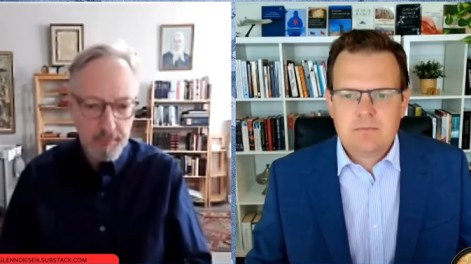
Read the full transcript of Professor Nicolai Petro’s interview on Greater Eurasia Podcast, August 7, 2026.
EDITOR’S NOTES: In this interview, Professor Glenn Diesen speaks with Nicolai Petro, a Professor of Political Science at the University of Rhode Island and former U.S. State Department special assistant for policy on the Soviet Union. They examine Ukraine’s deepening political crisis amid the ongoing war, including elite tensions, military and economic challenges, and the obstacles to meaningful negotiations or a lasting peace settlement.
Ukraine’s Mounting Challenges: Military, Economic, and Political
GLENN DIESEN: Welcome back. Nicolai Petro joins us today, professor of political science at the University of Rhode Island, who also served as the US State Department’s special assistant for policy on the Soviet Union. So thank you for coming back on the program.
NICOLAI PETRO: See you again, Glenn.
The Changing Character of the War
GLENN DIESEN: Well, we know that the war in Ukraine is a war of attrition, but again, it’s changed the character of this war, well, quite a few times over the past 4 and a half years. And with this new round of escalation, I would argue entered a very dangerous phase. Again, much of the focus is devoted to bringing the war to Russia and making Russians feel the pain. And many do so indeed, but often a less popular topic here in the West is how Ukraine is doing. That is, the problems which are mounting. And there are problems. I mean, it has big problems with the military, the economy, political problems, as well as a lot of social challenges. I was just wondering, what do you currently see happening within Ukraine?
Political Tensions and the Ceasefire Question
NICOLAI PETRO: Well, we can see obvious tensions within the political elite, which is spilling over into the military, as different groupings and factions in the Ukrainian government apparatus try to position themselves in anticipation of the elections that should come after the end of the war.
So I was listening to some Ukrainian commentators, one in particular, Ruslan Bortnik, who is well connected in the West as well as in Ukraine. And he mentioned something that I hadn’t thought about, which is that if there is a ceasefire, it does not necessarily mean that martial law is over and that elections should come about automatically under the constitution. A ceasefire, as requested by Ukraine, only allows for a suspension of the casualties, the inflicting of the casualties, but it does not require resumption of normal political life, which a peace settlement would.
In other words, Russia’s been holding out for a peace agreement, rejecting a ceasefire as something that is in fact a way station that is not conducive to an ultimate peace settlement, but rather is an attempt to regain supplies and refurbish yourselves by Ukraine rather than actually settling the conflict.
So he pointed out, and I think this does explain partly the insistence of Ukraine on a ceasefire rather than on a peace settlement, that it would not oblige the Ukrainian authorities to submit themselves to the popular vote again.
The Energy Crisis and Ukraine’s Weakening Position
GLENN DIESEN: But how, in terms of the military and the economy? Because, well, if you look at the economy there, the energy crisis, this is something that I see often mentioned in the commentary about the Ukrainians, that if you go to all the different media, this is something they’re worried about. That is, if the goal is to strengthen Ukraine’s hand in negotiations, this could be hampered if the conflict now stretches into the winter. Because if things begin to fall apart, then the Russian position would only strengthen further. And this is something I see with growing concern in Ukraine. So how severe is this?
Operation Coercion and Its Failure
NICOLAI PETRO: Well, this week, August 3rd, marked the end of the much-touted Ukrainian campaign announced at the end of June to force Russia to the negotiating table, called Operation Coercion. This was announced by President Zelensky as a 40-day intensified military campaign against Russia, not on the ground but through strikes, through long-range deep and middle strikes on refineries, logistic bases, and other targets that would instill fear in the Russian population. And therefore, as Zelensky and the military command has said, bring the war home to Russia.
So that ended on August 3rd. The stipulated intent of this campaign was to force Russia to the negotiating table and to negotiate seriously, meaning accept Ukraine’s terms in the negotiation. But that failed. Russia has not shown any greater willingness, and in fact has responded to this campaign not in a direct tit-for-tat.
As another popular Ukrainian commentator, Kost Bandaryanka, has put it — and I think he may have been exaggerating for effect — he says, “For every one missile that we send, Russia sends 20. So we’re not getting it. This is not a good deal for us.”
And I would expect, there’s no reason not to expect, that correlation of inflicting damage where if Ukraine attacks a certain type, a certain category of targets, Russia will respond not in kind, but in an escalation, in an effort to force Ukraine to reconsider its strategy by inflicting even greater damage. That’s likely to continue so long as Ukraine continues its strategy of trying to coerce Russia to the negotiating table.
Ukraine’s External Dependency and Growing Debt
And from what we can all read, all the resources that Ukraine has are external. In other words, the funding is provided by the EU. The missiles, be they American, are bought by the Europeans. If they’re European, they’re nevertheless sold under a loan to Ukraine. So Ukraine gets more in debt. But these resources, such as they are and such as they’ve been promised, do not enhance Ukraine’s capacity significantly.
In other words, it seems to me that all of the effort was made to push Russia into a box during the month of July and early August — so June, July, and early August — and perhaps with the understanding that after that, the conditions will not be as good.
Military Reshuffling and the Failure of the Campaign
And I guess in answer to the political side of your question, it is at least plausible to suppose that the firings of the cabinet and the reshuffling of the military, and the getting rid of the Minister of Defense and the commander of the armed forces, are all partly indications of the failure of this military campaign to force Russia to the negotiating table, because it was a different tactic.
In other words, basically Ukraine felt it could not make many inroads on the battlefield.
Such inroads as occurred in the early part of this year were thanks to special assault brigades created by the now sacked General Syrskyi. And he diverted resources, vital resources, from other parts of the front in order to achieve breakthroughs in specific targeted regions, either holding the Russians or trying to push them back.
And in his final farewell speech, he claims credit for this strategy. He says, “As a result of my innovation with the assault brigades, Ukraine has reconquered 700 square kilometers of territory and is now an army advancing, is on the move forward.”
But many analysts dispute the accuracy of this. They say that what has, at best, happened has been that the gray no man’s land, which is contested on the maps that we see between Ukraine and Russia, has widened all along the front without any significant changes on either side. That’s the critical Ukrainian version.
Competing Narratives on the Frontlines
The Russian official version, as iterated by Putin, without giving a large degree of detail, has indicated that Russian forces are advancing all along the front, which probably would not be a wise military tactic. In other words, it would probably make more sense to concentrate and encircle certain regions and then allow the rest of the front to catch up. But be that as it may, they’re advancing all along the front, they say. And if you read Russian news, it’s striking that more or less every day there is some village that they declare has been captured. So there is clearly a momentum, if you read the Russian press, favoring the Russian forces.
But the West dismisses this as not significant or disputed. And Ukrainian sources deny it altogether. So you’re left to compare these different accounts. And these then, to some extent, affect the political calculus, but not in the West, because the West does not report, reports only the Ukrainian accounts and basically takes no notice of the Russian claims of advances.
And to the extent that elite opinion in the West and political opinion is shaped by these exclusively Western press accounts, we are getting perhaps an entirely distorted picture of the war. At least some analysts — John Mearsheimer, Danny Davis, Scott Ritter, and others, lesser known perhaps — would contend that the situation on the front is more accurately reflected in the Russian accounts.
GLENN DIESEN: I would say so as well, because, well, you do have geolocations for the people who are trying to map out how borders change.
Ukraine’s Military Situation and the Limits of Escalation
NICOLAI PETRO: Yeah, it’s, first of all, it’s a snapshot and you have to take a lot of these snapshots to see things. And then again, given the nature of drone warfare, which is drones come in, then they leave, and the difficulty of capturing territory in this gray zone, which would occur as a result of repeated drone strikes, then movement forward, then fortification.
Perhaps logically, the only time that you could say that a region is more or less secure is after you see the fortifications in place, which I would expect would take at least a few weeks. And we are a very impatient society. We want to know what has happened, you know, already this morning. And I admit I do the same thing. I feel that on the one hand, things are, I’m told that the world is changing so rapidly. And so I get up in the morning and read the newsfeed and wait for the change. You know, what literally has changed since last night? And I’m almost constantly disappointed in that when I look at the front lines and the things and the changes that have occurred.
So maybe there’s a deeper wisdom that we should reflect on, which is that war has vicissitudes and you advance, then you maybe lose some battles. I was struck by someone I read that said that we shouldn’t be surprised that every now and then, even let’s say if there is a systematic Russian advance for several months across the board, that Ukraine successfully counterattacks occasionally. Because Hitler successfully counterattacked even in, I think, the very early months of 1945, conducted one or two spectacular but ultimately fruitless counterattacks because they moved some elite forces forward into a pocket, hoping to be able to sustain it.
But then the momentum of the war, and this is something we should really be more attuned to, the momentum of the war, not just what is happening at the front, but the logistics supplying the front, the economy and how it is able, how much munitions and general support, food, transportation to the front, port supplies, electricity — all these things are ultimately vital to sustaining momentum. So at any given time, a battle can go one way or another, but that can be easily reversed if there is insufficient support overall.
And Russia clearly can rely on itself essentially for that support. I wouldn’t dispute that the Russian economy is suffering from these attacks, but it is not that Ukraine is. It has resources that have yet been tapped, domestic resources. Pockets of money can be shifted around. And one would, I hope, at some point understand that after 21 packets of sanctions from hell, the next one’s not going to be any different, significantly different. There’s no reason logically to assume that it will be.
So there’s going to be more of the same, but without tackling the fundamental ability of Russia as a huge country, as a country with huge internal resources, and for now, the popular will to fight and the support of the populace and the elite for this course in the war.
This contrasts sharply with Ukraine, where there’s constant infighting. There are basically no domestic resources, or the ones that they have are dwindling rapidly. And therefore, the support for the war effort comes from the West. And that support is, as I said, across the board — financial, political, and military. And of course, in terms of intelligence support. Without all of those components increasing over time, Ukraine is certainly destined — I would think any analyst would say — is destined to fail unless Russia, and I’ve never said this before, but I’ve thought about it a lot and it bears saying, unless Russia chooses to lose.
In other words, I don’t think Russia can be defeated just like America could not be defeated in Vietnam. But America could defeat itself. America could say, well, it is no longer worth it. We’re out. And it doesn’t — I’m no longer interested in the consequences or concerned about what happens afterwards. There is always that option for a great power to say, I’ve had enough and we’re going to go home and lick our wounds and basically give up on the strategic rationale for which we conducted this war. They’ll redefine it in some ways, but it was obvious just after, as the Vietnam War, as the Afghan War was, they were very quickly, and I think from then on, correctly interpreted as defeats for the United States. And anything similar in Russia would be considered a defeat for Russia.
So the consensus now in Russia is they don’t have to make that choice. And nothing that has happened so far in terms of the kinds of strikes that Ukraine has been able to muster against logistics supplies and against oil refineries and sometimes oil stations, gasoline stations, really changes that calculus in any noticeable way.
And it would be hard to imagine — maybe we could imagine together, because this is the only saving possibility, I think, for Ukraine, for its strategy — would be to do something so horrific and drastic to Russia that it would reel from the shock. Now, if it did that, then the question should be, how would Russia respond? Would it retreat like a wounded animal? Or would it say, well, now all the gloves are off, there’ll be a full mobilization, we will outnumber — right now the Russian army is in Ukraine fighting outnumbered in terms of the forces that are at the front line. But should they decide to enforce a full mobilization, they should be able to muster at least three times the forces that Ukraine has on the front line. And I would also have to imagine that the psychological value of this would add to the noted manpower and attrition problems that Ukraine has already been suffering.
Escalation Dynamics and Ukraine’s Strategic Dilemma
GLENN DIESEN: Yeah, no, again, there’s of course room for escalation, but if this — for Ukraine, if these 40 days of deep strikes into Russia didn’t work, they announced more or less now they’re going to do more of the same. That’s usually not an indicator of success. It’s a bit like the EU now with the 21st sanction package — this is going to do the difference, as if the 21st one didn’t do the job.
But as you said earlier, it might be an exaggeration, but if the Ukrainians can launch one missile, the Russians can respond with 20. We do see that the Russians have — well, that they haven’t retreated like a wounded animal, that they have instead gone up that escalation ladder. Because if you see what’s happening now to Kyiv, Russia didn’t do this before. The naval blockade on Ukraine — didn’t do this before. And it is an interesting point for Ukraine to actually do this though, because now that they have the greatest problem with air defenses, as they’ve had throughout the whole war, that this is the time one decides to go up the escalation ladder because they’re quite vulnerable now. And you see the Russian missiles and drones getting through.
Trump, Zelensky, and the Political Fallout in Kyiv
NICOLAI PETRO: So the initial reaction to the G7 and the Ankara meetings between Trump and Zelensky was relatively positive in the Ukrainian press, or at least segments of the Ukrainian press that are known to be close to the government. They said, well, look, the commitment has been reestablished. Relations have been reestablished with the United States. Trump essentially gave us his blessing to go ahead and said that we could win now, which he didn’t say last year.
But some astute Ukrainian observers have said that he may have been teasing Ukraine into overexerting itself. Trump may have said, “Yeah, well, go ahead and try. I’m not standing in your way. Do whatever you can with the forces that you have and see how well it goes. You’ve got your 40 days. Let’s revisit the issue after 40 days.” And if that was the case and he doesn’t actually expect Ukraine to do any better than they have in the past, then this would reinforce Trump’s position vis-à-vis the war hawks in Congress and the military and intelligence establishment to say, well, this was the best that they could do in these 40 days. They, as we like to say in English, shot their wad. They gave it their all. And the situation is no closer to a peaceful resolution. In fact, it has led to greater damage to Ukraine’s military and civilian infrastructure and to the chaos that we are currently seeing in the political elites and to increasing infighting.
Part of which is manifested, by the way, in unexpected but persistent criminal investigations for corruption. For example, the Ukrainian ambassador to the US, Olga Stefanishyna, resigned on Monday and is now under two criminal indictments for corruption, being called back to Kyiv to face corruption charges. But that’s par for the course now.
I guess this suggests to everyone in the Ukrainian political system that everyone is vulnerable, perhaps even the president. That would be the ultimate sort of — not to use a pun — but the trump card that someone could play, because there are all these tens of hours, if not more, of tapes that led to the downfall of Andriy Yermak, to the escape to Israel of Timur Mindych, known as Zelensky’s confidant, under Zelensky’s wallet. And not to mention others previously. So anyone is vulnerable.
It is widely assumed that Zelensky is caught somewhere on those tapes, which have not been released, but could be released when needed, where his voice clearly is heard involved in some sort of illegal transactions. So that’s the speculation. And there could be a lot of ticking time bombs, as a matter of fact.
The question only for the internal political actors in Ukraine is when to release it. Do you release it now to force the collapse of government? How does that affect the war effort, but also the prospects of you and your candidates or your faction after the war? Or do you release it after the war is settled in anticipation of the campaign to denigrate and make sure that Zelensky — who’s very unpopular according to polls, he may be the most popular Ukrainian politician, but that’s among a very poor field, all of whom have a very poor rating — and many would not like to see him be president if the war ended. However, whatever that means, whether that means ceasefire or peace is not specified, but if the war ends, they would like to move on from Zelensky. And so maybe the best thing to do is to keep those tapes available for the post-war political engagement.
Zelensky’s Inner Circle and the Fracturing of His Coalition
GLENN DIESEN: Well, as you said, there’s been a lot of political crises within the government. Of course, the corruption scandal made sure that a lot of people in Zelensky’s inner circle fell off. You also had some people abandoning the ranks, like his former spokesperson who went against him. You have the ambassador now to the US also leaving. The Salushny leaving his former position was also speculated was because of the rivalry with, yeah, taking more openly critical positions.
NICOLAI PETRO: But there was a team that came with Zelensky that assured his election victory in 2019. And Reba Shapka, who was the Minister of Justice, and the head of — oh, I forget his name now — oh, it’s Razumkov, who is now head of an opposition political party in the Duma. Bogdan, who was the chief of staff. You don’t hear very often from them, because they’ve left the country and they’ve kind of left all of this behind, becoming disillusioned pretty quickly in the first year or so of Zelensky’s reign.
But when you do hear from them, and I always take note because they were well connected and obviously knew everyone in the inner circle in the transition period where Zelensky’s authority was being set up as president, they’re also very critical. They’re critical along the lines that Yulia Mendel, who’s a little bit later in the sequence, is today, where they basically say the problem now for Ukraine is Zelensky’s obstinance. He cannot see a Ukraine without himself. And as a result, he cannot move toward peace. He cannot be a president for peace. He can only be a wartime president.
And the costs of engaging in a peace process for him and his family could be not just politically high — in other words, he could lose his position — but they could also be physically very high. And because of the unpredictable nature of the militarized far right, which thanks to the war has gotten all the arms it needs and is only, I think it’s fair to say, nominally under the authority of the military.
Ultimately, if there’s going to be civil peace in Ukraine after the war ends, the far right, which has always aspired to be a military guarantor of the new Ukraine — for Ukrainians only, an order for the country, this ultranationalist order that they envision Ukraine becoming — this was their ambition since 1991. They pursued self-militarization and became a kind of civilian military watchdog over the civilian authorities even before 2014, more intensely after 2014 to 2019. And now they’re thoroughly militarized. And without demilitarizing them, as I indicated there, there will never be peace internally in Ukraine.
The Political Economy of Ukraine’s Military Infighting
GLENN DIESEN: With these splits we saw though, I mean, I thought that the fighting between Syrskyi and Fedorov was quite fascinating. And the fact that first Zelensky got rid of Fedorov, which made Zelensky to some extent look weak because he was seen as, you know, challenged to his authority. But then people took to the streets and wanted Syrskyi gone. And essentially Zelensky made himself look weak again by having to bow to public pressure. So essentially in this infighting, both had to go.
And I was just wondering, how much deeper does this political rift go? I mean, is it only these personal issues between the 2 leaders? Fedorov would like this focus on the drones. Syrskyi, he was more into the traditional military structures. How do you see that? What are the fault lines here?
Following the Money: Oligarchs and Military Procurement
NICOLAI PETRO: I’ve been impressed by the argument that you should follow the money, not the personalities. It’s a complicated picture with a number of wealthy oligarchs, but not perhaps — I mean, low-level billionaires. That’s what Ukraine essentially at this point can muster. 1 or 2 or 3, you know, up to $5 billion or so accessible, who are making money in this war by providing the weaponry, by investing in the technology of drones and anti-drone technology and probably electronic warfare technology and all these new battlefield technologies, which they can test in Ukraine and then sell the expertise and the type of innovations that have been developed, the schematics to the West, where they can be mass produced and produced in a more perhaps sophisticated fashion — because it needs, in the West, it would need to be integrated into NATO standards and all sorts of conditions and systems that need to be adapted to that. Whereas in Ukraine, these are battlefield conditions.
So these oligarchs are at the cusp of being the middlemen between wealthy Western buyers. And by Western, I also include the Middle East and anyone else who’s now looking to improve their military capability through improved drone and anti-drone warfare. So they’re in the middle offering their services and their expertise from the types of systems that they are deploying almost as draft systems, almost as the experimental systems in Ukraine itself.
So there’s a lot of money involved because a lot of military monies have been pledged to Ukraine. And it is the nature of the Ukrainian military industrial system that these oligarchs are a very core and essential component of the military procurement system and have in the past been given free rein by the politicians to do what needs to be done. So this led to the creation of many fly-by-night companies, including FirePoint, which was set up overnight by people from the entertainment industry that had connections with so-and-so and so-and-so. And all of a sudden they’re given a third of the military budget to produce this new technology, a very promising technology. And it was widely poo-pooed as unsuccessful because the first several attempts to launch Flamingo missiles and others were not terribly impressive. But that’s how you learn. You learn through these kind of tests. And they’ve apparently gotten better and better so that now with this expertise, they can again make money.
And it’s not so much Syrskyi versus Fedorov. They are the public faces of this debate. But I think I read somewhere that a better way to think of it is Skyfall versus FirePoint. In other words, these are 2 large industrial military conglomerates that have their representatives in Western capitals, in London specifically, and in Ukraine, and that have contracts now probably throughout Europe — co-production contracts with a number of NATO countries that are investing heavily in this technology. And along the way, certainly on the Ukrainian side, everyone gets a cut for maintaining and fulfilling these contracts, for getting these contracts and fulfilling them. So war is profitable.
And what was happening was that Fedorov was trying to take money away from FirePoint and shift it to his favorite forum company. And that led to internal fighting, which again is more than individual personalities. Now, when you sell it to the streets, to the media, it has to be something simple like young versus old, Soviet versus modern Western NGO. It can’t be something as grubby as my bank account versus your bank account, which I think really probably helps us to understand what ultimately happened and why — or let’s say why the street protests can appear so instantaneously and disappear just as easily.
I think there’s a widespread assumption, especially among Ukrainian observers, that these are not real true expressions of popular discontent. Because when you have street correspondents go say, “Well, I see on your placard there that you say Fedorov represents the new modern age and Syrskyi is a Soviet general. Explain what you don’t like about Syrskyi’s tactics.” There’s nothing there. They have no background in this. They see one face versus another face. They’re told to go out in support of this candidate for this long. And they will do so as long as there are financial means at their disposal to provide it to them for this.
So no one in Ukraine certainly would take these street protests very seriously. They’re not of the type of magnitude that we saw by the end of 2013 and early 2014 in the Maidan, where hundreds of thousands of people crowded the streets. And it’s unlikely they would ever be, under the conditions that we have now in Ukraine, which are conditions of martial law. Every one of these protests is illegal, and the government is fully within its rights under martial law to disperse them if it chose to do so. The fact that it chooses not to do so, again, is probably more of an indication of who funds them and who stands behind them than anything else.
Political Infighting and the Prospects for Peace
GLENN DIESEN: Well, just my last question though is how this could lead to a possible peace, because I’m thinking these internal political struggles — or be it over money, and yeah, probably it is money more than ideology or anything else — but the way I see it, the fragmenting or political infighting in Ukraine would impact whether Ukraine is being weakened or even defeated, but also what kind of peace deal Ukraine would accept. I’m just thinking, how does this political struggle possibly either support a peace deal or undermine it?
NICOLAI PETRO: Yeah, I think Thomas Graham had an op-ed in the New York Times today about this being a good time for a peace deal. Well, abstractly, anytime is a good time for a peace deal. There doesn’t seem to be anything novel at this time. Certainly Russia’s tactics are continuing because Russia believes them to be successful. They believe them to be leading this policy of attrition and of escalation of retaliation on Ukraine directly if Ukraine decides to strike into Russia. So those are the 2 components that I see right now to Russia’s campaign.
The question that arises in my mind is what happens when Russia achieves its declared military objectives, which is, as they put it, the liberation of the 4 territories and Crimea? Russia at that point will have succeeded on its own terms. It will have won. There are other corollary things that Russia is concerned about — security, the rights of Russian speakers, the rights of the church and language and other things. But militarily, it does not need to achieve anything else. It has achieved its military function.
If one can imagine a strategy where the territory would be defensible, it could be defended, and the remainder of these Russian objectives — the political objectives — could be achieved through diplomacy, but the threat of military action, but without actually engaging in military action. I think that seems to be where the current Russian military leadership is generally headed. This does not please the more hawkish wing in Russia, which says, “Well, we cannot achieve the full spectrum of our objectives. And those 3 other political objectives should not be separated from the military objectives because it’s primarily a political campaign that we’re waging, and it requires at least the isolation of Ukraine, the creation of a landlocked state, if not full occupation, and we should do it.” So that seems to be the debate in Russia, but it’s at least plausible that they could — at least after the taking of Donbas, Zaporizhzhia and Kherson — offer some renewed peace terms and insist on them.
Now, Ukraine’s strategy shows a striking lack of originality. In other words, they are pursuing exactly the same strategy they’ve been pursuing since the beginning of the war. It boils down to harsher sanctions on Russia from the West, more military assistance from the West, more money from the West. And ultimately, if all of that does not succeed and Russia continues to advance, forcing Western boots on the ground in Ukraine — having Western troops in Ukraine fight Ukraine’s fight because the manpower is not there. And probably it’s accurate to say that Western resolve without that sort of military commitment of forces would also eventually dissipate. There would be little hope, I think, for the prospect of a Ukrainian victory, which still sustains some in the West in their hopes in this war.
So there’s nothing new there. And I would say there’s no plausible hope for a negotiated, serious negotiation stance on the part of Ukraine without severe Western pressure, which means the withdrawal actually of support, which they show no indication of doing. Although probably intelligence and Starlink support, which is due to the United States — something the United States is giving to Ukraine — if that were withdrawn, that would probably hasten the willingness of Ukraine to negotiate.
But the problem now also resides in Zelensky proper, who sees no role for himself in a peacetime Ukraine. He’s not spoken of it. I think there’s no plausible position for him. And again, I see that as both a political threat and possibly a threat to his and his family’s livelihood as well. So I think he would have to himself be retired or resign — he would have to resign in favor of some other personality, and Fedorov has been touted as such a personality. Anything’s possible in Ukraine. Anything.
The Fall of Donbas and Ukraine’s Endgame
GLENN DIESEN: Well, that’s what I’m thinking. If it looks as if what remains of Donbas — that is, Kramatorsk and Sloviansk — if it would now fall as it’s becoming more and more encircled, that would resolve the main territorial dispute. And then essentially the only — the main thing remaining would be the neutrality of Ukraine, and of course restoring some rights of the Russian language.
NICOLAI PETRO: And that could already be negotiated theoretically. Yeah, but the question is, right now the Ukrainian stance is, “We don’t care what happens on the battlefield. Our objective is the restoration of the 1991 borders, and there can be no peace without that.” Okay, well, that’s—
GLENN DIESEN: But that is a position of the government. But if there is fracturing in the government — because I thought if Donbas now falls to Russia, and again, this could be quite a difficult winter, we don’t know what’s going to happen — I would assume then you know Russia might more or less say something along the lines, after taking Donbas, that “Well, that’s more or less done.” More or less, of course, this still officially claims Zaporizhzhia and Kherson. But the main thing now from Ukraine is, “We need to restore your neutrality — that is, not a de facto member of NATO, not a regular NATO member. But if you can’t meet these terms, if Ukraine insists on remaining a NATO frontline state, then essentially we will have to strip you of your Black Sea coastline and take all of Novorossiya and gradually march towards Odessa.”
I mean, at that point, do you think other voices would emerge? Because if there’s nothing that can stop the Russians, it seems like every day the deal will get worse — that this will be an impetus for— but that’s been the case for 5 years.
NICOLAI PETRO: Yeah, and that’s true.
The Far Right as an Obstacle to Peace
NICOLAI PETRO: And obvious for 5 years. The problem is there is no political voice for negotiation of where there’s a concession, a concession of territory or neutrality even, or even an acceptance of new borders. Less than the eye-to-eye borders, there’s no space in the political arena of Ukraine today for such voices.
People, including members of the political elite, including members of parliament, will think it, but they cannot say it for fear of being directly targeted by the right wing, by the armed, by the army, by that faction of the army or the right-wing militias, which are everywhere. And so how do you get, even get these ideas out?
That problem would be somewhat resolved. At least you could begin to resolve that problem if the main spokesman for that position for all these years, Zelensky, resigned in favor of someone who himself had a track record of being a staunch military defender, et cetera, but who has come to realize that the salvation of Ukraine requires concessions, which of course will only be temporary. But, you know, we’ll all, we’ll sign the necessary documents, but in our heart of hearts, we will, you know, strive for the restoration, et cetera, et cetera, over the coming decades, all of that.
But I don’t see anyone in Moscow believing that Zelensky, even if they said that, could carry through on it. A new figure would have to have this new rhetorical compromise and this new strategy. It would have to come up with a new strategy. And would have to have it passed by the Rada, by the parliament. Possible, given incentives and, you know, threats and things like that. I think a coalition could be stuck together, but it’s all very iffy and tentative.
And I’ve always said, ever since before the war, again, the big problem in coming to peace both with Russia and within Ukraine is the far right. So at the same time that that is occurring internationally, the far right must be defanged and brought to heel to the political system, a more or less pluralistic political system in Ukraine. That has to happen more or less simultaneously, because otherwise there’s no room for political discourse. There’s no room for political negotiations, including peace negotiations.
A Peace Deal Seems Out of Reach
GLENN DIESEN: Well, it becomes even more complicated then because of course you have the EU emboldening this maximalist position. You have the far right forcing it. But of course, if they would be not weakened but have an incentive to change their position, and then you would have someone like Zaluzhnyi or Budanov replacing Zelensky, who then see defeat coming, that saving the Ukrainian nation requires a painful and humiliating compromise then. But this — a lot needs to be done to put all this piece into place, so it doesn’t look like a peace deal is forthcoming, right?
NICOLAI PETRO: I don’t see much hope for it, even with continued Russian advances and devastating Ukrainian losses. And the argument that, well, we need to because it’s devastating for Ukraine clearly does not matter to the EU, does not matter to the current Ukrainian leadership.
And I think with respect to the far right, I think they have the most consistent position of all. It’s like the more undecided and indecisive, meaning not true Ukrainians, die in this fight, the better. Because what will be left will be the true fist of the nation that will stand to the very end and we’ll win. We will win because of our visionary commitment to this nationalist ideal that we have. And, you know, it won’t be necessarily our generation that wins, but, you know, our children’s children’s generation will, you know, win, despite our temporary setbacks.
Anyway, that’s all mythology and sort of passionate vision of politics, which has nothing to do with actual negotiations and people’s lives today and the kind of peace they want to live in.
GLENN DIESEN: Well, I’d been hoping for some more good news or optimism from you, but I do prefer reality. So thank you very much for your perspective and analysis. I very much appreciate it. And yeah, have a great day.
NICOLAI PETRO: Thank you.
Related Posts