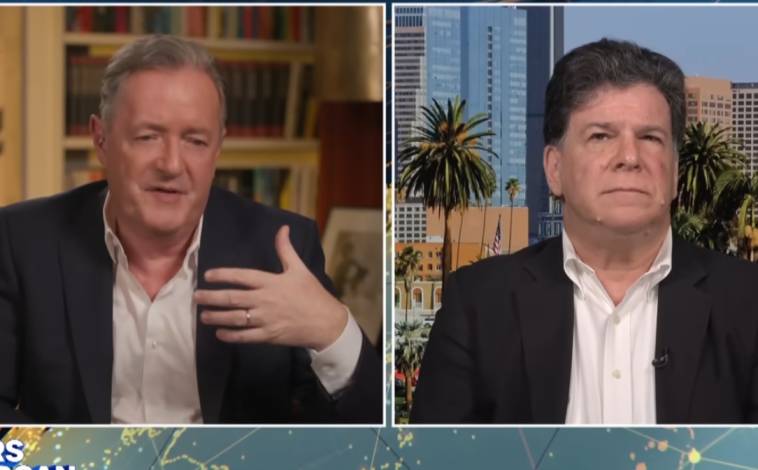
Editor’s Notes: In this compelling episode of Piers Morgan Uncensored, Dr. Eric Weinstein returns to discuss the “existential threats” defining our modern era, ranging from the escalating conflict in Iran to the looming artificial intelligence mega-shock. Weinstein offers a provocative deep dive into the hidden layers of the Jeffrey Epstein scandal, alleging that Epstein functioned as a “science spy” focused on theoretical physics and national security secrets. He further connects these disparate threads—atomic weapons, UFO disclosures, and the Epstein files—to a singular center of power in New Mexico, challenging viewers to look beyond mainstream narratives. (March 7, 2026)
TRANSCRIPT:
Iran: A Courageous and Consequential Decision
PIERS MORGAN: While many of us have been debating men in women’s sport and woke Snow White unapologetically. By the way, Dr. Eric Weinstein has long maintained that three far more consequential stories will define this era. The successful failure of Iranian regime, the looming artificial intelligence megashock. And the extraordinary reach of Jeffrey Epstein into his world, the field of science.
Well, Dr. Weinstein joins me now. I hesitate to call you Nostradamus. Eric Weinstein, welcome back to Uncensored. But all the pointers are that you are indeed a modern day Nostradamus, not least because of your focus of all our attention on Iran. What do you make of what has happened with these unprecedented attacks on Iran?
ERIC WEINSTEIN: Well, good to be with you, Piers. Just to be completely honest, I’m not exactly sure what to make of it. But this was a very courageous, strong decision that may have far reaching consequences. We’re just at the beginning of it and it’s going to ripple all the way to Pyongyang, Moscow and Beijing in its implications.
And I think as we’ve seen with Cyprus, the willingness of the Iranian regime to reach out and try to involve as many players as possible should not be discounted. This is in my opinion simultaneously somewhat inexplicable in terms of the rules based order, but also necessary, which is extremely confusing. There wasn’t enough of a move in my opinion to prepare any kind of groundwork or theory in which to fit this, which turns out to be important over time.
And roughly speaking, we’re seeing the rise of the sort of Dirty Harry administration. An administration where when the world stops being able to handle the injustice and what’s wrong with it, suddenly Inspector Callahan comes out of the woodwork and uses unorthodox methods to put things right. And if there is a doctrine associated with this administration, I would say it’s the FAFO Dirty Harry doctrine of people finding out the consequences of trying to be cute, getting around the letter of the world order by using proxy, ARM and others to do the dirty work. And I think Iran has just found that these long deferred consequences have come home because this particular president has had enough.
How History Will Judge the Iranian Regime
PIERS MORGAN: How will history judge, do you think, the Iranian regime? Assume for a moment that it is either toppled, which is obviously we’re way off that, but severely damaged, which leads to a toppling over time, and we end up with a regime that lasted, say 47, 48, 49 years, whatever it ends up being.
If that is the case, how will history judge it? Because many people have tried to frame this Iranian regime since 79 as one of the worst regimes, if not the worst in the world, primarily because of the way it simultaneously repressed its own people, but also acted as a kind of octopus with multiple tentacles to terrorists throughout that region through the Houthis, Hezbollah, through Hamas and other groups. That it became a sort of a terrorism octopus. Do you think that’s how history will judge it?
ERIC WEINSTEIN: I think that history will probably judge it by its theocratic nuclear ambitions. I think the idea of coupling a theocracy to a sovereign nation empowered with nuclear weapons, and particularly a theocracy devoted to martyrdom, presented game theory that was not easily understandable by anyone. So it posed a unique sort of a threat where self interest could not really be determined.
I mean, all of the horrible crimes that have been committed through proxies like Hamas or Hezbollah or the Houthis or who have you, pale in comparison to what I think the regime ultimately aspired to. And I should also say that the oppression of a thoroughly modern people, particularly in Tehran, is what is very disturbing to many of us, people who knew freedom, who were very much a part of the modern world.
And I’m just going to reiterate something I say frequently, that the Persian contribution to world culture is an astounding one. This is not a random nation pulled at random out of the UN membership. This is one of the most important peoples, cultures, nations in the world. And for that nation to have this regime was an oddity never before seen.
An Advanced Civilization Under a Backward Regime
PIERS MORGAN: You said something very interesting in September 2022. You posted then: “Iran is too advanced, modern and important to the modern world to be under this kind of backward human rights violating, religiously intolerant regime. For this long it’s been 43 years of imposed backwardness on an advanced civilization. Maybe it’s finally enough.”
Which looks very prescient, I have to say, looking back on that now, what, three and a half years on. But it has felt like that. Whenever I meet a lot of Iranians who’ve come to the UK, for example, to get away from that regime, they are extremely cultured people, they’re very sophisticated in their thinking, they’re very well educated, they’re very modern in many ways in their thinking as well. And yet they’ve had to flee a very draconian, as you put it, backward looking regime that wanted to drag everybody back to the dark ages.
ERIC WEINSTEIN: Well, I am nothing if not consistent.
I hadn’t remembered that tweet. I do think that, particularly in my case, loving Persian music and having some appreciation for the ways in which Persian filters into Turkish and Urdu, two languages that I fumble around with, there’s no question that this is a people who, if freed, are going to exert a major influence on the world at all levels, intellectually, scientifically, artistically. In terms of trade, obviously the energy endowment I don’t even need to talk about.
So one of the things that we have to think about is that I in some sense believe that the regime has fallen. You can’t survive with that many of your leaders killed and not become something. If that many of your leaders are killed off, you become something new. So that’s already been accomplished. What this uncorks is unclear.
In part there are other cultures that are extremely important. Shout out to the Kurds of Iran as well as the Azeri population and Armenians. There’s no shortage of diversity within the modern nation of Iran. And all of these things in part may produce one of the most advanced civilizations if freed from this theocracy.
I think that that is something we’re going to have to contend with because it’s also going to be naturally a major regional player even if it became a secular country, which I don’t think is likely. I do think that there’s a little bit of wishful thinking where people pretend that there is no support for the regime and that there are no hard line fundamentalists in the country. Obviously that’s not true, but I think we’re going to get a lesson in how much complexity was covered up by the sarcophagus of smothering Sharia law under clerics.
Netanyahu, Trump, and the Nuclear Pretext
PIERS MORGAN: There are many people who are very skeptical that America has been sort of persuaded to do this by Benjamin Netanyahu and the Israeli government, who’ve been itching to do this for decades. You said last June in a post: “Israel is not attacking the people of Iran. It’s trying to end a regional and global nightmare regime. At least let us wish them and the Persian people a safe night while Israel is working through the wee hours to make sure the mullahs weren’t going to strike us here with WMD. And let us pray they know what they’re doing. Godspeed.”
I think that was around the time of the 12 Day War, in which the Americans and Israelis attacked the nuclear plants there. People say, well, hang on a second. We were told then that the nuclear capability had been pretty well destroyed. Now the pretext for this new war, less than a year later, is the threat of Iran having a nuclear weapon. That is the pretext for doing this.
How can those two positions be right? How can the 12 Day War have been a spectacular success and neutered its nuclear aspirations, but we need to go and do this a few months later? What do you say to people that think that?
ERIC WEINSTEIN: You’re asking a hell of a question. Let’s get into some trouble, which is frequently done on your program. I myself have stepped in it a few times.
I think that the Israelis, in part, have a great deal of love for the Iranian people and viewed themselves, whether rightly or wrongly, and again, I can’t say because I’ve never been to Iran, viewed themselves as wanting to liberate a great people. There’s a long historical relationship between Jews and Persians, and mostly there’s a great deal of respect from every Jew that I know who’s knowledgeable about this. So in part, there is the fantasy of being the Jewish liberators of a great nation as opposed to the attackers of Iran. So you just have to understand that that’s a reframe that is very common in Jewish, and particularly in Israeli circles.
I also believe that, in part, Donald Trump is sparing us from the Israelis having to do this alone. And as a person who is on record calling Donald Trump an existential threat potentially to life on Earth, I will say that this is an extremely courageous action that is not only America first, it’s Earth First. And the attempted reframe of this as Benjamin Netanyahu persuading Donald Trump — nobody’s going to push Donald Trump around. Try it. You see what happens.
In this situation, what you have is that Israel might have had to go to weapons that I don’t even want to talk about, given the disparity between the two countries in terms of, say, humans. Israel needs a technological military equipment advantage in order to take on Iran, and that would have been a disaster. So I think that what you can say is that Donald Trump is in part acting to stop the Israelis from doing this alone and using methods that I think would be far more dangerous.
And let me just say this. This is a return to the America that many of us are quite proud of, that has intervened on behalf of people who could not stand up for themselves. And I just don’t understand the level of anti-Semitic rhetoric. This is a country that threatened our president, that released videos talking about the assassination, picturing and visualizing the assassination of Donald Trump, our sitting president.
And there’s no question that this nation is different, unique. In all the world, there are probably a tiny number of countries that pose any kind of comparable threat. And I think that you have to look at it from the time of the Iranian embassy being taken over, the US Embassy in Iran, and the time of the military barracks bombing in 1983. These people have been at low grade war with us for almost half a century, striking our targets as well as our allies’ targets, as well as causing trouble for their Arab neighbors. They’re not an Arab country. And you look at where all of these missiles have fallen just to stir things up.
No, these people have shown you who they are. And I don’t mean the Iranian people. I mean this horrid regime. And let me just say congratulations to Donald Trump for having the guts to do this, despite the fact that your base very often sinks into the simplicity of trying to figure out whether everything results in a lower price for butter at the supermarket. That’s not the extent of the US Project.
And quite honestly, I’m very proud of a president that I have in general had very little positive to say about over many years. And I can tell you that I’ve had very little to say positively about Benjamin Netanyahu. Say what you will, if you’re going to call balls and strikes, these are two courageous men taking on what the world feared to do.
And by the way, there are going to possibly be serious repercussions inside the United States. This is not without risk physically for people far away from this theater of operation. Cyprus is the beginning. You’ll see what comes after.
Epstein’s Deep Reach Into the World of Science
PIERS MORGAN: There are some people who think that Donald Trump has only done this to try and distract the world from the Epstein files, which have become a massive sort of Damocles around him and a lot of people in his circle.
You for years have warned about Epstein’s influence in an interesting way, where you were most primarily concerned about his links to top scientists. And it does seem from the files that have been dumped on the world, the millions of files that — newly released documents from the Department of Justice, the distinguished science journal Nature revealed that Epstein invested millions of dollars in science projects, made donations to MIT and Harvard, and maintained a list of nearly 30 top scientists. The documents show researchers consulted the sex offender on publications, visas and public relations crises, and even allowed him deep involvement in their research work.
So you’ve been clearly vindicated spectacularly in your concerns about this. But now we know the full extent of Epstein’s connections to the higher echelons of science, it does beg the question — why was this happening? Why was he allowed to?
Epstein’s Science Espionage Network
ERIC WEINSTEIN: Well, because we don’t know the full extent. I mean, I think if we ever get to the bottom of this, if we’re playing the Nostradamus game, I’d like to go double or nothing. I think some of this is going to have to do with a topic in number theory called elliptic curves, which people don’t have at the tip of their tongue. But it’s behind your ability to send an encrypted love letter or trade Bitcoin — cryptography rests on number theory.
And the Harvard Mathematics Department, where I got my PhD, was a leading source of innovation in the world of elliptic curves. I wonder very strongly whether people paid attention to that Steve Bannon pseudo interview in which, while doing media training, Jeffrey Epstein directly — and somehow nobody broke this out until I clipped it for Twitter, which I find astounding — he literally says, “Why did I get the ranch in New Mexico, the Zorro Ranch? It was because Los Alamos was downsizing and firing its nuclear weapons physicists and high priests of high energy physics. And I wanted to be close to them.”
He’s saying that when the Cold War ended, he recognized that there were going to be a lot of disaffected, disgruntled, laid off people because the US, in its most asinine moment, decided that it was entitled to a Cold War dividend by screwing the various very people who won the Cold War — by inducing a threat so severe no one could contemplate going to war with us.
What he was doing was he was setting up listening posts in exactly the most telling places. Zorro Ranch is close to Sandia Laboratory and Los Alamos Laboratory, where he found his high energy physicists, as he said. And One Brattle Square in the 02138 area code of Massachusetts is a listening post to listen in on Harvard and MIT, which are connected by a 30 minute walk down Mass Ave.
So if you just go into those documents, as I said to everybody, you will find that he had an extensive relationship with the Harvard Mathematics Department. Search on Math.harvard.edu in those files and you’ll see he was meeting with everyone from S.T. Yau, who often acts in part as a representative of Chinese interests in the American mathematical elite, Martin Nowak, Clifford Taubes, Michael Hopkins — all of these sorts of people were meeting with Epstein.
And then we find out in particular, you had a debate on with Sean Carroll. I believe Sean Carroll shows up as having a meeting with him, as well as Benedict Gross, who is a number theorist and elliptic curve expert who pioneered Jeffrey Epstein’s entry into the Harvard Math Department.
People are not understanding this — he was a science spy, and he was spying directly. The reason I knew that — it wasn’t a prediction — he was spying directly on my work. The earliest we see him in the Harvard Math Department is around 2002. I got my PhD in 1992. He had information on me that was from the late 80s, early 90s, about something called the Seiberg-Witten equations, which actually weren’t recognized then and aren’t recognized now to have to do directly with gravitational theory. He somehow knew that my work, which technically would have been about something called self-dual Yang-Mills equations, was actually about gravity.
He was very focused on gravity — and this is going to come up in the UFO disclosures — the UFO weirdness is not just about UFOs, it’s about the golden age of general relativity and US attempts to gain control over additional forces of nature. There are four forces of nature. We know how to control two of them somewhat — the strong force and the electromagnetic force. The strong force is what we got control of in 1945 and took out two cities in Japan. So what happens when you can control gravity?
This is absolutely a matter of national interest. The national security apparatus has completely fallen down on the job. Nobody’s picked up on what kind of a spy he was, and the idea that this is some sort of auxiliary thing that he was doing with respect to science — when the main story is just about the sexual misdeeds — this is not true. His operation, I think, in part was about spying on scientists.
The Modus Operandi: Who Was Epstein Working For?
PIERS MORGAN: So that’s fascinating. I mean, what do you think his real modus operandi was? What was it that he was trying to do, and who was he doing it for?
ERIC WEINSTEIN: Well, I guess I’m very confused about this. Everyone saw Oppenheimer, and if I put up names like von Neumann, Fermi, Bohr, Oppenheimer, Feynman, everybody knows that that’s a security risk. But if I were to name the 10 most powerful minds in mathematics and physics, and I said, “The goal is to break codes, come up with new directed energy weapons, go beyond Einstein’s concept of the space-time continuum,” you’d say, “Oh, that sounds like tinfoil hat stuff.”
Wake up. This is the most powerful stuff on Earth. Physics and mathematics are much more powerful than money. Mathematics created Bitcoin — you can’t have Bitcoin without mathematics. And physics created the ability to end the human species as we know it. When did we become disinterested in protecting all of these ninja priests?
Do you think of me as a cultural commentator, or do you think of me as a differential geometer focused on the standard model and general relativity and trying to push the edge? I have no idea why nobody — I had an interview with the Diary of a CEO podcast, and at the end, I’m saying, “Is there no one at the Department of Energy who knows what their job is?” Because the Department of Energy is tasked with safeguarding our national laboratories. They have an intelligence wing that’s supposed to know if a mysterious pseudo fake billionaire shows up and says, “I need to make contact with all the people we’ve decided to stop paying who know the deepest secrets of the United States with respect to theoretical physics.”
The Missing Documents: Are We Being Misled?
PIERS MORGAN: I mean, it is quite extraordinary. Do you think we know the half of it yet about Epstein? I mean, we know that over 3 million documents have still not been released. That alone — you’d have to be a conspiracy theorist to think, well, what the hell’s in there, given what we’ve already seen.
ERIC WEINSTEIN: 3 million. No, no, you’re falling for the oldest trick in the book. The whole idea is that they’re going to say something. Let’s imagine that they said, “Look, we have 10 million documents and we’ve released 4 million of them.” And then you say, “Well, what about the other six?” Well, now you’ve just bought into the idea that there’s only another six. You didn’t question the ten.
Tell me something — if you really ran a foreign exchange hedge fund, how many documents does that throw off? Just the compliance alone on a hedge fund creates reams and reams of documents. I know of at least two documents that haven’t been released, one of which — well, I’m not going to get into that.
I don’t think you’re on the right order of magnitude. I think you’re being led down a garden path which says that we’ve released half of the documents — let’s see the other half. And I hope, Piers, that we can use your program to inform people: don’t be dumb enough to follow this. This is like a magician’s choice. They’re pushing you to pull the card out of the deck that they want. Ask the right question. If there really was a hedge fund, how many hundreds of millions of documents might that have thrown off just for compliance?
Conspiracy Theories and the Epstein Scandal
PIERS MORGAN: That’s interesting. Someone asked me the other day what my overview was about the Epstein files. I went — I’m not a conspiracy theorist, genuinely. I just try and get through all conspiracy theories to some kind of reality, and if they turn out to be true, as some of them do, okay, great.
I have to say, on the Epstein scandal, there’s pretty much no conspiracy theory that I’ve heard that I would be very confident in ruling out, simply because of the concerted effort by so many rich, powerful people to suppress the information. All my journalistic antennae tell me — when people go to this amount of trouble to suppress the truth from the public, then you can pretty much think that almost every theory might be true. And ruling any of them out might be a very foolhardy thing.
ERIC WEINSTEIN: I’m very surprised to hear you say what you said. Surely you believe in La Cosa Nostra. I have no doubt that you believe that the Manhattan Project existed. Therefore, you are a conspiracy theorist.
Every smart person — and I certainly count you in that group — has to be a conspiracy theorist. The idea that we claim we’re not conspiracy theorists is really what we used to say when we wanted to give room for our intelligence and covert operations to work. So we would pretend that we didn’t believe in our own conspiracies, so that our hopefully ethical and public-spirited covert operations and intelligence services would have the room to move.
But it’s much the same thing, Piers, as when you go past a five-car pileup with burning cars and body parts scattered all over the road and somebody says, “Nothing to see here, move along.” You say, “Okay, I agree to act as if there is nothing to see here.” The question is, do you agree to act as if conspiracies are not true? Or that those who speculate about them must be mad?
And the odd part about it, of course, is that you can look up the terms “special access program,” “unacknowledged special access program,” and “waived unacknowledged special access program” as three different categories of conspiracies that the United States government has agreed to create. These are containers into which we put our conspiracies. So to say that you’re not a conspiracy theorist is basically just, in good faith, saying, “I agree not to investigate what we’ve put in our secret containers.” But in bad faith, it’s an attempt to make people who speculate about such things knowledgeably into pariahs — and that way we can keep our intelligence services safe.
As I said to the FBI in a meeting with them on Wilshire Boulevard not too long ago, “If I find out that you guys are behind covering up the rape of little children, all bets are off.” And the old adage — that I swear to defend the country against all enemies, both foreign and domestic — holds.
Now, the key question is, can we report the FBI to the FBI? Can we seek justice against the Department of Justice? To whom do we report what is effectively almost certainly an international interstitial covert operations hub that we’ve pretended is one man named Jeffrey Epstein?
PIERS MORGAN: I mean, it’s very interesting, you challenging me like that, and it’s made me think about what my response should be.
I would say what I meant to infer was that there are certain conspiracy theories that do the rounds which have been very clearly, in my view, proven to be untrue by cold, hard fact — and yet they continue to be promoted, propagated, and spread around. That’s my definition of a genuine conspiracy theory. It’s not a very out-there idea about something that’s in the news or something historic that remains unproven by hard evidential fact.
For example, there are people who still think we didn’t land on the moon. I think that’s complete bullshit. I think it’s been absolutely proven we landed on the moon. People think Elvis is still alive — he’s not. He died age 42, back in the 70s. In other words, there are things that happened which people have decided didn’t happen, and they promote them. And those are what I call conspiracy theories.
I think it’s different to what you’re getting at, which is that — especially with the way that modern media has gone, and going through things like the pandemic, for example — it’s actually incumbent on people to be naturally very curious. And however wacky the theory, the Epstein scandal is a perfect example: a lot of the more out-there theories about this have sort of been borne out by evidence contained in these files now. That’s how I would clarify my view about conspiracy theories.
The Stigma of Uncomfortable Truths
ERIC WEINSTEIN: I appreciate what you’re trying to say. I had to go on Joe Rogan to say that one times one is not equal to two because a rumor spread that Terrence Howard had shown that multiplication was incorrect. There are a lot of wacky things that people say. I’ve talked particularly on the portal, my podcast, about responsible conspiracy theories.
I don’t know what you can say, for example, about Building 7, but you’ll notice that just the words “Building 7” causes an immediate reaction — am I in Nutterville? If I said to you that there has never been a building that collapsed like Building 7, you should suddenly feel very uncomfortable because the social cost of pointing that out, even though I’ve said nothing about who did it or how it happened or anything like that. I’m just going to say that it’s an unprecedented building collapse in the history of construction. We can’t talk about certain things in part because they’re defended by stigma.
And so I think that one of the things that you and I are both concerned about is, how do people who are responsible members of society, who want to take us away from the brink of degeneracy and madness, operate if those who are engaged in degeneracy, madness and the destruction of our society’s trust structure — if those people are in charge of newspapers and behind the scenes of our computers hurling epithets at us?
And so that’s what you’re trying to say. You’re saying, “Please don’t confuse me with a nutter.” And I say, of course I’m not going to confuse you with a nutter. But if you can’t let me mention that there are 300 MANPADS missing from the Afghan theater from the U.S.’s time in Afghanistan — those are shoulder-launched missiles — now, is that a conspiracy theory? No, that’s a fact. But it’s a very disturbing fact. It will cause you to start thinking about whether or not they could shoot down commercial airliners.
So anything that starts to cause a loss of confidence in the system is defended by the same exact mechanism, which is to call the person pointing it out nutty. And I very much appreciate, even though it was totally unwarranted, the very kind words you had in the introduction, because in order for me to keep playing this game, I have to get things right. Like saying Joe Biden is not going to make it to November with high probability, and then being borne out.
And the more times I do that, the more times you’ll see the words “grifter” and “charlatan” attached to my name on social media. And that is itself called a covert influence campaign, which is something that has been studied as part of another concept — look it up — called human terrain, which was the weaponization of the social sciences, particularly cultural anthropology, against targets involved in spreading information which is not supposed to be in the public’s hands. Which got renamed as “MAL Information” — which is true stuff the public isn’t supposed to know.
Stephen Hawking, Epstein, and the AI Warning
PIERS MORGAN: The third prong of your Nostradamus positions has been AI. And there is actually a link between Epstein and this. Because I did one of the last interviews with Professor Stephen Hawking — I think I said this to you before — and he’s been dragged into the Epstein files. He’s in there several hundred times, his pictures and him with Epstein. He went to the island to attend a physics conference and so on. From everything you’ve seen or gleaned — and I’ll come to what he said about AI in a moment — but from everything you’ve seen and gleaned in relation to his relationship with Epstein, do you see anything particularly sinister there?
ERIC WEINSTEIN: Yeah, sure, of course I do. I think that Professor Hawking, along with Roger Penrose, are two of our most important theorists, working primarily in general relativity and secondarily in the quantum theory.
I think people don’t understand how dangerous — and if I can predict something on your show for the future — space-time is about to be superseded, both for theoretical reasons and for reasons of an experiment in Arizona called the Dark Energy Spectroscopic Instrument, or DESI, which has shown that the cosmological constant is likely not constant.
I think that we don’t realize that kindly old Stephen Hawking was a very potent physicist who might give a military advantage or a national interest advantage to anyone who could understand his martial arts, so to speak.
I will also point out that the normal sexuality of men — and you’ll notice he’s not pictured in that salacious photo with people who appear to be underage — my guess is that he had a healthy appetite for romance and amorous activity, which was relatively well known in the community. And I’m also tired of us creating a situation in which we make fun of anyone who has a normal sexual appetite, which makes it very difficult to get anyone to go after the depravity that was Jeffrey Epstein.
So I think it’s very important to realize that a lot of people were sucked into Epstein’s orbit with proximity to attractive adult females, and that the sideline — which was children, and maybe even infants, and maybe even horrible satanic rituals — was not the same thing as the fact that he was gathering adult females to entice scientists in order to learn all they knew.
PIERS MORGAN: Well, just on that picture — it turned out his family said there were two long-term carers, and I think he did end up with one of his carers in a genuine relationship. But they said it wasn’t on the island, that picture, and that seems to have been the case in that particular circumstance.
The link to AI with him was when I asked him, “What’s the biggest threat to mankind?” Stephen Hawking said to me, “When artificial intelligence learns to self-design, that will be the end of the world.” And Elon Musk has said we’re in the singularity already — which is the point in time when artificial intelligence surpasses human intelligence, leading to rapid, unpredictable and irreversible technological advancement — which seems pretty similar to what Stephen Hawking was warning about. Where do you feel we are with AI? Are we about to — or could we have already — lost control of it?
The AI Tsunami and the Labor Market Reckoning
ERIC WEINSTEIN: Somehow, for whatever reason, my view doesn’t exactly fit with anyone else’s. I believe that, for example, Grok already knows secrets of the universe that are not public. I believe that we are not that close, in a certain sense, to AGI — Artificial General Intelligence — or super intelligence. But on the other hand, I believe that we underestimated just how much can be done without getting to true intelligence.
Most of what we do, Piers, as I’ve said before, is we are functioning as LLMs who use thinking as an absolute last resort. So mostly what we learned was about humans. And we learned that most human behavior, speech and discussion is pre-programmed in a certain sort of way that we hadn’t understood. So it turned out to be much easier to mimic that — much the way a parrot can speak to us and not necessarily understand what it’s saying.
Now, that said, if you actually code — as I’ve gone back to, in order to understand what’s going on with AI — coding is right now being transformed. And I think February will go down, maybe, as the Rubicon between two regimes, where things that happened in February of this year show what code can be capable of when given a mech suit. Effectively, a lot of what happened was that these agents were dropped into an Iron Man-style mech suit and allowed to do things on the Internet. You could give it a task like, “Found a company that does this, make sure you get business insurance and open an employer identification number for the IRS.” All of those things now are sort of doable.
What I think is that those innovations that separate us from the machines are going to be found once we realize that there is a wall, and that the AIs will get very, very good reading our corpus, but they won’t cross that wall until we have one or two more ideas and we give them those ideas — and then the machines will become very similar to us. So in a discrete sense, yeah, I think we’re a couple of innovations away.
But before we ever get to that, you’re going to see a labor market dislocation — which is bizarre — that no one is really talking about or planning for. In other words, you can see the tide rushing out, and you know that a tsunami is coming, and nobody’s holding the conferences that say, “How do we get rid of UBI?” — which is the dreaded wrong solution to the AI tsunami that’s coming.
We’re supposed to be going after somebody named Ronald Coase’s ideas on Coasean rights, so that we can preserve markets, agency and freedom even as these things gobble up our jobs. And the idea is, roughly speaking, that we — those who are soon to be unemployed in traditional terms — will gain licensing income from licensing the right to all the work on which these things trained, and we will lose wage income. So the blended stream will be a decrease in our ability to earn a living from our labor and toil, and an increase in our ability to earn a living from licensing the right to use all this stuff that has just been appropriated by these AI companies.
The law hasn’t caught up, the economics haven’t caught up. And I very much wonder what outfits like the Institute for New Economic Thinking are doing, not convening conferences and saying, “Look, the era of capitalism and communism is over. Right now we have to come up with a new theory.” And if Karl Marx and Adam Smith were alive today, I don’t think they would be going back to capitalism and communism. They’d be trying to figure out what’s next.
Somehow all we do is look backwards. It’s like we’ve lost our agency. And I can’t understand it because this is imminent, this is about to happen. And somehow we don’t have the leadership in Washington that understands — you better figure out what Coasean rights are very quickly and get rid of UBI, or we are all going to become on the dole and enslaved in a relatively short time if we can’t figure out what to do next.
PIERS MORGAN: I share a lot of your concerns about that.
UFOs, Aliens, and the New Mexico Connection
PIERS MORGAN: Let’s just end with a couple of quickies. UFOs. Aliens. We saw Barack Obama stumble into global headlines by saying he thought aliens existed. People assumed he’d seen evidence of this. He sort of reined back on that. But Donald Trump has now said he will release all the classified files on UFOs and aliens, and you posted after that: “An enormous secret is buried here. I have failed to guess it year after year.” What did you mean by that?
ERIC WEINSTEIN: We have a puzzle that I can’t solve. There is more accumulated anecdotal, circumstantial and sporadic evidence of an enormous program about UFOs than I know how to dismiss. I’ve talked to people who have strikingly similar firsthand accounts of bizarre behavior, either in terms of objects in the skies or the seas, or seeming U.S. government employees with no insignia and no identification behaving in bizarre ways.
I can’t explain the amount of firsthand claims from non-actors, delivered with perfect sincerity, that would make Hollywood blush if there isn’t a reality behind it. Now, sometimes we get a look at that. For example, there’s a private air force that seems to come down from the skies and destroy equipment of people observing UFOs — that I think turned out to be the CIA’s Office of Global Access. I wasn’t smart enough to figure out how you could hide an air force inside of the United States from a breakaway society, but I think it was just the CIA. So that was bad for me. I didn’t get that right.
I think what you’re seeing is that there’s probably a very long-standing program, particularly involving physics and particularly involving aerospace companies — not aerospace as we know it, but as shells in which you can put very sensitive stuff that could be FOIA’d if it was found inside of government. I don’t know what’s in that structure. I think Wright-Patterson Air Force Base is going to be very important. There’s a site in Indiana, several in New Mexico.
My guess is that you’re going to find out that a lot of these stories — just take New Mexico — New Mexico is going to be the hub that connects atomic weapons, UFOs and Jeffrey Epstein, and they’re all going to merge into one story about power that we don’t understand. Human power is going to be centered in a state that we barely ever talk about, including Bill Richardson at the Department of Energy, which of course is really the custodian of physics and our nuclear weapons — that Jimmy Carter converted from the AEC, where “atomic energy” was the cover story for atomic weapons. So it went from atomic weapons, to atomic energy, to just “energy.” And now we sound like Bill Richardson went there to be the head of oil and gas.
So I think that you’re going to find out that New Mexico is going to be the hub that connects all these stories.
Closing Remarks
PIERS MORGAN: Eric, you always say stuff which gives us the most brilliantly sellable headlines for the content that people then watch when I interview you. I don’t think you’ve ever done anything to surpass the words that just came out of your mouth, linking the trifecta that you just illustrated. Absolutely riveting, Eric. Thank you. I can always talk to you for hours. We’ve run out of time, but I really appreciate catching up with you. Thank you very much.
ERIC WEINSTEIN: Good to be with you, Piers. Thanks.
Supporting Independent Media
PIERS MORGAN: Piers Morgan Uncensored, that is proudly independent. The only boss around here is me. If you enjoy our show, we ask for only one simple thing. Hit subscribe on YouTube and follow Piers Morgan Uncensored on Spotify and Apple Podcasts. And in return, we will continue our mission to inform, irritate and entertain, and we’ll do it all for free. Independent, uncensored media has never been more critical and we couldn’t do it without you.
Related Posts