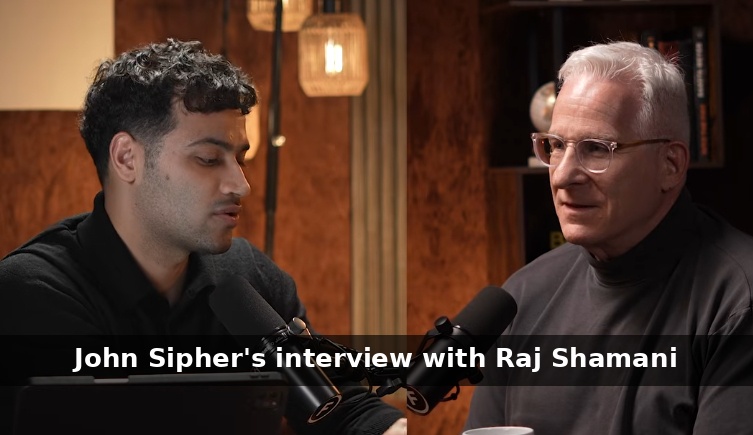
The following is the full transcript of former CIA officer John Sipher’s interview on Figuring Out With Raj Shamani, August 4, 2026.
EDITOR’S NOTES: In this episode of Figuring Out, Raj Shamani sits down with John Sipher, a former CIA officer who spent 28 years running clandestine operations worldwide. Sipher reveals how intelligence agencies truly work, why China can challenge America without firing a shot, and offers rare insights into Putin, Trump, and the silent contests shaping global power.
How the CIA Recruits Spies
RAJ SHAMANI: You have spent about 28 years recruiting people who would probably betray their own countries. You have helped people overthrow their governments. You’ve hunted down traitors and identified moles in your own system. I mean, that’s something that you would do, right? So you do a bunch of these things. Explain me, let’s say if somebody’s watching you for the first time, and in this conversation that person is hooked right now—
JOHN SIPHER: Uh-oh, careful.
RAJ SHAMANI: Yeah, watching you for the first time, how would you explain them what you do?
JOHN SIPHER: So I don’t do it anymore, just to be clear.
RAJ SHAMANI: Okay, what have you done?
JOHN SIPHER: I did it for a career, and it was actually a very rewarding and fun career. So in general, CIA— I don’t want to make it look like it’s bigger and more powerful than it is. It’s just one piece of a larger U.S. national security apparatus, and it’s just one piece of the intelligence collection part and intelligence analysis of the United States.
But what the CIA does is 2 basic things. It is the espionage part of the US intelligence, which means running human spies around the world. And it is sort of the main analytic cadre of the US intelligence service. So it’s almost like a small, mid-sized university.
There’s people there who are on the analytic side. They stay in Washington mostly, and they have people who are experts on everything. So there’s cadres of people who are experts on the Indian economy and the Indian Navy and the Indian relationships with China and whatever. And then there’s people who are experts on the Tunisian economy and on Iranian missile systems and name your— and their job is to collect— they don’t collect, I’m sorry, they receive intelligence from everywhere.
So they’re trying to read all of the academic papers, they’re trying to look at articles, what’s coming from businessmen, they’re looking at what’s coming from satellites, from US diplomats around the world, State Department officials. All that information on your subject is coming to you.
And then of the things that the US government is collecting openly, if there’s a subset of things that policymakers think they need that we’re not getting openly and with satellites and all that, then you come to the spy side and you say, listen, we have a pretty good understanding of Iran’s economy and Iran’s navy, but we don’t understand really what’s happening in the nuclear system. We need you to go try to find spies who can tell us the stuff that we can’t learn otherwise.
And so the spy side of the agency, espionage, where I work, is actually very small. It’s not very big. There’s more FBI special agents in New York City than we have worldwide doing our work.
And so our job is, when I’m overseas, sort of 2 things. Which don’t seem to fit together, but they sort of do. When I’m overseas, I’m usually undercover, meaning I don’t go to the world and say, “I’m the CIA officer in India.” But I do go to the Indian security service, RAW, and the security services in the government and say, “I’m the CIA officer and I want to work with you.”
And then there’s people in our office who are there while they’re in India. They’re not reporting on India, but they’re going after to try to meet Chinese, Russian, Iranian diplomats and others to spice it up. To talk to them, to befriend them, to learn about them. And again, say there’s Iranians living in India. We’re going to try to talk to them, try to see if any of them are willing to befriend a spy and go back to work in Iran for us.
The chances of that are pretty slim. Most people don’t want to spy. But we’re trying to develop those relationships to see if there’s anybody who says, “Listen, I’ve been doing this now for 30 years and I’ve realized my system is corrupt. I hate my system, and my children needed healthcare and they let my daughter die, and therefore I want to get vengeance on these people.”
And then there might be one person we’re like, “Well, yes, you’re working in a place that could be dangerous for this part of the world. Are you willing to talk to us?” And so our job is to try to find those spies, and it’s hard because again, most people don’t want to, but some do. And some of them can be in places that can be really important, but rarely are the spies answering all of our questions. They’re answering small, important but small questions.
And so the spy side of it is human relationships and then trying to maintain those relationships with people secretly to provide us those secrets. And then separately working with locals, the local security services, diplomats, and others to get information.
Because I would say 70, 80% of the information that the CIA and the clandestine force, the espionage, get are from our open— they’re not open, they’re secret, but their relationships with security services. I mean, again, say RAW in India, for example, who are, you know, we’re finding things that we agree on, like we want to work together on China, or we want to work together on Taliban or whatever, and we exchange and help each other and train together and all those things.
America’s Eroding Global Trust
RAJ SHAMANI: Do you think the United States of today is losing trust all around the world and people see US as an unreliable partner now?
JOHN SIPHER: Yes, I believe that strongly.
There was just a thing that was put out yesterday that our intelligence relationships, they call them the Five Eyes, with those countries like Canada and England and New Zealand and Australia, saying, you know, they don’t do anything for us, we have to stop paying them all this money. Well, first of all, we don’t pay money for that. Those are just sharing relationships, and they’re relationships built over time and trust. And those relationships are really beneficial to the U.S. government. There’s places and activities that the Australians and British people can do for us because we don’t have access, that are really important for us.
But this administration seems to have this sort of view of the world that since we’re the biggest and the most powerful, bullying and pushing people around and extorting them is the best way to get things. It’s almost like a mafia view of the world, right? It’s a view that Vladimir Putin and the Russians try to use.
And so yeah, I think those relationships of trust, we benefit by alliances far more than we benefit, I think, by just pushing our weight around. We are big and we are powerful and we are rich, but we are no longer that big and powerful and rich that we can get our way everywhere. Look what’s happening in Iran. I argue we’re losing in Iran. Yeah, we’re doing great at bombing and hitting the things we want to hit, but that doesn’t mean we win. And in fact, I would argue we haven’t won in places like Iraq and Afghanistan and Vietnam. Being big and being powerful doesn’t guarantee success. It’s more the relationships and the alliances, and those are built on trust.
Life as a Spy: Family and Secrecy
RAJ SHAMANI: Do you tell your kids about it, that you were a spy at some country?
JOHN SIPHER: Yeah, so that’s interesting. At the end of the day too, the CIA, like anything else, is a government bureaucracy. There’s rules, there’s regulations, and you have to fill out paperwork and you have to make sure your accounting is done and all these other kind of things. There’s rules for what we can do and how we can do it, and we have lawyers that make sure everything we’re doing is legal and all these type of things.
But there’s one thing where they don’t say this is the way to do something, and it’s with your children. Essentially, everybody’s children are different. At some point, most everybody tells their children what they’re doing, but it’s up to you to decide when they are mature enough and ready to do that. Because you can imagine, in certain circumstances, you might be putting your kids in a very difficult situation because you’re asking them to lie for you.
You’re like, “Okay, Dad actually doesn’t work for the State Department as a diplomat. He works for Central Intelligence Agency doing spy work, but you can’t tell any of your friends. You have to be careful. Don’t ever say it on the phone.” You put them in a difficult situation. And so everybody chooses when to do that differently. Most people wait until their kids are maybe in high school and they’re back in the United States. They can explain it to them, that type of thing.
I can remember in the old days of the CIA, when I came in, there were still some old people there that their spouses, their wives or husbands didn’t know. And that doesn’t happen at all anymore. If you’re married and you’re overseas, you’re a team. You have to know.
RAJ SHAMANI: At what age did you tell your kids?
JOHN SIPHER: I had gotten fairly senior while they were still very young. And so I was back in the United States and in Washington. And so I actually took them into the building and showed them around. And frankly, they don’t care. Kids don’t care. You want to be like, “Oh, this is important work and your dad’s very important.” They’re like, “Yeah, sure, sure, whatever.”
RAJ SHAMANI: You don’t have an app, you’re not important anymore.
JOHN SIPHER: Exactly.
Russia, China, Pakistan: Different Intelligence Playbooks
RAJ SHAMANI: Okay, see, you’ve worked in Russia, you’ve worked in Southeast Asia, you’ve worked in Pakistan. Russia, China, Pakistan, they all play intelligence games. Yes, but they have very different ways of working, right? Russia wants chaos. China wants a little bit of patience. Pakistan wants a lot of leverage. That’s what they at least intend to do with their spy world, with the information world, with the intelligence world. Explain me how each of them is different and what are their ways to operate.
The Culture and Origins of Intelligence Services
JOHN SIPHER: It’s interesting. I would argue that the culture of security services often comes from the beginnings of the state. And so if states started in a revolutionary way, like Iran, China, Russia, in a sense, they took things over. The security service starts out what we would call in the West national security. In those places, it’s regime security.
So when the Bolsheviks took over in Russia after the Russian Revolution in 1917, they created a security service right away, and its job was to make sure the leadership stays in power. It’s to kill the opposition, it’s to make sure there’s no threats to the regime. Their job is to make sure you stay in power. It’s not national security or security for the whole country. It’s like the government.
And so they start very much focused domestically first to make sure there’s no threats to the leadership, and then if they get big enough, they create an overseas thing that supports the regime to keep the leadership in power. And so different regimes develop differently.
So the Russians have developed this in this way. And also because when the Bolsheviks first took over, it was World War I and they were worried that these much more established powers in Germany and France and England and others would be threatening to them. So they knew they couldn’t take them on head on. So like I said, they created asymmetric means. So they said, “Okay, we can’t deal with them straight on with their military. We’re going to create these subversions to weaken them from the inside and to use Communist Party to infiltrate these places and to create disinformation and false narratives and use assassination and all these other kind of things.”
And so the way security services grow and where they come from depends a lot. And so in those places like China, Russia, Iran, those places are meant to keep that leadership in power. If that leadership actually is out of power, those guys are gone too, right? So it’s a completely different thing.
Whereas in your country, my country, if the leadership changes, generally those people still stay. Like in the CIA in general, when there’s a new president, they might put in a new director, but everyone else in that place, the professionals, they stay there. I worked for Reagan and Bush and Clinton and Obama. It didn’t make much of a difference. We were very focused on doing what we thought to get intelligence to help the policymakers as best as we could.
How Different Countries Use Their Intelligence Services
So when you look at different places, it depends. So Russians, again, very focused on domestic oppression and keeping leadership in power. Other countries like China — China very much so the same. The one thing with China is, as they are growing and becoming more powerful, they want to sort of own the 21st century.
It’s interesting when you look at Russia, we look at them and the States as both sort of either enemies or challengers or what have you. And Russia is losing the 21st century. Essentially, they’re sort of losers and they want to just overthrow the system and create chaos like you mentioned. China wants to own the 21st century. They don’t want to overthrow the system that they benefit from in trade because they’re making lots of money, they’re making lots of relationships.
And so they are building a much more powerful and much larger ability. They did come from revolutionary roots, so they’re going to be very powerful and control their population inside. And they’re also going to use a lot of these cyberattacks and others to weaken others on the outside.
Whereas most countries don’t have that worldwide view. So the United States has worldwide interests, so we’re everywhere. You could argue Russia, for a country with an economy the size of Portugal, still has a worldwide presence of spy stuff because spying — you have a KGB president and you have a place where the spy services sort of run the government. It’s the most important organization, you can argue, in the country, more important than the military or the diplomatic service or what have you.
Other places, like you talked about Pakistan. Pakistan, again, it’s focused just in its neighborhood. It’s probably 90% focused on you, on India. It’s probably trying to create problems and focus on Afghanistan, and it actually created the Taliban, but it’s created a terrorist problem for itself which it now has to deal with. So they have to focus on all of those things. But there’s not like Pakistani spies in South America running around doing much because that’s not — and it’s the same with Israel. Israel is a very skilled security service, but it’s very focused on its neighborhood out to as far as Iran.
I mean, I worked in the Balkans. I worked with the security services there. Again, they’re very focused on threats to their country that we can help them with, but they don’t have big tentacles going everywhere.
Nowadays, I would argue that most of the Chinese, the Russians, the Americans, the Israelis do. The British, in many ways, because of the legacy — still have not a full worldwide capability, but much more so than you’d think for the size of the country. So different services are very different in that way.
What about India? I never worked with the Indian service, so I don’t have a really good sense. My understanding is they have to be focused on serious threats, right? So China, Pakistan, there’s Maoist things in the East and they’re dealing with what’s going on in Bangladesh now and all those kind of things. You have relationships and people in Canada and the United States. And so you have an external interest, but also a very robust internal security service.
Which Intelligence Service Does the CIA Fear Most?
RAJ SHAMANI: Which one does the CIA fear the most?
JOHN SIPHER: Fears the most? That’s a good question. I think — it’s not just CIA. I think the FBI is in charge of domestic security in the United States, of sort of protecting its counterintelligence and intelligence threats from overseas. I think overwhelmingly China is the biggest long-term challenge and threat. They just have so many people.
I saw some kind of statistic — I’m going to get this wrong — they had more English speakers working on intelligence than all of the Five Eyes countries put together that all speak English intelligence services. They’re incredible. They just have so many people and it’s growing so fast. And in this modern age using AI and other things, they’re playing it.
So I think China is probably — I mean, as China grows, it could dwarf us. Things are changing. When I first came in, it was very much a one-on-one relationship business. Nowadays, using big data, the ability to collect information on everybody around the world and your whole population and put connections together that you could use using AI and computer tools — that’s stuff we didn’t have when I first started. These are the kind of new games that a place like China could find themselves being at the front edge of.
Will China Challenge the U.S. for the Number One Position?
RAJ SHAMANI: Do you think it’s inevitable that China at one point will challenge the position of number one in the world?
JOHN SIPHER: Yes, I think so. I think there are some real challenges for China, demographically. I mean, they don’t get immigration. One of the biggest strengths of the United States is we have new immigrants coming from around the world. We did. And this is one of the things this administration is trying to stop, which I think is ridiculous and stupid. But that kept our economy buoyant, kept it moving, kept us fresh, learning new things. China doesn’t have that.
And the other thing — and this is another thing this administration is throwing away — is that we had allies. China can bully people and have some relationships around the world, but everybody watches it carefully. They’re not long-term friendships built over time. Whereas we used to be — when something happened, there was a crisis in the world, the Japanese would help, the Koreans would help, the Indians could help, Pakistanis could help, the Indonesians could help, the Italians, the Germans, Polish. Countries in Africa, all around the world, would at least find a way to help us in some way.
But if we’re creating a system where we’re acting like we don’t want those relationships, that’s a mistake, because that’s what made us special. If something bad happened, we had a whole team coming. China — some people will come along, but they don’t feel part of the team.
China’s Economic Colonization and Its Limits
RAJ SHAMANI: But don’t you think just by sheer way of bullying people or bullying countries, they’ll be able to get through this? Because what they did in Africa and a few neighboring countries, they just economically in some sort they are colonizing them just by giving them so much money that they could never return. So now they control their ports, their governments, their airports, their literally every infrastructure out there. So those countries might support China. And then it’s not an ally, but in some sort it’s like expanding my kingdom.
JOHN SIPHER: Yeah, that’s right. But there’s a downside to that too. I remember I was working on Russia things when 9/11 happened. I was the deputy of our worldwide Russia collection, overseeing Moscow and stuff. And of course, when 9/11 happened, there was such a big pull to work on counterterrorism and to go after Al-Qaeda. And working in a bureaucratic unit, it’s like, “Okay, you people in Russia, I need you to give us some of your people to move.” So we were losing some resources focused on Russia because we needed to move and change and go after this sort of new challenge.
And I remember talking to a senior officer saying, “Hey, this is tough because we’ve got some really important things happening in Russia. The Russians are doing this, Russians are doing that.” And he said, “Listen, don’t worry because the Russians will always do something. They’ll overpush their hand and eventually we’ll have to realize, okay, they’ve gone too far, and you’ll get back resources.”
And China’s done sort of the same. You’ve seen it economically. There are places in the Balkans and in Africa where, yeah, they went in and they put a lot of money into building bridges and roads and infrastructure, but they often brought in their own people who were racist towards the locals, who got involved in corruption. And so the government was happy when the investment and money came in, but then they sort of started to realize those relationships aren’t real, we’re being mistreated, our people are being mistreated. They’re really in it for themselves. They don’t really care about us. And so there’s often a backlash in those places. People end up disliking the Chinese. The more Chinese come, the more they dislike them.
And that was like that with the Russians. The Russians in the Cold War were in Egypt and all these places in Africa, and they ended up — it looked to the outside world and probably to Americans who were paranoid, “Oh my God, look at — they’re everywhere.” But almost everywhere they went, they ended up making enemies of the people where they were. And so unless China learns how to use soft power rather than just hard power, I think it’s not going to be as beneficial for them as they’d like.
The U.S.-Pakistan Relationship: A Complicated Alliance
RAJ SHAMANI: But what’s going on? You tell me from a CIA lens. Like, India should be the most natural ally for the U.S. because ideologically we’re both — we are democracies. You’re the most powerful democracy and we’re the largest democracy, right? We both believe in free market, freedom, capital building, looking out for our own interests. We both, at least on paper, talk about world peace. I mean, the U.S. doesn’t look like keeping their promise at this point, but we both on paper talk about world peace, world friendship, coming up together, democracies, freedom, all of it, anti-terrorism. So it looks like we should be the allies.
JOHN SIPHER: Yeah.
RAJ SHAMANI: And then you guys have some sort of toxic marriage or relationship with ISI and Pakistan for some reason. I don’t know what the hell is going on there, right? Because they believe in terrorism and supporting them to get some of their agendas done and pushed. So the U.S. should — the U.S. is against terrorism, right? So you should be anti-Pakistan. They have a very army military sort of rule, not a very heavy democracy. The U.S. should be against that. The U.S. is absolutely against China, right? And Pakistan is best friends with China, and still the U.S. somehow is in some sort of relationship with Pakistan. What’s going on?
The U.S.-Pakistan-India Dynamic
JOHN SIPHER: Well, I think now it’s almost like personal. It’s almost like the president or prime minister, whichever one of Pakistan has sort of worked on Donald Trump. And Donald Trump, it’s about who sucks up to him the most, and so he likes that person. Doesn’t matter what country or whether they’re democratic or not. He doesn’t care about those kind of things.
But in general, your point’s a good one. Yeah, we should be natural partners with India. Now, there’s a history there. The Cold War was powerful for the United States. The notion that the Soviet Union could destroy us and we’re challenging them around the world. And at one point, Pakistan seemed to be a more supportive ally in that sense that we eventually invested and put in there.
But of course, by the 1990s, they were developing their own nuclear weapons and the relationship was souring and probably would’ve continued to sour and become less important. But then 9/11, the War on Terror, found us having to work with them more than we did before. Now, of course, those days are over too, and therefore we obviously want to make sure Pakistan, which has stability problems, huge population, poor economic issues, terrorism charges with the nuclear weapons. We can’t afford for Pakistan to become a terrible rogue state with nuclear weapons run by terrorists or whatever. Pakistan falling apart is not in our interest.
But you’re right, as a natural ally, India seems to be— and there’s so many Indians in the United States and these relations have developed for years and years. And economically you’re just growing and it seems to be a much better market both ways. And so I think you’re right. And maybe just based on the natural evolution of things, it will get there, but it should have been there earlier. I tend to agree.
But I think world politics had us on the Cold War sort of found its way, and then the War on Terror ended up sort of going a certain way. And so Pakistan, I don’t want to dig into it too much, but despite all of its problems and the fact that it does things that are very much against our interests— I mean, the support for the Taliban and some of the things with terrorist groups and attacks in India and these kind of things, which are horrific— it also has helped. It probably was more involved in helping kill al-Qaeda and stop al-Qaeda than many other countries were.
And so it’s a weird, weird relationship. You’re almost dealing with this sort of group that you don’t want to, but there’s a piece of it that’s helpful to you. And so we’ve continued to invest in that. So you’re right, I think naturally it will and should change. I don’t know if this administration will get that and do that because we’re mistreating people who should be our natural allies.
Trump, Personal Interests, and Pakistan
RAJ SHAMANI: Exactly. But now you guys have interests. I think there’s a personal interest in the crypto world, and I don’t know what all is going on with the family.
JOHN SIPHER: Oh yeah, yeah, that’s true.
RAJ SHAMANI: I mean, you guys are super personally invested in Pakistan now, at least.
Corruption and the Loss of America’s Intelligence Edge
JOHN SIPHER: Well, let me put it this way, which hurts me as a former CIA officer. Look, again, I took pride in, largely, what we were doing. I think the United States in general was a force for good and sometimes overstepped and wasn’t. And the CIA was a supporter of that and did good work. And I liked living overseas. I liked working with foreign partners and things.
But in the spy world, the espionage world, Americans don’t have any super secret sauce. I think we were probably the most effective and most powerful espionage intelligence service in the world, probably still are. But it wasn’t because we were naturally better or super secret like Hollywood spies. It was because we represented the United States.
And so if I went to you and you were in a country and you were upset with the corruption and the behavior in your country, you could see the United States as— if I give the information to the United States, that could help, sometimes, changes in my country or changes to our effect. So it wasn’t that we were super secret great spies, it was that we represented the United States. And if you’re in a corrupt country, the United States looked like it was something special.
Now, if we are going to be a country that the world sees as corrupt— where you can pay off the leader, you can pay off people— we lose that ability. Why would you need to come to the United States if we’re just another country with hands in your pockets? When a new leadership comes in, it’s time to steal, steal, steal till the next guys come in and it’s their chance to steal, steal, steal. If we’re going to become that, then we aren’t anything special. We’re not going to get those kind of sources that used to work for us years ago. And so I worry about that.
The corruption thing in this country— we did work around the world. You did see that a lot. But frankly, and I’m sure there are views out there that differ, it wasn’t like that. I never saw, ever, working in the US government, people trying to take money or make deals with sources. Literally, I carried suitcases with millions of dollars to hand to people. I never ever thought about taking some of it or using some of it. I never saw any of that kind of stuff. And if somebody did, they would be immediately arrested and fired. I would tell him the same.
So if we’re going to become the corrupt country, then I don’t know. Maybe some people will become rich, but we’re going to lose out in the long run.
Is Trump a Russian Asset?
RAJ SHAMANI: Okay, talking about Russia, you’ve said Russia doesn’t need Trump to be an agent, right? Something like that. That was very interesting for a former CIA guy to say something like that. What was that statement? Can you repeat it?
JOHN SIPHER: Well, I’ve done some writing on it. So it was a big deal here in 2016 when Trump ran for president. His campaign had all sorts of contacts with Russians, which makes no sense in domestic politics. Why, if you’re trying to win elections in some state in the Midwest, why do you need to be talking to Russians?
And at the time, the FBI was investigating these contacts. In fact, my podcast today just interviewed Christopher Steele, who is the British intelligence officer who wrote the Steele dossier about the Russians, suggesting the Trump campaign had these secret contacts with Russians. It became a big issue.
So when Trump won the election, there was all this stuff that was looking into Trump, and there were people saying, oh my God, Trump’s relationship with Putin is such, and all of this money and things, and they’re trying to hide these relationships. And still to this day, a lot of people on the anti-Trump side in America say, oh, he’s a Russian asset, he works for Putin. Back in the ’70s, the Russians built a relationship with him, gave him money, corruption, prostitutes, all this kind of stuff. There’s this view that Trump somehow is owned or run by the Russians.
And I had no intention whatsoever when I retired to have a public face, like doing this kind of stuff. I had no interest in that. And all of a sudden in the US media, there’s all— oh my God, what is all this stuff? What is this notion about he was in a hotel room and they filmed it? That doesn’t make any sense. What did the Russians do?
And so all of a sudden I found myself, people saying, well, you worked with and against Russians in Russia. Like, does any of this make sense? So I found myself speaking and talking and going on TV and starting to write about Russian espionage and intelligence to say, hey, listen, pieces of this, yeah, do make sense. This is how the Russians operate.
When I lived there, they had audio and video of my house inside and followed me everywhere for 2 years. Never ever a break. Every time I went out, people followed me. Every time I went around a corner and they didn’t see me, they’d bring people behind to make sure I didn’t put down some sort of secret dead drop or something. In my house, there were cameras when I was in there. I wasn’t married at the time. If I always had somebody in there, they would have video of it. They’d break into my house when I wasn’t there. They did that on all Americans. So this oppressive secret security service thing— I found myself trying to explain it.
But I also then tried to explain the differences in how CIA runs sources and how Russia looks at spies and sources, and tried to put Donald Trump into context. So there are all these people saying he’s clearly a Russian spy. And so I wrote some articles— essentially, is Trump a Russian asset? Is he?
And as I tried to explain how Russians look at this world and how CIA looks at the world— and I can leave you with some of these articles and things— the CIA, again, it’s a bureaucracy. We’re small. We’re trying to run spies that give us secrets that we can’t get any other way. So we have to focus on those types of things.
And for me in my world, to get promoted, to do well, I have to find someone who has secrets, develop the relationship with them, validate and vet to make sure that they are who they say they are, that they have the access they claim, train them, and continue to get this intelligence information, check the intelligence, see if it makes sense. And then when I leave, keep that secret relationship to pass over to another CIA officer when they come in. So we were trying to develop very secret, controlled, understood, motivated sources who work for us. And that’s how I get promoted.
RAJ SHAMANI: Okay.
Trump as a Russian Asset vs. Spy
JOHN SIPHER: Russian intelligence, on the other hand, because the way it grew up and the way it worked through communist parties during the Soviet Union days and all these other types of things, they’re much more interested in a much wider variety of people. And there’s even— they use even different terms for this. They call useful idiots or fellow travelers or these type of things.
So whereas I only get recruited if I have this super secret spy who’s providing information and that the person works for the US government. So I’m leaving and they’re passing it over. The Russians, on the other hand, if they can funnel money corruptly to some journalist to write something, that’s fine. Even if they don’t spy and meet on the street, that’s fine. If they can develop relationships, if they can give money to a right-wing motorcycle group that beats up people, then that’s fine.
So yes, they run some super secret spies like we do. For sure, that give them intelligence and they have analysts. But they also run this wider group because their goal is not just intelligence information, it’s to create this chaos and create problems.
And so we’ve seen recently, like Epstein, you know, this guy’s traveling back and forth to Russia. He’s got, you know, he’s had this sex thing, an island and girls and powerful people and money laundering. Like, that person would be of great interest to the Russians. They don’t have to treat him like he’s a spy. Meet me on the corner and I’ll— like, he’s already benefiting them and they can help each other and scratch each other’s back, as we’d say.
And so if you look at Donald Trump, he would be the worst spy, in my world, because can you imagine? Like, okay, here’s the rules you need. We’re going to meet once a month at this place. Make sure you show up on time. Make sure you follow these rules and no one’s following you. And then make sure you provide— let’s sit down and debrief you. What happened? What, you know, give me more details. What did this— tell me about the report? What didn’t it say? Like, he’s crazy. He’s only about himself. So he would never fit that model of a spy that we see in the West.
But on the Russian side, he could be of use to them because he’s involved. It’s almost like more like organized crime, the way the Russians see things, right? So it’s like, if you’re in that world where everybody has compromising information on anybody, and there’s a little money and you’re paying off this, and I’m helping you here, and I’ll share some information, or we’ll try to give you things. The system is not one that’s legal and lawful and all these type of things. It’s more of a sort of free-for-all corrupt system of compromise. Who has compromised on who? Like, if he’s been over there and maybe there’s been processes, maybe he’s been filmed in rooms, maybe he’s met people, maybe he’s got shady deals going. So they would come to him, and he doesn’t know what they have on him. He doesn’t know what they could— so they help each other a little bit. It’s not spying per se.
I’ve written articles trying to say I don’t think the notion that Trump is a Russian spy and always has been, and he’s been a Manchurian candidate who’s worked— but I do think his sort of brazen behavior and corrupt behavior and sort of not caring about democratic norms, not caring about legal norms, comfort dealing in sort of the criminal side of things is a real benefit to Russia.
So I think he’s an asset in the way we use that English word asset. He’s helpful to the Russians because he only cares about himself. And so if the Russians give him information that helps him beat Hillary Clinton, yeah, give it to me. So yes, he’s not an agent, but useful to the Russians. And again, that’s a Russian term, useful idiot. It’s like, hey, if we can get this guy to say this stuff— you know, what do you think is more dangerous?
The Useful Idiot vs. The Knowing Agent
RAJ SHAMANI: The guy who knows that he’s working for an enemy country, or the guy who has no clue that he’s working and he’s just a fool?
JOHN SIPHER: Well, the Russians, in a sense, they’re smart in their system. To them it doesn’t matter. You’re benefiting. These people are all helpful. Like, if I went to CIA, what’s more dangerous? I have this guy, you know, he’s just saying this crazy stuff, but it’s useful to us. And I wrote that to headquarters and they’d be like, no, stay away from that.
Which is more dangerous? I mean, I would argue at this point, if Donald Trump was a long-term secret mole spy that’s working, I don’t think he could do more damage than he’s doing as he is. And so, I mean, I personally think— and this is me going further than intel knowledge— I think it’s gotten to a point there’s almost like a mental illness thing here. I think he’s a narcissist and he can only see the world that benefits him and his people, and it’s doing damage, I think, to our fabric.
RAJ SHAMANI: Isn’t he doing good for America?
JOHN SIPHER: No.
RAJ SHAMANI: Just as an American, don’t you think he’s doing good for the country? Because probably what he’s essentially saying is that he wants to bring back jobs to America, he wants to bring back manufacturing to America, he wants to make this economy better, he wants to make trade imbalance equal. He wants to make sure that all the threats in the world, they don’t get a second chance. They get demolished and finished. So probably he must be doing something right for Americans. I’m just asking.
Trump’s Promises vs. Reality
JOHN SIPHER: No, that’s a good question. And I think that’s what has made him successful politically is that he says these things and a lot of Americans are like, hey, that makes sense to me. And he says, one of his sort of standard things is that we’ve been ripped off, we’ve been treated poorly. And it’s either foreigners are screwing us or the Democrats, the people who don’t support me, are against us. They’re making us weaker. And so that appeals to a lot of people because it’s a simple argument. It makes sense.
But I think if we look at sort of the actual outcome of that, yeah, I’m going to bring back manufacturing jobs. There’s no evidence whatsoever. And a lot of presidents have said they’re going to bring back manufacturing jobs. And the economy, the world economy and the way things are moving, we’re bringing back healthcare jobs and AI jobs. That’s, you know, other than that, we’re not bringing back many manufacturing jobs.
And I think he’s taking actions that are going to cause us larger economic problems over time. You know, just cutting back on immigration. I mean, I can see creating a better immigration system. And that’s the problem is Congress has never really dealt with creating a legitimate economic immigration system where people can come to this country and work or bring people in. But doing it in such a brutal way is going to hurt us in terms of immigration and bringing in talent and bringing in skills into our country.
And so I think on all of these fronts, he makes— he’s a charlatan, a salesman. And essentially, even if something is not true, if you just say yes— and you saw it in his speech the other day about Iran— oh my God, this is the best. We’re winning like no one’s ever seen. This is the biggest success. The world has never seen a war like this. Everything is going perfect. Everything is like— that’s how a carnival salesman says, oh yes, that’s great, you know. And they sort of sell you while they hide the bad things. And if you’re a narcissist, you’re never going to admit problems. You’re never going to take guilt. You’re never going to accept those things.
And so the things he says that he wants— of course, those are things everybody wants, but I don’t see almost any sense that those things are actually happening. And even people on the conservative side of the United States are now starting to realize, yeah, our economy isn’t getting better. There are lots of problems. These things that you say you’re fixing don’t seem to be getting fixed.
RAJ SHAMANI: He just talks about it.
JOHN SIPHER: Yeah, he just claims— and that’s what he’s going to do at some point with Iran. He’s just going to say, “We won,” and then walk away. Like, everyone else in the world’s going to be like, yeah.
Trump’s Philosophy: Never Accept Defeat
RAJ SHAMANI: Do you know one of his theses, one of his principles is, right, that never accept defeat? You know, out of his top 3 principles, that’s one of them.
JOHN SIPHER: Yeah.
RAJ SHAMANI: One is attack, attack, attack. One is never accept defeat. I’m forgetting the third one, but that’s his philosophy throughout, from his days when he was mentored by Roy.
JOHN SIPHER: Yeah, yeah, right.
RAJ SHAMANI: And he met— like, it was Roy’s principles, and then he mentored Donald for a very long time. Never became—
JOHN SIPHER: Never— and never accept fault or accountability.
RAJ SHAMANI: Yeah, never accept fault. So probably that’s something that he’s doing. It’s visible, right?
JOHN SIPHER: Which is fine if you’re doing low-level real estate, I suppose, but he’s the President of the United States. I mean, the world is so huge, so complex, so many people, so many things.
Public Perception of Trump
RAJ SHAMANI: Do people like him here?
JOHN SIPHER: I think it’s funny. I have a lot of people now who’ve worked for him or around him, and I’ve seen some things saying essentially anyone who’s ever been around him, even the people who support him in the Congress, it’s like, no, they don’t like him. He’s a mean, nasty, ignorant person who nobody likes.
But there’s a group of people in America who like the bullying. They like that his enemies are their enemies, right? So he’s, you know, if they heard me talking, they’d say, “I hate that guy, and Donald Trump hates that guy.” And so, you know, Donald Trump on his first day in office wrote an executive order stripping us of our security clearances, and I’m not supposed to go in government buildings anymore and all this other kind of stuff because somehow I’m an enemy because I’ve expressed my opinion.
And so there’s a core group of people, oftentimes white evangelical hardcore Christians, very right-wing, that have sort of almost like a cult. They followed him, they believe in him, and almost nothing can change them. They might have, 2 months ago said, “Oh my God, I never want another foreign war, we’re sick of these foreign wars.” And then now they’d be like, “Well, Donald Trump did it, so it means it’s the right thing to do.”
And so he won election twice, frankly. So the issue is not just him, it’s our country, and there are people who believe in this and support it. So is it that our civic education is not as strong as it should be? Is it real structural problems in our economy where people are willing to risk taking somebody like this to be president because things are so bad? There’s a lot of bigger issues than Donald Trump here.
But yes, there are people who love him and follow him. I wonder if 10, 15, 20 years from now whether those people will be like, “Oh, that was a mistake,” or whether there still will be that cadre of people who think that he did wonderful things.
RAJ SHAMANI: Probably both. Yeah, probably both. That’s what happens with these kind of personalities.
JOHN SIPHER: And some people won’t admit that they were wrong either, right?
RAJ SHAMANI: Yeah, yeah. And see, that’s what happened with strong personalities like him. Yeah, they polarize their audiences. It’s either love or hate. There’s nothing in between.
JOHN SIPHER: Oh yeah, so there’ll be diehard fans and there’ll be diehard haters. Yep. And anger works, and scaring people works politically, all those type of things. And like I said when we were chatting earlier, there’s a large portion of the United States— you know, we’re a big country, we’ve been successful economically, you know, richest country in the world arguably, or in the history of the world. So there’s people who live in a lot of parts of the United States who never ever see a foreigner, never travel overseas, but live comfortable lives. And if somebody like you or I come in and tell them, “Hey, you know, this is causing problems in the Philippines and in India, and there’s a worldwide market here,” they’re like, “We don’t care about any of that.”
CIA, Israel, and Targeted Intelligence
RAJ SHAMANI: Talking about world problems, CIA tracked Khomeini’s records, right? And they shared that intel with Israel. Israel used that targeted data by using AI and traffic cams and attack.
JOHN SIPHER: I thought— my understanding is, yeah, Israel was using the traffic cams to figure out where people are going.
RAJ SHAMANI: So yeah, I’m sure CIA’s data actually confirmed all those targets. Okay, targets. Like, that’s what it’s out there in the world.
CIA Intelligence, Israel, and the Limits of Analytical Power
JOHN SIPHER: But yes, that’s the one thing I have to say. After 9/11, when the United States really moved towards focusing on terrorism, it was a different target set. So in the old thing that I grew up in, in the Cold War, it’s like, okay, we need someone in the Kremlin to give us the secrets of what the Russians are doing and what the Russian KGB is doing, all those type of things.
After 9/11, it was a different set. It was almost, you could argue, more of a law enforcement set. These guys are terrorists, they’re moving in small groups, they’re trying to blow up things and hide. Collecting against a nation-state is different from finding individuals essentially criminals who are traveling around the world.
Over time, we became really good at using networks, figuring out who’s who, making arrests, pulling in the data from them to figure out who else is connected to who. And we became really good, arguably manhunters, finding people, finding bin Laden. It took a long time, but we got much better at putting together those maps, using data, using big data, using all this type of stuff to figure out where people are.
So yes, I think when you say it’s CIA, but it’s probably a mixture of the NSA and CIA and overhead, all of those things together. Intelligence agencies with foreign partners. And it may have been Israel, but there might be others that have some roles in all this type of stuff. So yes, we’ve become much better at that. So yes, it’s certainly possible that CIA had information on locations of people.
RAJ SHAMANI: But then the word is that American agencies shared that data with Israel. Israel said, let’s attack, and the regime change would follow. And CIA said the regime change won’t happen, right? And yet they continued doing the thing, and now we can see the result.
JOHN SIPHER: Yeah, that’s a good way to look at how the system works together. So I mentioned when I talked about CIA, there’s the spy side, the espionage side, and there’s an analytics side. And so the spy side might be working with the Israelis and working with NSA to put together, okay, where are these people? The analysts are the ones that are collecting it.
And so if the question comes to them is, okay, if there’s a war and we take out the leadership, will that mean regime fall? That’s a different group of people. And they say, no, it doesn’t make sense. Now that information then goes up to the White House for decision makers. The State Department, the National Security Council, the president, they’re going to make a decision on that. And they’ll say only one part of this is like, what’s intelligence say? And intelligence says, no, it won’t work. And they’re like, yeah, yeah, great, go away.
We used to have a saying in CIA: “You can bring intelligence to a policymaker, but you can’t make them think.” We can say, here’s what we think. But that doesn’t mean they have to take it or act on it.
And this administration, Donald Trump, from the beginning when he came in in 2016, said, “I don’t trust these intelligence people. They’re a deep state. They worked against me. They tried to make it look like I work for Russia. Go away. I’m not interested in this.” So I’m sure, yes, the CIA analysts come and say, yes, this, this, this, this. That doesn’t mean they care or they’re going to act on it.
Even this guy Witkoff, who’s been involved — his golfing friend who’s involved in negotiations with the Russians and Ukrainians and the Iranians — the CIA said, “We’d be glad to brief you on these things.” And he said, “No, I don’t need any of that.” So essentially they’re making their own decisions, and presidents can choose to use intelligence or not. So what you say is probably true, but it shows how our system either works or the dysfunctions in our system. I think that’s fair.
Russia, Putin, and the KGB Mentality
RAJ SHAMANI: One thing you’re very confident about — that’s your knowledge on Russia, right? That’s something that you’ve been very vocal about, very confident about. And you’ve compared Russia’s escalation to Al-Qaeda before 9/11. Why?
JOHN SIPHER: Geez, did I? So I—
RAJ SHAMANI: If you did, it’s in the sense that ignoring Al-Qaeda before 9/11 is almost like ignoring Russia today.
JOHN SIPHER: Well, I think when I look at Russia — we talked about it a little bit earlier — the Russian security services, the intelligence service security services, are the central policymaking issues. Like I said, it’s almost an intelligence state. Vladimir Putin’s a career KGB officer. He’s been involved in these things. And you have to understand the mentality.
I use the term KGB, the old sort of Cold War security services. It still encompasses what is an external service, an internal service, a variety to protect the regime. They grew up from the czar’s security service through the Soviet days till now, using all of these tools we talked about, asymmetric tools. So it’s all about weakening your enemy from the inside. It’s like, okay, we can’t take you on directly, so we’re going to do all of these things — subversion and sabotage and disinformation and assassination and all these kinds of things. We’re learning and learning and doing more of those things.
So if I want to compare Al-Qaeda to the Russians, it’s that. It’s essentially Russia, you can argue, is almost a terrorist state. It is looking for our weaknesses, just like a terrorist organization does. It’s like Al-Qaeda says, “I can’t take on the US Army and its tanks and its planes, but what I can do is find weaknesses and political places where I can cause pain for you that cause bigger issues.” So I can hit the World Trade Center and that’s going to cause so much more overreaction and pain than it would be if I tried to attack your soldiers in the field.
And that’s the way Vladimir Putin and the Russians look at things. It’s like, I’m looking for ways to find your weaknesses and take advantage of them. So we saw in 2016, they came to the United States and said, “Jesus, Americans are fighting each other. These political parties hate each other. Let’s get inside the system and turn Americans against each other.”
In the Cold War, they had to create fake stories. Like, they had to create a story that the Pentagon created the AIDS virus and sell that story around the world, and people still believe it. But now they don’t have to do that. They can just look at our social media and say, “Oh, look — he’s saying these horrible things about him, and she’s saying horrible things about her. Let’s just amplify and push that and use those tools to make Americans turn on each other, because the more they fight each other, the less of a threat they are to us.”
And so if I talk about Russians as Al-Qaeda, it’s that — the skill of looking for your weakness and exploiting it is what a terrorist group does, and it’s what the Russians do.
RAJ SHAMANI: Interesting. You were in Russia for a very long time.
JOHN SIPHER: I was there just a couple years, but over the years I worked on Russia. So I was at our headquarters working on—
RAJ SHAMANI: Yeah, you ran the CIA’s Russia House, right?
JOHN SIPHER: I was deputy of its Russia House. Yeah, I was there.
RAJ SHAMANI: So you were the deputy there and you have seen the rise of Putin very closely. Tell me about Putin. Tell me about what’s your view on him — not how the world sees it. What’s his demeanor? What’s his agenda? What is he like psychologically?
Understanding Vladimir Putin: The Chekist Mindset
JOHN SIPHER: I think, and I’m going to sound like a one-trick pony here to come back, is that you have to understand the Russian intelligence services to understand Vladimir Putin.
So in Russia, when the Bolsheviks took over in 1917, they created this new security service and it was called the Cheka. And the head of the Cheka, the new guy, Felix Dzerzhinsky, said, “We are a terrorist organization. We’re going to destroy any potential opposition to the Bolsheviks.” From the beginning, that was their job.
And so the Russians have a term called Chekist. Ever since the original Cheka that was there to destroy opposition and create this Soviet Bolshevik security service, all Russian security service intelligence people since then till now call themselves Chekists. And there’s a day — the creation of the Cheka, I think it’s December 20th, I’m not exactly sure — but they celebrate this every year, and Vladimir Putin makes sure that every December 20th he goes to the SVR, FSB offices to celebrate Chekist Day with these security services.
So he grew up in this system. He worked in East Germany working with Middle Eastern terrorist groups and funneling money and smuggling operations and things like that when he was in East Germany. And he was there when the Soviet Union fell apart. So you can think about how that wears on you psychologically — you think that you are part of the elite organization in the Soviet Union, the KGB, the sword and the shield. “We’re what keeps the leadership in power.” And your country falls apart while you’re in the field working with agents and giving money. You think you are in the most important job in a superpower, one of the big superpowers in the world, and your country falls apart while you’re there.
He has to go back. He goes back to his hometown in Leningrad, which becomes known as St. Petersburg. He gets some jobs, works with the mayor there, gets involved in doing some sort of foreign business as it comes in. And then as the new regime, Yeltsin, takes over in the 1990s, he does some work for them. As a former KGB officer, they put him in charge of the FSB, which was the domestic political security service in Russia in the ’90s.
And when Yeltsin starts to go out of power, he has developed enough compromising information on Yeltsin’s enemies that he sort of leveraged that into Yeltsin saying, “I want this guy to be the president.” He runs literally a month later and they make him the president. And he’s been in power ever since, since 1999.
And he would describe himself this way, as a Chekist. And he says, “Once a Chekist, always a Chekist. There’s no such thing as a retired intelligence officer” — which is not true. I’m a retired officer. But to him, this is the central organizing, mental view of him.
And as he’s been in power since that period of time, he has very much brought back all those kind of things to keep those security services powerful. All of the people that are close to him are also former KGB officers, former security service people.
And one of the interesting things is, as the Soviet Union fell apart, the KGB was the place that ran the Communist Party’s money. So the money of the Communist Party of the Soviet Union was handled by the KGB and kept in foreign bank accounts and all these other things. So the security service guys are the ones that, when the system fell apart, knew where the money was and how to deal with it. So the security service maintained power while the diplomatic service fell apart, the government fell apart, the economics fell apart.
And when he came back into power, he used that group to continue to strengthen himself and stay in power. So to understand Vladimir Putin, you have to understand the mentality of a KGB officer, a security officer — and that’s using those tools to keep your enemies off balance, to manipulate, to bully, to threaten, to smile at you while he’s trying to steal from behind you, all of those kind of things.
So he’s an interesting character. I also think he’s a paranoid character. And I think that’s something—
RAJ SHAMANI: What do you mean by paranoid?
The Paranoia of Power: Putin, Trump, and the Dictator’s Dilemma
JOHN SIPHER: I think in a certain sense, all dictators are paranoid because they have to worry about— well, if I run for presidency in India or in the United States, the electorate puts me in charge. So my power is legitimate in the sense that it’s been proven with voters, and I might get voted out, but I might get voted in.
If you’re a dictator and you want to control the media and the courts and the businesses and the money and the oligarchs and all these types of things, to maintain your power, and you have this small cadre of people that deal with you, as time goes by — you’re talking like 26, 27 years he’s been in power — over time, you become like— this cadre worries about, is there anybody out for me? Is there anybody that’s trying to overthrow me? Are anybody in this system traitors and they’re going to try to kill me? All these type of things.
And so for a dictator, every day you have to worry about, okay, what’s the threat to me today? How can I do it? I don’t know. I have no real means of knowing how popular I am, because essentially everyone’s going to smile and say, “Oh, you’re the boss.” But will they stick a knife in my back as soon as they get a chance?
And so the paranoia, in the sense that he’s a KGB officer and you are paranoid, distrusting, because that’s what you do for a living — you sabotage and put false information, disinformation. Also paranoid in the sense that you’re now in power, but you don’t really have the proof or knowledge or the authority to know whether you, you know, have power. And so you always have to worry about where threats come from. And so you have to sort of, if this security service and this guy seems to be getting more powerful, I have to find a way to pop them down by putting this person up in charge.
I think he’s in a situation now where he really bet everything on going into Ukraine and it’s been a disaster. You’re talking like a million people killed or injured or more, and he claimed that he was going to take over the place and he didn’t. And he’s coalesced enemies against him. Now he’s sort of more a vassal of China. China owns him sort of financially. It’s been a disaster for him.
But he has to worry about — if the war ends, he has to go back and try to explain to these sort of powerful people around him why it was a success, when they would be looking at him and say, “You essentially just screwed our country.” They might be coming after him at any point. And so I think paranoid in that sense.
And there’s been a report — you even highlighted it — that the internet system has been down in Moscow for a while.
RAJ SHAMANI: Iran, Moscow, everywhere in the world now.
JOHN SIPHER: And one of the things that they’re suggesting — or at least I read, and I’d be interested in what you thought — is that he saw what happened with Khamenei and found out that the Israelis and Americans were tracking him through the traffic cams, and he became paranoid that, “Oh my God, this could be a way that they’re going to come for me too.”
Now, of course, no one’s coming for Vladimir Putin. I wish they would, but they’re not. But that’s the kind of mentality. If he actually believes that, say, the Americans are watching him on traffic cams and are going to come kill him, that’s the kind of paranoia that he has, I think.
What Does Putin Really Want?
RAJ SHAMANI: What do you think? What does he actually want which he cannot say publicly?
JOHN SIPHER: Who? Putin? I don’t know. I mean, I think he can say things publicly. I think he, like any dictator — and we’re seeing it actually with Trump now — is they want to be seen in history as Peter the Great or Catherine the Great, one of the great czars and powerful leaders in Russian history.
And I think he has to worry now that he may have jeopardized that by this sort of failure in Ukraine. He wants to go down in history as one of the great Russian czars, and he’s potentially jeopardizing this with what’s happening in Ukraine. And so he’s got to try to find a way to pull a victory out of a defeat, or at least a claim to victory. And so in that way, he and Trump are like the same. They’re going to have to find a way to say something terrible is really a great success.
RAJ SHAMANI: He’s a good friend to us though.
JOHN SIPHER: Yeah. Well, because he has to be, because with the sanctions and stuff, he needs money and he can sell you guys cheaper oil, which is good for you, for your economy. It’s good for him. But I don’t think that that saves him necessarily. I mean, he’s doing what he has to do to stay.
RAJ SHAMANI: But do you think Russian people also want this, what he’s doing?
The Russian Mentality: Imperial History and the Question of Reform
JOHN SIPHER: That’s a good question. He certainly doesn’t give them the opportunity to tell the truth or to vote for him. They have rigged elections. So it’s interesting. There are two ways to look at this. I just had a discussion with a group of Russia experts recently at the Hayden Center where we talked about this.
Is there something unique about Russia and Russians that creates this sort of imperial mentality that’s been there? Because you can argue — if you go back — they’ve always had strong leaders, czars, that sort of oppressed the peasants and kept people down. And so it was the same with the czars in the 18th and 19th century. It was the commissars and the communist leaders. And they’ve always bullied their neighbors and they’ve—
RAJ SHAMANI: It’s always been like that.
JOHN SIPHER: You can argue so. It’s always been like that. Is there something about Russia that makes it that way? Or is it an economic system which created a thing where there became more power in the leadership, but that obviously, given an opportunity to become a different kind of more European system, if you will, would people want it? And I think both those things exist in the Russian people.
There’s a lot of really well-educated, serious Russian people that probably would like to have— from my time there, one of the things you often hear from sympathetic Russians is, “We just want to be a normal country.” Every time there’s a chance that there could be reform and change here, it always reverts to this. What you see with Putin, or what we saw in the Soviet days, is, “Please, please, we just want to be a normal country.” And it hasn’t been.
I tell a quip oftentimes that in the Cold War, probably the most famous diplomat in US history after World War II is this guy George Kennan. And he was a diplomat, he was in Moscow after World War II, and wrote some of the famous early pieces that led to the US Cold War stance against the Soviet Union. And when he retired from the State Department senior positions, he went to Princeton University. He was a professor there.
And all of the new ambassadors that were getting ready to go to Moscow all through the ’80s and ’90s would always go up to Princeton to see him before they went to Moscow. It was sort of like going to see the great man, get advice. And he reportedly would give the same advice. His advice was — say this is 1994 or whatever, and whatever’s happening there with Yeltsin and all of this — he would say, “What you should do is just go to the academic library here at Princeton, or any big library, pull out any book on 18th or 19th century Russia and read that. That’s all you need to know about today.”
So what he’s suggesting is there’s a Russian mentality, behavior, history, politics that are sort of eternal in this imperial Russia. This is something that’s been there forever. It wasn’t communism that made the Soviet Union that way — it was Russia that made the Soviet Union that way. And it’s Russia that’s making Putin this way. So those are things that people have to debate about.
But I don’t think the Russian people have ever been given an opportunity. And I also think — maybe the worst thing Putin’s done for the Russian people is, yeah, he’s sort of screwed the economy and he’s killing his people in this war and all of these other things. But potentially the most dangerous thing is he’s created a system where there’s no opposition, there’s no potential follow-up.
If Vladimir Putin drops over tomorrow, what happens? There’s no system, there’s no political parties, there’s no political leaders, there’s no successor, there’s no system of creating a successor. Conceivably, Russia could fall into a civil war like we had in Yugoslavia.
Perhaps the worst thing he’s done is, yeah, he’s gained all power unto himself and he’s oppressed everybody to make sure there’s no threat to him, but he may have set Russia up for terrible things in the future. You’re always taught in the business world or even in the government world that the most important thing of a leader is to build new leaders behind you, so that they understand what to do, other people can make good decisions, and by the time you leave, there’s a good system of people behind you. And that’s one thing that hasn’t happened in Russia for sure.
Leadership, Succession, and the Trump Parallel
RAJ SHAMANI: There’s a saying that says, “Don’t call yourself a leader until you have two more people who are way more capable than you to lead your position right behind you.”
JOHN SIPHER: Yeah. Good leaders are comfortable with really talented and smart people around them. I often say, I want to be in a room where the people who work for me are smarter than me. I want good people around me.
Whereas there’s the other view — maybe the Putin and the Trump view of the world — is, “I’m in charge, I’m the smartest. Anyone who seems to have their own sort of sense of power or smarts is a threat to me, and therefore I’ve got to cut him down.”
Trump — going back to America — the people he’s put in these positions of great power are completely unfit for the job. No experience. Their only real qualification is they’re willing to suck up, or they’re willing to do whatever Donald Trump says to do. And so there are people in the intelligence community now — Tulsi Gabbard — who shouldn’t even get a security clearance. A junior 23-year-old person joining the CIA would have a better chance of getting a security clearance than some of these people who are in place. And so it’s sort of all about loyalty, not about talent and skill. And I think that’s a dictator thing too, isn’t it?
RAJ SHAMANI: I don’t know. I don’t know if he has the successors or not.
JOHN SIPHER: Yeah, I mean, the system—
RAJ SHAMANI: I wouldn’t know the leadership that well. I’ve not done enough research on that, so I won’t be able to comment.
JOHN SIPHER: Come on, you know these things.
RAJ SHAMANI: No, for real. I don’t know if there are really, really good capable people right after him. I have no idea. Probably there are.
JOHN SIPHER: Putin?
RAJ SHAMANI: I mean, not Putin. I’m talking about Trump. Who do you think will be the successor to Trump?
The Race for Trump’s Successor: Rubio, Vance, and the Democrats
JOHN SIPHER: Wow, that’s a big thing. So there are congressional elections coming up this fall. Trump is trying to change election rules to try to rig the system so that his people win or what have you. I don’t know if they will, and I hope that doesn’t happen, but it is happening. And so that’s going to impact it a little bit.
So who wins these sort of congressional and smaller races? Then immediately in this country — which I think is a weakness — we start into this effort of political effort to create for new elections like a year or two beforehand. You see in France they have like one month where people run — oh my God, that would be great. But here it’s like this constant effort.
And so there’s going to be lots of people on the Democratic side and the Republican side trying to put themselves in positions. There’s like a big article I was reading on the plane on the way up here about Rubio. It’s between Rubio and Vance who are sort of fighting each other internally to put themselves in a position to take over the voters that vote for Trump, so that they can be in the best position to run for president.
But in the United States, oftentimes those early things of who looks like they’re going to win don’t win. No one would have put Trump in 2014, 2015 as the person who would win the election. So it’s so hard to predict.
RAJ SHAMANI: But on this side, you said Rubio and Vance look like the early ones. And the opposition — who do you think has a good chance?
JOHN SIPHER: So there’s a lot of young and up-and-coming. So there’s the governor of Illinois, Pritzker. There is in fact the mayor of Chicago who worked for Obama — he was his chief of staff. There’s the governor of California, Newsom, who might run. The governor of Minnesota, who was the vice president candidate last time running against Trump, is a possibility. There’s governors of Pennsylvania and Kentucky who have won Democratic elections in states that are very — what we say — red. They’re more sort of centrist or Republican.
The Future of the Democratic Party
RAJ SHAMANI: Who do you think, if you have to choose one, which you would like to see?
JOHN SIPHER: You’re trying to get me in trouble.
RAJ SHAMANI: Who would you like to see?
JOHN SIPHER: I think the future of the Democratic Party, frankly, is these really talented women that we have that often worked in military intelligence services. So I live in Virginia. The governor of Virginia, Abigail Spanberger, was a CIA officer for a number of years. She then ran for Congress in areas where we say red, very sort of Republican-leaning, and she’s a Democrat, but won 2 times in Congress and then ran for governor. And so she’s very, I think, very talented, very serious.
The senator from Michigan, Elissa Slotkin, worked for CIA and the Defense Department. She’s a capable senator. These people are very smart, very sensible, very focused on national security issues. The woman who just became the governor of New Jersey was a former Air Force fighter pilot, really, really quality kind of person, very serious.
So what I would like to see is people who are really serious about the problems we have. I mean, this is a huge country with huge issues, huge problems. We can’t just continue to treat them like they’re just slogans or easy to solve. It’s one thing to say things to win elections, but once you win election, you need to govern. You need to actually do things. And it seems to be that people are more interested in winning than they are in actually doing something once they win.
The Art of Tradecraft: How Spies Are Recruited
RAJ SHAMANI: Walk me through tradecraft.
JOHN SIPHER: Tradecraft.
RAJ SHAMANI: So tradecraft is like, walk me through, yeah, how would you exactly recruit a spy?
JOHN SIPHER: Well, I’d like to say that there’s one way to do it, or that I have some super skill in it, but it’s just human nature. How do you find the person that you marry, right? I mean, how do you find somebody who’s compatible with you by accident. It is a nature of trying to find people who might have access to secrets that we need, right?
So if I develop a great relationship with you and think, hey, you’re willing to spy for me and you have needs and money and you want your kids to move to the United States and I can help do that, but you don’t have access to those secrets, I can’t. It’s stupid. I have to find someone who has those secrets and might be willing to work with me. And so what we call this, what’s called the recruitment cycle. So it’s called spot, assess, develop, recruit, handle, and terminate.
RAJ SHAMANI: Okay.
JOHN SIPHER: Terminate means to stop the relationship, right? It doesn’t mean— no. So the first part of that is spotting, like finding someone, finding the people who might have access. And so in the old days, before there was data and computers and internet, you essentially would just try to go to events. That’s why we often would work as diplomats overseas, because you’re in that milieu of meeting people who might be in government places and you’re working on it.
It might be like a military attaché, might meet somebody who— and you befriend them, you meet them at parties, or you go out, or you find ways to, you know, international schools and meet people who have their kids there, what have you, whatever it is, to find someone and try to just essentially human to human talk to them.
So spot, assess — that’s the next play. Okay, I met you, I found a way to meet you, and then I’m going to just find out about you. Like, who are you? What do you like? What’s important to you? What motivates you? Tell me about your job. Tell me what’s important to you. Tell me about your family. And you’re not just getting this from people, you’re talking about yourself too, right? You’re actually trying to build a friendship, right?
RAJ SHAMANI: Yeah.
JOHN SIPHER: Because no one’s going to put themselves at risk and spy for you unless they trust you. So it’s not just, I’m trying to figure these things out from you. I’m trying to make clear to you that I care about you and I’m actually asking these things because they matter to me, and try to develop some trust.
So spot, assess. And then you’re also writing this stuff up, you’re sending it back to Washington, they’re going through their database. Do we know this person? What do we know? He says he works in this place. Over the years, we’ve learned that they do this, this, and this. Maybe ask them some of these kind of questions.
So spot, assess, and then develop. So develop is now, you look like you’re an interesting candidate. It looks like you have this information. You seem to be willing to talk to me more. You have some issues. You might have mentioned a little bit problems with your boss or whatever. And then I’m going to deepen that relationship to find out whether those things really are important and matter to you, or whether they’re the kind of motivations or vulnerabilities that I could take advantage of to see if you’re actually willing to spy.
And then that person has to say yay or nay. And then I have to make it clear that this is a dangerous situation, that we’re going to have to meet secretly. We might have had this sort of open relationship, but we can’t have that anymore because it puts you in a difficult situation. We’re going to have to meet different places, different ways, maybe in a car, maybe in a hotel room, maybe by dead drops here and there to work for us.
So spot, assess, develop, recruit, and then handle. And that’s what— once we developed this professional relationship, we found a way to meet secretly and share the information. And I might be giving you money, I might be like helping you to an agreement. Like if you work inside the Iranian nuclear program for 5 years and share with me everything you know and answer all of our questions, I can arrange for you and your family to move to France or the United States and we’ll support you for the rest of your life or whatever. So there’s different things for different people. So that’s what we call the recruitment cycle.
But it sounds much cleaner and fancier than that. It’s essentially building a relationship and understanding people. So let me get back, and I’m sorry, I feel like I’m not answering your question. I’m just talking too much.
The Big Data Revolution in Intelligence
JOHN SIPHER: But that was like in the old days, just trying to find a way to meet people. The thing that’s come in the last certainly 15, maybe 20 years, but much more now, is the big data revolution. And this really came about a lot as we started to move after 9/11 to go after terrorist stuff — the world has its data online now.
So what we’ve created is another professional cadre in the intelligence service called targeters. So rather than me just going out hoping to run into someone who’s of interest and meet someone, there’s enough data out there that people could pull together and look through and figure out who are the right people in this place.
Again, just to use Iran, we can pull together who we think are in this organization, who are they? And then let’s just go through the dark web, everything to figure out what have they put online? What have people that are around them put online? Families? What do academics say? What are their bank records? We could look, go through their movements. You might be able to build a picture of that person before I ever meet you physically now, right?
And we didn’t have this when I was coming through, but you can create essentially — okay, I’ve learned this person doesn’t put much of his own stuff online, but I’ve learned now that his friends and family around him say all these things, which has allowed us to look through big databases of movements and family. And there’s just so much out there now. Everything. Our cars, our car tires send signals out to make sure there’s enough air in them. Every place you go, everything.
And so using AI now, you can pull all of that stuff together and I can put together a picture before I ever meet you about what is this person? What do they like? What appeals to them? What doesn’t appeal to them? So that when I meet you, we might be able to move that assess-develop thing much faster.
FBI vs. CIA: Different Cultures, Different Missions
RAJ SHAMANI: Tell me what’s going on between FBI and CIA, traditionally or now. Tell me traditionally and now.
JOHN SIPHER: Yeah, so the FBI is a law enforcement organization. The part that we’re going to talk about is the counterintelligence part. So the FBI gets involved in, you know, everything from bank heists to corrupt politicians, and they’re making sort of federal cases. So they’re essentially a supercharged federal police organization.
But they have a subset of that organization who’s the counterintelligence and now after 9/11, intelligence too. Their job is to be able to defend against potentially terrorists, foreign intelligence officers, other things. So their job is internally.
So there’s a Russian embassy, there’s a Chinese embassy, there’s all these people coming, foreigners coming to the United States. Their job is to make sure that if there’s people like me coming into the United States that are trying to steal information from the United States, they need to be able to track them, know them, cause problems for them, put things in their place, maybe try to recruit them.
So a lot of the people who spy for us in CIA, they worked in the United States and the FBI looked at them and said, hey, this person’s— and they might have recruited him and then passed him over to the CIA so that when they went home, we ran them. So it might have been an Iranian who was studying at Cal, Berkeley, studying physics or whatever, and made it known that he wants to stay in the United States. And they said, hey, I have someone for you to meet. And they introduced him to a CIA guy who says, yeah, we can arrange that, but you got to go back for— So their job is to try to thwart, stop, and map threats to the United States from abroad. So foreign spies, foreign terrorists, those type of things.
But the culture is different. So each organization builds up a culture, doesn’t it? So military people have a way of thinking and the way they build their culture, and CIA does. And so we often joke like the FBI and CIA really sort of need each other and work together on this issue of counterintelligence and intelligence, but the mentality and the systems they have are very separate, the culture.
And so the culture of the FBI are cops and the culture of the CIA are robbers. Our job is to figure out a way to steal the thing we need overseas. Their job is to stop anybody and take them to court or arrest them or whatever. And so everything they do in terms of how they’re recruited, how they’re trained, how their computer systems work, how their filing systems work, how the way they write things, all of that is built on those cultures. And so they’re very different.
And so oftentimes there’s friction between the CIA and FBI because they’re like, “I can’t trust you. Usually you guys are slimy like spies and we’re buttoned down.” If they’re going to meet someone, they often have to have 2 of them to do it. Whereas, like I was telling you, I can go out to meet a spy out in the woods somewhere with a bunch of money by myself, and my organization trusts me that I’m going to be honest, I’m going to report exactly what happens. If I screw up, I’m going to report it. The FBI, it’s like there’s 2 of them to make sure that none of them— all this kind of stuff. So it’s just different.
RAJ SHAMANI: But why don’t they trust each other even though they work for the same cause?
CIA vs. FBI: Different Cultures, Different Goals
JOHN SIPHER: They do in general, and we work together and we share things. It’s just personalities and differences in looking at some— So if the FBI is looking at an activity taking place in the United States, let’s just use terrorism. They’re following someone who’s on the fringes or supporting money to a terrorist group. They’re in Detroit where there’s lots of Arabs or something, and they find this thing and they share it with us that they’re doing this. And they’re like, okay, we’re going to arrest this person. I was like, why don’t we just wait and see who else they meet to try to map a bigger thing? And then maybe there’s someone we recruit. Because in our world, if we can find someone in that organization who spies for us, that might eventually open up a much bigger knowledge base.
Whereas that person, in their world culturally, if they get an arrest, that’s how you get promoted. You’re in a bureaucracy, you get an arrest. Well, last year I did 6 arrests, 4 cases to court, whereas in my world, it’s like I did 2 recruitments and 3 whatever to try to collect this much intelligence. I’m judged on how much intelligence I receive that goes to policymakers. They’re judged on how many arrests they make.
And arrests versus intelligence sometimes— and intelligence and evidence are 2 different things too. So evidence is collection of something that you’d be able to take in front of a court and say, yes, yes, yes. Intelligence is more patterns of analysis. It’s not 100% certain because you’re just getting from different sources and stuff. So they’re just different cultures, mentalities, but they do work together.
The Last Question: Unlimited Power, No Restrictions
RAJ SHAMANI: Here’s the last question for you, which is, if you were given the unlimited budget and 90 days, and there’s no Senate, no government, no White House, no permissions, you have everything. What would you want to do which no government would ever approve for?
JOHN SIPHER: Okay, geez, I would like to think I wouldn’t want to do things that were— wouldn’t—
RAJ SHAMANI: What would you want to do?
JOHN SIPHER: Geez, I think it’s— I don’t even know. I mean, if assassination was possible, I do think killing Vladimir Putin would make the world a better place. Although maybe not, because like I said, if he dies and there’s no system to follow up, I might create the world’s worst civil war and I don’t want to do that. So let me take that off the table. I don’t know. I enjoy—
RAJ SHAMANI: Think about the biggest problems which is going on in the world and you think you could—
JOHN SIPHER: Well, if I could help solve it. That’s a good point. I have to say, what is the biggest disruption in the world? What is the biggest problem that everybody has to face as they look to the future? What might be inhibiting in them, what is it that’s sort of making sort of healthy, comfortable life where you’re making money and doing well for yourself.
The biggest problem probably in the United States is the United States of America itself. So we are the biggest, richest, most powerful country with a massive, massive army, massive intelligence capabilities that is now being used actually to disrupt the world order rather than support the world order. And so every country in the world, even small countries, have to think like, oh my God, what’s America doing? I have to figure out my place in the world because America, we could count on for these years, despite foibles and problems that we all know, generally we could support them. This is how they looked at the world. This is how— and I could figure out how I operate in that world.
The biggest disruptor right now is Donald Trump and his movement. And so if I could do something and use that money, I would try— and not as a CIA person, it would be try to help work on civic training in the United States, work with politicians to try to build up a political system.
I’m an institutionalist. I grew up in an institution. I worked with people who I thought were really smart, really professional, who cared about America, that didn’t care about politics. That’s the one thing I would say about working in the CIA, and probably was the same in— we never, ever talked about politics or who’s the president or we like this person or not that person. I worked with people all around the world in all these kind of places in all kinds of situations, and I have no idea whether they’re Democrats or Republicans or whatever, actually until I retired. And then you see them on Facebook and you’re like, oh my God, I had no idea that he was a Trumpie, or whatever it is. Because essentially you’re professional, you’re trying to do your work, you’re overseas, you’re focused on your mission.
And so, I don’t know. I think the biggest disruption is the United States. How would I find a way to deal with that? I don’t know. Maybe I would try to find ways to strengthen the democracies of Europe and Asia so that they’re resilient against what’s happening now until America can get itself back together again.
The Brick from Osama bin Laden’s House
RAJ SHAMANI: There’s one thing which is very curious. I didn’t ask you that. I was just curious. When I found— that’s something that I found online. You have a brick from Osama bin Laden’s house.
JOHN SIPHER: Yeah, I do.
RAJ SHAMANI: How did you get that? What is the story behind that? And why have you kept it?
JOHN SIPHER: It’s funny. Well, I have it behind my desk. I have a brick from the Berlin Wall, and then I have a brick from bin Laden’s house. It’s sort of like from the Cold War to the War on Terror. So when I was in Pakistan, after we got bin Laden and he left and stuff, the Pakistanis were, I think, upset and embarrassed and came and destroyed the house right away. And we had some people that were helping us and working with us that when they did that, they just went and scoped up a bunch of the bricks. And so the people who had been working on the bin Laden thing for a long time, they would use the bricks. Mine isn’t, but a lot of people, the senior people, they would take one of the bricks and they would put a little thing on it like, “Thank you for working on this issue.” It’s just sort of a silly, you know, memento. And so, but so I have this brick from his—
RAJ SHAMANI: What does it remind you of? Why have you kept one of the biggest terrorists of the world?
JOHN SIPHER: Well, it’s not to support the biggest terrorists of the world.
RAJ SHAMANI: Obviously not support.
JOHN SIPHER: No, it’s just a reminder about sort of the dedication, the amount of really serious, hard-working people that work for a long time to deal with that threat and what it means to finally succeed and find him and crush that threat. I think, I don’t know, just, it’s just a memento of that to me. I don’t know.
RAJ SHAMANI: All right. Okay. Well, thank you so much.
Related Posts
- Seyed M. Marandi: Iran-Oman Hormuz Deal & the Saudi-Turkey-Pakistan Defence Pact (Transcript)
- Transcript: Jeffrey Sachs Keynote Speech at Singapore Economic Review Conference 2026
- Pepe Escobar: A Secret Diplomatic Deal Taking Shape in Iran (Transcript)
- Transcript of Ian Bremmer Interview with Raj Shamani FO545
- Nicolai Petro: Ukraine’s Political Crisis Is Deepening (Transcript)