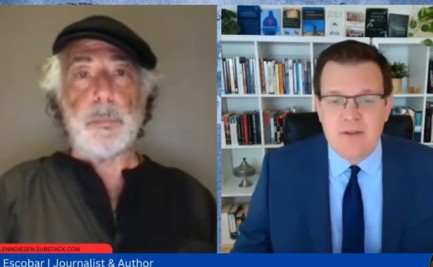
Read the full transcript of journalist Pepe Escobar’s interview on Greater Eurasia Podcast, May 26, 2026.
Editor’s Note: Host Glenn Diesen is joined by journalist and author Pepe Escobar from Shanghai to dissect the rapidly evolving strategic partnership between Russia and China following a critical summit in Beijing. Escobar highlights the significance of the leaders’ recent joint statement, detailing how it forms the foundational blueprint for a new, egalitarian system of international relations led by Eurasia and the Global South. The discussion also addresses the failure of the Western media to grasp this geopolitical shift, alongside escalating tensions in Ukraine, Iran, and the growing internal fragmentation within BRICS.
Introduction
GLENN DIESEN: Welcome back. We are joined today by Pepe Escobar, a journalist and an author, to discuss the strategic partnership between Russia and China. So thank you for taking the time. I know it’s late there in Beijing.
PEPE ESCOBAR: So Shanghai. I am in Shanghai for 3 weeks now. Yes, it’s midnight. And yes, frantic days. And at midnight, like I was telling Glenn before our talk, my brain turns into a wonton soup. So I hope I can contribute something to all of you.
The Putin-Xi Meeting and the Joint Declaration
GLENN DIESEN: Well, what I really wanted to discuss with you was the meeting last week between Putin and Xi in Beijing. And in terms of how do you see this in the wider trajectory of China-Russian relations? I mean, what is it that makes the Russia-China partnership, I guess, structurally different from previous great power alliances?
PEPE ESCOBAR: This is enormous. It is as big as it gets. I wrote a column last week where I dedicated half of the column to break down their joint statement, which was something absolutely extraordinary. It was, of course, redacted by Sherpas with the final approval by both Putin and Xi. The terminology and certain sectors of their joint statement, which was relatively concise — you can read that in 5 minutes — but some of the specific concepts, some are Putinisms and some are Xiisms, meaning stuff that they have been talking about in many cases for years.
And immensely important because apart from all the deals that they signed, the tea ceremony that lasted over 2 hours — by the way, very, very important — with only 3 members of the Chinese delegation, 3 members of the Russian delegation, the translators, and Xi and Putin, where they discussed, of course, essentially Ukraine, the war on Iran, and the United States.
The declaration is the real deal because it’s, let’s say, the foundation act of the next stage of the Russia-China strategic partnership. You, Glenn, and myself, we have been following this in detail for years. It’s part of our job, right? But when you look at this relatively short document, everything is outlined over there. And basically Russia and China are telling Eurasia as a whole, and especially the Global South, and whoever wants to listen in the Global North, that we are in the driver’s seat of building a new system of international relations. So that’s why this joint statement is the real deal. And it was very, very important that it was signed, sealed, delivered by both in this special meeting in Beijing, less than 24 hours, in fact.
So now we have all these discussions — on the Russian side, and this is something that you followed, Glenn — the concept of Greater Eurasia Partnership, for instance, and on the Chinese side, which is Community for a Shared Future for Mankind, with the geopolitical, geoeconomic arc of the New Silk Road, the Belt and Road. Now this is explicit in terms of: we are going to use all these mechanisms leading towards more equanimity, egalitarian mechanisms, respect for international law, no exceptionalisms of any kind. This is the building block for all of us to build a new system of international relations.
So it’s not an accident that virtually nobody in Western mainstream media paid attention to the joint statement, or even made the effort to try to understand what the joint statement is saying. So this was the number one takeaway of the meeting itself.
And it was great to watch this from Shanghai. I deliberately preferred to watch the whole thing from here, Shanghai, because here is the cultural capital. This means cultural traditions here have an enormous weight. It’s the business capital. It’s one of the top innovation and tech capitals of China. And of course, in terms of the modernization of China, you just need to go for a walk in Shanghai and obviously you are — wow, that’s it. And of course, when you see the reactions of foreign tourists when they are exposed to Shanghai the first time, they can hardly believe it. Yes, this is the big, big window of modernization of China. So it was much more interesting to follow from here.
And I had a particularly fascinating aside because I spent the day in a school — it’s a primary school, middle school, and college — Aurora, one of the top ones in Shanghai. And I spent the day with the students and the teachers. And while we were having our activities, we had a conference on artificial intelligence, etc. We were discussing what was going on in Beijing. And even the students had their own opinions on what’s going on in Beijing. They are fascinated by Russia, for instance. So this added, I would say, a Xi Jinping element of people-to-people exchange to this very, very fateful day. But this is it. This joint declaration is the real deal.
Western Misconceptions About the Russia-China Partnership
GLENN DIESEN: What do you think are the main misconceptions though, that the West has about the relationship between China and Russia? Because one gets the impression here that it’s still one filled with mistrust, and there’s always pointed out, oh, they don’t have shared values.
But how much of this partnership do you think is based on a common vision of the future, versus mere opposition to US global dominance? They’re not opponents — there’s an overlap there, of course, as well.
PEPE ESCOBAR: Well, Glenn, in Europe they have no clue about the Russia-China strategic partnership. Well, you can see that from your vantage point in Norway, no? In my case, when I’m in Europe, I am between France and Italy, which is still, at least they have a certain remaining tradition of intellectual thought and critical thinking — disappearing very, very fast. So only in marginalized scholars or academics or professionals in France or in Italy, you see that they are starting to get what’s happening across Eurasia or in East Asia or in China itself.
But in the US, as we all know, these are two strategic threats, which now happen to be closely intertwined. So the Russia-China strategic threat is going to undermine American civilization, if that thing exists, by the way. So don’t expect intelligent analysis coming from the West about Russia-China.
Well, for all of us who live around here, or between Russia and China, or going to Russia and coming here to Asia, it’s a completely different story because we see how Russian soft power is increasing. We see how, of course, there’s still a lot of challenges, how Russia is starting to understand China better and vice versa. Still a long way to go, but it is already happening in Southeast Asia, where you have Russia making inroads in Southeast Asia. And Southeast Asia — the number one partner for all of them, the 10 of the ASEAN — is here, China.
So it’s two parallel universes: how the West sees this strategic partnership evolving, and how and why — in Xi Jinping terminology — they are now in the driving seat of changes we have not seen in 100 years. And he repeated that in his introduction. It was exactly what he told Putin when Xi Jinping was visiting Russia in the spring of 2023. Putin took him to the entrance of the Kremlin to say goodbye before he stepped into his limousine. That’s what Xi told Putin. And now we are in the driving seat, and they agreed.
So this joint declaration is a formalization of what they discussed 3 years ago in Moscow, and everything that happened in between — the solidification of SCO, solidification of BRICS, the concept of global governance, which is part of the declaration as well.
But most of all that, Glenn, and all of you, our audience — from the point of view of the West, they don’t even know what they’re talking about, or they don’t see it. They don’t see it. And of course, the mainstream media, they don’t even make the effort to explain. So you receive stupid reports from US think tank land, which happens to all of us. And the same thing in the headlines: “The threat of China,” “the threat of Russia,” “the technological threat from China,” you name it. Well, ideally if I could, I would forget about the West completely, but it’s part of our job.
GLENN DIESEN: Well, I think if one could differentiate between the West and Western hegemony, then perhaps there wouldn’t be so many threats. But at the moment, any great power rising would be essentially a threat, which is—
PEPE ESCOBAR: Exactly.
GLENN DIESEN: It’s very hard to explain how China became a threat in any other way, because I heard many people refer to, well, they want to — they believe Taiwan is part of China. Well, they always thought this, and we recognize this. The one thing that has changed is the power. It’s not that much more.
Ukraine, Iran, and Managing the Empire of Chaos
GLENN DIESEN: But you did mention that one of the things they were discussing was Ukraine, Iran, and the relationship with the United States. But with Ukraine though, do we know anything about what they discussed, or what do you think they discussed? Because I know that the Russians have been worried that the attacks are becoming more than pinpricks — that is, from the West — the attacks from the Baltic territories, for example. And it looks like they are not just planning to escalate; now, based on what we saw in the attacks against Kyiv, they are indeed escalating. They’re talking more openly now about retaliating against the Baltic states. So I’m assuming that Putin must have run this by Xi when they met, just to keep him in the loop. So how do you think—
PEPE ESCOBAR: Yeah, but Glenn, no leaks whatsoever. Forget it. This was, first of all, a closed meeting — only those who were in the room, among them Ushakov. And Ushakov, as we know, is an old fox. After that, he just leaked what was, let’s say, inoffensive.
But obviously, we are practically sure that Putin had to explain to Xi that the conditionalities and the internal logic of the SMO is going to have to change, because now they are facing essentially a series of terrorist attacks. So obviously, for the Chinese, it’s very uncomfortable because they obviously would love a solution, but they know this — there’s only one solution and it’s going to be in the battlefield, essentially.
So Putin obviously had — I wouldn’t say a hard time, but he had enough time to explain to Xi that from now on Russia might have to be much more forceful than before, because they’re essentially fighting a terrorist organization. And when we see, after this latest massacre in the dorm — wow — this first response with ballistic missiles and also Oreshniks is probably the first of many. But will that be enough? Not necessarily.
And this is something that I’m very curious about. I’m going to Moscow by the end of this week. So I’m very curious to see how they are discussing the possibilities of, okay, let’s get rid of this thing, let’s go for the head of the snake, etc. Because now there is a groundswell of revolt and exasperation, because they know that it can only get worse in terms of attacks against civilians inside the Russian Federation.
From this point of view, Xi can understand that the Russian way of waging war is going to have to change, or will change. It’s practically inevitable.
And on Iran — from what we know from a few nuggets here and there — they are completely coordinated, totally coordinated, on a diplomatic level, on the visible and invisible military means of support, and especially these mediation efforts which are being conducted by Pakistan, but behind it is China, 100% China. China basically gave to the Pakistani mediators: “Okay, no problem, you can do everything, just report back to us,” which is something that is happening today as we speak.
For that matter, there would be no path towards what was becoming until yesterday an Islamabad Declaration, which would be a Memorandum of Understanding. There will be a declaration, then we’ll have a second stage of negotiations. And now, of course, the usual suspects blew it all up. So we don’t know if this Memorandum of Understanding will even be signed in the next few days or so. But behind all these diplomatic maneuvers, it’s China. So that’s great. And of course, the Russians already knew that. So they were talking about the technicalities and the details about all that.
And of course, in terms of managing the totally out of control empire of chaos, piracy, etc., they are more than synced, right? After all, Xi had the opportunity to tell Putin face to face what he heard from Trump. So this was a personal briefing to Putin by Xi. And of course, Putin could tell Xi about the direct and sometimes indirect negotiations between the Russian oligarchy and the American oligarchy. Let’s put it this way.
So they are — that’s how a strategic partnership works. They are linked, interlinked, and talking about all these major issues nonstop. And that’s why they need to see each other every few months, because it solidifies, for instance, what Wang Yi is telling Lavrov and vice versa. So now it’s up there at the highest level.
You know, it’s fascinating to watch how the whole thing moves. Fascinating, fascinating. And good Chinese analysts, they recognize that very, very well. And some of the best are here in Shanghai.
Common Security Challenges and the US Sanctions Factor
GLENN DIESEN: I’m amazed by the speed of everything though. Also, on the basic— but also some of the common security challenges they’re all facing. For example, the Chinese have been for many years been very worried about this dual island chain of the United States, the efforts to possibly shut down the Strait of Malacca in the future, again, putting Chinese shipping under threat, some containment.
Now, the Russians are obviously facing the same thing, the possibility of the Baltic States becoming more and more inaccessible, the piracy of Russian ships. But of course, you have the blockade on Venezuela to Cuba. And of course the hijacking of Iranian ships for many years, and you’re seeing naval blockades there by the US can also be extended. So everyone seems to face the same, not just the military challenges, but the economics.
So I think this partnership would develop anyways because there has to be something else than the US-centric economic architecture. But the US hostility now, it’s really pushing them together much, much faster than they otherwise would have. So it seems very counterproductive, everything that’s being done.
But I did notice one thing though, as the war intensified in Iran and the US pushed more sanctions, the Chinese are now essentially instructing their companies not to abide by US sanctions. How significant is this for the relationship with the Russians? Because for a while, the Chinese appear to be a bit cautious with the Russian trade in order to protect themselves from this kind of American sanctions.
China’s New Defiance and Energy Independence
PEPE ESCOBAR: They discussed that, of course, and they discussed the fact that now any batch of American sanctions, or the next tsunami or whatever, the instruction directly to Chinese companies is: don’t follow it, ignore it completely, abide by Chinese law. This is an enormous difference compared to only a few months ago.
And in terms of investment, Chinese investment in Russia, in the Russian Far East, in the Arctic, etc., and Russian investment in China, this is going to grow. They will be discussing St. Petersburg next week, of course, and then at the Vladivostok summit in early September. And of course, Power of Siberia 2. They finally got some sort of agreement on pricing because the pricing discussion had been going on forever. And of course, it’s not going to be 2029, 2030. They want to speed it up, and have Power of Siberia 2 functional by the end of 2027 already.
And this is part of, of course, the escape from Malacca. The Chinese observed in detail everything that happened with Hormuz. There are no illusions here in China that sooner or later the Americans are going to try something funny with the Strait of Malacca, especially after that ultra ill-conceived military pact between Jakarta and Washington, which even inside Indonesia they were saying, “What the hell is this?” The Foreign Ministry criticized the Defense Ministry in Jakarta. “How could you do something like this? It’s completely crazy.”
But we know why. And these guys at the Ministry of Defense in Jakarta — by the way, the president, a former soldier, Prabowo, worked with Suharto before. So all these people, they were always very, very close with the Pentagon. And this is a serious internal rift inside one of the top BRICS. Once again, more BRICS problems if they needed any more.
But the Chinese, when they look at the escape from Malacca, they are not very worried because they have so many Plan Bs, Cs, Ds, etc. Gas from Turkmenistan, oil from Kazakhstan, gas from Myanmar, etc. They’re not worried. And when you discuss this issue here, nobody is worried about Hormuz, because they’ll continue to get their tankers. And it’s true. Iran now, compared to a few weeks ago, is exporting 100,000 more barrels of oil a day compared to 2 months ago to China. And all the Chinese tankers, they cross Hormuz with absolutely no problem. They don’t even need to pay the fees, the environmental fees — if you want to call them the toll booths. So they’re not worried. And of course, it’s a fraction of what they import. And they are becoming more and more self-sufficient in energy. I think it’s around 86% self-sufficient, which is enormous.
So of course, they discussed, after Hormuz, Malacca, but the Chinese are prepared if that happens. And on the breaking out of the first and second island chain, slowly but surely — I would say more surely than slowly — they have all it takes if they want to break out anytime they want.
So you see a new, I would say since last year, since that tsunami of sanctions by Trump 2.0 in April last year, there’s a new self-confidence atmosphere in China across the spectrum. They are not intimidated by the Americans anymore, and they respond in kind. It changed completely, and diplomatically they respond every day.
India and the BRICS Crisis
GLENN DIESEN: Yeah, that’s what I meant by being his own worst enemy, because it looks like not just the Russians but the Chinese as well, they were a bit risk-averse — they were decoupling too fast from the US, but they’re essentially being forced to do so. I mean, you can’t ask the Chinese to respect sanctions on Russia, Iran, and many of their key partners. At some point, they would reach the conclusion that it makes more sense to alienate the Americans. So no, I think they overplay their hands in Washington, definitely.
I just had a last question — because you and I have spoken in the past about BRICS running into trouble, and you mentioned Indonesia — but where does India fit into all of this? Because we see Russia and China gravitating closer and closer. What is India doing these days?
PEPE ESCOBAR: Well, you saw the BRICS foreign ministers meeting in New Delhi last week, right? It was a disaster. It was such a disaster. There was not a joint statement at the end. And you could tell by Lavrov’s body language that it was really a disaster. And the only guy who could put this Humpty Dumpty back together in Delhi was Lavrov himself. Wang Yi was not even there. Wang Yi was here, side by side with Xi, meeting Putin.
So obviously there were no leaks from the Indian side and no leaks from other BRICS, but this meeting in Delhi was definitely a disaster. And now they have only 4 months because the annual summit is in Delhi in September. With so many rifts inside BRICS, can they produce something consequential 4 months from now? Glenn, I’m very sorry to be so pessimistic, but I don’t think so.
First of all, we have 2 BRICS at war with another one. We have the UAE at war against Iran, and we have India supporting the Zionists and the UAE against Iran. So this is already a major disaster. There are rumors around, and that includes some of the Sherpas, that maybe it’s time to bring Pakistan into BRICS now that Pakistan has a new geopolitical place, very high up across Europe, from South Asia to West Asia and across Eurasia. Obviously, we can imagine the Indian reaction.
India is paralyzed completely. The Russians and the Chinese, when they look at the Indian position, they don’t like it at all. They are the most important members of BRICS, so they would have to do something to put the Humpty Dumpty back together. But in only 4 months, it’s going to be very, very hard.
So the possibilities for this summit ahead are very, very gloomy because at the moment — and it’s inevitable, I have been saying this over and over again — BRICS is in a deep coma. So it has to be resuscitated. And there are only two who are able to do that, and they will have to do this in their full time, and they can’t because they are worried about zillions of other important issues. That would be Lavrov and Wang Yi. So, dreadful to say the least for the moment.
And I don’t believe in Hail Mary passes in terms of BRICS. Like at the last minute they will come up with some— no, it’s not going to happen. The Brazilians were good at that last year. Basically, the summit in Rio worked at the last minute. That’s a typical Brazilian setting — they know how to improvise. But Indians, not at all. They don’t have the swing to pull that off. And they know that they are in a minority inside BRICS because of their close relations with Israel and UAE.
GLENN DIESEN: Well, thank you for taking time, and yeah, keep keeping a close watch on what’s happening in BRICS, and I hope you’ll check in on us very soon. So thank you.
PEPE ESCOBAR: Yes, absolutely. Take care, Glenn. Thank you so much. Cheers.
GLENN DIESEN: Cheers.
Related Posts