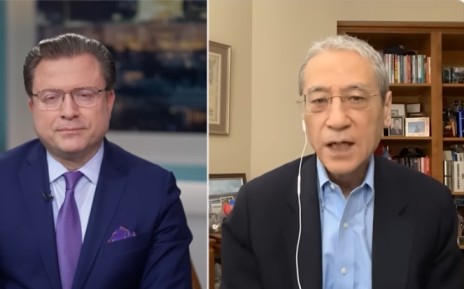
Read the full transcript of veteran China analyst Gordon Chang’s interview on American Thought Leaders, May 24, 2026.
Editor’s Note: In this episode of American Thought Leaders, host Jan Jekielek sits down with veteran China analyst Gordon Chang to dissect what really unfolded behind closed doors during the high-stakes Trump-Xi summit. Despite Beijing’s aggressive media messaging, Chang explains why the United States still holds the ultimate geopolitical upper hand and reveals the critical vulnerabilities tearing at the seams of China’s failing society. He also breaks down the two massive chokeholds Beijing still weaponizes against America—rare earth minerals and pharmaceutical precursors—and why Washington must dismantle this leverage before it’s too late.
INTRODUCTION
JAN JEKIELEK: This is American Thought Leaders, and I’m Jan Jekielek. Gordon Chang, such a pleasure to have you back on American Thought Leaders.
GORDON CHANG: Thank you so much, Jan.
What Really Happened at the Trump-Xi Summit?
JAN JEKIELEK: There are such different readouts on what happened during this Trump-Xi meeting recently, and I just want to get your take on it. What do you think really happened?
GORDON CHANG: We don’t know at this stage. For most US-China summits, they’re canned. Everything’s decided beforehand. This one wasn’t, which means that Trump was negotiating really important and substantive matters on hostile territory without a script.
We know that the readouts between the White House and China are different in some respects, but the thing here is that we don’t know what they talked about. And so this is only going to become evident weeks, months down the road. I think that historians are going to be talking about this summit for quite some time because in some respects it was historic. So I think that there’s a lot we don’t know right now.
Who Had the Upper Hand?
JAN JEKIELEK: People are saying that Xi had the upper hand, that Trump had the upper hand. I mean, some really divergent analyses that it’s difficult to comport. How do you see it?
GORDON CHANG: Oh, Trump certainly had the upper hand. He represented the far stronger country. China right now is in distress. Its economy, as we can see from the April numbers, could very well be contracting. If it’s not contracting, it’s growing at a very low pace. And China needs very high growth in order to deal with the debt that it’s accumulated, especially since the 2008 downturn.
You have a China which is demographically in collapse. It now has 1.4 billion people as officially reported. By the turn of the century, it’s going to lose half its population, maybe two-thirds. This is the biggest demographic collapse in history in the absence of war. So we just don’t know what’s going to happen. The Chinese people are really unhappy at this point. They’re pessimistic, they’re opting out of society. You have a military which has been decimated by Xi Jinping’s purges. The Communist Party is in disarray.
But fundamentally, you have a China which needs to import large amounts of energy and food. The US, in contrast, we’re self-sufficient in both of those. We’re the largest producer of oil and gas in history. So it’s just no question about it. I know a lot of people don’t like President Trump, but they need to come to some balanced assessments of what’s going on. Now, this is not to say that President Trump did better at the summit. It’s just to say that coming in, even though he was traveling to China, he had the upper hand.
Xi Jinping’s Arrogance and the Pomp of the Summit
JAN JEKIELEK: One thing I noticed at the summit, thinking back to 9 years ago — you indicate kind of one area that’s changed. I do think the US position has increased, if you will, and I think that’s what you were suggesting here. But what about this great pomp that we saw? I think it was much more significant than the last time. What’s your take?
GORDON CHANG: Yeah, I haven’t looked at the 2017 arrival ceremony, and it’s probably about the same. This time, maybe a little bit less. I don’t know. But what is different, though, is Xi Jinping was extremely arrogant this time. And he had, I think, very few reasons to be.
Remember, Trump comes into the summit. He has been pushing China out of the Western Hemisphere. He’s been pushing China out of the Middle East. He’s the one who is making the decisions in the world, and he’s driving events. And the Chinese are, for the most part, bystanders. But nonetheless, Xi Jinping wanted to play this very arrogant type figure, and he actually convinced media around the world that he was in charge.
Thursday, everyone talks about his comments on Thucydides trap. I mean, that refers to a period where you have a declining hegemon dangerously challenging a rising power, and that has been the framing. But Xi Jinping was even much more arrogant than that because he used the phrase “new era.” “New era” is a time when China dominates the world, rules the world maybe, and the US is nowhere to be seen.
So we have a very arrogant figure and people sort of glommed onto that. But we got to remember, this was not a confident Xi Jinping because on Friday when Trump went to Zhongnanhai, the leadership compound, the Chinese put him in that chair which was lower than Xi’s. And that was just silly. And I think that really reveals insecurity on the part of the Chinese.
So whatever advantages they got from Thursday — and remember, Trump was very confident. He didn’t reply to the insults. Whatever advantages the Chinese got on Thursday, I think they lost it on Friday.
China’s Propaganda War and America’s Disarmament
JAN JEKIELEK: One of the most powerful tools that the Chinese Communist Party uses is propaganda, and they’re very, very good at it. And what you’re describing seems to me an attempt to develop this kind of messaging of Chinese success, Chinese Communist Party success.
GORDON CHANG: Yes, they’re very good at propaganda.
And so Xi Jinping has been beating the crap out of us in the information warfare space, and that’s our fault. We’re just not fighting it. And we have seen how successful they are. I mean, in the United States, you have a whole generation of kids who are marching in favor of rape, brutality, murder, genocide. I mean, this is inconceivable, but we know why.
Xi Jinping has been able to use, for instance, TikTok. One of the more interesting statistics to come out of that platform is that of the videos on Hamas, 86.5% of them supported the terrorist group. So yeah, we’ve got a real problem here, and Trump has got to figure it out fast because this is a very bad situation for us. I just hope that we understand that right now information warfare accounts for a lot.
Trump’s Praise of Adversaries and the Fentanyl Crisis
JAN JEKIELEK: The president has made a habit of, I think, praising all of the — by my estimation — kind of prime antagonists of America. It’s a curious thing. I view it as a bit of a negotiation strategy. Because it seems to me pretty clear that there’s broad awareness that Kim Jong-un, Vladimir Putin, Xi Jinping are prime antagonists of America. The actions that the US is taking seem to me to make that pretty clear. But on the other hand, there’s this lavish praise and not much reciprocation from Xi Jinping this time.
GORDON CHANG: Trump views Xi Jinping as a friend, as he says. This is either a complete misunderstanding of the nature of the relationship between China and the United States, or just a gross miscalculation.
But one thing we do know, Jan, and that is the American people don’t like this. We can see this from what Americans say, but also Trump on Thursday before the start of their substantive session actually said it in his opening remarks — that Americans don’t like it when he praises Xi Jinping as a great leader.
The one thing here is that we know that China, for instance, has been involved in the fentanyl gangs, fully behind them. These aren’t overdoses, these are murders. Last year, 48,000 Americans died from fentanyl, and the president of the United States needs to acknowledge that.
The CEOs at the Summit
JAN JEKIELEK: You mentioned a bit about the economic reality of Communist China, and it seems like the president took, I think, 17 of some of the wealthiest CEOs of the largest companies, not just in America, but in the world, with him. What do you make of that?
GORDON CHANG: Initially, I did not like the idea of Trump bringing CEOs to Beijing because in this period we should be trying to decrease the reducing the vulnerability of our companies to China, not increasing it. Xi Jinping has made it very clear that in his conception of China, there’s really no place for foreign companies on a long-term basis.
But if you step back at it, I thought, well, look, this is also a way to intimidate the Chinese. And in a way, Trump used them quite effectively, the CEOs. So for instance, Trump and Xi were in one room, the CEOs were in the next, and completely off script. This is not something that Xi Jinping contemplated at all. Trump said, “Well, why don’t we bring these guys in?” And after some kerfuffle, Trump got his way, and the chief executives came into the room and actually talked with Xi. So I sort of like that in a sense, that Trump was unpredictable, and what he was able to do was to sort of set the tune with them.
It’s been initially reported that these guys got very little from China during this trip, and that’s to be expected. So they were, in effect, props in this competition, and Trump used them effectively.
But nonetheless, we do need to de-link our economies because China uses every point of contact to take our society down, and one of these important points of contact are going to be these CEOs doing business in China.
And this sort of leads us to one more thing, if I may, and that is Trump wants this board of investment. He wants Chinese investment into our country. That’s absolutely the wrong thing. First of all, the American people don’t want that. We can see that from the howls of people to this idea. But also, these factories are going to be bases of subversion in our country. We’re going to give more Americans reasons to support the Communist Party. This is just not good for the United States at all.
Kerfuffles Between Secret Service and Chinese Security
JAN JEKIELEK: So speaking of kerfuffles, there was a significant — at least one if not several — kerfuffles between the Secret Service and Xi Jinping’s security. What do you make of that?
GORDON CHANG: In these US-China summits throughout the years, there have been a lot of these disagreements and shoving matches between US Secret Service and Chinese security in these summits on Chinese soil. I’m not surprised it happened this time, and it will continue to happen. The Chinese are just arrogant, and we got to expect it.
There’s no real possibility of good relations with China as long as the Communist Party rules. So yeah, we’re always going to have these problems if we have summits on Chinese soil, which leads me to believe that this is another reason not to talk to the Chinese in Beijing.
Stripping the Delegation of Electronics and Gifts
JAN JEKIELEK: Something else that just comes to mind since we’re talking about some of the key moments or scenarios that have kind of been played up in the media. One of them is basically the entire US delegation getting rid of all their phones and gifts and absolutely everything. I don’t know if it was actually as prominent as it was suggested by multiple media, but it was something that was highlighted.
GORDON CHANG: Before officials got onto Air Force One, they had to give up everything. And it’s not just electronics, but it’s also these pins, gifts. I’m sure that some of this equipment was bugged, even the non-electronic stuff. So it was good. It showed you the lack of trust that we have. And I’m glad that the Chinese saw that.
Taiwan: Arms Sales Pause vs. Presidential Phone Call
JAN JEKIELEK: Let’s talk about Taiwan. There’s a very curious juxtaposition that I’ve noticed. One of them is that on the one hand, we have basically a pause on the arms sales to Taiwan, which is interesting. And on the other hand, we have the president, I believe, committing to a phone call with the Taiwanese president really for the first time, I think, in 47-odd years. What do you make of that?
Taiwan Arms Sales and the Stakes of American Credibility
GORDON CHANG: There’s a lot going on here, Jan. First of all, you’re right. American president has not spoken to a Taiwan president since the breakoff of relations. 1979, 47 years. I’m not sure this phone call will actually take place, but for Trump to say that in public by itself, it got the Chinese upset. It’s reporting that they have postponed Elbridge Colby’s visit to China. He’s the undersecretary of war. And so that mere answer to a reporter’s question has triggered a lot of anger in the Chinese capital. Good for us.
But there’s a lot here. So for instance, the Chinese Foreign Ministry, they put out Xi Jinping’s comments on Taiwan, really belligerent and hostile. Secretary of State Rubio, after the meeting, sort of put a different view on it. He said, “Well, look, they’ve, yeah, of course, they always raise the issue of Taiwan. We always listen and then we move on.” And that’s what happened here, at least behind closed doors.
But Trump made things a lot worse going back after the summit. He gave that interview to Bret Baier on Special Report. He talked about Taiwan arms sales as a negotiating chip for us. He said that he made it clear that China was going to be the one that determines whether we make these arms sales. I’m not sure that he had intended to say that, but it’s on tape.
And he said all these other things about adopting China’s framing on Taiwan, that Taiwan is causing problems, that it’s changing the status quo, that it wants to go independent. Well, Taiwan is already independent. It has all the attributes of sovereignty in the 1933 Montevideo Convention. And Taiwan is not the one trying to change the status quo. China is, because it wants to annex Taiwan as its 34th province. And for the president of the United States to frame this in the way China does, especially when China frames it incorrectly, it’s just wrong.
Now, arms sales are going to be a really important topic here, because if we don’t go forward with that $14 billion arms sale, it will say to the world that China owns the United States. China makes American policy. President Trump has submitted to the intimidation of the Chinese. And that’s not going to only unnerve Taiwan, it’ll unnerve Japan and our other friends. And not just in the region, around the world. Because the question is, what is the value of a relationship with the United States if the president of the U.S. is going to do what the Chinese tell him to do? So this is critical.
Now, if Trump makes that arms sale announcement quickly, he’s going to not only tell the Chinese that they don’t own him, but he’s also going to say to the Iranians, “You better deal with the United States in good faith because the United States has a lot of strength.” Now, Trump has the upper hand, but that’s not to say that he’s going to come out on top, as I mentioned. And the Chinese could just wipe the floor with him if he accedes to their demands on Taiwan.
JAN JEKIELEK: Well, again, in our conversation earlier about information warfare being so important to the Chinese Communist Party, this would be a very powerful weapon for them in that view.
GORDON CHANG: Yeah, extremely powerful. It’ll say the U.S. is an exhausted power. That China rules the world, that the US is feeble. All of those narratives will appear to people and they’ll resonate around the world. And you have to say there’s reason why they should resonate, if indeed Trump accedes to the Chinese on Taiwan arms sales.
And think about this situation. Yeah, the Chinese are huffing and puffing and they’re blowing hard on Taiwan. But Xi Jinping has decimated the Chinese military. It’s in no condition to launch hostilities with an invasion of the main island of Taiwan right now. So this is the perfect opportunity to make those arms sales because that will bolster deterrence and that will instill confidence in American leadership. And as I said, not only in the region but around the world. So we have every reason to make these arms sales. It’s an opportunity. It’s cost-free. And I think the United States in general should just say to Xi Jinping, “Yeah, you’re China and that’s Taiwan, and Taiwan’s none of your business.”
The Thucydides Trap and the Danger of Accommodation
JAN JEKIELEK: But lay out a little more of this Thucydides trap argument. This is something that the CCP has been using for a very long time, perhaps since Graham Allison wrote the book about this, right? The US being the declining power and China being the ascending power and this inevitability in his view of war. And China saying, “No, we don’t want that.” But of course, we take for granted that we’re the rising power and America is the declining power. “But let’s work together to prevent this problem.” Anyway, that’s how I read it. But I’d like you to kind of elucidate this piece a little more for me, please.
GORDON CHANG: Graham Allison makes the argument that we need to accommodate China because it is the rising power. And as he looked through history where you have a rising power and a declining hegemon, war results like two-thirds of the time or something like that. So this book has become very influential in the Pentagon. And therefore, we have acceded to the Chinese on many cases. But by doing that, we have made the Chinese more aggressive. We’ve emboldened the worst aspects of the Chinese character.
Just give you an example. Go back to 2012, it’s Scarborough Shoal, which is 124 nautical miles from the main Philippine island of Luzon. It’s obviously part of the Philippines. It’s been part of the Philippines for time immemorial, and it’s very far from China, but it’s within China’s 10-dash line claims. So you have the Chinese early 2012, they surge the area with their boats. The Philippines do the same thing. The Obama administration, they negotiate an agreement between Beijing and Manila where both sides withdraw their craft. Only the Philippines complies, and the Obama administration does nothing to enforce the agreement that they broker.
Well, what happens? Obama didn’t want to create a problem with the Chinese. So what did he do? The Chinese saw that he was weak. And they then pressed the advantage. They started pressing at Second Thomas Shoal, another South China Sea feature of the Philippines. They started going after Japan in the Senkakus, which the Chinese have a very weak claim to, and they call them the Diaoyus. And they start to rapidly militarize those coral reefs in the Spratlys. So the Chinese just went out and made the problem bigger, because we showed them that aggression works.
That’s the result of Graham Allison’s theory, where it’s applied in practice and it makes things worse. So Graham Allison has a lot to answer for as far as I’m concerned. Oh, and by the way, we do too for listening to that ridiculous stuff.
China Is Not a Rising Power
JAN JEKIELEK: Well, I’m not so convinced that China is the rising power at this moment. I mean, their propaganda certainly says that it is, but I’m seeing lots of indicators that it’s going in a different direction.
GORDON CHANG: Yeah, China is not rising. And you can see it. I mean, you can go look at the economy and all sorts of things. Just to give you one example, Xi Jinping reveres Mao Zedong. And he can’t implement Maoist economic policies, but he can do a lot to undo what was implemented during the reform era. So we have now a Chinese economy that Xi Jinping has turned his back on consumption. He does not believe consumption should be the basis of the Chinese economy.
Now, consumption is the basis of most economies. In the US, it accounts for 68%, 70% of gross domestic product. In China, it’s 38%, 39% of GDP, and it’s going down. The reason why this is important is because it means that the only way the Chinese economy can grow is to export more. Now they’ve been exporting and they’ve been doing very well the last couple of years, but they’ve sort of hit, I think, a wall. And that means Xi Jinping has put his fate into the hands of other countries, especially the United States, because we Americans account for 31, 32, 33% of global consumer spending. So he can’t replace us with the so-called global south. So if nothing else, that shows you that China is now more dependent on the US. That’s not a superpower.
Trump talks about the G2, which he did after the summit. But there’s no G2. There’s no G2 because China’s not a superpower. There’s only one superpower. It’s the United States. And if you want to talk in G numbers, President Trump, try this. Say G1, because that is the reality. You have China falling away, and I’d say in a couple years’ time, even Chinese propaganda will not be able to hide it because these numbers that are coming out of the Chinese economy this year, they are very, very distressing.
Trump’s Tariff Strategy and China’s Two Cards
JAN JEKIELEK: One way to interpret what President Trump is doing — he’s been using this tariff regime quite extensively, even though there are some questions about how exactly it will continue, given recent Supreme Court rulings and so forth, but he’s been using it. Clearly, we’ve seen the Chinese starting to dump goods into Europe and other places because of the effectiveness of these tariffs. And the Chinese have also, under the Communist Party, developed some pretty significant leverage, whether it’s the critical mineral processing, rare earths, whether it’s the medical precursors. There are other points of leverage. So one way to interpret it could be that he’s looking to get rid of those types of leverage that the CCP has developed against America while bolstering the leverage that America has, while talking nice, so to speak. What would you say to that?
GORDON CHANG: China has two major cards. One of them is rare earths. 92% of the world’s processing of rare earths occurs in China. And they mine substantial portions of the world’s rare earths. The other one is an even bigger card, which we don’t talk about as much, which is pharmaceuticals. If you look at the key starting materials and the active pharmaceutical ingredients — those are the building blocks of completed pharmaceuticals — China has a 100% monopoly on about 800, maybe 850 pharmaceuticals that Americans use. That’s an astounding chokehold.
Now China can’t weaponize it, I think, to the same extent that they can weaponize rare earths, but clearly those are two important cards. You’re right. Trump is moving at Trump speed to reduce America’s reliance on rare earths. And we’re making some headway, not nearly as much as we need, but we’re making some headway on pharmaceuticals as well. So yeah, Trump is talking nice to them while he’s doing this.
And remember, Trump is giving the Chinese a really hard time, pushing them out of the Western Hemisphere, pushing them out of the Middle East, as I mentioned. Trump has a foreign policy that really is, I think, driving Beijing to the point where they just don’t know what to do. I mean, they carp and they complain. We heard Xi Jinping and Putin complain about the US at their summit, which followed the Trump-Xi Jinping summit. But the Chinese and the Russians can’t do anything. And by the way, Russia is losing in Ukraine. Ukraine is taking back territory. It’s flying its drones and hitting Russian energy infrastructure. These Ukrainian drones are even going and hitting targets in Moscow, for God’s sakes. Things I think, if you look at them objectively, say that Trump is driving world events and the Chinese and Russians are bystanders.
Geopolitical Shifts: Venezuela, Iran, and Cuba
JAN JEKIELEK: So let’s talk about the geopolitical dimension here. We have the Trump administration changing the equation in Venezuela. We have the Trump administration changing the equation in Iran. And most recently, even as we’re recording, we have the Trump administration changing significantly the equation in Cuba. And these, of course, are all proxies of the CCP, in effect. Tell me a little bit about how that’s playing out.
China’s Energy Vulnerabilities and Strategic Miscalculations
GORDON CHANG: Venezuela was important to China because it was its main friend in the Western Hemisphere. And of course, China had extended something like $63, $64 billion in loans. That outstanding balance has now been reduced because Venezuela has been providing oil at heavily discounted rates. And those discounts have been applied to their outstanding loan balance.
But that’s no longer going to be the case because Venezuela may sell oil to China, but they’re not going to be selling it at discounted rates thanks to one Donald John Trump. The same thing is going to be true for Iran. After this war is over, Iran probably will continue to sell energy to China, but it’s not going to be at the cheap rates and it’s not going to be in the renminbi. It’s going to be in hard currencies.
So China, the world’s largest importer of oil, has now had two main providers of oil at discounted rates now taken off the board. So yeah, China’s got a problem here.
And this is very interesting if you step back and look at Xi Jinping’s mentality. He gets somewhere between 45 to 50% of his seaborne imports of crude oil through the Strait of Hormuz, and that is a significant portion for China. So it would make sense for him to buy oil and gas from Russia. But in the Xi Jinping, Vladimir Putin summit afterwards, they didn’t come to terms on the Power of Siberia 2 pipeline. What’s gas? It’s not oil, but nonetheless, it’s energy. And China has, I think, a real need for energy of all types right now, especially energy that is not carried over critical waterways, choke points which the US Navy can close off at will.
So Xi Jinping is really arrogant right now, and that means China is, I think, headed for some really bad troubles. I mean, it is as it is, but Xi Jinping is making this much worse.
And by the way, April 13th, the Pentagon and Indonesia came to a memorandum which looks like a closer cooperation with the United States, and that’s significant in this conversation because it is the Indonesian island of Sumatra that is the southern part of the Strait of Malacca, which is even more important than the Strait of Hormuz. The Chinese must be hysterical right now, or they should be, but they don’t seem to be taking care of a problem. So this shows the state of mind in China right now, which they just don’t understand what trouble they are in.
The Taiwan Strait and China’s Export Dependency
JAN JEKIELEK: So speaking about straits, I recently had the Taiwanese representative to the United States, Ambassador Yu-Yi, on the show, and we talked about the Taiwan Strait, which we often talk about in the context of the CCP crossing the strait and trying to take Taiwan. What he pointed out, which I thought was very interesting and astute, was that a whole lot of Chinese trade, and in an economy that’s based on export, as you pointed out earlier, is actually coming through that strait. So some kind of a war-type scenario in that area would have an incredibly disruptive effect on China itself. And that, I don’t know how much that’s figuring into their own calculation, but it feels like it should.
GORDON CHANG: Well, it should because China now is just almost completely dependent on exports for economic growth. And you hear a lot of people say, “Oh, the Chinese don’t need to invade. All they need to do is establish a blockade around Taiwan.” Well, yeah, they can establish a blockade, but to do that, they would be trading their economy in the balance because that has all sorts of knock-on effects, because of the ones you just talked about.
China right now needs peace and stability in the world in general because it needs to export. And yet it is disrupting the world by fueling the war in Iran, by fueling the war in Ukraine, by creating, or at least intensifying, the insurgencies in North Africa that look like wars. So yeah, China is doing exactly the opposite of what it needs to do. And this is absolutely fascinating because it shows that Chinese foreign policy right now is counterproductive.
Japan’s Historic Shift and China’s Self-Defeating Foreign Policy
JAN JEKIELEK: Well, and you mentioned Japan earlier. The US, you mentioned this kind of increased cooperation, or at least on the surface, with Indonesia, but also absolutely with Japan. I mean, I think it’s kind of the love fest with a Japan that’s actually for the first time really pushing to increase its military expenditures and its own ability to protect itself. That seems to be a significant shift.
GORDON CHANG: A lot of people focus on the historical enmity between Japan and China. And yes, it’s there. But we should also remember that during the Maoist era and during the era of Deng Xiaoping, Beijing and Tokyo had very warm relations, and Tokyo was a supporter of the Communist Party. It’s only when you get to Jiang Zemin, Hu Jintao, and Xi Jinping that relations with Japan deteriorate.
And this is fascinating to watch what’s happened since early November. When Prime Minister Takeichi was asked a question about what would Japan do if there were a war in Taiwan and China, she said this would be a crisis, a security crisis for Tokyo as defined in their 2015 national security law. That’s all she said. She didn’t say that Japan would come to Taiwan’s aid. She just said this would give her enhanced powers under Japan’s internal laws.
So what did China do? It threw a fit. It actually had their Osaka Consul General threaten to kill the Japanese Prime Minister. And although Chinese propaganda on this has continued since early November, it hasn’t been resonating anywhere except perhaps in Zhongnanhai.
So what is China doing? It’s continuing its assaults on Japan. And what has that done? Well, it has strengthened Takeuchi. By standing firm, she has changed the Japanese political landscape. She came in as one of the weakest Japanese prime ministers ever. Her LDP, Liberal Democratic Party, was ailing. So what does she do? Well, she calls an election in February and she wins an historic mandate. And the LDP is now stronger than it’s ever been. So thanks to China for that.
And the same thing happened in Taiwan. Sorry for going on here, but it shows you how bad Chinese foreign policy is. Remember Tsai Ing-wen, president, Democratic Progressive Party, 2019. There was talk that she was not going to win the nomination of her party to run for reelection as president. But you have the demonstrations in Hong Kong. The people in Taiwan looked up and said, “My gosh, we don’t want that here.” So Tsai wins the nomination of her party and she goes on to win the election in a landslide.
So here are just examples of China driving countries in the region away from what China wants. And it shows you how deeply unproductive Chinese foreign policy has become. They’re our best friends. Xi Jinping’s our best friend in that sense. He’s creating coalitions for us. He’s driving all these countries into the arms of Washington. I mean, we couldn’t devise a better foreign policy if we tried.
Trump’s National Security Strategy in Action
JAN JEKIELEK: Well, so as we’re speaking here, I can’t help but think when I look at President Trump’s and the administration’s policy, I mean, aside from their national security strategy, which it seems to me they’re enacting pretty deliberately, not just in the Western Hemisphere, but also in the Pacific, that there’s just kind of a lot of different moves and a lot of questions about what Trump will ultimately do, which strikes me as kind of his M.O. And I’m curious for your thoughts on this.
GORDON CHANG: Yeah. Let’s talk about it when it happens. I don’t know where this is going. We do know that his National Security Strategy, which was released in December, he’s actually implementing it, which is really interesting because a lot of these documents, they just put them out there, they have everything in the world in them, and everyone forgets about them. Well, not Trump. Trump is actually going forward with it.
He made the Western Hemisphere his number one priority, and he’s been acting on that. So we see, for instance, the United States ejecting China from the Panama Canal Zone. We all know what happened on January 3rd in Venezuela. Cuba is now at a point where it can’t keep the lights on, literally. And we have the US indicting Raul Castro for the deaths of those four who were on the flights.
So this is Trump being very transparent. We talk about his unpredictability and yeah, he’s unpredictable, but he’s told us what he’s going to do in that national security strategy. And by God, he’s actually implementing it.
JAN JEKIELEK: Well, but on the Taiwan side, and frankly, on these relationships with the other island nations in the region and the Pacific in general, it seems to me, if I recall correctly, that the language in that National Security Strategy is pretty clear on them being an important part of the U.S. strategic posture in the region.
GORDON CHANG: Yeah, the National Security Strategy is interesting because although it doesn’t mention China by name in a lot of places, it refers to a situation that can only involve China. So South China Sea — it talks about a hostile power either imposing tolls over the waterway or excluding the planes and ships of other countries. Well, it doesn’t mention China by name. It should, but it didn’t. But China is the only power that could impose those tolls or could try to exclude others. It’s the only one with those ambitions. It’s the only one with this 10-dash line business.
So yes, the Trump administration has been clear about it. Now, I would have liked the National Security Strategy to say China and South China Sea in the same sentence, but if you read it, you can see what’s going on there. And there are a lot of people who commented on that document without reading it, and there’s no excuse because it’s only 28, 29 pages, Jan. So everybody can read every single word. And so it’s clear what Trump was getting at when he issued that document.
The Limits of AI Cooperation with China
JAN JEKIELEK: You know, one of the things that was a big subject of discussion around these meetings that happened recently — Trump, Xi, and the administrations — it was this issue of AI and sort of collaboration around AI safety negotiation. And the talk of that somehow died out after the actual events. What do you think?
GORDON CHANG: Yeah, thank God for that. I mean, at the end of April, we had Bernie Sanders with that event on Capitol Hill where he had Chinese and American scientists talk about the need for cooperation on AI, establish guidelines because AI can be incredibly dangerous. And at least on defining the problem, Sanders was absolutely 100% right. AI is dangerous.
China’s got AI, it’s got humanoid robots, and I have seen the Terminator movies, and a lot of other people have as well. And yes, it’s science fiction, but you can see how that could become reality. So yeah, I agree with Sanders, this is incredibly dangerous stuff.
But just because it’s incredibly dangerous doesn’t mean cooperation with China is the way to go. People are forgetting that in November 2023, Xi Jinping came to see President Biden in Woodside, California, and Biden raised the issue of AI as one area where the United States and China could cooperate. The United States then starts a discussion with China about the role of AI in the launch of nuclear weapons. And so this should be the easiest place for the two countries to cooperate, because everybody should agree that no, AI should not have the ability to end humanity, which is what we’re talking about.
But China blew us off, and that was clear in, I think, March of the following year in those discussions in Geneva between American and Chinese officials. The Chinese said, “No, we’re not going to talk to you about this.”
So it’s clear that discussions with China are not going to be fruitful. We cannot fall into China’s trap of endless discussions that give up our lead on AI. Yes, we do need guidelines and they’re critical. But the way to get there is for the US to win the AI race, to have other countries adopt our standards, and to have Americans develop those guidelines that other countries adopt in terms of AI usage. That’s our only hope.
Yes, it would be nice if we could all sit down with other countries and come up with some sort of rules. But this is not like counting warheads. If there were an AI agreement, you can’t police it. You can’t promise enforcement and you certainly cannot monitor and verify that the other country is complying. So this is inherently a very difficult subject, and we need to recognize that, and we need to recognize the limitations of what we can do in these circumstances.
Because what some people say is necessary — and thank God Bernie Sanders raised the issue — but what is necessary is not possible in these cases. And by the way, Bernie Sanders talks about nuclear weapons arms control as a template for AI agreements. Well, he should have thought about this because China won’t talk to us about nuclear weapons. So this is not a good example for Sanders to raise. Yes, Sanders identifies the problem, but he comes up with solutions that are completely unworkable, and can lead to global disaster.
America Will Eventually Defend Itself
JAN JEKIELEK: Well, one of the challenges with his approach is the assumption of good faith from the Chinese Communist Party’s side. And it’s something I’ve written extensively about as well. And it’s just simply, historical precedent shows us that’s not a reasonable position. But also the kind of approach of the regime itself tells us that that’s not a tenable position. We can’t assume good faith.
GORDON CHANG: The Communist Party of China is core evil, as someone said on television a couple days ago. And even if it weren’t, there is no possibility for long-term cooperation between the United States and China on this.
In May 2019, People’s Daily, which is the most authoritative publication in China, in a landmark editorial declared a “people’s war” on us. And yes, we’re Americans and we think we can ignore what our enemies say, but “people’s war” is a term that resonates in Communist Party thought. And if there was any doubt on the part of Americans, in March of 2023, PLA Daily, the main propaganda organ of the Chinese military, defined “people’s war” as total war. And we know they have a doctrine of unrestricted warfare.
The Communist Party, and we’ve got to recognize this, views the United States as an existential threat. It views us as an existential threat, not because of anything that we say or do, but because of who we are. So you have an insecure regime in Beijing that is worried about the inspirational impact of America’s values and form of governance on the Chinese people. So that means we will never, never have amicable relations with China as long as the Communist Party rules it.
We’re Americans, and so we think it doesn’t really matter what others think. But we have to go back to February 1993. Osama bin Laden killed 6 Americans with the bombing of the North Tower of the World Trade Center, and we just ignored it. We ignored it until one day Osama bin Laden killed 2,977 Americans. And then we said, how did that happen? Well, you can go back to Tocqueville or you can go to Mackinder and they will all say the same thing, that democracies in general, and especially America’s democracy, tries to ignore threats until it’s too late. And that’s us.
Now, China is far more powerful than Osama bin Laden ever was. So we’ve got to recognize that although we’re a far more powerful society than China, we can lose our country because we’re not defending it with the vigor and determination that’s necessary.
Is China Really Not a Superpower?
JAN JEKIELEK: So let me ask you briefly about your thoughts on this superpower status, because you mentioned that China under the Communist Party is not a superpower. The US is probably the only superpower, but there are some indicators. I mean, it is the second largest economy. There’s this nuclear arsenal, which is probably a lot larger than what is officially disclosed. There’s this kind of insinuation into hundreds of countries around the world, control of the telecommunications infrastructure, at the very least these debt trap diplomacy arrangements. I mean, China has really extended itself all over the world. So when you say it’s not a superpower, can you kind of clarify what you mean here?
GORDON CHANG: There’s no question China has a lot of reach, but China was able to put this together in a very different era when it was reforming its economy and society, when it was showing a kind face to the world. Now things are different and China’s position is rapidly declining. So you could say, well, was it a superpower 10 years ago? Yeah, probably was in a sense. But not now. It is a rapidly failing society.
Now, people’s perceptions haven’t caught up with reality. But I think that one thing that’s occurring, and we’re seeing this now, especially among economists and economic analysts, they’re seeing the Chinese economy start to rapidly deteriorate. I think that’s going to have a change in people’s perceptions. Then they’re going to start looking at what else is occurring in the world with regard to China. And I think they’re going to come to the conclusion that China is not a strong state, except for the will of one person, Xi Jinping, who seems to be able to push around President Trump and others.
But at some point, I think that even President Trump is going to have enough of it because I think he’s going to get tired of Xi Jinping trying to humiliate him and the United States in general. And I’m damn sure the American people are going to be tired about that. And they’re going to push Trump in different directions, whether Trump wants to go there or not. Because after all, we do have elections in this country. And by the way, one of them is coming up pretty soon.
So I do think that we are going to see a change. Trump is shrewd. He can see the weakness in the Chinese system and he is going to exploit it. And that is, I think, going to be where we will be in the future.
I know too many people use it, but I will as well. We’re Americans, and as Winston Churchill said, we end up doing the right thing after we exhaust everything else. And that’s where we are right now. We are desperately trying to achieve some sort of accommodation with China when it’s no longer possible. This system is core evil, and it’s malicious, and it’s identified us as an enemy. So eventually we will get to the place where we will start defending ourselves. And when we do, and we’re a far stronger society, it’s going to become evident that there is only a G1. There is only one superpower and it ain’t China.
JAN JEKIELEK: Well, Gordon Chang, it’s such a pleasure to have had you on.
GORDON CHANG: Well, thank you, Jan. I really appreciate it.
JAN JEKIELEK: Thank you all for joining Gordon Chang and me on this episode of American Thought Leaders. I’m your host, Jan Jekielek.
Related Posts
- John Mearsheimer: Ukraine May Cease to Exist – The Coming Ugly Victory (Transcript)
- Richard Wolff: U.S.-Israel Divorce as U.S. Economy is on the Brink of Collapse (Transcript)
- Yanis Varoufakis: EU Is Finished & China Can Now Pull the Plug on the U.S. Economy (Transcript)
- Douglas Macgregor: Ukraine Endgame Is Here — West Will Fragment (Transcript)
- Jeffrey Sachs: BRICS Builds a New World – Without the West (Transcript)