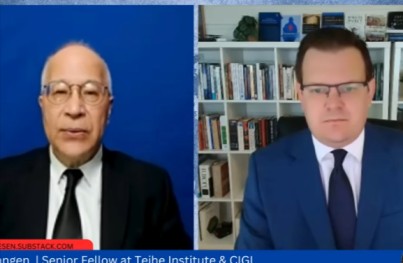
Read the full transcript of CIGI senior fellow Einar Tangen’s interview on Greater Eurasia Podcast, May 25, 2026.
Editor’s Note: In this episode, host Glenn Diesen is joined by Einar Tangen, a senior fellow at the Taihe Institute and the Center for International Governance Innovation, to analyze the shifting dynamics of global diplomacy. Together, they explore China’s evolving strategy for managing the relative decline of the United States and handling transactional foreign policy. The conversation also delves into the historical roots of American political trends, the erosion of diplomatic rationality in the West, and the path forward for an increasingly multipolar world.
China’s Strategy for Managing U.S. Decline
GLENN DIESEN: Welcome back. We are joined again by Einar Tangen, a senior fellow at the Taihe Institute and also senior fellow at the Center for International Governance Innovation, the CIGI. So thank you very much for coming back on the program. I’ve been looking forward to speaking with you.
EINAR TANGEN: Well, thank you for having me. I’ll try to do what I can, but I find your shows more interesting than my own.
GLENN DIESEN: Well, I’ve been looking forward to some of your thoughts on the recent meetings of Xi Jinping, because for many years Beijing appeared to keep a low profile, then especially in the 2000s, essentially attempting not to draw too much attention to itself. It seems that is to be allowed to grow in peace.
But again, the distribution of power has shifted and I guess the whole idea of covering up the might of China is now gone. So we have all these world leaders lining up essentially to go to Beijing and meet with Xi Jinping. And of course, the two main ones would be Trump and Putin.
What did you make of this shift, by the way, of Beijing taking a more greater stand in international diplomacy? I mean, is it just a reflection of power or is it refilling a vacuum, or how are you seeing its new role in the world?
China’s Strategy for Managing U.S. Decline
EINAR TANGEN: Well, I think they’ve been studying Donald Trump very, very carefully. They were surprised the first time he was elected. They thought, “Hey, he’s a businessman, he’ll just do what’s good for business.” And since you have an intertwined world logistics, everything like that, it just didn’t make sense. So they thought it was a campaign issue, to be tough on China. And like many other presidents before him, as soon as they get in office, they realize the realities. But that’s not what happened. He really wanted to carry it forward. And there is no going back, as they say.
So China has to understand that he’s transactional, that he is going to be here for the next 2 and a half years, and that they have to have some way of handling him. And they’ve seen quite clearly that if you try to be nice to Donald Trump or you agree, you’ll get the back of his hand. Literally, he will start mocking you and saying you’re losers and all this types of things. Might even take personal affronts, as we’ve seen with Zelensky and other people like that.
So they decided they had to be somewhat firm. And there’s two prongs to this. First off, they need to do it with Trump. It’s very transactional. And if you’ve been following what’s been happening, it’s very clear they’ve made promises to Trump: “We will do B if you do A. If you do C, we will do D.” And that’s exactly what is happening.
And I’ve never seen Donald Trump’s messaging being so tight as when he got on the plane and came back to the United States. Generally, his people are all over the place. Bessent is over here, Hegseth is over there, Rubio’s somewhere else, or they say things which are slightly different. They had very, very strong messaging. So they need to deal with Donald Trump. They think they have the formula in terms of transactionalism.
But the second part is, how do you deal with the rest of the world? I mean, I appear on a lot of stations internationally, especially in the Global South, and the refrain is always, “What is China going to do?” I always say, look, China is not the United States, doesn’t have 800 military bases, has no interest in getting into a toe-to-toe battle with the US, which could lead to a nuclear war. Even if it didn’t lead to a nuclear war, you would still have war, and this would drain everything away from society. No one in the world would be helped if China and the US go to war, and people should think about that.
But they’re always saying, “Well, China should do something because they’re a big powerful country.” Well, China’s response to that has been to stand up and say, “Look, we’re going to draw some red lines here. We’re going to deal with this guy. We’re going to show you that there is a path to dealing with him.”
How Did We Get Here?
But, Glenn, if I may, I just want to add something in here. It’s a fairly long conversation, but I want to start with how did we get here? I mean, we tend to look at Donald Trump as somebody who just kind of — well, how probable is it that some guy with bankruptcies and all sorts of sexual misconduct allegations, fraud, lying, criminal — I mean, it just doesn’t seem possible that somebody like that could rise to the top of the system. So then you have to kind of wonder why. What’s behind this? Why is America this way? And is Donald Trump simply a symptom, or is he some sort of instigator or something who has changed everything?
I would argue that he’s really a symptom. Because what I would do is go back to 1964.
The Powell Doctrine
So flash forward a few years to the 1970s, and you have the Powell Doctrine. This is Lewis Powell. He goes on to become a Supreme Court Justice, but 6 months before he becomes justice, he writes a secret memo. And in that memo, he outlines that the American public cannot be trusted. It’s time to put democracy aside, and it is time for businesses to be aggressive, to take control of media, to take control of the courts, to fight against any kind of consumer protection, against labor laws, against universities, intellectuals. And this is all outlined, and if people are interested, they should just look up the Powell Doctrine.
And not Powell the Secretary of Defense who was waving that little white vial around saying, “This is why we’re going to war.” This was Lewis Powell. He went on to the Supreme Court, and it was he who wrote in the affirmative to make corporations people. And by extension, people have freedom of speech. And by extending that, therefore corporations can back whoever they want with as much money as they want. And this changed politics. Companies can put an unlimited amount of money — they can basically control elections. You need money to run elections, but they can also hobble the parties because each party is making deals with special interests. Well, if you’re a business, you’re the special interest. Labor was then making deals with the Democratic side, but the biggest amount of money was on the Republican side.
So he outlines his plan to take over America thoroughly — a very thorough plan. You have to read the document in order to get a complete idea of it.
The Clean Break Doctrine
And then we fast forward a little bit to the Clean Break Doctrine, which we’ve talked about before. That was by Richard Perle. And in this document — I think it was 1996 — it is written to Netanyahu. And the essence of it is Israel should forget about any kind of diplomacy in terms of settling its issues. It should not seek to live with other countries. It needs to either dominate or decimate. If the country acquiesces to Israel’s greater goals, that’s fine. If they don’t, you knock them down. And this in essence becomes the mantra, the blueprint for Israel’s actions, even as we come through today.
Elbridge Colby’s Strategy of Denial
The last one was done by the current Secretary of War for Policy, Elbridge Colby. He’s important. He was also supposed to come to China, and China has delayed his visit. He is completely anti-China, and I don’t mean in a small way. In 2021, he wrote a book, The Strategy of Denial. And in this, he talks about the way to get at China is to deny it access to trade routes, basically by controlling these chokepoint areas — whether it’s the Panama Canal, or the Straits of Hormuz, or the Straits of Malacca, the Red Sea, the Suez Canal. And also as part of that, to deny China access to energy. The thinking being that if we don’t allow them to have energy — they have to import a lot — therefore they can’t produce a lot. And even what they produce, we can intercept it and prevent them from distributing it worldwide.
So this is really — I mean, he just lays it out there. This is a book he wrote. He’s not going to deny it or anything. And he is now, as I said, there. He’s not a very likable fellow. During his confirmation, he got all sorts of out of step with so many people in the Congress, even people who wanted to kind of support him, but he was able to get through.
The Shift from Family-Owned to Corporate Control
Okay, so you have these three documents. And then you have one other thing that people should pay attention to, and that is 1964. As I keep stressing, it was the families that controlled businesses that were basically directing things like the Bradley Foundation. I lived in Milwaukee, and the Bradley Foundation was founded there. I knew the people who were on the board — not too well, but I knew them. Small city, so everybody kind of knows each other.
Those families went away, and what they did is they hired help. And who were the hired help? Well, they were professionals — people with business degrees, accountants, consultants, investment banking houses. These were the people who started controlling and running the corporations. And what was their goal? Their goal — they had no affinity towards any local place. It didn’t matter. Every single factory was just a profit and loss center. And if I move production away from there to somewhere else, whether it’s another country, another town, all I care about is the numbers. I look at the spreadsheet, because that’s what they’re trained to do.
The families, despite all of their vagaries, they did live in their towns. They lived in the towns where they had factories. Ford lived in Michigan. He lived in Detroit. He was there. His executives were around them. They were part of the community. When you start bringing in hired help, there is no community. They’re there from somewhere else. They’re there to maximize shareholder values and in the process maximize their bonuses.
The Blueprint for Today
So you have these three papers and then this massive change in control and the aims and objectives. This became the kind of blueprint. The first document, in terms of the outline by Powell, structured domestic political control. The second exported the logic into foreign policy — we’re going to control everything. And the third said it’s not only foreign policy, it’s foreign policy plus economic policy, all pushed together.
So this is how, when somebody asks me how do you explain where we are today, this is how I explain it to them. There were shifts and movements, and thoroughly anti-democratic. I mean, you can point to one other area — this dark enlightenment area. We’ve talked about it before. These people are just thoroughly out there. There’s no secret memo. They publish in books: “Democracy is dead. We need to bankrupt the government to allow private industry to take over the functions of government, and then we would control the world. It would be beneficial for everybody if they were serfs.”
This is just literally going back to square one, where you have fiefdoms run by tech titans. The only comfort I get from that is tech titans, just like the oil barons and the steel barons and railway barons back in the roaring ’80s — the 1880s — they’re so busy fighting with each other over who should be the prima donna that they can’t possibly agree as a group, which would be required to do that. And you have to look no further than OpenAI and Elon Musk and all his lawsuits against everybody and lawsuits against him and things like that. This is not a stable class. So it probably won’t happen, but it doesn’t mean they aren’t having an effect.
The Role of Palantir and the Absence of Empathy
Palantir is really gobbling up all sorts of resources from governments around the world, telling them, “We know where all your enemies are, and if you need to get them, we can direct your firepower towards them.” Now, it doesn’t always work out — like schools in Iran full of young ladies who all die because it was mistargeted. But these people say, “Well, it’s all worth it.” It’s kind of like when she said, “Well, how many children have died?” And he says, “Well, yeah, it’s probably worth it.”
It’s a world where there’s no empathy. You can’t have empathy if you’re going to do these big things, if you’re going to justify killing women and children, civilians, prisoners. And that goes also to terrorists. There’s no empathy. They think they have empathy for their own cause and people, but they’re willing to walk into a crowd and kill innocent people. So there are no heroes in any of this. It’s just the kind of way it is.
China’s Response: Outlasting and Leading by Example
So here’s the way I explain it in China to people that I run into, and also in essays and things like that. China is looking at this and deciding where is the logical endpoint to any of this — or not endpoint, let us say, how do you get along with a power that has been shaped in this direction? And I think the only thing they can come up with is you kind of outlast it. You lead by example. You keep your talking points to: “We want security for all countries that isn’t dependent on the insecurity of another country. Every country has the right to a development path. Every country has the right to be respected and sovereignty. And lastly, there has to be a mechanism so that when there is inevitably friction, you can sit down and talk rather than throwing tanks at one another.”
And it’s not something that they’re just talking about. I mean, they’ve done it. Over $1.3 trillion invested in the Belt and Road Initiative, which really only started putting money in 2015. So we’re talking 11 years later, and you start looking at the Global South, the growth patterns there — it’s undeniable. And I remember back in 2018, there was Chalani, Professor Chalani from India. He invented this word, “debt trap diplomacy.” Do you remember that?
Debt Trap Diplomacy and the Hambantota Port
GLENN DIESEN: Yeah, no, they still refer to this, by the way.
EINAR TANGEN: Well, okay. Well, yeah, but I mean, let’s talk a little about debt trap diplomacy. So Chalani says, and he uses the Hambantota, Sri Lankan port. He says, “Ah, they don’t need it. They have Colombo. What is this? It’s a white elephant. It was politically motivated. This is a perfect example of how China is subverting Sri Lanka into debt trap diplomacy.”
Well, guess what? Last year, Hambantota port expanded by 175% in terms of their handling of cargo. They are now having to expand, to put tens of millions of dollars into expansion because they do not have enough capacity. So those people who said, back then it was sexy, it was easy — when you talk about a big project like this, freight does not come in the day you open the port, right? It takes quite a while to set up all of the receiving. You have to have people who are there. There has to be loading and unloading. People have to get used to the idea. But once it starts, it starts rolling.
So Hambantota is very, very successful. And you still hear these echoes of it, but I love getting into debates with these people because they say, “Okay, well, let’s talk about it. What were your expectations? That it would be profitable the day after they cut the ribbon? Is that the way ports work?” If you look historically at ports, rails, everything like that, it takes — there’s a breaking-in period that always happens. But if it’s strategically located — see, the reason Hambantota Port was put there in relation to Sri Lanka is it’s only about 10 miles from the regular marine routes. So you don’t have to go off as far as Colombo, and that’s also fairly busy as well.
So now they have this situation where we offer them two and they’re specializing. They don’t do the same kind of business. Each one — Hambantota is newer, they can do roll-on roll-off type things. Colombo is a little bit older, it’s still fairly well mechanized, but they do more different kinds of container loading, unloading, things like this.
China’s Communication Challenge and Leading by Example
So this is a perfect example of how people will always react to anything that China’s doing. China has to look at this stuff and they say, “Okay, we can’t — the United States has a million-watt stereo system with the media, which you can blast out.” And you know that well. They’re always nice to you, Glenn. And China has like a squeaky toy. Yeah, they’re trying hard. They have CGTN. They’re trying earnestly to put the message out, but it’s very hard to get coverage.
So they’ve given up on this idea that they can out of the box convince people. What they’re doing is convincing people by action. Lead by example. And that’s not only true in terms of externally, but also internally. Corruption not tolerated, and you’re never safe. If you’re corrupt, there is no place for you to hide if they can find you. And they’ve been pretty good at doing that.
China’s Strategy Toward U.S. Dominance
So China, at the end of the day, the best way for China to handle the U.S. was to understand where it was coming from, what this guy wanted, where it was possibly leading. And not an endgame, but just kind of, “We dominate, we dominate, we dominate, we’re king of the hill.” Okay, well, you can be king of the hill, but we can still trade. This doesn’t mean, just because you’re on top of the hill doesn’t mean you don’t need $4.3 trillion worth of imports, which is what the US imported last year. And without the $4.3 trillion, the economy literally would collapse.
Now you take that to the next level. We start talking about an area like the Straits of Hormuz in Iran. And I’ve said before, the solution is for the rest of the world to come together — because the rest of the world is getting hurt — and say to the US, Israel, and Iran, “Knock it off. Stop. And if you don’t stop, we’re not going to go to war with you. We’re just going to not trade with you.” And all three of your economies will literally collapse, right? That is the ultimate pressure. It’s peer pressure. It’s not a gun. It’s just the realities of an interconnected world. All of these countries need things that they don’t have and they cannot make them themselves.
Building a Collective Global Response
So that’s where I see — when I would start talking about bringing countries together to do that, this is exactly what China is trying to do. They’re trying to get other countries to step forward, not just one. China cannot settle this by itself. What is it going to do, go to Iran, dictate their foreign policy? Not going to happen. And it certainly can’t do it to Israel or the United States. So it takes an overwhelming majority of the countries coming together.
And maybe this is the beginning of something like the Global Governance Initiative, because right now, unfortunately, the truth is the United Nations is useless. As long as you have 5 countries that have veto power, you can’t get anything done. It would be nice if they would give them up. What are the chances of that? Not great.
So this is where we are today. We have more than 80 conflicts going on around the world. We have a crisis that’s affecting somewhere between 13 and 20% of our energy — energy that is going to impact food. We have maximalist positions because there’s no trust. No one’s willing to give an inch because they feel the other side will take a mile. So they sit, they go back and forth, but nothing’s happening.
And that’s why I’m saying the last element is all the rest of the countries coming together because they have no choice. It’s that or take a roll of the dice whether it’s a recession or a depression. So hopefully there will be some leadership in the world. I think China is trying to encourage it. As I said, it can’t do it alone.
Xi-Putin Summit and the Contrast with Trump
So this is China’s approach and you could see it quite clearly laid out during these two visits. Trump — transactional. Putin — it was a great visit from this perspective. They didn’t agree. They didn’t get the Power of Siberia pipeline agreement. Now, will it happen? Yes. But they’re arguing about price. But if Donald Trump, at least, says, “If you don’t give me the price I want, I’m going to tariff you to death.” Okay, you didn’t see that. You saw Xi and Putin very comfortable with each other, talking very clearly. Communication was free and easy. They did have issues that they haven’t resolved yet, but it did not change the tone, tenor, or direction of the negotiations.
They signed 40 MOUs, 40 deals, and this is about the same amount that they sign almost every year. So the cooperation is continuing to deepen as the US thrashes and tries to maintain things — it’s actually scoring own goals. And now you have an example, and the rest of the world is watching, about how China is leading not from the front but from the side, trying to get people to understand that if we have a common direction, we are unstoppable. If one person tries to dictate it, it’s just going to lead to more wars and friction.
Managing the Decline of a Hegemon
GLENN DIESEN: What you described to a large extent is about China attempting to manage America’s decline. I don’t mean to push for the decline, but to manage it, because you often see a diminished rationality in a declining hegemon — a strategic desperation, if you will — because the expectations, the competence, the psychology, it still belongs, or remains, to the commitment of dominance. But at the same time, the material advantages are going away.
So you have this — again, I think this is a source of the irrationality, this split. They want to pursue a hegemonic policy even after the hegemony is gone. So you often see a declining hegemon will have commitments that will be exceeding its resources. When it faces challenges, it feels existential because every challenge threatens to push them off the hegemonic throne. You will have internal fragmentations, also obsession with symbolic dominance.
So this is all something you see in Trump, but I think a mistake is only to assign it to Trump. I mean, this is something you see wider, not just in the United States, but the political West. And this part of the internal splits as well is because rationality — which is required to maximize your own security and prosperity — it demands that you accept the new realities and adjust to them. But what I see across the political West now is rationality is almost condemned, because if you recognize the limited power, it’s seen as a surrender or even cheering on the other side.
The Irrationality of Denying Multipolarity
How dare you? Actually, it was the funniest thing. I was criticized in the media, as you mentioned it, recently, because I had said that the world is turning multipolar, and they made the point, “Well, why would he say this? Well, because it’s a gift to Putin, because if it’s only the US and China, if we say the world is multipolar, that’s what the Russians want us to think, because if we treat them as a pole of power, they get this respect.”
So essentially, we all have to walk around pretending, living in an imaginary world where we pretend, “No, they’re not a real power, they’re just a gas station with nuclear weapons.” Like, this is what we have to do now. We have to all live in a fantasy world, because otherwise we give them respect or legitimacy.
So I think this is irrationality. It should have been predictable that this comes with a declining hegemon, which is why it’s so difficult to readjust to a new distribution of power. And I bring it up because I noticed that Xi Jinping mentioned this during the meeting with Trump — that is, we have this Thucydides moment, or trap, where you have a declining hegemon, a new power rising. This is usually what you expect to see conflicts. We have to manage this carefully.
But we’re not — this should be the core of all discussions being had in these meetings. But if you look at the media here, there’s nothing of the sort. Again, there’s no rationality anymore. It’s only, “Well, how are these mullahs in Iran or these commies in Beijing or the imperialists in Russia — how can we manage or defeat them?” That’s it. There’s no discussion about, “Well, actually, instead of living in the old world, how about we recognize current realities and carve out as good a position as possible?” I see no such thing though.
Trump as a Symptom, Not the Cause
EINAR TANGEN: No, I’d agree. And that goes to this issue that Trump is a symptom. He might be outrageous. He has certainly lots of faults, but he’s a symptom of a system that is dedicated to — ironically — anti-democratic democracy. I mean, he’s running around trying to make sure that no one can vote who won’t vote for him, right? I think he’s going to find that that backfires.
All these two forms of identification — well, guess what? Wealthy people, middle class, upper middle class people, yeah, they do have passports, they do have birth certificates, they have multiple forms of ID that would satisfy this. But a lot of the people that he works with who work in blue-collar jobs, they don’t have passports. They’re not going to have their birth certificate on them when they go to the polls, and they’re going to be turned away. And as I said, if I was advising them on this, this is not the strategy I would take.
But getting to this rationality — they accuse — I think your Wikipedia page now accuses you of being connected to neo-Nazis. No, really? Historically, yes.
GLENN DIESEN: Well, it tends to be either far left or far right. I’m either a communist or a fascist. I’m not quite sure what they’re going with this.
The Hypocrisy of Empire and the Silencing of Dissent
EINAR TANGEN: Well, I think you represent all ills. I think you’re all bad things wrapped in one package. And the fact is you’re a historian and you’re simply trying to point out to people that we’ve been down these roads before. As you said, empires come and go. We should study them. We should understand them. They become irrational towards the end, right? Because they’re trying to protect something that is unprotectable. It’s lost. It can’t come back irrationally.
But, you know, look at Albanese, the lady who’s supposed to be looking out after Gaza, she was just appointed by the UN. She had to fight to be— she had been depersonalized. She couldn’t get to her accounts. She couldn’t travel, all of these things, because the US decided, well, we’re going to attack her. We not only dislike these countries, but we’re going to personalize it. We’re going to attack anybody whose voice threatens us.
And you know, I was having a discussion with my son about it. He was the one who said, “Oh yeah, they’re really going after Glenn. They are now accusing him of being a neo-Nazi.” I just can’t even— I don’t even know where you begin with that. And he said, “Well, I’m worried about him being depersonalized.” And we were discussing and I said, “The reason you represent a threat is because you’re rational. So when you go out and you start talking about irrational points,” this is 1984. You have to do the doublespeak, you know, quack quack, whatever, whatever they tell you.
And here’s the irony, we’re the ones who are running around the world saying that we’re against 1984, that we’re against fascism and totalitarianism and all of these things. And we are the worst offender, which goes to this issue that we have become such a hypocritical nation. We do everything we tell everyone else not to do. We start wars, we take things from people, we break international treaties and laws, we blow up people because they’re on a part of the ocean that we don’t own, but we suspect they might be drug dealers or drug carriers.
So I think we’re now up to close to 200 people who they don’t know— they’re in a boat and they blow them up, and they not only blow them up once, they use this double tap syndrome. So they blow them up and make sure that they’re all dead. So there aren’t any witnesses and no one can testify as to what they were doing out there fishing, going for a sail, whatever. They make sure that they’re all dead. And I think that’s pretty much deliberate. Why would you spend two very expensive missiles on a speedboat? One is enough. You’ve sunk it, they’re gone, they’re probably going to drown, but you send in another one just to make sure. Why? Why is that worth a couple hundred thousand dollars?
And I think it comes down to this fear that we will be caught in this particular lie and we won’t be able to get out of it. I mean, we did so many of these things— Vietnam War, Korea, Iraq, Afghanistan. I mean, the litany goes on. The things that we did in South America, toppling democratic governments. Why? Because they were against the business interests of our companies. I mean, “banana republic” became— it was a phrase that was developed around Honduras because Dole had huge plantations down there. And every time the government would be elected and said, “Well, we need to have fair wages,” people would scream to Washington, “They’re communists,” and we’d send down troops or we’d kill a bunch of people and the government would change. So in theory, this is what we’re trying to protect the rest of the world from, but in reality it’s exactly what we do.
America Is Not Evil — But Its Interests Can Be
America is not evil. I was in a symposium and somebody said, “America is evil.” And I said, no, it isn’t. Don’t fall into the trap of demonizing whole groups of people. America is full of very concerned people, right? It’s full of ordinary people who would, if they saw you in need of help, they would stop and help you. Not bad people.
But you do have, as I was alluding to before, interests that have absolutely no empathy, who live by profit motive alone, who are amassing wealth at an even faster pace under Donald Trump than they have before. And they’re happy. I don’t know, I always ask— I know some people and I say, aren’t you worried that you’re going to basically undercut the markets that support your fortunes? Because if people can’t buy what you sell, eventually it all— you’ll have a lot of money, but you won’t have a business, or it’ll be severely compacted.
I mean, today in America, 10% of the people represent 50% of all the sales. I mean, that should be frightening to people because that means 90% of the people are only taking 50% of the sales. And if they’re doing that, by definition, it’s mostly about necessities. America is overwhelmingly a tertiary economy. We rely on services and things like that, but you can’t afford services if you don’t have wages.
So there should be some real concern. My great-grandfather, who was an industrialist, he always said, “Never pay your people less than is necessary for them to buy your products.” Now, he built ships and things like that, so it wasn’t like he was selling ships on the street corner. But he was clear. He said, “You have to keep an eye on the economy. Our growth is dependent on a large middle class which is able to have needs and desires that are expanding, and that creates more business and more business opportunities.” And he understood that. He wasn’t an economist, he was an engineer, but he understood that.
Today you go into a boardroom, no one talks like that. No one. I’m on a public board and the only talk is, “How do we maximize shareholder value?” And it’s almost a legal requirement. If you’re not going to do that, you have to say, “Look, we can maximize next term or next year, but the cost will be that the company will suffer.” They always do things short-term and it looks great, and some companies do that. But what is your long-term position? Where are you going to increase your business next year? So there has to be obviously some sort of trade-off between the idea of getting instant gratification and delayed gratification. And unfortunately, that seems to be getting very, very thin out there.
The Threat to Independent Voices
But going to this point, I worry that voices like yours are going to be intimidated, that they’ll come after you and try to say you’re either a pro-totalitarian or you’re a fascist or you’re a communist or something like this. You’re a bad guy, you’re a neo-Nazi or something like this, when you’re simply trying to get people to think about these things.
If you look at the people that you have on your show, it’s very, very broad-based. We were discussing this before you started recording about how these people who dedicated themselves to helping their countries, who believed in principles, are now turning against— particularly in the United States, but you also have it in Europe.
You have Tucker Carlson. I mean, he was— gosh, Trump blue, or red, I should say. I remember even when they showed that he was saying that Donald Trump— there’s something fishy about the elections, that Donald Trump won it, that there was all this stuff. His private emails showed quite clearly he didn’t believe any of it. Thought these guys were fools and morons and this wasn’t true and all this kind of stuff. And it’s all out there. It was in a lawsuit brought by the company that they defamed, who said that their election machines had been hacked and that they had basically swung the election in favor of Donald Trump. Never proven. The only thing that was proven is that they were defamed. And Tucker Carlson’s emails were the basis of that.
Now, he left Fox shortly after that. He’s been very successful. He now is coming out very strongly against Israel because he believes that they are manipulating— they’re the tail that is wagging the American dog. But this is not something new. And this is where I have a problem. He’s saying, “Oh, look what they’re doing.” And in my mind, “When weren’t they doing this?” You go back to ’96, “Clean Break, Defense of the Realm.” It’s right there. Everybody sees the report and they say what they’re going to do and they want our backing. And we’re giving them, back then, I think it was around $4 or $5 billion. Now it’s about $3.5 billion in regular aid, and then additional ones from war and things like this.
But it didn’t start when Tucker Carlson left Fox News, right? It just happened. It was happening all along, but he just discovers it at that point. So this is my point. I do think Tucker has some feeling about America. He thinks that it’s probably going the wrong direction, wars are not good, all this stuff. But he’s also a media personality. And I sometimes wonder if there’s some compromise that people make to do that.
I have never had any sense— I watch your shows religiously. There’s a lot of them. I have to listen at 2x speed to get through them all. But I never have any sense that you’re like, “Oh, well, let me pander to somebody here.” It’s just strictly, let’s look at the facts, let’s look at the history, let’s try to learn from them, let’s bring people on who can provide perspectives. And I really appreciate it. But this idea of people trying to shut you down, depersonalize you, everything like that— scary. That’s real totalitarianism. That’s 1984. Everything we’ve heard.
NATO Expansion and the Betrayal of Post-Cold War Ideals
GLENN DIESEN: I’m worried when we see governments and media attempting to teach us to hate entire nations, even if it’s the United States with 330 million people, red flags should go up. This is kind of absurd.
But no, it’s interesting if you listen to a lot of these Americans— they have the military, they previously held top military positions in government, and you hear them speak now about how they feel all their ideals were essentially betrayed and weaponized for very different goals. For them it’s kind of interesting, after decades of serving their country, it’s painful for them and they express this as well.
But yeah, I often feel— because if anyone reads my Wikipedia page, it’s a very strange reading, but it’s the same group of people who write this kind of stuff. Again, my position I thought should have been fairly uncontroversial. I mainly argued that towards the end of the Cold War, we had key goals. That is, we were going to overcome bloc politics. We were going to pursue a new European security architecture, which pursued security with each other instead of against each other. And this was the objective. This is why we had the Helsinki Accords. This is why we signed the Charter of Paris for a New Europe in 1990. This is why we set up an inclusive security institution, the OSCE, in 1994.
So this was the goal, but it didn’t happen. So I just argue, well, what happened? Well, you hear top officials from the Clinton administration, others, they tell us exactly what happened, such as William Perry, the defence minister of Clinton. He said, well, NATO— we instead decided to go for hegemonic peace. We saw that Russia was weak, and so we didn’t really have to include them in a security arrangement. This coincided with the Wolfowitz Doctrine, that is, let’s pursue security based on hegemony. We’ll be so powerful no one can challenge us.
And essentially this— what did this mean for Europe? Instead of having this new common European home which Gorbachev had spoken about, we replaced it. Instead, we went with NATO expansion. So instead of indivisible security, NATO would expand and push essentially Russia out of Europe, essentially reviving the logic of the Cold War.
So many people had good intentions behind this, I think, at least how it was sold, because they said, well, if we have a hegemonic peace, a dominant West developed through NATO expansion, there won’t be any more security competition in the international system because there is only one central power, and that central power prioritizes liberal democratic values so we can develop a more benign world.
EINAR TANGEN: The problem is—
GLENN DIESEN: No, of course it doesn’t work out because it would be temporary.
EINAR TANGEN: You would have to hold down the vice power.
GLENN DIESEN: But this is—
EINAR TANGEN: How do you impose peace? I don’t even understand this concept. I know you don’t want it, but I’m going to impose it on you and you’re going to like it. These are nations. They’re supposed to be sovereign. I never understood the premise that we were going to basically— the Francis Fukuyama thing, the “End of History.” I mean, he’s been walking it back. Did you have him on your show?
GLENN DIESEN: Oh, I should try to get him, yeah.
EINAR TANGEN: You should, because he’s been walking it back ever since. Unfortunately, the people seized on it. The neocons and all the rest of them saying, “Okay, this is our mantra. We’re doing peace. We’re going to kill you. But in the end, it’ll all be very, very good for everybody.” The greater good.
The Suppression of Rational Discourse in Europe
GLENN DIESEN: But they made an ideology out of it almost. The entire political class we have in Europe now, they were raised on Fukuyama and they’re essentially trying to organize a Europe around these ideas. But in practice, this means that Europe remains divided, which means we can’t have proper economic prosperity. We can’t have proper security.
And now that the distribution of power is shifting, the US of course will deprioritize Europe. So Europe sits there increasingly becoming more and more of a vassal. That is, it will become the exclusive economic sphere of the US. It will be completely divided, full of conflict, as our security is premised on the perpetual march towards Russian borders.
And my argument is essentially we have to adjust to this new distribution of power. The hegemonic moment is over. Why wouldn’t we adjust to current realities? That is, whatever great dreams they had in the 1990s, it’s not going to work anymore. The Russians have put their foot down — no more expanding NATO to our borders. The Americans have realized, okay, we have to prioritize some regions over others. Europe is no longer a priority.
But you can’t say this. If you say it, then you’re essentially betraying the Fukuyama ideology, as you suggest. So I thought this was an uncontroversial argument. You adjust to current realities because that’s good for us. You maximize your own security, your own prosperity.
But in this country, we have government-financed non-governmental organizations. They will write articles about you, do social media campaigns. I can’t even speak anywhere because they call and demand that they cancel my invitations. They send letters to universities. One of these NGOs even posted a picture of my house on social media.
And the former foreign minister even said that Putin wants to destroy Ukraine and put Europe under perpetual threat — and that’s what I’m working for. The foreign minister and the defense minister, since I said that NATO had helped to provoke the war in Ukraine — which is a necessity to recognize if we’re going to solve it — essentially encouraged media not to talk to me because he said I was spreading Russian propaganda. That’s the current defense minister telling media what academics they can speak to. It’s very wild here.
Ad Hominem Attacks and the Collapse of Rational Debate
EINAR TANGEN: Yeah, but it sounds to me like — I don’t know what the laws are in terms of slander in Norway. I imagine they follow international standards, and if she wants to say that, she’s going to have to prove it. This is the only way sometimes to get these people to realize, because they’re bullies. They say to themselves, “Oh, what is he going to do about me? I’m a former defense minister and I have the weight of all these people.”
But sometimes the courts are the only last refuge of rights. And I’m not sure — as they say, I don’t know what the laws are there — but if she’s saying this, that sounds very slanderous to me unless she has some sort of proof. That would be an interesting case. I wonder if there would be somebody in Norway who would say, “Look, I’d like to take that case,” because it’s not just you, Glenn. They have a list of people they don’t want to speak.
You’re dangerous because you’re not some raving loony guy shouting and screaming. Look at you — you don’t look like a radical. You don’t have long hair. You’re very clean-shaven. You always use rational arguments. You cite historical facts. You talk about, well, there are points when things change and you have to adjust. How is this communist fascist totalitarianism?
But it’s beginning to be more and more personalized. Having a debate with anybody now is almost impossible. If I go abroad, it’s either you’re with us or you’re against us. It’s a shame.
GLENN DIESEN: I think Europe’s become one big circus of ad hominem attacks. There’s no discussion — it’s only personal. I was reading the German media yesterday. There was a German Brigadier General, a former advisor to Angela Merkel, making the point that we’ve reached a point in the war in Ukraine where to escalate is very dangerous for Germany — that it’s throwing away our own national security and we should do a rethink. He outlined this argument, and then below it said he’d been accused of being an apologist for Putin. So again—
EINAR TANGEN: They put that in the article?
GLENN DIESEN: Yeah, yeah, yeah. What does that mean? Anyone can say anything, and then suddenly this is something that’s obligatory to cite.
Government Pressure on Media and the Trump Factor
EINAR TANGEN: Yeah, but who’s making these decisions? The question to ask is, who’s making these decisions? I don’t think the editorial board of German magazines and newspapers are independently saying, “Oh, well, he’s an apologist — do some research.” There is pressure being put, mostly by the government. They fan out, they do their talking points and they tell people, “Well, this is very sensitive. You have to be with us or against us. You have your licenses.”
I mean, this is what Donald Trump is doing openly in the United States. He’s trying to get late-night comedians fired because they make fun of him. Why do they make fun of him? Because he’s a clown. And he invites satire — in the morning it’s “I’m going to bomb them to oblivion,” and in the afternoon “negotiations are going great.”
GLENN DIESEN: I mean, it just happened once.
EINAR TANGEN: It didn’t happen just once. He invites this stuff and then he wants to use all the powers at his disposal, like this $1.67 billion slush fund that he’s given himself. I mean, even his Republicans, who are cowed by him after he’s been beating people who opposed him in the primaries, can’t even stomach this. $1.7 billion in tax dollars to give to people who were beating police — from a group that says they stand behind the police. The only way they’re standing behind these police is with a billy club.
All the people who were hurt on the police side have protested. The idea that these criminals were pardoned — 1,600 of them — a fair percentage have now gone back into the criminal justice system for everything from murder and rape, and quite a few of them are pedophiles. Including some of his closest advisors — his religious advisor spent six months for diddling a 12-year-old.
I mean, these are the people who were screaming that the Democrats were pedophiles who killed children and drank their blood — all this kind of nonsense. It’s all towards demonizing the other side, but it doesn’t go anywhere. At some point things have to fall off. This is what I’ve been hoping for with Donald Trump. Hopefully he will hit the bottom, because in America we always do the right thing when we have no other choice. And hopefully that will happen.
The Danger of Ignoring Your Opponent’s Security Concerns
GLENN DIESEN: The problem is, if he would simply be replaced, well, by whom? I mean, this is often my point — in 2016 when Trump was saying we have to get out of the JCPOA with the Iranians, we have to sanction the Chinese, all this — there was a lot of opposition to it. But then it didn’t matter that Biden took power; they just continued the policy. So I don’t think it matters that much who’s on the throne. That being said, I do agree that Trump is much less stable than anyone before him.
I think the source of a lot of the censorship, harassment, intimidation, cancellations, and even sanctions in Europe against its own citizens, is the fact that in international security, the point of departure is always security competition. Every state is seeking security. If America develops missiles, it’s insecurity for China. So usually when you want to have peace, the first step is always to put yourself in the shoes of the other side and recognize their security concerns.
However, we stopped doing that. And if you try to recognize, “Well, what are the Russians worried about?” — then you’re a Putin apologist, you’re pro-Russian, spreading Kremlin talking points, because that’s what Russia says. Yes, that is Russia expressing their security concerns. Usually we would listen to this and then try to mitigate the mutual security threats. But this is not just a Russian thing — it’s China, it’s Iran.
If you try to explain that these countries are big nations with real interests, that their policies don’t come out of a vacuum due to their evil nature, that they’re actually responding to their own security and economic concerns — then you’re a panda hugger, a mullah apologist, and a Putinist. I mean, this is the level of sophistication in the discourse. I don’t see any politicians, any journalists, anyone ever discussing the security concerns of your opponent, because they would be out of a job. That’s what it’s called — apologists, essentially.
EINAR TANGEN: But if you don’t do that, you’re never going to solve the situation. If it’s just “I win and I’m going to destroy you,” historically, that hasn’t worked.
GLENN DIESEN: Well, that’s what I said.
The Danger of Dehumanization and the Path Forward
EINAR TANGEN: There’s no endgame. “I’m not going to talk to you. Why? Because you’re evil. All right. And all your people are evil and I get to kill you without remorse because you’re evil.”
The reason I mentioned Clean Break instead of the Wolfowitz Doctrine is that to me they’re in parallel. Earlier when I was talking about these changes, it’s just this idea that total dominance is the only way to go. It’s like, “We’re going to get rid of democracy. We’re going to get rid of all competing countries, whether it’s Japan, Germany, Russia and Germany together, China.” Whatever it takes, we would brook no rivals. And then we’re taking this beyond the military. We’re going to ramp this into economic.
But the United States isn’t even in a position to do that. If we imported only half a trillion dollars worth of goods, we could go our own course. But when you’re at $4.3 trillion a year? You need other countries. And this is what I don’t understand. Rationally, I say, okay, but where are those things going to come from? They don’t even know what they are half the time — what it is that we’re importing. These are a lot of essential goods to your standard of life. If you want to go without them, you could. I think you’d find yourself quickly going down about 2 or 3 levels in terms of your lifestyle.
I think there is a desire — I mean, you go back to the Japanese when they were preparing for war. They would bring people in and dehumanize them for a year, beat them, long hours, horrible dehumanizing humiliation, combined with beatings. It causes a psychic break. And then by the time they came back for the second year, they were just intent on doing what had been done to them to the first years. And they continued. What you do is you create a group of people who thought anyone who wasn’t Japanese was less than human, okay to kill them.
That resulted in what, 35 million deaths between famine and murders. They would also drop poison grain and globules on cities, and immediately thereafter there would be epidemics, and many hundreds of thousands of people died in these cities. This was a mass atrocity which they never came to terms with.
But my point is there could be no debate in Japan. Because if you debated, you were against our boys. You’re not a patriot, you’re a traitor. Same thing in Germany and England. As soon as they’re ramping up for war, the propaganda goes into full tilt, and everyone else is evil.
That’s why I always object when somebody says America’s evil. You don’t know what you’re talking about. America isn’t evil. We have evil people, you have evil people. They do evil things, but people are just people. They’re just trying to get by. The question is, who’s trying to manipulate them? And with social media these days, the opportunities are great.
People don’t know what to believe. I mean, somebody actually said to me, “Well, you think you’re so smart. You went to school and everything like that, but you don’t have any common sense.” I said, “Excuse me?” “Well, I graduated high school and I have common sense,” as if common sense is something you get by not going to school. Completely anti-intellectual.
And I’m not saying intellectuals have all the answers. They get it wrong just as much as anyone else does. But to actually say, “I’m ignorant and incapable of thinking and therefore I’m superior or equal to you,” just goes to show how far we’ve gone. It’s an attitude which is hurting the countries who adopt it, because they basically say education’s useless. “I don’t need education. I just read a book — the Bible, or the Quran, or whatever. I’ll take it all from there.”
The Cost of Self-Delusion in Foreign Policy
GLENN DIESEN: But even if one wouldn’t care about China or Iran or Russians or anything, it’s not a charity to recognize the concerns of the opponents. It’s a necessity to improve your own security.
This should be obvious, even with Iran. I noticed when the Americans started bombing Iran, it was compulsory to just explain that they’re crazy mullahs who kill their own people, an evil regime, and everyone will take to the streets and celebrate once this regime falls apart. That’s the only thing you can say.
But the problem is, if you don’t recognize reality, first of all, you will end up in a situation where the US gets defeated and didn’t understand — taken by surprise by what Iran actually did on the battlefield, how resilient they were, their ability to rebuild, the support they got in the international system. And also, what are the consequences now? Where are the Iranians willing to make compromise? Where aren’t they? None of these things can be achieved if you live in your fantasy world where they are just evil savages who want to destroy civilization.
The self-delusion is so harmful, and people think it’s patriotism. We do the same with Russia. We do the same, increasingly, with China, I think.
No Endgame: The Trail of Tears
EINAR TANGEN: It’s not out of memory that we’ve done it before. We did this in Vietnam. “Oh, they’re just waiting for the communists to fall.” Iraq, Afghanistan, Libya — it was always, “The boys will show up and people will be throwing roses at them as they stride into the capital, and freedom will break out everywhere, and prosperity will soon follow.”
Well, look where we’ve been. All it has been is a trail of tears, death without development, more problems, not less. Economics, nothing.
I have friends who have very different views from me and I always say, “Is it possible to consider that there’s a middle ground, that things have changed?” Life is dynamic after all. We want it not to change, but the fact is it’s like telling the tide not to come in. It’s just not possible.
This is my real problem. There’s no endgame to any of this stuff. They’re hyping up people to hate each other. And at the end of the day, this is what really leads to war. This is how you do it. Once the other side is evil, “I’m not going to talk to you because you’re evil.” And they think I’m evil, so they won’t talk to me. Exactly what you’re describing.
So how do you unwind from that? I’m just hoping that economics might be the answer, because I don’t think politically we have the maturity of leaders — except for a few — who could handle that situation. So it has to be by some force, and the force cannot be kinetic. Because it doesn’t work. We’ve seen that.
I’m hoping that people will realize that trade is necessary to all, and it’s time that we use that. Look at the Treaty of Westphalia — we’ve discussed it many times. You’re an expert in that. You get to a point where you’re tired of killing and you’re bankrupt, and all of a sudden you have to realize that what you do is your business, what I do is my business, but we can trade. We’ll respect each other’s sovereignty.
The Lessons of Westphalia — and the Dangers Ahead
GLENN DIESEN: The problem is that the Peace of Westphalia came after 30 years of war, which decimated the entire European population — from 1618 to 1648. If you add now industrial, military, and nuclear weapons, we can’t afford to do it anymore.
My key proof of the lack of rationality now is — look at the European leaders. After more than 4 years of boycotting diplomacy, not talking to the other side as we’re fighting a proxy war against the world’s largest nuclear power, they criminalized diplomacy. And the huge challenge now is it’s too difficult and controversial to restart diplomacy, to talk to Russia.
If this is where we are, we should really take a step back and say, how do you end up in a situation like this? Where you can’t talk to the other side, can’t pursue diplomacy, while political leaders walk around pretending it’s moral virtue to sit on the sideline watching hundreds of thousands die, saying that diplomacy is appeasement and weapons are the path to peace. Certainly something has gone wrong here, but we can’t address it because that’s only what Putin apologists would do. It’s insane. It’s beyond.
EINAR TANGEN: I mean — all right, we should leave it there.
GLENN DIESEN: Yeah.
EINAR TANGEN: Thank you. Thank you for having me. Really. It’s always very insightful to talk to you and I hope your voice continues — a voice of rationality questioning where are we going?
GLENN DIESEN: Well, thank you. And yeah, hope to see you again soon.
EINAR TANGEN: All right. My pleasure. All the best. Bye-bye.
Related Posts
- John Mearsheimer: Ukraine May Cease to Exist – The Coming Ugly Victory (Transcript)
- Richard Wolff: U.S.-Israel Divorce as U.S. Economy is on the Brink of Collapse (Transcript)
- Yanis Varoufakis: EU Is Finished & China Can Now Pull the Plug on the U.S. Economy (Transcript)
- Douglas Macgregor: Ukraine Endgame Is Here — West Will Fragment (Transcript)
- Jeffrey Sachs: BRICS Builds a New World – Without the West (Transcript)