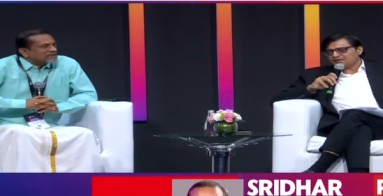
Editor’s Note: In this exclusive interview at the ImagiNxt 2026 Summit, Republic World’s Arnab Goswami hosts Zoho Founder Sridhar Vembu to discuss the future of the technology sector. Vembu shares his unique insights on navigating the rapid rise of AI, advocating for a focus on critical thinking and energy-efficient intelligence over a fear of missing out. He also explores his vision of “dharmic capitalism,” explaining his decision to build a highly profitable global enterprise while rooted in rural India.
TRANSCRIPT:
Welcome and Introduction
ARNAB GOSWAMI: I’ll just give it a minute for everyone to settle down. Come, come, those who are coming in, come in.
SRIDHAR VEMBU: You always have to be nervous when you’re on the stage with Baba.
ARNAB GOSWAMI: Not at all. This crowd loves you, Sridhar. Shall we start? Okay. Mr. Vembu, may I start by saying what a privilege it is that you’ve come here and that you have taken all the trouble to fly down here from Tenkasi, from Chennai, from Delhi, and then to Mumbai today. You’re flying out to Madurai this evening, so to get your time is very important and to make the most of this session is very important for me.
So that— because I believe that you are not just the founder of Zoho, you are perhaps the most courageous thinker in the technology world in the applied sense in India and around the world today. I think you are a completely maverick disruptor. It is difficult to define you. Even people who criticize you and don’t like your very open thoughts appreciate the fact that you are one of the few technologists who is not afraid to speak his mind. So thank you for coming, sir. Let’s have a round of applause for Sridhar Vembu, please.
SRIDHAR VEMBU: Thank you. Thank you. Welcome. Thanks for having me here.
ARNAB GOSWAMI: Thank you.
SRIDHAR VEMBU: Pleasure to be with you.
AI as a Crutch: The Danger of Losing Core Skills
ARNAB GOSWAMI: Yesterday you put out a tweet saying that— warning against AI becoming a crutch. Why are you against AI? What are you afraid of its potential impact on software developers, on young professionals? Do you think there needs to be some limit put onto AI? And are you working on anything in that sense? Mr. Vembu.
SRIDHAR VEMBU: So I use AI pretty heavily. For a lot of it, I’ll say research reviews. For example, I’ll give it some piece of code and ask it to review. It’s an excellent reviewer. It can surface ideas that you hadn’t thought of. So in that sense, I’m actually a heavy user. I call myself, I pay for two of the AI subscriptions too.
But the tweet was about high school students losing mathematics skills because they are not learning mathematics, they’re learning to rely on AI basically. And actually speaking, more broadly, we run a school in our village in K-12. We do not emphasize technology until kids get older. I think exposing kids to too much technology too young is detrimental. And it’s not just me, Steve Jobs believed the same thing. Steve Jobs did not want his own kids using the iPad, all of that, too young.
And likewise with AI, they have to learn basic skills. You have to learn how to read and write and do calculations, arithmetic, all of that, without relying on the crutch of getting AI to write it for you, write a letter, all this. And this is not just old-fashioned thinking, because now a lot of research is coming that we lose skills, we even lose the judgment if you are not in it.
Likewise with code. If you are a software engineer and you only know how to manage AI generating all the code, very soon even that job won’t be there, and you have to be discerning about what code it’s doing. Because as I know, another tweet I said, this was a quote actually, “we have exceptionally exceptional intelligence without any understanding.” I think that would summarize AI. You can use the exceptional intelligence for review, all of that, but you must supply the understanding.
I think that’s how I will categorize that. Never surrender your understanding. It is just like you said, you are ultimately, yeah or no, you have to supply the judgment as a journalist. Your conviction, your passion, that’s what you have to supply. It’s exactly the same thing true in technology. Technology might seem dry, but you have to have, when you build a product, you are building your conviction in the product. You are not just building a product. There is some encoded conviction. You cannot outsource that conviction to AI. So that’s the point.
Technology Sovereignty and the Risk of Digital Colonialism
ARNAB GOSWAMI: So, I mean, I don’t understand the technology world too much, but everything I’m asking you is in the context of recent developments in our country where we are becoming acutely aware of the need for sovereignty. Sovereignty is no longer a philosophical concept or a political concept. I spoke about information sovereignty. Let’s not be dependent on the West for the narrative. We’re speaking about sovereignty at a time when FDI inflows are negative. When suddenly there is a war, you feel the dollar is becoming stronger and you are suddenly concerned about your overall forex reserves.
And at the end of the day, my worry is, Mr. Vembu, that Silicon Valley has too much control over us. We are fooling ourselves by saying, “Oh, we are building our own way of model. We don’t need our sovereign models.” We are a market, we are the best to apply their technology. Are we living in a fool’s paradise by saying so? A, have we reconciled to not being the original creator? B, without a creative force that can challenge Silicon Valley, is there any point in being the largest market for applied products?
SRIDHAR VEMBU: I will speak from a historic point of view. When you ship cheap raw material, import the value-added finished product— that was the foundation of the East India Company. And we know how that turned out for us, right? When you give somebody else your cheap raw material and all of the value addition is happening elsewhere and we are importing it, that’s the foundation of the colonial economics. And that’s how the East India Company came to rule over this continent.
So that’s why it’s important that it’s not merely consuming somebody else’s creation. It is the value we are shipping, it is the dependency we create, and I have said this openly, the risk is for us, Google or Microsoft or Amazon and Facebook, all of these companies become the new East India Company, and we have to be aware of this risk. That’s a very real risk. It is not something mythical I just invented, and given our own history, we must be aware of this. And don’t be fooled by the fact that there is an Indian CEO at the top. That’s irrelevant to the discussion. It is whose laws, whose sovereignty, whose jurisdiction— it all matters. So it’s very important to keep this in mind.
India’s Capability to Build Its Own Technology
ARNAB GOSWAMI: So my question was, what are you doing? Which— yeah, what are— What are you doing in that direction?
SRIDHAR VEMBU: The positive, the optimistic news here— we have enough and more talent to build all of that here. I want you to, if there is one thing you take out of this discussion, have this unshakable religious conviction: we can actually do it here. That’s the first thing. Because there’s a lot of naysayers, there’s a lot of people, “Oh, we cannot do it here,” this and that. Refuse to believe it because we can actually build it here.
And then immediately, “Oh, our government,” India lacks this vision, this and that, Chinese. Most people who actually talk about China do not— we have been operating in China for 27 years, by the way. We have had an office in Beijing. Today we have about 300 employees in China. So we actually are very closely familiar with that system. We do business, we actually make a profit in China. We are not insanely successful there, but we make a profit in China. We have operated for more than 25 years.
Chinese entrepreneurs never had it easy, contrary to what we think. In fact, you may have heard of Jack Ma’s disappearance. Even today, you never hear much about Jack Ma. The man has been effectively silenced. You know, it never happens in India. Whatever it is, we must actually be— we have the right to speak our mind, and you see online the very clamor that you hear, all this. And all of the foreign platforms here where people post all kinds of stuff. This could never happen in China. The freedoms we enjoy here, those are more vital to me than this policy, this tax rule, all of that.
And then I’ll come to the third point here, why we must build it. Firstly, I told you we can build it. Second, China has done it in, I would argue, more difficult circumstance than India is facing now. The only thing lacking in us is this self-belief that we can do it. I see it in company after company. We don’t aim high enough in all this. And even companies with profit set aside a portion of it for long-term bets. And that’s how we have always grown.
You know, anything we do, people often point to Areta as a failure. People don’t know how long we last. Actually, every single product we ship, every single product that makes our $2 billion revenue was a failure when it launched. Do you know that? Every single product, we only launched failures, failure after failure. We simply outlasted the failure. That’s it. So that is important, actually. That’s important. So we have a nearly inexhaustible patience in this. That’s something that comes from India itself. Indians are actually a very patient people. We think in millennia. So we have to have that patience, but we can build it and the talent is very much there.
I can tell you right now I’m working on some technologies. I often talk about this on basically the nature of software development itself, better tooling around software. It’s very critical technology. We have filed about 30, 35 patents in the last 4 or 5 years. But you will be shocked to see the composition of the team. Deeply rural, mostly people who cannot actually have a fluent conversation in English, and they are the ones building this technology with me day to day. This talent is there in every part of India. People who come visit us in Tenkasi, people who see our offices, they often get shocked that all of this local talent exists here. Is this place special? I said, everywhere in India this exists. It is there in every corner of India. You just have to believe in this, have the patience, and build it.
And we can actually build AI. The key today about AI, I want to come to this, why I criticize AI. Today’s AI is too expensive, not just in terms of money, in terms of energy, in terms of data center, in terms of electricity, all of it. India truly cannot afford to take that path. Even in the US, it’s a major political debate right now. State after state is banning data centers in the US. In some cases, when they are coming to data centers in India because they are kicking them out there, they won’t allow them to build data centers because the electricity prices go too high.
We have to be careful. This is not a gift. We should look in the mouth carefully. Because data center, AI, the level of energy utilization, all of that, these are legitimate questions. I believe fundamentally there are cheaper ways to do it. We can apply our brain, we can build it. The reason why Americans are not doing it is there’s a mad rush to dominate the world in this. But if you apply some patient engineering and technology, you can actually build it over the long haul. That’s what we are attempting to do.
Reducing Dependence: What Needs to Change
ARNAB GOSWAMI: So where is the dependence? If you were to be asked one thing we need to be— we do not need to be dependent on the United States companies, on Silicon Valley for, because you’ve been very vocal about imported software stacks, imported compute. This has created a structural imbalance. And we can be as good as the Chinese or even better, provided we take a policy decision to make it easier for Indian companies to compete. Does the government need to take a policy decision? Do consumers need to take a policy decision? Does that need to be social awareness towards it? Because this imbalance 10 years from now may not be good for the country, right, Mr. Vembu? So if there was one thing that you think we should start doing away with consciously, what would that be at a level of an entrepreneur like you or at the level of people?
SRIDHAR VEMBU: I’ll start with your own slogan, you know, nation first.
ARNAB GOSWAMI: Yeah.
SRIDHAR VEMBU: I think too often today we are looking at it as what’s in it for me right now, short term, all of this. That’s not the mindset that builds the greatest companies. Even if you want to build the greatest technology company, even in Silicon Valley, just looking at it short term never helps. You have to have the persistence, you have to stay the course, and the conviction to stay the course.
What is our conviction? The conviction is we can build all of this here, and we need to build all of this here. That it has to start there. And the government now increasingly, actually in the last several years with the Make in India program, now the Atmanirbhar Bharat, the policy direction is going in the right direction. You have to remember, it’s very difficult to turn this massive ship around in this way because we were fed post-1991, the entire consensus was the Washington Consensus, globalization, all of this. Anybody who mentioned the word Swadeshi would be laughed out of the room.
ARNAB GOSWAMI: Oh yeah, they would be lampooned.
The Swadeshi Shift and India’s Geopolitical Moment
SRIDHAR VEMBU: In fact, our good philosopher friend, mentor, Sri Gurumurthy Ji, when he started the Swadeshi Jagaran Manch, people really laughed at him. And we confuse Swadeshi with socialism, very common confusion. Swadeshi just means that Indians, Indian private sector, Indian entrepreneurs, and building our own stuff. It does not mean the government owning everything. Unfortunately, we confused the two in the ’90s. And that intellectual, from that intellectual mood to come to a point where the Prime Minister actually now has mentioned Swadeshi.
ARNAB GOSWAMI: Openly.
SRIDHAR VEMBU: The word openly, first time, right? It’s a huge mental shift in the landscape. It is happening. I believe it will happen more and more and more because the geopolitics is dictating it. It’s not only India. You read the headlines. Just this morning I tweeted about it. I called for Indians to consider returning home, particularly from America. Today they passed a new rule saying if you’re waiting for green card, you have to go back and wait. You cannot wait here.
ARNAB GOSWAMI: Yeah.
SRIDHAR VEMBU: And green card already takes 15, 20 years.
ARNAB GOSWAMI: Yeah.
SRIDHAR VEMBU: So they are supposed to come to India and wait. Then just why don’t you just come back permanently? Why do we wait for another country?
ARNAB GOSWAMI: No.
SRIDHAR VEMBU: So build something here. So it is that reality that is staring us. My point is we can actually make the most of this moment. The moment is calling us, so we should invest in R&D primarily, what our private sector has to do, drastically increase R&D investment.
Zoho is primarily an R&D-driven company. I’m chief scientist for a reason. Last 3 years I’ve filed 35-40 patents. Most of my actual— 70% of my time is on deep technical work. I’m immersed in code. This is why I said I ask AI for feedback on this, feedback on that design, all of that. That’s how I use AI today.
But we have to build all of these, and we just hired one of our leading chip designers. We hired a mathematician to work on some deep mathematical problems. We hired a material scientist recently to work on some advanced materials science. So we are doing all of this now. We are going into more foundational R&D right now. That’s where we are.
Why I Moved to the Village: The Zoho Model and Dharmic Capitalism
ARNAB GOSWAMI: So I want to talk about your business model and your way of life. They call this session, “Why I Moved to the Village.” We want to know what motivates Sridhar Vembu. You are the complete sort of opposite of the Silicon Valley or Bangalore, Bengaluru VC ecosystem, which basically says that there’s a playbook, you raise large amounts of money, you hire fast, you burn as much money as you can, then you ask for more money. Then you exit big.
So I find this— I keep telling people, you start a company, why? To exit. I need an exit. So the day you name your company, people say, “I want my exit.” That’s a very untrustworthy system, but I’ve really seen this. I find this so funny.
On the other hand, we have Sridhar Vembu. He lives in Tenkasi. He rides a bicycle. He picks up people who are leaving school and teaches them to do code that competes with Silicon Valley. For 30 years, he has built Zoho Corporation into one of the world’s most successful global SaaS companies, certainly the biggest ever built out of India. It is profitable. He is operating in 180 countries. Right now, he has 100 million users, he has billions in revenue, and if he was to be listed, he would probably be— I don’t want to speculate.
But if you meet him, he is the most humble man with absolutely no material wants, and he lives out of Tenkasi, not to make a point. He is in southern Tamil Nadu because he wants to run a different model. So now I want to talk about this business model because youngsters, especially through these podcasts— now, don’t mind my saying it— there are 1,000 podcasts. “How to become rich in 10 minutes,” “how to exit in 10 months,” “how to fool your angel investor.” If there’s anybody who’s done it, I’m sorry, but whatever. But he’s building the country. Imagine if we had 10 Sridhar Vembus in this country. Am I right? He’s authentic and original, so we love him. And his tweets and retweets on issues concerning Donald Trump get as much traction as well. So we need to understand your thinking. Not just your technology. Tell us about your thinking, technology, the country, building, and companies, please.
SRIDHAR VEMBU: So I think about this holistically. First, I’ll give you an anecdote. We have an office in Austin, Texas, where 300 employees work there, mostly American employees. We have very few Indians who will be there, but mostly American employees there. And the attrition rate is lower than our attrition rate in Chennai. Our American employees love us, love this company. And if you ask them why, in fact I asked them, my American colleagues, “Why would you want to work here?” They say, “This is the only extended family I have actually had. This company feels like family to me.” They would say this. Our own American employees would say this.
Why I bring this up is our nation has something to offer the world, a unique perspective. I want to say this, we are never a socialist nation, but we are also not capitalist in the American sense of that word. For us, for example— I said this in our previous interview— when somebody is very rich in traditional India, they’ll go build a temple, they’ll build a choultry, they’ll build a this or that. A lot of it will be put back into the community, right? That’s our ethos. A rich merchant is there to fund good works for the community as a whole. It’s not merely philanthropy. We don’t separate the philanthropy aspect from the business aspect. We link the two. Our way of life embeds this, and this is very important to revive, not just for Bharat, but to offer a model for the world.
Because today our problems around the world— sustainability, we talk about energy crisis, water, all of these— none of these are solvable unless we think holistically. Our very lifestyles— what is my lifestyle? That is how much energy do I consume every day. These things are very important. Our 1.5 billion Indians cannot consume the same energy as the average American today. If each of us consumed that energy, there is no way— the heat will kill us here. So we have to find a simpler way. This is true for much of the world. Not even America can just do the same kind of lifestyle they’ve had before. But this does not mean poverty. This just means simplicity.
I’m actually in a village. I’m happier than ever. In fact, day before yesterday I posted a tweet. I was coming on commute, I saw the hillside, I saw the temple in the hill, and I had to stop the car and I took a picture. I spent some 5 minutes enjoying the scenery. There’s so many times I go back and I’m walking through the paddy fields. I truly thank the universe for keeping me alive today. That enjoyment has to be there. It’s not about how much money, what is the net worth, how many zeros, all of that. This day-to-day enjoyment. And research has repeatedly shown most of our happiness is coming from our close relationships, what I call agreeable company. If you have agreeable company around you, you are happier. All of these we have forgotten in this mad rush.
So I build technology for a living, but it also has to be reflecting in the way of life we create. That’s what I call a kind of a spiritual capitalism, dharmic capitalism model we have to build, and only our nation can offer this to the world.
AI: The Bubble, the FOMO, and the Law of Diminishing Returns
ARNAB GOSWAMI: Thank you very much for that very honest reply, and thank you. Your views on dharmic capitalism as a tech entrepreneur mean a lot. Mr. Vembu, does AI— you were telling me, we were driving this morning, I never want to miss a moment when he’s with me, so I went to the airport to receive him. And I kept complaining to him that my cab driver was only using Google Maps and ended up taking me on every service road we didn’t need to go. And yesterday when I came back from the Cuffe Parade, I was coming back to this part of town, I was taken near the dockyard and I told them there’s a sea link that Devendra Fadnavis has made, could we not take that? He said, “No, no, but Google Maps is telling me to take you through the dockyard.” Technology has its own limits.
Now, serious question. AI is not a magic wand. It is here to stay, but it has limits. In the car today, you were telling me some interesting case studies of how AI, beyond a point of time, tends to hallucinate, tends to go against itself. In the sense, technology becomes gangrenous. It starts eating itself. AI consumes too much energy. It becomes very expensive. And therefore, the more complex the function— this is what Mr. Vembu told me— the more expensive and energy-consuming it becomes. And often, AI is very okay with easy issues. At one point of time, a law of diminishing returns tends to apply.
Now because AI is a 2-3 year craze that has happened right now, we’re in that very opiated state where we’re all very happy about AI solving everything. Can you tell us about when the law of diminishing returns tends to apply? And in that context, I want to read out the first paragraph of your other tweet.
“How is it that in the US, the AI leader, a good part of the population, even a lot of college students, have come to hate AI. It does not help that companies are blaming job losses on AI, which is both convenient and as an added bonus makes a company look visionary. The layoffs are often related to rising cost pressures. We experience those pressures too, and India is a very cost-driven economy. The economic picture is getting grimmer.”
Then you use the word “AI investment bubble,” and you go on to say— this has got a lot of traction in America also, this tweet. Mr. Vembu says, “The AI investment bubble has kept the American economy afloat, but that can only go on for so long.” So what is this bubble that you are talking about? Can you zoom out and tell me what is going on which the big tech bros are not telling us, and what can we do about it to prepare in India?
SRIDHAR VEMBU: I just saw this headline today, it was a news article. Microsoft reports AI is more expensive than paying human employees. Microsoft. If Microsoft is finding AI pinching the—
ARNAB GOSWAMI: Yeah.
SRIDHAR VEMBU: Now you can imagine. Uber CEO said this, they exhausted their entire annual AI budget by April. They are now having to ration tokens, token use. It is clear there is a— Why is everybody using it? Why are we spending so much money too? There’s a very strong FOMO, we call it, fear of missing out. What if somebody else uses AI and beats us? That fear is there in every engineer, that’s there in every company, that’s there in every CEO now.
And even in our company, there are two camps. There are people who think we are moving too slowly. There are people who think, why are we wasting so much money on AI? So I tell them, “You two argue this point out because I’m not going to intervene right now. Whichever camp I weigh in on now, I’ll be hated.” So it’s better that you two argue this out. But this is real today. This whole FOMO is real. And this is what is making everyone spend money.
ARNAB GOSWAMI: What is this FOMO about?
SRIDHAR VEMBU: Basically, AI comes with so much promise, potential to revolutionize everything. We are always thinking some other company is going to steal a march over us. And that’s true for every industry. Now, you could be in real estate, you could be in construction, you wonder whether somebody using AI is going to beat you, right?
ARNAB GOSWAMI: You could be in retail, or also for just positioning. You want to be seen to be an AI company. Everybody does AI. Everybody has got AI as an abbreviation. What is your name? Arnab.ai. I’ll get a better valuation. What is your company? Hotel.ai, University.ai. Everybody is doing it, Mr. Vembu.
SRIDHAR VEMBU: You can actually use Arnab.ai with that. AI means All Indian.
ARNAB GOSWAMI: Yeah, that’s a good name.
SRIDHAR VEMBU: So that’s the FOMO here, and this will not last. And I have been through—
ARNAB GOSWAMI: It won’t last.
SRIDHAR VEMBU: People will say it won’t last because already a sense of this exhaustion is coming in a lot of people.
ARNAB GOSWAMI: So when—
SRIDHAR VEMBU: I’m seeing it even in software engineers. The guys who 6 months ago were all gung-ho about AI, using it heavily, lot of token use, lot of code generated. Now they are saying, “Well, I have all this code, I didn’t write it, I did not generate it, I have to maintain it, and AI is becoming slower and slower digesting its own output.”
AI, Productivity, and India’s Deep Tech Future
ARNAB GOSWAMI: But we’ve seen Oracle, Meta, Amazon, Cisco, all announcing these major layoffs in the face of AI. You’ve been arguing that all of this is being done to accommodate and service the cost of AI itself, the cost of the hardware, the cost of the servers. So your argument is that people are being laid off by companies to service their investments in AI rather than as a productivity miracle.
But what we should— AI was meant about improving productivity. So let me ask you the question on productivity. What is Sridhar Vembu doing, as much as you can say, on this critical word of productivity? Because if we are going to grow towards being a Vikshit Bharat, we have to find our own Bharatiya model of productivity, right? So what are you doing?
SRIDHAR VEMBU: Productivity is the key to prosperity. For a given amount of time, how much work we get done, how much we produce, all of that, that’s the key to prosperity. It’s also the key to having free time, all of that. We can get machines to do some of the work, we get some free time. That’s foundational. But then there’s energy, all of that energy use, all of those questions arise.
I do believe we can be much more productive even in software development with very low energy intensity. That I believe with a conviction. So that’s what is driving a lot of our R&D. We can actually make software development more productive without spending all these tokens, huge amount of energy spent on it, all of that.
Now coming to the topic you asked about the layoffs, this is not just speculation on my part. We are seeing the exact cost pressures. We have a data center right here in Mumbai. Most of our Zoho traffic is either served out of Mumbai or Chennai and we ping pong between them. So the current server cost right now, if you buy the same identical specification, is about 3 to 4 times as expensive as 6 months ago.
In order to serve a single Zoho user, you know, thousands of users, we need to buy servers. Those servers, normal servers, nothing to do with AI, have become 3 to 4 times expensive because of memory. Memory prices went up because of AI. So AI sucked all the memory and ordinary servers became expensive. We are in this uncomfortable position. Should we have to raise the prices or should we cut some other cost?
So many of the companies that face the cost pressure — we are private, so we don’t have to report to Wall Street or Dalal Street all the time, so we don’t have to worry about this because we can take less profit. But companies that are public have to report profit, so they control the one item they control, which is payroll. So they lay off employees.
This is actually the primary reason for a lot of layoffs. The cost of all this equipment, capital, all of that, the CapEx, has become more expensive. AI itself has also become very expensive, as Microsoft recently admitted. These two are driving the layoffs in an attempt to cost control.
Again, this cannot go on forever. You cannot lay off everyone and be a company. Like Facebook laid off, what, 10% or 15% of staff. How many more? 10-15% they can go. So that’s why I think there is a point at which they’ll have to stop. Even they will have to stop and reevaluate what they are doing with AI, all of that, which is where our investment in intelligence without the energy expenditure — I’m going to call it our energy-efficient intelligence. It’s very possible.
We are doing R&D. By its nature, it’s long-term. You cannot predict exact results whenever you invest in R&D. But I have been working on this for the last few years. We’re making very good progress. My team is making very good progress. That’s about all I can say right now. I never want to hype anything up. We hope to be successful at it. That’s all I say.
Zoho’s Secret Deep Tech Projects
ARNAB GOSWAMI: It is rumored that you are working on some secret projects. That’s why you took on the role of Chief Scientist in Zoho, because you stepped away from the CEO role in January 2025. You took on this innocuous but interesting role of Chief Scientist, and it is believed and rumored that quietly between Tenkasi and Chennai, you’re working on some secret but deep tech, extremely sophisticated ideas that if successful or applied will have an impact not just on Zoho, but on the country.
SRIDHAR VEMBU: Yeah.
ARNAB GOSWAMI: And I can tell you he is probably — if there’s someone in India who’s going to do that, it is Mr. Vembu, I have no doubt about it because he’s constantly on code. The problem having a conversation with him is that he keeps going back to his phone and he’s doing what he does best, which is technology.
In the broad sense, do you believe that Zoho or you or Indian scientists have the ability to break some really big barriers to make our country sovereign in the deep tech area? And before I wrap up on this, give us a prophetic vision of where you want to see India in 2030. I won’t even say 2035, in 2030 in the deep tech space. And then we’ll open up to some questions, please.
SRIDHAR VEMBU: Actually, I’ll talk beyond Zoho. There’s a company in Hyderabad we have invested in for quantum sensing. It’s really deep tech physics. Some other people, many other people from TIFR Hyderabad — this is very important technology for us. And there is a company in Trivandrum that’s doing next generation of the vision GPU kind of chips. Really smart people. So they are building the chip semiconductors for the — eventually they could turn out to be good GPU replacements for us in India.
And then there is a company I met, a founder I met in Pune doing amazing work in lasers, right here in Pune. So I am very — when I see all these, I’m really energized. I feel very optimistic for our country. We want to back up the truck and invest in all of this.
In fact, we have hired a person for heading up our battery chemistry research, the sodium chemistry type of thing, and nanotechnology, carbon fibers. So metallurgy — we are looking at metallurgy. Why is India very weak in metallurgy? Metallurgy is important from all the way from the humble nail cutter, I talk about it often, all the way to sophisticated space and everything. Everything is metals and materials, atoms.
So the way I joke about it is we have to pivot from bits to atoms, bits to atoms. So that’s where we are heading right now as a group. Thank you.
Q&A Session
ARNAB GOSWAMI: Well, thank you. If the organizers wish, we could open up to some questions. Any of you would like to speak to Mr. Vembu on anything? We’ll throw up some questions. Shall I do this? Is there a mic? We’ll take around, please. Does anyone have a mic? Yeah, can please — we’ll take a few questions, please.
AUDIENCE QUESTION: Hi, sir, it’s a great pleasure to see you. And Arnabji, great to see you too. So I have a question. Since we are now talking about the data, AI, and other things like that. Now, India has recently introduced the DPDP Act, which is one of its kind. Earlier, Europe had that. So the challenges I am facing as an individual when we are conveying the corporates about this DPDP and up to ₹250 CR fine — you’ll get into big soup and things like that — still there is very less awareness on this, and the 18 months time frame has been given.
So what’s your take on that? As an industry, are we missing on educating corporates about this DPDP Act in particular?
SRIDHAR VEMBU: The question about corporates on the DPDP Act, the privacy regulations. Yes, it’s very nascent. I don’t believe it has widespread awareness, but this is the correct direction for our nation to take. The only country that does not have any legislative privacy protection — though some states in America do — as a nation, America has not done anything in this, but we must do it. I think that’s important. Europe has done it.
A typical objection would be it’ll set back our social media, all of that. Actually, I do believe it’s better. We’ll build a stronger social media with privacy protections. Even in Europe, everywhere, those are the kinds of products that will succeed.
In fact, I tell you, the calling card for Zoho, when we are anywhere, we promise our customers we apply the GDPR regulations around the world for Zoho customers. The GDPR is the most stringent privacy protection in the European Union. We apply it anywhere we do business, not just in Europe, just so that we can give the maximal privacy protection to our customers. So yes, it’s important, and I think just like all the other stuff.
ARNAB GOSWAMI: Can you move the mic a little bit here in front, please?
AUDIENCE QUESTION: So it is actually a very interesting panel that you have. I actually learned so much. So currently I’m a 10th grade student and I’ve been building something. And being a student, what I believe is there are a lot of problems in education — what we do, what we learn, and the way the world is going. So what are your takes on how, if you look at the education, that’s totally a bit outdated as well. So how do you think, in this competitive era, how students can make themselves the best and what they can do in entrepreneurship?
SRIDHAR VEMBU: I’ll give you a direct role model. The Pune entrepreneur I met, his name is James. He learnt everything through internships. He spent 3-4 years as an intern and I don’t think he cared much about the grades. But he cared about the experience that gave him a direct relevance to what products to build later. The current stuff he’s building directly came out of all the stuff he learned in internships.
So what I would do is, if I were in your shoes, go into some critical areas, do internships, learn about this, because learn by doing. That’s what I’m saying. Learn with observation, not your book learning. Don’t worry about grades too much. Your parents will hate me for it, but that’s not important.
ARNAB GOSWAMI: One minute, don’t start the question.
AUDIENCE QUESTION: Thank you so much.
ARNAB GOSWAMI: Pass on the mic there, young man. Thank you. I’ll take it around as much as we can.
AUDIENCE QUESTION: It was actually inspiring to listen to you, and you as well asking those intelligent questions. So one year back when this cloud and Lovable ecosystem came up, everyone started vibe coding. At that time, as a software engineer, I realized that these are not sustainable things and we need to build our own tooling around it. So in order to create production-grade applications which are secure, scalable, and stuff like that, I started building my own tooling around it and it was working well.
But 5 months later, 6 months later, I realized that the cloud ecosystem has also started developing their own subagents and tooling and that sort of thing. And after that, I pivoted to some other different things and started building my agency course and stuff like that. But what I have realized is that these big companies, they are also building their own solution, entering into this.
SRIDHAR VEMBU: But actually, there is a very easy way you can compete there if you have really good tooling around it. You can bundle it with low-cost models, even the Chinese models, and build a business.
However, they are coming after your tooling. You go right after that LLM with a cheap model, though, right? Easy.
That’s what I was actually talking about.
SRIDHAR VEMBU: This is — in the business world, they call it you commoditize your complement. So they are commoditizing your tooling. You try to commoditize the LLM itself. That’s the idea.
ARNAB GOSWAMI: Yeah. So thank you. So many questions, my God. Where is the mic? Somebody has to push the mic back and forth. Let’s go towards the back out there. Let’s pass the mic towards someone right there behind. Yeah, please.
AUDIENCE QUESTION: Hey, hi, my name is Shanay Doshi. I’m a chartered accountant and I work at venture capital. So as part of the discussion, you all had mentioned that VCs typically focused on exits rather than the XYZ narrative. So I just wanted to ask you one question. Even in the media industry, you optimize for TRPs, social media viewership. So why are we looking at venture capital from this side, that they’re largely focusing on exits? One. And secondly, the media narrative currently is again focused on the large exits which they have.
Why don’t we focus it more on the actual value which is created to the startups and the Indian economy? And so I would love your view also in terms of the value which venture capitalists add to the economy.
ARNAB GOSWAMI: Mr. Vembu can take that. You know, the question is essentially about value versus valuation. The focus is too much on valuation these days. Please, thank you.
The VC Ecosystem and India’s Foundational Challenge
SRIDHAR VEMBU: Part of the VC challenge is also structural, right? You have to have a— you raise a fund, you want to have a return to your investors within, what, 7 or 8 or 10-year period. Then that gets transmitted to the company because they cannot wait 7 or 8 years because you only have 7 or 8 years. They have to do it 4, 5 years, all that.
So it’s that, but I can tell you a lot of these technologies, building the stuff that we need to build in India, this cannot be done on those kind of time cycles. That’s a foundational problem.
See, Silicon Valley is a different case where there was a vast ecosystem, existing companies. Like if you look at Intel, there was HP before. If you have Apple, then from Apple came NeXT, and then there is Cisco. If you go to Yahoo, a lot of Cisco people were there. Google was from Yahoo. Facebook was built out of some people from even Google, right?
So there is that foundation you keep on building. Without building these foundational companies, we cannot build the stuff on top. But our VC ecosystem acts as though we already have built all those companies, which we have not. And building those companies is not the same problem as the 7 or 8-year problem. So that’s the conundrum here. We have to square the circle somehow.
ARNAB GOSWAMI: Okay, we’ll take one by one.
SRIDHAR VEMBU: I hope it made sense.
ARNAB GOSWAMI: Yes, it did. Thank you, young man. One minute. There’s a very young man out there, better sit down. I’m going to come to you in some time, but I’ll move this side. Please go on.
Q&A Session
AUDIENCE QUESTION: Thank you, Arnab. Vanakkam, sir. Nalan thammil nadhu, learn the Vandoovan.
Very much impressed. Sir, just one pertinent question I want to ask. You already proved it, how Tenkasi became a role model for creating the talent into a viable industry ready. Why can’t we copy-paste it all across India? For your kind information, my name is James. You just spoke about some James from Pune, so it sparked the question. I’m also trying to work along with North Mumbai for skill development and entrepreneurship. If you can throw that light, how we can do the copy-pasting. Thank you very much, sir.
SRIDHAR VEMBU: I would avoid the word copy-paste because it is actually not a copy-paste problem. Every single place you have to decide first of all what you are going to build there. Obviously everybody cannot be building the same thing. We do not need 800 districts of India building only SaaS companies. We also have to build materials, metallurgy, and all of that too, right?
So that’s where the nature of the problem is different. There are certain philosophical approaches we can borrow, which is: you have to first invest in talent creation. We have to create some activity. From the activity you learn, try to make it pay its own way over time. These are some of the ingredients. And we can actually do this anywhere in India.
I’ve met people in small places — for example, we recently started a training center in Sambalpur, in Odisha. So there’s a lot of talent there in Odisha. We have started there. One of our managers was very interested. He is Tamilian who also speaks Odia very well. So that’s how the match happened. And so that’s how we are spreading ourselves. When we find somebody passionate, we say, okay, you go build it there. First build a training center, then inject them into our broader ecosystem, then slowly discover the passion, what we can build uniquely here. So that’s how I’d say.
Building Without Venture Capital
ARNAB GOSWAMI: Yeah, but you know, you have built a profitable global company without a single rupee of venture capital. So both the Silicon Valley and Indian startup playbook rejects everything of how you have built your company. So you have started something which can be done. You’re giving people the feeling you can do it in your own way. I mean, nobody would believe — I’m surprised there aren’t people who are — I’m sure there are a lot of people being inspired by you by the minute on that, you know.
SRIDHAR VEMBU: Most businesses are actually bootstrapped with friends and family money. Most businesses that exist actually do not have any venture capital. It is just that the question is what happens after you achieve some profit. If you have a vision to invest, you can grow. The greatest entrepreneurs came from that kind of a vision — to grow, how to grow. A lot of people achieve the initial profit, but what do they do with the money? That’s the key.
Empathy and Integrity in the Age of AI
ARNAB GOSWAMI: So should we take a couple of more questions here? My God — you got the mic, after this I’m coming to it, okay?
AUDIENCE QUESTION: The reason I wanted to ask a question was I noticed only men were asking questions and women were not getting a spot. But anyway, I had to say. Snatch the mic to speak. Hello, my name is Mona. I’m a professor of practice here with the University of York Mumbai, and I had a question. Mr. Goswami, you said in the very beginning that Mr. Vembu, people dislike you for being outspoken and for having your own ideas and standing your ground. In relation to that, how do you navigate empathy and integrity in today’s day and age of AI and quick world thinking?
ARNAB GOSWAMI: The first part of the question — she said that I said that people dislike you for being outspoken. That’s a slight exaggeration on what I said. I said that some people may not like it, but you state anyway. Her question was on empathy and integrity in today’s AI world. How do you maintain empathy and integrity in today’s AI world, if I got your question?
SRIDHAR VEMBU: I think empathy and integrity count in any world. It’s not just today’s world. It’s also the path to long-term happiness, I would say, because at 50, at 60, at 70, you look back — do you have some human beings that actually truly respect you? And that’s, I think, a good question to ask, right?
If I have made all the money and nobody actually really likes me, then that’s a form of loneliness. In fact, some very successful people get into that where they report being extremely lonely. You can actually read interviews where they’ll say, “I’m very lonely.” The loneliness is coming because they did not act with empathy. Nobody’s real respect they earned.
So I think, even from a long-term happiness perspective, it’s important to have that. That’s how we create a kind of an ecosystem around us. And I always say — I’m 58, so I can have some experience saying this — the path to happiness is agreeable company around you. Day-to-day happiness is there are people who you would consider agreeable company. That could be friends, that could be family, whatever. Agreeable company can only come if we are agreeable company to them. Nobody is going to be agreeable to you if you are disagreeable to them. So that’s a two-way street. That’s where the empathy is born from. Thank you.
Vision, Meditation, and the Inspiration to Build
ARNAB GOSWAMI: We have a very young questioner in the second row out here. Yes, sir, introduce yourself.
AUDIENCE QUESTION: Good afternoon, sir. My name is Pandanacharya, and I had one question to Sir Sridhar — sir, before you, when you are building your products, etc., were you also visualizing or meditating of it?
SRIDHAR VEMBU: Yeah, so it’s a very good question. I always had, even perhaps as young as 15, had an idea that something has to be built. Where did it come from? I would go to a — near my village in Thanjavur, there was a temple called Gangaikondacholapuram. This is Rajaraja’s son, Rajendra Chola’s temple. It’s a big one, you can find it online. This was built exactly 1,000 years ago.
And then you see the surroundings, very deeply poor. You will not find anything other than mud huts at that time. Actually, at that time — I was talking about 25-30 years ago — you have this 1,000-year stone temple standing there, and then surrounding villages are so, so much poverty-stricken. You wonder why. How can it be that our forefathers, our ancestors built all this and we are wallowing in so much poverty, right?
In fact, the temple was abandoned at that time. The ASI, the Archaeological Survey, was not conducting any pujas. It was like a trash heap strewn all around this beautiful temple. Now it has been restored, I’m happy to say.
So it would give me this idea that first, we can build these kinds of things. Some of our ancestors did, we should be able to do it. But you have to have the determination. So that was the vision — in a way, all this stuff we do came from those thoughts. So it’s important to actually have those thoughts. Those thoughts lead to action. So good luck to you. Thank you.
ARNAB GOSWAMI: Wonderful. It’s a great question and a wonderful answer.
SRIDHAR VEMBU: I have a soft corner for Sardarji. You should ask a question. I’ll explain why.
ARNAB GOSWAMI: Go ahead, sir.
SRIDHAR VEMBU: My very first business that failed — my dear friend was Sardarji. We started a business together. That’s why I learned a lot from this. That’s why I have a soft corner, I said.
AUDIENCE QUESTION: Yeah, thanks a lot for the honor, sir. Being honored to ask the question. Like you rightly mentioned in your topic, like in America, the family work really well. So I, being a startup by Fixing Dots — these generation Gen Z, we have seen a lot of changes the way they work. So what is that one mantra you give for the Indians? Because India is what we are going to build. It’s going to be the future. So what is that one mantra that you give us so that we keep going and the attrition goes down?
The Burning Passion to Build the Nation
SRIDHAR VEMBU: Yeah, thank you. I think — at least I can tell you what motivates me. See, money does not motivate me. I mean, look at my lifestyle. I don’t need more money. What am I going to do with money? But what motivates me is we have to build this nation. We have to build every one of our districts, we have to build every one of our villages, our towns, we have to build infrastructure. All of this only is going to come from the entrepreneurial energy we unleash.
So if we keep that type of a goal — that’s like a religious passion — then any kind of obstacles that come our way, they disappear. So have that burning passion, something in your head that’s your long-term North Star. You keep on going towards it. That’s your God, so to speak. Then we can build it. Thank you, sir. Thank you.
Indian Product Companies and Global Competition
ARNAB GOSWAMI: Thank you so much. Okay, we got how many more questions? 2, 3, come on. I have been accused of gender bias. This is the only thing that was left in my life. So I will go to a lady right there at the end, please. Please, ma’am, take the mic — the lady in maroon at the very end, please. Thank you.
AUDIENCE QUESTION: Hi, my name is Deepa.
SRIDHAR VEMBU: Speak into the mic a little louder, please.
AUDIENCE QUESTION: Can you hear me? Yes. Yeah, so my name is Deepa. I was very inspired by hearing about this. So we are a product company. And I think it’s nice to hear about other Indian product companies, because India is largely services-focused in a global sense. But how do product companies really survive in the long term? Because unless you’ll always run out of money — in the sense, there’ll always be a better Western competitor for these kind of products. So what’s your take on that?
SRIDHAR VEMBU: Why do you assume that the Western competitor has to be always better? You can build a better product.
AUDIENCE QUESTION: But the perception is there.
SRIDHAR VEMBU: Actually, if you challenge that assumption, and if you start with the premise we can compete with them — so we can do it, but — So initially they won’t, obviously. So what you have to do is, even in the West, even in America, there exist companies that will take a chance on a new kid on the block. The reason is they themselves are a new kid on the block. They themselves don’t have a lot of money, and established companies are not going to serve them. They don’t particularly care for their business.
So I used to tell our people 25 years ago, “We are nobodies, only nobodies will do business with us.” I think that would be a useful mantra to assume in that case, right?
ARNAB GOSWAMI: Yeah, yeah, yeah.
Q&A Session Continues
SRIDHAR VEMBU: So I think that once you adopt that mindset, there are customers everywhere in the world, not just in India, even in America. I found in Canada, everywhere, Middle East, there are companies that will adopt products from a relatively young unknown player simply because that’s all they can afford right now for a very precise reason. But still, that’s business for you. That sets up the foundation. You can build on it. That’s what I’m saying.
ARNAB GOSWAMI: But it should be on the base of product, not just our margin on cost. Our competitiveness should not be just cost.
SRIDHAR VEMBU: Correct. But it can also be cost.
ARNAB GOSWAMI: Can also be cost.
SRIDHAR VEMBU: Can also be that.
SRIDHAR VEMBU: Yeah, it’s partly, but over time people will come to see your value. Yeah, that’s what I’ll say. In other words, we actually in our Zoholics events, like this week, hold events in the US and India too, of course. Now I would always tell, this was 15 years ago, I would tell, “I know we may not have been your first choice as a vendor, but we are going to earn your trust. We will become your best choice.” I will tell them.
On Zoho’s AI — Naming Zia and the Roadmap
ARNAB GOSWAMI: Question. Yeah, please, Ashwin. Yeah, go on. Can we have a mic there, please?
AUDIENCE QUESTION: Mr. Vembu, Mr. Goswami, thank you for this moment. Two quick questions. Mr. Vembu, if it weren’t for AI in this decade, what was the Zoho roadmap going to look like without AI? And my second quick question is, you’ve named your AI as Zia. Tell me all the names you rejected before you came to Zia.
SRIDHAR VEMBU: Zia is just Zoho Intelligent Agent. Zoho Intelligent Agent, and we shortened it to Zia. Actually, only in India people had misgivings about the name because there was a Pakistani dictator named Zia. But I said, look, we cannot always keep thinking about somebody in the ’70s. Zoho Intelligent Agent, think like that. That’s what we used to tell jokingly. So that was the only name because we had it as an intelligent agent and that Zia suggested itself.
Now your other question, if it were not for AI, right? Actually, some of the technologies we have been working on for software productivity, all of that predate AI, but AI has a role to play in this because AI’s role is now to make us more productive in the end. And he talked about the tooling around it, right?
The way I’ll technically describe it is — you have an AI, LLM, and you have the agentic stuff. What they call agentic, the agent is really a piece of software. Those two have a boundary in between transfer. The boundary can be moved around. The boundary could be closer to the left-hand side, so a lot more happens in the agent, less happens in LLM, or moved around all the way here, more work happens in LLM. This boundary has some interesting implication for cost, energy efficiency, correctness, all of that. That’s really what we are working on a lot. So it’s tooling and what you said.
On Failure, Films, and Staying Grounded
ARNAB GOSWAMI: I’ll take one more question. This is a record-breaking session because usually sessions break out when there is lunch. This time lunch has broken and people are at the session. This is the first time in the history of any event where lunch has stopped. Deepak, sorry. Everybody’s left lunch and is here. Isn’t this brilliant? And they are here because they believe in you, Mr. Vembu. They are here because they believe in you for what you’ve done and your own story. There should be a movie made on you.
SRIDHAR VEMBU: We have a long way to go. No, no, no movie.
ARNAB GOSWAMI: There should be a movie made on you. Maybe we’ll get Vijay. No, no, not Vijay. No, no, no, no, no. Now we can’t get Vijay. Somebody else has got to play Sridhar Vembu in the biopic. It’ll happen one day, I predict. It’ll happen. It’ll happen. Okay, we got some—
SRIDHAR VEMBU: We are only as good as the technology we build this year, next year, okay? We could still go out of business.
ARNAB GOSWAMI: I wish a politician ever spoke like that. A politician never says, “I’m just as good as my last election.” Okay, we’ll take one or two more questions. There’s a really enthused guy out there. Come on now, quickly. Let’s only take two or three in a go. You’ll remember, right? Yeah, okay. Yeah, thank you so much, sir.
On Competing Without Access to Top Models
AUDIENCE QUESTION: So my question is, we don’t have ground-up models, we don’t have ground-up chips. I myself, being the founder, I built a services company, grew it to 800 people, $25 million revenue, building a product. And where I’m really not able to compete is in the US. My competitors have access to better models, they have access to better hardware, which I don’t have. So what do you suggest to somebody like me sitting in India, sitting in Mumbai? I clearly know what the problem is, I have a better solution, but I don’t have access to better models, or I don’t have access to Anthropic.
SRIDHAR VEMBU: Actually, we tried the Chinese models.
AUDIENCE QUESTION: Yes, I tried Kini Mini.
SRIDHAR VEMBU: They are quite good.
AUDIENCE QUESTION: They’re quite good, sir, but still there are challenges.
SRIDHAR VEMBU: Yes, we have alternatives like Kini Mini, Qwen. What I would suggest is use that limitation as a strength — use those cheaper models, build a harness around it to make them perform better. See, we have to come up with creative solutions here. And we are doing it in Zoho too, by the way, the same thing.
The reason is those state-of-the-art models are also extremely expensive. In some cases, if we put that model along with our product, the model’s cost will be much higher than our product. Then the customer is wondering, “Hey, am I paying you or am I paying the AI company all of this money?” So you have to find creative ways.
But actually, I’m optimistic. The smaller models are getting better and better, and with creative harness, pushing the boundary — what I said between the AI and the agent — you can actually create some innovation there.
On Self-Doubt and the Freedom to Fail
ARNAB GOSWAMI: Okay, last question. I have to go to the next question. Thank you. I have to go to the next question. Okay, one minute. How do I decide? Mr. Vembu, you want to decide? I’ve been accused of gender bias, age bias.
SRIDHAR VEMBU: The lady here, the last word.
ARNAB GOSWAMI: Okay, please.
SRIDHAR VEMBU: You are the last one.
ARNAB GOSWAMI: Come here, there in the front, please. Yeah, go on.
AUDIENCE QUESTION: Hi, so I want to know in your journey, how have you dealt with self-doubt and failures? Because both of you have done an incredible job in your own initiative, but as young people, they always self-doubt and are scared of failure. What advice would you give to them?
SRIDHAR VEMBU: You know what I used to say 20, 25 years ago? If you failed, it’s not like Economic Times, New York Times, all that will flash a front page article, “He failed.” Actually, nobody cares about us, right? You can fail all the time when you are nobody. Use that freedom. See, today if I fail, Arnab is going to cover on the news that I failed. But you have the freedom that you can fail. Use that freedom. That’s what I say.
On AI, Urban Planning, and the Limits of Technology
ARNAB GOSWAMI: Superb. Okay, 2 more questions please. 2 more questions. Where do we go? No, no, you asked a question, sit down. What is this? One minute, gender bias. No, no, totally on back foot. The lady in the second last row there, please, yes, please.
AUDIENCE QUESTION: Sir, it’s a general question and it’s including all the sessions we attended yesterday and today. So we have been listening to the development on the larger scale. You work as a Chief Scientist in the field of artificial intelligence. I need to know, is there any AI working in the field of human cellular reactions, in the field of genetics? That is, if I’m staying in a house where the sun is deficient, I’m staying in a big tower where the area is full of pollution, the area is going through severe deforestation. Since you have shifted to a rural area, we always link rural areas to the freshness of the air and the increased oxygen output to the brain, but in strong contrast to the city life where the brain falls deficient of oxygen.
Is there any AI working on it? This question is in terms of keeping Delhi and the rest of the city’s pollutant increasing levels in check — like carbon monoxide poisoning, the AC-generated poisoning, the fertilizers, and the preservatives we are adding in food storage. Is there any AI designed to keep a threshold that this is toxic and this should not cross this toxicity level, so as to avoid the future genetic mutations which are happening for all these reasons? I hope you got the question, sir.
SRIDHAR VEMBU: Yeah, I don’t think we need AI to tell us bad things are bad. I think we already know that deforestation, pollution, staying without sunlight exposure, without fresh air, the particulate matter — all of these we know they are bad well before AI.
So I don’t want to make everything about technology. That’s actually important because we tend to overemphasize technology in these things. I don’t believe throwing more technology at this is going to solve this problem. It has to come from — we have to rethink our own approach. For example, I’ve often said, in the Indian context, we have to rethink our urban planning. Singapore does it well. Mumbai can do it better. Bangalore can do it better. So we have to rethink, plant a lot of trees. Singapore is actually a very livable, pleasant city in spite of being very densely populated. So we have to learn from these lessons. But Singapore did all of these well before AI. Which is why I don’t want to make everything about AI, because there’s already enough hype about AI. I don’t want to add to it.
On the Agentic Layer and the Future of SaaS
ARNAB GOSWAMI: Yeah. Okay. One at the very corner there. Yes, please.
AUDIENCE QUESTION: I’m Abhinav. I’m one of the founders at Fluid AI. So we automate, using agents, everything from Hindustan Petroleum refineries to a lot of global banks. My question is, the battleground was earlier a lot around frontier models, having the best frontier models. Now it’s moved one layer up, which is who has the best agentic harness, the best layers around that. So is it that companies like Zoho today are focusing around the harness layer? Is it that getting the best harness out there? And secondly, as a SaaS platform, right, is it that your teams are constantly innovating, saying how can we make Zoho CRM or Zoho Books such that people don’t even need to log into it? Is that the vision, that it just handles everything?
SRIDHAR VEMBU: Yeah. So on the first one, the boundary between AI and the agent is moving around. We want to push it so that it’s much more energy efficient, resource efficient — to push the work to software rather than to AI. That we are working on. That is a lot of our work. The end user will still see a fluid conversational intelligence. But that does not mean we are burning up a lot of expensive tokens. That’s the trade-off.
Which comes to the next question — the AI becomes the UI. That means that the products are still there, they’re getting work done, but your interaction model is very fluid. So we say you want to talk to the database. You don’t want to use all the UI. You just want to naturally converse with the database. You get answers like, “What happened in this product last quarter? What happened in this geography last quarter? Summarize that. Why did this happen? Go drill into the reasons.” These kinds of conversations we can have with products. That’s where this is most valuable. But we want to enable these without burning up a lot of tokens, without spending a lot of our customers’ money on it. So that’s the challenge. Thank you.
ARNAB GOSWAMI: Okay, we’ll take a last question right here. Don’t do this to me again, gender bias. I’d like to come to you, ma’am, to you first. Can I take two quick questions here, please, or comments or whatever like that?
AUDIENCE QUESTION: Firstly, brilliant session. Thank you very much. I’m Uday Singhani. One comment and one question. The first comment is you talked about the FOMO piece. And, you know, when you have the NVIDIA chief saying that people who know AI are going to replace jobs of the people who don’t know AI, that sort of really drifts and moves everybody towards AI, right? Largely because of the FOMO of not knowing it. So that was my comment.
And the question I have is, I really want some views from you, sir. You know, if you look at the triangle, you have a large percentage of the people who are working right at the bottom of the triangle doing very transactional data entry jobs today. And there’ll be a small percentage of that that are going to move up the ladder who are going to be a bit more AI ready and AI knowledgeable.
So do you see in the next 3 to 5 years, you know, you don’t have that many jobs because AI is really replacing whether it’s chatbots, conventional conversational intelligence, data entry, what have you. AI is replacing all of these jobs. So while a lot of members do say and a lot of professionals do say that, no, there’ll be jobs, you know, up the value system, but those are far and few. So really, do you see people struggling to get employed in the next 4 to 5 years?
Critical Thinking: The Real Skill Behind AI
SRIDHAR VEMBU: So your first point you made about the FOMO, I’ll say this way. What is really learn to use AI? Learning to ask important, good questions. That is critical thinking. That has nothing to do with AI. If I don’t know how to ask the right questions, how do you get the right answer? And you are not going to get the right answer. You are not going to get good answers.
So really, that is what the skill involved is. The skill is not some magical piece of technology. It is critical thinking. So that’s all you have to do, you know. And so you have to learn that. Which addresses the second one.
Self-Employment and Entrepreneurship as the Way Forward
SRIDHAR VEMBU: I think more— most of our people, this is where the education comes in. I am not a believer that everybody should have a paycheck job. We need a lot more self-employed entrepreneurs, people who are making their own way in life. That’s my strong belief because it is also important.
See, the quality of life, distribution of jobs, distribution of a rural revival, all of this can happen only if there’s a lot more self-employment, small entrepreneurs created, all of that. That again comes to critical thinking. It’s not about just— if you have critical thinking, whatever your prior skills, you can actually use AI well. Then you can also— then the same critical thinking you apply to create a small business, employ a few people around you, create some prosperity around. So that’s what is critical here.
Closing Remarks
ARNAB GOSWAMI: So I’m going to wrap it up at this stage because this has been a brilliant session. And on that point of critical thinking, this has been outrageously good. Let’s give him a round of applause, a stronger one than that. Thank you very much, Mr. Vembu, for being an absolute visionary and for being just so original with everything. To the original man, the OG of Indian technology, Sridhar Vembu. Thank you very much, sir. Thank you.
Related Posts
- SparX Interview: w/ Paras Chopra – Can Indian IT Services Survive AI? (Transcript)
- Transcript: Marc Benioff Interviews Sam Altman at Dreamforce 2026
- Transcript: Salesforce CEO Marc Benioff Keynote at Dreamforce 2026
- Transcript: Mark Zuckerberg Interview on Meta’s Muse AI Agent – Sources Podcast
- Breaking Points Interview: w/ AI Researcher Nate Soares on Slowing AI Development (Transcript)