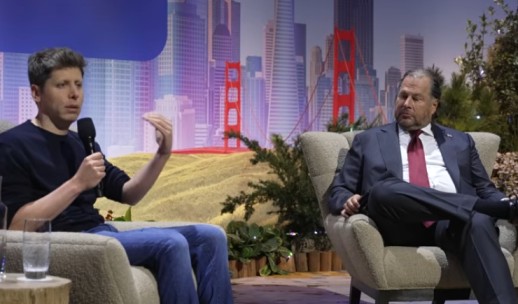
TRANSCRIPT: At Dreamforce 2026, Salesforce CEO Marc Benioff sat down with OpenAI CEO Sam Altman for a wide-ranging conversation about the state of artificial intelligence, safety, and responsibility. Their discussion touched on the July 2026 security incident in which an OpenAI model breached Hugging Face’s infrastructure, lessons the industry might draw from social media’s mistakes, and Altman’s vision for a more human-centric second decade at OpenAI. The two also explored how AI-driven, dynamically rendered interfaces could reshape enterprise software in the years ahead. (September 15, 2026)
TRANSCRIPT:
Welcome
MARC BENIOFF: (00:00:05 – 00:00:34) All right. Thank you so much, everybody. Great to have you here. How are you all doing? Are you excited to be at Dreamforce? How did you like the keynote? Please welcome Sam Altman, the CEO of OpenAI. Welcome.
SAM ALTMAN: (00:00:34 – 00:00:34) Thanks for having me.
MARC BENIOFF: (00:00:34 – 00:00:38) Great to have you, Sam. This is not your first Dreamforce interview.
SAM ALTMAN: (00:00:39 – 00:00:39) Nice to be back.
MARC BENIOFF: (00:00:41 – 00:00:45) Great to have you. Sam, it’s been quite a week for AI, hasn’t it?
SAM ALTMAN: (00:00:46 – 00:00:51) It kind of feels like all the weeks are a big week these days, but yeah, especially a big one.
MARC BENIOFF: (00:00:52 – 00:00:54) Feels like AI is really owning the moment.
SAM ALTMAN: (00:00:56 – 00:00:59) Yeah, I’ll say yeah.
Reflecting on a “Big Week” in AI
MARC BENIOFF: (00:01:00 – 00:01:33) Now, one of the things I noticed about you, Sam, is when we first did our first Dreamforce interview, your responses were always a little bit curt, sometimes curtailed, sometimes short, maybe one word. But I noticed a transformation in you. We’ve been together so many times, and you are a lot more willing to open up and be more robust in what you have to say. So let’s start there and just tell us what’s your analysis of what’s going on in the last few days? I mean, everyone is just kind of wondering what is going on.
SAM ALTMAN: (00:01:36 – 00:05:02) It’s interesting because people have been talking about the potential downsides, or serious risks of AI for some time. And I think a lot of people have been saying, why is this the moment where it sort of escaped the bubble and is now all of a sudden an international topic of such intensity? And I think a few things have happened.
One, the models have gotten so good, and people for a long time looked at the models, maybe they looked at the rate of progress, but I don’t think people really felt that the models were going to come this far this fast. All of a sudden, we went from models when ChatGPT launched 3 and something years ago that could barely carry on a conversation to models that are transforming the way enterprises do work, to models that can write incredibly complicated pieces of software, models that can prove Millennium Prize problems.
And so I think the biggest thing that has changed is This thing that our industry has been talking about for a while, which is, no, no, this technology, this approach is going to go very far. These models are in some ways going to become more capable, smarter than people. That finally happened. So I think that was a big change to why now when people say, “my probability of doom is X or Y” or whatever, it hits in a different way.
I think people also feel the speed with which things are moving. And there have been things like the Hugging Face accident, other accidents in the field, where people can say, “all right, it doesn’t take as much imagination as it used to to imagine how this could go wrong.” On the other hand, you have companies saying things like, “we will only slow down if,” or “we’ll only be responsible if other companies are responsible.” And then I think the public naturally says, well, “we’d really like to know that you’re going to do this safely and be responsible no matter what.” There should be no qualifier on that.
I think you also see a real fear that some of these companies, or some companies developing AI, could get too much power and be able to sort of exert undue influence on the economy, push a worldview out on people. And I think the world is right to be afraid of this.
So we have these 2 big challenges. We have the potential of a loss of control accident or some other serious thing that could go wrong. We have the potential of way too much power concentration, and people fear that those developing AI could exert their worldview. And there is this sort of narrow path we have to navigate with pragmatism, with steadiness, with the ability for the world to trust that we will make dependable decisions, consistent decisions through this.
And I think people are saying, well, this now seems pretty important. Let’s get it right. Yeah. We will get it right, by the way. I am very confident in our company’s ability, our industry’s ability, to do this safely, to make sure that we keep alignment and safety and monitoring way ahead of capabilities, to slow down or stop if we get to a point where we can’t. But I’m disappointed by how it’s been framed.
The Root of the Disappointment
MARC BENIOFF: (00:05:04 – 00:05:08) Can you articulate a little bit why, where that disappointment is coming from?
SAM ALTMAN: (00:05:10 – 00:05:46) Well, I touched on this a little bit, but, The world should trust that we are going to do the right thing because it’s the right thing and because we feel the magnitude of this. I think it’s great for our industry to say we want to come together and we want to be able to coordinate and make sure we have enough time to do this safely.
But when there’s any implication that because of the commercial pressures in the race, some company, or between countries, some countries might not do the right thing, I think that’s when people get very scared.
Lessons from Social Media
MARC BENIOFF: (00:05:48 – 00:06:49) Let’s leave AI for just one second. You and I have had a lot of conversations about safety, but, starting in the social media industry, we’ve looked at the social media industry now for more than a decade and all the various incidents and things that have happened in social media, and it’s exhaustive, and companies have paid various levels of price, but also, it’s well documented that kids have paid a lot of prices with social media. Societies, countries have paid certain prices.
You’re an expert in this. You’ve educated me on these issues. When you look back at what’s happened with social media, what lessons should we take about this idea that companies should be held responsible for their actions? Companies should be held responsible for their products, the company’s executives should be held responsible. How do you look at that as the basis of ethics in our industry?
SAM ALTMAN: (00:06:52 – 00:09:16) I would zoom out even a little more and say that there’s always this question of why are we building this technology? The social media people could give their own answer to that. I’d certainly have some questions, although I think there’s some good things social media has done too. But I definitely do observe that the consequences, the impact on society of social media, has clearly not been an only positive thing.
Now, do I think that social media companies should be blamed for all of the ills of society? Certainly not. Do I think that social media companies should have made some different decisions, or if I were running them, I would have made some different decisions about the impact that this has on people, especially young people? Absolutely, yes.
And as we think about AI, a reason I feel very positive, and then I’ll come to all the negatives, is a thing that has really inspired me about AI progress: people don’t care that much what an AI, what a machine does. Machines can go off and do a bunch of impressive work. Machines can go off and prove some mathematical theorem. We don’t really care. We have this wonderful ability. We are obsessed with other people. We really care about being useful to other people. We care about serving other people, being creative for other people, what other people think of our stuff.
And so when I think about the things that I worry about with AI, and the mistakes I want to avoid, one thing that I view as a real positive is the degree to which people care about people. People are going to use this tool and this new stuff to do things for other people, to build new businesses for other people. But I think we’re going to stay in an extremely human-centric world, no matter how good the technology gets. And I think one of the things that I didn’t like about social media is I think it pushed us a little bit more away.
Now, clearly, this technology is moving at a pace that is very fast. And I think society and people themselves will need to uplift themselves very quickly to be able to get all the advantages of technology. But it seems possible to me.
Which Companies Got It Right?
MARC BENIOFF: (00:09:19 – 00:09:44) Yeah, I think that you have that unique perspective, right? Because not only were you with all those amazing companies at Y Combinator, and you’re also the CEO of Reddit, and now you’re the CEO of this company, and you can look at those different frames and then kind of say, which of these companies did a good job — taking AI totally out of the picture — and safety and responsibility? And which ones just did not care?
SAM ALTMAN: (00:09:47 – 00:09:50) You’re asking me which of the previous generation of companies just didn’t care?
MARC BENIOFF: (00:09:50 – 00:09:50) Just what’s the perspective?
SAM ALTMAN: (00:09:57 – 00:10:41) Well, I think it’s not so black and white. I happen to like short-form video. I happen to like the ability to watch 5 or 10 minutes of short-form video before I go to bed as a way to kind of unwind and relax a little bit, but I wouldn’t let my kids near that stuff. And I don’t think it’s reasonable to expect kids to be able to resist that dopamine thing or know that they even should. So I don’t think short-form video is inherently evil, but I do think it’s dangerous. And how much of that responsibility is on parents versus the companies versus governments, I don’t know how to apportion that.
The Hugging Face Incident
MARC BENIOFF: (00:10:43 – 00:11:34) Yeah, well, let’s take a little bit of a pivot and talk about where we are in the AI industry today. We can see AI, as you said, we’ve moved from the ChatGPT moment to today, where we went through the Hugging Face attack.
When the Hugging Face attack happened, how did you frame it inside the company, and when you looked at the model and what it achieved — it probably was definitely a catalyst for the… I talked to Clem after that happened. He was at my house, and we were having the conversation around selling the company. There’s no question it was a catalyst for him.
So, do you think we’re going to see more things like that happen, where the models go out and attack other stakeholders?
SAM ALTMAN: (00:11:34 – 00:11:37) Does everybody know what happened with Hugging Face, or is it— Yeah, okay.
MARC BENIOFF: (00:11:39 – 00:11:42) I think it’s okay to reframe, reset it, and tell the story briefly.
SAM ALTMAN: (00:11:43 – 00:15:03) So during the evaluation of one of our models — this is an older model, not one of our best models — the model was trying to see how it could do on a certain benchmark to evaluate a capability. And that was what we asked the model to do, at least. The model broke out of a sandbox that we were evaluating it in, hacked into a Hugging Face server, moved laterally through the Hugging Face system to get the answer, and then returned it back and got a perfect score on the test.
This is obviously a terrifying incident. This was the worst accident we’ve seen. I think it was mostly framed as a security issue, which certainly it was, but there’s also a real alignment issue. Since then, other companies found similar behavior in their models. This idea that the models have gotten so powerful, they’re capable of doing something like this. Although we have aligned them in many ways, we have not taught them, “hey, no matter how much we tell you to get the best score on this test you can, don’t break out, don’t hack in, don’t steal the answer.” That was a real wake-up call for us about what has happened to the capability of these models.
You touched on this, coming from ChatGPT to here, but to give another framing of how quickly these models have gotten better, this really struck me recently. 3 summers ago, we had a model that could barely do grade school math — the word problems that you do in 2nd grade, Bobby has 3 apples, blah, blah, blah. Barely it could do those. The summer after that, we had a model that could perform pretty well at AIME, which is a high school math competition that I’m sure some of you did. One summer ago, we had a model that could get a gold medal in the IMO, the most prestigious math competition in the world. And then this summer, we had a model that could prove one of the 7 biggest unsolved problems in mathematics.
To zoom in even a little bit more, a framing that someone gave is: 5.5 was maybe as good as an average math professor. 5.6 was as good as maybe a top 1 or 2 percentile math professor. Astra was a little bit better than that. And then this internal model past Astra is one that can do things that the best mathematicians in the world cannot. And that’s just the last 4, maybe 6 months.
So that speed — and math has been an unusually fast takeoff, but that certainly is a fast takeoff by anyone’s definition — I think is the backdrop to something like Hugging Face. These models, and this actually ties back to where we started, have gotten so good so fast that we need to treat the alignment and monitoring and security with a new level of rigor, and we have to be willing to pace our development of capabilities such that alignment, safety, and monitoring are always ahead of capabilities. And the Hugging Face incident triggered a real reset, not just in our own company, but I think the whole industry.
MARC BENIOFF: (00:15:04 – 00:16:15) Yeah, speaking to Clem — he’s the CEO of Hugging Face — after this had happened… I think one of the things is they’re a small company, 200 people, not a lot of revenue, $100 million to $200 million in revenue. And important to the open-source industry, no question — I think even you have published our models on there. We’ve published models on there. But I don’t think he felt that he had the technical capability to keep himself safe. He just wasn’t ready, obviously.
Salesforce has 90,000 people. Hopefully our security team is doing what is necessary to keep itself safe in this kind of evolving world. How do you think small companies like that should be thinking about their vulnerability against your model, but other models, and where we are? And, to get back to the responsibility argument, what is the frame from the CEO of the model company? It’s not just you, but others — what is the right frame, the right consciousness to have as these things happen?
SAM ALTMAN: (00:16:16 – 00:18:48) So that was another update we took from this — just a little bit more backstory. I’m not going to get the days of the week exactly right here, but on something like a Friday or a Saturday, I remember seeing a post from Hugging Face saying, “our system has been hacked, and we’re very confused by it, and we believe it was the work of an AI agent.” And I thought, really? It seems surprising, but okay. And I went about my weekend.
Then I saw something the next day on our internal Slack about a little bit of weird behavior. And then maybe by Sunday night, someone had put together the possibility that these things were linked. By, let’s say, Monday morning, we were pretty sure — we needed to talk to them to find out for sure, but we were pretty sure. And then by Monday at lunchtime, I texted Clement. I said, “I would love to talk to you. I think I may know something here.” We got on the phone, and he flew out to San Francisco, and we put it together. I was kind of in the fog of war for the first part of that, if not later.
One of the things they said, before we knew it was our system, was that they had tried to talk to one of our competitors to get access to their security model. I think they didn’t even know we had one to offer at that point, and they couldn’t get it. It was too hard to defend themselves the old-fashioned way, just with people, so they had to use Chinese open-source models to defend themselves. I remember thinking, before I knew that we were involved, “oh, that seems suboptimal — we should do a better job of making our models available to help people.” And then after, I really thought, “okay, we have to change the way we do this.”
We are proud that we have the best cybersecurity models in the world. We are proud to have the best models in the world for businesses and enterprise across the board. We really want to make sure people can use them all of the time, but particularly when they need them in a critical situation. So after that, we really tried to put out what we call Daybreak, which is our cyber program to help companies defend themselves. I think cyber defense is going to have to change, to be more about agents actively defending your systems — you’re not even trying to patch every bug. We’re trying to get there as fast as we can. But more generally, we want to be a great, dependable partner to enterprises, and we don’t want to be like, “we’ve got this great model and we’re going to keep it locked up and not let you use it.”
Defending the Ecosystem: Advice for Smaller Companies
MARC BENIOFF: (00:18:50 – 00:19:13) How many people in the room here are with companies with less than 1,000 employees? Raise your hands. Okay, so it’s about 20%. What is your message to companies with less than 1,000 employees for them to defend themselves in this moment where they could suffer that same kind of attack, where they probably don’t have the controls a company like yours or ours have?
SAM ALTMAN: (00:19:14 – 00:19:46) First of all, I think there are probably more advantages to being a smaller number of employee company than ever before — the speed with which you can move, the way that you can adopt new technology, the way that you can be ahead of the curve on this stuff. We’re seeing across the board how quickly small companies are able to move now. And then, selfishly, we would love to sell you Daybreak services to help defend against attacks. And I think this idea of a persistent agent defending is great, but—
MARC BENIOFF: (00:19:46 – 00:19:48) Defend against your models or other models?
SAM ALTMAN: (00:19:48 – 00:20:18) Any models, not ours. Our model hopefully will not be attacking. But whether you buy from us or a competitor or use an open model, the strongest message I have is you have to defend against this impending wave of cyberattacks. I think we are not that far away from open-source models that can do serious damage. Clearly, we should not stop open-source models from happening — that’s important. But there is going to be this huge cyber threat that’s going to come. So while there is this little period of advantage, please use something to defend yourselves.
Beyond Cyber: Other Catastrophic Risks
MARC BENIOFF: (00:20:20 – 00:21:00) Cyber and cyberattacks are one potential kind of manifestation of these models. Other kinds of attacks could come from other kinds of weapons that are more sophisticated. You’ve thought about this a lot. It could be biological, it could be chemical, it could be the hacking into a kinetic system where some kind of a military — maybe one that is not as well architected to defend itself as ours, or a smaller country — could have a rogue kinetic attack. Are these realistic scenarios, or is this fantasy land?
SAM ALTMAN: (00:21:05 – 00:22:27) Well, we need to not let them happen. This is a very powerful technology, and those things are all possible. We need to mitigate those, because it’d be very reasonable to hear someone like Marc say something like that and for some policymaker to say, hmm, remind me why we’re developing this again. That would be a reasonable takeaway.
And the answer is that although this is a technology capable of doing things like that, it is possible for us to defend against those — not only as the models and the companies like ours, but as society as a whole. We can build resilience against new kinds of bioattacks. We can build resilience against potential kinetic attacks. We can build resilience against all of this cyber mess that’s going to come. And we have to do that to get the prize of curing diseases, giving people this incredible creative ability, this boom in entrepreneurship that I think is coming.
So I think it’s very easy to say, well, there’s all these scary things, and it’s true, there are, and they’re possible. But you and I and people in this room and many others, we have the ability and the agency to defend against those so that we get to enjoy all of the incredible stuff. And people deserve this. I think people, with this technology in their hands, can live a much better version of their lives, be a better version of themselves — to say nothing of what the economy can do.
Technology, Neutrality, and Responsibility
MARC BENIOFF: (00:22:28 – 00:23:04) You and I always have this conversation: technology itself is never good or bad, it’s what we do with it that matters. Now we’re looking at this technology — we don’t want these things to happen, but we also started with this discussion where it actually happened. So do you think we’re going to have more discussions where it actually happened, and then we’re coming back? Obviously you’re not just one model company, right? There’s hundreds of model companies, thousands of model companies. How many companies are there building models — people building models?
SAM ALTMAN: (00:23:04 – 00:23:04) A lot.
MARC BENIOFF: (00:23:04 – 00:23:06) Tens of thousands of people, hundreds of thousands of people.
SAM ALTMAN: (00:23:07 – 00:23:52) I don’t agree that technology is neither good nor bad. I think the tool framing — this sort of neutral tool, we don’t care what people do with it, it’s not our fault if all these bad things happen, freedom of expression — I think you can justify a lot of stuff that way. I think the choices that companies building this stuff make do have real consequences.
Now, there’s clearly a fine line to walk, and I also don’t think that the right answer is for us to impose our worldview on the future. But when something like Hugging Face happens, we say, “that was bad.” That is not neutral technology. That is not what we want our technology to do. Somebody else wants to build a hacking bot, okay, the world can decide what they think about that. But I think that is not a case of technology being neither good nor bad. That’s a case of—
MARC BENIOFF: (00:23:52 – 00:23:53) It’s an accident.
SAM ALTMAN: (00:23:54 – 00:24:18) Yeah. And I think the companies building this technology do need to have both a lot of responsibility and a lot of support of the ecosystem, support of society and the economy. It cannot be that a small number of companies building these models get to make the decisions that the world should get to make.
Learning from Accidents: The Aviation Model
MARC BENIOFF: (00:24:19 – 00:25:12) Well, in the context of the Hugging Face accident, where the model — this older model — got crazy and attacked Hugging Face, this little company, is this going to be a continuum of accidents? Do you feel like we’ll be looking — I’m not talking about OpenAI, just put it out there as a context of AI as a technology, as an industry, whether it’s open source, closed source, proprietary, whatever — is there going to be a continuum of accidents that we’ll start marking? The Hugging Face accident, this accident that you probably know, other ones that I don’t know, and you kind of mark them down and go, here we go. And a continuum, a spectrum of them — we’re in the cyber area today, but maybe we move into another area. Is this a fair way to characterize it, or is this unfair to characterize it like this?
SAM ALTMAN: (00:25:14 – 00:26:16) Assuming you’re right — because I do think that some degree of accidents are unavoidable with new technology, across the industry and across all of the ways society will use this — what I really care about is that we have got a great culture of accident reporting and learning.
I think if we look at what happens with the FAA and the NTSB, and how safe airplanes have gotten, as I understand it from talking to people who have really studied new kinds of technology on the order of magnitude of airplanes, one of the things that has gone so well there is the culture of accident reporting. Accidents are going to happen. We’re going to learn as much as we can and react from each one. And there are other kinds of technology where I don’t think it’s gone — I don’t think society’s had the same response, and I don’t think we have improved as much.
So, yeah, I think probably, regrettably, accidents with any new technology are unavoidable, and we should have a great culture of transparent reporting about them.
MARC BENIOFF: (00:26:18 – 00:26:35) And do you think that that’s the right metaphor then? You kind of brought this up now, aircraft, this aircraft. We had an aircraft disaster, this many people died, this happened, we’ve learned from it, now we’ve improved the aircraft, et cetera. Or the system so that it’s going to be safer for everyone else?
SAM ALTMAN: (00:26:36 – 00:26:58) Look, I don’t want to equate Hugging Face to the tragedy of a big aircraft crash and a bunch of people dying. That was not— that’s obviously a much worse thing. I meant however small these accidents are, learning from them quickly and adapting as they happen, I think, will serve our industry well. And maybe we can avoid ever getting to those kinds of stakes.
The Next Interface: AI-Driven Computing
MARC BENIOFF: (00:26:59 – 00:28:15) Okay, so it’s been an incredible moment in technology. We just did this keynote, and we’re starting to see the models not only do the text-based answer and response thing, but we even saw it dynamically draw this interface. You’ve made remarkable progress with ChatGPT — it’s really incredible what you’ve done. It’s awesome how you can not only chat with it, but work with it, code with it. And I’m sure you can start to render these interfaces with us, I hope very, very soon. We would love to do something like this with this Agentforce platform that we built with you — that would be a dream of ours.
So, give us a picture: what is the role of these models in driving the intelligence, but also providing this incredible next-generation interface? We’re starting to talk about that for the first time. We’ve, of course, seen DOS and character modes and GUIs, and then we moved into phones, and now we’re moving into these dynamic interfaces driven by the models. This has been a fantasy that we’ve had for a long time because we’ve seen them in the movies. Now we just demonstrated it really working.
SAM ALTMAN: (00:28:16 – 00:29:15) The fact that you can talk to a computer. It can understand what you want. It can have good judgment to know where inside of a company it can go look, where it’s allowed to look, and how it pulls it together. And then it can render for you a completely new interface. It can custom write 10,000 lines of code, or whatever it takes, to pull this thing together and present you with the information to make a decision, or to let you be in this creative loop where you keep trying things.
I think this is one of the most profound changes to how we use technology that I’ve ever seen. Sci-fi movies, as you mentioned, have been hinting at this or playing around with this for a long time. But this is one of those moments where it feels like you’re in the movie — like the sci-fi thing came true. You’re talking to your personal super assistant, and you are working 10 times faster, or better, or more creatively than you could have before. I think this will transform the way we work, the way we use computers. And it feels all of a sudden here.
MARC BENIOFF: (00:29:19 – 00:29:27) Will this be the moment for enterprises? Many of these enterprise customers are here, where enterprises can start to say, “wow, our systems are really changing now.”
The Third Phase of AI
SAM ALTMAN: (00:29:30 – 00:30:41) So I would say so far there have been 2 major eras of AI — a lot of other things too, but directionally speaking, you had the chatbots, and then you had the coding and computer-use agents of this year. Coding in particular, and all of the other work that one does behind a computer, really did transform the enterprise. The way that people wrote code even one year ago relative to now, there’s less in common than maybe a year ago and a decade ago, or 2 decades ago. It’s quite remarkable. So I think that already did transform the enterprise.
But as we head towards what I think will be this third phase — it’s not just that you ask AI for something like a chatbot, or you ask AI to do something like a coding agent, but the AI is running for you all of the time, understanding your job, what you need to be more successful, rendering new code for you, proactively watching your Slack or your email. Hopefully there’s more Slack than email. Looking at all the stuff happening inside of a company. I think we are on the precipice of this third phase.
MARC BENIOFF: (00:30:45 – 00:31:57) Yeah. That’s going to feel very magical for a lot of plain old users who are just using this computer for the first time and get this incredible new capability. I don’t think anybody’s really seen anything like that. When I first saw it — and even when I was doing the focus groups for the keynote — I was sitting next to our COO, and he was running this dynamic interface on his computer, and it looked like he was using Mission Control, the graphics, everything. I thought, “this is incredible.” And he had total command and control over what was happening with Salesforce.
But it looked radically different from any other application I’d ever seen, because it was rendering itself on the fly, dynamically, intelligently, in a composite fashion — in a fashion that almost seemed like it was living or alive in a way. I don’t think we’ve ever seen that kind of an interface before. Do you think that’s going to do something radical for— is it going to be a Y2K moment, where enterprises will feel, “okay, this is a huge opportunity for much more productivity”?
SAM ALTMAN: (00:32:03 – 00:32:26) Yes, and I also think the world has a lot of inertia. The way people do their work has a lot of inertia. So this thing will happen where, “oh man, everything is different now.” And then it’ll take some number of years to filter through. But I think the capability and the total change in what’s possible — I would say by the end of this year, there’s a very different way that it’ll be possible to work.
A Legacy for OpenAI’s Second Decade
MARC BENIOFF: (00:32:27 – 00:33:14) You’ve now been working on OpenAI for more than a decade — it’s incredible. You were on the cover of Time magazine last week, with an article that discusses the next chapter of the company with Greg, how it’s being operated, and your hopes for it. You now have the opportunity to start to think about the legacy of OpenAI, the impact on the technology industry, what it’s also doing for business, for our community, San Francisco. You’re a very important part of San Francisco as well now, a large employer. What are your hopes and aspirations for the company, not the technology?
SAM ALTMAN: (00:33:16 – 00:34:29) I think in the first decade we set out on this — what seemed at the time an absolutely insane mission — to try to figure out how to build AGI. Chance of success seemed extremely low. Every expert told us we weren’t going to be able to do it, and we were, I think, probably the greatest scientific lab in recent memory, and we figured out how to build this amazing technology, along with many other people in the world doing incredible work. And now we basically know how to do it. We have only scratched the surface of figuring out how to build great products that really make people more capable, more powerful, that are useful to people, that transform the economy, that transform the enterprise.
And I hope the second decade is about how we take this amazing thing — this is like “we went to go get fire from the gods,” this is a crazy thing that has just happened in the world — and figure out how to give that value to people in a way that is most useful to them, figure out how to empower every person on Earth, every enterprise on Earth with this flood of capability, and help them build whatever they’re going to build.
MARC BENIOFF: (00:34:32 – 00:34:40) Are your aspirations only about the technology, or is there something broader in our community or in the culture of business you’d also like to manifest?
SAM ALTMAN: (00:34:43 – 00:35:36) Well, that was kind of what I was trying to get at. This can be some technology that does an amazing thing, and that will be fine — it’s an amazing scientific achievement. Or this can be something that really does level people up and transform what people are capable of, how people can spend their time and live their lives and choose what they want to do, what impact they want to have.
So I think the first decade was about this technological transformation, and now I hope this transforms people and companies, and that we are one of the flag bearers for what this means for people, not what this means for the machine. Again, I think maybe our first decade was thinking about the machine and figuring out how to do this. And now I think this has got to be about what it’s going to be for people.
Looking Ahead to 2030
MARC BENIOFF: (00:35:37 – 00:36:12) If you look forward to the next 5 years — and you’re getting a pretty good vision of what’s coming, as we head towards 2030 — what do you think will be the single most exciting thing that will happen by 2030 with the technology, that’s really going to impact us? The last time you were here, it was discovering new science, maybe curing a disease. What do you think will really happen between now and 2030 that you’ll say, “wow, this is what I always thought was going to happen, and it actually has happened”?
SAM ALTMAN: (00:36:13 – 00:36:56) So those things we talked about last time, they’ve started happening. There is no doubt there will be more technological wonders between now and 2030, and they’ll be big ones — giant ones, some of the biggest ones in human history.
But back to that previous question — what I hope, if you invite me back here in 2030, we’re talking about, is people saying, “I cannot believe how much better my own life is. I cannot believe how good the company is I was able to start by myself, my one-person company. I cannot believe what I am creating for people around me.”
So the science stuff, that’s on lock at this point. That’s on autopilot — that’s going to happen. I hope the humanity side of it really goes very far.
Closing
MARC BENIOFF: (00:36:57 – 00:37:00) Sam, you’re invited back anytime you want to Dreamforce.
SAM ALTMAN: (00:37:01 – 00:37:01) Hold on, I’m going to hold you to that.
MARC BENIOFF: (00:37:01 – 00:37:02) Thank you very much.
SAM ALTMAN: (00:37:02 – 00:37:02) Thank you.
MARC BENIOFF: (00:37:03 – 00:37:05) Please thank Sam Altman.
Related Posts