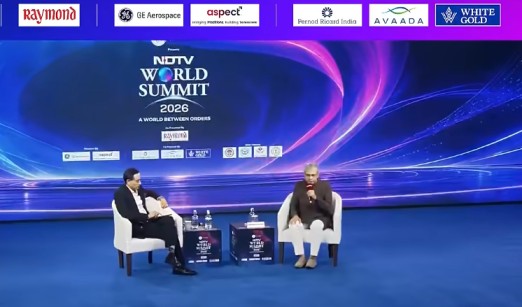
Union Minister Ashwini Vaishnaw sits down with Rahul Kanwal at the NDTV World Summit 2026 to set out India’s semiconductor roadmap, from the first made-in-India wafer by 2028 to 3 nm and 5 nm chips by 2035, and the goals of Semicon 2.0. He also reveals that a consultation paper on an Indian AI law is coming within weeks, predicts an Indian-designed mobile phone brand by 2028, responds to former Japanese minister Hideki Makihara’s criticism of the Mumbai-Ahmedabad bullet train project, and addresses the arrest of CJP activists in Delhi. Read the full transcript of the interview below:
The Nail in the Railway Minister’s Office
RAHUL KANWAL: (00:00:00 – 00:01:42) In the railway minister’s office, there is a nail in the wall behind where the mantri sits. I noticed it the first time, and I thought to myself, कि ये किसी railway वाले ने कोई rail की picture लगी होगी, वो हट गई, अब नई वाली लगनी लगी नहीं। And it was just a note at the back of my head. I went back. I came back a few weeks later, met Ashwini ji again. And I noticed this nail.
So it’s very awkward because a very prim and proper formal office, and you have this one nail in the wall, and there’s nothing there. फिर मैंने सोचा ये क्या है तो कुछ कुछ the officials must be in trouble. कुछ डाली नहीं रहे हो कील के अंदर अभी भी पड़ी हुई है खाली। Anyway, I thought God knows what’s happening, and I left it there. I came back now few months later. And the nail was still there. By now, I am totally confused.
So I started that third conversation by asking Mantri ji, “Sir, ये आपके सर के पीछे जो कील लगी हुई दीवार में वो क्या है?” The minister said that “this is where the first semiconductor wafer manufactured in India will be put. The moment it comes out of the manufacturing line. And I have it at the back of my head so that every single day when I’m doing meetings with officials, delegates who come from the world over, that nail in the wall reminds me what we need to do with semiconductors in India. And it will stay like this till the time we can find that semiconductor.”
So when is that nail going to find the wafer that you hope to put over there, Minister?
ASHWINI VAISHNAW: (00:01:43 – 00:01:44) 2028.
Legacy Nodes and India’s Semiconductor Strategy
RAHUL KANWAL: (00:01:50 – 00:02:21) 2028. You’ve been working really hard towards making this happen, but your critics say that we are trying to play catch-up, and essentially even when we get there in 2028, we will have very old world technology. The world is moving into nanochips. It’s far more advanced. We’re producing what they call from chip standards, really old technology. What do you want to tell everyone watching you at this time, watching you across the NDTV network, Minister?
ASHWINI VAISHNAW: (00:02:22 – 00:06:42) If you look at the entire semiconductor spectrum, the entire from, let’s say, 90 nanometers to 2 nanometers, close to 75% of the chips which are used, all the chips, whether chips in the refrigerators, chips in cars, chips in the mobile phone, chips in this mic. All these chips, if you look at the entire spectrum, close to 75% are 28 nanometers to 90 nanometers. These are called the legacy nodes. This is where the large volume is there. Value-wise, this will be lesser. Complexity-wise, this is lesser. But the large volume is in this segment, and this segment is now getting concentrated.
One country is already having 80% of the manufacturing capacity of this 28 nanometer to 90 nanometer, and that capacity is growing. So imagine a world 5 years from now where the advanced nodes— 2 nanometer, 3 nanometer, 5 nanometer, 7 nanometer— there will be 5 manufacturers. And 28 nanometer to 90 nanometers, there will be only one country which is manufacturing. That is the geopolitical significance of our strategy.
We decided that in the high-volume segment, which is extremely important for all manufacturing, whether it is manufacturing of cranes, trucks, trains, refrigerators, white goods, practically everything in that high volume, the dependency should not be there. People want resilient supply chains, people want reliable partners, people want countries to come up who can manufacture in that segment. That’s why we decided that our first fab will be 28 nanometers.
Now 28 nanometers fab will be ready. Tata project at Dholera is progressing very well. Beyond that, the path from 28 nanometers to 14 nanometers, 14 nanometers to 5 nanometers. That path is clearly laid out. By 2035, we will be manufacturing 3 nanometers and 5 nanometers chips in our country. So that path is very clearly laid out.
See, our country wanted to have a semiconductor industry way back in 1962. Attempts were made by Mr. Nehru, by Mrs. Indira Gandhi, by Mr. Rajiv Gandhi, by Dr. Manmohan Singh. Finally, the success has come to our country only during Prime Minister Modi’s period. It’s not that— see, it’s an extremely complex industry. Human beings have never manufactured something as fine as this.
It’s like on this nail, not just writing your own name. Writing names of all the NDTV employees. After that, writing everything that has been said on NDTV for next— for the last 100 days, each and every word that has been uttered on NDTV, 100 days, writing that entire thing on this small nail. So that is the complexity of manufacturing semiconductors, and we in our country are making a successful attempt at that industry, getting that industry into India.
My sense is, with full humility, I can say that within a very short time frame from 2022 when we started this journey, 1st Jan 2022, since then we already have 5 plants which are doing commercial production. Our chips, made in India chips, are today exported to Japan, exported to US, exported to Europe.
That is the level of quality and reliability we have already achieved. The 6th plant will be inaugurated very soon. Very soon, these 12 plants as a part of the first Semicon will be done.
And in Semicon 2, our endeavor will be to make India the design capital of the world. The entire world’s design engineers, 20% are in India, and we have created such a huge pipeline of talent through about 300+ universities, that India will become the design capital of semiconductors in the world.
Judging Semicon 1.0 and Semicon 2.0
RAHUL KANWAL: (00:06:43 – 00:07:10) Let’s unpack this one by one. What according to you was the biggest achievement of the first semiconductor mission? What should we judge you on? Yeah, what should we judge you on when it comes to the second semiconductor mission? And how do you respond to the concern being voiced that a lot of what we’re seeing right now are because of the subsidies and incentives the government is giving? At some point in time, these will be drawn down, and then the competitiveness and the reason to manufacture will no longer be there.
ASHWINI VAISHNAW: (00:07:11 – 00:10:37) See, the first Semicon, our measurement, our metric for success was we should get 3 plants. If we get 3 plants, we are successful because extremely complex. People— when I remember going to Davos first time in 2022 and talking about semiconductors, people were like so skeptical, they would not even listen to what we were saying. ’23 Davos, it was like, “Oh, you guys have prepared something, you have done some hard work, but still you cannot manufacture.” That was the thought process. ’24 Davos, people were like, “Oh, you got Micron, so there must be something right you are doing, something good you are doing, something proper you are doing.” ’25, it was like, “Whatever you want to say, we are willing to cooperate.” That change has happened.
And that change has happened with lots and lots of hard work, persistence, perseverance, listening to the people, listening to the industry, understanding their perspective, finding out where the gaps are, working with the state governments, working with the local governments. All that is behind us instead of like our metric was 3 plants, we have 15 plants.
In the second Semicon, Semicon 2.0, we have flipped the entire priority of our projects. We have now 6 pillars. The pillar number 1 is design. That’s going to be the most important pillar of our Semiconductor 2.0. The pillar number 2 is materials and machines.
There are companies in the semiconductor industry who have never ventured out of US, which is largely the parent. And there is another company in Netherlands which— ASML, and many in Japan and South Korea. These companies have never gone out of their home country. Our goal, we will be judging ourselves as successful if we can attract at least 3 of these equipment machine manufacturers to India. If we can get them outside their home countries, to manufacture in India and design their very complex machines in India, make sure there are MSMEs, Indian MSMEs, Indian precision manufacturers, they get the opportunity to supply parts and equipments and components to these machine manufacturers, then we will be successful.
Second, if we can get the extremely pure chemicals and gas manufacturers to India, then we will be successful. Our target here is 5 companies we should be able to get.
Design, our target is very ambitious. First version, we got about 20 deep tech startups who could get VC funding. In this one, in this round, we are aiming at 200 deep tech startups who will be— who we think will be able to generate. And the momentum is very good. Momentum is superb. Companies already— I guess about 25-odd patents have been filed, have been granted in semiconductor design. So that kind of momentum is already there.
So Semicon 2 should be judged more on our ability to build the ecosystem around the fabs and ATMP units and getting the design ecosystem in place.
An Indian Mobile Phone Brand by 2028
RAHUL KANWAL: (00:10:37 – 00:10:55) So we’re now the 3rd largest electronics exporter in the world. But all the IP is controlled globally, in China, in the United States. Why don’t we have an Apple, Samsung of our own? Do you see that happen at some point in time on the horizon?
ASHWINI VAISHNAW: (00:10:56 – 00:11:13) This is October 2026, 23rd October 2026. Please note it. 23rd October 2028. क्या होगा? You’ll have Indian designed, Indian manufactured, Indian brand of mobile phones.
RAHUL KANWAL: (00:11:15 – 00:11:16) कौन सा वाला आएगा ये?
ASHWINI VAISHNAW: (00:11:16 – 00:11:20) आप wait करो ना, आज से note करके। इतना कुछ बता रहे थे, थोड़ा और भी बता दो। Listen.
RAHUL KANWAL: (00:11:20 – 00:11:23) You obviously know something that I’m— I just want to get more information.
ASHWINI VAISHNAW: (00:11:24 – 00:11:29) If you look at your mobile phone, just hand me over. I’m not watching anything.
RAHUL KANWAL: (00:11:29 – 00:11:35) Big brother watching. Actually I&B minister told and I want to address it. But okay, I trust you, I trust you.
ASHWINI VAISHNAW: (00:11:36 – 00:13:24) This small little real estate, you have to have radio frequency communication, you have the antenna, you have compute, you have memory, you have all the passive component, you have camera module, you have display, you have power management. Everything has to be built into this small little device. You have to manage the weight, you have to manage the power management, everything you have to do. Within this small little real estate, small little form factor. That’s why it’s extremely complex to design a mobile phone.
3 years back, we gave this challenge to Indian designers. “Why can’t you design the PCB, which is the motherboard of mobile phone? Why can’t you design that?” 2 companies came forward, they designed, one of them designed it very well. And today, that company’s design has been selected by the largest US telecom service provider.
In US, there is a different con— I mean, when you buy a phone, you also get a 12-month contract with the telecom service provider. So they’ve already got a contract. They have designed and delivered a 5G+ mobile phone to one of the largest telecom service providers in US. That phone is today already manufactured and delivered to the customers.
So that capability we have been able to develop over 3.5 years, over last few years, and that capability is now available for us. Now we will use that capability to have the Indian brand, Indian design, Indian IP retained in India and that mobile phone will be one of the largest selling— I mean, the mobile phones.
“It’s Not Catch-Up”: India’s Manufacturing Story
RAHUL KANWAL: (00:13:24 – 00:13:39) Even if you play catch-up and be able to do it, how do you know it will sell? We had the Nothing people here, Apple, Samsung. There is a certain level of technological advancement. Even if we can ultimately play catch-up and manufacturing, why do you think— you’re saying we’ll be the largest selling. Why do you think it will be amongst the largest selling?
ASHWINI VAISHNAW: (00:13:39 – 00:15:43) Rahul, it’s not catch-up. It’s— see, for 40 years from 1950 to 1990, we lost 4 decades in a country where manufacturing was never seen as important sector in our economy. Entire manufacturing sector was totally, totally like the kind of rules, regulations, and laws the Congress governments of those periods created, they stymied our manufacturing sector.
1990 onwards, there was an opening up. That opening up played very well till 2004. 2004 to 2014, once again that entire mindset of control, mindset of stymieing things, mindset of that entire left-leaning mindset came. Things went back. ’14 onwards, our Prime Minister came back with the philosophy of Make in India.
Those— we have to look at that entire historical context of our economy. The political economic— politico-economic context of our country to see where we stand. With that context, I can say that within this short time frame of a decade, today we are manufacturing mobile phones, we are manufacturing drones, we are manufacturing missiles, we are manufacturing trains, we are manufacturing some of the most advanced equipments.
And that’s why we are able to say that today we are among the goods exported out of India, electronics is the 3rd largest exported item. Imagine 12 years ago, could you even think of electronics as an exported item from India? It was difficult to even imagine that. Today it is already 3rd, very soon it will become 2nd.
So that change has happened already, and that is spawning the entire ecosystem which gives us the confidence that we’ll be able to equal some of the large electronics manufacturers, the largest electronics manufacturers and designers in the world in the coming years.
Regulating AI: Does the Government Have a Plan?
RAHUL KANWAL: (00:15:43 – 00:16:30) So right before you came, we had the cybersecurity head of Microsoft speaking, Nicholas Butts. Before that, we had Alex Turner, who used to be at Google DeepMind and is now a rebel researcher of sorts warning about the possibility of AI driving humanity to extinction. And as I hear these international speakers at the NDTV World Summit, it worries me whether our lawmakers fully comprehend the challenges that face us.
Not you in particular, you’re a technocrat, your background is slightly different, but the average MP, do they even realize the challenges? Does the government have a plan on regulation? Does it understand enough to be able to regulate? Because even Dario Amodei and Sam Altman don’t fully know what is to be done. They’re asking for regulation. But in the Indian context, who drafts this regulation? Who executes it? What’s your view as the minister?
ASHWINI VAISHNAW: (00:16:31 – 00:19:21) It’s a very complex point. Definitely, it’s a very complex point. There are 2 thought processes in it, 2 thought processes globally. One thought process is that this is an emerging technology. AI is something which has just started happening last 5-6 years. Of course, industrial AI was there since 2020. Sorry, since 2000. The consumer AI has come in the recent times.
One thought process is that let this technology evolve sufficiently, then only we should bring regulation. Then there is this European thought process where any innovation you put a kind of swat it, don’t let the innovation grow. Our bias has always been more towards innovation. Simultaneously, we should look at keeping our citizens safe.
We have given enough thought to it. We have consulted the industry. Today the time has come when the risks of AI have crossed a threshold when we should come up with a law, we should come up with a new regulation where the harms from the new technology can be regulated. Having said that, we are already working on it.
Having said that, I also feel that in the digital world, the physical boundaries do not exist. So in this digital world, any initiative that you take has to be globally aligned. My sense is, my understanding is that like the nuclear industry, where globally the people came around, they came, they sat on a table and agreed on certain principles basis which the nuclear industry will be governed.
Similar thought process will emerge in AI also, where the global giants, they will sit together, all of us will sit together, people like us who are among the top 3 or top 4 AI ecosystems in the world, countries like us will all sit together and come up with some fundamental principles by which AI has to be judged. The race towards innovation has to be moderated by safety of human beings.
Some principles have already got established now. It has to be human first. AI has to be human-centric. It has to make sure that the control over the agents, the control over the models, the control over the outcome which happens, control over the processes has to be in human hands. There has to be some equivalent of stopping things if they go out of control. Those principles have already come.
AI Law Consultation Paper in Coming Weeks
RAHUL KANWAL: (00:19:21 – 00:19:37) No, so this is interesting because I haven’t heard you talk about an AI law in the Indian context. Is this something on the immediate anvil, medium term, long term, next session of Parliament, couple of sessions down the line? Where are you at in terms of drafting? When will we see this new law?
ASHWINI VAISHNAW: (00:19:38 – 00:19:41) We’ll be issuing a consultation paper in coming weeks.
RAHUL KANWAL: (00:19:42 – 00:19:43) Weeks?
ASHWINI VAISHNAW: (00:19:43 – 00:20:33) Yeah, so we’ll be issuing a consultation paper, and that consultation paper will be where we will seek all the inputs from civil society, from citizens, from industry stakeholders. Because see, AI has been adopted very aggressively by our industry. When we talk to the banks, we talk to the manufacturing industries, we talk to service industries, we talk to finance, insurance, financial services, everywhere people are rapidly using AI.
So there is a good understanding of what good AI can bring, and there is also an understanding of what harms AI can do. So that’s why that understanding is today there in various sectors. We would like to get the inputs from each of these sectors. We have discussed a lot with the tech companies. Now we need to discuss with the stakeholders who are users of AI.
The Bullet Train Row: Responding to Hideki Makihara
RAHUL KANWAL: (00:20:34 – 00:22:20) Is Alex Turner here? If Alex is not here, can someone just step out and bring him? I think he was doing a social media reaction just a moment before now, so just bring him in. Because he’s a rebel researcher, I want him to just suggest to the minister how lawmakers should be looking at the issue of trying to figure out what to do with AI law, especially if you’re coming up with it. It’s good free advice. He’s come all the way. We should try and get him to say something to you.
Now, there was this Japanese Justice Minister, former Japanese Justice Minister Hideki Makihara, who came and this gentleman was very deeply involved. One of the minister’s pet projects is the high-speed rail project from Mumbai to Ahmedabad, and the minister is very passionate. And I met him and he was just “बड़ा अच्छा चल रहा है, time पे चल रहा है” and “we’re fully on it.” And just a few days after that, we heard this Japanese minister completely take apart what was happening. So let me first recall what happened, and then I’m very curious to hear the minister’s response to it.
So this Japanese former justice minister Hideki Makihara accuses the Indian side of repeatedly breaking commitments, pursuing its own agenda, and being responsible for delays. He says that we’re not being able to live up to our commitments, we’re saying different things, were not able to deliver on them.
On India’s conduct, he says “they don’t just keep promises no matter what.” This— he’s saying this about our government. On negotiations, he says “even if they make a promise, they flip it right away.” On the minister responsible, Minister Ashwini Vaishnaw, he says “the minister in charge was especially awful.” And on responsibility for the delays, he said he believed that the lack of progress was entirely on the Indian side.
ये तो हमारे दोस्त थे सर ये आपको क्या कुछ बोलके चले गए “मिनिस्टर इन चार्ज इज़ स्पेशली ऑफुल”। Our relationship with Japan is a strategic relationship.
ASHWINI VAISHNAW: (00:22:20 – 00:26:04) We are working together on so many things. The high-speed rail project, the bullet train project that is dealt by the MLIT Ministry, Ministry of Land, Infrastructure, Transport. Nakano-san, my very good friend who is in this particular government, his party is not part of the coalition there. We used to regularly interact with him. He was the minister in charge of it.
When he visited the project, 1.5 years or 2 years ago, he was like spellbound by the progress. When he saw the quality of the work, when he saw the work, the way it was executed, the speed at which it is being done, he was like, “Oh my God, I’ve never seen this kind of speed of work anywhere in the world.”
The Japanese engineers who are working on this project, they say some of the technologies which have been used in Indian project— because we decided, we decided that we will not limit ourselves, we will not bind ourselves by one set of technology, we’ll get the best which has been used in the world, adopt it, absorb it, and innovate on top of it. So some of the technologies which have been used in our project, the Japanese engineers have again and again said that they will take these technologies to their next bullet train project.
Recently, the International High-Speed Rail Association chairman, who was here in India on one of the summits, he had come to speak about. And there he said, “even Japan could not have completed the project in such a short time.” So these are the statements coming from various Japanese ministers, engineers, and leaders in the high-speed rail industry. It’s up to us to judge what is the right thing.
I’ll tell you the entire history of this project. 2017, the foundation stone was laid. It took about one and a half, two years to do the design work because it’s extremely complex project. Again, very complex. Imagine you are driving a car at 80 kmph. 80 की स्पीड पे आप गाड़ी ड्राइव कर रहे हो। You generally feel under control. Now take it to 120 kmph. You imagine the vibrations. You imagine the lack of control. Imagine driving at 200 kmph. Now imagine riding a train at 350 kmph. 350 kmph is a totally different ball game. It’s a totally different thing. So the complexity of design is very high. So 1.5 to 2 years it took us to design.
Then came COVID, then came Mr. Thackeray. Mr. Thackeray decided not to have the— he decided not to have bullet train in Maharashtra stretch. And the Japanese said that “if you don’t get the entire permit for the entire stretch from Mumbai to Ahmedabad, we will not start the construction work.” That is, yes, our side, as in India as a whole, not just one— we can’t put the blame on a party. India as a whole in that sense was responsible, but 2021, we started the construction work. 8th August 2021, we started the construction work.
And today in October 2026, we are at a stage when we can say with confidence, next year, Mr. Rahul Kanwal and all the audience present here, please come to the inauguration of this project.
RAHUL KANWAL: (00:26:05 – 00:27:10) No, because you are someone from what I can gather from the outside who takes his professional standing very seriously. You see yourself as a technocrat and you work very hard, which is why I was a bit surprised when I saw this minister. Is it down at some level to internal politics that he’s the former minister, doesn’t like this prime minister? तो उनके यहाँ जैसे हमारे यहाँ चलता रहता है सड़क पे प्रोटेस्ट, उसने बोला मैं देखे जाता हूँ एक डोज मिनिस्टर को। कुछ कुछ ऐसा ही है। कुछ कुछ ऐसा ही है। That’s interesting. कुछ कुछ ऐसा ही है।
Microsoft’s Nicholas Butts on AI Security
Oh, we have Nicholas Butts. Nicholas is head of cybersecurity at Microsoft and we just heard from India’s IT minister, one of the bright sparks in the Union government, about the fact that he intends to bring a bill on AI in terms of ensuring that there’s a human at the end of the AI layer, in terms of governing how AI progress makes.
As somebody who looks at this very closely, what is your advice or suggestion to the Indian government in terms of how they should go about drafting an AI law which unlike what’s happened in Europe, which oftentimes curtails innovation, is actually useful in the human context but doesn’t set us back in terms of overregulation.
NICHOLAS BUTTS: Thank you. So first of all, Minister, thank you.
NICHOLAS BUTTS: (00:27:10 – 00:27:16) And I would never presume to suggest to the Minister how to conduct policy. I think the Minister is more than capable.
NICHOLAS BUTTS: (00:27:16 – 00:27:23) And I just want to start out by saying thank you for the partnership that we have with Microsoft and the Indian government, particularly around security.
NICHOLAS BUTTS: (00:27:23 – 00:27:52) The Minister covers a broad portfolio, including for critical infrastructure, where security and our partnership has been really critical. On AI security, I think we just wholeheartedly support it and agree. We recognize we need to treat models as potential insider threats, that agents can take unauthorized action, and we need to make sure that we clearly control what we allow them access to, that we monitor them, and that we have safety brakes in place for it. So we look forward to the partnership with the Indian government.
NICHOLAS BUTTS: (00:27:52 – 00:27:54) I look forward to working with the minister on this.
NICHOLAS BUTTS: (00:27:54 – 00:27:59) I think the approach to making sure that AI is deployed safely and securely is the only way that it can be trusted.
Is India Really an AI Leader?
RAHUL KANWAL: (00:28:00 – 00:28:14) Thank you. Thank you for that. So you’ll do this in the Indian context? So you said you will do this 3 or 4 of the leading countries on AI doing it together. And you’re describing India as a leading country on AI, and I’d love to believe that to be true. But I also—
ASHWINI VAISHNAW: (00:28:15 – 00:28:16) Among the top 4.
RAHUL KANWAL: (00:28:16 – 00:28:37) But I also see that when you were at Davos, for example, you got a very strong pushback. You’re saying we’re setting the pace, and the Westerners there were saying, “क्या बोल रहे हैं?” मतलब ऐसा तो है नहीं। Most of the developments happening in the United States, China is playing a close catch-up. That the Indian government’s claims about India’s powers on AI are far bigger than the reality of where things stand in India at this moment.
ASHWINI VAISHNAW: (00:28:37 – 00:30:26) See, we have maintained very clearly that India will be the leader in services related to AI, and that is actually happening. That is happening because models have already become commoditized. LLMs today, there are close to 100,000 LLMs which are of very good quality. There are at least 50, 60 which are very good.
The way the models have evolved, today if you pick up any open weight model, you train the entire model on something very precise, something which is very useful for your industry, for your requirements, that model will deliver you more than any of the frontier large models.
So it’s like, how do you get the best value out of AI? How do you get the ROI out of your investments which you make in AI? That is a fundamental question which the entire industry has been asking. In our industry in India, our IT industry, they took a very conscious call. They took the call that instead of putting their money in LLMs, developing LLMs, they will put their money in providing these services which are basically using LLMs. That is a call they have taken, and that’s a very good call. That call is paying them well.
Whatever initial disruption which had to happen, more or less people say, the industry says that almost 60-70% of that transition has happened. Now the industry is getting stabilized. They have understood, the entire industry has understood what needs to be done to provide those AI-based services, and that is where the lead is coming up.
Criticism Over Action Against CJP Protesters
RAHUL KANWAL: (00:30:26 – 00:30:50) Before I end, in your capacity as I&B Minister, I’d like you to respond to the criticism coming the government’s way over overreach and excessive penal action against the likes of Saurav Das, Ashutosh Ranka, protesters unfurling the flag coming under a backlash from the government saying that what is being done in terms of protesters and how the government is acting against them is too much, it’s excessive. How do you respond to that, Minister?
ASHWINI VAISHNAW: (00:30:51 – 00:31:15) So the other side of this coin is the disruption which has happened to the city, to all the people living in Delhi, to the businesses here. To the people who are running small little shops on the pavements, to the rehri khomcha wale, उन सबकी लाइफ में जो disruption हुआ है, because of what CJP people have attempted, do you think that’s right?
RAHUL KANWAL: (00:31:18 – 00:31:48) Okay, we’ll leave it there. We’re out of time on this conversation, but you’ve taken a whole sweep of questions and given us a lot, which is going to keep our desk very busy for the next few hours, as we bang out one headline after another from this conversation. Mr. Ashwini Vaishnaw, you have so many different portfolios. We should set up separate conversations for each of these: one as I&B minister, one as IT minister, one as railways minister. There’s enough juice there. But for coming to the NDTV World Summit and for being so candid in your thoughts, thank you very much, minister. Thank you very much.
ASHWINI VAISHNAW: (00:31:48 – 00:33:31) Thank you.
Related Posts