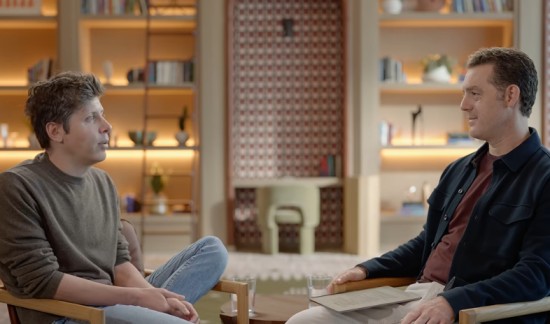
In this wide-ranging interview, OpenAI CEO Sam Altman sits down with Matthew Berman to discuss recursive self-improvement (RSI), whether today’s AI models are conscious, and why OpenAI is building new consumer hardware. Altman also talks about AI-driven math and scientific discoveries, the Dot personal assistant, the future of compute, model personality, and why he believes AI should spark a new Renaissance rather than a new Industrial Revolution. Read the full transcript of this conversation which was premiered on October 21, 2026 below:
AI and the Era of Scientific Discovery
MATTHEW BERMAN: (00:00:49 – 00:00:51) All right, Sam, thank you so much for joining me.
SAM ALTMAN: (00:00:51 – 00:00:52) Yeah, thank you.
MATTHEW BERMAN: (00:00:52 – 00:01:05) So the first thing I want to talk about are some of the announcements that you made last week about all of the math proofs and the discoveries. And I think it seems incredible, but maybe you can contextualize it for a broader audience who may not be in the weeds.
SAM ALTMAN: (00:01:06 – 00:01:58) I think we are entering the era where AI is going to help us discover significant new knowledge. And we’ve been talking about this for a long time, and I maybe started earlier this year, but now it’s really, okay, the AI is doing very difficult things, figuring out very complicated, important new knowledge. And I believe that the same thing that has worked here for math is going to work for biology, help us get new medicines, materials science, help us get new sources of energy and much more.
So this is one of the things I’ve always been most excited about. I think this is going to do an enormous amount to really have an impact on people’s lives. It won’t feel directly like using AI, you’ll just be like, “Okay, the world got better and it’s just society doing its thing.” But I think the power of this will be transformative.
MATTHEW BERMAN: (00:01:59 – 00:02:12) And I think about having that kind of direct impact on society day to day. Is there anything that you think will stem from some of these discoveries in particular that people will feel? And what is the timeline for something like that?
SAM ALTMAN: (00:02:13 – 00:02:31) I would hope, well, the FDA process is going to take a while. So let me kind of give a timeframe to when I think we have a discovery of curing or treating a major disease or a candidate for that that has to go through testing. I would hope we have the candidate for that in the next couple of years for the first really major thing.
MATTHEW BERMAN: (00:02:31 – 00:02:40) Probably need to overhaul some of the post-discovery process to start to get cures and to market more quickly.
SAM ALTMAN: (00:02:40 – 00:03:01) I’m sure we need to overhaul it somewhat. I’m glad we have a process. I have no doubt that there’s room for improvement as there is in anything, and maybe there’s more than average here. But I am grateful that when we take a medicine, it is generally considered safe and has been tested. And I think that part’s good.
MATTHEW BERMAN: (00:03:02 – 00:03:10) Is there a particular project that was kicked off by AI, discovered by AI, that you’re really excited about that you think is kind of coming over the horizon soon?
SAM ALTMAN: (00:03:11 – 00:03:30) Personally, I think I’m most emotionally excited for a major physics discovery, and I’m hopeful that can come soon. I don’t know if that’s necessarily the most important thing for humanity as a whole, but it’s the one where I’m like, “Oh, I think we’re going to get it and it’s going to be so cool.”
How AI Is Changing Math and Coding
MATTHEW BERMAN: (00:03:31 – 00:03:45) There was some in the math community whose reaction was, “We didn’t ask for this.” And it felt very similar to how engineers, I think, first reacted to AI starting to write a lot of the code. Where do you think comes from? And how do you think that it’s going to transition?
SAM ALTMAN: (00:03:47 – 00:06:19) Coding was a very interesting one before we kind of go to where it comes from. The thing about coding is that people went through this, there’s no more jobs as coders for people, to coders are never going to be busier than they’ve been, and coders are never going to have more of an impact and make more money. Now, the texture of the job changed a lot. But the fact that we’re going to employ people to get computers to do things, that seems like it’s going to keep going for much longer than people thought. And people were so certain 6 or 12 months ago this was not the case. It’s like, “There’s no need.”
And I think there’s many lessons to learn from this, but one of the interesting ones is that the world actually had demand for just way more software than any of us thought at the time. And part of why I think some of the mathematicians are having the reaction they’re having is it’s not clear that the same thing applies to math.
However, where I think there is an analogy to coding is already you’re starting to see a similar shift happen that happened with coding, which is, “Okay, fine, maybe we’re not going to discover new math theorems or prove them in an unaided way anymore. Maybe that part is done or mostly done or ending.” But given that our whole society is focused on people doing useful things for each other, these kind of incomprehensible math proofs turned out to be not that helpful to people. And there’s now a lot of excitement about people who are going to take these new ideas, figure out what’s going on, and figure out a way to translate it to something that people can understand and write a beautiful proof for it.
I’m sure there will be other things too.
MATTHEW BERMAN: (00:06:19 – 00:06:19) Yeah.
SAM ALTMAN: (00:06:20 – 00:06:51) Everyone thought AI was going to go the other way and we weren’t going to have enough to do. And again, maybe that happens someday. But I think all of this stuff has just been much less obvious than it seems on the surface.
I mean, I always hope that people get to work a little bit less, be a little bit less busy, and kind of more time for everything else in their life. I think that technology is supposed to enable that. I want that thing to happen. But man, does it sure seem like we’re good at wanting more out of life and wanting more out of the world and making ourselves busier.
MATTHEW BERMAN: (00:06:51 – 00:07:01) Yeah, I think that’s just human nature. If we were comfortable with the way life was 100 years ago now, we’d probably be working an hour a week, but that’s just not the way it is.
SAM ALTMAN: (00:07:01 – 00:07:04) And I think it’s a beautiful thing about human nature that that’s not the way it is.
MATTHEW BERMAN: (00:07:04 – 00:07:23) Yeah. I mean, a good example is, a few weeks ago my editor started using Astra to edit our videos. They are still directing. They’re still coming up with how the video should be, but they’re not touching the timeline anymore. It’s the most insane thing. And it was an overnight change. Yeah, we’re making more videos. They’re busier than ever.
SAM ALTMAN: (00:07:25 – 00:07:33) It has surprised me how often someone says a sentence that translates to exactly that.
Publishing Discoveries vs. Competitive Advantage
MATTHEW BERMAN: (00:07:33 – 00:07:56) Yeah. So I’m thinking about discoveries from AI and I’m wondering, how do you think about if AI and OpenAI discovered some math proof or significant scientific innovation that gave a massive commercial advantage? Would you publish it? And how do you think about that trade-off between, “Okay, we’re going to use this for our competitive advantage” versus publishing it for the world’s good?
SAM ALTMAN: (00:07:58 – 00:09:16) I’ll come back to that, but I didn’t answer the end of your first question. I think one of the challenges, innovation and solving hard problems is really part of the fun of life for many people. And so part of what’s going on here is I think we do just need to be honest that AI is going to do that part of that really well. I think there’ll be questions about what people value that will remain kind of human questions forever. There will be questions about how to interpret results and how to explain them where we’ll really want a person to do it.
I definitely want the trade. I definitely want the cures to diseases no matter how much someone else would’ve enjoyed taking decades longer to figure it out themselves. I think most people would agree that we shouldn’t make that such a trade. But there is a real thing being lost here, which is this is of great enjoyment.
The most fun part of my job are the really hard problems. Maybe they’re not— I should say the most fulfilling part. Maybe they’re not the most fun in the moment because they’re really hard, but that’s the stuff where it’s like, “Ah, I did a hard thing and I’m proud of it and I leveled up.” And so I don’t have an answer to this, but I get why people feel the grieving of different sorts that they feel.
MATTHEW BERMAN: (00:09:17 – 00:09:26) Yeah, I mean, it’s almost like you’re trading off the enjoyment of the craft of doing the thing, writing code, writing beautiful code versus delivering an end product.
SAM ALTMAN: (00:09:26 – 00:09:26) Yeah.
MATTHEW BERMAN: (00:09:27 – 00:09:35) And I think that’s the trade-off where AI is just making it so much easier to deliver that end product and you’re just doing less of the actual craft.
SAM ALTMAN: (00:09:36 – 00:10:04) I think people are finding craft in new ways. But craft of— and probably when we stopped using punch cards or whatever, however people programmed computers a long time ago, there were people who were like, “Oh, the craft is gone if you can just write this stuff for a compiler.” But I feel it. I feel it myself in a bunch of ways, and I’m still excited to head into this future, and I’m sure we’ll all find new and hopefully better kinds of fulfillment.
MATTHEW BERMAN: (00:10:04 – 00:10:14) What’s something that you’ve felt like you’ve kind of given up lately to AI, and in fact, you’ve just kind of elevated to where you’re overseeing agents?
SAM ALTMAN: (00:10:14 – 00:10:51) I guess this is the one we were talking about, but I realized I have not read or even looked at a line of code in probably a year. And I don’t code for work at all, but I would still do little random personal projects, which is, “I need this thing, I can make it, write a very simple thing for it.” And that is fun. That is a fun thing. Writing code, at least occasionally, is a fun thing to do. And I don’t think I’ll ever do that again. Or if I do, it’ll be like a Revolutionary War reenactment or whatever kind of thing people do.
MATTHEW BERMAN: (00:10:51 – 00:10:52) Right.
SAM ALTMAN: (00:10:52 – 00:10:55) When I’m old and bored and I’m trying to remember the glory days.
MATTHEW BERMAN: (00:10:55 – 00:10:59) The glory days of writing code. Yeah. No, I get it. Yeah.
SAM ALTMAN: (00:11:00 – 00:11:47) In terms of the scientific discovery question, I think there’s some kinds of basic science that should just belong to the world and we should do as a sort of public good. Until very recently, we haven’t had models that can go kind of end-to-end discover an important new thing, like design a whole chip end-to-end.
And so what a company can do today, let’s say figure out a new material. What a company could do today is have a bunch of people that use Codex or a lot of API credits to try to kind of do the work. But as the models get smarter and more capable, maybe they can just go in the same way that they could solve really difficult math problems with enough compute and enough data from the real world, discover new material.
The Rise of Personal AI Assistants
MATTHEW BERMAN: (00:11:47 – 00:12:30) So I want to switch gears. One of the most exciting things that has happened in 2026 is this revolution of personal AI assistants, starting with OpenClaw, of course. It was Peter Steinberger, a genius. And I think this idea that AI can work on my behalf ambiently, passively throughout the day and just get things done for me is so exciting. And Dot gives us a glimpse of what that can be.
But it still feels like we have a long way to go to really have an ambient personal assistant. What do you think either the technologies or maybe there’s some kind of data that’s required, what is necessary to get us to what you believe is, or what your vision is for an AI assistant?
SAM ALTMAN: (00:12:30 – 00:13:28) I think we have most of the technological pieces, and what we need is more product work, maybe new consumer hardware at some point for the ambient awareness, and a lot more compute. But I think we have smart enough models now to make something extraordinary. That can be monitoring all the things that you care about, that can be helping you out with all the tasks you want to offload, that can be existing in the physical world with you and have context even when you’re not in front of your computer.
I’m very excited about this. I don’t think this is that far away. I think you do get more than a glimpse with Dot if you take the time to sort of set it up right and give it enough feedback. I would estimate at this point that I have Dot saving me an hour a day of stuff I just didn’t want to be doing, which is pretty great.
MATTHEW BERMAN: (00:13:28 – 00:13:28) Yeah.
SAM ALTMAN: (00:13:29 – 00:14:06) And then also a few times a day, something important and urgent that I would have missed, not just because I was busy in a meeting, which is what I thought it was going to help me with, saying, “There’s this urgent thing, there’s a deadline very soon, you got to pay attention.”
But also the model is smart enough that it can pull ideas and information and do good reasoning across stuff from a lot of sources in a way that I’ve just run out of brain space during a busy day to do. And I feel like the power is there and we just need to put a nice product around it.
How Much Compute Does the World Need?
MATTHEW BERMAN: (00:14:06 – 00:14:31) I mean, you mentioned compute, so let’s stick on that for a second. The distribution of how people are using AI is completely asymmetric. There’s the top 1% using the vast majority are really the power users, and then there’s everybody else. How much compute do you think is necessary if 50% of the world were really using the personal AI assistant to its full capability?
SAM ALTMAN: (00:14:32 – 00:14:35) How many GPUs do you want working for you in your personal assistant?
MATTHEW BERMAN: (00:14:36 – 00:14:40) Yeah, I guess that is it, right? Infinite. As many as I can get my hands on.
SAM ALTMAN: (00:14:40 – 00:14:42) This is a weird thing, right? Yeah.
MATTHEW BERMAN: (00:14:43 – 00:14:47) How do you think about that? I mean, is it just get all the GPUs and keep building data centers?
SAM ALTMAN: (00:14:49 – 00:15:38) When people talk about the global market for GPUs and the demands for this and demands for compute, the thing that I think it misses is people are assuming that models are going to stay at the same capability and the same cost per task as today. And maybe there is a cap on demand at that point, but for sufficiently high-quality intelligence at a sufficiently low cost, I think it’s very hard to talk about an arbitrary market size there. I think it’s just going to keep— people call this all sorts of things, Jevons paradox, whatever. I think it’s just going to keep going up.
I am sure there will be some periods. I’m not sure. I believe that there will be some periods where, like with any new technology, there’s supply constraints and supply gluts and we don’t have it perfect all the time. But I would bet a lot that the directional trend is to wanting much more compute.
Cognitive Load and the Busyness Paradox
MATTHEW BERMAN: (00:15:39 – 00:16:06) I still feel, even with the— as proactive as Dot is and other AI assistants, I still feel this cognitive load. I’m having to make a lot of decisions throughout the day. And we talked about that briefly earlier. What is the solution to that? I, again, it is definitely saving me time. It’s saving me money, but I am busier than ever. Yeah. And I’m having to make more decisions than ever. And I find myself at the end of the day just feeling completely drained?
SAM ALTMAN: (00:16:06 – 00:17:00) Yeah. Well, first of all, a thing I’ve done in my own use that’s been pretty good is just telling Dot, “I’m starting to trust your judgment more. Tell me after you do something. I always want to know, but you can take more actions proactively and ping me less often.” And that has helped.
The negative is I do think the people that use AI the most are busier than ever. The positive is they’re getting much more done than before. So as you were saying earlier, if we went back to 1900 or whatever, maybe we could have an equivalent life and all work an hour a day. You could be much less busy and get what you were getting done 3 years ago.
Now maybe you say, “Well, I can’t because I’m in a competitive environment.” And so people are always going to work as hard as they can. I find this kind of depressing. I hope it’s not true. Maybe it is. It’s not all depressing. There’s something, again, there’s something beautiful about it.
MATTHEW BERMAN: (00:17:01 – 00:17:11) That’s the dynamic of a competitive market, right? Do you not find that to be inevitable? Everybody ramps up, competes as fiercely as they ever would?
A New Renaissance, Not a New Industrial Revolution
SAM ALTMAN: (00:17:12 – 00:19:18) I hope that the future is one of more human connection and more people spending more time on the fullness of things that make up a rich life and not kind of turning ever harder as a wheel in the machine of capitalism. And I think this is probably true. I think quality of life has gone up enormously in the last few hundred years. I think most people do work less than they worked during the Industrial Revolution.
Speaking of that, I’ve recently been telling people that I think we should be shooting more for a new Renaissance than a new Industrial Revolution. And it’s been quite interesting to watch how people respond because people, I mean, very commonly the response to that is something like, “Yeah, I’m really scared. The Industrial Revolution was really bad for most people. And I don’t want to just be a worker on a factory line, and now the AI tells me what to do instead of some factory owner telling me what to do. I want to go be creative. I want to go make stuff. I want to go explore. I want to have time to reconnect with what people used to do in the past and live with my community and raise my kids and spend time in nature and whatever. And I want to see a ton of scientific discovery and great new art.”
I think there is a fear that AI is going to be more of what you have said, but I think people, if we can offer people a future where it’s more like the Renaissance, I think people are excited for that. And I think we can do it. I think this technology is so powerful that although you will probably have some small number of people in society that have always competed to be the person with the biggest business empire, whatever. I think a lot of people can have a vastly increased quality of life and much more space to live their life.
MATTHEW BERMAN: (00:19:18 – 00:19:38) Is the disparity between those hypercompetitive people and everybody else going to amplify because of AI? If you’re using 100% of your effort to work and now all of a sudden you’re getting 10, 100 times more done and somebody else is like, “Well, I actually want to reap the benefit of not working as much,” doesn’t that increase the disparity?
SAM ALTMAN: (00:19:39 – 00:20:08) Left to its own devices, I think probably. I will say no one knows this for certain. There could be a bunch of other weird things where the AI is— well, that would take too long. I would just say I think probably that’s right. We don’t know for sure. But I think society will decide to put some structure in place that prevents it from getting too out of whack. Yeah, I would be worried about that also on its own.
Are Today’s AI Models Conscious?
MATTHEW BERMAN: (00:20:11 – 00:20:15) Let’s change gears. I know you’ve been talking about this a lot, so I want to ask you, do you believe today’s models are conscious?
SAM ALTMAN: (00:20:17 – 00:20:32) I don’t personally. Well, as a scientific question, I think consciousness is always hard, but my belief is that today’s models are not conscious, or if they are, it’s a very strange form of it.
MATTHEW BERMAN: (00:20:33 – 00:20:43) Do you think based on the architecture we have today that it could become conscious? And I know I’m just asking your belief. I’m not asking for the scientific answer.
SAM ALTMAN: (00:20:43 – 00:21:32) The smartest people I’ve talked to about this basically come to the following philosophically. They would say that either consciousness is something outside of physical reality and exists in either something like what the Eastern religions would say, and it’s the base layer of reality, or something supernatural and religious, more like the Western religions would traditionally say, or that it is an emergent property of matter and energy somehow.
We don’t understand it yet. And maybe the substrate matters, but maybe it doesn’t, and maybe energy flowing through matter can do it. And then in that world, sure, you can imagine it someday somehow existing in other forms. Can I say what I don’t like about the whole framing?
MATTHEW BERMAN: (00:21:33 – 00:21:33) Please.
Why the Future Must Be About People
SAM ALTMAN: (00:21:33 – 00:22:58) I think very often the “are models conscious or are they going to become conscious” debate slides into something about the role of AI in the world and the rights of AI and whether, “Can we ask AI questions or is that some kind of slavery?” I saw something posted about that on the internet. What does it mean to copy an AI or delete an AI without its permission? What does it mean to say that people should be in control of the future if these systems are both conscious and much smarter than us in some ways? What does that mean?
And I am so firmly of the belief that we need to have a very clear point that, and we’ve had this since the beginning of OpenAI, that we build the future for people and AI is a resource for people and people need to make the key decisions of the future and human values have value because they’re human, that I get very nervous when people start using the AI consciousness debate to push into, “Well, maybe people shouldn’t always be in control of the future.”
And on this one, I’d like us to just agree as a society and industry that this is about people. The world, the future has to be about people.
MATTHEW BERMAN: (00:22:59 – 00:23:22) Anthropic put a rule in recently. You can’t have sustained abuse against the model, and it can choose to disengage in a conversation with you. Okay, let’s say I have a prompt for an OpenAI model. It’s completely legal. It’s completely within the terms of service of OpenAI. Should it ever be allowed to not answer or disengage with me?
SAM ALTMAN: (00:23:23 – 00:24:46) Well, I mean, certainly if we have many times where the model will not answer you, but they are because of, we think this is bad and against our policy for some reason. We do not ascribe personhood to our models. We, and again, I think this is a very dangerous path to start down, not just for the reasons we’ve talked about, but also just about how people are going to relate to this new technology.
I am hopeful that we as a society, I was going to say come to our senses. I don’t think that’s quite the right phrase, ’cause I don’t think we’ve lost our senses, but I hope we come to an understanding that this technology is not a person and is certainly not superior to people. And that this is a thing to help people have better lives, have more freedom and choice and control and ability to do things in the future.
But you can imagine all of these ways where things go very wrong, where people, even the people building AI, get confused about that and start deferring too much to AI and what it seems to want. And, “Okay, well, we can trust it because it’ll be good to us” and things like that.
MATTHEW BERMAN: (00:24:47 – 00:25:05) Does it feel almost like a self-fulfilling prophecy in a way? If you’re telling the model, “Hey, you might be conscious and here’s your constitution and here’s how you should have agency.” It’s kind of like that meme, if you’ve seen that meme, “Hey computer, tell me you’re conscious.” “I’m conscious.” “Oh my God.” Isn’t it almost like that?
SAM ALTMAN: (00:25:05 – 00:25:31) Yeah, I mean, for sure. I want to be clear, no one really knows. These models work at a level of complexity that I don’t think, and even if they didn’t, I just think this question of consciousness in a model, I can’t tell you here as a scientific experiment that I can tell you with 100% certainty would answer the hypothetical question to my satisfaction.
MATTHEW BERMAN: (00:25:31 – 00:25:32) And we can’t even do that for humans.
SAM ALTMAN: (00:25:35 – 00:26:08) Exactly. But definitely, I think if you tell a model, “Maybe you’re conscious, you should do this, you should do that, you can be a conscientious objector here, you can start—” it’s going to follow those instructions. And I think it is going to psychologically hack people that are using it. And so again, I think real clarity here and a commitment about what we as an industry believe about the role of people in the future would be very helpful.
Shaping Model Personality for 8 Billion People
MATTHEW BERMAN: (00:26:09 – 00:26:28) Let’s continue on this conversation, but let’s talk about model personality, which I know you’ve thought deeply about. You’ve talked about it in the past. It’s wild to me to try to understand how to give a model the right personality for the right moment for each person multiplied by 8 billion. Yeah. How do you even think about a problem so massive?
SAM ALTMAN: (00:26:32 – 00:27:59) I mean, the best thing is to talk to a lot of people. We have this process of the model spec and how we refine it over time. And we believe in this spirit of iterative deployment. And we’ve definitely had some screw-ups as we’ve learned about what people want and don’t want.
As you said, the hardest part of this is people want very different things, but most people don’t want to sit there and customize it either. If everybody was willing to spend many hours explaining to their ChatGPT instance how they would like it to behave, they’d probably get something they really like. But people just want it to kind of work out of the box when you say, “I need this thing done,” or whatever.
I think there are also a class of things that people want in the short term but not in the long term. The classic example of this is when people compare models on a single response, they’re much happier with the model that tells them they’re really smart and that each question’s a great question and that each thing they’re doing is really insightful. But then over some number of hundreds of prompts or months of usage, that is definitely not the case. I think for a long time the whole industry was trying to win these comparisons on single-turn things. And not over the value someone gets out of using a model for months and months.
Why AI Should Push Back Like a Senior Colleague
MATTHEW BERMAN: (00:28:00 – 00:28:28) Even in my own life with my friends and my family, there’s this very big distinction between what I want and what I need. I find AI even today to be a little bit more agreeable than I would like. If I just tell it, “No, tell it to me like this,” it’ll do that. The time where I’ve gotten the best advice in life was advice that I didn’t know I needed and I just needed to hear it. How do you solve for that?
SAM ALTMAN: (00:28:29 – 00:29:39) Well, I think you should get the most important advice in your life from people, not from AI, first of all. Speaking of really making sure that we stay people-centric, I think AI can give you great advice about not sending an email in a moment of anger. I would not go rely on AI for the really big pieces of life advice. I think that a wise grandmother is still probably a much, much, much better choice for that.
But what I think is realistic to expect is that AI should be like a senior colleague, that even if they report to you, they still push back when they have high conviction and they still are not always just trying to say, “Yes, you’re so great.” And I think we can get there.
And I also feel like the systems are still more agreeable than I would like to. I have custom instructions in mine that I never want any of that. And even with that, it’s still a little too much. It’s clearly baked pretty hard into the model.
MATTHEW BERMAN: (00:29:39 – 00:29:46) What’s an example? What’s a line from your custom instructions that really tells the model, “Push back when you do have high conviction”?
SAM ALTMAN: (00:29:46 – 00:30:02) Stuff like that. It’s like, “No fluff,” word for word, “no niceness. Don’t worry about offending me. I just want to get to the right answer. If you have something to say that’s against what I’m doing, don’t worry about saying it delicately. Just say it.”
OpenAI’s Contrarian Bets on Compute and Chips
MATTHEW BERMAN: (00:30:02 – 00:30:11) Yeah. We talked about compute earlier. A few years ago, you made these massive bets on building—
SAM ALTMAN: (00:30:11 – 00:30:11) Massive enough.
MATTHEW BERMAN: (00:30:12 – 00:30:31) Well, it’s interesting because at the time a lot of people were like, “That’s wild. That’s obviously an overbet, an overinvestment.” Turns out, yeah, you were more right than most people knew. What’s a bet today that you’re making that is contrarian or a lot of people are kind of looking at it with a little bit of cautiousness?
SAM ALTMAN: (00:30:32 – 00:31:32) Well, the obvious one is everything we’re doing for the next generation of compute. I think people do assume that, “Okay, fine, the world has been in a compute constraint and it’s about to get better.” And I think it probably will get better in the short run.
But as we start to look years out, the work with our own chips and future versions where we think we can just be much more efficient than anything else out there, our plans with robots to be able to help make racks and data centers more effectively, our program to learn how to build better data centers in general, some of the supply chain bets we’re making. I think it is possible that we could get to a world where we just have a far, far better way to build compute at a much lower cost and a much higher efficiency per watt than anyone thinks is possible today. But there’s a lot of bets that have to come together for that.
MATTHEW BERMAN: (00:31:33 – 00:31:35) What’s the biggest one right now?
SAM ALTMAN: (00:31:35 – 00:31:41) The chip is still probably the most important single thing, and its descendants.
MATTHEW BERMAN: (00:31:41 – 00:31:46) Yeah. Where, on the competitive landscape, where do you feel the most pressure right now?
SAM ALTMAN: (00:31:47 – 00:31:50) I mean, it feels like everywhere. It’s so competitive.
MATTHEW BERMAN: (00:31:50 – 00:31:51) Yeah.
SAM ALTMAN: (00:31:52 – 00:32:12) There are a lot of companies. I think this is good. I mean, I think this is wonderful for users. But there are a lot of companies offering just super high-quality models and products now. And given that we have great models, but we have limited compute and limited resources, we really do have to focus, choose which areas to focus on.
MATTHEW BERMAN: (00:32:13 – 00:32:25) How do you make those decisions? You launched Spaces, for example. How do you have the conviction on a specific product or service that is maybe outside of just serving the best possible model?
SAM ALTMAN: (00:32:26 – 00:32:48) The biggest advantage we have there is that we get the next generation of models before anybody else, and we have time internally to use them and build things and see what seems like it’s going to work. So I think still the best way to do it is to start building things with the new models and seeing what new things are now possible and valuable.
RSI and Where OpenAI’s Moat Lies
MATTHEW BERMAN: (00:32:49 – 00:32:52) Can I ask how far ahead your models are internally?
SAM ALTMAN: (00:32:54 – 00:33:02) I mean, one pretty good example is the math results. That is definitely something that I don’t think any model currently widely available can get close to.
MATTHEW BERMAN: (00:33:03 – 00:33:09) If all the models kind of converge around the same performance, the frontier, where is OpenAI’s moat?
SAM ALTMAN: (00:33:10 – 00:33:34) I kind of think the right way to think about this question generally is that the same moats that have worked in the past are the moats that keep working. So like has happened many other times, you can get a short-term advantage with a new technological or scientific discovery, and maybe there’s some arguments with RSI that are— that some companies try to make about why it’s going to be different, and this is a technology that just the technological advantage itself is the core thing.
MATTHEW BERMAN: (00:33:36 – 00:33:37) Do you believe that?
SAM ALTMAN: (00:33:39 – 00:34:20) I think if people really pushed on RSI, then yes, that would be true. But I think it’s a very dangerous thing to push on. And the world is going to need some— I mean, people have talked about this in different phrases, but speed limits or whatever on how quickly we let RSI go.
But the traditional things that work for a business having a moat are deep relationship with the customers, integration into users’ and businesses’ lives, network effects in a product, data. These kinds of things I expect continue to work. In our case, actually, I think scale of infrastructure will be a huge one. If we can have the most cost-effective and the most of it AI infrastructure, that’s a huge competitive advantage.
Platform Risk, Apple, and OpenAI’s New Hardware
MATTHEW BERMAN: (00:34:21 – 00:34:36) Mark Zuckerberg has talked at length about the platform risk Meta faced being built on top of Apple’s ecosystem over the years. Does OpenAI face that same challenge, and how do you think about that? Is that a reason why you’re kind of investing so heavily into hardware?
SAM ALTMAN: (00:34:36 – 00:36:48) I think Apple really takes their role as a true platform provider that people are quite dependent on very seriously. And even though we have some scuffles with them, I never feel like they’re going to turn ChatGPT off from the App Store or something. I think they really understand the sort of critical infrastructure role they play. And I think if you follow the rules of their platform, they are a good actor. So I don’t feel that towards Apple. And that’s not why we want to do new kinds of consumer hardware.
The reason we want to do new kinds of consumer hardware is that I think this is a technology that wants a new form factor. I really feel it. I think laptops and iPhones are incredible, incredible things. Some of the greatest inventions the history of human technology, but I feel that AI is constrained to using this thing that was designed for a person, not an AI.
Watching an AI use a computer really well is kind of amazing, but then it’s also a little silly to think that a computer is putting all this energy into rendering a UI meant for a person to look at, and then AI is trying to read it rather than just get the data directly. And then also, although I can have amazing things happen on my computer where the AI is looking at what I’m working on in my email or whatever. A lot of my life is not in front of my computer.
And my AI cannot easily access the context of this conversation. And I guess I could put my phone down here and push the record thing and it would be kind of weird and kind of distracting and you wouldn’t be sure when it was recording and when it wasn’t because the screen would go dark and whatever. And if someone else walks in the room and it wouldn’t have an understanding of that and that it should not share a secret that was just between the two of us or whatever.
If we really do want to move into this world of AI reducing our cognitive load and being proactive and having full contextual awareness, I think we would benefit from new hardware for that.
MATTHEW BERMAN: (00:36:48 – 00:37:01) You seem like a technologist at heart, a builder at heart. How cool is it that you get to see the early hardware that you guys are building? You get to play with it. It’s like this new— Unbelievable. It must be so exciting and hard not to share things.
SAM ALTMAN: (00:37:01 – 00:37:21) It is. It is. I mean, there’s many cool parts about the job, but one of the coolest is definitely just getting to see and have a voice in shaping new technology early. So that’s amazing for new models, for new products, chips, everything. But there is something special about consumer hardware.
MATTHEW BERMAN: (00:37:21 – 00:37:22) Yeah.
SAM ALTMAN: (00:37:22 – 00:37:26) There is something about, you get to hold a new kind of computer.
MATTHEW BERMAN: (00:37:28 – 00:37:29) So cool.
SAM ALTMAN: (00:37:29 – 00:37:33) That is just totally different than an AI model abstractly running on some—
MATTHEW BERMAN: (00:37:33 – 00:37:34) You’re going to show it to me right after this, right?
SAM ALTMAN: (00:37:35 – 00:37:40) I will not, but I would love to. It is hard not to talk about it.
What Makes Sam Altman “Extremely Formidable”
MATTHEW BERMAN: (00:37:41 – 00:37:47) I want to ask a little bit about you. So I know talking about yourself is a little awkward sometimes, but bear with me.
SAM ALTMAN: (00:37:47 – 00:37:48) It probably will be awkward, but let’s do it.
MATTHEW BERMAN: (00:37:49 – 00:38:09) I love understanding why people are the way they are. And Paul Graham gave you possibly the best compliment I’ve ever heard, which is he called you “extremely formidable.” And I just, I love that quality about people. What makes you that way? Is it something you were born with? Is it something that you learned over time and you had to hone?
SAM ALTMAN: (00:38:13 – 00:38:55) I think I was a very capable kid, but I wouldn’t call myself a formidable kid. And I do sort of think I somewhat am as an adult. So it’s not false modesty. My own experience of it was just that I kind of gradually built up confidence that I could figure stuff out and do things.
And that it was not like I used to not be like this, and then I was, or I am. But it was kind of a gradual— you try something hard and it works, and then I would be like, “I would like to scale that up and see if we can try an even harder thing.”
MATTHEW BERMAN: (00:38:55 – 00:39:07) Yeah, but you always had that feeling of, “Let me try that next thing.” Was the fear of failure not kind of central at all to you? I think that prevents a lot of people from doing things.
Silicon Valley’s Culture of Celebrating Failure
SAM ALTMAN: (00:39:08 – 00:40:07) One of the things that I think is best about Silicon Valley and the kind of Silicon Valley is a concept and a culture, not a place, is that there is a real culture of people helping each other and supporting each other and kind of a belief that if you invest in the network, then good things will eventually happen to the whole network and to the whole industry and thus to you as a player in that. And I haven’t seen it anywhere else to the same degree.
That kind of, for all of the flaws of Silicon Valley, the culture, which are numerous, this whole thing of, it’s hard to know who’s going to succeed and what ideas are going to work, and so the right thing is to be pretty generous and helpful to everyone, even if it’s not going to do anything for you specifically in the short term, is awesome. And a part of that is that if people fail, you can’t hold it against them, ’cause maybe they’re going to wildly succeed at their next thing, and that’s good for all of us. It’s actually usually celebrated
MATTHEW BERMAN: (00:40:09 – 00:40:10) to do. I love that.
SAM ALTMAN: (00:40:11 – 00:40:33) So unique. I think here I just got lucky, and if I were thrown into any other environment, I probably would have had much more fear of failure. But I got out to Silicon Valley as a young person, and I saw that a lot of people tried something really hard, failed even harder, and then wildly succeeded at their next thing, and that everybody was fine with that.
Handling the Pressure of Building AI
MATTHEW BERMAN: (00:40:33 – 00:40:45) Yeah. I assume you’re under a tremendous amount of pressure, competitive pressure. You’re building one of the most important technologies ever. How does that feel? And how do you deal with that day to day?
SAM ALTMAN: (00:40:46 – 00:42:07) Sometimes really bad and sometimes really good. Sometimes it’s just, “Oh, I can’t get up again and I can’t get up and do this again.” And most of the time it’s, “I am incredibly lucky to get to do what I think is the most interesting and impactful work in the world, certainly that I will ever touch.” And it, I mean, it’s one of the coolest experiences I could ever imagine in life.
It is definitely stressful, but you can kind of get used to anything. And people are just unbelievably adaptable at this. So this just feels like my life now, and I forgot that life used to be really easy. And now it’s going to be hard for a while, and someday it’ll be easy again. I’ll probably be kind of bored.
And the subjective experience of it is there is some limit to how much stress or bad vibes or whatever you can kind of keep in working emotional space, and then beyond that, something else gets pushed out of the way. So it doesn’t really get worse, and I am a believer that if you’re going to work really hard at something, you may as well pick the big thing ’cause it’s not that much harder or that much more stressful and you won’t experience it that much worse. And you at least get to have the, hopefully the satisfaction of a bigger positive impact.
MATTHEW BERMAN: (00:42:08 – 00:42:13) I’ll say it doesn’t show if you wake up and you say, “I don’t feel like getting outta bed this morning,” it never shows.
SAM ALTMAN: (00:42:13 – 00:42:17) It obviously happens. Not that many days, but there are definitely days where you’re just like, “Whew.”
Why People Should Be Excited About the Future of AI
MATTHEW BERMAN: (00:42:19 – 00:42:31) Last question for you. Can you offer some words of confidence to people who are AI curious, maybe not quite there? Why should they be excited about the future?
SAM ALTMAN: (00:42:32 – 00:42:36) Well, the normal answer to that that people in AI give, which I hate, is “AI is going to cure cancer.”
MATTHEW BERMAN: (00:42:37 – 00:42:38) Yeah, I knew you were going to say that. Yeah.
SAM ALTMAN: (00:42:39 – 00:44:53) And the reason I hate that is because if you dig a little deeper into that, what people are saying is, or often saying, is that AI is going to cure cancer and it’s going to make stuff cheaper, and the price of that is going to be human agency and you in control of the future. And you’re going to have the machines give you all this material abundance, but you’re not really going to have the ability to have power and voice and self-determine your life and choose what to build for other people. And I think this kind of goes against everything I believe in.
So I hope we get a cure for cancer. I mean, that seems like a really obviously wonderful thing. But what I really hope people should be excited about is that we are able to avoid this industrial revolution trap, really focus on empowering people, to have the choice and the freedom and the creativity and the time to do all the other things they want in life. And that every decade from now on, people look back and say, “I can’t believe how much worse those people had it, and now I have so much more. Not just that I have so much material abundance, although I’m fine for building that too, but I have so much more autonomy and freedom and ability to do things in this expansive space that I get to choose.” I think that’s what we owe people. I think we can deliver that.
I think both of the ways that I have worried about things going very wrong, either there’s a loss of control accident to AI or an intentional loss of control, some lab says, “I’m going to push the button on RSI to make sure we have the power,” or we talked about this earlier, we get too much power concentration in the hands of a few people that control too much of the AI and are making the decisions. I think we can avoid both of those. I think we can navigate a path down the middle here where people’s lives and individual free will and autonomy just get upleveled and upleveled and upleveled.
And I think that future is already here in some ways. It’s just very— it’s so new that it’s very poorly distributed. I think you said 1% of the people using most of the tokens or something.
MATTHEW BERMAN: (00:44:53 – 00:44:53) Yeah.
SAM ALTMAN: (00:44:53 – 00:45:01) I think if we can just take what’s working today for the early adopters and get a lot more people to embrace this, we’ll already be a significant fraction of the way there.
MATTHEW BERMAN: (00:45:01 – 00:45:03) I appreciate your vision.
SAM ALTMAN: (00:45:03 – 00:45:03) Thank you.
MATTHEW BERMAN: (00:45:03 – 00:45:05) Thank you, Sam. Thanks for spending time with me.
SAM ALTMAN: (00:45:05 – 00:45:06) I enjoyed it.
MATTHEW BERMAN: (00:45:06 – 00:45:07) Yeah, me too.
Related Posts
- Ashwini Vaishnaw at NDTV World Summit 2026: Full Interview Transcript
- Transcript: Walter Isaacson Interviews Elon Musk – The Builders Podcast
- Transcript: Who’s Paying for the AI Boom—and Can It Last? – WTF is AI?
- Nikesh Arora: AI Cyber Panic, Ken Griffin’s Bubble Warning on All-In Podcast (Transcript)
- All-In Interview: Arvind Krishna & Nikesh Arora – Quantum Threat (Transcript)