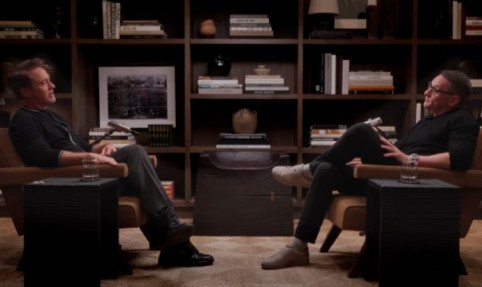
Read the full transcript of Hollywood icon Robert Downey Jr.’s interview on The LIVING Room Podcast, May 22, 2026.
Editor’s Note: In this episode of The LIVING Room Podcast, host Chris sits down with Hollywood icon Robert Downey Jr. to discuss his personal journey toward longevity, deep resilience, and the power of hard-earned discipline. Drawing from his own life transformations as he steps into his sixties, Downey shares practical insights on avoiding burnout, cultivating meaningful relationships, and what it truly takes to find authentic happiness. It’s an honest, raw conversation about separating the signal from the noise to build a intentional life.
Introduction
CHRIS WHARTON: Robert Downey Jr.
ROBERT DOWNEY JR.: What’s up, brother?
CHRIS WHARTON: Welcome.
ROBERT DOWNEY JR.: Chris Wharton, as I live and breathe.
CHRIS WHARTON: Or as I like to call you, patient zero.
ROBERT DOWNEY JR.: Yes, yes, we’re going to get to that, but in a vacuum it sounds weird. It sounds like you got me like locked up in the covered here. Yeah.
CHRIS WHARTON: Well, that’s the first time out in some time. I’m— hey, I’m glad you’re here.
ROBERT DOWNEY JR.: I’m glad you’re doing this. Thank you. Likewise.
CHRIS WHARTON: Thank you.
ROBERT DOWNEY JR.: I wanted to dress like you today.
CHRIS WHARTON: Okay.
ROBERT DOWNEY JR.: I wanted to dress like you today with maybe a slightly higher budget just to get you a little tiny bit jealous, and then, you know.
CHRIS WHARTON: So I’m going to let the listeners in on a secret, and whether you like it or not. And that is, you said to me, “I get to keep that sweater that you’re wearing if I ask the right questions.”
ROBERT DOWNEY JR.: You know when you’re close with someone, you have weird rules? Like you can arbitrarily decide, “I hope you’re enjoying those sneakers because they’re your last wear.” And it’s that kind of— this is not a bro code moment. There’s way too much testosterone wheeling around out there. We’re just guys.
CHRIS WHARTON: I just like your sweater. That’s it. Thanks.
ROBERT DOWNEY JR.: Well, there it is. You don’t have to say it twice.
CHRIS WHARTON: Yeah. I like our sweater.
ROBERT DOWNEY JR.: Yeah.
CHRIS WHARTON: Better.
ROBERT DOWNEY JR.: The royal sweater. The royal—
How They Met
CHRIS WHARTON: Hey, why don’t we start with you explaining how we even know each other?
ROBERT DOWNEY JR.: Yes.
CHRIS WHARTON: Because it might be a bit random for people.
ROBERT DOWNEY JR.: Few people can relate to this, but I wound up being invited to this weekend symposium. And you’re meeting a lot of people. Think of it as a mixer. I’m there and we wound up just crossing paths and we kind of checked — oh, martial arts, check. Okay. Dynamic guy, check.
CHRIS WHARTON: Great fashion sense.
ROBERT DOWNEY JR.: That too. Also, you’re significantly younger, so I always like checking in with what are folks who are a generation behind me doing — not who are the cool kids now, but what do I really think? My dad’s generation was always like, “Hey, y’all are soft.” Or I’m sure his generation was like, “You goddamn hippies.” So I’m always kind of wondering what’s going on with the cool kids. Yeah, fine. Okay.
Anyway, we wound up staying in touch, which turned into me recognizing that I had a good regimen going on, but I was just open — open to a new experience and curious. And also now, when we met, looking at the back nine of my 50s and now being 60, I was thinking, I don’t really understand this phase. I knew the 40 to 60 pretty well, the 50 and afterwards I didn’t even think to be that big a deal. But this is now where you start realizing that you’re on the back nine no matter what. And while I don’t find that a daunting thing, I knew with what I knew of you and what you were putting together — and congrats, by the way.
CHRIS WHARTON: Thank you.
ROBERT DOWNEY JR.: That I should buy in. And I don’t know how it happened, but I thought — yeah, either I can tell you, I can tell you how it happened. How did this happen? How did I become patient zero?
CHRIS WHARTON: That’s your version of the story. Now I’ll give them the truth of what happened.
ROBERT DOWNEY JR.: Yeah, that’s always worth something.
CHRIS WHARTON: No, that is largely true. What actually happened was you — we stayed in touch and became kind of close, and one of the random phone calls I got from you one day was a FaceTime, and you just — there was a statement more than a question.
ROBERT DOWNEY JR.: That is correct.
CHRIS WHARTON: You’re like, “I’m patient zero, when do we start?” Truly, that is what happened.
ROBERT DOWNEY JR.: You got to assert yourself in this.
CHRIS WHARTON: Yeah, and good for you. I mean, you did become patient zero, certainly up there.
Broadway, Training, and Setting Yourself Up to Win
ROBERT DOWNEY JR.: What a journey it has been. Yeah, because as the facility and the business was being constructed — and I also want to talk about this, because this is a very rarefied experience I’m having, but all the tenets of it and everything that I think it’s really leading toward — because I know you and I know that your heart is in helping as many people as possible. And that’s what, to me, you’ve demonstrated time and again. You’re tireless with it. But I knew I’d be in good hands.
Also, I was getting ready to do a Broadway play, and I didn’t really know what that was going to be like, but I knew that it was really nerve-wracking, and I didn’t know how to train specific for something like a marathon like that.
CHRIS WHARTON: Yeah, that was McNeil.
ROBERT DOWNEY JR.: McNeil.
The reason I did this and the reason it ties into Wander Health and the work we’ve been doing is that I wanted to — for a bunch of reasons, for my mental health, for my kind of spot check about really where am I at — I wanted to do something I hadn’t done for a long time that was very difficult, which is, I think, a little bit a part of the credo around here, which is you’re supposed to be able to bring big innovations, novelties, or systems checks.
So the same way that I’ll do all the cognitive training here, the real cognitive training for me in my day job is, can you be off book with a 100-page essentially monologue, which was in and of itself crazy. So where are you at mentally? Where’s your heart? How’s your head? Where are your stress levels? Relocating to New York, where I’m from, in and of itself evocative.
CHRIS WHARTON: Yeah, yeah, yeah.
ROBERT DOWNEY JR.: And looking back, I realized like, wow, man, so much of it is — what are those little pockets that you decide to take care of yourself while you’re going to try to do something? Because we’re all going to be out there doing stuff.
CHRIS WHARTON: Yeah, yeah, yeah.
ROBERT DOWNEY JR.: And then it’s just a matter of — are you setting yourself up to win or not?
Intentionality and the Last 20 Years
CHRIS WHARTON: Do you think that that has been something that you’ve had to make more intentional over time?
ROBERT DOWNEY JR.: Yes, in particular the last 20 years, it’s been 70% of my focus, largely because when you’re young — and my story is no mystery — I was wild and I was burning the candle at both ends all the time. And it seemed like I had unlimited capacity for resilience. But honestly, you always pay for it somewhere.
CHRIS WHARTON: You have to pay the Pied Piper.
ROBERT DOWNEY JR.: Correct. The Pie-Eyed Piper.
CHRIS WHARTON: Sure.
ROBERT DOWNEY JR.: In this instance, I just realized there’s different kinds of resilience too. And over time, my recovery is better now than it’s honestly ever been. But I also spent a lot of time focusing on — what can I do to not come out of center?
Part of that is because I’m happily married and want to remain so. Part of that is because the culture we’re in is happy to blow up your life and your legacy by making one misstep. So I think all of us can relate to this feeling of everything is kind of a razor-thin margin for error. Yeah, it’s not true. But it seems that way because that’s what’s being reflected all the time. Whether it’s true or not, I think the body is registering this time period we’re in.
CHRIS WHARTON: Sure. So do you think that that has become the case because we are under the spotlight so much more now, even as a person of recognition? You know, when you’re very recognizable, go back 30 years — not everyone had a video camera in their pocket.
ROBERT DOWNEY JR.: Yes. Everything’s like everything else. I can tell you, in the ’90s, if you were going to do something dumb, whether you were a celebrity or not, it was newsworthy, particularly if you did it in a heroic way.
CHRIS WHARTON: Yeah.
ROBERT DOWNEY JR.: In other words, whether it’s making a misstep at a local bar or something more egregious. But I think about this lately too — of course the access was different. I just think it’s the information age. That’s what I’m getting at.
CHRIS WHARTON: Yeah.
ROBERT DOWNEY JR.: It is the information age, for better or worse. I think for better, but I also try to limit my exposure to the vagaries of the time.
CHRIS WHARTON: Yeah. Out of sight, out of mind.
ROBERT DOWNEY JR.: Yep.
Discipline, Self-Optimization, and the Right Approach
CHRIS WHARTON: Hey, can I ask you a question on your approach to just optimizing performance in general? And I don’t just mean performance in your day job, I mean just the performance of you, RDJ. Has that changed? The past 20 years you’ve been — I think this is fair to say — extremely self-disciplined, right? I think for as long as I’ve known you, you’ve been extremely disciplined with the diligence to, certainly to the prescription of the things we’ve given you. Your adherence to everything is near on 100%, right?
And I think part of that is because of your self-awareness and self-discipline. I also think we should take credit for part of that, which is not giving someone too much. I think when you try and overload someone with hours of workouts or diet plans or interventions, then it becomes something that sucks the fun out of life.
ROBERT DOWNEY JR.: Yes, that’s the problem with the information age too — Instagram can tell me that all my answers are right there, and then I’m just flooded. And like we were talking about earlier, it is difficult to separate the wheat from the chaff.
CHRIS WHARTON: Mm-hmm.
ROBERT DOWNEY JR.: What is sensational, even if it’s purporting itself to be really practical and the like. So I always had discipline even when I was a teenager, but I also came from a really eccentric house where if I wasn’t going to create discipline, it would not exist. And that’s one extreme. I think some folks come from very disciplined households, and sometimes they rebel.
CHRIS WHARTON: Yeah.
ROBERT DOWNEY JR.: And then everyone else is somewhere in the middle or at these wild extremes. But I remember doing theater in my late teens in New York, and I would be the first person who arrived, and I was doing Richard Hittleman’s 30-Day Yoga Program and all that. I mean, this was also back when I was definitely balancing it with some unadvisable activities too. But I think part of me knew I had to create this. Everyone’s different, dude. Every thumbprint, completely original.
CHRIS WHARTON: And what works for some people just doesn’t work for others.
ROBERT DOWNEY JR.: But I’ll tell you what works for everybody is the innovation where you say that these sessions should be 35 minutes, should be really efficient so that the drop-off — you can’t justify it.
CHRIS WHARTON: Yeah, yeah.
ROBERT DOWNEY JR.: And I think that’s the thing nowadays, which is why I’m really looking forward to all the potential and the drive toward making this a more accessible approach.
CHRIS WHARTON: Yeah.
ROBERT DOWNEY JR.: It’s really hard to blow off something that you realize is not even a big mountain to climb. It’s tough and it’s challenging.
CHRIS WHARTON: Yeah.
ROBERT DOWNEY JR.: And the consistency is everything. But I remember, dude, I used to go and do these workouts that were just endless. And some part of me would always recoil — I’d always recoil in the permission I would give myself to eat indulgently or in some other way compensate for how I, looking back now, unnecessarily grueling —
CHRIS WHARTON: Yeah.
ROBERT DOWNEY JR.: — a situation I was trying to adapt to.
CHRIS WHARTON: Would you mean just like the length and volume are just too much?
Fitness, Discipline, and the Hollywood Gym Scene
ROBERT DOWNEY JR.: I mean, in the ’80s. But the funny thing is, even in the ’80s, there was isometrics and pulling on towels and different stuff. And people were looking at what Bruce Lee did, and people are looking at what Arnold did. And there was a gym in LA, in Brentwood, called Pro Gym, that was run by a bunch of big shots. And it was like the Hollywood gym.
CHRIS WHARTON: Yeah, yeah, yeah.
ROBERT DOWNEY JR.: And you’d have a bunch of far out, you know, some people would come in and just do something different to show that they— and then I knew folks, I wound up in the same gym as him, but like Sly Stallone had this gym that he just purpose-built just for him, and every piece of machinery looked like something you wouldn’t understand unless you were him.
CHRIS WHARTON: Yeah, yeah.
ROBERT DOWNEY JR.: But he was hardcore. Anyway, back to today, I feel like, again, there’s always been all these different modalities, but they were either for the elite few or they were for the people that we would call radicals, like the folks that I knew that were doing Ashtanga yoga and were vegetarian in the ’70s and ’80s and would never drink any liquid while they were eating at the same time. But they’d been raised in these kind of counterculture extremist families.
CHRIS WHARTON: Sure. And so I think one of the nice things about having so many different perspectives across so many of these verticals, these disciplines or domains of science, is we just get more clarity now on what is signal and what is noise, what is real and what isn’t. Because I think we can easily be led astray by a shiny object, all of us, right? And I think I at times have been like, I want that thing to be true, and therefore I will champion that. But then if you really look into the actual evidence, you’re like, oh, that’s not— there’s no real evidence, right?
ROBERT DOWNEY JR.: Which is why, again, we were talking an hour ago about how what’s pleasing to the eye and soul is that it looks like this generation coming up under you is starting to consider analog as the novelty. So the cyclical natures of evolution. Yeah, I see a lot of promise in it. And by the way, we did our part to turn them off to this information inundation.
The Pendulum Swing: From Screens Back to Nature
CHRIS WHARTON: Well, for the audience, I think it’s worth a little bit of context there. We were talking about how our prediction is that this next generation will lean away from this over-analysis, over-optimization, overdoing it with the screen time, and then move back towards spending more time in nature, spending more time with human connection or with their friends or outside. And I think maybe that is wishful thinking. I’m not sure. It could be the exact opposite. But typically we see the pendulum swing through generations.
ROBERT DOWNEY JR.: I’ll say case in point, right? Our family, we’re based in Malibu. Our kids have kind of been raised on a farm, ranch-ish, away from Hollywood. We come to New York and it can be so overwhelming, and you think maybe they just want to lock down and play Roblox or Fortnite and isolate. But then there’s something about the daunting nature of New York to California kids.
But tonight my 14-year-old’s going to Rangers. He’s going to go see some hockey. And my daughter is going to some little bespoke concert in Washington Heights. So again, we were wondering how traumatized this generation would have been by the pandemic. I think, again, this return to live events, to saying it’s cooler to be there than to just watch it.
CHRIS WHARTON: I love that. And I hope that that does prove to be true.
ROBERT DOWNEY JR.: Yeah, that’d be nice.
CHRIS WHARTON: Yeah, wouldn’t it? Hey, can we switch gears, please? Not that I’m not enjoying it.
ROBERT DOWNEY JR.: Hold on one second.
CHRIS WHARTON: Okay.
ROBERT DOWNEY JR.: I was promised coffee in 5, 4, 3, 2. Can we switch gears completely?
CHRIS WHARTON: Okay, well, so the listeners, if we do end up even cutting that, we’ll just now see a coffee just—
ROBERT DOWNEY JR.: Yeah, my slightest thought gives birth to worlds.
CHRIS WHARTON: Dr. Doom himself, he’s coming. Yeah.
Preparing for Marvel: Fitness, Sprints, and Staying Strong on Set
ROBERT DOWNEY JR.: By the way, again, just how the system has helped me too. I think it’s been a great testament to forget the fact that you have the A-list of scientists all contributing to kind of having this real, not just think tank, but this real actionable way of separating the wheat from the chaff.
But going from project to project, one was a marathon, and then this last Marvel film was very much like a series of sprints and really taxing just physically because of the nature of these heavy costumes and stuff. And I really thought, because I was seeing people start to drop like flies— I remember back in the past I’ve been on tarmac in Atlanta where all the Avengers assembled, and you just go like, it’s like 94 degrees and 88% humidity, people are going to start passing out.
CHRIS WHARTON: Yeah.
ROBERT DOWNEY JR.: And this is a real fit bunch of folks. Anyway, I didn’t want to be the first man down.
CHRIS WHARTON: Yeah.
ROBERT DOWNEY JR.: On Doomsday. And I feel like that ability to withstand high pressure and exhausting action and/or dramatic scenarios and then just quickly be able to cool down. And you wait a bunch, so I wanted to make sure that I wasn’t always feeling like I had to rev up again. And the way we changed the program was really helpful.
CHRIS WHARTON: I’ve had the privilege of being on some of these sets in the past, and I know how long these days go on for. But I think the more difficult element of that is you have to go from nothing to 100% in an instant. Like having— and I don’t mean like physically necessarily, but you have to go from no action to action, consistently throughout the day.
The Power of Routine and Showing Up Early
ROBERT DOWNEY JR.: Yeah, I’m more used to that. I guess the real thing too is, and this goes back to creating a routine that’s flexible enough to whether you’re doing it late afternoon, late morning, or when I’m working, I’m up at 5 and doing it at 6, which can be a little rough. But the whole thing is, if I don’t take care of myself before the day starts its merry march, then that’s on me. I need to enter the day with as many of my needs having been met as possible.
And it’s good, particularly if you really know your disposition type. It’s really good for me to be up before the sun. Now, I don’t want to say that out loud because everyone likes to sleep in for a while, but I know that the norm is— for me, I really do well if I’m up hitting it hard and then not coasting through the day.
And by the way, part of this might be growing up, going to school. Everyone has those feelings of like if they miss the school bus or what it was like when it was drilled into us that there was a clock running on our education, on our extracurriculars, on our everything. And again, I just feel like if you hit it early when you can, as often as you can. It’s why I did arrive 4 minutes before our projected start time, which was 10 minutes ahead of schedule. That is my own serotonin. That’s my antidepressant.
CHRIS WHARTON: Did you do that just to be here earlier than me? No, you did a few minutes before that tell me that we would start.
ROBERT DOWNEY JR.: Yeah, I didn’t say when you needed to be here. I told you the start time. I’m not in charge of your time management.
CHRIS WHARTON: Okay, fair.
ROBERT DOWNEY JR.: I also like to be the first person to show up at work. I also like going into work on days that I’m not required to be there so I can get ahead of things that otherwise I’m trying to mix into a work day.
CHRIS WHARTON: We share that, and I think— do you think that’s born out of like when you are on a set or when you’re doing a project and there’s so many people around, there are so many relationships to manage and interactions to have, those days when there’s no one there or you’re not required to be there, you can actually catch up on doing the thing?
Discipline, Self-Awareness, and Being Present
ROBERT DOWNEY JR.: Yeah, I don’t know. I mean, look, I’m not all that high functioning. What I am is disciplined enough to cover my insufficiencies. It could also be said that, funnily enough, I never thought I would be in this position where people look at me as some figure of accomplishment or authority. And I know what that looks like. Whether you possess all of these principled behaviors or not, you act as if.
I am here earlier than I need to be to demonstrate that I have respect for everyone else’s time. Even more than that is just engaging with the world. It’s so easy to lose touch. And this has nothing to do with status or celebrity. So many of the humans that I run into who look like they’re so preoccupied and not confused, more just not oriented in the moment. That to me is the thing I see most on the rise.
CHRIS WHARTON: Can we speak about that for a minute? Because I think, and I’ve mentioned this to you before, I think you’re one of the most self-aware people that I know and have taught me a lot about that. And we’ve spoken about that in the past.
And I think one element of that is you are really good at staying present and being present with whoever you’re with, whoever’s in the room. I really struggle with that still, and I struggle with the thing that you exactly just defined, like being in the moment, being with my thoughts, not getting distracted. Have you always been that way, or has that been something that you’ve developed over time?
And I think one particular thread to pull on there is, do you think that’s born out of your art? Like, do you think that the burden of carrying a complete character allows you to sort of step into that and then be in that moment?
ROBERT DOWNEY JR.: No objectivity on that. I really don’t. But I know that the weird trick for me is it also happens to be true, right? Like, if I’m number one on the call sheet at work and there’s all these younger or other accomplished actors, you kind of have to set the tone for— forget just professionalism. How about just like, are you a prick or not? How about just that? How about just like, “Oh my God, who the f* does he, she, they think they are.” That to me is the worst. And I also grew up experiencing that.
We’re just talking about status. Forget my f*ing day job. I worked blocks from here as a busboy in the ’80s. I saw everybody. I served Sting peppermint tea. I saw Elvis Costello. I saw Chris Walken getting ready to go do a play at the Public across the street. I worked in nightclubs where Andy Warhol and David Bowie came in, and I was behind a display dressed up like a space mutant putting gummy dolls down a conveyor belt. Like, I’ve had a crazy life.
And what I’ve been exposed to is seeing several generations of the it crowd come and go. And that’s in business, in fashion, in the creative arts, and then also I’ve just known a lot of really cool people who I feel were role models for me about just like, “Wouldn’t it be great if I was like Eric?” And nobody will ever know who this dude was, but to me, just people who have principled behavior. How about that?
CHRIS WHARTON: Give me an example of someone like that that you think someone who you really looked up to. As a person?
Uncle Jim: A Role Model in Principled Living
ROBERT DOWNEY JR.: Yeah, I would start with my Uncle Jim. My Uncle Jim was a bartender and a musician and a ne’er-do-well. He worked in Westport, Connecticut, and he was this kind of big, chunky, tall dude, and he just had a great sense of humor. I have more of his mannerisms than my father’s. I don’t know why. And I think because he was also my dad’s brother, it took the pressure off whatever projection or difficulties I had with him.
He just really got it when it came to, like, for him, if he had his acoustic guitar and a place to crash and some cool LPs, and he lived for music and culture and theater. But I could also relate because he was a guy who stole a painting from his mom, basically his stepfather’s place. They were on the Upper East Side, and he just went and clucked it. And I was like, wow, he’s got a little larceny in him. I love it. But the problem was his stepdad was walking by this little gallery. He sold it, and they put it in the window.
CHRIS WHARTON: No, that looks familiar.
Failure, Hardship, and the Road to Success
ROBERT DOWNEY JR.: He was someone who had great stories. You know what, that’s my answer to your question. Yeah, who’s someone who has great stories and a great understanding?
CHRIS WHARTON: Yeah, of life. Yeah, you’ve got some pretty good stories. Oh boy, not all for this kind of podcast.
ROBERT DOWNEY JR.: Well, that— yeah, that’ll be our Dark Web podcast.
CHRIS WHARTON: Hey, can I move on to something that I’ve wanted to ask you in the past, but I haven’t. And that is, you know, we have been— and I say we now because I’m in a really privileged position because of the sort of network of people that we’ve built here and some incredible mentors and partners, you know, get to spend a lot of time with, with, you know, objectively some of the most successful, revered, influential people in the world.
And one thing that I’ve noticed that I think is a through line— I want to say all of them, but I could be wrong— is that they’ve all been through some kind of hardship or failure. And I think— I’m curious as to whether you agree with this, that that is the way. And that to become, to get the thing that you really want in life, do you have to get the scars along the way to become the person you need to become to achieve that level of success? Or am I massively overthinking it and that is just not the case?
ROBERT DOWNEY JR.: Definitely not. I mean, failure to me is the norm, right? The difference to me is what I would say is seemingly insurmountable circumstances, right? And we know that that’s time immemorial, right? The entrepreneur who came from nothing, you know, had to pull themselves up by the bootstraps. I mean, and it’s a very American ideal.
I would hope that the idea is you don’t have to suffer as much to be happy and not overly concerned with sustaining your life. I would hope that future generations don’t have to withstand that, but I do know that it’s wild, you know, stopping short of “whatever doesn’t kill you makes you stronger.” We got to take a look at that statement. And kind of whittle it down to a more manageable set of situations.
CHRIS WHARTON: Yeah, yeah, yeah. I think not fearing failure and being able to roll with the punches and, you know, dust yourself off and keep going is— yeah, whether you fear it or not, putting yourself in circumstances where it’s just going to occur.
ROBERT DOWNEY JR.: You know?
CHRIS WHARTON: Yeah.
ROBERT DOWNEY JR.: And I know that that’s part of wellness and health too, is like, I suck at tennis.
CHRIS WHARTON: Yeah.
ROBERT DOWNEY JR.: I don’t want to try to play it because I look douchey when I do. I don’t look as coordinated as I truly am. I just don’t have that skillset.
CHRIS WHARTON: You did beat me actually very recently. I’ll give you that.
ROBERT DOWNEY JR.: I did?
CHRIS WHARTON: You beat me. Yeah.
ROBERT DOWNEY JR.: Well, that’s a fluke.
CHRIS WHARTON: I just had surgery on my shoulder.
ROBERT DOWNEY JR.: Oh, that’s true. All right, so I beat a one-armed you. Yeah. It’s really important to humble yourself intentionally. And by the way, if you can develop a skill set, even if you’re not really interested in that skill set, I’ll give you a funny one. I’m now sent this app where I’m supposed to do, because I’m not a kid anymore, this cognitive training twice a week. And you just look at how easy it is, which ones are not, and you do it. And the mind, as soon as it wanders, you’re getting them wrong when you didn’t need to.
CHRIS WHARTON: Yeah.
ROBERT DOWNEY JR.: And you just get to know yourself about, oh, yeah, yeah. We all know the stuff that we’re covering over. About where we stray or where we’re lazy or where we look to cut corners or where we’re only as communicative as we need to be or where we want to be seen in a favorable light. But we harbor these thoughts that are not very kind about everyone except ourselves, which is some sort of weird self-preserving thing.
CHRIS WHARTON: Yeah.
ROBERT DOWNEY JR.: So, you know, I’ll tell you why. If I’m self-aware at all, it’s because I’ve paid such a high price for the times that I wasn’t, right? That this is not virtue, this is just tired, right? Yeah, burning. Yeah, in purgatory.
CHRIS WHARTON: And you know the alternative, right?
ROBERT DOWNEY JR.: I do.
Happiness, Success, and the “I’ll Be Happy When” Trap
CHRIS WHARTON: So it’s a small price to pay. On moving on from that last question that I asked, about you know, the price of success. I’m often curious about what that even means. And the reason I say that is I think everyone listening could probably think of a time where they said to themselves, “I’ll be happy when,” you know, “I’ll be happy when I get that promotion,” or “I’ll be happy when I’m in that relationship,” or get that car or house, or you fill in the blank.
From someone who, at, you know, has truly achieved— you know, at the pinnacle of your profession, very difficult to argue against that, you know, with the accolades and the incredible box office hits. There must have been one, if not more, points where you’re like, “I’ll be happy when I get the Oscar,” or “I’ll be happy when I get this.” Is that the way that you work?
ROBERT DOWNEY JR.: I’m more like, I get called now to be the kind of elusive happiness backup comforter guy. Like, I know someone’s going to go into a k-hole when they have some monstrous weekend. And so sometimes I’ll just reach out and I go, “You’re going to think this is great Monday. And on Thursday, when you don’t understand why you’re still you, then let’s talk,” because that’s when it gets interesting.
CHRIS WHARTON: Yeah.
ROBERT DOWNEY JR.: And look, this is all outward stuff. You know, it’s really important that all of us get wins. And I think it’s also important to be completely unrealistic on occasion about what you think is possible. I think it’s really important to have contempt for things that are out of our reach, but also feel like our potential is truly unlimited.
CHRIS WHARTON: Yeah.
ROBERT DOWNEY JR.: But to me, there is no substitute for a clear conscience and being able to put head to pillow at night with no wreckage, no damage, no apologies required, and also even just feeling good enough in your own skin to be able to fall asleep easily and warding off that most toxic of feelings, which is resentment.
Particularly the justifiable resentment. That is really tricky because you go, “But it’s not—” It’s like, I know. You see what’s happening in you? Now, some of us, and this is a lot of Type A folks are just like this, they need to get hopped up and pissed off just to get their juice going. So I think part of it too is making space for each other and saying, “Oh, I understand this is just part of the way she operates,” or “I understand when he does this.” It’s that code of loving tolerance. And people have been very loving and very tolerant with and of me for a long time.
CHRIS WHARTON: Yeah.
ROBERT DOWNEY JR.: So I think happiness is honestly just finding the situations where you feel seen, understood, safe, and trying not to step on God’s toes too much.
CHRIS WHARTON: Yeah. And I think being— for me anyway, like being proud of yourself regardless of the outcome, like, yeah, that’s what allows you to sleep real well at night. I think, you know, proud of your behavior, proud of the way you treated others.
ROBERT DOWNEY JR.: Well, by the way, honestly, and we’ve had this discussion, I’m sure our Shinto priest friend would agree, the Lord of Happiness himself, that, you know, I’ve watched you go from someone who had the dream of something like this to the backing and the endorsement of Sujei and Jeff and all the folks around you that have done this. And now things are up and running and likely absorbing other entities and providing other services and possibilities and products.
And to the layman, it would seem like, “Oh, right now, Chris should just be on fuego.” And the crazy thing is, no matter where you get is— you’re always kind of dog paddling in 30,000 fathoms of molasses. It’s just the nature of One Day at a Time, you know?
CHRIS WHARTON: How do you do that though? Like, how do you in practice— because it’s so true. I mean, if you look back after some success or some progress, yeah, in life, you’re like if you’d have told that person 5 years ago, look at where you’re going to be in 5 years, you’re honest, you’d be like, “How are you not ecstatic when you wake up in the morning?”
ROBERT DOWNEY JR.: If the present is the point of power, then I find myself speaking often in dialogue with some version of myself in the past that was at a lost place or a stuck place or a broken or hurt place and say, “Dude, I got you. It’s going to be okay.” It stands to reason then I shouldn’t be fearful to also listen to that future. And it should all just be not foreboding stuff, not spooky, superstitious stuff, which we’re all— I’ll speak for myself— we’re all imbued with these odd, just kind of genetic predispositions to having, afraid there’s, you know, things we’re not going to get, or things that are going to be taken away and lose what we have or not get what we want.
And I think just giving myself the freedom to be in dialogue with aspects of myself and then hook it up to the universe in some way. I think we both find that in martial arts, too, when you’re just in relation to this moment, where if you’re not guarding your center, it’s very obvious because you’re going to get clipped.
Martial Arts, Apprenticeship, and the Peaceful Warrior
CHRIS WHARTON: Let’s talk about the martial arts piece. This is something we both share a love for, and has both probably helped us in immeasurable ways throughout different stages of our lives. How do you think that has sort of helped on your journey of wellness and self-discipline?
ROBERT DOWNEY JR.: Apprenticeship.
CHRIS WHARTON: Hmm.
ROBERT DOWNEY JR.: And I was in my late 30s when I really started taking it seriously, and I had just gotten sober. So it was kind of like this thing. It was like, it’s not just about healing from alcoholism, it’s also about I’ve got to do something really difficult that I know I’m not going to be good at for a long time.
And I think it’s also just choosing someone. If you think you have a good chooser, choose someone that you’re going to apprentice under and don’t question them unless they turn out to be unsound or immoral. Don’t question them. I mean, unlike me, who, you know, I’ve had some moments and I know how to defend myself and I’ve looked really good on, you know, with my shirt off in a Sherlock movie or two. You’ve actually gone out, you’ve gone next level and just gone into open competitions in Thailand, which to me is mortifying. That’s like the difference between being on a trampoline and jumping out of a perfectly good airplane.
I was talking about this with Dr. Mao. Mao Xing Ni is a great Eastern practitioner and also Western doctor. And he has said this, way of the dragon, having to find and ignite this part of yourself that really activates all of our faculties and all showing, you know, we’re formidable creatures. And I think that to be a peaceful warrior is a great thing to strive for.
CHRIS WHARTON: Yeah.
ROBERT DOWNEY JR.: I was always much more of a weak endomorphic, kind of like— I just remember just getting beat up on the streets after school in New York. I just remember just like I was quick enough to kind of get my hands up. It’s a terrible, terrible feeling. But I also recognize that I’m not a natural anything. Some people are naturally— I may be a natural actor, whatever that is, and so what? Like, how big a deal is that?
But when it really comes down to the whole picture of a person, it’s really funny to recognize 10, 12, 15 years into studying a martial art that you’re not really well suited to become great at it. But it doesn’t matter because if you love it and it feeds you and it’s good for your head, then that’s going to do it. Then again, it’s nice when some choreographer from some, like, you know, John Wick series will come and say, “Oh no, no, no, he really knows how to move and his blocks hurt and he’s got chi.” Then quietly you go home and you just, “Yeah, man.” Yeah, that’s right. But again, that’s just dumb butch guy stuff, you know?
CHRIS WHARTON: Hey, with the— we were pulling on a thread a minute ago and I’m trying to recall where I wanted to go with it. So just think— just have a sip of coffee for a second. How is that?
ROBERT DOWNEY JR.: Well, it’s less than half full, but I’m going to enjoy.
CHRIS WHARTON: Yeah, as you should.
ROBERT DOWNEY JR.: Just cradle it. I’m just going to cradle it.
The Next Phase: Relationships, Community & Giving Back
CHRIS WHARTON: Let’s talk about the next phase of Robert Downey Jr. Where do you see yourself in 10 years? And I mean that from a — I don’t want to sound cliché, but I mean, what’s going to bring you joy in the next 10 years? Because you do a lot of different projects. You’re busier than ever, I would wager, or certainly as busy.
ROBERT DOWNEY JR.: Yes. I’m nowhere near as high functioning as my missus. Quiet as it’s kept, I’m a little bit of kind of a thoroughbred. I like to be paddocked. I like to be taken out and trotted around. I am very jealous of my energy. I try to really utilize it correctly. And I also know some people’s red line is just lower, right? Like, it’s really hard to get my heart rate up and I can get it back down easy. But that’s been many, many years of just never wanting to red line in the middle of kung fu grading, or I never want to be that guy who’s gassed when you’re doing multiple takes of a running shot or whatever.
I think these next bunch of years are honestly about relationships, staying involved in things that interest me. Everything that your whole operation is into, I’m game as a train. I’m all in. I feel like a partner. I feel like I can be additive, but I’m also just a really good demo model because, again, younger, longer. I don’t — I’m not interested in miracles. I’m interested in practicals.
CHRIS WHARTON: Yeah, yeah.
ROBERT DOWNEY JR.: And it just sucks when you have a bunch of days in a row where you don’t feel right.
CHRIS WHARTON: Yeah, yeah.
ROBERT DOWNEY JR.: You can’t really explain it, but you know that it’s something. And I think that that’s why having a steering committee that is not just for the cultural elite, but is someone has painstakingly put together a group of folks that may be able to give you a different perspective and keep you from becoming an online diagnoser of self.
CHRIS WHARTON: Especially in this day and age.
ROBERT DOWNEY JR.: Yeah, there’s a lot of things I haven’t tried that I’d really be into. Directing. I’m also in that phase where I’m supposed to be giving back more than I’m taking, which I’m cool with the idea of it, and I’m starting to explore how that might work.
Bob Waldinger & The Science of Relationships
CHRIS WHARTON: Can we touch for a minute on the two of those things? One is that this community of scientists that we’re both involved with.
ROBERT DOWNEY JR.: Yes.
CHRIS WHARTON: One of them in particular, Bob Waldinger, who runs the longest ever study on human happiness at Harvard. And I know that you’ve had —
ROBERT DOWNEY JR.: I had a session —
CHRIS WHARTON: You had a sesh with Bob. And I speak to Bob a lot. And one of his core tenets and the very foundation of his science is that the thing that impacts our length and quality of life the most is relationships.
ROBERT DOWNEY JR.: That’s it.
CHRIS WHARTON: And how close those close-knit relationships are. Giving back, that selfish selflessness, which is effectively like the reward you get from giving back.
ROBERT DOWNEY JR.: That service principle is crazy. Yeah, it’s —
CHRIS WHARTON: But there’s real data, like proper legitimate long-term, longitudinal data about the people who build, who invest in relationships, are the ones that have the longest, happiest, healthiest lives.
ROBERT DOWNEY JR.: Yeah.
CHRIS WHARTON: You do a lot of that, right? You are a great friend, and I know that for certain. We had a trip very recently which I’m not going to talk about because I’d get upset, because when I lost my friend — and I think that is probably one of countless times that you’ve shown up when you didn’t have to for people. And I know that about you and I know how much that meant to you as well as me. And I just think there is so much that people can learn from people like you who are actually — well, you have felt that, you put yourself in that moment. This empathy that you have, I don’t see in many people.
Showing Up, Grief & The Service Principle
ROBERT DOWNEY JR.: You’re a stoic guy. You lost someone close to you, and thank God I was there to act like someone who knew what should be done instead, because I’m a stoic guy. And I think many of us are loath to really give ourselves permission to go through the steps of making peace with anything.
So anyway, all I did — and you would have done the same for me — is accommodate a ritual and making some effort to go, actually, because this is the problem nowadays. Everything is blowing fast, so quick that if I don’t plant a flag in a moment and go, “Oh, actually, I have to emotionally deal with this,” it comes back and it kicks your ass. So I think even just those small things. And again, it gets me out of my head. That’s the service principle.
But I want to say too, that this thing of seeking community and seeking to be a worker amongst workers — I’m not saying it’s like we should all go to the bingo hall. Everyone is so different. But we all know those things that we’re hesitating to participate in because time feels so short. And we do have to be selective because part of it is deselecting. “This person is an energy vampire. I’ve established that. Why do I keep acting like I’m so magnanimous that I can let them in a little bit?”
Sometimes you can. The power of blocking contacts is unparalleled. And then I give myself permission also to unblock them if I judge too harshly. And if I’m talking about my boundaries or whose contacts I do and don’t block on my phone, I got a bigger issue than who I am and I’m not talking to. I’ve externalized my self-care into a Rolodex. That’s an old phrase. That’s back from my time.
But again, I think it really is important, which is also why being in New York, being in urban environments — the older you get, if you can handle it, the more important it is to be somewhere where you can just get right outside and get the juice and be amongst it. Be amongst it. And again, exposure therapy — how much is too much? We all know how we’re disposed, and we know which sibling or which kid is more like us and more like the mom. And you see these predispositions to, “Oh, I’m kind of an X type.”
CHRIS WHARTON: Sure.
ROBERT DOWNEY JR.: And I’m into it, but I want to be able to withdraw. It’s the people that you grew up knowing who always drove their own car to the deal. They always — yeah, I understand. I love you. I’m all for the fellowship, but I need my out. And some people are just more built that way. I’m more like clown car, I’m into it. But in my older age, I’m like, “Oh, that’s kind of smart. I’m responsible for my ability to cut or not.”
All I’m saying too is sometimes — and this doesn’t apply to just being older — it’s so easy to isolate yourself to the point where you don’t even activate the resources that are available to you right there, because so much of life is happening in here.
Loneliness, Isolation & The Challenge of Public Life
CHRIS WHARTON: And we know how dangerous that isolation is, the loneliness and isolation. Is that a bit of a juxtaposition for someone who’s a very public figure? Typically we say get more, spend more time with people, spend more time in community.
ROBERT DOWNEY JR.: Yeah.
CHRIS WHARTON: Is that a challenge? I mean, I can only imagine.
ROBERT DOWNEY JR.: I always ask, when I hear anyone who has any notoriety at all talk about why they can’t do A, B, C, or D anymore, I go, “Are you bragging about your victimhood of being favored by luck and fortune and talent? F*ing shut up.”
CHRIS WHARTON: Dry your eyes. Yeah. That said, I get it, though.
ROBERT DOWNEY JR.: Community, friends. And I also think the main thing is openness to new experience. That’s the main thing. And the whole ADD revolution, which I think was really well understood in that we realized we’d been misunderstanding it — it’s just a low tolerance for boredom. That’s all of us now. It’s good to be ADD because possibly you’re going to wind up becoming more open to new experiences because you kind of have to. And I think that’s going to go a long way with these next generations.
CHRIS WHARTON: Yeah.
ROBERT DOWNEY JR.: We need to be able to look at them and say, “Oh my God, they’re kind of really impressing us. They’re kind of taking over and getting back to a less —” It’s really your generation and the ones coming up. I kind of feel like Robert Duvall at the end of Colors. Long story. I feel like I’ve been around for a long time and I see things, which actually gives me more faith because I feel like I’ve seen 50-year cycles of stuff. You go, “Oh, okay.” It’s like 50, 80 years, things kind of —
CHRIS WHARTON: Switcheroo.
ROBERT DOWNEY JR.: Yerps.
Optimism, Self-Knowledge & Democratising Wellness
CHRIS WHARTON: One thing that’s filling me with optimism on that note is, I know that generation specifically — people in their 20s and 30s now, even younger, even the kids — they’re getting so much more agency to know those things about themselves, right? Because we are able to do these tests and we have this data and wearables and even the genetic test that we did. And this gives you so much more context about who you are as a person and then how you should be approaching your journey or your wellness, and then becoming more self-aware and understanding more about you — that these certain things are great for your biology and these other things aren’t. And I think we’ve spoken about this being the true north for what we’re building here: how do we give everyone access to those things.
ROBERT DOWNEY JR.: That’s it, dude. And that’s where I think you and I both get excited the same way we would for a sparring session. Except this one is about — okay, that’s where you get to really individuate from usually what an enterprise like this wants to do.
CHRIS WHARTON: Yeah.
ROBERT DOWNEY JR.: So I’m really looking forward to how I can be useful in that. I’m a good B2B guy. You’ve already got more than enough great people on board, but I feel like I add a little innovation here and there. A couple of things we were talking about at lunch. And ultimately, what conversation is worth squat unless I walk away with it with a little action plan? Even if it’s just, “I’m going to check that out.” One, “I’m going to check that out,” can make a huge difference in a bunch of people’s lives.
CHRIS WHARTON: Yeah. And it is already. And we’re going to see that filter down into something that is just wildly accessible. That’s the ambition. And I think that’s going to happen sooner rather than later.
Closing Reflections: Grit, Growth & Coming Back
ROBERT DOWNEY JR.: Look, in this Living Room thing you got going, I feel like I’ve got to come back on the annual or biannual just for a spot check. Also, maybe I can come in and just check your pulse too. People want to know, how’s the host doing? Who’s asking him the hard questions?
No, you are a great example of what’s possible if you really have the grit to stick with something. Because, dude, I’ve seen you on the grind for 1,000 days and the highs and lows of building a business and all that. But I also know what really gets you going is you love information. You love connecting, you love sharing information. And I know that your passion is to be able to really make it available. We get exclusive, I get it. But we also know that that’s not really where — that’s not where the super juice is.
CHRIS WHARTON: I love that. First off, I think you’re just a product of the people you spend your time with. So you were really giving yourself a compliment as well there.
ROBERT DOWNEY JR.: Oh, isn’t that funny how that works?
CHRIS WHARTON: And what’s been great as well is everyone that we have involved in this as a project share that same true north, that vision. The scientists, our investors, our partners in general. I think that’s been the really incredibly exciting thing about it and restores my faith in people in general.
ROBERT DOWNEY JR.: Even just when I came in earlier, me and the missus came here, we trained, we turned around, I saw your previous guests, and you just want to kind of be around where innovation is occurring.
CHRIS WHARTON: Innovation, collaboration — and I think those scientists in my mind are like the academic A-listers.
Final Thoughts and Advice
ROBERT DOWNEY JR.: 100%. It’s always felt so literally alien to me because I’m not a formally educated guy. So it doesn’t matter, no matter what circles you wind up running in, if you feel kind of like, I can’t relate to how someone has that level of understanding of a subject. But it makes it— you just kind of feel a little bit like you’re backstage at the world here. And there’s no pressure to perform, but just kind of like be part of what’s going on.
CHRIS WHARTON: There’s cameras on you and you’re forced to do a podcast.
ROBERT DOWNEY JR.: I wake up like this.
CHRIS WHARTON: You got one question to finish. What’s the best bit of advice you’ve— no, you got two questions.
ROBERT DOWNEY JR.: Okay.
CHRIS WHARTON: 30 seconds each. So, yes, best bit of advice you’ve ever been given.
ROBERT DOWNEY JR.: Know what your action is. What am I doing? Hopefully you already know who you are, but in the moment, oftentimes I’ll just be like, dude, what am I doing? And it should be a very general thing. I’m moving through the day. Or sometimes it’s not like I’m trying to— no, I’m not trying to do anything. What are you doing? Oh, I’m showing up for my kids. Okay. What are you doing? I’m working for a living. And so I try to get into it, get in a friendly dialogue with yourself and know what you’re doing.
CHRIS WHARTON: Okay, last question. If you could give yourself advice to the— some— to you 20 years ago, something you wish you knew 20 years ago, what would it be?
ROBERT DOWNEY JR.: Brother, you have no idea. No idea.
CHRIS WHARTON: It’s Robert Downey Jr., patient zero.
ROBERT DOWNEY JR.: You saw it first, man.
CHRIS WHARTON: It’s a privilege, honestly, dude.
ROBERT DOWNEY JR.: And like, you guys have revolutionized my whole program, and the general public will be the benefactor.
CHRIS WHARTON: Hell yeah.
ROBERT DOWNEY JR.: Yep.
CHRIS WHARTON: Thank you, sir.
ROBERT DOWNEY JR.: Thank you, thank you. Give me some skin.
Related Posts
- Transcript of Nara Smith Interview: Call Her Daddy Podcast
- Transcript of Pop Base Interview: w/ Cherien Dabis on All That’s Left Of You
- Transcript of Actor Tim Robbins Interview: Joe Rogan Experience #2532
- Transcript of Paul Wesley Interview: Call Her Daddy Podcast
- Transcript of Madonna Interview: Howard Stern Show