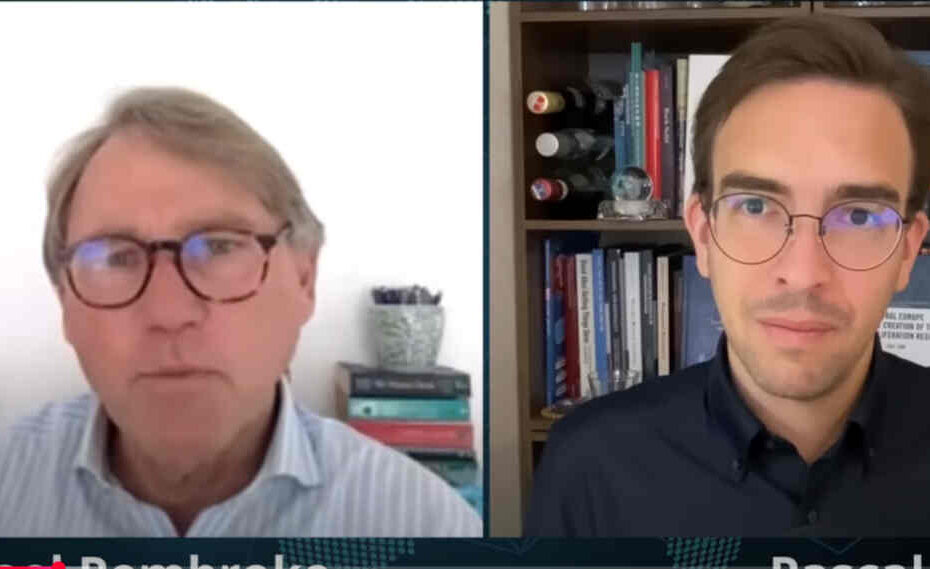
Read the full transcript of Australian author and historian Michael Pembroke in conversation with Pascal Lottaz of Neutrality Studies on “2000 Years Of Chinese Economic Power”, July 28, 2025.
Introduction
PASCAL LOTTAZ: Hello, everybody. This is Pascal from Neutrality Studies, and today I’m talking to the Australian author and historian Michael Pembroke. Michael is based in Sydney, has written several books and for various outlets including Time Magazine, Al Jazeera, and South China Morning Post. He was also a Supreme Court judge from 2010 until 2020 on Australia’s state of New South Wales.
His most recent work came out this July and carries the title “Silk, Silver, Opium: the Trade with China that Changed the World.” This is what we want to discuss today. So, Michael, welcome.
MICHAEL PEMBROKE: Thank you, Pascal. It’s a pleasure to be here. I’ve enjoyed your podcast for many months.
PASCAL LOTTAZ: Thank you very much. And I’m glad having you because you wrote this really good book and you tried to give a history of the trade China was doing. And one of the nice things about your book is you actually take China’s perspective. You kind of start off with all of the people who came to China and the experience China had over the centuries. Actually, you started with Mongolia. In fact, can you maybe give us a little bit of the background of you take this perspective?
The Roman Empire and Early Chinese Trade
MICHAEL PEMBROKE: Well, the essential focus of the book is China’s trade with the West. So although I mention the Mongols, of course, the trade started when the Silk Road carried silk and other exotic goods all the way to the Roman Empire. And so I start with Augustus, the first Roman emperor, who really encouraged and enlarged the trade, both overland across the Iranian plateau and also by sea.
Because under Augustus, Roman ships went out through the Red Sea and around the Arabian Peninsula to a port then known as Barbaricon. It was at the mouth of the Indus River. It’s now closer to where Karachi is. Of course, under Augustus, Rome acquired Egypt, which was enormously wealthy, and so that helped push the trade to great heights.
But the problem in one sense was that the Romans were so exorbitantly wealthy and affluent, and silk was such a new, expensive and exotic product unlike anything they’d ever known before. They were only used to wool and linen and, of course, furs and animal skins. And so the color and sensuousness of silk made Roman women and some men absolutely crazy about acquiring it at huge costs.
They paid enormous amounts, and they also wanted everything else that they could get their hands on from China because it was so exotic and unusual. So the old men of Rome at the time, Seneca was one. But there were many of them became very concerned about two things. One was the outflow of silver and gold from Rome’s treasury to China or to the traders who brought the goods from China. And the other was about the expenditure, the extravagant expenditure of valuable monies, resources on what they regarded as flippant products just to make the Roman lady shimmer in public.
PASCAL LOTTAZ: Yeah, I mean, this is eternal stories, right, of how human societies work. And one of the thing is like, oh, I want something fancy to wear. So, I mean, but this is quite interesting, right, that already 2,000 years ago, this continental trade actually was, okay, maybe we shouldn’t call it flourishing the way it is today, but it was. The trade route was open and the exchange between these empires was going on. Was it only gold and silver that flew the other direction, or were there other kinds of things that China actually wanted to buy from Europe?
China: The Graveyard of Silver
MICHAEL PEMBROKE: Not really, no. And it was mostly silver, not gold, because the Chinese preferred silver. It was more tradable, the gold was more valuable. And that was the story throughout the next 1,800 years, actually. So, China became known in due course as “the graveyard of silver from the West.”
And when the trade was at its height in the 18th century, Isaac Newton, Sir Isaac Newton, who among many roles was warden of the Royal Mint in London, complained that the trade from China was so huge that it “drains away all the silver of Europe.” And Carl Linnaeus, a Swede, you’d know who he is, a botanist. But he was also a public intellectual who expressed opinions on lots of things and lived in London for some of his time. He said, sounding very much like President Trump, that “there is nothing more important than to shut that gate to China through which all the silver of Europe goes.”
The trade was so huge that by the middle of the 18th century, David Hume, the Scottish philosopher, said in 1750 that “if China were as close to us as France, everything we buy would come from China.” Now, that trade eventually, by the 19th century, diminished and petered out because of the conflict which occurred over opium. That’s another story. I deal with that in several chapters towards the end of the book.
PASCAL LOTTAZ: Let’s stick with this trade for a moment. But also a question that I had on my mind for a while because your book makes this beautiful case, like, look, trade with China for the Europeans is basically as old as Rome, but in public, there’s this whole idea that Marco Polo went around the world in order then to discover China and that discovering China, that reaching China is a thing that you need to do by the sea. And why is it that there’s this myth that China is like there was Marco Polo. Why is this guy so important when in fact the trade with it is so much older?
The Parthian Barrier and Silk’s First Appearance
MICHAEL PEMBROKE: Because after the Roman trade, and by the way, it wasn’t two way trade.
But at each point along the way, the trade changed hands, the goods changed hands. And there was a culture called the Sogdians in far eastern Central Asia at the foot of the Pamir Mountains. And they were the best traders. Frankopan says they were very clever at money. And they managed the camel trade from coming over the mountains from China through, across Central Asia, across the Iranian plateau, eventually to the Euphrates river, which was the eastern boundary of the Roman Empire.
The Romans couldn’t get further east because as you probably know, the Parthians and ancient Iranian Persian Empire blocked their way. The Parthians jealously guarded the trade from China and took their clip along the way, of course.
And there’s a wonderful story of a battle in 53 BCE between the Roman legionnaires and the Parthians. The Roman legionnaires encountered for the first time a cavalry troop of Parthian soldiers on horseback, carrying silk pennants on long poles, colorful pennants. The legionnaires had never seen anything like it ever in their life. And they were completely mesmerized and concerned.
The Parthians then surrounded the Roman legionnaires who huddled together with their shields above themselves, locked together in their testudo formation. And the Parthians showered arrows on them as thick as hail or rain. It was said by the historians of the day, the Parthian arrowheads were steel manufactured according to Chinese techniques which had not reached Rome. And they were so strong that the arrows pierced the shields and pinned the soldiers, arms, legs, parts of their body. So it was a terrible slaughter. Sometimes the arrows went down and pierced their feet to the ground.
So that was what really revealed silk to the Roman soldiers. And then it started to dribble through in small quantities until in fact, Julius Caesar before Augustus. Augustus was his adopted son. Julius Caesar introduced silk at The Roman forum in 46 BCE, replaced the linen awnings which shielded the people the plebeians from the harsh sun replaced them with silk. And it was a staggering new development, which really was the beginning of the Roman craze for silk from 46 BCE, for the next couple of centuries until Rome’s treasury began to run out of resources.
And of course, what contributed a factor which contributed to the collapse of the Roman Empire was the debasement of its currency. Its treasury had been depleted by sending all this silver and some gold, but mostly silver, to China.
Now, to get back to your question, there was no trade until the Mongols with the West. So the Dark Ages enveloped Europe. Then it was the Mongols in the 13th century who opened up Eurasia and the overland.
PASCAL LOTTAZ: Very, very, very belligerently. Yeah. Not because Europe wanted to open up, because they just came.
The Pax Mongolica
MICHAEL PEMBROKE: Yes, Golden Horde, that’s true. So they opened up the overland route from Central Europe all the way to China. And it was said that they were so good at, they were good at commerce as well. They made the routes so safe that in the 13th century, you could travel from Europe to China for the first time. Really. I mean, I’m not counting Rome as the same thing. And even from Rome you were blocked by the Parthians, but you could travel from Europe to China quite safely.
A Persian historian said that “a virgin with a gold dish could travel unharmed from Europe to China.” It was very well organized, good roads, post stations for changing horses. And not only did merchants and travelers travel all the way to China, but so did missionaries and representatives of the Pope. And believe it or not, the envoys of the Pope went all the way to the court of the Khan in China. And emissaries from the Khan, after initially rejecting Christianity and saying they should all submit to us, emissaries from Kublai Khan and later they went to Rome to pay their respects to the Pope.
PASCAL LOTTAZ: So that was around the 1250s, 1260s.
MICHAEL PEMBROKE: No, later. So the Mongol Empire, the Yuan Empire in China, was from 1271 to 1368, less than a century. And Kublai Khan was in that last period of the 13th century. But the most famous envoy from China was in the 1300s, around the 1334 mark, sometime like that. And when envoys came from the Pope, and I think some at that time were coming from Avignon, not just Rome or mainly Avignon, because the popes moved to Avignon, they were greeted with all sorts of pomp and ceremony and formality in the court of the Khan.
PASCAL LOTTAZ: Right, right. This is one part of European history that we often forget about. But the importance of the Mongols and the reign wasn’t that huge, but they came all the way. They took Kiev, they took both like north and south.
MICHAEL PEMBROKE: Yes.
PASCAL LOTTAZ: And defeated everybody along the way. And by doing so actually opened up the routes. Right. And as long as you don’t challenge them, you can actually go back and forth.
MICHAEL PEMBROKE: And there was a northern route through Ukraine which went across Ukraine, Mongolia into China, the capital of the great Khanate. The Chinese Khanate was initially in what we would call now Inner Mongolia. And it was later moved in the Ming dynasty to Beijing by one of the Ming emperors.
Marco Polo and the Yuan Dynasty
PASCAL LOTTAZ: Right. And so that is then the second flourishing of Chinese European trade, the first one being the Roman Empire, then Dark Ages and like, very bad relations and everything on the way basically in little principalities and blocked. And then it opens up because of a Pax Mongolia or whatever we want to call it.
MICHAEL PEMBROKE: Well, it’s commonly called Pax Mongolica. Yeah, yeah, yeah.
PASCAL LOTTAZ: But it was short. Right. The Mongols then splinter, splintering into their own little groups and actually one of them then took over the Chinese mainland. And the dynasty that came out of that is called, help me, the Yuan Dynasty. And that’s around the same time that Marco Polo actually does his travels. Right. So.
MICHAEL PEMBROKE: Around about 1270s, 80s, early 90s, and he was a guest at the court of Kublai Khan. And so was his father and uncle, by the way, his father Niccolo and his uncle Matthew. Three of them went, the other two are often forgotten. But Marco Polo made the biggest impression.
PASCAL LOTTAZ: Right. And so from then on, the trade with China remains stable or like, on, on, on, like, or go through, or did it go through a lot of ups and downs?
The Ming Dynasty and the Great Treasure Fleets
MICHAEL PEMBROKE: Again, no. So after the Mongols, the Ming dynasty took over from the Mongol Empire in 1368. And the Ming went through two phases. The initial phase of the Ming included that incredible period between about 1405 and 1433, when Zheng He, the eunuch Muslim admiral, took treasure fleets as far as the known world.
So there were seven great treasure fleets of huge junks. They were considered to be many times the size of European ships. So in the book I’ve tried to compare them. There’s a picture of Columbus’s primary ship, his leading ship, the Santa Maria – tiny little ship. And the equivalent medium-sized junk of a treasure fleet was many, many times larger.
And there are many historical accounts of how huge these ships were because they were observed in India on their way through and other ports on their route. They went as far as East Africa, they certainly went into the Persian Gulf and to the Red Sea, and they went all over East Asia.
Of course, this is the great area of controversy that is the subject of a book by the English submariner well known to many people. His name is Gavin Menzies. He’s dead now. He wrote a book called “1421: The Year China Discovered the Americas.” And it’s his theory that Chinese ships went as far as the Americas during that period of exploration.
In fact, it wasn’t so much exploration, it was like the Belt and Road Initiative. The Chinese were going out to impress the known world of their strength and economic power and they weren’t waging wars. There were one or two altercations, but they were not out there to wage wars. They didn’t engage in regime change, they didn’t send armies across the world like some countries in the 20th century or the 21st century. They went out on a sort of quasi-economic and diplomatic mission and they were extremely successful.
But for reasons which have baffled historians, but we probably know why, after seven huge voyages in the mid-1430s, the emperor was persuaded by court officials, mandarins, literati, to stop the expenditure on these massive voyages. They were obviously very, very expensive and the Chinese Navy imploded. The emperor would not allow expenditure on frivolous things such as going to foreign countries.
And whilst to a reasonable extent private merchants continued their trade, the Chinese Imperial Navy imploded. There was not much left of it. It went from many, many hundreds of ships to almost nothing by the end of the century. And China from that point turned inward.
The Wealth of Trade and the Qing Dynasty
However, it was still wealthy from trade. And the 1500s and 1600s and 1700s were so wealthy through trade, especially to the Persian Gulf, the Arab states and to East Asia and to South Asia, that there was so much money coming into the country, so much silver, that the emperors hardly had to govern. They could leave it up to their officials. They could sit back in the inner sanctum of the Forbidden City and just indulge themselves. So there are a number of long-serving emperors in that period and that’s sort of what happened, except that the Ming Dynasty itself collapsed in 1644.
So the Ming was then replaced by the Qing Dynasty, Manchus, foreigners, effectively from the north. But at the time of the transition from Ming to Qing, China was in a bad way because of civil war, conflict and some terrible natural disasters. Climate change is blamed by some on what happened. So it took the Qing 50 years or so to recover.
So from 1700 through to 1800, for the next hundred years or so, the trade with the west absolutely boomed because the East India Companies started to arrive. The Dutch were the first to arrive. Sorry, the Portuguese were the first to arrive, then the Dutch, and then eventually the English, Swedes and French even came, and then eventually the Americans.
The Tea and Porcelain Trade Boom
And that trade through the late 1600s and especially through the 1700s was so huge because the Europeans were exposed for the first time to porcelain, which they had no knowledge of. They were used to pewter and wood and silver, of course, but they’d never seen porcelain and couldn’t fathom how to make it.
They were introduced for the first time to tea, and tea became a must-have necessity and very fashionable. In fact, tea became the most popular beverage in England after water, starting from nothing. Because when Shakespeare was alive, say 1600, no one knew what tea was. No one knew what a hot decoction was. Shakespeare knew mead and claret and Madeira ale, of course, but no one knew what tea was. Within a hundred years, it was the boom industry.
And tea brought in millions, really literally millions of pounds to the English treasury. In fact, by the early 1800s, the tea trade effectively funded the Royal Navy because the government made money from duties and taxes. And of course, the East India Company was effectively owned by the government by that stage.
PASCAL LOTTAZ: It’s fascinating how this goes hand in hand, but also hand in hand, I mean, in conquest and trade. The issue with the Europeans is that they usually, wherever they trade, they start to conquer and they did so immediately. Right. So maybe we also need to quickly just talk about these companies, East India Company and so on, because they are not companies the way we would think of them as of today. They’re basically royal dependencies, right, with full power of executing also the law over where they operate in. Can you talk about that a little bit?
The East India Companies and the Opium Trade
MICHAEL PEMBROKE: There were government consortiums, effectively, and they could wage war. But the British East India Company traded very peacefully in China for the first century that it was there from 1700 to 1800. It was controlled effectively by merchants. And the directors were in London and they made – their primary concern was making profits.
The problem arose at the end of the 18th century when the British could no longer sustain the outflow of silver. Ships would leave England laden with chests of silver which had been purchased with the Bank of England or from the major bullion traders in London, and come back with even more chests, many more chests of tea plus porcelain and anything else they could.
They could bring back the tea trade was so incredibly popular that even when convict ships were going out to the colony of New South Wales in its early days, they would refit, after unloading their convicts, refit for the tea trade and go up to Canton, now Guangzhou, to pick up loads of tea and take back to England.
So there was no conquest, no war in the 1700s by the English East India Company, nor any of the others. They were all there to make as much money as they could, as fast as they could.
But the arrangement they worked out to overcome the outflow of silver was that they would create the largest opium production factories in the world along 800 kilometers of the lower Ganges river in British India. They commercialized, industrialized and corporatized opium production. Opium had existed before, but not anything like the scale the British engaged in.
And they knew opium was illegal in China. The emperor had banned it from a long time before. But they also knew that there was a market for opium. So the East India Company arranged, through its production facilities in India, to sell the opium at auction in Calcutta, which was then the capital of British India.
They sold the opium to independent traders, such as Jardine and Matheson, who were not part of the East India Company, and many others – Parsi traders as well, and some Scottish, other Scottish traders, and then eventually to Americans as well. Those independent traders smuggled the opium to China and sold it to drug barons and drug peddlers in the Pearl River estuary outside Canton. And then it was distributed.
The traders received silver from the drug barons in China and they then took the silver to the East India Company’s treasury, which they exchanged for bills of exchange drawn on London banks, accepted by London banks. And the Bank of England was involved as well. So those bills then sustained global trade because they were discounted and traded all around the world for all sorts of trade, including the purchase of cotton in America and anything that you could think of.
So the London financial market sustained the opium trade in China. It was not so much the Canton and Shanghai, it was London and the bill trade. The London bill trade became so important to the global economy that it was not readily possible to consider stopping the opium trade, because the opium trade was sustained by the bill trade, and perhaps the bill trade was sustained by the opium trade.
PASCAL LOTTAZ: What’s the two sides of the same coin? Right. It’s what makes the silver then flow back even without actually flowing. So it’s basically the start of fiat as well, because you just need to transport it. You have the bills.
MICHAEL PEMBROKE: Yes. So what happened as a result was it reversed the flow of silver. Silver flowed out of China for the first time in centuries. And this impoverished China and contributed to its ultimate demise during the 19th century.
I mean, it goes without saying. I think it’s well known that the British started the First Opium War and continued it in the Second Opium War for the sole purpose of preserving and expanding its opium trade. The Emperor quite understandably had tried to stop the opium trade and he sent a Commissioner Lin to Canton to carry out his orders. But when he locked up the European traders in the 13 factories at Canton, he caused a great ruckus which led to the war.
PASCAL LOTTAZ: And I think it is easily forgotten that these opium wars were about the right of Europeans to flood the Chinese market with drugs. It was a drug war, but the war not against the drugs, the war for the drugs. That’s the craziness about it.
MICHAEL PEMBROKE: That’s exactly right, Pascal. Yes.
European Control and the Carving Up of China
PASCAL LOTTAZ: What does this do? I mean, this is also the time when China again, I mean, it goes up and down in terms of centralized control. Right. And thunders of control. And that was a time when then control went down and the Europeans made it their business to actually make sure that China would not be under anyone’s direct control like India. Right. You have open China policy and open door policy of the Europeans saying everybody’s allowed to play on that market. But on the inverse side, the Chinese are not allowed to control their market. Period. Can you speak to that a little bit?
MICHAEL PEMBROKE: Well, by 1860, after the Second Opium War, the Europeans were all over China. They went through China as if it was their own country. They paid no regard to Chinese sovereignty. They established extraterritoriality everywhere they went. European banks operated in China, issued their own currency. The missionaries were allowed to go anywhere they wanted in China. And the missionaries were a huge aspect of the troubles that occurred in the second half of the 19th century. The Chinese sovereignty counted for nothing.
By the late 1890s, there’s the famous cartoon that appeared in the French magazine of the cake of China being carved up by the Kaiser, by Queen Victoria, by Queen Victoria’s grandson Kaiser William, by the French, Marianne. And I think I said Kaiser at one stage. I meant the Tsar. So Russia, Britain, Germany and France were all there carving up the cake of China.
And that resulted in a practical way, in ports around Beijing and along the coast, becoming territories controlled and operated by foreign navies and foreign merchants. So Qingdao, now a famous brand of beer, became famous because the Germans took that port. They put a brewery there. But it was strategically placed near the entrance to Beijing.
The Russians took a port on the peninsula just further north on the other side of the water there. And the British took a place called, strangely named Port Edward. It’s now Wehai, just a little bit further to the east. And then coming down the coast, there was already the European settlement in Shanghai.
The Hong Kong Territories
Hong Kong had been ceded to Britain at the end of the First Opium War. That was the island of Hong Kong. At the end of the Second Opium War, the Kowloon Peninsula, the main part of Kowloon was ceded to Britain again then. And in the 1890s, Britain said, “We want even more.” So they demanded and received the New Territories, a much larger area. So Hong Kong was comprised of three parts.
And it’s an interesting quirk of history that the island in Kowloon was ceded in perpetuity and there was no real need to give them up ever, subject to political and moral persuasion. But the New Territories were leased to England for 99 years. So that 99-year period expired in 1997. So it was the legal obligation to give up the New Territories which led to the giving up of Hong Kong island and Kowloon at the same time. It was thought, I think, that Hong Kong could not function without the airport and some other infrastructure elements that were on the New Territories. But there was also a great deal of moral and political pressure.
Interestingly, the French also demanded and received a port in Southern China and it was also given to France on a 99-year lease, also expiring in 1997. But Charles de Gaulle, at the end of the war, very nobly gave it back to China in 1945. So the English hung on, but the France gave up their territory at that stage.
PASCAL LOTTAZ: But they gave it up in order to have more time to focus on Indochina.
MICHAEL PEMBROKE: Exactly.
The Structure of Colonial Trade Networks
PASCAL LOTTAZ: They kicked their fights. But yeah, let’s continue with the British because this period of colonialism is super important. And colonialism cannot be understood without actually understanding trade. Because also from my research, one of the things I can say for sure is that the Swiss, they always want a part of the pie. But the pivotal requirement was that wherever they would go and do second hand trade, you know, I call this “piggyback colonialism” where they just go on the ships of the others and then they do the trade that the big ones don’t want to do.
The pivotal issue was consular jurisdiction that they would not be under the jurisdiction of the receiving state right of China, but that all disputes with the locals could be managed in front of the courts of the primary colonial power. And that was a structure that was established throughout this trading network of the Europeans.
MICHAEL PEMBROKE: Well, that was the essence of extraterritoriality that I mentioned before. Not just banking, but also the legal systems. So Chinese legal systems and financial systems were completely undermined by the Europeans. And in the second half of the 19th century they had their own courts, as you say. Some, like the English, constructed their own huge courts with a grand edifice in Shanghai, but others conducted their legal arrangements through the local consul.
And they all had appeal structures which in every case would not countenance appeals within China. But you had to go out of China to, in the Portuguese case to Goa to conduct your appeal. And of course the law applicable was the law of the European state, not the Chinese law. So a Chinese merchant who had a commercial dispute with a European merchant didn’t have much chance because he was subjected to a European legal system and European laws with which he was no doubt unfamiliar.
PASCAL LOTTAZ: And the interesting thing is that these systems were open for the other European states. Right. That’s why I do think it was a continental effort actually. You know, the French and the Spanish and the Portuguese and the Swiss even could use these systems in order to conduct their little trade. It was pretty much this kind of extended European systems implanted in these trading hubs which were also developed very strategically, which is why sometimes they change.
I mean, if you go back to the 1860s, Manila was a way more important trading port than Singapore. But Singapore was then built up strategically, just like Hong Kong and so on, as trading ports for channeling back this wealth to the home empire. And for China this was tragic, wasn’t it? I mean, the opium and so on killed probably millions of people, many millions.
The Manila Galleon Trade and Spanish Silver
MICHAEL PEMBROKE: The very well regarded Anglo American historian Jonathan Spence said it was huge, very substantial. Some estimates are 30 to 40 million people who were addicted to opium and most of whom probably died. It was a dreadful situation.
But just to come back to Manila, which you mentioned, it became the center of Spanish colonialism off the China coast. Spain established its control over Manila in about 1571. And the Manila galleon trade, there were these huge ships built by the Spanish state in the Philippines, took place between Manila and the port of Acapulco for 250 years. During the 1500s, 1600s, and 1700s.
And those ships would load up at Acapulco with silver, hundreds of chests of silver. They were like floating bank vaults, and they were manna for the pirates and buccaneers of the time. The silver would come from the mines in the viceroyalties of Peru and Mexico. The ships would go across the Pacific Ocean to Manila, and the silver would be used to buy Chinese products which were brought across from Fujian province by Chinese traders.
And then the Manila galleons would load up with all of their products and sail back across the Pacific to Acapulco. Acapulco was the place where there was an annual trade fair when the Manila galleon arrived, because there was only one trip a year. And the Acapulco Trade Fair became the biggest trade fair in the world.
And after the trade fair had sold as much as it could, the products would then go along the road to Mexico City. And from Mexico City, the goods would be transported to Portobello and then off to Cadiz and throughout Europe. Mexico City became the center of the world between China and the West. And the Spanish silver dollar, the silver peso, became probably the world’s first reserve currency. Its use and spread was so great that it had no competition. So that started to change only in the late 19th century.
China’s Return to Global Trade
PASCAL LOTTAZ: There’s so much we could talk about, also about Japan and how Japan learned the European lesson and started going into China, took off chunks and so on. We could talk about all of that. But let’s take it a little bit forward, because one of the things that I hear people say, and I always think I would like to start strangling. “The biggest mistake America made was to let China into the World Trade Organization in 2001. Because allowing them, allowing China to become a trading hub, a global hub, was foolish. You know, the United States could have continued to exclude China, and they would still be a developing little backwater.”
Right. You are misunderstanding what China was in global trade for the last 2000 years. Can you maybe tell us a little how then this intermittent period between the Chinese civil war, let’s say it ended in 49, although there’s a good argument that it’s still ongoing. But let’s say 49 as the point when the big shooting stopped and the Communists took over up until 2001. What happened in that Cold War period?
MICHAEL PEMBROKE: Well, Pascal, my book stops in 1912, so I’m not a historian of the 21st or 20th centuries, and I probably know as much about the modern period as you do. But, you know, we all know what happened. Deng Xiaoping decided after the Mao period, which was full of mistakes. I mean, I take a broader view on the Communist revolution. They had good intentions, but they made dreadful mistakes and they caused terrible hardship.
But it took 30 years of those mistakes for the country to get back on its feet. And after 30 years, you had a few premiers like Deng Xiaoping who stabilized the country, began to stabilize the economy, and began to encourage trade with the west again. Mao had effectively closed China. But there’s incredible hubris amongst those who say that we wanted China to become like us, but it didn’t. You know, it went its own way. We allowed it into the World Trade Organization.
PASCAL LOTTAZ: I mean, how dare you? How dare you not become like us? China, you evil.
MICHAEL PEMBROKE: Yes.
Western Expectations and Cultural Values
PASCAL LOTTAZ: I’m sorry, it’s so frustrating, but because especially the Germans. The Germans, right now, they have a discourse. I’m sorry, I just need to rant about this a little bit. In German, you can make this little phrase called “Wandel durch Handel,” like change through trade. It rhymes in German, right? It’s like it failed, you know, and our good intentions of changing China to the better and making it a beacon of democracy, it failed. And now we need to go to outright confrontation because that’s the only language they understand.
It’s an absolutely dumb discourse. But this is really the level of TV shows and so on that they’re making at the moment. Can you speak to that a little bit also from, you know, the way trade also historically works for China.
MICHAEL PEMBROKE: It worries me that so many people think that China should change, that it should conform to Western values and Western ideals seems to run counter in my mind to the very principle upon which the United Nations Charter was drafted. There are 193 countries in the United Nations. And the principle of the United Nations Charter, which China was the first country to sign, by the way, but which the Americans were hugely important in framing, is that every one of those countries should respect the sovereignty of every other of those countries.
And it used to infuriate me when Trump’s first ambassador to the United Nations, Nikki Haley, used to complain about other countries and say they don’t share our values. But the point is, no, they don’t and probably never will. And there are many different values and many different civilizations with different values.
So the whole argument about crimes against humanity that is made against China, for example, Xinjiang, or the treatment of prisoners, is an argument which presupposes that China should have the same values as European countries. And China, if you look at the history, has always been very heavy handed with people that it believes represent a threat to its society. So it’s heavy handed, more heavy handed than we might be. But that’s its system, they’re the values that it operates by. And Chinese people understand that.
And I think it’s wrong to go around the world thinking everyone should conform to the one standard, trade. And trade was thought to be a means by which people could be persuaded to adopt Western ideals, the Western profit motive, Western capitalism. Dress like the west, wear dark suits, which they largely do when they’re engaged in trade. But it conceals the fact that each of those countries, China in particular, is entirely different, entirely unique. And the Chinese are determined not to allow that to change.
The Changing Global Order
PASCAL LOTTAZ: And just let me add this, because it’s not just the Chinese who understand that these days, it’s also the Africans, it’s also the South Americans. And you know, the point is also that whenever you try, whenever other nations and civilizations try to conform to Western standards, they never reach it, they never do because the west always changes.
And I have this beautiful, an African friend, a Ugandan friend of mine a few years back told me, “You know Pascal, you just never make up your mind because first you come over and you tell us to kill the gays and love the book and then you tell us to burn the book and love the gays.” It’s like once we are, once we live up to what you’re telling us to do, you tell us to do the opposite. And this just continues over and over.
And we are currently in the most recent iteration of the same old mindset that the others haven’t caught up yet. But the China, the Chinese, the Africans and so on, they’re not going to play along with this anymore. So that the new world, and I think that’s what seriously worries this, is this existential angst now in the west that this game of the last 500 years ain’t going to work anymore.
MICHAEL PEMBROKE: No, it’s coming to an end. And the reason why in part is that the countries, many of them represented by the BRICS grouping, are now so much more profitable and powerful and influential than they were. And you know, once the US dollar is not used for most of the world trade and it’s diminishing all the time, it’s going to be a huge problem for the balance of power.
And I say problem, it’s not a problem in one sense. It just means that the balance of power will change. So I think I understood from something I read the other day, someone spoke to me about this that the US dollar is used for 60% of world trade at the moment, but that when it drops below 50% that will be a disaster for the United States. Well, we all know what Brazil and China and Russia and probably India are hoping to achieve by conducting more and more of their trade in their own currencies. They’ll bypass the US dollar and bypass swift.
The Future of Global Trade
PASCAL LOTTAZ: Yeah, and the structural power of the United States is going to decline. And yes, at the moment the US can still threaten people with tariffs, but that ain’t going to work for that much longer anymore. But just also the expectation that the US Dollar is going to collapse. I don’t think we have an example in world history in which a reserve currency has been replaced overnight. Even the pound is still an important currency today.
So I mean things still in this space, it tends to happen gradually but the political sway of individual states is going to decline. What do you see though in terms of trade at the moment? I mean Chinese trade today is again at an all time high and historically speaking it has been going up and down. But probably China would try to further integrate. Right. Not just in the west but again with the BRICS partners or what are you seeing developing?
China’s Economic Independence and Global Trade Shift
MICHAEL PEMBROKE: Yeah, well China’s export trade to the United States represents less than 3% of its GDP. I think China has just set its face against the United States. It may be prepared to make some arrangement but in the long term it’s not going to allow the export market to the United States to determine the way it operates.
And of course you know that China’s trade with the ASEAN nations is greater than its trade with the United States. And China’s trade with Europe is also greater. And China’s trade with the ASEAN nations, with South Asia, with the South American countries, and of course with the 54 African countries and of course most of the Arab states, it’s growing every month.
So, and you can throw into the mix the fact that last month China’s GDP increased by 5.2% whereas Germany’s I think is flatlining, the United States less than 2%. Britain I think is less than 1%. So, and most of the prosperous Asian nations are increasing as well. So the movement of trade and power is clearly changing towards China and the Asian nations, probably the BRICS nations in general. Whereas there’s no getting away from the fact that military power still seems to predominate in the United States.
US Military Production Limitations
PASCAL LOTTAZ: But although even that one is not clear anymore because it seems as if though the United States has reached production full capacity and it’s not producing enough for what it wants to do. So I had this discussion the other day. It’s like the first time that even neoconservatives are learning that the US cannot just conjure up shells out of nowhere.
And even they learned that, okay, we need these rare earths from China, otherwise we cannot even make our sophisticated weapon systems. So that’s a problem. Yeah, but in a sense, I’m very glad for your book because it brings together this 2000 year old industrial and trade power that China has been having and the ups and downs that it was going through and it puts what’s currently happening into a very large context.
People who want to get it, where should they get it from? And is there a place where you regularly also publish now? You know, outside of the book?
Book Availability and Core Message
MICHAEL PEMBROKE: Not yet, but I will start to do that soon. But it’s available online through all the usual sources, Amazon and the like, for people who care to use that source. I’m told it’s in all the good bookshops in Singapore and Kuala Lumpur. And I may be going up there to promote the book.
And I don’t think it’s been released yet in the United States or in Northern Europe. I think that is probably next month. So it’s only been out a few weeks. But the essential message is that China’s been the dominant force in the global economy for most of the last 2000 years and that the last 200 years have been an aberration to that trend.
PASCAL LOTTAZ: So what we are seeing now is not a new phenomenon. It’s back to how the world used to be for most of the time. So people don’t freak out. We’re just back on track, that’s all. Michael Pembroke, thank you very much for your time today.
MICHAEL PEMBROKE: Thank you, Pascal.
Related Posts
- Transcript of Mohandas Pai Interview: Raj Shamani FO539 – Truth About India’s Tax System
- Transcript of Alex Hormozi Interview: The Diary Of A CEO – Jul 20, 2026
- Transcript of Scott Bessent Interview: The Way I Heard It with Mike Rowe
- How To Buy A Used Luxury Car Safely
- Only In America Interview: w/ Indra Nooyi (Transcript)