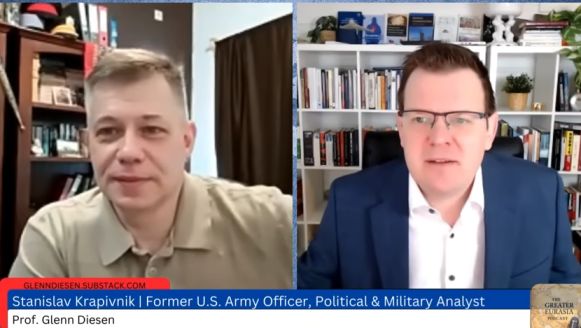
Editor’s Notes: In this conversation, former US Army officer and analyst Stanislav Krapivnik explains how Russia and China are preparing to shield Iran from a potential American and Israeli attack, and what that means for the global balance of power. He breaks down the integrated Russian–Chinese air defense architecture being built over Iran, and why it could shock US and NATO planners who still assume military dominance. The discussion then widens to Marco Rubio’s Munich speech, NATO’s strategy in Ukraine, and how Washington may be pushing Europe toward a catastrophic war while staying in the background. Finally, Krapivnik and Glenn Diesen explore internal debates in Moscow, the limits of Putin’s patience, and how miscalculation in European capitals could drag the continent into direct conflict with Russia. (Feb 18, 2026)
TRANSCRIPT:
Russia and China United in Defense of Iran
GLENN DIESEN: Welcome back. We are joined again by Stanislav Krapivnik, a former U.S. army officer and military analyst originally from Donbass, who has now returned to Russia. So thank you for coming back on. I have a lot of questions I’ve been looking forward to ask you.
STANISLAV KRAPIVNIK: Always a pleasure. Always a pleasure.
GLENN DIESEN: I thought perhaps we can look toward the Middle East first because, as the United States continues to build up all this military capability in preparation of a possible attack on Iran, the big question everyone asks is what will countries like Russia and China do, as they can’t afford to see Iran being defeated and possibly Balkanized. However, neither Russia nor China wants a direct shooting war with the United States. But how does Russia assist Iran in terms of defending itself?
Iran’s Integrated Air Defense Shield
STANISLAV KRAPIVNIK: Well, this is an interesting topic because Iran is presenting for both Russia and China a platform of integration where they may be getting battle tested. Russia has developed for Iran, in a very quick order, an integrated air defense shield, something Iran didn’t have at first. Iran had S-300s, it had S-200s. The older systems, or the S-60 systems, which by the way still work quite well against Tomahawks, when the Tomahawks are going to actually explode within the system.
An integrated air umbrella is a system, if it’s fully integrated. You have on the strategic level where you can start picking up and possibly intercepting enemy targets outside of the country whose territory you’re defending. Then you have an inner layer where you’re starting to defend on a strategic level inside that country. Then you have on a battle theater level, then you have on a localized level, and then you have pinpoint defense.
The Panther is on a localized level. The IGLA, or the shoulder-fired MANPADs — those are spot defense. That’s the last line of defense. If something has gotten all the way through, or it lifted up somewhere very close so it’s within your range, like a drone or some helicopter that just pops up, then you do spot defense. So obviously you’re not going to be taking out ballistic missiles or cruise missiles with a shoulder-fired missile, but you could take out a jet, for example, or a helicopter or a large drone.
But that’s an integrated system. And it’s integrated not just because it has multiple layers — it’s because the radar systems and the systems themselves are communicating. So if it failed to make contact or failed to destroy the object on one layer, it passes that information off to the next layer that engages, that passes off to the next layer that engages, and so on down to the point where either they destroy it at some point or it blows up.
Which, by the way, I mentioned about the Tomahawks — the 12 Tomahawks Trump fired into Syria had a 33% failure rate to detonate. There were four warheads that were found non-detonated. A bad batch, I don’t know. But if that says the same thing about most of them, then the U.S. has even bigger problems.
So that’s on one level. Plus the radar system that went with it — Iran, at first, Russia was pressured not to sell the S-400s that Iran wanted. Iran actually even paid for them and Russia failed to deliver back in the 2000s because of sanctions. After that, Russia was ready to deliver. Iran said, “We’re going to build our own system, we don’t need the S-400.” Well, they did build their own system, but it was much weaker and worse off, and heavily damaged in the 12-day war.
So Iran came back, Russia came back, built a reintegrated system, and over the last six months trained up Su-35 pilots and delivered Su-35 fighters — which outrange, by the way, the F-35s, even though it’s a generation 4++ fighter versus the generation 5 fighter that the F-35 represents.
On the other side, the Chinese are bringing in their integrated radar systems, which include very tight-beamed, low-wavelength sections that can pick up — integrated with the satellite systems — anything within, I think, 500 to 600 kilometers outside of Iran. So anything that the U.S. or Israel is launching is already being picked up and gives them enough time to start reacting to it.
If you figure a cruise missile is flying at 1,000 kilometers an hour, for example, you still have about 30 minutes to react before it’s in your airspace, which is actually a lot of time for anti-aircraft systems. The whole point is to try to cut that time as much as possible. Stealth aircraft are not invisible — they are very hard on radar. The hope is that they’re over target or somewhere close to target by the time the radar system picks them up, or somebody visually picks them up.
Which is, by the way, how the Serbs took out several American aircraft — B-1s. They put circles around of people with radios, and they visually saw them coming in because they kept using the same flight corridor.
So with these two systems — the formerly Soviet, now Russian system, and the Chinese system — integrated, we may be watching a synthesis of something much more powerful and greater. Now, the U.S. planners are writing it off. “It’s not really capable. They’re not going to be able to do anything.” There’s a lot of bravado that has never been tested. So I think there’s going to be a very big shock and surprise for U.S., Israeli, and NATO forces if they start initiating contact. And I think they will. Whether Trump wants it or not, he’s going to be backed into this war.
GLENN DIESEN: But all of these things — they weren’t present back in June when the U.S. attacked the first time around.
What Has Changed in Six Months
STANISLAV KRAPIVNIK: No, the S-400s were not. And the decapitation strike at the beginning actually did damage quite a bit — at least some, we don’t know exactly how much — of the radars and some of the anti-aircraft systems. They killed key officers that would have been in charge of getting all that operational. Plus the Chinese systems, the multi-phase radar systems, were not there.
So all of this has been brought in over the last six months, set up, and integrated. We’ll see how well it’s integrated. Combat is the ultimate test when your life is on the line. But if they’re as integrated as they may be, one thing that’s going to happen is — you know, China, Russia, and Iran signed a trilateral alliance too. If this integration works, we may be seeing this all over the Russian border areas or the Chinese border areas — China using Russian S-300s, S-400s, S-500s, the S-550s that are coming out right now, and Russia using the Chinese radar systems, and Iran both. So this could be a very big game changer, this synthesis of these two systems. We’ll see. Yeah.
Rubio’s Call to Re-Empire
GLENN DIESEN: Well, this is one of the strange things I think was missing in — well, you probably saw Marco Rubio’s speech in Munich. It was very imperialistic. He complained about the loss of European empires proudly spread across the world, all of this being lost after World War II. However, I thought it was a bit strange because the assumption was, “We’re not going to apologize for throwing away all these rules and liberal pretenses because we have to reverse our decline. We’re going to just use extreme force in order to restore the empire.”
It was only that simple. The problem is, if you punch too hard, if you get too aggressive, the rest of the international system will begin to collectively balance you. And again, people used to call it Kissinger’s worst nightmare to have China and Russia come together. But putting Iran into the mix — of course it would be the weaker of the three — it kind of shows these three large Eurasian powers coming together. How foolish this idea is that if you just throw away all your inhibitions and go for empire, then no one can stop you. It seems not well thought through.
STANISLAV KRAPIVNIK: But it’s worse than that, Glenn. It’s worse than that. First of all, there are minor players involved. There’s also Belarus, obviously, and North Korea. North Korea is nuclear capable. There may be Cambodia. Vietnam, if we’re going to start going down that line. So the third world is actually troubled by the theater. They don’t want the refugees. They don’t want Iran being destroyed. They may not be best friends with them, far from it, but they don’t want the chaos that’s going to happen, especially on their own borders.
And there are other countries involved. India right now has a bad relationship with the U.S. Now, India is interesting — India, which was the biggest blocking force in BRICS on a combined currency of any kind, is now the biggest cheerleader. Modi and Trump had a falling out because of Trump’s mercurial attitude toward everything when he doesn’t get his way. I’m not saying India is ready to join a military alliance of any kind, but that is a possibility. Russia is brokering Indian-Chinese peace, and there is actually quite a bit of trade between the two that people don’t talk about.
There’s always Pakistan. Pakistan made overtures toward Iran, stating that if Israel uses a nuclear weapon, Pakistan will use a nuclear weapon against Israel in defense of Iran. So there’s a lot at play — just not counting the three — there’s a lot of other issues at play that could really change the outlook.
And you’re absolutely right. Nobody likes the big bully. The international tendency is, if somebody’s coming at you, everybody figures out, “We’re probably next,” and it’s time to rebalance them. And when somebody like Rubio gives — I call it the “call to re-empire” — the only things that it reached that were worth anything was empire. That’s what you get from the speech. There was nothing else in Western civilization but empire. Its glory was empire.
Rubio’s Ancestry and the Viceroy Mindset
There are several problems. But first, to understand where Rubio is coming from, you know his ancestry.
GLENN DIESEN: Yeah, Cuban.
STANISLAV KRAPIVNIK: Well, Cuban as far as he came — his father was born in Cuba — but that’s just recent ancestry. His ancestry not that far back, you know, 100 to 150 years ago, were Spanish viceroys. They were the governors, the nobility that was used as governors in the Spanish Empire. They were the local big guys. That’s where his family comes from.
And as somebody whose family is also from nobility on my mother’s side — you learn about who your ancestors were. That’s something that gets passed down very seriously. So he knows who his ancestors were, and he even mentioned it in his speech. Something to the effect of, “My ancestors are from” — I don’t remember the exact province — “they would be very shocked and impressed that their offspring has come back as a diplomat, the main diplomat to Europe,” and so on. He’s got this drive to, I guess, reclaim being the Viceroy of Latin America or some portion of Latin America.
Empire is what he was raised on, at least to some degree. Even though his father did flee Cuba — from Batista, not from Castro, as his family moved to Miami four years before Castro came to power. It’s not what he tells people, but it is what is historically documented.
So his whole mindset is empire. You’re dealing with a person whose view is that the triumph of Western civilization is empire — enslaving the third world. His ancestors were the big guys that sat over the dirty, ugly peasants and lorded over them because they were the viceroy class. And I think that’s very heavily influencing him to this day.
European Political Class and the Threat of Escalation
GLENN DIESEN: Yeah, I thought that part was even a bit offensive. European civilization has achieved a lot, and I would agree that there’s been some decadence in place, especially in civility and morality after the Second World War. But to reduce European civilization to, “oh, we had empires, this was what it was, this is what we must have back” — it’s interesting, and also very telling of his view.
But on the topic of the Munich Security Conference, how do you see the possible relationship between Russia and Europeans going further down a dark road? Because I saw Chancellor Merz making the argument there in Munich that “we have again emphasized we have imposed unheard losses and costs on Moscow.” Quite extraordinary to hear from a German chancellor. I also heard other comments coming from the Danish Prime Minister saying we shouldn’t respect any more red lines, there should be deep strikes into Russia. It appears that all the pretenses of this merely being a proxy war are slowly going away, and more and more there’s talk about direct war.
Do you see anything on the horizon? What is the mood when they hear this in Russia among the political class, the military, or the public for that matter?
STANISLAV KRAPIVNIK: Well, the military’s job is to take every threat seriously and to contingency plan for it. The politician’s job is to figure out what really is the threat and act accordingly.
At this point, what I’m hearing from a lot of politicians — and the military, I’ve been hearing this from day one — is, of course, if somebody’s telling you they want to kill you, take them very seriously. They may not have the weapons and the ability to do it right now, but they have the intent, and you have to accept that they have the intent and the desire to do it.
Now, having said that, what I think we’re looking at is that the political class is starting to realize — yeah, these people really are that stupid. First of all, you’re looking at a pampered, inbred aristocracy, for the most part, that’s ruling the EU. The same aristocracy that ruled before, except it’s now a republic instead of something else. The unfortunate part is that when they were real monarchies, they had better control over their idiots — like these prime ministers — than they do now. Now, as a republic, the worst of the worst can rise to the top, especially in an enclosed system that doesn’t allow any real competition, and run the country. This makes things even worse, as republics tend to do in the end before they die — and all republics die.
The Decay of European Republics
This is the third or fourth big wave of republics in the world, and they all die within, usually, 200 years. They die because of these types of people. The system becomes absolutely corrupt. In a crude way of putting it, gold sinks and crap floats to the top — that’s how these systems work out. They’re a popularity contest at best, and usually the people who are most popular are not the smartest. And worst of all, the systems are so rigged it doesn’t really matter if you’re popular or not — you’re going to get the power because you’re in the rigging class that has blocked off paths for anybody else.
Romania is a good place to start. The US State Department put out that Ursula von der Leyen has now rigged eight elections in Europe — not just in the EU, but in Europe in general, because she did it twice in Moldova. So the EU is in the business of rigging elections. I know, it’s shocking. Nobody could see this one coming, especially after Romania. That was just clear-cut — fair elections, whoops, wrong candidate, elections canceled, new candidates put in power.
The Nazi Legacy in European Leadership
So you’re looking at people who have no concept of war. There are two concepts at work here. One, a lot of these people’s ancestry were Nazis — out-and-out Nazis. Even if you look at the head of MI6 — I don’t remember her name — her grandfather was a Ukrainian Nazi and a mass murderer, a wanted war criminal. No big surprise there. And now his granddaughter carries that legacy. I’m sure she’s been told all the glories of her grandfather and she’s carrying it on.
If you start looking into the family backgrounds of many of these people, they weren’t just some Wehrmacht officers — most of them were SS, card-carrying Nazis. And Nazism wasn’t just in Germany; it was spread across all of Europe. Norway had Quisling, who was very happy to serve his Berlin masters after Norway was invaded by Germany. You always find people in any country like Quisling who are more than happy to serve whoever comes to power.
Over time — and I think this has been a deliberate goal — the people rising to power all over Europe are those whose ancestry were not just ordinary military, but actual SS, actual party members. It’s scary if you look at it realistically in a lot of these countries.
So you get people who are upset, who want revenge — revanche — against Russia. They have no concept of what military service is, no concept of war. Hitler, for all his faults, knew what war was from World War I, as a corporal. What does Merz know? What does Scholz know? What do any of these people know? They’ve never worn a uniform, or if they wore a uniform, it wasn’t in combat. Graham, for example, was a combat lawyer — a JAG lawyer. That’s it. He wore a uniform and was a lawyer, which doesn’t really make it any different.
It’s easy to toss somebody else’s kids into this. As Albright once said, “Why have a military if you can’t use it?” Well, you have a military so you don’t have to use it — that’s hopefully your goal. But if your goal is empire, of course you want to use it. And these people are out of their minds.
Hungary, Slovakia, and the EU’s Push for War
I am very much hoping the Austro-Hungarian bloc stays strong, that Orbán survives the next elections, and that Austria’s next elections bring it fully into the bloc if the conservatives get a super majority and tell the EU to bounce.
There’s an article, I think with Article 47, that covers the common defense clause for the EU. Apparently, von der Leyen gave a speech that they’re going to force Ukraine into the EU by 2027, and then everybody has to go defend Ukraine — basically, all member states have to go to war because that’s part of the deal. And the veto powers are going to be annulled for countries like Hungary or Slovakia who don’t want Ukraine in the EU. I think she would have a very big surprise seeing how many countries in the EU would say no, or would face a revolution on their hands if they forced their populations into it. Greece and Bulgaria come to mind.
But I think the intent in the politburo of the EUSSR is very much on war, and it’s backed up by key countries like Germany and Poland. Poland, by the way, is now seeking compensation for the Soviet occupation — a country whose population doubled from the end of World War II and has been shrinking every year since.
Okay, fine. If we’re going to start going back in time, how about Poland’s annexation of Western Ukraine and Western Belarus in 1920? Or 500 years of Polish occupation of Russian land? Or the Polish occupation of Moscow — twice? If we’re going to go back down that road, why stop at 80 or 40 years ago? Let’s go 300 years ago, let’s go 500 years ago. Who owes whom more? This is the ridiculous level of these politicians.
I don’t see, short of a coup or a revolution and the right parties taking power in a lot of these countries and steering away from war, any way of getting around this. They’re insane — clinically insane people.
Reparations, Intentions, and the US Role in the Conflict
GLENN DIESEN: The issue of reparations, I think, is quite damaging. I get the idea behind it — settling grievances and all of that. But once you create economic incentives to not let the past stay down and start making money off it, it’s poison to diplomacy. You’ll always have this incentive to cash in on former grief.
And of course, this couldn’t be more political — this would not happen were it not for the current conflict.
But it’s a good point you made about threat assessments being based on capabilities and intentions. If you’re expressing hostile intentions without the capabilities to back them up, “stupid” is a good way of defining it, because now you’re telling your opponents what you want to do even though you don’t have the means to do it. It’s a very dangerous thing and a form of self-sabotage as well.
However, the United States has both intentions and capabilities. The intentions became a little clearer after Rubio’s speech. And we still see, for example, whenever a US drone flies over the Black Sea, you go through the Telegram channels and they already know a Ukrainian drone attack is coming — because these are still US weapons, US missiles, US intelligence, with the US picking out the targets as it flies drones along the Russian border. It still seems very much like a US war.
So how do you see this affecting the talks now between the Americans and the Russians? Trump still insists that he’s the only mediator and that this is a conflict between Russia and Ukraine only. Of course, every now and then Rubio and the rest will come in and say, “Hey, this is a proxy war.” But at the same time, they want to be the mediator. How do you see this working in the negotiations? Because surely the mood in Russia must be getting quite angry about the very direct involvement by the United States.
The Kremlin’s Patience and the American Playbook
STANISLAV KRAPIVNIK: I can’t talk exactly about what’s going on in the Kremlin. I haven’t been invited there in a very long time — like, never. Unlike, well, if you listen to or read Newsweek and these other journalistic endeavors, where apparently I’m like best friends with Vladimir and privy to all the secrets. But yeah, I learn new things about myself all the time when you read this kind of pulp fiction.
But the reality — I mean, we’ve seen Lavrov come out and repeat the same message three times in one week, that this is all just a big boondoggle. It’s going into a dead end and something needs to be decided. I think the Russian side’s patience — it’s got to go down in the book of Zen. It’s legendary. I think me personally, I would have struck already at least some kind of preparatory blow, as a warning to the US first, to negotiate. These negotiations are pointless. I mean, let’s just begin with that. The absolute Kabuki theater. They’re going absolutely nowhere and they’re not going to go anywhere.
Negotiations are never done this way. Like I’ve been saying, this is the McDonald’s drive-through fast food of negotiations. You’re not getting real food, you’re getting crap, plastic crap. Basically it’s the same thing you’re getting out of these negotiations.
I think the Russian side was, “Let’s talk to the US side and pull them into our orbit, because we can do mutually beneficial economic relationships.” Well, so far the three businessmen that keep going — Jared Kushner, Witkoff, and the other guy, I cannot remember the third guy’s name, he’s an investment banker, now head of the US Federal Procurement Office — he just showed up the last time in Moscow. I don’t know, he’s just taking a field trip.
But I think the point was, maybe we can pull the Americans out of their stance and closer, because we can have mutual business deals. Now, the one thing Trump does not want is a lengthy war, which he may wind up getting as a rocket war in Iran. He doesn’t want US troops dying by the thousands in Russia — by the thousands, or at least hundreds if not thousands every day — in a full-scale war like the Ukrainians are doing. That wouldn’t fly very long at all in the US. Once the caskets come in, then he has to start ordering a lot more American flags made in China to drape all the caskets coming in. If they went down that road, that’s suicide for Trump.
The Aircraft Carrier Threat and the Iran Factor
In fact, if Iran sinks an aircraft carrier, or heavily damages one — and they can, because they’ve got live radar and live satellite data coming in from China and Russia. I’ve mentioned that to people, because they’re like, “Oh, no, no, the aircraft carriers would be running in the Indian Ocean. They can’t find them.” Why do you think they can’t find them? How many Russian satellites are there? About 170. How many Chinese satellites? About 300. You think they can’t find them with live data? Of course they can. Same thing the US and UK do for Ukraine in the Black Sea.
Even if that happens, that could be a massive, devastating blow — and possibly a resignation blow for Trump — because he doesn’t have Congress’s approval. That’s how Congress plays both sides: if you win, “We were always behind you.” If you lose, “We never told you you could do this war.” It’s duplicitous, but that’s American politics.
But in this case, if you listen to what Marco Rubio said: “We need our allies strong. We need you to start rebuilding your empire. Go east, young man. Go east and die under Russian tanks and artillery fire.” That’s what they want the Europeans to do. The US isn’t going to go fight this war. They’re going to make money off of this war.
America’s “Great War” Strategy
Something I’ve mentioned quite a few times — you know what the Americans call World War II? The “Great War.” Not because it was great in size, but because it was great for America. World War II lifted America out of the Great Depression and put her back on her feet economically, because everybody whacked each other back and forth. Depending on who you ask, World War II started in 1941 for the Russian side, 1939 for the European side, and 1936 for the Chinese side.
But because everybody whacked each other hard enough, the US became the vast economic superpower on top of everything. I think it was something like 50% of world GDP at the end of World War II. They went from being in a Great Depression, losing about 10% of their population, to all of a sudden being a world economic superpower. So it was a “great war” for them.
The first article I read — I think it was in Forbes, if I remember correctly — was in 1999, and it said, “We need another great war. We need another big European war. That way we can write off our debts, we can become creditors, and we can rebuild Europe.” Now if Forbes was talking about this in 1999, they’ve been talking about it for a while longer. So even if we start from 1999, that’s 27 years the US has been building up to pushing Europe into a suicidal death ride — against whom else? Against Russia.
They’re not going to go against China — China’s too far away. But against Russia. And if everybody’s destroyed, they can come in, pick up the pieces they want, write off their debts, and rebuild you for big credits, whilst stripping you of everything that’s worth stripping. That’s the American point in this.
The Neutral Bystander Trap
America is not going to fight Russia directly — that’s suicide. What they’re going to do is remain “neutral.” And once the fighting starts, they’re going to sell equipment and fuel to the Europeans under American flagships. Russia sinks an American flagship — it’s game on for the big, big war, possibly a nuclear war. Russia’s fighting Europe. And hey, all those little people are getting killed off, and they’re going to make money off of it later.
I mean, somebody’s going to listen to this and say, “No way. They can’t be that evil. They can’t really be doing this. That’s insane.” These are the Epstein people. These are people who would literally eat their own people’s children. And you want morality out of these people? It’s the bottom line: “Where are we going to make the best ends? How many do we have to sacrifice? Who gives a damn? They’re not real people. They’re not ours.” And by “ours,” I don’t even mean Americans — I mean “ours,” our clique.
These are the people telling you we need to cut humanity down to 500 million — the “golden class.” But really, the golden class is going to be that half a million, and then maybe 20 to 30% that’s educated and serving them, and the rest are going to be the peasants. These are the people pushing these ideas. Believe you me, they want this. They may not have the capability of doing it at the moment, but if they keep telling you they want this — they want this. This is what’s really in their souls.
Rubio’s Speech and Europe’s Fate
GLENN DIESEN: Well, that’s another thing that seemed clear from Rubio’s speech. Ever since Trump got reelected, the lingering question has been: what is the objective here in terms of the loss of unipolarity? Do you want to restore it, or do you want to adjust to multipolarity? I think that’s been cleared up. Also the relationship with Russia — is the objective to end this century-long conflict, weaken Russia, or is it outsourced to the Europeans? I think that’s been settled as well.
But no, it’s the perhaps dark intentions towards Europe, and nobody wants to hear it, because we have a narrative built on an 80-year history of the benign alliance of peoples with the same values. But on this channel, I’ve had Harald Kujat on twice — he was the former head of the German army and even held the highest position within NATO. He makes the point that not only did NATO provoke the war, but the US and British sabotaged efforts to make peace, both in Minsk and in Istanbul.
But what I found most interesting is he also makes the point that part of the reason was to sabotage Germany — that is, they’re draining all the resources and industries out of Germany, weakening Germany and strengthening themselves. I mean, it just sounds crazy, because nobody ever puts people who make that point on any news program. It’s always interesting to me why nobody seems to want to talk to the guy who held the chief position, who was the head of the German armed forces. Nobody wants to hear from them.
But again, the journalists, on the other hand, they have a window into Putin’s head which is always open.
STANISLAV KRAPIVNIK: They —
GLENN DIESEN: How many articles have I seen now where they know all of Putin’s thoughts, his feelings, his fears, his aspirations — as if these were facts. It’s just become so common that people don’t really question it. Like, where exactly is this coming from? Where are these excellent sources? It’s quite extraordinary. But yeah, my last — sorry, go ahead.
Operation Gladio and American Control of Europe
STANISLAV KRAPIVNIK: One other thing to add. Well, on this topic of the benign relationship between America and, and particularly Western Central Europe, I’ve got one thing to say to that. Operation Gladio. And if anybody doesn’t know what Operation Gladio is, go look it up. That’s the stay-at-home armies.
I knew about Operation Gladio to begin with. I had an interview with Colonel Downs Downer. She’s a retired Air Force colonel and she’s bitten huge on that. I knew, I had written a couple of articles on it, so I knew a lot about it. But she’s on a whole different level, and you should have her on sometime to discuss that. It is amazing just the amount of terrorism, assassination, control, political control — crude, foreign control, gloves-off control — that the Americans were exerting since 1948.
For God’s sakes, portions of Operation Gladio, portions of those CIA-funded and trained stay-at-home armies, were trying to assassinate de Gaulle in his own country. Which is why NATO is now in Belgium and no longer in Paris. Because de Gaulle — they tried to kill him.
De Gaulle was trying to negotiate and get rid of Algeria, because de Gaulle figured out real quick — he was no leftist by any means — but he figured, if we keep Algeria, they’re going to just flood us with people, which happened anyway after him because they opened the borders. But he saw what was going to happen, what France was going to turn into. He said, “No, this is an anchor around our neck. We don’t need Algeria.”
There was a coup against him in Algeria by a group of French officers, and with the help of CIA operatives, they tried to assassinate him and his whole family. De Gaulle took that personally and exterminated these guys. I mean, a radical campaign of extermination on his enemies. And then told NATO to get the hell out and left NATO — for which you have to give him credit. And he demanded his gold back. The gold ended up getting the colour revolution from all that. But the point being is the US was never this benevolent friend of Europe. The US held Europe through terror, through assassination, through extreme hard force.
Meanwhile, it was growing this generation of today’s politicians who are sellouts. When von der Leyen said, “I feel just as much at home in America as I do in Germany,” she’s not lying. I mean, these people — you have to start wondering where their loyalty is.
And one of the other things a lot of people don’t understand is how the CIA operates with foreigners. The CIA will come up to a general in some country and say, “Hey, we want you to work for us. We’re going to give you a major’s rank in the CIA. Here’s your passport. We’re going to keep all that. You do the job that you’re supposed to be doing, and if everything goes sour, or when you want to leave, you come to the US. We’ve got a house for you.” You start working for the CIA as a major, as a captain, as opposed to where you were a general. But you’ve got money set aside and you’ve got a landing platform that you can flee to. And this is how they buy people. It’s evil but ingenious, and they do this constantly.
So you start to wonder: who in your security services are working for you? Who are they really working for? Who are their real masters in the media, and so on and so on.
There has been a corrosion and corruption of Central and Western Europe from the mid-1940s, since the end of World War II. And if we wanted an actual peace in Europe — well, in 1948, Stalin asked to join NATO, which was just being formed and officially came into being in 1949. He just didn’t quite understand enough that it was being formed against him — or against Russia in general, the Soviet Union, whichever you want to call it.
But if you wanted a defensive structure in Europe, there you go. 1948 was a prime chance. 1992 was a prime chance with Yeltsin. 2000 was a prime chance with Putin. But they all asked to join NATO. Obviously there’s no interest in that. NATO needed an enemy. NATO needs to fight a war, otherwise NATO ceases to exist — it’s an expense. And who gets to fight that war? It’s not going to be the Americans. They’ve got China. So here you go — Europeans, go back to empire. Go east, go die, so we can make money. That’s Marco Rubio’s speech in a nutshell.
—
European Sovereignty and the War Narrative
GLENN DIESEN: Well, they also have this for political leaders. I know them — the outgoing president of Georgia, for example. As soon as she left, she took a position at the McCain Institute, of all places, and just moved across to the US. So it is a common post-career retirement plan.
But this is one of the things that annoys me a lot in Europe as well. De Gaulle was considered to be one of the great statesmen. He recognized that alliances don’t mean overlapping interests — they’re not completely identical. And when those come into conflict, you stand up for your own country.
But now that we see interests drifting apart between the US and Europeans, there’s still no recognition that there are different interests and that your loyalty to the US shouldn’t go above your own. The willingness to throw away national interest now is just extraordinary — the self-sabotage. It’s annoying to watch. If you want to talk about restoring European greatness, perhaps looking after national interest before dreaming of empire would be a good start.
But my last question was about NATO. The NATO countries are still pushing this narrative that Russia is taking huge losses and achieving very little on the ground. I know that the war narratives are intended to sell a long war — “we’re winning, so let’s keep the war going.” But how are you assessing the situation on the ground compared to these narratives?
—
Assessing the Battlefield Reality
STANISLAV KRAPIVNIK: Well, it’s obvious. Those narratives are built on nothing. They’re idiotic. Some of these narratives, especially the British press — the worst of all — “the Russians are eating pigeons,” “the Russians are eating each other,” “Putin’s throwing men with no legs back to the front.” Whatever they can think of to outdo each other in stupidity and ridiculousness, they march forward with all glory.
Anybody that’s looking at the map — yes, the map isn’t moving as fast as, say — well, actually, it’s moving faster than most of World War I was moving on the Western Front, until the collapse. And then when the collapse happened, there was no more German government and no more German army, and all of a sudden it was all over. The Western Allies never took a single step onto German soil in all of World War I until the German army and German government fully collapsed. Then they went in with very little standing in their way.
Now, the Ukrainian army right now is throwing in whatever strategic reserves they have around Dobropolye in Zaporizhzhia — not Dobropolye in Donetsk, two different cities or towns. They came in pretty hard and fast in the north, maybe even too hard and fast. That was something interesting. They went through the new Russian lines really fast. They lost a lot of men and a lot of equipment because they tend to not spare their men or equipment — they just throw them into the meat grinder as much as possible.
Then about three or four days into this, all of a sudden Russia starts bombing the bridges across the rivers that they had crossed, and their movement starts to collapse. So this is one of two things: either Russia was caught off guard and surprised by the Ukrainian advance, or this was preplanned — you collapse your line to draw your enemy further in. The reason the bridges weren’t hit at first was so the enemy would pump in as many soldiers as possible into this new trap. Then they start blowing all the bridges so the Ukrainians can’t get supplies and can’t get reinforcements. What they have is what they have. And then what?
In the last day and a half or so, they started blowing the bridges. All reports of advance basically stopped. They’re still making claims, but they don’t have any video proof or any other proof of advance. Russia has done this several times — allow the enemy in, get the enemy sucked in, and then start hitting them on the flanks while they’re in a prepared kill zone. So this may be what we’re looking at there.
Other than that, and a few localized counterattacks — usually trying to grab a little piece of terrain back for whatever reason, or just for PR — and by the way, this all happened right before the Munich conference. The Ukrainians usually make some kind of suicidal charge before any of these conferences, under Zelensky’s orders, because they have to have a PR moment to show that they’re still alive and fighting, no matter how much they lose.
Other than that, the rest of the front is moving in the proper direction — proper for Russia, that is. There are advancements up and down the border areas. In Sumy, they’re combining small buffer areas into a bigger area. The same thing in Kupyansk, which is being reclaimed a chunk at a time. Kostiantynivka — Russian forces were fighting in the east and southeast, and have now moved up in the southwest. There’s a river that goes right down the middle of that city and splits it in half, right up to the edge. Russian forces have now entered Kostiantynivka. Kreminna, just to the north of that — Russian forces aren’t really fighting into the city itself. They’re outflanking it right now and cutting off the final supply line to isolate those forces, wearing them out that way. And from Kreminna, you go straight into Sloviansk to the south and downhill. So it’s all going in the right direction.
I mean, you look at some of the stuff that these generals are even saying, and you have to wonder. For example, Representative Bacon, who is a retired Air Force general, puts out a claim from the British press — which got its information from the absolutely truthful Kyiv intelligence bureaus, the home of the Ghost of Kyiv and Tank Girl — that Russia is losing 27 men to every Ukrainian. Well, first, that’s ridiculous and it’s BS. You don’t lose like that when you have air dominance, artillery dominance, and ordnance dominance in general. Number two, who is press-ganging people off the streets? Ukraine had 100,000 desertions just in the first month and a half of this year. By their own admission, 90% of their replacements right now are coming from press gangs.
—
Narratives vs. Reality
GLENN DIESEN: Yeah, the numbers don’t make much sense. At one point you had reports in British media where they had to account for all those fantasy stories — the Ghost of Kyiv and all of that. And they admitted that no, it wasn’t real, but it was “the story we needed then.” It was a morale booster. So it’s more or less very open now — “we’re selling narratives, not necessarily reality. It was a feel-good story about resistance, so we went with it.” But it’s problematic.
STANISLAV KRAPIVNIK: Sorry.
—
The Kremlin’s Internal Divisions on Dealing with the US
GLENN DIESEN: Actually, let me squeeze in one final question here, because I just remembered there have been some talks now in Moscow about a split going on — between people like Kirill Dmitriev, who thinks it’s a good idea to strike a deal with the US based on trade and all of this, and that peace can be made on this basis. And then on the other side, you have essentially Sergei Lavrov, who is more critical of this prospect. How are you seeing this division, or do you think that division is overblown?
STANISLAV KRAPIVNIK: And then on the other side of Lavrov, you have the military that’s supposed to make a strike, something like a London or Paris, slightly different kind of strike. And I’m not kidding about that, by the way.
Look, there’s no such thing as a monolith government ever anyway. There’s always going to be different factions. There’s always going to be people with different views. Actually, be afraid if you run a government that has only your view and you’ve got problems, then you’ve got serious problems.
So I think it’s being overblown — as far as it’s not going to be a revolution or a palace coup or anything like that. There is debate, and there are factions that want a harder line, and that’s actually good that they’re coming out. Because if nothing else, the West needs to be reminded that the only thing that’s keeping them breathing is Putin’s patience. And there’s a limited amount of patience, whether you like it or not. And he is under pressure to just, “Let’s get this over with the hard way. Just take the gloves off.”
I mean, honestly, if Russia wanted to, it could turn any Ukrainian city into Gaza or Mosul quite easily. Those heavy bombers with the really heavy carpet bombing — they haven’t gone up. They have never been used so far. That’s something, by the way, the Europeans don’t seem to understand either. When the fight with the EU starts, or NATO, those gloves are off. There’s not going to be, “Well, you know, it’s our people there,” and all that. No, it’s just going to be mass destruction. It doesn’t have to go nuclear.
So I think from that point, it’s good that there are multiple opinions, and they obviously exist. Like I said, I don’t believe any palace coup or anything like that is going to happen. And the West better pray real hard there isn’t a palace coup, because if there is, they’re going to get their worst nightmare. They’ll get that war, and they’re going to get dead. They obviously don’t understand what they’re playing with, but we’ll see.
The West is pushing in the northern Europeans around the Baltic Sea. They’re pushing hard toward the start of war. “Oh, we’re going to block all Russian traffic.” Well, yeah, definitely after war. So when those tankers come through with armed marines with man-pads on there, taking out your helicopters, you’re going to sink the tanker. Okay, that’s an act of war. Additionally, when it has a destroyer escort, especially if it’s going through between, say, Denmark and Russia, that’s easily covered by Russian aviation and missile fire, particularly out of Kaliningrad. Yeah, you’re going to wake up to a very bad surprise real quick.
So far, they’ve backed off. Whenever the Russian military appears, their bravado evaporates real quick. Like with the Estonians — a Su-35 showed up fully armed. Hopefully it’s just a Chihuahua barking. But if they decide there’s a pack of Chihuahuas and they’re going to be big and bad and take the bear on, the bear is going to be having some dinner. Fresh Chihuahua.
I mean, Estonia — look at Estonia. Probably half the population is Russian. Consider that most young Estonians have Estonian passports and have left Estonia, even though they still get counted in the census. And Russians, even though cities like Narva have been part of Russia since the Middle Ages, they don’t get a great passport. They can’t go anywhere, so they’re there. So you look at places like that — do you really want to start the fracas? But you’re dealing with really stupid people. You’re dealing with Captain Estonia. Have you seen that photo of Kaja Kallas?
GLENN DIESEN: Yeah.
STANISLAV KRAPIVNIK: No.
GLENN DIESEN: Well, she did promise us she would start reading books and get smarter. So she made it to the Marvel comics already. So I believe in her. She’ll soon get to the good literature.
STANISLAV KRAPIVNIK: You know.
GLENN DIESEN: I did see a report in the media that the Russians might be planning to kidnap her. And I thought to myself, well, that just makes no sense. I think it’s from Napoleon — “Never interrupt an enemy when they are making a mistake.” But she’s just one walking, talking big mistake. So why kidnap her? To get all this brilliant analysis and insights out of the hands of the EU? None of this makes any sense. I’m sure the Russians are happy she’s sitting there. She’s certainly not doing the EU any favors.
The Decline of Western Leadership
STANISLAV KRAPIVNIK: The problem with kidnapping her is she’s easy to find. You look at the zone where the IQ drops tremendously — that’s where she’s at. She’s in the middle of that black hole of IQ. It’s like, “Thank you, we’ve all gotten dumber. Please shut up. God have mercy on your soul.”
GLENN DIESEN: It’s hard to believe sometimes this is real, you know. But yeah, this is who’s the foreign policy chief now. This is the best we could get. It’s very strange because across Europe there are a lot of good people. The same as in the U.S. — you have the Mearsheimers, the Stephen Walts. These are smart people. And you end up with this kind of drooling idiocy. It’s very sad. But it kind of goes back to your earlier point that this is often how you see that it’s the crap that often floats to the top. It’s not a good sign of our time.
So anyways, I know you have a very big schedule today, so I’ll let you go. And thank you very much for taking the time.
STANISLAV KRAPIVNIK: All right. Thank you. Thanks, Glenn. Always a pleasure.
GLENN DIESEN: Bye.
Related Posts
- Transcript of President Zelenskyy Interview: Diary Of A CEO Podcast
- Transcript of Megyn Kelly Interview: Cornell 7 Case on Tucker Carlson Show
- Transcript: Suhel Seth Interview – WTF Is Going On With India? – Azzallure Podcast
- Transcript: TRIGGERnometry Interview w/ Historian Andrew Roberts on Napoleon
- Transcript of This Past Weekend #688: w/ Candace Owens