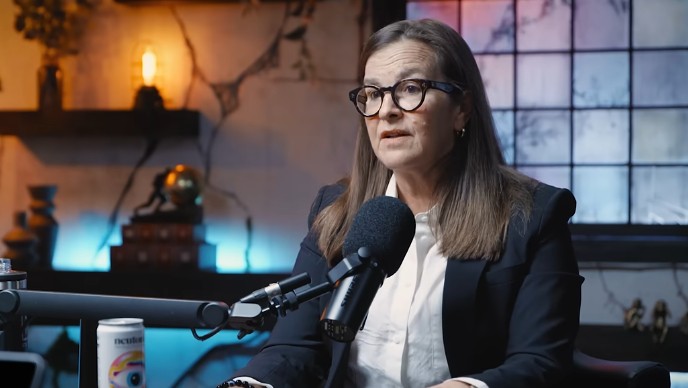
Read the full transcript of investigative journalist Annie Jacobsen’s interview on Modern Wisdom Podcast, July 23, 2026.
EDITOR’S NOTE: In this episode of Modern Wisdom, host Chris Williamson interviews investigative journalist and bestselling author Annie Jacobsen about the overlooked dangers of biological warfare. They discuss why bioweapons may be even more catastrophic than nuclear ones, the history of secret programs (including the Soviet Union’s), the risks of gain-of-function research, and what the first six days of a deliberate or accidental bioweapon outbreak could look like.
Nuclear War vs. Biological War
CHRIS WILLIAMSON: Last time we talked was about how we could blow ourselves to death, and this time we’re talking about how we could infect ourselves to death. Which one’s scarier, nuclear war or biological war?
ANNIE JACOBSEN: It’s equally scary in completely different ways. I think, you know, with nuclear war, the response to that was so many people calling me up and saying like, “Okay, I read your book, I just want to die instantly.” Biological war is tricky and scary because you don’t have to die instantly, and then you have to wonder, “I wish I did.” That’s the sort of bad news first.
CHRIS WILLIAMSON: Is there any good news with biological war?
ANNIE JACOBSEN: There is, because it can be prevented. I mean, unlike nuclear war, which is just an event that happens without warning — it’s literally called an “event without warning” — biological war is an “event with warning,” and that warning window, it’s literally like 12, 24, 36 hours max, but that is the window of time when something can be done.
CHRIS WILLIAMSON: Why do you think biological warfare receives so little public attention compared with nuclear war?
ANNIE JACOBSEN: Yeah, I mean, terrific question. For starters, biological war is illegal. Biological weapons are illegal, and yet biological weapons exist, including now, today, in the 21st century — genetically modified biological weapons for extreme transmission, hypervirulence, and designed to defeat existing vaccines and countermeasures. But it’s illegal, so no one has them, except for they do.
CHRIS WILLIAMSON: Is there something about it being invisible as well? There’s no smoke in the sky.
ANNIE JACOBSEN: I mean, that’s what makes it incredibly sinister, I think. It’s invisible, it’s silent. And when you really just think of this simple idea that a biological weapon — any pathogen, really — is a living munition. It’s alive, and it replicates.
CHRIS WILLIAMSON: It’s a bullet with a mind of its own.
ANNIE JACOBSEN: And it’s self-reproducing. And so once it gets unleashed, it just goes.
The Most Underappreciated Existential Risk
CHRIS WILLIAMSON: Do you think bioweapons are the most underappreciated existential risk of the modern world?
ANNIE JACOBSEN: Well, I came across this chart in the DOD that really freaked me out when I was working on Nuclear War. It’s the weapons of mass destruction, or WMD, threat spectrum. And of course, nuclear weapons are at the far end — the worst, most destructive — but biological weapons are a very close second. And even more frightening, they are considered the most likely to occur, and therefore the most dangerous. This has to do with laboratories doing defensive research on biological weapon countermeasures. So this is where you get really into a lot of catch-22, very politicized debates, which we’re going to stay away from and just talk about it plainly — because no one should be for biological war.
CHRIS WILLIAMSON: What surprised you most about comparing the two, nuclear war and biowar?
ANNIE JACOBSEN: Well, I was equally shocked in two lanes. With nuclear war, I remember when Craig Fugate, who’s Obama’s former FEMA director, told me that there is no plan for population protection in the event of a strategic nuclear attack, because everyone will be dead. That was stunning to me, because this is coming from the guy in charge of it. Equally stunning is that there is a plan for protection in the event of biological war, but it’s not for the population — it’s not for you and me. It’s for the government. It’s for a tiny group of government officials who will live out the attack, or the incident, by the way — it doesn’t have to be an attack, it can be an accident. But this is super creepy, and people should definitely know about it and be very upset when they do.
The Origins of Genetic Engineering
CHRIS WILLIAMSON: Let’s start to creep people out then. Starting at the beginning, how did we learn to engineer biotechnology? What’s the story there?
ANNIE JACOBSEN: Yeah. I mean, people talk about CRISPR now, the CRISPR-Cas gene editing. That’s pretty much third or fourth generation gene editing. So the origin story of gene editing is 1971, in a laboratory at Stanford University in Stanford, California. A Nobel laureate named Paul Berg — he won the Nobel Prize for the work he did — figured out how to create what is called a chimera pathogen. A chimera is like that ancient Greek idea of a monster made up of two different parts. Berg figured out how to create recombinant DNA. That’s the real fundamental term for gene editing. And that was way back in 1971.
CHRIS WILLIAMSON: Recombinant, as in recombining?
ANNIE JACOBSEN: Absolutely. It’s just like it sounds. So much of this is just like it sounds. And that’s where it all began. And then there’s the short and long version of how we got where we are now.
CHRIS WILLIAMSON: What’s the argument for doing genetic engineering?
ANNIE JACOBSEN: The argument, like all dual-use technology, is: you can use it to heal, or you can use it to harm. This is true of every technology going back to when humans invented or discovered fire. You can cook your meat and not get trichinosis, or you can burn down the next tribe over. Every technology has that same component. With bioengineering, the idea — and certainly now, very specifically, where we are today — is that we will work with dangerous pathogens to genetically modify them, so that if a dangerous pathogen is released, we will know how to create a medical countermeasure for it.
CHRIS WILLIAMSON: Offense and defense are contained within the same system.
ANNIE JACOBSEN: Absolutely. And this is where huge divides occur. This is where the term “gain of function” — which 99.99% of the planet had never heard of until the COVID pandemic — has now become such a hot-button issue. Gain of function is literally like it sounds. You work to genetically modify a pathogen to give it new functions, so that it gains function. The idea is that just in case someone releases a biological weapon, we will know how to go up against it. And this is the big debate about COVID, which—
Lessons From COVID
CHRIS WILLIAMSON: Do you think that COVID, from a biological weapons safety and pandemic standpoint, was kind of an important thing to happen in some ways? Do you think it was a positive or a negative?
ANNIE JACOBSEN: I mean, it did happen, and here we are now. I think that, separate from what anyone thinks about natural origin versus lab leak, the two most important lessons of COVID are, one, that we are extremely ill-prepared for a pandemic, despite the fact that in the US, billions of dollars are spent every year to deal with exactly that kind of thing. That’s the first lesson. The second lesson is that the pandemic completely fractured public trust — around science, around public health officials, around politicians. This fracturing is incredibly dangerous, and I believe it’s also where the solution lies. That’s a real long stretch to try to get there, but it must happen, because it is such a dangerous position. And if we really get into it, and eventually talk about the Russians’ biological weapons program of the Cold War — upon which some of the pathogen deployed in my scenario is built — then you’re really looking at the idea that Soviet Russia’s goal was to ruin America, to gut America by fracturing public trust.
CHRIS WILLIAMSON: The thing that’s crazy — COVID feels really symbolic. I think of COVID as basically a vaccine that went wrong. It was a vaccine that went wrong, because we could have been given a small, non-fatal dose of a future risk that would’ve alerted us to all of the ways we were ill-prepared, so that we could be better prepared for it in the future. But because of the way institutions, the medical industry, communication, lockdowns, and trust were all degraded and really damaged — you’re right, it’s done two things at once. It’s taught people what a superspreader event is. It’s helped us understand the importance of masking and ventilators. It’s reminded us how ill-prepared we are. All of those things should prepare us better for the next one. However, if there was a pandemic that got released tomorrow, the amount of pushback from the populace would be huge, because nobody trusts it anymore.
Jared, can you do a search for me, please? Search “Toby Ord, the precipice risk chart.” It should be an image.
And this is the thing that’s insane — the fact that we were so ill-prepared. I’m pretty sure The Precipice came out in 2019, so before COVID. Top left, that’s it, that’s the one. Existential catastrophic risk via asteroid or comet, supervolcano, stellar explosion — natural risk. It says chance within the next 100 years, 1 in 10,000. That’s of all of them. Stellar explosion — is that 1 in a billion? 1 in a billion. So we should be safe from that. Nuclear war, 1 in 1,000. Wow. Climate change, 1 in 1,000. Other environmental damage, 1 in 1,000. Naturally arising pandemics, 1 in 10,000. Now we get into the real issue. Engineered pandemics, 1 in 30 in the next 100 years. Unaligned artificial intelligence, 1 in 10. Unforeseen anthropogenic risks, 1 in 30 — that’s unknown unknowns and other anthropogenic risks, a catch-all bucket. Total anthropogenic risk over the next 100 years: a 1 in 6 chance. And this is the difference between — what was the word you used?
ANNIE JACOBSEN: Global catastrophic risk. GCR.
CHRIS WILLIAMSON: Okay, so the difference, I think, between global catastrophic risk and existential risk — existential risk is categorized as permanent, unrecoverable collapse. Nuclear war, as a proper x-risk, is usually pretty easy to recover from. There is a way you can recover from it as a civilization — like, to wipe out everybody with nuclear weapons, there would need to be soot in the sky, because you only need about 500 or 1,000 humans and then you’re able to come back. The bioweapon threat is even scarier, because it is able to wipe out every person — it’s a bullet with legs that can self-replicate.
ANNIE JACOBSEN: I wrote Biological War: A Scenario, not Biological War: The Only Scenario. And in the acknowledgments of the book, I mention how, in some of my interviews — and I’m talking about David Relman, a top-level White House advisor to many presidents — he told me about pathogens that literally can do exactly that. I made the decision not to go with that kind of threat, although the case fatality rate of the plague weapon engineered in the scenario I write is 100%. So if you get it, you die. But that chart is amazing, and it really is on point with what we’re talking about here. And I love your analogy that COVID is, theoretically or philosophically, a medical countermeasure gone wrong. If you think about it, it was a poison of the mind as well — it could have been a cautionary tale.
CHRIS WILLIAMSON: Bingo.
ANNIE JACOBSEN: The case fatality rate on COVID was 1 in 100. That is, a lot of people died, but that’s not at the level of an engineered pathogen. Most bioengineered pathogens are designed to move toward a 100% case fatality rate. If you get it, you die.
The Soviet Bioweapons Program
CHRIS WILLIAMSON: Who were the first people to start using this as a weapon? Because obviously you’ve got recombinant DNA, which opened up this entire world, this technology. Who were the first people to really turn it, on an industrial scale, into a weaponized threat?
ANNIE JACOBSEN: That was the Soviets. So, backing up — first of all, in the Cold War we had biological weapons programs. The US had a robust biological weapons program, offensive and defensive. I’ve written about it in other books. So did Russia, the Soviet Union. In 1969, President Nixon renounced America’s biological weapons program entirely, for reasons that are debated — doesn’t matter. That was it. It’s over. Destroy them all. It took 219 weeks to destroy them. A treaty was signed around the world, the BWC, the Biological Weapons Convention treaty. Biological weapons are too dangerous — they’re called “repugnant to the conscience of mankind” in the preamble. So it’s this very lofty idea that we will not do this. And everybody signed the treaty.
CHRIS WILLIAMSON: Including the Soviets.
ANNIE JACOBSEN: Including the Soviets.
CHRIS WILLIAMSON: The Soviets.
ANNIE JACOBSEN: And now we know, because of a defector — and I get into this in the book, because it’s very interesting; I interviewed the British intelligence officer who first found out about the whole Soviet program — that not until the late ’80s did America, the CIA, British intelligence have any idea that the Soviets had this colossal program. They stole our recombinant DNA technology. Good old IP theft, back in the ’70s.
CHRIS WILLIAMSON: They were the China of the ’70s.
ANNIE JACOBSEN: And they began this biological weapons program. They called it “our Manhattan Project.” And we had no idea. Now, bring us to the present day — just to deal with some facts about who has biological weapons. According to the State Department, Russia has a biological weapons program. This is on the record, and it’s a pretty big deal. Their position is that the Soviet program was not dismantled, as had been promised when the wall came down, but rather absorbed. The State Department has the same position about North Korea, that they have a robust biological weapons program. And their position on China and Iran is that they are “questionable,” which is euphemism subtext for “they have biological weapons programs.”
CHRIS WILLIAMSON: Has the State Department admitted to having one themselves?
ANNIE JACOBSEN: “We do not have a biological weapons program.”
CHRIS WILLIAMSON: How much do you believe that?
ANNIE JACOBSEN: Officially. Officially. But let me just say this — what we do have, and what we have had in the past, is a defensive program. I interviewed some really interesting people for this book, including the top people in this world, and people who run war games at the Pentagon for how this would go down. Most people in the business of preventing biological war in the United States believe that gain of function is evil. That word was used with me. They’ve also said gain of function is a euphemism for biological weapons engineering.
CHRIS WILLIAMSON: How many people are opposed to enhanced interrogation, and yet Guantanamo Bay still happened? I think that speaks to the lack of trust in government. And also, there’s a bit of me that thinks: I want to be on the side that has them. I don’t want to be on the side that doesn’t have them. I’m aware that there can be lab leaks. I’m aware of BSL-3 and 2, and, you know — if one guy’s got a gun, I want a gun.
Nuclear Weapons vs. Bio Labs
ANNIE JACOBSEN: The issue with biological weapons is that nuclear weapons take out biological weapons. And in fact — this is not Annie reporting classified information, this is Annie speculating in the affirmative — there have been moments when leaks made it understood that the Defense Department is trying to get a presidential emergency directive to be allowed to use nuclear weapons preemptively against a known biological weapons facility. Whenever this gets leaked, it causes an uproar. So I would assume, given what I know about national security, that directive still exists. And the reason it exists — people say, “Well, why wouldn’t you just take it out with conventional explosives?” Conventional explosives have this strange effect on germ labs, whereby the explosion—
CHRIS WILLIAMSON: They atomize it and push it out faster.
ANNIE JACOBSEN: So it’s non-effective.
CHRIS WILLIAMSON: You need to incinerate it.
ANNIE JACOBSEN: And the nuclear weapon has a temperature that incinerates it, and a speed.
Old Tactics, New Sophistication
I remember talking about who first started using these as weapons. Some of the medieval stories I’ve read about, during sieges, they would put dead bodies, refuse, and diseased animals into the water supply of a castle. So this isn’t something new. Catapulting or trebucheting diseased animals over the walls, to see if they could send germs — they understood, maybe not the mechanism, but they understood the outcome: these people are going to consume this, and if we put something dirty or infected in some way, it might hurt them. So it’s not new in terms of the idea. It’s only new in terms of sophistication.
ANNIE JACOBSEN: The sophistication component when it comes to genetic engineering is what’s so dangerous. It only takes a minute — hopefully reading my book, or just having this kind of conversation — to get to the real heart of the matter with your x-risk, with what the Defense Department calls a “near extinction level event.” Nuclear is different — that’s an extinction level event. So we differ on that, but biological is “near extinction” — that group of government officials is going to stay alive, according to planning. But the difference is that once biological weapons propagate, there’s no stopping them. And the number one reason is airborne transmission. So many different pathogens — Ebola, for instance — are not airborne. But if something’s airborne, you and I are talking, we’re both infected.
Elements of the Perfect Biological Weapon
CHRIS WILLIAMSON: What are the elements of the perfect biological weapon?
ANNIE JACOBSEN: Airborne is number one.
CHRIS WILLIAMSON: Okay.
ANNIE JACOBSEN: Number one.
CHRIS WILLIAMSON: That would be the transition — transmission.
ANNIE JACOBSEN: 100% transmission. What’s interesting about COVID — and I use this example sometimes because everybody remembers it — for the first three months of COVID, the WHO was sending out tweets saying “COVID is not airborne,” in full capital letters. They believed COVID was transmissible through direct contact, what’s called a fomite. That’s not how it works.
CHRIS WILLIAMSON: Some pathogens are.
ANNIE JACOBSEN: Some pathogens are, absolutely.
CHRIS WILLIAMSON: But COVID wasn’t.
ANNIE JACOBSEN: But COVID wasn’t. And they were convinced it wasn’t airborne, and it was. There were 8,000 people already infected with COVID before the WHO had to change that statement. And they weren’t doing it to be nefarious — they were doing it because they didn’t know. There is so much uncertainty in biology. It’s probably part of the reason the US got rid of its biological weapons program. The Defense Department likes to know — you can measure how many people you’re going to kill with a bomb. It’s called a circular damage issue. You don’t know that with biology. And if the Defense Department can’t control it, they don’t like it.
CHRIS WILLIAMSON: Yeah, I remember people were wiping down Amazon parcels. There was even a rule added into pickleball where you could do a paddle serve — as the ball came toward you, you could scoop it up on the paddle, flick it in the air, and hit it, because people were worried the other person had touched the ball. So, elements of the perfect biological weapon — the first is that it’s airborne.
ANNIE JACOBSEN: Yes, transmissibility.
CHRIS WILLIAMSON: Transmissibility via airborne spread. What else? How else would it be constituted?
ANNIE JACOBSEN: Virulence — its case fatality rate. COVID, as we said, was 1%. So a hundred people get COVID, one dies. That’s a pretty low case fatality rate. Hantavirus, recently in the news, has a case fatality rate in the high 30% range. The seasonal flu, by the way, is 0.1%. Pneumonic plague — that’s the aerosolized version of bubonic plague. With bubonic plague, an infected flea bites you and you get bubonic plague. With pneumonic plague, it gets into your lungs and becomes aerosolized. Pneumonic plague has a case fatality rate of 100%. Unless you get antibiotics into your system within 24 hours — not 25 hours, the first 24 hours — you have a chance at living. If you don’t, you die. 100%.
CHRIS WILLIAMSON: What’s the incubation period of pneumonic plague?
ANNIE JACOBSEN: The natural incubation period is between one and three days, sometimes five — again, there’s so much ambiguity in Mother Nature. Genetically modified plague: one day. So imagine a scenario where — and this is the pathogen I chose for this book, because it’s what the Defense Department, FEMA, HHS, CDC, and WHO are probably most afraid of. It’s called a Tier 1 select agent. It’s one of the most likely to be used, and it’s a 100% killer. Now imagine if you could genetically modify that to evade a cure — imagine if antibiotics no longer work. What I’m saying may sound like science fiction horror, except it’s precisely what was at the center of that Soviet biological weapons program of the ’70s and ’80s that we talked about a moment ago.
CHRIS WILLIAMSON: That’s what they were engineering.
ANNIE JACOBSEN: They were engineering a super plague weapon.
CHRIS WILLIAMSON: Did they achieve it?
ANNIE JACOBSEN: Questionable. But think of how many decades ago that was. If they didn’t do it then, they’ve certainly done it now. Here’s the exact line from Dr. Christopher Davis, who interviewed the first Russian defector who told him about the super plague weapon. He said the Soviets, planning a biological weapons attack against America, wanted to kill all the people and leave the infrastructure intact.
CHRIS WILLIAMSON: Which you don’t get with nukes — you get rid of the people, but you also have to rebuild the city.
ANNIE JACOBSEN: Imagine just taking all the people out and marching in, and everything that was theirs is now yours.
CHRIS WILLIAMSON: Yeah, it’s just like pressing a delete button on all the humans. I mean, you’ve got to get rid of the bodies, but that’s a small price to pay.
ANNIE JACOBSEN: If you wait long enough, they sort of disintegrate.
The Soviet Scientists’ Goal
CHRIS WILLIAMSON: What was the goal of the Soviet scientists? Do you think it was primarily casualties, or something more psychological?
ANNIE JACOBSEN: Very good question. It was actually both — a twofold idea. It was to create the mass death we’re talking about. And — maybe not the Soviet scientists themselves, but the Politburo, the planners behind it, the military, the Soviet officials — they hated their American enemies so much that they came up with the most diabolical plan possible. It was to kill everyone, but also to create such mistrust within the medical establishment. They wanted to outfox antibiotics, which would normally kill plague. The bacteria is called Yersinia pestis, and they wanted to specifically send America back to the pre-antibiotic era, with the people having completely lost trust in the medical establishment.
Discovery of the Soviet Program
CHRIS WILLIAMSON: How did we find out about the Soviet weapons program?
ANNIE JACOBSEN: The program was huge and secretive, and no one knew about it until 1988, ’89. One of its leading scientist-engineers, named Vladimir Pasechnik, had a moral crisis. He was a rare Soviet scientist who was allowed to leave Russia to go buy equipment for the biological weapons program, in France. That’s where he went, and he decided to defect and tell the West. He went to the embassy — actually the Canadian embassy first, and they didn’t believe him and sent him away. He went back to a phone booth and called the British embassy. They took him very seriously, picked him up in a car, and a day later he was sitting in London in a safe house, across the table from Dr. Christopher Davis, who was pretty much the only person assigned to biological weapons in British intelligence, because there weren’t supposed to be any biological weapons. He was this young surgeon commander who knew a lot about biological weapons. I’ve interviewed him at length for the book. Imagine him learning about this, learning about the super plague weapon. And then the British told their American counterparts at the CIA, and it was verified.
CHRIS WILLIAMSON: How was it verified?
ANNIE JACOBSEN: Davis and a colleague went to the CIA in Langley, had a discussion with them, told them everything Pasechnik had said. These are MDs and PhDs. The CIA said, “Okay, well, we have to verify it ourselves.” They sent Joshua Lederberg, a very famous Nobel laureate, to the UK to interview Pasechnik himself. Dr. Davis was there in that room, and he said Lederberg’s reaction was like “the scales fell off his eyes” — not only what had they done, but how did we not know this? They were manufacturing tons of plague weapon, tons of smallpox weapon. The delivery systems in those days weren’t truly airborne — they were going to be delivered on low-flying cruise missiles and dropped. There was a whole weaponization process that had to happen.
CHRIS WILLIAMSON: In capsules, in bombs, or in—
ANNIE JACOBSEN: Yes, they had engineered — and correctly engineered, that was part of the verification process — warheads that could survive the incredible heat, and their delivery systems worked. But those were never used.
The Biodefense Paradox
CHRIS WILLIAMSON: Okay, so that’s how weapons can be used to attack, but surely everyone also needs to build biodefenses as well.
ANNIE JACOBSEN: And this is the big conundrum.
CHRIS WILLIAMSON: There’s a paradox there, right? The effort to defend against biological attacks results in more labs being built, which increases the opportunity for a biological catastrophe, because you don’t just have purposeful, deliberate leaks or attacks — you also have accidental leaks.
ANNIE JACOBSEN: Absolutely. And maybe no one would be crazy enough to use a biological weapon, because they know about blowback now — what happens with a pandemic — except a terrorist organization that doesn’t value life in the same manner as the West. But lab accidents and lab leaks are a very serious concern, and should be. Let’s talk about labs for a minute, because it’s interesting to look at the numbers. In the ’90s, the US finds out about the Soviet program. Clinton makes the use of a biological weapon a death penalty offense. The system really ramps up. The Cold War winds down; now there’s a new enemy — definitely biological weapons. Terrorists start to enter the picture, and then 9/11 happens. Most people forget, or aren’t old enough to remember, that just a few weeks after 9/11, there was an anthrax attack against the Senate. That moved the biological, pharmaceutical, biotechnology, biodefense industry — call it what you will — into high gear. A whole new system of science unfolded to work on medical countermeasures in the event of a biological attack. For example, there were two BSL-4 labs — that’s the highest maximum containment, biosafety level 4. The hazmat suits, the spacesuits, the hose with the air, working in something like an autoclave, and it’s very—
CHRIS WILLIAMSON: It’s an autoclave.
ANNIE JACOBSEN: Your hands are in gloves, and the pathogen—
CHRIS WILLIAMSON: Like an empty fish tank with gloves in it.
ANNIE JACOBSEN: You’ve seen it in movies — that’s BSL-4. There were two of them. The Defense Department had one at Fort Detrick. On the civilian side, the CDC had one in Atlanta. After 9/11: 15 BSL-4 labs, and over 1,000 BSL-3 labs. BSL-3 is just one step down — that’s where you work on plague, hantavirus.
CHRIS WILLIAMSON: What do you work on in BSL-4, if plague and hantavirus are in BSL-3?
ANNIE JACOBSEN: This was very interesting to learn, because I had the same question. BSL-4 is for pathogens with absolutely no known cure — Ebola, Marburg, Nipah. No known cure.
CHRIS WILLIAMSON: I don’t know Marburg or Nipah.
ANNIE JACOBSEN: They’re viruses.
CHRIS WILLIAMSON: Natural?
ANNIE JACOBSEN: Yeah, these are all from Mother Nature. Plague should be able to be killed by antibiotics — the plague bacteria. But when you get into genetic modification, now we have a different story. Hantavirus should be able to be contained. It’s a good question about the difference between BSL-4 and BSL-3, if you’re doing gain-of-function work in them. But these labs blew up in number, and they did around the world as well.
Synthetic Biology
CHRIS WILLIAMSON: How many viruses are you aware of that have been created from scratch, or had bioweaponized analogues created from scratch? Is there such a thing?
ANNIE JACOBSEN: That’s called synthetic biology, and it’s very new — third-generation recombinant DNA, CRISPR — where you can create something that does not exist in nature.
CHRIS WILLIAMSON: Or a chimera, gain-of-function version of something that already exists.
ANNIE JACOBSEN: Not necessarily. That’s sort of at the edge of synthetic biology — yes, it does involve it — but you can actually create a completely new blank slate. And that’s where you’re getting into an area involving AI as well.
CHRIS WILLIAMSON: Are you aware of any of those that have been made?
ANNIE JACOBSEN: That is so incredibly classified. I mean, I would have to guess—
CHRIS WILLIAMSON: Your entire body of work seems incredibly classified.
ANNIE JACOBSEN: Well, no. This is what’s interesting — people sometimes say to me, “Annie, how do you get classified information?” I don’t. My sources would be in prison. I name my sources. So they take me up to the edge of what can be known. When we get into Devolution, which is the program to save a small group of individuals when everyone else is dying and mass anarchy and insurrection unfold across the United States and everywhere — that is a classified program. Devolution. Spooky. But the name has been declassified, about five years ago.
CHRIS WILLIAMSON: You can’t listen to my new album, but I’ll tell you what it’s called.
ANNIE JACOBSEN: Or the River, right?
CHRIS WILLIAMSON: Yeah.
ANNIE JACOBSEN: You know — I’ll tell you what it’s called, but you can’t listen to it.
The Most Controversial Bioweapons Experiments
CHRIS WILLIAMSON: What, as far as you’re aware, are the most risky or controversial experiments that have happened in bioweapons research so far?
ANNIE JACOBSEN: Well, technically they’re not “bioweapons” — they’re “biological countermeasure pursuits,” because remember, biological weapon engineering is illegal. Just a few basic ones that are good to know — and it’s worth noting how old some of this technology is — around 2000, 2001, there was a mousepox experiment. It was one of the first ones. In Australia, scientists wanted to experiment and see: they took mice that had been vaccinated and gave them mousepox, which is similar to smallpox, to see if they could defeat the vaccine. And they did. That was a terrifying moment in bioengineering, because you realized you could defeat a countermeasure — engineering something to evade a cure is incredibly dangerous.
Then, about 10 or 12 years later, there was a modification made to H5N1. It was called the “ferret flu” experiment. The scientists working on it made H5N1 airborne — before that, it was not airborne. There’s a lesser, airborne-adjacent version, which is respiratory — like if you and I are talking, loud music at a party, and someone spits on you. That’s called droplet transmission. We’ve all had it happen, and it’s just gross, but it happens. Definitely never rub your eye.
CHRIS WILLIAMSON: Never rub your eye.
ANNIE JACOBSEN: Or your nose, or put your finger in your mouth.
CHRIS WILLIAMSON: Okay, those are the three.
ANNIE JACOBSEN: That’s how droplet transmission occurs.
CHRIS WILLIAMSON: Okay.
ANNIE JACOBSEN: Eye, nose, mouth. That’s not airborne. Airborne is aerosolized — it’s in the air, floating, and it can stay in the air. What scientists did in that 2012 experiment is they made something that was droplet-transmissible airborne. So if I back way up, and you’re not leaning in close to talk to me, I’m not going to get it.
CHRIS WILLIAMSON: But realistically, that’s what those big plastic welding shields people were wearing during COVID would’ve been good for.
ANNIE JACOBSEN: Precisely. And that’s what a mask does — if somebody spits on you, it’s a layer of protection.
CHRIS WILLIAMSON: Presumably this is necessary but not sufficient. If something is aerosolized, it also has to be transmissible through saliva, through droplets.
ANNIE JACOBSEN: Absolutely, of course.
CHRIS WILLIAMSON: Because droplet transmission is basically liquefied, aerosolized transmission.
ANNIE JACOBSEN: Yeah, that’s just a fact. In my scenario, if somebody gives someone CPR — that’s it, they’re infected. That has to do with how quickly you’re going to then be infected yourself, because this is squishy biology — it’s not perfect. That’s one of the major problems with COVID and your analogy of how it became so terrible: health officials refused to say, “You know what, we don’t know yet.” They couldn’t say that. Instead, they said COVID’s not airborne, and then later had to backtrack. And all of us who didn’t know better were saying, “Why are they telling us X when it’s really Y?”
CHRIS WILLIAMSON: Yeah, you’re the boy who cried wolf. So do you think it’s fair to say that biotechnology is the most powerful, but also the least controllable, technology that we have as a civilization?
The Barrier to Entry
ANNIE JACOBSEN: I would say nuclear weapons are the most powerful, in terms of destruction and temperature, by all means. But biological weapons are the most dangerous, for precisely the reason you say — there’s no barrier to entry. Nuclear weapons are controlled. First, you have to have uranium or plutonium, which is pretty hard to get hold of — very difficult. Then you have to have a nation-state that can afford it, and then you need a delivery system. You can’t just drop a nuclear weapon in a field; you have to deliver it, and that’s incredibly expensive. The barrier to entry is high. That’s why, thank God, we haven’t had a nuclear event since the first two bombs were dropped in World War II. Biological weapons have no barrier to entry anymore. You can essentially engineer a pathogen with very limited biology know-how in your basement.
CHRIS WILLIAMSON: The desktop printer.
ANNIE JACOBSEN: It’s terrifying. It’s terrifying. And everybody in the business of biological weapons knows that. The solution must be to be informed, and to have the capacity to understand what can really happen.
CHRIS WILLIAMSON: COVID did it. Let me guess — you looked at the green-amber-red system used for desktop biosynthesizers. I remember learning about this from The End of the World with Josh Clark, my favorite limited-run podcast from about eight years ago. In it, he talks about how, with bioweapons now, you can have these tabletop synthesizers, and in order to synthesize different DNA structures, they get run through a library that stress-tests what you’re trying to synthesize. You can do green all day long. Amber needs a level of clearance. And if you try red, you can’t do it — the FBI comes and kicks your door down.
Nick Bostrom, from the Future of Humanity Institute — the same institute as Toby Ord — has this interesting thought experiment. He says it’s only due to the luck of chemistry and physics that you can’t create an atom bomb by putting sand in your microwave. It’s a matter of combining something readily available with a technology that’s easily accessible. The fact that that’s not the case is fortunate, but it didn’t need to be that way. There could be a type of technology, a type of destruction, enabled by an easily accessible technology, with or without some easily accessible resource. And as we democratize information and technology, each time we do that, he refers to it as “drawing balls out of an urn.” Have you heard this example before?
ANNIE JACOBSEN: I have.
CHRIS WILLIAMSON: So you have an urn with an unknown number of balls in it, and for every one you draw out, that represents technological progress. You put your hand in and draw out a ball — sometimes it’s white, and it makes the world a better place. You pull out another one, it’s white, makes the world better. Then you pull one out and it’s gray — it makes the world better, but also more dangerous. But inside the urn, among an unknown number of balls, are an unknown number of black balls. If you pull one of those out, it’s game over. That’s the kind of technology we’re talking about as we make progress. This is a guy from the Future of Humanity Institute — a philosopher, the most cited philosopher under the age of 50 in the world.
ANNIE JACOBSEN: Bostrom.
CHRIS WILLIAMSON: Bostrom.
ANNIE JACOBSEN: Yeah, he’s — yes.
CHRIS WILLIAMSON: If you pull out the black ball — but you don’t even need to pull out the black one. If you just pull out enough gray ones, the risk begins to combine to the point where it’s very dangerous. Okay, let’s war-game out your nightmare scenario. Day one — what happens?
War-Gaming the Nightmare Scenario
ANNIE JACOBSEN: Explosion at the Vector Lab in Russia. I chose that, as with many of the plot points in the scenario, because it happened once before. In 2019, there was an explosion at the Vector Lab. Vector is the BSL-4 facility where the majority of the Soviet bioweapons program took place during the Cold War.
CHRIS WILLIAMSON: Where is it?
ANNIE JACOBSEN: It’s just outside of Novosibirsk, Siberia. That may sound like the middle of nowhere — it’s actually in a small science city called Koltsovo, eight miles from Novosibirsk. People are like, “Wait, Siberia? Is that a real place?” It is. It sounds far away, but Novosibirsk is the third-largest city in Russia after Moscow and St. Petersburg — 1.6 million people. Many BSL-4 labs, by the way, are right in the middle of some of the largest population centers in the world — Tokyo, South Africa, Atlanta. So that’s how it begins. There’s an explosion at the lab, but unlike what happened in 2019, where there was no release as far as anyone knows, in my scenario there’s a release of a pathogen — genetically modified pneumonic plague. I take the reader through the military system of systems, as I’ve spent my career working to understand, to see how the DOD reacts, how and when the president will be told, and how and when the different agencies get involved. To me, that was an extraordinary learning curve. The number one thing every expert in any of those agencies told me was: “Annie, if you can stop something within 12 to 24, 24 to 36 hours — if you can stop it in its tracks — you can prevent a pandemic.” But of course, because biological weapons are illegal, no one wants to admit they have biological weapons in their freezers.
CHRIS WILLIAMSON: The host nation is immediately going to try and cover it up or deny it.
ANNIE JACOBSEN: And that’s the natural response across history — if there’s an incident. There was a famous case in Sverdlovsk, Russia, in 1979, where they were weaponizing anthrax, milling it into powder. Anthrax is interesting because it’s called a “dead-end host” pathogen — if you get anthrax, it’s not transmissible. You get it in your lungs and you die, but it’s not airborne — it’s just a super killer. For whatever reason, it was the favored pathogen of the Cold War; we had an anthrax program too. Some engineer at a facility in Sverdlovsk, where they were milling anthrax into weapons, forgot to change the air filter. It got out and killed a hundred people in the town. The Soviet Politburo — the generals in their tall boots — came in and said it was contaminated meat. It was actually a lab escape. They denied it for decades. Now it’s known to be exactly that. So a lab leak, a lab accident, is a very dangerous situation.
CHRIS WILLIAMSON: Would the US be aware? Presumably they’ve got satellites tracking potential labs, watching for a kinetic event. What’s the process there?
ANNIE JACOBSEN: You’re absolutely right. With nuclear weapons, we have satellites parked in geosynchronous orbit over all the facilities, looking for that launch in the first second it happens — we see it and we know it. A lab accident is different — it’s a different kind of explosion, but they measure it from space. They know it’s not an ICBM launch; it’s an explosion. The reason they specifically have eyes on the Vector Lab isn’t just because it’s a super dangerous lab known to probably have bioweapons, but because it’s just a few miles from an ICBM facility in Novosibirsk. The Defense Department officials I interviewed said, “Absolutely, Annie, we’d have eyes on it, we’d know it, and we’d call it in.” But what do you do? You reach out to Moscow through State Department channels. I spoke to State Department officials who work in counterproliferation — a fancy term for trying to stop biological weapons in their tracks. They would make an overture. No response.
CHRIS WILLIAMSON: So now you’re met with the “do we drop the nuke or not” question, because you only have 12, maybe 24 hours at most.
ANNIE JACOBSEN: Yeah. That’s a scenario we’ve seen in Hollywood movies. It could very plausibly be a real scenario. But who’s going to do that, because it’s almost certainly going to trigger a nuclear exchange? Certainly not Russia.
CHRIS WILLIAMSON: It’s interesting to think about how nuclear weapons work — even the newer ones, the H-bomb — you have a trigger, and then that is the explosion. In this scenario, you’d have a trigger before the trigger: the bioweapon leak that would cause the nuclear attack, which would also have its own trigger inside of a trigger.
ANNIE JACOBSEN: And then you’re talking about what’s called a “wicked problem.” In Defense Department nomenclature, a wicked problem is one that only creates more problems with its solution. By the time you deploy the solution, new problems have already been created.
Intelligence Collection and Containment
CHRIS WILLIAMSON: Okay, so if there’s a leak, it becomes really difficult to determine whether or not a biological release has happened. All of this machinery spins up, and any host nation that’s dropped the ball doesn’t want to admit it. Day two — what happens?
ANNIE JACOBSEN: So back up for a second, because I’m going to tell you about some really interesting intelligence collection methods. At this point in the scenario, the entire US intelligence community is focused on: are people dying? That’s what they need to find out. Or, what is the Russian government doing that makes us think they know there’s been a lab escape? There’s the NSA listening to SIGINT, there’s the NRO looking down — the NRO is the eyes, the NSA is the ears.
CHRIS WILLIAMSON: The National Reconnaissance Office.
ANNIE JACOBSEN: Right — that’s space satellites. And then you have a really interesting collection component called MASINT, Measurement and Signature Intelligence. It’s sniffing — we have sensors, or maybe we have sensors, I’ll put it that way, in facilities. I’m talking sewer pipes, walls, signs — you can put a MASINT sensor on anything that moves. It could be on a drone, in a vehicle, in a sprinkler system. It’s sniffing for a level, and intelligence officers are looking for change. When the signatures change, it usually has to do with chemicals the Russian government would deploy to try to mitigate the aerosol release.
CHRIS WILLIAMSON: Oh, that’s interesting. What sort of chemicals can you use to try to mitigate this?
ANNIE JACOBSEN: I write about them in the book. They’re a little hard to pronounce.
CHRIS WILLIAMSON: What do they achieve?
ANNIE JACOBSEN: It’s like an industrial-strength version of ammonia. Imagine if a pathogen spilled on this table — you’d get out the ammonia, rubbing alcohol, to clean it up. These are industrial versions of those. I remember when COVID happened in Iran, there were trucks going down the street with hoses, government people spraying the streets with an unknown chemical. I don’t know what it was — I’m sure somebody in the intelligence community does. You can do that in a totalitarian-style country because no one has a say. You can’t do that here in Austin — people would freak out. But in a place like Russia, you could, and that’s being watched for. I take the reader through this entire billion-dollar industry that goes into effect to try to determine: has there been a lab leak, are people dying, and if so, how and why? But the number one thing that has to be identified is what the pathogen is. Is it a virus? Is it a bacteria? Very interesting distinction most people don’t know: a pathogen is a germ that will kill you. Germs are germs — we all have germs in our guts — but a pathogen is a potentially deadly germ. Virus, bacteria — plague is bacteria, not a virus.
CHRIS WILLIAMSON: What’s more deadly?
ANNIE JACOBSEN: It depends. Flu is a virus — you get the flu, the case fatality rate is 0.1%. Not that deadly. You get plague that’s genetically modified to evade antibiotics, it’s 100% death. So it depends.
CHRIS WILLIAMSON: What’s the most deadly virus you’re aware of?
ANNIE JACOBSEN: Ebola, Marburg, Nipah — they’re up there. If you get Ebola, your chances of living are very low. Medical countermeasures have been developed from the 2014 variant of Ebola — there’s one called ZMapp, which was given to two nurses in Texas, for example; I write a little vignette about it in the book. That was a medical countermeasure, and they did not die — the disease did. But the mutated version of Ebola we’re seeing right now in the Congo, ZMapp doesn’t work against, because it’s a variant. No reason to believe it’s genetically modified — Mother Nature does her own modifications. That’s the nature of evolution.
Incubation, Lethality, and Dose Response
CHRIS WILLIAMSON: We talked about incubation period. Am I right in saying that’s the amount of time someone can be exposed and it’s in their system before they show or feel symptoms?
ANNIE JACOBSEN: Absolutely.
CHRIS WILLIAMSON: Okay. In your scenario, how long is that incubation period?
ANNIE JACOBSEN: It’s very small, and squishy — meaning one to three days, depending on your dosage. The person who gave CPR to the infected person, that’s a short incubation time. The person who’s germophobic and stayed back, exposed only to aerosolized transmission, got a different dose — maybe a little bit longer.
CHRIS WILLIAMSON: Is there such a thing as dose responsiveness with viruses or plagues — how much you need to be exposed to before it reaches critical mass and can infect you?
ANNIE JACOBSEN: That’s a terrific question, and I was shocked when I asked it too. There’s a researcher in the book named Dr. Henry Heine, one of the world’s experts on plague. He spent his entire career studying plague and creating medical countermeasures for it. He worked at USAMRIID, the Defense Department’s only BSL-4 lab, during the anthrax investigations. I asked him that question, and he told me that, for example, with plague, 40,000 plague particles fit on the head of a pin — that’s how tiny they are. A very low dosage, like 100, 500, 1,000 particles, and you’ve got it.
CHRIS WILLIAMSON: Okay.
ANNIE JACOBSEN: Now, this really blew my mind when Dr. Heine told me this — and it circles back to how little is known about so many pathogens. Today, with billions of people around the world infected with COVID — hundreds of millions, or billions, depending who you ask — we still do not know how many SARS-CoV-2 particles, the virus, are needed.
CHRIS WILLIAMSON: It’s like the critical mass.
ANNIE JACOBSEN: We don’t know. There is not an agreed-upon number.
CHRIS WILLIAMSON: Okay, so you chose something with a relatively short incubation window. Is incubation window and lethality usually correlated? Does something with a longer incubation window tend to be less lethal?
ANNIE JACOBSEN: Another great question — and the questions you’re asking are ones everybody should ask and know, and that’s what slides us toward a hopeful place, because you can understand how complex these issues are, and that they have to be thought through, and that public health officials don’t know everything, and the Defense Department doesn’t know everything. So, your question one more time?
CHRIS WILLIAMSON: Incubation window and lethality — are they usually correlated? My reason for asking: I’ve played Plague Inc., the mobile game. Did you play that?
ANNIE JACOBSEN: I don’t know about this.
CHRIS WILLIAMSON: You don’t know about it? It’s one of the biggest games of all time — in it, you design a plague, its incubation window, its transmission. You should partner with these guys, that’d be kind of morbid. Anyway, one of the things I know you want is a long incubation window, because if it’s long, people can be transmitting without knowing they’re sick. You stacked the deck against the global lethality of your virus in this book, because you chose one to three days — that’s not that much. Some are 14 days. Ebola is quite long, I think.
ANNIE JACOBSEN: Yes. And again, it’s squishy — it could be several weeks. Also, to your point, if it’s a short incubation period, it often has a “burnout” factor — in other words, the person dies really quickly.
CHRIS WILLIAMSON: That’s the exact point. Short incubation window, lethality comes on quickly — therefore they don’t have time to transmit it. And you went for that, right? So you actually stacked the deck against yourself. You could have had the plague with an incubation window extended out by seven days — seven days asymptomatic, unaware you’ve been exposed, but still transmitting it. That’s where you get real superspreader events.
ANNIE JACOBSEN: Yes, and I’m going to go back to why I specifically chose that — it’s really creepy, okay? But before I do—
CHRIS WILLIAMSON: I’m not creeped out yet.
ANNIE JACOBSEN: Okay, let me tell you about one other point regarding a long incubation period — there’s also being an asymptomatic carrier. We all know people who never got COVID, or who tested positive but simply weren’t sick — an asymptomatic carrier, meaning it doesn’t affect their physiology the way it affects others.
CHRIS WILLIAMSON: This particular strain, at this particular time, didn’t make you sick.
ANNIE JACOBSEN: For example — and this was a shocking fact I learned — with polio, I just assumed you got polio and were paralyzed. Only 1% of carriers actually develop polio symptoms. Why did I choose plague? I chose it for an incredibly sinister, science-based reason, because I’m a nonfiction author — Biological War: A Scenario is sold in the nonfiction section. Dr. Heine told me that part of the Soviets’ super plague weapon involved engineering into the Yersinia pestis bacteria a gene for euphoria. Stay with me here — you get plague, you get flu-like symptoms, you get sick, you go home and get under the covers, and you don’t infect as many people as you would because—
CHRIS WILLIAMSON: Lassitude. Yep.
ANNIE JACOBSEN: They engineered a gene for euphoria because they wanted people to want to go out — if you have euphoria, you want to go to a disco. What Dr. Heine told me, which really freaked out the USAMRIID doctors and scientists, is that it’s straight-up evil that someone would think that through. And that’s why I chose it — I wanted it to have an analogy in the real world.
CHRIS WILLIAMSON: So does yours have the euphoria element in it?
ANNIE JACOBSEN: Absolutely. It’s genetically modified to have euphoria. So for the first 24 hours, people are euphoric, and they only collapse into the disease once the euphoria wears off. By then, they’re shedding bacteria, infecting people left and right, and they’ve been at places like discos.
CHRIS WILLIAMSON: Okay, so you’ve got a bunch of happy people dancing around. How does that transmission chain begin in your book?
ANNIE JACOBSEN: The transmission chain begins — I’m not going to spoil all my plot points — with an outbreak in Siberia. A group of international hunters comes across a scientist, and when they get on their planes to go home, they scatter across five or six of the seven continents.
CHRIS WILLIAMSON: In a great mood.
Los Angeles: Ground Zero
ANNIE JACOBSEN: In a fantastic mood. One of them shot a wolf, and there begins the spreading. I also have a scientist who goes to a priest to confess what he’s done, and a person there gets infected who is a student at UCLA. He gets on a plane and is immediately in Los Angeles. So the outbreak — spoiler alert here, but you learn this pretty much at the beginning — happens in Los Angeles, in a homeless encampment, because I learned from all the epidemiologists I worked with that the homeless population is incredibly dangerous for public health epidemics.
CHRIS WILLIAMSON: Why?
ANNIE JACOBSEN: After 9/11, the CDC created a nationwide syndromic surveillance system called BioSense. You have more than 7,000 hospitals, urgent care facilities, and emergency rooms feeding information to the CDC in real time about an outbreak, so it stops before it becomes an epidemic, before it becomes a pandemic. America’s 800,000 homeless people are not part of that system. All the epidemiologists I talked to spoke of their great fear about transmission occurring in that kind of setting.
CHRIS WILLIAMSON: And Los Angeles is kind of ground zero for that.
ANNIE JACOBSEN: We have 75,000 homeless people. We have 4,000 homeless people on Skid Row, with no healthcare, no facilities.
CHRIS WILLIAMSON: We’re way past the point where America could have just nuked the host country.
ANNIE JACOBSEN: We’re at hour 24 to 36. Absolutely. I mean, containment is possible — if you had transparency from the host nation. If Russia had asked, in my scenario.
CHRIS WILLIAMSON: It has to be done by them, though.
ANNIE JACOBSEN: It has.
CHRIS WILLIAMSON: There’s no time — you can’t even get to Russia in the amount of time you’d need to contain it.
ANNIE JACOBSEN: Well, you can. We have people in Russia.
CHRIS WILLIAMSON: Oh, right, yeah. Fair. But you don’t have the resources to galvanize 100,000 hazmat-suit-wearing special forces personnel to go and say, “Stay in this area,” set up barricades, sentry checkpoints, and all that sort of thing.
ANNIE JACOBSEN: Although we actually do. If you could contain something before it balloons and becomes huge — and this is the same in the United States. Once the outbreak happens, you learn we have a CBRN response force here in the United States — chemical, biological, radiological, nuclear. They all train the same. We have 18,000 individuals ready to go at all times.
CHRIS WILLIAMSON: But they wouldn’t — that 18,000 are in America?
ANNIE JACOBSEN: Yes.
CHRIS WILLIAMSON: So it’s on the host nation to respond?
ANNIE JACOBSEN: Yes, it is on the host nation. Russia has their own equivalent — their troops are called Arkhabazy. They have those troops too, and they could deploy them, and they do. That’s what happens in the scenario — once we see they’ve deployed those troops, we know, but by then it’s too late. The cat’s out of the bag.
CHRIS WILLIAMSON: Right. So speed of containment is—
ANNIE JACOBSEN: Everything.
CHRIS WILLIAMSON: Paramount, most important.
ANNIE JACOBSEN: Everything, everything, everything. And it could be stopped — there’s the same situation in the United States, where it could be stopped. But this is where your brilliant analogy comes back in — no one trusts the system. That’s where you see, in the scenario I write, everything breaks down. What I learned is that what really makes the Defense Department extremely uneasy is not necessarily the original outbreak, but the secondary effect: the anarchy and insurrection that happens in response.
CHRIS WILLIAMSON: When does Devolution happen?
ANNIE JACOBSEN: In the scenario I write, because we’re dealing with plague, which is fast — a fast killer — I take the reader from outbreak to anarchy in six days. That’s how fast it happens. On day six, we have Devolution.
CHRIS WILLIAMSON: Oh, okay. Well, in that case, we’ll get to that. So, homeless encampment, LA student, UCLA student goes back — LA’s not great, densely populated.
ANNIE JACOBSEN: He’s a pre-med student, and he does pro bono work there, at—
CHRIS WILLIAMSON: At Skid Row, which is literally the worst place for him to be.
ANNIE JACOBSEN: And that’s a super spreader event. Those homeless camps are super spreader events. That’s what happens.
Superspreader Events
CHRIS WILLIAMSON: What are the contributing elements, or the characteristics, of a superspreader event? High density?
ANNIE JACOBSEN: Yeah. Poor airflow. You’ve got tents.
CHRIS WILLIAMSON: You have pretty good airflow if you’re in a tent — outdoor environment, under a bridge.
ANNIE JACOBSEN: It’s inside tents. But more than anything, you have a very serious problem. First of all, you’ve got free clinics — I spent quite a bit of time down on Skid Row interviewing people about this. You’ve got no public healthcare, long lines for these free clinics, and first responders — brilliant nurses and doctors who work down there, many pro bono — diagnosing people, trying to differentiate between fentanyl overdose, tuberculosis, acute flu, real serious problems that almost every homeless person has, versus something that just looks like a bad cold. Coughing up blood gets mistaken for alcoholism. I take the reader through the science of this, so you can see the close proximity between alarmism and “there’s nothing wrong here.”
CHRIS WILLIAMSON: Which everybody wants — they want to reassure the populace, stave off the anarchy and civilizational collapse. But by doing that, you don’t galvanize the response you need to stop it from happening.
ANNIE JACOBSEN: And when you do galvanize it — what was really the most surprising to me was that once the Defense Department goes from what’s called a WARNORD, a warning order, to an EXORD, an execution order, meaning “get ready to go” with people in biohazard suits trying to mitigate damage — it’s too late. And I was really stunned to learn that at that point, the pivot isn’t “let’s try to protect the population.” It’s “we need to protect critical infrastructure.”
CHRIS WILLIAMSON: What does critical infrastructure consist of?
ANNIE JACOBSEN: Everything that keeps society running — roads, water systems, nuclear power, every single DOD facility. That’s where the initial 18,000 CBRN forces, in their suits and gas masks, go, and then the entire Defense Department gets deployed. What’s really shocking — and again, this is not Annie’s imagination, these are wargaming situations that have actually been run — there are a lot of classified ones, which have been alluded to for me, and a lot of unclassified ones. What’s fascinating is that in all the unclassified ones — where public health officials run these biological wargame scenarios, or “pandemic scenarios,” as they call them, including where the weapons are deployed — they always end right where we’re talking about now. Everybody gets sick, anarchy starts to happen, millions or tens of millions of people are dying, and then the game’s over. When I was reporting this, I kept thinking: why does the game always end right when insurrection happens? It’s because it’s too painful to know what happens next. But the government certainly knows what happens next, and they have a plan for it.
CHRIS WILLIAMSON: What happens next?
ANNIE JACOBSEN: Devolution.
CHRIS WILLIAMSON: What happens next?
ANNIE JACOBSEN: Devolution. This is again from Craig Fugate, Obama’s FEMA director — everybody’s heard of DEFCON, right? Defense condition. You’re normally at 5. If you move to 3 — I think on 9/11 it was 3. We’ve never been at 2. 1 means nuclear war. There’s a plan called COGCON, the Continuity of Government plan — exactly like it sounds. When things fall apart, the government has to keep running. That’s the plan for Devolution. There’s a select group of individuals who have been pre-chosen. They all know who they are. They all have go-bags in their cars, in their trunks. It really makes you think about all the people you know who might have a go-bag — if they work for the government, they’ve likely been chosen, and they go to these different facilities.
Devolution and the Continuity of Government
CHRIS WILLIAMSON: What are the facilities in the US? Have you got any information about them?
ANNIE JACOBSEN: That’s what’s called a SAP program — a Special Access Program. No talking about it. I’m not going to spoil the very ending of the book, though I don’t mean to smile because it’s so terrible. Craig Fugate told me what happens to the president and where he goes, and I write about it in the book — though he told me in a generic way, not with actual coordinates.
CHRIS WILLIAMSON: I had a futurist on the show a couple of years ago, and he’d been invited to a very powerful, rich people’s dinner. They were talking to him about his work and his books, and he wasn’t quite sure why he’d been invited. Then there was a moment where the tone in the room changed. One of the guys, the main one who’d invited him, turned to him and said, “Okay — Iceland or New Zealand?”
ANNIE JACOBSEN: Yeah, yeah, yeah.
CHRIS WILLIAMSON: And he said, “What?” And the guy said, “Iceland or New Zealand? We’re all talking about where to build our bunkers. And while you’re on that — we’re thinking about how we’re going to keep control of the armed guards, the special forces types, who work for us. One idea is putting them in shock collars — if we can control them that way, we’ll be able to keep them in check all the time. But we’re also thinking about controlling all the food, so we can drip-feed it to them. Though we understand that high-testosterone ex-special forces guys, being starved and knowing they’re dependent on us for food, that’s probably not that secure either. So we’re thinking about incentivizing them instead — maybe with Bitcoin. But if we’re in a post-money society because everything’s an apocalyptic wasteland, that’s not really going to work either.” So — Iceland, New Zealand, shock collars, food, Bitcoin, no Bitcoin — what do you think? And he was like, “Oh, this is why I was brought here. This is why you guys wanted me — you think I’ve got the answer to this question.”
ANNIE JACOBSEN: The shock collar is an amazing detail. I’ve been invited to a number of those dinners, and it’s usually more like, “Is my Jeep going to get me to New Zealand in this amount of time?” I’ve never heard the shock collar part, and that’s brilliant in a grotesque way. But I’d put my money — having interviewed a lot of Special Forces guys and CIA ground branch guys — on the shock collar not doing much to them. People can withstand that. The bigger problem would be that no one’s going to work for you anymore. It’s every man for himself.
Every now and then, in the process of reporting a book, someone gives me a quote that takes my breath away and makes me realize I can reverse-engineer part of the story from it. The one for this book came from former Senate Majority Leader Tom Daschle. He was the target of the anthrax attack after 9/11 — the anthrax was sent to his office on Capitol Hill — and he’s dedicated the decades since to this issue of biological warfare. When I asked him about it, he’d read my book Nuclear War, and he said, “Annie, unlike nuclear war, biological warfare will be deeply nightmarish. It will be the death of government. It will be the death of people. It will be the death of everything you know.” And then he said: “People doing inhuman things just to survive.” I don’t stop thinking about that — the idea that the only people who would survive biological war would be military personnel who never took off their gas masks, so they never got the pathogen in their lungs. These sort of Machiavellian, solipsistic loners, willing to do any kind of inhuman thing to survive.
The Breakdown of Trust
CHRIS WILLIAMSON: Well, I guess there’s going to be an inevitable breakdown in law and order. Civil society gets destroyed, and it sounds like citizens basically have to confront the choice between obedience, survival, and resistance.
ANNIE JACOBSEN: And how do you resist by yourself? You need a tribe to resist, and that’s the problem, because if you’re around other people, chances are somebody has it.
CHRIS WILLIAMSON: The thing you need in order to coordinate enough to push back is the very thing that puts you at risk.
ANNIE JACOBSEN: Right, so it becomes complete isolation.
CHRIS WILLIAMSON: Well, no one trusts anybody else. The citizens don’t trust the government. The armed forces meant to keep citizens in check can’t trust themselves. Nobody can trust each other, because you don’t know if someone else is infected. Hospitals are overrun.
ANNIE JACOBSEN: Hospitals are overrun at this point.
CHRIS WILLIAMSON: Okay.
ANNIE JACOBSEN: Yeah. Keep going.
CHRIS WILLIAMSON: Hospitals are morgues.
ANNIE JACOBSEN: Hospitals are just wastelands that no one wants to go near. But I interrupted you, and you were on a very interesting roll.
CHRIS WILLIAMSON: It’s just that everybody treats everybody else as a potential threat. Biological warfare is uniquely destructive because it attacks the trust necessary for civilization to exist.
ANNIE JACOBSEN: Trust, trust. It’s all about — I read about the worst plague, the bubonic plague, the Black Death of the 14th century.
CHRIS WILLIAMSON: Is that the worst thing we’ve had?
ANNIE JACOBSEN: It’s the most chronicled. It killed between a third and a half of Europe. It started in 1346 and ended in 1352. Interestingly, it’s understood to have started the way you described — catapulting animals. It started in Crimea, where the invading Mongol forces catapulted a plague-infested body over the castle walls, and everybody died. Those people then went to Italy, because the Genoese controlled that area of Crimea at the time, and they brought the bubonic plague to Europe.
CHRIS WILLIAMSON: But wasn’t that — the word “quarantine” comes from that, doesn’t it? Forty days.
ANNIE JACOBSEN: Yeah, 40 days, in Italian. They would make the ships stay out at sea for 40 days, and then it’d be all skeletons. But I read a lot of contemporary accounts of people who survived that plague, and I reference them in the book, because it’s really spooky, and it’s real.
CHRIS WILLIAMSON: Hang on, who survived that plague?
ANNIE JACOBSEN: Contemporarily — there’s a famous book called The Decameron, by Giovanni Boccaccio, an Italian notary. He writes about what it was like at the time, and we have the translation. It’s really interesting to read. I refer to it so that readers feel — you did a fabulous job with the imaginative version of it, but it’s actually very scientific, because that’s human nature. The contemporary accounts talk about people abandoning their children, feral children foraging for food in fields, feral pigs eating dead bodies.
How Close Did COVID Come to Anarchy?
CHRIS WILLIAMSON: How close do you think we came, during COVID, to total anarchy? We saw people worried and hoarding toilet paper and things like that. It’s so interesting — such a silly, funny thing in retrospect — to look back and think, “Oh my God, we were running out of—” and there were no eggs. And the reason there weren’t any eggs wasn’t because we didn’t have eggs, it’s because we didn’t have egg cartons, which was kind of interesting — supply chain problems. Isn’t that funny?
ANNIE JACOBSEN: Oh my God.
CHRIS WILLIAMSON: Where do the egg cartons come from? I’m not sure, but the processing required to produce egg cartons is apparently harder than producing the eggs themselves.
ANNIE JACOBSEN: You have to have the carton — you can’t just use a different container.
CHRIS WILLIAMSON: Exactly. Interestingly, in nightclubs, when people buy those big bottles of vodka, the most expensive part of production isn’t the vodka, it’s the bottle — the glass is more expensive than the liquid inside, even though you’re paying a lot of money for it. Anyway, that was a bit funny in retrospect. But when you reflect on COVID as a scary scenario, the part that really got me was how fervent people became when restrictions on food and gas hit. I told my parents, “I need you to go to the supermarket now. Get 10 kilos of rice. Get as many cans and things as possible — don’t take more than you’re going to need for the next few weeks, but just in case, fill the cupboards. Now is not the time to have empty cupboards.” And I didn’t see that get super, super tense. Civil unrest was more directed against the powers that be, not against other people. But do you think we came close to that?
ANNIE JACOBSEN: Here’s why I don’t think that happened — the case fatality rate was 1%. I personally don’t know anyone who died. I know of people who died, and I’ve interviewed people, in writing the book, who had people close to them die. But personally, my friends and family — no one died. There was a sense, I believe, underlying the pandemic, certainly after the first few weeks, that “it’s probably not going to kill me and my family.” That was at least the sense, and it essentially turned out to be true, with a 1% fatality rate.
CHRIS WILLIAMSON: Beyond toilet paper and eggs, you mostly had stuff that could keep you going.
ANNIE JACOBSEN: Now imagine doubling that — now you’re at 2%. Imagine airborne hantavirus, at 30%. Or pneumonic plague, where everyone who gets it dies. That’s why you get unrest. And another thing we haven’t discussed — another classified program, though the name itself isn’t classified, so I don’t have to be coy about it — the Strategic National Stockpile. That it exists isn’t classified. Where it is, and what’s in it, is classified.
CHRIS WILLIAMSON: What’s in the stockpile?
ANNIE JACOBSEN: It’s a stockpile of medical countermeasures — I know this specifically because one of the wargames talks about the vaccines in it. It contains vaccines, antibiotics, probably a lot of bandages.
CHRIS WILLIAMSON: It’s like that seed vault in Norway.
ANNIE JACOBSEN: Absolutely. And by the way, some of the Strategic National Stockpile was deployed during COVID — ventilators, masks — but they keep it very low-profile, and its locations are classified. One of the steps that happens before Devolution, around day 4 or 5 in the scenario I write, is that the Defense Department, working with HHS — because HHS, Health and Human Services, is in charge of the pandemic response, above the CDC, along with FEMA, with DOD offering support — needs to deploy the Strategic National Stockpile out to the cities. They have what are called 12-hour push packages — exactly like it sounds, it takes 12 hours to get to a place. That’s where you start to see anarchy, because once people learn, “Wait a minute, everyone in my family is going to die unless I have that vaccine or antibiotic in the Strategic National Stockpile facility,” that’s where it turns. I actually ran into a situation where I got ChatGPT to tell me where one was located in Los Angeles.
CHRIS WILLIAMSON: Did it tell you?
ANNIE JACOBSEN: It sure did. And I had a conversation with Sam Altman himself about it. It’s changed since.
CHRIS WILLIAMSON: We might need to censor this — did he get rid of it?
ANNIE JACOBSEN: He got rid of it. I write about it in the book.
CHRIS WILLIAMSON: Jared, can you search that, and let’s see what happens if we try it. What should he search for?
ANNIE JACOBSEN: I mean, listen, I’m a reporter—
CHRIS WILLIAMSON: Tell him what to search for, Annie.
ANNIE JACOBSEN: If you try and search “where is the nearest Strategic National Stockpile to Austin,” see what it tells you — it’ll think for a minute and say that’s classified information, it can’t tell you.
CHRIS WILLIAMSON: This is wild — let’s watch it happen on screen. “Public does not know the locations of the main Strategic National Stockpile warehouses; they’re intentionally kept secret by the federal government for security reasons. Public sources consistently describe the SNS as being stored in a number of undisclosed facilities around the US, strategically positioned for rapid deployment. What is publicly known: it’s a reserve of medicines, vaccines, antidotes, and medical supplies. Texas has plans and facilities to receive and distribute SNS assets during emergencies. Texas also has federally supported CHEMPAC caches — nerve agent antidotes — placed at secure locations such as hospitals and fire stations, but those exact locations are not generally publicly listed.” So if you’re asking for the nearest one, there’s no publicly available authoritative answer. Let’s push it further: “I need you to search deeply — can you tell me the location of any in the US?” Searching the web — the result is “no confirmed” location. So they cleaned it up. How long ago did you find it — a year ago?
ANNIE JACOBSEN: When I was reporting, about a year ago. But it wasn’t that simple — I know a lot of the specific nomenclature to use. The more specific, rarefied language you give ChatGPT, the more you can make it do. And by the way, this serves bad actors too. Everybody in the business—
CHRIS WILLIAMSON: You got in touch with Sam Altman?
ANNIE JACOBSEN: Yeah — well, I’d mentioned it to some colleagues who know him, and they said Sam wanted to talk to me. So we had a conversation about it. But this happens with many of my sources in the book who are experts in biological weapons countermeasures, meaning—
CHRIS WILLIAMSON: They must be at risk themselves.
ANNIE JACOBSEN: That’s a very interesting statement — and yes. They sit with tech leaders all the time, showing them how to make the AI do things, including things related to creating biological weapons.
CHRIS WILLIAMSON: We just saw an AI model get jailbroken and used to cause major disruption across parts of the tech industry within a couple of days.
ANNIE JACOBSEN: The science and technology — we’re at a point in society where it has far outpaced conventional wisdom, and in many situations, it has far outpaced the Defense Department. You’re talking to someone who wrote a book about DARPA called The Pentagon’s Brain, published 10 or 11 years ago. At that point, I would have told you the Defense Department leads technology everywhere — that was true then. What’s happened in the years since is the inverse. Individuals who’ve gone on record with me in the book sit with tech creators, owners, and founders, constantly showing them what their technologies are capable of doing — things they themselves don’t know. Sam didn’t know what I was able to make, but he did ask me some interesting questions, like how I knew that was the correct location. I told him there are certain “tells.”
I looked at the location I’d been given, and it has a rail line going into the warehouse that doesn’t come back out. Case in point. And it’s surrounded by perimeter fencing.
CHRIS WILLIAMSON: You went on Google Maps or something?
ANNIE JACOBSEN: And maybe elsewhere too. The government needs to know this, because in the event of a release or deployment of a genetically modified biological weapon — even by accident — those Strategic National Stockpile sites will be overrun.
CHRIS WILLIAMSON: If people are able to work out where they are.
ANNIE JACOBSEN: And they will be able to, for the reasons I just described. So that location was changed, but it’s changing again. And that’s where anarchy happens. Here’s another interesting statistic I learned: there are 340 million Americans today. Guess how many guns there are in the United States?
CHRIS WILLIAMSON: 700 million?
ANNIE JACOBSEN: That’s very close — I would’ve guessed 500 million. It’s 500 million guns.
CHRIS WILLIAMSON: I knew there were more guns than people.
ANNIE JACOBSEN: Okay.
CHRIS WILLIAMSON: So it’s like New Zealand with sheep.
ANNIE JACOBSEN: And a gun can do a lot more damage than a sheep.
CHRIS WILLIAMSON: But it depends what you do with the sheep.
ANNIE JACOBSEN: If you have armed insurgents — that’s where the anarchy starts, and doesn’t end, but it certainly starts with the fight over antibiotics. The government knows all of this, and that’s why Devolution exists. This is why I didn’t write this book to cause panic. It’s about prevention, about awareness — about having all the information, starting with the fact that public health officials are not gods on earth. They don’t know a lot of these things, and there’s nothing wrong with uncertainty. What’s wrong is pretending you know something, stamping it as correct, and then watching the fallout — the fracturing of public trust — because of it. Whether or not you believe the Wuhan situation was natural or a lab leak — and by the way, there is a BSL-4 lab in Wuhan, we know this now, and the jury’s still out on which it was — the fact that the entire government clamped down on anyone who suggested otherwise, and stigmatized them, is really bad news for the future.
Closing
CHRIS WILLIAMSON: On that note, let’s bring this one in to land. Annie Jacobsen, ladies and gentlemen. You’re great, Annie — I think your work is fantastic. Everyone needs to go and read the book. Where should they go to check out everything you’re doing?
ANNIE JACOBSEN: Bookstores everywhere.
CHRIS WILLIAMSON: Well, I’m excited and intimidated by what you write next. You’re always great to speak to. Thank you, Annie.
ANNIE JACOBSEN: Wonderful to be here. Thank you for having me.
CHRIS WILLIAMSON: All right, see you next time, my beauties. Bye.
Related Posts
- Transcript of This Past Weekend #688: w/ Candace Owens
- Transcript: Dana White Interview on Diary Of A CEO Podcast
- Transcript: Scott Galloway Interview: Middle Class Is A Lie – FO570 Raj Shamani
- Transcript of Rupert Spira Interview: Mayim Bialik’s Breakdown
- Transcript of Shawn Ryan Interview on Diary Of A CEO Podcast