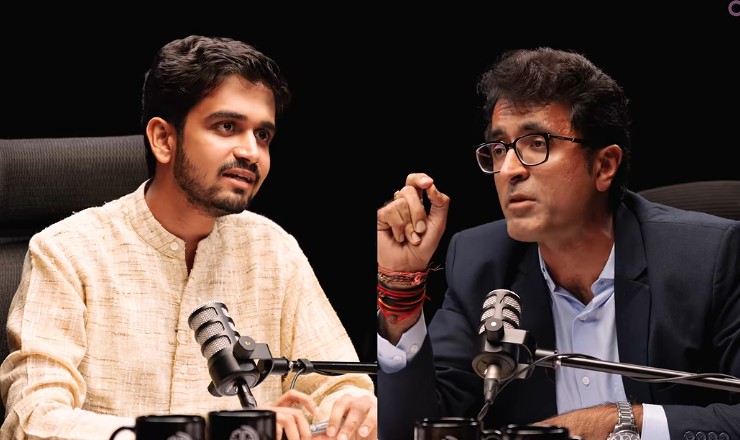
EDITOR’S NOTE: In this Think School debate moderated by host Ganeshprasad Sridharan, BJP spokesperson Pradeep Bhandari and opposition spokesperson Anish Gawande clash over whether the party’s 12 years in power have delivered genuine progress for India or mostly propaganda. They examine key areas including the economy, infrastructure, education, healthcare, poverty reduction, and national security, weighing data on achievements against persistent challenges. The discussion ultimately asks what the real benchmarks for India’s success should be after more than a decade of BJP rule. Read the full transcript of the debate below:
Opening Statements
GANESHPRASAD SRIDHARAN: Ladies and gentlemen, the BJP has been governing this country for 12 years now. 12 years is not a honeymoon period — 12 years is a verdict period. 12 years is enough for the excuses to die and for real progress to show up.
There are two schools of thought. The optimists believe that India under the BJP has taken the most revolutionary leaps in its history — because the airports have doubled, railways have been electrified, the poor have been insured, manufacturing is booming, highways are being built everywhere, and toilets, houses, gas connections, and bank accounts have all been provided at a scale that no other country has been able to match.
On the other side, the pessimists believe this revolution exists only in photographs. They believe the infrastructure is failing, inflation is crushing the poor, and health and education are practically a joke in this country — that it’s all just marketing, marketing, marketing. Some even say India has learned one thing well: how to photograph development better than it shows development.
The truth lies somewhere in between, which is why, to debate this topic, we have Pradeep Bhandari, who represents the BJP, and Anish Gawande, who represents the opposition. This debate is divided into six pillars: education, healthcare, poverty upliftment, national security, infrastructure, and economy.
Let’s start with Pradeep. Pradeep, why do you think the BJP has done an excellent job in the last 12 years?
PRADEEP BHANDARI: On 15th August 1947, when the country became independent, the concept of “Tryst with Destiny” was discussed. Within that, two pillars were laid out: equality of opportunity and poverty eradication. The founding fathers of the Indian Constitution and the freedom movement believed in an India that could realize its full potential.
So what shift has happened since 2014? Before 2014, a youth living in India was looking at a country suffering from a twin deficit — not a shining spot, but one pulling the global economy downward. Eight hundred million people had no health insurance. Thirty-five to forty percent of the country was below the poverty line. Despite 70 years of independence, tap water connections had not reached the majority of rural households.
A youth with no family background and no entitlement did not have the support system to dream big. There was no Indian dream before 2014, because if a young person wanted to start a business, they had to navigate a License Raj. That era began with news of corruption and double-digit inflation. So the tryst with destiny our forefathers envisioned — equality of opportunity and poverty eradication — despite every prime minister speaking about it, was never executed on the ground.
Now look at what has happened after 2014. If a poor household’s child is born anywhere in this country, they know there is a permanent roof over their house, because this government has provided 40 million households with a permanent home. They know a permanent road has reached their house, and that their bank account is open — imagine that for 70 years, people did not even have a bank account. They also know their health insurance is being taken care of by the government, up to 500,000 rupees.
So a youth born in this country to a poor or middle-class family after 2014 did not have to worry about who would take care of their needs, because the government took care of it. Growth is about the realization of aspiration, and that has changed.
Imagine a scenario where the world is going through instability — no place in the world is experiencing an era of stability and security. But this stability does not mean the government is in stasis; it means we can dream to do the impossible. This is why Naxal terrorism has completely vanished and is now confined to only two districts, which was once a huge problem for this country. This is why Article 370 was abrogated — violence in Jammu and Kashmir has come down, and youth from Jammu and Kashmir are now making it onto the Indian cricket team and dreaming big.
Whether it is security, which is the fundamental job of the state; whether it is taking care of the poor, which is the fundamental job of the state; or whether it is providing opportunities for the youth to dream big, which is the fundamental job of the state — the Narendra Modi government has, over the last 12 years, been able to deliver on all of it.
GANESHPRASAD SRIDHARAN: Beautiful. Anish?
ANISH GAWANDE: That’s the same opening statement we heard in 2014. In 2014, India was sold a dream. Acche din was the slogan an entire generation of young Indians — myself included — grew up on. When Prime Minister Modi got that historic mandate, I was a little upset — I was running an election campaign — but I was still hopeful about the future ahead, because young people in India were sold that hope. They were told an older model of growth that had failed under previous governments was going to be replaced by good governance.
But 12 years later, I’m almost 30, and the BJP has won three consecutive elections. Youth unemployment is at 25.9%. Household savings have fallen to a 47-year low, as of 2023. Real rural wages — wages adjusted for inflation — have fallen between 0.6% and 1.4%, depending on farm or non-farm income.
What exactly are we going to be celebrating 12 years later — at a time when Manipur is still burning, with more than 217 dead and 58,000 still displaced? When young people fighting for their rights on the streets of this country, over education, are met with pellet guns and AK-47s instead of a government willing to engage in dialogue?
In the middle of all this — a scenario that looks more worrying than ever — the government, and Pradeep here today, is still pretending that everything is fine. But Dilulu cannot be the Solulu. You can change the baseline GDP calculation to make your growth rate look better. You can delay the census — something even our colonial rulers did not delay — and prevent real data from emerging. You can launch Startup India, Stand Up India, Sit Down India. But what you’ve actually launched, in the middle of all this, is one flagship scheme that’s hurting you more than anything else: Shut Up India.
I will not claim the BJP has done nothing for the country, or that it has been a completely failed government. I will also not say the government before this was perfect. But what I will say is that the real tragedy is that we’re witnessing a government that has failed to listen — to the students at Jantar Mantar, to the ASHA workers sitting in Azad Maidan, to the farmers, to the people of India.
GANESHPRASAD SRIDHARAN: Wonderful. Anish, do you have a question for Pradeep?
ANISH GAWANDE: My question is very simple. Do you think the government has done nothing wrong, or that the government has no room to improve? I think a lot of people worry that the government isn’t open to any kind of critique or feedback.
Student Protests and Accountability
PRADEEP BHANDARI: The government improves every single day. But those who are permanently in Dilulu can never see the Solulu — that’s the issue. For example, if the government wasn’t listening to the youth of this country, how is it possible that MBBS seats have increased one-and-a-half times over? The first law against paper leaks came under this government.
But you know what surprises me? That when we speak about students, we become so hypocritical and politically convenient that we forget it when it comes to our own political territories. We didn’t forget — when it came to our own, we took accountability. Isn’t it surprising, Anish, that those who have been protesting for the last 15 days in Jharkhand aren’t even demanding a political resignation? They are sons and daughters of farmers, of poor people — the very people you speak about.
You made the argument about “Shut Up India.” Do you not believe that right now, the opposition is not listening? It’s the government that’s listening. If the opposition were truly listening, you’d see a senior leader go to Jharkhand and tell the chief minister to meet the students. If you were really serious about the student protests in Delhi, you’d see Mr. Rahul Gandhi and others going to Jantar Mantar. But they didn’t, because you were looking to score political credit.
So my question is: if I’m not listening, Anish, why isn’t your government even asking for a CBI probe or a cancellation of the paper? There’s no demand for a political resignation — there’s only a demand to cancel a tender awarded to a company that’s been blacklisted by every opposition-ruled state, including your own.
My only plea to you is this: criticize us, protest as vehemently as you can — that is your democratic right. But pelting a stone, having a stone in your hand and throwing it at somebody, is not your democratic right. Similarly, there is no democratic right for a policeman to take a lathi and beat an innocent protester — absolutely not. But if I call that out, you need to call out that those who pelted stones are not students, and that students in Jharkhand and Delhi, Anish — just because they’re less privileged, just because they don’t have access to reach you and me — doesn’t mean we shouldn’t speak about them.
ANISH GAWANDE: No, but this is the challenge. The challenge is that the BJP, when in government, behaves like the opposition. You say you’re not in government —
PRADEEP BHANDARI: Not in government in Jharkhand.
ANISH GAWANDE: No, but at the central level, you are in government. And yet, when lathis are used on students, when tear gas is fired on students, when lathis with nails stuck to them are used to beat students black and blue, when pellet guns are used illegally in the national capital for the first time ever — you see no accountability. A police officer, Sandeep Lamba, is merely sent back to Northeast Delhi, where he was already posted, not suspended, despite CCTV footage. No one is reprimanded. When six police officers are seen beating a young man from Nagpur, no action is taken by the government.
So yes, the government can apologize all it wants. But the only entity that can take action against both the people pelting stones and the people beating innocent protesters is the government. Because at the end of the day, the government still has no answer for where that truck came from — the one that drove into Jantar Mantar, which all of us had flagged that very morning. How did a truck that crossed the Haryana border make its way into the most secure part of this country, conveniently on the day of a march to Parliament, so that disruptions could be carried out? How were metal detectors removed that morning? How were CCTV cameras disabled, and how was every check removed by the police to allow anti-social elements to enter?
So I agree with you — accountability needs to be on both sides. And I’ll end with Jharkhand. I agree the government has come to the negotiating table and started conversations with protesters there. But how many days did it take the government to even meet the young people at Jantar Mantar? It is impossible, in a democratic country, to have people protest for 31 days — whether or not you agree with what they say, whether or not you think their demands are just — without engaging. That has consistently been the challenge.
If Rahul Gandhi should go to Jharkhand, I’d encourage the opposition to also encourage the Prime Minister to go to Jharkhand — after all, he is the opposition there. And if Rahul Gandhi should have gone to Jantar Mantar as an opposition leader in the BJP-governed national capital, then the Prime Minister, or at least the BJP president, should go to Jharkhand as the leader of the opposition there. Why has not a single senior BJP leader —
PRADEEP BHANDARI: Yes. It’s unfortunate, Anish, that you chose to speak about Jharkhand only at the very end. That’s the problem with people like you. Let’s stick to the point here. Let me ask you a very quick question.
GANESHPRASAD SRIDHARAN: Let’s stick to the point here. Let me ask you a very quick question — because this is beating around the bush. My question to you is: do you think the government’s reaction to the student protests was slow or fast?
PRADEEP BHANDARI: It was appropriate. Until the students were protesting, they wanted the right to protest. The day the students formally began negotiations with the government, the government met with them twice on that very day. I’ll make a fundamental point: those policemen also have Gen Z children. You saw the press conference given by the daughter of a policeman.
GANESHPRASAD SRIDHARAN: Now you’re spinning it around.
PRADEEP BHANDARI: I’m not spinning it. I answered your specific question directly.
GANESHPRASAD SRIDHARAN: Let me ask you a very specific question: did the government respond early or late?
PRADEEP BHANDARI: Absolutely neither early nor late — it was appropriate.
GANESHPRASAD SRIDHARAN: If your idea of “appropriate” is 23 days to understand a paper leak — you know how much time it took my team to cover the entire case study on why the paper leak happened? Twenty-four hours, and that was one day after my daughter was born. It took my team of two junior writers 24 hours to simply search and figure out what went wrong and what the solution was. In the US, there’s a Nobel Prize-winning algorithm called the Match that prevents exactly this kind of counseling chaos and ensures matching happens quickly. So you’re telling me, in your own words, that your benchmark of excellence is 23 days to understand something this simple?
PRADEEP BHANDARI: You’re factually wrong, and allow me to explain. First, on the paper leak — it’s unfortunate that you covered so much on the students of Delhi, but gave no proportionate coverage to Jharkhand.
GANESHPRASAD SRIDHARAN: That’s because I’m sitting here, brother.
PRADEEP BHANDARI: Yes, so even in your question, Jharkhand didn’t feature.
GANESHPRASAD SRIDHARAN: That’s because I’m sitting here, brother — that’s what I’m saying. That’s where the tyranny of distance comes in.
PRADEEP BHANDARI: Now you’re gaslighting.
GANESHPRASAD SRIDHARAN: I’m not gaslighting, Pradeep. I’m telling you the reality.
PRADEEP BHANDARI: Have you spoken about Jharkhand? Just answer me — yes or no?
GANESHPRASAD SRIDHARAN: No, that’s what I’m saying. Leave it — let me answer your question. Pradeep, you’re asking whether your government listens to criticism. Are you actually listening to criticism right now?
PRADEEP BHANDARI: Yes. You’re a moderator, not a critic. Are you listening? You’re a moderator — if you’re taking sides, that’s a separate issue.
GANESHPRASAD SRIDHARAN: Pradeep, if you’re taking sides, that’s a significant step. Okay, so I’m presenting statistics. I’m asking you: is 23, 25, 30 days — whatever the number — appropriate or not? You said yes. So you’re claiming your benchmark of excellence for reacting to a very simple issue — one that isn’t subjective, it’s objective that what happened was wrong — is: protest for 25 days, and then we’ll give you a reaction. After 25 days, we’ll take action, and that’s appropriate. If that’s your benchmark of excellence, Pradeep, I’m sorry — that is a terrible benchmark. That is my criticism.
PRADEEP BHANDARI: I’m talking about myself — that’s my own view. Now, can I respond?
GANESHPRASAD SRIDHARAN: Yeah, sure, sure.
PRADEEP BHANDARI: Factual inaccuracy number one: for those 23 or 24 days, the children were protesting — they were exercising their right to protest. The day they formally requested to meet the government, check with your research team — a meeting was held with them twice that same day. Point one: the claim that the government didn’t listen to the students is wrong.
Secondly, within the same system, the re-NEET examination took place, in which 2.2 million children appeared, 1.1 million cleared it, and many of those students have since been selected. So they have the same freedom of expression as you, Anish, or anyone else. Point two: the right to protest is a basic fundamental right, but the right to commit violence is not. You also need to admit that there were elements at play that none of the protesters spoke about. Is uprooting Parliament’s barricades the right way to protest? No, definitely not.
GANESHPRASAD SRIDHARAN: Definitely not.
PRADEEP BHANDARI: Is abusing the Prime Minister a right under freedom of expression? No.
GANESHPRASAD SRIDHARAN: Correct.
PRADEEP BHANDARI: Does Umar Khalid have anything to do with it? No. Peaceful protesters are peaceful protesters, and the government heeded that. Now, this is your interpretation, but it goes beyond the facts. Now let’s come to Jharkhand.
GANESHPRASAD SRIDHARAN: Let me say one thing first — before going to Jharkhand, let me finish this. I have a friend, Raunak Rajani —
PRADEEP BHANDARI: Let me finish first — before Jharkhand, let me complete this.
ANISH GAWANDE: Hmm.
GANESHPRASAD SRIDHARAN: His wife was mishandled, and her rib was fractured.
ANISH GAWANDE: And this was in Mumbai, where there was no slogan of Umar Khalid — nowhere.
GANESHPRASAD SRIDHARAN: This is happening across India. A woman police officer arrived very late, and a man was mishandling her. Do you think that’s appropriate?
PRADEEP BHANDARI: No. Okay, sir — you said something wrong happened, and it’s on record. If something wrong happened, who is looking into the case right now?
GANESHPRASAD SRIDHARAN: Now tell me, which one?
PRADEEP BHANDARI: This case is before the Supreme Court. The Supreme Court doesn’t belong to the government, does it? So, in that proceeding, what did the Solicitor General say? That we will provide every piece of video evidence. If any policeman did this to any innocent student, action will be taken according to the Supreme Court’s ruling. So if you feel there’s an issue, tell me and I will ensure it gets addressed.
GANESHPRASAD SRIDHARAN: As a citizen, I’m telling you, Pradeep, that faith in the system is being questioned. And I’ll tell you how. Looking at the police, one should feel safe. If I ask the audience here right now — guys, tell me one thing: looking at the police, how many of you feel safe? Raise your hands. How many of you get scared? Raise your hands. You see — here, the sound crew is raising their hands, the production crew is raising their hands too.
PRADEEP BHANDARI: Okay, one question — this very question itself is flawed. Listen to it.
GANESHPRASAD SRIDHARAN: This is gaslighting.
PRADEEP BHANDARI: I’m telling the truth. What question did you ask? Listen, I’m telling you the truth — you have to listen. You’re suppressing the response.
GANESHPRASAD SRIDHARAN: This is gaslighting. Look — go back to it. Listen, no — but I have to hear one thing first.
ANISH GAWANDE: No, it’s not like that — you will have to listen. Here, no one is being silenced. This is the opposition doing its job.
PRADEEP BHANDARI: The government took action. Before this, the Radhakrishnan Committee was formed — who formed it? The Supreme Court formed it, and the government implemented it based on its recommendations. A computer-based test was recommended; 60% of it has been implemented. The remaining part — a computer-based test — the court said will be implemented next. Sir, you should recognize that for the first time in 70 years, we’re actually talking about taking action on paper leaks. One second — now you tell me, where else —
ANISH GAWANDE: No problem, I won’t interrupt — 60% is applicable.
GANESHPRASAD SRIDHARAN: No, I have no idea.
PRADEEP BHANDARI: That’s the problem — you don’t even know where paper leaks are happening across the country, and you only talk about one paper leak. I’ll tell you: more than five paper leaks happened in Punjab, and you should have known about and talked about Punjab. Not just the Jharkhand paper leak, where seats were sold — seats were sold there through bribes taken from children. You should have talked about that, but you won’t, because you live in Mumbai and reels about it aren’t going viral on Instagram around you.
We should talk about everything. In Maharashtra, the TET exam paper was leaked — you should talk about that too.
GANESHPRASAD SRIDHARAN: Action has been taken on that too.
PRADEEP BHANDARI: I’m saying, talk about everything — that’s the problem. There’s no problem in talking about it, why are you framing it as “either-or”? I’m saying talk about everything. You’re doing “either-or.” In this entire conversation, you brought up eight instances where action has already been taken. But not once did it occur to you that a paper leak also happens in states you should be —
ANISH GAWANDE: In Maharashtra, the TET paper was leaked, you’re talking about that — that’s the problem, isn’t it? It’s not a problem, man. Why are you doing “either-or”? I’m saying talk about everything. You’re doing “either-or,” right? No — but its… You’re gaslighting now. No, I’ll just highlight the actual challenge. If you don’t have measures in place to prevent paper leaks, prevention will not succeed. You’ve increased jail time from five to ten years, you’ve doubled the fine — that’s not going to solve the problem. What will solve it, tell me.
PRADEEP BHANDARI: What will solve it, you tell me.
ANISH GAWANDE: The solution is biometric checking, which several of us have already pointed out —
PRADEEP BHANDARI: Already happening.
ANISH GAWANDE: No, biometric checking happening this time, every —
PRADEEP BHANDARI: It’s already happening — this time, everyone who went to the invigilation center underwent biometric checking. You’re wrong. Tell me — education is a concurrent subject. What have your state governments done to prevent paper leaks? We’re implementing what the Supreme Court has directed. We’re introducing a computer-based test starting tomorrow.
If you don’t believe in the rule of law, I can’t help that. Offer innovative solutions — we’ll consider them — but go and implement them in Jharkhand too. Go do something in your own states, where children’s papers are being leaked and you’re doing nothing, yet you’re taking the high moral ground. I’m telling you one thing — what’s expected?
ANISH GAWANDE: State governments individually have done it.
GANESHPRASAD SRIDHARAN: I’m telling you what’s expected, Pradeep. I know your government works faster than other governments have — your government has done a phenomenal job, and I’ve personally endorsed several of your policies. Here’s my perspective: prompt action after something has gone wrong is obviously expected. But what’s further expected, especially from the BJP because you’ve set such high benchmarks, is that these problems shouldn’t occur in the first place.
You’re right that action is being taken, and that’s wonderful. But what’s the root cause of the problem, Pradeep? After 12 years, if action still has to be taken to stop something like this from happening, that’s a big problem. Because my benchmark for the BJP is this: when I look at the police, I should feel as safe as I feel in Belgium when I go to Tomorrowland.
PRADEEP BHANDARI: Expected — yes, absolutely yes. If in Belgium too, my friend, someone had a stone in their hand —
GANESHPRASAD SRIDHARAN: No, Pradeep, let me complete — no, no, no, let me finish. Raunak Rajani’s wife did not have a stone in her hand, okay? So let’s not quickly paint a picture of all protesters. What I constantly hear you say is “it happened here” or “it happened there” — I can’t verify each instance, and it’s impossible for me to know everything. I’m telling you something very simple: under your government, something like this keeps happening. It’s been 12 years — why does this keep occurring in the first place? That’s my only question.
PRADEEP BHANDARI: No — good, now can I give you my perspective? Brutality is brutality, no matter who commits it. If a person picks up a stone and throws it at a policeman, that is also wrong. Correct? Or if a policeman does that to an innocent student, that is also wrong. Correct? So don’t just use the term “police brutality” — brutality by protesters is also brutality. That’s point one, and I think you should correct that framing.
If you think there’s room for feedback — obviously, whether it’s been 12 years or any span of time, there’s always room for improvement. Point three: the room for improvement did happen. The system you criticized as having completely failed did, within 40 days, improve itself and conduct a re-NEET exam within 47 days, and did it correctly. There was a flaw in it — what was the flaw? It wasn’t the government’s officials who leaked it. Some invigilators, some coaching center staff leaked the question paper — it didn’t happen through any government system. The system corrected itself, and the same system delivered a clean exam the second time.
GANESHPRASAD SRIDHARAN: Correct, correct.
ANISH GAWANDE: Unless there is ground mobilization of unprecedented proportions, this is a government that expects the families of 21 kids who died by suicide to plead in front of it and ask for a solution before it will listen. That is not how government should work. The government’s job is to listen — the voice that should travel from the street to Parliament isn’t reaching it, and that, I think, is the tragedy. I wish it were otherwise.
PRADEEP BHANDARI: The road is a bit bad — I wish that voice would reach your states too, where children are being beaten with sticks. I hope it reaches there as well.
ANISH GAWANDE: And I wish it reaches there too. I hope so as well.
Education
GANESHPRASAD SRIDHARAN: Let’s move to the second theme, guys — education. Anish, do you have questions on education?
ANISH GAWANDE: The first challenge with education currently is that you are woefully underprepared for the number of young people in this country. Just yesterday’s headlines showed that 92,000 schools have shut down across the country, and 40% of students cannot clear grade 12. This is a huge challenge because you’re not able to meet students where they are. You don’t have enough teachers, and you’re creating cluster school schemes in states like Maharashtra, where students now have to travel four, eight, ten kilometers to the nearest village just to attend school.
Take a young person pursuing a bachelor’s degree in graphic design in most colleges in this country — they’re learning skills that make them just about good enough to be a passport-photo retoucher. Something Gemini could do two years ago, something AI will replace within weeks, if not months.
The ASER report says only 23.4% of class three government school children can read a class two-level text — that’s abysmally low. Among older children, only 26% of rural 14-to-18-year-olds could read a class two text. The number of government schools fell from 1.1 million to 1 million, according to government statistics. India’s best-ranked university, IIT Delhi, was ranked 123rd globally in the QS World Rankings 2026 — not a single Indian university made the world’s top 100.
GANESHPRASAD SRIDHARAN: But have we gone up or down?
ANISH GAWANDE: We’ve gone down. You used to have multiple universities in the QS top 100 before, and now you don’t have a single one there. IIT Delhi dropped from 44th to 59th in the QS Asia rankings. IIT Bombay dropped from 46th to 71st. IISc dropped from 62nd to 64th. This is 2026.
The final point: on higher education drop-off, over half of students moving from 11th to 12th grade opted for the humanities stream, and 32% of those over 18 were not enrolled in any institution. It’s possibly only in India right now that young people without a degree have a higher chance of getting a job than those with graduate degrees — because they’re engaged in gig work, becoming Swiggy delivery partners, Zomato drivers, farm laborers, or construction workers. Do we have an effective pipeline to ensure young Indians who aren’t finding jobs, who don’t know what to do next, are given a way forward?
GANESHPRASAD SRIDHARAN: Pradeep, do you have an answer?
PRADEEP BHANDARI: India’s higher education enrollment ratio has increased from 23.7 to 30 in 2023–24 — the highest ever. The ratio of women is higher than the national average of 31.2%, meaning that for the first time, women’s enrollment in colleges is comparatively higher than men’s across the country.
STEM enrollment, which you raised, has gone up from 9 million to more than 15 million. Fifty-eight percent of universities offering formal degrees now have industry partnerships and agreements.
Now, on education more broadly — this country talked about a new education policy for decades. For the first time since independence, after 40 years, a new education policy finally arrived. The number of IITs before 2014 was minimal; it has gone up substantially. The same is true for IIMs and for medical seats, which were around 40,000–50,000 and are now more than 150,000. So there’s been more representation and more enrollment.
Now let’s talk about youth unemployment, since it’s come up. If you look at the overall picture: labor force participation — people above the age of 15 — has gone up to 54.4%. The unemployment rate has declined to 5.5%. Average monthly consumption in rural areas, which was 1,430 rupees in 2011–12 according to NSS data, has gone up nearly fourfold to 4,122 rupees, meaning rural incomes have quadrupled. So every data point — if we look at data and not opinion — shows that Indian education has moved upward, whether in enrollment or job opportunity.
GANESHPRASAD SRIDHARAN: Anish, any follow-up?
ANISH GAWANDE: Put simply, I think the numbers you’re pointing to are a result of India’s youth population booming — this isn’t an achievement in increasing the number of seats, it’s a demographic reality. India is the youngest it has ever been; the median age is 29, and it’s only going to get older from here, which means you have to build this capacity — it’s not optional. The scale of capacity required at this moment isn’t a government achievement, it’s a response to exceptional need.
The fact is, even today, what is the acceptance rate for NEET? Do you have enough MBBS seats to accommodate everyone who wants to pursue that profession? The real problem is exactly what I pointed out earlier: the Kothari Commission, back in 1968, laid out a 6% of GDP allocation target for education. The NEP 2020 reaffirmed that target. Unfortunately, this government has not followed through — we’re hovering around 3%, and it has actually declined as a percentage of GDP over the last ten years.
My question for Pradeep is simple: you can increase the number of seats, colleges, and educational institutions. But who decides the syllabi, and who are the panel of educationists currently —
PRADEEP BHANDARI: It’s all in the public domain — experts do it. The NEP was drafted after consultation with experts; we can look it up and verify. There’s no real question there. Look at what’s happening in the world right now — 48 million people are becoming unemployed in China; that’s the news coming out of China. Britain is looking at rising blackouts because energy demand has fallen there. China’s economy is stumbling, and millions entering its job market aren’t finding work. The US has its highest long-term unemployment rate in years. The UK’s economy is facing a recession.
Against that backdrop, India has the biggest IPO market. Look at the IMF, the World Bank, any global agency — no one is talking about jobless growth in India. There’s global acceptance that India’s growth is producing the jobs it needs. Do we need to grow faster? Yes. We went through Covid and emerged stronger, and for eight of the last 12 years we’ve grown faster than China.
ANISH GAWANDE: What’s happening now under this government? Your schools are shutting down. SSC schools that were Marathi-medium are shutting down — a lifeline for young people who don’t come from privileged backgrounds and need to be educated in their mother tongue, which is their surest path to an education that prepares them for the future. You’re seeing an unfortunate and unnecessary shift toward CBSE within states, completely compromising the principles of federalism, deleting parts of our history like Mughal history, and introducing chapters that are pro-government.
You’re seeing these systems fail. The One Stop Centre at KEM Hospital, the state’s and city’s most important center for survivors of sexual assault, was shut for the last week and remains shut, due to a staffing shortage. How can you have a staffing shortage at a shelter for survivors of sexual assault, in the heart of the city, at the most important public hospital? This is one, a funding shortage, but two, a crisis of incompetence — which is why I ask who is making these decisions.
PRADEEP BHANDARI: Again, that’s opinion, not fact.
ANISH GAWANDE: What’s stopped is a fact.
PRADEEP BHANDARI: Look at this graphic data — this is AIIMS. Until 2014, in 70 years, this country did not build even two AIIMS. For 70 years, the youth population kept increasing. These AIIMS opened in the last 12 years. Logically, if an institution has existed for 70 years, whatever opens in 12 years cannot outnumber 70 years of output — but the same standard, the same curriculum applies. If our intentions were bad, we wouldn’t have opened as many AIIMS in 12 years as we have.
On the claim that we’re unfair to opposition-ruled states in fund allocation — please fact-check this. In any state, we’ve given more funding in the last 12 years, proportionally, than the Congress-led UPA gave in its 12 years. Take Tamil Nadu, for example — we’re not even a political party there, our vote share isn’t even 10%. The length of national highways in Tamil Nadu was approved to go from 4,900 kilometers to 5,000 kilometers under the previous system; under us, in the last 12 years, it’s been approved to reach 7,000 kilometers.
On quality upgrades — no money was spent earlier on quality upgrades or maintenance; we’ve spent significantly, including on Vande Bharat. New railway track additions: 14,000 kilometers were added in the first 70 years; that’s now increased to 34,000 kilometers within 12 years. On annual railway allocation — you’ll remember which government made which political decisions — it was 879 crore rupees over five years from 2009 to 2014. We’ve increased it from 879 crore to 6,626 crore, and this is in an opposition-ruled state, so we are not withholding funds.
Another example: the Congress government has just come to power in Kerala — look at the seat numbers, you can fact-check this. Until the youth get a seat, where will they study? This is where the Congress left it, and this is where we’ve taken it. It should be higher, I agree, but we’re increasing it at the fastest rate.
GANESHPRASAD SRIDHARAN: Pradeep, I have one small concern here, and this is something I raised with the Chief Economic Advisor as well. The Economic Survey itself says that if 100 students are admitted in class one, barely 46 of them reach class 12 — so we’ve already lost 54 students there. Of those who do graduate, barely 50% remain employable. Which essentially means that of 100 students who enroll in class one, by the time they seek employment, 75% are either under-educated or unemployable.
My question is this: our demographic dividend is projected to peak in 2041, after which there’s a sharp decline. Look at South Korea, China, and Japan — they got rich before they got old. India, after 2041, will get old very fast. So if 75% of our students today are either under-educated or unemployable, how do we ensure we maximize our demographic dividend?
PRADEEP BHANDARI: I believe that with technology spreading across the country, this gap can be addressed — it’s a legitimate concern, and I’m not here to dismiss it. The government is thinking about this too. There’s another dimension: ultimately, you have to widen the base of the economy — that’s the crux of it.
Look at Japan today — there’s talk of recession there, and people from different places, including India, are investing under overseas development frameworks in India. People from India are being sought there as a workforce; there was a story about people from Assam and other states going there. So it’s a real concern.
The solution, in my view, is widening the economic base. Our economy is at 4 trillion dollars now; it was around 2 trillion until 2014, so we’ve doubled it. As we widen the base, we’re targeting a 20-trillion-dollar economy, with 5 trillion dollars expected by 2029. As the base grows, you’ll see more opportunities emerge. The Indian entrepreneurial spirit has revived, and that energy is now reflecting in the Indian IPO market too, which is outperforming the US and other markets. So yes, it’s a challenge, but we’re addressing the root of it by widening the economic base, and you’ll see demand and supply align. But yes, it remains a concern.
Poverty, Manufacturing, and Economy
GANESHPRASAD SRIDHARAN: Got it. Now, when it comes to lifting people out of poverty, the most important engine the BJP focused on was manufacturing. In 2014, Modi ji set a target that by 2024, manufacturing would be 25% of our GDP. Today, it’s falling below 2014 levels as a percentage. My question is: what prevented us from hitting that benchmark, apart from Covid?
PRADEEP BHANDARI: There have been significant supply chain disruptions — the Russia–Ukraine war caused one, and disruptions in the Middle East caused another. For example, take UPI: before 2014, we were a cash-driven economy. Now, 50% of global digital transactions happen in India.
On semiconductors — for the first time, India is investing in semiconductors, and our first semiconductor fab has come up. Under the PLI scheme, more than 2 lakh crore rupees have been invested across 14 sectors. Under the green transition, 283 gigawatts have been added. In infrastructure, 11 crore rupees have been invested, and 767 billion dollars have gone into the digital economy. You’re seeing global capacity centers being set up in India by major companies — all of this will offset the temporary slump.
GANESHPRASAD SRIDHARAN: In the 1970s, we saw two oil shocks. In the 1980s, the Iraq war. By 2000, the dot-com bust, and by 2008, the global recession. Back then, we weren’t liberalized, so these shocks didn’t affect us as much. But post-liberalization, India is permanently part of the global economy, and every disruption — a war in Iran, a war in Russia — will affect us. So if our delay in progress is due to supply chain disruptions, that’s going to keep happening. How do we plan to de-risk ourselves as these disruptions recur every decade?
PRADEEP BHANDARI: Self-reliance — that is the essential pillar. Every one of these crises has told us we need to become fully self-reliant and de-risked.
Look at cement production, which tells you a lot about the state of manufacturing. Over the last 12 years, across G20 countries, India is the only country with a massive increase — 67% growth in cement production, because cement demand reflects construction activity. China’s cement production is down 29%, Japan’s is down almost 17%. Just a month ago, we talked about the world’s biggest refinery in India, which used more steel than the height of the Eiffel Tower. We’re building for the future.
GANESHPRASAD SRIDHARAN: Pradeep, I think this comparison is a little shaky, because we’re comparing a developing India with an almost-developed China. We should be comparing India’s growth in 2026 to China’s growth in the 1980s and 1990s, when it was in double digits year after year.
PRADEEP BHANDARI: We’re in a position of strength, not crisis. Here’s the growth trajectory of India and China over the last 40 years. From 1990 through this entire decade, India’s growth rate was roughly half of China’s. In the decade before this one, from 2005 to 2014, it was similarly mixed — higher some years, lower others. But this decade, from 2014 to 2026, is the only one where India’s growth is outpacing China’s.
China liberalized in 1978; we liberalized in 1991. On renewables — India has added more solar and renewable capacity in total than China has added over the last 12 years.
GANESHPRASAD SRIDHARAN: When you say more than China, what do you mean? What’s the total comparison of India and China in renewable energy capacity right now?
PRADEEP BHANDARI: More than 200 gigawatts in solar for India; China is at roughly 50 to 60 gigawatts. I’ll check the exact figures.
GANESHPRASAD SRIDHARAN: I believe that’s incorrect — China will likely have more capacity within three or four years.
PRADEEP BHANDARI: No, this is about capacity addition — solar capacity addition specifically.
GANESHPRASAD SRIDHARAN: Pradeep, that still doesn’t answer my question.
PRADEEP BHANDARI: I don’t have the exact figure on hand right now, but I’ll verify it. One second — you made an important point that we’re becoming poor. We are not becoming poor. Our per capita income, which was 77,000 rupees, has increased to over 150,000. Our GDP, which was 110 lakh crore rupees, has increased to more than 300 lakh crore. And this reflects that 80% of the capacity building in this economy has happened only after 2014.
ANISH GAWANDE: The problem is that the government has started believing its own data — manufacturing is the perfect example. Manufacturing’s share of GDP has fallen from 16.7% in 2014 to 15.9% in 2024, or 14% according to the World Bank — so there’s a real discrepancy about whose data should be trusted.
Manufacturing isn’t growing at the pace or in the form required either. You mentioned semiconductors — the problem is India is decades behind on semiconductor production. You’re building eight-nanometer chips when the world is already at two nanometers. Should you even be building semiconductors, or should you be focusing on other manufacturing sectors? You cite steel manufacturing growth as your government’s credit, but continuity aside, there’s a lack of strategic prioritization.
There’s a real debate to have: should India invest in GPUs? We’re far behind the US and China on compute. Should we be strategically pursuing other avenues in semiconductor design to add value in the manufacturing chain? That’s the real problem today.
GANESHPRASAD SRIDHARAN: Got it. I want to make one thing clear — this is part one of our debate on 12 years of the BJP government. We wanted to cover six topics, as I mentioned in the intro, but we could only get through three. During the debate, we had a choice: rush through all six topics superficially like prime-time news, or take a few subjects and go deep. We chose depth. So yes, something is missing, and something will always be missing — we’ll cover it in future episodes. Please be patient, and if you can, show some love for the team, because they’ve spent many sleepless nights putting this debate together.
Now, let’s move to the next theme: infrastructure and economy. Anish, do you have a question for Pradeep on infrastructure?
Infrastructure
ANISH GAWANDE: I have one simple question. We have thousands of kilometers of roads being built. Why does the Mrinal Tai Gore flyover develop more potholes right after opening than a flyover that’s lasted decades? Why do we see a similar condition on the Dehradun Expressway? Does the quality of infrastructure matter under this government, or is only the quantity shown as a data point?
PRADEEP BHANDARI: I want to extend an open invitation to all of you, including my friends Ganesh and Anish — come travel the length and breadth of this country with me by car. We’ll drive on all the highways and see the quality of infrastructure for ourselves. If you don’t find it 99.99% good, I will apologize to you. Where maintenance is needed and hasn’t been done, tell me.
On infrastructure specifically: the transmission network was expanded 42% within these 12 years, gas pipelines by 42%, coal production by 44%, crude steel capacity by 51%, power capacity by 54%, airports by 54%, four-lane highways by 55%, railway electrification reached 99% — which isn’t even the case in China — port capacity grew 69%, the National Expressway network was 85% built within these 12 years, National Waterways 84%, and the Dedicated Freight Corridor 100%. There is no segment of infrastructure where less than 80% of the work hasn’t been done in the last 12 years. Eleven lakh crore rupees — 29% of total government spending — has gone into infrastructure.
If you look at the World Economic Forum’s Global Competitiveness rankings — not government data, not my data — India was ranked 13th among the top 20 global economies in the early 2000s. In 2025, we’re ranked fourth. The market for high-speed rail alone is projected at 150 billion dollars.
On high-speed rail corridors — you mentioned Delhi to Siliguri, Chennai — even in opposition-ruled states, this work is happening. In Maharashtra, we’ve made progress on high-speed rail corridors, because economic activity grows with connectivity. India’s first and longest hydrogen train has started running. On expressways — no other major economy has added expressway length at the rate India has in this period.
GANESHPRASAD SRIDHARAN: Think about that.
ANISH GAWANDE: One data point to add: why is the cost of these projects being inflated the way it is? Infrastructure projects worth 42 lakh crore rupees are running behind schedule. The government stopped using the word “delayed” after May 2025 and switched to “ongoing” in the new Pragati tracker, to avoid accountability. The number of delayed projects was 779 out of 1,873. Cost overruns hit 1,392 projects, totaling 5.42 lakh crore rupees in overruns. So where is this money going, and why is it costing this much to build this much infrastructure?
The highway figures you cite are counted per lane — the Ministry of Road Transport counts every lane of a highway as an additional kilometer, so of course the numbers look inflated. The real question isn’t how much has been built, but what the quality of what’s been built actually is. Railway projects show incredible delays and overcrowding — 54% of projects have exceeded their budgeted costs.
GANESHPRASAD SRIDHARAN: Pradeep, I have one question to add, drawn from NITI Aayog’s recommendation. NITI Aayog says 10% of the infrastructure budget should be set aside for maintenance. The actual allocation as of 2023–24 is only 1%, and the Parliamentary Standing Committee itself has called this allocation minuscule. Are we planning to increase it?
PRADEEP BHANDARI: Yes.
GANESHPRASAD SRIDHARAN: Okay — when do we plan to raise it to 10%?
PRADEEP BHANDARI: That’s the government’s decision, but from what I’ve seen in media reports and from various analysts, the government is definitely looking at it.
GANESHPRASAD SRIDHARAN: Nitin Gadkari ji admitted in Parliament in July 2026 that 629 out of 1,191 projects are delayed. Why are they delayed?
PRADEEP BHANDARI: To reduce project delays, the Prime Minister implemented the Pragati scheme for the first time, where he personally reviews every delayed project with all secretaries. Many times — and I’d need to check the exact data — delays happen due to local conditions, court cases, or land acquisition issues, since we’re still operating under an older land acquisition act, which takes time.
Overall, the government is examining each project specifically to see how to move it forward. On trains — I’ll show you a beautiful data point we should all be proud of. Because of the Kavach safety system this government introduced, there’s been a huge decline in train accidents — from 234 per year down to just one or two. This is because of institutional investment, and this is how infrastructure investment saves lives. On quality — go ride a Vande Bharat train and compare it to older trains, and you’ll see the difference.
GANESHPRASAD SRIDHARAN: Pradeep, when it comes to flagship projects like the Atal Setu — it was inaugurated in January 2024, and within five to six months, cracks appeared on the road. Why do these things keep happening, even with flagship projects? Even the Mumbai Coastal Road, built at a cost of 14,000 crore rupees, had tunnel water seepage reported within days, in March 2024. Why do these incidents keep recurring, especially for flagship projects?
ANISH GAWANDE: Inaugurated six times.
PRADEEP BHANDARI: We need to move toward empowering municipalities — that’s something parliamentarians on both sides have spoken about, and it’s a debate worth having, because in many places, local officials and corruption cause these issues. It’s not that this is happening at a large scale. Suppose you build 1,000 kilometers of road and three patches develop — those are three patches, not a systemic failure.
We’re not living in an ideal society. We implement policy in good faith, trusting it will be executed honestly from top to bottom. If someone at the local level commits corruption or uses substandard material, the government’s job is to punish them, and it is doing that. But three or four potholes across a thousand kilometers being framed as a systemic failure — that’s wrong. The government is working to fix it.
ANISH GAWANDE: The problem is the Mumbai Metro is inaugurated, and within a couple of weeks, one of its stations floods. But the Bandra-Worli Sea Link, inaugurated more than 15 years ago, still doesn’t have a single pothole on it. So how does the logic hold that for the government’s flagship projects, there’s always a delay, always a pothole, always a slab collapsing, always a bumpy road — and the explanation given is “that’s how it was designed,” like with the Mrinal Tagore flyover? Or take the Gokhale Bridge, supposedly a marvel of engineering, where there was a gap of nearly eight inches between two sections that were meant to connect, and VJTI engineering students had to be brought in to fix it.
The explanation given is always that “these things happen” — a slab falls, there was unseasonal rainfall. You’re supposed to account for that and more, because what happens when people die?
PRADEEP BHANDARI: I feel very good that all the hope rests on me, because I know that you know I’m going to do the work. I’m very happy — you’re the one in government.
ANISH GAWANDE: You’re the one in government.
GANESHPRASAD SRIDHARAN: Okay, so what’s the answer, then?
PRADEEP BHANDARI: We’re fixing it — don’t worry about it, we’re fixing it.
GANESHPRASAD SRIDHARAN: Okay, got it. Do you have a question on the economy, Anish, or should we move to national security in the interest of time?
PRADEEP BHANDARI: I want to bring up a beautiful data point on the economy, since my friend has no questions, so I’ll go ahead.
GANESHPRASAD SRIDHARAN: Okay.
ANISH GAWANDE: Go ahead.
PRADEEP BHANDARI: Look at this — this is from around independence. The Congress-era trajectory kept falling, down, down, down, down. That was their condition — so low, even at independence, that they couldn’t do much, and they brought in License Raj and corruption. And now, this is the sharp rise in economic growth — per capita income up from 77,000 to 150,000 rupees.
ANISH GAWANDE: So does that account for ethanol?
PRADEEP BHANDARI: Yes, ethanol — I’ll tell you why. I knew you’d bring that up, that’s why I prepared for it. Look at this — first, on ethanol, this is about price stability. What people used to say — the common man — was that inflation was double digits; they used to joke that if you ate ice cream, inflation would rise because of it. It was 12%; now it’s in single digits.
GANESHPRASAD SRIDHARAN: Can I see that inflation graph?
PRADEEP BHANDARI: Here, this is all for you.
GANESHPRASAD SRIDHARAN: Pradeep, I have a concern here. This inflation figure is calculated year-over-year, so it compounds — it keeps increasing, increasing, increasing. Because of that, you have to look at the ground reality and question the quality of life of the common man. Is education becoming more affordable for them? Is that education high quality? Is healthcare becoming more affordable?
Let alone affordable — right now, the doctor-to-population ratio is supposed to be 1 to 1,000. The official government figure is 1 to 811, which translates to 1.23 doctors per 1,000 people. But here’s the catch: that includes Ayurveda, Yoga and Naturopathy, Unani, Siddha, and Homeopathy practitioners. If you look at allopathic doctors alone, the number falls to 0.7 to 0.8 per 1,000. And it gets worse — as our population grows toward 1.46 billion, we’ll need 4.2 million doctors and will fall short by close to 2.8 million.
On Ayushman Bharat — I spoke with a few friends who are insurance brokers running large companies, and what they tell me is that Ayushman Bharat is more about marketing than execution. There are hospitals that don’t accept patients presenting an Ayushman Bharat card — I’ll name a few: Sushila Hospital in Delhi, Saibhi Hospital in Noida, Indus International Hospital in Mohali, Navjeevan Nursing Home in Himachal Pradesh, and Bhatia Hospital in Punjab. All of these have had cases where cardholders couldn’t use their coverage.
The scheme also only covers hospitalization. So a poor person with diabetes, who consistently incurs costs for medicine and doctor visits, cannot use the Ayushman Bharat card. And as you said, a large share of India is one illness, one hospital bill, away from poverty.
So when you factor all this in, you realize that the life of the common man, regardless of what the numbers say, is always hanging by a thread — one step away from poverty. Government schools aren’t of very high quality, even if the number of schools is rising or falling depending on the statistic cited. And in healthcare, although on paper a large share of the population is insured, that insurance is more gimmick than action. Pradeep?
Healthcare
PRADEEP BHANDARI: Okay, you named five hospitals — we’ll look into those. There are thousands of hospitals across the country; send me the details and I’ll check them.
But let’s look at out-of-pocket healthcare expenditure — how much a person spends on healthcare out of their own pocket. That was 62%, meaning if a person got sick and spent 100 rupees, 62 of it came out of their own pocket. That’s now dropped to 43% — meaning a poor person who falls sick first gets insurance coverage up to 500,000 rupees, and beyond that, an average Indian now spends 43 out of every 100 rupees, down from 62. So out-of-pocket expenditure has gone down, which speaks to affordability of healthcare.
GANESHPRASAD SRIDHARAN: But medical inflation has gone up.
PRADEEP BHANDARI: Listen to me, Anish — why are you taking on so much? Let’s talk further. On the Ayushman Bharat scheme, I want to share a few data points. First, on the overall healthcare budget — it has gone up by 194%. The healthcare share of GDP has gone up from roughly 1% to 2%. Now let’s get into specifics on Ayushman Bharat and health insurance.
GANESHPRASAD SRIDHARAN: But medical inflation has gone up — listen to this carefully — precisely because you’re making people pay for it.
PRADEEP BHANDARI: Health insurance coverage was 19% in 2013–14; it’s now gone up to more than 60–67%. The Ayushman Bharat scheme didn’t exist before; today it covers 500 million people. If there are specific hospital complaints, we’ll look into them — we’re talking about hospital admissions where 120 million people have been served through the data.
On the number of hospitals — if I total up the empaneled hospitals, there are now 36,229, including 19,483 government hospitals, and roughly 16,746 private hospitals. Earlier there was nothing comparable. On the specific hospitals mentioned — if they’re not empaneled, we’ll check; empanelment is gradually expanding. Give me the specific data points and we’ll take action.
Look at this data: maternal mortality decreased from 130 to 88 per 100,000, infant mortality decreased from 39 to 27 per 1,000. Beyond that, there are 186,000 Ayushman Arogya Mandirs for the poor, meaning that if you’re at home or in a village, you can access general medicines locally.
Within general medicines, the average cost or price of medicines has also dropped by 44%, meaning that on average, if a medicine costs 100 rupees at a private pharmacy, you can get it for 5 or 10 rupees at these centers. Along with that, the government also guarantees your 500,000-rupee coverage. So today, if you’re sick, you don’t need to worry about how the money will come together.
If I look at the overall data — on secondary, primary, and tertiary healthcare — not just have medicine costs come down, but affordability of healthcare has increased, alongside expanded insurance coverage.
GANESHPRASAD SRIDHARAN: From the empaneled hospitals — inflation —
PRADEEP BHANDARI: Inflation, very good point.
GANESHPRASAD SRIDHARAN: Which is above the previous year — this is 6.7%, above 9.2%, right?
PRADEEP BHANDARI: No one will dispute that. Let’s do one thing — Ganesh’s logic, let’s take it forward, he’s a brilliant man, he does beautiful podcasts, I saw that episode of yours on China. If you take a 12-year average, there will naturally be peaks and troughs throughout. But over a 12-year average, this bracket still reflects the lowest inflation this country has seen in such a period, along with the highest forex reserves and no twin deficit.
ANISH GAWANDE: In March 2026, there were 13.1 billion dollars in FDI outflows — bigger than the net FDI for the whole of 2023–24.
GANESHPRASAD SRIDHARAN: Okay, so we’re moving to economy now.
ANISH GAWANDE: We’re moving to economy to counter the argument that your macroeconomic fundamentals are secure. Your export-to-GDP ratio is 22.1% today, lower than 25.4% in 2013, signaling a failure of export policy. Your net FDI crashed 96% in 2025. These are macroeconomic indicators that, if I were the government, I’d be watching very closely.
Your FII outflows — foreign institutional investment leaving the stock market — totaled 1.6 lakh crore rupees in 2025. These numbers don’t inspire confidence in the economy. And in the face of rising inflation, household savings have fallen to a 47-year low, at 5.1% of GDP. When household savings fall this low, the cushion that protects you from a shock disappears.
What’s your plan B for a macroeconomic shock, given FDI and FII outflows are at record highs? India’s dependence on the US as its primary export partner has increased. In the face of rising US tariffs, you need a trade deal that secures India’s interests. Where is that trade deal that was promised to us, the one announced as a historic agreement many months ago?
GANESHPRASAD SRIDHARAN: Got it.
PRADEEP BHANDARI: Can I answer? On exports — exports in 2013–14 were 466 billion dollars; they’ve now gone up to 860 billion dollars, nearly double.
GANESHPRASAD SRIDHARAN: What about the trade deficit?
PRADEEP BHANDARI: The trade deficit exists because we’re a growing economy dependent on oil imports — that’s exactly why we’re pursuing ethanol separately. As a ratio to GDP, of course it’s increasing in absolute terms.
ANISH GAWANDE: What’s the ratio to GDP now? Of course it’s growing in absolute numbers — that’s expected as the economy grows.
PRADEEP BHANDARI: That’s it.
GANESHPRASAD SRIDHARAN: What you’re saying is absolutely right — exports are increasing, 100% yes. But that’s a vanity metric. You have to look at the trade deficit, because eventually that’s what matters — if you’re importing more than you’re exporting, and that gap is widening, isn’t that a big problem?
PRADEEP BHANDARI: It would be a big problem if our forex reserves were falling, if our current account deficit, our fiscal deficit, or our inflation were rising. For a growing economy with rising energy needs — and we don’t have oil wells of our own — that’s why the Samudra Manthan scheme was introduced, to pursue oil exploration and shift toward renewables. Export destinations have expanded to over 200 countries.
On FDI — take the 12-year average and compare it to the 12 years before that. On rare earths — China used to control more than 90% of rare earth supply; we’ve now diversified 33% of our sourcing away from China. We’ve signed 24 agreements globally wherever rare earths are available, in addition to domestic sources, so that during any future disruption, we’re not stranded for mobile components or other materials. Most importantly, it’s about security, and today we’re living in a secure India, and I’m not the only one saying this.
GANESHPRASAD SRIDHARAN: So our conclusion is: the trade deficit is increasing, an attempt is being made to reduce it, but exports are also increasing.
ANISH GAWANDE: The US trade deal hasn’t been signed, exports as a share of GDP haven’t improved, and FII outflows haven’t been countered. Those are the real statistics.
GANESHPRASAD SRIDHARAN: Those are good statistics, but I’ll say this — I’m not denying your numbers are wrong, or that they aren’t impressive; they’re absolutely impressive. But put it all together: manufacturing as a share of GDP isn’t increasing, exports are increasing but so is the trade deficit —
ANISH GAWANDE: Exports as a share of GDP aren’t increasing, they’re decreasing.
GANESHPRASAD SRIDHARAN: Correct — so putting it all together, it seems like we’re not making enough progress. Stats in isolation suggest progress, but for every statistic you give me, I can give you one that suggests we’re not.
PRADEEP BHANDARI: Optimists succeed in life, brother, along with realists.
GANESHPRASAD SRIDHARAN: Okay, Anish, your conclusion?
ANISH GAWANDE: The problem is the government can’t answer on the fundamental statistics — it hides behind other statistics to avoid answering. The reality is, regardless of which government is in power, opposition-led or BJP-led, there’s a crisis that is global in nature, and there’s a need to acknowledge it and listen.
When every statistic is countered with “that’s the exception” — a few hospitals not accepting Ayushman Bharat is the exception, potholes on roads are the exception — then the exception is being treated as the norm, and the data being presented is being cherry-picked to suit the government’s narrative. The biggest concern is a crisis of belief in data that may be misleading the government itself.
At a time when the government should be calling an all-party meeting on the global economic scenario, there’s a complete breakdown of conversation in Parliament. At a time when RBI governors are resigning unexpectedly without explanation, there’s a problem — there’s a need to restore impartiality to our institutions. At a moment when we need to focus more on fundamental pillars like health and education, we’re seeing a decline in GDP allocation to both, alongside a complete shifting of the burden onto states. We’re entering a very worrying period for where this government will stand over the next three years.
GANESHPRASAD SRIDHARAN: Got it. Pradeep, your concluding statement?
Closing Statements
PRADEEP BHANDARI: I want to say one thing to you — listen to my words carefully, and make your own decision. This is the best time to be in India. Leave politics to us — we’ll handle that. If you have a dream, if you want to build a big company, if you have an idea — for the first time in this country’s history, there is a government that will support your idea, help make you employable and job-creating, and help you achieve global success. And it’s young people like you who’ve built unicorns and startups because of it.
The job of politicians is to do politics — you build the country. The people of this country build it, and there’s no better time to do that than today. Why do I say this? Because today, India is the safest and most secure it has ever been. More than 180 districts used to be affected by Naxal terrorism — today, only two remain, and India is safer for it. Today, if someone enters and kills inside India, we enter and kill inside Pakistan — there’s a confidence that this country is back.
Do you go to your neighbor’s house to fix your life? No — you improve your own home, working with your family. This country is your home too, and this government wants to work hard with you, with clear intentions. Narendra Modi has no family stake in politics or in the future — he is the only one in his family in politics today. His intent is pure, and he is personally honest.
Did Narendra Modi ever take a decision against the country’s interest? No. Did he do historic work? Yes — he abrogated Article 370, ended Naxal terrorism, and put the country on a track where, wherever he goes in the world, people speak positively of India.
So build your career — you won’t get a better time than Narendra Modi’s tenure to build a career in this country, because we are not doing politics, we are doing national policy. We are not perfect, we are imperfect, but our intentions and our policies come from the right place — for the country’s benefit, for your benefit. When you’re in pain, we’re in pain; when you’re happy, we’re happy. Give us whatever suggestions you have, criticize us if you want — we will continue to do the work.
GANESHPRASAD SRIDHARAN: Beautiful. Now, people, you decide who’s right and who’s wrong, and let me know in the comments what your opinion is on this debate.
Closing
PRADEEP BHANDARI: Hi.
ANISH GAWANDE: All good.
PRADEEP BHANDARI: Yes.
ANISH GAWANDE: Hello, hello, how are you doing?
PRADEEP BHANDARI: Guys, it’s all set now.
ANISH GAWANDE: The three best things about my opponent —
GANESHPRASAD SRIDHARAN: Incredible moderation done by Ganesh. Three guests we should get next — I can face off against anybody.
PRADEEP BHANDARI: I want to face Rahul Gandhi. This is a success model that the Narendra Modi government has built. See you, brother — take care, take care of your leg, bye.
ANISH GAWANDE: See you, brother.
PRADEEP BHANDARI: Thank you so much, brother.
GANESHPRASAD SRIDHARAN: Thank you so much.
PRADEEP BHANDARI: Thank you.
GANESHPRASAD SRIDHARAN: The first political debate — incredible. Shivotsav was up until 5 a.m. in the morning. Great job, boys, great job.
Related Posts
- President Trump Remarks @ Trump Accounts Event (Transcript)
- “He BETRAYED MAGA” – Tim Dillon On Donald Trump @ Uncensored (Transcript)
- Transcript: President Trump’s Speech at Midterm Rally in Mobile, Alabama
- Transcript of This Past Weekend #687: w/ Zohran Mamdani
- Transcript: Trump Remarks at Peterbilt Motors Company in Denton, TX