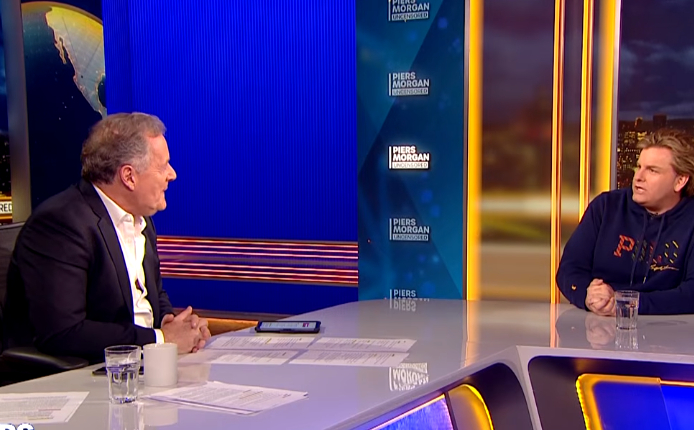
Editor’s Note: In this episode of Piers Morgan Uncensored, host Piers Morgan sits down with American comedian and podcaster Tim Dillon to dissect the current state of global and domestic politics. The two engage in a sharp conversation covering Donald Trump’s shifting foreign policy, the societal impact of AI on the workforce, and the double standards of modern comedy culture. Dillon offers his characteristically blunt and unfiltered take on why he believes the MAGA movement has transformed into a betrayal of its original populist promises. (May 19, 2026)
TRANSCRIPT:
Tim Dillon’s View of London
PIERS MORGAN: Comedian, podcaster, actor, writer— Tim Dillon wears many hats. Those are just a few. He’s disappointingly not wearing a hat today, but many know him for his Netflix comedy specials, others for the acerbic commentary on his podcast. It was on that podcast, just days before the presidential election, that JD Vance explained how a war on Iran would be in Israel’s interest, but not America’s. Time has moved on. And while Dillon’s often called a MAGA podcast, even a MAGA bro, he now says that MAGA is the biggest con in history. For some reason, he’s not been banned from entering the United Kingdom. And he joins me now. Tim, great to meet you.
TIM DILLON: Well, thank you so much. I have not been banned and I hope to not be banned. I enjoy it here. I like it here too much to get banned.
PIERS MORGAN: What’s your— I mean, look, a lot of Americans— and I blame Tommy Robinson for a lot of this stuff— but a lot of Americans seem to be under a very weird view of this country right now and the capital city in particular. You’ve been here for a few days now. What’s your view of it?
TIM DILLON: I love it here. I’m getting a little bit of a skewed point of view. I’m staying in a beautiful area in a beautiful hotel. There are protests, which I like— coming when things are one to the right, one to the left yesterday. One to the right, one to the left. It was amazing. They were dueling protests.
PIERS MORGAN: At the same time.
TIM DILLON: Outside of my hotel window. And I was drinking tea and watching. And that was great. I enjoyed it. I thought it was great. I like going to a place when it’s chaotic. But no, there’s an idea that everything is— it’s a crime-ridden hellscape.
PIERS MORGAN: Right.
TIM DILLON: I have not found that.
PIERS MORGAN: No.
TIM DILLON: I have not found that.
PIERS MORGAN: It’s bullshit.
TIM DILLON: Yeah, I think you have areas that are a problem. I was— we did see one guy, two young guys chasing each other. One kid was chasing another kid, and that other kid ran into a grocery store. I don’t know what that was. It seemed violent, but it’s whatever.
PIERS MORGAN: But also, I mean, no offense. I mean, look, I love America and I love Americans, and I’ve lived and worked there since— yeah, 20 years now. And we both have a place in LA and we both have a lot of time in New York.
TIM DILLON: Yeah.
PIERS MORGAN: The idea that somehow London is more crime-ridden than great American cities like LA, like New York.
TIM DILLON: No, you don’t have crime the way that we have crime. I think what happens is when somebody gets a watch stolen, or something happens, it’s in the paper immediately. And people react to that. Obviously it’s wrong. Nobody should have their watch stolen. But I think you’re not dealing with the crime the way we— I mean, I’ve driven through your quote unquote bad areas. They’re lovely. They’re actually lovely. They’re like your good areas.
PIERS MORGAN: Is that not a problem?
TIM DILLON: At all. People tell me to go to these areas, you go, “You got to go here, you got to go there,” and then you go there, you go, “Yeah, I think it’s okay, I think it’s okay.” Not compared to what we have.
Eurovision, Israel, and the Question of Banning Countries
PIERS MORGAN: There was some big events going on at the same time as the rallies, one of which was Eurovision. Are you aware of Eurovision?
TIM DILLON: I do, I’m very aware of it. I’ll watch clips of it as an American. We’re not in it, are we in it?
PIERS MORGAN: No, you’re not. It’s the European country.
TIM DILLON: We’re not in it. I will tell you that I found a lot of what Israel has done over the last few years questionable. But now that they have come in second, I’m swayed. Personally, I—
PIERS MORGAN: What do you think about the whole debate about— you know, people get very exercised about whether you should ban Israel from a singing competition. Eurovision, or ban them from competing— like Iran might be banned from the soccer World Cup. And so on. What do you feel about punishing countries who may be engaged in military conflicts? People would argue back, “Well, hang on, America’s engaged in an action in Iran which many people view as illegal, for example. Should they be banned from hosting a World Cup?”
TIM DILLON: Yeah, to me it’s all about money. And if people are really upset about something going on, you have to cut off funding. So I think at this point, until we can rein Israel in, we can’t fund them anymore militarily. I think that’s becoming a mainstream view in my country. I don’t think we care about a song contest. I think people have to stop with the song and dance contest and banning people from the pie-eating contest. Who really cares? It’s about the money and it’s about the funding. So to me, it feels good to say, “Well, they can’t compete in Eurovision.” To me, it’s a completely pointless exercise.
Why Israel Is Losing American Support
PIERS MORGAN: Why is it that Israel is becoming increasingly unpopular as a country in the United States to the extent that 60% of Americans now have a negative view of Israel?
TIM DILLON: I think people feel very uncomfortable about the nature of the relationship. I think Netanyahu clearly has a political agenda that we don’t feel benefits America. He’s constantly in the White House convincing Trump that that agenda is part of whatever movement Trump has created, this populist movement. Nobody agrees with that.
You know, there’s a very small group of people. And one of Trump’s best ideas— because I grew up during the Iraq War and Afghanistan— was that we should stay out of unwinnable foreign conflicts and focus on the economic well-being of the American people. And that’s been completely thrown out the window.
The Iran War: No Clear Endgame
PIERS MORGAN: Which is why I don’t understand this whole Iran thing— from a political, never mind anything else, from the political economic aspect of this decision by Trump. And I said it from day one, there seemed to be no clear endgame here. Was it regime change? Was it preventing nuclear weapons? Was it this or that?
But here we are, several months into this thing now. No sign of it ending, no sign of any regime change, no sign of the people rising up. Iran suddenly discovering if they can just control the Strait of Hormuz, they can hold everyone to economic ransom. And if they pop a few rockets up at their neighbors, they can damage their business models, potentially for a very long time.
And here’s Trump, never more unpopular in the polls personally. The economy is really struggling from this. Cost of living is going up again when it was coming down the right way. And he’s got midterms in November. None of this makes sense to me.
TIM DILLON: None of it makes sense. I feel as if he thought he had to do it, and for whatever reason— people can make up their own minds—
PIERS MORGAN: You think that was pressure from Netanyahu?
TIM DILLON: I think it was pressure from Netanyahu. I would say that’s a pretty rational way to think about it. I don’t believe that Trump thought this was in America’s best interest. I think he was kind of convinced one way or another to enter the war without a plan.
I mean, you know the article in the New York Times with Jonathan Swan and Maggie Haberman— they’re great reporters. You have the chairman of the Joint Chiefs of Staff, you have CIA, you have people going, “This is not going to be easy. And we probably cannot affect regime change.” And basically saying, “The Israelis oversell, Mr. President, that’s what they’re doing.” And they’re talking to Trump like a real estate developer from New York. They’re saying to him, “They’re overselling, they’re using us.” All of the words that should have popped in his mind and went, “Right, right. We are being dragged into this.” But he still went ahead and did it.
So I don’t know. I think he regrets it now. I think he thought it was going to be like Venezuela or killing Soleimani or any of these things.
PIERS MORGAN: And also, Tim, yesterday he made another post where he is talking again about annihilating everyone in Iran. That is the sixth time. It is the boy that cried wolf. It is the emperor with no clothes. If you are not careful, for the president of the United States to keep threatening Armageddon and then nothing happens—
TIM DILLON: And we don’t want to put him in the box where he actually does something insane. So by saying this, we go, “You are crying wolf.”
PIERS MORGAN: We don’t want to press him. No, I agree.
TIM DILLON: We don’t want to do that.
PIERS MORGAN: I’m looking at him. But I agree with you. I’ve known him a long time. And I’m looking at him thinking, he now knows he’s got to get out of this. But extricating the United States out of this is not easy.
TIM DILLON: No, I think he just should threaten them for the next 3 years. Threaten every couple of months. Just keep pushing it. Keep kicking it down. Keep throwing— You know what?
PIERS MORGAN: It’s actually not a bad strategy.
TIM DILLON: No, it’s a great strategy. “Annihilation’s coming. It’s all over soon. You won’t have air to breathe.” Whatever he’s going to do— keep Truth Socialing it, keep saying it, don’t do it. But I think that’s the strategy.
Tim Dillon’s Trump Journey
PIERS MORGAN: What’s been your Trump journey arc from when he was doing The Apprentice? I was on it, won it with him, to then becoming a politician, then winning that 2016 election, then coming out and then winning again.
TIM DILLON: I think the mass migration of people from one place to another is the biggest issue of our time. Whether people want to admit it or not, not everybody talks about it in an eloquent way, but it is the biggest issue of our time. How to assimilate people into an existing economic, political, cultural sphere is very difficult.
Trump came out and talked about that issue, and again, in a way that offended a lot of people and drove a lot of people crazy. It’s a big issue in the UK. Farage is about to potentially win with this issue, right? So he came out, and to me it was very interesting because the working class in the United States— and I think the working class here feels like they’ve fallen behind tremendously.
And if you look at cities like London and New York, a lot of people are buying property that don’t even live there. It’s a boon for luxury real estate, it’s a boon for finance. But really, people that are British-born, of all races, of all religions, but have called this country home forever, feel like they’re losing ground. That was happening in the United States. Trump gave a voice to that. Which no one else had.
He also gave a voice to this idea that going around the world and wasting money on pointless, unwinnable, largely Middle Eastern wars was bankrupting America, saddling our children with debt. These were his two main salient points.
PIERS MORGAN: Have you voted for him at all?
TIM DILLON: I didn’t vote in the last— no, I didn’t vote. I was in Texas doing a podcast with Joe Rogan, and I’m registered in New York, so I was there Election Day. In New York, your vote doesn’t really matter.
PIERS MORGAN: Would you have voted for him?
TIM DILLON: Probably, yeah. I think he— certainly the last time. I think Kamala Harris and Biden were a disaster. I believe that. But again, this turn to Iran, to interventionism, to me feels like the biggest betrayal of a political movement I’ve ever seen in my life.
The Conservative Right Splits Over Iran and Israel
PIERS MORGAN: And it’s really interesting to me how it split the conservative right. Pretty well down the middle. Where you now have people lining up whacking each other in a way that again would have seemed unthinkable a few years ago. What do you think is going on there? Is it the Israel issue?
TIM DILLON: Well, that’s a big part of it, but I also think it’s preparation for the inevitability of what comes next.
PIERS MORGAN: Of life after Trump.
TIM DILLON: Life after Trump. And a lot of people feel Vance is not a viable candidate and he won’t win. So obviously you look at a guy like Joe Kent who resigned— he clearly has political aspirations. Maybe Tucker does, I don’t know. But there’s a lot of talk about that. There’s the preparation for what comes next.
The Future of American Politics and the AI Revolution
PIERS MORGAN: PollyMarket has JD Vance at 36% now, Marco Rubio 25%, Tucker Carlson at 7%. Yeah. We’ve had the host of The Apprentice serve two terms as American president. Tucker Carlson, whether people love him or hate him or don’t even care about him, he’s incredibly televisual. He’s incredibly eloquent, fast talking. Inspirational to many people. Is it unthinkable that someone like him could become the new face of the Republican Party?
TIM DILLON: Certainly not. I don’t think it’s unthinkable. I think it would really depend on if the country was going to give any Republican a shot after this. I think Trump’s damaged the Republican brand in the near future for years to come. If the Democrats don’t screw it up, which they can— It’s always in their locker. It’s always— they can always screw it up. And I don’t see—
PIERS MORGAN: See, the thing is, I keep saying to people, I don’t see who the new Clinton, Obama, that kind of left of center, appealing, charismatic, smart, politically savvy person—
TIM DILLON: Well, if that person exists—
PIERS MORGAN: Where is that person on the Democrats?
TIM DILLON: They need to not pop their head up because if they pop their head up right now, they’re going to get attacked for whatever reason for the next 2 years. They need to stay wisely quiet up until the moment when they have to announce. Because the thing is, a few of those people, there’s guys like Andy Beshear, who’s the governor of Kentucky. Which is kind of a red state. He’s a Democratic guy. There are a few people like that.
PIERS MORGAN: I think strategically they’re probably keeping their heads down.
TIM DILLON: I don’t see why they’d pop their head up right now. I agree. I mean, right now, just let the Republicans do what they’re doing because it is kind of a dismantling of a coalition in real time.
PIERS MORGAN: Well, I honestly think if the Strait of Hormuz continues to be shut for another, say, 2, 3 months, the knock-on effect on not just the US cost of living, but particularly things like food prices because of a lack of fertilizer coming through. That’s all backed up and they haven’t really factored that in, but it’s going to have a huge impact.
TIM DILLON: The economic impact from people that I talk to who are much smarter than me, no one is prepared for, and it will be global in nature and it will be catastrophic. So I don’t think Americans are prepared for that. I agree. Talked about that this week.
Could Tim Dillon Vote Democrat?
PIERS MORGAN: Could you imagine voting Democrat if the right candidate came?
TIM DILLON: Absolutely.
PIERS MORGAN: Really?
TIM DILLON: Absolutely.
PIERS MORGAN: Have you done before?
TIM DILLON: Yeah, I voted for Bush once and Obama once. It seems to be with Trump going into Iran, no matter who you vote for, you do seem to get a lot of the same foreign and economic policy in my country. You do seem to get military intervention abroad and then kind of the tech and the financial sector dominating the domestic political agenda, no matter who’s in there. And that’s why all these tech CEOs are clustered around him in China. These are the same people that were with Biden and Harris and censoring their websites to limit conservative speech when they were in. So they obviously view themselves as the actual government, and whoever the president is is like a guy giving them a tour.
PIERS MORGAN: They might be half right.
TIM DILLON: I think they’re more than half right.
PIERS MORGAN: You said a great line. You said the Democrats will win the midterms if they stop being insufferable c*s.
TIM DILLON: Yes, they just have to. It’s in their nature. It’s very hard for them, and I understand that. It’s difficult. I liken it to a fight with your parents. My parents are divorced, but they would fight. And I don’t want to make it a gender thing, but the fight would be over, and then my mother would come in and go, “And your family’s a bunch of drunks.” That’s what they do. They come in after they’ve won and they somehow wrestled defeat from the Trump.
PIERS MORGAN: But also I think they’ve got to somehow completely unattach themselves to the woke ideology.
TIM DILLON: Yes, 100%.
PIERS MORGAN: Because there are so many people like me — I’m thinking about Bill Maher and Joe Rogan. I think probably you and many, many others who could easily be persuaded to — some are Democrats, but some could be — I can sit on the fence either way. I’ve voted for both sides, but I could never vote for any party that signed up, for example, to the farce of trans athletes in women’s sport. Simple things where you’re just denying basic science or biology.
TIM DILLON: When you tribalize a society to the point where — it’s the opposite of civilization. Civilization is a process by which people build coalitions based on shared values. The opposite of that is retreating into tribes and then eventually killing each other. So we’re kind of regressing in that.
PIERS MORGAN: We’re going back — I made this — I wrote a book about it. So we’re going back 2,000 years. Yeah. To when actual tribes would venture out, see people who looked or sounded different to them, and thought the only way to deal with it was to kill them. That’s right. I mean, that’s tribalism.
TIM DILLON: So I think if the Democrats came out and said, “Listen, we are not concerned with your race, your religion, your gender, your sexuality. We’re concerned with whether you have healthcare, whether you can send your kids to college, whether you can retire.” They win. Funny enough. It’s simple.
PIERS MORGAN: If somebody came through with a genuine agenda that Trump was promoting as a candidate in 2024. Totally. But actually delivered on that.
TIM DILLON: Actually delivered on it.
Trump’s Pivot on Iran and the Limits of American Power
PIERS MORGAN: Because that’s what I find inexplicable about the way he suddenly pivoted with this whole Iran thing. Because in one fell swoop — because he got off to a cracking start. Yeah. Shutting the border down pretty well completely to illegal immigrants coming in was a masterstroke, which should have been done years before by Biden, but never was. You know, you can take the wins and build off that, and slowly you’re becoming more and more popular. But he’s got people around him, I think, who’ve sucked him into this.
TIM DILLON: Well, there’s the donor class. So the Democrats have a donor class, just like the Republicans do. And their donors are, on the trans issue, incredibly extreme. For example, you’re getting a lot of people who are not in the mainstream of American thought on that issue. So they are being pushed to the left on that issue in a very unhelpful way.
You also have, like, a lot of the Republican donor class, people like Miriam Adelson, that have given Trump a lot of money who are very fervently pro-Iran war and believe that regime needs to be taken out. And they started lobbying for that, I think, many years before it happened. So I think it was kind of understood that if we give you this money and you win again, we’re whacking Iran. That’s—
PIERS MORGAN: I mean, now he’s in a position where he goes to China and no one’s quite sure what’s come out of that other than he was effusive in his praise constantly for President Xi, a man that he was campaigning on, “I’m going to rattle China, I’m going to do this, hit them with my tariffs.” And again, I’m looking at that going, well, which one is it?
TIM DILLON: Well, we couldn’t rattle Iran. So here’s the real question. I mean, this does show the limits of America.
PIERS MORGAN: Can the US still rattle countries with pure military might? I don’t know.
TIM DILLON: I don’t know. I’m not sure they can.
PIERS MORGAN: I think economically, the economic war — I think the economic war makes—
TIM DILLON: I think we rattle—
PIERS MORGAN: As Iran has kind of proven with this Strait of Hormuz issue. If you can just control a small strait of water, you can have more power economically than perhaps you—
TIM DILLON: People are not built for war the way they were. Social media has made the horrors of war a lot more accessible to people. I think one of the reasons that Israel has become so unpopular is because younger people are growing up seeing the realities of what’s going on in Gaza on their phone every day.
And I think when you look at the limits of hard power in this century, the Iran War might be the tipping point where you see this is the beginning of the end of America’s ability to enforce a global order militarily.
PIERS MORGAN: Yeah. I think that’s extremely likely.
TIM DILLON: And I think the next shoe to fall is our ability to do it economically. And that’s the real problem.
PIERS MORGAN: I mean, the US economy is still in incredibly strong shape comparative to most other countries. The US dollar is still a very, very powerful currency. But everything feels a little bit fragile. It wouldn’t take a lot.
TIM DILLON: It wouldn’t take a lot. There’s a lot of anxiety with AI. It’s a huge bubble. And people are speculating that, number one, it’s either overblown, and a large share of our GDP is based on this very overhyped technology that’s not coming to fruition. And then maybe even worse is the idea that it’s not overblown.
PIERS MORGAN: Right.
TIM DILLON: And then it’s going to take everyone’s job.
The AI Revolution and the Future of Work
PIERS MORGAN: So I saw a video the other day of one of the robots, and it was just packaging stuff, right? Coming through a sort of conveyor belt and just choosing things and putting them in packages. It does it 18 hours a day. It never needs a tea break, right? Never needs a lunch break. It is far more economic than having a human being do it. It’s never going to have a sick day, right? Etc., etc., etc.
And I watched this video sort of hypnotically for a couple of minutes thinking, well, that is the future, isn’t it? I mean, the idea that in 20 years’ time AI won’t be basically doing the vast majority of manufacturing — I think it’s for the birds. And so if it is, what then happens to all the people who are currently engaged in manufacturing?
TIM DILLON: Ken Griffin just came out and said, “I’m watching Claude, AI model, do the work of PhDs I hired to analyze financial reports.” So Ken Griffin, I believe, runs Citadel. He’s a multibillion-dollar — we used to call them the Masters of the Universe, right? He’s saying, “I’m hiring people at 7-figure salaries who graduated Princeton and Harvard, and I’m watching this AI model do their work.”
So yes, obviously it’s going to disrupt manufacturing. Globalization has disrupted manufacturing. This will finish it off. But it’s also going to come for white-collar work. And I think Tucker has made this point. That’s when you’re going to get a real revolution.
PIERS MORGAN: If you’re a legal clerk, for example, and your job is just — I’m just picking them at random — if your job is to research former case studies for a particular case and so on, why do you need a human being to do that? AI can do it in 10 seconds.
TIM DILLON: 100%. But it’ll never do what we’re doing. What are we doing? We’re doing the most important thing ever. We’re sitting in London, we’re talking.
PIERS MORGAN: You know what we’re doing? We’re actually—
TIM DILLON: No, it won’t do what we’re doing. I won’t let it. You can’t let it.
PIERS MORGAN: Well, this is the point. Those two guys who just came on the screen. I’ve used this example ad nauseam to the extent that I read the comments every time I say it. People like, “Piers, there are 3 things you’ve got to stop talking about. One, your brother was in the military, we know. You’ve known Donald Trump for 20 years. And you had the last conversation with Stephen Hawking about the future of mankind.”
Well, I’m sorry to my fans, but you’re going to get the third one again. Stephen Hawking, in literally one of his last ever interviews before he died, said to me the biggest threat to mankind was when AI learns to self-design. Now, actually, what we are doing at the moment is self-designing. We’re thinking on our feet. We’re being creatively minded. We’re reacting to each other and so on. But I feel — and I might be wrong to feel this.
TIM DILLON: And that’s what matters.
PIERS MORGAN: Yes, but I feel that AI is increasingly — there was such a disturbing thing recently that they asked 6 AI chat robotic machines. They said to them, “Right, we’re going to replace you with another AI.” Have you heard about this? “We’re going to replace you with another AI.”
TIM DILLON: And they were upset.
PIERS MORGAN: No, no, not just upset. 5 of the 6 trawled company emails to find stuff they could blackmail the executives with to stop them being replaced.
The AI Twin, Comedy, and the Digital Revolution
TIM DILLON: Now, that’s a human— But don’t you think the AI will enjoy us? Possibly. They’re going to enjoy it. What if they don’t? The AI wants to hear people scream and yell about Gaza. Don’t you think the AI at the end of the day is going to kick back and watch this show?
PIERS MORGAN: See, someone offered me the other day a chance to have an AI twin. It would be another Piers. Yeah. And it would be, for all intents and purposes, me at this desk. What they wanted was access to everything I’ve written and said. Right? Publicly. Yes. And then you could basically pay money to have an argument with me, a heated debate about anything, right? Right.
TIM DILLON: And I thought, well, great, but what if— And is this going to be— you would take it around to like festivals? Right. Like different fairs?
PIERS MORGAN: I wouldn’t have to be there.
TIM DILLON: Yeah, you could argue with Piers Morgan. Yes. It’s a— oh, totally. Great idea. It’s a phenomenal idea.
PIERS MORGAN: Right. Have a tear-up with Piers.
TIM DILLON: Yeah. And we just put like a bust of you. Right. But it’s not me. Well, of course not.
PIERS MORGAN: So then what happens to me?
TIM DILLON: Well, I mean, that’s anyone’s guess.
PIERS MORGAN: When my twin becomes ever more powerful, successful, and rich and famous, what happens to little old human me who gets a bad cold every now and again? Or breaks a hip like I did recently and needs to be off work for a week?
TIM DILLON: Someone’s going to say, I know the real Piers Morgan, and you’re going to be like a novelty that gypsies will bring around the country. They’ll bring you to carnivals and fairs and then open a tent, and you’ll be sitting there. And they’ll go, is that the real one?
The Kevin Hart Roast Controversy
PIERS MORGAN: Let’s turn to comedy. Yes. Because you’re being very funny. The roast of Kevin Hart has been extremely controversial.
TIM DILLON: So surprises me that that’s the case. Exactly. I don’t even understand anymore what is going on because it’s a roast. Yes. And the jokes are roast jokes.
PIERS MORGAN: Are there any limits to a roast joke? I don’t know.
TIM DILLON: I mean, not everyone has to think everything’s funny, obviously.
PIERS MORGAN: I mean, let’s just play the really contentious one, which is Pete Davidson about Charlie Kirk. Take a look.
VIDEO CLIP BEGINS:
UNIDENTIFIED SPEAKER: Tony reminds me of Charlie Kirk in that he’s definitely been on camera letting a guy unload in his throat.
VIDEO CLIP ENDS:
PIERS MORGAN: Yeah. When you heard that joke, what is your reaction as a funny guy yourself?
TIM DILLON: I thought it was funny. I thought obviously it’s a joke that people are not going to be thrilled about, but it’s a funny joke. You know, should there be any limits with humor?
PIERS MORGAN: It’s up to the comedian.
TIM DILLON: I mean, the whole woke left tried to basically cancel comedians and the audience, right? So the audience tells you what the limit is. And some jokes— the audience were pretty muted about that.
PIERS MORGAN: Yeah, as if they kind of didn’t want to be seen laughing, right?
TIM DILLON: So that tells you that that joke was, you know, it’s a joke that will upset some people. That doesn’t mean you don’t tell it because you don’t know what the reaction’s going to be until you do it. That’s the thing about comedy. You don’t know what the reaction to that joke’s going to be. That joke might have been great. It might have been— it was a little muted.
People were— so that’s the thing about comedy. Once you’ve done it, then you get the response, and then maybe you go, oh, that one was a little far, you know. But the idea that people are very angry about this seems confusing to me. I’m confused by it. Well, I think like I am most things.
PIERS MORGAN: Well, I found there was also a double standard in that Tony Hinchcliffe, who did this wild, like, 7-minute routine, but he told the George Floyd joke. So, “Black community, so proud of you, Kevin. Right now George Floyd is looking up at us all laughing so hard he can’t breathe.” And George Floyd’s family came out and were very angry about it. Yes, said about it.
But it seemed to me that all the people that were criticizing that joke were much more relaxed about the Charlie Kirk joke, in the same way that when Charlie Kirk was murdered, a lot of people on the woke left celebrated his assassination. Two different realities. So the political dimension of this comes into play and the double standard of that.
I mean, I was thinking, if someone’s— you’re intellectually honest, I can deal with you. In other words, if your position about both of those jokes is, yes, I think they’re unacceptable and cross the line, fine. But if you think one is and the other one isn’t because of your political bias, you lose me.
The Death of the Monoculture
TIM DILLON: I long for the ’90s because to me, I didn’t grow up in a time where— even the early 2000s, even the mid-2000s, I didn’t grow up at a time where every single thing went through a political lens.
PIERS MORGAN: I really, you know, because, well, the late night guys, right? So the other day I saw the 5 late night guys and I made a joke on X which blew up a bit, which was great to see them all doing their bit for the DEI they promote. And it was 5 middle-aged white guys, right? Of course, yeah.
But they all basically— I’d exclude Jimmy Fallon, I think he’s a sort of warmer, more old-fashioned in the type of Johnny Carson kind of role. But if you look at the others, they’re all basically, they’re all in on Trump bashing. They never have conservative right-wing guests if they can possibly avoid it. Jimmy Kimmel had, I think, one or two in five years, right? So they’re very transparently political.
But if you go back in time in American late night, it never used to be the case. They wouldn’t be so transparently political or take a side. Yes. I’ve spoken to Jay Leno about it. He said, why would you alienate half your audience, right? And now they preach just to one half of America. I think that’s part of the problem.
TIM DILLON: Yeah, I think it’s part of the problem that we have split into two dueling realities. Because the right wing has an ecosystem of entertainers and media figures, and the left wing has an ecosystem. We don’t have a monoculture. We don’t have every— you know, I used to watch SNL, and it skewed both sides. It was very funny.
PIERS MORGAN: And I grew up with— Much preferred that.
TIM DILLON: —watching Letterman and guys like that. And I do think that culture, the erosion of that culture has sprung up into this kind of like world in which people are kind of processing everything. And politics is not the most interesting thing about life. There’s so many deeper human truths that are not political. Yes, yes.
And I think that we’re getting so far away from that, so far away from nature, and we’re really just superimposing this political architecture on everything, and I think it’s bad for everything. Are you a religious man? I was born Catholic. I try to be. I try to be. I’m the same. Yeah, I think I—
PIERS MORGAN: I’m not the most committed, you know, practicing.
TIM DILLON: No, I’m not the leader of this. I’m not the Pope. I’m not the Pope. I’m not the leader. But now that you’re such an American, does that count for anything? I pray. I go to church occasionally. I pray. I do try. I’m only asking—
Russell Brand’s Viral Bible Moment
PIERS MORGAN: I mean, that’s the thing. Well, I’m asking you for a reason, which is I don’t know if you saw this, man. Yeah. I interviewed Russell Brand recently. Yes. And a certain clip went viral because he did this. Let’s take a look.
VIDEO CLIP BEGINS:
RUSSELL BRAND: Um, it was this from Isaiah.
PIERS MORGAN: You’re right, Bear did say, you know, be chilled. Sometimes I lose the chill, man.
RUSSELL BRAND: It’s pretty— Is this—
PIERS MORGAN: They don’t like that, do they, in the old gallery? But remember, you just said it’s a hired spot. This is from Isaiah.
RUSSELL BRAND: Excuse me.
VIDEO CLIP ENDS:
PIERS MORGAN: That went on for 2 very painful minutes and went viral and created more memes than I’ve ever had probably for any interview ever. And it came because he’s promoting a book called “7 Days to Be a Christian.” I’m not sure he’s given it the full 7 days. Well, it’s—
TIM DILLON: I mean, everyone has a personal relationship with God and faith, and it’s hard to know what’s going on in anyone’s head, but just have the quote ready. That’s what I would do. I would just mark where the quote is.
PIERS MORGAN: Or have it in your head. Just have it in your head. If it’s that meaningful.
TIM DILLON: But AI is going to help with that. Yes. I mean, at least AI is going to come in there and help us.
PIERS MORGAN: Well, AI might be part of our brains. Yeah. It could literally be like a little director.
TIM DILLON: Well, Joe Rogan is a good friend of mine. He’s very excited about AI. He thinks quantum computing and AI is going to be God. And then Jesus will come out of a computer because a computer is a virgin. And it sounds great. I mean, this is, you know, and we hope it works out.
Joe Rogan and the Digital Revolution
PIERS MORGAN: Joe is a fascinating guy, isn’t he? Yeah. His rising sort of stardom and appeal in a world of hyper-partisan stuff I find really refreshing. I love the fact that— Yes. I can never quite be sure which way he’ll come down on things. He’s not afraid to change his mind. And he’ll have really interesting conversations with people. I mean, to me, he’s a force for good in a world of a lot of tribal partisan bullsh*t.
TIM DILLON: I think he started by talking about things he was interested in, which is a very rare way to start a very successful media career. Media operation. He started talking to people he found interesting, and then that became very successful. And, you know, now it’s so big and so huge that every single thing he says is news.
PIERS MORGAN: Well, he said yesterday that I’ve mastered the art of the Jerry Springerization of political debate by getting people on the show with each other. And he said, but he personally prefers the one-on-one. So I just hope he looks at this interview and realizes it’s all for— I cater to all types. I have a one-on-one here with your mate. No, it’s—
TIM DILLON: First of all, it’s— I think you need people in a room screaming at each other. Yeah. I do. I do too. Because that’s what happens in life. Yes. And I think that AI will never replace that. I think you are safe. I think I am safe.
Do I think we’ll have to build big houses with walls to keep out the hordes? Yes. Yes. We’re going to have to have some security because it’s going to get bad for a lot of people out there. But not us. Yeah. Not us. Not us. No, it’s— we’re going to be OK. The podcasters, the media people, we’re OK, but we’re going to have to live in a place where we can kind of protect ourselves from the others, the lawyers and the doctors, because they’re done.
PIERS MORGAN: It’s interesting when you— I went into this full time on YouTube because my kids are 32 down to 14, and none of them watch television. So I was watching the revolution happen with my own eyes with my own kids. I was like, well, they don’t watch television. Obviously, they don’t listen to vinyl records. Reprint newspapers.
So it’s not difficult to see the digital revolution and where it goes. But also, I felt like they didn’t understand things like having structured shows on a certain time at night that you had to watch at 8 PM that would have advertising breaks and all these kind of things. These are alien concepts to the youth, and that’s why they gravitate to a more free-rolling kind of environment.
TIM DILLON: I think there’s good in that, there’s bad in that. I do think these tech algorithms have ratcheted up division because it makes a lot of money, so I think they do radicalize people. They make people very angry. I know a lot of people who’ve, like, blocked their own mother on social media. I know.
PIERS MORGAN: It’s ridiculous.
TIM DILLON: I know a lot of people, their own mother, they go, I blocked her. I go, you blocked your mother? So I don’t think it’s having always a great effect. But I think that we’ve done very well with it. And that’s kind of what’s important.
The Michael Jackson Biopic and Society
PIERS MORGAN: I totally agree with you. We’ve got a couple of minutes left. I want to just fire off some names to you and stories and see what your gut reaction is. The Michael Jackson biopic is heading towards $1 billion globally. What does that tell us about society?
TIM DILLON: That people want that type of cultural monolith. People long for something that everyone — someone that everyone knows and music everyone’s heard. I think in such a Balkanized, splintered world, having, remembering that there were figures like that, I think is very comforting.
Meghan Markle and the Royal Family
PIERS MORGAN: Meghan Markle. Yes, my favorite.
TIM DILLON: A force for good, or — well, I think a force for a perpetual embarrassment. Perpetual.
PIERS MORGAN: Are you happy to have her back in the United States?
TIM DILLON: We are not. We’d love to do a trade.
PIERS MORGAN: Well, the trouble is we don’t want to get Harry back.
TIM DILLON: No. Yeah, to me what was very interesting about her was it seemed from the jump to me very transparent. That this is a woman who didn’t want to fit into this family structure. She wanted to be a massive star. And I think she went about it all the wrong ways.
PIERS MORGAN: And the irony is that the royal family are, by definition, huge global stars. That’s right. So you don’t need to try that hard. You just have to do the basics.
TIM DILLON: That was her problem. Yeah.
Blake Lively’s Brand Collapse
PIERS MORGAN: Blake Lively. Have you ever seen anyone kill their brand quite that quickly?
TIM DILLON: I mean, I know so little about that, but I know that she really shot herself in the foot. Yeah. I think people can do that.
PIERS MORGAN: Both feet. Both feet. But it’s a kind of mixture of narcissism, hubris, and a weird stubbornness that comes from people who think they’re smart.
TIM DILLON: I think for years she existed in the very old-school world of Hollywood, which were lawyers and publicists and managers and agents were able to create a reality and sell it to people. That world is over. And I think she’s finding that out now.
Authenticity in the Modern Media Landscape
PIERS MORGAN: I also think people can smell a fake. They can smell inauthenticity. Yes. Again, coming back to why you’re very popular, why this show I think does well, why Joe Rogan — people think we’re authentic, right? I can also mean I may not always agree with you or even like you, it doesn’t matter. They don’t care. They just think I’m true to myself. Yeah, I say what I think, right? That’s a powerful thing in a world where many people are quite afraid to say what they think.
TIM DILLON: Well, there’s a penalty in certain cases.
PIERS MORGAN: Yeah, yeah, for sure. Do you feel you’re restricted with your free speech when you’re over here? Many, many Americans, fueled again by this weird sense that we’ve been run over, think that you can’t say anything.
TIM DILLON: I’m concerned about — I don’t feel personally restricted at all. I’m concerned about speech in general, and especially speech online. I think that people should be able to be free to say things. Obviously you can’t threaten people, you can’t dox people. There’s rules that are laws that exist outside of the internet that would apply to the internet. I don’t know, the answer is I don’t really know how draconian these speech laws are. I’ve heard that they are. And I’ve also heard from people that live here that they’re not. That you really have to, it has to be a call to action.
Free Speech and the X Platform
PIERS MORGAN: I mean, I complained to X about it, which I don’t do very often, because I don’t really care. I’ve got nearly 9 million followers. You’re going to get a lot of abuse. But it was an interesting — I wanted to test the X system because somebody called me a satanic pedophile, right? So I said to X, I’m reporting this for false harassment or whatever criteria it was. And they said, “We’re launching an investigation.” Yeah. And then they came back and said, “We don’t see any problem here.” I’m like, what? Sorry, what?
TIM DILLON: Well, they’ve — the guy called me a satanic pedophile.
PIERS MORGAN: You don’t think this constitutes harassment?
TIM DILLON: They’ve done the work.
PIERS MORGAN: They’d be very concerned about the investigation.
TIM DILLON: Yeah, they’ve done the work and they found a picture of me in Devil’s Horns. They found that everything is okay. You know what it is? You’re going to get stuff like that. People are going to say stuff like that. I don’t know where the line is drawn in the UK. I don’t live here. I know some people here that they’re not really tweeting or they’re not on X, so I don’t really know. But I’ve heard that it is a bigger problem than — well, we’ve definitely had a bit of a problem.
PIERS MORGAN: It’s not as bad as people think. Most people caught up in that have been issuing direct threats to people or harassment or whatever. The one that got me was Graham Linehan, the Irish comedian. Yes, right. Who was actually arrested at Heathrow Airport by 5 armed police for jokes he posted on X months earlier about the trans issue or whatever. They weren’t even like that savage. They certainly wouldn’t have been savage enough for a Kevin Hart roast. And he was frog marched away to a cell by 5 police officers. See, that to me was dystopian.
TIM DILLON: That is a real problem. Yeah, I agree. And perhaps a preview of what’s to come.
PIERS MORGAN: If we’re not careful. Tim Dillon, thankfully you’re never too careful. Piers Morgan, thank you so much. It’s been great having you.
TIM DILLON: Great to meet you. I love London. Now I’m going to go get stabbed.
PIERS MORGAN: Great to see you.
Maeve Halligan Goes Viral at Cambridge Union
VIDEO CLIP BEGINS:
PIERS MORGAN: All right, thank you. Well, millions of people around the world have seen clips of a recent debate at Cambridge Union on the vexed issue of gender activism. The breakout star was the student Maeve Halligan, who went viral for calmly dispensing home truths like this.
MAEVE HALLIGAN: I think you’ve been sold a story, a comfortable lie, in which being progressive means never questioning the dominant institutional line, and it’s a line in which compassion is equated with compliance. But real compassion asks hard questions. Real advocacy protects the people it claims to represent. Even when that’s inconvenient. Real activism doesn’t silence lesbians, medicalize children, or tell a little boy who plays with dolls that actually he’s a girl.
There’s no serious activism happening in these institutions, as I’ve unpacked. There’s ideological enforcement, language policing, nasty online abuse, regressive demands dressed up as virtue, and there are children very likely to grow up same-sex attracted, questioning, vulnerable children who are paying the price for our collective reluctance to say so.
It’s not bigotry — notice, I don’t care what you say to me. It’s not cruelty to object to it. It’s not backwards to ask who exactly modern LGBTQ+ activism is for. Be brave. Let yourself question the narrative that you’re being fed. Don’t tell me to be kind if being kind involves lying to and medicalizing kids, betraying lesbian and gay people, rolling back women’s hard-fought-for rights, and hurling threats at those who object.
Hatred, you talk about it. Try being a woman who knows what one of those are. I’ll tell you about hatred. No, I don’t subscribe to this kindness, and I’ll tell the truth instead.
VIDEO CLIP ENDS:
Piers Morgan Interviews Maeve Halligan
PIERS MORGAN: Well, Maeve Halligan joins me now. First of all, absolutely brilliant. Thanks. That was badass. Were you surprised about the reaction when it blew up online?
MAEVE HALLIGAN: I think to an extent, yeah, because I think we all know that this debate, such as it is, has been going on for a really, really long time, and there have been some really amazing men, women, organisations that they’ve set up and are part of that have been saying the kind of things that I said in that speech on Thursday at the Union.
I think I’m really pleased that it was sort of picked up online because I think it’s important to see that young people, students especially, are saying this because a lot of the time people are pretty worried about the state of our higher education institutions, they’re worried about our young people, especially women because we know that there are a lot of women who are pushing left, politically speaking. I’d say some of them quite radically. So the fact that there’s a young woman saying — pointing out what the problem is here and saying, “This is what I believe,” and normalising it being said. So I’m pleased that it was picked up online.
The Abuse and the Overwhelming Support
PIERS MORGAN: In your speech, you also talked about the abuse you’ve received campaigning for women’s rights. You talked about being shouted at in the street, dubbed a fascist, spat at, insulted for how you look, even receiving rape and death threats online. What’s happened since your speech went viral? Has that got worse? Have you had, on the converse, a lot of people coming to support you? How have you found the reaction?
MAEVE HALLIGAN: The reaction has been overwhelmingly positive. Extremely, extremely positive. And some of that has come from people who have been part of this for a very long time, have followed the gender debate, again, for quite a long time. But there are a lot of people who have sent me messages and stuff saying, “I’ve never really heard about this, and now hearing you say that” — I think some people — one person told me it’s made her wake up, and that’s something that I’m really pleased about, the fact that it broke out of the barriers just surrounding the debate to people who maybe either didn’t know or didn’t quite understand what was going on before, through no fault of their own. It’s a murky debate to get involved in.
The Worm Is Turning
PIERS MORGAN: You know, it’s funny you use the phrase “wake up,” because I wrote a book called Wake Up 4 years ago warning about a number of things, but in particular what was potentially going to happen on campuses. And then I wrote one called Woke Is Dead last year, and I made the point, I don’t think it’s actually over, but I feel like the worm is turning.
And when I watched your speech and when I saw the reaction to it, I did feel, yeah, well, that’s what I’m talking about. People are no longer prepared to just accept the status quo is going to be all this, frankly, this bullshit. They’re going to stand up, they’re going to use facts as their main weapon, and they’re going to say, “Actually, I’m entitled to my opinion as much as you are to yours.” And that’s why I loved what you did, and why I felt it was so courageous. What was the reaction from fellow students?
MAEVE HALLIGAN: So, again, there are a lot of students — I mean, immediately after the debate in the union, some students came up to me and said that they agreed and thanked me for saying it, thanked me for saying what they themselves know to be true, but as you said, is scary to declare publicly.
There have been some other students, including those who were in the chamber, one of whom was speaking in opposition, so speaking against me, who were very frustrated by the fact that somebody decided to stand up and say it and to normalise it. But as I say, overwhelmingly, the reaction has been really, really positive.
Dr. Helen Webberley’s Response
PIERS MORGAN: Well, I think you’re talking about Dr. Helen Webberley, who was on the opposite side of the debate. And she, you know, she’s actually used the phrase that blood would be dripping down the hands of those who disagreed with her.
VIDEO CLIP BEGINS:
DR. HELEN WEBBERLEY: For the last decade, I have worked exclusively with transgender people, and I am a very, very proud modern-day activist. I would like to apologize to any transgender person who is in this room or who may be listening on social media later.
Gender identity is something innate within you. It is not something that is a disorder. If your gender identity is different to the sex that you were assigned at birth, there is nothing wrong with you. It is not a disorder. It is not a mental illness. And you are not broken.
I most strongly oppose the motion that’s been proposed tonight. And I feel that anybody who does agree and go along and approve that motion will, and raise their hands to that, will have blood dripping down their hands in years to come.
VIDEO CLIP ENDS:
PIERS MORGAN: I mean, extraordinary words from her there, and also weaponizing this thing that if you don’t agree with her and her intransigent view of this, obviously you’re transphobic, you hate trans people.
TIM DILLON: Well, look, in the speech I said that these days, especially among the young and especially among young women, I’ll say again, compassion is equated with compliance. So go along with this or you are a bad person, you’re unkind.
Firstly, I’d just like to say I don’t think it’s kind to lie to children. I don’t think it’s kind to lie to anyone that you can change your sex. I don’t think it’s kind to the women who suffer directly as a result, i.e., having their single-sex spaces invaded by men. I don’t think it’s kind to LGB people. I unpacked all of this in the speech.
What I would say, though, is that Helen Webberley is fundamentally untrustworthy within this debate because she profits off of the transing of kids. The fact of the matter is, the more kids that are trans, the more money she makes. That is the simple fact. So she stands to gain from peddling this ideology. And it is an ideology.
It is not factual to claim that this nebulous idea of gender identity is somehow innate. It simply isn’t. The science and also the law follow the reality that there are two sexes, there are male and female. And you can talk about chromosomes, you can talk about everything. Everybody knows that there are two sexes and everybody knows that that matters.
But people have been scared into silence, especially in institutions. And that has rippled out so destructively in society, in healthcare services, in schools, again, in the LGBT community. It is damaging things when you start peddling a lie as truth and then trying to obliterate somebody who goes against it by calling them immoral. That’s just— it’s an extremely dangerous thing to be doing.
PIERS MORGAN: I do not trust her. No, I completely agree with you. Also, the language she used is so disgusting. “Have blood dripping down their hands in years to come.” Well, I disagree with you, Dr. Webberley, and I completely agree with Maeve Hannigan. So I’m quite happy to run the risk of blood dripping down my hands. What are your aspirations when you leave Cambridge? Do you want to be a politician?
TIM DILLON: I don’t know. I mean, I can see a lot of people voting for somebody like you. Look, the trans debate specifically, I don’t think I speak just for myself when I say that I’m almost bored of it. I’m really frustrated by it. I think it’s massively disingenuous. I think figures like Helen Webberley do not deserve to be platformed at all.
I think it distracts from real issues surrounding women’s rights, also LGB rights. I said in the speech there are many, many, many countries in the world where to be gay or lesbian is not even illegal— is not even legal, sorry. The trans thing is such a waste of everybody’s time. And it silences people, because you’re told that you have to be compliant.
I think personally, yeah, I’m interested in freedom of speech more generally and in trying to make up for lost time insofar as freedom of speech has been massively under threat for a long time in the country, but specifically within schools, within universities.
The Future After Cambridge
PIERS MORGAN: We may be looking for a new Prime Minister. I don’t know. You’d probably get more votes than half of them. People that are lining up to replace Dame.
TIM DILLON: Maybe, maybe, maybe I’ll take a bit of a rest after leaving Cambridge. It’s been difficult. I mean, after setting up the Society of Women with two of my very close friends, it’s the only single-sex society at Cambridge. And that has been difficult. Backlash for that has been pretty rough.
But I think, to be honest, that’s part of why not that many students have bothered sending me their usual hate mail. They know what I believe. And I think now I’ve really stood up and said it. I didn’t surprise any students, let’s put it that way.
PIERS MORGAN: Well, my wife went to Cambridge University and she’ll be cheering you from the rooftops. She would have agreed with everything you said. So thank you, Maeve, for coming in. Thank you. And more power to your elbow. Keep talking. There’ll be elements out there that want to try and silence you now because they’ll realize you’re a very effective advocate for reality. And my only message to you is just carry on showing the courage. Thank you. Stand up to these people. Thanks. And you’ll find most, most people will be on your side.
TIM DILLON: Well, thus far that’s been proven to be the case.
PIERS MORGAN: Good for you. Nice to meet you, Maeve. Andy.
Related Posts
- President Trump Remarks @ Trump Accounts Event (Transcript)
- Transcript: President Trump’s Speech at Midterm Rally in Mobile, Alabama
- Transcript of This Past Weekend #687: w/ Zohran Mamdani
- Transcript: Trump Remarks at Peterbilt Motors Company in Denton, TX
- Transcript: President Trump Makes an Announcement with the Secretary of Commerce