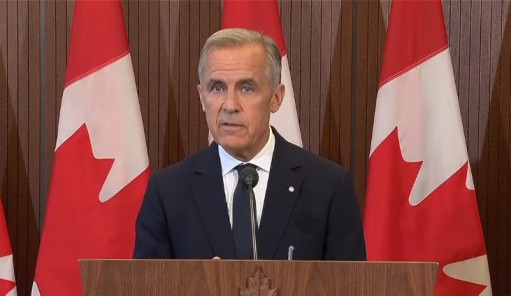
Fourth, protect our small and medium sized businesses, including by removing the imminent threat of those new tariffs. And fifth, fundamentally, maintain Canada’s flexibility, independence and sovereignty so we can keep building the country Canadians want. Canada has made offers to secure a fair, comprehensive deal that would be in the best interest of Canadians. We were willing to drop our remaining retaliatory tariffs on strategic sectors, particularly steel, aluminum and substantially lowered theirs to levels that made it economic for Canadian companies to export to the United States.
In exchange for a fair deal, we would encourage our provinces to return U.S. alcohol to the shelves. And we would take administrative measures to protect supply management without changing the system itself, the U.S.
Quotas or the tariffs that would apply. There were some things we wouldn’t do. We were not prepared to compromise Canada’s sovereignty or to undermine our key industries. Now, in recent weeks, there had been important progress made towards a possible agreement, an agreement that would have reinforced Canada’s position as having the best deal in the world with the United States, including by securing the best terms for each of our most important strategic sectors and by providing greater certainty about our future trading relationship. And while we believed earlier this week that we were moving towards a mutually beneficial agreement, in recent days, the United States proposed new terms that were uneconomic, unfair and undermined the net benefits for Canada and called into question the reliability of any deal.
In short, they asked too much and they offered too little. More fundamentally, the cumulative effect of U.S. demands revealed the limits of their commitment to a true economic partnership. As I said earlier, as a result, last evening, I suspended trade negotiations with the United States and directed our negotiators to return to Ottawa.
Canada’s Response
I want to thank Minister LeBlanc and our Chief Negotiator, Janice Charette. Their team, they’ve worked hard in good faith right up to the last minute to defend the interests of Canadians. Now, Canada will match Washington’s new tariffs dollar for dollar in order to protect Canadian workers, farmers, families, businesses. Our response will be concentrated in sectors such as steel, dairy, appliances, agricultural equipment, pulp and paper, electronics. Also include products that are currently subject to unjustified Section 232 and 338 tariffs.
This is a focused response, a focused response to protect and defend our industries and allow them to compete with U.S. products in the Canadian market. In the coming days, we’ll release details of these new tariff measures, measures which will come into force the Tuesday after Labor Day. Let me be clear.
We take this step reluctantly. Reluctantly because we recognize that some of these measures will raise costs and reduce choice for Canadians. Reluctantly, because we recognize that some U.S. companies and some U.S. states are innocent bystanders in a dispute that they did not want. Reluctantly, because this trade dispute is preventing Canada and America from doing so much good that we could do together. But at the same time, we take this step confident that it is in the best interest of Canada. And that by rejecting a bad deal, by standing up for Canada, by focusing on what we can control, we will build Canada strong for all.
Building Canada Strong at Home
Building at home and diversifying trade abroad is not our plan B. It has been our plan A from the start. Canada will continue to pursue this path to build Canada strong because it’s right and because it’s working. We’re moving rapidly to build major infrastructure. We’ve already referred 27 nation building initiatives to the new Major Projects Office, new ports, mines, energy corridors from every region of the country that now represent $500 billion in new private investment.
Projects that will help Canada build bigger, move faster, and trade more with the world. Just last Monday in St. John’s, the governments of Canada, Quebec, Newfoundland and Labrador launched the single largest investment in Canada’s history to build the largest clean energy project in North America ever. In Churchill Falls and Gull Island, it will produce enough clean electricity to power every single vehicle in Canada. We’re building our economy while taking charge of our security by investing $500 billion into our defense, expanding our shipyards, growing our aerospace industry, increasing our cyber capabilities. And we’re realizing Canada’s full potential as an energy superpower in nuclear, LNG, renewables, and low carbon oil and gas.
These are the initiatives that are the future of our country. Canada is now the best connected economy in the world. Over the last year, we have signed more than 20 trade and security deals across five continents. We completed our most recent deal with the United Arab Emirates in a record 47 days. Canadian businesses now enjoy tariff free access to 1.5 billion consumers.
Over the next six months, we’ll double that number through new trade deals from ASEAN to India. Canada is building such unparalleled market access because we’re trusted, because we’re reliable and because we have what the world wants. That’s why the world is coming to our door. In just three weeks, we’ll host the first Canadian Investment Summit in Toronto. The summit is attracting the world’s largest investors who collectively manage over $100 trillion in assets.
When they get here, they’ll find a Canadian economy that has never been more connected or more ambitious. This fall, in Budget 2026, we will go further to make Canada even more competitive and attractive for businesses and strategic investors to build, invest and grow. The new U.S. tariffs are designed to hurt us and divide us.
They’re a miscalculation. They’re a miscalculation because Canadians will always take care of each other. We know we’re stronger together. In the last year and a half, Canadians have met this moment with resolve, with purpose, with strength. Many ways, vacationing in national parks, buying Canadian products, choosing Canadians, small acts of solidarity repeated millions of times that make a statement.
We’re masters of our destiny. This government is matching that spirit with $25 billion to protect Canadian workers and businesses hurt by American tariffs. We’re helping small and medium sized businesses respond by investing in equipment and productivity and supply chain resilience. And we’re financing large companies to keep large employers operating and to retain their workers. We’re helping those hardest hit industries retool and pivot to those new international markets.
And we are being our own best customer. We have the right plan to build Canada strong. We’re on track and it’s working. At the same time, we recognize that some of the biggest payoffs of this plan, of this transformation will take time. And that’s why we’re also focused on giving Canadians a boost today and a bridge to that better tomorrow.
So we’ve cut taxes on incomes, on housing, and on gas. We’ve introduced the Canada Groceries and Essentials Benefit up to $1,890 per family, helping 12 million Canadians get ahead. We’re stronger now than when the United States started this trade war. More unified, more determined, more ambitious. With the strongest fiscal position in the G7 and a resilient economy, Canada has all the resources we need to pivot and to prosper.
Growth is accelerating. We’re projected to have the second fastest rate in the G7 this year and next. We are creating jobs in this economy at four times the rate of the United States. Our non-US exports are up sharply. They’re on track to double over the next decade.
Foreign direct investment in Canada is at its highest level in two decades. It’s running at twice the rate of our nearest G7 competitor. Canada, Canada now ranks as the most attractive country in the world for infrastructure investment. Last spring, I warned that America is trying to break us so they can own us.
And I promise that that will never ever happen. We are keeping that promise. Canada is becoming stronger and less dependent on America. We are already giving ourselves more than they can take away. And we are just getting started.
As we observed earlier this week in St. John’s, Canadians don’t submit to the weather, we thrive in it. We don’t wait to see which way the wind’s blowing or surrender ourselves to the waves to be storm tossed by events. We set our own course. We make our own weather.
Building Canada strong for all. Thank you very much and I look forward to your questions.
UNIDENTIFIED SPEAKER: Thank you, Prime Minister. We have time for questions. First question, Mackenzie.
Question and Answer Session
REPORTER: Hello, Prime Minister. Mackenzie Gray with Global News. I’m hoping you can tell us what the specific last minute changes that the Americans proposed that made a deal untenable. Thank you.
PRIME MINISTER CARNEY: Thank you for the question. Look, I would say two things. One is there are some specifics and I’ll give you some examples, but it was also a cumulative aspect, as I mentioned in my remarks, about the willingness of the Administration in total to enter into a true economic partnership. But in terms of specifics, I’ll give you three, and I know there’s other questions.
First, with respect to the auto industry, both in terms of the level of the tariffs, the treatment of Canadian content, so Canadian parts, Canadian steel, Canadian content in vehicles, the scope of the tariffs. Americans wanted to limit it to autos only, not include medium and heavy autos and light trucks, to be more specific, not include medium and heavy duty trucks, which is a big change, obviously.
And with respect to Ford’s new plan, for example, in Oakville, is F-350s, F-450s, F-550s, they would have been excluded. GM Silverado, same thing, would have been excluded from that. No rationale, just for exclusion. So effectively moving into a series of terms that would have made the production more uneconomic over time. Okay?
So that’s a change. That restriction, that clarification, that precision was a change. The U.S. introduced at the last hours, in the last hours, efforts to restrict our ability to have other trade deals.
You heard me say a moment ago what we’ve accomplished in the last year, 20 new deals, economic and security partnership. The prospect of doubling our market access because we believe in free trade. We’re the partner of choice in many respects for countries around the world, and the Americans wanted to restrict that. They had language that they wanted to restrict, unacceptable. And I’ll give you a third.
Continual efforts always resisted, as I said in my remarks, and always will be resisted. Efforts to restrict our protections of our language, our culture, and in effect, our sovereignty. So elements coming in, ramping up, any of them individually, but collectively put us in a position where what had been on a trajectory, absent those elements for a fair deal, a good deal for Canadians, not perfect, a good deal. A deal we would not accept.
REPORTER: Follow-up. Was Howard Lutnick’s involvement in the last days an impediment to getting a deal?
PRIME MINISTER CARNEY: It’s a question for the US administration. Ultimately, ultimately, I’m responsible for the decisions of the Canadian government. We take it as a cabinet, but I certainly bear those responsibilities. And so the head of the US administration, the President, bears responsibility for decisions they take.
But I will say this, which is that the Canadian team, unified, unified, the individuals you see here, their team members, our ambassador in Washington, my chief of staff, unified talking together, the Clerk of the Privy Council, everyone in the loop, everyone knows what our objectives are. Collective decision making. As I say, ultimately, I and the cabinet bear responsibility for those decisions, but unity — you cannot say that about the United States administration.
And as a consequence, last point, and I’ll go to your colleagues because I think this is important. In the last few days, we were drilling down on specific issues where that might have been papered over, the differences in the administration, if there were indeed differences. Ultimately, there’s a decision maker at the top. And in drilling down on those, a number of those issues that I just referenced became very clear, and there was not a deal that we would sign. Thank you.
UNIDENTIFIED SPEAKER: Next question.
REPORTER: [QUESTION INAUDIBLE]
UNIDENTIFIED SPEAKER: Next question.
REPORTER: Good morning, Prime Minister. David Baxter with the Canadian Press. There’s a lot of people watching this right now who are rightfully worried about losing their jobs, losing their businesses in this trade war. What’s your message to those people who are worried about becoming collateral damage?
PRIME MINISTER CARNEY: Well, thank you, David. A couple of things. First, these, the people in these industries, particularly the industries that are being hit today by these 50% tariffs, many of them are small, medium sized businesses. They’re in a wide range of industries spread across the country, concentrated Ontario, Quebec, British Columbia.
By and large, that’s not exclusive, but it’s that. And they have very much been top of mind. Top of mind, it’s one of the reasons why we work so hard and stretch so far to try to get a deal. Now, but not a deal at any price, not a deal on any timetable. So a couple messages for those people.
The first is we’re going to hit back. Okay? We’re going to hit back, and we are going to provide tariff protection where we can, where it’s relevant for some of those industries. Steel is a steel products and others, is some, in some cases, an example of that. We’re going to provide full tariff protection there to prevent American businesses coming in and taking business.
So that provides some. But more fundamentally, we will provide support, and we will do whatever it takes to support these businesses. We’ll be releasing details of this early next week alongside our tariff actions to support these businesses. And we will support these businesses for as long as it takes. In other words, beyond the life of this U.
S. Administration. Okay? So there’s various mechanisms that we’ve worked up. We’ll give all the details in a few days.
But think of working through our regional development agencies, also working through the Business Development Bank of Canada. And those will be the focal points for a limited number of easy to use but very effective programs that are going to help these businesses work through this period, pivot as necessary, because part of what we’re seeing is what the potential future limits are to the American market.
UNIDENTIFIED SPEAKER: Next question, Suvi.
REPORTER: In the last couple of days, we heard some pushback from some of the premiers, such as Wab Kinew. Susan Holt said she was reluctant to put liquor back on the shelves. Quebec’s Christine Fréchette was saying she hadn’t made up her mind on what Quebec’s response is going to be yet. And Doug Ford was uncharacteristically silent, but he did send you a letter outlining his red lines last Monday. Just, did any pushback from the premiers play a factor in the decision to end talks with the US? Thanks for the question.
PRIME MINISTER CARNEY: First, let me say a couple of things. I mean, the short answer is no. So, just to give you that perspective. But, and this is an important but, the dialogue with the premiers in the last few days, over the course of the last eighteen months, and the partnership that we’ve established with the premiers is crucial and fundamentally important. The essence of our First Ministers’ discussion two days ago, we’re going to have another one this afternoon. But the essence of our First Ministers’ discussion two days ago was that it’s our judgment, as we told Canadians, that we were on a path to a potential deal that would give Canada not just the best deal overall, but the best deal in all of our strategic sectors, that the price for that deal, in our judgment, was worth paying.
We still had to come back to the premiers with the exact specifics, so it’s entirely reasonable for a premier to say, well, I want to see everything before I make that determination. But our judgment was going to be that it’s going to be worth it, to take steps, a couple of steps that provinces needed to do in order to get the overall deal. I’ll go back to Mr. Baxter’s question, not least because of the potential impact that we will now be fighting against, on these small and medium sized businesses. Okay? So that was the discussion.
I would, as chair of that meeting, there was a consensus that that’s what we would do, subject to finishing the negotiation. Now, they didn’t have to make that determination Wednesday, I guess it was, when we spoke, yeah, because we hadn’t finalized all the terms of the deal. We were still negotiating the deal. And as it turns out, as I’ve just described, the Americans changed a number of those terms, introduced new elements, made it uneconomic. And so we’re not asking the premiers to do anything today except work together to support our businesses and build the country strong.
And I’ll underscore that last point, which, and I said this on Monday in St. John’s, for the future of the country, the Churchill Falls agreement, Quebec and Newfoundland and Labrador, supported by the federal government — that agreement and those initiatives are the most important initiatives for the future of our country. As important as trade is with the US, and as dramatic as the issues are, and the response that we have to give in certain industries, what we’re doing ourselves — premiers, the federal government, truly Canadians — is far, far more important. It dominates. Thank you.
UNIDENTIFIED SPEAKER: Next question.
REPORTER: Morning, Prime Minister. Mike Blanchfield, Politico Canada. You’ve outlined a few things that the Americans asked for that were unacceptable. Did they ask about critical minerals, given their importance, requirement for it? And how did that play out and what happened at the last…
PRIME MINISTER CARNEY: Well, thank you for the question. Look, the critical minerals, other aspects of energy — but let’s focus in on your question, critical minerals. There is a real opportunity for cooperation between Canada and the United States on critical minerals. Just as there is cooperation between Canada and the other G7 countries, like minded countries, on critical minerals. We are demonstrating that cooperation right now. Over the course of the last 12 months, we’ve signed 50 deals, or, you know, it’s on the order of $50 billion worth of transactions in critical minerals, stockpiling and other funds.
And having the U.S. as part of that process and merging some of the processes that the US have — they have a tariff initiative that they’ve worked on, we have the G7 Action Plan, which we launched in Kananaskis. Bringing those together makes sense, good opportunity, kind of thing you do as part of a trade deal. One of the reasons to do a trade deal with Canada. So, yes, makes sense.
Now, in the context of the US putting 50% tariffs on a bunch of our business, trying to influence our cultural support and language protections, not agreeing to sensible economic terms for our core industry in autos — you know, we’ve got a lot of demand for critical minerals. So there’s less opportunity to cooperate with the United States. That is something that is a missed opportunity as a consequence of what’s happened. But we didn’t cause it to happen.
REPORTER: Did they ask exclusive access to our critical minerals?
PRIME MINISTER CARNEY: We would never give exclusive access.
REPORTER: And did Canada do anything at the last minute that could have triggered this? Did you make any asks or offers?
PRIME MINISTER CARNEY: No. There’s a short answer from our perspective. We clarified what was on offer, and we’re continually disappointed by the answers.
UNIDENTIFIED SPEAKER: Next question.
REPORTER: Good morning. Greg Quinn. Your midnight statement mentioned part of the breakdown was the reliability of any deal. What do you say to other global business and government leaders around the world who can wonder if the US can be trusted from here? If Donald Trump can’t execute the art of the deal with friendly Canada, who can he do business with?
PRIME MINISTER CARNEY: Yeah, I mean, you know, if you execute a deal, you have to stand by that deal. And Canada stands by our agreements. We’ve stood by — I mean, we’re only responding in the context of a series of unjustified tariffs that have been put in place, unjustified under — we have a deal with the… I mean, that’s the thing. We have a deal with the Americans. It’s called CUSMA. We have side letters that clarify behavior in steel, in aluminum, in autos. All of those are being violated day in, day out. They act as if, you know — yeah, we have a deal.
Okay, what message does that send? On the other side of the ledger, you have a country, Canada, that has a series of trade deals around the world that’s expanding rapidly, that will continue to expand because we’re trusted, because we’re reliable, because we have things like critical minerals, many other aspects that the world wants. And so we’re going to continue to pursue that. And one thing that we certainly were not going to accept was any restriction on our ability to execute those deals.
REPORTER: Secondly, was part of your calculation around declining U.S. bargaining power? I’m thinking of President Trump’s polling numbers versus yours. I’m thinking of already elevated inflation that American consumers are facing, and also, you know, recent instability in the US bond market.
PRIME MINISTER CARNEY: Well, let me say a couple of things. No. In terms of what we’re focused on, as you know, is building Canada strong. It’s putting Canada in a better position for Canadians, for all Canadians. Now it happens to be the case that we are stronger, and we’re in a better position than we were eighteen months ago, because we’ve recognized right from the start that we needed to focus on building at home, we needed to diversify abroad. Both of those have longer payoffs, but we’re already starting to see some of the benefits of that.
We recognized, and credit to the Minister of Finance, we recognized right from the start that we need to continue to maintain the strongest fiscal position in the G7. So that our borrowing — and we will borrow, but borrowing for investment, not for operating expenses, and that shift in borrowing there. And let me make this point, because the last part of your question, you know this well, that we are entering a phase where fiscal strength, discipline, focus is going to be very important. It’s going to be scrutinized. I mean, I will say to Canadians at home, as someone who’s been in and around financial markets for a long period of time, what I’m about to say doesn’t make sense, but it’s the way the world works — is that markets sometimes ignore these fundamentals.
And then all of a sudden they focus on them. And when they focus on them, if you don’t have your house in order, it’s too late. We have our house in order and we’re getting stronger.
UNIDENTIFIED SPEAKER: Next question.
REPORTER: Question from Tom Perry with CBC. Can you talk more about what the United States was demanding Canada do with its other trading partners? Were they asking us to impose tariffs on other countries in conjunction with them?
PRIME MINISTER CARNEY: Tom, there were elements of that, and in certain sectors. And to be clear, there were elements where we would see the merit of that as part of a comprehensive deal that made sense for Canada. So if you have an integrated auto market and you want to have an integrated steel market, for example, related aluminum market, then — and you have concerns, as we do, as the Americans do, about non-market economies, about transshipment of steel, for example, through third countries, etcetera — then it makes sense to align.
And I would say that, again, within a comprehensive deal, we’d be prepared to do that. But that’s us deciding to do something that is in our joint interest, as opposed to being told to do something or being restricted from doing something else. Now, the second point is there are a series of steel and aluminum related — by the way, if you do do that though, you should have an integrated market. In other words, the tariff level that you apply from Canada into the United States, because America wants to tariff everybody on everything, but the tariff level you apply should be clearly the lowest. It shouldn’t be the same as other people.
It should clearly be the lowest, because you have this added market protection. That’s part of the negotiation. We weren’t satisfied ultimately where on steel, aluminum and related products, so called derivative products — think HVAC systems, nuts and bolts, you know, anything that’s Bombardier products, Bombardier Recreational Products — there wasn’t enough movement. Then there’s a separate issue, and I’ll stop with a sentence here, which was language which suggested restrictions in terms of our ability to execute trade deals, which would always be unacceptable to this government.
REPORTER: What do you think their goal was there? What were they trying to do? And if I could just, a second part, what were they asking on culture?
PRIME MINISTER CARNEY: You can ask the first, not double follow-up. Since you asked, could you ask… I’m going to say no, you can’t ask three questions.
Look, sorry, now I’ve forgotten the first part of your question was — what was it —
REPORTER: in trying to get us to gain more control over our trade power?
PRIME MINISTER CARNEY: Oh, why are they trying to do that? It’s a power play. It’s a power play. And, you know, it becomes a question of sovereignty. Look, we’re very — let’s take a big step back, big step back. And this is what is unfortunate about the situation we’re in. We’re here for the right reason, but it’s unfortunate.
Canada and America, our G7 partners, we think about a lot of issues the same way. We’re concerned about excess capacity in non-market economies. We care deeply about forced labor, child labor. We want it — and I’ll take that second example — where, absolutely, do we want to cooperate? Do we want to share information? We want to align our approaches and our implementation of those approaches. And was that potentially part of this deal? Absolutely. There’s a host of other things where, absolutely, we want to work together. But when it moves into restrictions and using Canada effectively as more leverage for America, that, I mean, clearly, that’s — Canadians wouldn’t accept that.
We’re a proud independent country. We’ve got the right values. We’ll make our decisions about who we want to trade with and how, including on how we work with the United States and other partners. Thank you.
UNIDENTIFIED SPEAKER: We’ll have time for one last question. Chris?
REPORTER: Good morning, Prime Minister. Chris Vernardi from the National Post. The government to date seems, at least publicly, to have been very reluctant to wield critical minerals and energy as a weapon as part of this trade war. Is that going to change now? Are those on the table?
PRIME MINISTER CARNEY: We have a range of other options to protect our industry. You know, first and foremost, what are we looking to do with our counter tariffs? It’s to protect industries that are disadvantaged by the American trade action. So we start with that. And then we think about matching in ways that have the least negative impact on Canadians. You — we don’t like doing these, but in this environment, it makes sense.
One of the things that’s happening — I’m going to answer your question this way. One of the things that has happened over the course of the last twelve, eighteen months is that we have considerably ramped up development of critical minerals. Without a doubt, I can’t put a precise number on it, but much less of that development has been related to the United States than it would have been if we were not having these trade issues. It is clear to Canadians the value of diversifying our partnerships. And it’s clear to Canadians — I’ll say something — it’s clear to Canadians that a pipeline to Asia that exports oil to Asia, or an LNG facility that exports LNG to Asia, is more valuable than just the dollar value, because it helps diversify our economy, our partnership. It makes us less dependent on the United States, less — I mean, I’ll just state the obvious there.
So that’s — I’m taking your question transparently and turning it to the positive of how we act to build out this, as opposed to pulling things, relationships that already exist, and restraining them. But, you know, we’ll see.
UNIDENTIFIED SPEAKER: Last follow-up, Danielle.
REPORTER: Double barrel it because it’s the last one.
PRIME MINISTER CARNEY: First, do you plan on — I know…
REPORTER: I can’t…
PRIME MINISTER CARNEY: Now you’re squeezing water out of water. Tom tried that.
REPORTER: It’s — you plan on reviving certain measures eliminated, what, previous concessions, the digital services tax, streaming services tax, the US streaming payments for CanCon, for example, those measures? And why does it feel like today, Mark Carney is going to war? Trade war. The tone.
PRIME MINISTER CARNEY: I — because we’re attacked. Like, you’re at war when you get attacked. We got attacked. US put 50% — we waited until the United States decided to actually implement these so-called 338 tariffs. That’s fine. We’ve got the reserves. We’ve got the resilience. We’ve got the plan. We’ve got the focus. We will respond. We’re going to focus on what we can control. We’re going to build.
In terms of measures and tax and others, we are constantly looking at our tax system, how we can make it as fair as possible, shift the burden to those who are most able to pay, and in a way that incentivizes investment and entrepreneurship. Right? We are, you know, all elements of the following: build Canada strong. It’s not just — it is the plan. And so we want builders to put money to work in new businesses, in big infrastructure. We want them to put it to work in Canada. And that makes it strong, and it works for all.
Thank you.
PRIME MINISTER CARNEY: Thank you. This puts an end to our press conference.
Related Posts