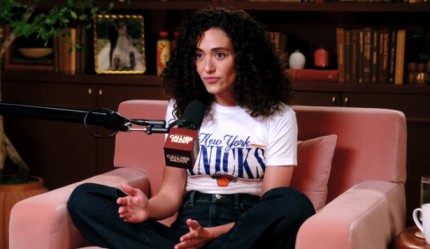
Read the full transcript of actress Emmy Rossum’s interview on Call Her Daddy podcast, July 8, 2026.
Editor’s Note: In this candid episode of Call Her Daddy, host Alex Cooper sits down with actress Emmy Rossum for a deep dive into her illustrious career and personal life. The conversation covers her iconic decade-long portrayal of Fiona Gallagher on Shameless, her fierce and successful advocacy for pay equity in Hollywood, and her transformative journey into motherhood. Rossum also opens up about finding her new creative spark as both an executive producer and the star of her latest thriller project, Furious.
Welcome & The Knicks Win
ALEX COOPER: Emmy Rossum, welcome to Call Her Daddy.
EMMY ROSSUM: Thank you.
ALEX COOPER: Okay, we have so much to talk about today. You have accomplished so much in your career. You got into the industry as a kid. You spent nearly a decade of your life playing the fierce Fiona Gallagher that we all know and love on Shameless. And you have fought for pay equity in Hollywood. So I am like, girl, we have a lot to talk about today.
EMMY ROSSUM: Okay.
ALEX COOPER: I’m so happy to meet you.
EMMY ROSSUM: Me too.
ALEX COOPER: The shirt. Let’s start with the shirt because I know you’re a true New Yorker.
EMMY ROSSUM: We’re the champions.
ALEX COOPER: Are you still clearly riding the high?
EMMY ROSSUM: It’s never going to end. Okay. I’ve been waiting for this since I’m like 6 or 7 years old. I became obsessed with basketball. I don’t know why. I loved watching the sport. I deeply identified with John Starks growing up during that playoff run. I remember I wrote in my diary, “He’s so fiery on the court and I just identify with him. I see myself in him.” And I love basketball because it moves really fast and you can see all the players’ faces really, really well. And I need to understand the emotional narrative of what’s going on with the players in the game. Like football, I’m too far away, I can’t see their faces. Hockey, I can’t see their faces. Tennis I like for the same reason. It moves fast. I can see them. I’m with them. I’m with the narrative. Like, what is going on? They’re trash talking each other. I can see it.
ALEX COOPER: You want to see the sweat, but I need to see the emotion.
EMMY ROSSUM: I want to see the drive. I love it. I get so invested.
ALEX COOPER: I need it.
EMMY ROSSUM: I love it.
Watching the Knicks Win from Rhode Island
ALEX COOPER: Okay, where were you when the Knicks won?
EMMY ROSSUM: I was in Rhode Island with a bunch of actors and crew. I just finished a movie there, and so we kind of commandeered this bar. The bar was actually— I was like, hey, I’m looking for a place to watch the game, and they were like, oh yeah, that’s great, we’re actually having a thing on the roof to watch the game. I was like, amazing. So then I got up there and there was all these, like, World Cup flags. And I was like, what, are we going to turn on the Knicks? And they were like, what game are you talking about? And I was like, the only game to care about right now.
ALEX COOPER: You start being like, the New Yorker starts coming out of you.
EMMY ROSSUM: You’re like, ah, I’m getting so panicked. And it turned out that there was actually nobody there to watch the World Cup, so they turned it into a Knicks playoff game. And then a wedding ended up coming up and they turned out to be Knicks fans. I cried.
ALEX COOPER: You had a whole night.
EMMY ROSSUM: I had a whole night because the first teaser for my show got like a 15-second spot, and I only heard about it a couple hours before the game, and I was losing it.
ALEX COOPER: You’re like, if there’s ever been a moment that I am getting promo, it’s right here, right now, that I actually care about the most.
EMMY ROSSUM: I was like, if we win tonight and my show has a promo on it, like I can just, I can just die happy.
Laboring Through a Knicks Playoff Game
ALEX COOPER: I did want to ask you, when I was stalking you, there is an Instagram post that you shared 5 years ago when the Knicks were also in the playoffs.
EMMY ROSSUM: Oh yes.
ALEX COOPER: And you were in labor at the time.
EMMY ROSSUM: Yes.
ALEX COOPER: But it feels like there’s a bit of like a chaotic story where like, are you putting basketball before giving birth? Like, can you tell the story? What happened?
EMMY ROSSUM: I was pregnant with my daughter, and I knew that I was due, and I was very much in denial that I was in labor the first time. I remember I like gave my husband a haircut, I was cleaning the house, I ordered some Thai food, and I had some contractions, but like was kind of like, meh, it’s probably fine. I was definitely scared of childbirth. My mother’s mother had died in childbirth, so that narrative was very in the back of my head or my psyche somewhere. But what was in the front of my psyche was I was not going to go into labor until after the Knicks game. And so I was laboring over a large kind of exercise ball in full labor.
ALEX COOPER: As you’re watching the game.
EMMY ROSSUM: As I’m watching the Knicks game. And in this photo, my mom is next to me on the couch being like, “I really think you should just like go get the epidural.” And I was like, “Nope, I’m going to watch this game.
ALEX COOPER: And then you, what, you call an Uber and you’re like in labor?
EMMY ROSSUM: I actually labored the whole night before I went to the hospital in the morning. My contractions never got any closer together than like 8 minutes, so I didn’t think I was very close. And I was like, I don’t think I can do much more of this.
ALEX COOPER: Right.
EMMY ROSSUM: And then finally, yeah, I woke my husband up and I was like, “We gotta call an Uber. You gotta go.” And he was like, “Should I get the playlist ready?” And I was like, “I think I don’t, I don’t want the playlist anymore.”
ALEX COOPER: Like you had a playlist? The labor playlist.
EMMY ROSSUM: Yeah.
ALEX COOPER: Oh wow.
EMMY ROSSUM: So I get the playlist ready and I was like, I’m ill. I don’t want the playlist anymore.
ALEX COOPER: I love you so much. Is this like a thing? Like do I need a labor playlist? Maybe. What kind of music do you have on it?
EMMY ROSSUM: There was like a lot of hip hop, R&B.
ALEX COOPER: Oh, okay. So not like soothing.
EMMY ROSSUM: I don’t think we knew about like—
ALEX COOPER: We have like Kendrick Lamar going. I’m like, I feel like I would be thinking more of like soft meditation, but you’re like—
EMMY ROSSUM: We were not. We were not. Yes. His contribution to the labor was his playlist.
ALEX COOPER: You’re vibing out loud.
EMMY ROSSUM: Which went unused because we took the Uber to the hospital and I remember I was like, “Sir, like you really, I feel like you really gotta step on it.” And we were like driving up Park Avenue in the city and he like, the light would turn, like start to turn yellow and he would just stop. And I would like go into another contraction.
ALEX COOPER: Like, sir, do you want 5 stars? He’s like, your Uber rating’s going down. You’re about to have a baby in my backseat.
EMMY ROSSUM: I know. Oh, and that, that was the fear. I was like, I just don’t want to have this baby in the backseat. But then I got to the hospital and I was fine. And they were like, my water still hadn’t broken. And they were like, “Oh, you’re 8 centimeters dilated. Like, don’t sneeze. Like, this baby’s going to fall out of you.”
The First Moment Meeting Her Daughter
ALEX COOPER: Okay. What was it like the first moment you met your daughter?
EMMY ROSSUM: Wow. I held her and I have a video of the first moment and I said, “Oh my God, that’s a person.”
ALEX COOPER: And obviously I’ve heard people say like, and then you’re staring at your child and you’re like, oh my God, like this is on us now. Like we’re, they’re, we’re allowed to leave the hospital with this beautiful thing, but like what do we do? Did you have any of that feeling?
EMMY ROSSUM: Certainly I was overtaken by the feeling of vulnerability. Just that this thing that you’ve been able to keep safe inside of you for so long is now outside of you, and it’s so vulnerable, and anything could happen to it, anything could hurt it.
The postpartum anxiety for me was very, very rough, like very intense intrusive thoughts. And I had had a kind of crazy journey to get pregnant, where I have PCOS. So I had very, very debilitating ovarian cysts throughout my 20s, and tried to get pregnant naturally. It didn’t happen. Tried IUI, didn’t happen. And then tried IVF, and it happened in a big way. I only did one harvest, but a kind of side effect of PCOS is that you can kind of become a super responder. So they woke me up from the harvest and said that I had 72 eggs. Which was trippy and bizarre. And I thought I’d maybe have 12.
ALEX COOPER: Of course. Right.
EMMY ROSSUM: And they were like, “And we fertilized them all.” And I was like, what? So it had been a long journey to get to meet my daughter. And then when I finally had her, it was also towards the end of COVID. So I had been able to keep the pregnancy private the whole time, which is something I know you desperately wanted too.
The Reality of IVF & Women’s Journeys to Motherhood
ALEX COOPER: It is. And I also love that, like, I get to sit here and talk with you about it. And I know that so many women who have PCOS or did IVF are going to be, like, hanging on to every word that you’re saying right now. Because I think what is so unique about women’s experiences is they are so unique and no one is the same. Like, you saying that you got 72 eggs, I was like, yeah.
EMMY ROSSUM: And then the offshoot of that was after you do IVF, they tell you to like monitor your weight in the next couple days to see if you put on any water, and I gained like 14 pounds in 2 days and I was like, something’s wrong here. So I called the doctor and I’d just eaten like a big fat cheeseburger and I was like, I don’t know, like I feel like a plump grape, something’s wrong. And so I went back in and I’d gone into hyperstim, so they had to extract the fluid, which modern medicine is incredible, but this procedure was bizarre and kind of barbaric.
I went in and they were like, “Have you eaten today? Because we could do Twilight.” And I was like, “I’ve eaten a huge cheeseburger.” And they said, “Okay, well, we’re going to have to extract this fluid.” And then they took out an enormous Diet Coke bottle and just like took the fluid out right into the Diet Coke, empty Diet Coke bottle.
ALEX COOPER: You’re like, just—
EMMY ROSSUM: And I was like, this is okay. I guess this is what we do.
ALEX COOPER: I know. I’m like, oh, is there not like a normal tube that looks a little bit more like medical? Like anything other than like, oh wow.
EMMY ROSSUM: Yeah.
ALEX COOPER: That’s the fascinating part. Because I want to go through your whole life and we’re going to get more into motherhood as we go. Because I know you were also raised by a single mother.
EMMY ROSSUM: Yeah.
ALEX COOPER: But like, that’s the part of motherhood that’s so fascinating is we act like it’s such like a, oh, and then she like had a baby. And it’s like, no, no, no, like the actual war that women are up against to even be able to say, and then a baby came. And it actually, there’s so much like glamorization around it. It acts like it’s like just like a normal casual thing. And it’s like, this is so complex. And there’s so much that goes into it that I had no concept of. And maybe I’m becoming even more aware of it, obviously because I’m going through it.
EMMY ROSSUM: Yeah.
ALEX COOPER: But like, women are so incredible and it is overwhelming what we have to go through to get to where the standard and the norm feels like it should be.
EMMY ROSSUM: Yeah.
Emmy’s Childhood and Early Career
ALEX COOPER: Okay. So you’re raised by a single mother.
EMMY ROSSUM: Yeah.
ALEX COOPER: She was a photographer.
EMMY ROSSUM: My mom was a photographer. My mom is very adventurous. She was a single mom and she met my dad on an airplane. And he was not interested in being a dad. He left her when she was pregnant. And so I didn’t meet him until I was 4, and even then I didn’t know he was my dad.
But my mom was— my mom is amazing. She’s very adventurous. She was a corporate photographer when I was little. She would travel a lot and she would do things like go to Saudi Arabia to do the annual reports for Mobil Oil, and she would hang out of a helicopter, like attached by a cable, and take pictures of an oil rig. She photographed like the making of the atom bomb for our government. She was Steve Jobs’ personal photographer for many years before I was born.
And my mom is just like hugely impressive and capable in so many ways. Like we went to Japan and she could like order in Japanese and ask where the bathroom was. We went to France and she like broke out the French with the cab driver where they were like talking about the First World War in France, in French. And I was like, that’s like real French.
My mom’s going to be 80 in January. And she had me when she was 40. I asked her last week, “What are you doing this week, Mom?” And she was like, “My dishwasher is broken, so I’m going to fix it.” And I was like, “What do you mean? Do you know how to fix a dishwasher?” And she said, “No, but I will by Friday.” And I called her and she fixed it.
ALEX COOPER: What a gift to have such a capable, inspiring, intellectual mother. As your kind of like North Star to life.
EMMY ROSSUM: Yes.
ALEX COOPER: And watching the world through her eyes is like, it explains a little bit obviously of why you are the way you are. How would you have described your relationship with her when you were young and growing up?
Growing Up With a Single Mom
EMMY ROSSUM: We were close, but I certainly felt the absence of my dad. I certainly didn’t want my mom to go to work. My kids are 3 and 5 now, and sometimes it’s hard when you go to work. Sometimes they have big feelings about this.
One time when I was like 4, I think I was like throwing a tantrum, like, “Don’t go to work, don’t go to work.” And my mom said, “Okay, do you know what happens if I don’t go to work?” And I said, “What?” And she said, “We would sleep on the street.” And I said, “Okay.” And she said, “Do you know what it’s like to sleep on the street?” And I said, shrug— I’m 4, I don’t know. And she opened the 4th floor window and she took my pillow and my blankie and my teddy, Huggy, who I still sleep with to this day.
ALEX COOPER: Of course.
EMMY ROSSUM: He is in my hotel room right now. Huggy. He’s a polar bear.
ALEX COOPER: I love this, like, this Huggy.
EMMY ROSSUM: He’s a polar bear.
ALEX COOPER: Is he a little scary though?
EMMY ROSSUM: No, he’s very hugged on his belly.
ALEX COOPER: Have you gotten him like restitched a little?
EMMY ROSSUM: He’s been so operated on, Frankensteined. But she took all that and she put it out the window and I remember watching it like float down, and that was how she taught me the importance of survival. She threw it out the window.
ALEX COOPER: I’m picturing there’s like a little fire escape situ—
EMMY ROSSUM: No, no, no. Oh, it was 4 floors down. 4 floors down.
ALEX COOPER: So then did you walk down and have to go to the street?
EMMY ROSSUM: And we went and got it, and then she went to work.
ALEX COOPER: Yes, she did.
EMMY ROSSUM: So I might do things differently now, but we were very, very close. I needed her, I wanted her, but she had to go to work. She made me understand survival in a very intense way. My mom’s not a woman of feelings. She’s a woman of— her love language is acts of service.
ALEX COOPER: And she’s quite hardcore, practical. Like, this is what it is, so this is what it is.
EMMY ROSSUM: Yeah. There you go. “Your bedding’s in the courtyard if you’d like to sleep there.”
But also, as I’ve become a mother, I have found so much forgiveness for my mother for all the ways in which feelings were not her strong suit. My mom’s mom died when she was 13.
ALEX COOPER: Her—
EMMY ROSSUM: She grew up in a really traumatic household. She was out of the house by the time she was 15 and went to Barnard College and really made a life for herself as a single woman, as an adventurous single woman. So I know that I’m going to need forgiveness as a mom too. And I think as we step into these new chapters of our lives, we are afforded the opportunity to recontextualize the ways in which our parents came up short for us. But still love them.
ALEX COOPER: Yeah. I remember I read somewhere you had said like in the past you wanted to be worthy of being your mother’s daughter.
EMMY ROSSUM: Oh, s*.
ALEX COOPER: And I was like, oh, that’s a good one.
EMMY ROSSUM: I am.
ALEX COOPER: That’s a heavy one.
EMMY ROSSUM: I certainly am. But for my daughter, she doesn’t have to do anything to be worthy of being my daughter.
ALEX COOPER: Interesting.
EMMY ROSSUM: Yeah, she’s amazing. Like, my mom and I never had a lot of money, but I never felt that as a kid. She never bought herself new underwear. She took care of me. She put me in a private school. Like, everything went to taking care of me and funneling into me. So even though she may have not been able to be all the things a conventional mother is supposed to be— although I hate shoulds— she did a lot for me and I love her very much.
ALEX COOPER: It’s really impressive because talking about two women living in an apartment together in New York City—
EMMY ROSSUM: Till I was 18, one bathroom, one bedroom.
ALEX COOPER: I can picture it. And then to know— so you went to one of the most prestigious prep schools in the city. What were you like at school? Like, how would your teachers have described you?
Finding Her Place at the Opera
EMMY ROSSUM: It’s funny because I found my old report cards. She gave them to me. She had everything saved from my childhood, and she was like, “I want to give these to you.” I was really into drama, really into art, really into make-believe, and I had a solid group of friends, a very small group of friends from day one. My best friend Dory, Joanna, Pam, from day one. Dory, who is still so my best friend— they’re actually all my close friends— but Dory bought the apartment 3 floors below me so that we can raise our kids together. It’s very like Fiona and then Kevin and V, the neighbors next door.
ALEX COOPER: I love it, I love it.
EMMY ROSSUM: And our kids literally go up and downstairs the back stairs to hang out, and it’s like a little community in our little apartment building. We actually lived across the street from each other and decided it wasn’t close enough, and she sold the apartment and moved into my building when it became available.
ALEX COOPER: This is like making every Shameless fan so happy right now, because I’m just picturing you and like the chaos of going up and downstairs and all of you being so close.
EMMY ROSSUM: Yeah. Oh wow, it is amazing.
ALEX COOPER: And were you an overachiever in school?
EMMY ROSSUM: No, but I never really found my place or my people in school. But it was my second grade music teacher that recommended that I go audition at the opera, at the Children’s Chorus. And I did. And that’s how I ended up singing at the Children’s Chorus. And then I loved it. The second I walked into the opera, it was like I had found my people, my place.
ALEX COOPER: That’s what I was reading. So you were 7 years old when you started singing at the Met?
EMMY ROSSUM: Yeah.
ALEX COOPER: 11, you landed your first TV role. 16— life changes— you starred in the movie The Phantom of the Opera.
EMMY ROSSUM: 17.
ALEX COOPER: 17. Did your mom have any hesitations about you going into this career?
EMMY ROSSUM: Well, my mom was an artist, and so being an artist was a noble profession and not a profession that you went in to get rich or famous. Certainly didn’t go to the opera to sing there for $10, $20 a night to have that outcome. My mom was very aware that there were dangers and drawbacks to this.
Drive, Ambition, and the Stage
ALEX COOPER: When you had the pressure that you put on yourself to be worthy of your mom, did you bring that mindset into your career at all?
EMMY ROSSUM: I had a lot of natural drive and ambition to be the best that I could be. And also there was a lot of rigor that came with being at the opera. You were expected to go on stage, perform, get it right every single time. There was not a lot of leniency for f*ing up. And so that really made my own Virgo perfectionism kick into high drive.
But I felt when I walked out onto stage that that all evaporated. It was so easy for me to share, to feel that I could lose myself in that, and that there were people that were sitting there every night experiencing that live with me. It was magic.
ALEX COOPER: You have said that you like to be a little terrified by a role.
EMMY ROSSUM: Yes.
ALEX COOPER: What feelings draw you to that, of wanting to be terrified?
EMMY ROSSUM: Well, it’s different in life. I think in life, you have that little smoke detector in your head, and when you’re young, you’re like, “Oh, I think I hear something beeping, like maybe the battery needs to be changed,” or like, “Oh, it’s a little hot in here. Maybe I should turn on the AC. Is that the smell of singeing? I’m sure my neighbor’s making cookies.” Like, no b, your hair’s on fire. Get out of the house.
So in life, when you hear the smoke detector, you have to run from it. But in art, when you hear the smoke detector, you move towards it, because that says that there’s something there for you, something unexamined in yourself, something that scares you, something that causes you shame. And those are the things that we must examine about ourselves, about our characters, about our womanhood, about our society. We have to— no different than what you do. You’re unafraid to look in the places that other people don’t want to look.
Fiona Gallagher and Shameless
ALEX COOPER: Yeah, that makes me think about Fiona Gallagher. Let’s talk about— so your character on Shameless, she was ferocious. She was resilient. She was pretty self-destructive at times. Take me to the moment that you read the script for the first time. Like, what drew you in in the way that you’re kind of talking about right now about Fiona?
The Making of Shameless
EMMY ROSSUM: It was unlike anything I had done before. It was raw. There was sexuality. There was longing and yearning for an absent parent, which is something that hit deep for me. There was kind of this slightly chaotic environment that was based on survival that also felt very familiar to me. There was deep love and connection and loyalty in that family, and that hit deep for me.
And there was a sense that even though they were in an economic depression, they were not depressed. They refused to be. And there was resilience and love. And I knew it was mine. I knew it was my role. I knew it was for me. There’s like sometimes when you read things, you’re just drawn to them and you’re like, “Yes, I volunteer as tribute.” You know what I mean? Like, “Put me in, coach.”
ALEX COOPER: And didn’t they at first not feel that way about you?
EMMY ROSSUM: No, I was told that they thought I was too princessy. I had come off Mystic River, Day After Tomorrow, Phantom, Poseidon Adventure. I had walked a lot of red carpets and press tours for those, and I had not displayed that level of rawness in a performance, certainly. But I think only an actor knows what they’re capable of, which is why it’s so important for all artists to take their careers into their own hands and get into the driver’s seat, because only you know what you have inside.
ALEX COOPER: I mean, and just knowing — I was such a fan of the show and I still am — the environment that you were able to create with your character, it felt so immersive. When you’re watching the show, I’m literally a part of this family. I can’t stop watching. You all did such a good job bringing it to life, playing this character for almost a decade. Did you discover anything unexpected about yourself in the process?
Life on Set
EMMY ROSSUM: I had always wanted a big family. That was so emotional for me to walk in and — first, you make a pilot, you never know if it’s going to go. But before we made the pilot, they gave us a week in the house, in the space, which was built on a stage in the Warner Brothers lot. And in the kitchen, the director, Mark Mylod, put a bunch of cold cuts and bread.
And at that time, the fridge still smelled fine, but after years and years of the fridge getting unplugged and replugged, the fridge smelled so bad by the end. And they would put GoPros in the fridge and we would have to open the fridge, because there’s a little camera inside, and we would get something and you would have to plan when you would take your breath. It was like a joke we all played. Like an old fridge, just like there’s something wrong with it. It was like something had died in that fridge.
ALEX COOPER: I can smell it and I’m not even there.
EMMY ROSSUM: It was so bad. You’d be like, “Okay, so as I’m coming around the kitchen island, I’m going to take my breath here and I’m in, I’m getting the bread. Okay, I’m closing it.”
ALEX COOPER: Ah, exhale.
EMMY ROSSUM: Like it was crazy. But the first week that we were in that house, it was magic. And that’s kind of what it’s like being on a show. It’s like summer camp or Love Island — you’re all in, with less glam. You are all in the same place. You are caring about the same thing. You are talking about the same thing. You are eating your meals together.
Those cold cuts were in there so I could prepare the meals for the family for our week of rehearsals. The fridge still smelled great, so it was fine. But it was really this amazing time where we were sharing and getting to know each other. And there was rigor on the set too. We didn’t have a huge budget, so we would shoot up to 8 or 10 pages a day sometimes. When we went to Chicago, there were no sides on set ever. No sides.
ALEX COOPER: All actors were —
EMMY ROSSUM: No sides for crew either. You were —
ALEX COOPER: Can you explain what that means?
EMMY ROSSUM: Yeah. So when you get to set ordinarily, people shrink down the script to this kind of pocket-sized version, and you just have the pages that you’re going to shoot that day. So if actors haven’t learned their lines, which some choose not to, they can look at them, or people can refer to them. So everyone’s got a little mini Bible of what you’re making today.
John Wells doesn’t believe in that. He believes everyone should show up and be ready to do the job. So he doesn’t make those available. They’re literally not produced. So if you want sides on set, you’ve got to lug your whole script around. That meant that everyone showed up completely ready to work, at all times. There were no last looks. Last looks is when your hair and makeup team come in when they say the cameras are ready to roll and they touch you up. Zero. We didn’t have sides, we didn’t have last looks.
It was the best training camp for 10 years of show up on time, be ready. This is my home. I don’t need touch-ups, I don’t want touch-ups. I want to make some feelings, right?
ALEX COOPER: No, this is like back to what you were saying about the opera. You’re like, “This is it.” And I know that there have been reports of like 20-hour production days and the set could be challenging at times. How do you look back on that period when you hear those things? Do you stay positive?
EMMY ROSSUM: I mean, I love that show and our experience so much. 20-hour production days — they happen. And when we were in Chicago, we would shoot 2 units at once. You would change sometimes in a restroom at a gas station, or sometimes you would do a quickie change behind a dive coat on the L train. You would go to the next location. But we were so enmeshed with each other. We were so in each other’s lives. We spent 10 to 16 to 20 hours a day, 5 days a week, 5 months a year for 9 years together. So it’s impossible not to be so close.
Work Ethic and Gratitude
ALEX COOPER: Did you ever feel like your work ethic was mislabeled in the press or in those moments where you were showing up and doing your job?
EMMY ROSSUM: That wasn’t my experience. I felt very, very nurtured and shepherded by John Wells, who encouraged me to direct on the show, which I got to do many times. My cast also was very championing of me to do that. I certainly come to the set to work, and I bring my all. And I think like many women, we care deeply and we prepare deeply and we love what we do.
I love that job so much. I felt like I was born on that job, that that’s where I learned to direct. John also was so shepherding of my writing as well, giving notes on the first script that I had written, hiring me to direct on another one of his shows. And those are all my buds — we’re close. I’m seeing one of them tonight on set, so I’m really grateful for that time, and it has just nothing but happiness in my heart for it.
Shameless Rapid Fire
ALEX COOPER: Okay, we’re going to close out the Shameless conversation with some rapid fire. If you had to pick, which of Fiona’s exes would she end up with?
EMMY ROSSUM: Jimmy Steve. They’re just so good together. It has to be. I mean, he’s not always honest at all, but I just love them together.
ALEX COOPER: Jimmy Steve. Even in the honesty lies the problem.
EMMY ROSSUM: Loved him.
ALEX COOPER: He thought his name was one thing.
EMMY ROSSUM: Loved him.
ALEX COOPER: It’s another thing.
EMMY ROSSUM: He was cast before I was too.
ALEX COOPER: Yeah. Interesting.
EMMY ROSSUM: And we had made a movie together called Dragon Ball Evolution a couple of years before. So I already knew him. And the second that I knew he was cast, I couldn’t wait to work with him again.
ALEX COOPER: Oh, that’s amazing. Okay, which Gallagher sibling were you the closest to off camera?
EMMY ROSSUM: Lip.
ALEX COOPER: Okay, let’s talk about good old Jeremy. Who do you think was more stubborn character-wise, Fiona or Lip?
EMMY ROSSUM: Lip.
ALEX COOPER: But I’m team Fiona. Obviously he was the problem. Okay, what is one of your favorite memories with Jeremy Allen White on set?
EMMY ROSSUM: Anytime we had a scene that was just us where we could really dig in, either a quiet scene or scenes where we went at each other. He has so much soul, and he brings so much intensity and so much truth and honesty. That’s the kind of beautiful thing about playing characters for — I mean, I made 110 episodes of the show. They made more than that. And after a certain point, the writers start to write little bits of you in there, and they start to understand the symbiosis of how you guys work together.
I’m so happy for him and proud of him, and he’s such an incredible human being and incredible actor. I just feel lucky that we got to share all those scenes together.
ALEX COOPER: I was thinking about that, like how crazy to see the success that he’s having.
EMMY ROSSUM: Yeah.
ALEX COOPER: And having probably felt like he’s like a brother to you on this set.
EMMY ROSSUM: Yeah.
ALEX COOPER: And then to see you both having so much success — that must be so gratifying.
EMMY ROSSUM: It’s amazing.
ALEX COOPER: It’s amazing. Okay, what is your favorite off-camera memory that you have with the cast?
EMMY ROSSUM: In Chicago, we had this massive, massive snowstorm and we got shut down for one day. We would go to Chicago to shoot twice a season, and we all stayed in the same hotel. We would be in and out of each other’s rooms, and we ate all meals together. And we got this piece of cardboard to be a makeshift sled. And Justin Chatwin saw a truck and got on the piece of cardboard and rode it down the road. He’s such a daredevil. And I have this video of us watching him do it, being like, “Don’t do it, but also do it!” And that was kind of like — we had a lot of mischievous play and craziness. It was just incredibly fun.
ALEX COOPER: That tracks.
EMMY ROSSUM: And it was just incredibly fun.
ALEX COOPER: Love it. What Fiona decision will you go down defending?
EMMY ROSSUM: God. I mean — the worst time she ever f*ed up was when she left the cocaine around that Robbie had given her, and Liam got into it, and he ended up hospitalized for it. And I think that that was the worst I ever saw her. And certainly when I read it, I was terrified of the scene because of how much I cared about Fiona, even though it made for really good drama.
ALEX COOPER: Oh my God, not you like reading that scene, you’re like —
EMMY ROSSUM: I’m like, “It’s really good drama, but oh God, I’ve got to do this now.”
ALEX COOPER: Okay, off the top of your head, most emotional scene to film?
EMMY ROSSUM: Certainly in the prison, the strip search scene was really very challenging.
ALEX COOPER: It’s so crazy because that show was so funny in moments, but my parents are re-watching it and they’re like, “It’s dark.” What’s an iconic line of dialogue from the show that you still remember?
EMMY ROSSUM: I don’t think it was even in the show, but we had this off-camera joke of, “Look what you could have had, Craig Heisner.” That was maybe Shinola’s line, but maybe not. And it was about Taylor Kinney, who played this guy Craig Heisner that Fiona was into in high school, and he ends up married, but then she ends up sleeping with him even though he’s married. So I think — I don’t know if that was in there, but that’s what we used to say a lot.
Fighting for Pay Equity on Shameless
ALEX COOPER: I want to talk about a huge accomplishment of yours, your fight for pay equity on Shameless. How did you first decide to even take that on?
EMMY ROSSUM: Well, when I started the show, it made a lot of sense that Macy made a lot more money than me. He was coming in much older, much more accomplished, tons more credit, and number one on the call sheet. And then by season 3, they approached us— we had a 6-year contract— approached us to add another year. And I think my lawyers felt at that time that we had the receipts, like we could see the way the storylines were shaping. We knew about fan engagement, and we felt that it made sense to ask for that. We didn’t get it, and that’s fine. We thought, we tried, we didn’t get it.
And then in season 5 or 6, they came and they asked for more years. So I guess at 6 we extended to 7, and then maybe in 7 they came and they asked for 8, 9. That’s right. And by that point, I had been directing a lot on the show, and it very much felt like a two-hander. And we said, let’s go for it again. It was kind of shut down pretty fast, and that kind of lingered for a while.
It’s always scary asking for what you think you’re worth. To say, “I think this is what I’m worth.” You have to take up space in the room, and it’s their job to make the show for as little as possible to make the most profit. That’s how any business runs. So I can understand it from the other perspective too. And I didn’t know if they were going to come over to our side and do it or not.
We were getting kind of close to filming the next season, and I was one day sitting— I was like on a writer’s retreat and I was procrastinating, and I opened up Twitter. And it was a headline that we were in, like, a stalemate. And I was shook.
ALEX COOPER: Because you had intended for this whole thing to stay private.
EMMY ROSSUM: Yeah, it’s a private business negotiation. And I never imagined it would become public, not just for the public, but also for the rest of the cast and the crew.
ALEX COOPER: Right, because the cast wasn’t aware, obviously.
EMMY ROSSUM: Everyone was doing their own negotiation. And so I certainly didn’t want that.
ALEX COOPER: How did you manage that once it broke on Twitter? Like, did you reach out to cast? Did they reach out to you? Like, because it’s a little awkward.
EMMY ROSSUM: I didn’t say anything. And after the first headline or article, I was kind of like, refresh, refresh, refresh, what’s going to happen? And the tide really shifted. People seemed to write other articles immediately, commenting on that, kind of being quite surprised that I wasn’t already being paid equal. And it was resolved within a day. I was shocked, shocked, and quite frankly very, very surprised that we actually got it.
ALEX COOPER: Wow. So maybe the public commentary actually really helped in your favor, because it woke people up to be like, “She’s not delusional. Guys, what are we doing here?”
I also think something that’s so interesting is that when men advocate for their worth, they seem strong, and it’s kind of competitive, and it can even be strategic. And when a woman does it, you can just come off as difficult and ungrateful for what you have been given. As you were navigating all of that before it got released on Twitter, did you feel this pressure to remain likable during the negotiations? Because these are people that you have to work with.
EMMY ROSSUM: I only desire to remain professional, and my focus is never on money. It’s on what’s fair and what’s right. And I believe that people should be paid for their labor. It was really about being valued equally when I was doing equal work. So for me, it was as simple as that.
And I was very, very happy when we got it, and very, very happy for what it seemingly did for other women. I was like in a health food store in Ontario or somewhere in Canada making a movie a year later. And a girl in the health food store said to me, “Oh, thank you so much for what you did for pay equity. We all asked for a raise here.” And I couldn’t imagine that it had traveled so far.
I think ambition and wanting to be in the driver’s seat of your life is not something to be shied away from. I think “likable” should not be the focus. It focuses on outward in, not what we know to be true about ourselves and our worth.
ALEX COOPER: And I think, I agree. I think that’s the goal, right? I remember when I interviewed Ellen Pompeo and she talked to me about her contract negotiations with Grey’s Anatomy. And she was like, “Girl, no one is going to give it to you. You have to ask for it.”
EMMY ROSSUM: That’s interesting, we had the same agent.
ALEX COOPER: Oh my God, very interesting. I like her very much.
EMMY ROSSUM: I like her very much too.
ALEX COOPER: Oh wow, okay. Because when Ellen said that to me, I was like, “Oh man, you’re so right. No one is going to give it to you. You gotta go for it.”
EMMY ROSSUM: There were also a lot of men on my team who were like, “Let’s get this. We are going to get this. We are not going to go back unless we get this.” So it wasn’t just me saying I want this. There were a lot of times where I felt scared and wanted to cave. I was like, “Who cares? I love this show. I love these people. I want to do this.” And they were like, “No, we’re not doing this. We’re not doing it.” Because I had caved once before.
ALEX COOPER: I had caved in the first contract negotiation.
I also just really appreciate you talking about it, because I think it’s just such an uncomfortable conversation for so many people. You think about money and you think about men. And so we’re kind of dancing around a topic that historically just has not been synonymous with women. And so to reacclimate people’s brains to like, “No, no, no, no, no, I’m doing the same job as this person who happens to be a man, but why are we not making the same amount? Where is the pay equity?” It sparks a larger conversation. Twitter obviously took it and ran with it. But there is that fear within you— it’s fascinating. It’s like, would a man be scared? Because we’re kind of trained to think, “How far do you want to push it?”
EMMY ROSSUM: And I’m so pleased that now this equity conversation is being had.
ALEX COOPER: It is a conversation.
EMMY ROSSUM: It is very hard for women to get what they are worth, because there is a double standard.
Advice for Women Advocating for Their Worth
ALEX COOPER: Do you have any advice for women who have a hard time advocating for themselves and for their worth?
EMMY ROSSUM: Practice it at home. Practice saying it out loud. Practice saying what you need and what you want in every aspect of your life. Sexually, say what you want. With your partner, say what you want. Eat what you want for dinner. Don’t eat the thing you think you should eat for dinner. Do what you really want and treat yourself in the way that you want to be treated.
It’s also like, I wanted to stay in the job. I loved the job. I wasn’t walking away from the job. I loved the job until it felt like there wasn’t enough juice to squeeze out of the lemon. We had made 110 episodes, and by the time I left and they offered us 2 more years, I had already started my production company. I had set up my first show, and I was greenlit and getting ready to make it. So when they came with 2 more years, I felt beholden to the other job.
And I think a common misconception is that I left to go have babies. That could not be further from the truth. I left to go make the show I had been developing, that our showrunner, John Wells, had encouraged me to kind of get in the driver’s seat of my own career and make my own shows. Make things. And I left with a lot of grief and sorrow, because I would miss all those people. And I couldn’t believe that they were going to go on the journey without me. But I was also really excited. I felt like I was launching into a new chapter, getting ready to start this new chapter of my life.
ALEX COOPER: I wasn’t aware of that rumor. That is— of course, that is so on the nose, Emmy, of what we’re talking about. Like, “Of course it was because she left the industry to go have babies.”
EMMY ROSSUM: She moved back to New York.
ALEX COOPER: Obviously. Yeah, obviously. Of course.
Dating Patterns and Early Relationships
ALEX COOPER: I want to talk about dating.
EMMY ROSSUM: I love that topic.
ALEX COOPER: Okay, when you look back on your life, do you notice any patterns or similarities between the guys that you were drawn to in your single and early dating days?
EMMY ROSSUM: Oh, intensity, intensity, intensity.
ALEX COOPER: Explain.
EMMY ROSSUM: My first great love was when I was about 18. He was the older brother of one of my closest friends, so I had known him a little bit from when I was younger. And he asked her to ask me if he could ask me out, and I thought it was so cute. And she was kind of like, “LOL, like, this is going to work out, like, you should totally go out with him.” So I did, and he picked me up in a Hummer, which I thought was ridiculous. And I told him immediately, “This is a ridiculous vehicle for New York City.”
ALEX COOPER: In New York? This man owned a Hummer in New York City. He thought it was a flex, for sure. What color was it?
EMMY ROSSUM: It was like light green or gray. It was not amazing. But I gave him sh for it, and he liked that, so I liked that. And then on the second date, he let me drive the car. I had no license and I had never driven a car. And after dinner he was like, “Do you want to drive yourself home?”
ALEX COOPER: And then I’ll drive the Hummer.
EMMY ROSSUM: “Do you want to drive the Hummer?” And I was like, “I don’t have a license.” And he’s like, “I’ll teach you how to drive.” And I was like, “What? This is great.” And he was like, “You got to accelerate into the turns.” And I was like, “Oh, this guy’s intense. Love this.”
We didn’t kiss. And I started dating him when I had shot Day After Tomorrow and Phantom of the Opera, but neither of them had come out yet. So it was this quiet little chapter in my life before everything kind of exploded.
And the second date, I was on the press tour for The Day After Tomorrow—
ALEX COOPER: What a good movie.
EMMY ROSSUM: Thank you. Oh, such a good movie. So fun to make. I love Jake Gyllenhaal. We were on the press tour in Paris, and he flew to Paris to take me on the second date.
ALEX COOPER: On the second date, this man flew to Paris?
The First Marriage and Meeting Her Husband
EMMY ROSSUM: He was 20, I was 18, I think. And he said, “I’ve got a surprise for you.” And he shut down the Palace of Versailles and took me on a date there. It was epic.
ALEX COOPER: He shut down Versailles for you.
EMMY ROSSUM: And it was misty and raining. And you’re 18. And we kissed for the first time at the Palace of Versailles. And I was like, “This is the rest of my life,” right?
ALEX COOPER: How is that a second date? Intense. Very intense. And when you look back, what does that intensity in a relationship really feel like and ignite in you?
EMMY ROSSUM: I’m also drawn to people that are very good at what they do. His family were art dealers, and he was extremely educated in art and history and spoke multiple languages and was like a fisherman and could do a lot of things. And I found that really interesting.
ALEX COOPER: I completely agree. I think when you can be intellectually stimulated but also watching someone be really good at a craft, it’s—
EMMY ROSSUM: And also, I don’t like opacity. I don’t want to wonder if you like me or not. I don’t want to play games. I don’t want to be in a situationship. I don’t want to be like, “Is he going to—” No. I will know if I like you. And I want to know if you like me.
ALEX COOPER: But date 2. Yeah. Paris. Yes. Versailles. Yes. We’re shutting it down. Yes. It leaves a fall-off opportunity because what is date 3, 4, 5, and where do we go from here when the intensity is so intense? Obviously you’re saying you saw patterns. We were together for almost 2 years, and at 18, that’s pretty long. When did you ever come down from that relationship?
Heartbreak and Choosing Career Over Love
EMMY ROSSUM: Maybe we were together for a year and a half. It felt like a long time. It was the first time I moved out of my house where I’d grown up with my mom, and I moved into his house with his family, his whole family. They all lived on different floors of the house. My friend that I had grown up with, she was on the third floor. We were on the second floor. The parents were on the top floor. It was like all a big family in a house.
ALEX COOPER: I love how the people, when they were trying to cast you for Shameless, they’re like, “I don’t know if you’re really her.” Everything in your life so far is like, I am Fiona Gallagher in a different extent.
EMMY ROSSUM: And then the first time I went away to make a movie when we were together, I was going to be gone for 6 months just in LA. And it was the first time we’d really been apart. We had been to the Oscars together. We had really kind of enmeshed in each other’s lives. And my world had really kind of changed and exploded. And he had been along for the ride on that with me.
I was going to be away for 6 months, and he worked in New York. And I remember on a call he said something like, “Well, do you think you’re going to continue to do more of this?” And I said, “Hopefully, that’s the plan.” And that was not the answer he was looking for. And so I was really heartbroken. I remember I cried for days.
ALEX COOPER: I was very heartbroken because you’re basically like, “Do I pick my career or the guy I’m in love with?”
EMMY ROSSUM: Yeah. And I was like, “Well, my identity cannot be the cost. My being an artist, which I’ve been since I’m 7 years old, cannot be the cost for being in love.”
ALEX COOPER: Did you find that you continued to crave intensity again? Did you slow things down ever? Did you ever have a slow burn, Emmy, or no?
EMMY ROSSUM: My husband is a slow burn.
ALEX COOPER: We’re going to get there. Don’t fast forward. Okay, hold on. So we’re still in the — you were looking for intensity. Yeah. You would find yourself enjoying it in the beginning. Yes. Eventually it would burn out. Yes. 21. Yes. You got married. Oops. Okay, tell me about what happened.
The Impulsive Marriage at 21
EMMY ROSSUM: You know that smoke detector that you’re supposed to hear in your head? Well, I heard it and I ignored it. After I dated Versailles Guy — who we will call him now Versailles Guy, who’s now, by the way, happily married, lovely kids, and I’m still friends with his sister. Love that for him.
I dated a guy whose favorite pastime was breaking up with me in public. We would like to order the meal, and then he would say things to me like, “I just feel like you’re growing so much from knowing me, but I don’t know that I’m growing that much from knowing you.”
ALEX COOPER: And on average, how many times do you think he did this to you?
EMMY ROSSUM: 2 or 3.
ALEX COOPER: Emmy, 2 or 3. And you would just sit there and like—
EMMY ROSSUM: I really liked him. He was really talented. I was very attracted to his talent, his power on stage. We had done Romeo and Juliet together, and he had been Mercutio, and Mercutio was just like a real panty dropper, and I was just — yeah, I really liked him. And so there were like two very consecutive rough heartbreaks.
ALEX COOPER: How did your mother feel about you getting married at 21?
EMMY ROSSUM: Well, she felt great about it because she didn’t know.
ALEX COOPER: When did she—
EMMY ROSSUM: So I started dating Justin, and he worked at Interscope Records, which I was signed to. And we were dating for maybe a couple of months. We certainly liked each other. And then I got Dragon Ball Evolution and I was going to go away for 6 months to Durango, Mexico, the middle of Mexico, and make this movie.
And I remember the day that I was going away to make the movie, he said something to me like, “I don’t know if the relationship is going to survive the distance. So maybe we should break up or get married.” How could I make this up? I literally had a flight that night to Durango, Mexico. And so I think the decisions that we—
ALEX COOPER: I am obsessed with you. So it had to be — we had to get married. Yeah. So from either break up or get married. Yeah.
EMMY ROSSUM: Well, at that moment I thought to myself, “Well, I’m just coming off these two really rough heartbreaks. Abandonment is my core wound. I don’t want that. That hurts.” And I literally thought — my 21-year-old brain thought, “You know, divorce doesn’t seem that complicated. It’s probably pretty straightforward.”
ALEX COOPER: How did that work out?
EMMY ROSSUM: It wasn’t not straightforward. But no — I knew that I—
ALEX COOPER: No, you’re planning the divorce before. 100%.
EMMY ROSSUM: And so he literally printed out like a marriage contract online and got some guy on the internet to come over to my house. I found like a white turtleneck that was in my closet and threw it on because I was like, “This is appropriate, right?” Literally not hearing the smoke detector in my head being like, “Don’t do this, you don’t have to do this.” No guy should be like, “Let’s marry,” you know what I mean? It was my intention not to tell anyone because I knew in my gut it wasn’t right.
ALEX COOPER: How long were you married for?
EMMY ROSSUM: I think we were married for — oh, I was away for 6 months. When I got back, it became abundantly clear we weren’t a match in any way.
ALEX COOPER: Did he come to visit you in Mexico?
EMMY ROSSUM: I don’t think so. I don’t remember.
ALEX COOPER: That’s interesting.
EMMY ROSSUM: That’s interesting because it’s not that long of a flight. Like, everyone was very dramatic. It’s literally just like — you people go to Mexico for the weekend. What are we talking about?
ALEX COOPER: I love that it’s like, “If you leave, we’re not going to make it, so we have to get married.” It was so dramatic. Okay, so you come back and then eventually you’re like, “This isn’t the thing.”
EMMY ROSSUM: When did you tell your mom? I told my mom, “Hey, I’m breaking up with Justin and I need a lawyer.” And she was like, “You did not.” And I was like, “I did.” And my mom has always been somebody that mobilizes. My mom is like — if anyone is going through a breakup, my mom is not employed right now, so if you need someone to show up, she’ll send you for a manicure and be like, “I have the U-Haul, go take care of yourself.”
ALEX COOPER: What is your mom’s first name?
EMMY ROSSUM: Cheryl.
ALEX COOPER: Cheryl is going to be there to be like, “Girls, let’s get the divorce papers.” Oh wow. Okay, so she mobilized for you.
EMMY ROSSUM: Yeah, she mobilized.
Meeting Her Husband
ALEX COOPER: And you got the f* out. Yeah. Almost a decade later. Yeah. You met your now husband. Yes. On a movie set. What drew you to him? Was there intensity there? Tell me everything.
EMMY ROSSUM: Okay, we met on my birthday. We had a meeting about a movie that he had written, the first movie that he was ever going to make. And when a director offers you a movie, they send you an email through your agents, and there’s usually the script, maybe a lookbook, and usually a letter that expresses why they think you’re right for the movie and tells you a little bit about the movie. And sometimes with a first-time filmmaker, they’ll tell you a little bit about themselves.
So I brought you the letter because I knew we were going to talk about relationships.
ALEX COOPER: I am — no one has ever done this on Call Her Daddy.
EMMY ROSSUM: I have the letter. Oh, I’m not going to read the whole thing because my husband is long-winded. His films are long and his letter is long. But this is the letter that he wrote me. I’m going to read some excerpts.
ALEX COOPER: Give it to us.
EMMY ROSSUM: So here’s the thing. “You’re a beautiful, successful actress with a long career ahead of you. Doing my movie would require you to take a gamble on somebody you don’t know, so I’ll give you a rough sketch of whom we’re dealing with. I’m a screenwriter reluctantly living in Los Angeles wishing I were in Manhattan. I’m tall but I hunch. My parents are Egyptian but I was born in New Jersey. I’m too nerdy to be a hipster and too cool to be a nerd, so I have friends and enemies on both sides of the aisle. The entire situation fills me with a lot of anxiety. A lot. I do not care much for money. I also don’t have much of it given my incredible Dartmouth NYU student loan debt. I also want to make movies because I have to. I’ll explain. I was in therapy the other day analyzing the very subject. I’ve wanted to be a filmmaker ever since I was 8. And it’s been a long, arduous journey to get there. And I’m telling all of this to Cottle. That’s my therapist’s name. It’s pronounced like Cottle. How fitting. Anyway, Cottle sits there all intense and pensive like he normally is and says the same thing he normally says. ‘This is just your career, Sam. There’s more to life than your work.’ I hated him for using that word. I finally told him, ‘Stop using that word.’ That session turned ugly and weird, but it also turned out to be very important. It’s when we realized, I don’t look at this like a job. It’s the same way a mom wants to be a mom, a dad wants to be a dad, or a pet wants to be petted. It’s a want that just is. If there were a parallel universe where filmmaking was the equivalent of a $30,000 a year factory job, I’d be there.”
And I was like, “Who is this?” I’m immediately into it.
ALEX COOPER: He’s like, “I’m in therapy.” Check. “I love my job.” Check.
EMMY ROSSUM: “I’m tall, but I hunch.” I’m like, “Who is this voice?”
ALEX COOPER: “I’m a nerd, but I’m not a nerd. I’m not a hipster.” All the everything. So when you get that, what is your first reaction?
Finding Love on Set
EMMY ROSSUM: I remember I was sitting in the hair and makeup trailer at Shameless and I was reading the letter before I had read the script. And I turned to Shanola Hampton and Sharon Rivera, our head of hair, and was like, can I read you this letter? I think I’m supposed to know this person. And there was something that was just like immediately familiar or intriguing or something.
So I read the script and it was undeniable and I was like, who is this person? And then I met him and he showed up in an American Apparel hoodie in a vintage Prius and he had lookbooks upon lookbooks upon lookbooks about what the film was going to be, how he was going to make it. And I was immediately impressed by his work ethic and his vision and thought he was a really interesting person.
ALEX COOPER: What did it feel like after you are like, “I am so impressed with this person, I am already into it by his writing,” then you meet him, see him for the first time, hear his voice? When does it turn from work to romance?
EMMY ROSSUM: We knew each other for about a year. We developed the movie, went and found financing for the movie, put the movie together, he cast it, and then we started— we had spent time together over that year, and I remember I started thinking about life through the lens of him. I would be eating a sandwich and I’d be like, “I wonder if Sam likes tuna?” Or I’d be like, I drove past a museum and was like, “I wonder if Sam would like to see the Kubrick exhibit? I wonder if Sam would think that’s funny?” And I was so curious about him.
And I had spent so long trying to find someone that I thought would understand me. When I realized maybe what I’m after is trying to find somebody I never want to stop trying to understand. I was so fascinated by him. And then about a week before I made the movie, he came over to my house for dinner and he said, “I’ve just been to therapy and I really have to get this off my chest. Cottle and I talked about this, and I just have to tell you that I love you.”
And we hadn’t even started the movie yet. I was like, “Huh?” I did not say it back. I did not know how I felt. And then we started the movie a week later.
ALEX COOPER: What did you say back?
EMMY ROSSUM: “Bon appétit.” I don’t really remember saying much of anything. I think he said something like, “But I don’t mean it like that. What I mean is, I mean, I do, but I also don’t. Obviously I’m me and you’re you, and I’m sure that you could never love me. And one day I’m sure that I’ll be at your wedding and I’ll always love you from afar. And nothing ever has to happen. Obviously it won’t. And I just needed to say that.”
From Colleagues to Partners
ALEX COOPER: And then the rest is history, eventually.
EMMY ROSSUM: Yeah, I mean, the second that I got on set and I saw him, he was so kind and capable, and he played really good music at video village, and he gave really good notes. And so suddenly he went from someone— suddenly he was really sexy. His quiet power was like, “Oh no.” So then I said after the first week, “I think I love you too.” And he was like, “No you don’t.” And I was like, “Yes I f*ing do.” And he was like, “Okay, here’s what’s going to happen. I’m going to kiss you and you’re going to be like, I don’t feel anything. And then we’re just going to go back to the way—” And I was like, “What are you doing? Just do it already.” And he’s like, “But it can’t mess up the movie.” And I was like, “Okay, it won’t.”
ALEX COOPER: And then it didn’t mess up the movie.
EMMY ROSSUM: And then we kissed, and we’ve basically— we broke the couch. We had an L sofa, and we broke the couch. Yeah. And that was 14 years ago.
Healing Through Her Husband and Family
ALEX COOPER: Can you talk about how you’ve said throughout our conversation today, you know, like, “I have these abandonment wounds.” And I know your relationship with your— or lack thereof relationship with your father was extremely complicated. How did you— finding such a stable, incredible partner that you love so much, have you been able to look at that relationship with your father and whether it’s healed some wounds or just, how do you feel about it now?
EMMY ROSSUM: Oh, it’s such a good question. My relationship with my husband and watching him be the world’s greatest girl dad— he was made to be a girl dad. It’s the ultimate healing, the ultimate. And my husband is so loyal and so kind and so giving and so everything I’ve really ever wanted.
ALEX COOPER: That’s so beautiful. I didn’t even think about that. Like, you are getting— it’s healing watching him do to your daughters what you didn’t get.
EMMY ROSSUM: Yeah.
ALEX COOPER: And to watch him do it so incredibly— effortlessly— and to do it to such a caliber that he would never ever leave her. Wow, that’s really beautiful. Because I feel like I’m sure there’s so many women watching who have complicated relationships or don’t have relationships with their father, and that is such a— from experience with my friends who have a similar situation where you’re like, “I don’t have the relationship,” and some of my friends are like, “I don’t even want it.” But trying to find your way forward with those male figures in your life and put in place what that would look like in your ideal world, to be able to get it and to watch it— how healing that must feel. I’m so happy for you. It’s moving.
EMMY ROSSUM: Yeah, it is.
A Father She Never Really Knew
ALEX COOPER: Have you ever reached out or ever spoken to your father again since you were younger?
EMMY ROSSUM: I met my dad when I was 4, but I wasn’t told he was my dad. And why was that? He told my mom that he wouldn’t come if she told me who he was.
ALEX COOPER: So you thought you were just meeting like a—
EMMY ROSSUM: A guy came to— one of my mom’s friends came to take me for dinner for my birthday, and I was 4 or 5, so I didn’t ask many questions about it. I didn’t really get it. And Sky came and took me for dinner and we went for spaghetti. And I don’t remember much of it. The only thing I remember is, kids cut their spaghetti, and I remember he said, “We don’t cut our spaghetti.” And I went home and my mom was like, “How was it?” And I was like, “He said we don’t cut our spaghetti.” And she was like, “Okay.”
So then a couple years later, after hearing at school in kindergarten and first and second grade, “Who’s your dad?” It wasn’t common to have a single-parent household, at least when I was growing up. All the families that I grew up in looked very traditional and conventional, and so I felt that absence very much. And so I started asking my mom more and more, “Who’s my dad? Just tell me who’s my dad.” And she’s like, “Do you remember that guy that came to take you for dinner?” And I was like, “‘We don’t cut our spaghetti’ guy is my dad?” And she’s like, “‘We don’t cut our spaghetti’ guy is your dad.” And I was devastated. I was like, “I didn’t like ‘we don’t cut our spaghetti’ guy.” She’s like, “I know.”
ALEX COOPER: And then did you ever— I did, I did.
EMMY ROSSUM: I met him once when I was 8. He took me to see Casper and he fell asleep. But I did develop a deep crush on Devon Sawa. So the day was not for naught. And then I didn’t really see him again until I was on Shameless in my 20s. And we tried a couple times, but he’s just not really interested in loving me.
But my husband is amazing with my daughter, and getting to watch him play with her, pick her up from school, be so incredibly devoted as a dad, and to my son too. Getting to watch the fact that I got to give her something that I didn’t get is— I get to live vicariously through that, and that’s enough for me.
Intimacy and Knowing What You Want
ALEX COOPER: It’s beautiful. How has your understanding of intimacy changed since your early 20s?
EMMY ROSSUM: Well, I’m so much better at asking for what I want. That little voice inside of you that says, “I’d like to be touched like this,” or “I’d like this,” or “I don’t like that”— I felt that my voice felt quiet and stifled when I was younger. I felt shame about expressing desire. I felt shame about expressing specifics that I wanted, about using the words.
But you have to tell somebody what you want. And also, what you want on Monday doesn’t mean you want it on Thursday. And it’s okay to say, “Yeah, I wanted that on Monday, I don’t want that today.” It’s okay to grow and change. And I feel like I have a lot more comfort, and part of that was my pregnancy, because my hormones were so strong and I felt so sexual. I was so down. The voice was so loud in my head, it was screaming— I couldn’t ignore it.
Embracing the Uncertainty of Motherhood
ALEX COOPER: Can we talk about motherhood?
EMMY ROSSUM: Yeah, my favorite topic.
ALEX COOPER: I’m pregnant, obviously, and I feel like a lot of the advice that I’m getting for parenting, a lot of people just keep saying, “Oh my God, you kind of just have to figure things out. That’s it. People can try to prepare you and tell you what’s going to happen.” How did you personally embrace the uncertainty of not having all of the answers and not being able to look at the page like you said you do your script, and fill in the blanks and prepare and be ready and then get onto that set and take it 100% like a pro? You kind of can’t do that, from what I understand, with motherhood. Emmy, tell me.
The Pancake Problem: Motherhood and Doing It All
EMMY ROSSUM: You can and you can’t. You can prepare, but then you never know how things are going to hit you. And there’s so much instinct at play. You will just know, at least for me, I can only say from my experience. I saw my child, I knew my child. And I was so taken.
I had the same thing where I said about my mom. I wanted to be a mother that was worthy of being this child’s mother. And then I realized I’m trying too hard. I’m trying too hard to be worthy of anybody else. I just gotta be me.
And women are always told, “You can have it all.” You can. But that actually means you have to do it all, and it comes at a cost. And often that cost is not your job and not your kid, but you.
So when my daughter was 10 months old — this is an insane story — this is what my therapist calls the pancake problem. I was going to shoot on The Crowded Room and I had a 16-hour shoot day and I was waking up before she was going to wake up and I was coming home way after she was going to be asleep. And I was like, “How will my daughter know that I love her today? She will think I don’t love her today.” She’s 10 months old, she doesn’t know what’s going on, right?
So I thought, okay, the car is going to pick me up in like 20 minutes, but I have to do something so that my daughter knows I love her today. I have to take a shower, I have to get in the car in 20 minutes, but I’m going to make my daughter pancakes from scratch also before I leave.
So I turn on the stove, I make the batter, I turn it on low, I put 3 little pancakes in the pan, and I set a timer on my phone for 3 minutes because that’s generally how long until you gotta flip. I ran to the shower, got in the shower, shampooed, washed it out. Ding, ding, ding, the timer goes off. Time to flip the pancakes. I gotta get out of the shower, but I still have to condition, so I’ll have to get back in the shower.
This is insane, but this is also so postpartum. I was in it the first year.
ALEX COOPER: I’m picturing you with a wet towel, like running back and forth.
EMMY ROSSUM: No, I’m naked. I don’t have time for a towel. The pancakes are on and I’m in the shower and I gotta be in the car in 15 minutes. Run to the pancakes. They’re perfect. Flip them. Gorgeous golden brown perfection. Sprint back to the shower, but I left the shower door just a crack open. So the water is on the floor, so I slip and my foot gets caught under the shower door and I hear like a crack. And now I’m down on the shower floor and I scream out, “Someone turn the pancakes off!”
I then army crawl to the kitchen. The pancakes were fine. I then called work and was like, “Hey, I’m going to be a couple minutes late and I need to switch my pickup to Lenox Hill Hospital. Probably just 20 minutes late. I’m so sorry. I just need a quick x-ray and I’ll be right there.”
By the way, I didn’t hold camera. I was completely there on time. I got the x-ray, my daughter got the pancakes, and at the end of the day I was like, “Something’s gotta change.”
ALEX COOPER: I’m listening to the story and I thought we were going to have to call in to work and be out for the day. No, no, no. She got the pancakes. She did the work in a boot and she lost her mind in a boot.
EMMY ROSSUM: Yeah, 100%. And so this was a lesson I learned that year and got really, really good at being like, “I’m going to do less.” But it’s something that comes up for me a lot. Just last week I went to set, I shot my first scene. I had the middle of the day off. I took my kids to the zoo. I took them on a zipline. We got lunch, I went back to set, did my last scenes, went back, did bath time, bedtime, got on a Zoom, and I was like, “I’m depleted.”
So this pancake issue, I think, is real for a lot of women, a lot of moms who really want to show up on every level in their lives. They’re showing up at work, they’re showing up for their kids. No one is feeling it, right? But they’re feeling it. And so I think for me, the biggest lesson is that sometimes it’s okay to do a little bit less.
ALEX COOPER: I feel like that’s what everyone says, but then I feel so guilty because one area has to suffer. Has that impacted the way that you view your career and success at all?
EMMY ROSSUM: Motherhood hasn’t made me any less desirous of storytelling or ambitious.
ALEX COOPER: Clearly not. That’s why we’re here today.
EMMY ROSSUM: We’re about to get there. And I think it’s made me more strategic and clearer about when the story is worth me missing even the smallest moments of my kids’ life. A normal day, I wake up and I take them on the public bus and I do drop off. And if I go to set, I go to set, and if not, I go about my day and I pick up. I want to be in my kids’ lives as much as possible.
Furious: Emmy’s New Show and Production Company
ALEX COOPER: Your new project — the show Furious. It is your production company’s second project, and you are both the executive producer and the star. Congratulations. I am so excited. I’m interested to hear you talk more about it because it is so female-led, and I know that’s what your production company focuses on. Tell us a little bit more about it from your perspective and what drew you to it.
EMMY ROSSUM: I really wanted to go back and look at old films that had good skeletons of what could make a TV show, and was really looking for a character that would be as rich and as deep and as fascinating as Fiona that I could play for years and years.
It tells the story of my character, Alice, who is a former NYPD detective, which is a very prestigious job. It is not a job that people leave. And Alice has left the police department because she’s been in an abusive relationship with another officer who she’s known since her teenage years. She started over at the FBI. So she’s a new FBI agent who’s really going to have to work her way up. And she stumbles upon this idea that there’s a murder that is connected to an old case that she had at the NYPD.
So we are simultaneously following this serial killer, this really fascinating, mysterious woman who has been also a victim of violence and is kind of on a mission to enact vengeance and get justice for herself, and Alice’s plan to get justice on a much larger scale. And we’ll notice that the women are actually more similar than they are different.
I was really fascinated, too, by what happens for women in law enforcement when they need to make a complaint on their own behalf. Like, who do you call when your partner is hurting you and is also in law enforcement? You call 911. And who answers the phone? The partner of your partner, whose responsibility is to watch each other’s back on the street. It is an incredibly complicated dynamic and very charged.
And for Alice, who stumbles upon this case and then gets back involved with the NYPD, who she’s been running from — to have to see that former person at your new job when you’ve done everything to get away from them. Also, the relationship between Alice and her ex is one that had violence and control, but also love and desire and loyalty and history for a very, very long time. So it’s very complicated, fertile ground, and one that I was like, “I could dig here for a long time.”
ALEX COOPER: My team and I were talking about how we just love these female characters. And I know the show gets its title from the Greek goddess of vengeance. You had mentioned the word “vengeance.”
EMMY ROSSUM: Multiple goddesses, who want to enact vengeance.
ALEX COOPER: Can you explain what really started to interest you about female fury and rage?
EMMY ROSSUM: I think women have a lot to be furious about. That felt cheesy, but I didn’t mean it that way. I think sometimes, as we see with these characters, our power does come from being underestimated. For both of these women, they have to work in the shadows, outside the conventions, and they both exhibit very risky behavior. And I think that’s why they’re fascinating to watch.
Living in the Gray Area
ALEX COOPER: Something that I love that you do a little differently is the central conflict, yes, being at first between these two women. Obviously there are so many layers to it, but I feel like neither woman neatly fits into the hero or the villain box, which I love so much. And I’m curious, what interested you in putting out a show that does live in the gray area?
EMMY ROSSUM: I love that. I think that’s so delicious. I think there’s so much more juice to be found in moral gray areas than in people who seem one way but then surprise you and can be other ways.
ALEX COOPER: Are there any themes that you have been really pulled to in your life recently, or anything thematically that you’re like, “That’s something I want to definitely explore in the future in a project” — especially with your female-led company?
EMMY ROSSUM: I’m interested in exploring all aspects of contemporary womanhood. Anything that causes us shame, anything that makes me uncomfortable or confused or to feel some sort of way, that’s what I move towards. Certainly roles that scare me, and this one did.
Wrapping Up
ALEX COOPER: I have so much respect for how much you pour into your roles. And even hearing you say you wanted to find something that was as intense and brought it to life like Fiona — those are huge shoes to fill. Everyone thinks of that role and they’re like, “Oh my God, it was so iconic.” And so the fact that you have such a passion for this show coming out, how exciting — as an actress, but also on the back end, being behind the camera and bringing this to life. I’m so happy for you.
EMMY ROSSUM: Thank you.
ALEX COOPER: It’s really cool. I was just like a sponge wanting to talk to you about everything, and I know we went all over the place today, but that was by design because I was like, I need to cherry-pick every little thing. Thank you very much. Thank you for sitting with me and just having some girl chat.
EMMY ROSSUM: Thank you so much. I appreciated it very much.