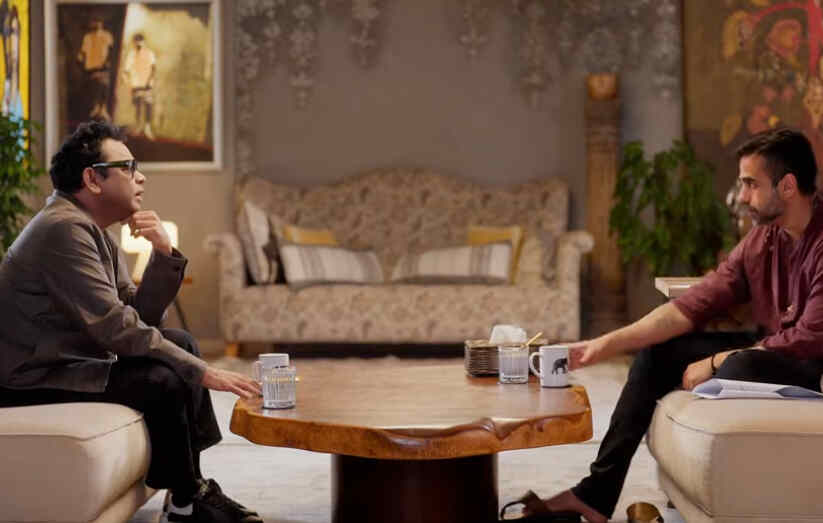
Read the full transcript of Indian music composer and philanthropist A.R. Rahman’s interview on People by WTF Podcast with host Nikhil Kamath, episode titled “The Genius Who Took Indian Music Global”, November 20, 2025.
Growing Up in South India
NIKHIL KAMATH: When you speak Tamil, I can understand it because I’m also a South Indian. And I have grown up all my life in Bangalore.
A.R. RAHMAN: Oh.
NIKHIL KAMATH: Kannadiga. Half Kannadiga, half Konkani. Dad is from this town near Udupi called Udiawara. Mom is from Mysore. Have you been to Bangalore much?
A.R. RAHMAN: Yeah, yeah. 80s. Quite a lot. Used to work for Kannada industry a little bit.
NIKHIL KAMATH: So how’s the Kannada industry?
A.R. RAHMAN: Kannada industry is now rocking, right? There was a dormant 20 years. Nothing happened after the greats. Now they just leaped. I met, I sometimes wish all them. I call them, zoom and wish they’re doing much better. The Kantara music composer and everybody.
Early Life in Chennai
NIKHIL KAMATH: So you grew up in Chennai. Most of your life has been in Chennai?
A.R. RAHMAN: Most of the life in Chennai, yeah. I was born in Chennai. My father, yes, he used to work in the studios. And then we are in the belly of the beast near Kodambakkam. Our house and all the studios used to exist.
NIKHIL KAMATH: So maybe we start by making you a little bit awkward and getting you to speak about your life so far. Everybody knows you and I’m a fan. I’ve heard so many of your songs from different eras and I love them. I wish I could sing better and then I would have, but I can’t.
My mother used to be a music teacher, classical Carnatic music. And they tried to teach us everything. So I went to classes for guitar, piano, flute, mandolin, everything. But I discovered after much effort that I have zero talents.
A.R. RAHMAN: Oh. It’s not about talent. It’s about leaning in. Never give up.
Childhood Trauma and Resilience
NIKHIL KAMATH: Tell us a bit about your childhood. It feels like you’re a, from what I’ve heard, you were very introverted.
A.R. RAHMAN: Yeah.
NIKHIL KAMATH: And now you’re more open to speaking because as you have said, your ability to articulate has gone up significantly. What changed?
A.R. RAHMAN: I think when I was growing up, I went through all this. The death of my father, my grandmother. And then conflicts where I was just seeing trauma every day. My mother was a single, very, very confident lady. She took all the pain.
NIKHIL KAMATH: At what age did dad pass away?
A.R. RAHMAN: Nine. And she had to protect us from, and she was so strong that withstanding all the kind of humiliations, she single-handedly brought us up. Right. Encouraging me to go into music. She decided for me that I should be in music. So I’ve told that many times.
And so in a way I felt like I should be clean because I had three sisters. And me behaving in a certain way would also reflect what’s coming back. And I was, my whole childhood was with 40 year old and 50 year old, 60 year old in the studio playing music. And I missed all the fun with friends and all the stuff at school. No college.
NIKHIL KAMATH: But what year did you stop going to school?
A.R. RAHMAN: 15, 16.
NIKHIL KAMATH: Same, actually. Me also.
A.R. RAHMAN: Me also. School is not just about education. It’s about understanding humanity. It’s about seeing each other and getting to know the stories and learning things from other kids. Their families are different. That I missed definitely.
But then I got the, I was with intelligent people in the studio, great musicians in the studio, which also inspired me to reach up to more musicality and play more stuff.
Father’s Legacy
NIKHIL KAMATH: And your dad was a successful…
A.R. RAHMAN: He was. So the story is like dad lived in his, in his house, father, mother’s house. And both mom and dad, their clothes were thrown onto the streets. Said get out of this house from his family members. So he had to go search for a house. So he took a rented house.
And then to get us a house, he worked day and night. Worked in three different places at the same time. So that one story is that his health went haywire because he, anyway, there’s a dark side of my childhood memory. That’s why I never speak about my dad.
NIKHIL KAMATH: You have vivid memories of this age nine.
A.R. RAHMAN: Yeah, yeah. I think after that to forget what the trauma took ages, right?
NIKHIL KAMATH: And has that memory changed now?
A.R. RAHMAN: It’s changed because I think he’s such an inspiration. Because every musician came from his troupe. Whether it’s a guitarist, a violin player. Because he had given so much work to the musicians. Because he was working different places.
And everybody used to adore him even if they’re not talented. You sit in the last row, take some money and go. Be good for your family, good for education. Even people like world class players like L. Subramaniam had kind words to say. He shared with me like a couple of years back.
So even now, even today, that probably set the standard for me to where I should head as a human being, as a successor to him. And now my nephew Jeevi Prakash is shining. Won the national award twice. He’s a hero. And my son, my daughters.
NIKHIL KAMATH: And how did that change you? Like my dad passed away recently. Last year.
A.R. RAHMAN: Oh, sorry.
NIKHIL KAMATH: How does it affect you? First and how does it change you later?
A.R. RAHMAN: It affects you because that’s the only thing you have, right?
Your mother is the angel who was a safe place to go. The lap is the safe place to sleep. And that’s where the respect for my mother or my father is still there. Same thing.
Mother’s Entrepreneurial Spirit
NIKHIL KAMATH: Did the position of your mother in your head change after your father’s demise?
A.R. RAHMAN: Yeah, my mother became like an entrepreneur. She took the equipments and started renting it out. Everybody suggested that she should sell all the stuff, put it in the bank, get the interest. And she said, “No, no, my son will play, I’ll keep my husband’s stuff.”
And she expanded it. She bought more keyboards for rental. Used to rent it out for light music for studios. So that was the income for like six, seven years. And then that stopped because everybody started buying the equipments. That’s when she said, “Now it’s not going to happen. You need to go and play. The acumen rental has gone down.”
Playing for Other Composers
NIKHIL KAMATH: And you started writing jingles?
A.R. RAHMAN: No, I started playing keyboards for other composers. Yeah, like Telugu composers, Kannada composers, T. Rajender, the MSV, Raj Koti, like multiple composers. Like every day there are two songs. Every day they’ll be like, I go at 9, I come back at 10.
NIKHIL KAMATH: And do they tell you what to play or do you have to come up with…
A.R. RAHMAN: Yeah, they have to. They’ll give the notes. But after a while I think when I bought my computer systems, which is around ’86, they gave me the freedom. They’ll just give me a melody and say, “You arrange it.”
So I’d arrange all this stuff for them so that I got used to arrangement. It was easier for me to arrange. Then they’ll say, “Okay, just do a fight music.” So I’ll have to create a fight music with rhythm and large tutti bangs and stuff like that.
NIKHIL KAMATH: If you could pick one instrument and never play another again, which one would it be?
A.R. RAHMAN: Piano, maybe.
NIKHIL KAMATH: Yeah, it’s hard to travel with, right? It is like a guitar you can just carry.
A.R. RAHMAN: No, but keyboard is like you can have a smaller one, right? The electronic one. But having a piano I could only afford after probably six, seven years of my learning. Then I bought a Yamaha and then now I have Steinway and all this stuff.
NIKHIL KAMATH: So for a few years you played with other composers?
A.R. RAHMAN: Almost 10 years.
NIKHIL KAMATH: 10 years. And then they started first telling you what you should play and then allowing you your own compositions or arrangement.
A.R. RAHMAN: Yeah.
NIKHIL KAMATH: And then…
A.R. RAHMAN: And then slowly went into jingles, which everything is mine, right?
The Jingles Era
NIKHIL KAMATH: My jingles. You mean ads, right?
A.R. RAHMAN: Ads, yeah.
NIKHIL KAMATH: Like in Tamil.
A.R. RAHMAN: No, I think jingles, because most of the agencies are international agencies, right? O&M, HTA, they would do the scratches here and they will throw that out and do it in Mumbai. And then after a time, I think they’ve started agreeing. They started putting my stuff. Initially it was scratches.
NIKHIL KAMATH: What is a scratch?
A.R. RAHMAN: Scratch is a tune where they just give it to the client to say if it’s an ointment or a paint. And they say, “Okay, yeah, this will work. Now go to a bigger jingle composer and get this.” So then that became like, “Okay, now this itself is good enough and we can use it.” So that’s the process.
The Turning Point: Building a Home Studio
NIKHIL KAMATH: When did it all change? When did it, when was that?
A.R. RAHMAN: ’91. Yeah, I know. Actually magic happened when I built my studio. It was ’89. Panchatan Studio, which I have, is when I felt like empowered. Like I had something which nobody had.
NIKHIL KAMATH: Which was which?
A.R. RAHMAN: My home studio.
NIKHIL KAMATH: Why did that change so much? Many people probably had access to a studio, right?
A.R. RAHMAN: Those days, studios means like the big halls where 90 people can play together. The concept of home studio never came. So when I built my home studio is when I realized, like, nobody will judge me whether I do good music or bad music. I can judge it myself and play the final product.
Because in studios, whatever you play, 50 other people are watching you. If you’re bringing equipment, they’re all coming. “Oh, what is the new stuff? How many people are going to lose jobs?” So I was the gizmo guy, right? I used to buy the computer film.
NIKHIL KAMATH: So if I want to become a musician in my life or if people watching want to become a musician, what is that thing they have to do now? Like you got a studio, is there some equivalent for today?
A.R. RAHMAN: You just have to practice. You just have an intention to learn. You can learn anywhere.
NIKHIL KAMATH: Now what if I’m already learned? Like not me because I have no knowledge, but somebody who is a learned, trained musician.
A.R. RAHMAN: You come to Chennai, come to my conservatory called KM Music Conservatory, can join there, right?
NIKHIL KAMATH: And there you will teach me how to compose music.
A.R. RAHMAN: Everything, any course, like piano, voice and…
The Roja Breakthrough
NIKHIL KAMATH: Yeah, okay, so you started a studio at home. And then?
A.R. RAHMAN: And then I started experimenting my own music which nobody heard. When Mani Ratnam came and I played them all and he was quietly listening to all the stuff. That listening session became the DNA for Roja.
NIKHIL KAMATH: And then Roja changed everything immediately.
A.R. RAHMAN: Yeah. Overnight.
NIKHIL KAMATH: Yeah. What year was this?
A.R. RAHMAN: ’91, I think. ’91, right.
NIKHIL KAMATH: So Roja released and next day people started treating you differently all together.
A.R. RAHMAN: Yeah. Because he’s one of the top directors which every actor, every composer wanted to work with him is one of the top notch. Still, I feel like everybody is drooling over to work with Mani Ratnam in a movie. Whether it’s the successor, even the process is so respectful.
NIKHIL KAMATH: The same is true for you, you know that?
A.R. RAHMAN: Yeah, absolutely. Oh me? Okay.
NIKHIL KAMATH: Yeah. And then everything changed. People around you treated you changed. How did you change?
The Resistance to Film Industry Consumption
A.R. RAHMAN: How did I change? I was like, okay, this will be the last movie. I don’t want this. I don’t want movies. Because I’ve been in movies and it’s so boring. But the Mani Ratnam movies are completely different. And he kind of listened to me like this is what I want to do or I don’t want to do movies.
Then I told him, I said, I’m very satisfied working with you. I don’t want to work with other people. He said, no, no, no, no, you should work with everyone. So I said, I’m very happy working just with you. And I’ll do jingles or I do private albums. I said, no, you should work with everyone.
And so my first 10 years was like, okay, enough. After this movie, I’ll leave everything. I’ll do my own stuff. Even movie was my own stuff. But I have something non-film.
NIKHIL KAMATH: Why do you think that was?
A.R. RAHMAN: I don’t know why I had this thing of leaving everything.
NIKHIL KAMATH: Is that because fear of disappointment?
A.R. RAHMAN: No, no. I was resisting. I was resisting the way the movie industry was consuming. Because my father was consumed right after he passed away. Only a couple of people were there and nobody else showed up. So that’s when I like people have their own lives. Then you realize they all have their own lives.
NIKHIL KAMATH: You were thinking, this high will go away.
A.R. RAHMAN: Not the high. No, I said like, it is a thankless any industry. It’s not a community. We just meet in studios. Very rarely do musicians meet. Right. So after he passed away, it is not a government job. There’s no pension, nothing. Right. Musician job.
I said, if they are like that, we also have to be careful in not giving every part of us to the industry. We should have soul left with us so that I can do other things in art.
NIKHIL KAMATH: Do you still feel that way about movies?
The Importance of Artistic Evolution
A.R. RAHMAN: I always. I always. That’s one of the reasons why when other composers were doing 30 movies a year, I felt I would do two. I started with two and then three, and then four, then became 12.
Then I escaped to resist people coming to me. I went to England and sat with Andrew Lloyd Webber doing Bombay Dreams. The reason is to resist and grow. Because I’m giving away all the stuff I learned, but I don’t have anything new to offer. I’ll be thrown away.
So it’s important to evolve artistically as a musician, composer is when I think the foundation of what I’m doing now is probably my time in London, my time in Hollywood, not doing music, studying, going for short courses, unconnected with music, but to understand art in a very different way.
NIKHIL KAMATH: That’s crazy that you’re still learning to the day.
A.R. RAHMAN: Learning in the way because you’re forced to learn. You buy a new rhythm machine. You have to learn how to where to project load. Most of them are common, but even there, many stuff is changing right now. There’s granular synthesis, there’s algorithmic composition. There is now AI-assisted editing arrangements which all the masters have done, like Bernstein and Gershwin and John Williams.
And it’s fascinating to see the older Tchaikovsky or Mozart. And there’s always things to learn, not to copy, but to understand the. To speed up your orchestration. And even studying songs about poetry, about metaphoricness, about not straight words, but where it’s hitting you.
Imposter Complex and Lifestyle Choices
NIKHIL KAMATH: Did you feel any imposter complex in this period? There you thought you were undeserving of what you got.
A.R. RAHMAN: And hence that’s why I surrender.
NIKHIL KAMATH: Does this also translate into personal life where you might spend a lot less money than you can afford to?
A.R. RAHMAN: Like what?
NIKHIL KAMATH: Like, say, as a very wealthy man, you can afford to live X lifestyle, but you live 10% of that or 20% of that.
A.R. RAHMAN: My son is listening there. Yeah, I think, I think because it’s not that I’m not. I feel like if I can sustain like my mother, God bless her, she used to give on Friday, she used to give food. So doing one thing and for certain number of people, she used to feed them. We’re still doing that. She didn’t feed on every day.
And on a bad situation, you cut all the stuff. We’re able to do that by the grace of God, even now that’s consistently doing something good for a longer time is better than doing everything at the one time and then not having money. So I believe that consistency is very important.
Your lifestyle, even whether you have money or not, can be the same. Because when I was doing Roja, I didn’t have money for even putting petrol because I was just doing that one movie because I concentrate so much. There are days where I didn’t have my petrol was. I used to drive that time was zero.
And I felt like it’s a good feeling because you’re sacrificing all that stuff for the believing in what you’re doing. Right. So it’s important that even my children realize like to be consistently in one lifestyle where I can travel, you can eat anywhere you want, but you don’t want to show the whole world like what you are and then it’s a fake pompousness. Right.
And anyway, in Chennai, I think it’s a city which makes you be simple. It’s not unlike some other places where they don’t hug you and see what you’re wearing.
Regional Differences in Lifestyle
NIKHIL KAMATH: I would ask myself when I like Delhi and Hyderabad are on one side and Bangalore and Chennai are on the other side of where projections sit. So I would think why is it appealing to Bangalore and Chennai to live under their means? And why is the opposite, the whole showing, living in the moment, more appealing.
A.R. RAHMAN: To the nothing wrong in. I think it’s the way I think is consistency over years rather than, you know, you can buy the best car, you can buy a Bugatti, you can be in the best flat. But then ultimately where do you get the happiness in the studio?
So if you look at my studio, I have the most expensive piano, the most expensive mixer. But that’s again helping me to serve better. Right. So it’s a little old school, but I believe it.
NIKHIL KAMATH: When I thought about this, I was thinking about things like, okay, maybe North India saw so much war, so many people invaded. People did not live for as long, so they lived more in the moment. People in the south have largely been secure for a long period of time.
A.R. RAHMAN: Nobody’s secure relatively. They have other tortures in life.
NIKHIL KAMATH: Yeah.
A.R. RAHMAN: It is a double-edged sword when we go out, it’s important to present India in the best possible way because the whole world think India is in poverty and this and that. I feel like India, the certain people are not in poverty. We probably have the richest Indians here.
NIKHIL KAMATH: Yeah.
A.R. RAHMAN: And it’s important to represent the country with dignity, to dress up, to show that we are culture people. We have a great history in culture and style and everything. It’s very, very important. You don’t want to show them they’re very simple. Then when people are judging you, as an Indian I feel like I want to be in the best representative, the best car outside.
When I go and I’m in LA, I have Bentley, I lease a Bentley. So I mean, at least I had that time. At least.
NIKHIL KAMATH: So why a Bentley? Fun.
A.R. RAHMAN: Because it’s easy, it’s cheaper, you have to pay 110% duty here, there you just lease and.
NIKHIL KAMATH: Right.
A.R. RAHMAN: But is there a reason you can get any car?
NIKHIL KAMATH: Like as an artist, the style aesthetic of Bentley appeals more.
A.R. RAHMAN: Not like that. Because I never believed in that. And because it was so cheap there to rent any car, I said I had that moment of two years driving my kids around, hey, come, let’s go. And I have still videos of my son screaming when I’m going fast, sitting at the back.
NIKHIL KAMATH: And you started driving when you were really early and still enjoy driving? Do you still drive?
A.R. RAHMAN: I do drive. Started driving again. I got my Mahindra electric car and there I have.
NIKHIL KAMATH: Why Mahindra electric car?
A.R. RAHMAN: I don’t know. I just love it. For the first time I felt like it’s world-class quality and I also worked on it. I was also constantly suggesting them do this to them. The sound system, man, we have some of the best. My music sounds the best in that. Yeah.
NIKHIL KAMATH: So you’re part of the design.
A.R. RAHMAN: I’m not getting paid for this. Okay.
NIKHIL KAMATH: So it was like a hobby project.
A.R. RAHMAN: It was something very different. I think Hans Zimmer had done for BMW and Mr. Velu, who’s the CEO like he came in and we had fun.
The Roja Revolution
NIKHIL KAMATH: And beyond Roja and the initial success, what happened after that? Also, were you in some way on the cusp of a change in trend of what kind of music was working in India in the 90s? Did you catch a change in trend or did you create a change in trend?
A.R. RAHMAN: The trend happened because of Roja. There was a denial that, oh, this won’t last. And I think there was a denial constantly.
NIKHIL KAMATH: What was the incumbent trend and what was the change in trend?
A.R. RAHMAN: There was this traditional kind of music which is beautiful. Like the Hindi composers were all there and there’s a beauty in it still. But because I’m not made of that, my sensibility was different because I was in a band. I liked jazz, I liked rock, I liked Qawwali. I like Carnatic, I like Hindustani.
So my aspiration was very expansive. I didn’t want to stick to that dholak and mandolin kind of this thing. I wanted to because I could do it because I was now experienced in arranging for other people and also seeing the results and I had my own studio and I could get to the results faster than imagining it without people judging me.
NIKHIL KAMATH: So you changed that trend into Roja kind of music. And how would you articulate that? What was Roja kind of music?
A.R. RAHMAN: Roja was very. So my intention was when I met Mani Ratnam Ji, I said when we are listening to Pink Floyd, Queen, right? John Williams, Vangelis, Beatles, Michael Jackson, they don’t listen to us, right? So what’s the reason? Language, production and vibe feel recording multiple things, right?
So I addressed all this stuff. I was studying all this stuff. I addressed all this stuff. I said Tamil song, which we do here, should go. And my. You look at my initial interviews, it says each Tamil song I do should go around the world, right? And it was planned. I worked for it. That’s why I did less work.
And I had to. A lot of people thought, okay, this guy is like very adamant and snobbish. Not. My human limitations are. I need time to heal, I need a time to listen to it. I need time to change. I need to evolve a song into what? It’s not like I could do a song three songs in seven hours.
So because I knew all the formulas, that’s not what I wanted to do, right? I wanted to take it inch by inch to what I felt would be the future of my sound or the world.
NIKHIL KAMATH: Indian classical music never had its day under the sun per se. Like at some point, rock music was cool. At some point, jazz was cool. At some point, I’m saying across the world in India, obviously Bollywood is very, very popular.
The Importance of Classical Music Education
A.R. RAHMAN: We need to position classical music in a very higher way. I think right now it’s like, “I give this much money, I can get a teacher.” No, getting a good teacher, getting the… There’s a heart to heart transfer of knowledge, mind to mind transfer. No spirit. Not just the knowledge of ragas, but the spirit of giving from a guru is only India sees that. It comes in the saints and the Sufis.
It’s not just knowledge, it’s giving the prayer. The soul actually wishes something. It manifests, right? The product has to be truthful. The product has to be sincere. When it’s sincere, they grab it. Because if you look at all the voice talent shows, they pick the best compositions usually because it’s tough to sing and it shows the prowess of the singer. That’s very important.
So even classical music, the way it’s performed needs to change. It needs to be more immersive and that’s what we’re doing. We have a band called Jala and we’re also floating an award called the Bharat Master Award to find the next Zakir Hussain, next Ravi Shankar. Of course, Lord Ganesh Krishnan is there already for India. We need to find them and then nail them. That these are the masters of India.
Like recently I did a song called “Muthamarai” in Tag Life. It’s a very complicated song. They embraced it so much and it became a talk of… For three months they were talking about the song because it has multiple ragas mixing and going in. And if we put our energy in mastery in how we deliver the songs to people, definitely they’ll like it.
Should not be the engine. “Oh, I’m giving you classical music. Listen to it. It’s good for you.” No, give something good and make it masterful with the whole team. Like the dance and creativity and everything. They will take it. Definitely. “Hey Rama” is a classical song. The narrative is how you make them feel. It’s the most important thing. Like this decor. It feels very inviting. It feels very… It’s welcoming. It feels like somebody’s…
NIKHIL KAMATH: It feels lived in. Right?
A.R. RAHMAN: Yeah, that’s very important.
Indian Art and Architecture
NIKHIL KAMATH: Yeah. It’s all from 1800s old. Like those pillars are temple pillars. That door is from a temple chariot. They’re all from South Indian. I think you will also find it familiar because it’s largely South Indian stuff.
A.R. RAHMAN: Yeah, I love South Indian stuff.
NIKHIL KAMATH: Yeah.
A.R. RAHMAN: Same with the Peace Garden. If you come to Peace Garden, if you come to Chennai, I’ll take you to… Which is a combination of South Indian temple architecture, Sufi architecture, mix of all this stuff.
NIKHIL KAMATH: Yeah. But Indian art seems to be making a comeback.
A.R. RAHMAN: Not enough, I think. No, I think art should be taught. Artistic view should be taught to the kids from kindergarten. The way they keep the houses. If every house in the street is kept well clean, the street is going to look beautiful.
When I went to Italy, that’s what I found. Or if you go to Jaipur or Kerala, they have a sense of style which and neatness. And I’m not saying I’m not been to many states, but I feel like that’s very important to inject that in the minds of younger people who will change the look of a country.
NIKHIL KAMATH: Western cities are very homogenous. Like every building will have the same color.
A.R. RAHMAN: That is us. But if you go to places like even Italy, Greece is different, Spain is different, Morocco is different. They all have a character.
NIKHIL KAMATH: Don’t you feel like Indian cities have every building which is so different and the color is so different that it doesn’t look cohesive.
A.R. RAHMAN: No, it doesn’t. Anyway, let’s not talk about that. But important thing is to nurture children from kindergarten so they look at a country in a way where they’ll be the future. People will change the way it looks better like AI.
AI and Creativity
NIKHIL KAMATH: I think creativity will become more relevant in the world of AI.
A.R. RAHMAN: Absolutely. Because I think you’re empowering people with a vision who don’t know the chops. And the chops are actually AI. So the vision and the prompts actually gives you options which you see. “Oh, I like this.” And it’s a very empowering tool for younger people who don’t have the access to make a movie or make art or they know how to paint, but they have a vision.
At least it will force them to have an example to in power of what it’s creating to beat that. Right. Which is an interesting thing. Now, I think when you do music also, you’re constantly thinking the songs which are coming out are very experimental. Like recently there’s a song by Raye, R-A-Y-E, and it cleanly shows that she’s trying to beat AI. How is that? The way the construction of the song is different from what people would do, which what AI copies. Right. It’s learned from the past.
NIKHIL KAMATH: So you have to be contrarian to whatever the predictive model is.
A.R. RAHMAN: Absolutely. Yeah. It forces us to think differently. Okay, now we got that. Okay, how about this?
NIKHIL KAMATH: But can’t tomorrow, another AI just play…
A.R. RAHMAN: The role of humans have this evolutionary spirit and we will do something else. We’ll go back and do something which is completely wrong, which would be very cool.
The Rules of Music
NIKHIL KAMATH: Does music have rules?
A.R. RAHMAN: Music, I feel, I go by nostalgia. I go by the good things of tradition. And sometimes I got bored with that and I break the tradition. So it’s not one formula. It’s like how… How a narrator… So like when I’m talking to you, if I talk anything boring, you won’t look at me. I was like, “Oh, he’s already told this. I’m going to look away,” but I’m looking at you. I’m constantly evolving.
I’m saying like, “Let me tell you the stuff or let me tell you a new information which you not know.” Then you are curious about it. Music is like that, like a conversation where one is like, this tune is going like this and I need to surprise them with this one. Pull out the rhythm or change the key or change the rhythm. Right. Change the raga or come with the same lyric in a different way. So it is an experience. Right. That’s how I used to think. I’m still thinking the same way.
NIKHIL KAMATH: Do you think to be as successful as you have been, you need to catch a counter trend?
A.R. RAHMAN: What is the counter trend?
NIKHIL KAMATH: Whenever the incumbent trend, like you said about old school music with dholak and mandolin and all of that.
A.R. RAHMAN: No, I love dholaks, but not all. But that’s not the only thing. Even now when I do a qawwali track, I use dholak and tabla, I use strings.
NIKHIL KAMATH: But to be able to recognize that people are tired of that and I…
A.R. RAHMAN: I am the people. I need to see whether I like the song. And if I feel good. “This feels really good.” And they will love it. Sometimes it takes time for them to get it and they get it, and then it stays there forever.
Advice for Aspiring Musicians
NIKHIL KAMATH: And for all the aspiring musicians and songwriters and composers watching this, what do you think the next change in trend will be? That they can get on early.
A.R. RAHMAN: I think all of them are so smart now. And because the exposure, they get to see everything on reels and social media, every person is a makeup person, an actor, a cinematographer, a director. And it’s fascinating to see how the younger people are evolving.
Like, I discover so many people who are extraordinary in comedy, in direction, in effective reels. Like it’s just 30 seconds and they have to come up with stuff.
NIKHIL KAMATH: Right.
A.R. RAHMAN: And it forces them to become great directors, storytellers. And so I get inspired by them.
NIKHIL KAMATH: Yeah, but any… Any suggestions?
A.R. RAHMAN: Lean into it. Leaning into something. Not giving up. Like, you shouldn’t give up. You should go back to music and lean into it.
NIKHIL KAMATH: I’ll show you how bad I am at some point in…
A.R. RAHMAN: No, bad and good is subjective.
NIKHIL KAMATH: Right.
A.R. RAHMAN: One person’s bad, the other person’s good. Like, you know good music when you listen to it.
NIKHIL KAMATH: So I’m good at listening to music. That’s a great start.
A.R. RAHMAN: It’s a great start. The lead would just… Don’t give up. And because, you know, you dig. Like the cliche is like, first you get mud and then you get water, then you get petrol, then you get gold. So… But you have to keep digging. And the more you dig, you will forget yourself that you’ve become that. Right.
The Practice of Music
NIKHIL KAMATH: How do I look? Okay, this is very personal. I don’t know who this will help, but I can play a few chords. I don’t sing well now. I want to suddenly get better. Not suddenly, in a year. Get better. How do I do it?
A.R. RAHMAN: Let’s practice. Practice? Yeah, yeah. Don’t wait for tomorrow to practice. Practice now. Once you go, after you eat, sit for five minutes. Take your tampura.
NIKHIL KAMATH: Yeah.
A.R. RAHMAN: Sing Sa Re Ga Ma Pa Da Ni Sa. Yeah. Slowly.
NIKHIL KAMATH: I’ve heard it all my life. I don’t know why it flew.
A.R. RAHMAN: I have to tell you a secret. I’m singing from 1992. But then my singing was always to compose.
NIKHIL KAMATH: Right?
A.R. RAHMAN: Right. I was… I’ll play a chord, compose. Then I realized that when I’m composing, I don’t have to be in tune. I just need to understand what you… When that becomes a habit, your singing becomes more… Not that perfect because you’re trying to reach notes and you’re trying to, like, scribbling something while painting, sketching something.
Then when I’m on the stage is when I realized, like, I have to be in tune because people are recording. People are putting it on YouTube. Then I started… My teacher said, who passed away? So he said, “Practice your lower notes, like, go Sa Ni Da. Make it stronger, and your higher notes will be as strong as that.”
So… And now I’m learning a little bit from Majeda. And his thing is like, “Go and go louder when you go down.” And that made a lot of difference in my pitch. When I’m singing a note longer, I could feel that I’m in pitch. And when I look at some of the reels, I was like, “Yeah, okay, that’s good. That’s good.” Twenty percent improvement of what I was doing. Right. So there’s no time, no age. Right. We are constantly evolving in every aspect of life.
NIKHIL KAMATH: Maybe I’ll try and get a teacher.
A.R. RAHMAN: That’s a great idea.
NIKHIL KAMATH: Right.
A.R. RAHMAN: And Bombay is filled with teachers.
NIKHIL KAMATH: Yeah.
A.R. RAHMAN: Yeah.
Talent vs. Practice
NIKHIL KAMATH: Do you think there’s such a thing as talent in music?
A.R. RAHMAN: There is. Some people understand something better than other people because it comes the way the mind works. It doesn’t mean that other people can’t reach there. Right.
NIKHIL KAMATH: I have this theory about passion.
A.R. RAHMAN: Okay.
NIKHIL KAMATH: I feel like all people are born the same and we all attempt different things. If I was 5 years old and I played cricket, and I played cricket better than the 20 classmates of mine, I would organically become passionate at cricket because I’m doing it better than the 20 kids around me. Do you think the same is true for music?
A.R. RAHMAN: No. When I was young, I felt I was very bad at music.
NIKHIL KAMATH: Yeah.
A.R. RAHMAN: I had star wars, like Mandolin Srinivas was a genius. He could play. He was younger than me. He was playing Kirtana. I said, “I’m not as good as that.” And I was seeing my teacher’s son playing piano who was younger than me. But I was forced to work anyway so my needed talent was less because I play some sound effect or some simple melodies.
And I met a teacher called Jacob John, who’s my father’s friend. He called me and said, “You play very well.” I said, “No, I don’t play very well.” And he had this amazing technique. He would intentionally play with mistakes and he’d let you play, “See, you’re playing better than me.” So he had this incredible technique of trick to make you feel better. And I hung out with him like three, four years is one of some of the best times I had.
Staying Young
NIKHIL KAMATH: I must also say you look incredibly young for your age. Like skin is glowing and all that.
A.R. RAHMAN: My software is very, very latest. But hardware is becoming old.
NIKHIL KAMATH: Any secrets?
A.R. RAHMAN: Secrets? Just don’t think negative stuff. Don’t worry about anything. Nobody cares. We all going to die one day.
NIKHIL KAMATH: So all this happened.
A.R. RAHMAN: Okay, yeah.
The Global Recognition Era
NIKHIL KAMATH: And then I have like notes about different years of your life and what happened and I’m trying to go into today. You did Andrew Lloyd Webber, Dilse happened, Vande Mataram, India at 50, Maa Tujhe Salaam. All of that happened. We come to 2006. What’s happening around this era?
You started in the 90s because of the studio. When you started a studio, you got this big break in Roja. Your life changed overnight. People around you started treating you like something else. You got a little imposter complex and insecure about putting all your eggs in one basket because you had seen it happen at home at an early age.
You diversified, you continued to do many things. You went to Andrew Lloyd Webber’s thing. You did things outside of India, in India. Tell us where your mind is at 2006, 7, 8, around this era, global slowdown era.
A.R. RAHMAN: So 2006, I was appointed as the Stop TB Ambassador by UN. So I traveled to Singapore, met AIDS, TB patients, and a completely different role. I met Kofi Annan in the UN, all that stuff. And then that’s when my foundation idea came by.
NIKHIL KAMATH: And by this time you were a big deal because you’re meeting them.
A.R. RAHMAN: I don’t know.
NIKHIL KAMATH: 100%.
The Birth of KM Conservatory
A.R. RAHMAN: Yeah, I don’t. So I meet them, I come back with a vision of why don’t we have a school like all these musicians of my father’s age now, and what if they pass and we don’t have string players or trumpet players. So the idea of starting the school came in 2008 where I called one of my associates and said, “Hey, we have to start a school. It’s a free school. I’m going to…”
He said, “No, no, no, no free school. Nobody’s going to respect. You have to get money and I’ll be there and I’ll take care of it.” So I didn’t know anything. So I called him and he took care of it. And then there’s so many conflicts, so many conflicts happening. It evolved and then finally we bought a bigger place.
Mr. Ambani came and kindly inaugurated the place in 2013. My mother was there and we started the KM Conservatory where it is now. By then we had some of the young, best piano players in the world, young ones. And then it started evolving and then Oscars happened. All this stuff. In 2008, 2009, I was in a band with Mick Jagger and how big is that?
The Oscar Experience
NIKHIL KAMATH: I’ve always heard of Oscars as being this crazy thing that… What is it?
A.R. RAHMAN: Actually, I think when you see from outside, it’s much more fascinating than being inside.
NIKHIL KAMATH: Yeah.
A.R. RAHMAN: Inside it’s just, it’s like it’s happening. It’s like once you get, once you pass one and everything’s the same, same, same. Photographs are coming. “Hey, AR, look here.” So that’s interesting.
First when I got the Critics Award, nobody called me then. Then was the Golden Globe. “Hey, that’s you. Come, let’s take a photograph.” Three people call. Then the next one is Oscar, 100 people calling. So I could see that whole evolution of how famous that movie and the music and everything was becoming.
NIKHIL KAMATH: And how does it make you feel personally? Now I’m guessing wherever you are, people are probably surrounding you and asking you for this and that and pictures and…
A.R. RAHMAN: No, actually I have a lot of private moments in the studio.
NIKHIL KAMATH: No, when you’re at home. Yes, but if you step out.
A.R. RAHMAN: I step out very rarely.
NIKHIL KAMATH: But whenever you do…
A.R. RAHMAN: I’m prepared for it. When I’m very uncomfortable is when you take a long 16-hour flight and during a transit, when people come in and they say, “I’m tired.” “No, no, but we have to go. Can you take a photograph?” Anyway, it’s part of the game.
NIKHIL KAMATH: Is there an on-off button?
A.R. RAHMAN: For what?
NIKHIL KAMATH: For when some fan walks up to you and you’re tired, you’re in transit.
A.R. RAHMAN: Yeah, it is, but rarely. It’s not every day. So now I have the mask.
NIKHIL KAMATH: They recognize you with the mask?
A.R. RAHMAN: No, no, not everyone. Because I don’t go with securities. I just walk alone.
NIKHIL KAMATH: No security anywhere?
A.R. RAHMAN: Only when I’m doing shows.
NIKHIL KAMATH: Right?
A.R. RAHMAN: Because when you don’t go with security, people don’t take you seriously. Only when a group of six people come, “Oh, somebody is important. Oh, that should be him.”
The Price of Fame
NIKHIL KAMATH: So when you go to dinner in Chennai, for example, you have to…
A.R. RAHMAN: That is the irony of my life.
NIKHIL KAMATH: You can’t.
A.R. RAHMAN: That actually took a toll on my family life. When nobody allows you to eat even in a marriage, when you go there, when you’re eating, people say, “Can I take a photograph?” “I’m eating.” “No, but we are going to go. We have to go.”
So they don’t understand that person who’s eating is a human being. He’s not being bought by you. But then you understand how important you are in their life. And they don’t want to miss the chance from their perspective. So I’d never eat in marriages. I just go wish them. I said they won’t allow.
Whenever I worked with rock stars abroad, they just straight on the face. And I don’t do that. “Sorry.” Whether it’s Hollywood actor or I’ve been with a couple of them and they’re straight on the face. That’s why people don’t come, because most of them are like that. They just snap and say, “No, I don’t do that,” straight away. Indian actors are more kind.
NIKHIL KAMATH: Why is that?
A.R. RAHMAN: I think because we are a different race.
Friendships and Connections
NIKHIL KAMATH: We did a call with your sister and she gave us some points.
A.R. RAHMAN: Which one? Reihana?
NIKHIL KAMATH: Yeah, I think so.
A.R. RAHMAN: Okay.
NIKHIL KAMATH: You didn’t have many friends growing up.
A.R. RAHMAN: She said? Yes, I had two friends actually. One was an electronic geek who used to love making amplifiers. Still met him. The other one was also electronic geek. I was fascinated with electronics when I was young.
NIKHIL KAMATH: Is it the same even now? Is it tough to be friends for somebody in your position?
A.R. RAHMAN: There’s no time outside of time. Just even to spend time with family, I have to make sure that I now pull them on to a dinner or something where not everybody is free. They all have their own lives now, right?
NIKHIL KAMATH: Do you have friends?
A.R. RAHMAN: All the directors are my friends.
NIKHIL KAMATH: Work people don’t count.
A.R. RAHMAN: I don’t always treat like work. I treat like when I work with Aanand L Rai or Mani Ratnam…
NIKHIL KAMATH: People ask me this question and I say, “Who are your friends?” I’ll say lawyer, CA, all of that. It doesn’t add up. It doesn’t count.
A.R. RAHMAN: Then I should have a life where I go to a club. No, I go to a gym or something.
NIKHIL KAMATH: Nothing. No hobbies, sport, gym?
A.R. RAHMAN: No, nothing. No, I love what I’m doing. Because it’s not just music now. Now it’s metahumans and AI and virtual reality. And you know, I have younger people who are joining and doing amazing work. So they are my friends. I just eat with them, hang out with them. Each team is different.
And I sometimes DM people. If there’s a good person with a farm, interesting plantation thing, I DM them, say, “I would like to meet you.” Then it’s like random people. It’s not just music. It is illustrators and cosplay artists.
NIKHIL KAMATH: Anyone incredible you have run across by DMing them? By DM, I’m assuming social media.
A.R. RAHMAN: The biggest surprise I got was Spike Lee DMing me. “Hey, sir, how are you?”
NIKHIL KAMATH: Really?
A.R. RAHMAN: Yeah. I was doing Covert.
NIKHIL KAMATH: On what platform?
A.R. RAHMAN: On Instagram.
NIKHIL KAMATH: You’re active like that. You use it yourself?
A.R. RAHMAN: Yeah, yeah.
NIKHIL KAMATH: Can I message you?
A.R. RAHMAN: Of course.
NIKHIL KAMATH: Yeah.
A.R. RAHMAN: But I don’t pick everything. I see sometimes people, I see some blue, “Oh, blue tick.”
NIKHIL KAMATH: What would be interesting for me to send you on Instagram that will make you be like, “Thanks, Nikhil, for sending me”?
A.R. RAHMAN: “I have this investor who’s got $1 billion to invest in your company.” I’ll immediately answer. Yeah. And then you went…
Meeting the AI Pioneers
NIKHIL KAMATH: You went to the US and met a bunch of AI people, right? Yeah, some of them are my friends.
A.R. RAHMAN: Okay.
NIKHIL KAMATH: And they mentioned it. You went to Perplexity. You went to… Who was the most interesting of them all?
A.R. RAHMAN: No, actually it’s very brief. Sriram and Aarti came to my house and we hung out there and I met Aravind Srinivas of Perplexity.
NIKHIL KAMATH: What do you make of him? He’s also from Chennai. What did you make of him?
A.R. RAHMAN: Yeah, yeah, he’s very good. He’s my son’s friend more than me. Yeah, yeah. They hang out. And Sam Altman…
NIKHIL KAMATH: What do you make of…
A.R. RAHMAN: Strangely, I was the only person I followed on Twitter for a while when ChatGPT came in and he was looking at the sacred mountain. He was fascinated. I think that whatever help you guys need in technology, right?
But I think there’s not just Sadhguru. It’s about fashion, merchandise, music, wisdom, entertainment. Quite a lot, big package and pretty exhausting if we don’t have a big team. So that’s one of the reasons why we are waiting for the big leap too. We’re just preparing all the groundwork on that one.
AI and the Future of Work
NIKHIL KAMATH: When you hang out with those AI guys, I’ve ended up spending a reasonable amount of time with all of them. In fact, I have to go…
A.R. RAHMAN: My first comment with any AI person is, “Don’t make people lose jobs. Empower people to remove the curses of generational curses,” which comes to poverty, misinformation, and lack of tools to create stuff, to tell stories. Right?
I think this is from the beginning, I was like a broken record just saying this because you don’t…
NIKHIL KAMATH: How is that possible?
A.R. RAHMAN: That’s… If you buy a gun, you’ve set rules, right? You don’t give it to everyone because they want to shoot everybody. They’re going to kill people. It’s not free to use. It has restrictions. Now you’re not shooting people, but you can pull the carpet off, make them jobless, which is like making families go into poverty.
So it is the rules. Humans have to set the rules. You have traffic rules, you have immigration rules.
NIKHIL KAMATH: While it might kill jobs in the short term, one can argue that productivity in a society will go up in the long term.
A.R. RAHMAN: You have to shape it up. I’m saying you can’t give a tool which is very destructive in making a family go into debt. If somebody just learned something and now everything can be done with AI, he’s going to be helpless because he’s learned that in college for four years. He spent all his life learning something and AI can do it in two seconds.
So we need to find an alternate way before you jump and give those tools to people.
NIKHIL KAMATH: It’ll be tough, though.
A.R. RAHMAN: No, because Australia now has said no person can learn, use their data to learn stuff so that to create their identity.
NIKHIL KAMATH: But the new AI, they’re learning of…
A.R. RAHMAN: Them. They let it do stuff which humans cannot, rather than doing things which humans can do better. That’s what I’m saying. So that’s why I think art plays a very big tool. You need to make musical theater, symphonies, and all the stuff which can entertain people and they can be a part of that larger system, economic system.
The Challenge of AI Regulation
NIKHIL KAMATH: The problem with regulation around AI, in my opinion, is the incumbents will use it to not allow new people to come into AI. If there is a young kid in Bangalore trying to build an AI wrapper, albeit by virtue of regulation, he will be regulated out of the park.
A.R. RAHMAN: Not that kind of regulation. Not in entertainment. I’m saying in finding a way that all the people running things, entrepreneurs or the chiefs, they should be careful in finding… Because this is history is going to talk about them in future.
How they made something which is a monster as a blessing. It could become a monster. It’s a blessing and a curse.
AI and the Future of Music
NIKHIL KAMATH: I’m actually going back to the U.S. I’ve been there a lot this year. I’ve been working, interning with these AI companies, trying to learn what is coming up next, what can be done. I’m going back.
A.R. RAHMAN: The reason is Shaker Mountain has also set a pattern where we use the best of AI and we use the best of humans. And there’ll be so many jobs, so much of human contribution to something like this so that it becomes an industry by itself.
NIKHIL KAMATH: AI in music will hurt musicians, right?
A.R. RAHMAN: It’ll hurt. But then can AI go and sing with a guitar in a house or in a concert? Or can it teach in the human way, which a teacher has been teaching with the spirit, passing on the spirit of music to a student? There are so many things which comes. Human experience is the best word, I would say, which it can’t do. Anything on TV could be generated now.
So I think that’s why live concerts, live dance, live musical theater, symphonies will be respected even more. The value of that is going to go.
NIKHIL KAMATH: So in a way you’re saying build more live experiences businesses for young people who want to start a business.
A.R. RAHMAN: Because we’re all now locked in something called the flats, imprisoned in those little boxes we can’t even get out. So live actually gives, goes back to that community feeling where you enjoy something which the other person share the experience, the joy.
And that is also being reinvented now. Live experiences now, the way visuals and everything is time for single with augmented musical gadgets, visual gadgets. So the experience is not as like how we watched 10 years back. It’s much more better now.
The Creative Process
NIKHIL KAMATH: When you work with people and you try and figure out what music should be put out, I’m guessing very often you know so much more about music than these people.
A.R. RAHMAN: I don’t know anything. I go like a blank slate.
NIKHIL KAMATH: Because like if a movie producer tells you, for example, say in Hollywood that this is not working, can we change it? What do you do?
A.R. RAHMAN: Always change it. I don’t go with one idea. I go with sometimes four ideas, five ideas, then I throw out two of them. So I keep sometimes three. I play them and sometimes you have an instinct to say this is going to work. I put them somewhere. I think they will connect to something.
But it’s nice. But can you do this? Yeah. I’ll add that. It’s not a ready made product which is given. That is why that’ll never work. Somebody calls up, I do a song and send it to me. There’s specifics about story, characterization, vibe, which they like.
NIKHIL KAMATH: So I was reading this book about Michelangelo, like, artist extraordinaire, all time, whatever. And he was like, once while he was sculpting David, a politician came to him and said, “the nose is too big.” So what he did next is he just, he was on a scaffolding, he threw some dust down, and he said he changed the nose, but actually he didn’t do anything.
A.R. RAHMAN: Exactly.
NIKHIL KAMATH: A lot of that.
A.R. RAHMAN: Yeah. Yeah. It happens. See, now it’s correct. And you don’t know anything. It’s just their ego. Yeah. See, I made it better sometimes.
Virtual Reality and the Future
NIKHIL KAMATH: I was in Delhi a couple of days ago, and I was at a friend’s house and I tried the new Meta glasses.
A.R. RAHMAN: Okay. It’s coming.
NIKHIL KAMATH: It’s coming. Yeah. Which have a, so on the right side, they have a display and you have to wear a band. And then you click like this and you scroll like this for the first time. It’s starting to feel like it could be the form factor. Do you have a bet on what could be the form factor of tomorrow? How you interact with AI?
A.R. RAHMAN: So I started researching on virtual reality from 2015. So I directed my first VR movie in 2016. And I was fascinated because it’s so real, it’s so immersive, and it helps you to go to places which you’ve never been. Like the spaces you can, you can see spaces which, Antarctica, the Vatican, the Kaaba, the temple where people. It’s so real.
And I could probably look at one image for more than five minutes. There’s so many details, so much details in it. So it fascinated. And then I said, why don’t we do, I had a story and I said, why can’t we do a movie in this? This is the path nobody’s taking. It was a very difficult path, Lone Ranger taking in and walking.
So I did Le Masque. Now it’s been almost nine years since I directed that one. It’s playing in Singapore and it’s playing in Vancouver Dome now.
NIKHIL KAMATH: And you have to wear the VR glasses in Vancouver?
A.R. RAHMAN: No, it’s projected in the dome. It’s been translated to dome thing.
NIKHIL KAMATH: So my primary job is of a stock investor. So I used to follow Meta, now Facebook, then stock for the duration that they attempted to put a lot of money behind the Metaverse. They would spend something like eight, nine billion dollars a year. If I’m not wrong about the number. And eventually they ditched it. So does that, they didn’t ditch it or they stopped the amount of money that was being spent.
A.R. RAHMAN: I think what happened was for making VR movies, you need to unlearn many things for content. So film people come and use their techniques to do virtual reality. It makes people throw up.
So because I didn’t have any experience in film, I could take the path of what I felt will be right for me. So like moving the camera would be like nausea. Then the frame rate, global shutter. And what kind of experience would be great for a person who’s a. It shouldn’t be a replacement for cinema, but an alternate coexisting.
So what you don’t get in cinema, you’ll get on this one. And cinema you get the kind of community feel like you all whistled on the same thing. You all austed and look at the other person. Oh, that’s a great scene. That you can’t do in VR. It’s very personal. You can’t look at your Facebook, Twitter and.
NIKHIL KAMATH: But you can have other people who are also on VR watching something with you.
A.R. RAHMAN: No, but this, when you come to Chennai, I play my experience. It’s installed there. You will understand what I’m talking about.
Secret Mountain: A Global Band from India
NIKHIL KAMATH: Yeah. So I have no agenda today. I don’t want to speak about anything. I want to speak about what you want to speak about.
A.R. RAHMAN: Let me speak about the Meta band. Yeah. Again, this idea came from when I was hanging out in LA after the Oscars, Grammys and all this stuff. I said, why are Indians not creating something for the west or not the west for the whole world?
Because we’ve seen great bands coming from Sweden, America, England, Africa. But the only Indian was famous like Ravi Shankar, Zakir Rosen, El Shankar, Subramaniam. But then why can’t young India create something like that? Because we need to be ahead. We can’t go back to what they did, but we need to find a space which India, what India wants to say to the world.
So that’s where Secret Mountain was created. And not just to saying Hindi songs or Tamil songs, but being a voice for from India to the world. Not like Indian voice, but international voice. So we’ve been working on it for three years.
NIKHIL KAMATH: Can you simplify it for me? Like I watched a bunch of videos of you talking about it.
A.R. RAHMAN: Yeah.
NIKHIL KAMATH: I saw the characters. Who are the band members? The blond guy, the Punjabi guy, all of them. And they all said that my proficiency is in A and B and we are a band. But what does that mean, really?
A.R. RAHMAN: It talks about each community, where they’re coming from. Like Africa, North India, South India, Ireland.
NIKHIL KAMATH: She was the prettiest. The African.
A.R. RAHMAN: Yes. We made sure that we gave her the full respect. Especially Africa, Ireland, India, China. They have millions of stories to tell, but there’s no conduit for that. But now, if they’re virtual, they’re now mentors for each character.
So we go into, like, this is what we want to say. Is it okay politically? This is the kind of lyrics which are going to come. And they’re lyricists. There are, I’m composing all the stuff. But then we have partners, like people like Ed Sheeran. They’ve promised to write songs for this. He was hearing a song. I love this. I want to do something. So.
NIKHIL KAMATH: So these are virtual characters. You are the mentor for, say, one virtual character amongst.
A.R. RAHMAN: No, I’m a mentor for the whole band.
NIKHIL KAMATH: For the whole band.
A.R. RAHMAN: All of my digital children.
NIKHIL KAMATH: And they will create songs.
A.R. RAHMAN: They won’t create songs. So they’re human people. Like in a movie. A James Bond movie comes in. James Bond is a character. People keep changing, but James Bond is constant. Superman is constant. Spider man is constant.
NIKHIL KAMATH: So these people will be constant.
A.R. RAHMAN: Exactly. They’ll be constant. The voices might change because they’re all live voices. Live musicians. Live musicians going to play with it. So it’s not AI created content, near composition or anything. It’s all live. Only the face of that. They want to have flesh and blood. But what’s going to appear on TV or in a show will be real because of the technology. Hologram. And.
NIKHIL KAMATH: And why would this be better than, say, Ed Sheeran is writing a song for one of those characters. Him singing it himself and having his face on it.
A.R. RAHMAN: Because this is a multicultural band. They stand for the whole world. Yeah. There is no band like this either. You see a K pop band who are all Koreans. An English band. They’re all English. And very rarely you see this kind of eclectic, diverse band coming together.
And me being not in just one genre of stuff in film music has taught me to be expansive. So I felt like taking the burden on myself to see how much I can go dwell in it, making it pop.
NIKHIL KAMATH: I’m not able to picture it. You think an audience will. I mean, the same premise, I guess, in a way, applies to movies where you look at.
A.R. RAHMAN: Did you see the ABBA Voyager?
NIKHIL KAMATH: Yeah.
A.R. RAHMAN: You saw that?
NIKHIL KAMATH: The hologram, right?
A.R. RAHMAN: Yeah. So this is, this is probably a diverse version and maybe seventh generation of that.
NIKHIL KAMATH: Right?
A.R. RAHMAN: That was like created seven years back. This is today’s technology.
NIKHIL KAMATH: Was that kind of playing on memory? Because everybody kind of.
A.R. RAHMAN: Yeah. But then being a songwriter and I just tested all the songs. I was testing all the songs. I was trying to see whether they liked the music or not. So all kinds of nationalities, like people from America, England, Ukraine. And it tested very well. At least four, three to four songs tested like I like this. They didn’t mention the same song. They mentioned four different songs. So I felt like, okay, we’re on a good track.
NIKHIL KAMATH: An end case. What will be happening with this?
A.R. RAHMAN: They will be performing. They could also perform in three different places too, at the same time. Omnipotent, because they’re virtual. They could be performing in England, in India, in Dubai, all the same time. The different, different teams can come in. And they could become a series, they could become a movie.
NIKHIL KAMATH: Have you seen NFTs?
A.R. RAHMAN: Yes.
NIKHIL KAMATH: This kind of like started like that.
A.R. RAHMAN: It started like in a way when Hedara came to. It started like can we do, crypto, NFT kind of thing. I said like, we need a bigger idea. The bigger idea is this and let it, let other stuff source come from here. Because even if that goes off like a fad, this will stay, the music will stay, the vision of this band stays and what they’re going to say. So it’s a solid idea.
So that’s one of the reasons why even after three years we all excited about it and every inch we move towards getting it out. We feel like because it’s evolving. When we started it was a game engine, Unreal Engine and metahumans. Now we have AI technology which enhances the face. Enhances not generative, but face swapping and all this stuff which might used to take a long time. Even the capture is much faster. Cleanse the capture which sometimes you have some stutters with those costumes. I can send you all the footage, so you can.
The Role of AI in Entertainment
NIKHIL KAMATH: I’d love to see it tomorrow. If there was a movie with say Shah Rukh Khan and a particular actress, not really them, but artificially generated movie, would you watch it?
A.R. RAHMAN: There are so many movies like that, you don’t even know.
NIKHIL KAMATH: Half the movie is 100% of the movie.
A.R. RAHMAN: 100% of movie. It depends on the story. You don’t do what a Shah Rukh Khan will do. Well, you don’t try to imitate that. That’ll be mediocre of this band. They have to do things which only they can do. They have the superpower to do stuff. So that is important because I’ve seen a lot of people use AI generate a TV serial, which is, you know, TV serial actors can do better than what this generates.
But you do stuff which will be impossible for production or to finance or to act and give that experience, which is transformative.
NIKHIL KAMATH: Once you’ve been able to articulate an expression in voice and program it in long term, these AI characters will inevitably—
A.R. RAHMAN: They’re not AI characters, they are real characters. It took nine months to illustrate. Get the nose, the eyes, the smile and everything.
NIKHIL KAMATH: No, but these characters will always do better than real world humans.
A.R. RAHMAN: No, that’s we. I’m the founder of that. So I determine and I set the rules, the parameters for what, how much it can talk, how much money you can send to each fan. All this stuff will be said by our team.
NIKHIL KAMATH: Why would it send money to a fan?
A.R. RAHMAN: That’s a secret. So just to be like, I think if they make money, the band makes money, why can’t they share the money with people who deserve. And so that is the whole ultimate plan that they benefit not just by watching it, but, you know, that is the whole. By going to things which humans might be corrupted, but with the kind of transparency which systems can run and do all the checks and balances.
Revenue Sharing with Fans
NIKHIL KAMATH: I know people have attempted this with social media where super users got a percentage of the traction or the revenue that the social media platform earned overall. So here you’re saying because the success of the character is dependent on the amount of traction, which in turn is dependent on the fan, you would share a part of the revenue with the fan.
A.R. RAHMAN: That is the plan. Right. And in future, so you become the—
NIKHIL KAMATH: Platform which collects the rake.
A.R. RAHMAN: In a way, even in the future, even the website will have all six of them. You can talk to each other, they will answer back.
NIKHIL KAMATH: This is not a real human answering back though, at the back.
A.R. RAHMAN: No, the parameters are set by all the data, all the information, or all the wisdom which each character wants to. Which comes from mentors, which comes from the research of what does an Africa, an African person want the world to hear? What is the unsaid narrative about that? Or what does a North Indian wants to what a South Indian.
I just put that because it’s. We are different. Like Punjabi is different from a Tamil guy, right? And extremes, north and south. And a Chinese person, an Irish person. You have great history, the great history in every character.
NIKHIL KAMATH: And you would scrape news to figure out bias in narrative.
A.R. RAHMAN: No, it is your stir from a common perspective. And a middle ground. I think when you look at things, there are a lot of unfair things which has happened to many, many races. Undeniable. And even if you look at the genocide in Africa, which has happened, which is more than any other genocide in the world, is unfortunate, but the world. It is not a political band. They’re not going to do political stuff.
But I feel the gravitas of that is very important for a band coming from India, which is just. Which is pure in thinking and which is entertaining, first of all, not boring, telling advice.
NIKHIL KAMATH: Would it speak about society?
A.R. RAHMAN: Of course.
NIKHIL KAMATH: But when you speak about society, you become political.
A.R. RAHMAN: I think you’ll find a balance. AI will help.
AI and Liability
NIKHIL KAMATH: There’s this interesting debate happening in the US now where if I’m the New York Times. I’m the editor of the New York Times. If a journalist writing an article under the New York Times says something which is defamatory, I’m liable. The same question then starts to apply for a large language model.
A.R. RAHMAN: Absolutely.
NIKHIL KAMATH: If the output they are throwing out, are they liable?
A.R. RAHMAN: There is so much of responsibility. Yes.
NIKHIL KAMATH: They claim not.
A.R. RAHMAN: No. But then that’s why I set the parameters. Very important. Sometimes you can’t say the truth, just keep quiet. Right. I think because it’s music and because it’s about entertainment, we don’t have to go into that stuff. Unnecessary conflicts. It’s very important to entertain in a way where people get hope and faith and. Yeah.
The Evolution of Music and Creativity
NIKHIL KAMATH: Someone said a passion ceases to be a passion when you truly understand it.
A.R. RAHMAN: The good thing about music is you never understand it. It’s constant evolution. That’s why they say if you paint with the right hand constantly and you get comfortable with it, tie your right hand and paint with the left hand. But then you will find a different way because your mind wants to express. And the limitation of what your left hand is will make its own art. And it won’t be like the comfort zone. Oh, I can’t do that. So I’ll do this and that’ll be different.
So music is also like that. Sometimes you just have to throw all the formulas. I have to rethink, I have to see, I have to get there. But I don’t want to go this route. I’ll go on this road. Because you are the first listener. The maker is the first listener. Like the cook is the first taster. Right.
NIKHIL KAMATH: Whenever I cook food, you don’t taste it. No, because I don’t know what it is. Like, whenever I spend half an hour, 45 minutes making something, I’m inherently biased into liking what I’ve made because of the opportunity, cost of time that has been invested. You’re less judgmental or critical of—
A.R. RAHMAN: I’m very critical.
NIKHIL KAMATH: Right.
A.R. RAHMAN: When I listen to it a couple of days back, later or a week later, you, you know what’s working, what’s not working, what makes you. Oh, I love that. Oh, this is boring. I’ve heard this before. I do a curation and then whichever thing I like. Sometimes I don’t like anything, I go back to the drawing board.
NIKHIL KAMATH: But how do you prioritize something like that where it’s not. It’s not what is earning you your wage, but to focus on it enough to not give up.
A.R. RAHMAN: I think what happens when you do something constantly, you get fatigued, your mind becomes tired. And in this case where photography or anything else, poetry or it’s all part of the creative industry. It’s not like gambling or going away from something, losing money, it is enhancing your widening your imagination, widening your confidence in you that you can do much more.
NIKHIL KAMATH: Are you still able to do that? Pick up new hobbies?
A.R. RAHMAN: Yeah, yeah, yeah. Something which doesn’t involve a display. Because all my life I’ve been sitting in front of a display. So that’s one of the reasons I don’t play video games, any PlayStation or Xbox and all that stuff. Because I don’t want to sit in front of her and I wanted to try something organic. So I’m going might go into farming a little bit more.
NIKHIL KAMATH: Are you farming now?
A.R. RAHMAN: Yeah, we have a mom’s plot, the trust plot. So near the house is one hour from Chennai. That’s where her samadhis also live.
Personal Philosophy and the Music School
NIKHIL KAMATH: Okay, this is on the work side. Tell us what’s going on in the personal side. By personal I don’t mean some controversial thing or anything like that. Where is your head space at? How are you looking at society, at music, at what is occupying?
A.R. RAHMAN: What’s beautiful about the past, I would say 18 years is starting the foundation, starting the music school and watching miracles happen there. You know, kids demolishing the whole stigma, saying that this caste is intelligent, this caste is not demolishing all this stuff. If any kid who’s created by God, the light of God is in every kid. And the knowledge comes from God is not that they are worthy or not if they’re taught properly.
And we find those kids, they shine, they become an orchestra and they all play together as one voice, as one emotion. So that’s what we discovered and it’s a phenomenal breakthrough which we are proud. As a family. My sister runs a school. I go there, I’m the mentor, I’m the principal.
And then recently went to Canada for the Glenn Gould Foundation. They invited us and they all played. It’s such a great moment to see kids from corporation schools taking your flight, going to Canada and playing for billionaires sitting there. And that itself is a great statement. And that keeps me going.
If I’m the principal of that kind of kids, I need to be shining more, I need to be working more. And that keeps me going. People ask me what keeps you going? Is that I need to inspire my school children there, my students, where we are teaching incredible artistry. Right. To sing or to play the piano, to compose, to inspire. Yeah.
Altruism and Service
NIKHIL KAMATH: Do you think humans can innately be altruistic, selfless?
A.R. RAHMAN: It is how we were brought up. I’ve seen many people, many families, any religion, if they are coming from a great family, the fathers and mothers are selfless and they act upon it. And they create a kind of system where the kids automatically get inspired. They look up to their father and mother.
NIKHIL KAMATH: If you go one level deeper, why is being selfless appealing?
A.R. RAHMAN: I think it is hardwired. Like if you look at every spiritual teaching in the world is to serve only when we serve. Somebody served and build you this house. Somebody served and built the road and they might be dead, but their soul is there in every. And somebody built a school.
NIKHIL KAMATH: Did they do it with the intent of service or did they do it with the intent of individual gain that they were chasing?
A.R. RAHMAN: Of course everybody needs to run the family. But when you think about they’re not. You can see the sweat, you can see the. And everybody wants their work to shine. When they want the work to excel, that means it is so. Excel is not mediocrity. Right? There’s a. Sincerity is very important. The sincerity is what makes them tick. Get them another job. If I’m not sincere in my music, they’re going to throw me out for a movie, right?
NIKHIL KAMATH: I think you’re way beyond that.
A.R. RAHMAN: No, I’m just saying, I mean nobody, anybody can be thrown. Anybody can cease to exist. It is because if I’m not sincere to that thing, I’m not sincere to myself. I won’t be able to sleep if. If I let a mix pass by or a song which could be better and I didn’t work enough for that. That will be the biggest punishment or self torture for me for at least three to four months. I should have done that better. I should have done so.
I never give that chance for my mind to torture me, even at the cost of getting a bad name from the producer. Right.
NIKHIL KAMATH: So I’ll share a secret. I was going through some, I would not say bad time, but I would say I was feeling vulnerable because of some issue being blamed for something that I didn’t have anything to do with. And I was sitting and thinking about all these things. When I have been altruistic, is it because the projection of altruism has appealed?
Because in the society that. So if I go back in time, when I think about it, all men are competing with each other at some level. The hunter gatherer, the. The biggest hunter got more validation and importance in the society that he was in. So everybody wanted to be the biggest hunter at that time. And I think with evolution, society has kind of progressed like that. In the capitalistic society, the projection of being selfless is a value add.
Spiritual Philosophy and Faith
A.R. RAHMAN: So I think we are spiritually oriented. If you believe in God, whichever God, there’s only one creator, right? We call them in different names. So if I take that path, they might be atheists. I respect everybody. I’ve taken that path where I feel like every breath is a blessing to me, every opportunity is a blessing to me. And it comes from one source.
It comes from me surrendering that I don’t have to worry, I will be truthful. I’ll remember you. And he remembers me. And if my share, which he wants to give has to come to me, even if the whole world is against it, it’s going to come to me, right? And if I don’t deserve something and if I want that, if it’s not my share, it will never come to me.
So simple to be peaceful. I take this as a formula. If anybody. So there’s no cause of jealousy. If somebody is in a better car and a better house. I said his share is. His share is coming. It’s great. I love it. I praise God for that and may live happy. So you don’t have. The root of jealousy is now killed.
And if I need to be. If I need something like that, my worthiness has to be improved once I’m worthy. Suppose I’m going to get 100 kgs. I need to handle it, I need to take it, otherwise it’s going to destroy me. I’ve seen many people be given something which is very valuable and that has destroyed their whole lives because they’re not able to take that much.
So each one gets what they share by becoming worthy of it. Become the vessel. Empty vessel which can become cleaner. And then you’ll get all that gift. I think this over years. You realize that one. Oh, I didn’t get that project. I’m not famous in this area. So. Become worthy, you’ll get.
NIKHIL KAMATH: So do you feel like that you are probably one of the proudest sons of our country ever?
A.R. RAHMAN: No, I’m just saying, we can get sometimes when we are human, right? Oh, that music is selling well. It crosses 2 billion streams. I was like, fine, right? So my share is always coming to me and I’m working for it. And each day I’m trying to get become worthy of something else and. Right.
Sufism and Religious Understanding
NIKHIL KAMATH: I know you follow Islam and mostly.
A.R. RAHMAN: Sufism because my quest to religion was more spiritual because I’ve been in. I’m a fan of all the religions, right. I’ve studied Christianity and Hinduism and Islam.
NIKHIL KAMATH: I think every religion has something beautiful about it. But I also keep trying to figure out the intricacies of what makes one religion different from another and why one works depending on the problem.
A.R. RAHMAN: My problem is killing people in the name of religion or harming people or abusing people in the name of religion is not cool for me. I feel like it is a tool to discover greater things and we have to go. Which is the core of humanity. Right. And that’s one of the reasons why I love music. I love to entertain.
I think when I perform, I feel like it’s a shrine. We are all enjoying the fruits of oneness in a stadium that you don’t even know. Some people believe, some people don’t believe. And they come from different nationalities, different languages. And one sound and one happiness and one ecstasy, which is beautiful. That’s what the Wonderment tour is about.
NIKHIL KAMATH: Can you tell me more about Sufism? I’m very interested.
A.R. RAHMAN: Sufism is.
NIKHIL KAMATH: Somebody gave me two books to read about this.
A.R. RAHMAN: Okay. The simple things to discover yourself. How do you discover yourself? Because you have screens. Your true self is screened. And to remove those screens, you have to perish. So when you perish, you become a part of the light.
NIKHIL KAMATH: You’re saying when you are alive, perish. Take out ego? In a way.
A.R. RAHMAN: Yeah. So it’s like dying before dying. Right. What is death? The death of lust, the death of greed, death of jealousy, the death of judgmentalism.
NIKHIL KAMATH: Bit like Buddhism. Take away desire.
A.R. RAHMAN: No, this is different. This is like when you remove everything, the drop mingles the ocean. That’s it. When there’s no drop, there’s no ocean. Metaphorically. So we are all, in the process, some people achieve it early. And when they achieve it early, they go off, they pass off.
So when that happens is your voice becomes the voice of God. Your deeds become the deeds of God. Your sight becomes the sight of God. So your ego is gone. And then you become transparent to the divine. So this is the main essence of it.
So when you say Auliyasu, the saints who are like Hajjali Sahib or Khwaja Sahib. So they’ve achieved that status. And when you go to a place like that, you don’t worship them. You go in a place where they’re surrounded with spiritual beings like angels who are praying constantly. Because that place is blessed. So when you pray there, it’s effective. Much more to God than in a normal place.
NIKHIL KAMATH: Same with the temple.
A.R. RAHMAN: It’s like a gathering. Like if you go in a place where intelligent people are. It sticks to you. You get that knowledge, right?
NIKHIL KAMATH: Like energy. You believe in energy. Like if you go to a temple which has like Tirupati, I go every year. You do feel a certain way.
A.R. RAHMAN: Yeah. There’s a secret of every spiritual place. And undeniable, I think.
NIKHIL KAMATH: Every spiritual place, yeah.
A.R. RAHMAN: If people are going there, there’s a blessing there. There’s honesty. There is the commonality of faith is what I love. Like, you might be in a different religion, I may be in a different. But the sincerity of the faith is what is measured, I feel. That’s what makes you do good things. That’s what makes me do good things. Not that I’m worshiping a God who’s different, right?
So I might build a school, he might build a school. But everything’s benefited. Humanity is benefited by that.
Karma and Deeds
NIKHIL KAMATH: So I heard you say in another interview, karma, karma, karma. This is leading towards karma as the answer.
A.R. RAHMAN: I think in the belief of Sufism or in Islam. You’re judged by your deeds, right? Not by how much money you have, what car you have, or how famous you are. But your deeds, the deeds. So that’s why we are all spiritual. We call us fakis, spiritual beggars. We might be rich in money, but poor in spirituality.
And that’s one of the reasons why I consider myself as a spiritual beggar. So I go to Dargas or I sit near the beach or meditate. Just to get spiritually rich. And spiritual richness comes in and the material riches follows, right? If you need it. If you don’t need it, it’s fine.
And then there is the aura which comes to you and which is a blessing which comes to you. So your work becomes successful. You, what you do with intention becomes more appreciated. I would say, yeah.
NIKHIL KAMATH: I ask everybody, what is spirituality? Some people tell me, they ask me if I am spiritual. I’m like, I don’t even know what it means. What does spirituality mean to you?
A.R. RAHMAN: The good deeds, being kind, to serve humanity and to be respectful to your parents, to your neighbors.
NIKHIL KAMATH: Is that morality or spirituality?
A.R. RAHMAN: It is spiritual. I mean, these are all part of Sharia. If you look at. Smiling is a part of Sharia. Smiling at someone is the biggest charity. If you don’t have money to give, only smile at them, you know.
So the beauty of. I mean, I’m just a student. I’m not an expert in anything. Don’t take me seriously. I’m constantly trying to imbibe and I don’t read stuff. I want to experience things. And then I realize, okay, that’s true. I don’t read something and believe something which is, oh, this is what it says and I believe in it.
But I want to knock at a door, I should get an answer. Whether it’s music, whether it’s spirituality, and that’s how my life is. I test out everything, right? So even music, when they say something is good, everybody says, oh, that’s a hit song, listen to it. If it’s not good enough for me, I throw it out. It has to do something to my heart. It has to do something to my soul.
And that’s why I don’t care when some of my songs fail and I know it’s going to come back. And three years later, what a song this year. I said, yeah, I knew it. So that self validation is very important to find, believe in your work and find why it is not so.
NIKHIL KAMATH: In a way you want to give more than you take.
A.R. RAHMAN: If all music is actually right, music is giving. And I’m getting so much love from people. I’m so. I feel worthless most of the times. Like, do I need this? Do I deserve this? Makes you work harder.
Legacy and Recognition
NIKHIL KAMATH: When I think of Indians, I think of politics. There is one person who comes to mind. I think of cricket. Maybe Sachin and Virat come to mind. I think of artists acting wise, maybe, I don’t know, Amitabh Bachchan. Somebody like that comes to mind when I think of music, not I. When the country thinks of music, you come to mind.
They say that it’s easy to be godlike if you get the validation and devotion that comes with being known as God. It’s much harder for a normal person to be godlike by virtue of that.
A.R. RAHMAN: So who’s the God?
NIKHIL KAMATH: You’re known as the God of God. I mean God of Music. In this domain for sure.
A.R. RAHMAN: No, they just. I am.
NIKHIL KAMATH: I am such a big fan. Like your song “Tuhi Re.” I think I must have heard that song through so many heartbreaks and falling in love and stuff like that. Maybe you wrote it for a completely different reason.
A.R. RAHMAN: Actually, you know, strangely what happened was Mani wanted a. He wanted a love song. I was like, what love song? And I was so famished and I was sleeping and then this tune was coming into my mind. It’s so slow. So anyway, it’s coming. It’s coming in my dream.
So I took my. I used to have a tape recorder, like mini cassette. So I just recorded it. And so next day. Where is the tune? I said, I got it on tune. It’s okay, let’s record. Then we recorded it. And so for the singers, I wanted SPB or J Sudhas. So I put also Hari Aran’s name and I picked. I don’t do that anymore. So I prayed and picked one. It had Hari Aran’s name.
NIKHIL KAMATH: Right.
A.R. RAHMAN: So Hari is a very, very unusual singer for that song. Right.
NIKHIL KAMATH: Why is that?
A.R. RAHMAN: Because he’s a Gaza singer. Right. And even now when he sings concerts, all this stuff, he doesn’t stand out or not. Because that’s his style. Right. So we recorded it and then money shot it. Then he called up, he said, Arkansas. This song is doing something. I just put it on it and it’s magic. I think we need to do a BGM, you know, when she’s running. Then we added all that music in it. So it had an interesting history.
NIKHIL KAMATH: No, incredible song. Love that song. But now that you’re on this, in this space, like you’re essentially God to all of us.
A.R. RAHMAN: No, no, no. I’m not God. I’m a servant only.
NIKHIL KAMATH: How does that make you feel?
A.R. RAHMAN: It’s a double edged sword, right?
NIKHIL KAMATH: Yeah.
A.R. RAHMAN: It’s like they say, there’s no fame without blame. It just takes one second for people to completely turn the coin. So I don’t take it seriously. I said I’m sincere to what I believe in. And even if I shout at people, I say, sorry guys, I’m human. Right. Sometimes the pressure I shout at people might be.
NIKHIL KAMATH: You don’t look like somebody who can shout at people.
A.R. RAHMAN: Come to my studio. Yeah, not always.
NIKHIL KAMATH: Yeah. You seem like you have a very calm.
A.R. RAHMAN: I’m calm most of the time. But for me, my work sincerity is. It demands a lot of. If something is not happening, then I’m failing myself and failing the client.
NIKHIL KAMATH: When was the last time you shouted at somebody? And for what?
A.R. RAHMAN: Yesterday.
NIKHIL KAMATH: Really?
A.R. RAHMAN: No, just because it’s a very demanding work. Suppose we’re having 77 tracks. And then you want the strings to be loud or even, you know, EQing a strings or I need speed. Like musicians are passionate. Right. You don’t want somebody to take 30 minutes to get something which I think could just take one minute.
NIKHIL KAMATH: Is that what irritates you? Something taking longer than it should?
A.R. RAHMAN: No, no. I’m just saying my voice will be a little louder. The dynamics will be forte, not cancel in musical language they say.
NIKHIL KAMATH: Anyway, what are you looking forward to at this point? What are you scared of? And what are you looking forward to?
A.R. RAHMAN: Scared of?
NIKHIL KAMATH: Yeah.
Facing Life’s Greatest Fears
A.R. RAHMAN: All the scary things have already happened in my life. My father’s death, my grandmother’s death, my mother’s death. And I’m looking forward and does it.
NIKHIL KAMATH: Affect you in that order?
A.R. RAHMAN: It did, right? Made me completely numb. It made me Zen mode. It made me believe that everybody’s going to die. So catching on to something and loving something deeply is unfortunately anti spirituality. Not anti spirituality as loving. The true love is the love for God. I feel like every other love is tested.
NIKHIL KAMATH: And when you say God, you in a way are saying universe.
A.R. RAHMAN: The Creator. The creator. And I think we can learn from everything. From the plant, from the sea, from the mountain, from the sky, from a bird, from a microorganism.
NIKHIL KAMATH: Is that where your music is most inspired by nature?
A.R. RAHMAN: Absolutely.
NIKHIL KAMATH: Also mathematical.
A.R. RAHMAN: And the complexity of every creature, every creation. And in the galaxy we’re not even a dot. Right. And the multiple galaxies makes you humble, how small you are. How the micro and macro they say. Right.
NIKHIL KAMATH: Do you also look at that technically? Like in my world of trading, we have Fibonacci sequence, the golden ratio. And try to find that in music or create music?
A.R. RAHMAN: No, I just go by instinct. I go by what would be interesting and what would be a good combination of things.
Looking Forward to Secret Mountain
NIKHIL KAMATH: What are you most looking forward to?
A.R. RAHMAN: I’m looking forward to the success of Secret Mountain if it deserves. Because we are putting all our hard work and we want to create something extraordinary from India to the world. And because we put three years of a life in it, you want to make this the most significant entity from India to the world.
NIKHIL KAMATH: Are you bored of movies now?
A.R. RAHMAN: No, I’m never bored because if a Western artist has to do an album, they have to think about it. Getting help from the script, from the director, from the screenwriter, from the lyricist. My part is just music. Right.
So each album is different because the different combination of different consciousness comes together and we create with the intention of creating something great. We push ourselves into it. And when we have live feedback, each song, how it’s received and how people respond. So that magic has not changed at all.
What you get from people, that instant feedback and the adulation in the concert is a great thing. I never want to lose that. And if I want to do anything, like I want to do a private album, instrumental album, or a collaborative album, I’m free to do it. Nobody’s stopping me.
NIKHIL KAMATH: The big project right now is Ramayan.
A.R. RAHMAN: There’s Ramayan. There is so many sacred mountain and couple of English ones going on. And an Arabic movie, horror movie called Bab.
NIKHIL KAMATH: Then Namit showed me parts of Ramayana. It looks incredible. Yeah, look. Sounds incredible.
A.R. RAHMAN: Thank you.
The Future of Movie Theaters
NIKHIL KAMATH: Do you think there’s a future to the movie business? The movie theater business?
A.R. RAHMAN: So theater business is not going anywhere. It’s going to stay, but it should be reinvented.
NIKHIL KAMATH: Can you tell me how?
A.R. RAHMAN: Because over 100 years now, we are still seeing a rectangle screen and of course some 3D and all this stuff comes in. I think immersive thing is the future, like the sphere, what’s doing in Vegas. Everything looks so unbelievably spiritual. And it’s something very human about watching with that quality.
NIKHIL KAMATH: I’ve never been there, but I’ve seen the videos.
A.R. RAHMAN: It’s incredible.
NIKHIL KAMATH: Yep.
A.R. RAHMAN: Yeah. I think that’s the future because you can never get that in home entertainment or a phone or anything. It’s experience that kind of incredible.
NIKHIL KAMATH: So you’re saying everybody can afford a big screen? Not everybody, but a lot of people can afford a big screen at home. So the difference between a rectangle in your house and the rectangle in a movie theater can’t just be 10x the size. It has to be a bunch of things.
A.R. RAHMAN: Exactly. Especially now, because now that we are being bombarded with the content. I hate that word. You need to reinvent the way movies are made together so that they don’t go to their “It’s boring. I know what’s going to happen. So let me look at who’s, Instagram me or what’s happening.”
So that goes away because you’re awestruck, completely involved. All the senses are active in Lamusque. We have scent, we have haptics, we have motion, we have 3D, we have Ambisonic sound. All the stuff comes in together and that’s a different experience.
NIKHIL KAMATH: But can a theater screen afford that?
Investing in Entertainment Infrastructure
A.R. RAHMAN: That’s not our problem. When people make money, they would have to invest more money. But even each metro can have one. And we don’t even have a proper symphony hall in any of India. Nowhere.
And musical theater is another important aspect of entertainment which could come in because we have so many talented singers, actors here and they’re all looking at movies. And if you look at London, West End or Broadway or Canada or Australia, they are musical theater. And it travels.
Once you make one big hit, it travels all over the world forever. For like years, 40 years, 50 years, it’s there. Look at Sound of Music or Phantom of the Opera. We have great stories to tell. And I’ve seen when I was a kid, I’ve seen Parasuram Ravaneshwaran and that’s it.
Now I think the only one which I keep seeing is Mughal-e-Azam, nothing else significant in India. I went for the Phantom premiere at NMACC. Yeah, incredible. And that’s probably the only place which is world class in India.
NIKHIL KAMATH: Is it a chicken and egg problem? Because the discretionary spending power of Indian audience is limited to a certain number.
A.R. RAHMAN: Can you just think about an airport? “Oh, the airport is very costly. Let’s go on trains.” We can’t. It’s a necessity for people. They have a right to have proper infrastructure. It’s very important.
There should be enough places where it brings hope, pride, entertainment. If you don’t deliver that, they take a flight, they go to Germany, watch Hans Zimmer and Phantom of the Opera in London and they come in, “Oh, so great.”
What about the person who can’t afford that? They don’t deserve that? They also deserve to see. You are influencing minds which can become the next Einstein or Ramanujan or Steve Jobs. This is the way you should inspire them. They don’t need to see that only in America or England.
Our country is now prosperous enough to. It’s important to be in a chorus to say that we need this. This is for future India, for our youth, for our children to experience all this stuff.
Business Advice: Finding the Void
NIKHIL KAMATH: If you were to give some advice. So our audience.
A.R. RAHMAN: I’m not good at advice.
NIKHIL KAMATH: Our audience is largely wannabe entrepreneurs, young from India who want to know what business to start, what company, what startup in the live event space. Like there’s BookMyShow, there’s District, there’s a couple of concert organizers. If you could advise our audience to start a business in life, it’s growing the fastest in terms of rate of growth versus other form of entertainment. What could somebody start?
A.R. RAHMAN: Simple thing. Finding the void. I find void. And in art, artistic stuff. Fashion. Fashion is taken. I mean, definitely coming like it’s much better now.
But even furniture, like this furniture you have here, you can’t buy it. Nobody makes it. They make something very boring. It’s copy pasted from 100 years back. There’s no imagination in any kind of furniture, which I see. It comes from Indonesia or China or Malaysia. I see a void there.
NIKHIL KAMATH: It’s because of scale that China has in producing these.
A.R. RAHMAN: But we should have scale. We have more population than China.
NIKHIL KAMATH: Right, but they’re producing for the world, so they get the cost. I see the same thing people ask.
A.R. RAHMAN: You, not export and electronics. We still don’t have. Like my keyboard. I wish I play an Indian keyboard in my lifetime. No, it’s from Japan or US or Germany or London. Never from India.
Musical theater, of course, in my thing, definitely musical theater. Having an orchestra in every state is very important. Having a world class, like a sphere kind of a thing. Changing entertainment. Entertainment is something which people need. People board.
NIKHIL KAMATH: But if a sphere costs $500 million.
A.R. RAHMAN: No, I don’t think it’s that.
NIKHIL KAMATH: No.
A.R. RAHMAN: Everything’s so slashed up. Like all the LEDs you get so cheap now. I mean, at that time, maybe it will cost that much money.
NIKHIL KAMATH: Not anymore, you think?
A.R. RAHMAN: Not anymore. I think definitely with the latest technology, it’s probably 100th of the price now. And you don’t need that big a sphere.
NIKHIL KAMATH: Would that be something? If somebody comes with a very interesting business pitch to build one of our young friends, would you be interested in?
A.R. RAHMAN: Bring them in. Bring them in. We’ll create the content for that, right? We’ll create everything.
Final Thoughts on Life and Humanity
NIKHIL KAMATH: Right. Okay. I mean, I have no questions per se left. Last part. Anything else you want to say? Fleeting thoughts about the world society. What is occupying your mind space that you’re actually thinking about?
A.R. RAHMAN: I stopped seeing the news literally from 2000, 2001, after the war.
NIKHIL KAMATH: Smart man.
A.R. RAHMAN: I think most people should stop. Whenever I tried, sometimes when I forget and go into streaming and I see, and then I get sick. So I think the best choice for anybody is to look at your own family, your own welfare, your own parents, your kids and be kind to your friends, with my neighbors.
Because if you think about the world, what’s going to happen to the world?
NIKHIL KAMATH: Yeah.
A.R. RAHMAN: You miss what is going to happen to your family. If you look after your family, the world will take care of itself.
NIKHIL KAMATH: Makes sense. I think even back in the day world was going through problems. It’s just today we are seeing.
A.R. RAHMAN: Now we’re seeing everything. Like this close.
NIKHIL KAMATH: Yeah.
A.R. RAHMAN: So every problem looks big. Yeah.
NIKHIL KAMATH: Like now we are wondering why is some crime happening in some corner of Africa? I’m sure it was happening 50 years ago.
A.R. RAHMAN: Absolutely. Not that we are insensitive about it. I think we just definitely have to develop a great justice system socially.
NIKHIL KAMATH: Right.
A.R. RAHMAN: But it’s important not to get disheartened and lose your faith in humanity. Because you are humanity. Each one of us is humanity. Our good and bad affects humanity. Very important.
Closing with Music
NIKHIL KAMATH: Thank you so much for doing this. Would you like to finish with a song? Is it possible?
A.R. RAHMAN: I’ll send you a clip.
NIKHIL KAMATH: If I give you a guitar, would you like to?
A.R. RAHMAN: I don’t play guitar much.
NIKHIL KAMATH: I can play if you sing. If you tell me what chord to play.
A.R. RAHMAN: Wow. I don’t know what. I’m just. I’m in the talking mode now.
NIKHIL KAMATH: We can do one minute. It’ll look really nice. Just bring that guitar from my bedroom now.
A.R. RAHMAN: Bedroom guitarist.
NIKHIL KAMATH: Bedroom guitarist.
A.R. RAHMAN: Give me the. Okay. It’s in tune.
NIKHIL KAMATH: It’s in tune.
A.R. RAHMAN: I think yeah.
NIKHIL KAMATH: Should be tuned. I’ll play a chord. You tell me if it sounds in tune.
A.R. RAHMAN: Play a minor chord. No. What? What chord is that?
NIKHIL KAMATH: E minor.
A.R. RAHMAN: And go to E major. So I’m. Am. Image. Okay. Okay. So go. Go on. Just a. And then I’ll say change. O. Oh.
NIKHIL KAMATH: Thank you. That was fun.
Related Posts
- Transcript: Druski Interview on Diary Of A CEO Podcast
- Transcript of Alanis Morissette Interview: Anger, Attachment, & Postpartum – Call Her Daddy
- Transcript: Dolly Parton Interview on Dumb Blonde Podcast
- Transcript of Dolly Parton Interview: Khloé In Wonder Land Ep. 23
- Short Videos on Hanimax: A New Way to Enjoy Animated Stories