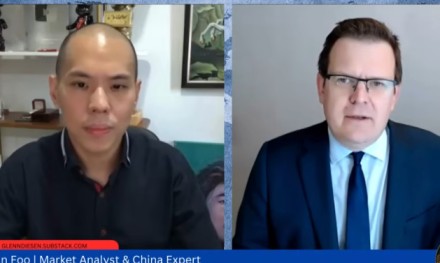
Editor’s Note: In this episode, Glenn Diesen and market analyst Sean Foo examine the escalating economic conflict between the United States and China, particularly in light of China’s move to divest from U.S. Treasuries. The discussion highlights the broader implications of geopolitical tensions, including the risks facing the AI sector and the financial challenges posed by high energy prices and rising debt.
TRANSCRIPT:
# A Conversation with Sean Foo, Market Analyst and China Expert
GLENN DIESEN: Welcome back. We are joined today by Sean Foo, market analyst and expert on China. So thank you very much for coming back on the program. A lot has happened since the last time we spoke.
SEAN FOO: Sure, of course, glad to be here.
China’s Retreat from U.S. Treasuries
GLENN DIESEN: Well, besides the actual wars not just being fought against Russia, but also in Iran, we forget that there’s also, of course, the ongoing economic war between the United States and China. I want to start off by asking how you view this economic war going, especially with focus on the US Treasuries. Is China still looking at further investment or do you think they’re going to essentially begin to reduce their position in this market?
SEAN FOO: I think more or less China is done with US Treasuries. I mean, the last month they dumped around $40 billion or $41 billion. And going forward, I think China doesn’t really see a point in coupling their economies too tightly with the United States.
If we look at the entire debacle over the last 60 to 90 days, especially when we talk about the Iran war, the war in Iran, well, at the grand scheme of things, it is in a way to contain the Chinese economy. Now, if we look at the flows of oil from Hormuz all the way to China, China does buy a lot of Iranian oil, and right now their flows have been compromised. Right now, obviously that isn’t really a big problem for China because 90 to 95% of their power generation is not from oil and gas. It’s from renewables, it’s from coal, and most of the supply chains China controls themselves. But it does show a concerted effort on Washington to really use the US military and other sanctions, geopolitical schemes to really corner China’s economy.
Now, if we look at what happened during the recent Trump-Xi summit, when Trump brought his delegation, including his family, to China, to Beijing, to talk with President Xi, the grand idea was basically to throw the heads of Iran, throw the heads of Venezuela on the floor like a conquering hero in order to intimidate the Chinese, saying that, “Hey, we managed to do X, Y, and Z, we managed to pressure the Iranians, so it’s time for you to comply.” But that didn’t happen at all. And we could see a lot of supplication from the Trump administration side. They really didn’t push the Chinese on anything, and they even accepted phrases from the Chinese saying that, “Yeah, we’ll look into rare earths,” but chances are they won’t, right? They’ll just keep their hands on the tap. And I don’t think China is going to really recouple themselves with the United States going forward, least of all buying more treasuries.
Can the U.S. Benefit from Higher Energy Prices?
GLENN DIESEN: Yeah, well, in the United States, there’s many who thinks that the increasing energy prices will essentially benefit the United States as it’s considered self-sufficient, at least in some areas, and also an exporter. So the money, the price will go up, they may have greater income. Also, countries will then be forced to spend more on energy in US dollars. And as you said, many are hoping that this will also slow down the Chinese economy. Well, you mentioned the Chinese side of this, but how do you assess the American side? Do you think this would actually work, that this would end up benefiting the United States? Because the US is part of the world. I know they seem like they’re trying to build up, well, insulate themselves, build up some Western Hemisphere or Exclusive Regional Security to insulate themselves from the rest of the world. But to what extent do you think this is possible?
SEAN FOO: Well, I don’t think it’s really possible at all, right? Let’s just take a look at an example that you just gave. Now it’s true that because of the constricted oil flows from Hormuz, a lot of countries are being forced to buy more American oil. Now that is true. And because oil is a global market, the price of oil goes up for American crude as well. So if you look at all the stock prices of the big companies from Chevron to Exxon, they’ve been exploding higher and higher over the last 90 days, right?
Now, obviously, the big problem with that is oil is a global market, so prices for everyday Americans also go up. Now, if we look at the inflation numbers over the last 2 months, it has been absolutely disgusting, right? Inflation has gone from 2.4%, it has gone up 2 months ago to 2.8%, and now it’s around 3.8%. So there is a trend of inflation going up. Now, no doubt that a lot of the big oil companies are going to rake it in, but other parts of the real economy are going to suffer, right? Americans are now paying between $500 to maybe $1,000 more a year for just their gas bills. So sooner or later, consumption is going to crack. Something has to give. They’re not going to spend perhaps in restaurants. They’re going to buy less from Walmart. They’re going to slash their discretionary spending. So a lot of cracks are already being formed in the US economy.
And because of higher energy prices, inflation goes up, bond yields are going to stay high as well.
So if we look at the other side of the equation where Trump is trying desperately to tout the new AI economy, he’s trying to keep the bubble afloat. They’re trying to build fields of data centers. Well, you can only keep doing that to a certain degree. Money is finite. And if interest rates still continue to go up, or at least stay stubbornly high, well, it’s going to backfire on the US economy sooner or later.
Right now we are looking at the stock market at bubblish valuations. Trump keeps telling us that the war is on, the war is off. They’re going to discuss something with Iran or no. Now we want them to give up their nuclear weapons and sign it on paper. So everyone is really in a bit of a state of confusion. And I don’t think the US can isolate themselves. In fact, they’re just stacking more cards on this house of cards.
The Chip War: China’s Technological Leap
GLENN DIESEN: Yeah, Trump has become the boy who cried wolf. I mean, every day it’s either Iran will be bombed again or we’re so close to a deal. I mean, it’s a bit strange that the markets still respond to his statements because they seem, you know, not very credible and then very evidently aimed towards managing the markets or influencing them.
But while the financial markets are in a very difficult position, a key aspect of this economic war though is still the tech fight, or the chip wars, if we can call it this. If we go back, we remember that initially the goal was, or the assumption was, if they would cut off China from American chips, then somehow all their major tech giants would then begin to stumble. Either they would stagnate or begin to decline. Obviously this didn’t play out, but where do we stand today in this chip war?
SEAN FOO: Most recently Huawei revealed a breakthrough and innovation, right? They are now beginning to make chips, at least by 2031, to the scale that they can compete with NVIDIA, they can compete with TSMC. And this is what happens when you push the Chinese to a corner. You force them to innovate and they have no choice. Either they innovate or they lose the AI race.
Now, over the last 1 to 2 years, we have seen the Chinese economy, Chinese engineers come up with very interesting solutions to the tech race. Now, if NVIDIA and Trump deny the most powerful AI chips to China, well, the first solution was basically to create a lower-end version of theirs and just string a bunch of chips together, right? Instead of using maybe 100 NVIDIA chips, we’ll use 1,000 Huawei chips. And considering the energy buildup in China, energy prices is a quarter that of the United States, at least 50% cheaper.
And if we look at the entire AI race, the base layer is always energy. As long as you have sufficient and you have cheap enough energy, everything else will follow, right? Your manufacturing gets cheaper, you can make more mistakes, you can undergo more trial and errors, and eventually you can just get up to better innovation through brute force. And this is why I think the chip race is starting to backfire.
When Jensen Huang of Nvidia went all the way to China, I think he basically gave up. He wanted the administration to just allow China to buy the high-end chips because China isn’t even importing much of the lower-end chips, right? China already understands that, “Hey, we are going to leapfrog this technology sooner or later. Why do we want to invite NVIDIA to really get a foothold into the market?” And because of that, 50% of the global market is now effectively shut away from the United States.
Even on the visit itself, Beijing banned, if I’m not wrong, an RTX NVIDIA gaming chip that some companies use for AI as well. And that was during the same trip where Trump went to visit President Xi. So you can already tell a bit of the ring-fencing going on in plain sight.
I think the AI war — I won’t say the US has lost it completely — but they’re going to have to find a way to desperately make up the shortfall when you lose 50% of the market. And maybe that’s why over the last week, Jensen Huang came out onto the convention holding two laptops, telling the whole world that now Nvidia is going to go into the personal laptop business. Because where else can you find the revenue from when half of the market is gone from you?
Gulf States, AI Bubble, and the Shifting Flow of Capital
GLENN DIESEN: It’s kind of strange if you look back. Remember, it was the United States that decided to a large extent to cut itself off from the Chinese market. If you want to lead innovation, you do need some revenue stream. And if there’s no money coming in, how can they continue to fuel this? And I guess this is where there’s been a lot of focus on the argument that the AI market in the United States is in a bubble, that the financing especially is also not sustainable.
It appears that this has taken a further hit though by the Middle East, because a lot of the Gulf states, they can’t sell all their energy and they used to pump a lot of money into not just US Treasuries, but the AI in America as well. Do you see this having an effect, or do you think this is exaggerated?
SEAN FOO: Well, I think it does have a bit of an effect, and it really depends on how Trump ends the war, right? Does he end the war where the Gulf allies understand that they’re not going to get pummeled by Iran forever, and where the Gulf allies realize that, “All right, at least the United States is not treating us completely like trash.” Because if the United States continues this, where the war continues on indefinitely, we are going to see more so-called revolt in the alliances.
So far we have already seen the UAE, the Emirates, break away from OPEC, and that really shows you that once the war ends, they need a lot of revenue to rebuild their shattered economy. Tourism is down, a lot of the oil facilities has been hit. And if I’m not wrong, the airport in Kuwait has been hammered yesterday or a few days ago. Saudi Arabia, they’re desperately shifting their oil flows from Hormuz all the way to the Red Sea. And the El Mandeb Strait is always under the constant threat of the Houthis, if I’m not wrong.
So because of that, I think it really depends on how Trump manages to settle the war. Can he come together to make some kind of accord that pleases both the Iranians and the Gulf allies? I think that’s going to be hard. And going forward, I don’t think the Gulf allies are going to place all their eggs in the same US basket as well.
I think we were talking about how flows from the Gulf go into US stocks and bonds. Now I think that is going to be compromised as well. Over the last 3 days, we have seen quite a few announcements from Scott Bessent, the Treasury Secretary, about how Iranian assets has been confiscated. Now, it’s not much. He bragged about confiscating around $1 billion worth of Iranian crypto.
Now, this is something that is quite alarming because a lot of us come with the concept that money — if you buy Bitcoin, if you buy cryptocurrencies, it’s somewhere out in the ether. It’s supposed to be anonymous. No one can see it. You can transfer it from country A to country B. But it has been shown that the US manages to trace it on the public blockchain. They can go to the exchanges and they can just freeze it or take it away.
So right now there’s a lot of uncertainty going on on where the Gulf allies are going to put their money. Now, obviously, one good option, the traditional option, will be to buy gold, just ship the gold to your country and store it in a vault. There are other options where you can invest into so-called adversary economies of the US. Obviously, China is one where you’ll be at least protected within the Chinese sphere of influence. So it’s about spreading your eggs across the basket, and I don’t think that’ll be good for US assets in general.
The Dollar’s Dilemma and the Coming Financial Crisis
GLENN DIESEN: Oh, well, this is what happens in economic wars. There’s a diminishing trust, people have to diversify. It’s quite extraordinary if you think how short a period of time it took us to get here, where the United States first starts to seize and, well, steal sovereign assets of countries. They steal gold, as we’ve seen, from countries, hijack ships, and of course, now they’re getting into the cryptos, able to seize this as well. So no, obviously countries have to react to this.
But the Gulf States, the lesson is that the US security arrangements are linked to the economic links with the United States. So this is not a new thing. For the Gulf States, the fact that they have been protected by the US is a large reason why they sell their oil in dollars as opposed to, for example, gold or the Chinese yuan. But it’s also a reason why they invest a lot of this money in the United States.
However, what we’ve seen in the Iran War is that the Americans used a lot of their weapons up in Ukraine, so they didn’t have enough to fight Iran. And for this reason, they had to begin to divert weapons that were supposed to go to Europe to fight Russia. Then they also had to divert weapons out of East Asia, especially South Korea, and then send them down to the Gulf states. And even there, they prioritised Israel. So this military overstretch, it must be sending some signals to Europeans, the Gulf states, and East Asia, that the Americans can’t really protect everyone anymore.
But how do you see, again, in all these regions, how does that translate into economics? Because does it mean that the South Koreans will begin to decouple a bit from the American economy, and Europeans, or are we not quite there yet?
SEAN FOO: I think we are not quite there yet. There’s still a lot of partnerships going on between the Japanese, the Koreans, and the United States. As we can see, there’s now a lot of concerted effort by the US and all these economies to invest between each other. And most recently, we can also see Nvidia investing more money into TSMC, or at least into Taiwan. So that in a form is a kind of technological shield, right? Using money to shield their economies, at least from the perceived threat of China.
I think going forward, we are going to see a lot of money printing, a lot of debt going on when it comes to rearmaments. At the end of the day, all these economies, whether it be the Koreans, whether it be the Japanese, they already can see in real time they cannot rely solely on the American security umbrella. As you just pointed out, a lot of missiles, a lot of weapon systems have been shifted to other fronts that are active, right? Whether that be Ukraine, whether that be the Iranian front.
So all these countries, they already know, and there’s speculation that they will have to step up. They will have to borrow more money in order to build all those weapons. So I think we are going to enter a very dangerous age of money printing where currencies lose even more value in order to build out the weapons. And even today, there’s still the perceived threat that China is going to invade any country anytime in the Indo-Pacific, or Asia-Pacific. So this constant fearmongering, I think, is going to push the US and their allies to just rearm even faster.
The $40 Trillion Debt Trap
GLENN DIESEN: Well, I get the same impression that especially the Europeans now, and yeah, everyone wants to arm themselves to the teeth. The Americans, I’m not sure if this has yet passed, to spend $1.5 trillion on the military. It’s again a lot of weapons, and it can fuel many industries. During this kind of military buildup, there’s often technological innovation, but no one in the West, or in the East as well, countries like Japan, they’re not really suited yet for it financially, it seems. I mean, they’re all ridden with debt, and inflation is already high.
And the United States, where they’re ticking now towards a $40 trillion debt, that’s a big hole. To what extent do you think this can continue? Because if an economic crisis would begin to unfold, banks will be threatened. What weapons do they have now to essentially restore their markets or stabilize them? Because if they increase the interest rates, they can’t service $40 trillion in debt. If they reduce interest, they will further destroy their currencies. More countries might de-dollarize. So what exactly can we expect in terms of financial stability moving forward?
SEAN FOO: Well, I think true market financial stability is now more or less officially gone. We are now in a new world where low interest rates are more or less finished. Interest rates have been staying sticky. They have been going higher. And as you said, the $40 trillion debt is just going to balloon even worse. Now, a lot of market participants are still hoping for rate cuts by the end of this year. But if we look at what’s happening with the Federal Reserve, the US central bank, there’s a very good chance they’ll actually hike in 2027. So this is going to make the debt situation even worse.
Now, the United States is really trapped in a quandary, right? If they decide to issue more bonds in order to pay off their deficits, interest rates and yields are going to go even higher, and that will push the national debt off a cliff. However, if they decide to cut rates in order to ease the debt burden, inflation will go up. And the markets will punish them with even higher rates down the road. So everything just leads down to the central bank saving the entire system.
As you said, the US economy cannot afford a freeze of the money supply where everything suddenly slows down, right? No one is spending, the banks are not lending, the entire economy as we know it will grind to a halt. At this point, the Fed, either silently or outwardly, will be buying bonds to flood the market with cash, flood the market with liquidity.
So we are going to move towards a period where either a systemic crisis happens — for example, let’s say the AI bubble bursts, or the semiconductor bubble implodes, or somehow everyone loses faith because Trump’s war on Iran has taken too long, and then basically confidence collapses. So the Fed will come in and tell the whole world, “Hey, we are printing $3 trillion.” Or if that doesn’t happen, it’ll be a slow print where hundreds of billions of dollars a year will be suddenly pumped into the situation. And if we look back all the way to December, 6 or 7 months ago, the Fed has been printing money into the system already.
China’s Strategic Decoupling from the US
GLENN DIESEN: Yeah, I often think back to the global financial crisis in 2008 and ’09 when essentially there were no alternatives to the United States. It was argued, you know, the same as the dollar, it was “the cleanest shirt in the hamper,” essentially. And there wasn’t much that could be done to diversify. But as you know, after this, this is when China began to develop its own transportation corridors. It attempted to replace much of the US supply chains, develop its own development banks, and use more national currencies.
And I know that in this meeting you mentioned before between Xi and Trump, the hope was, I think, by many that they would reach some grand bargain. That wasn’t achieved. However, after this meeting with Trump, President Putin came to Beijing as well, and they had this common declaration on the establishment of a multipolar world. And I was thinking, only 3 years ago, Putin and Xi were caught on open mic saying that “the world will change more than it has in 100 years now.”
So what do you think will be essentially the solution when the US markets begin to melt down, its tech war won’t prevail, the dollar will begin to struggle? What do you think China is planning to do, or how will it essentially get out of the splash zone and adjust to these new realities? Because it doesn’t look like they will behave the same way as they did back in the 2008 global financial crisis.
SEAN FOO: Sure. I think we can see that China and Russia are both consolidating even closer together. I think we all remember back in 2022, 2023, there was a joke and a meme that the US was pushing Russia closer to China because of all the sanctions and how the G7 hammered Russia, which is true. And Trump is doing the exact same mistake, right? He’s pushing Russia closer to China as well, especially when it comes to oil flows and energy flows.
Now, what China has been doing over the last 3 months, and just recently over the last 3 weeks, is slowly decouple their entire financial economy from the US. Over the last 2 weeks, China imposed even more capital controls on people’s savings that are leaving China, going to Hong Kong, and then from Hong Kong leaving to other Western economies. So China has had enough of that. They’re clamping it down. They’re telling the brokers, “All right, you’re not going to allow mainland Chinese to send their money to you and then disperse it to the rest of the world.”
So you can see China already starting to consolidate. Their entire capital flows, how much money they have, the savings of their people, which is enormous, is around over $50 trillion. What China is doing is basically concentrating all their investments into either their allies. They’re trying to make some headway into Europe if possible. But mainly they’re consolidating around the BRICS alliance. That includes Brazil and countries along the Belt and Road.
Now China, I believe, has seen the devastation done in the Middle East. I’m not saying they’re going to pull out all their investments there, but I think they’re going to concentrate more in the Asian region, which is exactly where they should be, right? So we can expect more cooperation with Russia. We can expect more cooperation with the Central Asian states. China definitely will work more together with India as well and Southeast Asia. I think at this point China understands that they have to decouple from the US in quite a big way.
Europe’s Decline and China’s Shifting Priorities
GLENN DIESEN: I think a big consequence of the war in the Gulf is also that many countries are worried that the Gulf states might actually go under if this war escalates. But even if it doesn’t, it will take a long time for these countries to essentially go back to where they used to be, if that can even be achieved. So there seems to be a huge capital flow out of the Gulf states heading towards East Asia, to places like Singapore and other areas.
But on China trying to decouple from the US, do you see it also limiting its position in Europe? Because the Europeans began to a large extent to repeat the American talking points. That is, they were very worried about what they call Chinese “overcapacity.” Again, it’s a fantastic concept. No one’s talking about America’s digital overcapacity, or the French wine overcapacity, or the Italian fashion overcapacity. But anyways, this is a way of saying, let’s try to diminish the Chinese market. Sounds very defensive.
But how do you think China will respond to this? Because the European markets are already in a very difficult position. By cutting themselves off from first Russian energy, and now being forced to have less contact with the Gulf states, the energy prices go through the roof. They are beginning to deindustrialize in a big way. And what does that mean for China? Because even if you put politics aside and only look at the economics of it, to what extent is Europe still an attractive market, or does that fall within the decoupling? If China is shifting to the BRICS states for investments, does that also entail reducing its position in Europe?
Europe’s Limited Options and Where to Invest
SEAN FOO: Well, I think it does entail China reducing their position in Europe sooner or later. If the EU decides to ramp up the trade war with China, China will have no choice but to enter other markets, whether that’s in BRICS, Southeast Asia, or even Africa.
Now, as you mentioned, I think Europe is really lost. They are lost in the Twilight Zone, right? They have lost cheap Russian energy. They have lost flows from the Middle East. And I don’t see any way for them to really revive their economy and make their own manufacturing attractive unless they do a radical shift of their energy policies.
You know, a very simple one could be just to, I don’t know, dismantle some of their green policies or start reviving some of their nuclear plants. It’s as simple as that because they only have a few options. And most of it they find distasteful, you know, running back to Putin for natural gas. Von der Leyen herself has said it’s distasteful, asking the Chinese, you know, for solar panels. Well, you have tariffed them, so you have just raised the cost of production for yourself. So the Europeans are left with very few options.
Now for the Chinese, I don’t think they really want to decouple with the EU because Europe has always been seen as one of the other big third kingdoms around, right? Apart from the US and China itself. And I think they do see that there could be eventual hope for the EU, but how long it will take is a very, very big question. So I think China, they just going around hedging their bets. I don’t think China really wants to decouple from the EU. There’s still quite a bit of consumer base there. You know, there are some definitely some EU countries are still relatively rich. So I don’t think the Chinese, they want to just cut Europe off forever.
GLENN DIESEN: Yeah. Well, it’s not too late to change course, I guess. I’m waiting as well for the European leaders to stop doubling down on failed policies and pursue some kind of course correction. We’re not quite there yet, but perhaps when the pain begins to ramp up, they will change course.
Well, I guess that takes me to my last question though. Where do you think the good money is going these days? Because we’re seeing such massive disruptions in international markets. We see the geo-economic center of power shifting further to the East. Where do people invest? I know you’re very big on gold and, well, silver and metals, but where else do people essentially put their money these days in order to, I guess, preserve their wealth and ideally grow as well?
Where to Put Your Money in Uncertain Times
SEAN FOO: Sure. I think now is one of the most difficult eras to really invest. Everything looks like it’s in a big bubble, right? Whether that is the US stock market, whether that is in tech stocks, we see a lot of semiconductor names like Micron, SK Hynix, Samsung, all going up.
So I think now should be a time where people should really consider the idea of diversification, right? I can’t sit here and tell you that gold is going to go up in a straight line. I can’t sit here and tell you that S&P or even Chinese stocks is going up in a straight line because there’s a lot of big risk coming down in the next 2 to 4 months.
We just need to look at the oil crisis from Hormuz. Everyone thinks that the crisis is done, but there’s a very big backlog of oil shortages coming in that’s going to register in July, register in August. And if there’s such a low volume of oil, that means prices are going to go up. And the only way for that to reconcile is for people to consume less, and the price of oil will come down because people are consuming less. And that itself could really pop the bubble.
But at the same time, if you buy bonds, if you leave your money in cash, you’re going to get inflated away. So I think this is really a time to spread your eggs across the basket. You know, having some gold is not bad. Having some international stocks isn’t the worst idea as well. You know, investing into China, the RMB has been strong. That is also a great avenue.
So I don’t think I can really give anyone a clear answer right now. Personally, I am still buying gold every month, every quarter because I see the long-term trajectory. But to put all your eggs in one single basket at this point of time, I think it’s extremely risky.
GLENN DIESEN: Well, this is the problem. Everything, all the markets are very integrated and once something goes wrong, such as say the shutdown of the Strait of Hormuz, not only would it be energy, but it would also be the fertilizers. And you know, with the energy crisis, food crisis, you can expect the triggering of more conflicts in the world as well. This will impact the markets again.
So with this many variables in play, with conflicts now between, well, where most of the great powers, if not all of them, are involved, it’s very difficult to make any predictions at all.
Let me ask you, where can people find you? Because I enjoy the YouTube channel you run. So people want to follow you, where can they find you?
SEAN FOO: Sure, you can just find me at YouTube itself, youtube.com/ShawnFuGold. Shawn Fu Gold. Basically, I cover economics, a bit of geopolitics as well, investments, the bond market, and of course, gold and silver.
GLENN DIESEN: Well, thanks for taking the time. I always enjoy talking to you and hope you can come back soon.
SEAN FOO: Sure, thanks, Glenn.
Related Posts