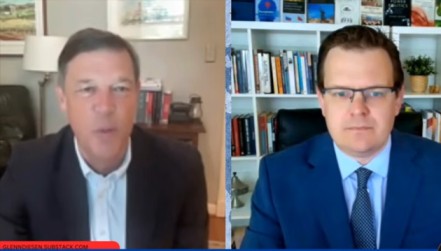
Read the full transcript of former CIA director George Beebe’s interview on Greater Eurasia Podcast, June 16, 2026.
Editor’s Note: In this episode, host Glenn Diesen is joined by George Beebe, former CIA director for Russia analysis and current director of grand strategy at the Quincy Institute, to examine the history of NATO expansion and the Western narratives surrounding it. The discussion explores why many experts previously warned that expanding NATO toward Russian borders would be perceived as a threat and how the current geopolitical climate has contributed to a dangerous, escalatory dynamic in the conflict in Ukraine.
NATO Expansion and Western Narratives: A Conversation with George Beebe
GLENN DIESEN: Welcome back. Today is June 16th, 2026, and we have the great pleasure of being joined by George Beebe, the former CIA director for Russia analysis and currently the director of grand strategy at the Quincy Institute. So, thank you for coming back on the program.
GEORGE BEEBE: Thanks for the invitation.
The Post-Cold War Identity Crisis
GLENN DIESEN: So, I wanted to discuss today the, I guess, NATO expansion and the Western narratives, how they’ve developed over time, and indeed the extent to which we’ve been trapped in them. Because we already know from the 1990s that many, many American leaders, as well as European political leaders and military leaders, they warned against expanding NATO. While there were benefits, they also recognized that this would be perceived by Russia as a threat.
Yet what was common sense in the ’90s has now become somewhat controversial and often dismissed as Russian talking points. And I’m not sure if we do ourselves any favors by portraying reality in this way. But you, coming from such a high-level position in the CIA, when you look back at the ’90s, what did you see as the main concerns within the US intelligence community, and indeed the European one as well, regarding NATO enlargement and the potential impact on relations with Russia?
GEORGE BEEBE: Well, when the Cold War ended, the Berlin Wall fell, the Warsaw Pact broke up, and then ultimately the Soviet Union itself broke apart, there was a big question that arose in the West, both in Washington and in European capitals, which is, okay, what is our foreign policy about anymore?
For more than a generation during the Cold War, we had a very clear purpose. It was to contain the Soviet Union, to ensure that Europe would not be subject to yet another great power conflict, to make sure that the states in the Western Bloc did not fall prey to communist ideology and Soviet domination. We knew how to do that. We established deterrence militarily and we put in place a series of rules and institutions that were designed to minimize the risks of direct warfare, which everybody knew would go nuclear and would be catastrophic for everybody involved and for the entire world.
So we knew what we were doing and we had worked out how to achieve the goals that we had during that period. Then suddenly there’s no more Soviet Union, there’s no more Warsaw Pact. And I think people in Washington and Europe said, okay, so what do we do now?
The Western Vision of Expansion and Transformation
GEORGE BEEBE: And we came to a judgment, and the judgment essentially was, well, the Western community that we had built during that Cold War period was very successful. It ensured prosperity for the people in that bloc. It worked out very well in providing for their security. And we had, we thought, proved the superiority of our ideology in the way the Cold War ended.
So we thought, well, let’s extend that Western community and make it a world community. Let’s globalize the Western system, which means we’ll take those old Warsaw Pact members and we’ll transform them. We’ll help liberalize them, reform them from within. “And we’ll do the same thing with Russia. We’ll transform Russia. We can re-engineer it socially and politically to look like the West.”
And we even extended that to the Middle East, thinking that liberalization of states there would stabilize that region, end the chronic instability that the Middle East had suffered from for so many decades. And that didn’t work out. We bit off far more than we could chew. We tried to do things that we really weren’t capable of.
And when you think about how hard it is to engage in social engineering in your own country, in a political culture that you know intimately, whose political system and players you know extremely well, social engineering inside countries seldom works out very well. Now try to do that in foreign cultures that you really don’t understand, with histories in ways that you’re not steeped in.
Russia’s Response and the Red Lines
GEORGE BEEBE: So what happened was essentially this: NATO enlargement was based on the idea that if we extend the security umbrella of the NATO Alliance, we extend EU membership, that will foster the Westernization and liberalization of these countries. The problem with that, in addition to being unachievable, was the Russians said, “Hey, wait, that’s not what we were envisioning. We thought that when the Cold War ended, we would be accepted as a co-equal in the Western community. Instead, what you’re offering is subordinate status, being some sort of junior partner, a rule-taker rather than one of the rule-makers alongside the United States and others.”
“We don’t see a role for us in this expanded European community that you’re building. We have no say in how that operates. We’re simply supposed to do what we’re told. And on top of that, we’re supposed to accept a NATO military presence on our borders. That’s not a deal that we’re willing to accept. Those terms are not attractive for Russia.”
Now, the people in Washington and, to a great degree in Europe, that had developed years and years of expertise in the Soviet Union, that understood that system, that were vital to containment and the rules of the game that we put in place so successfully during the Cold War, almost all of them said, wait a minute, if you’re going to start expanding NATO and bringing it closer and closer to Russian borders, there’s going to be a reaction.
The Russians are going to feel threatened. They’re going to feel as if they’re being surrounded and treated as the other rather than as a part of a broader Europe. And that reaction is going to be more and more intense the closer the NATO alliance gets to Russian borders.
So in the mid-1990s when this issue was under discussion in Washington, it was basically a case where most of the Russia experts at that time said this is crazy to try to expand NATO. But what was regarded as completely unthinkable at that time — this is 1994, 1995, 1996 — was the notion that you would go beyond some of the Warsaw Pact nations and bring core elements of the former Soviet Union into NATO, such as Ukraine. That was unthinkable among the people who were the Russia experts at that time.
And it’s remarkable now in retrospect for me to think back at the discussions that were taking place in Washington at that time and just how completely unimaginable it was then to think that we would be trying to bring NATO into Ukraine or Ukraine into NATO. And now this seems to be conventional wisdom. Of course Ukraine has the right to choose its military allies. Of course the host nation can choose what military forces it wants to host on its territory. This is almost a sacred principle that no one is questioning.
And I think it’s really at the root of the conflict that we’ve got right now. And understanding these dynamics are critical, not because they justify a Russian invasion of Ukraine. It’s not a justifiable invasion. It’s illegal, shouldn’t have happened. And there’s no question that the Russians made the decision to invade and should be held accountable for that.
But to argue that it was completely unprovoked, that Putin woke up one morning and said, “Yeah, I really would like to have Ukraine as part of my country,” I think is ignoring the history and the dynamics that shaped this decision. And if you don’t understand those dynamics, you’re not going to find a way out of the war that we’re in right now. Your peacemaking efforts will be unsuccessful.
From 2008 to Today: How the Narrative Shifted
GLENN DIESEN: Well, what was strange though is in the ’90s when, as you said, there was this fierce disagreement about whether or not expanding NATO would be a good idea. And of course the chief critics were people like George Kennan or William Perry, James Baker, Jack Matlock, all of these heavyweights. But it seemed that once the decision had been made, this very polarizing issue suddenly — they seemed like they essentially accepted this is the new situation on the ground. Let’s all just organize around the narrative that this was unproblematic.
To some extent, because by the time we reached 2008, when the issue of NATO going to Ukraine and Georgia arose, you still had some very fierce opposition. Less fierce perhaps from people like former CIA Director Robert Gates, but you had those — what was it, WikiLeaks from William Burns — when he made the point that, well, if you try to pull Ukraine into NATO, we’re going to have a civil war in there, probably a Russian intervention, which the Russians do not want to do, but which they would feel compelled to do.
So apparently there was already, even up to 2008, a recognition that this would be quite mad. Merkel, back in those days, she referred to this — that the Russians would interpret this as a declaration of war. So 2008 is not that long ago, because from 2008 till now we went to saying that, well, NATO has nothing to do with this.
But I guess, what is it about Ukraine that’s so special? Because now the argument is, what about Sweden, Finland? Why isn’t Russia invading there? So what is it about Ukraine that makes — well, in the language of, again, William Burns — this was the reddest of the red lines for the Russians?
“Нет Means Нет”: Ukraine as the Ultimate Red Line
GEORGE BEEBE: Right. And Bill Burns’ cable was not just something that came out in WikiLeaks. He published it in his book. He actually got that cable declassified and it is out there in public for anyone to read. And the title of that cable was “Нет means нет.” And he essentially said, look, there is no one across the Russian political spectrum from the far left to the far right that believes that Ukrainian membership in NATO is something that Russia can tolerate. They will react. And that proved absolutely accurate.
Now the question you’re asking is how did we get to the point where there was real recognition, at least among parts of the Western political community, that this was a problematic development, to convincing ourselves that NATO enlargement had nothing whatsoever to do with this?
Well, I think part of it is that the authors of that enlargement became the power brokers in Washington. They reached levels of government where they were making key decisions about American foreign policy, and they’re not about to stand up in public and say, “Yeah, we were wrong. We shouldn’t have done that.” Their position on this was, look, nothing that we did remotely caused or justified the Russian invasion. They’re not going to take responsibility for that. That’s the first part of this.
The Changing of the Guard in Russia Expertise
GEORGE BEEBE: Another part is that a new generation of Russia experts arose in the West. These are people who did not get their training and education in what I would call classic realpolitik balance of power foreign policies. These were people that went to graduate school during a period when we all thought we could transform these countries, we could hasten their transition from communist totalitarianism and authoritarianism to liberal market democracies.
And a lot of the curriculum in major Russia studies programs focused on this transition. So you didn’t have to know about geopolitics and all of this. The geopolitics take care of themselves. Russia will change. It will become like us. And democratic peace theory would then ensure that there would be harmony in the international system because liberal democracies don’t go to war with one another. Problem solved. You don’t have to worry about the kinds of things that actually resulted in conflict over Ukraine’s geopolitical orientation.
So there’s a combination of not wanting to accept responsibility for what happened and the changing of the guard within the Russia expert community in the West, where you had a bunch of people come to the fore that didn’t really understand the kinds of foreign policies that were vital to containment. These were people who were ideological, who believed that foreign policy flows almost exclusively from the nature of the internal system of the country that you’re dealing with. Geography and balance of power had little to do with behavior.
So they didn’t get it, I think, is the short answer to all of this. And the old generation faded away. People get old. Henry Kissinger and George Shultz and George Kennan pass on, and the baton has been handed to a community of experts that have a much different kind of expertise on Russia than in the past. And that’s a part of this.
Narrative Traps and the Dismissal of Dissent
GLENN DIESEN: That’s interesting though — more than three decades of a political class emerging which has essentially embraced this idea that relations with Russia should be seen in the framework of a teacher and a student, that is to socialize or transform them. I think in this climate, the social constructivist has really taken over.
And this is what I also noticed: if you make the point that the Russians always perceived NATO expansion after the Cold War as a major threat because it redivided the continent, one can point to a sea of evidence. Yet there’s no interest in this. It’s always the assumption that, well, if you recognize that this is a threat to Russia, that means you’re giving legitimacy to the Russian position, and then it is considered to be pro-Russian. And so then it has to be dismissed. It’s a very strange turn.
Europe’s Identity Crisis and NATO’s Existential Purpose
GEORGE BEEBE: Well, it also attacks the raison d’être, so to speak, of Europe post-Cold War. What did Europe become? It did not become a geopolitical actor. It can’t be a geopolitical actor because it expanded its membership to the point where it’s become paralyzed. Different members of the European Union have much different interests, particularly as they relate to Russia. So it’s very hard for them to act as a coherent geopolitical actor.
Europe has become a regulatory superpower bent on expanding its values, transmitting them. This notion that Europe ought to be about liberalizing countries outside of Europe and expanding that Western community has become a core purpose of the European Union. And so if Russia comes in and says, “Yeah, no, what you’re doing actually threatens our vital interests and we’re going to go to war to prevent the continuation of what you’ve been doing,” that causes Europe to actually face an existential question. What’s our purpose? What are we about? What’s our role in the world?
And the one that they thought they had settled on after the end of the Cold War is not viable. So what do you do under those circumstances? That’s the dilemma that the Europeans are facing right now. It’s part of the reason why they don’t want to see this war settled because a compromise end to the war in Ukraine will force them to address that question and it will force them to acknowledge that the vision that they’ve had for more than 30 years is bankrupt.
GLENN DIESEN: Yeah, no, it’s a good point, but it’s also difficult for the Europeans, I think, to adjust because again, if you recognize that the world is multipolar, then one can reach the conclusion that it’s not in the interest of the US to devote that many resources to Europe anymore because it steals resources from more important regions. And it pushes Russia towards China.
But in this country, I saw even an article in the paper arguing that, well, we shouldn’t say that the world is multipolar. Again, these are the social constructivists, because if we say it’s multipolar, we recognise that Russia is a polar power, then we give legitimacy to Putin. We can’t give legitimacy. So essentially, we’re compelled to walk around, pretend as if there’s no multipolarity, because this is the right thing to do. So if you say it’s not multipolar, then we act accordingly, and then it wouldn’t be multipolar. It’s very, very difficult to navigate in such an intellectual environment.
But what do you think are the main misunderstandings then, not just in Europe but also across the West, about how Russia interpreted developments in Ukraine after 2014, that is, after Yanukovych was toppled?
How Russia Interpreted NATO Expansion and Ukraine
GEORGE BEEBE: Well, I think Russia’s view of events in Ukraine didn’t happen overnight. It wasn’t a single event that sparked this. I think Russia’s views had their roots in, at the very beginning actually of NATO enlargement when we were bringing the Czech Republic and Poland and Hungary into the alliance. And we were telling the Russians, no need for concern here. NATO’s a defensive alliance, number one, so it doesn’t threaten you. Number two, all of these countries, when they come into NATO, they’ll feel more secure, more confident, and they’ll be able to deal with Russia with much less hostility because they won’t feel fearful. They won’t feel threatened by Russia. You’ll have better relations with them.
And I think the Russians looked at this and said, okay. Now what happened within a few weeks after Hungary, the Czech Republic, and Poland joined the alliance? What happened was the Kosovo War in which NATO actually was a player in this. NATO chose to intervene in Serbia against the Serbs. Why? Not because the Serbs had attacked NATO. They had not. And Serbia was out of area for NATO. It went beyond its borders to take action against another country that had not attacked NATO for things that happened inside of Serbia. A minority Muslim separatist movement had come under attack by the central government. And NATO said this will not stand, but it didn’t get UN Security Council authorization for this and it wasn’t attacked. So under international law, this was an illegal act.
And the Russians came to us at the time and said, “Okay, you told us NATO was defensive. You told us we don’t have to worry about NATO attacking Russia. What is the guarantee that NATO wouldn’t do something like that inside Russia? For example, in retaliation for things that Moscow is doing against Chechnya, a Muslim separatist conflict.” And the answer that we provided to the Russians at the time was, “Well, of course we wouldn’t do that in Russia. Russia has nuclear weapons.”
Now, ironically enough, the Russians said, “Aha, right. It’s not NATO that guarantees our security, the nature of NATO. NATO could in fact do this sort of thing. It’s our own ability to fight back and deter militarily that protects our security.”
The Bucharest Summit and the Window Closing
So having drawn that lesson from Kosovo, the Russians then looked at what NATO did in 2008 at the Bucharest Summit, announcing that Ukraine and Georgia would one day be part of the NATO alliance. At a time, by the way, when public opinion in Ukraine was not in favor of joining NATO. The majority of Ukrainians in 2008 did not favor joining the NATO alliance. Now, obviously things have changed a lot since then, but at the time we said that Ukraine was going to join, the United States was actually pulling pretty hard to get Ukraine and Georgia to come into the alliance.
And the Russians looked at that and said, “Wait a minute, this is getting into the heart of Russia’s geopolitically sensitive areas.” Russia’s been invaded many times from the West, going through where? Ukrainian territory. There’s a painful history there and there’s an awful lot of intermixing between Ukrainian and Russian families. There are cultural, religious, linguistic ties, a lot of trade going on there, intermixing of economies. This is extremely sensitive territory and the Russians reacted to this very strongly.
Now, those that say the Russians are overreacting, they’re paranoid, there was no prospect that Ukraine was going to be a part of the NATO alliance anytime soon, the Russians didn’t have to invade, this is a pretext — my reaction to that is, well, there is certainly no doubt that Ukraine was not on the brink of formally joining the alliance. Ukraine was being NATO-ized. The links between NATO militaries and Ukraine in training and equipment and standardization, operating procedures, intelligence cooperation were all deepening.
And I think the Russians, with some justification, looked at that process and said to themselves, “If those trends continue, 5, 10 years from now, Ukraine will be so thoroughly enmeshed with NATO that Russia won’t have a military option to prevent formal entry into the NATO alliance unless Russia is willing to go to war, not just with Ukraine, but with NATO itself.” So they saw a window closing there that meant either they had to live with Ukraine ultimately being part of the alliance or they would have to go to war with NATO itself. And Putin didn’t want to have to face that choice. So he acted preemptively, preemptively and illegally. But this was certainly not the case that there was no cause for this other than Putin’s own imperialist desires. I think it’s a far more complex situation than that.
GLENN DIESEN: Yeah, well, I saw an interview you gave actually back in December of 2021. You were one of the people who actually said then that, as NATO entrenched itself more and more in Ukraine, the Russians were essentially reaching this conclusion that it’s essentially now or never to take military actions. And that should have been, again, a good 2 months before the Russian invasion, should have been a good warning based on solid evidence.
But I have to tell you though, in Europe, among the social constructivists, the people who see the world as, the goal being transforming, they would have looked at this kind of warnings as essentially undermining what NATO is. That is, we don’t talk about it being a threat because then we legitimize it being seen as a threat. So all of these cold warnings were essentially thrown away, I think, a bit.
NATO’s Open Door as an Article of Faith
GEORGE BEEBE: Right. Well, I think NATO and Europe more broadly regarded the open door as critical. That was not just a technical issue. It’s not just something that was in the Washington Treaty that allowed for the alliance to add new members. It was actually seen as vital to the survival of the NATO alliance itself. And back in the ’90s when this was first being debated, people explicitly used this analogy that if NATO doesn’t expand, it will die. It’s sort of like a shark. If it’s not swimming forward, it can’t get air through its gill slits and it will literally die. And I think that belief that NATO had to be enlarging became seen as critical to NATO’s purpose and its survival.
GLENN DIESEN: And of course, if NATO doesn’t survive, what keeps the US in Europe? This is the entire world order built on this. But of course, it is a problematic recipe for stability, or the assumption that recipe depends on the world’s largest military bloc built against Russia, that it would incrementally go closer and closer to Russian borders, and hoping that Russia would accept that this would produce stability.
But anyways, since 2022 when the Russians invaded, we’ve seen this escalation all along. For me, one of the peaks were last year, not just the attacks on the early warning systems of a nuclear attack on Russia, but also the attack on its nuclear retaliatory capabilities, that is, its bombers. But since then, we’ve seen, at least the rhetoric I hear from Moscow, is that the Kremlin is under greater pressure to retaliate as they see NATO going up that escalation ladder. Now, of course, the long-range missiles, the drones, but also the attacks coming from NATO territory.
But what happens now though, if the assumption is that NATO, that Russia would not dare to attack, but this is happening at a time when the US seems to be drawing down its forces in Europe and it begs the question whether or not the US would sacrifice New York for Tallinn. But what happens the day after if Russia now retaliates against some German manufacturing plants, logistics centres, or Latvia for that matter? Because I spoke recently with Professor Mearsheimer, who made the point that he seriously doubts the US would fight and die for the Baltic states. But if they don’t, that’s the end of NATO, isn’t it? I mean, what’s keeping you up at night, I guess, is what I’m asking.
The Danger of Escalation and Nuclear Complacency
GEORGE BEEBE: Well, I think this is an extremely dangerous situation. Because we’re in circumstances where the Ukrainians actually would like to see NATO drawn directly into this war against Russia. It’s their best bet for being able to prevail in some form on the battlefield. One-on-one, Russia against Ukraine, Ukraine has enormous disadvantages. The more NATO is involved, the more those Russian advantages are mitigated. And the best scenario of all for Ukraine is if NATO forces are directly fighting against Russia. So they would love to provoke some sort of incident where NATO gets drawn into a confrontation militarily with Russia.
The Russians know this, at least, Putin understands very well the game that’s being played here. He knows he’s being baited into an overreaction. He understands the consequences of getting involved in a direct confrontation with NATO. He doesn’t want to go there. I think he’s tried to be very cautious. The problem is the provocations are getting more severe over time. And you mentioned going after one of the legs of the Russian nuclear triad. That’s an extremely provocative thing. It strikes at the heart of Russia’s nuclear retaliatory capability.
Turning the other cheek is a very dangerous thing to do because it gives Europe and Ukraine and the United States the impression that Russia simply will not retaliate. We can do whatever we want and the Russians will simply grit their teeth and tolerate it. So Putin also understands that, and he’s got a lot of people in Moscow who were saying to him, “You can’t simply continue to ignore this.”
And so I think what’s happened is the Russians have grown increasingly vocal and increasingly demonstrative to send the message to Ukraine, to Europe, and to the United States that they’re not simply going to continue to ignore these deep strikes into Russian territory, that they’re going to have to retaliate. So that’s why we got the messages about what the Arashniks are capable of doing. Putin went into a fair amount of public detail saying, “Here’s what they can do. We haven’t really used their capabilities yet. We’re developing those capabilities, but at some point we may well have to use them.”
That I think is why the Foreign Intelligence Service of Russia issued such a stark warning about Latvian involvement in these drone strikes against Russia and explicitly threatened to attack Latvian facilities that were involved in these attacks. I think what the Russians are trying to do is send a message first and foremost to Washington, which is put a leash on the Ukrainians and the Europeans. Make sure that they don’t continue to do this because if they do, we will have to retaliate. We don’t want to have to do that.
For right now, I think the message has been received in Washington anyway. We’re re-engaging in the peace process. I’m sure you noticed President Trump publicly specifically said, “Now that we’re putting Iran in the rearview mirror, we want to focus more intently on the peace process in Ukraine.” So we’re re-energizing our involvement there. Steve Witkoff and Jared Kushner are going to be going to Moscow, it was announced. So I think that’s all good. It increases the likelihood that the United States can manage this kind of problem.
But the last thing that you want to have to do if you’re working on the NSC staff is send a memo up the chain saying, “Well, Mr. President, the Russians have struck NATO territory. And Latvia, or fill in the blank, has invoked Article 5. So we’re going to be faced with a choice. Do we in fact go to war with Russia over this and defend our NATO ally and demonstrate that Article 5 remains in effect? Or do we say to the Latvians, or whomever, too bad, you shouldn’t have poked the bear. Good luck, but this is your problem, not ours.”
That’s a very, very painful decision to make. You’re choosing essentially between warfare with Russia, which could well turn nuclear, or hollowing out the NATO alliance itself. That’s a very bad decision to have to make. So I think it’s very much in the interest of the United States to engage diplomatically, bring this war to an end, and avoid ever having to face that kind of decision. Because I don’t know how it would turn out. And anybody that tells you they do is probably overconfident. That’s a very painful decision.
GLENN DIESEN: I agree. It just seems like the pathway to war now is charted very clearly. That is, well, for example, I assume that the drone attacks on Russia through Baltic territory — I assume that, well, for example, the Germans may have a hand in this. And now that we heard this stern warning that the Russians might retaliate against the Baltic states, we saw this statement from the head of the German armed forces that, well, if Russia strikes the Baltic states, then we’re going to hit Kaliningrad or Moscow or something like this.
I mean, if this is the case, if the Germans are bombing Kaliningrad with its million citizens, this is — it’s not hard to imagine how few steps that would be away from nuclear retaliation from Russia. I mean, its legal documents would approve this in a second, I think. So it’s this —
Kaliningrad, Nuclear Thresholds, and the Loss of Fear
GEORGE BEEBE: Well, yeah, my understanding is that Kaliningrad has more tactical nuclear weapons stored on its territory than probably any other place on Earth on a per-square-kilometer basis. If you attack Kaliningrad, you automatically cross into the nuclear threshold. You’re now involved in a nuclear war.
So we are very, very close to that kind of situation right now. But the irony in all of this is that a lot of people in the West have lost their fear of nuclear war. And that’s a problem. The fear of nuclear war has a deterrent effect on both sides. It brings sobriety to decisions that isn’t there if you really think, “Well, that’s just not possible. That was a threat during the Cold War, but we’ve been there, we’ve done that, we’ve turned the page. We’re not going to get into a nuclear war now. We don’t have to worry about that.”
The real fear should not be of nuclear war. The fear should be the fear of nuclear war. We can’t allow ourselves to be scared into submission with the Russians. It’s a very different psychological climate that we’re in right now than we were for almost the entire nuclear period, when everybody recognized, “Boy, we really don’t want to go into nuclear war. That would not work out well for anybody.” And in the West, we’ve largely lost that. And that’s a problem because the Russians know it.
And you have people like Sergei Karaganov, whom you have talked to extensively, saying we have to restore the fear of nuclear war. That’s extremely dangerous. Restoring the fear of nuclear war could easily cross into an escalatory spiral that would be catastrophic. So this is very dangerous territory.
GLENN DIESEN: Yeah, it’s this idea that nuclear deterrence, for these ideologues, translates into nuclear blackmail, which we cannot accept. So essentially they’re dismissing the whole principle of nuclear deterrence, which puts the whole world on its head.
But this is the thing — when they refer to how weakly positioned Kaliningrad is, that it’s surrounded by NATO, and they say this with certain joy — I mean, that’s not great. You don’t want, as you said, the most nuclear-armed place on the planet to feel exposed and vulnerable.
And it’s the same as these media reports I see every day with the attacks now on the refinery in Moscow or deep in Russia. The news headlines as well as the politicians always frame it as, “Oh, look how humiliated Putin is.” But again, why would this be a goal when you have Putin who is pushing back on the hawks, who are saying it’s time to make the Western powers fear our nuclear weapons again? This is the time you want to humiliate Putin by striking deep in Russia? I mean, none of this makes any sense.
And again, just as a last question, how do you make sense of the narrative? Because we appear to now be entering, or going back to, the narrative that Ukraine is winning, Ukraine is winning. I’m not sure if it’s like this in the US now, but in Europe, this is now being accepted — that yes, Ukraine turned the tide and now it’s winning. I mean, how are you reading the narrative war?
The Propaganda of “Ukraine is Winning” and the Fantasy of Russian Capitulation
GEORGE BEEBE: Well, it’s exactly what it is. It’s propaganda. It is an effort to try to sustain the course of action toward Russia that has failed since the beginning of this invasion. The idea was we crank up so much pressure on Russia that eventually Russia says uncle and it says, “Sorry, we made a mistake. We shouldn’t have invaded. We’re going to withdraw. We’ll never do it again. Please forgive us.”
And that effort to turn the ruble into rubble, to turn Russian diplomats and politicians into international pariahs, to bring so much pressure militarily on Russia, send so many Russians home in body bags that Putin has no choice but to succumb to the pressure and capitulate — it hasn’t worked. And it’s not going to work.
But this propaganda line that the Ukrainians are now winning — stay the course, don’t lose heart — is designed to buy time. The opponents of a settlement oppose a compromise. They want Russia to capitulate. They don’t want to “reward aggression” in any way. They think that’s very dangerous to do. So they think that we just have to continue to turn up the pressure on the Russians and eventually they will succumb to that pressure. We won’t have to give up anything in a settlement. We won’t have to compromise anything. And we can end this war on our terms.
And it’s a fantasy. It’s been proved to be a fantasy. And Konstantinivka is about to fall. I think that’s going to put the lie to this notion that the Ukrainians have turned the tide in this war. And we’re going to have to face the reality that if the war is going to end, it’s going to have to end in a compromise in which the Russians give up some important things and the West and Ukraine do as well. There’s no other way for this war to end unless it’s going to escalate or result in Ukraine’s essential collapse as a functional state.
GLENN DIESEN: Yeah, I see some comparison between the war on Iran and the war on Russia. That is, by failing to recognize that the opponent sees this as an existential threat — well, we can’t, because it goes against the narrative of what the war is about — by failing to accept that they see this as an existential threat, well, for good reason, we can’t recognize how much pain they’re willing to absorb and why capitulation isn’t possible.
I hear these slogans here in Europe as well. “When Russia leaves Ukraine, then the war is over.” Well, that’s not how they see it in Moscow. If they leave Ukraine, NATO follows into Ukraine, and that’s existential, and it can’t happen under any circumstance. But again, we can’t discuss that because it goes against the narrative. So it’s a very strange time of politics, I think, across the West. But anyways, do you have any final thoughts before we wrap up?
Cautious Optimism and the Road Ahead
GEORGE BEEBE: Well, my optimism about whether we can get a compromise settlement or not has ebbed and flowed over time. After the conflict erupted between Israel, the US, and Iran, I grew very pessimistic because of the negative effects that that had on prospects for peace in Ukraine. The fact that the United States and Iran appear to be moving forward on this memorandum of understanding — we seem to have a basis for a compromise to end this conflict with Iran — that is a hopeful sign. It means that prospects for negotiations on Ukraine look a little brighter than they did a few weeks ago. So that’s at least some cause for optimism right now.
GLENN DIESEN: Well, I think the diplomacy on the American side will be complicated though, because not only do they need to find an agreement with Russia, but they also have to get Zelensky to accept something. And of course, the Europeans at least — yeah, think in the world as it is, not how they wish it was.
GEORGE BEEBE: That’s right. This is really a battle between the Trump administration and the deep state, and that deep state is not just in Washington. It has strong links to the deep state, so to speak, in Europe. They don’t want to see this compromise happen. So the question is, can he overcome that resistance? And we will see. I think the next few weeks are going to see a lot of movement on this issue and we’ll get a better sense of how much progress can be made.
GLENN DIESEN: Well, when that happens, I hope you’ll come back on. So thank you very much for taking time.
GEORGE BEEBE: Thank you. Bye.
Related Posts