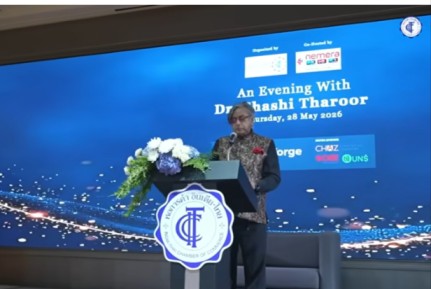
Read the full transcript of Dr. Shashi Tharoor’s address to the India-Thai Chamber of Commerce, May 28, 2026.
Editor’s Note: In this insightful address, Dr. Shashi Tharoor reflects on the evolving global landscape and the unique opportunity for India and Thailand to deepen their strategic and economic partnership. Highlighting their shared civilizational history and common aspirations, he argues that the two nations must move beyond traditional diplomatic ties to become anchors of stability and progress in the Indo-Pacific region.
Welcome and Opening Remarks
DR. SHASHI THAROOR: Thank you very much for the warm welcome, the garlands, the beautiful boat, and for the very, very generous and kind words I’ve already heard this evening. Distinguished members of the Indoratai Chamber of Commerce, various representatives of other chambers of commerce and of the government, all those who are here, distinguished business leaders, maybe simply just to say ladies and gentlemen, friends, I hope that covers everybody. Thank you all for having me here and I wish you all a very good evening.
I do think of it as a pleasure, a genuine pleasure to be with you here in Bangkok. The leadership of the India Thai Chamber of Commerce has been persistent for some time in asking me to come and they have really been extremely kind with their generous hospitality and warm welcome since I got here yesterday.
I must say an institution founded in 1944, before India itself became independent, carries with it not merely institutional memory but historical perspective, and in a world increasingly affected by, or afflicted by, short attention spans and an increasingly transactional diplomatic environment, such continuity really does matter greatly.
Bangkok: A City with a Civilizational Soul
You know, there are some cities in the world that announce themselves merely through skylines and infrastructure, but Bangkok possesses something much rarer, a civilizational soul. It’s at once ancient and modern, deeply rooted, yet remarkably dynamic. A city where gilded temples stand beside towers of global commerce, where tradition does not retreat before modernity, but actually converses with it.
As an Indian visiting Thailand, of course, one cannot help but feel not estrangement but familiarity, not distance but echoes.
I think Vedavayas has already mentioned Suvarnabhumi Airport, the very first sign for an Indian that he’s really some version of home. In fact, I was pointing out yesterday to friends that even the old name for Thailand, Siam, is actually from Sanskrit. It’s Siamadesha. And we all know about Ayutthaya being the ancient capital, coming from Ayodhya, and the fact that the kings of Thailand even today are actually known as King Rama. I think Rama the 13th currently, or 14th going on.
So it’s a long tradition and one which clearly connects the countries very, very well.
Setting the Stage: Soft Power and Global Uncertainty
Now we have a vast area to cover today, and the president has already done me the great favor of quoting me extensively on soft power. I’ve written and spoken too much on it already. So we agreed with the host that maybe I’ll leave that for the discussion period that will follow. We have a Q&A exchange.
I think he’s ably summarized the key concerns or opportunities that soft power represents and we can talk about that some more during our exchange and the talk. But at this time I thought it was important to begin with the era of profound global uncertainty in which we find ourselves, when the assumptions that shaped the international order for nearly three decades are being tested simultaneously by geographical rivalry, economic fragmentation, technological disruption, and renewed contests for influence and power.
The comfortable certainties of globalization have given way to a far more anxious and unpredictable world. And it’s precisely in such moments of transition that partnerships like those between India and Thailand acquire renewed significance, not merely as bilateral relationships, but as anchors of stability, progress, prosperity, and strategic balance in the wider Indo-Pacific region.
In fact, last year the two countries signed a strategic partnership agreement, and that means that we are now taking our relationship to an even more elevated level.
So I’d like to reflect not only on India’s place in the changing world, which as I was asked to do, but also on the opportunities before countries such as ours, nations with ancient civilizations, democratic aspirations, entrepreneurial energy, and a shared stake in ensuring that Asia’s future remains open, inclusive, stable, and prosperous.
The Erosion of the Post-Cold War Order
We meet, of course, at a moment when the international landscape is undergoing a profound transformation. The assumptions that shaped the post-Cold War world for nearly three decades are steadily eroding. The world that once spoke confidently of globalization, economic interdependence, and the seamless movement of goods, capital, technology and people now finds itself increasingly defined by barriers, strategic rivalry, protectionism and increased geopolitical uncertainty.
Today, economics and geopolitics cannot be viewed separately. Trade policy has become an instrument of strategic competition. Supply chains are being weaponized. Technology flows are being restricted. Tariffs have returned as tools of political leverage.
The language of globalization is gradually giving way to the language of resilience, strategic autonomy and economic security. We’re witnessing the consequences of the wars in the Gulf, the Iran War and Ukraine, simultaneously rising tensions in the Indo-Pacific, disruptions to maritime trade routes, renewed great power competition and the growing fragmentation of the global economic order.
Even countries long regarded as champions of free trade are increasingly turning inward, prioritizing domestic manufacturing, supply chain security and what is now fashionably termed friend-shoring or near-shoring. In many ways, the age of frictionless globalization is behind us. We’re entering an era of strategic interdependence where nations will continue to trade and cooperate, of course, but with far greater mutual mistrust and far sharper calculations of national interest.
Challenges and Opportunities for India and Thailand
For countries such as India and Thailand, this changing global environment presents both challenges and opportunities.
The challenge lies in navigating instability without becoming its captive. The opportunity lies in the emergence of a more multipolar world, one in which middle powers and regional actors possess greater agency than before.
India in particular has long believed in maintaining strategic autonomy in foreign policy. After 200 years of other countries deciding what we believed in the world, we would determine that nobody else would dictate to us.
So we engage widely but align selectively. We seek partnerships without dependence, cooperation without subordination, and dialogue without surrendering sovereign choice. In an increasingly polarized world, this ability to maintain relationships across multiple geopolitical axes may well become one of India’s greatest strategic advantages.
It’s precisely this changing global context that compels us to think more deeply about India’s evolving role in the world, the future of Asian economic cooperation, and the growing importance of partnerships like the one we have between India and Thailand.
India’s Place in the Changing World
It’s against this backdrop of global transition that India’s contemporary positioning acquires some significance. Today, India occupies an unusual place in the international system. We are simultaneously an ancient civilization and an emerging power, a developing country with developed world capabilities in several sectors, a democracy of continental scale navigating the opportunities and anxieties of the 21st century.
At a time when many regions are experiencing political polarization, demographic stagnation, or economic slowdown, India represents a rare convergence of scale, stability, and growth. Our economy continues to expand at one of the fastest rates amongst major nations. Our demographic profile remains comparatively young. Our median age is still 29.
Our digital public infrastructure has transformed financial inclusion and service delivery on a scale unprecedented in human history. We have the unique identification number given to 1.4 billion Indians. It’s quite an extraordinary thing. We have the UPI payment system, which is the fastest means of getting money from one bank account to another. Swifter than Swift, as we like to tell the Americans.
And our entrepreneurial ecosystem increasingly positions India not merely as a market, but as a source of innovation and talent.
India’s Strategic Autonomy and Multi-Alignment
India’s growing importance is not merely economic, though. It is also strategic. In an increasingly polarized world, India retains the ability to engage meaningfully across geopolitical divides. We maintain deepening relations with the United States and Europe, long-standing historical ties with Russia, expanding partnerships in the Gulf countries and with Africa, growing engagement across the Indo-Pacific and ASEAN. This is not inconsistency, it is strategic autonomy in practice.
For India, foreign policy has never been about choosing permanent sides. It has been about advancing national interests while preserving sovereign decision-making. In recent years, I have often argued that India’s real strategic advantage lies precisely in its capacity for what one may call multi-alignment. The ability to sustain multiple productive relationships across competing centers of global power without becoming excessively dependent on or vulnerable to any single one of them.
This approach is especially important in Asia. The rise of China has undoubtedly altered the strategic landscape of our region. China’s extraordinary economic transformation deserves acknowledgement, but its growing assertiveness, whether along contested borders, as with India, in maritime spaces, as with many countries in ASEAN, or through strategic infrastructure initiatives, has also generated legitimate anxieties across many parts of the Indo-Pacific.
But India is not interested in confrontation. We seek competition where it’s necessary, cooperation where it’s possible, and stability wherever it’s achievable. We believe that Asia’s future cannot be secured through dominance by any single power, but through equilibrium, mutual respect and adherence to international norms.
This is precisely why partnership with ASEAN countries, particularly Thailand, is so important for us. For India, Southeast Asia is not merely geopolitical theater, it’s an indispensable pillar of the emerging Asian balance. It’s a vital economic partner and a region with which we share deep civilizational and maritime connections.
Economic Diplomacy in the Modern Era
And that brings me, of course, to the growing importance of economic diplomacy in our time as well. Because if geopolitics naturally shapes economics, it follows naturally that economic diplomacy has become central to modern statecraft. Trade today is no longer merely about commerce. It’s about technology, about supply chains, energy security, critical minerals, digital infrastructure, semiconductors, logistics corridors, and strategic resilience. Economic decisions are now inseparable from national security considerations as well.
We are living through a period, as I mentioned, in which globalization itself is being redefined. Are we in a phase of deglobalization, of re-globalization? The jury is still out. For decades, efficiency was the governing principle of the global economy. Nations optimized supply chains for cost, speed, and scale.
But recent disruption, starting with the COVID pandemic all the way to the recent geopolitical conflicts and tariff wars, have exposed the vulnerabilities of excessive dependence on concentrated production networks and politically fragile trade relationships. As a result, many countries are prioritizing resilience over mere efficiency.
We see this clearly in the resurgence of protectionism across parts of the world, particularly in advanced economies that once championed open markets. Tariffs, industrial subsidies, export controls, and strategic restrictions are increasingly being deployed not merely to protect domestic industries but to pursue geopolitical objectives. For export-driven economies this creates profound uncertainties.
India’s Economic Strategy: Diversification and Value Addition
India itself has had to carefully reassess aspects of its economic strategy in light of these developments. Excessive dependence on a narrow range of export markets or low-value manufacturing leaves economies vulnerable to external shocks. The lesson for India is not to retreat from globalization, but to integrate more smartly into it.
Our objective must therefore be twofold, diversification of both markets and suppliers, and value addition. Diversification of markets to reduce economic vulnerability to any single region and diversification of capabilities so that India moves steadily up the value chain from low-margin manufacturing towards design, innovation, advanced technology, digital services, green energy, artificial intelligence, pharmaceuticals and sophisticated industrial production.
All of this is a transformation that is already underway. India today is not merely exporting goods, it’s increasingly exporting these capabilities, digital capabilities, technological talent, entrepreneurial innovation and development models. Our digital public infrastructure, which I’ve mentioned already, from financial inclusion systems to digital identity systems, is now studied internationally as an example of scalable governance.
At the same time, India’s large domestic market offers an important stabilizing advantage in a turbulent world economy. If you can’t sell abroad, sell at home. A growing middle class, expanding consumption, and rising technological adoption create internal economic momentum that complements external trade.
But no country can navigate this changing economic global order in isolation. In the years ahead, we’ll need partnerships, resilient regional partnerships. Supply chains will increasingly be regionalized. Connectivity will matter as much as production. Trusted partnerships will shape investment flows.
ASEAN: Central to India’s Strategic Vision
And this is where ASEAN, one of the world’s most dynamic economic regions, becomes indispensable to India’s long-term strategic and economic future. You’re not just a regional grouping for us. I would say that ASEAN is central to India’s strategic imagination of Asia.
The relationship has evolved considerably over the past three decades. What began in the early 1990s with our Look East policy, largely economic in orientation, has today matured into a more comprehensive Act East policy, which encompasses trade, connectivity, security, technology, culture, and maritime cooperation.
This evolution reflects a larger geopolitical reality. The future of the Indo-Pacific will depend and be shaped significantly by the stability, prosperity and strategic autonomy of Southeast Asia. ASEAN today sits at the crossroads of global commerce and geopolitics. Some of the world’s most critical sea lanes pass through your region. Major supply chains intersect here. The balance of power in the Indo-Pacific is deeply influenced by developments in Southeast Asia.
For India, ASEAN represents not only an economic opportunity but also a vital partner in maintaining an open, inclusive and rules-based regional order. India has consistently supported ASEAN’s centrality in the Indo-Pacific architecture. We do not view the region through the prism of block confrontation or any kind of zero-sum rivalry. Our vision is not of exclusive spheres of influence, but of cooperative multipolarity, where all countries, regardless of size, retain their sovereignty, their strategic space, their freedom of choice.
This principle is especially important at a time when smaller and middle powers increasingly find themselves pressured by larger geopolitical contests.
Connectivity and Civilizational Ties
India’s engagement with ASEAN therefore seeks to strengthen connectivity rather than dependency. Physical connectivity through initiatives such as the India-Myanmar-Thailand trilateral highway, maritime connectivity across the Bay of Bengal and the Andaman Sea, digital connectivity through technological partnerships which are increasing, economic connectivity through trade, investment, tourism, education, and innovation ecosystems. All of this, I think we can explore much further and take farther.
There’s a deeper civilizational dimension, of course, as we’ve already mentioned. Remember that the relationship between India and Southeast Asia was never in history one of conquest or coercion. It was a relationship only shaped by exchange, exchange of ideas, exchange of faiths, of commerce, of art, architecture and philosophy. Indian civilization traveled to Southeast Asia not in the baggage of armies, but in the minds of monks, traders, scholars, travelers. That legacy continues to give our contemporary relationships a cultural depth, rare in international affairs.
India-Thailand Relations: A Civilizational Partnership
At the same time, India recognizes that ASEAN nations pursue their own strategic interests with great sophistication and clarity. They do not wish to become arenas for great power competition either, and rightly so. India’s role, therefore, would not be, unlike other bigger powers, to impose their choices upon the region, but rather for us to expand our options within your region. In an area of geopolitical uncertainty, that may well be the most valuable form of partnership, and amongst all ASEAN countries, few are as naturally positioned to deepen this partnership with India than Thailand. I would say this relationship with Thailand is not only important strategically and economically, but civilizationally.
We are linked by far more than diplomatic protocol or commercial engagement. Ours is a relationship rooted in centuries of cultural familiarity and maritime interaction. From the influence of Buddhist tradition to the enduring resonance of the Ramayana, entire cultural life, from linguistic and artistic exchanges to shared spiritual inheritances, the connections between our societies predate the modern nation’s state itself. It was interrupted by colonialism, but we can rebuild it again.
Indeed, when one walks through Bangkok or Ayutthaya or Chiang Mai, one encounters not an alien civilization, but echoes of a shared Asian heritage, interpreted, of course, through a uniquely Thai genius sensibility and accent, which sometimes, perhaps, makes Indians think that what is familiar is not that familiar because they don’t understand it when they heard it said. But when they read it, they realize where the origins of these terms come from.
The very vocabulary of kingship, of spirituality, of art, of classical literature in Thailand bears testimony to the centuries of intellectual and cultural exchanges that have taken place across the Bay of Bengal. These links, as I said, were never forged through conquest. There was never Indian colonialism in this part of the world, always through contact. And therefore, the merchant scholars, travelers, monks who came here, they built bridges of understanding long before modern diplomacy institutionalized relations between states.
The Untapped Potential of India-Thailand Partnership
While history has given our relationship depth, the future now I would argue demands even greater ambition. I would argue that the truth is that India and Thailand remain in many respects under-developed in their partnership relative to their potential. Thailand stands today as one of Southeast Asia’s most dynamic economies, a major manufacturing hub, a gateway to ASEAN markets, and a country with impressive capabilities in tourism, we all know that, logistics, food processing, health care, hospitality of course, electronics, and advanced industry. India meanwhile offers scale, talent, technological capacity, a rapidly expanding consumer market and growing manufacturing and digital ecosystems. There’s compatibility right there.
The complementarities are not just obviously visible, they’re compelling. And increasingly, I would argue that the uncertain global economic environment strengthens the case for closer collaboration between our two countries. The trade imbalance is of course very much in Thailand’s favor. I think you export $11.6 billion to us and we only export $4.203 in exports from our country to yours. But the truth is there’s a tremendous potential.
India obviously has extra incentive to try and redress the balance. That gives us perhaps a greater compelling need to see this partnership strengthened, but at the same time we believe we can be useful to Thailand in the process. As international supply chains undergo restructuring, businesses across the world are seeking reliability, diversification, regional resilience and trust. This creates a historic opening for our two countries to position themselves not as isolated national economies, but as interconnected partners within a wider Asian growth architecture.
There’s a tremendous scope for deeper cooperation in renewable energy, for example, pharmaceuticals, where India has a significant lead, digital technologies, FinTech, Education, where you already have made some advances, as we have. Healthcare, again, in different ways, we both have. Tourism, where we can probably learn a lot from you. Food processing, logistics, semiconductors, and advanced manufacturing. So all of these areas could be explored very much farther.
Thailand’s industrial sophistication and connectivity to ASEAN markets complement India’s strengths in technology and digital infrastructure and innovation and of course what one thing we have, human capital.
Digital Economy and Tourism as Pillars of Engagement
The digital economy in particular offers exciting possibilities because our success in building the large scale digital public infrastructure I talked about, digital payments, financial inclusion systems and so on, can be of great use to you too. 19 countries have signed up to our UPI scheme. Thailand could think about that. Thailand has already emerged as one of Southeast Asia’s most innovative digital economies. And I know the government is spending money to support it, but imagine if we had collaboration in fintech regulation, in cyber security, in e-commerce ecosystems, in startup incubation, and in smart city development, we could become truly a new important joint pillar of bilateral engagement.
And tourism, of course, is not just a commercial activity, as we all know, it’s also an instrument of cultural diplomacy and economic integration. Millions of Indians already visiting Thailand every year, drawn not only by your hospitality and the natural beauty of your country, but by an intuitive cultural comfort. Equally, I would argue that India also offers enormous opportunities for Thai tourism that have not been developed. You’ve got people flying to the Buddhist circuit in Bodh Gaya, but that seems to be the limit of Thai tourists’ adventures in India. There’s so much they could come for. Of course, our own country’s natural wonders, our historic sites, our wellness industries.
We’ve talked about Buddhist pilgrimages, that’s fine, but what about medical tourism? What about cultural experiences? What about even educational exchange? Thai students in Indian universities and Indian students here. Enhanced connectivity, physical, digital, and cultural can all significantly deepen people-to-people ties between our two countries.
Connectivity, Maritime Cooperation, and Regional Architecture
Connectivity itself will play a transformative role in the coming decades. Prospects and projects such as the highway that I mentioned, the trilateral highway, it’s been slow in coming up because of the Myanmar situation, but they do carry great significance even beyond infrastructure. They would, when completed, represent the physical realization of a larger strategic vision, the seamless integration of South Asia with Southeast Asia by land. For India, particularly for our northeastern states, improved connectivity with Thailand and with the rest of Asia and through Thailand can become a powerful engine of economic growth, trade expansion, regional development.
One must remember that connectivity is never just about roads and ports. It’s about opportunities. When you’re connected, more opportunities open up. It’s about enabling commerce, tourism, investment, educational exchange, human interactions. Infrastructure at its best is diplomacy in concrete and tar. It can be done, and it should be.
Maritime cooperation similarly deserves far greater attention than it often receives. The Bay of Bengal and the Andaman Sea are no longer peripheral maritime spaces. They are rapidly emerging as strategic corridors of commerce, of connectivity, energy flows, security cooperation within the wider Indo-Pacific region. As geopolitical competition intensifies across maritime Asia, India and Thailand share a common interest in ensuring that these waters remain open, stable, secure, and governed by international law.
This naturally creates opportunities for deeper collaboration in maritime security issues, blue economy initiatives, coastal sustainability, humanitarian assistance in the region, disaster relief coordination, marine research and environmental protection. Why haven’t we done all this yet? We still can. Climate change also represents, respects no national borders, rising sea levels, extreme weather events, ecological degradation are threatening all coastal societies alike, yours as well as ours. You’ve had a tsunami, we’ve had a tsunami. We’ve had problems in both our countries.
Regional cooperation, I think, is therefore not an option for us. And this is also why BIMSTEC has grown in importance for India. We’ve had to deemphasize the South Asian Association because of geopolitical problems with our Western neighbor. But in the East, BIMSTEC has actually meant we’ve been able to solidify our partnership with Thailand in a larger sub-regional grouping.
Equally important is the role of institutions such as the India-Thai Chamber of Commerce, which serve not merely, I would say, as commercial facilitators, but as bridges between our societies. Governments may create frameworks and agreements, but it’s all of you – entrepreneurs, innovators, investors, and institutions like this ITCC that actually transform diplomatic goodwill into tangible economic benefits.
In many ways business communities often move faster than governments. They identify opportunities before policymakers fully recognize them. They build trust through practical engagement. They create networks of familiarity and confidence upon which enduring partnerships are ultimately constructed. The fact that you are here is an advantage to both governments if they want to get closer.
So I believe the time has come now for India and Thailand to think ambitiously. Our relationship should not be confined to managing existing ties. It should aspire to shaping the future architecture of Asian cooperation itself. Geography has made us neighbors across the Bay of Bengal. History has made us civilizational partners. The demands of the 21st century that I’ve described to you must now make us strategic collaborators in shaping the future of the wider Indo-Pacific region, and if we approach this partnership with sufficient imagination and ambition, I have little doubt that the best chapters of the India-Thailand relationship still lie ahead of us.
India’s Vision for the Indo-Pacific
Now, of course, we’re hearing a lot these days, particularly from foreign capitals, about the Indo-Pacific, sometimes so much so that the risk is that the phrase itself becomes more a slogan than a strategy. For India, however, the Indo-Pacific is not an abstract geopolitical construct coming out of Washington think tanks. It is a lived geographical reality. Our trade, our energy flows, our maritime security, indeed much of our economic future depends on the stability of these waters stretching from the eastern coast of Africa to the western Pacific.
Nearly all major Asian economies are connected through the maritime space within the Indo-Pacific. Disruptions anywhere along these routes, whether through conflict, coercion, piracy, or instability, reverberates across global commerce. We have seen this repeatedly in recent years, from supply chain disruptions during the pandemic to growing anxieties over maritime checkpoints and freedom of navigation.
India’s approach to the Indo-Pacific is guided by a few simple principles. First, the region must remain open and inclusive. No country should seek dominance over the Indo-Pacific, and no nation, large or small, should be denied the opportunity and the freedom to pursue its legitimate interests. Second, sovereignty and territorial integrity must be respected. Rules cannot apply selectively depending on the size or power of the country involved. Third, connectivity initiatives must be transparent, financially sustainable, and mutually beneficial. Infrastructure should strengthen regional prosperity, not create unsustainable dependencies.
And finally, maritime cooperation must extend beyond security alone. The Indo-Pacific is not just a theatre of strategic competition, it is also a space for collaboration on disaster relief, on climate resilience, on sustainable development, and of course on blue economy initiatives and humanitarian assistance, all of which we needed to do at different times with Myanmar, parts of Indonesia and so on, and we could do together in so many ways.
India’s own vision articulated through initiatives, one that we call SAGR, which actually means sea, but also stands as an acronym for Security and Growth for All in the Region, reflects precisely this philosophy. We seek partnerships that enhance collective stability rather than deeper rivalries.
I believe countries such as India and Thailand have a particularly important role to play in shaping this balance. We are not revisionist powers seeking to overturn the international order through force, nor are we passive observers of other people’s efforts to transform our region. We are stakeholders in an Asia that remains stable, multipolar, connected and prosperous. Perhaps that is a critical challenge before our generation of policymakers and business leaders alike, ensuring that the Indo-Pacific emerges not as a battleground of competing hegemonies, but as a cooperative space where commerce flourishes, sovereignty is respected and strategic equilibrium prevails.
India’s Pluralism as a Strategic Asset
In the final analysis however the nation’s influence in the world is shaped not only by the size of its economy or the strength of its military, but also by the power of its example. One of India’s greatest strengths has always been its extraordinary pluralism. Few countries of continental scale have attempted, with all the imperfections and complexities inherent in democracy, to accommodate such immense diversity of languages, faiths, ethnicities, cultures and traditions within a single constitutional framework.
This diversity, I believe, is not a weakness to be managed. It is a strategic asset to be protected and to be promoted. It gives India a unique capacity to engage across civilisations, across regions, across political cultures. It strengthens our soft power as the President mentioned earlier this evening. It enhances our credibility in the developing world and it enforces the moral authority with which India speaks on issues of democracy, sovereignty, and international cooperation.
I’ve often believed that India’s civilizational confidence comes not from uniformity, but from the coexistence we celebrate, from our ability to absorb influences without losing our identity, and to remain open without becoming rootless. That openness has long shaped India’s engagement with the world. Whether through our diaspora, our educational institutions, our cultures, our technology sector, or indeed the global affection that exists for Indian cinema, Bollywood, cuisine, yoga, and literature, India’s international presence extends well beyond our formal diplomacy.
Soft power, of course, can never replace hard power, but in an interconnected world it undeniably amplifies influence. Thailand too understands the importance of balancing tradition with modernity, heritage with innovation. Perhaps that is one reason our societies instinctively relate to one another.
At a time when many parts of the world are turning inward, becoming more polarized, more protectionist, and sometimes more intolerant, countries such as ours carry a special responsibility to demonstrate that economic progress and cultural openness need not be contradictory. That national pride need not require hostility towards others, that stable societies are built not through exclusion, but through confidence in the strength of their own institutions and civilizations.
The Rise of the Global South
As the international order undergoes strain, we’re seeing the important shift of the visibility and growing assertion of the so-called global south. For too long, the concerns of developing countries were often treated as secondary in global decision making. Issues such as debt vulnerability, unequal access to technology, climate injustice, food insecurity and developmental financing rarely receive the urgent attention that they really deserved. Yet for billions of people across Asia, Africa, Latin America, these are not peripheral concerns, they are existential ones.
India’s Role in the Global South and the India-Thailand Partnership
India sought in recent years to articulate these concerns with greater clarity on the international stage. Whether during our G20 presidency or in discussions on climate responsibility or in conversations about reforming multilateral institutions like the UN, India has consistently argued that the world cannot be governed effectively through frameworks designed for a very different era. The voices of emerging economies and developing societies must carry greater weight in shaping global outcomes.
But leadership in the global south cannot merely be rhetorical. It must also be practical. It requires building development partnerships, sharing technological capabilities, expanding educational opportunities, strengthening healthcare cooperation. Many of you will remember India’s vaccine diplomacy during COVID, when many developing countries received vaccines from India. Creating more equitable economic arrangements. So India’s development partnerships across Africa, the Caribbean, Southeast Asia, the Indian Ocean region, all this increasingly reflects the philosophy I’ve tried to summarize for you.
And there I would say India and Thailand have an absolutely indispensable opportunity. We may not individually command the overwhelming military or economic dominance of certain major superpowers, but collectively we can shape norms, institutions, and regional stability through cooperation, credibility, and strategic moderation.
Indeed, one of the defining features of the emerging world order may well be the growing importance of countries that can build bridges rather than build blocks. Countries capable of engaging across divides, reducing tensions, and creating spaces for constructive engagement amid increasing polarization. That, I believe, is where our two nations can make a meaningful contribution to the future of Asia and indeed of the wider world.
I think we are taking more time than I intended to, so I will try and bring this to a conclusion. We’re all like Egyptian mummies. We are strapped for time.
Navigating a Period of Global Transition
So let me just say that, in my view, history rarely moves in straight lines. Periods of stability are often followed by moments of turbulence, moments of uncertainty, in turn, create opportunities for renewal and reinvention. We are living in many ways through such a period today.
The international order is becoming more fragmented, as I said. Economic nationalism is rising. Strategic rivalries are intensifying. Technology is transforming societies faster than governments can regulate them. And across much of the world, there is a growing anxiety about what the future may hold.
But Asia, despite all its complexities, remains one of the great centers of optimism in the 21st century. This is where growth is taking place, this is where innovation is accelerating, and this is where new ideas, new markets, new technologies, and new generations are shaping and reshaping the global economy.
Within this larger story, it is an Asian story. Countries like India and Thailand have a particularly important role to play. We’re not just the inheritors of ancient civilizations I’ve celebrated today. We’re also participants in building the future for those who inherit it from us.
A Forward-Looking India-Thailand Partnership
The India-Thailand relationship therefore cannot remain confined to ceremonial goodwill or periodic diplomatic engagement. It must evolve into a genuinely forward-looking partnership, one that connects our economies, strengthens our maritime cooperation, expands educational and technological exchanges, deepens our cultural understanding, and creates opportunities for the next generation of entrepreneurs, of innovators, scholars, citizens, tourists.
And of course, young people are indispensable to this transformation. The future of our relationship will not ultimately be shaped only in government ministries or diplomatic meetings. It will be shaped in universities, in startups, in research labs, in digital platforms, in investment corridors, in tourism networks, and in people-to-people exchanges.
It will be shaped by young Indians and young Thais, who increasingly see one another not as distant neighbors, but as partners in a shared Asian future. That is what I would argue can be the most encouraging aspect of our present moment. For all the anxieties surrounding geopolitics that I’ve described, the extraordinary possibilities are also extremely inspiring. Never before in human history have nations possessed such a capacity for connectivity, for collaboration, for shared prosperity. The challenge is of course to ensure that wisdom keeps pace with power.
A Vision for the Indo-Pacific
I believe deeply that the Indo-Pacific region need not become an arena of rivalry and competition. It can and should instead become a model of cooperative coexistence, a region where economic growth is matched by strategic stability, where connectivity does not produce dependence, where prosperity is shared, not hoarded.
India’s own vision for the future remains anchored in precisely this belief that progress is most sustainable when it is inclusive, that partnerships are strongest when they are based on mutual respect, stability is best preserved when nations retain both confidence in themselves and openness towards others. Thailand with its remarkable resilience, sophistication and strategic importance will undoubtedly remain an essential partner for India in that journey.
As we look ahead, therefore, let us not think merely in terms of agreements signed or trade volumes achieved, though we’re going to try and improve those trade volumes. Let us think instead in terms of the larger arc of history that we wish to help shape together.
A century from now, perhaps, when future generations look back at this period of global transition, I hope they will say that our two nations responded not with fear, narrowness, or retreat, but with confidence, imagination, and cooperation. Because ultimately the future does not belong to nations that isolate themselves from the world. The future belongs instead to those with the courage to engage constructively, the wisdom to navigate it prudently, and the vision to shape it collectively.
India and Thailand, as I’ve tried to explain during the last 40 minutes, are fully capable of doing exactly that. Thank you very much. I look forward to the question.
Related Posts