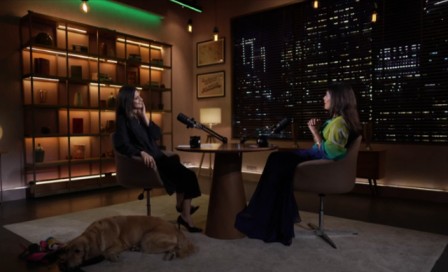
Editor’s Note: In this insightful episode, prominent journalist Palki Sharma joins India, Russia and the World with Runjhun Sharma to discuss the increasingly fractured state of global politics, covering topics from the rise of China to the limitations of American military power. She also addresses the persistent anti-India bias she perceives in Western media and introduces her new venture, India Global Review, which aims to shape India’s narrative on the world stage. (June 11, 2026)
TRANSCRIPT:
Introduction
RUNJHUN SHARMA: One of the most prominent, popular, recognized journalists in India. She’s all over your feed, and once you start watching her, you cannot stop. Palki Sharma, welcome to India Rush In The World.
PALKI SHARMA: Thank you so much, Runjhun, for having me here.
A World in Chaos
RUNJHUN SHARMA: In your two decades as a journalist, have you ever seen the world so chaotic, so broken?
PALKI SHARMA: The short answer is no. I think the fracture is very, very evident and real now. You know, post the Second World War and then the Cold War, we were in what was called the Long Peace, and there was a sort of a system in place. But that has ruptured, and it is happening with the rise of China, with America going with Donald Trump not once but twice as president, with the wars that we see.
A lot of people like to write about this being the end of globalization. It’s not necessarily the end of globalization, but we are looking at the flip side of globalization. We are so connected that anything happens anywhere in the world and it impacts you whether you like it or not. Technology has made distances and borders irrelevant in a lot of ways.
You don’t have a lot of adults in decision-making chairs anymore. What do I mean? I mean, you have a man-child in Washington, D.C., you know, you have presidents who are acting up, who start a war and don’t know how to end it. So no, like I said, the short answer is no, I’ve not seen things so chaotic, unstable, and divided.
A New World Order
RUNJHUN SHARMA: So where do you think the world is heading? Is it heading towards more chaos, or is it a kind of reset that we are talking about?
PALKI SHARMA: It’s settling into a new order, I would say. You know, you cannot wish away the rise of China. It is happening. The fact is that there is no other manufacturer like China that can deliver on the scale at which China does. So that is one challenge.
And we only talk about trade when we talk about the integration of the world. We do not talk about financial integration. The fact that Russia had billions of dollars parked in financial entities in Europe and elsewhere, the fact that Iran has assets which were frozen, the fact that Afghanistan had assets which were frozen, the fact that China has invested so heavily in US Treasuries and bonds. So this financial interconnectivity and interdependence is very real.
The labor interdependence, this whole talk of not having immigrants, but immigrants have built countries. You cannot go back to a clean slate and say, okay, now this country is for these people only.
There is a fracture and the world will increasingly go into camps where you have the US and its sphere of influence, you have China and its sphere of influence, you have middle powers like your India, France, and other countries. And whether we like it or not, we will be drawn into these spheres and we have to see where we want to pick sides, where we want to stand our ground. It’s not going to be easy, but that’s what more and more countries and governments will have to do going forward, according to me.
India-Russia Relations
RUNJHUN SHARMA: And how strategic would you say is the New Delhi-Moscow friendship in this new world that we are talking about?
PALKI SHARMA: I think it’s one of the few relationships that has stood the test of time. You know, for every country, for every leader, the first focus has to be your national interest. And when you meet a partner whose interests align with yours, then you work together and then there is an understanding.
The fact is that India and Russia have been — because, you know, during the Cold War, India talked about non-alignment. Now we talk about multi-alignment. We do work with very many partners. And yet the relationship with Russia has endured because there is a maturity in the understanding that we will do things. Russia will partner with China on a lot of things, even though India remains uncomfortable with the idea, because Russia is also the biggest arms supplier for India even today, despite the diversification. India understands that, right?
RUNJHUN SHARMA: Recently we saw President Putin visit China. There’s always this — India’s watching that visit. But India is also uncomfortably looking at Mr. Xi and Mr. Putin shake hands.
PALKI SHARMA: It is an uncomfortable proposition because there is one country that you depend on for your defense supplies, despite the diversification, like I said. And there is another country that poses the biggest military challenge to you at your border. And these two countries claim to have a “no-limits partnership.” So you have to sit down and think, what if a situation were to arise.
And we saw during Galwan, and it was a difficult time. It tested the relationship. And yet, like I said, it endured because there is a level of maturity.
America and the Rules-Based Order
RUNJHUN SHARMA: The US has built this post-war rules-based order, and now it’s the US that is bombing sovereign states, it’s kidnapping leaders, it is bullying allies on trade. So Palki, would you say that the US is breaking this rules-based order that it had once created?
PALKI SHARMA: The rules were always for other people.
You know, the US made the rules, but did the US follow those rules? I think it’s as mythical as the US Army fighting aliens in Hollywood films, right? So the US has always bent rules to suit itself.
RUNJHUN SHARMA: Are we living through the first real post-America moment? And has America’s dominance seriously been challenged or damaged, would you say?
PALKI SHARMA: There is no taking away from the fact that the US even today is the biggest military power in the world. It’s the biggest economy in the world. It is still miles ahead of competitors when it comes to technological advancement. Those are all facts.
I think what has cracked is this veneer of invincibility. The world has begun to entertain ideas that there could be an alternative, and we need to explore that. The dollar will remain the big currency for the foreseeable future, but the very talk of de-dollarization unsettles Washington, D.C.
And you mentioned the wars. I think those wars have shown the Americans — if they’ve not understood, I don’t know if they’ve understood — but those wars have shown them the limits of their military power. You can drop bombs left, right, and center and yet not win. You know, in this latest conflict with Iran, the US is losing as I see it.
Iran’s Resilience and West Asia
RUNJHUN SHARMA: Do you think Iran’s response, its resilience, has shaken the image of America’s military invincibility?
PALKI SHARMA: I think the Americans thought that Iran will be a Venezuela. Iran is not a Venezuela. You cannot go and abduct their president or kill their president and then have the rest of the system succumb to you. Iran prepared for this eventuality for more than two decades. They have eliminated the top leadership, and yet today at the negotiating table, Iran’s hand is stronger than it was. So Iran is definitely bruised and battered, but in terms of the political outcomes of this war, Iran has emerged stronger.
RUNJHUN SHARMA: How has the Iran conflict reshaped West Asia and America’s position within it?
PALKI SHARMA: I think Iran has lost the strategic depth that it used to have, with its proxies also coming under attack and Iran not being able to protect a lot of them. And I’m not talking about the last few months, I’m talking about the last few years. What has happened with Hamas and Hezbollah and the Houthis, and there’s been a lot that’s going on.
The Arab players who built an economy on the promise of being an oasis in an otherwise troubled region, including kingdoms like the UAE, cities like Dubai, will have to again figure out. So there’s a lot on that front that’s going on.
But like I said, the USA played the role of the major security provider of the region for a lot of its partners. That role is now under doubt because a lot of these countries now see themselves as having come under attack because of that association.
There are larger strategic ramifications of America’s engagement here, and it was an ill-thought-out military offensive where they thought they’ll be able to wrap it up. Then they couldn’t figure out whether they wanted to launch a ground offensive or just keep bombing the country and hoping that they would succumb. And it’s become such a mess.
You know, it’s going to take a lot of time for this to settle. And once it does, then the rest of us will have to figure out what it means for us, because those oil wells, those supply chains, all those routes will take forever to be up and running.
India’s Energy Vulnerability
RUNJHUN SHARMA: Also, global energy markets, they’re rattled since the US-Israeli strikes on Iran. How vulnerable is India, Palki?
PALKI SHARMA: Very. Oil shocks are not just the numbers that you see on a petrol pump. So inflation goes up. Cost of living goes up. A lot of people in India cannot afford that. So the government has to insulate them. It has to cushion the blow.
But we are seeing hikes now. And so everyone’s complaining. People are complaining because they’re going to have to pay more. Oil companies are complaining because there is massive under-recovery. The government is trying to figure out how this is going to happen. India is in a very vulnerable position.
India-US Relations and Trump
RUNJHUN SHARMA: Trump has been openly harsh towards India of late. Tariff threats, the “hellholes” and all of that. Some say, Palki, that while India’s response has been very measured and polite, but it’s also seen as meek by some. How do you see it?
PALKI SHARMA: So the short answer is that discretion is the better part of valor, as they say. India is a mature player. We do not believe in conducting diplomacy through Twitter or Truth Social. In Trump-led America, policy is more a factor of his mood swings than any sort of well-considered position.
We must also remember that the policymakers in India cannot not keep in mind the fact that the US remains our biggest export market. But India stood its ground where it had to. When the US president tried to take credit for getting the ceasefire post Operation Sindhu, India said no, the Americans had nothing to do with it.
Trump is used to people massaging his ego, I think. Including our neighbors to the west. We did not play that game. And I think that’s what upset the Americans a lot more than anything else.
For Donald Trump, you should look at his actions because words are cheap and there are too many of them. There are too many posts, there are too many statements. You can’t make sense of it. There is somebody on Twitter who tracks Trump and has sort of become a bit of a celebrity because he knows all things Trump.
RUNJHUN SHARMA: Wow.
PALKI SHARMA: Yeah.
RUNJHUN SHARMA: Not having a mental breakdown, I hope, huh? So it’s a kind of strategic patience that India has shown, you would say? Dealing with Trump.
PALKI SHARMA: What other way would you handle something like this? You want the trade deal. You want your exports to keep going. Millions of Indians living and working in the US, students there, businesses that are impacted. There are no immediate alternatives. You have to make it work.
India, Russian Oil, and Western Hypocrisy
RUNJHUN SHARMA: India has been buying Russian oil, cheap Russian discounted crude oil ever since the war in Ukraine started. And India never asked anybody’s permission to do so. Yet the US has been pressurizing India, threatening India, and so on and so forth. Palki, why do you think that America believes that it gets to decide where India buys its energy from?
PALKI SHARMA: So India actually did the world a favor by buying Russian oil and stabilizing global oil prices. And I repeat, this is a matter of record. So the Americans actually, in the beginning, urged India to keep buying, while the Europeans kept virtue signaling and saying what the Ukrainians said — “you have blood on your hands” — and so on and so forth. And while they themselves are buying Russian gas, by the way. So the hypocrisy is unbelievable.
And then suddenly you feel that there isn’t enough pressure on Russia after you’ve hosted President Putin, after you’ve sort of stood on that red-blue carpet forever waiting for him to get off his plane and you’ve done whatever you want to do and it’s not worked and you’ve been played like a fiddle. Then you turn to India and say, “Oh, it’s because of you guys.”
You know, the truth is not lost on anyone. Everyone sees what’s going on here. The first responsibility of Indian policymakers is towards Indians. They have to see what is in their national interest. In their national interest, it was very important to keep oil prices low in a post-pandemic world so that the economy could grow. That is what the Indian leadership tried to do, and they continue to do it.
The Islamophobia Narrative Against India
RUNJHUN SHARMA: The Western media and some Western politicians, they insist on calling Mr. Modi and India broadly Islamophobic. India is home to over 200 million Muslims, the third largest Muslim population in the world. So where is this very strong narrative coming from?
India’s Place in the World — Bias, Belonging, and the Narrative Gap
PALKI SHARMA: I think that a lot of people in the West do not, A, understand India, and B, do not want to understand India because it doesn’t suit them. So it’s a mix of both. It’s a mix of ignorance and agenda.
I always say that today companies and countries talk about DEI— diversity, equity, inclusion. We had DEI baked into our culture when we became a nation-state in 1947. As a civilization, we always had it. But when we adopted the modern structures of statehood and we became an independent country, we believed in diversity and inclusion. A lot of homogeneous societies in the West have not understood.
It’s very easy to sit 5,000 kilometers away and say, treat your minorities well, but you won’t be able to take immigrants. You can’t take immigrants from countries that you plundered and left impoverished after years of colonization. So I think that you have to walk the talk first.
The fact that America is still dealing with racism, the fact that Europe is grappling with the idea of appearing to be open-hearted but not being able to assimilate with immigrants says a lot about how open they are. I’m not saying that India is perfect. Let me borrow from Secretary of State Marco Rubio’s words, who was in India recently, and he said, “There are stupid people everywhere.” And they do stupid things. There are stupid people in India too.
So that is not to say that India doesn’t have— we have problems. We are a country of 1.4 billion people. We’re bound to have problems. Two siblings fight. When we are a country of this size, there will be challenges. But we have remained a cohesive society by and large. And that is our strength. And that is something that the world should learn from.
Press Freedom Rankings and What They Really Say
RUNJHUN SHARMA: India ranks 157 out of 180 on the Press Freedom Index. This is below Pakistan and Bangladesh. Are these rankings giving you sleepless nights, Palki? Are you losing sleep over it?
PALKI SHARMA: No, I love every time one of these reports comes. So there was a democracy index. India ranked below Niger in Africa in democracy. Niger had, or has, continues to have a military junta. They jailed their president, but they are a better democracy than us. Kuwait was a better democracy than us, and that was the year when Kuwait had dissolved its parliament because some lawmakers said something about the Emir.
There’s something called the Happiness Index. Pakistan ranks above us— broke, infested by terrorism. Ukraine ranks above us. Myanmar ranks above India in the Happiness Index. This is a country that has been living with the aftereffects of the coup and the junta and the civil war and everything that’s going on there. Palestine ranked above us. I mean, what does that say about that index? Our Press Freedom Index— the Taliban’s Afghanistan ranked above us. I mean, clearly they don’t understand this country or they don’t want to understand.
So to your question, no, it does not give me sleepless nights. But we should also understand why someone is trying to portray you in a certain light. And this is not just a political argument anymore. When the press constantly describes you as an unsafe country, it has a bearing on whether a business wants to invest in India, whether someone wants to come and study in India, whether people want to come and work in India when the only thing they read are negative stories about India.
RUNJHUN SHARMA: Yeah.
PALKI SHARMA: They will not want to go and do anything. So these are not just political points anymore. They have real-world implications. So we should challenge where we are being wrongly portrayed.
The Roots of Western Media Bias Against India
RUNJHUN SHARMA: And this portrayal of India by the Western media, where is it coming from? Is this not understanding India enough? Is this deep-rooted bias towards India? Or is it hate? Because let’s face it that the Western media does not just hate, say, Narendra Modi. They’ve hated Indira Gandhi. They’ve hated Manmohan Singh. They’ve hated their diplomats in the UN. So what is this?
PALKI SHARMA: Let’s leave the politics. And I agree with most of the points that you made. When we had a big win in space— you know, I remember that. You remember that cartoon, right? So that bias is so ingrained that they— there was recently a cartoon, they still see India as the land of snake charmers.
RUNJHUN SHARMA: Narendra Modi is that snake charmer.
PALKI SHARMA: It is so problematic.
RUNJHUN SHARMA: Yeah. And racist. And racist.
PALKI SHARMA: And to want to not acknowledge anything that a country like India may have achieved. We are supposed to be an exotic land, troubled and exotic. Anything more than that is a lie. It makes for an interesting study. You should look at the requirements when they recruit correspondents for international media in India. It very clearly says— I think it was the New York Times, someone— that you have to be able to challenge government agenda. And so they are looking for people of a certain ideological dispensation.
RUNJHUN SHARMA: What is that?
PALKI SHARMA: That you have to be able to question the India story. I remember doing a story post the Pahalgam attack. 8 out of 10 stories in the international press, all 10 basically talked about Pahalgam as related to Kashmir and not a terrorist attack, which was problematic. It was a terrorist attack. 8 out of 10 were written by Pakistanis in international newsrooms. What is the level of fairness that you expect from them?
So I think the bias is very deep-rooted and there is no desire to understand India better, or if there is, maybe there are very few cases, very few and far between.
The “Gunman” Terminology and Double Standards
RUNJHUN SHARMA: And what’s with the “gunman” terminology, not using the word “terrorist” but “gunman”? And I’ve spoken to some journalists who work for international organizations here in India. They don’t really agree with it, but they say that they have to, under pressure, because of the policy.
PALKI SHARMA: We keep showing attacks and violence in Africa, in Afghanistan. It’s perfectly okay. There was a gun attack in New York. In this particular case, the pictures were quite explicit, and we got a notice from a regulator somewhere in Europe that you cannot show this. So it’s okay to show gun violence in Sudan, but New York, you can’t show. So again, that’s also a thing. One person’s terrorist is another person’s freedom fighter. Terrorism and hatred knows no boundaries.
Gen Z Movements and the Threat of Orchestrated Unrest
RUNJHUN SHARMA: In the recent years, Gen Z-led movements have overthrown governments— started with Sri Lanka, then Bangladesh, then Nepal. Some say that they were spontaneous, but there’s also enough evidence that they weren’t. They were orchestrated, at least in some parts. Could something similar happen in India, or do you think they would try to do something similar in India?
PALKI SHARMA: I’ll start with the last question. I wouldn’t put it past them. And by them, I mean any player who wants to trigger trouble can do it. The US, for instance, and this is again a matter of declassified records, during the Cold War, they were involved in more than 75 covert and overt regime change operations. It’s like their KRA. Which regime did you change this year? Or which one did you try to change? Those things very much happen.
I think we obsess with land borders a lot, but today infiltration is happening through your phone screen, through your social media that is directly reaching your youth. Those challenges are very real.
Are we there in India yet? No, I don’t think so. And I think that— see, if you’re referring to our neighbors, there were serious challenges in Sri Lanka when the economic collapse happened, very serious. Nepal, I understand— I don’t agree with everything that the youth of Nepal has said and done, but I understand their angst because they’ve seen democracy since 2008 and they’ve never seen any government complete its term in office, ever. Anyone who’s 20 years old today or 18 years old today would think that democracy doesn’t work, and which is why a lot of people protested and said, we want the monarchy back, because they have no understanding of history. They should read history.
So I think the problems were there. Did someone see an opportunity in those problems and try to instigate? Possibly. I have no proof. Could the same happen in India? We are not there. But like I said, India has its own issues. We need to gainfully employ a lot of our young people. We need serious reform in education. Those are undeniable facts. But will that lead to a revolution? I really doubt.
I think it’s good for young people everywhere to have a bit of a revolutionary streak, because if you’re 18 and you don’t believe you can change the world, then what’s the point of being 18? So I think it’s okay. I think for people to be more involved in politics, to have political opinion, to be associated with— people should dabble. Do I see it as a threat? No. We are a very structurally, a very solid country. We are not a Sri Lanka, we are not a Nepal, we are not a Bangladesh.
The Problem With Indian Media
RUNJHUN SHARMA: We’ve spoken about the Western media, sections of it being problematic. But let’s talk about the Indian media also for a second.
PALKI SHARMA: Yes. Why do they shout so much? I have no idea.
RUNJHUN SHARMA: How did you decide not to shout?
PALKI SHARMA: The same studio. I’ll tell you a story. This is almost, what, 20, 18 years back. There was some— was it a flood in Bihar? Something happened. And I used to do these breaking news afternoon bulletins where everything’s breaking news. So we got something that the death toll had gone up or something happened. And then I talk like that. I’ve always talked like that.
RUNJHUN SHARMA: I remember.
PALKI SHARMA: Yeah. So I finished that thing and then I went back to the newsroom and I saw a mail in my inbox from a very senior person. With one line, “Are you bored of a catastrophe?” And then to ask what happened, they said, “We need more urgency.” I said, “But I gave the numbers. These were people who died. What did you want me to do?” “No, we wanted more urgency.”
Why do people shout? I think that I would blame the people who lead newsrooms for this, not so much the anchors and the reporters, because they have to, in most cases, do what they’re told to do. But I think the people who lead should know that shouting does not help you make a better point and that this is not the way to attract an audience. To have 50 different elements on your screen does not make for a good viewing experience. So cut it down.
India Global Review — Owning India’s Narrative
RUNJHUN SHARMA: You’ve launched India Global Review, your new venture, Palki. Tell us more about it. What’s your vision there?
PALKI SHARMA: What we want to do is truly present India’s perspective and cover the world through an Indian lens. Last year, when Operation Sindoor happened, it came as such a shock. We won the military battle, and yet somewhere we lost the story. So instead of the world appreciating the fact that India had shown the kind of precision and restraint, we had a situation where India was sending members of parliament to the whole world to tell them why we had to do what we had to do.
And I thought to myself that there is such a big strategic gap in narrative building here, in telling our side of the story, our view to the world. The media should have been able to, including me, should have been able to cover it in such a way. We should have had the kind of reach and influence that you don’t have to send parliamentarians to countries all over the world to say, you know, this is what this thing was about.
The Americans kept asking, how many jets have you lost? We should ask Donald Trump today, how many jets has he lost in Iran? What happened? So I think that there is a big, big gap in how we position ourselves as a country. We are not taking ownership of our story. That has been the idea of what I’ve done over the past decade. I just want to build on it and I want to do it my way. It’s a very steep learning curve despite my more than two decades of experience in the news business, but I’m very excited.
Rapid Fire
RUNJHUN SHARMA: All the very best, Palki. But before we let you go, I have a quick rapid fire for you. I’ll start a sentence. Will you please finish it for me? Short and quick.
PALKI SHARMA: I’ll try.
RUNJHUN SHARMA: One thing that AI will never replace in journalism?
PALKI SHARMA: Empathy.
RUNJHUN SHARMA: One thing that sets Vladimir Putin apart?
PALKI SHARMA: Power projection.
RUNJHUN SHARMA: Indian diplomacy in the last 10-odd years has become?
PALKI SHARMA: Has become? Aware of the power of social media.
RUNJHUN SHARMA: One Gen Z term that you would like to use on air?
PALKI SHARMA: “Delulu is the only solulu.” I love that one. Would you use it on air though? Yeah, I have. Yeah, I have.
RUNJHUN SHARMA: Okay. Thank you very much, Palki. It’s been a true pleasure having you here.
PALKI SHARMA: Likewise. Always a pleasure talking to you. And thank you very much for hosting me here.
Related Posts