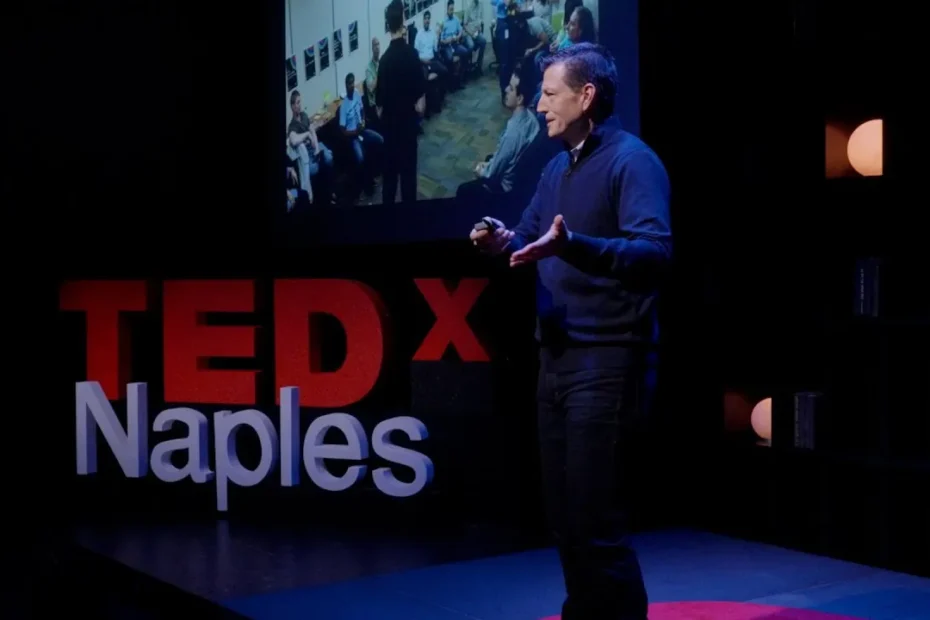
Read the full transcript of author Jeff Kavanaugh’s talk at TEDxNaples, March 21, 2026.
Editor’s Note: In this thought-provoking talk, Jeff Kavanaugh shares why the most powerful insights are not merely analytical but deeply human, stemming from a blend of intellectual rigor and genuine empathy. Drawing on lessons from his upbringing and a successful career in consulting and research, he outlines an “insight cycle” that integrates head and heart to solve complex problems and create meaningful impact.
Listen to the audio version here:
The Most Powerful Insights Are Human
JEFF KAVANAUGH: Insights help us understand what happened, why it matters, what to do about it. But over many years, career in consulting, teaching and research, I discovered something surprising. The most powerful and best insights are not just analytical, they’re human. But it took me a long time and some failure to understand that.
Roots: A Fifth-Generation Farm
This is our farm, fifth generation farm, back in Davis County, Indiana. You can’t get any farther from Silicon Valley or Wall Street.
This is my dad, Lee, second of ten children on a Depression-era farm, a farmer who loved the land and a coach who loved to win. Think drill sergeant meets Bobby Knight. He taught me the value of hard work, getting your hands dirty, and thinking creatively to solve a problem or win a game. How? By learning, using his head.
This is my mom, Irma. Her father was killed in World War II and her mother cleaned homes to make ends meet. Mom was the very definition of caring. She made you feel heard and she made you feel loved. How? By sharing, using her heart.
I grew up with these amazing people. Did you have someone like this growing up? I hope so. Because of them, as a kid, I prayed for wisdom, service, and stamina, literally those three words. I didn’t realize it then, but years later, those farm values became insight, empathy, and strength for a lifelong journey.
Hitting an Invisible Wall
Got an engineering degree, manufacturing job, started a family, gradually became aware of a broader world beyond the plant. Heard about this profession called consulting, essentially helping other companies solve their hard problems and getting paid well to do it. Caught the attention of a prestigious firm and made it to the case interview. This is where you solve a hard conceptual problem on the spot.
During that interview, I hit an invisible wall. Didn’t have a clue how to structure that problem, let alone solve it. Just felt a pit in my stomach. You ever felt that way? I didn’t get that job. In fact, I forgot my coat and had to go back the next day and get it. God, it was embarrassing. But I vowed then and there to learn these skills and never face that invisible wall again.
Later, I joined a consulting firm, went all in, and made partner eventually. Along the way, trained hundreds of consultants. It was remarkable how we could take people fresh from school, a few months of training on analytical thinking, reasoning, communication skills, and soon they were serving sometimes even senior clients.
The Career Readiness Gap
And yet it bothered me, coming from a family of teachers and coaches, that these thousands of students over the years that I interviewed on campus, a lot of them failed. And they were going to good schools, and yet they still didn’t do well. And I wanted to know why. I wanted to understand why these talented young people hit that same invisible wall.
I surveyed 5,000 college students and corporate recruiters to understand what drove career readiness, what made the difference. The findings were stark, but clear. There was a significant gap. The students thought they were ready. The employers did not. And the three big areas, critical thinking, communication skills, and empathy, that was the gap. And it was across the board.
The University of Texas at Dallas heard of my work and asked me to develop a course for them, for their students. These students, every semester, would walk in the door and they didn’t know these skills. They faced that same invisible wall. And yet, within a few months, they developed the ability to communicate, to create insights, and to be effective. In fact, I looked around for a book on the topic, there wasn’t one, so I ended up writing one for the class.
The story started to come in, someone would get a new job, someone would get a promotion. But the story that stopped me cold, a reader in Tennessee, who is legally blind, told me that using these skills from the book, he got a consulting job and provided for his family.
If they work for him, they can work for anyone. Around the same time, the chairman and president of my company, Infosys, came to me and asked me to create a research unit to convert our technical expertise into thought leadership. This meant producing hundreds of papers and videos on topics like AI, future of work, and how to lead in times of change. But we did something different.
Most research leads with facts and figures. We led with people. We understood our audience, we found out what they valued, and we crafted stories around it. Not just because stories are more interesting, they’re 16 times more memorable.
An Unexpected Setting Makes It Memorable
And this took us to some interesting places, some cool places. Like Abbey Road, famous recording studio. The Beatles, Pink Floyd, apparently me. I recorded several podcasts there. Even recorded the single, “Yesterday.” I still remember. That was just so much fun.
Why Abbey Road? It’s because even when you create good work, you do something good, it can get lost in the noise. But when you put it in an unexpected setting, you connect with people. It’s memorable.