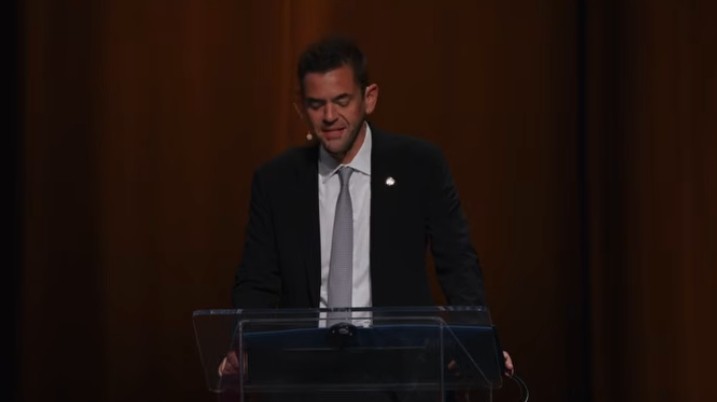
EDITOR’S NOTE: This is a transcript of Jared Isaacman, NASA Administrator, delivering a keynote address titled “A New Era for NASA and American Space Exploration” at the All-In Summit 2026. Following his remarks, Isaacman joined the hosts of the All-In Podcast — David Friedberg, David Sacks, Jason Calacanis, and Chamath Palihapitiya — for a wide-ranging fireside chat covering Artemis, the lunar economy, nuclear propulsion, NASA’s budget, and the new space race with China and Russia.
Opening Remarks
JARED ISAACMAN: Good morning, everyone. It is an absolute honor to be here at All-In. We are living through an extraordinary moment in history, aren’t we?
It took just sixty-five years from Orville and Wilbur’s first flight to Neil and Buzz walking on the surface of the Moon. Now, it’s been fifty-seven years since Apollo 11. And for a while there, pace of progress hasn’t been all that inspiring, but look at what is on the horizon right now. We got artificial intelligence, quantum technologies, robotics, additive manufacturing, the promise of fusion energy, biotech to heal the disabled, autonomous transportation, this whole abundance thing everyone’s talking about, all converging in the years ahead is beyond what most people can comprehend. Our world will fundamentally change.
How we live, how we work, how we fight wars, how we reach out and touch the stars. But we are not alone on this journey. We are living through a great power competition. Other nations understand the opportunities that can elevate nations and change civilizations. And perhaps nowhere are the possibilities, the competition, and the consequences of getting it wrong more apparent than in the ultimate high ground above us.
A Different NASA
Now at NASA, we are doing things differently and we are regaining our swagger and putting wins on the board. But absent this president, absent this geopolitical competition and the very real possibility of losing the second space race, I suspect very little would have changed. For too long, resources at the world’s most accomplished space agency were spread everywhere, trying to make everyone happy. Much of it was through external imposition, but plenty of it was self-inflicted. We partnered for the sake of partnerships, oftentimes becoming a drag on the mission instead of accelerating it.
As a result, we have the Orion spacecraft that we can’t inject into low lunar orbit like we did during Apollo. And the prior administration canceled the Mars Sample Return mission that was on track to cost more than an aircraft carrier. We created programs that were too big to fail, too costly to truly succeed in the hope that they would survive administrations. The results being a rocket that was designed when China was predominantly operating coal-fired locomotives and now becoming operational as China operates 25,000 miles of high-speed rail and is just a few years away from their own Apollo 11-like moment. Core competencies and tens of thousands of the NASA workforce were rented, outsourced, or lost, which turned what should have been months worth of progress into years at tremendously greater cost.
Eventually, too little was left to do things the right way, the way NASA showed the world how to do it in decades past. So, we invented this whole dream-state-as-a-service thing, forgoing the playbook of success and shifting the impossible burden onto others. The result is that our Moon rocket is in fact less efficient than Saturn V at converting launch mass into payload headed for the Moon. With more time between the Artemis I and Artemis II mission than all twelve of the Gemini missions that were flown sixty years before. A lunar space station that whenever it may have been delivered, put our astronauts in a position to look down on the desirable lunar real estate instead of operating on the surface and occupying it.
One X-plane that wasn’t flying very much, and billions spent on failed nuclear programs that had not left the laboratory since 1965. Now during the first space race, we were slow out of the gate, but NASA ultimately ran up the score. The second will be much closer than it ever needed to be. Since becoming the administrator of NASA last year, we have made a different choice. We are not going to try and make everyone happy.
We are not going to spread every penny across every district or partner with every nation just to try and make everyone happy or because that’s how people incorrectly believed it always was. I am certainly not here for the money, to favor companies, for the title, the notoriety, the politics. I’m not here to be your VC, to entertain your dream, or invent new markets if it detracts in the slightest way from the missions that we have been entrusted to achieve on behalf of the American people. You can take those conversations up with the Department of Commerce if you like. I’m here to execute on President Trump’s national space policy, to align and focus resources to work alongside and unleash the best this nation has to offer.
Artemis Moving Forward
From the NASA workforce to our industry to our partners and deliver the world-changing outcomes. The kind of outcomes that put Neil and Buzz on the Moon. The kind of outcomes that inspired many of you to be in this room in the first place. This is a very reinvigorated and energized NASA, and America is back in the business of sending our astronauts to the Moon. Now, Artemis II was just the beginning.
Those four heroic astronauts, recent recipients of the Congressional Space Medal of Honor, rode 8.8 million pounds of thrust to near-Earth escape velocities, traveled farther into space than any humans in history around the Moon and back home safely. And that was just the opening act. We are not waiting three years to fly again. We are not turning every rocket into a work of art. Artemis III is already being assembled right now at a pace many doubted was possible just months ago.
Before year end, we intend to roll out to Launch Complex 39B for a tanking test and send a message to our workforce, our industry and our rivals overseas.
NASA is back and we are not going to sit idly by. We are not just a procurement organization. We are going to do the extremely demanding work and achieve our objectives safely, responsibly, and urgently because that is what meeting the moment requires. Now in the summer of 2027, Artemis III will launch on SLS into low Earth orbit and rendezvous with lander test vehicles from Blue Origin and SpaceX in what will be a remarkable display of the three most powerful rockets and spacecraft in the world.
We will test interoperability and show what a future multi-launch campaign can actually look like. What we learn will inform the uncrewed test landings that follow, and then Artemis IV in 2028 when American astronauts return to the lunar surface, and this time to stay. In parallel — in parallel — we are establishing humanity’s first outpost on another world, a Moon base. And this time, we are leveraging the NASA playbook of decades past. We are not jumping directly to the dream state.
Building the Moon Base
We will launch missions on a near-monthly cadence and undertake the science of survival. That means autonomous and crewed mobility, surface improvement, in-situ resource utilization and manufacturing, logistics, habitability, power, communications, and all the science instruments the mass budget affords. We will bring it to you live in HD on the Moon Base website, and we will leave no doubters this time. We go for the scientific and the economic potential. We go to learn about the formation of our solar system, but primarily because the lunar South Pole, where the water ice is, is going to be the technological proving ground for where we inevitably go next, which is Mars.
In 2028, NASA will leave decades and billions of dollars of failed nuclear programs behind and launch SR-1 Freedom, a 100-kilowatt fission reactor that will finally get America underway on nuclear power. The mission will transit Mars and release Skyfall, which carries three Ingenuity-class helicopters and using ground-penetrating radar to scout subsurface ice and future landing sites. This will mark the beginning of the nuclear NASA, pivoting our workforce and facilities back to doing the near-impossible missions with no obvious business case. What no company, no agency or nation is presently capable of accomplishing, but that extend humanity’s reach farther into the outer solar system. And just like during the Apollo era, the technology that we pioneer to get there will surely benefit life back here at home.
There will be lots of nuclear missions, SR-2, SR-3, SR-4, alongside our industry partners. We will push the boundaries of high-temperature materials, more efficient power conversion, more reduced radiator mass, and higher-performance electric propulsion as we visit some of the most interesting moons like Enceladus, Europa, and Titan. These are worlds with oceans, with complex chemistry, and perhaps the ingredients for life. A reminder that some of the greatest discoveries in human history, they may be waiting for us in our own backyard. We could answer the question, are we alone?
And are we alone even in our own solar system, let alone the galaxy and universe around us? Someday, a chemically augmented nuclear power transfer vehicle, part of an American Starfleet supported by an armada of starships and other spacecraft, will carry humans to the surface of Mars and bring them home safely to tell us about it. And not just once. We are on this great destiny of human exploration and we are not turning back. Along the way, we are going to do the other things.
Science Missions and the Space Economy
Commercial satellites are being printed off at a rate that will help us affordably understand the only planet that we presently inhabit, our home star and space weather, and better predict weather and perhaps respond to wildfires and natural disasters better, freeing up more resources to build the exquisite flagship science missions that only NASA can undertake. Like, for example, the nuclear-powered Dragonfly octocopter. It’s powered by a two-kilowatt MMRTG converting to just 100 watts of electricity, barely better than an old light bulb, but it will journey to Saturn’s moon of Titan in 2028. Europa Clipper will arrive at Jupiter’s icy moon in 2030. And our great space telescopes, like James Webb and Hubble, will soon be joined by Roman.
And with her nearly 300-megapixel wide-field instrument and JPL-built coronagraph, in the moments ahead, Roman will open her eyes. And in that instance, she will see more of the universe than any scientific instrument we’ve ever put in space before. Her surveys will seek to — it is a cool telescope. Her surveys will seek to understand the mysteries of dark energy and dark matter and reveal tens of thousands of worlds that are hidden behind distant stars. Roman will return images so large and in such detail, there is no screen on Earth large enough to display them.
Now, other missions like NEO Surveyor will find asteroids and comets that can threaten Earth, while next-generation telescopes in development will seek out habitable planets orbiting other stars. The last few decades have shown us that the future in space that we all imagined as children will never be realized if they’re perpetually funded by taxpayers. NASA will do everything within reason to support an orbital and perhaps even lunar economy someday, building on the proven markets of launch, observation and communication. Whether the next frontier is in orbital data centers or commercial space stations or on-orbit manufacturing, regolith resource extraction, asteroid mining, or industries that none of us have even imagined yet. Now it’s not NASA’s job to force an economy, but we will do all we can to ignite one as we pursue our missions.
Aeronautics and the Next Generation
And in the service of the first A in NASA, we are rebuilding our X-plane fleet. The X-59 is researching quiet supersonic flight, but it’s just the beginning as NASA recommits to flight test and works alongside industry to push the boundaries of airframe and propulsion design. It will not be long before NASA is flying once again as high and as fast as we have from decades past, and then even more. But if this frontier is going to expand as rapidly as we believe it will be, we will have to cultivate the talent to lead it. The space domain deserves an institution focused on that future, and call it what many already have and should, a Starfleet Academy.
That is why the president established the Commission for the United States Space Academy, a NASA-led federal academy to prepare the next generation of astronauts, scientists, engineers, technicians, operators, pilots, leaders. And just as the need for Space Force became clear as their domain evolved, we should be equally forward-looking, preparing those who will build the Moon base, operate nuclear-powered spacecraft, command missions to Mars, ensure our national security, and create industries in orbit we can barely imagine today. And there is no time to waste. I want you all to think about where you were when Artemis II astronauts sent back those images from the Moon. Who did it touch?
The Stakes of the Second Space Race
Your parents, your friends, your colleagues, your children. Now I want you to imagine astronauts climbing down the ladder. Only this time, it is not grainy black-and-white footage from July 20, 1969. It’s high-definition color streaming live to billions of people all around the world. The astronaut steps foot on the lunar surface.
The camera pans up, and the flag on the space suit is not American. There will be no footnote explaining that we spent more, no disclaimer that our architecture was complicated, no one will care how many studies we completed, how many meetings we held, what congressional districts benefited, who all the all-star lobbyists were for their hardware, who served on the committee, or how many times we slipped the schedule for what someone thought was a perfectly reasonable reason. The world will just see who got there. China intends to put their astronauts on the Moon by 2030. Its robotic missions are targeting the Shackleton Crater of the lunar South Pole next year, and there are only so many good parking spots in that neighborhood.
And they intend to occupy them. They are working with Russia on their own nuclear-powered Moon base. And to be clear, China will accomplish what the Soviets never could during the first space race. They have a very achievable two-launch architecture, the national will and capabilities to put their astronauts on the surface of the Moon. And if America has not returned despite the decades of promises and the more than 100 billion dollars invested, the shock wave will be felt around the world.
Our allies will notice. Our adversaries will notice. Every nation deciding whose technology to buy, whose standards to adopt, whose security guarantees to trust, and whose vision of the future they will follow will take notice. And perhaps most importantly, our children will notice. That is why we must remain focused on the objectives that matter.
Closing
Why NASA was established in the first place. There is no time anymore for lobbying against America’s interests or further tolerating the status quo. Only extreme ownership, competence, and action. Those of us inspired by the pioneers and heroes of decades past know they set the bar high, but we do not honor them by living forever on what they accomplished. This is our time to pick up where they left off, return, and never give up the Moon again, and then set our sights on Mars and beyond.
And none of this will be accomplished by NASA alone. We have the support of President Trump. We have Congress. We have a clear mandate in the national space policy, but it will take brilliant entrepreneurs, scientists, engineers, our allies, and Americans across the country who still believe that great nations can do great things. Because our children will either inherit confidence of a nation still capable of the extraordinary or the memory of one that used to be.
That responsibility, that choice belongs to all of us. And I believe when history looks back on this moment, let it record that America did not hesitate any longer. We did not allow the bureaucracy, the complacency, the waste, inaction, or fear of failure to constrain what we could accomplish. We chose to go and we went. Thank you.
Fireside Chat
DAVID FRIEDBERG: I was commenting backstage on how easy it is for NASA to come and do speeches given the content, the capacity to show visuals like this. Can you imagine like Housing and Urban Development trying to do a presentation?
JARED ISAACMAN: No. We have unbelievable material to work with. I’m thankful every day that I don’t lead the IRS for social media.
DAVID FRIEDBERG: Yeah, right. Can we talk about — we don’t have a lot of time, so I know I want to move our way through the universe, but can we start with the Moon? Is there a case that NASA makes about the Moon being the starting point for getting to Mars, but is the Moon a potentially viable economy on its own? Is there an industry to be built on the Moon? Is there an ongoing set of operations that could be established on the Moon that makes sense beyond just kind of testing equipment before we go to Mars?
JARED ISAACMAN: Yeah. Maybe. Right? So I think we are extremely fortunate. We’ve been gifted a Moon three days away to test out everything we need on this great adventure of discovery. Right? I mean, is where you want to go to really dial in power. Your space suits, it’s taken us decades to build replacement space suits from the Apollo era. Let’s test that out on the Moon.
Habitation modules, certainly in-situ resource manufacturing, robotics. Right? I mean, look, EVAs are fantastic. Astronauts bouncing around on the Moon is going to be highly inspirational. That’s like one of the last things you should do when you have a Moon base, is send somebody outside in that extremely dangerous environment, let robotics do it.
And in order to accomplish all of this, you have to send an extraordinary demand signal to industry. I mean, over the next four years, we’re talking dozens of landers, dozens of rovers, lots of in-situ resource manufacturing experimentation. You’re giving industry all the opportunity in the world to figure out how to unlock value from the lunar regolith. Right? But I can’t guarantee it.
Right? And that’s my point on Department of Commerce. They have a whole Space Commerce Office that can work through that. I am going to make sure that NASA can master the skills necessary to go to Mars for its scientific potential, put radio telescopes on the far side to inspire the next generation. If along the way, it ignites a lunar economy, that’s fantastic. But it costs an awful lot to get there, an awful lot to extract resources —
DAVID FRIEDBERG: Jared, sorry. One sec. But then we have to map the South Pole to figure out where we’re going. Is that right? And that’s part of this Promise mission? That’s kind of the next big mission for the Moon?
JARED ISAACMAN: So — so I’m glad you brought up Promise. So we have mapped the lunar South Pole. There are only so many good landing spots. And what do I mean by that? I mean, surface area of the Moon is like the size of Africa. The South Pole of the Moon is like Washington, D.C. And there’s only so many good craters that have these permanently shaded regions, which by the way, is a harsher environment than Mars itself. That’s where the water ice is, but the crater cliffs can also give you near-eternal access to light for solar power. So there’s only so many good landing spots.
And you think about when a vehicle the size of Starship comes down on the lunar surface, believe me, that’s going to blast out a little bit of craters and debris. So really limited parking spots on that. Promise is very awesome because Promise is a radioisotope-powered rover that we built as a spare, essentially, for the two rovers Perseverance and Curiosity that are on Mars right now. And just to give you a sense, this thing is the size of a Jeep. Okay? So we have some plutonium-238 that’s decaying right now. You only get so much life out of it. We want to take that, put it on Promise, and send it to the Moon, and it can go prospecting in those permanently shaded regions that almost any other hardware would die in. It’s a very good way to make use of taxpayer dollars that have largely already been spent.
JASON CALACANIS: I think Jared, you were informing me last night, educating me on this specific southern region of the Moon being absolutely critical for us to get to first, versus China. Why is it so critical that we get there before China, and what’s it going to take to do that? And just as a follow-up to that, what was the state of NASA when you got there? Because it did feel like they, since the Space Shuttle program, haven’t been super focused or effective, but correct me if I’m wrong.
JARED ISAACMAN: Yeah. I mean, just to be clear, you’re talking about some of the best talent in this nation shows up to work at NASA every day, and they want to change the world in air and space. And for a very long time, everybody was trying to run NASA other than the people themselves that show up to work there. I mean, like you heard from my remarks, let’s make everyone happy, let’s spread our resources to every congressional district, let’s collect 25 different flags to partner on the next mission that takes something that should cost a couple billion — which is very cool, like going and getting samples back from Mars, it could lead to the most consequential discovery in human history — and layer a bunch of other people on and make it cost more than a carrier, and then it gets canceled.
So NASA’s back in charge now, right? We are in a space race. People are giving us latitude to do what we need to do. And as a result, we are extremely focused on the president’s national space policy: return to the Moon, build a base, get underway in nuclear power and the other things. And the workforce is responding well, and I’m grateful alongside them.
So we are in a different state today. Unfortunately, we don’t have the time we’d like because years were lost in this new space race. Now the South Pole of the Moon — again, we’ve been gifted a Moon three days away to master those skills to go to Mars. There’s only so many good parking spots. The Chinese and the Russians know that. Right? They were going to launch a mission a couple weeks ago to the Shackleton Ridge, which — maybe it was mechanical, maybe it was weather related, or maybe they were smart enough to know that if they actually did do it, it probably would ignite one hell of a fire and urgency in us. But that would have taken up one of a couple critical parking spots. They’re going to build a base there. They partner with Russia. They’re going to have a fission reactor there. They’re going to do the exact same things we are, which is interact with the water ice and get very good. And then where are they going next? The third space race? They’re going to go to Mars.
And then they’ll have that massive Neil Armstrong-like moment that will send a message around the world. And we are very committed to not letting that happen.
CHAMATH PALIHAPITIYA: What is the big technological leap that you have to make from the current course and speed to actually make Mars more realistic? Is it propulsion and thrust as the main vector?
JARED ISAACMAN: So I think there’s a couple things there. Look, robotics are going to be critical in all of this. So if you chose a path that was purely chemical propulsion, of which vehicles like Starship are going to be incredible at that, well, you will no doubt have the means to send astronauts to Mars. They’ve already figured out habitability a long time ago, and you’re talking very comparable velocities whether you’re going to the Moon or Mars in that regard. The hard part is how do you come back.
Right? You’re going to need to make propellant on Mars to do that. And, you know, one solution to that is to say, well, I’ll have an army of robots that’ll do it, and I’ll have football-field-size solar panels and then the robots can dust them off from all the dust storms that’ll happen. And then you’ll make your own propellant and you’ll come home. The hard part is it’s really challenging to do that under one atmosphere and one g here on Earth. I mean, you can see how many people show up at stage zero at Starbase to launch a mission.
And by the way, that is the right way to kind of win the war, to put lots of mass on the surface. NASA can help that by kind of pivoting, by stop doing what industry is already doing really well and invest in that next giant leap capabilities that have no obvious business use case today, which is fission power. And then you can have chemically augmented NEP spaceships, transfer vehicles, and go to and from Mars, and you don’t need to refuel them until they come back. And what you’re refueling is krypton or xenon. You’re not having to make propellant on the surface of Mars. That to me is how NASA works alongside industry to invest in the capabilities that are necessary for American leadership in space. And by the way, those are the capabilities you want to go to Saturn’s moon of Enceladus, to go to Titan, to go to Europa, where you have oceans on two of those moons that could have still life in them.
CHAMATH PALIHAPITIYA: How do you convince these incredible learned people to work for NASA versus SpaceX or other private space companies now, in a world where there’s so many ways in which you can contribute?
JARED ISAACMAN: So — so great. I’m glad you asked that because it’s a double down on nuclear. But right now, we don’t have a recruiting problem initially. I mean, take 1% of the intern applications that go into our pathway program, which guarantees them a job at NASA. Then the question is, can you retain them? And if you’re doing exactly what SpaceX, Blue, Rocket Lab, Stoke, ULA and others are doing in the industry, except you’re doing it off, you know, 50-year-old shuttle hardware that again is not as efficient for missions like going to the Moon as Saturn V was, you’re going to lose that workforce. So what do you need to do?
You know, when we have those near-impossible breakthroughs, and there is a business case, like there certainly is for launch where you can be one customer or many, you hand it off to industry and you pivot. And that’s how you retain talent that can only do these type of missions at NASA, is the nuclear NASA. SR-1 is just the beginning. That is our Nautilus. There will be a grand fleet of nuclear-powered spacecraft.
CHAMATH PALIHAPITIYA: To constantly — you keep pivoting to the next new thing?
JARED ISAACMAN: [Continuing.]
DAVID FRIEDBERG: Can you explain just really briefly a primer on how nuclear works for generating thrust?
JARED ISAACMAN: Yeah. Sure. So actually, you can just think of a lot of the Starlink satellites that you’d have up right now that use Hall ion thrusters right now. They’re generating electricity through solar power, and then they’re using — through electromagnetic forces — they’re ionizing either krypton or xenon and then just basically accelerating it out of the thruster, which gives you very high exhaust velocity. So it’s extremely efficient, very low thrust, and you can use that propellant for a very long time.
And in space, the faster the molecule shoots out the back, the more thrust it generates for the craft to move forward. I mean, it’s just very low mass flow but highly efficient. Right? So very efficient, high exhaust velocities. The idea though is where that breaks down is the farther you get away from the sun. So once you get out towards Jupiter, solar effectiveness is negligible. Right? So what you’re using is like the thermal energy from a nuclear reactor. So 100 kilowatts, we’ll scale it up to 250, who knows, maybe megawatt class. Right? You’re going to want to run that reactor as hot as you possibly can. So that’s your high-temperature materials. And then you’re going to convert it through like a closed Brayton cycle power conversion unit into electricity. And that electricity is then going to power those same thrusters that you would see on Starlinks. It’s just they’re scaled up. Right? They’re like 12-kilowatt, then 14-kilowatt, 25-kilowatt thrusters.
DAVID FRIEDBERG: What is NASA’s budget? And if you could have your druthers, what would it be?
JARED ISAACMAN: I’m incredibly supportive of — look, I’ve said it many times right now. Like, NASA does not have a top-line problem. Like, we are bad capital allocators and have been for a long time. And a lot of that is based on NASA choices. It’s based on what other people forced us to do. And that’s changed. We have 25 billion dollars. I mean, there’s got — how many entrepreneurs are in this room? Starve, 25 billion is a lot of money. You can build some pretty incredible hardware with that.
DAVID FRIEDBERG: You’re one of the few entrepreneurs that actually has built a profitable company and taken it public.
CHAMATH PALIHAPITIYA: You showed a picture of the Blackbird up there.
JARED ISAACMAN: You sure that’s a Blackbird?
CHAMATH PALIHAPITIYA: Well, okay. What was that picture that you showed up there?
JARED ISAACMAN: Like I said, NASA’s getting back in business flying high and fast again.
CHAMATH PALIHAPITIYA: I mean, that doesn’t seem like a space vehicle. It seems like an Earth air vehicle.
JARED ISAACMAN: Yeah. So the first A in NASA is our aeronautics portfolio and what we’ve contributed to over the decades, you may not realize this. Look, when you go see an F-22 fly at an air show and it wows you, the fly-by-wire technology was us. The thrust-vectoring technology was us. NASA has been contributing to breakthroughs in aeronautics, both civil, commercial and national security applications, for a long time. And again, kind of similar to the same theme, over the years we’ve been forced to spend our aeronautics budget subsidizing high-TRL efforts from big prime contractors. An engine that’s 40 years old, they want to squeak 3% more fuel efficiency out of it, get NASA to pay for it. I’m like, are you kidding? There is no way we are doing that. You can underwrite that investment yourself for competitive reasons. You know what I want to do? I want to get back to the radical airframe and engine designs like we were always supposed to do.
And you’re getting a little bit of a taste for that on the —
JASON CALACANIS: Tell us about the importance of having a human on these ships when we go to the Moon, when we go to Mars, versus if optimists figure these humanoid robotics are ready, why would we risk a human life in these incredibly dangerous environments? Is it ego? Is it we’re trying to prove a point to have humans in the loop on these? Or should we just be sending robots?
JARED ISAACMAN: Or it’s our destiny. Right? I mean, the same reason why we cross the oceans and seas and climb the mountains. This is who we are. Would many people have stopped, paused from the discourse of our daily lives to look at those astronauts go around the Moon on Artemis II if they weren’t humans? I don’t think so.
Now, don’t get me wrong. We are going to need robotics, and there are some environments — whether it’s the radiation — that we can only do uncrewed, robotic missions. But we can go to the Moon as we’ve done before with our astronauts. We can go to Mars, and we can continue on outward, and robotics will absolutely play a critical role in that journey.
CHAMATH PALIHAPITIYA: What about then just like the autonomous navigation systems? You talked about fly-by-wire. I mean, we still see even just like last week the incident with Amazon Air. Now this is civil aviation, but the overrun is ridiculous. That error mode was pretty shocking to people, I think. How do we push better and safer technologies and the more obvious solutions, even if that may actually disintermediate human involvement?
JARED ISAACMAN: Well, I’ll just say that NASA has been playing a role with air traffic safety and modernization for a long time. It was NASA that pioneered the autonomous ground collision avoidance software. So, I mean, it saved countless lives of fighter pilots — pull too many g’s, they black out, the point the nose of the aircraft’s pointed at the ground, the aircraft recognizes it and safely recovers it. That was NASA work. But I will, to your point — we are obviously very involved, as you think about a world that’s going to have, who knows, like millions of drones flying around delivering us medicine and other things. We have to work very closely with the FAA on that.
But I will tell you, we are thinking about AI and autonomous applications within the missions we’re designing right now. Like one mission going to Venus, DAVINCI. It will not last long in that high-pressure environment. Right? We are going to only have so much time to gather as much information as we can to update the trajectory of the vehicle. This is not interesting, disregard. This is interesting, I’m turning in that direction. We’ve already tested this with some of our rovers on Mars. And in my last dying breath, this is what I choose to send back to the scientists on Earth to understand this environment. And that’s just one step towards a direction that will inevitably include more autonomy in our crewed and uncrewed spacecraft.
DAVID FRIEDBERG: And how do you think about allocation of capital, resources, to some of the scientific discovery of the observational systems, future platforms for observational, deep space research? Is there a view in your mind it should be 5% of budget? Do you think about rationalizing where we go with the spend there?
JARED ISAACMAN: Yeah. I mean, I would say right now science is approximately, call it a third of NASA’s budget. We recently reorganized, but your main mission directorates right now are human space exploration, which covers both the great work we’re doing on the International Space Station as well as missions to, for example, the Moon and building a Moon base. You have your Research and Technology Mission Directorate, which is shouldering most of the nuclear NASA effort. And then you have your Science Mission Directorate.
And how I think about this is, you have to take advantage of commercial industry right now. Like, again, there’s no one who would doubt that launch, observation, communications are real services where NASA is one customer of many. And you’ve got all these great companies that are printing out satellites again for Earth observation, whether it’s for national security reasons or otherwise. Leverage it for agriculture, leverage it for Earth sciences, give them the instruments if necessary, license it to them. Free up resources to do what industry is not going to want to take on, which is building a nuclear-powered octocopter to go to Saturn’s moon of Titan. Right. So free up as much research as we can to do that. And I would always prioritize getting new missions out there to unlock the secrets of the universe versus the researchers. If we get the data, there’ll be plenty of brilliant people at institutions around the country that will want to analyze it, but what’s the point if you can’t launch those next missions?
Video Clip: Mars Helicopters
DAVID FRIEDBERG: And as we wrap up, can we watch the video of the helicopters on Mars?
VIDEO CLIP BEGINS:
UNIDENTIFIED SPEAKER: Oh, absolutely. Yeah. So here it is coming in. There it is.
VIDEO CLIP ENDS:
JASON CALACANIS: Yeah. I mean, how cool is this? I mean, I’m telling you, you can’t do this at HUD.
DAVID SACKS: Or IRS.
JARED ISAACMAN: I only made the IRS joke because I know —
DAVID SACKS: Here’s the auditor.
DAVID FRIEDBERG: I mean, it is really incredible. So what’s the status of this program?
JARED ISAACMAN: So we tested one, Ingenuity, on our last rover mission to Mars. It did fantastically well. I mean, can you imagine? This is near vacuum, by the way, on Mars. Right. It’s like a fifth of an atmosphere. Right? Now we’re going to send three of these with ground-penetrating radars, which I think is just awesome. But most importantly, how it got there — it got there under nuclear power. True fission-powered, 100-kilowatt spacecraft that flew by Mars and released it. This will launch in ’28. We believe it’s approximately a year before the helicopters will get there. We’re still doing some trades, but an absolutely extraordinary mission, the start of many more. I mean, again, think about it. There is so much we can learn on the moons within our own solar system. Some really shocking discoveries are just waiting for us in our own backyard.
China, Russia, and SpaceX
JASON CALACANIS: I know we got to wrap, but you mentioned China and Russia collaborating together. Just wanted to double click on that. What are their capabilities? Russia can’t even take Kyiv and they’ve been at war for four years. Are they capable of getting to space and doing anything of material? I mean, I mean this genuinely.
JASON CALACANIS: Please come back.
JASON CALACANIS: But then China is copying a lot of what —
JASON CALACANIS: You don’t have to listen to Chamath. This is a serious question. China is copying a lot of what Elon’s doing in real time. And what’s their actual capability if we assume Russia is up against it and they’re broke? And am I correct that Russia’s up against it and they’re broke?
JARED ISAACMAN: I would just say, look, obviously I have a great appreciation for the history of the Russian and Soviet space program. I mean, like I said in my remarks, they came out of the gate hot. First astronaut in orbit. First spacewalk. They’ve done a lot of great things, and they contribute with us today and collaborate on the International Space Station. But, yes, they have a conflict and they’re prioritizing resources there.
The Chinese are an incredible rival in space right now. Yes, they don’t have the same reusable launch capabilities that SpaceX and others have, but what they do put in space, even if they brute-force it there with hypergolic-powered thrusters or hypergolic-powered rockets akin to like Titan II of decades past — what goes in space is good. And I think there were some pretty interesting developments that came out of AFA today, that our secretary of the Air Force and others in the Space Force said that enlightened, I think, the general public about how contested that environment is. The bottom line is the Chinese are extremely good in space right now.
You couple that with some Russian capabilities on nuclear power, they will return to the Moon. And they will get to the Moon and they will build a base on the South Pole.
JASON CALACANIS: And where would we be if we didn’t have SpaceX in relation to China?
JARED ISAACMAN: I mean, SpaceX is our — I mean, they’re incredible. I mean, they’re our most important launch partner. We can’t send astronauts to and from the space station without them. We can’t have down mass of our science experiments from the space station without them. The Nancy Grace Roman Space Telescope that’s going out to pursue the secrets of the mists of the universe was launched on a Falcon Heavy not that long ago. We are fortunate there’s a lot of great companies in commercial space right now, but the United States would be seriously challenged in the high ground of space without their capabilities.
DAVID FRIEDBERG: Jared, I’m not a huge fan of government, but I think NASA plays one of the most important roles for humanity that no individual organization outside of government can play. I cannot think of a better person to lead it. I think you’re an inspiration to so many.
And I truly, honestly respect your service that you’ve provided to this country and to the world. We’re so lucky to have you. Thank you for being here.
JARED ISAACMAN: Oh, grateful every day. Thank you all. Thank you.
Related Posts