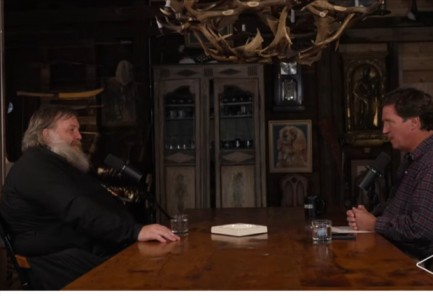
Read the full transcript of Dr. Stephen De Young’s interview on The Tucker Carlson Show, May 29, 2026.
Editor’s Note: In this intriguing episode, Tucker Carlson sits down with Dr. Stephen De Young to unpack the mysterious biblical history surrounding the Nephilim, ancient advanced civilizations, and the spiritual roots of human technology. Together, they explore the global convergence of flood mythologies, historical patterns of dark ritualistic practices, and the profound metaphysical transformation that occurs when humanity yields to demonic influence. Ultimately, the discussion bridges ancient scripture with the modern world, offering a provocative look at how spiritual warfare continues to manifest in contemporary culture.
Introduction: What Are the Nephilim?
TUCKER CARLSON: Thank you for doing this.
DR. STEPHEN DE YOUNG: Yeah, absolutely.
TUCKER CARLSON: I have read Genesis, on and off most of my life. Never noticed the first part of chapter 6 with the Nephilim until about 4 years ago. Someone mentioned it to me. In the subsequent years, I must have had 15 conversations, 25 conversations about the Nephilim. So it seemed worth talking to someone who understands exactly what the Nephilim are. What are the Nephilim? And am I pronouncing it correctly?
DR. STEPHEN DE YOUNG: Good enough. Yeah. The im at the end is the plural in Hebrew. But yeah, there’s a little bit of debate about where exactly the word comes from, because it’s not a regularly used Hebrew word in the Hebrew Bible, which isn’t all that odd either. There are a lot of words that are only used once in the Hebrew Bible.
People have tried to do different things with it. So there’s a Hebrew verb, nafal, which is the verb “to fall.” Some people have wanted to say, well, it’s “the fallen ones.” But in Hebrew, Nephilim is reflexive, so it would be “the ones who are fallen upon,” which is a little more difficult.
But it seems pretty clear. Most people agree now because there’s an Aramaic word, Nephilim, that ends with an N, that just means giant. And so it seems pretty contextually clear that this is just the Hebrew form of that word, and this is talking about giants. It’s translated in the Greek Old Testament with gigantes in Greek, which is where we get the English word “giant.”
But a lot of people, when they hear the word “giant” now, think Fee-Fi-Fo-Fum, right? That’s not the core of the idea. So all of the words used for “giant” not only refer to a tall person, but could also be used to mean a thug or a bully or a tyrant. And the example I use is — and you’re old enough to remember this — when we went into Panama after Noriega, they were always referring to him as “Panamanian strongman.”
TUCKER CARLSON: Yes, always.
DR. STEPHEN DE YOUNG: And that wasn’t talking about his awesome bench press. That was that he was a dictator, right? He was authoritarian. And so it’s the same kind of idea — that it’s characterizing these people as that sort of thuggish, brutish kind of character. And referring to them as tall or referring to them as giants is meant to symbolize and suggest that.
Genesis 6 and the Pre-Flood World
TUCKER CARLSON: Okay.
DR. STEPHEN DE YOUNG: And so in Genesis, at the beginning of the flood story in Genesis 6, we have to understand that the flood story is not a new story when Genesis is telling it. This is — everyone had a flood story in the ancient Near East. So the text of Genesis is not primarily claiming, “Oh, there was this flood.” It’s talking about the flood that the original audience all sort of knew had happened.
TUCKER CARLSON: Yes. And which it did happen, I think.
DR. STEPHEN DE YOUNG: Right. Yes, there is a historical event. This is referring to — but you could have asked anybody from Greece to Mesopotamia to Egypt, they would have all agreed at that point that yes, there was this advanced civilization, there was a flood that destroyed it, and current civilization is rebuilt after that.
TUCKER CARLSON: Yes.
DR. STEPHEN DE YOUNG: Now, one of the key differences in Genesis 6 that you already have in those first 4 verses is that Genesis recasts what that civilization was like. So in the pagan sources, that pre-flood world was this golden age of, for the time, high technology. And technology in the ancient Near Eastern mind included magic — magic as a sort of spiritual technology. And all of these things happened, and losing that world was sort of this great tragedy.
TUCKER CARLSON: But everyone agreed it was a more advanced world than the world they lived in.
DR. STEPHEN DE YOUNG: Yes, yes. That there was knowledge there that had now been mostly lost.
TUCKER CARLSON: Interesting.
The Bronze Age and the Legacy of Pre-Flood Wisdom
DR. STEPHEN DE YOUNG: And so you find the civilizations that grew up after that — and exhibit A of that is the original Babylonian Empire. So like Hammurabi’s Babylonian Empire at the height of the Bronze Age. People don’t understand how powerful the global structure was in the Bronze Age. It’s called the Bronze Age because they were smelting bronze. They were getting the copper from Cyprus and the tin from what’s now Afghanistan.
TUCKER CARLSON: That’s quite a distance.
DR. STEPHEN DE YOUNG: And bringing that together to smelt bronze in Iraq. And Hammurabi had a preference for a particular style of sandal from Crete, so he was importing those. There was sort of this global economy in the Bronze Age going on.
Hammurabi himself was from a group of people called the Amuru, who took over Mesopotamia. Amuru means “Westerners” in Akkadian, because they had come from what’s now Syria. And those are the same people who are called Amorites in the Old Testament. We’ll probably come back to them as we go forward.
But Hammurabi and the other Babylonian emperors attributed their success and their ability to establish this empire to the fact that they had access to this secret wisdom from before the flood.
TUCKER CARLSON: Do we have any sense of how much earlier the flood took place?
DR. STEPHEN DE YOUNG: So Genesis doesn’t really give us a time. There are people out there who want to add up the years in the genealogies. That doesn’t really work, because different textual traditions have different numbers. There aren’t numerals in Hebrew or Greek, and so you’re using letters to code numbers. And so numbers get a little slippery in translation and copying and things.
So a lot of people will attribute it to the Earth changes that happened at the end of the last ice age.
TUCKER CARLSON: Yes.
DR. STEPHEN DE YOUNG: So you’re talking roughly 10,000 years ago. Other people are more literalists and want to add up those ages, and will say that it was more like 6,000. But from the geologic record, because there is record of a flood — there are villages at the bottom of the Black Sea from that period, 10,000 years ago, that are submerged. There are the remains of villages. The glacial ice that melted created a lot of large bodies of water that were not there before.
TUCKER CARLSON: Yes.
DR. STEPHEN DE YOUNG: And sea levels rose a great deal.
TUCKER CARLSON: So do we think the flood came from melting glaciers?
DR. STEPHEN DE YOUNG: That’s probably the historical event that’s connected to that.
TUCKER CARLSON: Yes.
DR. STEPHEN DE YOUNG: When that ends, there’s this massive shift. And places where there used to be civilization are now underwater, literally. And so all those changes happen and there’s this massive disruption.
TUCKER CARLSON: So the villages, everything currently at the bottom of the Black Sea, were built during this golden age that preceded the flood.
DR. STEPHEN DE YOUNG: Previous to that. Yeah.
TUCKER CARLSON: And do we believe, just as modern people, that that civilization was more technologically advanced than the ones that followed it?
Göbekli Tepe, Collapse, and the Limits of What We Know
DR. STEPHEN DE YOUNG: I mean, if we’re talking about — there is some evidence. I mean, you can’t go completely Graham Hancock on this.
TUCKER CARLSON: Yeah. That’s actually exactly the question.
DR. STEPHEN DE YOUNG: Yeah. And Graham Hancock, if you get into his stuff, he starts getting into some new agey crystal technology, psychic technology stuff that’s a little iffy. But we know that there was definitely — you look at places like Göbekli Tepe and these things — there was definitely a level that was reached. There was a collapse. There was another move forward. The end of the Bronze Age, there’s another collapse. And then rebuilding after that.
TUCKER CARLSON: I mean, but there are ancient stone structures — we can’t radiocarbon date them — and we still can’t say how they were built. I mean, how would you—
DR. STEPHEN DE YOUNG: Not exactly. Yeah, right. We don’t know exactly. We don’t know because we’re dealing with pre-literacy. So we’re making conclusions and guesswork. You go to Göbekli Tepe, you see the carvings of animals, you see the way they had skulls displayed in certain ways. We could do guesswork, but nobody left us a text to frame any of it.
The Pre-Flood Civilization: A Golden Age or an Age of Wickedness?
TUCKER CARLSON: But big picture, the pre-flood civilization — we think it reached some kind of apogee, some high point technologically, and then post-flood had to rebuild.
DR. STEPHEN DE YOUNG: Right. And then his Bronze Age civilization — they’re not saying we have some texts or something that survived the flood. They’re saying that they’re in contact with spirits who were active before the flood. And that it’s the same spirits who are now revealing this wisdom to them.
So you have this in Genesis 6:1-4, this Nephilim phenomenon before the flood. And Genesis 6 says, “At this time and afterward,” right? And that “and afterward” is pointing to this sort of recurring or continuing or happening again.
TUCKER CARLSON: So the physical world changes, but the spiritual remains constant.
DR. STEPHEN DE YOUNG: Right, right. And so part of that recasting of this pre-flood civilization — this isn’t a golden age, this is actually an age of incredible wickedness.
TUCKER CARLSON: Yes.
DR. STEPHEN DE YOUNG: And the evil is that there are sort of these great kings from before the flood. You have the Sumerian Kings List and other texts like this later that list the ages of the kings before the flood. And people tend to think that the ages of people in Genesis and the genealogies are kind of ridiculous, with people living to be 950. But in the Sumerian Kings List, you have people living hundreds of thousands of years.
TUCKER CARLSON: Hundreds of thousands of years?
DR. STEPHEN DE YOUNG: Yes. Genesis is reserved, sort of in comparison.
TUCKER CARLSON: What is that, do you think?
Babylonian Mathematics and Encoded Numbers
DR. STEPHEN DE YOUNG: A lot of that — so there’s a little bit of a code to it, and this is true in Genesis also. Babylonian mathematics was all base 60. Our math, we do base 10, right? It’s a decimal system. Theirs is base 60, and the survivors of that are: we have 60 seconds in a minute, 60 minutes in an hour, 24 hours in a day. That’s the leftover from that Babylonian mathematics.
TUCKER CARLSON: Really?
DR. STEPHEN DE YOUNG: Yeah.
TUCKER CARLSON: I didn’t know we had Babylonian minutes.
DR. STEPHEN DE YOUNG: But yeah, that base 60 math. And if you look at those ages as sets of 60, there are sort of certain things encoded about the different kings and the different generations that way. Nobody’s totally cracked the code in Genesis.
But to give you an example — in the Sumerian Kings List, the 7th king in the list is the one who creates the solar calendar. And if you look at Genesis and the Epistle of Jude, which is like a paragraph in the New Testament, he refers to Enoch as “the 7th from Adam.” If you go to Enoch in the genealogies of Seth in Genesis, he lives for 365 years. So you have the number of days in the solar calendar year as his age. He’s the 7th person. The 7th person in the Sumerian Kings List creates the solar calendar. So there are some sort of encoded connections going on with those numbers.
Human Lifespan and Ancient Knowledge
TUCKER CARLSON: Is there any evidence that human lifespan was much longer at one point than it is now?
DR. STEPHEN DE YOUNG: That’s debated by a lot of people. Certainly not. I don’t think anyone thinks in the thousands of years, right?
TUCKER CARLSON: Yes.
DR. STEPHEN DE YOUNG: And part of the difficulty with that is that people hear life expectancy statistics, like you hear that at the beginning of the 20th century, the average life expectancy in the US was 35. And people think, oh, people were living to 35 and then dying. It’s like, well, no, a lot of people were dying. There’s a high infant mortality rate. There’s a lot of people died before 35, but people who made it to 35, a lot of them made it to 100, 120.
TUCKER CARLSON: Yeah.
DR. STEPHEN DE YOUNG: So when you’re doing kind of archaeology and stuff, yeah, you find a lot of young people because there’s no antibiotics. There’s no— right, right. You have a very high mortality rate. It’s hard to tell exactly how long the truly elderly people were living. Right?
TUCKER CARLSON: Yes.
DR. STEPHEN DE YOUNG: But yeah, I don’t think anybody would frame that in the thousands of years.
TUCKER CARLSON: Yes.
DR. STEPHEN DE YOUNG: So it’s more about them saying something about these people. And like I said, the 7th one has the solar calendar. All of them have, in the Sumerian Kings List, have associated with them sort of the things that they discovered, but the discovery is always it was revealed to them by this spirit came and this divine spirit revealed to them this and that and the other. And it’s technological things like metallurgy, it’s ancient technological things like sorcery and divination, and it’s things about the natural world like the solar calendar.
Technology, the Spiritual Realm, and the Mind
TUCKER CARLSON: But the ancients believe that technological advances came to them from the spiritual realm.
DR. STEPHEN DE YOUNG: Right, right. That’s where it’s coming from.
TUCKER CARLSON: But that doesn’t happen at all anymore.
DR. STEPHEN DE YOUNG: Well, this is— so this is— sorry. Yeah, no, this is part of the larger discussion. And this is—
TUCKER CARLSON: But nuclear technology definitely didn’t come from the demonic.
DR. STEPHEN DE YOUNG: Well, this is exact. So within the framework of how the ancients understood it. And this is the ancients going all the way late antiquity, and this is frankly maintained in the Orthodox Church. So the mind, the Greek word that’s usually translated mind is nous. It’s transliterated N-O-U-S. And we’re used to thinking of our mind as our brain.
TUCKER CARLSON: Yes.
DR. STEPHEN DE YOUNG: And it’s sort of this computer in our skull.
TUCKER CARLSON: Yeah, exactly.
DR. STEPHEN DE YOUNG: That churns and processes. But that’s not how they thought about it. They thought about the mind more as a sensory organ, like your eye.
TUCKER CARLSON: Yes.
DR. STEPHEN DE YOUNG: So you’ll see it referred to as the eye of the heart or the eye of the mind, and that the mind sort of perceives the spiritual realm. And so ideas are like sights or sounds or smells. They’re not produced by the brain, right? They’re not produced by the mind.
TUCKER CARLSON: They’re received by the brain.
DR. STEPHEN DE YOUNG: They’re received by the mind.
TUCKER CARLSON: Yes.
DR. STEPHEN DE YOUNG: Right. And so they come from outside.
TUCKER CARLSON: But that’s the experience of people who are paying attention now, even. Like, who hasn’t had that?
DR. STEPHEN DE YOUNG: Right. And I’ve never met anyone who had the experience of generating a thought, right? Like, what are the steps from not a thought to a thought, right?
TUCKER CARLSON: Oh, that’s such a deep point. Yeah.
Knowledge Given Before Its Time
DR. STEPHEN DE YOUNG: So, yeah. And so these things come from outside. And so this is in the genealogy of Cain in Genesis, right? It’s Cain’s descendants who invent metallurgy and use it to make weapons. Right. And who discover divination and who discover music and use it for seduction and for these other things. Right. And the idea is that these demonic spirits that are antithetical to humanity bring knowledge to humans before they’re ready for it. That a time would come when humanity had reached a level of spiritual maturity when they could receive this knowledge.
TUCKER CARLSON: Yes.
DR. STEPHEN DE YOUNG: And put it to proper use. And so it gets revealed early.
TUCKER CARLSON: Right?
DR. STEPHEN DE YOUNG: And that begins with the serpent in the garden. The tree of the knowledge of good and evil is not itself evil. So Adam is created, humanity is created innocent, but innocent like a child is innocent, and created for this purpose, created in God’s image in order to grow into his likeness.
TUCKER CARLSON: Yes.
DR. STEPHEN DE YOUNG: And so a point of maturity would’ve come where humanity could have had the knowledge of good and evil and been able to make good choices because God has the knowledge of good and evil.
TUCKER CARLSON: Yes.
DR. STEPHEN DE YOUNG: He knows what good and evil are. And this is the way the phrase, “the knowledge of good and evil,” is used throughout the Old Testament. It’s used to refer to a child coming to sort of what we would call the age of accountability, coming to the age where they understand good and evil, right and wrong. And so the serpent comes and promises— the devil comes and promises, “No, God doesn’t want you to have this because he doesn’t want you to be like him. Here’s the shortcut. Get this knowledge now before you’re prepared for it.” And it brings about destruction.
So yes, the atomic bomb is revealed to man. We don’t use it as a carbon-neutral source of electrical energy. We use it to make a weapon. And I don’t know if you’re aware of this or not, but Nagasaki was the most Christian city in Japan.
TUCKER CARLSON: I’m highly aware of it. I’m highly aware of it.
DR. STEPHEN DE YOUNG: One of the first things it gets used for is to wipe out—
TUCKER CARLSON: I’m fixated on it, actually.
DR. STEPHEN DE YOUNG: Wipe out most of the Christian population of Japan.
TUCKER CARLSON: So they zeroed in on a church. Yeah. And that infuriates people when you— they don’t say it, but it’s true.
DR. STEPHEN DE YOUNG: Yeah. So that’s a pattern, right? And so yeah, that is the understanding. And so they’re not— the promise is always, “Oh, I’m going to give you the secret knowledge. This is going to give you power. This is going to give you control. This is going to give you influence. This is going to give you XYZ, right?” But ultimately, ends up being toward humanity’s destruction.
Back to the Nephilim
TUCKER CARLSON: So to go back to the Nephilim.
DR. STEPHEN DE YOUNG: Yeah.
TUCKER CARLSON: The passage in Genesis we’re referring to, which is just a couple sentences long, I think, is explaining why God sent the flood. Why does all of this have to be destroyed? Why does peak civilization, peak technology have to be destroyed? And those two— can you summarize what it says?
DR. STEPHEN DE YOUNG: Yeah. So it refers to the Nephilim as the men of renown.
TUCKER CARLSON: Men of renown.
DR. STEPHEN DE YOUNG: So it’s referencing these kings, these ancient kings, the people in charge who are looked at as heroes, as divine heroes by these post-flood pagans, right? Look back to them as these were the leaders of the Golden Age. These are the great figures. These are the spirits we want to emulate, right? These are the people we want to be like, the great heroes. And instead, Genesis casts them as these evil, wicked tyrants and thugs who are leading people to destruction, to chaos, right?
Genesis says that it gets to the point where every thought of humanity is always evil all the time. And these people are actively leading humanity in that direction. It’s not just coincidence, right? They’re teaching this. They’re embodying this. Right. And so when you have a person who are calling a giant or a Nephilim, we’re talking about sort of a fully demonized human.
So in the way the church has traditionally talked about sin related to what we were just talking about with the mind, there’s sort of these stages. First stage is thought comes into your mind, right? Yeah. You can’t control that. Just like you’re walking down the street and you see something or hear something, right? Thought comes into your mind. That’s not really sin yet, right? But then we start to entertain that thought, start to dwell on that thought. We start to let that thought take root, start to let that thought turn into a plan.
TUCKER CARLSON: Been there.
DR. STEPHEN DE YOUNG: Then we let that plan turn into action, right? Then that action turns into a habit, a repeated action over time that we fall into. As it becomes a habit, it starts to take control of us. So we talk about the sins as the passions because they make us passive, right? They’re acting upon us at a certain point. And you can see that with anger, right? You reach a point where it’s now driving the bus, right? Or lust.
TUCKER CARLSON: Yes.
DR. STEPHEN DE YOUNG: Or addiction, right? All these things. So it gets to the point where it takes control. And then beyond that, you get what we call demonic possession, where there is this sort of spirit that is now driving full time. You’re not even really making your own decisions anymore. You’re kind of lost to it.
And then sort of the furthest you can go in terms of being lost when we’re talking about these Nephilim and these giants is that spirit isn’t in control of you anymore. You just agree with it. You’re on board with that sort of demonic spirit deliberately. You’re rejoicing and enjoying the chaos and the destruction and the wickedness. And by the grace of God, there’s relatively few of those people, right? But they do exist.
The Genesis Passage on the Nephilim
TUCKER CARLSON: Do you mind if I just pull up the passage?
DR. STEPHEN DE YOUNG: Yeah.
TUCKER CARLSON: Because there’s one part of it I want to ask you about, which you haven’t addressed, which is just how different the Nephilim are. I mean, they’re substantively different. They’re genetically different from people. And I think this is the most evocative or the most interesting, the weirdest. This is, I think this is NIV, whatever. It’s a version of the Old Testament.
“When human beings began to increase in number in the earth and daughters were born to them, the sons of God saw that the daughters of humans were beautiful and they married any of them they chose. Then the Lord said, my spirit will not contend with humans forever, for they are mortal and their days will be 120 years. The Nephilim were on the earth in these days and also afterward. And the sons of God went to the daughters of humans and had children with them. They were the heroes of old, men of renown.”
DR. STEPHEN DE YOUNG: Yeah.
TUCKER CARLSON: So that’s describing mating between spiritual entities, sons of God, whatever that means.
DR. STEPHEN DE YOUNG: Yeah.
TUCKER CARLSON: And human women, really the rape of them, whoever they choose, suggests.
DR. STEPHEN DE YOUNG: Right.
TUCKER CARLSON: Rape.
DR. STEPHEN DE YOUNG: Right. Yeah.
TUCKER CARLSON: So what is that?
DR. STEPHEN DE YOUNG: Yeah. So “sons of God” is used, for example, in Job. This is referring to a group of what we would call angelic beings.
TUCKER CARLSON: Yes.
DR. STEPHEN DE YOUNG: So the ancient texts, including ancient Jewish texts, will use small g gods to refer to them. But that makes us really uncomfortable. Yes. In the modern world, as monotheists, angelic beings works a little better.
TUCKER CARLSON: Yeah.
The Nature of Angels and Spiritual Beings
DR. STEPHEN DE YOUNG: But even that, we think of angels and we think, oh, kind of effeminate guy with wings, right? And that’s not really what angels are. Angelic beings are sort of vast cosmic intelligences.
TUCKER CARLSON: Yes.
DR. STEPHEN DE YOUNG: And so we have to sort of think about that a little differently, like what a spirit is. But yes, this is talking about them having intimate relations with human women and that that is involved in the production of these people, of the giants who we were talking about, right? And their sort of reproduction on the earth.
TUCKER CARLSON: And okay, so that’s a different genetic profile. They’re not fully human.
DR. STEPHEN DE YOUNG: Right. Right. And so this is—
TUCKER CARLSON: Now we’re getting freaky.
The Nephilim, Gilgamesh, and the Book of the Giants
DR. STEPHEN DE YOUNG: Yeah. This is also an inversion, right? Because of course, from the pagan perspective, they would say these people are part divine, right? So the Epic of Gilgamesh, Gilgamesh is two-thirds divine and one-third human, right? According to the Epic of Gilgamesh. There’s a text called the Book of the Giants that we found among the Dead Sea Scrolls.
TUCKER CARLSON: Huh.
DR. STEPHEN DE YOUNG: That’s not part of the Bible, but it includes a list of the giants, a list of the Nephilim. And Gilgamesh is one of the names that’s listed there. So this was a very deliberate— right, this isn’t just incidental.
TUCKER CARLSON: And this was in Qumran.
DR. STEPHEN DE YOUNG: Yeah. Yeah. And so this is, a millennium later. But they still have Gilgamesh in mind as one of the—
TUCKER CARLSON: So this is right at the turn of the last millennium, around the time of Jesus.
DR. STEPHEN DE YOUNG: Yeah. So that, of course, was part of why they were so great and so good and so admirable and why they had this secret knowledge. And so this is turning that around and saying, no, they’re two-thirds Demon, essentially. They’re two-thirds unclean spirit. They’re two-thirds—
TUCKER CARLSON: But this idea, just like the fact of it, that entities from the spiritual realm, non-human entities, whatever they are, whoever we’re going to describe them, lower G gods, angels, demons, whatever, that they can mate with human beings and produce not fully human replicas of human beings who can walk among us. And rule over us. Like, this is a biblical principle.
Og, King of Bashan, and the Rephaim
DR. STEPHEN DE YOUNG: Yeah. Well, yeah, but what this sort of corresponds to, right, if we had a time machine and a GoPro, is that there were these particular rituals that were happening that were involved in the production of the next king. And this happens after the flood too.
And one of the big clues to this that’s in the Old Testament is there’s this figure who shows up after the flood, after the Exodus, Og, the king of Bashan, who is described as the last of the Rephaim in scripture. And who exactly the Rephaim were, we sort of weren’t sure. The word pops up a few places, other places in the Old Testament, in Isaiah, the text that’s traditionally understood to talk about the fall of the devil from heaven talks about, as he’s thrown down into the underworld, the Rephaim rising up to meet him.
So there are these few places. There’s Psalm 88 talks about, “Will the Rephaim arise and praise you?” And it’s talking about in the underworld, talking about would they praise God? The answer being assumed, no.
But we now know exactly who they were because in the mid-20th century, we discovered the city of Ugarit, which had been destroyed at the Bronze Age collapse around 1200 BC and lost. Nobody knew it was there. Nobody knew it existed. It was discovered, and we discovered a library of texts there in a language that we now call Ugaritic. After the city.
TUCKER CARLSON: Where is it?
The Discovery of Ugarit and Its Significance
DR. STEPHEN DE YOUNG: It’s in western Syria, just above Lebanon, just north of Lebanon. And Ras Shamra is what it’s called now. And we found this library of texts. Ugaritic is a Semitic language, so it’s like Hebrew or Aramaic in terms of the vocabulary and the grammar. But it’s written in cuneiform on tablets. And so those tablets survived, because those clay tablets are very difficult to break even if you try.
And in there, it shed a lot of light on the Old Testament, because as I mentioned earlier, there’s a lot of words that only appear once in the Hebrew Old Testament, but we now have cognate words in Ugaritic that help us understand some of these things.
But one of the texts there is a ritual text, for when the king died. And when the king of Ugarit died, they did this funerary ritual where they offered sacrifices and did what is essentially magic, right? Ritual magic to try to ward off the Rephaim, who were the spirits of these dead ancient kings, so that the king who had just died could pass by them safely to get into the underworld.
And so that then showed us, oh, okay, well, so that’s what Isaiah’s talking about. That’s what the Psalms are talking about, the spirits of these dead kings. And so Og being the last one, right, who’s alive at the time of the Exodus, he’s one of these giants.
Deuteronomy describes his bed. It randomly says, talks about Og, talks about Og being slain by the Israelites. Him being slain is talked about in Numbers and Deuteronomy and in two different Psalms. They sing about how great it is that Og, King of Bashan, was slain by God through the Israelites. And they say Og’s bed, he had this iron bed, and it gives the dimensions. And you’re sort of like, well, that’s a random fun fact. Og slept here. And the dimensions are huge. You’re like, okay, he’s a giant, right?
But we found a ritual bed of the same measurements in the Great Ziggurat of Etemenanki in Babylon, Iraq. Yeah, in the city of Babylon. And that ritual bed was used in these sexual rituals to produce the next king. So this is not just saying Og was tall. This is saying Og came out of this sort of sexual ritual.
And this would involve what were called at the time shrine prostitutes. These were enslaved women who were sort of used as vessels for— they would be seen to be possessed by the spiritual entity. And then there would be sexual relations with the king at the time. So the king at the time was seen to be as part divine and part human. We have this woman who’s possessed, and then she is human. And so you get the two-thirds, one-third. There’s sort of three parents.
TUCKER CARLSON: So the temple prostitute would be the mother of the new king.
DR. STEPHEN DE YOUNG: Right.
TUCKER CARLSON: And the idea was because she was possessed by spirits, those spirits would infuse the new king.
A Ritual Spanning Cultures: From the Near East to Japan
DR. STEPHEN DE YOUNG: Right. And so birthed by that. So it’s the son of the previous king who was divine and the son of this lower G, lowercase g, god. And so that ritual, it was common throughout the ancient world. After the rise of Christianity, it was still common. You see it in places like Asia, the Khmer Empire in Cambodia, Asia. Had a version of this. Really? Yeah. And then the most recent example is Japan, right? Where—
TUCKER CARLSON: The most civilized, technologically advanced, rational country in the world?
DR. STEPHEN DE YOUNG: Really? Yes. That’s—
TUCKER CARLSON: In ancient Japan?
DR. STEPHEN DE YOUNG: Well, technically still currently. When a new Japanese emperor succeeds to the throne, he ritually and ceremonially spends the night with the sun goddess.
TUCKER CARLSON: Up until when?
DR. STEPHEN DE YOUNG: Part of the coronation ritual. Well, they still do it, but the Japanese government says that the sexual element of it was removed after World War II.
TUCKER CARLSON: So up until World War II, the Japanese emperor was having sex with a sun goddess?
DR. STEPHEN DE YOUNG: Yes. So Hirohito would’ve been the last one. So within living memory. Yeah. Hirohito would’ve been the last one. Yeah.
TUCKER CARLSON: Who was the sun goddess?
DR. STEPHEN DE YOUNG: Well, he would go into a chamber with a number of concubines. Who were embodying the sun goddess. So this is exactly this kind of ritual still going on.
TUCKER CARLSON: So how did— okay, so this is Japan, which is an island in East Asia.
DR. STEPHEN DE YOUNG: Yeah.
TUCKER CARLSON: And this is a precise replication of what was happening in the Near East.
DR. STEPHEN DE YOUNG: Yes.
TUCKER CARLSON: Which is a long way away.
DR. STEPHEN DE YOUNG: Yes.
TUCKER CARLSON: And then also in Indochina among the Khmers.
DR. STEPHEN DE YOUNG: Yeah.
TUCKER CARLSON: Also far from Japan and even farther from the Middle East. So how are these totally different cultures, languages, geographic locations all doing exactly the same weird thing?
DR. STEPHEN DE YOUNG: Yeah. Well, and this is where we get to the idea of a demonic spirit.
TUCKER CARLSON: Because maybe it’s real.
DR. STEPHEN DE YOUNG: Yeah. Maybe we have to accept this.
TUCKER CARLSON: Is that the answer?
Demonic Spirits and Collective Consciousness
DR. STEPHEN DE YOUNG: It’s real. Yeah. We know this. Right. We’ve seen sort of mass evil arise within living memory in the world that can’t be explained by a large group of people all making the same bad decisions simultaneously by coincidence. Right.
TUCKER CARLSON: This is what brought me to God, was this exact understanding. It’s a very obvious observation, which somehow I missed. But yes, that’s right.
DR. STEPHEN DE YOUNG: Yeah. And we’ve all been on the less negative side, right? We’ve all been in crowds, we’ve been in groups, we’ve been in stadiums, we’ve been in a place of worship with a group of people where we’ve had the experience of sort of acting together, right? Of participating in something together, right? And that’s ultimately what a spirit is. A spirit is a sort of collective consciousness at a level of sort of above human, right? It’s hard to understand, right? But if we work—
TUCKER CARLSON: But it’s not hard to recognize—
DR. STEPHEN DE YOUNG: Back a little bit, right?
TUCKER CARLSON: Yeah.
DR. STEPHEN DE YOUNG: So our human body, right, is made up of— there are actually suborganisms within our human body, right? It’s kind of gross to think about, but chemically right now, my gut flora and your gut flora are having chemical conversations.
TUCKER CARLSON: I’m sorry?
DR. STEPHEN DE YOUNG: Right. As we sit here, the bacteria, our digestive bacteria communicate chemically with one another. With one another. Yeah. When humans get together, right? There are all of these functions going on within our bodies, right, that have their own kind of low-level consciousness. And then we have our human consciousness, which is sort of over the top of that, which is the summing up of all of that. And so when we talk about angelic beings or demonic beings, we’re just talking about a level of consciousness that’s then above the individual human.
TUCKER CARLSON: But they’re not projections of the individual human. They exist separate and apart from the—
DR. STEPHEN DE YOUNG: They exist separate and apart, and we participate in them. Right.
TUCKER CARLSON: But we don’t create them.
DR. STEPHEN DE YOUNG: We sort of embody them in the world. Right. We come to be— this is what God created humanity for originally.
TUCKER CARLSON: Right.
Adam, the Image of God, and the Tohu Wabohu
DR. STEPHEN DE YOUNG: So we said earlier, Adam is created sort of innocent at the beginning of this journey to grow into the likeness of God. The way he would do that is by functioning as God’s image in the world. So in Genesis 1, the 6 days of creation, the first 3 days before that starts, God says the problem is that the earth is formless and void. In Hebrew, it’s tohu wabohu.
TUCKER CARLSON: Tohu wabohu.
The Nature of Creation and Human Transformation
DR. STEPHEN DE YOUNG: Tohu wabohu. Yeah, it rhymes, and it means basically it’s formless or chaotic. It’s disordered and it’s empty. And so in the first 3 days, God sets it in order, right? So he separates the light from the darkness. He separates the sky from the sea. He separates the dry land from the sea. So he places everything in order.
And then in the second set of 3 days, days 4, 5, and 6, they correspond, right? So day 4, he’s already separated light from darkness, sun, moon, stars. Sort of the bodies. He’s already separated the sky and the sea. Fifth day, he fills the sky with life. He fills the sea with life. Sixth day, he creates land, animals, and man, right? Because on the third day he had separated. So he’s taking care of those.
But then he says to man, when he’s been created, fill the earth and subdue it. And what is that two-part command? Subdue means to put it in order, right? And fill it, fill it with life. And so humanity is created to sort of continue that work of God in the world. That’s the purpose, to continue to participate in what God is doing in the world.
That then transforms humanity. So positive example of this, God is at work continually in the world, loving every human person. When I go and I show love to my neighbor, that love’s not coming from me. I’m participating in God’s love. God is loving them through me, but that transforms me. That love transforms and changes me more toward God’s likeness.
And the reverse is true, right? And in that way, I’m sort of embodying the Spirit of God, the Holy Spirit in the world. But the flip side is true. That means humanity can also embody other spirits in the world. And when you do that and you bring that into the world and make it concrete, that also changes you. And it’s not just a spiritual or a psychological transformation. It’s even a physical transformation. We’ve seen that. You can see someone who has gone down a dark road in life, a photo of them.
TUCKER CARLSON: Yes.
DR. STEPHEN DE YOUNG: They repent, they change, they come back. You see a photo of them out, you could physically see it.
TUCKER CARLSON: Well, there’s no question about it.
DR. STEPHEN DE YOUNG: That transformation happens in both directions.
TUCKER CARLSON: You can read it in their faces.
DR. STEPHEN DE YOUNG: Yeah. And so as humans, we’re going to participate in something. There are things larger than us at work in the world. God being the most important one. And we’re either going to participate in what he’s doing in the world and be formed and shaped by that, or we’re going to participate in something else and be formed and shaped by that. And the end of that is our destruction of ourselves and each other.
Hybrids, the Nephilim, and the Union of Spirit and Human
TUCKER CARLSON: The reason I was lingering on the creation of the Nephilim is because it suggests this idea that sounds really radical when you first think about it, that there are hybrids. Spirit-human together. But then as you talk about it a little bit and you realize that every culture has always believed this — in fact, Jesus is described as the union of God and a human woman — it’s like, actually, it’s a central concept everywhere, all the time. Like, it’s not shocking.
DR. STEPHEN DE YOUNG: Yeah, right.
TUCKER CARLSON: Right.
DR. STEPHEN DE YOUNG: Not in a sexual way in that case. Yeah, be clear. Yeah, right.
TUCKER CARLSON: Not in a sexual way. Right.
DR. STEPHEN DE YOUNG: But yes. Yeah, yeah.
TUCKER CARLSON: This baby is the product of God’s spirit and a human.
DR. STEPHEN DE YOUNG: Right. And Christ is the express image of God. Right. He is the fullness of the image.
TUCKER CARLSON: Right. And the Greek myths tell different but related stories about people being — so why is it crazy? And I think people have lived in the world for a while. Why is it crazy to someone have a feeling when you’re talking to someone that there’s something else going on here? Does this still happen? Yeah, I think I have felt that way really strongly about people in charge a couple of times. Not just I disagree with them. I think you’re a bad person. It’s not even that. It’s like, what is this?
DR. STEPHEN DE YOUNG: Yeah, I have only kind of thankfully met a person like that once in my life. It was in a part of my pastoral training in a forensic psych ward. I met a person who had done — I won’t describe what, because it’s hideous and you won’t be able to get it out of your head, but had done horrific things to a child. And that’s how he ended up there.
TUCKER CARLSON: Yes.
DR. STEPHEN DE YOUNG: But who enjoyed bragging about it and describing it in detail to people and watching the look on their faces. Right. Like that level of gone. So there are people like that.
TUCKER CARLSON: And did you feel as you talked to this person or listened to this person that there was — this was not fully human or this was some kind of hybrid?
DR. STEPHEN DE YOUNG: You could look in his eyes and see that there was something inhuman there.
TUCKER CARLSON: I’ve had that same experience with people, not quite as cartoonish and obvious as that, but still like, what is this?
DR. STEPHEN DE YOUNG: Yeah.
TUCKER CARLSON: So what is this?
Becoming Inhuman: The Metaphysical Transformation
DR. STEPHEN DE YOUNG: Well, so we would say in the church that to become like Christ, to be formed in the likeness of God, is to become truly human. That’s what it means to be human.
TUCKER CARLSON: Yes.
DR. STEPHEN DE YOUNG: And so to the degree which you go down the other road, you become something inhuman. St. John Chrysostom, in one of his homilies, is talking to — so he’s preaching in Constantinople to just regular people.
TUCKER CARLSON: 4th century.
DR. STEPHEN DE YOUNG: Yeah, end of the 4th, beginning of the 5th. Yeah. And he says to his people, he says, so you believe that if someone dies a violent death, they become a demon, right? So we kind of had that cultural idea too, right? Somebody dies some kind of violent or horrible death, they come back as this vengeful ghost or whatever.
TUCKER CARLSON: Yeah, exactly. Murder victims haunt the house where they were killed.
DR. STEPHEN DE YOUNG: Yeah. So they apparently had that kind of idea too. And he says, that’s incorrect. He says it is people who live like demons who become demons. So in the same way that there is an actual transformation of humanity as we’re formed in the likeness of God, there is an actual transformation of humanity into something else.
TUCKER CARLSON: Of course, then it’s obvious you become how you live, for sure.
DR. STEPHEN DE YOUNG: When you go down that other road, it’s an actual metaphysical transformation of who you are, even to the point where — so a big part of the understanding of what’s going on with the Nephilim before the flood is that a lot of the demonic spirits that are talked about later in scripture and after the flood are understood to be the spirits of those Nephilim, of those dead Nephilim.
This is explicit in the Book of Jubilees, which is a Jewish text from the period in between the Old and New Testaments, but a very important one. If you read Josephus’s Jewish Antiquities, he’s cribbing from the history in Jubilees all the time. He just accepts it as historical.
And it talks about at the time of the flood, the Nephilim are wiped out, they all die. And they have sort of a leader who’s named Mastema. And Mastema comes to God and wants to strike this bargain with him. “Don’t send us all into the abyss. Don’t send us all into the lake of fire. Let some of us stay on the earth. We promise if you let us do that, we’ll only torment bad people. We’ll only torment wicked people.”
And in the Book of Jubilees, God agrees to allow 10% of them to remain to torment wicked people. But it says that God’s motive is he wants to use that to bring wicked people to repentance. So there’s sort of a theodicy going on there, right? Sort of justification of God. Why does God allow these demonic spirits?
But you see reflections of that story even in the Gospels, right? Because these spirits are told at that time, “You’re allowed to wander until the Last Judgment, and then you’re going to the lake of fire with everybody else, but you get this sort of reprieve.” So for example, when Christ comes to the demoniac man and the demons say to him, “Have you come to torment us before the time?” Like, “Hey, wait, we had a deal.” And then he ends up casting them into the pigs and the pigs run off the cliff and it says they run off the cliff into the abyss, which is the place where those other demonic spirits were imprisoned.
And there’s a dynamic going on there where the name Jesus is actually the name Joshua, right? Of course, Joshua in the book of Joshua goes and battles these giant clans to sort of reclaim the land and purify them from evil. That’s paralleled with Christ as sort of the true Joshua comes into the land to purify it from evil, and he’s dealing with the spirits of these same beings.
And so the idea that, how does that become a spirit? Well, you can point to men in history who were wicked men, right, who are long dead, but their spirit has lived on.
TUCKER CARLSON: Oh, no doubt.
DR. STEPHEN DE YOUNG: People have continued to participate in that spirit and embody it, right? And bring it forward. Same’s true on the other side. Those are the people we call saints, right? They lived a life embodying the Spirit of God, being formed into his likeness. And even though they’ve died, sort of their spirit lives on. They become the patron saints of people and nations. Families and people groups and continue to have this life. Right.
Genesis 6 and the Act of Creation
TUCKER CARLSON: So you’re describing the process of becoming that every person experiences. You’re becoming something. But Genesis 6 is describing an act of creation.
DR. STEPHEN DE YOUNG: Yeah.
TUCKER CARLSON: Saying that these beings were different from the very start because they didn’t have two human parents.
DR. STEPHEN DE YOUNG: Yes. Okay.
TUCKER CARLSON: So that’s a very different thing.
DR. STEPHEN DE YOUNG: Well, and there’s — so we also have to understand what it means to be part of a people in the ancient sense. We have concepts like ethnicity and DNA and these kind of things that of course they had no idea about those concepts. So being part of a people was about two things: participating in their initiation rituals.
TUCKER CARLSON: Yes.
DR. STEPHEN DE YOUNG: And then participating in the ongoing ritual life of the community. So biblically, you look at ancient Israel, what made you an Israelite is if you were male, you were circumcised. If you were female, you were either the daughter or the wife of a circumcised male, and you ate the Passover, right? You participated in the festal sort of year. Within Christianity, right, it’s you’re baptized, initiation, right? And then you participate in the Eucharist and the ongoing sacramental life of the church.
So the same was true on this other side, right? So what we’ve been talking about is essentially the initiation ritual, right? The beginning, right? And then there was an ongoing ritual life. And according to the Book of Wisdom or the Wisdom of Solomon — that depending on where you land, right, Christianity may or may not be part of your Old Testament — makes this explicit. Other texts outside of the scriptures make this explicit, that the ongoing ritual life of these people involved human sacrifice, and human sacrifice involved cannibalism.
TUCKER CARLSON: Yes.
DR. STEPHEN DE YOUNG: We have a very skewed view of — we haven’t done a lot of animal sacrifice and seen a lot of it, so we have kind of a skewed view that it’s about killing the animal. It’s not really about killing the animal.
TUCKER CARLSON: It’s about eating the animal. Yes.
DR. STEPHEN DE YOUNG: Part of it being offered to God or a god, and then part of it being consumed. And so cannibalism, either at the level you see in Mesoamerica, blood drinking — that’s why blood drinking is forbidden throughout the Bible. And so there was cannibalism involved in this human sacrifice. And so that was sort of renewed. You have this initiation, you have this beginning, and then there is this ongoing ritual participation.
TUCKER CARLSON: Yes. And I mean, not to disagree with you, but I just have to ask, if ancient peoples had no sense of genetics, why were genealogies so important?
DR. STEPHEN DE YOUNG: Well, that’s descent, right?
TUCKER CARLSON: Yeah, but it’s genetic descent.
Caleb the Kenizzite: Incorporation Into Israel
DR. STEPHEN DE YOUNG: Yeah, yeah, yeah. But that could be broken. So let me give you an example. Caleb, there are sort of two. There’s the episode after the Exodus where the spies, one spy from each of the 12 tribes of Israel, is sent into the land, and 10 of them come back and say, “Nah, there’s Nephilim there. We can’t do it. It’s going to be too tough. You don’t want to mess with them.” And 2 of them, Joshua and Caleb, come back and say, “No, yeah, we can’t do this by ourselves, but God’s on our side. God’s going to win the victory for us. Put your faith in him. We can do this.”
Caleb is identified in the text as being a Kenizzite. A Kenizzite is not only a Canaanite, it’s one of the Canaanite tribes they were supposed to wipe out. It’s one of the giant clans. It’s one of these people. He’s technically one of them. Genetically or by descent, right? But he’s listed as an elder of the tribe of Judah in the Old Testament because he was incorporated. And when you’re incorporated, they would’ve said about him, “No, Judah was his father. He was a descendant of Judah.” Right now we would say, well, not genetically.
TUCKER CARLSON: Right.
DR. STEPHEN DE YOUNG: But from their view, now that he’s been ritually incorporated, you didn’t just become an Israelite in general. You became a member of a particular family that was part of a particular clan that was part of a particular tribe. And those are now his people, and the Kenizzites are not his people. He is now not a Kenizzite. So that’s the difference, is that that was malleable, that was changeable.
The Origins of Matrilineal Jewish Descent
TUCKER CARLSON: So when did the requirement emerge that in order to be Jewish, you had to be the son of a Jewish mother?
DR. STEPHEN DE YOUNG: That was after the destruction of the temple. Yeah, that was after the return from exile. So if you read Ezra and Nehemiah, they’re talking about that. They’re talking about that’s when they ban Israelite men marrying foreign women.
TUCKER CARLSON: Right. And the matrilineal descent is a way of ensuring genetics, just guaranteeing that. Yeah, right.
DR. STEPHEN DE YOUNG: Yeah.
TUCKER CARLSON: Because everyone knows who your mom is.
DR. STEPHEN DE YOUNG: But so that’s a later thing. If you look at in the Torah, in Deuteronomy, there’s a whole ritual setup for if you want to marry a woman from one of these other groups where she shaves her head and there’s this sort of ritual thing where she’s— her old life is put away and her new life, now she’s an Israelite. Right. So that they had a way of incorporating.
The Fossil Record and the Height of Giants
TUCKER CARLSON: Is there any fossil record that supports the idea of giants striding the earth?
DR. STEPHEN DE YOUNG: Actual 50-foot-tall people?
TUCKER CARLSON: No. Yeah. I mean, I don’t know how tall, but taller than—
DR. STEPHEN DE YOUNG: Well, yeah. So there’s a lot of times. So when we have visual depictions, they’re usually depicted as 15-foot tall. But that’s a deliberate coding. So in the ancient Near East, they believed that their gods had a ritual body that was about 15 feet tall. And if you look at, we’ve got excavated temples of Baal, for example, where they have footprints that are supposed to be Baal’s footprints. Right. As he was walking in to be sort of enthroned in his temple was the idea. And if you measure the stride, it’s based on him being about 15-foot tall. So they’re—
TUCKER CARLSON: Do we think they’re real footprints?
DR. STEPHEN DE YOUNG: Well, these are clearly carved by people.
TUCKER CARLSON: Okay.
DR. STEPHEN DE YOUNG: Right. To represent that. But the idea is that’s how tall the gods were. So that’s how they usually depict the Nephilim as being 15-foot tall. Goliath is sort of one of the last stragglers.
TUCKER CARLSON: Yes.
DR. STEPHEN DE YOUNG: At the end of the book of Joshua, it says that sort of the last of the Anakim, which is another word for the Nephilim, fled into Philistine territory. And so then when David comes as king, he sort of roots out the last of them, right? Goliath being one of them. How tall he is, again, Numbers, there’s not numerals, so things go weird places. According to the Greek Old Testament tradition, he was 6’6″. Which is like 2 inches taller than me, but which in the early Iron Age would’ve made him gigantic. The average man was, I think, like 5’5″ at the time in that area. In the Hebrew text, he’s 9’9″, which is more clearly a sort of supernatural kind of height.
TUCKER CARLSON: Yes.
DR. STEPHEN DE YOUNG: Right. To sort of convey this. So certainly there were people who were abnormally tall, like in the 6’6″, 6’7″ range, right? Some of them who were these people, we do not have. And given we don’t have a lot of skeletal remains from that period either, right, that are—
TUCKER CARLSON: There are a million reports from the 19th century in North America, in the US, of people finding 9-foot-tall skeletons in some cave in Nevada, et cetera, et cetera, et cetera. They were all destroyed by the Smithsonian. Any of that true?
DR. STEPHEN DE YOUNG: Not as far as we could tell, not as far as we could verify. And some of those were proven to be— the Cardiff Giants, those were proven to be hoaxes. So I think a lot of that came out of— there was very much in the anti-modernist movement, what became evangelical Christianity, there was very much an idea that we need to scientifically prove that everything in the Bible is literally true. And that led to some of that grasping.
TUCKER CARLSON: But as far as you know, there have never been found on Earth fossils of human beings—
DR. STEPHEN DE YOUNG: Not verifiably.
TUCKER CARLSON: Not probably. Okay.
DR. STEPHEN DE YOUNG: Yeah.
Is the Genesis 6 Process Still Ongoing?
TUCKER CARLSON: Do you believe that since Genesis 6 says this process of the sons of God impregnating the daughters of man is still ongoing. Do you think that happens now?
DR. STEPHEN DE YOUNG: I mean, it certainly could. Yeah, it certainly could. Like we said, it was 80 years ago. We know they were doing a similar sort of thing with the Japanese emperor. There’s no reason it couldn’t. There’s no reason the attendant later rituals with human sacrifice and things couldn’t be going on because they’re just glimpses of it.
TUCKER CARLSON: I mean, what’s interesting about the Epstein files, for example.
DR. STEPHEN DE YOUNG: Yeah.
TUCKER CARLSON: Which, to the extent I have read them, are only hinting at various things, and you have no idea exactly what it means. It is like reading an esoteric text. It’s like you’re not read in, so you don’t really interpret it clearly. But there is a fixation on blood, on genetics, and there seems to have been that for well, since the time that we’re talking about, like, yeah, blood, human sacrifice, sex, not just for pleasure but— or reproduction, but as a ritual. Like, these are ongoing motifs through human history.
DR. STEPHEN DE YOUNG: Aleister Crowley is a real person.
TUCKER CARLSON: Yeah, 100%. But I mean, the Incas were doing the same thing that, I don’t know, some remote African tribe was doing, the Canaanites were doing. It’s like everyone’s doing the same thing, is fixated on the same 4 or 5 themes.
DR. STEPHEN DE YOUNG: I am by no means a flat earther, but early NASA, there was some weird stuff with some of those scientists.
TUCKER CARLSON: Oh, big time.
DR. STEPHEN DE YOUNG: Yeah. Yeah. So that’s definitely right.
Universal Themes Across Cultures: Coincidence or Reality?
TUCKER CARLSON: But I guess what I’m saying is if different cultures at different times throughout history are focused on exactly the same kind of non-obvious ideas, like the spirit world breeds with people, technology comes from the spirit world, blood is somehow magical, human sacrifice is the source of power. Who would think of these things?
DR. STEPHEN DE YOUNG: Right. This isn’t a coincidence that just randomly all of a sudden happened.
TUCKER CARLSON: That’s what I’m saying. They’re rooted in some kind of reality.
DR. STEPHEN DE YOUNG: Right. And it’s a real— like I said, you’re going to embody and participate in something spiritually. And as Christianity has receded and been lost in “Western countries,” we should expect more and more of that to come intruding back in because that’s the other option.
TUCKER CARLSON: Frank, no, you would expect something brand new and people would think of a new religious expression that isn’t based on human sacrifice, but they never have.
DR. STEPHEN DE YOUNG: Right. Well, if it was just humans making it up, that’s what I’m saying. Yeah.
TUCKER CARLSON: So it’s obvious. It’s obvious to me. I mean, I’m not a priest unlike you, so maybe I’m just figuring this out, but clearly human sacrifice does bring dark power to the people who commit it.
DR. STEPHEN DE YOUNG: Yes.
TUCKER CARLSON: Like, duh.
DR. STEPHEN DE YOUNG: Yes, they weren’t doing this stuff because it didn’t work. Right. They were having some kind of experience. Something was happening there.
Witchcraft, the Occult, and the Ancient World
TUCKER CARLSON: So witchcraft is real.
DR. STEPHEN DE YOUNG: Yeah. And when you read just purely pagan sources, they’re kind of honest about it. And this stuff is— so we’ve received the classics through the Enlightenment, which means we purge all the— not just anything “supernatural,” but even religious elements. There are still people publishing books talking about how Plato and Aristotle were not religious. They represent these sort of— because the figures of the Enlightenment sort of recast the ancient philosophers as versions of them. And since they had rejected the religion of their time, well, clearly someone like Plato or Aristotle can’t have accepted the religion of their time.
TUCKER CARLSON: No, they were enthusiastic polytheists.
DR. STEPHEN DE YOUNG: Yes. Yeah. Aristotle’s school was in a temple of Apollo. They were on board. They nuanced things. But I mean, in Plato’s dialogue, Socrates talks about how he has this demon, this daemon, the spirit that dwells within him and whispers wisdom to his soul. Right? Yeah. There’s no— it’s Christians who come along and say that’s a bad thing. And then post-Christian Enlightenment people say, “Oh, well, that’s silly, so we’ll just ignore it.”
TUCKER CARLSON: Yeah, it’s not a thing. Yeah.
DR. STEPHEN DE YOUNG: But they’re very honest about it. Ancient authors are very honest. What’s happening at the Bacchanalia? The actual Bacchanalia is people are being possessed by the Bacche, by these spirits, and participating in drug and alcohol-induced orgies in public at these feasts.
TUCKER CARLSON: Again, the point of it is not just sex for pleasure, like, let’s go get laid. The point of it is to commune with demons, with spirits.
DR. STEPHEN DE YOUNG: Yes, these spirits are possessing them. Taking possession of them, taking over their body and participating in these things. That’s what they say they were doing.
TUCKER CARLSON: Well, that’s— I think of the remaining world religions that we know about that are practiced in public, only Haitian voodoo and African voodoo is honest about that, talks that openly about it, talks that openly about some forms of Hinduism.
DR. STEPHEN DE YOUNG: But yeah, okay, they aren’t prevalent in the West, right? Outside of India, right? Yeah.
TUCKER CARLSON: But certainly in Haiti, like, there’s human sacrifice. It’s denied in the United States media for whatever reason, but it’s— talk to any Haitian about it.
DR. STEPHEN DE YOUNG: It happens. Yeah.
TUCKER CARLSON: Oh, it’s the center of the religion. Yeah, right. And but the point of it is not just to kill kids for its own sake. The point of it is to receive spiritual power.
DR. STEPHEN DE YOUNG: Spiritual. Yeah, yeah. And I mean, I’m down in southern Louisiana, so I’m not that far from—
TUCKER CARLSON: And that still goes on. I mean, of course.
DR. STEPHEN DE YOUNG: Yeah, yeah.
What Are We to Understand About the Nephilim Today?
TUCKER CARLSON: So, what are we to understand about the Nephilim now?
DR. STEPHEN DE YOUNG: Yeah. I think it is this possibility that’s at the end of that chain of yielding to sin and wickedness. Right? Yes. This is the anti-saint.
TUCKER CARLSON: Right.
The World Run by Demon-Worshipping Pederasts
DR. STEPHEN DE YOUNG: Right. This is what happens when we not only don’t find our full humanity in Christ, but give up our humanity in favor of something else that twists and distorts our humanity. And so, yeah, it is this dark possibility. And there are people out there who have gone that far. I sometimes get asked, as someone who is that far gone, can they repent? Can they turn back? And it’s sort of, well, with God all things are possible. I don’t see how, but with God all things are possible. But an awareness that is a dark possibility and that it is something that happens. There are people doing this. I said not long after the full Epstein files got released, I said on my podcast, I said, “Well, we now know that the world is run by demon-worshipping pederasts, sort of like it has been since the Roman Empire.”
TUCKER CARLSON: Yes.
DR. STEPHEN DE YOUNG: Or before. Right. And Christians were able to operate right during that time in a world that was— that was how it operated. So I think it’s good to be free of some of our delusions. And not being aware of the spiritual world or ignoring it or denying it doesn’t make it stop existing. It’s sort of like walking through a minefield under fire and just denying that there’s a war happening. You’re just going to end up being a casualty of the spiritual warfare and things that are going on all around you that you refuse to see.
The Pre-Flood World and the Age of AI
TUCKER CARLSON: It also seems to have— I mean, the world that you described pre-flood is a world that’s just given itself over to rule by demons.
DR. STEPHEN DE YOUNG: Yeah.
TUCKER CARLSON: And the manifestations.
DR. STEPHEN DE YOUNG: Everyone has come on board.
TUCKER CARLSON: Everyone’s come on board. There’s no meaningful resistance to it. Technology has reached its kind of impossibly high place. That technology itself was a gift from demons. It’s anti-human, it’s anti-God, and then God destroys the world.
DR. STEPHEN DE YOUNG: I mean, it starts over. Yeah. Yeah.
TUCKER CARLSON: So what does that have implications for the moment we’re living in on the brink of AI?
DR. STEPHEN DE YOUNG: Well, I mean, everywhere in— this is true in Second Temple Jewish literature, but it’s true in the New Testament when they’re talking about the end. The end of the world, Christ’s glorious appearing, when that ends, it’s always compared to the days of Noah. Right. It’s always referred to as— and when St. Peter responds with, “Why is he taking so long to return with all the suffering and all the evil in the world?” St. Peter’s answer is that God is being patient and giving time, the maximal time for repentance.
But the world has reached a point and can and will reach a point again where no one’s interested in that opportunity anymore. And that’s when the end will come because there’s no point in delaying it at that point.
But I think it’s important that people understand that the way salvation, even in Christian circles, gets talked about a lot is it’s salvation from the world. And I don’t want someone to take from this conversation that, oh, okay, well, I could die and go to heaven and get away from all this. The world’s going to hell and the great escape. But the salvation begins here. Be saved from that now. That sort of spectrum of sin we talked about, right? You don’t have to ride it all the way to the end. You can be set free from it at any point, right? That slavery in this world.
This is the purpose of Christ’s church, right? Is to offer the other answer, right? The other way, the way toward becoming truly human, being set free from that, right? In this world. And then enjoying a world that’s free from that beyond this life in eternity. But both of those are included in what salvation is and what’s on offer.
Confronting an Openly Demonic World
TUCKER CARLSON: So, I mean, how does it make you feel personally as you see the world moving in a way that’s just more explicitly evil and the leadership of the world becoming just sort of openly demonic?
DR. STEPHEN DE YOUNG: Yeah.
TUCKER CARLSON: Does that strike fear into you or not?
DR. STEPHEN DE YOUNG: It doesn’t strike fear into me because I think it’s honest now. I don’t think it’s different. I think it’s honest. I think it’s revealed now, right? Because I don’t think any of this just suddenly restarted.
TUCKER CARLSON: No.
DR. STEPHEN DE YOUNG: Like in 1968. No, no, that’s— there is this sort of popular narrative that everything was beautiful from the end of World War II until about 1968, and that’s just not true at all. And so it being now out there, now provides a number of opportunities for helping people, right? I deal with actual individual people, individual lives every day. Right, in the church. And being confronted by the fact that spiritual evil is real can be the shock that brings someone to, “Oh, God is real. Salvation is something I need to find.”
TUCKER CARLSON: I think that’s often the case.
DR. STEPHEN DE YOUNG: These patterns in my life aren’t just bad habits that I could kick anytime I want, but there’s something going on in my life that I need to be set free from. And that’s going to require some things of me and require some changes and require some healing from God beyond myself. Right. And so there is this now opportunity here that when everybody sort of thought everything was okay and they were okay and everything was fine, you had to try and convince somebody that there was a problem. You don’t have to do that so much now.
TUCKER CARLSON: No.
DR. STEPHEN DE YOUNG: Right. And so I think there’s an opportunity for a lot of people to be helped, to find freedom, to find salvation, to transform their lives. So I choose to look at it that way rather than the other.
TUCKER CARLSON: I think that’s the right way to look at it.
DR. STEPHEN DE YOUNG: Yeah.
The Process of Being Set Free
TUCKER CARLSON: So what is your advice when someone comes to you in bondage? What is the process for being set free?
DR. STEPHEN DE YOUNG: Yeah. So I think the very first part is you have to become part of something and submit yourself to something bigger than yourself. Right. So in my case, obviously, that’s the church. Right. Because again, you’re not just an individual out there, right? Your brain is not just closed in this box and you’re just doing your own thing. You’re participating in these spiritual realities whether you like to or not. Right. And so you have to submit yourself to something. To being transformed by something.
And that involves becoming part of a community, right? Sharing bonds with other people. That community brings accountability, right? It brings a change of life, right? Because you can’t live a life in isolation. Aristotle said for someone to live alone, they have to be either a beast or a god. So you have to find this life in community.
It’s, as I was talking about, you find this transformation through participating in what God is doing in the world. Well, God is loving someone. I have to be with that person and love them, right? God is having compassion. I have to be with that person, have compassion for them and be kind for them. It’s not something you can practice off by yourself. Definitely not something you could practice on the internet.
And so you need to become a part of that. And then within that, you need to form spiritual relationships. Within the Orthodox Church, we have the idea of spiritual fatherhood that’s very important, where you have a person who you trust deeply, right, who you sort of open up and bare your soul to, right, who you— someone other than yourself who you say, “This is what I think I should do. Am I right? Should I?” Right. Where you can get feedback and have this ongoing relationship of guidance, right?
TUCKER CARLSON: Yes.
DR. STEPHEN DE YOUNG: As you work through these things, because this isn’t a snap. It isn’t you say a prayer. It isn’t even you get baptized and now everything’s great, right? This is a long process of working your way back down that road and then getting onto the right road and moving in a positive direction. But it’s available to everyone if you’re willing to come and participate in it.
TUCKER CARLSON: But it’s not as simple as an altar call during a church service.
DR. STEPHEN DE YOUNG: Yeah. And we know that, right? That’s why I have a friend who was an Assemblies of God pastor, and I asked him once, “Did you write the day you got saved, the date in front of your Bible?” He said, “Oh yeah, I wrote all of them.” Because he’d go forward and then he’d go back to his life and be, “Oh, I don’t think that took. Let me go do it again.” Right? And so it is this ongoing thing, right? It is. Adam was created to begin this life of growth toward God, right? Doesn’t just happen throughout this life, but stretches on into eternity because God’s infinite. So we’re not going to get to the point where now I know everything about God. It’s sharing in God’s life forever.
Covert Religion and the Persistence of Paganism
TUCKER CARLSON: Has there ever been any other society at scale that didn’t put God at the center, or gods at the center, put its religious practice at the center of its civilization?
DR. STEPHEN DE YOUNG: No, no, it always happens, right? So this recently covered that with a veneer of science. “Oh no, we’re insisting this isn’t a religion, right? It’s a secular ideology.” Okay. But there’s an ideology, there’s ritual activity, there are sacred texts, there are all the things religions have, right? You know, that’s— yeah.
TUCKER CARLSON: So that’s never happened, but has there ever been a society that was as dishonest about it as ours?
DR. STEPHEN DE YOUNG: No, I think there’s a lot of spiritual delusion and self-delusion, and that comes out of— there was a move in the 18th and 19th centuries where sort of deliberately spiritual iconography, religious iconography, religious symbols and practices were taken over by the state. I noticed it happened in Europe first. I mean, you could go to the Capitol, see the deification of George Washington and sort of all of these things, all the weird Masonic symbols on our currency. Like, what is that being attributed to? This political stuff, right?
And sort of the formation of, we’re not going to be sola scriptura Protestants talking about the original text. We’re going to be all about the Constitution and what did the framers have in mind, right? We’re just going to switch this all over into the political realm. And then as politics has kind of devolved, it’s become even more sort of ephemeral than that. And so we’re not willing to admit that our rituals are rituals. We’re not willing to admit the way most people talk about the economy is essentially the way ancient people would talk about a god.
TUCKER CARLSON: What do you mean?
DR. STEPHEN DE YOUNG: Flesh that out.
TUCKER CARLSON: That’s fascinating.
DR. STEPHEN DE YOUNG: The economy makes decisions. The economy favors this group over that group. We need to do this and that to sort of appease the economy, right? Let’s make sacrifices, right? So there are all these— we don’t call it mammon, but it’s the same kind of— it’s fulfilling the same kind of idea, right?
And other words, war, right? We don’t call it Aries. We don’t talk about a war god. But we talk about national events that need to be fed, it needs to be supplied with, sacrifices need to be made. And so it’s all the same ways of thinking because they’re built into what it means to be human.
TUCKER CARLSON: Yes.
DR. STEPHEN DE YOUNG: And so if you remove overt religion, you just get covert religion, which is but always a species of what the Canaanites practiced and what the Mayas practiced. It amounts to the same thing. It’s paganism.
TUCKER CARLSON: It’s human sacrifice. Once again, whether it’s abortion or war or whatever, it’s killing people in order to get peace and prosperity and power.
DR. STEPHEN DE YOUNG: Right. Right.
TUCKER CARLSON: What do you— I mean, how should Christians approach that? A lot of them seem to ratify it. A lot of the leaders seem to be like, “Yeah, no, this is a good thing.”
DR. STEPHEN DE YOUNG: Unfortunately, yes.
TUCKER CARLSON: Yeah.
The Secularization of Religion
DR. STEPHEN DE YOUNG: And a lot of religion has been secularized. It’s a bizarre phrase, right? But in the United States, it kind of has. I mean, it started with the more leftward-leaning religious bodies becoming sort of just overtly political and oriented toward this world. But it has now gradually come to include a lot of the more rightward leaning religious bodies where especially the eschatology of Christianity, the ultimate goal of blessedness is removed from sharing in the life of God himself or the life of the world to come and is made very this-worldly. So it’s prosperity now.
TUCKER CARLSON: Yes.
DR. STEPHEN DE YOUNG: Right. And whether it’s a mainline liberal Protestant denomination saying prosperity now in the sense of we need to help the poor and raise their standard of living, or whether it’s because that’s what the gospel is, right? Or it’s a prosperity preacher in a more socially conservative church saying give your seed and you’ll get back 10 times the money and you’ll all this. Well, it’s taking that and moving it all. Don’t build up treasures in heaven, build them up here on earth. That’s sort of the goal. And that is secularization in the true sense.
The first sort of thinker to talk about the saeculum was St. Augustine in City of God. And he was using that City of God famously, where the title comes from. He’s living at the time of the collapse of the Western Roman Empire, which from their perspective was the end of the world. Yes, certainly the end of the world as they knew it. And him saying, so yes, there is this City of Man, there is this empire, there are these kings, there is this government. There’s also the City of God, and the City of God exists eternally and is steadfast. And he described what was going on outside as the secular, the secularum, which included in it not just the world, but also the idea of an age, as in it’s constantly shifting. There’s sort of this cyclical pattern. Nations rise and fall. All these things happen. There’s a sort of churn, right? But that’s outside of the place where God is.
And so a lot of these formerly sort of overtly religious movements have just become engaged in that cycle. And you can watch them. It’s like they’re virtually in the news cycle now, right? In terms of what they’re “quote unquote” preaching, right? Coming out and weighing in on. It’s just sort of whatever’s going on in the news cycle right now, right? And this constant sort of churn, and they’re making these prophecies that don’t come true, and oh well, don’t worry about that, here’s the next one. And it just continues in this never-ending thing, but it’s divorced from the actual spiritual reality of who God is, who Christ is, right? What God is doing in the world. Those questions aren’t even asked. Right. It’s more about asking God to bless what I’m doing in the world or just asserting that God is blessing it, is behind what I’m doing in the world.
Are We on God’s Side?
TUCKER CARLSON: What do you think of that?
DR. STEPHEN DE YOUNG: Well, there’s a famous quote from Abraham Lincoln during the Civil War where a reporter asked him if he thought God was on the side of the Union. And he said, “The question isn’t whether God’s on our side. The question is whether we’re on God’s.”
TUCKER CARLSON: Exactly.
DR. STEPHEN DE YOUNG: Right. And that’s the core question, right? The core question that anybody who’s going to call themselves a Christian should be asking is, what is God doing in the world right now? Where is he active in the world right now? I need to get on board with that. I need to become a part of that. Not what do I want, what do I think should happen? And I’m going to try and get a whole bunch of people to try and pray and convince God to do— I’m going to claim and assert that God is going to do what I think he should do.
That’s not only kind of a gross inversion of Christianity, but it’s essentially the way ancient magic and sorcery worked. Really? Right. That’s what separates sort of your— when you’re talking about ancient religion in the Pagan world, where you’re talking about the Greco-Roman world or the ancient Near East, the division between magic and just sort of pagan religion is that in pagan religion, they thought that the gods, the spirits they were worshiping sort of remained free. So you could make a sacrifice, you make an offering to them, you try to cajole them into doing what you want, but they could say no. They could decide they don’t favor you. You read the Iliad, the gods could just decide to switch sides at the middle of the war. They sort of remain free.
With magic, the idea of ritual magic is that you get, by doing the ritual in the correct way, saying the correct things, doing the correct things, you get the spiritual entity to do, you kind of compel it or command it to do what you want it to do.
TUCKER CARLSON: That makes you God, God of those—
DR. STEPHEN DE YOUNG: Right.
TUCKER CARLSON: Demons.
DR. STEPHEN DE YOUNG: Yeah. And so even when someone identifies as a Christian, if they’re out there trying to say, well, if you do XYZ, right? If we get X number of people praying, if we do it, then God will— that’s essentially magic, right? The whole idea of Christian prayer and worship and the Christian life is that God is transforming me, not that I’m changing God or getting God to change and be different or do something he wouldn’t do otherwise.
TUCKER CARLSON: Or bossing God around.
DR. STEPHEN DE YOUNG: Yeah. Yeah.
Genuine Christian Practice Today
TUCKER CARLSON: So how much genuine Christian practice do you see?
DR. STEPHEN DE YOUNG: I mean, I don’t want to be mean. I think if you go to the level of the average person, the average Christian person, regardless of what denomination, what church, what group they identify with or are part of or where they go on a Sunday morning, I think the average Christian person is trying to follow Christ as best they know how.
TUCKER CARLSON: Yes.
DR. STEPHEN DE YOUNG: Sometimes they’re wrong. We can get things wrong. They’re misled. They’ve been lied to by leaders. All that happens. But in their heart and in their soul, that’s what they’re trying to do. So that level of Christian practice, there’s a lot, I think. Right?
TUCKER CARLSON: Yeah.
DR. STEPHEN DE YOUNG: If we’re looking top down, that’s where things get a little more troubling. Right. In terms of leadership. Now, obviously, I mean, I can’t sit here as an Orthodox priest and pretend I’m not biased toward the Orthodox Church.
TUCKER CARLSON: Yes, of course. Let me frame it differently. When was the last time— how do you experience God, like actual God’s work day to day?
Experiencing God’s Work
DR. STEPHEN DE YOUNG: Well, there’s both within the services of the church, right? Because I see God very much working in that way. And it’s not just the actual “quote unquote” worship service, but the time spent afterward in fellowship together, the life of the community, right? I see that continuously. Right. I also, I mean, I hear people’s confessions, and confession is done a little differently in the Orthodox Church than the Roman Catholic Church because we have this, as I said, spiritual fatherhood tradition. And so I’ve seen people come through and come back from some really difficult and terrible things.
TUCKER CARLSON: Like what?
DR. STEPHEN DE YOUNG: Well, I mean, I don’t want to divulge anything.
TUCKER CARLSON: No, I mean, not specifics, no names, but what kind of things you’re talking about?
DR. STEPHEN DE YOUNG: People who have had the kind of traumatic childhoods that you see as the origin of a villain in a movie.
TUCKER CARLSON: Like, for real?
DR. STEPHEN DE YOUNG: Yeah. And people who have gone down really dark roads of addiction and violence. And come back from committing violence from that. Yeah. And marriages being saved right after things that should have destroyed them.
TUCKER CARLSON: You’ve seen that?
DR. STEPHEN DE YOUNG: Yeah. And so that all happens, right? It really does.
TUCKER CARLSON: You’ve seen marriages totally blown up that are saved.
DR. STEPHEN DE YOUNG: Yes. Yes. And it takes time and it takes a lot of work and both of the people have to be on board. But there is healing there on offer from God. Part of the failure of a lot of Christianity broadly is that an environment has been created, I think unintentionally, where people are afraid to open up and even talk about things like that.
TUCKER CARLSON: Yeah, I know.
DR. STEPHEN DE YOUNG: With anyone. It’s sort of, we go to church on Sunday, we put on our Sunday best, we all act like everything’s fine when it’s definitely not fine. Right.
TUCKER CARLSON: And this is why AA meetings are so wonderful, because there’s no pretense like that at all.
The Power of Confession
DR. STEPHEN DE YOUNG: And I say to people, about confession, because especially if they’ve come into the Orthodox Church, they’re from a background that doesn’t do it. There’s a lot of trepidation and what is this and I’m scared and how can I tell you these things? And you’re a priest, I respect you. I don’t want you to know these things. Right. And I try and tell them, I’m like, each of us walks through life thinking we’re the most disgusting, perverted, weird, disturbed individual to ever walk the planet. And if you’re actually willing to open up with other people about that, you find out that most of them are dealing with the same stuff and struggling with the same things. And the power of opening up about that in a place that’s designed to bring you healing. Right. When we say over and over again in the Orthodox Church that the church is a hospital, not a courtroom.
TUCKER CARLSON: Yeah.
DR. STEPHEN DE YOUNG: It’s not about finding who’s guilty of what. Right. It’s about helping people in various stages of woundedness, some of them almost dead, right? Trying to help them find healing, right? And restoration to life. There’s incredible power to that, to just that honesty, right? Of telling someone finally this thing that I’ve been hiding from everyone, even myself, when I had managed it for decades. And saying that out loud, admitting it, and then talking about, okay, how are we going to work on this? How are we going to make things right? How are we going to start moving toward healing and restoration?
How Confessions Have Changed Over the Years
TUCKER CARLSON: You’ve been a priest for almost 20 years. Have the kind of confessions you receive changed? Are the problems that people are struggling with different from what they were? And what are the common ones? Again, without being—
DR. STEPHEN DE YOUNG: Yeah. I mean, honestly, they’ve changed less than you’d think. But there’s a pattern when you hear confessions. Usually the first 6 months to a year, you kind of get tested as a priest, right? So you get a lot of like, oh, I was stuck in traffic and I cussed at the guy who cut me off. And it’s like, I’m sure you did, but I’m also sure there’s a lot more going on. We’ll let it be. We’ll let it be for now. Right. You get those. And it’s sort of those kind of things. Oh, I was late for work and I made up a story, those kind of things. But they’re testing, right? They’re seeing if it’s safe. Yes. Right. They’re pushing the limits.
TUCKER CARLSON: And then I shot a man in Reno just to watch him die.
DR. STEPHEN DE YOUNG: Yeah. And then at a certain point, the real stuff comes out, sometimes with tears, sometimes with people you’d never expect to see tears from. And it sort of finally unloads. And a lot of it is the same stuff. A lot of people are— now it takes sort of different forms. So for example, sexual sin used to be a lot more about actually doing things with other people.
TUCKER CARLSON: Right.
DR. STEPHEN DE YOUNG: Right. And now a lot of it is distortions and things going on due to the internet, pornography on the internet and that kind of thing. And so that’s changed that.
TUCKER CARLSON: Yes.
DR. STEPHEN DE YOUNG: You’ve got people— this is one of the scariest statistics. The average age at which a person is first exposed to hardcore pornography on the internet in the United States today is 8.
TUCKER CARLSON: Yeah. I don’t know why no one’s in prison for that.
DR. STEPHEN DE YOUNG: It’s so weird. Yeah. Well, there’s too much money being made off pornography.
TUCKER CARLSON: I’m aware.
DR. STEPHEN DE YOUNG: Yeah. And again, the economy is kind of God now, right?
TUCKER CARLSON: Yeah.
DR. STEPHEN DE YOUNG: But so, yeah, so that’s right. And dealing with that has to be dealt with in a different way. That’s not, I went too far with my girlfriend on a Friday night.
TUCKER CARLSON: Right.
DR. STEPHEN DE YOUNG: That’s got to be unwound in a different way.
TUCKER CARLSON: Do people sense intuitively, do you think, that there’s something disordered and bad about porn, or is it something that they learn at your church and they’re like, oh, I guess it was bad?
Pornography, Addiction, and the Unforgivable Sin
DR. STEPHEN DE YOUNG: No, they know. They know. A lot of people who are dealing with sexual sin and that kind of thing, they will come and when they’re ready to talk about it, will say, yeah, I first saw pornography at some absurdly young age. And usually there’s an escalation pattern with it.
Starts out being sort of “quote unquote normal pornography.” Not that pornography is normal, but yes. And then moves into darker and darker places, more and more dysfunctional places. But yeah, they generally have an idea of that. But that is breaking a lot of people.
TUCKER CARLSON: You see that a lot?
DR. STEPHEN DE YOUNG: Yeah. Yeah. And that is a lot of people’s issues with sexuality, with gender identity. A lot of it is traceable back to some of that early exposure to really that material.
TUCKER CARLSON: I believe it.
DR. STEPHEN DE YOUNG: And it creates this confusion.
TUCKER CARLSON: Because compulsion.
DR. STEPHEN DE YOUNG: Yeah. And people’s first sexual experiences being divorced from their own body. Causes this distortion, right, that takes a lot to unwind. And part of the unwinding of that is having a community, right, where they’re spending time as themselves, right, in their own actual body, talking to other people who are sitting there in front of them.
I mean, it sounds absurd, but no, it doesn’t. For Zoomers, that’s a rare experience now. A lot of them socialize completely on the internet. The people they identify as their closest friends are people they only know online, man. They have boyfriends and girlfriends who they’ve never met in person. Very common. Gen Alpha, it’s even more common.
And so helping them get out of that and into a community of actual people who care about them and who are interacting with them in the real world is a huge first step in sort of bringing people back to reality.
TUCKER CARLSON: Do you find that pornography is a bigger problem than addiction? More common.
DR. STEPHEN DE YOUNG: Yeah. I mean, there’s an addictive element too, right?
TUCKER CARLSON: Yeah, I mean, yeah, I guess. But yes, then drugs or alcohol.
DR. STEPHEN DE YOUNG: Then drugs or alcohol. Yes. Really? Yes.
TUCKER CARLSON: Is it interesting? So that’s a huge part of your ministry, it sounds like. You don’t hear people talk about it very often.
DR. STEPHEN DE YOUNG: It’s all men and most women.
TUCKER CARLSON: Most women?
DR. STEPHEN DE YOUNG: Yes. Men don’t think that.
TUCKER CARLSON: But are you ever shocked? I mean, by this part of your job, do you ever hear things that shock you?
DR. STEPHEN DE YOUNG: So I can’t say I’ve never heard something that shocked me, but when I was shocked, it was more the particular person.
Knowing the Worst Parts of Ourselves
TUCKER CARLSON: Right.
DR. STEPHEN DE YOUNG: Part of what you have to do, I think, as a priest — part of what I honestly, I think we all ultimately have to do — is we have to become deeply acquainted with the worst parts of ourselves.
TUCKER CARLSON: Yes, I agree with that. Yes.
DR. STEPHEN DE YOUNG: And if you’re really acquainted with that and you really know what you are capable of in a negative way, given the right or wrong circumstances, you can understand more. Right. And you don’t get that shock reaction.
My dad told me the story that stuck with me. When he was a kid, he was watching the footage of the Nuremberg Trials, and he asked my grandfather, “What do you think of these horrible things these people did? What do you think of this?” And my grandfather said, “There but for the grace of God go I.” Amen. And usually people say that to mean like, oh, some accident, right?
TUCKER CARLSON: Yeah.
DR. STEPHEN DE YOUNG: Unfortunate thing happened to someone. Oh, God preserve me.
TUCKER CARLSON: Yeah. Car crash.
DR. STEPHEN DE YOUNG: But he meant without God’s grace, I could have done all those things. I could have gone down that same road. Right. And really coming to terms with that, then I think is a prerequisite not only for our own repentance and our own getting free of that, but being able to help others. And being able to hear where they’re coming from, right? And understand how they ended up there and trying to help them, give them the hand up out of the ditch.
Blasphemy of the Holy Spirit
TUCKER CARLSON: Amazing. Last question, which is totally unrelated, but it just seems like you might know the answer. There’s this, and most people will not be interested in this, but there’s this really interesting moment in the Gospel of Matthew where Jesus is talking about sin and how it can all be forgiven, but the one sin that can’t be forgiven is sins against the Holy Spirit.
DR. STEPHEN DE YOUNG: Yeah. Blasphemy of the Holy Spirit.
TUCKER CARLSON: Blasphemy of the Holy Spirit. What does that mean?
DR. STEPHEN DE YOUNG: Yeah. So what happened just before that was that Christ was working miracles and teaching and healing, and a certain group of his opponents among the Jewish religious leadership accused him of being demon possessed.
TUCKER CARLSON: Correct.
DR. STEPHEN DE YOUNG: Right. Said that the spirit by which he was doing this was actually one of the names for Baal, right?
TUCKER CARLSON: Was actually Beelzebub or whatever.
DR. STEPHEN DE YOUNG: Yeah.
TUCKER CARLSON: And so he was casting out demons with demons, right?
DR. STEPHEN DE YOUNG: And so that’s why it’s blasphemy of the Holy Spirit, because they’re calling the Spirit of God a demonic spirit. Yeah, right. And so if you’re not willing to accept and submit yourself to God and to his Spirit and what he’s doing in the world, you can’t be forgiven. You can’t be healed.
They were rejecting, rather than seeing what God was doing in the world, which was Christ himself, right? And what he was doing in the world, rather than seeing that and trying to get on board with that and be healed from their sin, they were rejecting it. So if you reject Christ, if you reject God’s provision, right, for our sin and our wickedness, then you can’t be healed from—
TUCKER CARLSON: By definition, right?
DR. STEPHEN DE YOUNG: But yeah, definitionally. Yeah.
TUCKER CARLSON: Father, thank you for that. That was fascinating. And great.
DR. STEPHEN DE YOUNG: Thank you for having me.
TUCKER CARLSON: Thanks.
Related Posts
- Transcript of Elizabeth Lane Interview on Propaganda Network: Tucker Carlson Show
- Transcript of Justice Ketanji Brown Jackson Interview: IMO Podcast
- Transcript: Mary Talley Bowden Interview on Tony Fauci’s Diary @ Tucker Carlson Show
- Transcript of CIA Whistleblower Jim Erdman Interview: Tucker Carlson Show
- Transcript of Shawn Ryan Interview: Trump’s Betrayal – Tucker Carlson Show