For manufacturing is more than output on a balance sheet. It is a reservoir of practical capability — engineers and welders, tool and die makers, logistics networks, plant managers and workers who know how to solve problems on the factory floor. When the ecosystem is strong, a country can adapt quickly. When it is hollowed out, adaptation becomes slower, more costly, and less certain.
We saw this during COVID and the scramble for ventilators, masks, and other medical equipment. We saw it again as the war in Ukraine reminded the world that high-intensity conflict consumes weapons and munitions at a pace far beyond peacetime assumptions. Surge capacity cannot be conjured overnight. It must be built before a crisis arrives. And a country that allows its industrial base to shrink in the quiet years should not be surprised when it struggles to replenish stocks in the dangerous ones.
In a crisis, the nation with a broad and skilled industrial base has options. The nation that has hollowed out that base only has excuses. America should never again put itself in a position where its security depends on supply chains it does not control, factories it no longer maintains, or skilled trades it failed to preserve.
President Trump’s Agenda
That is why the president’s agenda matters. Reasonable people can debate the calibration of any particular instrument, but the central strategic insight is undoubtedly sound: trade policy, industrial capacity, and national security are inseparable. And to allow foreign dependencies to degrade any one of these domains is to allow them to define America’s future.
So on his first day back in office, President Trump issued the America First Trade Policy Memorandum, a sweeping directive to Treasury, Commerce, Homeland Security, USTR, and other agencies to stop treating trade as a technocratic afterthought instead of an instrument of national strategy. Last April, the president declared a national emergency tied to the cumulative effects of foreign trade practices and announced reciprocal tariff actions framed explicitly around national and economic security.
Again, people can debate design, sequencing, and scope. Healthy democracies should debate those questions, but no one should miss the larger point: chronic non-reciprocal agreements, industrial hollowing, and strategic import dependence are not questions of commerce alone. They are fissures in our country’s foundation.
Critical Minerals, Maritime Strength, and Pharmaceuticals
A few weeks later, President Trump signed executive action on processed critical minerals and derivative products under Section 232, expressly linking import dependence to risk for national security, defense readiness, price stability, and economic resilience. Some have tried to weaponize critical minerals against us, but this administration is ensuring they will not succeed.
On maritime strength, President Trump signed an executive order to restore America’s maritime dominance, established a new Office of Maritime and Industrial Capacity at the National Security Council, and called for a Maritime Action Plan to rebuild US shipbuilding capabilities. This is what it looks like to connect industrial capacity, logistics resilience, workforce development, and national security in one strategic frame.
Finally, on pharmaceuticals, President Trump signed an executive order to fill the Strategic Active Pharmaceutical Ingredients Reserve so that America is never again caught flat-footed when access to critical drug components is at risk. Last month, the White House also highlighted further action to impose tariffs on patented pharmaceutical products while noting parallel Section 232 investigations involving personal protective equipment, medical consumable devices, and robotics. The strategic message is unmistakable: supply chain resilience in medicine will no longer be an afterthought.
This broader reorientation is also visible in the administration’s trade agenda for 2026 as we work to secure reciprocity, strengthen domestic production, and align America’s external economic relationships with our core national interests.
Economic Security Is National Security
Taken together, these efforts reflect the broader principle that President Trump has articulated clearly: economic security is national security. But let me be direct about what that doctrine does not mean. It does not mean retreating from the world. On the contrary, it means engaging with it on stronger, fairer, and more sustainable terms. It does not mean severing ties indiscriminately. It means distinguishing healthy interdependence from dangerous overdependence. It does not mean rejecting efficiency. It means refusing to worship efficiency when efficiency leaves our nation exposed.
And it does not mean treating allies and adversaries alike. It means bringing our trading relationships and our security relationships back into alignment by building supply chains with trusted partners where appropriate, rebuilding capacity at home where necessary, and ensuring that the economic architecture supporting American power strengthens American security.
Of course, America still holds enormous advantages, among them the world’s deepest capital markets, extraordinary innovators, abundant energy potential, leading universities, and unmatched entrepreneurial culture and workers who can outbuild and outcompete anyone so long as the playing field is fair. All we needed was a government willing to declare that as decline is a choice, renewal can be one too.
America Has Awakened
So yes, while America slept, our vulnerabilities grew. While America slept, too many leaders accepted failed supply chains as the price of modern life. While America slept, we let industrial policy erode and Main Street decay. We tolerated unfairness in the name of stability and conflated market access with strategic success.
But America has awakened. We are alert to the fact that a resilient economy is the foundation of a strong republic, that we can measure the health of our economy not merely by what it produces, but whom it lifts. That secure supply chains matter as much as stock indices. That productive capacity is power. That trade policy, industrial policy, and national security policy must all fit together, or they will each fail separately.
Closing Remarks
So let me end where I began. With President Reagan’s reminder to identify where we went wrong and to recover our faith in what can go right. If we learn from our mistakes, if we rebuild what we neglected, if we reward production as well as consumption, if we prize resilience alongside prosperity, as President Trump has been doing, then this country will not simply patch over our vulnerabilities. It will enter a new season of national strength with a more robust Main Street and industrial base than ever before. Safer supply chains, more secure medicines, more reliable access to critical minerals, a revived maritime capacity, a financial system aligned with a national purpose, and trading partnerships that reinforce rather than undermine our security relationships.
Indeed, the strength of this republic lies in not denying that the old consensus failed. Instead, we must restore resilience where complacency took hold, rebuild capacity where dependence took root, and above all, recover the confidence to believe a nation that knows how to build, invent, produce, and lead is never destined for decline.
While America slept, our vulnerabilities grew. But under President Trump’s leadership, we are alert to the risk we can no longer ignore and attuned to the responsibility we can no longer defer. Under President Trump, we have awoken to morning again in America, and our best days, I believe, still lie ahead. Thank you all. I look forward to exploring these themes in further conversation with Larry. Thank you.
Keynote Conversation with Lawrence Kudlow
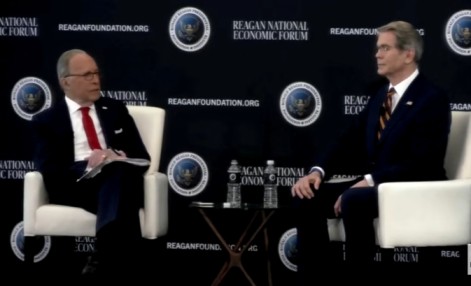
INTRODUCING SPEAKER: Ladies and gentlemen, please welcome to the stage the Honorable Lawrence Kudlow for our keynote conversation with the Honorable Scott Bessent.
LAWRENCE KUDLOW: Thank you, thank you everybody. Thank you, Mr. Secretary, for an excellent speech. I was just sitting there thinking, having worked for Reagan many, many years ago, peace through strength. Peace through strength.
SCOTT BESSENT: Peace through strength. It hasn’t changed.
LAWRENCE KUDLOW: It hasn’t changed between those two bookends. And it’s a terrific thing. Peace through strength. Trust but verify. And we’ll get to — I want to talk about the industrial economy because your points are very important. The America First trade policy. The economy is booming. But I must ask, as the world is waiting, I guess, for new information. The President is meeting with the Cabinet. I’m sure you’re plugged into this remotely. How do you read the situation? Are we close to a deal?
The last Truth Social I got said basically they’re looking at the issues, but the red lines have not changed with respect to denuclearization and no enrichment. And reopening the Strait of Hormuz and no money in the next 30 or 60 days. It’s a little sketchy, but the whole world is watching. The markets are positively reacting to it. So I thought I’d give you a chance to clarify the situation. Give us your thoughts.
Operation Economic Fury: Strangling Iran’s Financial System
SCOTT BESSENT: So the president was very clear in the cabinet meeting what he was looking for on the straits — free, free and open access. As we saw before February 27th and that Iran must give up their highly enriched uranium and cannot have a nuclear weapon.
And to be clear, I think one of the things that has gone unappreciated and unnoticed here is this is the first time the Iranians have been willing to discuss the nuclear subject. Before, we have the right to do this, we have — undisputed.
And so I think between 5.5, 6 weeks of an incredibly successful military campaign and then Operation Economic Fury, where we have really cut them off and they are at the end of their tether now financially. I think 40 or 50% of the troops aren’t getting paid, police aren’t reporting to the devastation. Inflation’s probably over 200%. They’re having to give out food vouchers. They have turned off the internet. So there was an information vacuum. And we’ll see.
The Iranians have engaged as they could. I would point out we did not change — we did not have regime change, but we changed the regime. The first-level leaders decapitated, the second level decapitated, so we’re dealing with the third level, and it’s very tough, because on one side we have a theocracy with the clerics, on the other side we have a thugocracy with the IRGC, and you’ve got to convince both sides.
LAWRENCE KUDLOW: I think kudos to you. You are probably the most significant, most powerful, most successful wartime Treasury Secretary certainly since World War II. You’ve closed them down. They are our enemies. In fact, Roger Zakheim reminds me, Reagan Institute did a poll. 80% of Americans, 80% of Americans believe Iran is enemy of the United States. Now, where are the other 20%?
SCOTT BESSENT: I don’t know who the other 20% are.
LAWRENCE KUDLOW: They’re all in New York and Connecticut. I’ll leave that aside. But what you have done with the economic fury, you basically turned their water off. Maybe you want to — how long can they go? They’re not meeting payrolls, they’re not meeting retirement, they’re not showing up for work. You closed down their offshore bank accounts, you’ve closed down their oil operations, you basically closed the whole place down. It’s kind of all over but the shouting, it seems to me.
SCOTT BESSENT: Well, Treasury, we’re doing the financial blockade, and the U.S. Navy — you want to talk about a group that hasn’t been this active since World War II, it’s the Navy. They’ve done an incredible job. And when I talked to General Cain and Secretary Hagset, they said these young people aren’t afraid. They want to fight. They signed — this is what they signed up for.
And some of the precision where they blockaded the Iranian ports with virtually, or perhaps zero, intrusions have been amazing. Karg Island, which is the Iranian oil export facility, is shut down.
LAWRENCE KUDLOW: You basically turned that off.
SCOTT BESSENT: The blockade did that. We think they have the lowest amount of oil on the water. Their only client is China.
And one thing I would point out is that the Iranians made a very big strategic mistake because everyone said, oh well, the Iranians attacked the GCC and the infrastructure and that really makes them vulnerable. That, on my side, on my duties, they made my job so much easier because before, many of our great GCC Gulf allies were a little less than transparent about their banking system. That, “oh no, we don’t have any Iranian oil,” and 2,200 shells and missiles and drones here, 500 or 600 there, all of a sudden it’s, “oh, here, have at it.” So we’ve frozen Iranian bank accounts.
LAWRENCE KUDLOW: After they started getting bombed by Iran.
SCOTT BESSENT: Yes, but it was a big strategic, big mistake, failure on the financial side. And we jumped right in. And they’ve been very good partners.
We — I believe that we have seized about $1 billion of their crypto and just outright seized it, just outright grabbed the wallets. Some of them may be typing in right now and realize — they might not realize that their wallet had been grabbed. And we are working with our allies all over Europe to grab villas and houses and properties. And this is money that’s stolen from the Iranian people.
LAWRENCE KUDLOW: But you’ve frozen the offshore accounts. I mean, people may not understand that the Revolutionary Guard, they own so many of the businesses. They’ve been stealing money from the Iranian people for decades and decades and decades. We think they were all living high off the hog, retirement accounts and condominiums, God knows where.
SCOTT BESSENT: We think they were stealing $400 or $500 million a month, right, divided between 80 leaders.
LAWRENCE KUDLOW: Now that can’t last. I mean, they’re in a heap of financial trouble, and that is your doing. That is your doing, sir.
SCOTT BESSENT: Well, it’s like Woody Allen said when he talked about the Mafia: “It’s a good margin when you consider they don’t pay for paper clips.”
The Booming Industrial Economy and the One Big Beautiful Bill
LAWRENCE KUDLOW: Okay, I got it. All right, well, anyway, congratulations on all that. Second point I wanted to raise, and you talked at some length about it in your prepared remarks, that the economy, the industrial economy, is booming despite gasoline prices and energy prices and the temporary effects of the war.
Just some numbers. I mean, with $4.50 gasoline, which I might add is coming down, you’re still growing. I mean, nearly 3% consumer growth from the latest numbers year on year. But the most extraordinary thing, and I think this is to your point about the trade reciprocity and the America First and being prepared, non-defense capital goods, business investment is growing over the past 3 months alone at nearly 19% at an annual rate. We haven’t seen numbers like that. 10.5% year on year. That’s quite remarkable. Shipments growing at 12.5%. Profits rising 17%, productivity almost 3%, unit labor costs, which is the most basic, in a sense, inflation measure for the entire economy, unit labor costs last 4 quarters, 1.2%.
That’s why I can’t get too excited about a temporary gasoline bump. I mean, in effect, the trade deficit is narrowing. These one big beautiful bill and other policies have been succeeding.
SCOTT BESSENT: It’s been fantastic. And much of it is what you all did in Trump 1.0 Tax Cuts and Jobs Act. But through — I see Jason Smith here, that he was working a year in advance to get the one big beautiful bill that did not spring up. I see French Hill, Jodi Arrington. They were all incredible in getting this across the line.
I remember I went to Mike Johnson, I said, “Mike, when do you think you can get this out of the House?” And he said, “I think I can.” I said, “And as one bill.” And Larry, I want to give a shout out to you because Dr. Kudlow here said you must have it as one bill. You cannot bifurcate this because if people start picking and choosing, then it’s the end. So Larry insisted on one bill.
Then Mike, Speaker Johnson, if we want one bill, how do we do it? Or when can we do it? And he said, “I think I could have this out by Memorial Day.” I said, “Hold please.” I called up Newt Gingrich and I said, “Could this ever happen?” And he said, “It’s ambitious.” Okay, Mike, let’s do it.
And then as soon as he did that, they called Leader Thune and said, “Speaker Johnson says it’s going to come out of the House by Memorial Day. You think we could have a July 4th signing?” Okay. And everybody got it done.
But I think it just speaks to the power of what we’ve done. We’re never going to have to talk about a tax cut again because these are permanent. And I just think the power of permanence and certainty and knowing that you’re going to be able to — like this full expensing just levels us up against so many other countries.
LAWRENCE KUDLOW: You know, business is not a dirty word. Profit’s not a dirty word. The reason that consumers have the income to spend at their kitchen tables even with this temporary gasoline bump, is the success of these policies. And I think the permanence — we’ve never seen investment rates like this, probably not since the Reagan recovery from the Carter recession 40-some-odd years ago.
So supply-side economics is working and the America First policies are working. So kudos to you for your implementation. Kudos to the president for sticking with it. Kudos to Jason and whoever else is here. I didn’t know you were here. Good to see you. No change in policy. The war will end. We will go back to normalcy on energy.
Inflation, Real Wages, and the Common Man Index
SCOTT BESSENT: Look, the war will end. We’ll get to the other side of this. The economy has been very resilient through all this. Look, for many families, it’s not nothing. But it’s been less than $200 in extra gasoline cost.
And all the Democrats want to talk about now is beef and gasoline. I’ve got a sheet that has the 12 supermarket items. Last year was eggs, eggs, eggs. And eggs are down 90% now. Beef is highly idiosyncratic now because of the cattle disease down in Mexico and the dynamics of the herd. But chicken’s down, many, many vegetables are down. So groceries are actually down.
And I can tell you, the one thing we’re not going to do is what the Biden administration did, where they came out and said, “It’s a vibe session. The American people don’t know how they’re feeling.” That was 21.5% stated CPI inflation. Real wages grew about 17%. So big loss in purchasing power.
But our friend Jason Trenert has something. I think it’s called the Everyman Index — the Common Man Index. And that was up 35 or 38%. So that was a 15%, 16% decline in real purchasing power, and Americans felt that. And the price levels have gotten elevated. It’s tough to bring the price level down, but what we can do is generate real wage growth, which I think we’re going to get back to as soon as we’re on the other side of this Iran conflict.
The $250 Bill and President Trump’s Image on Currency
LAWRENCE KUDLOW: So you were mentioning in your talk, we are here at this conference celebrating the 250th birthday of America and looking ahead for the next couple of hundred years. I can’t help but ask you, are we really going to have a $250 bill with Donald Trump’s picture on it? The whole world is waiting.
SCOTT BESSENT: So for the 150th, there was a Calvin Coolidge coin with his image on it. We are going to have the image of President Trump on a coin, and there is a proposed legislation in the House to put President Trump on the $250 bill.
As Treasury Secretary, I am only mandated to do two things with the design of the currency at present. It has to be someone who is not living, and it must say “In God We Trust.” I can do whatever else I want.
And I think that if you were the president, just like Calvin Coolidge was for the 150th, if you’re the president for the 250th, President Trump should be on there.
And for any of you who want to geek out in monetary theory, there’s something called seigniorage. So we print — Treasury prints currency, the Fed distributes it, and we have about $2.5, $2.6 trillion outstanding, and that’s a free loan. So we put currency out there and we don’t have to pay any interest on it. So with seigniorage, I think that you get the $250 bill, I think a lot of people are just going to put those away and hold them. I’m sure it’ll be — it’s a good free loan.
LAWRENCE KUDLOW: I’m sure the demand for it will be huge. The other side, I mean, we’ve got a lot of optimism, I think, at this conference, and I know I’m very optimistic. And the theme of going from Reagan through Trump and having you here to speak to the Trump economic policy is very, very important.
The other thing I wanted to mention briefly before I get to the Fed and our new chairman is the Trump savings accounts, which I think really is a game changer. That is a major, major piece of legislation.
Trump Accounts and Financial Literacy
SCOTT BESSENT: I think that this is the most important government benefit for young people since the GI Bill. And 38% of Americans have no exposure to our great equity market. They don’t participate in the innovation, the dynamic US economy, great management— many, many of the managements who I see here today. And for them, it is just a foreign concept.
So with the Trump accounts, any child born during President Trump’s term, they get a $1,000 seed investment from Treasury for these, and they’re going to go into low-cost index funds, and they will be able to see every day on their phone what the account’s doing. Folks with children under 18, families with children under 18 can open a Trump account and they can put up to $5,000 in there that’ll compound tax-free until age 18. At age 18, they can roll it into a traditional retirement plan or take it out to start a business, for education, down payment on a home.
And the other thing we’re seeing with these Trump accounts is that we are seeing some of our great philanthropists, Michael and Susan Dell, $6.25 billion to American children. As President Trump said, when Michael made the announcement, he said, “Michael, $250 million is a lot. $6.25.” So, and that is for young people who are from the bottom 80% of the economic zip codes. So it’s going to be about $250 for 80% of the American children. Own a piece of the rock.
LAWRENCE KUDLOW: They never thought possible. They might even learn a little bit about capitalism and business along the way.
SCOTT BESSENT: Well, I think we’re creating a whole new class of shareholders. And in nutrition, there’s this idea of a food desert. You don’t have access to good food. I’ve done a lot of work on financial literacy. I push for it. And I think that there was the idea of a financial desert that, if people don’t have exposure, many of them, they can’t open a Charles Schwab account or an E-Trade or any of the other— Robinhood or any of the others. So this is going to give them an account rather than giving a toy for someone’s birthday. You cut the price of the toy in half and give the toy and then put $20 into that account so you can constantly top it up.
LAWRENCE KUDLOW: It’s worth a lot more than a welfare check. It’s worth a lot more.
SCOTT BESSENT: But anyway, you look at it, Treasury went up yesterday, of course, encourage all of you to go to trumpaccounts.gov. We have 5— maybe we might be up to 6 learning modules because these are families who have never participated. Many of them have never participated in the stock market before.
Look, I was a kid from South Carolina, a small town, and I was growing up. I just knew something bad happened on Wall Street in 1929. Like, that’s what I knew about Wall Street. And now I think they’re going to be able to see it on their phone. They’ll sit around the dining room table, their families will add to it. Many states are going to top these up. So we’ve got 20 states so far that I think are going to add to these.
And I do think it is a new kind of philanthropy because now we have all these foundations. A lot of them do good work. But there’s a lot of bureaucracy. They have buildings, they have boards, they have dinners. If you want to give directly to the children of America, just give to the Trump accounts.
Breakfast with the New Fed Chairman
LAWRENCE KUDLOW: So you just had breakfast with our new Fed chairman, Kevin Warsh. How was that?
SCOTT BESSENT: It was great. President Reagan would say it was a new day at the Fed. So we know we now have the worst— the Treasury Secretary and the Fed chair have lunch or breakfast every week. It’s a home game and an away game. So I did the away game at the Fed. Their food’s much better because they don’t have a budget. They print their own money. Apparently not. One hears, but it was good.
Look, it’s the renewal and change is good. And I think we are going to see a new sheriff in town. I think we are. I’m not going to get out ahead of the chairman, but he said he’s going to get rid of forward guidance. So I think I would expect to approve of that 100%, 100%.
And I also think we’re going to get back to basics in terms of accountability, credibility, and what’s the purpose of the Fed? Because, Larry, your career is longer than mine, but for a long time the Fed just ran in the background. It wasn’t, “Oh, it’s Fed Day, it’s the Fed meeting, cover the press conference,” all-day event, all these governors out giving speeches and kind of popping off. And I think we are going to see much more focus, much more— a lot more credibility. And at the end of the day, financial markets, it’s all about credibility.
LAWRENCE KUDLOW: I noticed the president said right at the beginning, as soon as Kevin was confirmed, that he’s on his own. There’s really no pressure to move interest rates in one way or another, that you just have to trust he’s going to trust his Fed chairman, and I just wanted to be sure that the Treasury Secretary echoed those views.
SCOTT BESSENT: 100%. The president made the decision. I ran the process. The president made the decision. I never put my— the thumb on the scale for Kevin Warsh, who I’d known for 20 years. I think he’s an incredible choice, and the president got there for all the right reasons. And the president understands that the more credible you are, the more work the financial markets will do for you.
LAWRENCE KUDLOW: So no pressure at the moment.
SCOTT BESSENT: Look, again, a lot of the publications wanted to be alarmist. And to the extent I had any success in my 35-year Wall Street career, I was usually doing the opposite of what was on the front page. And when I saw over the past couple of weeks, “What a terrible time to start up as the Fed chair”— no, it’s a great time. It’s a great time.
Interest rates have spiked. Inflation has spiked. The tough thing would have been to have come in in February when the market was pricing in 2 or 3 rate cuts for the year, inflation looked like we were going to come back down to target, growth was high. Much better to come in now. And look, you all can be the judge. I’m not saying whether it’s the causation or the correlation, but rates peaked the day before Chair Warsh was sworn in.
The Dollar as Reserve Currency
LAWRENCE KUDLOW: And also tell me if this is— I think I’m noticing during this Iranian war episode, with all of the good things that are going on, the dollar is actually improving, and if I’m not mistaken, you yourself have been a strong advocate of maintaining the dollar as a reserve currency. And I know in the first term when I served, the president was always a strong advocate to maintain the dollar as a reserve currency. Has any of that changed?
SCOTT BESSENT: No, nothing’s changed. And again, I was in the currency market for 35 years, and I think people have the wrong notion of what a strong dollar means. Strong dollar isn’t the price on the screen every second, every minute, every day, every week. What a strong dollar means is that we are doing the right things to set our economy on a good course, that people will want to hold dollars, that they feel safe and secure, and that their money will get back to them, that they will have high real returns.
And I think we’ve done that, whether it’s through trade policy, tax policy, or energy policy. The United States— President Trump, with his policies, has made the United States the best place, whether you want to be in the liquid markets or to come build your factory. You will have great certainty on energy. And you will have great certainty on our workforce.
Iran: Sanctions, Blockade, and Military Options
LAWRENCE KUDLOW: So we appreciate all these remarks. The time is short. I’ve got a TV show to do. You’re going to speak with my colleague and dear friend Maria in a little while. I don’t think the president has made a decision. I was just looking on my phone. I could be wrong, but I don’t think a decision has come out. I just wanted to ask you, there’s in all likelihood no ruling out of further military operations, combat operations, kinetic operations, if the Iranians continue to misbehave. There’s no ruling of that out, is there?
SCOTT BESSENT: Everything we have done since the ceasefire began has been defensive. And Admiral Cooper, General Cain, Secretary Hagset have been very clear about that. And again, what’s important to realize here is just as in our government we have hawks, doves, in between, they have people who want to keep up a quixotic fight. And then they have people who want to settle. So they are also hashing it out.
But there are 3 scenarios. We have the deal. We don’t have the deal, but we just maintain the blockade and we keep squeezing them. And I think every day that goes by, much worse for them. Or we go back to kinetic action and President Trump— you know it, Larry, I know it— he likes to create the most leverage for himself.
LAWRENCE KUDLOW: You’re going to keep the blockade, the financial and economic embargo going?
SCOTT BESSENT: We’ll see. Anything that’s taken off has taken off slowly. And there’ll be milestones that the Iranian regime would have to meet. And I can tell you, we put more sanctions on yesterday. We sanctioned their two airlines. We’ve got some other financial targets. There’s a lot more that we can do if we have to. And there are some things that we can take off to help the Iranian people.
LAWRENCE KUDLOW: Secretary Scott Bessent, good friend. My friend, thank you for your service. Thank you for your good works for America. We appreciate it very much.
SCOTT BESSENT: Well, thank you, Larry.
Related Posts